




Abstract
The objective of this study is to determine the social and emotional factors that influence the Intention to Use Instagram Stories. The proposed model takes as different studies on the acceptance of information technologies a reference to assess a survey applied to 369 people by structural equation modeling. The results of the analysis show that the Cognitive, Affective and Evaluative Social Identity variables did not have a significant relationship with Intention to Use. Conversely, Social Presence and Perceived Enjoyment exhibit significant relationships in the proposed model.
Keywords
Introduction
Information technologies, particularly the Internet and everything that its use entails, have substantially changed the way people communicate and report events (Nedra et al., 2019), significantly widening its scope, as demonstrated by the estimated 3 billion active users online on the various available platforms (García, 1997). Social media has become an indispensable part of daily life, a means for creating assertive communication between brands and consumers and a growing component of advertising budgets. Companies, in all industries, are beginning to understand the possibilities offered by social media and have changed their focus to how brands engage with and reach out to their customers (Bainotti et al., 2021).
In this context, and given its relevance, a social network is defined as a digital platform capable of connecting people and organizations (Garton et al., 2006). LinkedIn, Instagram, Facebook, Twitter, and several types of blogs are examples of digital platforms that have different features to facilitate communication, not only through text, but also through multiple audiovisual features (Nedra et al., 2019). Currently, Facebook, YouTube and WhatsApp are the leading social networks and have the largest number of users, each one with over 1 billion users. Instagram is fourth with 800 million users, and has experienced the highest growth in recent years (Fernández et al., 2020).
Instagram, like the vast majority of social networks, is based on sharing life experiences with other users through text, images, emojis, and videos, which is done quickly and efficiently (Instagram, 2016). One of its features is ephemeral messaging through the popular function called Stories, which consists of posts that remain visible for a limited period of time and then disappear (Coa & Setiawan, 2017); this period is 24 hr in the case of Instagram (Belanche et al., 2019).
Like Instagram, the use of Stories is growing rapidly, with around 500 million accounts employing this feature daily. This has led several companies to focus their attention on Stories to generate advertising for products and services, as well as reaching their current and potential clients (Arya & Kerti, 2020). Therefore, 36% of businesses use Instagram stories to promote their products or services, with an average number of 2.3 Instagram Stories updates per week (Bainotti et al., 2021). Consequently, Instagram Stories can be considered a modality that merges brand-generated content and entertainment (Bainotti et al., 2021).
This study aims to analyze the factors influencing the Intention to Use Instagram Stories, as well as the theoretical and practical implications that can serve as a tool in decision-making. A first approach to the factors influencing the intention to use a technology is the TAM model (Davis, 1989), from which several in-depth studies have originated. Some external variables can be related to the TAM model. These variables have been assessed separately in different studies, but in this study, they are analyzed collectively.
Different variables, such as Perceived Ease of Use, Perceived Usefulness, Attitude toward Use, Perceived Enjoyment and Social Presence have been researched, as they are directly or indirectly related to the Intention to Use a social network (Coa & Setiawan, 2017). Additionally, Cognitive Social Identity, Emotional Social Identity, and Evaluative Social Identity have a close relationship with Intention to Use (Nedra et al., 2019).
Thus, based on an extensive research review of the factors that influence the Intention to Use social networks, we propose a model based on structural equations modeling (SEM) to assess the significance and strength of relationships, as well as the adjustment indicators, drawing conclusions from the results obtained.
Theorical Background
Currently, the business world increasingly uses Instagram as a tool for brand management, consumer services and social commerce (Jin & Ryu, 2020). Hence the relevance of constantly studying Internet user behavior and its evolution (Kihl et al., 2010).
The increase in the use of mobile technology, as well as the format and the growing culture of capturing every moment through the Stories tool, has sparked the interest of many researchers in studying the psychological dependence that this social network can generate, as well as how difficult it is to stop using it (Papacharissi & Mendelson, 2011).
Eight factors were found that motivate the use of the Instagram Stories platform, namely exploration, self-improvement, perceived functionality, entertainment, social exchange, relationship building, novelty and surveillance (Lu & Lin, 2022).
Exploration indicates that current trends, learning new things, following influential people, and receiving exclusive content in real time, among other reasons, motivate users to utilize Instagram Stories. Regarding self-improvement, users could obtain gratification related with popularity (Sheldon & Bryant, 2016), self-expression (E. Lee et al., 2015) and the need for recognition (S. Kim, 2016).
With respect to perceived functionality, it is related to the perception that the stories on Instagram are convenient, real, functional and casual (Lu & Lin, 2022). As for entertainment, people use Instagram Stories for fun, enjoyment and spending time. Experiences are expected to be more entertaining than the typical still pictures; the aim is to add dynamism to the use of the tool (Lorenz, 2019).
Social exchange, in turn, is reflected in the capacity of users to share interesting personal information, documenting their experiences on the platform. Additionally, Instagram has a wide range of interactive functions that allow users to build relationships through connections and conversations with other people. Novelty is another gratification present in Instagram Stories, new and private content that disappears in 24 hr makes users especially interested in engaging with the platform. Finally, surveillance reveals that users tend to differentiate between social interactions with family and friends, and with other people when using Instagram Stories (Lu & Lin, 2022).
The gratifications described above are directly related with consumption, as these can define the participation of users in Instagram Stories. Gratifications related to entertainment, exploration and perceived functionality are related with a higher probability of consuming content from Instagram Stories. According to Shao’s (2009) theory, entertainment is a key factor for the intention to consume the content offered by Instagram Stories. The mood of content consumers can be altered with the use of the platform, which also reduces loneliness levels (Bryant & Davies, 2006; Shao, 2009; Yang, 2016). It is likely that users consume content to observe how their social environment relates with the brand, preserve the knowledge and experience of others, obtain new ideas and receive information in real time (Muntinga et al., 2011).
Several theoretical models have been researched to determine the factors explaining the intention to use this type of platforms (Nedra et al., 2019). The Technology Acceptance Model (TAM) (Davis, 1989) has been employed in numerous studies to measure the acceptance of novel technologies in several fields, including the acceptance of mobile purchase apps (Yahia et al., 2018), e-mail use (Gefen & Straub, 1997), e-commerce (Pavlou, 2002), social network use (Rauniar et al., 2014) and e-purchases (Ha & Stoel, 2009; Natarajan et al., 2017).
From the TAM model perspective, behavioral intention is seen as a key mediator of the relationship between behavior and other factors such as attitude, subjective norms, and perceived behavior control (Ajzen, 1991; Ajzen & Fishbein, 1980; Bailey et al., 2018; Demoulin & Djelassi, 2016; Oni et al., 2017; Venkatesh & Bala, 2008). Many studies have concluded that behavior intentions positively affect user behavior toward technology (Amin et al., 2007; Hung et al., 2010; Mwiya et al., 2017; Nysveen et al., 2005; Tung, 2004). This behavior is manifested through uploading content/images, exchanging information and interacting with people, among others (Bailey et al., 2018).
In the world of online shopping, the usefulness that users perceive when performing this action is directly related to the intention to make an online purchase, since users not only perceive the use of the Internet in a positive way, but also see it as an economic advantage and a form of business (Nedra et al., 2019). Users perceive an application, technology, or social network as useful, if they consider that it improves their performance at work (Tunc et al., 2015). The greater the Perceived Usefulness felt by an individual, the greater their intention to use a technology (Fernández et al., 2007). Based on the above, the following hypothesis is proposed:
Now, it is said that the attitude people exhibit when using a new technology is directly related to their degree of interest (Harryanto et al., 2018). Along the same lines, in collectivist cultures, a positive attitude towards the use of a social network contributes to the Intention to Use it, especially in the context of online shopping (Nedra et al., 2019). Attitude towards Use is defined as the degree to which an individual positively or negatively evaluates the use of a particular technology (Davis, 1989). Finally, Attitude Towards Use directly influences Intention to Use (Kanchanatanee et al., 2014). Therefore, the following hypothesis is proposed:
When joining a social network, people believe that they can obtain an economic benefit when making an online purchase through the platform. Therefore, Perceived Usefulness can be linked to Attitude toward Use. Benefits when browsing a social network could have positive effects on user behavior (Nedra et al., 2019). The variables of Perceived Usefulness and Attitude toward Use are closely related in the context of online commerce, especially when users sell their products or services through mobile applications (Indarsin & Ali, 2017).
Regarding online classes, Perceived Usefulness is an important factor that affects student satisfaction with Google Classroom (Ansong-Gyimah, 2020).
Additionally, the attitude of a consumer positively impacts the love for a brand, which implies that attitude can influence behavior (Sreen et al., 2021). That said, the following hypothesis is postulated:
The ease or difficulty associated with the use of a technology is another important aspect to consider. One of the obstacles in the adoption of a technology lies in its complexity or the discomfort that it can generate in the user (Nedra et al., 2019). There is a positive relationship between Perceived Ease of Use and Attitude toward Use. Furthermore, although this influence highly varies depending on the case study, for an e-commerce mobile application, the relationship is significant (Indarsin & Ali, 2017). Therefore, the acceptance of a technology will depend on its Ease of Use, since if there is any difficulty, the user could present an unfavorable attitude (Davis, 1989). In this context, the activities that individuals perform daily require some degree of effort, and use of a technology is not unaffected by this reality. Therefore, the definition of Perceived Ease of Use (PEOU) is related to the beliefs of users in that the system they are using is to some degree effortless (Radner & Rothschild, 1975). Thus, the following hypothesis is defined:
Both the Perceived Ease of Use and Perceived Usefulness in the use of social networks are key factors in the study of their Intention to Use (Elkaseh et al., 2016). In a work environment or one that requires a certain degree of activity, if individuals perceive the use of a technological tool as easy, then they will be able to dedicate more time to other activities that they carry out daily, increasing their productivity (Fernández et al., 2007).
As for the use of government mobile applications in China, the Ease of Use these applications will influence both the adoption and the usefulness perceived by users (Mensah, 2020). Based on the above, the following hypothesis is defined:
In the context of social networks, Social Presence has also been studied. This variable is defined as a psychological effect produced by user-technology interaction that allows people to feel closer to the people on the other side of the screen, with human warmth as an important characteristic of this proximity (Coa & Setiawan, 2017). In this sense, all the characteristics of social networks help users feel human warmth, that is to say, emojis, text formats, videos and images promote social presence as they improve communication and socialization between users. Given the communicational richness of a social network and its diverse ways of sharing digital content, Social Presence is a fundamental variable when analyzing the acceptance of an information technology (Coa & Setiawan, 2017). In this line, Social Presence can be linked to Perceived Usefulness, since a social network has many benefits in the quality of communication, not only in an emotional domain, but also in a professional and provider-client relationships (Hassanein & Head, 2007). Social Presence is directly related to Perceived Usefulness in an online context (Hassanein & Head, 2005). Thus, the following hypothesis is defined:
Perceived Enjoyment is related to the degree of fun and entertainment that an experience can bring us; therefore, it has a psychological and subjective effect on users when they face a technology. Presenting high enjoyment does not necessarily imply high productivity but is a key factor in the adoption of a social network. Since social networks are systems oriented toward hedonism (pleasure), high enjoyment consequently plays an important role in its acceptance (Coa & Setiawan, 2017).
Currently, a social network should be considered from different perspectives, such as utility, hedonism, and ease of use, among others. Social networks are systems that can be used both inside and outside the professional environment, mainly in leisure activities, through which users can achieve high levels of fun. Consequently, Perceived Enjoyment is one of the most important factors in the analysis of the acceptance of a social network (B. Kim, 2011; Leng et al., 2011; Zhou et al., 2010).
The effect that Social Presence has on enjoyment is key. In fact, there is little research on this variable since it is taken for granted. In a study about entertainment based on virtual reality, users exhibited a higher level of fun the greater the Social Presence (Hassanein & Head, 2007). Furthermore, both telepresence and Social Presence significantly influence Perceived Enjoyment in media such as television, websites and mobile devices (H. G. Lee et al., 2013). Based on the above, the following hypothesis is defined:
It is universally recognized that social media provides people with a platform to have fun in several ways, for example, searching for other people who share the same hobby, keeping track of updates on interesting topics, communicating with friends offline, and updating personal profiles. People can creatively leverage applications and functional features for their many social demands (Wu, 2015). Compared to other constructions, in the classic Technology Acceptance Model, Perceived Enjoyment was crucial in the adoption of an information system in the context of social networks (Leng et al., 2011).
Facebook, a hedonic social network, is governed by Perceived Enjoyment, which strongly influences the attitude of users (Thomas & Praveena, 2014). Thus, Perceived Enjoyment is related to Intention to Use through Attitude toward Use (Coa & Setiawan, 2017). Based on the above, the following hypothesis is defined:
Subjective norms, group norms and social identity are related to the intention to use a technology. Precisely, Social Identity plays a relevant role in this aspect, as it defines how users identify themselves with a group of contacts, or belong to an online community, even to a brand-based community. Social Identity is studied through three components: Cognitive Social Identity, Affective Social Identity and Evaluative Social Identity, each of which is analyzed separately (Nedra et al., 2019).
Each of the three parts that compose Social Identity are directly related to Intention to Use. The concept of community derives from being able to interact with other users in a social network, which creates a sense of belonging to a community. Therefore, a high identification and sense of belonging in relation to the group is expected to result in a greater intention to use the social network (Cheung & Lee, 2010).
The first part of Social Identity is Cognitive Social Identity, which represents the alignment of the user’s thoughts, values, and beliefs with those of the group or community to which they belong (Nedra et al., 2019). People see the groups or communities as prototypes. Therefore, they assess the similarity of the thoughts and values of each group as well as the differences among different groups to choose which community to belong to, which would be the one that best suits and presents more similarities with their personal cognition (Hogg Ma. McKeown et al., 2016). During the assessment of the cognitive characteristics of a group, if individuals see themselves reflected—that is, their own beliefs, thoughts and values—they are thinking prototypically and therefore that is the ideal group they want to belong to. As a consequence, they will adapt to the norms of such a group. Cognitive social identity is also defined from the perspective of emotional attachment, and also as the extent to which that individuals become emotionally involved with the community to which they belong (Hogg Ma. McKeown et al., 2016). Thus, the following hypothesis is defined:
The second part of Social Identity is Affective Social Identity, which is related to the emotional participation, the sense of attachment, belonging and even the loyalty of users to a group or brand community. Some studies have determined the effects of Affective Social Identity on the use of social networks, mainly in relation to brands, with membership being a fundamental factor to analyze since it generates more loyalty and greater brand awareness. Consequently, Affective Social Identity will increase the loyalty of an individual to a brand in the context of social network use (Nedra et al., 2019). Affective Social Identity is defined, from the emotional attachment perspective, as a way of becoming emotionally involved with the community of belonging (Cheung & Lee, 2010). Based on the above, the following hypothesis is defined:
The third and final part of Social Identity is Evaluative Social Identity, which is dealt with from a self-esteem perspective, specifically regarding the value of the user to the group (Nedra et al., 2019). The Evaluative Social Identity is based on the importance that individuals have in their community, but from a personal point of view, that is, the same user is the one who evaluates its importance in the group, which is the reason for this variable to be considered a self-esteem factor (Cheung & Lee, 2010). Some studies mention that Evaluative Social Identity has a direct effect on the intention to use a technology, or to belong to a brand community (Nedra et al., 2019). Based on the above, the following hypothesis is defined:
These 11 study hypotheses represent the relationships of the nine latent variables of the proposed model, which were obtained through an extensive literature review.
Methodology
The analysis conducted in this study comprises an exploratory phase and a conclusive phase. In the former, an extensive bibliographic review is conducted based on the information technology acceptance models that are currently known, applied to the use of social networks such as Facebook, Instagram, and Snapchat, in order to identify the factors that influence the Intention to Use of each one of them.
Based on the factors identified and the hypotheses derived from the Literature Review section, the model in Figure 1 is proposed, which contains the variables of the TAM Model, and Perceived Enjoyment (PE), Social Presence (SP) and Cognitive, Affective, and Evaluative Social Identity as external variables.

Proposed model (Created by the authors).
The proposed model considers nine latent variables, which are measured through a survey that consists of 23 observable variables, as shown in Table 1. Each observable variable is an assertion measured through a 5-point Likert scale, where (1) equals to “strongly disagree,” and (5) to “strongly agree.”
Survey Applied.
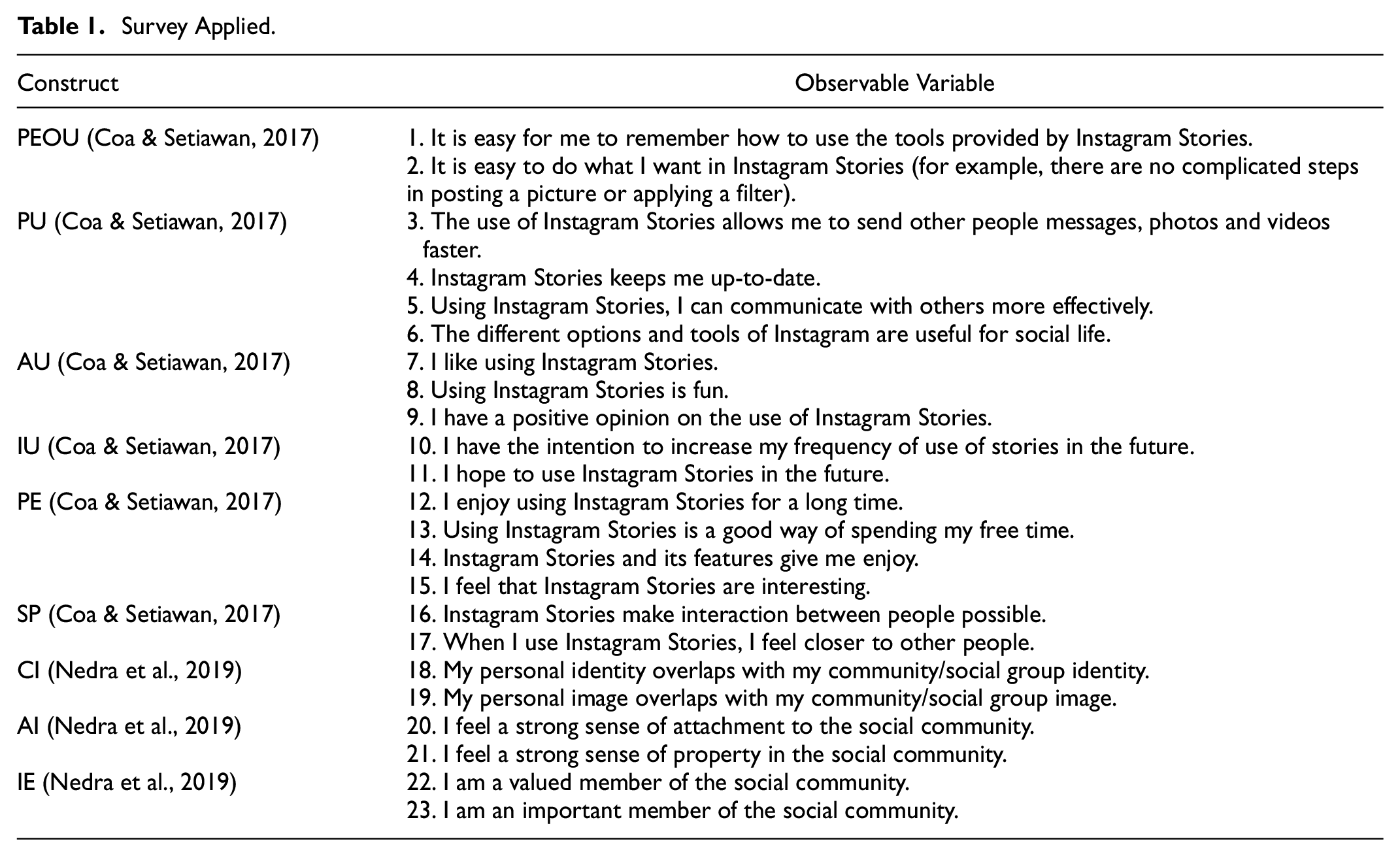
The survey was uploaded to SurveyMonkey and shared via social media, particularly via Instagram Stories. It was answered by 369 people, of which 55% were woman and 45% men. Regarding the predominant age ranges, 57.7% of those surveyed are in the [21–25] age range, followed by 20.6% in the [26–31] age range and 16.8% in the [18–20] range years. Furthermore, 54.2% of participants were studying a university degree, while 24.9% had already completed this stage. In the same line, 96% were single, which may imply that the profile of the sample consists mostly of university students and recently graduated students, mainly from the fifth region and Metropolitan region of Chile (Santiago).
Finally, the data obtained when applying the survey were analyzed through Structural Equation Modeling (SEM) using the SPSS AMOS software.
Results
Construct Reliability
Cronbach’s alpha was used to analyze the reliability of the constructs.
The limit value of this indicator is 0.6 (Loewenthal, 1996), because the constructs have less than 10 items. Additionally, all the constructs of the model have a Cronbach’s alpha above .6, as shown in Table 2.
Cronbach’s Alpha.

Model Adjustment
First, the absolute adjustment of the model is conducted, for which four indicators are analyzed: Cmin/DF, Probability level Cmin, GFI and RMSEA.
Cmin/DF: The model adjustment is reasonable for values less than 4 (S. Talwar et al., 2020). The value obtained in this case is 3.691 and therefore the adjustment is good according to this criterion.
Probability level Cmin: The p-value of Cmin(chi-square) should be lower than .05 in order to not reject a null hypothesis, that is, the model predicts the matrix of observed covariances. In this case, the value is 0.000 and consequently, the model meets the criterion.
GFI: The adjustment is good for values close to 1 (Byrne, 2013), ideally greater than 0.9 (S. Talwar et al., 2020). In this model, the value is 0.830, and so the adjustment is good according to this indicator.
RMSEA: Recommended values for this index are less than 0.08 (S. Talwar et al., 2020). The value obtained for this model is 0.086, very close to the criterion.
After analyzing these four indicators, it may be concluded that the model proposed exhibits a good absolute fit, that is, it can accurately predict the variance and observed covariance matrix.
Subsequently, the incremental fit of the model is analyzed through the NFI and CFI indicators, which represent the ratio of model improvement proposed after comparing it to a null model (with no correlated variables). The values of these indexes close to one represent a good incremental fit. In the case of the model proposed, the value of NFI is 0.801 and of CFI is 0.845; therefore, there is a good incremental fit (Byrne, 2013).
Finally, the parsimony fit of the model is analyzed through the PNFI index, which has the objective of establishing whether model fit has been achieved due to an over-adjustment of data when having too many coefficients. Parsimony is defined as the achievement of higher fit levels by degree of freedom used (a degree of freedom per estimated parameter), and therefore the highest parsimony possible is sought. According to recommendations, this index should be above 0.5 (Byrne, 2013). In the case of the model proposed, the PNFI value is 0.693; thus, there is a good parsimony fit. The above can be seen in Table 3.
Model Adjustment.

Validation of Hypothesis and Standardized Regression Coefficients
First, 219 degrees of freedom are obtained, which are shown in Table 4, indicating that the model is over estimated (above zero). Therefore, the model may be generalized.
Degrees of Freedom SEM Model.

Table 5 presents the standardized regression estimators and the significance of each relationship between latent variables.
Standardized Regression Estimators, and Significance of Each Relationship Between Latent Variables.

p < .000
When analyzing the p-value of each relationship, six relationships are significant, taking .05 as the limit value.
The relationship between the variables Social Presence with both Perceived Usefulness and Perceived Enjoyment is significant since its p-value is below .05, that is, H6 and H7 are accepted.
Regarding Perceived Enjoyment, this is significantly related to Attitude toward Use, as its p-value is below .05; therefore, H8 is also accepted.
The variable Perceived Ease of Use has a significant relationship with Attitude toward Use and Perceived Usefulness, as its p-value is below .05, which means that H4 and H5 are accepted.
The relationship between Attitude toward Use and Intention to Use is significant, with a p-value lower than .05; consequently, H2 is accepted.
Regarding Perceived Usefulness, its relationship with Intention to use is significant, since the p-value is lower than .05, which means that H1 is accepted. Additionally, its relationship with Attitude toward Use is not significant, since it has a p-value of .087, which is above .05; therefore, H3 is rejected.
Finally, the variables of Social Identity resulted non-significant in their relationship with Intention to Use, as the p-values of Cognitive Social Identity, Affective Social Identity and Evaluative Social Identity are .300, .125, and .374, all above .05; therefore, H9, H10 and H11 are rejected. It can be shown in Figure 2.

Model in SPSS Amos (Created by authors).
Table 6 shows the R2 of the latent endogenous variables of the model.
R 2 of Endogenous Latent Variables.

The R2 of Intention to Use is 0.474, that is, the predictors (endogenous latent variables) are estimated to explain 47.4% of Intention to Use. In this case the predictive variables are Perceived Usefulness, and Attitude toward Use, which were non-significant.
As for the other endogenous latent variables in relation to Perceived Enjoyment and Perceived Usefulness, predictive variables explain 54.9% and 85.8% of their variance, respectively. Finally, regarding Attitude toward Use, the predictor variables explain 68.2% of their variance.
Finally, since the inter-construct correlations are less than 0.8, it follows that there is no multicollinearity (M. Talwar et al., 2020).
Discussion and Conclusion
Theorical Contribution
Social Identity: Social Identity does not influence the Intention to Use Instagram Stories for the sample analyzed. Three types of Social Identity, namely cognitive (H9), affective (H10) and evaluative (H11) were studied, but none of them have a significant influence on Intention to Use, that is, the identification of a user with a group or brand is not related to Intention to Use.
From a cognitive point of view, sharing thoughts, opinions, feelings, clothing styles, etc., with a group or brand on Instagram does not affect Intention to Use. In terms of affective social identity, having a bond or adherence to a community, group, or brand in the context of Instagram or Instagram Stories does not affect Intention to Use either. Finally, regarding the evaluative di- mention, feeling like an important member within a group, community or brand does not relate to the intention to use Instagram Stories.
Social Presence: Social Presence is a highly influential variable in the model analyzed, as it is strongly related to both Perceived Enjoyment (H7) and Perceived Usefulness (H6).
Regarding its relationship with Perceived Enjoyment, it presents a standardized regression coefficient of 0.741, which indicates a strong relationship. Since most contacts of users on Instagram are family, friends and acquaintances, feeling these people closer through Instagram Stories results in increased enjoyment of this function, that is, users perceive more fun and entertainment when they are able to interact with people they know and know about their everyday life.
Additionally, Social Presence is the variable that influences Perceived Usefulness the most, with a standardized regression coefficient of 0.888. This is explained from the perspective of communication, that is, Instagram Stories provides us with an effective way of communicating with family and friends. In other words, the utility of Instagram Stories is perceived when users can communicate in a way different to the traditional means with people who are physically far from them.
Perceived Enjoyment: Perceived Enjoyment is the variable that influences Attitude toward Use (H8) the most, with a standardized regression coefficient of 0.665. This entails that having fun, enjoying the environment and versatility of Instagram Stories creates positive feelings for the application in the user.
Perceived Ease of Use: Perceived Ease of Use is an exogenous latent variable that influences Perceived Usefulness (H5) and Attitude toward Use (H4), in both cases slightly.
As for the influence of Perceived Ease of Use on Perceived Usefulness, this is low, with a standardized regression coefficient of 0.264. This implies that if an application is easy to use, the user would not waste time learning how to use it, and instead could spend it on other tasks such as work. Consequently, the ease of use of the application makes users perceive it as useful.
Additionally, the influence of Perceived Ease of Use on Attitude toward Use is also low, with a standardized regression coefficient of 0.260. This means that if the application is easy to use, a positive feeling arises that gives users more comfort when using it.
Perceived Usefulness: Perceived Usefulness works as an endogenous latent variable that within the model is explained by Ease of Use (H5) and Social Presence (H6), with the latter being clearly more influential. Additionally, Perceived Usefulness is a variable that explains Intention to Use (H1) and Attitude toward Use (H3), although the relationship with the latter is not significant. However, the relationship with Intention to Use is significant, with a standardized regression coefficient of 0.205, implying that the intention to use Instagram Stories increases when users perceive an improvement in their performance at work, since it creates a distraction that has no harmful consequences to professional performance.
Attitude toward Use: In the model proposed, Attitude toward Use is explained by Ease of Use (H4), Perceived Usefulness (H3) and Perceived Enjoyment (H8), with the last variable being the most influential. Additionally, Attitude toward Use is a variable that explains Intention to Use (H2), with a standardized regression coefficient of 0.522. This means that if Instagram Stories makes positive feelings arise in users, their Intention to Use will be higher.
In fact, the variables that explain Intention to Use in the model are Perceived Usefulness and Attitude toward Use, but the latter has a strong relationship, as its standardized regression coefficient is higher, as shown in Table 5.
Finally, this model leads to Intention to Use through two paths, considering the resulting significant relationships. The first path has Ease of Use and Social Presence as variables that explain Perceived Usefulness, and this, in turn, explains Intention to Use. In the second path, Social Presence explains Perceived Enjoyment, which together with Ease of Use explain Attitude toward Use, which in turn explains Intention to Use.
Practical Implications
Instagram is a powerful app in terms of communication, particularly through Instagram Stories. Therefore, brands must recognize the factors that affect the intention to use this social network as well as its characteristics, so that the advertising through this channel can be better focused, thus allowing for the planning and allocation of resources efficiently in this department. In practice, Instagram stories shows advertising while users scroll through their contact stories. Brands must identify the factors that influence the intention to continue using Stories, in order to guide their advertising to these factors so users do not skip the brand’s story. Hence the significance of carefully addressing the dimensions of Perceived Ease of Use (H4 and H5), Perceived Usefulness (H1 and H3), Social Presence (H6 and H7) and Perceived Enjoyment (H8) when launching a Stories post.
In the same line, Stories offers users the option to click on an add and be redirected to the product catalog to make the purchase directly. Therefore, another implication appears here, the Intention to use (H1, H2, H9, H10, and H11) the products that are offered in the story, considering the factors that can make a difference between skipping the story or clicking the link to make a purchase. In this sense, the dimensions mentioned above are of vital importance for brand penetration in the Instagram environment.
In turn, an innovative way that brands advertise products is through the so-called Influencers, people who have many followers on the social network and who can influence the opinion or behavior of their followers. Therefore, choosing the right influencer is essential. Furthermore, this study suggests that this person should be close to the public (H6 and H7) and that they can connect with users, as well as being able to generate a degree of enjoyment and entertainment (H8). Influencers do not need to be part of a group with which the user identifies with, nor does the user need to have a sentimental connection with the influencer’s stereotyped group, which is why the dimensions of social identity are left in the background (H9, H10, and H11).
Furthermore, this study allows us to understand the success of Instagram Stories through the factors that play a role in its success. This can also have an impact on the decisions of people developing new social networks and mobile applications. Specifically, the design, construction and improvement of these platforms must be focused on a communicative environment where Social Presence is a key factor (H6 and H7), that is, focusing on the search for greater closeness between those who communicate. Along the same lines, developers of social networks should focus on the degree of entertainment or enjoyment (H8) that the use of the tool can generate, since, as shown in this study, this is significantly related to the attitude toward its use. Therefore, the scope of the platform needs to be considered, identifying the target group, since the motivations and characteristics of consumers are different.
Limitations and Future Work
This study focuses mainly on Instagram users between 18 and 40 years old, concentrated in two regions of Chile (the two most populated ones). Therefore, it would be interesting to analyze another age bracket in future works, for example, people under 18 years of age, as well as expanding the scope of research to other Latin-American countries. Concretely, we propose studying different samples in order to obtain more general conclusions.
In turn, in this analysis of Instagram Stories, the Social Identity variable turned out to be non-significant in its relationship with the Intention to Use, contrary to what was found in the study by Nedra et.al, which was a study applied to Instagram in general. Therefore, a future line of research lies in applying the model in a comparative study of Instagram versus Stories, as well as extending it to other social networks that have Stories, such as Facebook and WhatsApp.
Finally, in connection with the above, there is currently a social network that has quite successfully penetrated youth, Tik Tok, which is also worth studying, using the model proposed in this study. In fact, Instagram, in order to compete with Tik Tok, launched a new functionality called Reels, another possible new line of research for the application of the model in this study.
Footnotes
Declaration of Conflicting Interests
The author(s) declared no potential conflicts of interest with respect to the research, authorship, and/or publication of this article.
Funding
The author(s) received no financial support for the research, authorship, and/or publication of this article.
