



Abstract
This article evaluates different factors under the Bangladesh Labor Act 2006 for promoting work satisfaction in the fish farming workers in Bangladesh. How far does this industry comply with standard labor laws adheres to international labor policy, and promotion of labor rights is another focus of this study. This study shows that yearly increment, overtime payment, weekly holiday, amount of compensation, appointment by appointment letter, and job security significantly influence the fish farming workers’ minds in Bangladesh. The Qualitative part of the study finds that the State must protect the workers’ rights by enacting a standard labor policy that adheres to international instruments, which it is unwilling to do so. This study helps in evaluating the opinion of the fishers’ work satisfaction as well as policy planning for the development of the fish farming industry. It will add value by creating awareness of labor rights in the Asian developing setting.
Keywords
Introduction
Bangladesh is one of the South Asian developing countries surrounded by India, Bay of Bangle, and Myanmar. About 165 million peoples are densely living within the total area of 147,570 km² in Bangladesh. Around 87.9 million labor force in Bangladesh, among them about 40% in agriculture sector, which contributes 19% to the national Gross Domestic Product (GDP) in Bangladesh (Bangladesh Economy, n.d.). The fishery is an important agricultural subsector along with jute, crops, livestock, and forestry in Bangladesh. This sector has been earning foreign exchange, contributing employment generation and poverty alleviation, progressing community in the coastal region in Bangladesh (Nuruzzaman, 2006; Syed, 2020). According to the Department of Fisheries (DoF, n.d.), this industry contributes 3.57% to national GDP, 25.30% to the agricultural GDP, and 1.5% to foreign exchange earnings by exporting fish and fish products in 2017–2018. This industry provides 60% of national animal protein consumption from three categories of fisheries resources (DoF, n.d.; Ghose, 2014). These are-Inland captures (28.4%), Inland culture (56.24%), and Marine capture (15.31%; DoF, n.d.).
The inland fishery includes rivers, ponds, estuaries, floodplains, salty water, etc. About 260 fish and 24 prawn species in fresh inland water in Bangladesh. In the early 60s, inland fisheries contributed around 90% of the country’s total fish production. Fish production from aquaculture has increased significantly, but open water fish production has been decreased. Currently, only about 28.45% of total fish production comes from inland open water.
This manuscript limits to deals with the inland fishery industry in Bangladesh. Though this inland fishery industry is regarded as an important means of dropping poverty, improving pro-poor growth through increased production, exports, recovering performance, and increasing competitiveness, this industry’s export earnings go down day by day. For example, in the fiscal years 2014–2015, the total export earnings from this sector were $568.03 million, 2015–2016 countdown $535.77 million, and in 2016–2017 the export earnings from this sector were only $526.45 million (Bangladesh Frozen Foods Exporters Association, 2019).
This study identifies two broad fundamental reasons behind the downgrading of this prospective industry. One is a natural calamity, such as climate change and natural hazards—for example, seasonal floods, drought, natural disasters, tornado, fish disease disruption, non-availability of fish fry, lack of quality feed, climate change, and so on (Ghose, 2014; Hossen et al., 2020; Syed, 2020). The other reason is humanmade such as unbalanced urbanization and industrialization, shortage of skilled labor, poor technical knowledge, lack of infrastructure, lack of sustainable policy, political turmoil, policymakers’ negligence, lack of money, overfishing, and environmental pollution and above all, substandard labor-management (Ghose, 2014; Hossen et al., 2020; Syed, 2020). In addition to these two fundamental causes, labor dissatisfaction for non-compliance with the standard labor policy which adheres to ILO is the other reason for decreasing the production in this industry (Syed & Bhattacharjee, 2018). There is a labor law in Bangladesh known as Bangladesh Shrama Ain, 2006 (from now on Bangladesh Labour Act, 2006 or BLA, 2006), which has last amended in 2018 to ensure workers’ rights. Notwithstanding the fact, workers are abuses in many aspects. Government, employers, and other stakeholders such as buyers are paying little attention to the factors that influence the workers’ commitment in Bangladesh.
As far as fish farming labor satisfaction is concerned, this study endeavors to assess, evaluate, and analyze to develop sustainable management to protect the fish farming workers’ rights under a standard labor policy which adheres to ILO Conventions and Recommendations.
Findings of this study may be a lesson to the policymakers and stakeholders. It may facilitate business leaders to take necessary action for the improvement of this industry in Bangladesh. Consequently, the livelihood of fish farming workers will be upheld. The level of satisfaction will be improved, socio-economic condition will be developed, and export earnings will be enhanced.
Having the all above issues in mind, this article has set the following objectives:
To evaluate the compliance level of standard labor policy which adheres to ILO’s Conventions;
To identify the factors under the Bangladesh labor law that influence the fish farming workers’ commitment in Bangladesh;
Based on the observation of this study, there will be probable suggestions to take necessary action to comply with the finding factors for promoting workers’ rights in Bangladesh.
Compliance of Standard Labor Law Which Adheres to ILO
This part of the discussion is about legislative provisions which adheres to ILO and level of compliance with the provisions with regard to workers’ amount of wages, yearly increment, overtime payment, weekly holiday, compensation for injury, appoints with appointment letter, and job security in fish farming industry of Bangladesh. The discussion is also extended to know the reasons for non-compliance with this legislation, along with the State’s responsibility in this regard under the national and international labor policy. A study investigates a present legal status of Bangladesh fisheries and constraints the application of fisheries law and finds that laws often met limited success due to a number of deficiencies in the national labor legislation. Lack of clear policy guidelines and strategy, non-enforcement of legislation and jurisdiction conflicts, inadequacy of existing regulatory framework, absence of regular law review and updating mechanism are the main constraints among others for implementation of labor legislation in Bangladesh (Shamsuzzaman et al., 2016).
Fishers are workers according to Bangladesh Labour Act (2006) [s. 2 (65) BLA 2006]. More particularly, fish farm is one of the agricultural subsectors in the setting of Bangladesh, and “agricultural worker” means “a person who is employed in agricultural work for wages on the basis of daily, monthly or yearly contract or on a contract of doing any specific work” (s. 8A BLA 2006). As fishers are workers, labor provisions under the national and international law will apply to the fishers, and the State will be responsible for executing such legislation to ensure their rights as per the law. This manuscript finds four financial factors such as wage, yearly increment, overtime payment, and compensation significantly influencing fishers’ commitment.
As far as laborers’ wages are concerned, the State is responsible for enacting a standard wage policy which adheres to ILO. The BLA 2006, has provisions related to wages and payment thereof (s. 2(45) BLA 2006). Broadening the wage define, BLA 2006 further included bonus, any additional payment, remuneration payable for leave, holiday or overtime work, any payment payable under an order of competent Court or any award by a competent authority or a settlement between the parties, any amount payable for the reason of termination, layoff or suspension are included within the meaning of wage definition (s. 120, BLA, 2006). Notwithstanding the fact, this definition is deficient compared to article 1(a) of the Equal Remuneration Convention (ERC 1951), Convention No. 100. Therefore, the State must keep in mind that they are responsible for obliging under the ratified Conventional provisions.
Bangladesh has no specific separate statute to deal with minimum wage (MW) system. However, under chapter XI of the Bangladesh Labour Act, 2006, the country has adopted a few provisions relating to minimum wages. Under this chapter, the Government is supposed to establish a separate Minimum Wage Board (MWB) for the individual labor sector in Bangladesh. However, there is no such board yet established to get a legitimate living wage in Bangladesh’s fish farming industry. In absence of MWB, workers are failing to get a fair amount of living wage. Even though they work from dawn to dusk to meet employers’ demands, they do not get performance-based feedback. Also, they do not get a proportionate living wage compared to hard and long working hours. Instead, they receive minimum returns, which are insufficient to meet their basic needs.
Further, the provisions under chapter XI were not approved with adhere to ILO Conventions relating to MW. Also, BLA 2006 has no MW enforcement mechanism. For example, there is no adequate inspection mechanism to ensure the application of MW provisions, which contradicts the Labour Inspection Convention (LIC 1947), Convention No. 81. They have no sufficient incarceration or other sanction for breach of the MW provisions (s. 138-149 BLA 2006). The workers’ and employers’ organizations have no participation policy to enforce MW provisions. Further, there is no policy to defend workers against any victimization. Due to these deficiencies, the Bangladesh labor law has not been implemented as expected.
As far as yearly increment is a concern, it is rational to think that workers must have a legitimate right to get an annual increment and performance-based increment. Unfortunately, the BLA 2006 has remained silent in this regard. A study finds that it is a common sensation that once workers are hired, they have the right to get yearly increments so that they can meet their occasional cost of living and other basic needs (Syed, 2020). In line with this phenomenon, studies claim that to have a long-lasting success there is need for the treatment of workers humanely (Boxall & Purcell, 2011; Guest et al., 2003; Syed, 2020). Though, policymakers have kept this industry far from this phenomenon (Syed, 2020).
Further, legitimate overtime benefits influence fish farming workers’ attitude. BLA 2006 entitled worker to get remuneration for overtime at the rate of twice his/her ordinary rate of basic pay, dearness benefit, ad-hoc or interim benefit applicable to him or her [s. 108 (1) BLA, 2006]. To comply with the provisions mentioned above, the Government may advise an establishment to maintain a register in this regard [s. 108 (3) BLA, 2006]. But in practice, there is no inquiry or investigation process to follow whether an establishment follows a register book in this regard. As a result, workers are randomly deprived of their legitimate overtime wages. As the fish farming industry workers are mostly illiterate, they do not know the overtime rate as per the labor law. As a result, they are not getting their overtime wage as per the existing labor law in Bangladesh.
A worker shall be entitled to get compensation for injury according to the existing labor law in Bangladesh. But there is no adequate compensation package for injury or other sanction under the national labor legislation.
Though a legitimate compensation package for injury influencing fish farming workers’ attitude; the compensation package is substandard compared and contradict to the Workmen’s Compensation (Agriculture) Convention (WC(A)C 1921), Convention No. 12, more particularly under art. 28 of the Employment Injury Benefits Convention (EIBC 1964), Convention No. 121. Further, the compensation package does not provide in time. Instead, it is shattering truth that fish farming workers are deprived of their compensation benefits in many cases. Employer offers a lump sum amount of compensation as they deem fit and appropriate. They do not follow the compensation package mentioned in the Bangladesh Labour Act (2006).
As far as fishers’ non-financial issues are concerned, hiring by appointment letter, job security, and weekly holiday significantly influence their attitude. Bangladesh Labour Act has an explicit provision about workers appoint by appointment letter in the following: “No employer shall employ any worker without giving such worker an appointment letter and every such employed worker shall be provided with an identity card with his photograph (s. 5 BLA 2006)”
However, the reality is that the recruitment policy is highly informal in the fish farming industry; workers are not appointed by the appointment letter. The absence of an appointment letter entails the uncertainty of losing a job without prior notice; thus, fish farming workers fear losing their job at any time, which contradicts the Termination of Employment Convention (TEC 1982), Convention No. 158.
Further, BLA 2006 guaranteed a weekly holiday for the workers. Every worker employed in a commercial establishment, industrial establishment, or shop is entitled to get a one and half-holiday in a week, and no deduction shall be made from the wages of a worker for any holiday mentioned herewith (s. 103 BLA 2006). Even if workers are deprived of the said weekly holidays, they shall be allowed an equal number of compensatory holidays as soon as circumstances permit (s. 104 BLA 2006).
Notwithstanding the fact, however, most of the fish farming workers could not enjoy their weekly holiday due to work pressure and meet employers’ demand. The worker does not get any compensatory holiday guaranteed by the existing labor law, which also contradict the Holidays with Pay Convention (Revised) (HwPC(R) 1970), Convention No. 132. They work dawn to dusk to meet the needs of their employers. In the absence of inspection policy, employers, on the other hand, do not care about working hour, working schedule, and weekly holiday set by the labor law in Bangladesh.
Though all the pecuniary and non-pecuniary factors are part of BLA 2006, in many cases, it has been observed that the workers in this industry cannot access these rights. It is also observed that the provisions under BLA 2006 are substandard compared to the numerous Conventions adopted by the International Labour Organisation (ILO; Syed, 2018). It is absurd that their greediness, coupled with non-compliance with this policy, deprive the workers of their legal rights to include wages, overtime benefits, yearly increments, compensation benefits, weekly holiday, job security, and fishers appoint by appointment letter.
Conceptual Model
A conceptual model has been developed based on primary and secondary sources, including informal discussion with the fish farming workers in Bangladesh. After that, this conceptual framework has been divided into two large parts: financial and other factors of fish farming workers that play a vital role in improving workers’ work satisfaction.
Participants opined in a discussion that their work satisfaction depends on both financial and other work-related factors in Bangladesh’s fish farming industry (Figure 1). Worker’s level of earning, ability to feed family, free from mental pressure, physical safety, healthfulness, cleanliness, and overall fulfillment of basic needs significantly influence their engagement (Figure 1). In addition to these basic needs, their work satisfaction depends on the social needs of sensible working hours and leave, time to spend with family, recreation, helpful community, shelters, etc (Figure 1). In the background of the inland fishery industry in Bangladesh, most fishers are poor but work hard from dawn to dusk. Although they work hard from dawn to dusk, they cannot make livable wages to meet their primary needs of food, clothes, shelter, and education. Thus, they are not satisfied with their job.

Development of a conceptual model.
So, a fair amount of living wage and wage-related benefits of provident fund, gratuity, festival bonus, yearly increment, and overtime payment plays a significant role in influencing the fish farming workers’ engagement (Syed & Bhattacharjee, 2018, p. 109). According to Shabnam and Sarker (2012), a worker’s level of satisfaction toward his occupation depends on a specific nature of work and a fair payment to workers. So, when workers are displeased with their wages, they must not be pleased with the other benefit packages provided to workers. Taylor (2008), on the other hand, shows that workers’ satisfaction with work depends on sufficient provident fund benefits and supportive monetary benefits.
To fulfill the employers’ demand, fishers are used to work at any time in addition to their fixed working hours. As a result, fishers are usually unable to spend time with their friends and family. They have no recreation facilities, which causes dissatisfaction in all spheres of life. Though labor law exists in Bangladesh, it is substandard and has no implementing mechanism under this labor legislation. As a result, labor law hardly complies in the fishery industry. Even though participants opined that they would be pleased if the national labor legislation inserts which adheres to ILO and implement in this regard.
As far as fishers’ non-pecuniary factors are also concerned, a study identifies few factors that directly impact the workers’ attitude, such as supervision of the administrator, affiliation with co-workers, nature of work, and promotion opportunity of the worker (Smith et al., 1969). Another study suggests that the workers’ minds influence when a worker can participate in a decision-making process, rely on his supervisors, and recognize his job as challenging and intrinsically rewarding (Gürbüz, 2009).
Furthermore, research suggests that the job security, hiring by appointment letter, flexibility, pleasant working environment, and awareness program for workers, motivate their commitment (Syed & Bhattacharjee, 2018, p. 110). In the same line, Sarker and Afroze (2014) shows that job security, job description, flexibility, and unbiased evaluation play a significant role in influencing the workers’ commitment. Working hours (Beckers et al., 2012), leave facilities (Chowdhury & Ullah, 2010) are also important to inspire workers’ minds. Workers’ health care facility, compensation package for injury, yearly increment, and any other pertinent reward, as well as an overall working environment and infrastructure, are also the factors that positively influence the workers’ commitment (Syed & Bhattacharjee, 2018, p. 110).
All of the above mentioned factors are part of the Bangladesh Labour Act (2006). Therefore, the implementation of labor law is indispensable to satisfy workers. Wage, bonus, over-time benefit, any sum for termination, profit participation among workers, and considerable benefits for retrenchment or discharge benefit as per the Bangladesh labor law may motivate the workers’ minds (Syed & Bhattacharjee, 2018, p. 109).
Literature Review
Fish farming subsector employs 45 million people in the world (among them 90% live in the least developed countries) and is one of the vital sources of animal protein in the world (Food and Agriculture Organization, 2010; Myers & Worm, 2003; Pauly et al., 2003; World Bank, 2009; Worm et al., 2006). A study reveals that this sector broadly considered to have the potential to decrease poverty and increase food security (Edwards, 1999; Subasinghe et al., 2010).
As this sector contributes significantly, there are numerous studies have been conducted around the world. Many studies focused on the factors that influence fish farming workers’ minds, that is commitment, attitude etc. From the last few decades (Binkley, 1995; Gatewood & McCay, 1988, 1990; Pollnac & Poggie, 2006), researchers have been investigating the fish farming workers’ work satisfaction in the North American region. Most studies revealed that fishers are over-all satisfied with their self-actualization. Research shows that fishing is more than that of just a livelihood, but rather “a way of life” (Gatewood & McCay, 1988, p. 126). In line with this result, Pollnac et al. (2001) finds a similar result from the southeast Asian fishers and argues that opposing to the expectation of fisheries administrators; fisherman are not likely to be involved in an alternative job (see also Binkley, 1995; Gatewood & McCay, 1990; Pollnac & Poggie, 1988). Particularly, a study investigates the status of fish farming and livelihood of the fish farmer in the Southern part of Bangladesh from March 2015 to January 2016 and finds that fish farming is the main occupation of farmer, and the other majority is involved with agriculture. But about 95% of farmers improve their socio-economic conditions by fish farming (Hossen et al., 2020).
Further, McGoodwin (1990) finds that even if fishers face declining catches and decreasing incomes, they will still hold onto their profession. Though fishers are considered their profession as a way of life, they may not happy if they are hardly meet their basic needs and social needs. This literature is trying to quest the finding factors that inspire fish farming workers’ minds. It finds that fish farming workers’ satisfaction mainly depends on the fulfillment of Maslow’s (1954) Hierarchy of Needs theory, which includes basic needs, social needs, and self-actualization (Bavinck & Monnereau, 2007).
A study shows a better understanding of workers’ satisfaction in the fisheries in Vietnam’s Ca Mau province (Sinh, 2012). Five categories of work satisfaction were considered in this study, which are basic or essential needs, social needs, self-actualization, administration, and nature. With the same line, another study investigates the factors that influence the fish farming workers’ commitment in the small-scale purse seine fishers in Senegal’s coastal pelagic fisheries (Sall, 2012). The results indicate that purse seine fishers are usually pleased with some extent to which the fishing meets their social needs and self-actualization. However, they are not happy with an amount to which basic or essential needs are not met, not pleased with the rule carried out by the administration and the condition of working environments.
Further, Pollnac and Poggie (1988) designed and tested a list of 22 variables and two supplementary questions on the fish farming workers. Factor analyses of the 22 variables resulted in the factors reflecting Maslow’s Hierarchy of Needs inspiring more research on the variables. After that, researchers made small amendments to this original set of variables, and their analyses pointed that fish farming workers’ satisfaction also depends on the overall structure of work environment (Binkley, 1995; Gatewood & McCay, 1988, 1990). To compare these approaches, one of the important results has been revealed that the non-financial aspects constituted important components to effect the workers’ commitment.
In India’s setting, Bavinck (2012) examines the fish farming workers’ work satisfaction in Chennai. He has considered 27 job satisfaction items for this study. Those are safety, predictability of earnings, mental pressure, cleanliness, hours of fishing, healthfulness, fatigue, time to fishing grounds, food security, catch level, time at sea, time away from home, being your own boss, neighbor, recreation time with family, challenge of job, adventure of job, doing something worthwhile, conflict in fishery, conflict resolution, overall management, performance of government officials, rules and regulations, influence over management, State of landing-place, and State of fish stores. Result suggests general satisfaction.
In his study, Ruiz (2012) reveals workers’ satisfaction with small-scale fishers in the Dominican Republic. The study indicates that, even though fishers are usually pleased with their professions; they have serious concerns about their job. These concerns comprise their level of income, the State of marine resources and management performance. In recent several studies finds that the fishers occupational satisfaction not only depends on financial factors of wages, bonus, increment, compensation and award, but also other non-financial factors of workers’ appointment by appointment letter, job security, weekly holiday, and safety of health and skin (Syed, 2020; Syed & Bhattacharjee, 2018, pp. 109–110).
There is plenty of research on the factors that promote fish farming workers’ minds, but mostly based on the North American context (see Gatewood & McCay, 1988, 1990; Pollnac & Poggie, 1988, 2006). The study in other areas now has been gradually attaining day by day (Pollnac et al., 2001, 2011), but their research attention based on human resource management. Therefore, this study attempts to know the factors that inspire fish farming workers’ minds under the labor law in Bangladesh. This study is an endeavor to bridge that gap.
Method and Methodology
Both quantitative and qualitative research methods are followed in this study. Through informal discussions with the workers and literature review, 23 variables under the Bangladesh labor legislation have been identified as root causes of labor dissatisfaction in Bangladesh’s fisheries industry. Among these variables, 22 were set as independent variables, and workers’ “work satisfaction” was set as the dependent variable.
The study population includes full-time workers working in different fish farming inland fisheries industry for between 1 and 20 years in the divisional city of Khulna, and two other hot-spots of Bagerhat and Satkhira. These areas are located in the south and southwestern part of Bangladesh. According to an opinion survey, these regions are the most promising for fish cultivation and create most of the fish farms of the country. Among the whole respondents, 35% data has been collected from Satkhira, 35% from Bagerhat, and the remaining 30% from Khulna area as per the ratio of present fish farming workers in these localities.
There is no complete list of the inland fisheries workers in Bangladesh. As a result, convenient sampling technique was followed for collecting data. For the empirical part of the study, primary data were collected through a close semi-structured and structured questionnaire administered by face-to-face interviews. The length of each interview varied from 10 to 12 minutes. As the workers in this industry were not able to understand English, the interviews were conducted in their native language in Bangla.
As labor abuse is a common phenomenon experienced in the background of developing countries, my stance to use interpretative phenomenological approach (Arslan, 2020; Smith & Shinebourne, 2012) that creates a room to discuss the factors that influence the fishers’ mind rather than generate general theory.
Further, data have been collected from the Department of Fisheries (DoF), Fisheries and Livestock Information Department (FLID), Bangladesh Fisheries Development Corporation (BFDC), and Bangladesh Fisheries Research Institute (BFRI) regarding industry policies and government establishments were used to conduct in-depth analysis.
Ethical issues were considered during the collection of data. Participants had the liberty to answer or refuses to answer any question. The aims of the study and interview process were shared with the respondents. It was reassured to participants that their identities will not be shared with anyone except the researcher. A total of 187 fishers were approached for collection of data, of which 132 specimens were found to be complete and valid. Data were collected between November and December 2018.
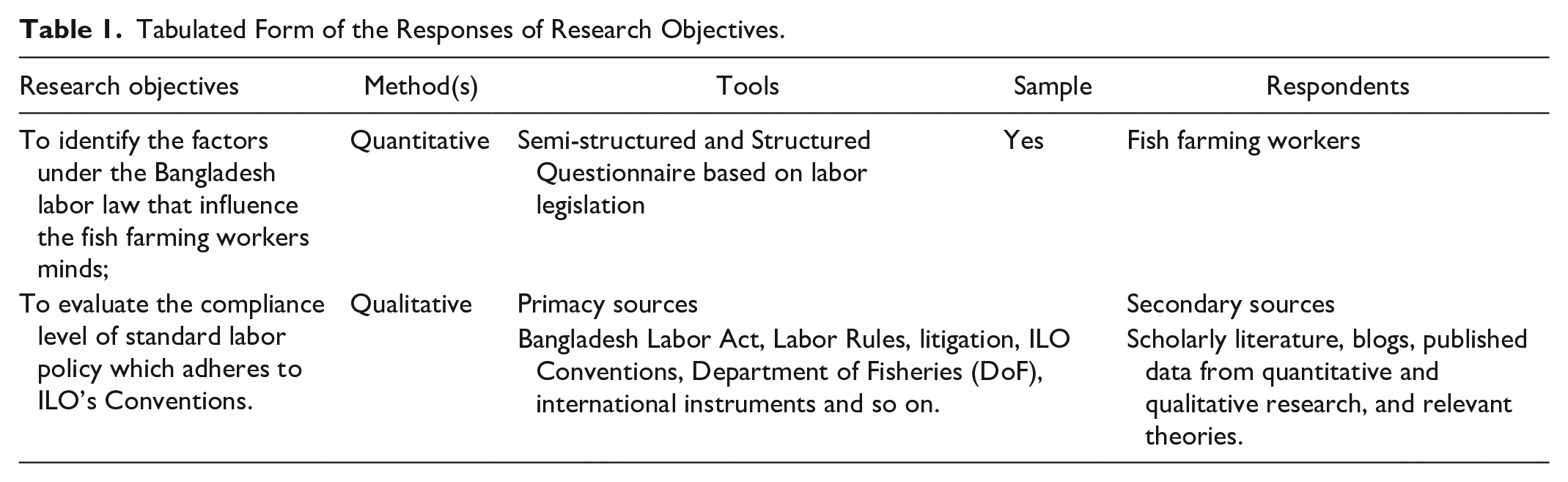
This questionnaire contained several statements. Perceptions of fishers have been measured by a separate variable on a 5-Point Likert Scale. Point 1 indicates strongly disagree, and point 5 indicates strongly agree with the statement. Along with the quantitative part of the study, other primary and secondary data were collected to get some qualitative information that was not covered by the quantitative tool. For instance, the Bangladesh Labor Act, Labor Rules, litigation, ILO Conventions, Department of Fisheries (DoF), international instruments, and so on were considered primary data sources. In contrast, scholarly literature, blogs, published data from quantitative and qualitative research, and relevant theories were considered secondary sources of data for the qualitative study.
The research objectives are furnished in Table 1:
Tabulated Form of the Responses of Research Objectives.
Descriptive Statistics Analysis on Variables That Influence Fishers’ Mind
Overall Occupational Satisfaction
This manuscript aims to assess the factors under the Bangladesh labor legislation that influence fishers’ occupational satisfaction. As a result, they have been asked about their overall job satisfaction. Out of 132 responses on this variable, the maximum score is 3, and the minimum score is 1, with a mean value of 1.76. It means the respondents’ average response is in between strongly disagree, disagree, and neutral with the statement. The standard deviation is 0.61.
Out of 132 respondents, 44 respondents (33.3%) are opined that they are strongly dissatisfied at all with their profession. Seventy-six respondents (57.6%) disagree with the statement that they are satisfied with their job. Only 12 respondents (9.1%) are uncertain as to their opinion.
Satisfaction on wages
The amount of wage is one of the significant factors that influence the fishers’ attitude. Thus, the respondents were asked about their level of wage satisfaction as they received. Out of 132 responses on this variable, the maximum score is 3, and the minimum score is 1, with a mean value of 1.78. That means the average response is that respondents are in between strongly disagree, disagree, and neutral with the statement that they are satisfied with their wages.
Among the respondents, 33 respondents (25%) feel that they are not satisfied with their wages. Ninety-five respondents (72%) disagreed with the statement that they are happy with their wages. Only four respondents (3%) are confused as to whether they are satisfied or not with their wage.
Yearly increment
All the respondents are either strongly disagree or disagree with the statement that they enjoy yearly increments. The maximum score is 2, and the minimum score is 1, with a mean value of 1.46.
Out of 132 respondents, 72 respondents (54.5%) are strongly disagree with the statement that they have an annual increment facility. On the other hand, 60 respondents (45.5%) disagree with the statement.
Overtime payment
All the respondents either strongly disagree or disagree with the statement that they are paid double amount for overtime. The maximum score is 2, and the minimum score is 1, with a mean value of 1.67.
Out of 132 respondents, 43 respondents (32.6%) are strongly disagree with the statement that they are getting paid double amount for over-time. On the other hand, 89 respondents (67.4%) disagree with the statement.
Weekly holiday
Also, the respondents have been asked about their available weekly holiday. All of the respondents are either disagree or agree with the statement that they have a weekly holiday. The maximum score is 4, and the minimum score is 2, with a mean value of 3.34.
Out of 132 respondents, only 4 respondents (3%) disagree, 79 respondents (59.8%) are neutral, and 49 respondents (37.1%) agree with the statement that they are having weekly holiday.
Compensation for injury
Then the respondents were asked about their available compensation package for injury. All of the respondents are either strongly disagree, disagree, or neutral with the statement that they are enjoying injury compensation. The maximum score is 3, and the minimum score is 1, with a mean value of 1.79.
Out of 132 respondents, 51 respondents (38.6%) are strongly disagree, 57 respondents (43.2%) disagree, and 24 respondents (18.2%) are neutral with the statement that they are receiving injury compensation.
Further, two more variables (fishers appoints with appointment letter & job security) are significantly influencing the fishers’ minds in Bangladesh. These two questions were not set of 5 points Likert scale; instead, the questions dummy were Yes = 1, No = 0.
Advanced Statistics (Regression) Analysis
Data reliability
Cronbach’s alpha is evaluated for internal consistency, which means how closely a set of variables in a group is related. It regards as a measure of scale reliability. According to Sekaran and Bougie (2010), the measurement reliability will be higher if Cronbach’s Alpha is nearer to 1. This study’s Cronbach’s alpha is .624; which means an acceptable internal consistency stage for the scale. Cronbach’s alpha has not calculated for each variable. Rather, it has calculated for all the variables in a combined fashion (Syed, 2020).
Restricted regression model analysis
An unrestricted regression model was used from the similar data that has been used for this restricted regression model analysis, and the result found a bit different (Syed, 2020). In fact, people argue that the restriction model is more generalized, and in terms of analysis, provides more exact statistics than the unrestricted model (The Open Educator, 2020) which creates a room for this restricted regression model analysis. In this study, the restricted regression model summary shows that the value of Adjusted R2 is .657, that is, 66% variation of the dependent variable is explained by the independent variables included in the model (Table 2).
Model Summary.

Predictors: (Constant), job security, yearly increment, fishers appoints with appointment letter, weekly holiday, overtime payment, wages, compensation for an accident.
The ANOVA table (Table 3) shows the model’s sig value is .000, which means the model is 100% significant.
ANOVA. b .
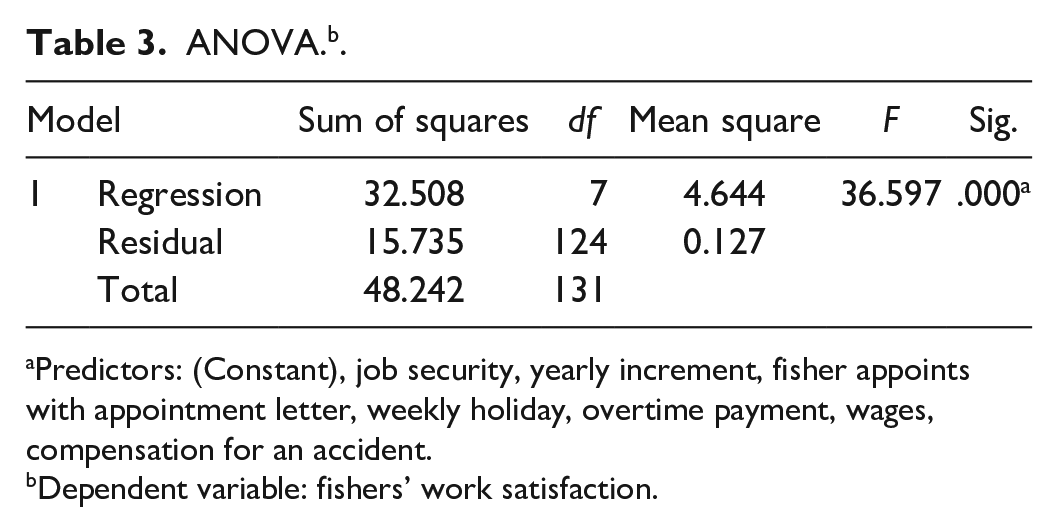
Predictors: (Constant), job security, yearly increment, fisher appoints with appointment letter, weekly holiday, overtime payment, wages, compensation for an accident.
Dependent variable: fishers’ work satisfaction.
Items for the restricted model are:
(i) Dependent Item
Y = fishers’ work satisfaction
ii) Independent Items
X1 = amount of wages X2 = yearly increment X3 = overtime payment X4 = weekly holiday X5 = compensation for injury X6 = fisher appoints with appointment letter (dummy: Yes = 1, No = 0) X7 = job security (dummy: Yes = 1, No = 0)
Regression result and discussion
The regression coefficients table did not assess as per unit. Rather, it is described as per percentage, as mentioned by Syed (2020). On the one hand, the regression coefficient Table 4 shows four financial factors: amount of wages, yearly increment, overtime payment, compensation for injury positively influencing fishers’ commitment at a rate of about 15%, 25%, 44%, and 35% respectively. On the other hand, the three other factors of the workers, namely, weekly holiday, fishers appoints with appointment letter, and job security, positively influence workers’ commitment: 32%, 38%, and 40% respectively.
Regression Coefficient.

Source. Survey, November and December 2018.
With pecuniary factors, workers are more concerned with their legitimate overtime payment and compensation package for injury. If workers have a proper overtime benefit, then their level of satisfaction increases by 44%. Also, workers expect a good compensation package for injury. The workers’ level of satisfaction reaches about 35% if they have a good compensation package for injury.
With regard to non-monetary factors, workers are more concerned with their job security and appoints with appointment letter. The worker’s job security corresponds to 40% of their level of satisfaction, whereas appoints with appointment letter comprises 38% of their work satisfaction.
Consequently, it can be summarized that financial and non-financial factors are equally significant for the satisfaction of fish farming workers in Bangladesh. Furthermore, it is noted that all the significant monetary and non- monetary factors stated above are the provisions of the current domestic labor legislation, ILO Conventions, and other international binding instruments under the United Nations. Therefore, the State is responsible and obliged to ensure the above rights to fish farming workers.
Conclusion and Recommendation
The fish farming industries are located in the rural setting in Bangladesh, and fishers are hiring from local areas. The local rural fishers are illiterate; they do not know about their labor rights (Hossen et al., 2020; Syed, 2020). Also, they have no strong labor union to promote their voice. In the absence of a strong labor union, fishers cannot compete with the strong employers’ and buyers’ associations and policymakers at large. Employers, buyers, and policymaker personal benefits and greediness, on the other hand, make this sector as a slaver industry in Bangladesh. So, the employers, buyers, and policymakers’ strong ethical responsibility are indispensable to ensure the labor rights and make this industry a success.
To protect labor rights, international institutional mechanisms are important (Eddy, 1997). ILO is accountable for drawing up and supervision global labor ethics. So, ILO can play a vital role by assigning different tasks to pertinent stakeholder organizations, and to follow monitoring progress. Bangladesh is a ratified state of numerous ILO’s Conventions, and once a member state ratifies ILO Convention, it becomes obligatory for that State, and compliance becomes compulsory. Unfortunately, Bangladesh has yet to ratify the Minimum Wage Fixing Convention (MWFC 1970), Convention No. 131, and the Minimum Wage-Fixing Machinery Convention (MWFMC 1928), Convention No. 26. Therefore, the provisions enlisted under these Conventions will not be applicable for Bangladesh according to art. 8 and art. 7 of these Conventions respectively. Most importantly, the Minimum Wage Fixing Convention (MWFC 1970), Convention No. 131, was designed especially for developing countries. This Convention was adopted to consider the needs of workers and their family’s basic needs depending on the level of economic development in developing states. So, as a developing country, Bangladesh needs to ratify and comply with this convention to get the international community’s attention.
Further, ILO has been following attention to the quality of labor conditions in fishing. Over time, it has drafted six Conventions and three recommendations for this sector (Bavinck et al., 2005; International Collective for the Support of Fishworkers, 2004, 2008; International Labour Organization, 1999). But the State is far from the labor conditions drafted under the Conditions as well as recommendations. So, international communities may create stress to ratify these Conventions and monitor the progress about the compliance of these Conventions. International community can play a vital role in protecting workers’ rights in different ways. For example, in their diplomatic relation, they can refer to the vulnerable labor condition in Bangladesh. Donor agencies and international buyers may recommend the Government to ensure labor rights in all aspects. They can urge the Government to ratify ILO’s Convention pertinent to labor rights and dignity. They can offer the Government that if Bangladesh ratifies and complies with the Conventions, international societies will play a prominent role in shaping its strategy and practice by providing a necessary remedy to Bangladesh’s labor development.
Deficiency of current labor law is another problem in the setting of Bangladesh. Further, there is hardly a successful prosecution for compliance of labor law in the history of Bangladesh. Therefore, workers are unwilling to file a lawsuit against employers. Furthermore, they are not in the same footing as employers, and there is no pro bono policy for the poor and illiterate workers. Red-tape, judicial backlog, prejudice, and ultimate lack of trust in the judiciary are the reasons for unwillingness to file a lawsuit. The absence of severe penalty provisions under the existing law is the other reason for unwillingness to file a lawsuit. Thus, Bangladesh’s civil society may play a vital role in establishing labor rights in Bangladesh. They can recommend the government to enact a standard labor law following by ILO Conventions and comply with these provisions. They can join in the discussion of new legislation to battle against the irrational wage, bonus, overtime benefits, compensation, and other non-financial benefits of job security, weekly holidays, and proper hiring procedures. If fishers are satisfied with all the factors, their level of satisfaction will be improved; livelihood will be upheld, the socio-economic condition will be developed, export earnings will be enhanced and contributes to the GDP significantly.
Footnotes
Declaration of Conflicting Interests
The author(s) declared no potential conflicts of interest with respect to the research, authorship, and/or publication of this article.
Funding
The author(s) received no financial support for the research, authorship, and/or publication of this article.
