




Abstract
This paper is designed to explore the current status of Chinese EFL teachers’ use of digital resources in doing research and its influential factors. It classifies digital resources into six types aligned to the research process and uses the revised TAM to find out and explain its influential factors. A total of 180 teachers were investigated via the online questionnaire. The results show the Chinese EFL teachers’ use of six-type resources is at an intermediate low level. Among them, the type of resources for getting data analysis software is most frequently used; The type of resources for managing literature is least frequently used. However, teachers’ intention to use the resources is relatively high. Frequency of doing research, facilitating condition (FC), and perceived ease of use of resources (PEOU) are the direct predictive factors for EFL teachers’ actual use of digital resources (AU). Self-efficacy in using resources, ICT skill, and FC are significant direct predictors of PEOU, and they are indirect predictors of AU.
Introduction
Using digital technologies is highlighted as an important need for teachers, who would benefit greatly from implementing these applications in their professional development. UNESCO (2018) released the ICT Competency Framework for Teachers providing a comprehensive set of competencies teachers need to integrate ICT into their professional practice and supporting their continuous development in diverse contexts. Active-duty teachers should also develop related capacities to satisfy the newly expanded requirements and make changes to adapt to the new digital environment (Zhao et al., 2021). Therefore, it is significant to investigate how teachers use digital technologies in their professional development in the specific field, such as in doing research, so as to support and empower them to get involved in doing research more effectively and efficiently. However, the ways digital resources can be used to support research work are still not sufficiently explored. Meanwhile, there have been very few studies about teachers’ using digital resources and factors influencing their use of technologies in doing research.
There have been calls for teachers to engage in research as part of their ongoing professional development (Burns & Mutton, 2015; Darling-Hammond et al., 2017; Zheng et al., 2021). It is obvious that using digital resources is having an increasing impact on teachers’ research, including the form of and access to research resources, as well as methods and tools. Guillén-Gámez et al. (2021) found a medium-high use by teachers of ICT resources in the teaching and research dimensions and the use of ICT resources for research purposes are the most employed ones in all areas, but lower in art-humanities. Other studies found that most researchers were confident about their ICT competent and skills; The great majority of the researchers held a positive attitude toward the adoption of new technologies in research, but most of them have not seen the value and potential benefits of using digital resources in research; Some of them have not had enough knowledge of using technologies and felt difficult to keep pace with ICT development, and they are uncertainty about the trust and quality to publish and share research through open access technologies (AHRC, 2006; BL & JISC, 2012; Procter et al., 2010).
In recent China, ICT has been an integral part of the teacher education curricula, and all preservice and in-service EFL teachers are required to take some generic ICT courses during their training to improve their capacity to effectively apply ICT in the EFL teaching practice (Mei, 2019). Meanwhile, research and publications have been increasingly emphasized in the assessment system in schools and universities (Bao & Feng, 2022; Gao et al., 2011). Chinese EFL teachers are also expected to do research though they are severely disadvantaged because most of them do not possess a doctorate degree (Huang & Guo, 2019). Meanwhile, Studies have found lack of time, limited resources and support, inadequate knowledge and necessary skills for research, difficulties in publishing or sharing their research, and weak research tradition have impeded their research engagement (Borg & Liu, 2013; Gao et al., 2011; Xu, 2014; Yuan & Burns, 2017).
While digital resources and support continue to be created in response to an education system growing in technological advancements, teachers need assistance to integrate and use technology with personal and professional skills for educational purposes (Zimmer & Matthews, 2022). Chinese EFL teachers need to make much effort to use digital resources to improve their research for sustainable development. If digital technologies can help solve the problems Chinese EFL teachers have in doing research, they will probably improve their research situation. However, in China, CNKI (China national knowledge infrastructure) and other literature databases show there have been no studies on teachers’ use of digital technologies to do research. This research gap needs much attention. Therefore, it is necessary to investigate how Chinese EFL teachers use digital resources in doing research, and significant to further explore what factors influence their actual use of digital resources in doing research. The focus of this study aims at answering the following questions:
What is the current status of Chinese EFL teachers’ use of digital resources in doing research?
What are the major factors influencing Chinese EFL teachers’ use of digital resources in doing research?
Although these questions have specific relevance to the Chinese context, they are also of value to the field of EFL teachers’ professional development, especially for EFL teachers who are expected to become teacher researchers, for teacher trainers who could get implications from this study when designing training courses, and for institutions which could create a friendly digital environment for teachers’ research needs.
Literature Review
Benefits of Digital Resources to EFL Teachers’ Research
“Though there are many definitions of research, what they all have in common is the notion of inquiring into, or investigating something in a systematic manner” (Merriam, 2009) and it “involves a set of steps which include selecting a problem, reviewing the literature on the problem, designing the research, collecting the data, analyzing the data, interpreting the findings and stating conclusions and reporting results” (Ary et al., 2013). It is clear that digital resources can contribute to almost all steps of research processes so as to encourage EFL teachers to make full use of digital resources in their research.
Providing Effective and Efficient Access to Literature
ICT makes research activities more efficient and effective by providing researchers with an immense collection of knowledge and with “unlimited access to a wealth of information, millions of electronic journals, e-books and such other information at very low cost” (Safdar et al., 2011). The Internet provides quicker access to relevant and current literature via a search engine like Google Scholar, universities, and libraries’ internal search engines (Fung, 2013), and delivers literature to the researchers timely and automatically by RSS and alerting tools (Greenhow et al., 2009). Considering EFL teachers’ lack of access to rich and open research resources (Borg, 2009; Borg & Liu, 2013; Gao et al., 2011), they need to get to know a wide range of available access to literature, instrument, and services, and uptake their effective use in research.
Providing Alternative Ways to Acquire Research Knowledge
Internet is, inexorably, becoming the dominant infrastructure for knowledge both as a container and as a global platform for knowledge exchange between people (LeNoue et al., 2011; Tapscott & Williams, 2010). Digital resources, such as MOOCs and online courses with rich interactive tools have provided teachers with a platform to improve their professional knowledge and skills continuously. The digital environment is “increasingly characterized by high digital connectivity and a need for life-long, demand-driven learning” (Tapscott & Williams, 2010). Chinese EFL teachers, who are supposed to take responsibility for their professional growth, are offered vast opportunities and innovative approaches to acquire research knowledge and improve their research skills in the digital environment.
Extending the Ways to Collect Data and Get Data Analysis Software
Nowadays, data can be collected via online, web-based, and Internet surveys which have the advantage of reducing time and cost (Fung, 2013). Regarding quantitative data analysis, statistical software like SPSS and AMOS is more user-friendly, and data mining tools also gain more popularity. In qualitative research, a variety of technologies like blogs, social websites, and wikis can also be used to collect data, and the availability and use of data analysis software (e.g. NVivo, SPSS Text Analytics, etc.) are greatly improving the accuracy of data. Besides, qualitative data from audio and video could be automatically transcribed into text by using voice recognition software (Fung, 2013). Recently, data mining combines statistics and artificial intelligence to analyze large data sets to discover useful information, for example, social network analysis software is used to analyze the relationship between all network members. Wang (2019) adopted SNA software Ucinet to analyze Chinese EFL teachers’ collaborative reflection.
Catering a Rich Toolkit for Academic Writing
Digital technologies provide a massive database for writing with uncountable resources of content, language data, and writing examples, and as a publishing outlet (Hyland, 2003), and supply researchers with authoritative online dictionaries, thesauri, encyclopedias, etc. In the writing process, Web-based visualization tools like concept mapping software allow researchers to digitally organize ideas and refine the relationship between kinds of literature (Price & Wright, 2012). Additionally, the efficiency and accuracy of reference compilation are largely improved by using reference management software like EndNote, Zotero, or Mendeley, which enable researchers to store, manage, and search for their references, and build lists of references by capturing and inserting the reference automatically (Kalb et al., 2009).
Creating Alternative Ways for Disseminating and Sharing Research
The emergence of Web 2.0 and Web 3.0 has made a significant increase in channels and the speed of disseminating research findings. The researchers have more options to share and disseminate their research online, for example by listing their publications, skills, or achievements on the web or social websites (Mas-Bleda et al., 2014). Web 2.0 has become feasible to develop alternative publication channels or create mutually interactive platforms so that teachers can share the process of their research engagement, and digital resources can promote and facilitate sharing among teachers so that their research efforts could be better recorded and shared (Gao & Chow, 2011).
Generating More Opportunities for Academic Networking and Collaboration
ICT makes it possible to do trans-institutional, trans-national, and trans-continental collaboration online because Web 2.0 applications and cloud computing support collaboration on a global scale and provide the users with a persistent “virtual research environment,” which is accessible from anywhere on any internet-connected PC, laptop or mobile device” (Millan & Bromage, 2011). Social media, such as wikis, blogs, social citation and social bookmarking, social networking websites, or meeting and collaboration tools, etc., opens up new forms of collaboration that are not so bounded by place and funding” (Cann, 2011). In fact, web-based tools could be aligned to the research process cycle in collaborative projects because Web 2.0 tools provide a place for multiple users to collectively complete a task on the web (Price & Wright, 2012).
Aligning Digital Resources to EFL Teachers’ Research Process
Thanks to the benefits of digital resources to research, how and in what aspect digital resources can contribute to the process of EFL teachers’ research are sorted out and categorized in Table 1. This study, based on reviewing literature and criteria of authority, coverage, objectivity, accuracy, and currency provided by VigniaTech University Library for evaluating digital resources for research, classifies the digital resources into six types, which is the basis of the questionnaire for investigating Chinese EFL teachers’ actual use of digital resources in doing research.
Research Process Aligned With Six-Type Digital Resources.

The Technology Acceptance Model
Technology Acceptance Model (TAM) by Davis (1989) has widely been used to explain and predict factors affecting users’ acceptance of technologies. TAM’s core variables, perceived ease of use and perceived usefulness, have a considerable impact on users’ attitudes toward technology and have been proven to be antecedent factors affecting users’ technology use (Marangunicä & Granicä, 2015). Besides, other variables, such as self-efficacy, computer anxiety, user training, system characteristics, and facilitating conditions, were significantly related to the TAM core variables (Abdullah & Ward, 2016). These external variables are also considered as adjustments and anchors to affect perceived usefulness and perceived ease of use, and both of them affect intention to use, which ultimately influences the actual use of technology (Granic & Marangunic, 2019; Venkatesh & Davis, 2000; Venkatesh et al., 2012).
In this study, the actual use of technology is considered as the outcome variable because the technology had been introduced to Chinese EFL teachers for quite a period of time, and external variables (teachers’ background information, self-efficacy in using digital resources, and facilitating conditions) are considered as the predictors of perceived usefulness and perceived ease of use. Therefore, the hypothesized model of EFL teachers’ technology acceptance with external variables in Figure 1 is the basis to understand and explain the factors influencing EFL teachers’ use of digital resources in their research.

Model of EFL teachers’ technology acceptance with external variables.
Methodology
Participants
This study chose 6oo in-service and preservice EFL teachers as potential participants from the online QQ community named Foreign Language Educational and Technological Research Group and WeChat voluntarily. The criteria of participants selection are: In-service College EFL teachers are required to do research for promotion and assessment; Preservice teachers from the Master Program of English Teaching are required to finish their thesis for MA degree; They are comparatively eager to do research because of more rewards; They actively seek online support. Meanwhile, the online questionnaire provides them with some detailed examples of digital resources. Between Dec. 15th and Dec. 30th, 2016, an online questionnaire was delivered to them with 30% valid responses. Thus, 180 Chinese EFL teachers became the participants (113 in-service and 67 preservice teachers). The background information of participants includes age, qualification, service status, teaching experience, their frequency of reading and doing research, self-perceived ICT skill, and self-perceived degree of ICT influence on research in Table 2.
Participants’ Background Information.

Instruments
Questionnaire 1. EFL Teachers’ Use of Six-Type Digital Resources in Doing Research
This study, based on the six types of digital resources with the technologies and examples in Table 1 and Procter et al.’s (2010) Web 2.0. for Researchers, developed a five-point Likert scale (Never Heard; No Use; No, but will use; Sometimes Use; Frequently Use) questionnaire to find out how frequently the participants use the resources. The validity analysis of KMO values is 0.893. Its reliability Cronbach’s α is .933.
After two-round online pre-testing revising, the final version contains six types of nine major questions, Type 1-1 Locating and Retrieving Literature (seven items), Type 1-2 Analyzing Literature (three items), Type 1-3 Managing Literature (two items); Type 2 Acquiring Research Knowledge (five items); Type 3-1 Collecting Data (three items), Type 3-2 Analyzing Data (four items); Type 4 Academic Writing (five items); Type 5 Disseminating and Sharing Research (five items); Type 6 Academic Networking and Collaboration (five items).
Questionnaire 2. Factors Influencing EFL Teachers’ Digital Resources Use in Research
This study, based on the revised TAM in Figure 1, developed a five-point Likert scale questionnaire from “Strongly disagree” to “Strongly agree” to explore the factors influencing the participants’ actual use of digital resources (AU) in their research. The validity of 4 influential factors with 17 items was analyzed by principal components analysis and Varimax rotation, and the result shows all items are above 0.632. The reliability of Cronbach’s α shows PU (.911), PEOU (.928), SE (.749), and FC (.915).
After the pilot survey, it contains Perceived Usefulness of resources (PU) with four items (In my research, digital resources (DR) are useful, increase efficiency, increase quality, and help a lot), Perceived Ease of Use of resources (PEOU) with four items (In my research, using DR is easy; It is not difficult to use DR; It is easy to become skilled in the use of DR; I find DR easy to use), Self-efficacy (SE) with four items (Be skillful in using DR; Use DR without others’ help; Use DR with others’ help when encountering difficulties; More frequently use more DR if having more time), Facilitating Conditions (FC) with five items (Get the help of using DR; Get training of DR; Get the guidance of using DR; Get support when encountering difficulties; Have many ways of getting information about DR), and a follow-up interview voluntarily. In addition, the participants’ background information was also considered as an influential factor.
Data Analysis
Data were analyzed with SPSS 22.0. Firstly, the descriptive statistics show the current status of EFL teachers’ background information and their use of six-type digital resources in their research. Secondly, actual use of digital resources (AU) is the dependent variable, and the independent variables are nine variables of participants’ background information, Self-efficacy in Using resources (SE), Facilitating Conditions (FC), Perceived Usefulness of resources (PU), and Perceived Ease of Use of resources (PEOU). Then, the relation between AU and independent variables is analyzed by Pearson’s correlation. Thirdly, stepwise regression analysis of the data is to find out how the independent variables affect the dependent variable. Finally, direct and indirect predictive factors affecting participants’ actual use of digital resources are constructed and evaluated by confirmatory factor analysis with AMOS 22.0.
Results
Current Status of EFL Teachers’ Use of Digital Resources in Their Research
Type 1 Using Resources for Retrieving, Analyzing, and Managing Literature
Table 3 shows more than 66% of participants normally use general and academic search engines and Chinese commercial databases for locating and retrieving literature. But Most teachers have not often used English commercial databases, free databases, social networks, and RSS in research. Besides, participants’ use of literature analysis tools is relatively low (M = 2.623). Nearly one-third of participants (N = 58) have never heard of reference analysis software. However, what participants mostly want to use in the future is the analysis function of the databases (N = 72). Besides, participants’ use of literature management services is very low(M = 2.16). The least used one is online reference management tools, and almost 77% of teachers haven’t heard of and used them. In general, very few participants frequently use digital resources for retrieving, analyzing, and managing the literature.
Descriptive Statistics of Using Digital Resources Type 1.

Type 2 and Type 3 Using Resources for Acquiring Research Knowledge and Collecting and Analyzing Data
Table 4 shows less than half participants (44%) acquire research knowledge with help of the digital resources. The most used one is E-books, but the least used ones are website and online courses. However, it is worth noticing that participants’ intention of future use of resources for acquiring research knowledge is relatively high (n = 63, 87, 57, 66, and 54,), showing more participants would like to use the resources in the future.
Descriptive Statistics of Using Digital Resources Type 2 and Type 3.

In Type 3, less than 18% of participants use digital resources of Type 3-1 Collecting data. Comparatively, more participants frequently use Type 3-2 getting data analysis software (M = 3.263). Meanwhile, 63% and 58% of participants use general search engines and organization websites, that is, websites of universities and libraries. To be specific, the academic forum is less used than search engines, organization websites, and online sharing tools (see Table 4).
Type 4, Type 5, and Type 6 Using Resources for Academic Writing, Disseminating and Sharing Research, and Academic Networking and Collaboration
In Type 4, 77% of participants use online dictionaries, and almost 38% of them use collaborative writing tools. However, there are less than 22% of participants using online notebooks, reference management software, and mind mapping software (see Table 5).
Descriptive Statistics of Using Digital Resources Type 4, Type 5, and Type 6.
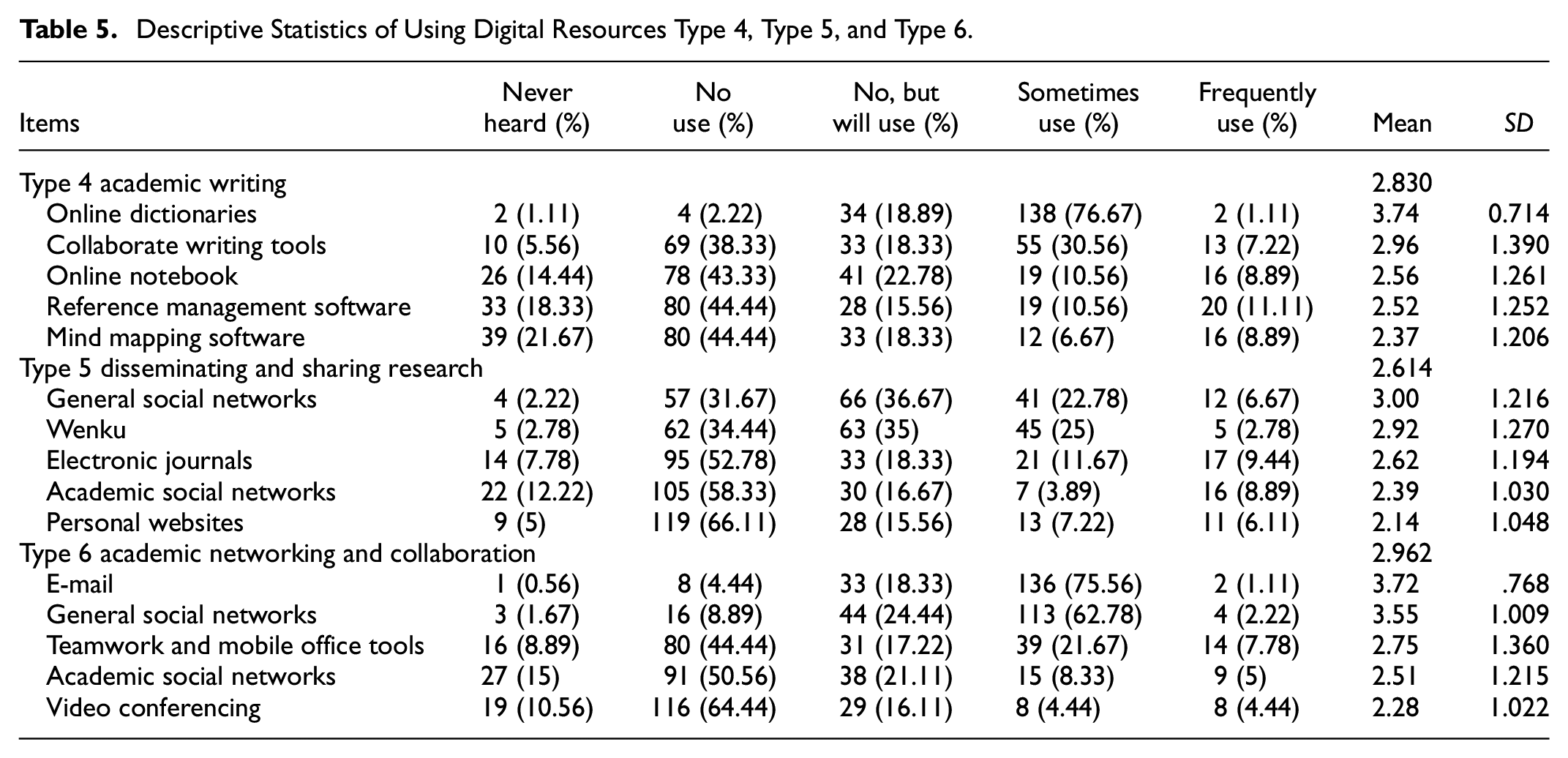
In Type 5, less than 29% of participants use disseminating and sharing tools in their research. They rarely use electronic journals, personal websites, and scholarly networks to share and publish their research papers or reports. Comparatively, there are a bit more participants using general social networks and Wenku, and more than one-third of teachers intend to use them in the future (see Table 5).
In Type 6, almost 76% of participants use E-mail to communicate and collaborate with others about their research, and 65% of participants use general social networks for academic networking and collaboration. However, there are respectively only 29.45%, 13.33%, and 8.88% of participants who sometimes and frequently use teamwork and mobile office tools, academic social networks, and video conferencing (see Table 5).
Figure 2 shows the ranking of Chinese EFL teachers’ use of six-type digital resources. Type 3-2, Type 1-1, and Type 6 are the most used ones, Type 2, 4, 1-2, 5, and 3-1 are the less used ones, and Type 1-3 is the least used one. Overall, the results of quantitative data analysis show participants’ use of digital resources is relatively low on average (M = 2.76). This result is similar to BL and JISC’s (2012) 3-year longitudinal research. Meanwhile, RIN’s (2010) research also claims that only a few researchers have made intensive and innovative use of Web 2.0 technology, and “the majority of researchers, however, use them only sporadically and in more limited ways, or not at all.”

Ranking of using six-type digital resources.
Influential Factors for EFL Teachers’ Use of Digital Resources in Their Research
Direct Predictors for EFL Teachers’ Actual Use of Digital Resources (AU)
Firstly, the correlation between participants’ actual use of six-type digital resources (AU) and nine variables of background information, shows there is no significant correlation between AU and five variables (teachers’ age, highest qualification, service status, years of teaching experience, years of researching experience). Different from the expectation, participants under the age of 36 have used technological resources less frequently than those above 36. Frequency of reading literature, Frequency of doing research, ICT skill, and ICT impact have significant correlations with AU (see Table 7). It is also worth noticing that 57% of participants’ self-perceived ICT skill is at a low level in Table 2. The low level of ICT skill could cause participants to have difficulties in using digital resources, and almost 43% of participants seldom do research may cause low-level use of digital resources.
Secondly, Table 6 shows the descriptive statistic of the perceived usefulness of resources (PU), perceived ease of use of resources (PEOU), self-efficacy in using resources (SE), and facilitating conditions (FC). The mean of PU is very high(M = 4.135), indicating most participants believe digital resources are useful and can give them strong support, esp. improving the efficiency and quality of their research. However, PEOU is comparatively low (M = 2.982), which shows it is not easy for most participants to skillfully use digital resources in their research. More importantly, the correlation between AU and four variables is at a significant though a moderate level in Table 7. Among them, the correlation between AU and PEOU (.543**), SE (.524**), FC (.548**) is stronger than that of AU and PU (.271**).
Descriptive Statistic of PU, PEOU, SE, FC.

Correlation Analysis of AU and Background Information, PU, PEOU, SE, and FC.

Note. FRL = frequency of reading literature; FDR = frequency of doing research; ICT impact = belief about ICT impact on research; PU = perceived usefulness of resources; PEOU = perceived ease of use of resources; SE = self-efficacy of using resources; FC = facilitating conditions.
Thirdly, according to the revised TAM, stepwise multiple regression analysis is to explore the most significant factors predicting EFL teachers’ actual use of digital resources. Eight factors reaching the significant level in Table 7 are the independent variables, and AU of six-type digital resources is the dependent variable. After analysis, FC, frequency of doing research, and PEOU are entered into the regression model and other independent variables whose coefficients are not significant are excluded. In Table 8, the multiple correlation coefficient (R) and coefficient of determination (R2) between the three predictive variables and the dependent variable are .665 and .422. F statistic for the whole regression model is 46.111 (p < .001) and the total explained variance by the three predictive variables is 44.2%. According to the results, the path analysis model is shown in Figure 3.
Model Summary of Stepwise Multiple Regression Analysis of Predictive Factors to AU.

p < .001.
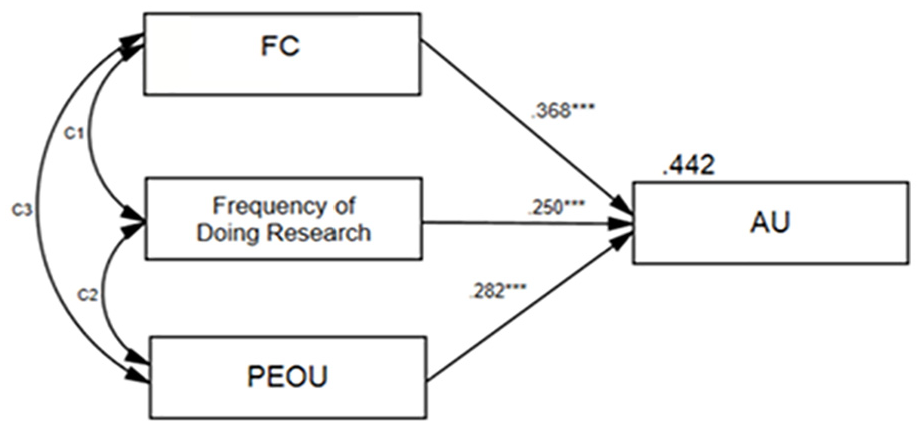
Path analysis between AU and independent variables.
Direct Predictors for EFL Teachers’ Perceived Ease of Use of Resources (PEOU)
To figure out the predictive factors for PEOU, the correlation between PEOU and the other seven variables (PU, FC, SE, frequency of reading research, frequency of doing research, ICT skill, and impact of ICT on research) is calculated in Table 9, and all these factors are significantly correlated with PEOU.
Correlation Analysis of PEOU and the Other Seven Variables.
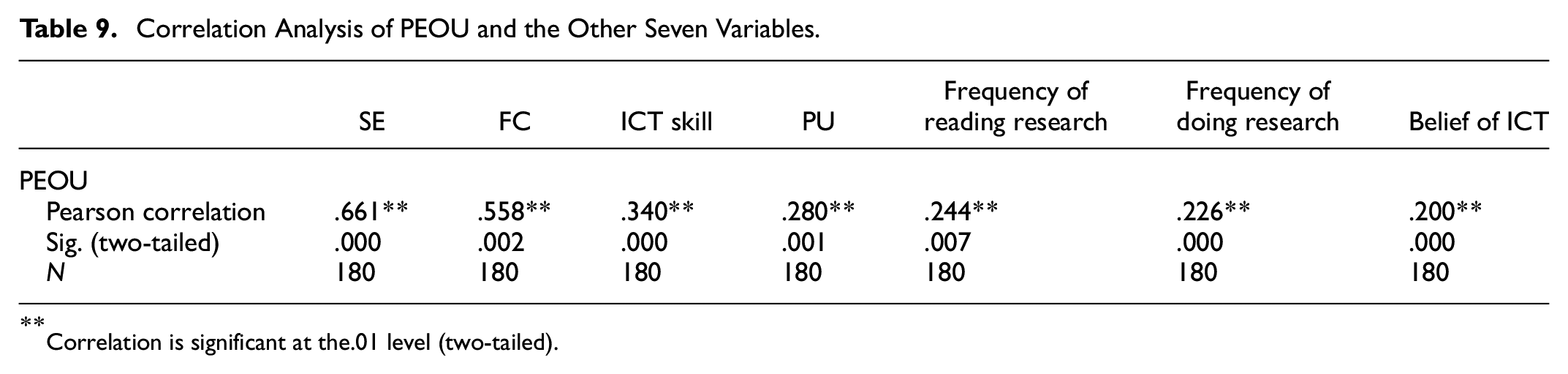
Correlation is significant at the.01 level (two-tailed).
Then, stepwise statistical regression analysis is to explore the most powerful factors predicting PEOU. After analysis, SF, FC, and level ICT skill are entered into the regression model. In Table 10, the multiple correlation coefficient (R) and coefficient of determination (R2) between the three predictive variables and the dependent variable are .701 and .492. F statistic for the whole regression model is 56.760 (p < .001) and the total explained variance by the three predictive variables is 49.2%. Based on the above results, the path analysis model is in Figure 4.
Model Summary of Stepwise Multiple Regression Analysis of PEOU.

p < .05. ***p < .001.

Path analysis between PEOU and independent variables.
Predictors for EFL Teachers’ Actual Use of Digital Resources (AU)
Through correlation and stepwise regression analysis, direct and indirect predictive factors to EFL teachers’ actual use of digital resources for research (AU) are identified and analyzed by AMOS 22.0 in Figure 5. Model Fit Summary shows a p-value of model chi-square (p = .202) is bigger than the significance level (p > .05), which shows the path model is consistent with the collected data. The RMSEA = 0.055 is considered an indication of fair fit. Value of GFI, AGFI, NFI, RFI, IFI, TLI, and CFI are all well matched by the fitness criterion (i.e., >0.90). These results meet the goodness criterion of fit. It also shows ICT skill, SE and FC are the significant direct predictor of PEOU, which accounted for 49% of the total variance of PEOU. FC, Frequency of doing research, and PEOU are the significant direct predictor of AU, which accounted for 44% of the total explained variance of AU.
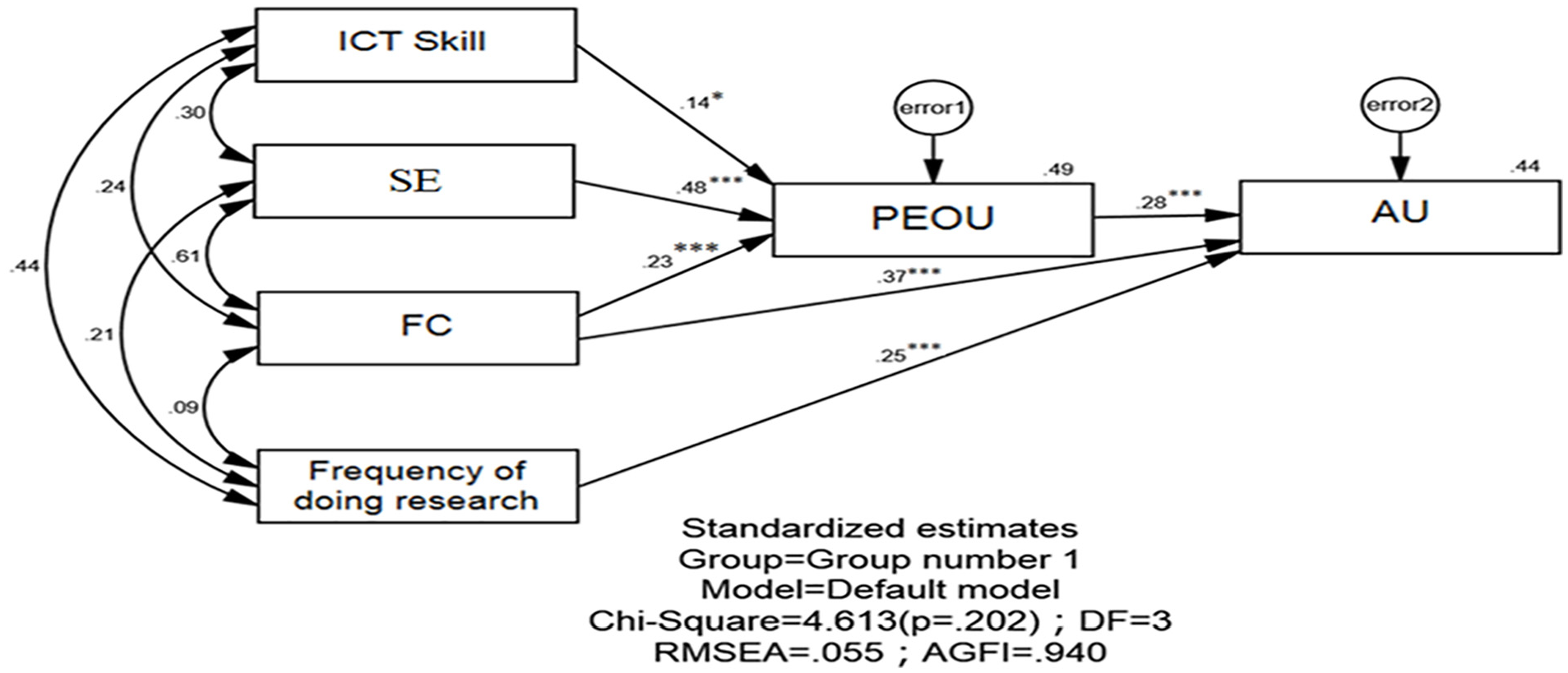
Confirmatory factor analysis diagram of AU.
Among the direct predictors, path analysis shows facilitating condition (FC) is the most significant predictor for AU which directly explains 37% of the total variance of AU. Thus, the effective facilitating condition is vital for EFL teachers to use digital resources in their research, which is similar to other research findings (AHRC, 2006; BL & JISC, 2012). They all find the availability of specialized tools or resources for their specific research area, is inadequate or otherwise ineffective. Besides, the participants in their studies are less satisfied with and less convinced of the benefits of those training programs because these programs are not available timely and are not tailored to their research needs.
The frequency of doing research significantly and directly explains 25% of the total variance of AU. It is obvious that the more frequently teachers engage in research, the more likely they will make the attempt and use digital resources in research. This finding is also similar to Procter et al.’s (2010) findings which participants’ use of Web 2.0 services of collaborative research is strongly influenced by the extent to which researchers are engaged in collaborative research activities.
Discussion
Alinement of the Research Process to Digital Resources
The development of technology has led not only to a significant increase in the speed of the dissemination of research findings, opened up huge platforms, and provided more tools for researchers to do research even in every step, but also expanded the research border. When considering the alinement of the research process to digital resources, it is essential to outline the basic steps of doing research with the support of technology development for teachers. Compared with Creswell’s (2012) six steps in his research process cycle (Identify a research problem; Review the literature; Specify a purpose for research; Collect data; Analyze and interpret data; Report research), this study outlined the new six-step process with more contents according to the advantages of digital resources: Identifying Research Problems and Reviewing Literature; Designing Research; Collecting and Analyzing Data; Writing paper; Publishing Results; Applying.
Among them, Designing Research with acquiring research knowledge can be supported via online courses, media sharing sites, and academic research sites, and Writing Paper via visualization and mind-mapping tools, word references, reference management software, and collaborative writing tools, writing apps suitable for different genres and styles. These tools need to be adapted to the needs of the researchers (Grosseck & Bran, 2016). This study also integrated qualitative, quantitative, and mixed methods by Creswell’s (2014) research design with the support of adaptive digital tools/ resources into the step of Collecting and Analyzing Data. When Publishing results, researchers have much more choices to report their findings, not only in academic journals, but also on Twitter, Wiki, Blog, and other social media, like social writing apps, journal guides, and analysis. Although the application of results in the practice is not a necessary part of every research process (Kalb et al., 2009), for EFL teachers, applying their findings should be regarded as a necessary part of the research.
Collaboration in research via academic networking and social networks, slide/documentsharing websites, academic social and professional networking tools, and collaborative online tools has become more popular and convenient. Web-based collaborative technologies can allow researchers to collectively participate in the research process through the use of visualization, resource storage, content development and management (Price & Wright, 2012). If technology-supported research is Research 2.0, it can promote collaborative knowledge construction, rely on providing online access to raw results, theories and ideas, and focus on opening up the research process (Koltay et al., 2015). As for EFL teachers, more connections with other experts /researchers/teachers via shared networking for document building and social networking can promote their professional development.
Status of EFL Teachers’ Use of Digital Resources in Doing Research
Regarding the results of the investigation, Chinese EFL teachers’ actual use of digital resources in doing research is at a relatively low level. The most used types of resources were for getting data analysis software, locating and retrieving literature, and academic networking and collaboration. Among them, web search engines, such as Google Scholar, CNKI, and academic databases were at the top. Similarly, Guillén-Gámez et al. (2021) also found that Spanish teachers most frequently used academic Google for scientific queries followed by search engines in databases or impact journals, and the use of ICT resources for research purposes was higher in science and engineering-architecture but lower in art-humanities. The limitations for teachers of art-humanities using ICT/digital resources in doing research may be due to research domains and types, their research experience, and their insufficient digital literacy. Besides, even though there is widespread adoption of social media technologies, email remains one of the most important tools for EFL teachers for communication, scheduling meetings, sharing documents, and sending quick and informal updates. Minocha et al. (2012) also found both postgraduate researchers and supervisors prefer using email for research dialogues alongside face-to-face communications, and professional learning email also challenged each teacher to find a support group for themselves (Zimmer & Matthews, 2022).
Chinese EFL teachers least frequently used resources for managing literature, and less used resources for acquiring research knowledge, academic writing, analyzing literature, disseminating and sharing research, and collecting data. These results correspond with their disadvantages in doing research, such as limited resources and support, inadequate knowledge and necessary skills for research, difficulties in publishing, or sharing their research. In fact, these disadvantages are the crucial elements of doing research and seriously prevent them from improving their research quality. These results also show they have difficulties in using comparatively advanced and adaptive digital resources to conduct complex, comprehensive, and creative research activities. That also means their digital literacy level, especially comprehensive and creative technical skills, needs to be improved. Although there is broad consensus that digital media literacy is vitally important for today’s postgraduate researchers, what skills constitute digital literacy is still not well-defined nor universally taught (Minocha et al., 2012). However, little research assesses the effectiveness of professional development methods in providing digital literacy support to teachers (Zimmer & Matthews, 2022). Therefore, enhancing EFL teachers’ digital literacy level needs multiple support methods, and in turn, the use of technologies in doing research can be a method for it.
Factors Influencing EFL Teachers’ Use of Digital Resources in Their Research
Compared with the hypothesized model of the teachers’ technology acceptance with external variables (Figure 1), the Confirmatory Factor Analysis Diagram of AU (Figure 5) shows the core variable perceived ease of use (PEOU) is a direct factor to AU which significantly and directly explains 28% of the total variance of AU. While some studies identified the other core variable perceived usefulness (PU) as a significant predictor of AU, this study and others could not find evidence for it (Mac Callum et al., 2014; Scherer & Teo, 2019). Meanwhile, the correlation between AU and PEOU is much stronger than that of AU and PU. Lah et al. (2020) also found the correlations between PEOU and other measures of perceived usability tended to be significantly stronger than those with PU. In fact, many studies show both PEOU and PU directly affect teachers’ actual use of technology. However, the different research focus on teachers’ use of technology may lead to a different correlation between the core variables and AU. This study focuses on EFL teachers’ use of digital resources in doing research, which means most teachers have a common consensus that digital resources are useful to support them in doing research, but effective and efficient use of digital resources is not easy. Thus, PEOU becomes the significant variable in the model and also the most teachers’ concern because inefficient use of digital resources may prevent them from actually using resources in their research. BL and JISC (2012) also found that technology tools were readily taken up if those tools “can be relatively easily understood and absorbed into existing work practices.”
Among the external variables, teachers’ comparatively low level of ICT skill is a significant direct predictor of PEOU and an indirect factor to AU. ICT skill that teachers need to harness technology in the service of education (UNESCO & UIS, 2017), has become the basis and driving force to support teachers in doing research. Improving teachers’ ICT skill by matching to the specific dimension, as in doing research, can be more effective than improving their general ICT skill. Second, EFL teachers’ self-efficacy (SE) can well explain PEOU and indirectly predict AU in this study, as in other studies, SE in using technology positively affected PEOU, and it is also correlated with the core variables and AU, and may be the direct or indirect predictors for technology use in education (Joo et al., 2018; Scherer et al., 2019; Scherer & Siddiq, 2015; Valtonen et al., 2015). Besides, PEOU and SE share commonalities of beliefs, and empirical studies testified that the two variables are interwoven (Scherer et al., 2015, 2020). Thirdly, facilitating conditions (FC) positively predict both PEOU and AU, suggesting support and encouragement from institutions are vital in making EFL teachers aware of available digital resources, the value of resources, and how to use them to support their research. Thus, FC becomes the possible barrier or enabler, which suggests institutions should have the responsibility to create conditions that allow teachers to use technology in doing research. Fourthly, the frequency of doing research directly predicts AU. If regarding the frequency of doing research as teachers’ experience, it possibly moderates or affects the TAM relations (Scherer & Teo, 2019; Siddiq & Scherer, 2016). Meanwhile, BL and JISC (2012) findings show if technological resources are compatible with researchers’ research needs and enhance their existing research practices, they could use them more frequently.
Implications
This study has some implications for in-service and preservice teachers, teacher trainers, and institutions. Firstly, six-type resources aligned to the research process for EFL teachers can provide effective and efficient means to access and manage literature, serve as a platform to acquire research knowledge and improve research skills, extend the range of ways to collect and get data analysis tools, provide with a rich toolkit for writing, create new forms of disseminating research, and generate opportunities for academic collaboration. Besides, specific tools and resources with function, specification and availability are evaluated, selected, and classified in each research step. Meanwhile, the fast development of technologies is updating the resources for research, which pushes EFL teachers to keep up with it. Teacher researchers can use mining tools to generate interactive visualizations of trends in a research field for a systematic review of a knowledge domain through an in-depth analytic process, which can help them find research topics, get new findings, and give new explanations.
Secondly, it is worth noticing that although the average frequency of using resources is low, the intention of future use of some tools and resources is relatively high, like the analysis function of the database and online courses in analyzing literature. Although new development in technology is a challenge for most EFL teachers, yet what they obtain adequate digital resources and sustainability support could improve their effort of research enjoyment, thus, improving their research productivity and quality. Specifically, teachers can try new digital tools to explore old and new problems and can find different kinds of digital resources for different kinds of research. Furthermore, digital resources can help EFL teachers conduct their research efficiently and effectively if they endeavor to engage more in research and actively learn to use the newly developed technologies in their research.
Thirdly, Chinese EFL teachers’ use of digital resources partly depends on their extent of perceived ease of use which significantly depends on their ICT skill, self-efficacy, and facilitating conditions (FC). Thus, formal and informal training and support are expected to help teachers to improve their ICT skill and self-efficacy. Furthermore, as FC is the most significant predictor of actual use, the teachers do need strong support, guidance, and encouragement timely from the institutions, which should adequately introduce the benefits of using technologies in research and successful practice to teachers, should investigate and identify teachers’ needs, thus make the training tailored and more suited to them, should help teachers raise their motivation of using resources ubiquitously, and should also sustain a network infrastructure and member participation, including financial, human, and technological resources (Marzano et al., 2020). It also concludes with implications for promoting teachers becoming teacher researchers as paths for empowerment and professional excellence through joint efforts from institutions, teacher educators, and teachers in the digital environment.
Footnotes
Acknowledgements
The authors would like to extend their gratitude to support of this grant project.
Declaration of Conflicting Interests
The author(s) declared no potential conflicts of interest with respect to the research, authorship, and/or publication of this article.
Funding
The author(s) disclosed receipt of the following financial support for the research, authorship, and/or publication of this article: This study is supported by Philosophy and Social Science Foundation of Gansu Province (CN; 14YB039).
Ethical Approval
In this research, the participations are voluntarily doing the questionnaire online. Meanwhile, a covering letter accompanies the questionnaire enlisting the details and purpose of the study, which is in general academic in nature and would not be shared for any profit motive or in a manner which can harm the privacy of the respondents. If any participants feel like stopping, they can stop at any time. In addition, authors provide contact numbers and emails if some participants would like to know more about the research.
