




Abstract
Little is known about sustainable information-sharing in virtual communities, although it is increasingly recognized as a useful information-sharing tool. The aim of this study is to explore the influential factors and the realization mechanism of sustainable information-sharing in virtual communities. Starting from the similarity between biological fermentation and the information-sharing process in virtual communities, the present study creatively introduces the knowledge fermenting theory used in the analysis. Six factors influencing sustainable information-sharing in virtual communities are first identified based on this theory, which include sharing bodies, interactive topics, communication mechanism, supporting technology, communication environment, and platform scale. The relations among these six factors are then analyzed using the Decision-Making and Trial Evaluation Laboratory (DEMATEL) method. The results indicate that the factor of sharing bodies has the strongest influence on other factors and the factor of interactive topics receives the most influences from the other factors. On this basis, the realization mechanism of sustainable information-sharing in virtual communities is elaborated from the following four aspects: the four stages of the information-sharing realization, the guide role of “strain,” the catalytic role of “enzyme,” and the effect of environment. The results indicate that sustainable information-sharing in virtual communities is a process of spiral evolution. Finally, recommendations are given to virtual community managers, users, and business firms.
Keywords
Introduction
Virtual communities, as new and popular social media, play important roles in information-sharing. People search for and process information based on their personal relevance (Jacobsen et al., 2017) and, therefore, are driven by their motivation to learn more about topics of personal interests. Virtual communities offer a convenient platform for individuals to share and gain information on specific issues (Hilverda & Kuttschreuter, 2018; Jacobsen et al., 2017), making it possible for the public to gain the needed information pointedly, accurately, and timely (Kuttschreuter et al., 2014).
The number of virtual communities have grown exponentially in recent years (McLoughlin et al., 2018). A virtual community can be described as an affiliative group of individuals with common interests connected through the internet on a specific social medium without the limits of geographical and demographic boundaries, which is informal and where any one can join and leave whenever and wherever possible. These virtual communities gradually take shape when there are people wanting to participate in public discussions and when members possess sufficient emotion to build networks of personal relationship through the internet (Vijayasarathy, 2004). Nowadays, a variety of virtual communities have developed, such as official online forums, post bars, microblogs, QQ groups, WeChat Public accounts, cellphone applications, and so on (Zhang et al., 2019). Usually, individuals in a virtual community interact with each other based upon shared enthusiasm, knowledge, a specific consumption activity, or related group of activities (Kozinets, 1999). This study focuses on online forums in the form of information sharing–based virtual communities. In general, a virtual community can be viewed as a cyberspace supported by information technology, where a group of people with common interests and goals gather for voluntary information exchange and/or sharing (Lee et al., 2002; Murad et al., 2017). In these virtual communities, participants can generate particular scopes of information, be able to learn from each other, and may contribute to the community information. Ultimately, individuals can extend their knowledge collectively.
Owing to the obvious merits of information-sharing, virtual communities have become more and more popular in information communication. Nevertheless, many virtual communities have failed in information-sharing due to various reasons (Liao, 2016; Tamjidyamcholo et al., 2013), a problem called unsustainable sharing (Li & Xiao, 2019; Zheng et al., 2013). For instance, the members may withhold efforts of information-sharing or may stop participating in the information-sharing in virtual communities. Continuous sharing activities are fundamental to the prosperity of virtual communities. Generally, the contents in a virtual community are generated by participants and all the participants are volunteers (Wang et al., 2016). Those who create contents do not receive any material benefits, and anyone with internet access can search and browse the contents for free. Individuals tend to take shirking action in a virtual community because of individual rationality and can actually benefit from free riding (Hughes et al., 2005). Some members may just search or browse the information provided by others to meet their own needs, for instance, learning knowledge or improving psychological interests, rather than providing information to others (Yang et al., 2019). Social loafing also occurs in a virtual community. Participants have a tendency to feel they can “hide in the crowd” (Latané et al., 1979) when sharing information with others. They typically believe that other members are likely to withhold effort of sharing information and are therefore likely to withhold effort themselves to avoid being played for a “sucker,” the so-called Sucker Effect (Schnake, 1991). Because members do not want to become “suckers,” they obviously tend to make less efforts. Some members stop providing information, “hide in the crowd,” or leave the community after participating a few times of sharing activities, leading to unsustainable information-sharing. The sustainable information-sharing in a virtual community involves a continuous process of information-seeking, -exchanging, -learning, and -providing through the communication and interaction of the participants (Lee et al., 2002; MacWalter et al., 2016). In this sense, it is important to understand which factors can exert influence on sustainable information-sharing in virtual communities and how sustainable information-sharing in virtual communities is realized.
The remainder of this article is organized as follows. The “Literature Review” section reviews the literature about the influential factors and the realization mechanism of information-sharing in virtual communities. The “Theory and Methods” section briefly presents the overall research framework and then reviews the theoretical foundations and the methods used. The “Analysis and Results” section provides the related analysis steps and the analysis results. The “Discussion” section discusses the findings with some managerial implications. The final section “Conclusion” summarizes the major findings and concludes with an outlook on possible future research directions.
Literature Review
Factors Influencing Information-Sharing in Virtual Communities
Factors influencing information-sharing in virtual communities have been extensively investigated from perspectives of technology acceptance, sociology, psychology and social psychology, and so on (Chou et al., 2015; Mpinganjira, 2018; Wasko & Faraj, 2005; Wu, 2015). For instance, system quality has a significant positive impact on information searching (Zha et al., 2015). Emotion and facilitation exert positive effects on knowledge-sharing in information security professional virtual communities (Tamjidyamcholo et al., 2014). Zhang et al. (2019) described the influencing mechanism of social capital on consumers’ knowledge-sharing in virtual brand communities and found that pan-family consciousness plays an intermediate role between cognitive capital and consumer knowledge-sharing. Brouwer and Jansen (2019) investigated the influence of altruism, trust, belongingness on general attitudes toward knowledge-sharing in learning communities and found that trust contributes the most. Reciprocity and altruism positively affect the information-sharing intention in online health communities (Zhang et al., 2017). Hung et al. (2015) analyzed the difference in information-sharing motivations between posters and lurkers. Hafeez et al. (2019) found that discussion moderators and senior members play important roles in igniting the “reciprocity” behavior, which can stimulate the interest of the community in the discussion of the topics. Furthermore, the group size of the interactors in a virtual community has an impact on information-sharing. The Ringelmann Effect (Ingham et al., 1974), which essentially states that there is a tendency for individual members of a community to become increasingly less productive as the number of interactors increases within one group, also exists in a virtual community. According to a recent study, group “cooperation” can be altered by the group size, and the larger the community is, the smaller the decrease in the capacity is (Guazzini et al., 2018). In addition, the relationship of group size and per individual performance is not linear, but curvilinear (Saha, 2018).
Information-Sharing Mechanism in Virtual Communities
Owing to the lack in the similarities of organizational or geographical relationships of the participants in virtual communities, it is a great challenge for virtual communities to motivate the members’ participation and realize the information-sharing (Kang et al., 2018). Hence, the information-sharing mechanism has aroused widespread concerns. Previous studies mainly focused on two research fields, that is, information systems and knowledge management.
In the information systems research, a virtual community is regarded as one of the representative forms of information systems (Chang et al., 2014). The realization of information-sharing in virtual communities depends on the success of the information system. The information system success model (DeLone & McLean, 2003), the technology acceptance model (Davis, 1989), and the confirmation model of information system continuance (Bhattacherjee, 2001) are widely used as the theoretical foundation. Based on the information system success model and the technology acceptance model, the previous studies have empirically investigated the influencing paths and effects between the antecedent variables, for example, system quality, information quality, and service quality, and the outcome variables, for example, user satisfaction and continuance intention of information-sharing in virtual communities (Chang et al., 2014; Deng & Yuan, 2020; Liu et al., 2020).
In the knowledge management research, the previous studies mainly focused on investigating why and how the individuals share information in virtual communities (Hung et al., 2015; Kang et al., 2018). Specifically, many researchers have explored the information-sharing motivation, incentive mechanisms, and influential factors that shape the participants’ information-sharing behaviors. They applied various theories such as the theory of planned behavior (Lin et al., 2018), social capital theory (Zhang et al., 2017), social cognitive theory (Bao & Han, 2019), social influence theory (Chou et al., 2015), and social exchange theory (Mpinganjira, 2018).
While the analysis of information-sharing in virtual communities has been an important research topic in academics, little attention has been paid to the study of the issues of sustainable information-sharing in virtual communities. In addition, extant studies on information-sharing in virtual communities focus on how the influential factors exert effects on the sharing behavior. However, the relationship between the influential factors and their prioritization has not been examined. Moreover, no studies have been reported in sustainable information-sharing in virtual communities from a knowledge, or information, fermenting perspective.
Focusing on sustainable information-sharing in virtual communities, this study fills these research gaps by exploring the influential factors and the realization mechanism of sustainable information-sharing in virtual communities from a biological perspective based on the knowledge fermenting theory and the socialization, externalization, combination, and internalization (SECI) model. Furthermore, this work also examines the prioritization of the main influential factors by using the method of Decision-Making and Trial Evaluation Laboratory (DEMATEL).
Theory and Methods
Research Design
The overall approach of the present work consists of three steps. In the first step, factors influencing the realization of sustainable information-sharing in virtual communities are identified based on the knowledge-sharing theory. In the second step, a direct relation matrix containing the relations between the influential factors identified in the first step is constructed using the Delphi experts grading method, the impact and the cause–effect relationships of each factor are determined next by applying the DEMATEL technique to this direct relation matrix, and the prioritization of each influential factor is then determined. In the third step, combined with the SECI model, the realization mechanism of sustainable information-sharing in virtual communities is elaborated from the four aspects, that is, the four stages of the sustainable information-sharing realization, the guide role of “strain,” the catalytic role of “enzyme,” and the effect of the environment.
Theoretical Foundation
The analyses of the key influential factors and the realization mechanism of sustainable information-sharing in virtual communities are based on the theory of knowledge fermenting (He, 2002) and the SECI model (Nonaka & Takeuchi, 1995). Knowledge fermenting theory can be used to explain some critical intellectual activities, such as knowledge-sharing and knowledge transfer (He et al., 2003; Xiong & He, 2004). There are many similarities between biological fermentation and information-sharing in virtual communities. The sustainable information-sharing activities carry out in ways similar to that in biological fermentation. Hence, starting from the similarity between the biological fermentation and the information-sharing process in virtual communities, the present work creatively uses the knowledge fermenting theory in the analysis.
Knowledge fermenting theory
Knowledge fermenting theory, graphically depicted in Figure 1 (Xiong & He, 2004), was first proposed by He (2002). Inspired by biological fermentation, He (2002) pointed out that the formation of new knowledge is a series of processes that are similar to the biological fermentation. Knowledge carriers, knowledge strains, knowledge enzyme, place, tools, techniques, and environment are the main elements of the knowledge fermenting model. The basic assumptions of the knowledge fermenting model are as the following. The growth of knowledge occurs under the guidance of knowledge “strains,” which decide the direction of the fermentation. The use of knowledge needs at least one person and an object, both are indispensable (He, 2002). An important prerequisite for knowledge production is that the interaction is between individuals in the society. Factors such as the organizational culture, intellectual conditions, organizational management, and external environment all affect the efficiency and quality of knowledge fermentation (Xiong & He, 2004).

The knowledge fermenting model.
Sustainable information-sharing in virtual communities includes some critical intellectual activities, such as information searching, information transfer, and information absorbing, which can be used to explain the knowledge fermenting theory (He, 2002). Individuals in a virtual community seek information that they are interested in and interact with other members to share their opinions. The individuals involved in information-sharing can provide the relevant information on one hand and launch topics for discussion as “strains” on the other hand. The individuals communicate and interact with each other and the information spreads rapidly and disorderly from one person to another mediated by the virtual community. The whole process is just like biological fermentation that is performed multiple times. Individuals involved in the process spread, provide, and receive the information (Kuttschreuter et al., 2014). After information fermenting is performed several times, the related information will be renewed and the recognition level of the individuals will have a big chance of being improved after absorbing the information. Sustainable information-sharing in virtual communities satisfy the basic assumptions of the knowledge fermenting model. Thus, the factors influencing the realization of sustainable information-sharing in virtual communities can be elaborated by using the knowledge fermenting model.
The SECI model
The SECI model proposed by Nonaka and Takeuchi (1995), graphically shown in Figure 2, provides an aerial view of the organizational knowledge dynamic creating process within the perimeters of tacit and explicit knowledge. Tacit knowledge is knowledge that is intuitively understood but is hard to formalize and communicate, such as some experience about how to identify food of high quality. Explicit knowledge is knowledge that is transmittable in systematic and formal language. SECI presents four modes of knowledge conversion, that is, SECI. All four modes can be used in the organizational setting to maximize knowledge creation. Socialization is the transfer stage from tacit knowledge to tacit knowledge; externalization is the conversion stage from tacit knowledge to explicit knowledge; combination is the transfer stage from explicit knowledge to explicit knowledge; and internalization is the conversion stage from explicit knowledge to tacit knowledge.

The SECI model (K represents knowledge).
The information shared in a virtual community can be distinguished as tacit and explicit knowledge. For most individuals, the purpose of participating in information-sharing in a virtual community is to get more information to solve problems encountered in daily life or to improve the recognition level so as to avoid potential risks. In the process of information-sharing, the members search for, provide, and learn information and create some new knowledge. Therefore, the SECI model can be used to analyze the realization of sustainable information-sharing in virtual communities.
Research Methods
As an effective approach for analyzing the direct and indirect causal relationships between components of a system, the DEMATEL method (Seyed-Hosseini et al., 2006) is used to analyze the factors having comprehensive influences and to find the prioritizations of the main influential factors. The method begins with a direct influence matrix that includes the impact of every factor on all the other factors considered. The Delphi experts grading method is used to obtain the initial data and to construct the direct influence matrix.
The DEMATEL method
DEMATEL was proposed by Seyed-Hosseini et al. (2006), which is an effective approach for analyzing relations between components of a system with respect to its type (direct/indirect) and severity. The DEMATEL method begins with the construction of a matrix including the direct influence between pairs of the factors. The normalized version of this matrix of direct relations is called the direct relative severity matrix (DRSM). A total influence matrix is then obtained including both the direct and indirect relations between alternatives or factors, which is called the direct and indirect relative severity matrix (DIRSM). Finally, the prioritization of the influential factors is computed. In DEMATEL, a dispatcher, a component having stronger effect on others, is assumed to have higher prioritization, and a receiver, a component receiving more influence from others, is assumed to have lower prioritization (Seyed-Hosseini et al., 2006). This work uses the DEMATEL method to analyze the relationships and prioritization of the identified influential factors based on the knowledge fermenting theory.
The DEMATEL procedure is briefly stated as follows:
A matrix of direct relations, denoted by M, is constructed as the initial data of the DEMATEL analysis using evaluations provided by a system designer or a decision maker.
The normalized version of M, denoted by

where
DIRSM, denoted by

The DIRSM consists of all the direct and indirect relations between alternatives. Generally,
The sum of each column

The alternatives are then arranged in terms of the values of
The Delphi experts grading method
The input of DEMATEL is M, which includes the direct impact of each factor on all the other factors considered. The Delphi experts grading method is used to obtain the elements of M. A total of 11 experts in the research field of virtual community and information-sharing, including three professors, five associate professors, and three PhD candidates, were invited to give the scores of the direct relationship between the main influential factors identified based on the knowledge fermenting theory. The pairwise comparison scale is measured in five levels, where the scores of 0, 1, 2, 3, and 4 represent no influence, low influence, medium influence, high influence and very high influence, respectively. The experts gave the scores according to their academic knowledge and experiences. The elements of M were obtained by rounding the averages of the scores of the experts and the values of the scores were finally checked and determined by three experts. For example, as for the direct impact of sharing bodies exerting on information demands, the scores given by the 11 experts were 4, 4, 4, 3, 4, 4, 4, 2, 4, 4, and 3, respectively. The average is 3.64 and the final value is 4. As for the direct impact of information demands exerting on sharing bodies, the scores given by the 11 experts were 2, 1, 1, 0, 1, 1, 1, 2, 1, 1, and 1, respectively. The average is 1.09 and the final value is 1.
Analysis and Results
Factors Influencing the Realization of Sustainable Information-Sharing in Virtual Communities
Compared with the knowledge fermenting model graphically shown in Figure 1, the following factors, listed in Table 1, are identified to influence the realization of sustainable information-sharing in virtual communities.
Factors Influencing the Realization of Sustainable Information-Sharing in Virtual Communities.

Virtual communities provide space for knowledge fermentation. The size and popularity of the platforms affect fermentation quality. Only when the platform reaches certain scale, the group can be regarded as a virtual community (Tamjidyamcholo et al., 2014). A sufficient number of members can guarantee that there are enough potential participants, including leaders, browsers, sharers, learners, lurkers, intruders, and evaluators, involved in the communication and interaction. These participants are knowledge carriers who can bring various types of information into the virtual community, and the higher the quality of the contributed information is, the more active the information-sharing behavior is (Zha et al., 2015). Rich information resources carried by the participants are the basis of information fermenting. The fermenting begins when the knowledge strains are thrown into the fermenting space. Hot topics, risk information, and some questions provided by the participants in the virtual community are the strains, which attract the participants to learn, comment, and query. In other words, the information-sharing behavior is triggered when some individuals have the demands for information or are attracted by the hot topics to join in the interaction. The members will then seek relevant information or participate in the discussion of the topics and information-sharing activities. In the fermenting process, knowledge enzyme ensures the fermenting quality and speed. Knowledge enzyme is the catalyst of the fermentation, which increases the frequency and efficiency of interaction and controls the quality of communication. Good management techniques and sharing mechanisms of the virtual community act as enzymes that play important roles in handling conflicts, establishing trust relationship among participants sharing information, and enhancing sharing intention. The absence of enzymes does not affect the occurrence of sharing, however, but will significantly impact the efficiency of the fermentation. As for an information system, technical support is essential to the success of a virtual community (Johnson, 2001). From a technology acceptance perspective, it is helpful for the members to use the community to search for, browse, and provide information when the interface of the system is clear and friendly, the navigation is valid, the system is used smoothly, and personalized service is provided, and so on. All of these will allow users to have a better experience and enhance their intention to use the system. Therefore, the techniques and tools of the virtual community are important for information fermenting. The fermenting environment plays a key role in optimizing the fermenting process. It consists of an internal sharing environment embodied into the virtual community culture and an external environment such as public policy, major events about public affairs, and so on.
To be brief, the realization of the fermentation is influenced by the sharing bodies involved (knowledge carriers), the information demands and interaction topics (knowledge strains), the communication mechanism (knowledge enzyme), the technical support (techniques and tools for knowledge fermenting), the communication environment (fermenting environment), and the scale of the platform (fermenting space). Under the combined influences of all these factors, the participants communicate with each other in a way similar to that when biological fermentation is conducted multiple times. After repeated fermentation, information and knowledge are renewed (fermenting outcomes), and the individuals’ recognition level on the related topic is improved after absorbing the new information and knowledge.
Based on the discussion above, a model of influential factors of sustainable information-sharing in virtual communities is established, as graphically shown in Figure 3.

Model of influential factors of sustainable information-sharing in virtual communities.
Prioritization Analysis of the Six Influential Factors Using the DEMATEL Method
The Delphi experts grading method is used to construct a matrix containing the relations between the influential factors identified based on the knowledge fermenting theory. DEMATEL is then used to perform the computations and to prioritize the identified influential factors. MATLAB 2017a is used to perform the matrix operations.
Let F1 to F6 represent the six influential factors, that is, sharing bodies, information demands, communication mechanism, technical support, sharing environment, and the scale of the platform, respectively. The results are presented in the following tables.
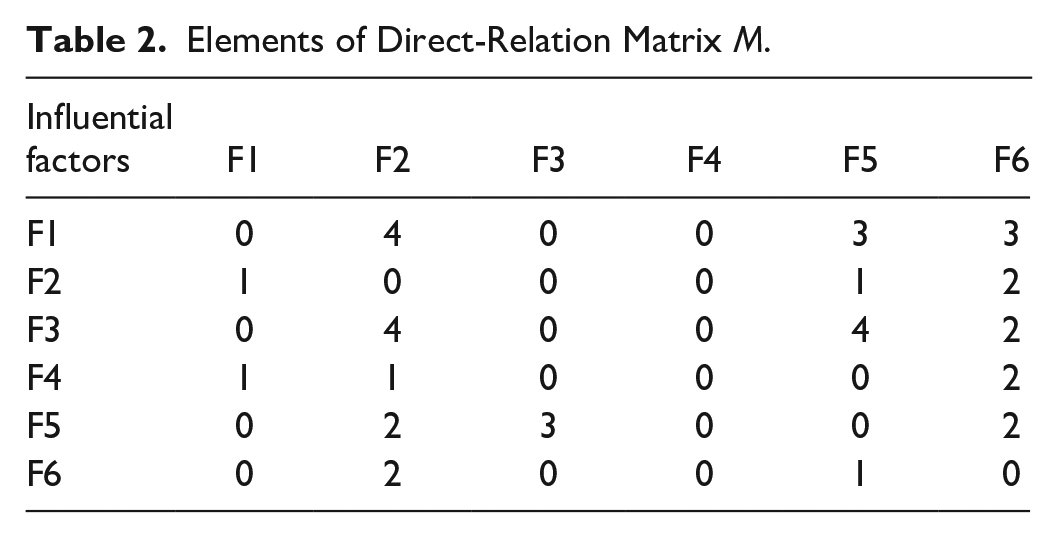
The Delphi experts grading method is used first to obtain the direct relations between the six influential factors as the initial data of the DEMATEL analysis. The matrix M is shown in Table 2. In Table 2, the 4 in Row 1 and Column 2 means that F1 exerts a very strong influence on F2.
Elements of Direct-Relation Matrix M.
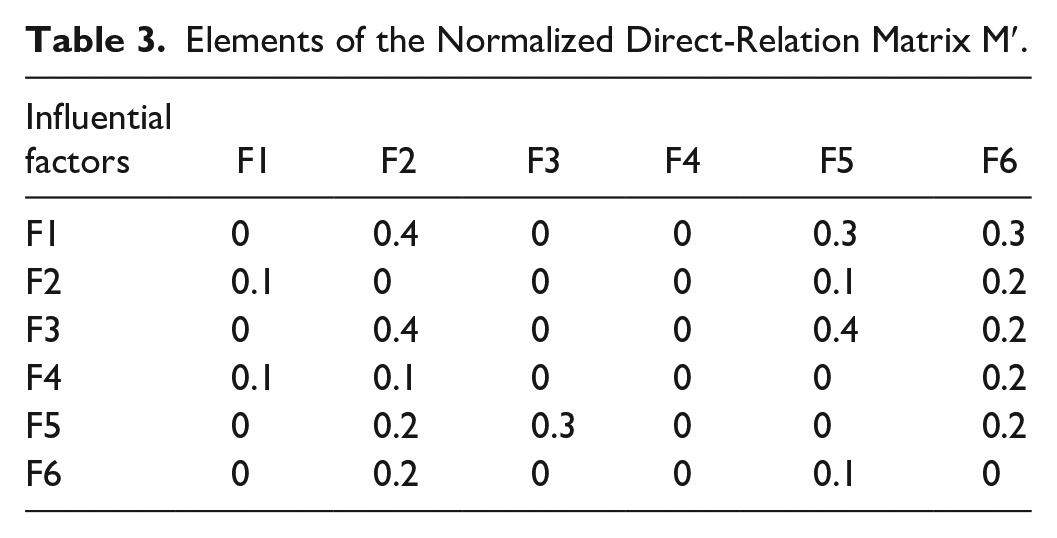
The elements of M' are given in Table 3. The elements of
Elements of the Normalized Direct-Relation Matrix M′.
Elements of

Elements of

Elements of the Total Influence Matrix (DIRSM)

Note.
Furthermore,
Prioritizations of the Influential Factors Using the DEMATEL Method.
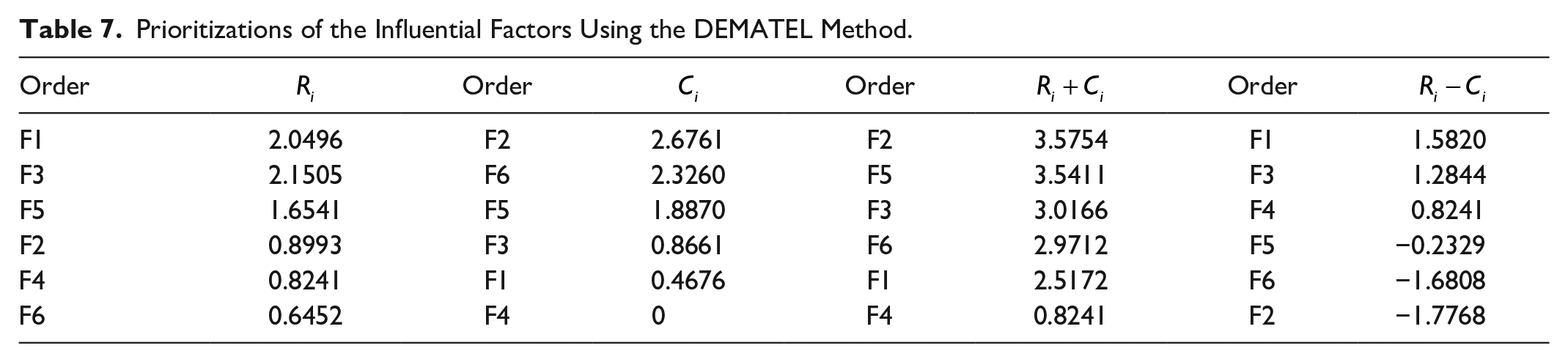
The factors are arranged in descending orders in the values of
Factor F1 (sharing bodies) has the largest value of
Because
In conclusion, the factor of sharing bodies (F1) has the strongest influence on other factors with a severity of 1.5820. The factor of information demands (F2) has the strongest relations with the other factors and receives the most influences from the other factors. Consistent with some previous studies (Kumi & Sabherwal, 2019), the factor of sharing bodies plays an important role in information-sharing in virtual communities. For instance, in online interactions, reputation significantly affects online social decision-making (Duradoni et al., 2020). Some sharing bodies will keep providing information in the virtual community continuously to obtain or maintain their reputation.
The Realization Mechanism of Sustainable Information-Sharing in Virtual Communities
Through the above analysis, the realization of information exchange and/or sharing can be stated as follows. Knowledge/information carriers bring some strains first, that is, they release some interesting information or bring up some hot topics to attract the individuals to browse, share, and discuss in the virtual communities. The information is then circulated in the virtual community and transferred between the members. In the process of interaction, some new information turns into new strains triggering a new round of fermentation.
For instance, Ding Xiang Yuan (DXY, http://www.dxy.cn/) is a popular virtual community in China, wherein people, especially doctors and experts in medical fields, share health information with others. DXY consists of many sections, such as DXY·BBS and DXY·DX Doctor. At the beginning of the COVID-19 outbreak, DXY launched a topic of COVID-19·Global Pandemic Real-Time Report (https://ncov.dxy.cn/ncovh5/view/pneumonia) in the DXY·DX Doctor section, which has become the strain attracting individuals to interact with others. Focusing on the topic of COVID-19, sharing bodies browse, transfer, and discuss the information provided in DXY. In the process of interaction, a lot of information is generated by individuals. For example, someone posted a message saying that people will get infected by taking an elevator. Because people care about this topic, this new information became a new strain and, therefore, attracted individuals to interact with others continuously. A new rounds of information sharing were then triggered. Hence, as long as new strains are generated from time to time, information-sharing in the virtual community will be sustainable.
In the whole process, the communication mechanism and the management of the platforms act as fermentation enzymes. The enzymes handle the conflicts between the individuals and enhance the trust among the main participants to guarantee the quality and the efficiency of the interaction. At the same time, different conditions about intellect and cognition levels of the individuals, the culture and climate of the platform, and the comments from outside all affect the realization of sustainable information-sharing. After several rounds of interactions, participants in the virtual community get more information and improve their perception and recognition levels.
In the previous example, the manager of DXY set up many measures to promote the members’ sustainable information-sharing behavior in DXY. For example, member reward points are given to the individuals who contribute to DXY. The sharing bodies can enjoy benefits in DXY by using member reward points. The reward point policy is a mechanism to encourage more individuals to participate in information-sharing and to help members develop a sense of belongingness to DXY, which plays the role of fermentation enzymes.
The four stages of realization of sustainable information-sharing in virtual communities
Referencing to the SECI model (Nonaka & Takeuchi, 1995) and considering the characteristics of information-sharing in virtual communities, the realization process of sustainable information-sharing is divided into four stages: externalization, diffusion, internalization, and creation. The information in virtual communities is provided by the participants, and only when the information owned by the individuals is transferred into virtual communities, can the information be diffused among and selectively absorbed by the individuals and, therefore, can the new knowledge be created. Hence, although externalization is designated as the starting point, these four stages are not isolated but spirally interconnected. These stages are intuitively presented in Figure 4.

Spiral fermenting model of sustainable information-sharing in virtual communities.
The first stage is externalization. Knowledge/information carriers release some hot or interesting topics to attract individuals to browse, share, and discuss. In this stage, the individuals’ personal information and knowledge are transferred into the platform (Cress & Kimmerle, 2008). Deeper processing and clarification are required in the stage of externalization (Flower & Hayes, 1980; Webb, 1982). The information presented in the virtual community exists independently from the members who created it and develops in a way that is determined by the related knowledge of the participants. The information in the virtual community is closely related to the contributors’ individual knowledge. A participant can make contributions to a virtual community only if he or she has corresponding knowledge about the topic. Of course, the information presented in the virtual community is not necessarily exactly the same as the knowledge in the contributor’s mind, but is similar to a certain degree (Cress & Kimmerle, 2008). A person’s knowledge is reflected in the virtual community. In the example mentioned above, attracted by the COVID-19 topic, the message of “people will get infected by taking an elevator” was transferred into DXY. This is the stage of externalization. Someone with corresponding knowledge about the coronavirus transferred the knowledge in his or her mind to DXY and this knowledge is then circulated in DXY.
The second stage is diffusion. After externalization, the information in the virtual community exists independently from the knowledge of the participants in their minds. Knowledge transfer between individuals takes place when members have the opportunity to communicate within the virtual community under the guidance of the information strains. The members can obtain the needed information provided by other members and stored in the database of the virtual community. In this stage, the information is diffused to the members in the virtual community through the network. More and more individuals get the information that they care about, and more members thus have more information. Enzymes are important in this process to promote information diffusion. For instance, in the previous stage, the information of “people will get infected by taking an elevator” has been posted in DXY, which exists in the database of DXY rather than in the minds of information providers. In the diffusion stage, this message is browsed, transferred, and discussed by sharing bodies in DXY. Sharing bodies thus have this message along with the relevant information generated during the interaction.
The third stage is internalization. After obtaining the information in the virtual community, individuals have to process the information and integrate it into their original individual knowledge. In this stage, the individuals selectively absorb the information and knowledge received from the virtual community and develop new knowledge, that is, using the information received from the virtual community to expand their own knowledge. The information and knowledge of the individuals in the virtual community thus are enriched. Through internalization, the related cognitive system of the individuals is expanded. For instance, the sharing bodies have received the information of “people will get infected by taking an elevator” in the previous stage. After receiving the information, sharing bodies integrate it into their original individual knowledge. Some of them think it is true or at least partially true while some others think it is false or it is a rumor. Sharing bodies then selectively absorb the information and their related cognitive system about COVID-19 is expanded.
The fourth stage is creation. The individuals study and make more use of the information. The processes of internalization and externalization provoke these individual learning processes (Cress & Kimmerle, 2008). In the process of learning and collaborative knowledge-building, new knowledge, especially emergence knowledge, can be developed, which was formerly neither part of their personal knowledge nor part of the virtual community knowledge (Holland, 2000; Johnson, 2001). These new creations of knowledge can become new knowledge strains when they are externalized and introduced into the virtual community. Until then, a new circle of information fermenting begins. In the example of DXY, sharing bodies believing the information of “people will get infected by taking an elevator” begin to make more use of this information in this stage. For example, some sharing bodies throw out a suggestion that you can wrap your fingers with a tissue before touching the buttons of the elevator as a good alternative if you do not have gloves. New personal knowledge is then developed. In fact, some people have actually taken this advice in their daily lives.
These four stages of spiral and sustainable processes are not isolated but interconnected. If there are enough strains generated in the process of interaction, many rounds of fermentation will be triggered and information-sharing in the virtual community will keep going. However, if the sharing bodies do not continuously generate strains, information-sharing in the virtual community will suspend, resulting in unsustainable information-sharing. Through sustainable information-sharing, the sharing bodies in the virtual community get new information and knowledge about interesting topics and then amend their original knowledge. Consequently, their perception and recognition levels about the related topics improve in a form of spiral evolution.
The guide role of the “strain” in the fermentation
The most important trait knowledge of a “strain” is that it contains knowledge genes that are a kind of idea and rational systemic knowledge that can be duplicated and inherited (He, 2002). It can grow and change when activated by outer demands. Based on the knowledge fermenting theory, knowledge bacterial strains, as the source of organizational learning, guide the fermentation directions (He, 2002). Affected by the surrounding environment, some new information and new ideas, acting as the “strains” of the fermentation, trigger the growth of the knowledge in the virtual community. A series of knowledge-processing activities happen under the guidance of knowledge strains, including knowledge acquisition, knowledge choosing, knowledge transfer, knowledge control, and knowledge coordination (Holsapple & Singh, 2003). Therefore, the knowledge strains in a virtual community determine why and how knowledge is fermented in the virtual community. If the knowledge strains change, the direction and result of knowledge fermenting will also change.
The quality of the knowledge strains is very important to the sharing activities in virtual communities. The DEMATEL analysis results indicate that knowledge strains have the strongest relations with the other factors and receive the most influences from the other factors. Although members in a virtual community provide knowledge strains, not every member in the community has the scientific recognition. The individuals in a virtual community have different abilities to identify, learn, and absorb information. Some false and exaggerated information will be inevitably input into the virtual community, which will guide the information diffusion to wrong directions. Therefore, if these false knowledge “strains” cannot be timely controlled, false information will spread quickly through the network and can diffuse as true information by many people without enough scientific recognition. A vicious cycle then may form. As a result, more people will be misled by the false information and the purpose of communication is failed to achieve. Information quality is an important antecedent for the success of an information system (DeLone & McLean, 2003). If information in a virtual community is unreliable or members think that information quality is unreliable, participants may stop participating in information-sharing in the virtual community (Liu et al., 2017). Hence, it is important for the managers of the virtual community to pay special attention to the “strains” by monitoring the fermenting direction. Hot topics that are widely browsed, forwarded, and discussed should be monitored timely. Sensitive information that is contentious to trigger fermenting should also be paid more attention. If the strains mentioned above are involved in scientific knowledge-sharing or rational discussion, the managers of the virtual community should encourage the sharing behavior of the participants by implementing reward mechanisms. However, if the strains are found to be rumors or false information, or the discussion becomes irrational, the managers of the virtual community should prevent the fermenting of such information immediately. For instance, a message about “drinking tea could prevent COVID-19” was posted into DXY, which triggered a new round of fermentation. The message was widely browsed, forwarded, and discussed in the virtual community. In fact, this was a rumor. However, many people received the information and believed that it was true owing to the lack of sufficient scientific recognition. The fermentation triggered by this message caused panic tea purchasing and tea hoarding in real life. In addition, if many pieces of information in DXY turn out to be rumors, the virtual community will gradually lose trust from the members and the members will stop information-sharing in DXY, and then information-sharing in DXY will become unsustainable.
The catalytic role of enzyme in the fermentation
Knowledge enzyme is the promoting factor of knowledge fermenting just like catalyst in biochemistry reaction processes (He, 2002). Generally, knowledge enzyme refers to the organization management and coordination mechanism of knowledge management in the virtual community. The speed of knowledge fermenting can be greatly increased, and the cost of organizational learning can be significantly reduced owing to the existence of knowledge enzyme. Enzyme is very important for the fermentation. In the DEMATEL analysis, communication mechanism (enzyme) has a severity value of
Many problems exist in the process of information communication in the virtual community, needing the coordination of the enzymes. First, the participants in the communication have different intellect backgrounds on the interested issues and varying abilities in identifying and learning the available information, causing different influences on sustainable information-sharing in the virtual community. Second, the trust relationship between the members in the virtual community is relatively weak compared with that in real life. However, trust positively affects the knowledge-sharing behavior of the members in virtual communities (Kim et al., 2012; Lin et al., 2009). The creation and existence of trust in the virtual community can create a friendly sharing atmosphere that facilitates sustainable information-sharing. Third, members will reasonably estimate the value of the information when they search for information in or receive information from the virtual community (Zha et al., 2015). Therefore, information quality is important for sustainable sharing. However, the information in a virtual community is not all of high quality. Moreover, some members may deliberately publish some false information into the virtual community driven by some personal interests. Therefore, the quality control of the information in a virtual community is also very important. The information with high completeness, accuracy, and currency is of high quality (Zha et al., 2015), which the managers of the virtual community should encourage the participants to share. At the same time, the managers of the virtual community should penalize the individuals who publicize rumors or disperse information of poor quality. Moreover, interactions in most of the virtual communities are not active enough. All these problems exert negative influences on information-sharing in virtual communities and, therefore, need to be resolved by knowledge enzymes.
The mechanisms of trust building, the direction of the public opinion guiding, the quality of the information controlling, and the stimulus of information fermenting are the knowledge enzymes in the platforms. These enzymes are the catalysts of information-sharing and help improve the efficiency and the quality of the interaction. This tells the managers of virtual communities that the management and the mechanism designation are very important to the communication which needs great attention.
In the case of DXY, in addition to the member reward point policy mentioned above, a reputation mechanism is also designed to encourage members to share information continuously. For instance, the Ding Xiang List of Outstanding Contributors show 20 most influential contributors and 20 most popular posts every week. Encouraged partially by attaining reputation, members keep making contributions to DXY. Moreover, an information control mechanism is also designed in DXY. DXY established many rules to regulate information publishing. Participants publishing too much information of poor quality will be penalized by removing their posts and suspending their accounts for at least a month. Those posting rumors multiple times will be sanctioned by closing their accounts. In addition, to prevent the fermentation of rumors, a special section is designed to dispel rumors. For instance, the information that “drinking tea could prevent COVID-19” was moved to the rumor dispelling section by the manager of DXY to stop the fermentation of this rumor. Rules for conflict resolution, trust enhancement, and continuous information provision, which are fermentation enzymes, are also designed to keep sustainable information-sharing in DXY.
The important role of the communication environment
The organizational culture, the human relations, and the external environment affect knowledge fermentation. Communication environment consists of the internal learning environment embodied into the enterprise culture and the external environment, including public policy, public affairs, organization climate, economic condition, and social culture. Communication plays a key role in optimizing the information fermenting course (Xiong & He, 2004). At the same time, communication environment with a value of
In a virtual community, as a form of virtual organization, the realization of information-sharing is easily influenced by the environment. The external environment, such as public affairs, public policy, and risk perception, would turn into strains and is introduced into the virtual community, which will attract the members to learn, adapt, comment, and query, thus triggering information fermenting. For instance, the outbreak of COVID-19 and the situation updates have a great influence on information-sharing as a topic of DXY. At the beginning of the COVID-19 outbreak, information-sharing in DXY was mainly related to the situation updates in Asian and the knowledge about COVID-19. After the World Health Organization (WHO) declaration of the coronavirus outbreak pandemic, the topics sharing about COVID-19 in DXY are mainly related to the situation updates of Europe and North America.
Internal environment, for example, organizational climate, exerts great influence on the improvement of organization performance (Akbaba & Altındağ, 2016). Integrating online justice is a good organizational climate for motiving the participation of the members in the virtual community. Within a virtual community, members who perceive greater procedural justice tend to be more motivated to participate in information-sharing. In contrast, conflicts among members or unfair regulations on postings likely discourage users from sustainable information-sharing in the virtual community (Chou et al., 2016). In addition, common language plays a positive role in improving the quality of information-sharing (Chiu et al., 2006). Members in a virtual community have different levels of knowledge, which creates obstacles for smooth communication. Therefore, the development of a common language is helpful for creating a good sharing environment. In addition, fairness (Alsharo et al., 2016; Chou et al., 2016) and sense of belongingness to the virtual community (Tonteri et al., 2011) are also important. Moreover, the management style of the managers and the comments to the platform from the members, among others, also influence the fermentation effects. DXY has created a relatively casual, fair, and friendly information-sharing atmosphere, which is helpful in motivating members to keep sharing information.
Summary
Six main influential factors are identified based on the knowledge fermenting theory, including sharing bodies (knowledge carriers, F1), information demands and interaction topics (knowledge strains, F2), communication mechanism (knowledge enzyme, F3), technical support (fermenting tools, F4), communication environment (fermenting environment, F5), and platform scales (fermenting space, F6). Results of the DEMATEL analysis indicate that the factor of sharing bodies (F1) has the strongest influence on other factors with a severity of 1.5820, and the factor information demands (F2) has the strongest relations with the other factors and receives the most influences from the other factors. The prioritization of these six factors is F1 ≻ F3 ≻ F4 ≻ F5 ≻ F6 ≻ F2 ranked using the values of
Under the combined influences of all these factors, the participants communicate with each other just like biological fermentation being conducted multiple times. The fermenting process can be divided into four stages, that is, externalization, diffusion, internalization, and creation. After externalization, the information exists in the virtual community independent of the knowledge in the minds of the members. In the diffusion stage, interpersonal knowledge transfer takes place. The information in the virtual community is selectively absorbed and the members’ cognitive system is expanded in the internalization stage. Emerging knowledge is developed in the creation stage. After repeated fermentation, information and knowledge are renewed (fermenting outcomes), and the individuals’ recognition levels improve after absorbing the new information and knowledge.
Discussion
The aim of this study is to identify the key influential factors, analyze the prioritization of them, and explore the realization mechanism of sustainable information-sharing in virtual communities. Starting from the similarity between sustainable information-sharing and biological fermenting, the present work creatively introduced the knowledge fermenting theory. Based on this theory, six factors influencing the realization of sustainable information-sharing in virtual communities were identified. The prioritization of the six influential factors was then analyzed using the DEMATEL method. On this basis, the realization mechanism of sustainable information-sharing in virtual communities was elaborated from four aspects, including the spiral fermenting process, the guide role of “strain,” the catalytic role of “enzyme,” and the effect of environment, combined with the SECI model. A spiral fermenting process of sustainable information-sharing in virtual communities was first proposed, which includes four stages, that is, externalization, diffusion, internalization, and creation. Then, the guide role of “strain,” the catalytic role of “enzyme,” and the effect of environment were expounded.
Virtual communities provide a virtual space for individuals to share information speedily and conveniently. Sustainable information-sharing requires the joint effort of the stakeholders together in a virtual community. The results of the present work provide some managerial implications to the managers of virtual communities and of business firms and, at the same time, give some inspirations to individuals or users.
The managers of virtual communities should pay close attention to the six influential factors to maintain the healthy development and sustainable prosperity of the information-sharing activities in virtual communities. Successive high-quality information sources are the prerequisite of sustainable information-sharing. Information is provided by the information carriers. According to the DEMATEL analysis results, sharing bodies have the highest prioritization. It is important for the managers of the virtual community to motivate the sharing intention of the members participating in the provision of high-quality information. Prestigious scholars in different areas can be invited to the virtual community to bring in high-quality and informative topics, which, at the same time, can act as knowledge strains to trigger a new wave of fermentation. Furthermore, owing to the different types of information carriers with different knowledge levels in a virtual community, a common language should be developed to help the participants communicate smoothly with each other (Chiu et al., 2006) and the information quality provided by the carriers needs to be controlled to a high level. Members are attracted by high-quality information satisfying their needs (Jacobsen et al., 2017). Therefore, only when a virtual community becomes a valuable source of information, can it attract individuals seeking and learning related information from the community and can it attract individuals possessing the required knowledge to contribute useful information (Kuttschreuter et al., 2014).
Continuous and sustainable interaction requires constant feedback on newly provided information, which is the role played by knowledge strains. Knowledge strains should be introduced into the virtual community to stimulate discussions and communication. Some hot and sensitive topics interested by most members, for example, topics on current public affairs and interesting issues, can be introduced into the virtual community by the managers of the virtual community. The management techniques and the implementation mechanisms of the virtual community are the enzymes. Good mechanisms can encourage the information-sharing activities among the members. Off-line activities and reward mechanisms can be effective tools. At the same time, a user-friendly platform should be designed and an easy-to-use interface should be adopted. A friendly environment with trust (Tsai et al., 2014) and sense of belongingness is also conducive for information-sharing (Park et al., 2014).
Virtual communities provide convenient platforms for users to communicate with each other, help them timely solve their problems encountered, and improve their knowledge level without geographical restrictions. Every individual participating in the interaction is a knowledge carrier. Everyone should provide true and high-quality information and help detect and prevent the spread of false information. As a result, individuals would improve their information level from the interaction and participation in sustainable information-sharing.
Information-sharing in virtual communities can provide business firms an opportunity to understand the customers’ needs and demands. Meanwhile, users in virtual communities are often creative in problem solutions (Franke et al., 2006). Hence, a virtual community is a potential source of new ideas and knowledge that can be used for collaborative innovation between business firms and customers (Poetz & Schreier, 2012). As free and relevant information is available from many virtual communities, manufacturers could build trust with their customers by sharing more related information of high quality and could use the user-generated information to gain customer insights, or alternatively could create their own virtual communities for interacting with their customers.
Conclusion
This study analyzed the influential factors and the realization mechanism of sustainable information-sharing in virtual communities. Six influential factors were identified, including platform scale, sharing bodies, interactive topics (strain), communication mechanism (enzyme), technical support, and sharing environment. The prioritization of the six factors was analyzed. The results indicate that the factor of sharing bodies has the strongest influence to the other factors with a severity of 1.5820; the factor of information demands with the highest value of
The contribution of this study is threefold. First, by focusing on sustainable information-sharing rather than just information-sharing in virtual communities, the present work introduced the knowledge fermenting theory into the analysis which provides a new insight for studying the relevant issues from a biological perspective. Second, not only six main influential factors were identified based on the knowledge fermenting theory, but also the prioritization of them was explored the first time by applying the DEMATEL technique, which contributes to the further understanding of the relationships among the influential factors. Third, a spiral fermenting model was proposed which gives some new elaboration about the realization mechanism of sustainable information-sharing in virtual communities and may give a new insight to future studies.
Meanwhile, this study may have certain limitations and may raise possible future concerns. First, the initial data utilized in the DEMATEL method were given by experts according to their academic knowledge and experience which may have subjectivity. Fuzzy mathematics based on fuzzy set theory can be applied further to reduce the subjectivity and to fuzzify the scores provided by the experts (Wang, 2018). The initial data can be converted into triangular fuzzy numbers and then crisp values can be obtained by deblurring the triangular fuzzy numbers. Second, this work just proposed a theoretical model of influential factors of sustainable information-sharing in virtual communities. The influencing paths of sustainable information-sharing in virtual communities need to be investigated and confirmed by conducting an empirical study in the future. The behavior of the sharing bodies is very important to sustainable information-sharing in a virtual community. For instance, the lurkers (read-only participants) and the posters show different behaviors and play different roles in sustainable information-sharing in a virtual community. Focusing on the information-sharing behavior of the lurkers and the posters in virtual communities, structural equation models can be used to test the influencing paths and effects of the influential factors on the sustainable information-seeking behavior and the sustainable information-providing behavior. In addition, issues about how to control the quality of the information shared by the members in virtual communities and how to steer the sustainable information fermenting in right directions need to be explored further in future works.
Footnotes
Acknowledgements
The authors would like to thank the article editor and five anonymous reviewers for thoughtful comments that greatly improved the article.
Declaration of Conflicting Interests
The author(s) declared no potential conflicts of interest with respect to the research, authorship, and/or publication of this article.
Funding
The author(s) disclosed receipt of the following financial support for the research, authorship, and/or publication of this article: This work was supported in part by Social Science Planning Project of Shandong Province (Grant No. 18DGLJ09), General Financial Grant from the China Postdoctoral Science Foundation (Grant No. 2017M622267), Shandong Government Sponsored Study Abroad Program Scholarship (Grant No. 201801030), National Natural Science Foundation of China (Grant No. 71874102), Nature Science Foundation of Shandong Province (Grant No. ZR201911060012), and The Humanities and Social Sciences Project of the Chinese Ministry of Education (Grant No. 18YJC630273).
