



Abstract
This study extended the Expectancy Confirmation model (ECM) to examine the factors that influence online learning stickiness. The structural equation modeling was used to reveal the relationships among the factors through a survey of 395 online consumers. The findings indicate that learning stickiness was significantly impacted by switching cost and satisfaction. Learners’ perceived usefulness, perceived interactivity, and expectation confirmation have a significant effect on their satisfaction. Furthermore, learners’ perceived usefulness was significantly influenced by their perceived interactivity and expectation confirmation. The results of this research also provide sustainable development directions for online platforms, such as the quality of curriculum design and the level of interaction between curriculum platforms.
Introduction
By 2020, 91% of registered learners worldwide (over 1.6 billion people) have been affected by COVID-19 (UNESCO, 2020). Most countries have offered emergency remote education (ERE) as an alternative to attending classes in-person. ERE alleviates the interruption of education brought by the epidemic but also reveals some problems in current education. The fact that online education is seen as an emergency rather than a norm also highlights the gaps and systemic limitations of the existing education system. The World Economic Forum (WEF) says the present education system is in urgent need of reform because it is in danger of becoming irrelevant (Karthik, 2020).
Therefore, the post-epidemic era is bound to be accompanied by the transformation of the education paradigm, and online education will be as normal as face-to-face education.
The epidemic has not only provided school administrators, teachers, and learners with opportunities to fully understand online learning but has also provided opportunities for the sustainable development of online learning. But making online learning sustainable is fraught with obstacles, and high dropout rates have long been a bane of online education. For example, an MIT study found an average dropout rate of MOOCs of 96% over 5 years, although that has done nothing to stop demand (Lucy, 2020). So what kind of online course learning system can encourage online learners to learn voluntarily, actively, and continuously? And how can one evaluate the student’s desire to continue taking a certain course? It is important to explore the reason why students don’t desire to continue learning from their perspective. This is of great significance for improving the quality of online courses, teaching strategies, predicting students’ learning status, and the sustainable development of online learning systems.
Researchers have begun to use the concept of stickiness to explain why users continue to use the learning management systems to which they have become accustomed (Geer & Barnes, 2006). LMSs are often widely defined as systems like Moodle, Edmodo, and Google Classroom that provide online education services for learners, educators, and administrators (Aldiab et al., 2019). Stickiness is the habitual return to the resources that an individual originally used. In the context of active learning, learners can produce a sticky effect on an online course, indicating that the course can meet their learning needs. According to Hsu and Liao (2014), when users become sticky to the website, they may spend longer time perusing than a usual user and may dig deeper into a site than other participants. In other words, when learners become sticky to the learning platform, they will be more deeply involved in the use of the platform. For example, they may earnestly complete homework and conduct in-depth topic discussions with teachers and students. A lengthier visit time can increase user engagement and give users additional time to accomplish activities or tasks (Huang & Lin, 2011). Learning stickiness may signify the likelihood of online learning (Zauberman, 2003) and help to evaluate the quality of learning platforms (Geer & Barnes, 2006). Learning is very powerful when the learner is not aware that it is happening (Dancer, 2005). That is to say, when the learner sticks to the learning platform, his/her learning activities are habitual, and in turn, this conscious learning state promotes the real occurrence of learning. This state of unconscious entry into learning is one of the external manifestations of learning stickiness.
Most current research in this area focuses on learners’ will and behavior, such as learner loyalty, satisfaction, and continuity (Chen & Chengalur-Smith, 2015; Martínez-Argüelles & Batalla-Busquets, 2016; Waheed et al., 2016). These studies, which focus on specific aspects of online learners, lack comprehensive analyses from the perspectives of learning stickiness. Studies have used students’ stickiness of Web-based English Learning (WBEL) to assess the effectiveness of the WBEL system implementation (Chen, 2014; Xu et al., 2017). Studies on media stickiness have direct implications for the study of online learning stickiness to better understand online learning platforms and students’ learning state. (Geer & Barnes, 2006).
The idea of stickiness, as applied broadly to a digital environment, could be directly implemented to monitor online learning tasks in a way that will conclusively improve learning design (Robinson & Cook, 2018). Therefore, research on learners’ learning stickiness is of great importance to understanding learning states. Therefore, the purpose of this study is to extend the expectancy confirmation model (ECM) to explore the factors that influence the learning stickiness of college students’ online learning from the perspective of online learners. This study aims to provide targeted and sustainable development suggestions for the design of online courses, course platforms, and the improvement of students’ online learning.
This study proposes three research questions that seek to identify the influencing determinants that affect college learners’ online learning.
Q1: What are the influencing factors of students’ online learning stickiness?
Q2: What are the relationships between the various influencing factors?
Q3: How can online learning stickiness be improved for college students?
Literature Review
Learning Stickiness
The current research follows the definition of stickiness from the perspective of the website and user. First, from a website perspective, stickiness is a property of a website or a characteristic of media, which describes how much attention a website receives from its user (Friedrich et al., 2019). The richer the website content, the better the website stickiness (Davenport & Beck, 2000). Highly sticky websites will cause consumers to repeatedly visit or purchase website products (Zott et al., 2000). Lin (2007) pointed out that stickiness refers to the ability of a website to re-engage users and increase the continuance of each stay. In this information age where customers are always searching and viewing relevant information to make appropriate decisions and show rational behavior (Cheng et al., 2017), website stickiness is the ability of a website to enable users to transform information into actions. Therefore, website stickiness is a significant factor when evaluating the success of a website (Lin, 2007). Secondly, user stickiness is also defined by the behavior performance characteristics of sticky users. First of all, in terms of users’ stay time, users will stay on a website for a long time during a session or a period (Lin et al., 2010). Stickiness reflects the repeatability of a user’s access to, reliance on, and dependence on a website (Hallowell, 1996; Xu & Liu, 2010). Besides, stickiness is an indicator of a user’s loyalty to a website, indicating the likelihood that a user will reuse a website or product (Zauberman, 2003). An extended concept of stickiness is learning stickiness, which refers to students’ repeated continuous use of products and is used by researchers to measure students’ participation in online learning (Robinson & Cook, 2018).
We find that the above definitions of user stickiness only describe stickiness from the perspective of behavior. They believe that user stickiness includes the number of times users visit websites and the length of time they visit them, as well as the number of times they buy products (what can be called the degree of participation). However, they ignore the importance of behavioral intention. The Theory of Reasoned Action believes that the user’s behavior depends on the user’s behavioral intention. So, there is only stickiness between learners and online platforms if learners have a strong willingness to use them.
In other words, stickiness should be a two-way relationship between a learner and the website. “Ideally, in a learning environment one wants the ‘Velcro’ sort of relationship, where both the student and the activity each provide the relevant surface to which to adhere; for the student to stick to the learning and the learning to ‘stick’ to the student” (Robinson & Cook, 2018, p. 5). Stickiness is a kind of mutual relationship between the learning environment and the students, not just the unilateral loyalty of one party to the other. That is to say, learners are not only attracted by the online courses that they enrolled in or in which the tool is used.
In conclusion, this study defines learning stickiness as the mutual attraction between learners and learning platforms, which is manifested as learners’ repetition, long-term visits, and active participation motivated by high learning willingness.
Theoretical Background
Learning stickiness, as one of the important external realizations of students entering the state of unconscious learning, plays an important role in predicting students’ learning states. Learning stickiness has some imperative implications. Firstly, learning stickiness could predict the likelihood of learners’ active online learning. Secondly, learners’ learning stickiness is closely related to their grades. Online learning stickiness has an important influence on the learning performance of learners with a high stickiness index, while there is no effective relationship between learners with a low stickiness index (Xu et al., 2017). Finally, the extent to which learners accept, reuse, and continue to use the platform is important for judging the quality of online learning platforms (Robinson & Cook, 2018). However, what factors influence learning stickiness?
The past research on the factors affecting user stickiness in network systems was mainly based on two theoretical models: the technology acceptance model (TAM) and the expectation confirmation model (ECM). Studies have shown that the model is suitable for most network technology environments, including online learning systems (Gefen et al., 2003). However, in a study on the applicability of TAM (Davis et al., 1989) usage, it was found that this model is suitable for measuring the technology acceptance status of new users or inexperienced users (Karahanna et al., 1999). However, the factors that influence users to endure using the technology after they have accepted it should also be considered. Many researchers gradually realized the need to grasp the behavior of users after acceptance. Early 21st century, experts and researchers led by Bhattacherjee believed that the acceptance and continued use of information technology are different. They continued to explore a new theoretical model of continuous use based on the expectation confirmation theory (see Figure 1). Bhattacherjee (2001) believes that the success of a website depends not only on the user’s first use but also on their continuous use. The continuous use model of information systems based on the expectation confirmation theory has made a great theoretical contribution to the research of users’ continuous use. This model pays close attention to information behavior research after user acceptance. It can also explain the problems that the TAM cannot explain, such as the inconsistency as to which users continued to use the systems after initial acceptance. Based on the theoretical framework of ECM (Bhattacherjee, 2001), constructs such as user satisfaction and expectation confirmation level were introduced to enrich research on users’ continuous use. Among them, user satisfaction emphasizes an emotional or psychological state, which is the basis for maintaining long-term user stickiness. To make up for the fact that the TAM does not take into account that user expectations will potentially change after acceptance, the perceived usefulness of the TAM is the ability to determine user expectations after acceptance, and that the variable of perceived usefulness affects user information behavior before and after acceptance.

Expectation-confirmation model of information systems (IS) (Bhattacherjee, 2001).
The original ECM (Bhattacherjee, 2001) supported a simple assessment of users’ willingness to continue using a system without too much complex environmental impact (Halilovic & Cicic, 2013). However, the learning environment is not only affected by an individual’s traits and desires. Learners’ learning is closely connected with aspects of the external environment, such as teachers, partners, and platforms. Therefore, the use of ECM models in complex scenarios is necessary for model extension.
According to decision theory (Li, 2014), the trend of learners’ attitudes about using online learning platforms is “acceptance-continuity-stickiness.” Shao et al. (2020) found that experienced users are more probable to be influenced by the degree of website interactivity while new users are more affected by basic functions such as interface navigation. Hence, learners’ online learning states can be divided into three stages: the rational stage, the emotional decision-making stage, and the habitual unconscious stage (Figure 2) (Li, 2014). The factors that influence learners at each stage are different.

Learning states.
In the rational decision-making stage, learners who have just started using online learning platforms are not familiar with the process, including the settings of the web pages and the course resources. The learners’ error tolerance to the online learning platform is relatively low, and thus learners make rational decisions as to whether to continue using the platform based on factors such as the platform’s interactivity and usefulness. Thus, the main question at this stage is whether learners can accept the learning platform. Among the external variables that influence learners’ perceived usefulness, perceived interactivity is the most important one, especially in an online learning setting in which it is not as easy to communicate as in face-to-face education (Appana, 2008). Therefore, this study incorporates perceived interactivity as an external factor that influences learners’ perceived usefulness into the constructive model.
In the emotional decision-making stage, learners are already highly experienced in using online learning platforms. Their personal and subjective experiences have become dominant factors in decision making for online learning. This feature refers to the degree to which learners’ expectations are satisfied with the online learning platform before they use it (i.e., the degree to which expectations are confirmed), and the degree of satisfaction generated during the use of the platform determine their behaviors and intentions. According to the expectation confirmation theory (ECT) by Oliver (1980) and the expectation-confirmation model (ECM) of Bhattacherjee (2001), the factors that influence learners’ learning stickiness at this stage are expectation confirmation and satisfaction.
Learners who are in the habitual and unconscious stages are accustomed to the learning environments provided by a platform and thus are reluctant to give up or switch to other platforms because they are unwilling to discard learning resources and connections. Therefore, the switching cost at this stage is an important factor that affects learners’ learning stickiness.
Based on previous research (Li, 2014), several models express different learning states, and the formation of stickiness is an extension of three states. This study integrated these three stages and explored the factors that affect online learners’ learning stickiness at each stage: perceived usefulness, perceived interactivity, expectation confirmation, satisfaction, and switching cost.
Research Model and Hypotheses Development
A model of the factors that influence learners’ online learning stickiness based on the ECT and ECM was constructed (see Figure 3). The model makes the following assumptions of effect, which is indicated by the unidirectional arrows.

The hypothesized research model.
Expectation recognition affects website users’ satisfaction and perceived usefulness (Bhattacherjee, 2001; Oliver, 1980). Craig et al. (2008) claimed that learners’ expectations and their experiences reduced students’ level of satisfaction. When the learners’ expectations of the online learning platform are high, they will tend to recognize the quality of the platform and have a high satisfaction level, and their perceived usefulness will be enhanced. This conclusion has also been tested in other areas of education. For example, Alshurideh et al. (2020) found that expectation-confirmation constructs affected perceived usefulness and satisfaction. Later, these three dimensions were found to have an important influence on students’ intention to use a Mobile Learning System. Besides, expectancy confirmation is considered to be one of the best predictors of perceived usefulness (Lv & Lv, 2020). Chen (2014) studied the influencing factors of student learning stickiness in an English-based online learning environment and found that learning expectations determine students’ learning satisfaction with WBEL. Therefore, the analysis makes the following assumptions about perceived usefulness:
H1: The expectation confirmation of an online learning platform will increase learners’ perceived usefulness.
H2: The expectation confirmation of an online learning platform will increase learners’ satisfaction.
Perceived usefulness refers to the learner’s view of the expected benefits of using online learning platforms. It is also the most basic demand of learners in terms of the functions of the learning platform. It mainly includes whether the learning platform has improved learner’s academic performance and learning efficiency. Zheng and Chen (2011) believe that perceived usefulness has an important effect on users’ satisfaction and long-term influence on network stickiness. This conclusion has also been verified in other studies. For instance, Lv and Lv (2020) believe that perceived usefulness and satisfaction are positively correlated with continued intention, thus improving user stickiness. Moreover, they incited that perceived usefulness had a positive effect on satisfaction. Xu and Liu (2010) found that the perceived usefulness of the website significantly positively affects online stickiness via users’ satisfaction. Researchers found users’ perceived usefulness positive influence on user stickiness in e-commerce (Polites et al., 2012). Davis believes that under the premise of focusing on performance evaluation, people’s attitudes and decisions on tools are mostly dependent on whether tools help them improve performance (Polites et al., 2012). Thus, the more helpful the learners feel the online learning platform is in improving their grades or meeting their learning needs, the higher the learners’ recognition of and satisfaction with the platform may be. Therefore, the analysis makes the following assumptions about perceived usefulness:
H3: Learners’ perceived usefulness of an online learning platform will have a significant effect on their satisfaction.
H4: Learners’ perceived usefulness of an online learning platform will have a significant effect on their online learning stickiness.
Student satisfaction reflects students’ recognition of the learning course quality of the learning platform, the teaching design level of teachers, and the fairness of the learning performance evaluation methods (Anderson et al., 2013). When learners are satisfied with the course quality, interaction design, and other resources within the online learning platform, they tend to have a pleasant emotional experience. Noel-Levitz (2009) found in his research on online learners that graduation rate is positively correlated with student satisfaction. Bhattacherjee (2001) has cited satisfaction as a highly positive influence on users’ will to use the platform. That is, when students’ satisfaction increases, the retention rate also increases (Hawkins, 2009). Continuous use willingness and frequent use behavior are just two of the external behavioral manifestations of learning stickiness. The stickiness status of users can reflect their degree of satisfaction (Yu et al., 2017). Lv and Lv (2020) also cited that satisfaction positively affected users’ stickiness. Lien et al. (2017) found that WeChat user satisfaction has a positive effect on its stickiness. Therefore, the analysis makes the following assumptions about satisfaction:
H5: The satisfaction of an online learning platform will increase learners’ online learning stickiness.
Wu and Wu (2006) believe that perceived interaction is the psychological state of learners in the process of interaction. The interaction on an online learning platform mainly includes human-computer interaction and human interaction. Both interactions affect user engagement (Jiang et al., 2010). A measure of perceived interactivity can be used as an indicator to distinguish successful and unsuccessful sites (Newhagen & Rafaeli, 1996). Therefore, perceived interactivity is an important factor for the platform as it influences the user’s perceived usefulness and satisfaction. For instance, users’ perceived interactivity had a positive influence on perceived usefulness in delivery applications (Lee & SooBum, 2017). The perceived interaction of mobile applications is an important antecedent to consumers’ perceived usefulness (Lu et al., 2019). Teachers’ perceived interactivity was strongly connected to the perceived usefulness of smart mobile devices (SMDs) (Leem & Sung, 2019).
Another area to address is the relationship between the user’s perceived interactivity and satisfaction. Perceived interactivity has a significant influence on users’ website satisfaction (Mero, 2018). Interaction between teachers and students increases learners’ online learning satisfaction (Vesely et al., 2007). Besides, the interactions between learner and teacher, and learner and learning platform are significantly positively correlated with user satisfaction (Anderson et al., 2013). The highly interactive learning platform reduces learners’ loneliness and increases their affinity for the platform. Thus, this study predicts that:
H6: A significant relationship exists between the perceived interactivity of an online learning platform and learners’ perceived usefulness.
H7: A significant relationship exists between the perceived interactivity of an online learning platform and learners’ satisfaction.
The opposite of stickiness is that learners perchance faithless, that is, switch to other products. The researchers point out that users’ switching costs can be increased through personalized web page settings, personalized recommendation services, peer communities (Wang, 2010). The discussion community and personalized learning space set up by the online learning platform allow learners to choose their circle of friends freely and to have a personalized space for learning. Learners face two clear consequences when switching to a new learning platform. First, the switchers have to spend time learning how the new platform works, and second, they lose their existing learning circle in the old platform. That is, the time, habits and other aspects that must be altered constitute the switching cost. The switching cost had a significant influence on the stickiness of web users so it can help websites create and retain competitiveness as well as sustainable development (Wang, 2010). Some researchers pointed out that to better improve the user stickiness of the website, the effect of conversion costs on stickiness should be deeply analyzed (Polites et al., 2012). A recent study showed that switching costs affect user stickiness in both the early and long-term phases of using WeChat (Zhang et al., 2019). Therefore, the analysis makes the following assumptions about stickiness:
H8: The switching cost of an online learning platform will increase learners’ online learning stickiness.
Methodology
Participants
In China, the users of online learning platforms are mainly college students, whose usage status represents the current situation of the majority of online course users. Therefore, the research is mainly to investigate the stickiness of online courses among college students. In view of this, the focus of this research is mainly on college students, although subsequent research may examine the differences between different learner groups, as well as the differences in learning stickiness between universities at different levels and locations in China as well as across the world. Given that most online learners in China are college students, the formal investigation of this study consists of college students who were randomly selected from a university in Northeast China. The chosen university is a typical public university that provides undergraduates with a wealth of online learning spaces and resources, such as China’s MOOC, EdX, Coursera, and other online learning platforms. Besides, students can freely choose the online courses offered by the school along with their interests and requirements. Learners have a wealth of online learning experiences; as such, they meet the profile of the desired survey participants. Specifically, this study conducts a random survey of the student who had just completed online courses at the end of their first semester.
Instrument Development
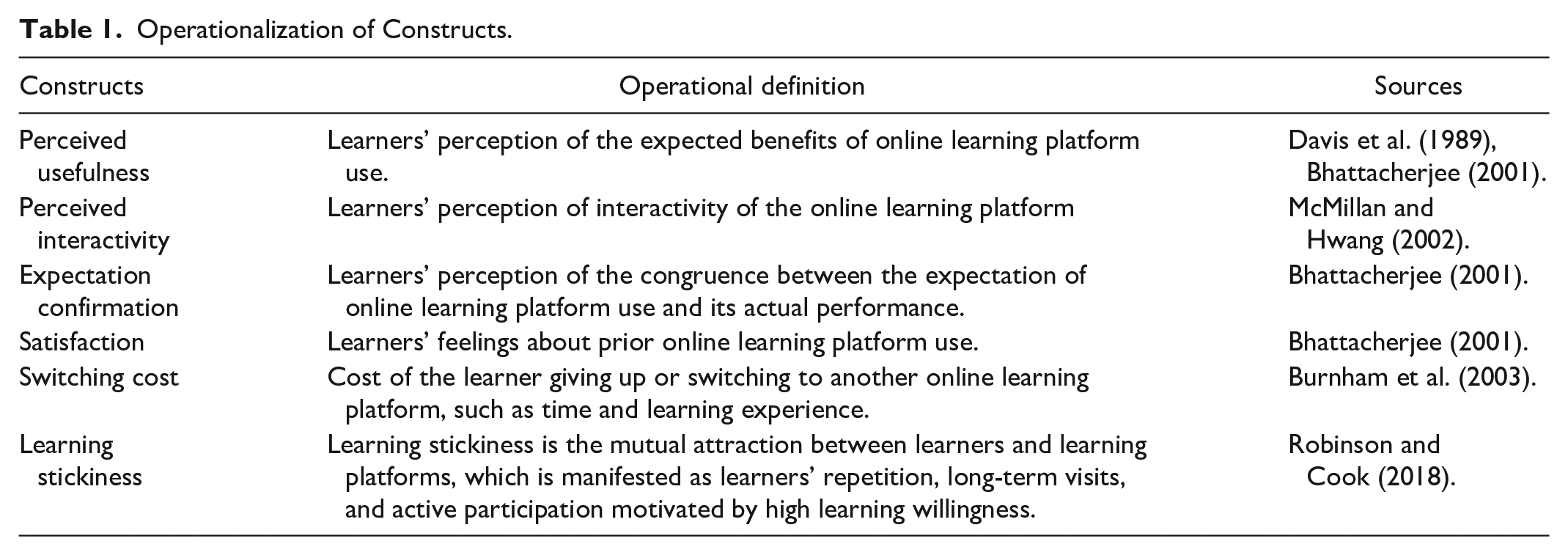
The study uses a questionnaire survey consisting of three parts. The first part of the questionnaire investigates the evaluation of five constructs, with 29 items extracted from previous research (McMillan & Hwang, 2002). The second part of the questionnaire is a survey of online learning stickiness (Lin, 2007; Lin et al., 2010; Zheng & Chen, 2011) with five online learning stickiness observation variables. The definition and source of each construct are shown in Table 1. All the items in the study were measured using a five-point Likert scale, ranging from 1 (strongly disagree) to 5 (strongly agree). The third part of the questionnaire measures the students’ characteristics and learning backgrounds, including gender, education level, learning platform, and frequency of online learning platform use. The design of the questionnaire is based on English literature which was translated into Chinese then used as a data collection tool for this study. Two experts were invited to verify the translation of the questionnaire, thus to make sure that the Chinese version is consistent with the original one.
Operationalization of Constructs.
Analysis Methods
Firstly, the validity of the questionnaire was evaluated by confirmatory factor analysis (CFA) by AMOS 18.0. The maximum likelihood method was used to estimate the parameters of the model. Then, the causal model was tested by the structural equation model (SEM).
Data Analysis and Results
Descriptive Statistics
This study received a sample size of 399 respondents. Data were expected to confirm construct validity when a respondent offered inadequate answers for each construct. A reverse question is set for each construct to ensure the construct validity of the questionnaire. This article finally conducted a statistical analysis of 395 questionnaires, and the effective recovery rate was 99%. Table 2 illustrates the sample demographics. In terms of the gender ratio, male students account for 51% and female students 49%, which is in line with the gender ratio of online learners in China in general (iResearch, 2018). The main online learning platforms for students were Edx (100%), China MOOC (46.8%), and Intelligence Tree (58.9%). Most of the respondents were using more than one learning platform. Also, all learning platforms were used frequently, with 234 people (59.2%) using them daily. The number of people who entered multiple times a week also accumulated to 134 (33.9%).
Descriptive Statistics of Participants.

Validity of the Questionnaire
395 questionnaires were entered into SPSS.23 software for factor analysis. The common factor was extracted by factor analysis and rotated by the maximum variance method. However, 10 cross-loaded items were deleted from the original pool of 34 items to obtain six common factors. Moreover, in Bartlett’s Test of Sphericity, the Kaiser-Meyer-Olkin (KMO) = 0.917, Approx. Chi-Square (χ2) = 4917.403, degree of freedom (df) = 276 and significance level (p) = .000 were obtained. This indicates that there are common factors among the correlation matrices. Besides, the factor loading of all common factors is greater than 0.6, and their cumulative explanatory variance accounts for 67.555% > 50% of the total variance, so the extraction of six common factors can be considered reasonable.
Validity of the Measurement Model
The measurement model included 24 items analyzing six latent constructs: perceived usefulness, perceived interactivity, expectation confirmation, satisfaction, switching cost, and learning stickiness. The suitability of the measurement model was judged using six measures of a good fit: Chi-square (χ2), degree of freedom (df), chi-square to the degree of freedom ratio (χ2/df < 5), root mean square error of approximation (RMSEA < .1), comparative fit index (CFI > .90) and the Tacker Lewis index (TLI > .90) with a 90% confidence interval (Hu & Bentler, 1999). However, the initial CFA showed that five items (PU2, PU3, EC3, LS3, and SC2) had large modification indices that affected the validity issues like convergent and discriminant validities. The re-specified measurement model justified the validity issues after dropping these five indicators one at a time where the fit statistics of the model fitted data well, with χ2 = 260.541; df = 137; χ2/df = 1.901 p = .000; RMSEA = .048; CFI = .966; and TLI = .957 (see Figure 4).
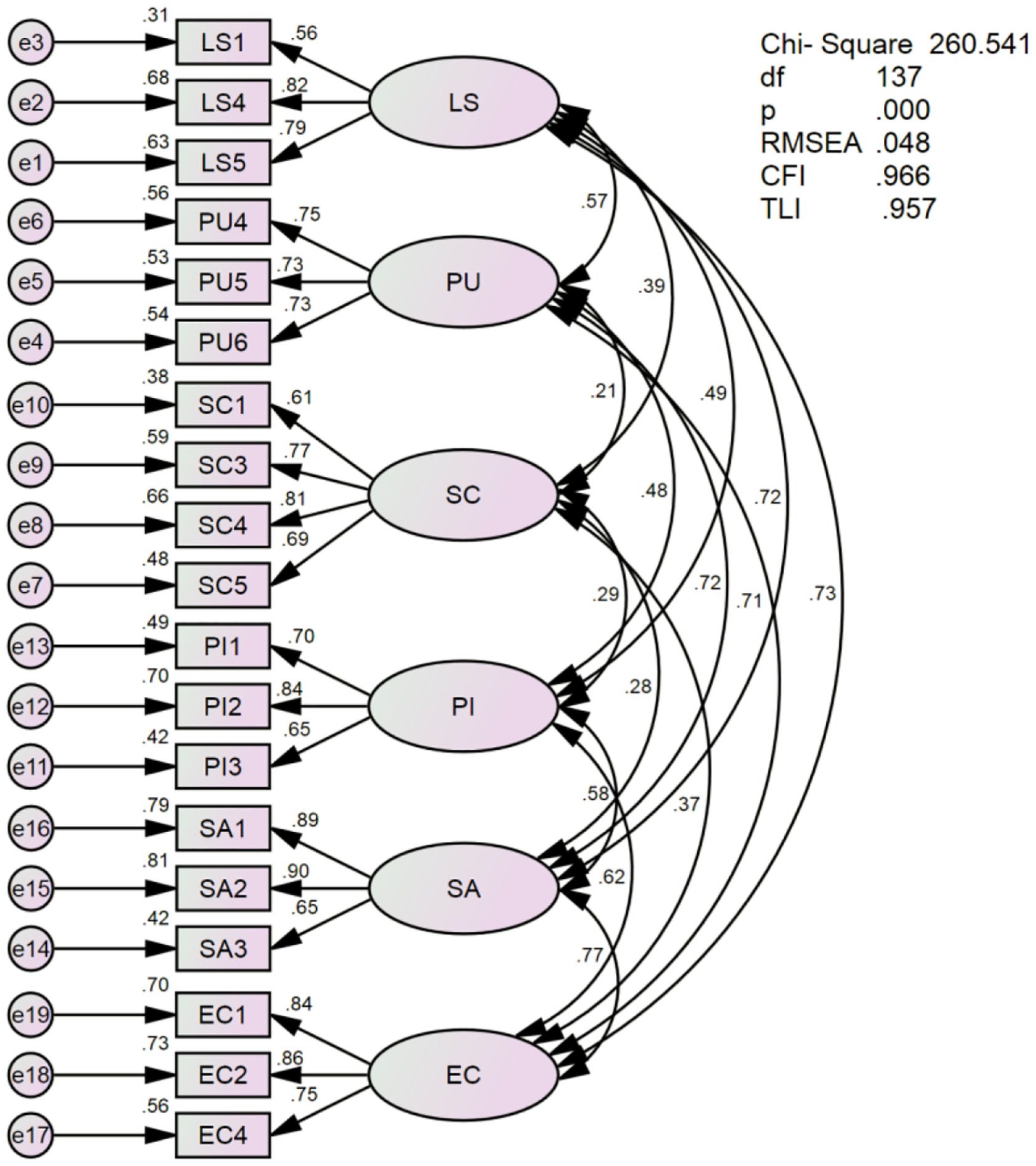
CFA for revised measurement model.
Regarding the validity issues of the measurement model, the values of average variance extracted (AVE) and composite reliability (CR) for convergent validity should be larger than the adequate level of 0.5 and 0.7, respectively (Hair et al., 2006), whereas, for discriminant validities, the square root of AVE for a determinant should be larger than the association between the component and any other dimension in the model (Fornell & Larcker, 1981). Table 3 illustrates that the re-specified measurement model for this study is confirmed by the validity issues and advocated for further analysis based on the results of convergent and discriminant validities.
Convergent and Discriminant Validity Values.

Note. The bold numbers in the diagonal row are the square root of AVE. PI = perceived interactivity; LS = learning stickiness; PU = perceived usefulness; SC = switching cost; SA = satisfaction; EC = expectation confirmation.
Figure 4 also indicates that all the standardized factor loadings were greater than 0.5, and the value range of Cronbach’s alpha is .760–.854, as shown in Table 4.
Valid Items, Loadings, and Cronbach’s alpha.

Analysis of the Structural Model
After achieving reliability and effectiveness at the project and construction level, use the measured construction and corresponding items to form a structural model.
The hypothesized research model is the structural model of this study, which fitted the data satisfactorily, with χ2 = 443.381; df = 144; χ2/df = 3.079 p = .000; RMSEA = .073; CFI = .917; and TLI = .901 (see Figure 5). The validated re-specified measurement model with six constructs was used to assess the causal relationships among the factors by testing the proposed hypotheses using the maximum likelihood approach. The hypothesized research model of this study revealed that all the proposed hypotheses were strongly supported except the hypotheses H4 as justified based on the path coefficient (β), critical ratio (CR), and p values. Constant with our proposed hypotheses, the results indicate that learners’ expectation confirmation (EC) of an online learning platform has an important effect on their perceived usefulness (H1: β = .69, CR = 10.013, p < .001) and satisfaction (H2: β = .50, CR = 6.394, p < .001). Perceived usefulness (PU) of an online learning platform has a significant influence on satisfaction (H3: β = .34, CR = 4.396, p < .001) but it does not have an important influence on learning stickiness (H4: β = .12, CR = 1.457, p = .145), while satisfaction (SA) has a significant effect on learning stickiness (H5: β = .61, CR = 6.642, p < .001). Interestingly, perceived interactivity (PI) has a significant effect on their perceived usefulness (H6: β = .12, CR = 2.241, p < .05) and satisfaction (H7: β = .19, CR = 4.090, p < .001). Finally, the switching cost (SC) of an online learning platform has a significant effect on learning stickiness (H8: β = .21, CR = 4.018, p < .001). Additionally, switching cost, perceived usefulness, and satisfaction together explained about 53% of the variability of learning stickiness (LS) in using online learning platforms. Similarly, perceived interactivity, expectation confirmation, and perceived usefulness collectively explained around 64% of the variability of satisfaction of online learning platforms as shown in Figure 5.
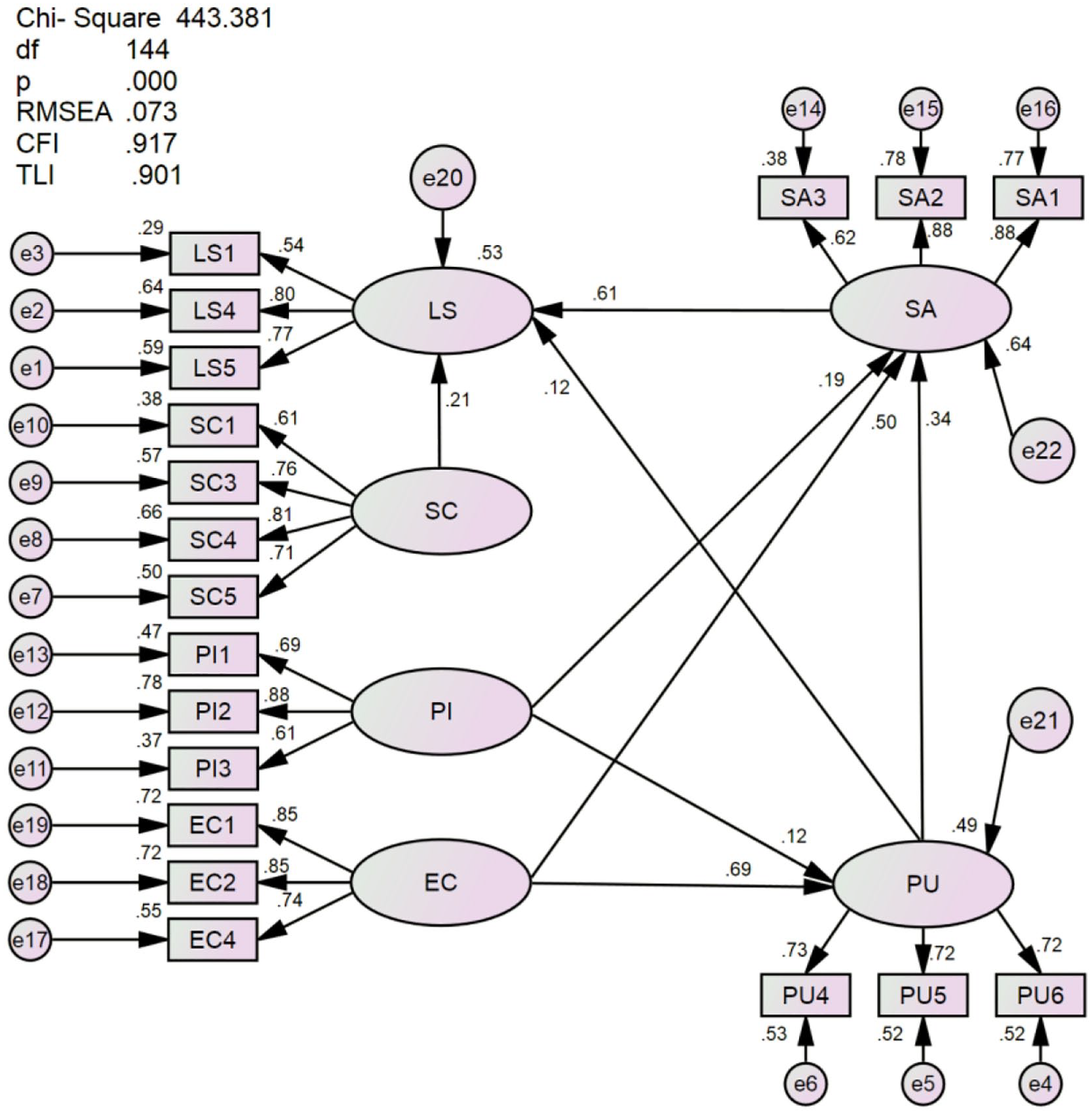
The hypothesized research model.
Discussion
This study determines to provide targeted strategies and directions for the optimization of online learning platforms. Whether from the perspective of long-term development of the platforms or the perspective of learners’ learning continuity and depth, it is necessary to improve learners’ learning stickiness. Therefore, it is of excessive importance to explore the stickiness factors that influence learners to improve the quality of courses and learning interaction and to deepen students’ participation. Some suggestions on the research results are given in this study. This study systematically analyzes the factors that influence learners’ learning stickiness according to the different stages of their use of the platform, such as the stage of rational decision making, the stage of emotional decision-making, and the stage of the habitual unconscious. Based on the research conclusions, the following suggestions were made in this study.
Firstly, this study found that satisfaction and switching costs are the two most important factors that affect students’ online learning stickiness; this verifies the hypotheses of H5 and H8. Users’ satisfaction with media positively influences their stickiness, a finding which is matches with results of recent studies (Lien et al., 2017; Lv & Lv, 2020). This implies that higher learner satisfaction is the key factor in improving their stickiness to the platform. Users’ switching cost positively influences their stickiness, a discovery that is compatible with Anderson et al. (2013). In terms of switching costs, it is possible to increase the cost of switching or giving up the learning platform by helping students to develop their learning habits using the online platform (e.g., helping students to set up personal note-taking files or expanding the learning circle among learners).
Surprisingly, learners’ perceived usefulness is the only factor of our research model which has no significant effect on their learning stickiness, invalidating hypothesis H4. This result is different from those of other studies (Bhattacherjee, 2001). However, this does not mean that perceived usefulness is not important to the formation of learners’ stickiness because it greatly affects the learners’ satisfaction, which confirms hypothesis H3. Therefore, this study assumes that the indirect effect of perceived usefulness on learning stickiness through satisfaction could occur. The findings suggest that online learners’ stickiness of the course does not depend entirely on the platform’s ultimate goal, which is to improve academic performance. Apart from whether the course platform helps them to learn knowledge effectively, learners also pay more attention to whether the process of learning is relatively easy. In other words, they also value the process of the learning experience. The result is different from that of consumers, whose goal is simpler (i.e., simply buying the goods they need) (Bhattacherjee, 2001; Davis et al., 1989). The perfect learning platform can provide students with high-quality curriculum resources and improve their learning satisfaction.
Hypotheses H1 and H2 predicted that learners’ expectation confirmation would influence perceived usefulness and satisfaction. The results identified that students’ expectation confirmation of using online learning platforms has a significant influence on their perceived usefulness and satisfaction, which are constant with the findings of Chow and Shi (2014). This means that students’ expectation confirmation is one of the most significant factors, which will help teachers design and offer suitable and effective teaching technology tools and resources to improve students’ learning. Moreover, learners were gratified with the learning platform and resources provided, because these helped them accomplish their learning expectations. The findings can benefit and motivate researchers to think about how to design and develop online learning tools and resources to enhance effective online teaching and learning (Keengwe et al., 2012).
The next hypotheses (H6 and H7) predicted that learners’ perceived interactivity would influence their perceived usefulness and satisfaction. However, studies asserted that users’ attitudes were positively connected to their perceived interactivity of the website (Ahn et al., 2014; Vesely et al., 2007). Recently, most learning platforms have been based on video teaching, and the interaction between students and platforms involves more human-computer interaction than teacher-student interaction or student-student interaction. As a result, their perceptions of interactivity are relatively weak. However, specific interactions (both instrumental and social) influence the user’s engagement and interaction. Therefore, sometimes the interactive performance of a website could be used as a key factor to distinguish its success (Jiang et al., 2010). The results of H7 are constant with those of previous studies (Anderson et al., 2013). However, Chow and Shi (2014) believe that teacher-student interaction and student-student interaction cannot predict student satisfaction but that such kinds of interactions in the course design and learning process can predict satisfaction.
In short, the identified influencing factors of students’ online learning stickiness have several implications for retaining online learners. First the findings of this study indicate that the main factors influencing students’ learning engagement are satisfaction and switching cost. Students’ expectation confirmation, perceived usefulness and perceived interactivity all influence learning stickiness through influencing satisfaction. At the same time, students’ perceived usefulness is related to expectation confirmation and perceptual interaction. Thus, in order to increase the stickiness of students’ online learning, focus should be placed on the improvement of students’ satisfaction and switching costs.
Finally, the research findings also suggest that, to improve student satisfaction, attention should be paid to increase students’ expectation confirmation, usefulness perception and interactivity perception of the platform to improve student satisfaction.
Theoretical and Practical Implications
Optimize online course quality
High-quality learning resources are prerequisites for learners to choose an online learning platform. When the learner is in the rational decision-making stage of using an online learning platform, the quality of the online course determines whether the learner will continue using the said platform. Besides, the empirical analysis of this study indicates that the main factor affecting learning stickiness is satisfaction, and the influence of perceived usefulness on satisfaction is dominant. This finding reflects that the current learners’ demand for an online learning platform is still at the most basic level. User experience theory reveals that the level of user experience needs to reflect the development level of the platform or the product (Luo & Zhu, 2010). According to our results, it could be suggested that the quality of online courses should be improved.
The question then arises: how to improve the curriculum? From the practical perspective, the design of online learning should focus on meeting learners’ needs. Therefore, the first step for designers should be understanding online learners’ needs by using technologies such as learning analytic, so as to design learning activities tailored to learners’ needs (Ginda et al., 2019).
Focus on the learners’ learning experience process
According to the results of the study, perceived usefulness has no significant influence on learning stickiness. This result is reflected in that, compared with consumers who shop online, learners’ continued use of the online learning platform does not necessarily indicate the usefulness of the platform. Compared with other factors influencing students’ online learning stickiness, the influence of student satisfaction is more significant. This finding is consistent with the conclusion reached in existing research (Li et al., 2016). Satisfaction has positive effects in improving students’ stronger intention and willingness to use, higher long-term adoption rate and so on (Cidral et al., 2018; Salam & Farooq, 2020). Learners are concerned with the learning experience process; Therefore, a high-quality online learning platform should focus on learners’ high-level learning experience process requirements (Luo & Zhu, 2010). To provide learners with satisfactory quality curriculum resources to ensure the usability and usefulness of the platform, the online learning platform should heed the comfort and pleasure of the learners’ learning process (Esarco, 2009).
From practical perspective, as some researchers suggested, to improve learner satisfaction through learning design by adopting learners’ feedback (Mangaroska & Giannakos, 2019). Students’ learning feedback is a kind of voice that reflects their real learning state. Designing learning according to student feedback is a direct and effective approach to improve their learning process satisfaction.
Enhance the intelligent interaction of online learning platforms
Learners’ perceived interactivity of the online learning platform is mainly the learners’ perception of the interaction among the platform, the teachers, and the other learning resources. Given the programing of the online learning process, the communication between the learner and the platform is mechanical. At the same time, communication between learners and teachers, and feedback given to learners is not timely. This situation may make the learner perceive a lack of social presence and easily give up. Subsequently, loneliness and feelings of helplessness make it difficult for dependent learners to use online learning platforms.
With the development of artificial intelligence technologies, the construction of adaptive intelligent online teaching system through big data and other learning analysis methods is an important research topic for the current and future development of intelligent education. Researchers have been trying to use smart technologies to improve the efficiency of human interaction with learning environments.
Improve student personalized space settings for online learning platforms
The research results show that switching cost has a weighty influence on learners’ stickiness. However, switching cost has far less of an influence than satisfaction, indicating that learners’ perceived cost of switching to other platforms or giving up is very low. The factors affecting the cost of conversion include learners’ learning behavior recorded on the platform, exchange circle, plan, and other personalized learning traces. Therefore, the personalized learning space construction can record the learning process, provide real-time feedback to teachers and learners, and allow learners to have a sense of dependence on the platform. Long-term personalized learning records indicate learners’ learning process, which can provide them with a sense of accomplishment and satisfaction when reviewing their learning process. Hence, personalized learning space plays a significant role in improving the conversion cost of learners and enhancing learning stickiness (Wang & Chen, 2011). From this point of view, it would seem appropriate to consider building and improving personalized learning space for learners. One way of achieving this is by tracking and providing personalized intervention to student learning. The other way is providing feedback that allow that students to monitor their progress and to own the individual learning space as their “secret box.”
Limitations and Future Directions
One limitation of the study lies in the sample bias. The participants in this study are mainly college students. Although online learners who are not full-time college students were selected, the proportion was small owing to the survey constraints and conditions. Thus, non-student groups should also be considered in future research.
The data for this study is obtained from a questionnaire survey. Although the content of the questionnaire is easy to understand, the tool may still likely be biased in the respondents’ understanding. Therefore, examining the influencing factors of online learning stickiness based on data on online learners’ behavior in future research is important.
This research on the influencing factors of learners’ online learning intended to explore the reasons behind the phenomenon of large-scale school withdrawal and to explore possible solutions and countermeasures. After the influencing factors of learners’ online learning are derived, future research can try to understand and subsequently influence learners’ learning stickiness in real-time for effective online learning. This study informs online instructional designers and instructors on instructional design. Hence, they can effectively develop their learning environments with a reasonable and balanced distribution of manpower and material resources.
Footnotes
Author Note
Aixia Li is now affiliated to Ludong university, Shandong, China.
Declaration of Conflicting Interests
The author(s) declared no potential conflicts of interest with respect to the research, authorship, and/or publication of this article.
Funding
The author(s) received no financial support for the research, authorship, and/or publication of this article.
