




Abstract
The problem motivating this study is the fact that almost 19.70 million university students in China have been required to engage in e-learning under the government’s initiative of “Classes are Suspended, yet Learning is still Ongoing” during the COVID-19 epidemic, coupled with varied responses, uneven adoption of e-learning platforms and varying degrees of satisfaction toward them. Using the online database adoption and satisfaction (ODAS) model, this study examines the determinants which impact university students’ adoption of and satisfaction with e-learning platforms at this particular time in China. The ODAS model was also cross-validated using gender as a moderating variable. A purposive sampling procedure was used to survey a total of 1,136 students from six universities in five provinces or municipalities of China. The data for this survey were estimated using the Rasch model and structural equation modeling. Results exhibit that students’ adoption of and satisfaction with e-learning platforms were significantly measured by their computer self-efficacy, their intention to use e-learning platforms, and their perceived ease of use and perceived usefulness of these platforms, while the relationships among these components were moderated by gender differences. This empirically-based cross-validation of the ODAS provides recommendations for future studies, including practical implications for e-learning. This current study contributes to the body of knowledge in evaluating e-learning platforms during the COVID-19 epidemic.
Keywords
Introduction
To prevent and control the COVID-19 epidemic on campuses, on January 27, 2020, the Ministry of Education of the People’s Republic of China (2020a) issued a notice requesting that schools of all kinds temporarily suspend classes. On January 29, the Ministry of Education of the People’s Republic of China (2020b) put forward an initiative called “Classes are Suspended, yet Learning is still Ongoing,” which required schools, teachers, and students to make full use of technology-enabled e-learning platforms. In response to this initiative, a major e-education campaign was launched across China.
There are more than 1,400 universities and 19.70 million university students in China (National Bureau of Statistics of China, 2019). Facing the high demand for e-learning among university students, the Ministry of Education and many institutions organized 150 platforms to open up more than 942,000 online courses for free (Ministry of Education of the People’s Republic of China, 2020c). Against this backdrop, e-learning platforms were extremely important, and their qualities were directly related to the effectiveness of students’ e-learning (Al-Fraihat et al., 2020). Under these circumstances, there was an urgent need to advance our understanding of the qualities of those e-learning platforms.
There are two critical indicators of the qualities of e-learning platforms, namely students’ satisfaction with and intentions toward e-learning platforms (Al-Fraihat et al., 2020; Uppal et al., 2018). Students will be more satisfied with e-learning platforms and have stronger intentions to adopt them if the e-learning platforms meet their needs and promote their learning effectively (Al-Fraihat et al., 2020). Prior studies showed that students’ satisfaction with and intentions toward e-learning platforms were not what was expected. For instance, some students are unaware that e-learning platforms are available (Cho et al., 2009; Moreno et al., 2017). Fang (2015) found that in China, only 12.7% of students could complete a MOOC e-learning course, on average, which also indicated that their satisfaction with MOOC was not high and intentions toward MOOC were not strong. Accordingly, it is necessary to improve students’ satisfaction with and intentions toward e-learning platforms. To this end, within a technology-assisted learning milieu in higher education, it is very important to explore ways of assessing students’ adoption of and satisfaction with e-learning platforms and identifying the factors which influence these phenomena (Barclay et al., 2018). Such studies were especially needed in the age of COVID-19 as nationwide school closures impacted over 90% of learners worldwide (World Health Organization, 2020) and the use of e-learning platforms was strongly recommended during the crisis (OECD, 2020; UNESCO, 2020). However, university students’ adoption of and satisfaction with e-learning platforms in developing countries have not been frequently focused on (Ameen et al., 2019; Pham et al., 2019).
Another focus of Chinese educators was whether e-learning could be effective for every student during the pandemic age of COVID-19 (Yang, 2020). In other words, Chinese educators hoped that e-learning would not exacerbate educational inequalities, and that everybody could have the equal rights to engage in e-learning (Yang, 2020). Among the educational inequalities, gender equity in e-education was considered an important issue in China. Prior studies once found that female students were more satisfied than male students with e-learning (e.g., González-Gómez et al., 2012). This may partially explain the differences in the effectiveness of e-learning between boys and girls, which went against the expectations of educational equality in China. In view of this, it is necessary to detect the gender differences in e-learning, especially during the pandemic age of COVID-19. However, as far as we know, gender differences in technology adoption and satisfaction in Chinese higher education have rarely been studied (Chen, Xia et al. (2020)).
Motivated by these two gaps (i.e., there was an urgent need to measure the qualities of e-learning platforms during the pandemic age of COVID-19 while students’ satisfaction with and intentions toward e-learning platforms were not frequently studied as two indicators of the qualities of e-learning platforms; in addition, there was an urgent need to understand gender equity in e-education during the pandemic age of COVID-19 while gender differences in technology adoption and satisfaction were rarely studied), the main aims of this current study were to validate the online database adoption and satisfaction (ODAS) model in light of Chen, Islam et al.’s (2020) work and to measure students’ adoption of and satisfaction with e-learning platforms. The ODAS model was also cross-validated using the moderating variable of gender to detect whether there was a moderating effect of gender differences in students’ adoption of and satisfaction with e-learning platforms. As many e-learning platforms have been launched and organized very quickly to meet the urgent need, our findings will provide insights into the improvement of e-learning platforms and educational emergency facilities in China and other countries. Moreover, we also hope our findings will be helpful in the promotion of e-learning during this particular moment in history and the encouragement of further studies in the relatively unexplored area of technology-enabled e-learning.
Theoretical Framework
Foundations of the ODAS Model
Technology adoption refers to an individual’s intention of using technologies (Kumar & Chand, 2019), while technology satisfaction refers to the degree to which “the use of technology is consistent with existing values, needs” and the individual’s experiences (Islam et al., 2018, p. 4). As e-learning platforms are increasingly used, students’ adoption of and satisfaction with them has received extensive attention in theory and practice (Al-Fraihat et al., 2020; Uppal et al., 2018). However, studies show that students’ adoption of and satisfaction with e-learning platforms did not meet the expectations of educators, administrators and service providers (e.g., Cho et al., 2009; Fang, 2015; Moreno et al., 2017; Wang et al., 2020). Wang et al. (2020) found that 38.54% of students reported that they were reluctant to learn by using e-learning platforms during the pandemic age of COVID-19. Also, student satisfaction with e-learning platforms varied greatly (Wang et al., 2020). As the low adoption of and satisfaction with e-learning platforms may directly decrease the effectiveness of e-learning (Al-Fraihat et al., 2020; Uppal et al., 2018), it is urgent to assess the adoption of and satisfaction with e-learning platforms and identify related factors so as to improve e-learning practice.
Over the past 50 years, many models have been proposed and developed to evaluate the adoption behavior of information technologies (e.g., Ajzen, 1991; Davis et al., 1989; Fishbein & Ajzen, 1975; Venkatesh et al., 2003). These TAM-based models have their roots in a series of foundational theories regarding behavioral and motivation (Kemp et al., 2019), and almost all these models include the three critical behavioral and motivation factors: perceived ease of use (PEU), perceived usefulness (PU), and intention to use. However, these TAM-based models ignored psychological factors (e.g., computer self-efficacy) (Yalçın & Kutlu, 2019), and thus were unable to assess user satisfaction (Chen, Islam et al. (2020); Scherer & Teo, 2019). Granić and Marangunić (2019) claimed that such TAM-based models could include other variables to increase their predictive power.
Meanwhile, over the past two decades, several previous studies have aimed to find the key factors of technology satisfaction (e.g., Arbaugh & Duray, 2002; Asoodar et al., 2016; Ifinedo et al., 2018; Islam, 2014; Yunusa & Umar, 2021). Among these factors, computer self-efficacy, PU, and PEU were frequently identified (Yunusa & Umar, 2021). This indicated that PU and PEU may be the antecedents of both technology adoption and satisfaction. However, prior studies always separated the measurement of technology adoption and satisfaction, and studies or models rarely combined them (Chen, Islam et al. (2020); Islam, 2011, 2016).
In view of this, Islam (2011) proposed the online database adoption and satisfaction (ODAS) model, where the two variables regarding technology satisfaction (i.e., satisfaction and computer self-efficacy) are combined with the TAM’s intention to use, PEU, and PU. Later, the ODAS model’s structure was modified by Chen, Islam et al. (2020), as shown in Figure 1.

Online database adoption and satisfaction (ODAS) model (Chen, Islam et al. (2020)).
The ODAS model was theoretically founded on the TAM model. Therefore, these three critical factors of technology adoption (i.e., intention to use, PU, and PEU) were also taken into consideration in the ODAS model. Most importantly, the ODAS model made up for this defect of these TAM-based models. The other two important variables, namely computer self-efficacy and satisfaction, were added in the ODAS model to measure users’ psychological factors. Due to this, the ODAS model can be used to elucidate both the adoption of and satisfaction with digital technologies. It shows that students’ computer self-efficacy will significantly affect their PU and PEU of technology and indirectly impact their intention to use technology in a satisfactory way. It should be noted that although this model was originally created and validated to measure the adoption of and satisfaction with online database platforms (Islam, 2011), it is not restricted by other ICTs, and various e-learning platforms or systems are also included.
As previously mentioned, the ODAS model could measure technology adoption and satisfaction together and examine related factors, which very few other models have the capacity to do. As such, we apply the ODAS model to investigate university students’ adoption of and satisfaction with e-learning platforms. In the following section, we described the operational definitions of the five constructs and analyzed the relationships between the five constructs within the ODAS model.
Hypotheses of the ODAS Model
Self-efficacy, a term coined by Bandura (1977) in his social cognitive theory, is described as “people’s beliefs about their capabilities to produce designated levels of performance that exercise influence over events that affect their lives” (Bandura, 1997, p. 71). It is found that self-efficacy predicts the amount of effort people will put forth, how well people will persevere when facing difficulties, and how effectively people will monitor and motivate themselves (Bandura, 1997). Numerous studies have substantiated self-efficacy’s considerable effects on learners’ learning behaviors, motivations and outcomes (Hsia & Hwang, 2020; Macakova & Wood, 2022; Yip, 2019; Zhou et al., 2019). In the field of educational technology, computer self-efficacy is defined as people’s judgment of their capabilities to easily use information and computer technologies (Venkatesh & Davis, 1996). Based on Bandura’s (1977, 1997) theory, computer self-efficacy could be understood as people’s perceptions of their own computer competence, but not their actual computer competence. For instance, if somebody over-estimates his or her computer competence, his or her computer self-efficacy may be high, but his or her actual computer competence may be low. Computer self-efficacy significantly influences an individual’s decisions regarding technology adoption (Hatlevik et al., 2018; Kuo & Belland, 2019). Students are more apt to use ICTs in their everyday educational practices if they have a high level of computer self-efficacy (Ameen et al., 2019). An increasing number of investigations have shown that both an individual’s PEU and PU of computer technology are directly influenced by computer self-efficacy (Bin et al., 2020; Chen, Islam et al. (2020); Chiu, 2017; Moreno et al., 2017; Yalçın & Kutlu, 2019). However, few studies have explored these relationships within the framework of determining Chinese students’ adoption of and satisfaction with e-learning platforms. Therefore, hypothesis number one is as follows:
PU and PEU are the primary exogenous (Islam, 2011) and mediating (Chen, Islam et al. (2020)) variables in the ODAS model. In accordance with the definitions of Davis et al. (1989) and Islam (2011), this study adopts the concept that PU describes a student’s perception of the advantages of using e-learning platforms, while PEU describes a student’s perception of how simple or difficult it is to use e-learning platforms.
Intention to use could be defined as “how hard people are willing to try to” use e-learning platforms (Eksail & Afari, 2020, p. 2684). As this current study employs Kumar and Chand’s (2019) definition of “adoption” (i.e., the intention of using e-learning platforms), the concepts of “intention to use” and “adoption” can share the same meaning. Studies have shown that PU and PEU are two of the most dominant determinants of intention to use (Bin et al., 2020; Nikou & Economides, 2019; Scherer et al., 2019). Based on these findings, it could be assumed that university students are more apt to use technology when they are aware that e-learning platforms add value to their learning activities and relatively effortless to use.
According to Alzahrani and Seth’s (2021) definition, satisfaction refers to the emotional assessment of the outcomes of using e-learning platforms. It could also be understood as students’ “perception of the extent to which their needs, goals, and desires have been fully met” when they use e-learning platforms (Yunusa & Umar, 2021, p. 1224). In other words, if students perceive that e-learning platforms could fully meet their learning needs, goals, and desires, they will feel very satisfied. PU and PEU are also considered influential factors concerning satisfaction (Bin et al., 2020; Chen, Islam et al. (2020); Yuen et al., 2019). However, literature affirms that these relationships have not been adequately validated in assessing Chinese students’ satisfaction with and intention to use e-learning platforms. Hence, based on the aforementioned arguments, we propose the following hypotheses:
Exploring the connection between satisfaction and intention to use is an emerging significant topic in assessing students’ adoption of and satisfaction with ICT (Islam, 2016; Pham et al., 2019). However, when comparing different studies, conflicting conclusions become evident: some claim that intention to use has influence over satisfaction (Islam, 2011, 2016; Taherdoost, 2018), while others found an opposite relationship (Del Barrio-García et al., 2015; Joo & Choi, 2016). As validating the ODAS model is one aim of the current study, we examine how intention to use directly impacts students’ satisfaction in using e-learning platforms, hypothesizing that when students have higher intention to learn online, their levels of satisfaction rise.
In addition to the direct connections among the components of the ODAS model, there are also indirect connections between computer self-efficacy and satisfaction as well as computer self-efficacy and intention to use, in which PEU and PU mediate the measurement of e-learning platforms. Recent research has shown that enhancing computer self-efficacy among students leads to an increase in their use of digital technologies (Chen, Islam et al. 2020; Cheng, 2019; Yalçın & Kutlu, 2019). It was found that computer self-efficacy also indirectly impacts students’ satisfaction (Chen, Islam et al. 2020; Islam & Sheikh, 2020; Islam et al., 2014). Chen, Islam et al. (2020) and Islam (2016) revealed that intention to use plays a mediating role between satisfaction and the two mediating variables, namely, PEU and PU, but these mixed arguments have rarely been validated in studies on Chinese students’ adoption of and satisfaction with e-learning platforms. As such, we propose the following hypotheses:
Methodology
Data Collection Tool
According to Burkell (2003), a survey instrument could be the most fitting approach to obtain views and information about learners’ experiences. Originally, Islam (2011) designed the instrument in English, which was then translated and tested in Chinese by Chen, Islam et al. (2020) in order to measure databases in higher education. We adapted and modified both versions of the instrument to suit our study for assessing university students’ adoption of and satisfaction with e-learning platforms, and then conducted a pilot test on 125 students from two universities. Based on the statistical analyses using the Rasch model, the questionnaire was revised. The 6-point Likert scale formal instrument contains a total of 38 indicators to measure all the components of the ODAS model. For instance, we modified 10 indicators for assessing PEU, another 10 items for PU, followed by eight items for computer self-efficacy. Lastly, we modified five variables for measuring intention to use and the other five items for satisfaction with e-learning platforms. The formal instrument is presented in the Supplemental Appendix.
Particularly, the approval for this research from the Research Ethics Committee was obtained before the questionnaires were distributed. We also confirmed students’ anonymity and carefully protected their personal information during the whole process of data collection and analysis.
Data Collection
As for the formal test, we selected six universities from five provinces or municipalities of China. One is a national first-class university, one is a key provincial university, and the other four are local universities. All kinds of e-learning platforms (e.g., MOOC, chaoxing, etc.) used in the six universities could be categorized as learning management systems (LMSs). Specifically, these e-learning platforms (i.e., LMSs) had the following features: (a) they were “web-based software platforms that provide an interactive online learning environment and automate the administration, organization, delivery, and reporting of educational content and learner outcomes” (Turnbull et al., 2019, p. 1); (b) they provided a series of services to support e-learning, namely security, communications, smartphone access, gradebook, learner progress tracking, course management, assessment (Turnbull et al., 2019; Turnbull et al., 2021). Similar to Pham et al. (2019), Prasetyo et al. (2021), and Zhou et al. (2021), this current study intended to investigate students’ overall adoption of and satisfaction with these e-learning platforms instead of one specific platform, as these e-learning platforms shared the same features.
The target sample size was 1,000, which is adequate for structural equation modeling analysis (Hu & Bentler, 1999). To this end, we randomly selected one head of the student union and one teaching administrator, respectively, in each of the six universities and asked them to distribute the formal questionnaires through email and WeChat near the close of the spring semester (2, 2019–2020). This current study used a purposive sampling technique, which means that heads of the student union and teaching administrators helped us distribute the formal questionnaires only to those university students who experienced e-learning. If a student was interested in our study, he or she could voluntarily click the online questionnaire link in the email or WeChat and complete it with mobile phones or computers. The questionnaires were distributed to around 1,500 students. A total of 1,151 questionnaires were submitted, and 15 inadequate responses were removed. The effective return rate of the questionnaires was around 75.7%.
Participants
The data set included 35.7% male and 64.3% female students. Of these, 21.3% were from a national first-class university, 21.9% came from a key provincial university and 56.8% came from ordinary universities. In terms of students’ ages, 8.9% were 17%, 18%, and 46.7% were 19%, 20%, and 39.4% were 21%, 22%, and 4.4% were 23%, 24%, and 0.6% were 25 or older. About 86.70% were undergraduate students, and 13.30% were postgraduate students. This ratio is almost consistent with the ratio of undergraduates and postgraduates in China, where the percentage of undergraduates is 86.14% and the percentage of postgraduates is 13.86% (National Bureau of Statistics of China, 2019). Furthermore, 91.6% reported that they were mentally ready for e-learning during COVID-19 outbreaks, while 8.4% reported that they were not ready.
Data Analysis
Data were analyzed using SPSS 21.0, Winsteps 3.94, and AMOS 16 to conduct descriptive statistics, confirm the validity of the scale and test measurement and structural models, respectively. First, we conducted Rasch model analysis to obtain the results on instrument validity, and then we employed structural equation modeling to obtain findings on measurement and the structural model. Finally, we estimated the invariance measurement on the ODAS model.
Results
The Results of Rasch Model Analysis
The questionnaire’s reliability and validity for this study were conducted using the Rasch model, as proposed by a prominent psychometrician (Rasch, 1960). The Rasch model is well-known for instrument reliability and validity measurement and is frequently used by psychometricians (Bond & Fox, 2015). We used Winsteps software version 3.94 to conduct Rasch analysis with 38 items. The analysis of the summary statistics found that the items reliability and persons reliability were 0.99 and 0.97, respectively. The items and persons separation were 11.24 and 5.39, respectively. The Rasch analysis’ item polarity map suggested that the majority of the point measure correlation (PTMEA CORR.) between the items was higher than .60. However, item fit order of Rasch output identified that infit and outfit mean squares for three items (pu4, peu6, and cse5) were outside the range of 0.5 to 1.5 (Bond & Fox, 2015). This means that these items are considered to be invalid and should not be included in further analysis. Figure 2 exhibits the results on an item map where all the items are calibrated on a single continuum. As indicated on the right-hand side of Figure 2, the indicators on this scale are arranged from the “less difficult to be rated as students’ adoption of and satisfaction with e-learning platforms” to the “more difficult to be rated as students’ adoption of and satisfaction with e-learning platforms” The left-hand side of Figure 2 also aligns with the level of a person’s ability on a single scale, whereby the students are ordered from the “higher level of ability to endorse students’ adoption of and satisfaction with e-learning platforms” to the “lower level of ability to endorse students’ adoption of and satisfaction with e-learning platforms.” The findings from the item map also exhibit that the most difficult items were pu4, pu7, and pu9, while the least difficult items were cse1 and cse2, as reported in Figure 2. Finally, the principal component analysis of the Rasch model confirmed that the data fit the model, and items were factorable to estimate the components such as computer self-efficacy, satisfaction, intention to use, PEU and PU e-learning platforms. The variance explained by the measures was 76%, which showed that the items were able to endorse the students’ adoption of and satisfaction with e-learning platforms.

Item map.
Validating the Measurement Model
The measurement model of this study consisted of the five factors of the ODAS model with 35 valid items obtained from the Rasch model, such as computer self-efficacy (CPSEC), intention to use (ITTN), satisfaction (STFT), perceived ease of use (PEU), and usefulness (PU). These constructs were interrelated to confirm the validity of the measurement model and to conduct the convergent and discriminant validity. First, the model’s validity was judged by the several fit indices based on the suggestion of psychometricians (Byrne, 2010; Hu & Bentler, 1999) like chi-square (χ2)/degree of freedom (df ) = ≤5, root mean square error of approximation (RMSEA) = ≤0.1, Tucker–Lewis Index (TLI), and comparative fit index (CFI) = ≥0.90. However, to fulfill these criteria through maximum likelihood estimation, several items were not included in the constructs of the model because of the large modification indices. The results indicate that the estimated revised measurement model with 19 indicators fit the data well: χ2 = 625.836; df = 142; p = .000; RMSEA = 0.055; CFI = 0.979; and TLI = 0.974. The modified measurement model also provided evidence for convergent and discriminant validity, which was estimated using composite reliability (CR ≥ 0.70), average variance extracted (AVE ≥ 0.50), and the square roots of the AVEs based on statisticians like Hair et al. (2010) and Fornell and Larcker’s (1981) recommendation. The values of square roots of the AVEs were larger than the covariances. A total of 19 valid indicators including the scores of CR and AVE are reported (see Supplemental Appendix).
Testing Structural Model
This study estimated the proposed hypotheses of the ODAS model with 19 parameters gained from the modified measurement model. The ODAS model fit the data well, as indicated by the following fit statistics: χ2 = 429.049; df = 142; p = .000; RMSEA = 0.066; CFI = 0.969; and TLI = 0.963. Figure 3 exhibits that students’ CPSEC was directly related to their PEU (β = .93, p ≤ .001) and PU (β = .69, p ≤ .001) of e-learning platforms. Students’ PU was directly related to their STFT with (β = .36, p ≤ .001) and ITTN (β = .19, p ≤ .001) e-learning platforms. Similarly, PEU was directly related to their STFT with (β = .38, p ≤ .001) and ITTN (β = .74, p ≤ .001) e-learning platforms. Students’ ITTN was also directly related to their STFT with e-learning platforms (β = .28, p ≤ .001). These results validated all the proposed direct hypotheses (H1–H4) of the ODAS model.

The ODAS model.
The ODAS model showed that students’ PEU (Chi-square, χ2 = 9.301; p = .0) and then PU (χ2 = 12.313; p = .0) mediate the relationship between CPSEC and STFT of e-learning platforms in multiple ways, respectively. Students’ PEU (χ2 = 18.336; p = .0) and then PU (χ2 = 6.829; p = .0) also mediate the relationship between CPSEC and ITTN of e-learning platforms in multiple ways, respectively. Finally, students’ ITTN mediates the relationships between STFT and PEU (χ2 = 7.009; p = .0) and PU (χ2 = 5.149; p = .000) of e-learning platforms in multiple ways. The results for these indirect relationships validated the remaining three hypotheses (H5, H6, and H7) through the Sobel test (Sobel, 1982). Table 1 contains all the variances of mediating and endogenous variables of the ODAS model, including a summary of direct and indirect hypotheses and effect sizes and their critical ratios (CR).
The Summary of ODAS Model’s Hypotheses.

The Results of Invariance Measurement
This study conducted invariance measurement to identify the moderating effect of gender within the constructs of the ODAS model. To perform invariance analysis with AMOS, SEM requires creating two group data sets for male and female students based on the original pool of 1,136 students. The original data contain 406 male and 730 female respondents. To cross-validate the ODAS model and identify the gender differences, this study first validated the ODAS model using the male sample, which shows that the model fit the data well: χ2 = 547.514; df = 145; p = .000; RMSEA = 0.083; CFI = 0.958; and TLI = 0.951 (see Figure 4). The ODAS model for male students confirmed the validity of all the proposed hypotheses where CPSEC is the strongest antecedent of PEU (β = .91) and PU (β = .75). CPSEC can explain 84% and 57% variability of PEU and PU, respectively. CPSEC, PEU, and PU together can explain 84% and 78% variability of STFT and ITTN, respectively.
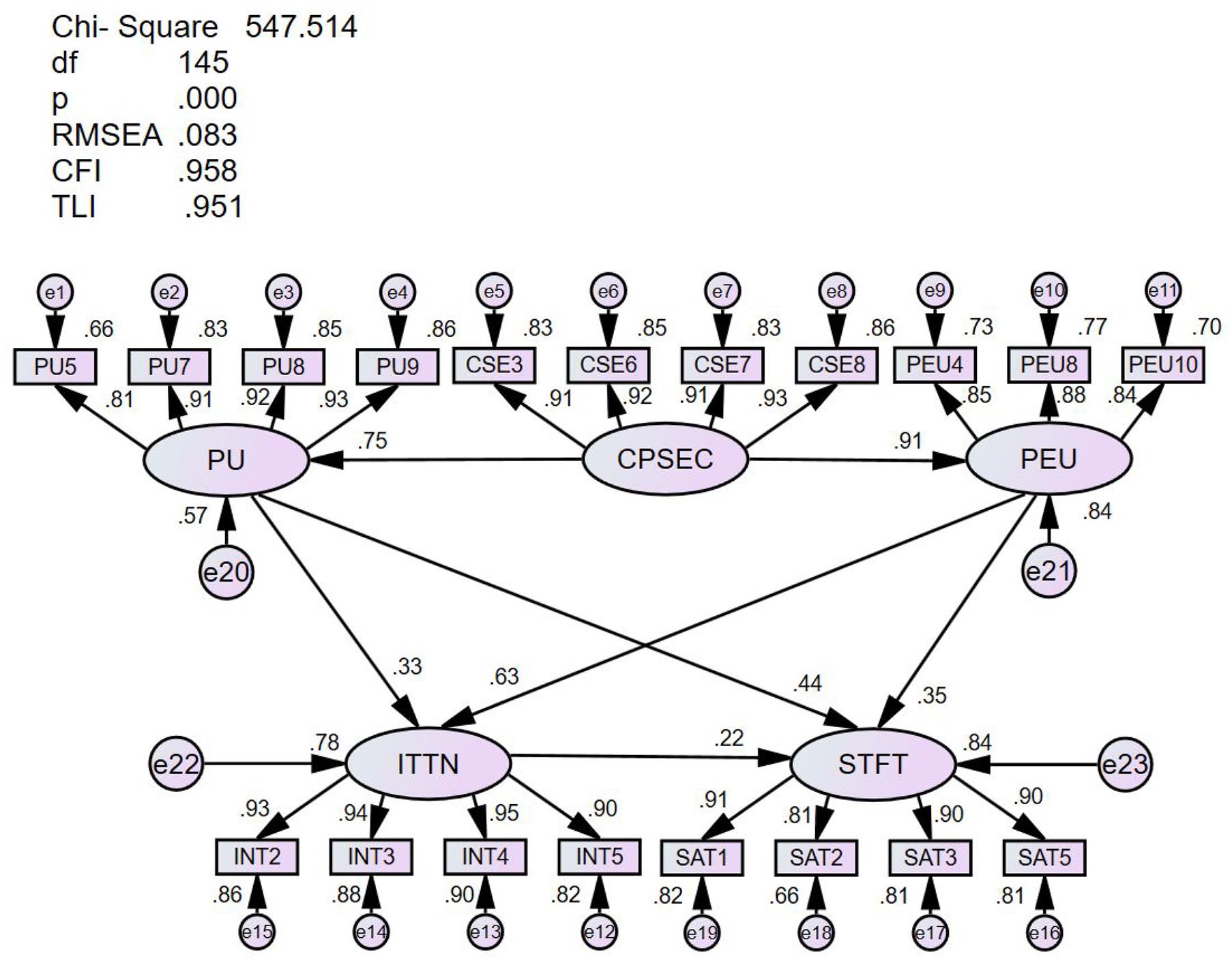
The ODAS model for male students.
On the other hand, the ODAS model for female students also determined the validity of the model including all the hypotheses and fit indices (see Figure 5). For instance, χ2 = 600.621; df = 145; p = .000; RMSEA = 0.066; CFI = 0.965; and TLI = 0.959. The model shows that CPSEC is the strongest antecedent of PEU (β = .94). CPSEC can explain 89% and 42% variability of PEU and PU, respectively. Then, CPSEC, PEU, and PU together can explain 85% and 73% variability of STFT and ITTN, respectively.

The ODAS model for female students.
Figures 4 and 5 display gender differences regarding path coefficients, variances, fit indices, and loadings. However, to examine whether these differences statistically moderate the relationships among the dimensions of the ODAS model, the present study performed configural and metric invariance analysis using unstandardized estimates. To test configural invariance analysis, we grouped male and female samples together without constraining the ODAS model and compared male and female models based on chi-square (χ2), degree of freedom (df ) and fit indices. The unconstrained models for male and students fit the data equally well: χ2 = 1,148.287; df = 290; p = .000; RMSEA = 0.051; CFI = 0.962; and TLI = 0.955. To test metric invariance analysis, we constrained all the paths of the ODAS model and compared the constrained male and female models. The constrained models for male and female students fit the data equally well: χ2 = 1,179.750; df = 297; p = .000; RMSEA = 0.051; CFI = 0.961; and TLI = 0.955. Finally, the unconstrained and constrained models were compared using chi-square and degree of freedom to obtain chi-squared change and critical value. Table 2 reveals that the critical value is lower than the chi-squared change. This means that gender moderates the relationships among the factors of the ODAS Model.
The Results of Chi-Squared Change.

Discussion
The study validated the ODAS model, assessed Chinese university students’ adoption of and satisfaction with e-learning platforms and detected gender differences through the extensive statistical analyses of the Rasch Model and structural equation modeling. Consistent with previous studies applying the ODAS model (Chen, Islam et al. 2020; Islam, 2011), this current study indicates that computer self-efficacy, intention to use, PEU, and PU of e-learning platforms directly and indirectly predicted Chinese university students’ adoption of and satisfaction with technology. Unlike prior studies regarding students’ adoption of e-learning platforms (Ameen et al., 2019; Taherdoost, 2018; Yalçın & Kutlu, 2019), this current study used a combination of behavioral and psychological perspectives, and it was conducted within the framework of Chinese higher education at an extraordinary time. The empirical findings achieved from the ODAS model have significant implications for both theory and practice.
Based on Bandura’s (1977, 1997) social cognitive theory, the present research emphasizes the significance of personal factors, such as computer self-efficacy, which directly impact Chinese university students’ PEU and PU of e-learning platforms. Bandura (1997) pointed out that self-efficacy strongly predicts an individual’s implementation of and persistence in certain behavior. Earlier studies indicated that enhancing computer self-efficacy is an effective way to help students accept the usefulness of e-learning platforms and develop positive attitudes toward them and belief in ease of use (Moreno et al., 2017; Scherer & Teo, 2019; Yalçın & Kutlu, 2019). The current study supported these findings in Chinese higher education. More importantly, we suggest that in addition to the mediating variables, like PU and PEU, students’ personal factors, like computer self-efficacy, should also be considered when evaluating their adoption of e-learning platforms.
As for the two main mediating variables, PU and PEU, the statistical analyses have revealed that they ultimately contribute to Chinese university students’ satisfaction with and intention to use e-learning platforms. This finding coincides with prior research, articulating that students who perceived advantages and ease of use are inclined to use e-learning platforms (Teo & Zhou, 2014; Yalçın & Kutlu, 2019) and derive satisfaction from them (Chen, Islam et al. 2020; Islam, 2011). PU and PEU are frequently seen as two important and influential factors of an individual’s adoption of technology, but researchers seldom relate them to satisfaction with ICT use (Scherer & Teo, 2019).
The current study identifies the direct influence of intention to use on satisfaction. This implies that students with strong intentions to adopt an e-learning platform may have high levels of satisfaction with it. Such a relationship was also found in earlier studies (Islam, 2011, 2016; Taherdoost, 2018). Meanwhile, studies (Del Barrio-García et al., 2015; Joo & Choi, 2016) asserted an opposite relationship, indicating satisfaction may directly impact intention to use. This sheds some light on the future application and development of the ODAS model.
Our statistical analyses also confirmed that there were some indirect relationships among the variables, enabling us to understand the connections relationships among the different determinants on a deep level. Our study found that Chinese university students’ PEU and PU play multiple mediating roles between computer self-efficacy and intention to use e-learning platforms, as well as between computer self-efficacy and satisfaction with e-learning platforms. These findings aligned with prior research on students’ adoption of and satisfaction with databases (Chen, Islam et al. 2020). Moreover, the present study also found more mediating roles played by PU, intention to use, and PEU. To be specific, Chinese university students’ PU and PEU mediated the relationships among computer self-efficacy, intention to use, and satisfaction with e-learning platforms. However, students’ intention to use also mediated the associations among satisfaction with, PEU of, and PU of e-learning platforms in multiple ways. The five findings presented above suggest that students’ adoption variables, namely intention to use, PEU, and PU, mediate the formation of the indirect relationship between psychological factors, specifically computer self-efficacy and satisfaction. These results also justify the power of social cognitive theory and TAM in assessing university students’ adoption of and satisfaction with e-learning platforms.
Gender differences were scrutinized in the current study. This current study demonstrated that there was a significant difference between male and female Chinese university students’ adoption of and satisfaction with e-learning platforms. The impact of computer self-efficacy, PEU and PU on university students’ adoption of and satisfaction with e-learning platforms could be moderated by gender. In other words, female and male students may not be as satisfied even if they are in the same e-learning environment. Since students’ adoption of and satisfaction with e-learning platforms are determinants of the effectiveness of e-learning, this issue may lead to gender inequality in e-education. The moderating effect of gender was never detected in previous studies. We recommend further studies in developing countries could focus on the issue of gender differences in technology adoption and satisfaction and further promote e-education equality.
When it comes to practical implications, four major ones can be generalized as follows. First of all, since e-learning was the only way in which students could carry on with their studies during the COVID-19 epidemic, the significance of e-learning platforms cannot be overstated. Since the quality of e-learning has been a great concern of numerous of Chinese administrators and scholars, e-learning platforms should also steadily improve their service and provide satisfying e-learning environments. However, less intention to use and satisfaction with e-learning platforms than expected at this particular time was reported in a previous study (Wang et al., 2020). This recommends that authorities, such as service staff of e-learning platforms and university administrators and teachers, use a combination of various effective methods to help students acquire continuous intention to use e-learning platforms and enhance their levels of satisfaction with them. This includes providing lectures, workshops, and strengthening programs targeting different student groups as well as creating various ways to communicate with student users. Moreover, considering the significance of students’ PEU and PU, it is necessary for e-learning platforms to simplify interfaces so students can easily access them and to develop more useful features to make them more beneficial to students. E-learning platforms should also be encouraged to issue or publish better-designed guidebooks and manuals to instruct students in their use and how to obtain maximum benefits from them. In addition, it may be best for university students to master their basic computer competence and therefore enhance their computer self-efficacy. Last but not least, over recent years, China has advocated providing students with environments for deep learning and personalized learning while pushing ahead with the building of e-learning platforms (Ministry of Education of the People’s Republic of China, 2019). This current study detected a gender difference in Chinese university students’ adoption of and satisfaction with e-learning platforms. It is meaningful for e-learning platforms to investigate and analyze the differences in the characteristics and needs of various groups, and thus try to provide different options of learning style models for personalized deep e-learning.
It is important to acknowledge four limitations of the present study. First, the percentage of female students in our sample was higher than that of male students because four of the universities we selected in this current study are normal universities in China, where there are more female students than male. Future studies can include more representative samples, where the proportion of female and male students is balanced. Second, this was a quantitative study because it used a modeling test. However, because of the constraints of funding and time, qualitative research methods were neglected. Further studies can employ a mixed method to capture and analyze the personal, contextual, and social factors behind university students’ satisfaction with and self-efficacy in using e-learning platforms in more depth. Third, the items used in each of the measurement scales are, to some extent, the same, which means the validity and reliability values may be “artificially” high in practice. This is often the case in such TAM-based quantitative studies. Fourth, the participants of this current study possibly had positive opinions toward e-learning and therefore participated in the survey voluntarily. Later studies are recommended to investigate students who are not mentally ready for e-learning and hold negative opinions toward e-learning.
Conclusion
Due to school closures as a result of the COVID-19 epidemic, 2020 was the first time that e-learning was required for all Chinese university students. In this sense, this practice of e-learning in China was unprecedented in scale and is the most significant exploration and experiment in the history of higher education worldwide to date (Ministry of Education of the People’s Republic of China, 2020c). However, very few studies have assessed university students’ adoption of and satisfaction with e-learning platforms. To address this gap, this study successfully applied the ODAS model and indicated the contributions of computer self-efficacy, intention to use, PEU, and PU of e-learning platforms to university students’ adoption of and satisfaction with those platforms. The ODAS model also explored how Chinese university students have great intention of learning online (75% of the variance) and they are highly satisfied (85% of the variance), which is evidence of the model’s predicting power. These findings are evidence in favor of e-learning, which could be provided in parallel with face-to-face learning in Chinese higher education. In addition, a gender difference was detected.
This current study should contribute to theoretical and practical understandings of the use of e-learning platforms or even other educational emergency facilities. First, although the ODAS model was not a new model, it was never used within technology-enabled e-learning environments. Our study validated the ODAS model and demonstrated its strong predicting power in assessing university students’ adoption of and satisfaction with e-learning platforms. In this regard, our study provided a possible and feasible way of effectively measuring university students’ adoption of and satisfaction with e-learning platforms. Researchers in other countries or regions could also apply the ODAS model to investigate the massive e-learning during the pandemic age of COVID-19. Second, our study detected that there was a significant difference between male and female Chinese university students’ adoption of and satisfaction with e-learning platforms. This moderating effect of gender was never found in prior studies applying the ODAS model (e.g., Chen, Islam et al. 2020; Islam, 2011). As gender differences may extensively exist in e-learning (González-Gómez et al., 2012), our study again called on the international education community to pay attention to gender equity in the massive field of e-learning. Third, based on our findings, we proposed some specific measures to promote the construction of e-learning platforms or other educational emergency facilities. Considering that our findings coincided with some similar studies in other countries (e.g., Moreno et al., 2017; Scherer & Teo, 2019; Taherdoost, 2018; Teo & Zhou, 2014; Yalçın & Kutlu, 2019), these measures may also be applied to other regions and countries at a time when e-learning platforms or other educational emergency facilities need to be built.
Supplemental Material
sj-docx-1-sgo-10.1177_21582440221095085 – Supplemental material for Technology-Enabled E-Learning Platforms in Chinese Higher Education During the Pandemic Age of COVID-19
Supplemental material, sj-docx-1-sgo-10.1177_21582440221095085 for Technology-Enabled E-Learning Platforms in Chinese Higher Education During the Pandemic Age of COVID-19 by Haozhe Jiang, A. Y. M. Atiquil Islam, Xiaoqing Gu, Jonathan Michael Spector and Suting Chen in SAGE Open
Footnotes
Declaration of Conflicting Interests
The author(s) declared the following potential conflicts of interest with respect to the research, authorship, and/or publication of this article: There is no conflict of interests between the authors and respondents.
Ethical Approval
This study had obtained the ethical endorsement from the universities and Research Management Centre for Non-Clinical Faculties in the East China Normal University before we distributed the instruments among the students to collect the data.
Funding
The author(s) disclosed receipt of the following financial support for the research, authorship, and/or publication of this article: This work is supported by the Peak Discipline Construction Project of Education at Faculty of Education, East China Normal University and Fundamental Research Funds for the Central Universities (2020ECNU-HLYT035). Haozhe Jiang and A. Y. M. Atiquil Islam have equally contributed to this article, and they should be considered as first authors.

Supplemental Material
Supplemental material for this article is available online.
References
Supplementary Material
Please find the following supplemental material available below.
For Open Access articles published under a Creative Commons License, all supplemental material carries the same license as the article it is associated with.
For non-Open Access articles published, all supplemental material carries a non-exclusive license, and permission requests for re-use of supplemental material or any part of supplemental material shall be sent directly to the copyright owner as specified in the copyright notice associated with the article.
