




Abstract
Creating a positive motivational climate in college courses can motivate students to engage in their learning. We conducted a case study of a graduate English language course in which the instructor implemented an intervention by intentionally selecting strategies intended to improve the motivational climate within a course. This study had two purposes: (1) to assess the effects of an intervention designed to increase students’ perceptions of the motivational climate, and as a consequence, their course motivation, effort, and perceptions of teaching effectiveness; and (2) to serve as an example of how instructors can assess the motivational climate within their courses over time to identify changes. The participants were engineering majors who were mostly male (84.9%), and their average age was 22.5 (SD = 0.66). We used the MUSIC Model of Academic Motivation Inventory to assess changes in the course motivational climate over five time points. We also included single-item measures of students’ motivation, effort, and perceptions of teaching effectiveness. The intervention, which included strategies consistent with the MUSIC Model of Motivation (e.g., group presentations), was effective in improving the motivational climate and in increasing students’ motivation, effort, and perceptions of teaching effectiveness. The results provide initial evidence that MUSIC strategies could be beneficial for other English language instructors seeking to engage their students and increase students’ perceptions of teaching effectiveness. The measure of motivational climate may be useful to not only language instructors, but also to college-level instructors in other fields interested in measuring the motivational climate within their course.
Plain language summary
Why was the study conducted? Most students in Chinese university language courses sit in a classroom and listen to the teacher lecture. We wanted to see if we could engage students more in the course by using teaching approaches that were designed to engage students. We also wanted to show teachers how they could use a survey to measure students’ motivation and engagement in ways that would provide the them with helpful results they could use to improve their instruction. What did the researchers do? We conducted a case study in an English course at a Chinese university. We changed the design of the course for four of the six classes from teacher lectures to student activities. For these four classes, students in the course were active participants in activities designed to help them learn the course content. We surveyed the 42 students in the course and 33 of them agreed to have their responses included in our study. The survey included questions that asked them about their motivation and engagement in the course, and to rate the teacher’s effectiveness. What did the researchers find? Students completed five surveys throughout the course. Students rated their motivation and engagement, and the teacher’s effectiveness, higher during the weeks in which they participated in the student activities than during the weeks in which the teacher lectured. What do the finding mean? We found that university instructors can change their teaching in ways that are more likely to engage students in their learning if they intentionally design their courses to do so. We also documented that it is possible to use a survey to understand students’ motivation and engagement in college courses.
Introduction
Graduate English language teaching has always been an indispensable and important part of China’s higher education system. Recently, however, the Chinese Ministry of Education [MOE] (2020) issued a document encouraging instructors to use teaching approaches that more actively engage students in their learning. The benefits of implementing teaching approaches that engage students have been noted by researchers within the field of language learning (Lamb et al., 2019), as well as by researchers who study student engagement in other disciplines (see Reschly & Christenson, 2022; Schunk et al., 2014).
The aim of this study was to implement an intervention in a graduate English language course to investigate the extent to which it affected students’ motivation and effort. To assess the effectiveness of this intervention, we measured students’ perceptions of the motivational climate at several timepoints throughout the course to determine whether students’ perceptions changed during the weeks in which the intervention was implemented. It was important to document students’ effort over time because researchers have documented the situational nature of student engagement in classes and have found that it can vary substantially over time in a course from situation to situation (Jang et al., 2016; van Braak et al., 2021). This case study has two purposes: (1) to assess the effects of an intervention designed to increase students’ course motivation and effort, and (2) to serve as an example of how instructors can assess the motivational climate within their courses over time to identify changes.
Background
The Chinese national graduate English course syllabus was first published in 1993, and it emphasized the importance of class organization, teaching assessment, and student motivation (Writing Team of the Syllabus, 1993). In 2014, the Chinese MOE (2014) issued a document focusing on improving and strengthening graduate English course development, and it emphasized that the graduate English professors should consider how to motivate students. They noted that course activities should allow for interaction between teachers and students in classrooms, and that graduate students should be encouraged to participate in teaching reform and teaching evaluation (MOE, 2014). In September 2020, China’s MOE (2020) issued another document focusing on accelerating the reform and development of graduate education, and that same year, the graduate English syllabus for Non-English Major Graduate Students was revised. The MOE (2020) document stated that teaching methods should be student-centered, that students should be encouraged to shift from passive to active learners, and that individual learning approaches should be shifted to team-based learning. The intent of these changes was to allow graduate students to not only gain practical knowledge and achieve success, but also to enjoy their learning. As for the evaluation system, the document stated that a scientific evaluation system should be designed based on teaching goals and requirements in the syllabus (Beijing Association of Higher Education, 2020).
However, improving the teaching quality and designing a scientific evaluation mechanism has been a challenge for most graduate English teachers because they have majored in either English language and literature, or English-Chinese translation; therefore, they seldom understand the theories and practices related to motivational research in education. Consequently, they do not know how to use current motivational theory and research to innovate their traditional lecture style and to motivate their students to engage in the student-centered learning process. They do not know how to create a positive motivational climate and scientifically evaluate their students’ motivation and effort, or their own teaching quality (e.g., Wang, 2014; Zhang & Deng, 2020).
Literature Review
The MUSIC Model of Motivation Theory
The MUSIC Model of Motivation (Jones, 2009, 2018) was developed to help teachers design instruction that would engage students in their learning. The MUSIC model includes five categories of motivational teaching strategies: eMpowerment, Usefulness, Success, Interest, and Caring (MUSIC is an acronym). The empowerment strategies are intended to give students some control and choice within a course so that they feel a sense of autonomy. The usefulness strategies help students understand how the course activities are useful to them, either in the short-term or in the future. The success strategies help students believe that they can be successful in the course activities and exams if they put forth enough effort. The interest strategies are intended to interest students in the coursework and activities, and to create an enjoyable learning environment. The caring strategies help students believe that the teachers and their classmates care about their learning and well-being in this course.
Figure 1 shows that the five MUSIC components interact with each other to form a motivational climate, which is affected by external variables (e.g., instructors’ teaching strategies, other environmental conditions) and internal variables (e.g., students’ cognition, affect, needs/desires, identity beliefs, personality characteristics, and abilities). Students’ MUSIC perceptions then affect their motivation, which is defined as “the extent to which a student intends to engage in an activity” (Jones, 2018, p. 5). Therefore, motivation affects engagement/effort, which then affects outcomes such as learning and achievement, which then cycles back to affect the external and internal variables. In sum, the MUSIC model is a dynamic cycle that demonstrates how a student’s motivation and engagement/effort within a course can change over time and this change can be measured at any timepoint (e.g., hourly, weekly, monthly, over the entire semester).

A simplified version of The MUSIC Model of Motivation Theory.
The upper-right side of Figure 1 shows that students are motivated for activities outside of courses and they weigh the costs and benefits of engaging in these activities. If they deem other activities (e.g., other courses, extracurricular activities) to be more beneficial or less costly, they may be more motivated to engage in those activities and put forth less effort in the course even if the motivational climate is positive within the course.
The MUSIC model has been widely applied in universities across various countries, demonstrating its applicability and effectiveness in diverse cultural contexts. For instance, Jones et al. (2023) conducted a cross-cultural study of English language courses in Iran, Mexico, China, and Egypt, and found that the MUSIC Model of Academic Motivation Inventory (Jones, 2020) exhibited evidence of validity and reliability across cultures. Their findings indicated that the MUSIC model constructs predicted students’ engagement and achievement. As another example, Li et al. (2022) used the MUSIC model to examine students’ engagement in English courses at two Chinese universities and found that students’ MUSIC perceptions were related to their engagement, which predicted their achievement. Finally, Jones et al. (2017) found that college students’ MUSIC perceptions were related to their behavioral engagement (i.e., effort) and cognitive engagement (i.e., use of self-regulation strategies) in courses in Colombia and China. These types of studies highlight the MUSIC model’s strong cross-cultural applicability in English language courses, offering theoretical support for improving globalized educational practices.
Motivational Climate in English Language Courses
Empirical studies have documented significant relationships between students’ MUSIC perceptions in college courses and their engagement/effort (Jones et al., 2014; Jones & Skaggs, 2016; Jones et al., 2017; Jones & Carter, 2019; Li, Yu et al., 2016) and course ratings (Jones et al., 2022). However, researchers have not conducted studies of students’ MUSIC perceptions within graduate English courses over time. Studies that have been conducted in graduate English courses have focused on only a few MUSIC perceptions or have included other motivation or engagement constructs. For example, T. S. O. Lee and Lin (2022) examined the motivational practices of teachers in an English academic writing course among 59 graduate students enrolled in a course in Hong Kong. The results indicated that these graduate students wished that the instructor used more motivational strategies and that they had more opportunities for engagement. K. Lee and Lee (2018) surveyed graduate students at a Korean university to ask them about various aspects of their English language skills and perceptions of learning English. They asked students items about their autonomy, competence, and relatedness (which they summed to create an “intrinsic motivation” scale for using academic English in their studies) and found that students reported moderate ratings of intrinsic motivation. The authors suggested that the students’ English courses may not be as motivating to these graduate students as they could be. These studies of graduate students in English language courses indicate that some instructors could do more to motivate their students in their courses.
The Present Study
To address the lack of graduate student motivation in English language courses, we conducted a case study within a graduate English language course to investigate the effects of an intervention intended to increase students’ motivation, effort, and perceptions of teaching effectiveness by improving the motivational climate in the course. This case study serves two primary purposes. First, it documents how a teacher intentionally selected MUSIC strategies as part of an intervention to improve the motivational climate—and consequently, student motivation, effort, and teaching effectiveness—within her graduate language course. Having examples of strategies to engage students is important to language instructors because they typically are unfamiliar with motivation theory and research-based strategies to improve the motivational climate. If the strategies are effective, they may be useful to other language instructors. Second, this case study serves as an example of how instructors can assess the motivational climate within their courses as an indicator of students’ motivation, effort, and perceptions of teaching effectiveness. These measures of affective assessment can be useful not only to language instructors, but also to college-level instructors in other disciplines interested in measuring the motivational climate within their course.
Methods
Participants
Participants were graduate students enrolled in a graduate English language course at a public university in eastern China. Their degree program was transport operation engineering within the School of Urban Rail Transportation. Of the 42 students enrolled in the course, 33 (78.6%) completed all five surveys and were included in this study. Among the participants, 28 were male (84.8%), five were female (15.2%), and their average age was 22.5 years old (SD = 0.66). The study procedures were reviewed and approved by the Institutional Review Board at the first author’s university (#2024-004).
Survey Procedure
The English language course was completed during a 16-week semester and students attended a 90-minute class every 2 weeks, for a total of eight classes. Students completed five online surveys (one during Week 2, 6, 8, 10, and 12) that accounted for 5% of students’ final grade. A survey was not completed in Week 4 because Unit 1 was completed over 2 weeks (Week 4 and 6). Surveys were also not completed in Weeks 14 and 16 because students were tested during those weeks. Each survey included the same items, which assessed students’ MUSIC perceptions (i.e., perceptions of the motivational climate of the course), their motivation (i.e., the extent to which they intend to put forth effort in this course), their effort (i.e., how much effort they perceived that they forth in the course), their ratings of teaching effectiveness, and their demographic information.
The teacher provided the survey link to the students about 5 min before the end of each class to minimize the chances that students would forget their perceptions of the course or confuse this course with other courses. To reduce the chances of students selecting desirable answers, the teacher told them that the results of the survey would not be viewed until the end of the course, and that the teacher would not download the survey responses until the course was completed.
Instructional Design
The graduate English Teaching syllabus (Beijing Association of Higher Education, 2020) represented the course in a traditional lecture style in which the teacher explains new vocabulary, long and difficult sentences, text structure, and exercises in each unit in the textbook. However, for this study, the teacher redesigned the syllabus, class activities, and the teacher-student interaction platform for this course to improve the motivational climate by using motivation strategies that are consistent with the MUSIC model (such as those provided in Jones, 2018). A typical class included a warm-up activity followed by either group presentations and a teacher summary (Weeks 4, 6, 8, and 10) or teacher lectures and a summary (Weeks 2 and 12). The summaries included a summary of the class content and an explanation of the assignment for next class. The students’ final grade consisted of several parts: attendance (5%), group warm-up activities (10%), group presentations (25%), a final individual oral test (5%), a final paper-and-pencil exam (50%), and five surveys (5%).
The teacher created an online classroom group via the WeChat app, which was accessible on students’ phones. The teacher shared the group presentation rubric/template in the online classroom group and demonstrated how to prepare and present the new words, phrases, long and difficult sentences, and exercises in each unit. For example, the teacher required that: the example sentences for the new words come from authoritative dictionaries (e.g., Collins or Longman Dictionary); the presentation of the long and difficult sentences include new words, phrases, and sentence structure; and the presentation of the exercise section consist of the answers to the questions and the reasons for the answers. After the teacher introduced the template, she asked the students within each group to discuss it and to ask the teacher questions.
The teacher then explained the details of assignment during the following class, and on the teacher-student communication platform. The teacher gave specific details about the tasks for each group. For example, the teacher told Group 1 (G1) which words, difficult sentences, and exercises should be covered in their presentation. The group members used the rubric to discuss and prepare effectively and to divide the activity into small tasks for specific students. The teacher-student communication platform referred to the way in which students kept in touch with the teacher and classmates. The teacher emphasized that students could leave messages on WeChat for the teacher or their classmates at any time to ask questions about the course or any other questions about their campus life and learning. The teacher promised to respond as early as possible, likely within 8 hr. In addition, students could ask the teacher questions privately, one-on-one with the teacher or other students.
Warm-Up Activities
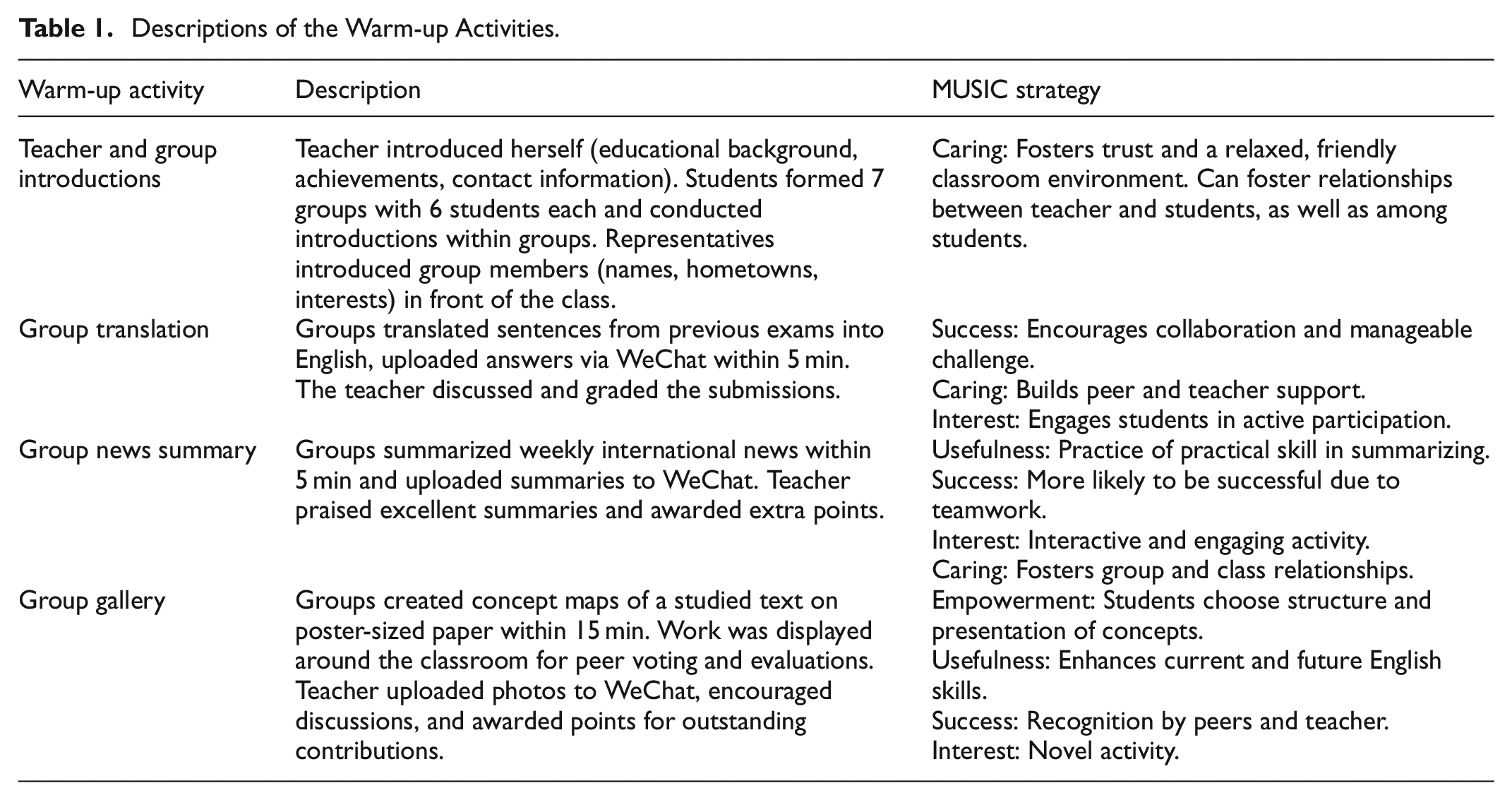
Each class began with a warm-up activity, as described in Table 1. Table 2 provides a summary of the warm-up activities and course content by class and week.
Descriptions of the Warm-up Activities.
Weekly Summary of the Warm-up Activities and Course Content.

Lecture Classes for Weeks 2 and 12
Because most students were unfamiliar with group presentations, the teacher spent most of the class time during Week 2 explaining how to prepare for the group presentation (e.g., forming a 6-member group, how to prepare the slides, showing them the grading rubric, demonstrating the interaction platform they used after class). Therefore, after the group warm-up activity, Week 2 included mostly lecture and did not include any specific MUSIC strategies.
After the warm-up activity, the teacher shared the syllabus and teaching plan, and told the students that this semester the class would participate student-centered, small group activities. That is, students would lead the in class by and presenting the content of each unit in small groups. The teacher also provided the rubric for the group presentation, including how the group is formed, the main components of the presentation (the teacher provided a reference template), and the grading criteria of the presentation (i.e., the required key points in the presentation, the cooperation among the group members; the interaction with the class; the variety of illustrations for the content such as Word, PPT, and audio or video materials).
In Week 12, the teacher provided a traditional lecture class, which consisted of three lectures. First, she gave a 10-min lecture instead of conducting a warm-up activity. Then, she gave a 50-min lecture for Unit 4, including vocabulary, phrases, key points in the text, and assignments to work on after class. Finally, the teacher spent 20 min summarizing the current class and describing the oral exam to be given in Week 14 and the final paper-and-pencil test to be given in Week 16. The classes in Weeks 12, 14, and 16 did not include any activities that were intentionally designed to include MUSIC strategies.
Group Presentations for Weeks 4, 6, 8, and 10
After the warm-up activities in class, the teacher asked the students to present their group work in class in Weeks 4, 6, 8, and 10. The content of the group presentations included the new vocabulary for each unit, the long and difficult sentences in the text, and the exercises in each unit. The teacher assigned each group a specific and different task. For example, group one was responsible for the first half of the vocabulary section, group two was responsible for the second half of the vocabulary, and group three worked on the exercises section. The teacher shared the group tasks in the online WeChat classroom publicly one week prior so that the students could have enough time to prepare for the presentation. Throughout the semester, each group provided four presentations (Weeks 4, 6, 8, and 10).
The MUSIC strategies were intentionally integrated into the group presentations. The group presentations empowered students to make choices about what and how to present the material. Students were more likely to believe that they could succeed because they were working together as a team in a caring manner to help one another. The students may also find it interesting and enjoyable to work on activities that involve engaging, collaborative activities and listening to their classmates present rather than listening to the teacher lecture.
Measures
The student survey included an inventory comprised of five scales and several other individual items. All survey items were rated on the same six-point Likert scale: 1 = strongly disagree, 2 = disagree, 3 = somewhatdisagree, 4 = somewhatagree, 5 = agree, and 6 = stronglyagree.
MUSIC Model of Academic Motivation Inventory
To measure students’ perceptions of the motivational climate, we utilized the Chinese translation of the college version of the MUSIC Model of Academic Motivation Inventory (Jones, 2020), which has been validated in prior studies (Jones et al., 2017; Jones et al., 2023; Jones & Wilkins, 2023). The 19-item version of this inventory consists of items that comprise five scales: four items for empowerment, four for usefulness, four for success, three for interest, and four for caring. These scales examine the extent to which students believe that: (a) they have choice in the coursework and assignments (empowerment); (b) the course content is useful for their present and future (usefulness); (c) they can succeed in the course (success) if they put forth enough effort; (d) the teaching methods in the course are interesting (interest); and (e) the instructor is friendly, willing to help, and concerned about their learning progress (caring). Here is an example item from each scale: “I have the freedom to complete the coursework my own way” (empowerment), “The knowledge I gain in this course is important for my future” (usefulness), “Throughout the course, I have felt that I could be successful on the coursework” (success), “The instructional methods used in this course hold my attention” (interest), and “The instructor cares about how well I do in this course” (caring). We computed Cronbach’s alpha values as a measure of internal consistency reliability within the sample, resulting in one alpha value for each of the five MUSIC scales.
Motivation, Effort, and Teacher Effectiveness
The one-item motivation item was designed to measure students’ motivation as defined by Jones (2018) as the intent to engage in an activity: “For the next few weeks, I intend to put forth my maximum effort in this course.” The effort item was selected from the items in the Course Effort scale (Jones, 2019): “In this course, I have put forth my maximum effort.” Teacher effectiveness was measured with one item that is consistent with items typically used to measure students’ overall evaluation of teaching in a college course: “Overall, the teacher’s instruction is effective.”
Results
Data Screening
To ensure the quality of the longitudinal study and the reliability of the paired-sample t-test, we excluded nine students who did not complete all five surveys, which led to the inclusion of 33 students (78.6%) in this study. Backend data showed that the response time for each survey exceeded 40 s, indicating that the students had likely read and answered the questions carefully as opposed to randomly selecting answers.
Internal Consistency Reliability
As shown in Table 3, a total of 25 alpha values were computed, with 13 falling within the good range (.80–.89) and 12 within the acceptable range (.70–.79; George & Mallery, 2003).
Cronbach’s Alpha Values for the MUSIC Inventory Scales.

Students’ Perceptions of the Motivational Climate
To assess how students’ perceptions of the motivational climate changed over time, we calculated the MUSIC scale scores for each of the five surveys and the results are presented in Figure 2. Overall, the scores were high for all of the MUSIC scale scores, ranging from 4.67 (Success, Week 2) to 5.61 (Caring, Week 8). The lowest mean scores occurred at Week 2 for all five MUSIC scales. The highest score for each MUSIC component occurred at Week 8 or 10. The largest mean difference from the lowest score to the highest score was for success (maximum difference was 0.54), followed by empowerment and usefulness, with differences of 0.48 and 0.40 respectively. Interest had a maximum difference of 0.38, while caring had the smallest difference at 0.22. Caring was consistently rated the highest (ranging from 5.39 to 5.61), while success was consistently the lowest (ranging from 4.67 to 5.21), with empowerment, usefulness, and interest scores between the caring and success scores.

Mean scores for students’ MUSIC perceptions over time.
To assess whether there was a difference across the weeks for each variable, we conducted a repeated-measures ANOVA using a Bonferroni correction as a post-hoc test. The results are presented in Table 4. There was a statistically significant difference across time for each of the MUSIC variables except caring. These findings indicate that students’ perceptions of empowerment, usefulness, success, and interest vary depending on the week; and thus, motivational climate changes within the course.
Means, Standard Deviations, and Repeated-Measures Analysis of Variance for Study Variables.

Note. Some of the degrees of freedom are different from one another because we corrected for the lack of sphericity in some analyses by using the Greenhouse-Geisser epsilon.
Values with the same superscript in the same row are not statistically significantly different (p < .05).
p = .051, which was almost statistically significant at p < .05.
p < .05. **p < .01. ***p < .001.
To examine the impacts of the intervention employed in Weeks 6, 8, and 10, we were particularly interested in whether the post-hoc tests indicated differences between these weeks and Weeks 2 and 12 (the traditional lecture weeks). We began by examining the Week 2 scores and found that they were significantly lower than the Week 6, 8, 10, and 12 scores for empowerment, lower than the Week 8 and 10 scores for success, and lower than Week 8 score for interest. These findings indicate that the intervention, especially in Week 8 was perceived to be more empowering, fostered increased success perceptions, and was more interesting than Week 2.
Next, we examined the Week 12 scores and found that the Week 12 score for success was significantly lower than the success score for Week 10. This finding demonstrates that the intervention in Week 10 helped students to feel more successful than the lecture activities in Week 10. We did not identify any other differences between Week 12 scores and the scores for the other weeks.
Students’ Motivation, Effort, and Teaching Effectiveness Ratings
Overall, students reported high levels of motivation (ranging from 4.94 to 5.33), effort (4.64–5.21), and teaching effectiveness (5.09–5.52; see Figure 3), and these ratings followed a similar pattern over time. The lowest ratings were in Week 2 and Week 12 (for the traditional lectures), while the highest ratings were in Weeks 6, 8, and 10 (the intervention weeks), which also align with the highest MUSIC component scores.

Mean scores for students’ motivation, effort, and teaching effectiveness ratings.
To determine whether there was a difference across weeks for these three variable, we conducted a repeated-measures ANOVA using a Bonferroni correction as a post-hoc test. The results are presented in Table 4. There was a statistically significant difference across time for effort and teaching effectiveness, and the difference for motivation was almost statistically significant (p = .051). These results demonstrate that students’ effort and perceptions of teaching effectiveness vary over the length of a semester.
To investigate the effects of the intervention implemented in Weeks 6, 8, and 10, we examined whether the post-hoc tests indicated differences between scores these weeks and scores in Weeks 2 and 12 (the traditional lecture weeks). The Week 2 scores for effort and teaching effectiveness were significantly lower than the scores in Weeks 6 and 10. In addition, the Week 2 score for teaching effectiveness was significantly lower than the score in Week 8. The Week 12 scores were not statistically significantly different than the other weeks for motivation, effort, or teaching effectiveness.
Discussion
The purpose of this case study was to examine students’ perceptions of the motivational climate, motivation, effort, and teaching effectiveness in a graduate English language course to investigate the effects of an intervention intended to improve the motivational climate in the course.
Students’ Perceptions of the Motivational Climate
The results suggest that implementing MUSIC strategies in Weeks 6, 8, and 10 enhanced students’ perceptions of the motivational climate as compared to the traditional lecture class in Week 2, and to a lesser extent, to the traditional lecture class in Week 12. All five of the MUSIC perceptions trended upwards from Week 2 to Week 6 and 8; however, only empowerment, success, and interest were statistically significantly higher in Week 8 than Week 2. Perhaps with a larger sample size, the increasing score trends for usefulness and caring would also be statistically significant (Button et al., 2013). These findings indicate that usefulness and caring are less susceptible to variation based on changes to teaching approaches. These results make sense given that caring is a measure of the quality of the relationship between the teacher and students, which may not be as directly related to changes to teaching approaches and may be more related to the manner in which a teacher relates to students (such as in a friendly manner and with respect). Similarly, usefulness may be more directly related to the curriculum content, which in this case was studying the English language. In fact, usefulness was not targeted in the intervention for the class activities (see Table 2), and therefore, we would not necessarily expect changes in this variable over time.
The relatively stable upward trend in MUSIC perceptions from Week 2 to Week 10 (with the exception of a decrease from Week 8 to Week 10 for empowerment, interest, and caring, as we discuss in the next paragraph) may be due to a couple reasons. Because the group presentations were predominant during Weeks 6, 8, and 10, the main instructional approach was consistent. However, the warm-up activities were different in these three sessions, and it is possible that they contributed to variations in the average scores. Warm-up activities included the group translation activity (Week 6), the group news summary activity (Week 8), and the gallery activity (Week 10). Because students rated their MUSIC perceptions higher during the weeks with the group news summary (Week 8) and the gallery activity (Week 10) than the week with the group translation activity (Week 6), it appears that instructors should consider using the group news summary and gallery activity if they align with their instructional goals. Another possible reason that the Week 8 and 10 MUSIC scores were higher than Week 6 may be that it took students time to get used to the non-traditional teaching approaches used during these three intervention weeks. In most English courses in China, students receive traditional lecture (MOE, 2020); therefore, they may not feel as comfortable with the MUSIC strategies that are more student-centered. Consequently, it may take them some time to determine whether they find these approaches interesting and useful, and whether they can be successful in these activities.
The decrease from Week 8 to Week 10 for empowerment, interest, and caring was surprising because the intervention was the same except that the warm-up activities varied (Week 8 included the group news summary and Week 10 involved the gallery activity). The decrease for empowerment was negligible (5.29 in Week 8 vs. 5.26 in Week 10), so we will not discuss that as a significant difference. The decrease in interest (5.45 in Week 8 vs. 5.35 in Week 10) and caring (5.61 in Week 8 and 5.48 in Week 10) were still relatively small, but possibly noteworthy. In Weeks 4, 6, and 8, the teacher discussed the strengths and weaknesses of the answers for each group’s presentations during the warm-up activity. However, in Week 10, the teacher did not examine their gallery activity work; instead, the students evaluated each other’s work. It is possible that students viewed the teacher as less caring because she did not take the time to evaluate their work. However, it is unclear why they perceived the gallery activity to be less interesting, because it was a new activity, which should have increased its novelty and created interest (Tulving & Kroll, 1995). One explanation may be that students found the main presentation activity less interesting in Week 10 because they had completed similar activities for the prior three classes. Perhaps the novelty of these activities was diminishing.
Caring consistently scored the highest across all weeks, which indicates that students regarded the instructor as someone who cared about their learning and about them as a person. These perceptions are likely due to the use of caring strategies such as the teacher: maintained constant communication with students via the online WeChat classroom, guided group presentation activities, and provided feedback after each activity. The caring scores were not statistically different across weeks which suggests that once students form a perception of an instructor, it may remain relatively stable unless a significant activity occurs to change their perception. Further research is needed to determine the extent to which caring is typically more stable over time than the other MUSIC perceptions.
Interest was rated the second highest across almost all weeks, except for Week 6. The high rating for interest may be due to the fact that the teacher incorporated group activities as the main instructional strategy during the intervention weeks, and this strategy differs significantly from traditional lecture-based classes which are more common in English language courses in China.
The empowerment and usefulness scores were typically in the middle of the other MUSIC scores. The empowerment scores were likely statistically significantly higher in Weeks 6, 8, and 10 because the group presentations during those weeks provided more choices and autonomy than the teacher presentations in Weeks 2. The higher usefulness scores may stem from the fact that English is a compulsory course for Chinese college students at all academic levels (undergraduate and graduate students; MOE, 2020), making students perceive the English course as beneficial for both their present and future.
Across all weeks, the success component was the lowest average score among the five MUSIC perceptions. Success and empowerment are typically challenging aspects to design for in foreign language teaching classes (Li, Zhao, & Cao, 2016). In this class, students may have been challenged by the group presentations, which were mostly unfamiliar to them and may have decreased their perceptions of success. Nonetheless, students’ success scores in Week 8 and 10 were statistically significantly higher in Week 8 and 10 than in Week 2, and higher in Week 10 than in Week 12.
The teaching strategies in Week 12 were similar to those in Week 2 in that they were mostly a lecture format. However, in Week 12 the teacher explained the key points of the new vocabulary, the difficult sentences in the text passage, and the analysis of the keys to the exercises in the textbook. Although only the success scores were statistically significantly lower in Week 12 than Week 10, there was also general downward trend between those weeks for empowerment, usefulness, and interest, which is consistent with what we expected.
Students’ Motivation, Effort, and Teaching Effectiveness Ratings
The pattern of responses across weeks for motivation, effort, and teaching effectiveness were almost identical, with the highest values during the intervention weeks (Weeks 6, 8, and 10) and lowest for the traditional lecture weeks (Weeks 2 and 12). These findings align with the MUSIC ratings in that the highest MUSIC ratings were documented during these same weeks when the instructor implemented the MUSIC strategies. The results of the ANOVA also indicated that students’ effort and teaching effectiveness ratings were statistically significantly higher for the three intervention weeks than Week 2 (except that the Week 8 effort score was not significantly higher than the Week 2 effort score). These results are consistent the MUSIC model theory in that higher MUSIC perceptions were related to higher motivation, effort, and course ratings (Jones, 2009; Jones et al., 2022; Jones, 2018).
We noted an interesting pattern when comparing students’ motivation and effort scores. Their motivation scores (i.e., their intent to put forth effort) should align with their effort scores that they reported the following week if motivation predicts effort as theorized in the MUSIC model (see Figure 1). We documented this pattern for the most part, as their motivation in Week 6 (M = 5.18), was similar to the effort they reported at Week 8 (M = 5.12). Similarly, their motivation in Week 8 (M = 5.24), was similar to the effort they reported at Week 10 (M = 5.21). These findings indicate that their motivation and effort aligned during the weeks in which the MUSIC strategies were employed in the course. However, this pattern did not align as well when the instruction was changed from traditional to MUSIC strategies (M = 4.94 for motivation in Week 2 and M = 5.18 for effort in Week 6) or from MUSIC strategies back to traditional instruction (M = 5.33 for motivation in Week 10 and M = 4.91 for effort in Week 12). This indicates that there is less consistency between students’ motivation (intent to put forth effort) and their perceived effort, with perceived effort being less than initially intended. This suggests that students’ effort was influenced by other factors, which appears to be the course design because these discrepancies occurred during the weeks in which changes occurred in instructional approaches.
Implications
Implications for Teachers
The findings indicate that instructors can enhance students’ motivation, effort, and perceptions of teaching effectiveness by incorporating MUSIC strategies into their teaching. Teachers unfamiliar with the MUSIC model can learn more about motivational teaching strategies at the MUSIC model’s official website (www.theMUSICmodel.com), which offers resources such as examples, tips, measurement tools, and a free book of MUSIC strategies (Jones, 2018). We provide some examples from this book in this section. Example strategies to increase students’ perceptions of empowerment include giving students choices during class and within assignments, incorporating more learner-directed approaches (e.g., project-based learning), and allowing students to talk more during class. Teachers can increase students’ perceptions of the usefulness of the course by explaining how the content is relevant to their lives, asking students to share the reasons they find the course useful, and providing opportunities for students to set and reflect on their goals. There are many strategies that can be used increase students’ perceptions of success, including: matching the difficulty levels of class activities with the abilities of the students; providing honest, specific feedback to students; explicitly communicating expectations to students; and providing tips that help students how to best study and learn in the course. Interest strategies include activities and assignments that attract students’ attention (e.g., adding theatrical elements, calling on students’ randomly, involving students in discussions), pique their curiosity about the content (e.g., providing surprising information, introducing contradictions, presenting controversies), stimulate emotional arousal (e.g., showing enthusiasm, varying instructional activities, decreasing debilitating anxiety), and build on students’ individual interests. Finally, teachers can create a caring climate by being approachable and fair, ensuring that students are respectful to one another, and providing consistent communication.
Teachers can also participate in professional development programs or workshops to learn how to integrate strategies related to one or more of the MUSIC model components. Jones et al. (2020) describe a six-step faculty development approach they used to help faculty learn how to improve the motivational climate in courses. This approach to faculty development includes teaching faculty about the MUSIC model, collecting motivational climate data from students (e.g., by surveys, interviews, discussions), evaluating the results of the data collection, revising their course, implementing the revisions, and collecting data again to assess the impacts of the revisions. This process allows teachers to identify any motivational climate problems in their courses, select appropriate strategies from the MUSIC model strategies, and redesign their teaching. By comparing the motivational climate results over time, teachers can gradually enhance the motivational climate in the classroom and thereby increase student motivation, effort, and perceptions of teaching effectiveness.
The case described in the present study can serve as an example of how instructors can measure motivational climate in their courses, which is important because the climate is a predictor of students’ motivation and engagement (Jones et al., 2017). These measures of motivational climate (i.e., the scales of the MUSIC Inventory) are available for free and have been translated to many different languages for instructors to use as needed (see Jones, 2020). Because the inventory is only 19 items, it can be easily conducted online via smartphones, allowing students to complete the course perceptions survey in a few minutes.
Challenges to Implementation
A teacher’s transition from traditional lecture-based teaching to using MUSIC strategies is not without its challenges to both students and teachers. With respect to student challenges, university students in many contexts (such as China) have been accustomed to playing a passive listener role in the classroom since elementary school. Typically, they remain quiet during lectures, take detailed notes, and prepare for exams by reviewing and completing assignments. To help students adapt to more interactive and motivational teaching approaches, teachers can explicitly communicate to students that they expect students to be actively engaged in activities during the course. Teachers can emphasize that the purpose of active student engagement is to empower them to become proactive students so that they can meet the specified learning outcomes. Such clear explanations may reduce students’ resistance to these teaching approaches.
With respect to teacher challenges, using motivational strategies can place higher demands on educators. Some teachers, such as those in Chinese universities, have long been accustomed to preparing lectures. In contrast, many MUSIC model strategies require teachers to shift from being “talkative speakers” to becoming “attentive listeners” and “classroom facilitators.” These new roles require instructors to redesign their course structure and learn how to balance a variety of activities (e.g., mini-lectures, interactive activities, student presentations) within limited class time, while ensuring that the teaching objectives are met. Thus, instructors must not only learn how to implement other teaching approaches (such as those explained in Jones, 2018), but also to structure them in a course to meet the course objectives in a timely manner.
Additionally, in the context of Chinese culture, “stability” and “conservatism” are often regarded as mainstream values, while “innovation” and “challenges” are considered less common. As a result, this shift from a comfort zone to an innovation zone poses even greater challenges for teachers. It not only requires them to redefine their roles in the classroom but also necessitates embracing uncertainty and confronting the risks associated with experimentation and innovation.
Implications for Future Research
Students completed the MUSIC Inventory five times during this study, but it could be conducted more or fewer times depending on the needs of the instructor. Future research could answer questions such as: Is conducting five surveys too frequent? Does conducting the survey more frequently provide useful information to the instructor? Do students feel fatigued from completing so many surveys? The inventory could also be conducted over several semesters, or in several different courses within the same semester, as a means to compare students’ perceptions across semesters, courses, or both. Adding some open-ended items to the MUSIC Inventory survey could also provide information that may be useful to instructors (see Jones, 2020, for example items).
Since the outbreak of the COVID-19 pandemic in 2020, many English classes have had to change from face-to-face to online formats. Therefore, in the future, the MUSIC model strategies and the MUSIC Inventory could be used in online English courses reforms to explore students’ course perceptions, motivation, and effort. Researchers have documented the success of such approaches in online courses in other disciplines (e.g., Jones et al., 2012, 2021). Similarly, future research could conduct comparative studies on college English course reforms based on MUSIC model strategies in both online and in person settings.
Given the initial promising results from this case study, future research could include experimental designs to confirm that it was the MUSIC strategies that led to increases in the motivational climate, student motivation and effort, and their perceptions of teaching effectiveness. Additionally, studies in diverse English teaching contexts would provide broader insights into the practical application of the MUSIC model (Lamb et al., 2019).
Limitations and Future Studies
The results of this study must be interpreted within the context of its limitations. First, the findings are limited to the specific sample used in this study, which consisted of Chinese college students in an English course. It is important to remember that this study was designed as a case study and not to provide generalizable results. Therefore, these results may not generalize to other ethnicities, cultural contexts, or geographic areas where teaching methods, student expectations, and classroom dynamics differ. In addition, the sample size of this study was relatively small (n = 33), which may also limit the generalizability of the findings to other contexts, such as larger classes. Furthermore, most of the students were male engineering students, who may not be representative of other genders or majors. Future studies designed with larger and more diverse samples will help confirm the robustness of the results.
Although the study included more than three-quarters of the students in the course, we do not know how the other students in the course may have responded. The voluntary nature of participation may have attracted individuals who responded differently than non-respondents, thus potentially affecting the representativeness of the results.
As a case study, this research did not include a control group. Therefore, it is impossible to attribute the observed changes in the variables solely to the intervention. Future research could include a control group and employ random sampling to permit causal claims.
Another limitation was that the data collected was based solely on self-reported survey responses from students. Although self-reports provide valuable insights into students’ perceptions and experiences, they are subject to biases such as social desirability and limited introspection. The absence of complementary data, such as classroom observations, teacher interviews, or reflective journals, limits the depth and breadth of understanding regarding the effects of this teaching reform. Future research could adopt a mixed-methods approach that combines quantitative surveys with qualitative methods (e.g., interviews with students and teachers, classroom observations) could provide a more comprehensive understanding of the depth and breadth of teaching reforms.
The one-item scales used in this study to measure motivation, effort, and teaching effectiveness are a limitation of this study. Single-item scales provide limited variance and may not fully capture the complexity of these constructs. However, they were chosen to reduce participant burden and ensure timely responses, considering the study’s practical constraints. Future studies could employ multi-item scales such as those provided in Jones (2020).
A final limitation is that individual differences in baseline motivation-related variables levels likely influenced the results of the study. For example, students with higher motivation to engage in this course may have put forth more effort and been more responsive to the intervention, leading to greater improvements in their perceptions and learning outcomes. Conversely, students with lower baseline motivation may have required additional support to benefit from the intervention, potentially limiting its overall effectiveness. To address these differences, future studies could stratify participants based on their initial levels of motivation-related variables (e.g., motivation, abilities, individual interest) and analyze the intervention’s impact within these subgroups. This approach would provide a more nuanced understanding of how baseline variables interact with the intervention to shape outcomes.
Conclusion
We investigated the effects of motivational strategies that were intended to improve the motivational climate in an English language course, and thereby, increase students’ motivation, effort, and perceptions of teaching effectiveness in the course. The MUSIC strategies selected by the instructor (e.g., group presentations) were effective in improving the motivational climate and students’ motivation, effort, and perceptions of teacher effectiveness. These findings provide initial evidence that these strategies could be useful to other English language instructors who want to try more motivational strategies to engage their students and improve students’ perceptions of their teaching effectiveness.
Footnotes

Ethical Considerations
The study procedures were reviewed and approved by the Institutional Review Board at Shanghai University of Engineering Science (#2024-004).
Funding
The author(s) disclosed receipt of the following financial support for the research, authorship, and/or publication of this article: Funding was provided by the Shanghai Higher Education Middle and Young Teachers’ Overseas Visiting and Continuing Education Program Fund. The Core General Education Courses Construction Program Fund (t202318001) at Shanghai University of Engineering Science paid the publication fees for this article.
Declaration of Conflicting Interests
The author(s) declared no potential conflicts of interest with respect to the research, authorship, and/or publication of this article.
Data Availability Statement
The data are available upon request by contacting the first author.