




Abstract
The research objective was to study local traditional wisdom of the art of producing fabric dye from fresh buffalo manure (FBM). Data were collected from rural weaving community cooperative (co-op) members and experts in Thailand’s northeastern Mekong River province of Nakhon Phanom. The study’s Method 1 added buffalo dung water, salt, and a mordant together, which was brought to a boil for 30 minutes. Method 2 added buffalo dung water and salt, which was brought to a boil for 10 minutes, after which a mordant agent was added, then boiled for an additional 30 minutes. There were five different formulas for each method using a different mordant. Results revealed that Method 1 had the best dyeing solution and produced a consistent, commercially usable, washable fabric with three-tone coloring and long-lasting yarn. Method 1 also used a hot dyeing technique in which cotton yarn and FBM were disinfected in a boiling vat while natural odor-reducing additives were added. Moreover, Method 1 consisted of either (1) FBM, salt, and lye, (2) FBM, salt, and muddy water, or (3) only salt added to FBM. These three solutions yielded a material in which testing by the Thailand Textile Institute (THTI) using ISO standards was determined to have a moderate degree of lightfastness, as well as an excellent resistance to color fading after washing. The study is important as it adds a wealth of knowledge to the literature concerning eco-friendly eco-fashion, sustainable products, and economically viable traditional handicraft textile production techniques.
Keywords
Introduction
Over many decades and across multiple continents, authors and governments have discussed and proposed solutions for sustainable, eco-friendly products, produced from the local traditional wisdom of rural community entrepreneurial craftspeople. Furthermore, sustainable product development in local communities has been discussed by many. In Japan, one such program was the now world-famous initiative championed by Japan’s Governor Hiramatsu known as “One Village One Product” (OVOP) (Anh, 2013). Some years later, Thailand adopted this concept, relabeled it OTOP (One Tambon, One Product), and marketed its own domestically produced, “home-grown,” products to the world (Figure 1).

Examples of clothing and accessories produced from buffalo manure dye.
Moreover, in Thailand, the Thai word “Tambon” is used to describe a small, local community sub-district, with the OTOP concept originally conceived as taking each local community’s traditional handicraft wisdom and turning it into a commercially viable product under one globally recognized brand (OTOP) (Inthachote et al. 2020; Natsuda et al., 2012; Sitabutr & Pimdee, 2017). Even the United Nations Industrial Development Organization (UNIDO) committed itself to these entrepreneurial, local-community self-development projects when they outlined their own OVOP/OTOP type programs for community development initiatives on the African continent (Curry & Sura, 2007; Haraguchi, 2008).
It must also be noted that the OVOP/OTOP type programs also offer skill training and employment for local people, from young to old (Anh, 2013; Huttasin, 2008; Natsuda et al., 2012; Prayukvong, 2005; Sitabutr & Pimdee, 2017). These programs can also help cope with the problem of youth migration from their rural villages, seeking potential jobs in urban centers (Anh, 2013). This is consistent with Shafi et al. (2019) who added that in developing countries, small entrepreneurial handicraft firms can provide significant income and employment generation.
Therefore, once again borrowing from the wise words of Japan’s Governor Morihiko Hiramatsu, “Think globally, act locally” is an idea that has taken root across a wide spectrum of communities around the world (Anh, 2013). Furthermore, traditional wisdom is something that must be studied, recorded, and embraced, as this knowledge is the cumulative result of decades, if not centuries, of experiences and experimentation. It is wisdom that strengthens local communities and offers people a stable life in a highly turbulent world.
Moreover, today we refer to processes or products as “eco-friendly”, “eco-fashion,” or “green” (Gam & Banning, 2011; Kim & Hyun, 2019; Park & Oh, 2014) but in reality, these concepts are no different than humanity’s efforts to live with what nature and their surrounding environment have provided them for thousands of years. Kumar and Prabha (2018) has also stated that dying is an antediluvian art, which predates written records and is the most essential component in the production of fabric. Furthermore, the global textile consumption of 30 million tons requires the use of 700,000 tons of dyes, which causes the release of a vast amount of unused and unfixed synthetic colorants into the environment (Samanta & Agarwal, 2009).
Moreover, with the ever-growing demand for eco-textiles, natural dyes are gaining attention as an alternative to synthetic dyes (Haji & Naebe, 2020), with natural dyes’ resurgence gaining fame within the textile industry due to their eco-friendly nature (Haji & Naebe, 2020; Kiran et al., 2020), their cost-effectiveness, renewability, no disposal problems, and their non-carcinogenic nature (Saha & Datta, 2008). Finally, natural dyes are sustainable, renewable, biodegradable, and anti-allergic from harmful additives (Buyukakinci et al., 2021; Islam et al., 2013; Rehman et al., 2017).
Some natural dyes are also abundant, easy to access, harmless to one’s health, and environmentally friendly. Natural dyes can also be extracted from numerous natural materials such as Citrus aurantium on Lyocell fabric (Tayyab et al., 2020), coconut coir based tannin natural dye (Kiran et al., 2020), oak and barberry dye (Buyukakinci et al., 2021), Juglans regia L. bark (walnut bark) (Haji et al., 2018), henna and yarrow (Haji, 2020), and Ixora coccinea (jungle geranium) or Peltophorum pterocarpum (yellow-flame) (Kumar & Prabha, 2018).
In addition to the properties of the fiber dyes, other important factors in the natural dyeing process include (1) the mordant concentration (2) dyeing time (3) acidity and alkalinity of the dye (Dyebath pH), and (4) dyeing temperature utilizing microwave heating, which is another option to shorten the drying time (Buyukakinci et al., 2021; Haji, 2020; Haji & Naebe, 2020; Kiran et al., 2020).
It is also recommended that the quality of the color fastness from natural dyes should be tested. As such, there are four durability tests commonly recommended. These include washing fastness, light fastness, rubbing fastness, and sweat fastness/perspiration fastness (Buyukakinci et al., 2021; Haji & Rahimi, 2020; Tayyab et al., 2020). Moreover, color fastness is how a material reacts and the level of change that occurs when exposed to light (ISO 105 B02:1994) (Geršak, 2013).
As previously mentioned, in Thailand, the government-managed OTOP program set out initially to identify and work with traditional community-based, handicraft experts in developing their products for the domestic commercial market (Inthachote et al., 2020). This has evolved today into a globally recognized, Thai national brand, that even the Thai national aviation carrier (Thai Airways) went on to market in both their inflight catalogs and on their website (“Government cooperates,” 2016). From locally made products, the OTOP in-flight catalog showcases products from nielloware to hand-woven clothes, that represent the wisdom and traditional arts of local villagers (Suksamran, 2019). Therefore, from gas station kiosks to Jim Thompson Silk retail shops, to world capital aviation check-in counters, Thai traditional handicraft has become globally recognized and sought after (Roll, 2006).
Therefore, traditional local community handicraft knowledge has also become recognized for its commercial viability and community sustainability knock-on effects (Barbier & Burgess, 2017; Inthachote et al., 2020). Therefore, we set out to investigate the large pool of local handicraft wisdom in the dyeing of yarn using FBM in Thailand’s Ban Don Samo Weaving Community (BDSWC), Village No. 1, Si Songkhram District, in Nakhon Phanom Province.
Bordering the Mekong River, the surrounding rice paddy buffalos produce an abundant, free, and fresh source of raw material for the yarn and fabric dyeing process. There is also a tight relationship between the local community, their environment, and the water buffalo, as the raising of buffalo has existed for countless generations in this area. With agriculture being the primary economic means, specifically rice farming, the water buffalo has become synonymous with each family’s livelihood and lifestyle.
Thailand’s Isan (Issan) region water buffalo has even been referred to in the global press as the John Deere tractor of Southeast Asia (Williams, 1985). Of the world’s estimated 130 million water buffalos, 5 million are in Thailand and most of those in Northeast Thailand’s Isan region. Moreover, whatever the season, the buffalo is a walking investment, often the major one for a poor farmer. When its working life is done, the buffalo can be sold for its meat and hide. In the meantime, it provides fertilizer or manure for handicraft dyes. There is also no doubt that the raw material (FBM) is highly abundant, free, and locally available.
As such, wisdom is abundant in the local communities concerning the skills needed for natural fabric dyeing and weaving. Also, according to van Dam (2008), in all countries everywhere, natural fibers are produced and used to manufacture a wide range of traditional and novel products. The author also added that competitive products need to be based on renewable resources that have high quality, show excellent technical performance, and do minimal damage to the environment when compared to petrochemical-based materials.
Also, due to the economic impact of the global COVID-19 pandemic, tourism and many related sectors have witnessed catastrophic collapse, forcing many to return to their rural village homes in Thailand’s northeast, such as Ban Don Samo. As such, employment sources are highly sought after, along with any related skills that can be learned (Inthachote et al., 2020). Moreover, Thailand’s entrepreneurial spirit is world-renowned, with the pickup truck for decades having become the primary tool for the sales and marketing of goods.
However, that is changing, as Thailand’s youth, today have become wizards of social media, the Internet, and smartphone technology, with digital literacy skills second to none (Phuapan et al., 2016). With many of Thailand’s youth now returning to their parent’s Isan region villages possessing 21st century skills, they potentially now can take their mother and aunt’s product knowledge and skills and move it onto a bigger stage; namely the Internet and global e-commerce platforms such as Lazada, Alibaba, and Amazon (Sukrat et al., 2018).
Therefore, we set out to investigate what wisdom can be gleaned, passed on, and improved from our interviews with the local handicraft experts concerning their use of FBM in fabric dyeing. Our objective was to evaluate the potential of these processes for a new line of eco-friendly and sustainable women’s fashion wear, as product fashion design and its related processes are essential in the evolution and development of Thailand’s traditional, home-grown fashion industry.
Literature Review
Sustainable Eco-Friendly Eco-Fashion
According to Chapman and Gant (2008) and Faud-Luke (2009), sustainability requires that society acquires a universal acknowledgment of its condition before individuals can take the radical steps necessary on the road to achieving sustainability. In short, sustainability demands a re-evaluation of societal values, and within the fashion clothing industry, sustainable practices have not, thus far, created a significant impact (Palomo-Lovinski & Hahn, 2014). Moreover, the fashion industry continues to work in an inefficient manner that creates massive waste. Other researchers, such as Gam and Banning (2011), have highlighted the increase in consumer demand for “eco-fashion” due to the significant environmental and resource depletion problems throughout the textile lifecycle. As such, fashion designers and merchandisers are seeking ways to practice sustainability in their design and production processes (Palomo-Lovinski & Hahn, 2014). However, some designers have begun to focus on “eco-friendly” recyclable fabric, which uses printing techniques that require little to no water, as well as local or fair trade production techniques (Fletcher, 2008).
In research from the UAE by Munir (2020), the author stated that eco-friendly fashion awareness and consumer choices were still the most difficult issues to overcome. Furthermore, there was a lack of brand association, eco-fashion clothing’s high cost, too much information, cheap and readily available fast fashion, unattractive and boring designs, lack of incentives to purchase eco-fashion, and poor quality consumer perceptions.
Moreover, Gam and Banning (2011) have highlighted that as consumers’ social and environmental concerns have grown in the past decade, so has their interest in eco-fashion. However, with the fast-changing fashion trends, the clothing industry generates significant environmental and resource depletion problems throughout the textile lifecycle. To respond to these trends, fashion designers and merchandisers need to be motivated to practice sustainability in both their design and production processes.
Some sustainable options are available, such as organic fibers, environmentally safe dyes, and traditional methods making use of natural products (Gam & Banning, 2011; Kumar & Prabha, 2018; van Dam, 2008). Finally, according to Ruppert-Stroescu (2018), the fashion industry requires leadership that uses creative thinking to pursue an industry-wide shift that capitalizes on the new paradigm which redirects the fashion industry toward a more sustainable future.
Traditional Knowledge and Wisdom
Various scholars have interestingly written that although for many years humanity has viewed modern science and technology as providing the answers to the world’s issues and problems, it is now more than ever clear that traditional knowledge has critical insights and practices in some ways superior to modern science (Kothari, 2007). Also, traditional knowledge is expressed in various ways. Some might call it indigenous knowledge, others local knowledge, while academic scholars might feel comfortable with the term “Traditional Ecological Knowledge” (TEK) (Cordell, 1995; Low, 2007).
However, no matter what one calls it, certain characteristics are common to all terms. These include an oral tradition that is generations old and only known by the local (indigenous) people of a local community. Indeed, individuals who are the local sages of their community’s traditional knowledge often insist that their knowledge cannot be divorced from the natural and cultural context within which it has arisen, including their traditional lands and resources, and their kinship and community relations.
Moreover, the concept of kinship with the land is very strong in Thailand’s northeast region of Isan, as there are many rich and old traditions concerning products made from the resources that the local land provides (Inthachote et al. (2020); Stone, 2009). One such tradition concerns a plethora of handicraft textile production techniques (Isan Cultural Routes, 2020; Namfon, 2013), which today, are at risk of being lost due to the rapid change in a technologically complex, fast-paced society (Stone, 2009).
In Thailand, acknowledgment and national branding of local craft, traditional knowledge, and skills began in 2001 under what has become globally recognized as “OTOP.” Under OTOP, thousands of entrepreneurs and local co-ops found a home to showcase their crafts to the domestic Thai market, as well as the much broader international market. Today, with social media and C2C (consumer-to-consumer) enterprises, local craftspeople and co-ops have set up channels directly with their customers, with Facebook being a primary source for orders and revenue generation (Napompech, 2014).
Problem Statement
For thousands of years, humanity has used natural materials to clothe itself. Moreover, over 500 naturally derived additives have been identified as being used to change the texture and color of the material used. All across Southeast Asia, hemp has existed for millennia; cotton came from India, Silk from China, and in very recent times, synthetic yarns from multitudes of foreign mills. However, during all this time, local craftspersons blessed with ancestral traditional knowledge have labored to produce the most exquisite of materials. However, this knowledge is being lost as the youth move away to urban areas seeking their fame and fortune, while their elders are left in the far-away rural villages to pass little or no knowledge on after their demise. Therefore, we set out to interview, observe, experiment, and document these sages’ local traditional knowledge of textile production methods and techniques, using the locally abundant resource of FBM as a dyeing agent.
Methods
Research Setting
In Thailand today, traditional wisdom concerning the production of fabric dyes from buffalo manure still survives, handed down from one generation to the next. As detailed earlier, in the small, rural, agricultural village of Ban Don Samo, fabric weaving entrepreneurs, young and old, are producing a rich assortment of eco-friendly, dyed fabric for use in Thailand’s traditional fashion industry. Marketing venues such as OTOP have existed for decades, but as a newer generation has arisen with extensive digital literacy and e-commerce skills, new marketing channels are being created using social media and e-commerce platforms such as Lazada. However, this wisdom has not been examined, tested, and evaluated by outside researchers that we can determine. Moreover, documented experimentation on local expert formulas, fabrics, and solutions seems to be even rarer. Therefore, this study details how we investigated the use of FBM in fabric yarn dyeing at the BDSWC in Thailand’s Mekong River province of Nakhon Phanom from August 2019 to October 2020.
Research Approach
A mixed-methods research approach was undertaken as experimentation processes evolved from the interview of local handicraft experts and the results from previous experiments. The experiments were conducted based on input from traditional knowledge interviews. To the best of our knowledge from primary and secondary research in both the Thai and English languages, no studies detail the processes that this study set out to examine. Moreover, results from the ISO lab testing concerning material colorfastness and wash-ability is a step seldom undertaken in handicraft fabric testing and analysis (Sufian et al., 2016). Therefore, we feel the research to be somewhat groundbreaking in its scope and determinations.
Research Scope
The scope of the first research objective was to study and analyze the dyeing process from the BDSWC buffalo manure. This also entailed a detailed examination of the solutions, additives, boiling times, and drying techniques on four variations of yarn. The results were to determine which fabric yarn had the most potential for use in women’s fashion design and use.
Tool Construction
In the process of creating the interview question and answer form, we did an analysis of similar studies’ variables and the results. The interview form was then presented to three experts from our university for their input on the form’s consistency and usability. Thereafter, adjustments were made based on their recommendations.
Data Collection
From random interviews of individuals working with FBM used in yarn dyeing in the local community, three names were often repeated as being experts on the subject. Therefore, contact was made with these individuals. After explaining our project, each expert volunteered to participate, after whom it was determined that each had over a decade of experience experimenting and producing colored yarn from FBM dye mixes. The interviews consisted of questions on the analysis of materials that are used, the yarn dyeing process from FBM, and the subsequent weaving process.
Furthermore, we made use of a semi-structured interview form (Fongsri, 2014) to gather information from the BDSWC Co-op on their background, and their perceptions of the importance and processes of FBM dyeing.
Research Results
Fiber Types
Potentially, two types of fibers were available for the study. One was synthetic, the other natural, with natural fibers eventually chosen as the best choice due to their ability to be dyed while providing natural colors. Moreover, natural fibers were determined to be environmentally friendly (Kumar & Prabha, 2018), while synthetic fibers were determined to have the potential to adversely affect the environment (van Dam, 2008).
From the research, it was found that natural dyes used to dye textiles can be obtained from locally sourced natural materials. The dyeing process depends on the different dyeing conditions, including time, temperature, and color stabilizer, with good dyeing results requiring consistency to achieve the desired color.
Also, from fermented buffalo manure used as a natural dye, the original color is dark brown. However, from the use of various yarns including cotton yarn, silk yarn, and hemp yarn, and a colorant and mordant, stronger dye adherence to the fiber can be achieved. Common techniques which can be used to achieve this color adherence strength include (Kumar & Prabha, 2018): (1) the use of muddy water which achieves a darker, gray color, (2) the use of lime water to make a lighter color with brighter colors, (3) the use of vinegar to achieve brighter tones, (4) the use of alum to achieve a darker, yellowish tint, and (5) the use of lye to make darker, grayer colors.
Furthermore, textile dyeing with natural dyes is generally accomplished using three methods. These include: (1) direct dyeing, where the dye will form a chemical bond directly to the fibers, (2) vat dyeing which uses a water-soluble compound before dyeing, and (3) staining by using a substance or a mordant dyeing agent. This is referred to as mordant dyeing, wherein the mordant acts as a dye fixative substance to set or bind the dye to the fabric. However, before dyeing, there should always be a cleaning procedure for the yarn and thread, to remove any dirt or substances that adhere to the coating.
As such, Table 1 summarizes the properties of the natural fibers cotton, linen, silk, and wool. After the analysis, cotton was chosen due to its characteristics (Inthachote et al., 2020). Reasons for cotton’s selection included the material’s excellent natural dyeing properties, it is inexpensive, it is easy to find, with a wide local variety. Moreover, we perceived cotton to be environmentally friendly after a review of the primary information.
Natural Fibers (Cotton, Linen, Silk, Wool, and Plant Fibers) Property Summary.

Local Expert Knowledge Input Concerning Fabric Dyeing Experience
Table 2 details the results from our interviews with local experts from Thailand’s Ban (Village) Don Samo Weaving Community. Each craftsperson expert selected for the one-on-one interview had a minimum of 10 years of experience within the community’s traditional trade of fabric dyeing by use of FBM. From these interviews, we concluded there were eight primary steps within the dyeing process, with only FBM used in the dyeing process. Because the pigment can attach to the cotton fibers thoroughly, it is also important to choose only natural fibers for the best dyeing results. Also, in dyeing, the difference in color hues depends on the properties of different fibers, such as plant fibers and animal protein fibers. The color of the buffalo dung dye is a light brown shade. If you want to increase the intensity of the shades, you can add two times the dyeing agent and increase the dyeing time to 60 minutes. Moreover, local herbs are used to help eliminate bad odor from the buffalo dung, with each of the following steps having been passed down from the accumulated folk wisdom over many local generations.
The process of dyeing cloth from FBM using traditional conventional wisdom.

Fabric Dyeing Process
In Figure 2 we can see six traditional steps used for the use of FBM in the cotton fiber dyeing process. Specifically, Image 1 shows us the cotton fiber cleaning basin, while Image 2 shows the FBM filtration process. Image 3 shows the boiling of the FBM along with the addition of local herbs to reduce odor. In Image 4 we can see the cotton fiber hot dyeing process while Image 5 and Image 6 show the wash and rinse of the cotton fibers and their final drying.

Traditional steps are used in the use of FBM for dyeing fabric yarn.
Experimentation Methods
After observations and discussions, we created various new methods to create a variety of new color tones with the intent to provide consumers with more fabric choices. These techniques also deviate slightly from traditional knowledge, but have the potential to increase consumer desirability, and thus more community income.
Therefore, Table 3 summarizes the experimentation analysis of the dyeing process from the use of buffalo manure using Method 1, which involved the addition of natural coloring agents to the dyeing process. This resulted in significantly noticeable color shade changes, and when combined with Formula 5’s use of salt and lye and Formula 1’s salt and muddy water, color adhered to the yarn quite well, especially cotton and hemp.
Method 1 Experimentation Results Summary.

Note. For. = formula; Time = fermentation time; Color = buffalo manure color; Amt. = amount of buffalo manure water used to dye; Boil = duration of dyeing boil; Mordant = color stabilizer.
Overall, Method 1 (five formulas) demonstrates excellent color adhesion characteristics as well as no fiber blemishes from the color pigments for hemp yarn, silk yarn, and cotton yarn (Figure 3).

Method 1’s color adhesion characteristics.
For purposes of this study, the term “lye” is potassium hydroxide (or caustic potash), which is a chemical compound with the formula KOH (Dadachanji, 2017). The purified material is a white solid that is commercially available in the form of pellets and flakes. Similar to sodium hydroxide (caustic soda, NaOH), it is a strong alkali, very soluble in water, and highly corrosive. Tsai et al. (2019) has suggested that cattle manure or dung is a renewable and inexpensive resource because it mainly comes from the undigested residue of cellulose-based feeds being excreted by livestock animal species such as cow (dairy cattle) and bull. Furthermore, the authors have suggested that for the production of activated carbon (AC), highly porous AC from cow manure using a potassium hydroxide (KOH) activation processed at different temperatures is an excellent resource.
Table 4 summarizes the experimentation analysis of the dyeing process from the use of buffalo manure using Method 2. Additionally, we noted that the shade of color of the fibers changes during the boiling process, with significant color and intensity changes occurring when the watercolor stabilizer is added during Method 2’s process (Figure 4). However, there is a slight increase in alkalinity and an uneven distribution of coloring within the yarn. Therefore, formula 1’s use of muddy water and coloring agent in Method 2 adheres to the yarn best. This is followed by formula 2’s use of alum water. For both formulas, the fabric that is best dyed is cotton and hemp yarn.
Method 2 Experimentation Results Summary.

Note. For. = formula; Time = fermentation time; Color = buffalo manure color; Amt. = amount of buffalo manure water used to dye; Boil = duration of dyeing boil; Mordant = color stabilizer.
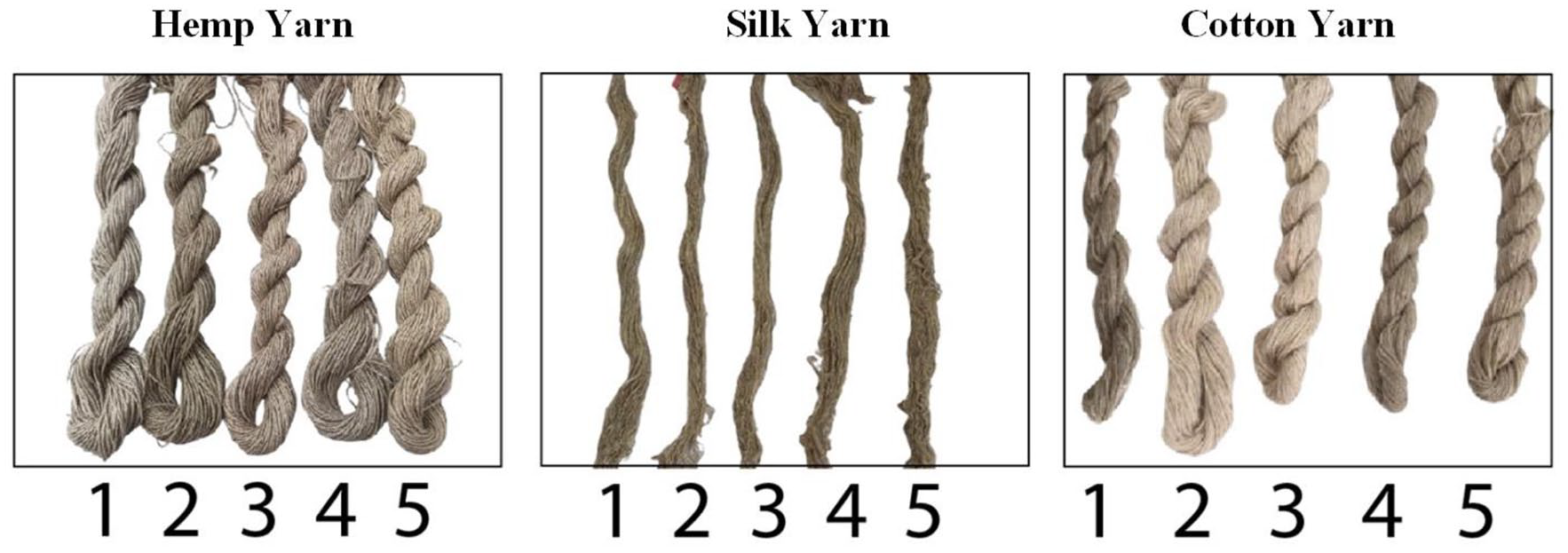
Method 2’s color adhesion characteristics.
Moreover, Figure 4 shows the colorization results on the three fiber types using Method 2’s five formulas.
Method 1 and Method 2 Comparison Results
Experimentation results also determined that the most effective and complete technique was Method 1’s dyeing process. Reasons for this included results which determined that the end product yarn had color pigments firmly and evenly attached to the fibers. Moreover, in Method 2, results showed alkalinity on the yarn, imperfections in the dyed material, and excessively long curing times. Also, Method 1 only required the batch to be stirred every 1–2 minutes, while Method 2 required stirring every 5 minutes. However, when salt was added to both methods, fibers swelled, thus allowing more color penetration and color adherence. We also concluded that the cotton yarn used in the experiments retained excellent qualities throughout the process.
Moreover, when natural fibers are used in the dyeing process in Method 1, the strands consistently demonstrate the most uniform color tone and saves processing time. Natural fibers also make the color adhere to the yarn without alkalinity. Experts also added that cotton makes the pigments easy to stick and the color perfectly fine. They also added that the use of lye and muddy water is also excellent dyeing solutions for the yarn.
Table 5 also shows the results of the colorfastness test in sunlight for 30 days during the intense tropical May sun. In Table 5’s Image 1, we see the fabric coloring immediately after initial drying, while Image 2 shows the results after being hung in the sun from the 1st of May to the 30th of May, with an average daily temperature of 35°C. From the comparison, we noted that the fabric coloring changed only slightly during the month.
Buffalo Manure Dyed Cloth from Month-Long Sun Exposure Testing.


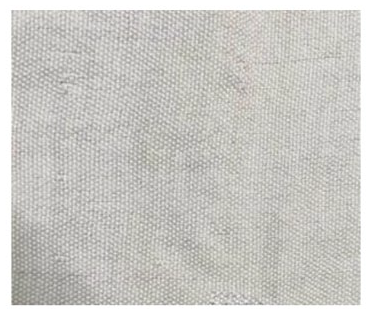
Furthermore, samples were sent on to Thailand’s Textile Institute (THTI) for further colorfastness testing for light and washing evaluation (Geršak, 2013; Jatuphatwarodom et al., 2019). The THTI operates under the Ministry of Industry’s Foundation for Industrial Development (FID). At this phase of the study, an Atlas Ci 3000+ Xenon-Arc Weather-Ometer was used for more evaluation. These devices are most commonly found within the automotive OEM sector and are used for long-term testing of interior and exterior automotive materials. As such, testing results on October 10, 2020, revealed that on a scale of eight for colorfastness to light, the buffalo manure dyed woven fabric had a color change rating of 3 to 4 (Table 6). This indicates a moderate color change tolerance.
Colorfastness to Light Testing Using ISO 105-B02: 2014(E) Exposure Cycle A2 and an Atlas Xenon ARC Weather-Ometer Model Ci 3000+.

Also, according to Geršak (2013), blue wool references are identified by the number 1 (very low colorfastness) to 8 (very high colorfastness), with each approximately doubling the fastness of the color below it. The term “change in color” also includes changes in hue, chromatic characteristics, lightness, or combination of these color characteristics (ISO 105-B01:1994).
In the second evaluation, colorfastness testing used the ISO 105-C06:2010(E) standard Method A2S which entailed washing the material at 400°C with 10 stainless steel balls for 39 minutes (International Organization for Standardization, 2020) (Table 7). Moreover, the wash liquor contained 150 ml using the 1993 AATCC standard reference detergent WOB 4 g/l and sodium perforate at 1 g/l.
Color Fastness to Washing Testing Using ISO 105-C06:2010(E) Standard Method A2S in an Atlas Xenon ARC Weather-Ometer Model Ci 3000+.

From this test, it was determined that the material had a color change rating of 3, which is interpreted to mean that there were noticeable colors changes/staining. The additional color staining testing for all six different materials revealed a rating of 4–5 on the five-level scale, indicating a slight color change (Tayyab et al., 2020). Level 4 is interpreted as a slight color change, while Level 5 is interpreted as no color change or staining.
Discussion
From the observations and interviews of the craftspeople with many generations of wisdom, we concluded that local wisdom in the traditional tradecraft of fabric dyeing was highly compatible with the ideas of sustainability and eco-friendly products. However, as Park and Oh (2014) noted in Korea, fashion entrepreneurs need to additionally consider a consumer’s characteristics, needs, and the environment in which they are purchasing their eco-friendly fashion products.
As mentioned earlier, Thailand’s national OTOP program or newer social media consumer-to-consumer (C2C) sales channels are excellent avenues for input for product fashion design. Data from the Thailand Productivity Institute also has reported that there are 70,000 OTOP enterprises throughout Thailand (Changsorn, 2015), with 10,000 having products qualified for international markets, which in 2015 generated $2.88 billion in foreign exchange revenue.
This is consistent with consumer fashion buying research in Thailand in which Napompech (2014) noted the growing importance of social media consumer buying, especially from the use of Facebook. Reasons for this transition from brick and mortar malls and OTOP outlets to online shops are the ability to exchange other user product information, purchasing convenience, clothing diversity, demand-driven items, and ordering system security, and the entrepreneur’s discounts.
The findings from the study’s expert interviews and weaving community co-op members determined that the most popular yarn/fabric colors are earth tones such as dark brown, light brown, dark gray, and light gray. These shades of color are determined by the color of the buffalo manure solution in which the yarn is dyed. Therefore, the color obtained from the dye from the buffalo manure is special and valuable in itself (Inthachote et al. (2020); Isan Cultural Routes, 2020).
Method 1 added water, buffalo dung, salt, and a mordant together, which was brought to a boil for 30 minutes. Method 2 added buffalo dung water and salt, which was brought to a boil for 10 minutes, after which a coloring agent was added, then boiled for an additional 30 minutes. There were five different formulas for each method that used different mordant.
Furthermore, Method 1 yielded the best overall results, including having the most popular color shades. Moreover, Method 1 used buffalo dung added to 250 ml of boiling water with a dyeing agent. This mix was then boiled at 90°C for 30 minutes. In formula 1, salt and mud were added to every 10 ml, for formula 2, salt and lye were added to every 10 ml, while formula 3 used just salt for every 10 ml. The results produced a dark brown fiber from each of the formulas.
The reasons stated were its gentle and warm coloring, which is very compatible with other local Thai fashion design colors and products. Of the five formula solutions used for the selected yarns, the solutions having (1) FBM, salt, and lye, (2) FBM, salt, and muddy water, and (3) FBM mixed only with salt yielded the best-colored yarns.
Furthermore, the local dyeing and weaving community craftspeople in the study were following the inherited wisdom from their forefathers, which for countless generations have focused on Thai traditional wear. However, what has been determined from this study is that technology has not changed the production process, but it has most definitely and radically changed how the resultant product is ordered and distributed. The smartphone, the Internet, and social media have created a near real-time feedback loop from consumers to each local village co-op or entrepreneur. Therefore, processes can be adjusted to best serve what each retailer or C2C product seller needs for their consumer base. Once again, we advise entrepreneurs to “Think globally, act locally” (Sitabutr & Pimdee, 2017).
We must also remember that these village co-ops not only offer employment for the locals who did not seek their fame and fortune in urban Bangkok or Pattaya but also offer new skills for those returning home seeking reprieve from the global COVID-19 pandemic (Anh, 2013; Prayukvong, 2005; Sitabutr & Pimdee, 2017). There is also synchronicity between OVOP/OTOP type programs, sustainability concepts, and eco-friendly, green consumer products. Srikaew and Theppituck (2017) also noted that Thai women’s wear consumers wanted eco-friendly clothing that was comfortable to wear and “seasonless”.
Moreover, from the discussions with the local dyers and weavers, it was stated hemp was easy to sew, could be used in many applications, while also holding excellent coloring characteristics. Silk was also stated to have similar characteristics, as it had good heat transfer characteristics, excellent coloring attributes, and was also easy to sew. However, with both hemp and silk, the raw material pricing is high and not considered economical for production use in the targeted eco-friendly domestic consumer markets.
Cotton, on the other hand, has all the same benefits, while also having soft fibers that exhibit easy heat transfer, while being more economical to produce and purchase. The special properties of FBM mud-soaked textiles are that the fabrics hold their color well, are soft, easy to iron, and comfortable to wear. In another Thai textile community that uses buffalo manure for textile dyeing (Ban Non Sawang), they state that their mud-soaked textiles use 10-year old buffalo manure water which creates the perfect fabric texture (Isan Cultural Routes, 2020).
As such, wisdom is abundant in the local communities concerning the skills needed for natural fabric dyeing and weaving. Also due to the economic impact of the global COVID-19 pandemic, Thai tourism and all the related sectors have seen catastrophic collapses. Therefore, this has forced the return of many to their ancestral homes in Thailand’s northeastern Isan region. As such, employment sources are highly sought, along with any other related skills that can be learned. Thailand’s entrepreneur is world-renowned, with Thailand’s youth having social media, Internet, and smartphone knowledge second to none. Therefore, with these 21st century digital literacy skills, they have returned to their villages having the capacity to take their mother’s knowledge and their aunt’s skills and move it onto a bigger stage, namely the Internet and e-commerce platforms such as Lazada, Alibaba, and Amazon.
Therefore, the value to each dyeing team operation from the use of Method 1 has the potential to be economically competitive at the community, national, and international levels. This is consistent with Stone (2009) whose extensive study on Thailand’s northeastern (Isan) region traditional textile production industry determined that both local and national benefits could be drawn from better-structured design and manufacturing strategies that are consumer-focused with better production outcomes, without detracting from local handicraft traditions.
Finally, from the initial investigation, there can be no doubt that there is a large pool of local handicraft wisdom in the dyeing of yarn using buffalo manure in Thailand’s Ban Don Samo Weaving Community, Village No. 1, Si Songkhram District, in Nakhon Phanom Province.
Conclusion
For countless generations, local Siam and Thai craftspersons blessed with ancestral traditional knowledge have labored to produce the most exquisite of materials. However, this knowledge is being lost as the rural, Isan village youth have moved away due to the call of urban life and seemingly better employment opportunities in Thailand’s metro areas. However, local wisdom remains, although aging and dyeing. As such, from an extensive review of Thai traditional knowledge concerning textile dyeing using fresh buffalo manure, we identified, then traveled, and then lived among the local people to interview, observe, experiment, and document the local village sages’ traditional knowledge of textile production methods and techniques, using the locally abundant resource of buffalo manure as a dyeing agent. This knowledge and process are ancient, and we are therefore so happy at having had this opportunity to document and share this traditional Thai wisdom with the world.
Footnotes
Declaration of Conflicting Interests
The author(s) declared no potential conflicts of interest with respect to the research, authorship, and/or publication of this article.
Funding
The author(s) received no financial support for the research, authorship, and/or publication of this article.
