




Abstract
Although China has enjoyed great economic growth in the past several years, environmental problems have not attracted enough attention, especially for the young Chinese population (Generation Z consumers). Based on the theory of planned behavior, this work aims to analyze the mediation role of product attributes, perceived consumer effectiveness (PCE), and environmental awareness in eco-label–informed purchase for Gen Z consumers in China. According to the result, it shows (a) eco-label–informed purchase could significantly increase two threads of PCE and product attributes, (b) those two threads intermediate the eco-labeling and environmental awareness positively, and (c) eventually lead to purchase behavior for Chinese Generation Z. For theoretical contribution, this article tries to have a more comprehensive investigation on green consumption, and to explore the theoretical relationship among product attributes, PCE, and environmental awareness in the context of Chinese Gen Z. Relevant managerial implications and practical guides are also discussed in this article.
Keywords
Introduction
Although China has experienced unprecedented economic growth in the last decades, environmental issues have only gained attention in recent years (Wong, 2003). The young Chinese generation has performed as a large consumer group to conduct sustainable behavior and environmental protection (R. Y. K. Chan & Lau, 2000) because they are willing to spend their disposable income (Fogel & Schneider, 2011) and are considered to have an active social responsibility, not only concerning the present but also considering the future impact (France, 1998). According to the Chinese population report, almost one third of the Chinese population are people less than 24 years old (The Statistics Portal, 2018). Such a young adult consumer group, generally referred to as Generation Z following the generation theory, has been found to possess a higher propensity to be socially and economically involved in the society: They have revealed a greater interest to actively participate in social issues, especially compared with Generation Y (Xinhua, 2019). To specify, Generation Z, as a concept shared by both Eastern and Western cultures, refers to the population succeeding millennials and preceding Generation Alpha (Dabija et al., 2019; Kadić-Maglajlić et al., 2013). Researchers (Dabija et al., 2019; Turner, 2015; Williams & Page, 2011) and popular media (Xinhua, 2019) use the mid- to late 1990s as starting birth years and the early 2010s as ending birth years. Therefore, educating this cohort of Chinese consumers about the green purchase is important for green business targeting the younger adult consumer segment in green marketing.
Within green marketing, consumer education with sustainable consumption has been ever more urgent in recent years as environmental deterioration continues to pose severe threats to the world population (Esteves et al., 2017; Liu et al., 2019; Razzaq et al., 2018). To communicate with consumers directly about environmental concerns (Fiksel, 2009; Taufique et al., 2014), products with eco-labels (referred to further in this article as eco-labels or eco-labeling) have rapidly become a practical tool to promote green economy (Ackermann, 1976; Finisterra do Paço & Raposo, 2010; Haga, 2018; Kanchanapibul et al., 2014; Pirog, 2003), shape consumer behavior (Grankvist et al., 2004; Minkov et al., 2018; Sammer & Wüstenhagen, 2006; Shen, 2008; Thøgersen, 2000), and improve environmental ethics (Dietz et al., 2002), especially within the young generation (Hill & Lee, 2012; Kanchanapibul et al., 2014; Lee, 2008; Teisl et al., 2002). According to Global Ecolabelling Network (2019), a specific eco-label can identify products or services that are confirmed environmentally friendly by an impartial third party. Thus, eco-labels work as an information tool to assure consumers of the authentic environmental claims attached to the product (Atkinson & Rosenthal, 2014).
Although the evaluation and estimation regarding the effectiveness and practice of eco-labeling have been conducted worldwide (Gutiérrez et al., 2012; Sörqvist et al., 2013; Streletskaya et al., 2019; Waechter et al., 2015), the mediating factors of eco-labels–related consumption remain ambiguous in current research (Esteves et al., 2017; Loureiro et al., 2002). For example, prior studies have identified and discussed the mediating environmental awareness within the process of eco-label–informed consumer behavior, which is mainly measured by environmental concern (Bamberg, 2003) and environmental attitude (Milfont & Duckitt, 2010). However, they might relatively focus on one single perspective rather than a holistic view of environmental awareness (Berger & Corbin, 1992; Schuhwerk & Lefkoff-Hagius, 1995; Tang et al., 2004). Moreover, limited research has addressed how eco-labeling could influence green consumption by other influential factors relevant to green consumption, such as perceived consumer effectiveness (PCE) and product attributes evaluation (Minkov et al., 2018). It appears that the lack of knowledge makes it misleading to conclusively design further managerial policies and strategic practice (Qin & Song, 2020; Song et al., 2019).
Taking the prominence of eco-labels–related green consumption (Hume, 2009; Kanchanapibul et al., 2014; Yadav & Pathak, 2016) and placing it in the context of the rapidly developing Chinese consumer market provides significant theoretical and practical advancements. However, to-date studies on eco-labeling and Chinese Generation Z are lacking. Besides, more recent literature reveals that young people would also show a higher tendency to doubt eco-information (Albayrak et al., 2013; Bailey, 2007; Goh & Balaji, 2016; Hume, 2009; Mohr et al., 1998; Sullivan & Heitmeyer, 2008).
The current research fills this research gap by empirically examining the in-depth effects and the underlying mechanism of eco-label–informed green purchase (referred to further in this article as a green purchase) from the perspective of Chinese Gen Z. The significant contribution of this article contains the following: (a) Our study provides preliminary evidence of Chinese Gen Z to enrich the theoretical relationship between eco-label marketing and generation theory, (b) make a clear distinction of different constructs of environmental awareness and the interaction among these constructs in eco-labeling, and (c) extend the existing literature by discussing the relationship between eco-labels and PCE, which is largely neglected by previous studies.
In the following section, we first discussed the theoretical background and relevant hypotheses. Next, we conducted a survey study to address the research question and further empirically validated the theoretical framework. Last, we summarized the results, compared the conclusions with previous studies, and discussed the limitation and future directions.
Literature Review and Hypotheses
Eco-Labeled Product and Product Attributes
Regarding the complexity in the product industry, not only consumers could not figure out where their product comes from or how it was cultivated, but also product procurement agencies cannot differentiate the environmentally friendly product from numerous delicate marketing claims (Ackermann, 1976). Thus, perceptions of eco-labels are one of the essential green advertising and strategic tools to express products’ environmentally friendly consciousness to consumers, and it has been increasingly adopted by corporations or organizations to show their corporate social responsibility toward the environment (Bougherara & Combris, 2009; Clemenz, 2010). Eco-labeling has worked as one of the most recognizable attributes of green products. Eco-labels could increase the level of transparency with its environmental friendliness claim (McKenzie-Mohr, 2002; Thøgersen & Ölander, 2002) as consumers often find it difficult to recognize green products. By reducing such information asymmetry between producers and consumers, eco-labels help consumers to get a better understanding of products’ intangible attributes, including the manufacturing process and the value of selecting this product (Cai et al., 2017; Prieto-Sandoval et al., 2016; Rex & Baumann, 2007).
There are some other studies arguing that eco-labels might not be a sufficient indicator to communicate recognizable environmental claim in green products, such as quality that would have a significant impact on consumer purchase intention (Aertsens et al., 2011; D’Souza et al., 2006; Tsakiridou et al., 2008). For example, Smith and Paladino (2010) suggest that the perceived functionality of environmental products is positively associated with consumer product attitude. Furthermore, Magnusson et al. (2003) explain the inconsistency of purchase selection by identifying different consumer preferences: A consumer who values environmental obligation to the society would have a higher probability of choosing eco-labeled products, whereas consumers who value individual satisfaction tend to choose functionally oriented products.
Besides, previous literature has discussed the positive relationship between perceptions of product attributes (hereinafter referred to as product attributes) and environmental awareness (Pohjolainen et al., 2016). Zhang et al. (2015) reveal that environmental awareness increases order quantity of environmentally friendly products when compared with traditional products. Indeed, environmentally friendly products share a collective description that includes nutritional benefits, health values, social contributions, and environmental considerations (Ackermann, 1976). For example, common green product claims include antibiotic free, no hormones added, free range, or pure natural. Although product attributes have been argued as an antecedent for consumers to form specific awareness and belief (Bergstrom et al., 1990; Cameron & Englin, 1997; R. Y. K. Chan & Lau, 2000; Wan et al., 2016), the antecedents of environmentally friendly product attributes are limited. Given this, eco-labels are argued for improving environmental awareness because it works as an educative medium to give consumers necessary environmental information (Tang et al., 2004).
Regarding the above controversial observations, it would be necessary to examine the relationship between eco-labels, product attributes, and environmental awareness. If people tend to perceive a higher level of product attributes when showed with an eco-labeled product, it would be reasonable to anticipate that product attributes would positively contribute to environmental awareness. According to previous literature, environmental awareness is further divided into three constructs, namely, environmental attitude, ecological affection, and environmental concern. To be more specific, environmental attitude refers to a cognitive tendency expressed by evaluation process of nature with some extent of favor or disfavor (Milfont & Duckitt, 2010); the environmental concern is considered to be more associated with individual fundamental values of environmental problems (Schultz, 2000; Stern et al., 1995). Whereas, compared with environmental, attitudinal awareness, ecological affection is found to be more related to the consequential behavioral reaction. For example, some previous research has argued a strong relationship between ecological affection and purchase behavior and further suggests an average correlation between these two variables is .37 (R. Y. K. Chan & Lau, 2000; Kanchanapibul et al., 2014).
Therefore, to scrutinize how eco-labels–informed product attributes affect environmental awareness, we have the following hypotheses based on the discussion above:
PCE
PCE was first introduced by Kinnear et al. (1974) in 1974 and then developed based on the concept of self-efficacy in social cognition theory (Schunk, 1989), referring to the degree to which a consumer believes that they could play a significant role in preventing and solving the environmental issue (Ellen et al., 1991). Different from environmental concern or attitude, which represents an evaluation of environmental problems, PCE has been defined as the inner evaluation process that an individual could contribute to the environmental issue (Berger & Corbin, 1992; Kim & Choi, 2005).
PCE makes an essential contribution to environmental research, such as prosocial behavior. The relationship between PCE and environmental awareness has long attracted scholarly attention (Cho et al., 2013; Tan, 2011). Previous research into this relationship has focused on improving environmental awareness through PCE. For example, Vermeir and Verbeke (2006) show that PCE could have a significant positive impact on the environmental attitude. Similarly, Tan and Lau (2011) suggest that consumers with high PCE are more likely to exhibit positive attitudes toward the environment than those with lower PCE. Furthermore, Laskova (2007) argues that PCE could positively contribute to a positive outcome for environmental concern. In this view, we might expect that PCE predicted by eco-labeled products would have a positive impact on environmental awareness.
Although eco-labels work as one of the essential tools to communicate environmental knowledge, prior research has largely neglected the useful role of eco-label in improving PCE in the context of green consumption (Taufique et al., 2016). Previous literature mainly presents that environmental knowledge could influence PCE directly or indirectly because it provided the necessary information for consumers to make an environment-related decision (Cerri et al., 2018; Tan, 2011; Zuraidah et al., 2012). Also, Taufique et al. (2017) suggest that consumers are sensitive to eco-labels and understand its meaning and significance to environmental protection. Because eco-label, as one of the significant environmental knowledge resources, could provide sufficient environmental information to help consumers to internalize their external influences on the environmental issue (Bougherara & Combris, 2009). In other words, based on their understanding of eco-labels, consumers could realize that their action, to some degree, protects the environment. Hence, we assume that an eco-labeled product could also have an influential impact on PCE, helping consumers to adapt their environmental behavior (Cho et al., 2013).
Therefore, based on the above theoretical observations, we present the following hypothesis aiming to understand the effects of the eco-labels on PCE better, and the effects of PCE on environmental awareness:
Environmental Awareness
Consumer’s environmental awareness plays an essential role in the research of sustainability and environmental issue because it emphasizes people’s general attitude, concern, or affection toward environmental problems (D’Souza et al., 2006; Hines et al., 1987). It is highly associated with environmentally conscious reactions, such as recycling motivation, environmentally orientated consumer behavior, and consumer cognitive and affective interaction (Gadenne et al., 2009; Littledyke, 2008). Although prior literature has suggested the useful role of environmental awareness in promoting consumer purchase behavior (Song, Qin, & Yuan, 2019), limited literature has addressed the difference within the constructs of environmental awareness (Littledyke, 2008). The relationship between different constructs within environmental awareness remained ambiguous (Littledyke, 2008). In other words, how the abovementioned constructs of environmental attitude, ecological affection, and environmental concern interact with each other remains unclear (details can be seen in the section “Eco-Labeled Product and Product Attributes”).
According to the physiological determinants of emotional state (Schachter & Singer, 1962), emotional arousal level was a hierarchical model of value–attitude–behavior (Follows & Jobber, 2000; Song & Qin, 2019a). Whereas environmental attitude was an antecedent emotional state, environmental concern was more associated with people’s fundamental values or beliefs of environmental ethics (Schultz, 2000; Stern et al., 1995), which are positively affected by altruistic beliefs and negatively influenced by egoistic beliefs. Consequently, environmental attitude and environmental concern were all belonging to the attitude level of emotional state (Follows & Jobber, 2000; Schachter & Singer, 1962), affection might be regarded as the consequence after environmental information and emotional processing (Hoffman, 1975; Laird, 1974).
Research Framework
Based on the previous hypotheses, we form a research framework to illustrate the effects of eco-labels on product attributes, PCE, environmental awareness, and the following behavioral reaction. Figure 1 shows the theoretical framework and 13 hypotheses between different variables, answering the research questions above.

The theoretical framework with hypotheses.
Research Method
In the present research, we used a survey research method to analyze the relationship between eco-label, product attributes, PCE, environmental awareness, and green purchase behavior.
Measurements
The survey questionnaires were adapted from previously related literature on a 5-point Likert-type scale ranging from strongly disagree to agree strongly. Table 1 shows the details of the definitions, measurement items, and the sources of each construct. Before data collection, a prestudy was employed to make sure whether the questionnaires were designed properly to address the research questions stated before. By recruiting 35 college students to participate in this prestudy, we rephrased the ambiguous questions, deleted the redundant items, and reorganized the logical structure, ensuring the conciseness and clearness of the current survey. In this way, an appropriate survey was developed, which included both the questionnaires and demographic information.
Measures, Definitions, References for the Current Study.
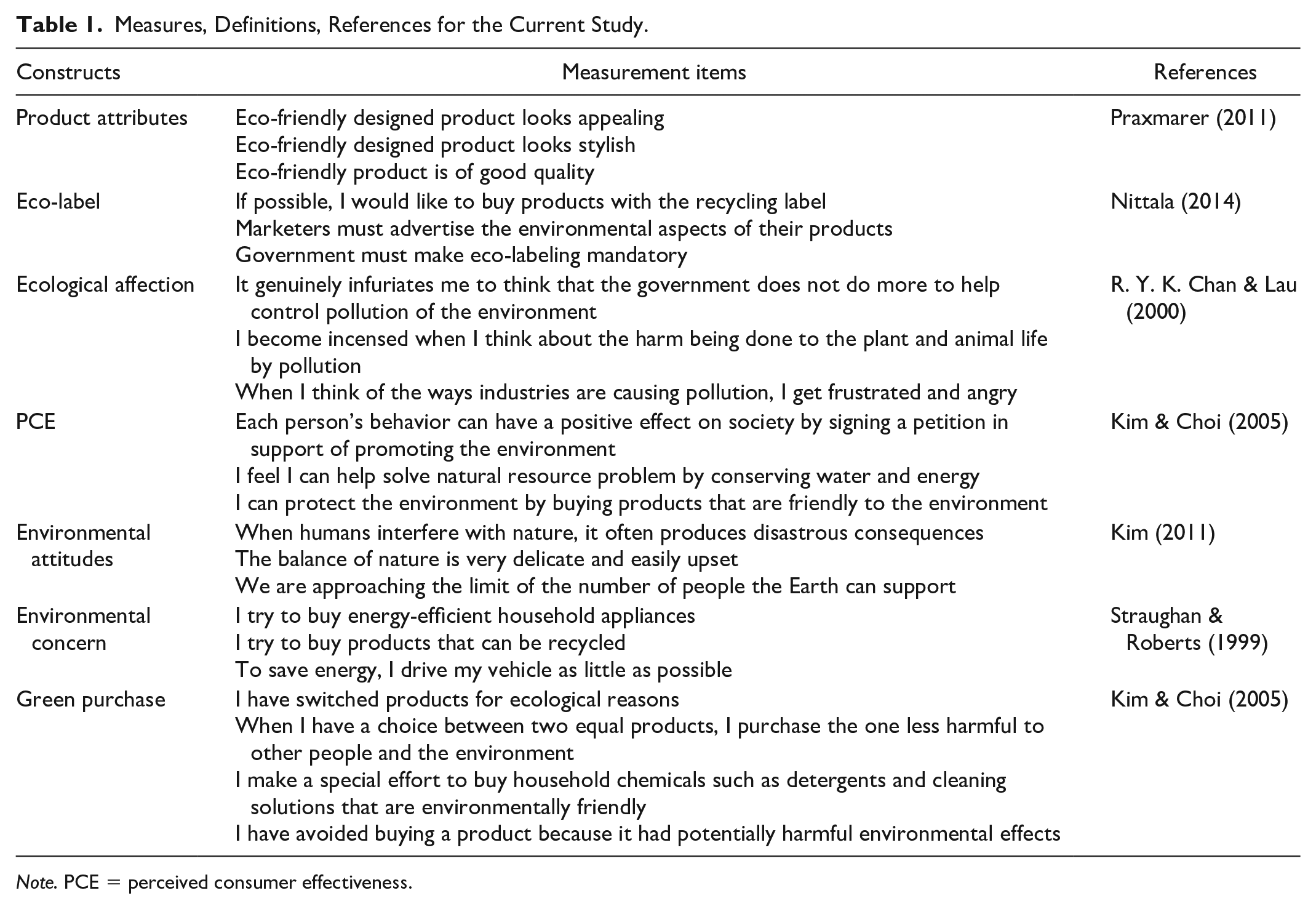
Note. PCE = perceived consumer effectiveness.
Sampling
According to previous literature (Seemiller & Grace, 2016; Turner, 2015), Gen Z generally refers to people born in the mid to late 1990s. Chinese college students are considered as appropriate for purposive sampling to improve the generalizability of the results as an accurate representation of the Chinese Gen Z consumers to a large extent. Therefore, we began to collect survey responses from major universities in Beijing and Anhui Province from October to November 2018. The reason why we choose these two places is that Beijing, as the capital of China for hundreds of years, is a typical city to get the insight of college students who are more influenced by traditional culture (Song et al., 2008), whereas college students in Anhui, one of the Yangtze River Delta urban agglomerations in the east of China, are believed to be more open-minded because Yangtze River Delta urban agglomerations emerged as one of the economic centers in China (Zhu et al., 2012). Also, college students from Beijing and Anhui came from different parts of China, which would decrease the influence of localization and have a general picture of Chinese college students.
Response Collection
We first retrieved the student list from the academic secretaries of the related universities in Beijing and Anhui, then a total number of 2,516 of survey questionnaires were sent individually and randomly to the college students by the counselors via QQ and Wechat. Last, a total number of 745 of valid responses were recorded, and the response rate was 29.6%.
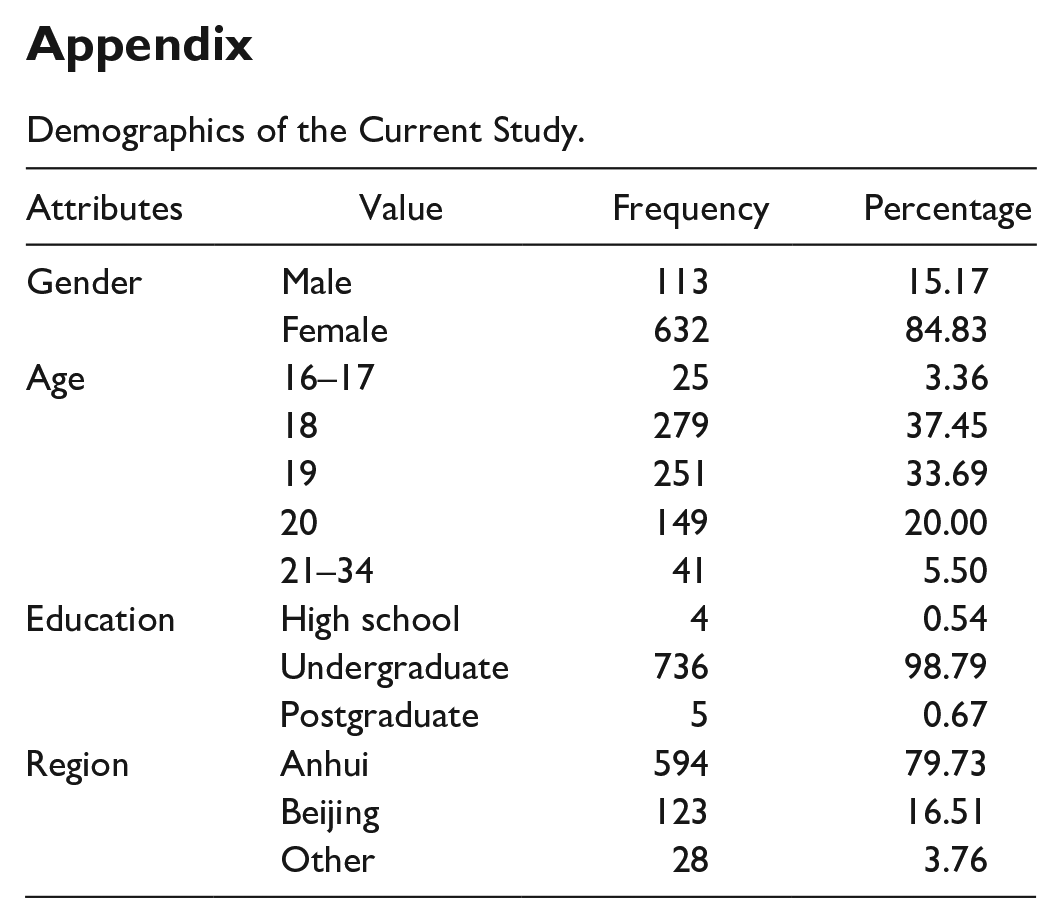
The demographics of the current sampling is shown in the appendix. In terms of education level, most participants are undergraduate students (98.79%). Regarding age, 18-, 19-, and 20-year-olds are the majority of all participants, accounting for 37.45%, 33.69%, and 20.00%, respectively.
Data Analysis
To get a better understanding of an effect of the eco-labeled product, environmental awareness, and consequent behavior, data analysis was introduced by SPSS 22 for windows and AMOS 24 for windows to perform the detailed statistical analysis. To be more specific, SPSS was employed to summarize the demographics of the sampling and confirm the reliability of different constructs and measurement items. AMOS was used mainly for the confirmatory factor analysis (CFA) of different variables and for the structural equation model (SEM) to analyze the model fit and related path coefficients between different variables.
Reliability and Validity
Reliability and validity are the standard tools of the survey to check whether the measurement items employed measure the research constructor. To be more specific, reliability means the degree that a construct measurement should have similar feedback under consistent circumstances. Composite reliability (C.R.) and Cronbach’s alphas are the indices to show the internal consistency of the measurement constructs in the survey. Table 2 shows the results of C.R. and Cronbach’s alphas in the present study. According to Carmines and Zeller (1979), both C.R. and Cronbach’s alphas of the measurement constructs should be above .70. In this way, the current measurement items and scales are considered to be reliable.
Reliability and Unidimensionality of All Different Constructs.

Note. C.R. = composite reliability; AVE = averaged variances expected; PCE = perceived consumer effectiveness; SMC = squared multiple correlation.
Besides, construct validity means the degree to which a scale or measurement item measures what it supports to be measuring (Gruber et al., 2010; Novick & Lewis, 1967). It included three specific validity assessments: convergent validity, discriminant validity, and unidimensionality (Gruber et al., 2010). Unidimensionality means the degree that a construct measurement or scale only has one dimension. To address the unidimensionality of the current study, CFA was adopted to confirm whether the construct measurement is referring to our understanding of the nature of the factor (or construct) through maximum likelihood (ML) estimation. Table 2 shows the reliability and unidimensionality of all seven constructs.
Convergent validity mainly means the extent that different measures of the same hypothetical construct should be correlated highly with one another if the construct measurements are valid. Consequently, the standardized factor loadings coefficient should be above .5, and averaged variances expected (AVE) value should be higher than .5 (Fornell & Larcker, 1981; Kwong-Kay Wong, 2013). In the present study, the results showed the minimum value of C.R. in the current study (= 14.869) was much higher than the “2” threshold; minimum standardized factor loading (= 0.695) exceeded the “0.5” threshold. Also, the lowest AVE calculated (= .518) is higher than the threshold, .50. As a result, the convergent validity of the constructs is still adequate.
Discriminant validity is aimed to check whether variables or construct measurements that are not supposed to be related are unrelated. Regarding this, the correlation coefficients of the present study were performed. Table 3 shows the maximum shared variance (MSV) and average shared variance (ASV) to check whether discriminant validity is adequate (threshold: MSV < AVE and ASV < AVE; Byrne, 2013). Table 3 shows that AVE values are all above MSV and ASV values, ensuring that the seven dimensions of this research framework achieved adequate discriminant validity.
Correlation and Discriminant Validity of Different Constructs.

Note. C.R. = composite reliability; AVE = averaged variances expected; MSV = maximum shared variance; ASV = average shared variance; PCE = perceived consumer effectiveness.
p < .1. **p < .05. ***p < .01.
The goodness of fit with absolute fit indices and incremental fit indices was also confirmed in the present model. Table 4 shows the results of all the fit indices. To be more specific, standardized root mean square residual (SRMR), goodness-of-fit index (GFI) and adjusted goodness-of-fit index (AGFI), root mean square error of approximation (RMSEA), normed fit index (NFI), incremental fit index (IFI), Tucker–Lewis index (TLI), and comparative fit index CFI) were all within the respective thresholds. Therefore, the current framework might achieve an adequate model fit with the responses collected.
The Goodness of Fit in the Current Model.

Note. GFI = goodness-of-fit index; AGFI = adjusted goodness-of-fit index; SRMR = standardized root mean square residual; RMSEA = root mean square error of approximation; NFI = normed fit index; IFI = incremental fit index; TLI = Tucker–Lewis index; CFI = comparative fit index.
Path and Mediation Analysis
The current study tries to analyze the effect of eco-label on product attributes, PCE, and environmental awareness, thus having an impact on green purchase behavior. Regarding the research questions of this study, the path analysis of the SEM was performed to test the relationship between different variables empirically. Figure 2 shows the results of the path analysis, and Tables 5 and 6 show the results of the standard coefficient in path analysis, mediation analysis, and summarizes the hypotheses results.
Path Analysis Result and Hypotheses Testing.

Note. C.R. = composite reliability; PCE = perceived consumer effectiveness.
p < .1. **p < .05. ***p < .01.
Mediation Analysis Result and Hypotheses Testing.
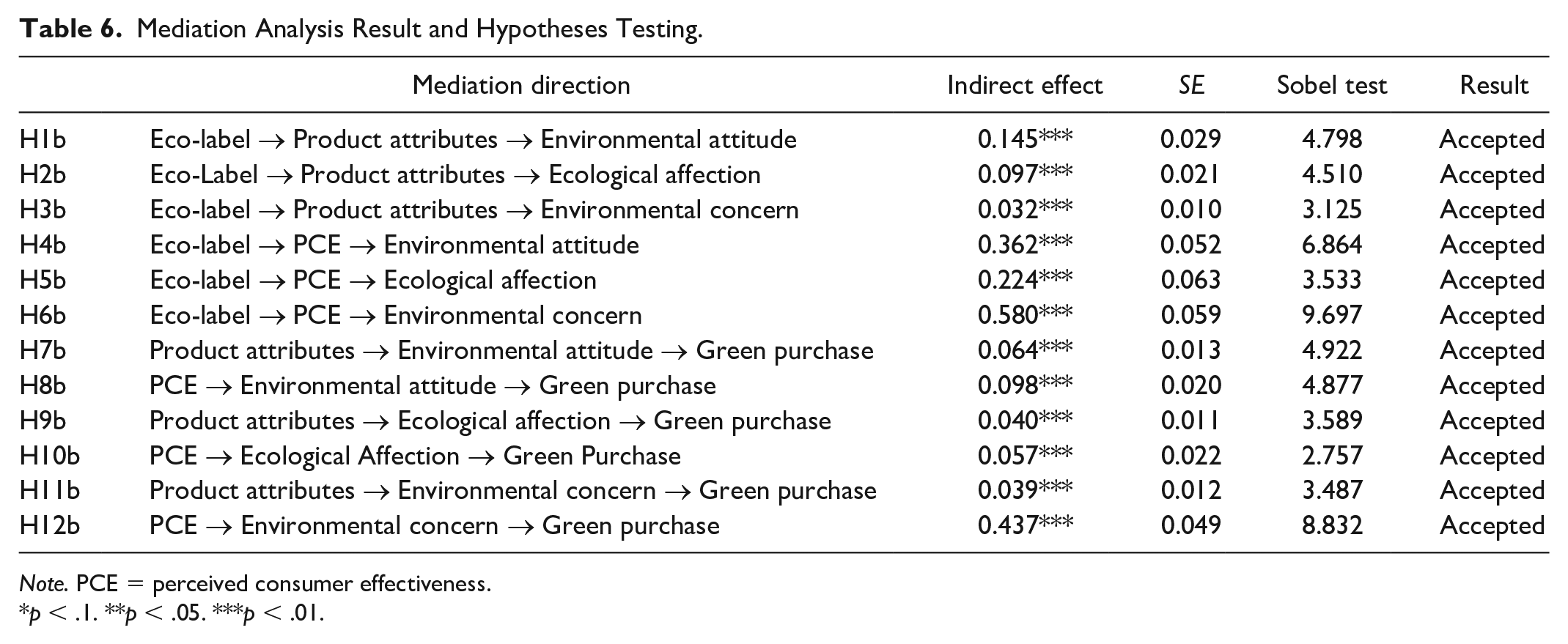
Note. PCE = perceived consumer effectiveness.
p < .1. **p < .05. ***p < .01.

Path analysis of structural equation model (SEM).
Results and Discussions
Results show that 13 hypotheses were all supported. Our study first verified that eco-labeled products influence the Gen Z’s PCE with a coefficient of 0.736 significantly; in this way, H5a was supported. It can be inferred from previous literature that an eco-labeled product tends to enhance the young generation’s awareness of environmental issues (Cerri et al., 2018; Cho et al., 2013; Tan, 2011). Through interpreting the eco-labels, young adult Chinese consumers may realize the meaning and significance of environmental behaviors (Taufique et al., 2017), because their external impact on environmental improvement is the result of their internal attitudes (Bougherara & Combris, 2009). Our results can further extend Kinnear et al. (1974), and Schunk’s (1989) theory on PCE in the Chinese Gen Z context of eco-label–informed product consumption. Eco-labels with relevant knowledge of environmental behaviors provide the concrete materials for young adult consumers to project the concept of self-efficacy and build the belief of an individual’s contribution to the environmental issue.
Concerning the relationship of eco-label–informed PCE and environmental awareness, our results primarily suggest a detailed structure to understand how environmental attitude, ecological affection, and environmental concern are influenced, respectively. First, ecological affection tends to be influenced by eco-label–informed PCE with a coefficient of 0.305. Thus, H7a was supported. As one of the main thread to investigate environmental awareness, ecological affection is found to be useful to guide consumer behavior (R. Y. K. Chan & Lau, 2000; Kanchanapibul et al., 2014). However, the research on its determinants remains limited, especially in the context of the product purchase. Our result has found that Chinese Gen Z consumers’ PCE tends to influence ecological affection significantly. It suggests that the Chinese Gen Z consumers’ emotions are possibly affected by how they understand the individual’s role in environmental development. Also, our study has verified that the environmental attitude is influenced by eco-label–informed PCE with the coefficient of 0.492, supporting H6a, which can support Thøgersen’s (2000) prior study that PCE tends to strength consumers’ belief and trust in environmental behaviors because the internal individual efforts work as the behavioral indicators to represent attitude (Eagly & Chaiken, 1993).
Moreover, the environmental attitude and concern are often used as interchangeable constructs within environmental research; our study shows that environmental concern is more closely associated with PCE within the Chinese Gen Z consumers. It is clear that PCE influences environmental concern with the coefficient of 0.789, supporting H8a. This is consistent with Schultz and Zelezny’s (1998) and Stern et al.’s (1995) observation that environmental concern is strongly mirrored by the individual fundamental values on environmental development. In addition, mediation analysis results suggest the mediating role of product attributes and PCE in influencing environmental attitude, ecological affection, and environmental concern. Thus, H1b to H6b were supported.
Ecological affection is influenced by environmental attitude and concern with coefficients of 0.188 and 0.209, respectively, supporting H9a and H10a at the same time. As the previous literature reveals that the current understanding of the structure of attitudinal environmental awareness remains ambiguous (Littledyke, 2008), our result primarily suggests a critical role of ecological affection within environmental awareness from the perspective of Chinese Gen Z consumers. It tends to be inferred that ecological affection is closer to emotions aroused by environmental senses, which belongs to the higher level of human cognition (Helenita et al., 2013). The attitudes and concerns on environmental issues may trigger young consumers’ emotional reflections to improve the current environment toward a more sustainable direction. Also, ecological affection positively influences product purchase directly with the coefficients of 0.189, H13 was verified. Although previous studies suggest a strong relationship between ecological affection and purchase behavior (R. Y. K. Chan & Lau, 2000; Kanchanapibul et al., 2014), our statistical evidence first verified the significant role of ecological affection within the process of an eco-label–informed purchase.
In this study, the perception of product attributes is verified to be influenced by eco-labeling, a path coefficient of 0.456 supported H1a. Prior studies have exerted efforts to understand how eco-label can promote and advertise products’ environmental-friendly traits (Bougherara & Combris, 2009; Clemenz, 2010); however, the views on the indication role of eco-label remain controversial. Our study statistically confirms that eco-labeling tends to be a useful indicator to communicate with the Chinese Gen Z consumers about environmentally friendly product attributes. It is anticipated that young adult consumers would appreciate the product associated with the consideration of environmental improvement.
The influence of eco-label–informed product attributes on environmental attitude, ecological affection, and environmental concern was confirmed within the Chinese Gen Z consumers with coefficients of 0.320, 0.214, and 0.071, respectively. Therefore, H2a, H3a, and H4a were supported. Although previous research (Testa et al., 2015) has proposed that eco-labeling is useful in informing consumers’ environmental attitude and concern, the mediators with all three aspects of environmental awareness are seldom studied together. Our results further verified that product attributes tend to be a prominent mediator to improve the Chinese Gen Z consumers’ environmental attitude, concern, and ecological affection in the context of green consumption. Thus, H7b to H12b were supported. It reveals that the Chinese Gen Z is more likely to notice and realize environmental issues after paying attention to the products with environmentally friendly attributes. These results can extend Simon’s (1992) and K. Chan’s (2000) arguments that products with environmentally friendly attributes are related to consumers’ environmental consciousness, such as saving resources and so forth.
Last, both environmental attitude and concern are prominent predictors of a product purchase, path coefficients of 0.201 and 0.554 are significant to support H11a and H12a. According to previous literature (T. S. Chan, 1996; Gadenne et al., 2009; Simmons & Widmar, 1990), environmental attitude and concern are closely related to environmentally orientated consumer behavior. Our study first verified that the Chinese Generation Z consumers’ product purchase behavior is predicted and guided by the attitude and concern regarding environmental development.
Conclusion
This study focuses on and examines the in-depth structural process of how eco-labeling influences product purchases within Chinese Gen Z consumers. Based on the findings shown above, the two threads of PCE and product attributes both intermediate the eco-labeling and environmental awareness positively, finally influencing the Chinese Gen Z consumers’ purchase behavior.
With respect to theoretical implications, the current study advances several aspects. First, our result reveals the crucial intermediator of product attributes in the eco-label–informed product purchase within the Gen Z consumers. As the mediators within the constructive process from eco-labeling to green purchase remain limited (Cai et al., 2017; Taufique et al., 2017; Teisl et al., 2002), our results reveal the significant mediator of the product attributes. It further contributes to the current understanding of how eco-labels can effectively communicate the environmentally friendly product appeal to the young adult Chinese consumer, and why they are different with other advertising media because Chinese Gen Z consumers are likely to perceive the eco-labels as the specific appeal related to how the product is processed and manufactured with the consideration of environmental development.
Second, our study contributes to the current understanding of the determinants of PCE in the research of environmental issues. The theoretical understanding of PCE has been underpinned by many researches dealing with environmental awareness and behavior (Laskova, 2007; Tan, 2011; Vermeir & Verbeke, 2006). However, its determinants and predictors in green marketing are seldom investigated. Our results verified that Chinese Gen Z consumers’ PCE trends to be informed by eco-labeled products. It is anticipated that information-based programs can positively enhance young adult consumers’ perceptions of individual power to improve the environment and further encourage future behavioral change.
Third, environmental awareness, as one of the general predictors to understand consumers’ green purchase, has been discussed and studied for a long time. However, its internal structure and effectiveness remain controversial. This study first examined environmental awareness from all three main streams, namely, the environmental attitude, concern, and ecological affection.
Also, our results show that Chinese Gen Z consumers’ ecological affection is predicted by environmental attitude and concern. In other words, young consumers’ purchase behavior is more likely to be influenced directly by ecological affection, compared with the other two. This finding may contribute to an in-depth understanding of environmental awareness and better improve the effectiveness of environmental awareness in the context of generation theory.
Regarding the managerial implications, governments and organizations should integrate and underline the individual images and powers when designing the eco-labels because of the prominent mediator of PCE. Chinese Gen Z consumers are more likely to process the eco-labels with strong clues of PCE into environmental awareness. Moreover, firms and corporations may consider promoting environmentally friendly design and introducing more green manufacture technology as distinctive product attributes.
The current study also has some limitations in sampling. Regarding the colleges, we collected data from two normal universities in which the major gender was female, there would exist an unbalanced gender sampling in the current study. Although the prior study has suggested gender difference might not be a significant factor in influencing environmentally related reactions (Blocker & Eckberg, 1997), it would be more appropriate to recruit a more balanced gender sample addressing this issue. Future studies would try to use comprehensive universities to recruit participants, analyzing the other effects of environmental factors on prosocial behavior.
In addition, more product-related perceptual factors can be integrated into future studies, such as aesthetics (Song & Qin, 2019b), religious belief (Qin, Song, & Jin, 2019), and cultural effects (Qin, Song, & Tian, 2019).
Footnotes
Appendix
Demographics of the Current Study.
| Attributes | Value | Frequency | Percentage |
|---|---|---|---|
| Gender | Male | 113 | 15.17 |
| Female | 632 | 84.83 | |
| Age | 16–17 | 25 | 3.36 |
| 18 | 279 | 37.45 | |
| 19 | 251 | 33.69 | |
| 20 | 149 | 20.00 | |
| 21–34 | 41 | 5.50 | |
| Education | High school | 4 | 0.54 |
| Undergraduate | 736 | 98.79 | |
| Postgraduate | 5 | 0.67 | |
| Region | Anhui | 594 | 79.73 |
| Beijing | 123 | 16.51 | |
| Other | 28 | 3.76 |
Declaration of Conflicting Interests
The author(s) declared no potential conflicts of interest with respect to the research, authorship, and/or publication of this article.
Funding
The author(s) received no financial support for the research, authorship, and/or publication of this article.
