




Abstract
The logistics department is one of the critical departments for most industries that play a critical role in their business objective. Therefore, this study develops a framework by considering the problem of optimization processes of multiple decision-making regarding the choice of any logistics in the frame of the present logistics system. We employed the theoretic game called Game with nature model for analysis. We took this process a step further and utilized the Hurwitz criterion as the optimality criterion synthetic, which is under consideration, for mixed strategies that allow obtaining their optimality with a joint position of winnings and risks is being used. This study demonstrates the vital approach to the optimization processes that is precise, concurrent, with similar risks and winnings. Since the developed criterion was defined for solving games with nature from a joint point of view, whereas, at the same time choosing the optimal strategy both for gains and relative to risks. This study provides strategy guidelines for managers to reduce their logistic costs as well as optimize the logistics and supply chain processes.
Introduction
Logistic activities, like any other field, are associated with decision-making (Gaeta, 2019). Moreover, decisions often have to be made in conditions of uncertainty, that is, under conditions “in which execution operation is uncertain, or there is a conscious opposition of a competitor or not enough clear and precise objectives of the operations.” Of course, the presence of uncertainty in the moment of decision-making complicates the process of choosing the optimal solution because uncertainty is probably the most critical risk factor in economic activities (Wetherill & Weiss, 1962). Uncertainties in logistics have an adverse effect on the decision-making capability of a firm; moreover, it also undermines the competitive advantage of its logistics (Ikram et al., 2021; Jum’a et al., 2021; Zhong et al., 2019). As sources of uncertainty, there can be a considerable number of different factors, such as fluctuations in demand, inability to predict actions of competitors, changes in legislation, and the factors of a natural character (Khan et al., 2020; Wang et al., 2020). Thus, to manage, it is necessary to consider a range of such sources for making the most balanced decisions.
Currently, new universal schemes, methods, and models are regularly appearing, aimed at facilitating the activities of logistic managers (Almumen, 2020). However, if there is a need to take into account random external influences, then the definition of the method allows you to choose the optimal solution (Huang & Chiang, 2021). In the theory of decision-making, this fact is taken into account, which means that in the context of a specific situation, the optimal solution chosen by the manager should be as adaptive as possible to the logistics system. Also, the symmetry concept is naturally used in decision-making to finding an optimal solution for decisions (Prasertsri & Sangpradid, 2020). Although decision theory offers a sufficient number of methods and models for optimizing the system, there is one specific and, at the same time, a significant feature, when using any of the existing algorithms for optimizing logistics systems, the manager must take into account that the system will be optimized taking into account only risks or just winnings.
It should be understood that logistics, from a practical point of view, often requires quick decisions, which should not mean that in making such decisions, the manager minimizes some risks, thereby not increasing others (Wilson et al., 2017; Zimon et al., 2020). Though some other strategies such as marketing, that is, green marketing might also be fruitful in improving decisions (Chen et al., 2021). It has become very challenging for organizations to take effective decisions about the logistics processes.
This study employed the theoretic game with the nature model that demonstrates the vital approach to the optimization processes that is precise, concurrent, with similar risks and winnings. The contribution of this study is to develop a comprehensive logistic framework to optimize the supply chains and logistics processes. However, despite their importance, most of the proposed methods for this purpose in terms of solutions can offer optimization processes either from maximizing winnings or for risks. This article describes a newly developed synthetic Hurwitz criterion (Eltantawy, 2011; Nyhuis & Schmidt, 2011; Santa-Eulalia et al., 2011) to be precise, its generalization for mixed strategies, enabling the logistics manager to make decisions, taking into account both the winnings and risks of the decisions made in such processes of chain supply and logistics, such as logistics of products, when decisions must be taken more than once and regularly. Finally, this study develops a criterion that provides the optimal strategy to solve decision-making problems for gains and risks in the logistic department.
Rest of the paper is structures as follows. Section 2 is the detailed literature review; Section 3 explains the Hurwitz Criterion theory with optimization parameters. The development of the logistic optimization model is presented in section 4. The conclusion of the study is presented in the last section of study.
Literature Review
The just-in-time decision in logistics based on consumer sentiments can provide the manufacturer a notable competitive advantage (Bayar et al., 2020). An analysis of existing models and decision-making methods in the field of optimization of logistics systems and logistics processes revealed a certain pattern. So, even though interest in logistics as a whole in recent decades, and therefore in the optimization of its processes has increased, all existing methods and models, as noted above, tilt either toward the choice of a decision regarding risks or toward a solution problem regarding wins. The optimization of cost in logistics has a vital impact on social performance, customer satisfaction, and improvement in service in order to develop a sustainable logistic network. Whereas the sustainable goals for logistics lead to reducing the cost also have minimal effects on the environment (Eratlı Şirin & Şahin, 2020).
All the above leads to the opinion that there is a need to develop a mathematical model that allows us to solve the problems of choosing the optimal method, model, or system in a complex way, that is, without exposing, to the choice of optimization, either regarding gains or regarding risks, these are the determining factors of the relevance of the study.
However, numerous studies have developed the methodologies for evaluation of logistic cost in the supply chain field are spare due to the complexity of logistics system and involvement of a variety of costs. Therefore, the research substantiates the need for the development and subsequent development of a game-theoretic model for choosing the optimal logistics system in the business (Hewitt, 2014). Based on the constructed comparison function, a new criterion has been developed for making decisions about the optimality of pure strategies in the face of uncertainty from the joint position of gains and risks, called the Hurwitz synthetic criterion. The analysis of the synthetic criterion Hurwitz includes the theorem on the equivalence conditions of the synthetic Hurwitz criterion to the classical Hurwitz criterion regarding risks is proved. Moreover, the theorem on the incomparability in the general case of the synthetic Hurwitz criterion with the classical Hurwitz criteria for gains and relative to risks was proved.
Further, a theorem on the necessary and sufficient conditions for the possibility of expressing the price of the game with the synthetic Hurwitz criterion through the price of the game under the Hurwitz criteria for wins and relative risks has been proved. This study defines the mix strategies based on the synthetic Hurwitz criterion to analyze the mixed expansion of the game with the synthetic Hurwitz criterion. The foundation of the Hurwitz method is also based on mathematical modeling like other MCDM methods. The main advantage of the Hurwitz approach, it has a simple procedure to find the optimal solution compared to other methods such as Fuzzy AHP and TOPSIS procedures. As it may be noticed, by applying the Hurwitz method, the optimal solutions may be obtained in a short period. The application of the Hurwitz method provides precise solutions and is suitable for solving real-life environmental problems. Finally, a theorem is proved that formalizes the central interconnections of the synthetic Hurwitz criterion with the Hurwitz criteria concerning risks and relative wins in the framework of many optimal mixed strategies.
Management of logistics systems in business is an elaborate scheme designed by using different mathematical methods such as systematic analysis, simulation modeling, probability theory, game theory, and many others. Application of game theory in the logistics system management used to be limited by the only optimization processes, that is, maximization of winnings or minimizing risks (Manzini & Gamberini, 2008). Tasks of analysis, selection of efficient solutions, and continuous optimization processes of supply chains and logistics systems under conditions of uncertainty are considered to be very important (Wang et al., 2019).
The optimization processes of logistics costs have recently been reported (Yan & Zhang, 2015). Also, the four main elements, including informatization, service quality, operation efficiency, and promotion of technical upgrading to manage logistics at a higher level with big data, have been studied recently (Yan et al., 2019). Also, some authors have considered the adaptive neuro-fuzzy inference system for queuing system optimization processes (Stojčić et al., 2018). Dutta et al. (2020) proposed a multi-objective optimization model to evaluate the three dimensions of sustainability, economic (cost), social (workdays created and lost due to harms at work), and environment (environmental impact on logistics processes) for reverse logistics in the context of India market. However, these studies lack a synthetic approach to the optimization processes that is more precise and simultaneous, with an ordinary account for the risks and winnings.
Research Framework
Hurwitz Criterion Theory
As an example of cost optimization processes, a simplified three-level logistic structure of Joint Stock Company (JSC) in the textile sector, namely “UzTEX” is used. At the zero levels of structure, there is a production of goods for the placement of products. On the first level of the structure, distribution centers engaged in distributing manufactured products through the dealerships regarding their predicted needs. On the second level, some dealerships perform the retail sale of products. Schematically, the structure is shown in Figure 1.
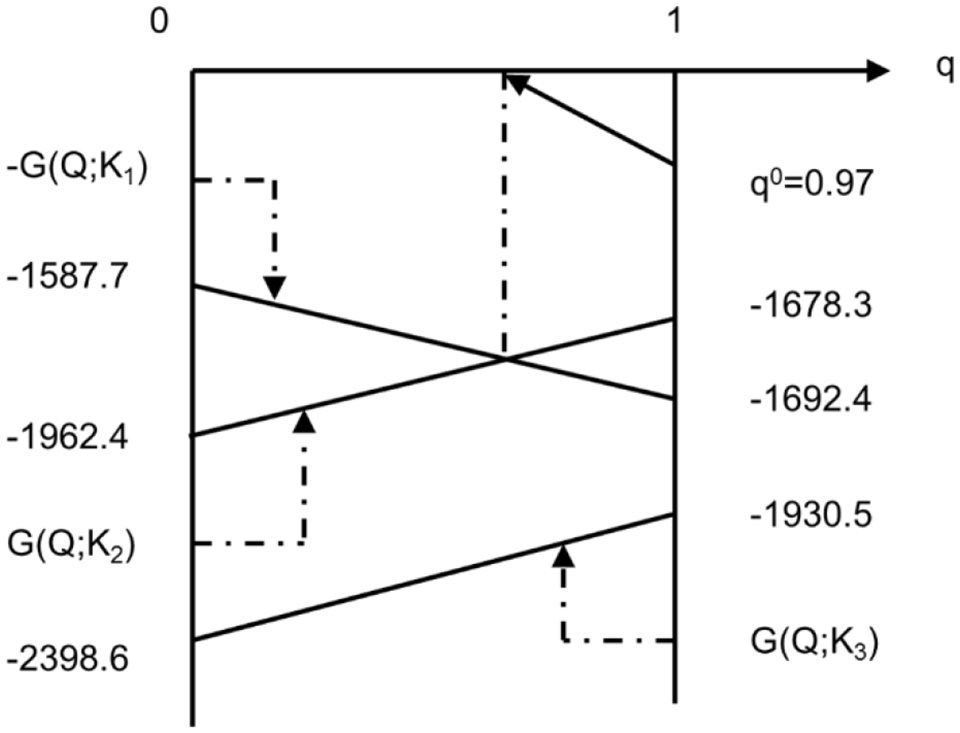
The winnings of the player in mixed strategies.
“Game with nature” used as the optimization processes model, the optimality of the strategies is determined by the new synthetic Hurwitz criterion, in this case, for mixed strategies. Taking into account the fact that by nature, we can include any of the many uncertain factors, thus appliance of such games for making an optimal decision is quite extensive. Below are the main components of the model “Game with nature,” and concepts and definitions for mixed strategies. To do this, first, let us consider and analyze the standard optimality criteria in conditions of uncertainty. After that by criteria such as the Hurwitz criterion regarding winnings and Hurwitz criterion regarding risk will be constructed and also analyzed new synthetic Hurwitz criterion.
The Wald Criterion of Decision-Making
This criterion belongs to the group of criteria under which a player makes decisions under conditions of uncertainty, but this does not mean that given such circumstances, the Wald criterion cannot be applied in the real economy.
The Wald criterion is a criterion regarding the winnings of the player. Under this criterion, the behavior of the player is prudent, as the player focuses on the “worst” outcome of the game, and therefore decision-making by this criterion focused more on the fact to minimize loss than to maximize winnings. T an indicator of the effectiveness of the strategy is called the smallest winning under this strategy:

W-the price of the game in pure strategies is called the greatest of W-parameter of the effectiveness of pure strategies that is the largest of the smallest winnings along with each strategy:

According to the Wald criterion is the strategy, which is optimal if its efficiency parameter is the same.
The Maximal Criterion of Decision-Making
In contrast to the Wald criterion, the maximal criterion is a criterion of extreme optimism. This means that the player, by making the decision, is focused on the most favorable possible state of nature and, therefore, the highest possible winning. Of course, this is a perilous approach, especially given the fact that the probability of a possible state of nature to the player in this case, as with the Wald criterion, is unknown. In other words, the maximal criterion is also the criterion of decision-making in conditions of uncertainty.
N an indicator of the effectiveness of the strategy is called the most significant winning along with this strategy:

N the price of the game in pure strategies is called the greatest of N—indicators of the effectiveness of pure strategies, that is, the greatest of the greatest winnings for each strategy:

The strategy is called optimal among maximal criteria if, by selecting it, the player Z can count the maximum possible winning, that is, if its efficiency parameter equals the price of the game.
The Savage Criterion of Decision-Making
According to the definition of the Savage criterion, this criterion, as well as the Wald criterion, is a criterion of extreme pessimism. However, the difference between these two criteria lies in the Savage criterion is a criterion of extreme pessimism regarding games of risks. It directs player Z the fact that when choosing a strategy, it is necessary to consider that nature at this point will be in the condition in which the risk will be the greatest. The savage criterion is known in the literature as the “criterion of minimax regret,” introduced in 1951 by L. J. Savage (Savage, 1951). To determine the leading indicators of this criterion, understanding a game of risk will be needed (Xiao et al., 2020). In this case, player Z accepts the decision to choose a pure strategy in the game with nature, based on the matrix of the winnings. However, the matrix of the winnings is not always adequately and fully reflecting the current situation. The choice of strategy is influenced not only on winnings but also on indicators of “success” or “failure” choice of strategy that is dependent on favorable conditions of nature for more chances to win. The parameter of favorable circumstances of nature Kj (relatively to the set of pure strategies) is called the most significant winning among winnings in the given condition of nature:

The degree of success of the selection strategy Zi in the state of nature Kj characterized by risk vij not receiving the highest possible winning, that equals to the difference between the parameter of favorability γj condition of nature Kj and winning zij:

From (5) and (6) it follows that

Fzr—parameter of the effectiveness of the strategy Zi according to Savage criterion is the greatest of the risks when choosing this strategy:

Fzr—the price of the game in pure strategies is called the least Fzr—the parameter of pure strategies:

The strategy is considered optimal according to the criterion of Savage if the risk of not getting the most significant winning player Z cannot be higher than the minimax.
The Minimum Criterion of Decision-Making
This criterion is a criterion of extreme optimism, but unlike the maximal criterion, it is the criterion related to the risks. This fact also makes minimum criterion the opposite in the meaning of the Savage criterion.
According to the minimum criterion of player Z, in the process of making decisions about choice of strategy examines the nature as its ally, which means that at the moment of decision nature will be in the most favorable condition in which the risk of the chosen strategy is equal to zero.
φ—Parameter of the effectiveness of the strategy Zi for a minimum criterion is called the minimum risk in this strategy:

Risks of the no negativity are: φi ≥ 0, i = 1, 2 . . ., m.
φ—The price of the game in pure strategies is called the least parameter of the effectiveness of pure strategies:

As the matrix of risk contains zero, then there are rows where they stand, and therefore, by (10) and inequality φi ≥ 0, i = 1, 2, . . ., m, the parameter of effectiveness appropriate strategies will be zero. Hence from (11), it follows that
From (10) and (11) it follows that
The strategy is optimal according to a minimum criterion; if the performance indicator is equal to zero, using this criterion gives the player the opportunity to choose without risk strategy. Considered the so-called standard criteria could help the player assess the optimality of a strategy or only with the position of winnings if we talk about criteria about the winnings, or only with the position of risks if we are talking about criteria about risks. However, the choice of strategies in such a position is inevitably accompanied by the risk of not receiving the maximum winning in the chosen strategy. Such a factor is significant; therefore, to leave it without attention is highly inappropriate. In this regard, an attempt was made to study and analyze the synthetic principle of optimality strategies with the common point of view of winnings and risks (Cachon & Netessine, 2006). As a result of the study and analysis of the synthetic assessment principle of optimality, a new synthetic Hurwitz criterion allows the player in the decision-making process to consider both the winnings and the risks (Eltantawy, 2011; Zhang, 2010).
The Hurwitz Criterion of Strategy Optimality of Winnings
This criterion belongs to the group of combined criteria, the primary purpose consists of using methods of combining—weighing to achieve generalization of the classical criteria and mitigate their extreme principles to determine the optimal strategies. Accordingly, based on these criteria, the player can hope that made decisions will be more effective than those who made only based on standard criteria. Notwithstanding the preceding, it should also be noted, that a balanced approach to the choice of the strategy proposed by Hurwitz criterion about the winnings, does not always lead to an equitable result. There is a problem with smoothing the Wald criterion of extreme pessimism and extreme optimism of maximal criterion with the Hurwitz criterion (Aparicio et al., 1967).
The Hurwitz Criterion of Optimality of Pure Strategies of the Winnings
Let α ∈ [0,1], (1–α) ∈ [0,1] indicators of optimism and respectively pessimism of the player Z when choosing a strategy, the effectiveness of which is assessed to them only from the standpoint of winnings. When selecting the index parameter α (or α−1), which the player Z determines from subjective reasons, it usually affects the measure of responsibility. This means that the closer the optimism parameter to zero, the higher the desire of the decision-maker to hedge, and respectively vice versa. Khq—an indicator of the effectiveness of the strategy Zi is determined as follows: (q-“payoff”).

Accordingly, if α = 0, that Khq(α)—indicator of the effectiveness of the strategy Zi turns into T—an indicator of the effectiveness of this strategy, which is a measure of the effectiveness of the strategy based on Wald criterion, and N—the parameter of effectiveness, that is, the parameter of effectiveness according to maximal criterion at α = 1, and when α ∈ (0,1) is a convex combination T—parameter and N parameter of effectiveness.
Khq(α)—the price of the game in pure strategies for the Hurwitz criterion with an index of optimism α ∈ [0,1] is the maximum of Khq(α)—parameter of pure strategies effectiveness:

Khq(α)—the optimal strategy in the set of pure strategies for the Hurwitz criterion with a parameter of optimism α ∈ [0,1] is called a pure strategy

The Hurwitz Criterion of Optimality of Mixed Strategies to Winnings
The Hurwitz criterion of optimality of pure strategies of the player Z, helps us find the pure strategy optimal under this criterion among pure strategies.
However, during the game, with a repeated selection of the same strategies, under constant conditions of the many positions of nature may occur a situation when a player wants to change his choice of strategy. Moreover, in this case, it is recommended by Labsker (2001) to go to a random choice of strategies with a certain probability, or, in other words, to use a mixed strategy. 1
So, a game with nature with a matrix of winnings (1), supplemented with the line, which presents indicators of favorable positions of nature
The set of all mixed strategies

Where,
Khq(α)—parameter of the effectiveness of mixed strategy Q the formula is:

Where
Khq(α)—the following formula defines the price of the game in mixed strategies:

Khq(α)—the optimal strategy in the set of mixed strategies is called the strategy Qf if the equivalent ratios are as follows:

The Hurwitz Criterion of Optimality of Strategies With the Risks
The Hurwitz criterion of optimality of strategies about risks, as well as Hurwitz criterion of optimality of strategies of winnings, belong to a group of combined criteria for the selection of optimal strategies in conditions of uncertainty.
The essence of the Hurwitz criterion of optimality about the risks consists of the smoothing of extreme pessimism Savage criterion and ultimate optimism minimum criterion, as in the previous case of the Hurwitz criterion about winnings.
Let us say ω ∈ [0,1], (1–ω) ∈ [0,1]—parameters of respectively optimism and pessimism of the player Z when choosing a strategy, the effectiveness which is assessed by them only from the standpoint of game risks.
The choice of parameter values ω (or [1–ω]), as well as in the framework of Hurwitz criterion of optimality of pure strategies of wins, the player Z determines from the basis of measure responsibility to be taken when choosing a strategy.
In ω = 0, the Hurwitz criterion concerning the risks related to the Savage criterion, when ω = 1 accordingly in minimum criterion, and when ω∈(0,1) is a convex combination of these parameters.
As



Also, note that in particular, parameters of optimism in the Hurwitz criteria about winnings and relation to risks can be the same: α = ω.
The Hurwitz criterion of optimality of mixed strategies about the risks: before presenting the basic concepts of Hurwitz criterion about the risks, recall the definition of risk:

a number representing the risk in selecting a player Z of mixed strategy
Now we introduce the basic concepts of the Hurwitz criterion to the risk with the optimism parameter

Khv(ω)—Parameter of the inefficiency of the strategy Q, where

Khv(ω) price of the game in mixed strategies.
The strategy is called the optimal Khv(ω)—optimal) in many mixed strategies if the following equivalent:

It should be noted that the choice of the player Z of winning-parameter, meaning ω ∈ [0,1], is subjective and is associated with the psychological characteristics of the player Z, defining his attitude to winning and risks.
Results and Discussion
Theorem 1
In any game with nature, there is a strategy that is optimal in many mixed strategies, according to the synthetic criterion of Hurwitz under all winning parameters and optimism parameters about the winnings and risks.
Proof of theorem 1
Proven the continuity of parameter of effectiveness
Proven the continuity
Hence, from (16; 19; 23), we obtain the continuity
In
In
Theorem 2
The following conditions are equivalent:
For each value of the winning parameters of the optimism

Many strategies that are optimal in many mixed strategies and according to the Hurwitz criterion about the winnings and according to the Hurwitz criterion about the risks is not empty:

The price of the game

The chart of game price
Proof of theorem 2
The theorem will be proven if we prove the validity of the following closed chain of implications:

We start the proof of the theorem that will prove the implication:

Assume that the validity of condition (1), that is, valid equality (26). As in Theorem 1 whenever the value of winning-parameter
Let us prove the implication,

Let the condition (2), that is, be performed (27). Then there is the strategy Qf и
Owing to this affiliation for each

Let us prove the inequality, reverse the inequality (31):

Inequalities (32) and (33) prove equality (28). The implication
Let the condition (3), that is, valid equality (28), from which it is evident that the price of the game
So, we have proved the feasibility of the conditions (4) and together with its validity of implications
Now let us prove the implication,

Let it be performed (4). Now we prove the inclusion

Let

Then,

Strategy Qf generates a cut–graph of the function

Note that if
So, inclusion (35) is proved.
Now we prove the inclusion

That is the reverse inclusion to (35).
Let strategy
This inequality means that
Thus, the implication (34) and, together with it, the chain of implications is proved.
Applying the above-obtained results attempts to find the optimal strategy in mixed strategies.
As shown from the analysis of the problem, in many cases, only two strategies are used among three:
Z1: For delivery and distribution of produced goods to use their trucks without the lease of railway platforms.
Z2: For delivery of manufactured goods to use their trucks and distributing products to use vehicles of other transport companies, without the lease of railway platforms.
Because of the company’s activities and multiple strategies, it is advisable to go to mixed strategies in this game problem.
Let

Using the matrix (40), we calculate the winnings of the player Z if the strategy

Symbolical graphs of these winnings are presented above (Figure 1).
We present the result after the necessary calculations that are not reflected in the article because of its bulkiness.
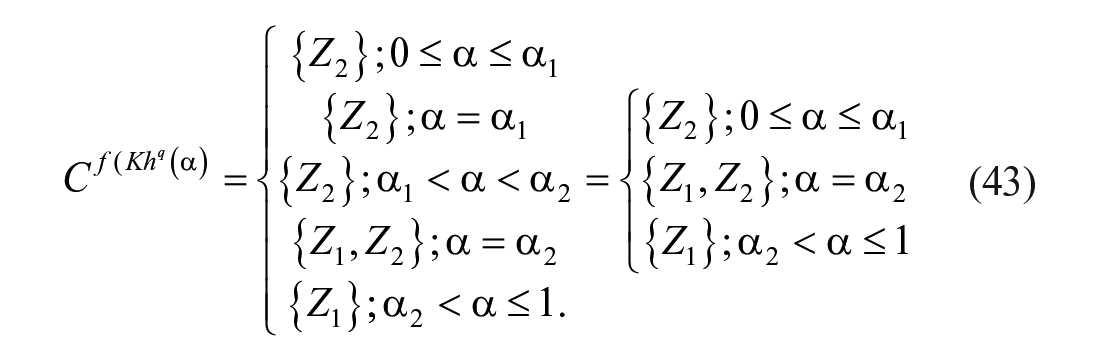
Z1, Z2—is
Z1—is

We now turn to the Hurwitz criterion for risks. Forming the matrix of risks generated by the matrix of winnings (40):
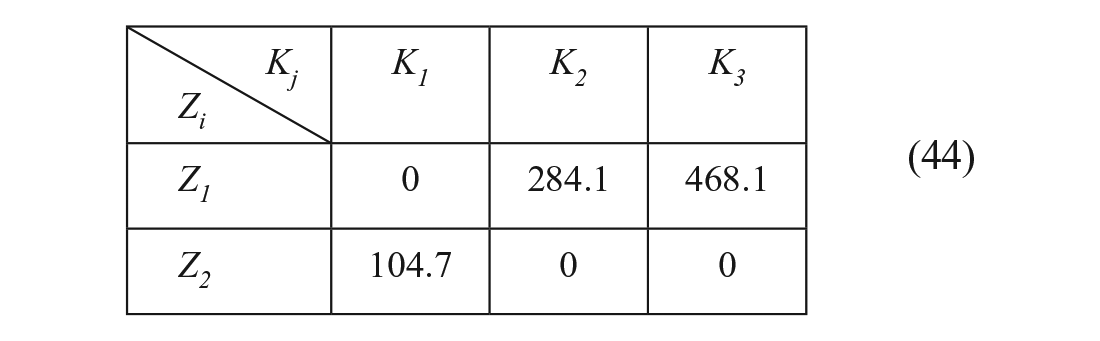
Using the matrix of risks (44), we calculate the risks of the player Z:

These risks are presented graphically below (Figure 2).
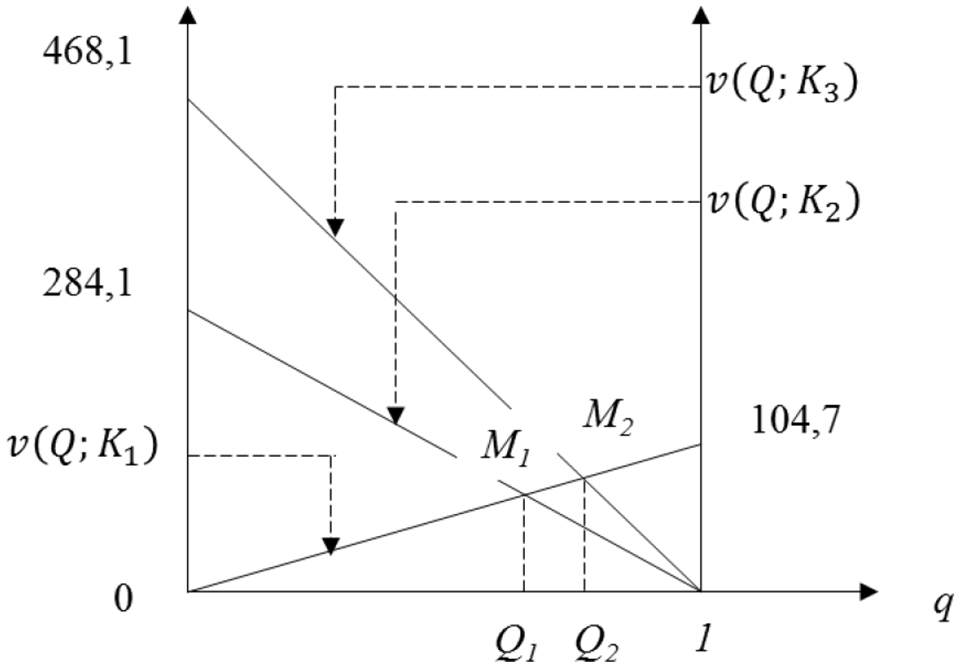
The risks of the player in mixed strategies.
Means:


From (43) and (47), it is clear that
Conclusions
This study develops a comprehensive framework to optimize the supply chain and logistic processes. By the analysis and the calculations carried out in the result section, it is easy to observe that the optimum strategy is Z2, to be precise during the logistics processes, along with the signed contract on the rendering of transport-forwarding services from the other transport company. In order to achieve this goal, this study used the synthetic Hurwitz approach to define the criterion and analyzed a convex combination of the efficiency functions of the Hurwitz criterion of optimality for gains and relative risks. The developed criterion is defined for solving games with nature from a joint point of view, that is, at the same time choosing the optimal strategy both for gains and risks. Within the framework of the developed criterion, the following questions were investigated.
The theorem on the equivalence of the synthetic Hurwitz criterion to the Hurwitz criterion regarding risks is proved. The theorem on the incomparability of the synthetic Hurwitz criterion with the Hurwitz criterion regarding wins and with the Hurwitz criterion regarding risks has been proved. Further, a theorem on the necessary and sufficient conditions for estimating the price of games of the synthetic Hurwitz criterion through the prices of the game of the Hurwitz criteria regarding winnings and risks has been proved. Moreover, the theorem on the existence in any game with the nature of an optimal strategy in many mixed strategies according to the Hurwitz synthetic criterion is proved. Finally, a theorem is proved that formalizes the primary interconnections of the synthetic Hurwitz criterion with the Hurwitz criteria concerning risks and relative wins in the framework of many optimal mixed strategies.
This summary is very logical and from the real economy, that is, in conditions where the logistics process is regular. This means the rest of the considered company strategy, considering that such transport and subsequent distribution are the regular process, have higher risks and costs. If one is only using this transport failure or other unforeseen situation, it could delay delivering goods to customers. Moreover, in this case of using the railway platforms, additionally, when demand is low, this type of logistics can result in high costs. Of course, in the case of the use of strategy Z2, there is a risk of entering into a contract with a bad company, but this factor can be minimized with careful marketing of the transport services market. This study is beneficial for managers and decision-makers to make their logistic processes more sustainable.
Policy Implications and Limitations
This study provides theoretical, practical implications. This study contributes to the enrichment of logistic cost, especially developing a new approach to provide the optimal solution. From a practical perspective, this study suggests valuable guidelines for managers, policy, and decision-makers to understand the logistic cost and performance in the logistic department. Lower the logistics costs of delivering the products, encouraging increasing sales, rising trade, and exploring new markers at national and international levels. Whereas reducing logistics costs will help improve the efficiency of the supply chain and related functions such as infrastructures, services, procedures, and regulation. This study also assists the policymakers in preparing fact-based policies to understand the main drivers of logistics cost and how cost reduction affected the logistics sector in the economy.
This study has some limitations. Initially, we developed the framework of logistic cost based on Hurwitz criterion in accordance with other studies without considering a case. For future research, it would be more interesting to use the application of this model in real-time and evaluate the comparison. Additionally, the different approaches can be used to develop the framework for the optimization process of logistic costs. The framework developed in this paper can only provide references and supporting information for the logistics decision-making process, such as all relevant logistics cost items and quantifying each of the cost elements.
Footnotes
Declaration of Conflicting Interests
The author(s) declared no potential conflicts of interest with respect to the research, authorship, and/or publication of this article.
Funding
The authors disclosed receipt of the following financial support for the research, authorship, and/or publication of this article: National Social Science Foundation of China: Grant Number (BGA200057).
