




Abstract
To enhance the logistics service experience of online shopping users, many comprehensive e-commerce platform enterprises have built their own logistics service systems, providing high-quality transportation, warehousing and distribution services for cooperative retailers and individual consumers. This paper establishes the Stackelberg game model between the comprehensive e-commerce platform and the cooperative retailers, and analyzes and solves the model. It determines the decisions for the optimal logistics service level of the platform and the optimal product prices of retailers under three logistics service strategies: (i) third-party logistics, (ii) third-party warehousing combined with platform distribution, and (iii) the platform’s self-built logistics. By comparing the optimal decisions of various logistics service strategies, it is found that under the self-built logistics service strategy of the platform, the platform provides the highest optimal logistics service level. At the same time, retailers set the highest optimal retail price of goods. Further numerical simulations reveal that the profit level generated by each logistics service strategy is influenced by several factors, including the platform’s warehouse construction, the distribution team’s construction cost, and the order commission rate paid by retailers to the platform. Finally, based on the dominant conditions of the profit levels of various logistics service strategies, this paper provides an orientation map for selecting logistics service strategies for comprehensive e-commerce platforms and cooperative retailers, offering a reference for their strategic decision-making.
Keywords
Introduction
With the development of information technology, online retail has become the most popular form of retail in the domestic market. According to the “Top 100 Online Retailers in 2022” report, China’s online retail market continued to expand in 2021, with national online retail sales increasing by 14.1% year-over-year to reach 13 trillion yuan (China Chain Store & Franchise Association, 2022). The scale of online retail sales of physical goods continued to expand, reaching 10.8 trillion yuan, with an average annual growth rate of 13.4% over the past 2 years, significantly higher than that of offline consumption. Traditional e-commerce platform companies mainly offer trading platforms that connect retailers and consumers, matching their buying and selling needs, and earn commissions by facilitating transactions, like Taobao did in its early days. These platforms usually do not handle logistics themselves and rely on third-party logistics companies for transportation and distribution. Y. Yu et al. (2017) noted that third-party logistics face numerous issues, including delayed delivery, damaged goods, and poor service, resulting in numerous user complaints about logistics problems. To enhance the logistics experience for online shoppers, many e-commerce companies, including JD.com, Suning, and Amazon, have developed their own logistics systems to ensure on-time delivery, thereby transforming into comprehensive e-commerce platforms (X. Wang et al., 2022).
Unlike traditional e-commerce platforms, integrated e-commerce platform companies not only offer trading platforms for retailers and consumers but also sell their goods. That is, they serve as both platform providers and self-operated retailers. More importantly, comprehensive e-commerce platforms have heavily invested in developing their own logistics service systems to offer complete solutions for their cooperative retailers, including warehousing, transportation, delivery, and customer service. They also provide high-quality transportation, warehousing, and distribution services to individual consumers, improving the logistics experience for platform users and thereby enhancing the online retail performance of both cooperative retailers and the platform (J. Wang et al., 2019). Besides charging trading commissions to cooperative retailers on the platform, the main revenue of the integrated e-commerce platform also includes income from self-operated product sales and logistics value-added services. It is clear that the business scope of the integrated e-commerce platform is wider, and its focus on service is stronger; therefore, the integrated e-commerce platform’s operational model and logistics service strategy deserve more in-depth analysis.
Under the influence of the COVID-19 pandemic, in the context of stabilizing the economy and promoting consumption, online retail with “instant delivery” as its main feature is developing rapidly (Chen et al., 2022). Consumers place orders on the platform, and retailers can complete the delivery of orders through the platform’s self-built logistics system or third-party logistics. Although online retail sales and the number of online shoppers continue to rise, competition among integrated e-commerce platform enterprises is intensifying. The quality of logistics services has become a crucial factor affecting their online retail performance (Tsang et al., 2021). Since consumers now prioritize timeliness, their purchasing requirements have shifted from “affordable prices” to “high-quality goods and efficient logistics.” JD.com, the leader in integrated e-commerce platforms, has secured multiple rounds of financing, invested tens of billions in building its own logistics service system, and has gradually become profitable after years of losses. Currently, most integrated platform companies that have developed their own logistics systems continue to experience losses due to high logistics construction costs. Therefore, developing a reasonable logistics service strategy based on the cost of self-built logistics has become a critical issue that these platforms cannot ignore.
Current State of Logistics Services on Comprehensive E-Commerce Platforms
After thorough research, the author classified the main operational collaboration modes and the related logistics service strategies between the integrated e-commerce platform and retailers into three categories, as shown in Table 1.
Logistics Service Strategy for Integrated E-Commerce Platforms.

Table 1 shows that the first logistics service strategy the integrated e-commerce platform can adopt is “third-party logistics.” Under this strategy, retailers and platforms typically collaborate in a “merchant-owned” operating model. Retailers on the platform only sell products and do not use the platform’s warehousing and distribution services. After an order is placed, the retailer chooses a third-party logistics company certified by the platform to deliver the goods to the customer. Although the platform is not directly involved in warehousing and distributing goods, it will recommend its certified third-party logistics companies to cooperative retailers and help facilitate cooperation between the two. At the same time, the platform opens its logistics information interface to retailers and individual users, providing them with accurate updates on logistics and distribution progress, along with other relevant services. As shown in Figure 1, the “EAZZ Qicheng Store” cooperates with the comprehensive e-commerce platform JD.com in the “ merchant-owned ” model, and the logistics service strategy adopted by the platform is “third-party logistics.” JD.com offers third-party logistics certification services to cooperative retailers and provides logistics information interfaces to end consumers, but it does not guarantee delivery times. Retailers cannot control the service quality during transportation, and end consumers often have a less satisfactory experience with logistics. However, the prices and delivery fees for goods are usually very low or even free of charge. This logistics service strategy is favored by consumers who are highly sensitive to commodity prices and have low requirements for delivery timelines (M. Xu et al., 2019).

JD.com integrated e-commerce platform JD.com’s logistics service strategy.
The second logistics service strategy that the integrated e-commerce platform can adopt is “ third-party warehousing combined with platform distribution.” Under this strategy, the retailer and the platform usually collaborate in an “Authorized sales and delivery” or “Merchant’s own commissioned delivery” operating model. Retailers on the platform do not utilize it for warehousing but rely on it to facilitate delivery services. After an order is generated, the retailer hires a third-party logistics company certified by the platform to deliver the goods to the platform’s logistics center warehouse. Then, the platform’s self-built logistics team delivers the goods to the end customer. As shown in Figure 1, “Xiaomi Youpin Jingdong Self-owned Store” cooperates with the integrated e-commerce platform JD.com in the mode of “Authorized sales and delivery,” and the logistics service strategy adopted by the platform is “ third-party warehousing combined with platform distribution.” JD.com offers third-party logistics, enterprise certification, and self-built logistics services to cooperative retailers and provides the logistics information interface to end consumers. The platform provides unified airbag packaging, and the goods are distributed to the platform’s logistics center through third-party logistics. The platform then completes the terminal distribution and delivery of the goods. Since JD.com handles logistics and offers value-added services like a “24-hr delivery guarantee,” consumers enjoy improved logistics compared to using “third-party logistics,” without extra delivery costs. This strategy suits consumers who need timely deliveries but are sensitive to logistics costs.
The third type of logistics service strategy that an integrated e-commerce platform can adopt is “platform self-built logistics.” Under this strategy, retailers and platforms typically collaborate in a “ full commission ” operating model. Retailers on the platform select it not only for warehousing but also depend on it for distribution services. The platform manages the entire process, from user order to product delivery, independently. For example, in Figure 1, the “Huawei Jingdong Self-operated Flagship Store” collaborates with the comprehensive e-commerce platform Jingdong in a “full commission ” model. The logistics service strategy adopted by the platform is “platform self-built logistics.” JD.com provides self-built logistics services to settled retailers and provides value-added services such as reservation delivery, “211 limited time delivery,”“night distribution,” and “speedy delivery” to end consumers. End consumers can enjoy high-quality logistics services and avoid additional distribution fees if the purchase amount exceeds 99 yuan. This logistics service strategy is typically accepted by consumers who have low commodity price sensitivity and high expectations for the delivery time of goods (Weiguo & Xiaoying, 2021).
On the one hand, e-commerce platforms have evolved from initially relying on third-party logistics to developing their own logistics systems and collaborating with or even competing against third-party logistics providers. The nature of e-commerce platforms has also shifted from being single third-party platform enterprises to comprehensive e-commerce platform enterprises. To enhance logistics service levels, comprehensive e-commerce platform companies need to cover the costs of platform warehousing and the fixed costs associated with their distribution teams. Therefore, even if improving logistics service significantly boosts the platform’s trading volume, the substantial expenses related to self-managed logistics will directly impact its profitability. On the other hand, for retailers operating on comprehensive platforms, their profits are influenced not only by consumers’ logistics service experience but also by warehousing and distribution costs, the commissions paid to the platform, and the retail prices of their goods. P. Wang et al. (2018) proposed that although platform enterprises’ self-built logistics service systems can improve the efficiency and quality of logistics services, they require a significant amount of capital investment and may even cause capital shortages, which could lead to an increase in the commission rate charged by the platform to retailers, and ultimately, end consumers may have to pay higher prices for goods. Therefore, in business practice, neither retailers nor platforms will blindly aim for a high level of logistics service, as it comes with higher logistics costs. There are no absolute advantages or disadvantages to these logistics service strategies, and both platforms and retailers need to make informed decisions based on the specific logistics needs of consumers and their logistics service cost budget. This paper aims to analyze the game relationship between the integrated e-commerce platform and cooperative retailers and examine how the game parties select suitable logistics service strategies based on logistics costs. It also examines how to optimize the profits of enterprises and retailers by implementing various logistics service strategies, including adjusting retail prices and enhancing logistics service levels.
Review of Relevant Research Literature
The literature related to this paper primarily focuses on three key areas: assessing logistics service quality, the impact of logistics service on e-commerce platform revenue, and logistics service strategies.
Regarding logistics service quality, S. Zhang et al. (2019) argued that enterprises need to compete on service quality rather than just lowering prices to address the issue of product homogeneity. Meidutė-Kavaliauskienė et al. (2014) noted that logistics service quality is the result of comparing customers’ expectations of logistics service with their actual perceptions of logistics service quality. Lin et al. (2023) examined the reuse intention of logistics services by incorporating factors such as operation quality, resource quality, information quality, personal contact quality, customization quality, and customer satisfaction. They based their analysis on the stimulus-organism-response theory and the logistics service quality framework model, offering valuable insights for logistics service providers. X. Li et al. (2016), Cohen and Whang (1997), and P. Zhang et al. (2018) discussed which logistics service provider is the best among manufacturers, retailers, and third-party service providers. Cohen and Whang (1997) found through empirical analysis that manufacturers provided a higher level of after-sales service. P. Zhang et al. (2018) demonstrated that with high-quality service efficiency, both manufacturers and retailers tend to prefer manufacturers to offer services. Rao et al. (2011) investigated the impact of e-logistics service quality on customer purchase satisfaction and retention by developing a structural equation model. They found that physical distribution quality and cost satisfaction are positively linked to customer satisfaction and retention. Wang and Xie (2022) concluded that the growth rate of optimal pricing for crowdsourcing logistics services is related to the wage ratio of delivery riders, and the platform’s expected revenue can be maximized by balancing the supply-demand relationship of crowdsourcing logistics services. Dan et al. (2012) found that retail services have a significant influence on the pricing strategies and profits of manufacturers and retailers. Retailers can increase their retail prices by enhancing their retail services to generate higher sales profits. Most studies consider logistics service quality a crucial factor impacting customer satisfaction, but they often neglect its influence on demand. In this paper, logistics services provided to consumers in the process of e-commerce transactions are defined as a class of services that can affect demand, and three logistics services strategies are discussed and studied, respectively, which have certain research significance.
In research on the impact of logistics services on the revenue of e-commerce platforms, S. X. Xu and Huang (2017) and Lou et al. (2020) suggest that logistics services are one of the highest-cost businesses and a core competitive advantage for e-commerce enterprises. Retailers’ demand for the platform mainly depends on the number of consumers patronizing the platform, and the quality of logistics services can affect consumers’ purchase intention on the platform. Ramanathan (2010) and Ricker and Kalakota (1999) believed that the effectiveness and efficiency of logistics systems are key factors for the success of e-commerce. Qin et al. (2021) examined the optimal mix of e-commerce sales models and logistics service strategies, emphasizing that logistics service effectiveness is a key factor affecting suppliers’ and platforms’ choice of their channel structures. Then, C. Zhang and Ma (2022) studied the market channels in online retail and pointed out that the changing trend of market demand matched the improvement in logistics service quality; that is, compared with the sales price of products, the level of logistics service had a greater impact on consumers’ purchasing choices. Niu et al. (2020) investigated the impact of competition between two e-commerce enterprises and their promised delivery times on the selection of logistics service strategies, specifically regarding whether a company chooses to join a logistics-sharing alliance. Qin et al. (2020) discussed whether the platform should share logistics services with third-party sellers and under what circumstances a win-win situation can be achieved. Based on the research above, the effects of logistics services on e-commerce platforms can be categorized into four key areas: reducing production costs, providing information services, generating profits for third parties, and enhancing customer value. This paper examines a comprehensive e-commerce platform that generates revenue from various sources, including commission deductions, advertising and marketing fees, platform service charges, membership customization fees, logistics service fees, and others. The model mainly focuses on platform commission deductions and logistics service fees as key entry points, comparing the optimal profit levels of the platform and retailer to assess the platform’s income under different logistics strategies.
Additionally, many scholars have conducted research on logistics services from different perspectives. Liu et al. (2023) and Ülkü and Bookbinder (2012) explored the optimal pricing of third-party logistics regarding delivery time, investigated whether retailers leveraged the free brand spillover effect, and studied logistics service strategy choices in the e-commerce market through a game model. L. Li et al. (2013) and Jiang et al. (2014) discussed whether retailers should outsource commodity delivery services to third-party logistics from the perspective of supply chain composition. He et al. (2019) identified three main factors influencing a company’s choice of logistics strategies: the disparity between two e-commerce businesses, the logistics utility perceived by consumers, and the logistics efficiency of suppliers. J. Yu et al. (2024) discussed the logistics service strategy selection of online platforms facing different service modes by establishing service models with or without self-built logistics. Cao et al. (2021) discussed the optimal choice between platform logistics services and third-party logistics services, concluding that enterprises should adopt platform (third-party) logistics services when the time-sensitive coefficient of logistics cost is low (high). Tianzhuo et al. (2021) examined the self-built logistics of e-commerce platforms and the collaborative distribution of third-party logistics. By studying the pricing and service levels of third-party logistics, they found that when the service level and pricing of third-party logistics are coordinated, the platform and online retailers can share logistics services, forming a win-win situation in the middle range. Most studies on logistics service strategy in existing literature focus on third-party logistics, primarily considering pricing and service levels. They rarely analyze logistics service strategy from the viewpoint of operational cooperation modes and distribution providers.
Unlike previous literature, this paper categorizes logistics service strategies based on their impact on consumer demand into three categories: third-party logistics, third-party warehousing combined with platform distribution logistics, and platform self-built logistics, from the perspectives of operational cooperation mode and distribution provider. This article uses the platform commission rate and logistics service fee as the starting point to explore how the platform formulates logistics service strategies, how retailers select among these strategies, and how to adjust retail prices for goods. This involves price decisions and logistics service level decisions, and has a particular research value.
Research Framework
The structure of this study is organized as follows: Section 2 details the model assumptions, constructs, and analyzes the Stackelberg game model of the integrated e-commerce platform and retailers under three logistics service strategies, and solves the model using backward induction. Section 3 compares the optimal decisions and profit levels of different logistics service strategies based on the model results. Section 4 performs a sensitivity analysis on the optimal decisions of the platform and retailers under various logistics service strategies and creates a strategic orientation diagram for the logistics services of the integrated e-commerce platform and retailers. Section 5 discusses the differences between this study and others, highlighting its theoretical contribution and practical importance. Section 6 summarizes the main findings, examines their practical relevance, and suggests directions for future research. The technical roadmap of this article is presented in Figure 2.
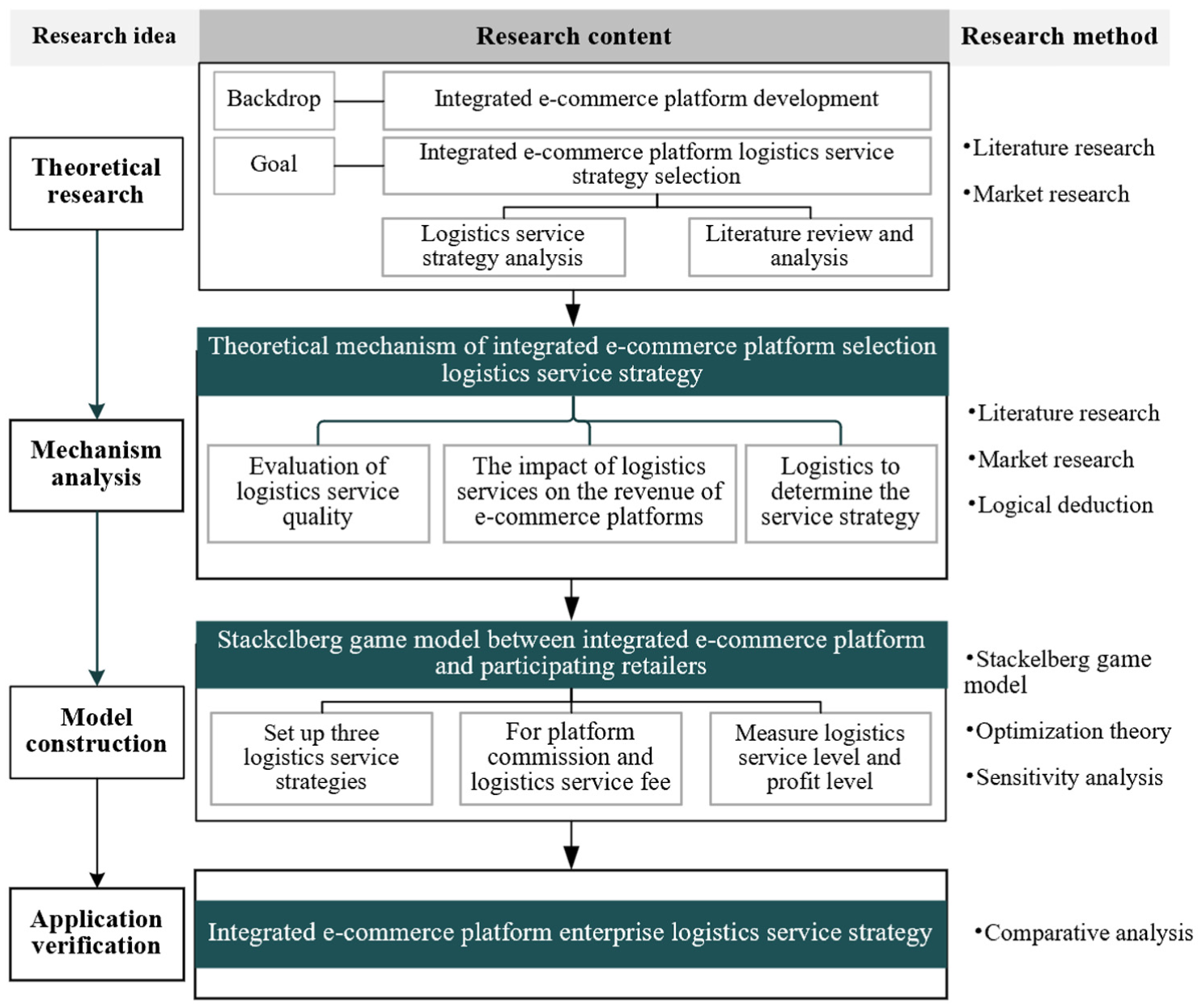
Technology roadmap.
Model Construction
Model Assumptions
According to the current game situation between the integrated e-commerce platform and settled retailers, and consistent with Zhao and Tang (2007), this paper employs the Stackelberg game model to establish the game model between the platform and retailers. The Stackelberg game is a model that describes the interaction between a leader and a follower. In this Stackelberg game, the leader is the integrated e-commerce platform, and the follower is the settled retailer. The leader can accurately understand the follower’s behavior patterns and reactions, while the follower can only observe the leader’s decisions. This information asymmetry enables leaders to predict and guide followers’ behavior more accurately when formulating strategies. Generally, in the Stackelberg game model presented in this paper, the integrated e-commerce platform chooses first, followed by the retailer.
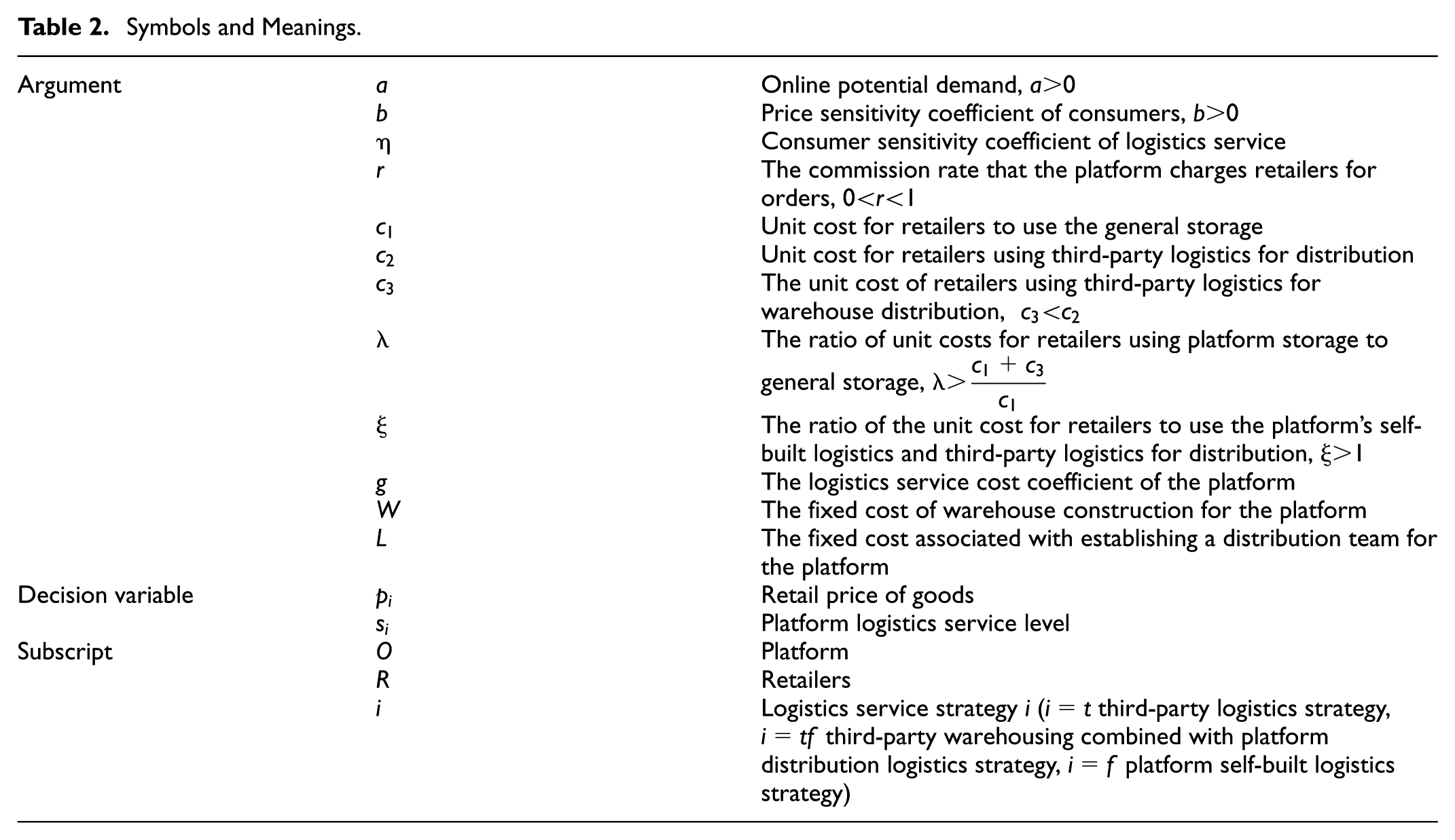
This paper focuses on an integrated e-commerce platform enterprise, which can adopt a logistics service strategy
Consistent with the literature by Shen et al. (2019) and Yan et al. (2018), it is assumed that retailers pay a commission rate
Symbols and Meanings.
Third-Party Logistics Service Strategy (i = t)
Under the third-party logistics strategy


Equation 1 demonstrates that the retailer’s profit is calculated as sales revenue minus platform fees, warehouse, and distribution expenses. Equation 2 shows that the profit of the integrated e-commerce platform is the difference between the order commission income and logistics service costs.
Consider taking the comprehensive e-commerce platform as the leader and establishing a Stackelberg game model between the platform and retailers. The decision order is that the platform first determines its logistics service level


The model’s equilibrium solution can be derived through backward induction, as demonstrated in Proposition 1.
If the integrated e-commerce platform and the resident retailers respectively formulate the logistics service level and the commodity retail price in the third-party logistics strategy according to the result in Proposition 1 and substitute

The maximum profit of the platform is

Third-Party Warehousing Combined With Platform Distribution Logistics Strategy (i = tf)
Under the third-party warehousing combined with platform distribution logistics strategy


Equation 7 indicates that the retailer’s profit is the sales income minus the costs of paying the platform commission, warehousing, third-party allocation, and platform distribution. Equation 8 indicates that the profit of the comprehensive e-commerce platform is comprised of order commission income, platform delivery service income, logistics service costs, and fixed costs associated with the delivery team’s construction.
Taking the integrated e-commerce platform as the leader, a Stackelberg game model was established between the platform and the retailer. The decision order is that the platform first determines its logistics service level


The equilibrium solution of the model can be found through backward induction, as demonstrated in Proposition 2.

If the integrated e-commerce platform and the settled retailer, under the logistics service strategy

The platform maximizes profit as

Under the logistics service strategy
Platform’s Self-Built Logistics Service Strategy (i = f)
Under the platform’s self-built logistics strategy

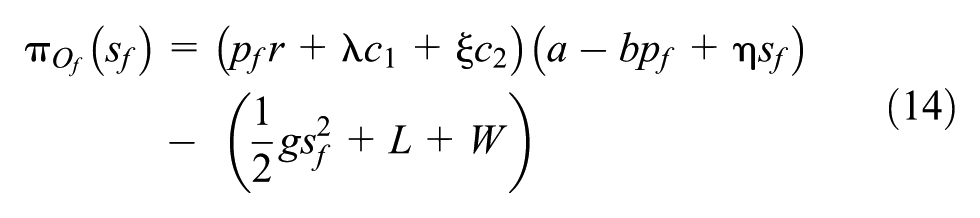
Equation 13 indicates that the retailer’s profit is the sales income after paying platform commission, warehousing cost, and distribution cost. Equation 14 indicates that the profit of the integrated e-commerce platform is the difference between the order commission, the platform’s warehousing and distribution service income, and the cost, including the logistics service cost, the fixed cost of distribution team construction, and the fixed cost of warehouse construction.
Taking the integrated e-commerce platform as the leader, a Stackelberg game model was established between the platform and the retailer. The decision order is that the platform first determines its logistics service level


The equilibrium solution of the model can be derived through backwards induction, as demonstrated in Proposition 3.
Under the logistics service strategy
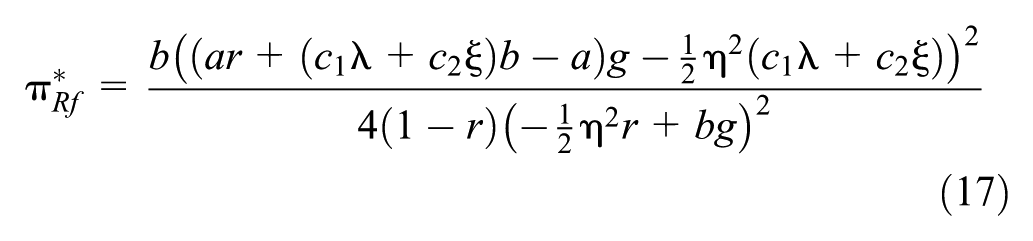
The platform maximizes profit for

Under the logistics service strategy
Similar to inference 1, inference 2 indicates that under the logistics service strategy
Comparison of the Optimal Decision and Profit Levels for Each Logistics Service Strategy
Comparison of the Optimal Decisions Made by Platforms and Retailers Across Three Types of Logistics Service Strategies
Based on the existing model’s results, the logistics service levels of the integrated e-commerce platform are compared across three types of logistics strategies, along with the retail prices of retailers under these strategies. From this, Proposition 4 is derived.
The results of the above model show that the optimal logistics service level of the platform increases progressively under the three logistics service strategies: third-party logistics, third-party warehousing combined with platform distribution logistics, and platform self-built logistics. Additionally, the retail price of the optimal commodity set by retailers also increases progressively. Offering high-quality logistics services requires the platform to bear significant logistics expenses. As a result, the platform will pass this cost burden onto cooperative retailers, who are likely to increase the retail prices of their products accordingly. While advanced logistics services boost market demand, higher sales prices for commodities may decrease demand. Consequently, it is necessary to analyze whether integrated e-commerce platforms and retailers achieve higher profit levels under various logistics service strategies.
Comparison of Profit Levels of Platforms Under Three Types of Logistics Service Strategies
Comparing the profit maximization of the integrated e-commerce platform under three logistics service strategies reveals that the outcome depends on the fixed costs of warehouse construction W and building the distribution team L, as shown in Proposition 5.
Proposition 5 demonstrates that, for the integrated e-commerce platform, the fixed cost of platform warehouse construction W and the fixed cost of building the distribution team L are the key factors influencing its profit level under various logistics service strategies. On one hand, when the fixed cost of the platform warehouse construction W and the fixed cost of the distribution team construction are both high, the third-party logistics strategy is the best choice for the platform because cooperating with settled retailers through third-party logistics allows the platform to avoid bearing high self-established logistics costs. When the fixed cost of platform warehouse construction W is high, but the fixed cost of the distribution team construction L is relatively low, third-party warehousing combined with platform distribution logistics strategy can generate higher profits than other logistics service strategies. Under this strategy, the platform can share the costs of warehouse construction with the help of third-party logistics, focus on improving logistics service quality in the terminal distribution stage, and increase the transaction volume of the platform to boost profits. On the other hand, when the fixed cost of the platform warehouse construction W and the fixed cost of the distribution team construction L are both low, the platform’s self-built logistics strategy has greater profitability than other strategies. The lower cost of self-established logistics can generate greater benefits for the platform. When the fixed cost of platform warehouse construction W is low, but the fixed cost of the distribution team construction L is relatively high, the platform should prioritize a third-party logistics strategy. In order to facilitate the application of the research results of this study to business practice by comprehensive e-commerce platforms, this paper provides a logistics service strategy selection guide chart for the platform in the numerical simulation section, based on the conclusion of Proposition 5, as shown in Figure 4.
Comparison of Profit Levels of Retailers Under Three Types of Logistics Service Strategies
Comparing the retailer’s maximum profit across pairs of the three logistics strategies reveals that it depends on the order commission rate r charged by the platform and the ratio of the platform’s warehousing unit cost to the general warehousing cost λ, as outlined in Proposition 6.
Proposition 6 shows that the retailer’s profit level under the three logistics service strategies of “third-party logistics,”“third-party warehousing combined with platform distribution logistics,” and “platform self-built logistics” depends on the order commission rate r paid to the platform and the ratio λ of the unit cost of the retailer using platform warehousing and general warehousing. When the retailer and the platform cooperate under the “platform self-built logistics” strategy, the retailer will choose the warehousing service provided by the platform. Its unit warehousing cost
Numerical Simulation
This section employs numerical experiments to explore further the management importance of logistics service strategies for integrated e-commerce platform enterprises and their partner retailers.
Sensitivity Analysis of Optimal Decisions for Platforms and Retailers Under Different Logistics Service Strategies
Numerical Experiment 1: A sensitivity analysis of the order commission rate r is performed on the optimal logistics service level
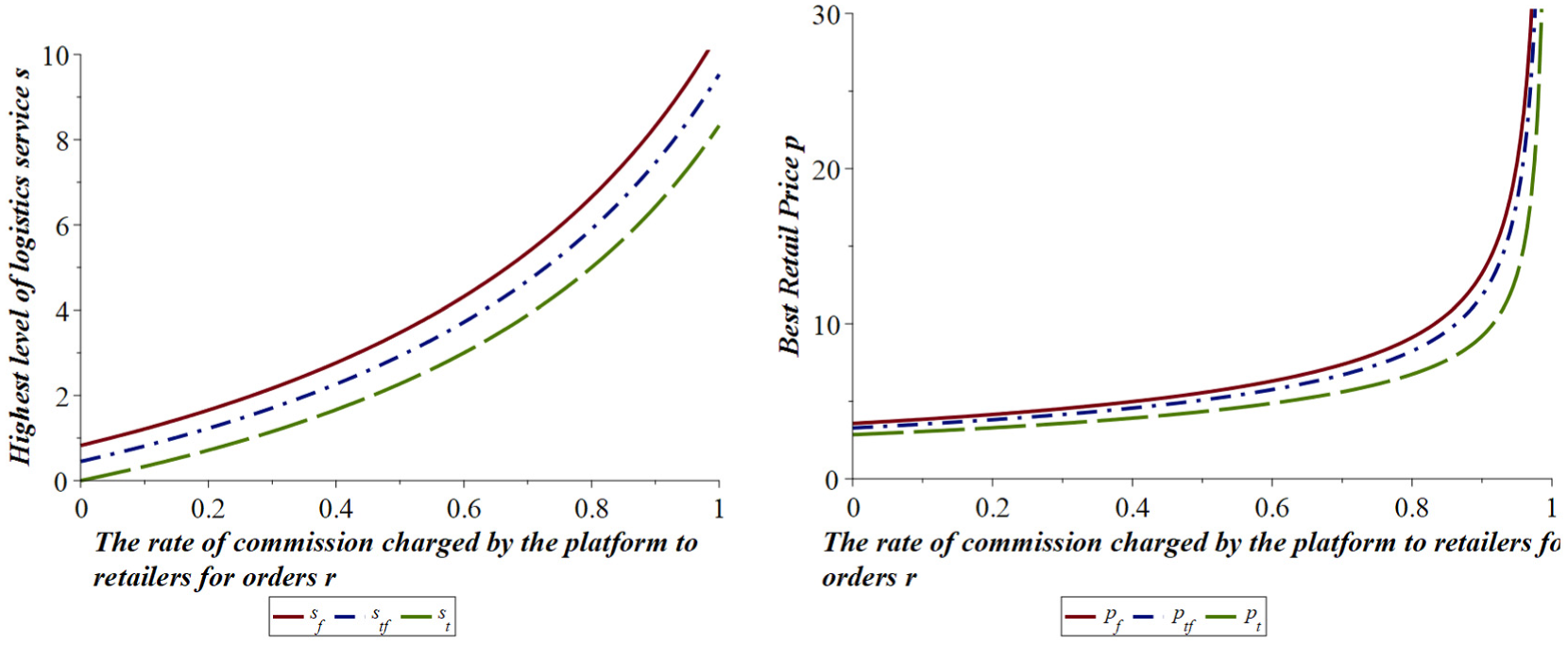
Sensitivity analysis of
Figure 3 shows that the optimal logistics service level
Figure 3 also shows that under different logistics service strategies, the size relations of the optimal logistics service level
Comparison of Maximum Profits of E-commerce Platforms Under Different Logistics Service Strategies
According to Proposition 5, based on the conditions related to the fixed cost W of the platform warehouse construction and the fixed cost

Integrated e-commerce platform logistics service strategy guide map.
Figure 4 shows a two-dimensional coordinate plane with W as the horizontal axis and L as the vertical axis, and the boundaries of each region correspond to the thresholds of the parameter
Comparison of Maximum Profits of Retailers Under Different Logistics Service Strategies
Numerical experiment 3: According to proposition 6, based on the relevant conditions of the order commission rate r paid by retailers to the platform and the ratio λ of the unit cost between platform warehousing and general warehousing by retailers, the dominant region of profit maximization for each logistics service strategy for retailers is depicted on a two-dimensional coordinate plane. This results in a retailer logistics service strategy guidance chart. The parameter employing

Retailer logistics service strategy selection guide map.
Figure 5 shows a two-dimensional coordinate plane with
Discussion
Research has confirmed that logistics service is a key competitive advantage in e-commerce. Numerous studies have demonstrated that logistics service quality can significantly impact consumers’ purchase intentions and, consequently, user demand. Based on the impact of logistics services on consumer needs, this paper categorizes logistics service strategies into three types and examines them to fill gaps in the existing knowledge system. Specifically, this paper defines the logistics services provided to consumers during e-commerce transactions as a class of services that can influence demand, divides logistics service strategies into three categories, and discusses how platforms develop these strategies and how retailers select among them, considering platform commission deductions and logistics service fees. The research results of this paper align with those of the previous studies (Lin et al., 2023; Qin et al., 2021; J. Yu et al., 2024), further confirming that the choice of logistics service strategy by e-commerce platforms significantly impacts both platform and retailer profits. In this paper, the Stackelberg game model is employed to analyze the interaction between the integrated e-commerce platform and the retailer, providing an effective examination of the optimal logistics service level decision for the platform and the optimal product pricing decision for the retailer.
Theoretical Contribution
Our research contributes to integrated e-commerce platform logistics service strategies and fills a significant gap in the literature on integrated e-commerce platforms and retailers’ logistics service strategies. It offers decision-making insights not previously documented in other studies. By analyzing how order commission rates and logistics costs influence the logistics service level and retail prices, we find that the optimal strategy for an integrated e-commerce platform and retailers depends not only on logistics service costs (Tianzhuo et al., 2021) but also on platform commissions. Specifically, a higher order commission rate helps the platform enhance its logistics service level, but it will also lead to an increase in the retail price of goods. As the logistics service level decreases, both the platform’s optimal logistics service level and the retailer’s optimal retail price decline.
Practical Significance
Our findings provide practical management advice for integrated e-commerce platforms and retailers. For the integrated e-commerce platform, if the fixed costs of building the warehouse and establishing the distribution team are both low, it should prefer the self-built logistics service strategy because the profit from this approach is higher than the other two options. For retailers, when the order commission rate paid to the platform and the unit cost ratio between platform warehousing and general warehousing are lower, they can choose the platform’s self-built logistics service because it offers the highest profit under these conditions.
Research Conclusions and Future Prospects
This paper examines the logistics service system of a comprehensive e-commerce platform and develops a Stackelberg game model for the costs of warehouse construction and distribution team setup based on the platform. The research findings indicate that:
(1) The optimal logistics service level and the ideal retail price of goods on the comprehensive e-commerce platform increase sequentially among the three logistics service strategies: third-party logistics, third-party warehousing combined with platform distribution logistics, and platform self-built logistics. As logistics service levels improve, the platform will shift the burden of higher logistics costs to retailers, encouraging them to raise retail prices.
(2) The fixed costs of platform warehouse construction W and the fixed cost of distribution team formation L are the key factors influencing the profit level of comprehensive e-commerce platforms under various logistics service strategies. The high fixed cost for platform warehouse construction and building the distribution team will lead the platform to adopt a third-party logistics strategy. Reducing the fixed cost for building the distribution team L will encourage the platform to alleviate warehouse construction expenses by utilizing third-party logistics for warehouse distribution services. Similarly, lowering the fixed costs for platform warehouse setup and for building the distribution team will lead the platform to adopt a self-built logistics service strategy.
(3) The order commission rate r charged by the platform to retailers and the ratio of unit costs λ between platform warehousing and general warehousing are key factors affecting retailers’ profits. Reducing the order commission rate r paid by retailers to the platform allows retailers to reach the highest profit level under the platform self-built logistics service strategy. When the ratio of unit costs λ between platform warehousing and general warehousing is low, retailers will not collaborate with platforms that offer third-party warehousing combined with platform distribution logistics services.
This study also has some limitations. For example, the model only considers the logistics service level decision of the platform and the retail price decision of the retailer, excluding the logistics service decision of third-party logistics providers. The different impacts of commodity attributes on logistics service strategies are not considered. For instance, fresh products, electronic items, and clothing each have markedly different logistics service needs. Furthermore, when examining the fixed costs of warehouse construction for e-commerce platforms, the depreciation cycle and the mechanism for allocating fixed costs were not considered. Therefore, future research should focus on including more influential factors into the model to better guide logistics service strategy in the e-commerce market.
Footnotes

Ethical Considerations
This article does not contain any studies with human or animal participants, and therefore ethical approval was not required under national research ethics guidelines.
Consent to Participate
There are no human participants in this article and informed consent is not required.
Funding
The authors disclosed receipt of the following financial support for the research, authorship, and/or publication of this article: This research was supported by the National Natural Science Foundation of China (72001182), the National Natural Science Foundation of Sichuan Province (2024NSFSC1066).
Declaration of Conflicting Interests
The authors declared no potential conflicts of interest with respect to the research, authorship, and/or publication of this article.
Data Availability Statement
Data sharing not applicable to this article as no datasets were generated or analyzed during the current study.