



Abstract
Faculty at the special education department of the University held mixed concerns about e-learning opportunities for Students with Disabilities (SWD) during the COVID-19 pandemic. This research investigated their attitude using a questionnaire survey. The sample was 70 faculty members who specialized in tutoring students with disabilities. The Pearson regression (0.655) established the reliability of the data collection instrument. The results showed that faculty members held a positive attitude toward the application of e-learning technologies for SWD and supported its ability to allow for cognitive, social, and education interaction during the pandemic. While faculty agreed the method was no more time-consuming than regular classroom sessions, they were reluctant to invest the time in training. The research concluded the views of department members in the design of appropriate systems/curricula would help to eliminate barriers and encourage more support for e-learning of SWDs during the pandemic. The faculty had several recommendations for the successful application of online learning during the pandemic for special needs students. Most suggested the need for adequate educational resources within the departments, and appropriate software and hardware to enable teaching appropriate skills to the learners with disabilities. There was a further recommendation that e-learning should be incorporated into the curricular programs.
Introduction
The incorporation of technology in education has improved learning for students with disabilities (SWD). Over the past 20 years, Saudi Arabia has expended tremendous effort and resources to implement technology in its universities, as part of plans to maximize the human resource complement in higher education institutions (Abdulrahman et al., 2018). Correspondingly, the Ministry of Education has made efforts to improve pedagogical approaches, emphasizing the use of computers to support efficient learning (Alghamdi & Holland, 2020). As a result of these initiatives, there is a perception that faculty involved in the teaching of SWDs would seize the opportunity provided as a result of the COVID-19 pandemic to implement e-learning. E-learning is positing to positively impact SWD’s learning outcomes (Waight & Oldreive, 2020) while equipping faculty with the necessary tools to capture and retain their interest (Babeley, 2016). Despite these benefits, researchers have found a reluctance by teachers to integrate technology while teaching in the classroom. Arguments have ranged from weak technical competence, insufficient teaching material, diminished control, and lack of time (Tallvid, 2016) to feelings of inadequacy (Atanga et al., 2020). In response, educational administrators have countered with interventions such as peer support, and requests for technical and financial assistance (Tusiime et al., 2020). Based on these researches, it is clear that a cognitive-behavioral approach is needed to understand faculty’s attitude to technology use in the classroom.
On the other hand, the study conducted by Catalano et al. (2021) has described that in the era of the Covid-19 pandemic, disable students have been recognized with various difficulties because of e-learning. It has been determined that students with disabilities face different issues with e-learning because they were not having access to the resources required to access the learning material and they were not having sufficient level of support from their mentors and teachers to have sufficient level of learning from their respective educational institutes. On the other hand, it has been further determined that disabled students were not having a significant level of skill-set that could be used accordingly for online learning skills. Furthermore, disabled students were also facing different issues to grasping a sufficient level of understanding from the lectures that were prepared for them because the teachers were having different issues in developing the lectures that could be used accordingly for teaching disabled students. Moreover, the teachers were not having a sufficient level of training that could be used for teaching the disabled students by which different issues arise and the desired level of learning is not done by the students having disabilities (Tonks et al., 2021). Another issue faced by the disabled students was related to the stay-at-home orders that result adversely on the psychological and mental health of the disabled students. This also produces a negative impact because the e-learning issues were already present and the mental and psychological issues also cause different issues where the disabled students have lost their coping abilities with the uncertainties caused due to the covid-19 pandemic (Gin et al., 2021).
Moreover, the issues associated with the transition from physical to the online environment also cause different issues for the students having disabilities. The facilities provided in the respective educational institutes were not present at their homes by which different issues arise and the process of learning was not done in the desired manner. Furthermore, the international students having disabilities were not able to cope with these uncertainties and these aspects also produces an impact on e-learning. Besides this, different financial issues were also there because the disabled students have to buy new devices to attain a sufficient level of learning through online mediums. All these aspects result in different barriers for the disabled students and it also results in different barriers for the teachers to provide a sufficient level of learning to the disabled students (Coleman-Jensen, 2020; Gundersen et al., 2020; Rabbitt & Smith, 2021).
The global shift to online platforms for student learning seemed a normal transition during the COVID-19 pandemic. In some cases, faculty were presented with a fait accompli instead of an opportunity to discuss policy changes. Consultations are important to consider viewpoints, assess the competence and disband any barriers to the successful implementation of e-learning to SWDs. Not much is known about the faculty’s attitude to this shift in Saudi Arabia. This study seeks to address this shortfall.
Objectives of the Study
The objective of this research is to gain an understanding of faculty’s perception of e-learning to SWDs, major barriers to implementation, and measures that can be undertaken to improve the implementation of e-learning in special needs departments in the universities.
Research Questions
What are the department members’ views on the application of e-learning for students with disabilities during the COVID-19 pandemic?
What are the faculty members’ perceptions of the main barriers to the application of e-learning for learners with special needs during the COVID-19 pandemic?
What are faculty members’ perceptions of the measures required to improve the implementation of e-learning in mainstream institutions?
Literature Review
E-learning for Students with Disabilities
In February 2018, Saudi Arabia established the Authority for the Care of Persons with Disabilities (Office of the High Commissioner UN Human Rights [OHCHR], 2020). The Ministry ensures persons with disabilities are cared for and lack nothing for want of access. Disability laws in Saudi Arabia are quite inclusive of students with special needs (Abed & Shackelford, 2020). The Saudi Disability Act identifies a disabled person as one who has a visual impairment, hearing impairment, mental disability, physical and motor impairment, learning difficulties, speech and speech disorders, behavioral, and emotional disorders Autism, double and multiple disabilities, and other disabilities that require special care and rehabilitation. Despite these considerations, SWDs are still negatively impacted by limited educational opportunities (Abed & Shackelford, 2020). In Saudi Arabia, the infrastructure of special education has rapidly been developing, with remarkable growth achieved through strategic support from the government, and planning and initiatives of the Ministry of Education’s General Special Education Administration (Al-Khalifa, 2010). Emerging trends in Saudi’s special education have enabled SWDs numerous opportunities to secure services. This is evidenced by the dramatic increase in the number of special education services from approximately 5,200 in 1992 to more than 63,000 by 2015 (Bin Battal, 2016).
E-learning refers to formalized teaching with the assistance of electronic resources, including the use of the internet and computers. E-learning has been beneficial in various aspects of the educational life of tutors and learners, and critical in the transformation of practices and procedures in the sector. The application of online learning in the education system has enabled an increasingly student-centered learning setting (Collins, 2020; Zimmer et al., 2021). The continuation of the coronavirus pandemic suggests e-learning is poised to continue its rapid growth post-COVID-19.
E-learning has greatly influenced teaching, learning, research, and development in the education sector. Apart from increasing the quality of education, e-learning has deepened innovation, and enriched and accelerated skills (Aljaber, 2018). The technology is now fundamental to student engagement and motivation and integral in assisting students to relate their school experience to the practical world of the work (Aljaber, 2018).
Bin Battal (2016) observed that the current generation’s upbringing was intricately intertwined with technology daily. As a result, faculty members needed to have the requisite technical skills to successfully engage with these students during teaching. Employing different pedagogical methodologies can improve teaching skills and the attitude of learners, which is particularly essential to ensure these students feel included. Accordingly, teachers should not be afraid to creatively engage with the technology, as it is important that these students feel a sense of accomplishment and develop the confidence they need for successful learning (Bin Battal, 2016).
E-learning in the Saudi Educational System
Like many other countries around the globe, Saudi Arabia continues to embrace e-learning as a transformational approach to education: Saudi Arabia’s transition toward online learning in education began with teacher training in computer skills before the technology was incorporated into the entire education system. The construction of computer laboratories in schools was instrumental in facilitating the tutoring of learners in e-learning. However, like most other subjects in the curriculum (Aljaber, 2018; Quadri et al., 2017).
In the interim, the Saudi government had been working toward the complete integration of e-learning into the education system to improve students’ level of computer skills (Alhabeeb & Rowley, 2018). Quadri et al. (2017) noted the government’s launch of an impressive e-learning program to accelerate online learning in institutions. Simultaneously, the Education Ministry devised various e-learning projects with a specific aim to improve the learning and teaching of e-learning in Saudi institutions. Despite such innovative projects, Aljaber (2018) asserted higher learning institutions have generally been unsuccessful in their application of e-learning. Some of the major hindrances to the success of these initiatives have been resistance from faculty members, insufficient financial support, and inadequate tutor training in e-learning skills. Despite these barriers, the Ministry of Education was able to establish 27 technical centers throughout the state to provide methodological services to Saudi tutors in e-learning (Aljaber, 2018). This was a significant move that was instrumental in improving the pedagogical performance of faculty members.
Alhabeeb and Rowley (2018) also investigated the application of online learning in Saudi universities. Their findings suggested a lack of confidence and well-trained faculty members to undertake e-learning lessons as some of the barriers to the successful application of online learning within institutions. Additional limitations were inadequate to support from the institutions’ administration, negative perceptions among the faculty members, and insufficient time slotted for e-learning lessons. Certain religious and cultural beliefs impeded the use of online learning.
Barriers Facing Utilization of E-learning with Students With Disabilities and Solutions
There were various challenges to applying e-learning to improve the educational experience for SWDs, especially during the COVID-19 pandemic. Several studies have highlighted the challenges in the classroom as well as the perspectives of various stakeholders regarding the implementation of technology. A significant challenge was the consideration of individual user’s needs (Alhabeeb & Rowley, 2018).
However, apart from the barriers existing in the E-learning domain with disabled students, the studies have found out that the KSA e-learning sector is witnessing potential growth, most importantly across higher education (Alhabeeb & Rowley, 2018). Acquiring an understanding of the system user was crucial since it facilitated the interaction between the system and human beings. SWDs had a different understanding of processes from normal students, and this had implications for system design requirements. The system designer had to clearly understand the students’ needs to ensure that the system adequately supplied the requisite educational provision to meet set goals. Additionally, teachers also had to have a clear understanding of students’ needs because of their unique training to interact with SWDs. Even though system designers had the technical capability and understood the system’s functional requirements, it is important to emphasize that the systems’ social components were equally important in SWDs’ education (Alhabeeb & Rowley, 2018).
Another significant challenge was users’ inability to gain sufficient access to the technology to make good use of it. System security issues formed much of the discussions in the present literature, including security breaches and unauthorized access to information. In this context, SWDs often suffer from a poor ability to memorize information and retain adequate cognitive knowledge. Consequently, SWDs would find it challenging to access systems that require pin codes, passwords, or other security features. The issue of data protection from unauthorized users promises to be a perpetual problem (Naumova et al., 2017).
Several studies have recommended that incorporating the user at the design stage may be crucial to its successful implementation (Naumova et al., 2017). This is because users are more cognizant of their requirements, which is sometimes difficult for a developer to understand. The downside to this suggestion, however, is that learners with disabilities are often challenged in their ability to ably express themselves.
Department Members’ Perspectives on Online Learning for Students With Disabilities
Studies on the implementation of e-learning in the teaching of SWDs have emphasized how crucial it is to evaluate the program’s effectiveness for these students. Computer-Assisted Instruction (CAI) is a perfect example of a tool, which has proven essential in developing their reading skills, listening skills, vocabulary, and language of SWDs (Williams, 2020). Other researchers have noted that e-learning platforms can assist students’ fundamental communication competencies, completion of tasks and activity scheduling, social skills development, and symbolic play skills establishment. Nonetheless, there have been concerns regarding the reliability of these findings because most of the studies depended on trial samples to arrive at these conclusions. The change in focus from personal views to interactional and systematic points of perception could result in a clearer picture. To this end, Alhabeeb and Rowley (2018) suggested a study among faculty members could provide empirical data about their views concerning successful e-learning implementation in tutoring SWDs.
Despite the indisputable potential available for using e-learning for academic and social skills, faculty members could find it intimidating to implement. Correspondingly, they might face significant challenges allocating time to collect content, acquire an in-depth understanding of the e-learning programs, or rework their tutoring aids to align with the e-learning platform needs. The excuses are not anomalies, as Alhabeeb and Rowley (2018) were able to uncover faculty members’ unwillingness to develop PowerPoint presentations, for example, because of their ignorance about the software and their unwillingness to devote time to design the presentations.
Methodology
Research Design
The research uses a questionnaire survey, which is appropriate to elicit overt information from respondents with knowledge of and competence to answer questions related to the phenomenon (Kumar, 2019; Kitchin & Thrift, 2009). Individuals’ perceptions, attitudes, beliefs, and motivations are often measured through self-reports obtained through questionnaires (Dawson, 2019; Kitchin & Thrift, 2009). Questionnaire design is a critical and delicate activity (Chlistunoff, 2015). Framing questions to acquire valid and reliable information for theory testing and informed decision-making requires astute research skills (Kitchin & Thrift, 2009; Swamy, 2007; Zimmer et al., 2021). Questionnaires contained a mixture of affirmative, negative and balanced statements.
The questionnaire constituted 30 closed-ended items related to faculty’s perception and attitude toward e-learning and SWDs. Four experts validated the instrument to ensure the appropriateness of the constructs measured to the research aims. The instrument’s internal reliability attained a Cronbach alpha coefficient of .83, confirming it had adequate reliability to be used in this research. The instrument was divided into three sections (A, B, and C/Part 1, Part 2, and Part 3): The first addressed the department members’ perceptions about online learning during COVID-19; the second addressed perceived barriers to online learning during COVID-19, and the third section addressed needed requirements to enhance online learning during COVID-19. Respondents were asked to rate their responses on a 5-point Likert scale ranging from Strongly Agree (5) to Strongly Disagree (1). Four research assistants helped in the administration of the questionnaire.
Sampling
Sampling facilitates the study of the population’s overall attributes (Kalton, 2020). Using simple random sampling (Etikan & Bala, 2017), 100 department teachers of SWDs were selected from four major special education departments at a major university. These departments provide segregated programs while others provided the learning support that enables the participation of special needs students in regular classes.
Analysis of Data
Descriptive analysis was used in the statistical assessment. Results were summarized and graphics were used to assist with the display. SPSS version (23) was used in data analysis (George & Mallery, 2019).
Results
This section of the study discusses the results that were obtained from the recruited respondents. All the results were generated with the use of statistical analysis in which different tests were performed as defined in the aforementioned section.
Frequency Analysis
The Appendix 4 defines the summary of all questions in the form of a bar graph that could be used to have summarized results for all the questions. However, the first question asked from the respondents was regarding the implications of e-learning for the tutoring and learning process along with the interaction skills of the learners having disabilities during a covid-19 pandemic. Below Table 1 describes that five respondents have selected the agree option and nine respondents have selected the neutral option. On the other hand, 38 respondents have selected the disagree option and 48 respondents have selected the strongly disagree option.
Response for Question One.

Source. Author.
The second question asked from the respondents was to evaluate the implication of e-learning either it should be integrated into the curriculum or not. Below Table 2 defines that only one respondent has marked the strongly agree option and nine respondents have selected the agree option. On the other hand, 23 respondents have selected the neutral option and 37 respondents have selected the disagree option. However, 30 respondents have selected the strongly disagree option for this question.
Response for Question Two.

Source. Author.
The third question asked from the respondents was based on the use of e-learning that is being used for social skill enhancement for the students having disabilities. It can be analyzed from below Table 3, which defines that two respondents have marked the strongly agree option and eight respondents have selected the agree option. On the other hand, 13 respondents have selected the neutral option and 47 respondents have selected the disagree option. However, 30 respondents have selected the strongly disagree option for this question.
Response for Question Three.

Source. Author.
The fourth question asked from the respondents was to evaluate either e-learning is a time-consuming approach for teaching or not. Below Table 4 defines the results and it can be analyzed that 27 respondents have marked the strongly agree option and 26 respondents have selected the agree option. On the other hand, 20 respondents have selected the neutral option and 19 respondents have selected the disagree option. However, eight respondents have selected the strongly disagree option for this question.
Response for Question Four.

Source. Author.
The fifth question was asked from the respondents was regarding the use of e-learning will be considered as an additional effort for the teachers for the students having disabilities during a covid-19 pandemic. Below Table 5 defines that 24 respondents have marked the strongly agree option and 29 respondents have selected the agree option. On the other hand, 17 respondents have selected the neutral option and 22 respondents have selected the disagree option. However, eight respondents have selected the strongly disagree option for this question.
Response for Question Five.

Source. Author.
Moreover, the sixth question asked from the respondents was to examine the use of e-learning for the development of social interaction and communication skills among the students having a disability. However, Table 6 defines that 17 respondents have selected the agree option and 23 respondents have selected the neutral option. On the other hand, 38 respondents have selected the disagree option and 22 respondents have selected the strongly disagree option.
Response for Question Six.

Source. Author.
The seventh question asked from the respondents was to analyze the difficulties for implementing e-learning for disable students during a covid-19 pandemic. Below Table 7 defines that only one respondent has marked the strongly agree option and 13 respondents have selected the agree option. On the other hand, 18 respondents have selected the neutral option and 41 respondents have selected the disagree option. However, 27 respondents have selected the strongly disagree option for this question.
Response for Question Seven.

Source. Author.
Below Table 8 defines the responses for the eighth question in which the implications of conventional teaching approaches were asked for the disabled students during the Covid-19 pandemic. It has been analyzed that two respondents have selected the agree option and 47 respondents have selected the neutral option. On the other hand, 45 respondents have selected the disagree option and six respondents have selected the strongly disagree option.
Response for Question Seven.

Source. Author.
Descriptive Statistics
According to the research of Kaur et al. (2018), the term descriptive statistics refers to the summary of the features of the collected information. This section of the paper presents the descriptive statistics based on the collected data. Table 9 represents the outcome of descriptive statistics for the collected responses. It can be analyzed that the value for mean for faculty perception is 3.53 and perceived barriers are 3.12. On the other hand, the value for a standard deviation for faculty perception is 0.583 and 0.640 is obtained for the perceived behavior.
Descriptive Statistics.

Source. Author.
Correlation and Chi-Square
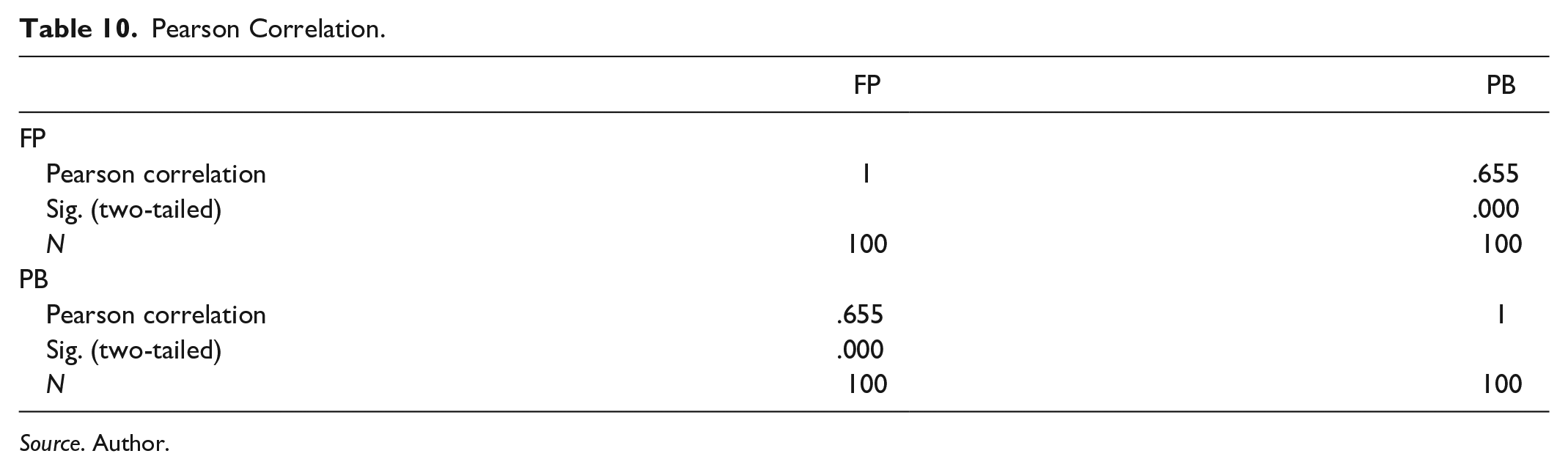
Below Table 10 defines the value of Pearson correlation for both of the variables (i.e., faculty perception and perceived behavior). It has been analyzed that the correlation value is 1 for faculty perception and 0.655 for perceived behavior.
Pearson Correlation.
Source. Author.
Table 11 refers to the value of the person chi-square test for the obtained responses. However, it has been determined that the value of Pearson chi-square is 0.009, which defines that a positive relation is present between the perceived behavior and faculty perception for the use of e-learning for the student with disabilities during a covid-19 pandemic.
Chi-Square Test.

Source. Author.
Discussion
This study sought to understand department members’ views on the application of e-learning for SWDs during the COVID-19 pandemic; to understand their perceptions of the main barriers to the application of e-learning for learners with special needs during the COVID-19 pandemic; and their perception of the measures required to improve the implementation of e-learning in mainstream institutions.
The application of e-learning has proven to be critical in the enhancement of behavior, learning skills, and communication among special needs students (Waight & Oldreive, 2020), during the pandemic. Department members perceived most faculty members advocated the use of online learning to tutor SWDs. They saw this as a continuation of the conventional teaching approach. This finding is in agreement with that of Naumova et al. (2017) who found that online learning assisted students with disabilities in their curriculum. Faculty perceived e-learning held various benefits to students with special needs during the pandemic. Some of these advantages involved the enhancement of tutoring and learning processes, improvement of social and communication skills, and the ability to save time among special needs students. The findings align closely with that of Barker (2020), who found that e-learning considerably enhanced skills and communication among children with disabilities during the pandemic.
For the second research question, faculty perceived programs for SWDs were not seen as a priority by administrators during the pandemic. They arrived at this conclusion based on the shift in focus from teaching to devising ways to safeguard staff from contracting the coronavirus infection. The pandemic also resulted in most of the institutions being closed as priority was given to “stay at home, work at home” campaigns. As a result, there was a breakdown in systems maintenance which resulted in a lack of technical support which ultimately affected online teaching and e-learning. Also, most of the training was directed to healthcare professionals, and this disrupted regular classes and further reduced emphasis on the training for the application of e-learning. These outcomes are similar to findings by Anderson (2020), who found that the unavailability of competencies and e-learning skills to be a significant barrier for faculty members’ adoption of e-learning skills.
The faculty had several recommendations for the successful application of online learning during the pandemic for special needs students. Most suggested the need for adequate educational resources within the departments, and appropriate software and hardware to enable teaching appropriate skills to the learners with disabilities. There was a further recommendation that e-learning should be incorporated into the curricular programs. The provision of financial assistance to acquire e-learning computers was another significant issue as this would help to overcome the lack of adequate finances in the institutions. The faculty also suggested communicating between the institutions and the Education Ministry using email. This approach would be vital in enabling real-time assessment of the entire process of e-learning implementation. These findings coincide with (Collins, 2020; Zimmer et al., 2021), who noted that the provision of support and training to department members who are teaching SWDs would ultimately improve the implementation of online learning in departments during the pandemic.
Conclusion
This study aimed to describe the perception and attitude of the members of special needs departments in the university regarding the application of online learning for students with disabilities during the COVID-19 pandemic. Based on the findings, more needs to be done as it relates to the training of teachers of special needs students in the use of the technologies and providing the appropriate equipment so that SWDs are not further disadvantaged.
Most of the study’s findings supported information found in the extant literature. One unique point which was perhaps unexplored was the role of religion in faculty’s perception and attitude to the SWD’s e-learning during the pandemic. Although this was one small study conducted at one university, it has implications for smaller and larger universities throughout the UAE. One of the limitations of the study was perhaps the questionnaire method. Future studies could explore this phenomenon further, using either a comparative or quasi-experimental approach to better understand faculty’s perception and attitudes toward e-teaching during the pandemic.
Limitations
A limitation of the study was that the participants were selected from one geographical concentration that may affect the replicable nature of the findings. Another limitation of the study was the selection of only faculty members. Students may not be convinced with the adoption of e-learning but this aspect could not be incorporated.
Implications for Future Research
The study makes a significant contribution to the academic literature and provided a new direction for continuing the transfer of quality education using e-learning during Covid-19. Covid-19 has also made a substantial impact on the education sector and future studies can further explore how digital tools and e-learning can improve the educational attainment for students with disabilities.
Footnotes
Appendix
Institutions’ Associated Needs, Faculty Members’ Development Requirements.

| Constructs | Items |
|---|---|
| Institutions’ associated needs | 1. Provision of the institutions with enough educational materials, software, and hardware relevant for tutoring various skills to the learners with disabilities in Arabic language |
| 2. Institutions’ preparation with adequate internet access and network | |
| 3. Provision of financial support to the institutions to acquire e-learning resources involving computers | |
| 4. Inclusion of implementation of e-learning in curriculum | |
| 5. Application of electronic approach in the communication between the Ministry of Education and schools | |
| Faculty members’ development requirements | 1. Faculty members should be obligated to utilize e-learning with the students with disabilities |
| 2. Offering faculty members with enough information concerning the importance of applying the new technique of e-learning in education of the learners with disabilities during COVID-19 | |
| 3. Provision of continuous training to the faculty members during COVID-19 | |
| 4. Inclusion of e-learning in the preparation programs for faculty members | |
| 5. Provision of e-learning computers to each of the students with disabilities within the mainstream institutions |
Declaration of Conflicting Interests
The author declared no potential conflicts of interest with respect to the research, authorship, and/or publication of this article.
Funding
The author received no financial support for the research, authorship, and/or publication of this article.
