



Abstract
In many countries around the world, students with disabilities (SWDs) have the legal right to adequate education, comparable to their non-disabled peers. What are higher learning institutions in these countries doing to ensure this is the case for SWDs? This study sought to determine the extent to which universities in Saudi Arabia provide sufficient accessibility and special resources to SWDs. Self-report survey responses were secured online from 173 Saudi Arabian undergraduate university students and analyzed using independent t-tests. The results show there are no significant differences in the accessibility and resources provided to undergraduate SWDs in Saudi Arabian higher education institutions based on age, gender, type of university (public vs. private), type of disability, or region. Recommendations based on the findings and best practices are provided to improve on the situation of SWDs in higher learning institutions with regard to inclusivity and equal rights, including collaboration among stakeholders, supportive environments, and accessibility audits.
Introduction
Education is an important resource, and the degree to which it is equitably accessible is important. In modern nation-states, education quality relies on government efforts and initiatives to provide sufficient resources and to ensure that all citizens have access to an education (Carter & Abawi, 2018). However, individuals with physical or cognitive disabilities may not have appropriate access to education comparable to their non-disabled peers due to a lack of resources, including special education programs or instructors (Eide et al., 2021). This places such students in challenging situations regarding education outcomes and, ultimately, a successful future (Eide et al., 2021). Although the consensus among education professionals is that disability does not equate to inability, a key issue is what governments are doing to ensure the right to education for individuals with disabilities (Zendeli, 2017). The current research focused on perceptions of accessibility and resource availability for students with disabilities (SWDs) attending Saudi Arabian universities.
The aim of the current research was to determine whether institutions of higher learning provide sufficient accessibility and resources to SWDs in Saudi Arabia. Additionally, the study fills a gap in terms of providing students’ perspectives that are underrepresented in the published literature. SWDs are better placed to provide information on whether sufficient accessibility and resources are provided by universities to address their needs. Thus, the study fills three gaps that include knowledge gaps, population gaps, and practical gaps. In terms of knowledge gaps, we aim to add to the knowledge of inclusivity for SWDs since there is limited knowledge on this issue in Saudi Arabia. We are also focusing on an underrepresented group, namely SWDs in higher education. Lastly, this research addresses a disconnect between research findings and their practical application by providing recommendations that can be applied in higher education settings.
The research is informed by an inclusive education framework that emphasizes creating a learning environment that is responsive to the diverse needs of all learners, promoting social equity and a sense of belonging (Rapp & Corral-Granados, 2021). This can happen by adapting conducive curricula, providing appropriate support, and fostering positive attitudes towards diversity (Yang et al., 2025). This framework also considers the social model of disability which views disability not as an individual problem but as a social issue resulting from societal barriers and attitudes (Adam & Koutsoklenis, 2023). Because the focus of this study is inclusive education that considers SWDs, we use the social model of disability theory to understand how societal structures and practices create limitations for SWDs, making it difficult for them to participate fully (Adam & Koutsoklenis, 2023). The solution could lie in changing society rather than “fixing” individuals. The inclusive education framework considers aspects that are highlighted in this research such as systemic change (laws, policies, and best practices), teacher training and support, sensitization, collaboration among stakeholders, assessment, and evaluation.
Literature Review
The Ministry of Education has endeavored to develop and diversify the educational sector to more effectively address the needs of SWDs. The Ministry of Education established the first administration of special educational needs in 1962 to serve students with visual and auditory impairments and students with cognitive disabilities (Bin-Battal, 2016). In the following years of the same decade, the Ministry of Education established three schools for students with special educational needs: two schools for students with auditory impairments (including Al-Amal Institute) and one for students with visual impairments in Riyadh (Alothman, 2014). In 1971, also in Riyadh, the Ministry of Education founded the first specialized institute (Al-Riain) for students with cognitive disabilities (Aldabas, 2015). In 1978, the Ministry of Education established the Department of Special Education to administer special education for three types of students: students with visual impairments, students with auditory impairments, and students with cognitive disabilities (Bin-Battal, 2016). The General Secretariat of Special Education established the Educational Advisory Unit that assesses the effectiveness of special education programs.
It is important to consider briefly the laws protecting individuals with disabilities in Saudi Arabia, because these laws are equally applicable to SWDs. The Legislation of Disability, passed in 1987, was the first legislation directed at individuals with disabilities, assuring them of rights equal to individuals without disabilities (Alquraini, 2010). This legislation also requires that public institutions provide rehabilitation services and training programs to support independent living (Alquraini, 2010). The Disability Code was passed by the Saudi Arabian government in 2000 to ensure that individuals with disabilities have access to free and adequate medical, psychological, social, educational, and rehabilitation services through public institutions (Poch et al., 2022). This law also requires that public institutions assist eligible individuals with disabilities to obtain social support, employment, and other services (Poch et al., 2022).
Regarding the education of individuals with disabilities, students with mild or moderate learning disabilities typically receive their education in regular classrooms with some support from special educational services (Alquraini, 2010). These students participate in regular school activities with some modifications. However, research considering the period 2007 to 2008 found that 96% of students with severe disabilities received their education in separate institutions (Alquraini, 2010). The students are instructed in segregated environments that do not enable them to interact with non-disabled peers in inclusive classrooms that would facilitate development of their social, communication, and academic skills.
The Saudi Arabian government has made some progress towards integration of SWDs in mainstream education through laws and policies (Abobaker, 2024). However, there is a need to identify specific education policies and practices of universities, and to determine whether some of these policies and practices are more successful than others. Most previous studies among those reviewed focused on Saudi Arabian instructors’ perceptions, whereas the current study focuses on Saudi Arabian students’ perceptions of how to include SWDs in mainstream education. In addition, the current research assessed whether these student perceptions reflected decrements or improvements in the provision of educational experience over a period of time.
The Convention on the Rights of Persons with Disabilities (CRPD) has been ratified by majority of the Arab nations that form the Gulf Corporation Council (GCC) including Saudi Arabia (Al-Hendawi et al., 2023). State Parties are required to conform their national laws and practices to the CRPD. Although they are essential but insufficient elements of CRPD compliance, national disability strategies and policies are valuable instruments for bringing national frameworks into line with the CRPD (Al-Hendawi et al., 2023). They offer the legal framework and enabling policies needed to enact legislation, programs, and initiatives that protect the rights of people with disabilities. Fundamental concepts that underpin the principles of special education in the Arab Gulf nations: everyone has the right to an education, including those with impairments (Al-Hendawi et al., 2023).
Yet, each Gulf Nation has its own unique program meant to ensure equality. The United Arab Emirates (UAE) is similar to Saudi Arabia, at least historically, in that persons with disabilities were marginalized, but laws and policies continue to change this. Inclusion at all societal levels is important to UAE national growth. People with impairments, for instance, are referred to as “people with determination” who are encouraged to obtain necessary services like schooling in society (Alzyoudi et al., 2021). People with disabilities have historically been excluded from receiving high-quality education, and some still attend special schools—known as centers for persons with determination in the UAE. The federal government has taken action to enhance service delivery, including offering universally accessible education, in response to the misperception and denial of fundamental rights to people with disabilities. Federal Law No. 29 respecting the Rights of Persons with Disabilities was passed by the government in 2006 in response to need for inclusive education (Alzyoudi et al., 2021). This law declares that all schools must encourage the participation of SWDs. Following this law were Federal Law 116 in 2009 and the School for All Policy, which was passed in 2010 and included strong statements from the UAE leadership calling for the adoption of inclusive education for all students (Alzyoudi et al., 2021). The state governments created policies such as the Dubai Inclusive Education Policy Framework, which attempts to make all schools inclusive by 2020, in accordance with best practices (Alzyoudi et al., 2021).
Research Questions, Hypothesis, and Significance
The main question guiding this research is: Do Saudi Arabian universities provide sufficient accessibility and resources to support SWDs? Other research questions include: What is the government doing to ensure that SWDs receive adequate education at all levels of schooling? Which current practices more effectively support the education of individuals with disabilities? What are the barriers to integrating and including SWDs in mainstream classrooms?
The hypotheses of the research are framed as follows:
H0: There are no significant differences in the accessibility and resources provided to undergraduate SWDs in Saudi Arabian higher education institutions based on age, gender, type of university (public vs. private), type of disability, or region.
Ha: There are significant differences in the accessibility and resources provided to undergraduate SWDs in Saudi Arabian higher education institutions based on age, gender, type of university (public vs. private), type of disability, or region.
The null hypothesis assumes no difference in the dependent variables, namely receiving information about accommodation for disabled in the campus, having disability cultural centers on the campus, having special programs for the physically and mentally disabled, and having a sign language interpreter among others due to independent variables such as age, gender, type of university, type of disability, or region. Any observable difference is due to random chance rather than variation in the independent variables, suggesting no relationship.
This study is significant as it could highlight the challenges of SWDs attending Saudi Arabian universities. The results may inform the extent to which Saudi Arabian higher education successfully ensures that all citizens have access to positive educational outcomes that secure their future in terms of skills and employment.
The potential benefits of the study to the society outweigh risk of harm to the participants because the research seeks to highlight the challenges of SWDs with the aim of addressing them by creating awareness. The study will provide recommendations based on the study findings and best practices from other universities and organizations worldwide.
Methods
The research applied a quantitative approach in which data were secured online. The study targeted SWDs in universities from different regions of Saudi Arabia and attending either public universities or private universities.
Participants
The study targeted 200 students and eventually secured responses from 173 students. The students were drawn from different demographic groups reflecting variation in gender (male, female), type of university (public, private), age (years), type of disability (disabled, non-disabled), period of study (2010–2015 and 2021–2025), and region. Table 1 provides a summary of the available sample demographic attributes.
Demographic Attributes of the Sample (n = 173).

Data Collection Tool
Based on informal interviews with students, instructors, educational researchers, and policy analysts, we developed for this study a self-report questionnaire for online data collection: the University Disability Services Questionnaire (UDSQ; see Appendix 1). Responses are recorded on a Likert-type scale. The UDSQ includes 14 items that assess student perceptions of the degree to which their university provides resources and information to support SWDs. This study was approved 3 April 2024 by Bioethics Committee of Scientific and Medical Research, University of Jeddah, protocol #UJ-REC-235. Data were collected 15 May to 4 June, 2024.
The items were selected based on domains of resource limitations such as disability cultural centers or lack of a sign language interpreter and difficulties linked to lack of inclusion and marginalization of SWDs. Content and construct validity, as well as sensitivity and specificity, were measured. Based on the results, the tool was subsequently refined and limited to 14 questions from the initial 18 questions, tested and validated in Saudi Arabia. The reliability coefficient for the UDSQ ranges from 0.70 to 0.98, indicating good to excellent reliability. The questionnaire met content validity by adequately covering the content domain it intended to measure. This is because it was assessed by expert reviews of the questionnaire items to ensure they are relevant, clear, and cover aspects of the issues being assessed.
Sample Size and Procedure
Purposive sampling was used instead of stratified or random sampling because we were intentional of selecting SWDs at the undergraduate level of higher learning. Other factors considered were the type of university, study period, and type of disability. Through purposive sampling it was possible to obtain appropriate data from participants who possess the most relevant knowledge, experience, and insight required to address the research objectives. Random sampling aims for a representative sample of the entire population and stratified sampling divides the population into subgroups (Ahmed, 2024), neither of which were most appropriate given the goals of this study. Prospective participants were identified through a third-party source known to them. Participants had to be able to communicate by reading and writing so that they could read our recruitment message and complete the open-ended questionnaire if they agreed to participate. Appendix 2 displays the recruitment message.
All the participants had a disability, either physical or sensory. Participants were sent the survey materials to the email address they provided after accepting an invitation to participate. All participants provided written informed consent (see Appendix 1) and were awarded nominal monetary remuneration for their participation.
Ethical Considerations
The study design limited the risk of harm to participants through careful planning and ethical considerations. The process involved explaining the purpose of the study, the procedure involved, and how the data will be used. We also informed the participants that they had a right to withdraw from the study anytime for any reason. We offered emotional support for any emotional impact the research could have on the participants as we were aware that some of the participants could have experienced negative experiences in the university such as discrimination or having minimal support during the registration and admission process. We did notify participants that the study was aimed at highlighting these challenges and providing recommendations that might improve learning situations for SWDs in universities and colleges. Lastly, we ensured the confidentiality of all participants by using codes instead of names, and securing their data by limiting access only to researchers.
Data Analysis
The study employed an independent t-test for the analysis because this approach assesses the difference between the means of two independent groups (which was the case with the study variables) to determine if there is a significant difference between them. For instance, all the participants were students with various types of disabilities but even so were categorized into other variables such as gender and the type of university they attend. The independent/ categorized variables appeared mostly into twos such as male and female, private or public university, physical or sensory disability, except for age and region that appeared different for easy statistical analysis. The questionnaire included several questions, but only those linked directly with the role of higher education in providing accessibility and resources were used for statistical analysis. Yet, even then there was a limitation in terms of achieving balanced groups in terms of participants from different universities, with the result that private university participants were more numerous than public university participants, and 2021 to 2025 students were more numerous than 2010 to 2015 students. In the latter case, this is understandable since most undergraduate students are younger below 27 years and this is confirmed by the high number of students below that age who participated. The analysis of different variables is able to provide information about whether universities are catering to the needs of diverse groups included in the category of people with disabilities.
One consideration during analysis is that the independent t-test assumes normality and equal variance even though Likert scales are considered ordinal not continuous variables. While individual Likert items are ordinal due to the ordered categories, the sum or average Likert items (a Likert scale) can be treated as continuous if it has sufficient numbers of response options, such as five or more. In this case there were five response options. The dependent variables in this research that appear as Likert-scale items are also treated as continuous when analyzing the overall scale (the sum or average of several items). We also considered the statistical analysis to ensure it is appropriate for the type of data used and other assumptions are met. In this case, the analysis was parametric t-test, Mann-Whitney U test, and regression. According to Sullivan and Artino (2013), for a 5-point Likert scale treated as continuous, Pearson’s correlation and t-test are appropriate.
Results
The items selected for analysis in this section are those that directly relate to the role of higher education in providing accessibility and resources for SWDs. Of the 14 items in the questionnaire, six met the roles that universities can undertake to assist SWDs and these are the items of focus. The items served as dependent variables. Six independent variables, namely age, gender, type of disability, period of study, type of university, and region were investigated.
Q1: Information About How to Receive Disability Accommodations on My Campus Is Easy to Access and Understandable for Students—Dependent Variable
The results indicate no significant relationship between the independent variables and dependent variable, as shown in Table 2.
Results for Item, “Information About How to Receive Disability Accommodations on My Campus Is Easy to Access and Understandable for Students.”

Q2: My Campus Has a Disability Cultural Center, Disability Student Group, or Other Space/Organization for Disabled Students to Build Community—Dependent Variable
According to the results, there was a statistically significant relationship among period of study and type of university with the dependent variable but not age, gender, type of disability, and region, as shown in Table 3.
Results for the Item, “My Campus Has a Disability Cultural Center, Disability Student Group, or Other Space/Organization for Disabled Students to Build Community.”

Q6: It Is a High Priority for My Campus Administration to Make Our Campus Accessible and Inclusive to Disabled Students
There was no significant relationship among the independent variables and the dependent variable, as shown in Table 4.
Results for the Item, “It Is a High Priority for My Campus Administration to Make Our Campus Accessible and Inclusive to Disabled Students.”

Q10: My Campus Has a Program That Specifically Serves Students With Physical, Intellectual, and/or Developmental Disabilities (TPSID Program, Autism Support Program, etc.)
The results show no significant relationship between the independent variables and dependent variable, as shown in Table 5.
Results for the Item, “My Campus Has a Program That Specifically Serves Students With Physical, Intellectual, and/or Developmental Disabilities (TPSID Program, Autism Support Program, etc.).”

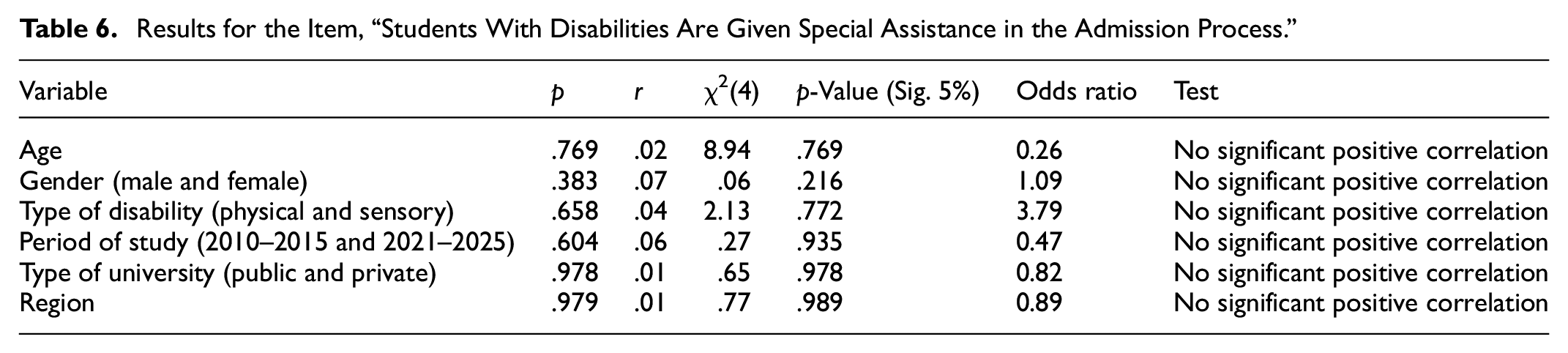
Q11: Students With Disabilities Are Given Special Assistance in the Admission Process
The results show no significant relationship among the independent variables and the dependent variable, as shown in Table 6.
Results for the Item, “Students With Disabilities Are Given Special Assistance in the Admission Process.”
Q12: A Sign Language Interpreter Has Been Appointed at the University
Except for period of study all the other results show no significant relationship between the independent variables and the dependent variable, as shown in Table 7.
Results for the Item, “A Sign Language Interpreter Has Been Appointed at the University.”

Discussion
Q1: Information About How to Receive Disability Accommodations on My Campus Is Easy to Access and Understandable for Students
Few studies have investigated how SWDs in Saudi Arabia access information before and after joining universities. It can be assumed that this varies depending on the university and insight of the student since some students lack awareness of the information. While the government of Saudi Arabia has a significant role to play in facilitating digital technology as part of a national program, individual universities have their own roles to play to ensure information reaches all students. Accessing information about accommodation requires both digital and offline support and this means having support centers in place with paid individuals or volunteers. The finding for this item shows that students regardless of the variables are not aware of information or it is not accessible or easy to understand.
Alsamiri et al. (2022) reported that the Saudi Ministry of Education released a powerful and diverse electronic system with fully interactive technology options through platforms such as Madrasati School, the IEN National Education Portal, IEN educational television, and virtual kindergarten. These platforms are accessible for SWDs and it was found that such students can equally benefit without adjusting them (Alsamiri et al., 2022). Some Saudi Arabian universities have disability centers that play a vital role in providing essential services to support SWDs and some of the services include BrailleSense devices, assistive technology training, and specialized transportation that helps with communication (Al-Eidarous et al., 2024). The government supports the special education requirement by tripling the disability stipend to an average of SAR 6000 (Al-Eidarous et al., 2024). Universities can access such funds specifically to improve services, since SWDs still face challenges during exams, especially in securing readers/scribes, underscoring the urgent need for a more inclusive and supportive system (Al-Eidarous et al., 2024).
Q2: My Campus Has a Disability Cultural Center, Disability Student Group, or Other Space/Organization for Disabled Students to Build Community
The period of study and type of university for this item were found to have significant correlations. The period of study would suggest an improvement or a deterioration in terms of having a disability cultural center, disability student groups, or other space for SWDs, which is also the case for the type of university. It can be assumed that positive changes have occurred as the years progressed since the Ministry of Education of Saudi Arabia’s official reports state that the Education Strategy 2016 to 2020 along with the National Transformation Program 2020 and the National Strategy for the Development of General Education established a comprehensive framework to guarantee high-quality, inclusive, and fair education for all members of the society (AlTaleb et al., 2024). There is also Article 2 of the Disability Care Act that guarantees the right of persons with disabilities to protection, care, and habilitation services (DisabilityIN.org, 2025). The initiatives prioritize the advancement of equal opportunities, support systems, including those with disabilities.
Several higher education institutions in different nations are required by law to make internal adjustments and at various levels to include the needs of SWDs and enhance their educational experience. Besides having cultural centers, groups, and other spaces for SWDs, universities should invest in infrastructures that support the centers and the groups especially in terms of communication to raise awareness. Moreover, even if universities have adaptive and assistive technologies, SWDs may have trouble using them if they require special training to use, or if the program needs to be updated frequently (AlTaleb et al., 2024).
Q6: It Is a High Priority for My Campus Administration to Make Our Campus Accessible and Inclusive to Disabled Students
There was no significant correlation among the variables for this item. This question relies on the perception of SWDs based on their experience. It is different because it is highly subjective; that is, one person might view a university as doing much to make the campus inclusive, whereas another may not. Areas in which an administration can be seen to be working to ensure equality include the admission process, implementation of policies, accessibility and support, and integration of critical factors for successful inclusion (Abu-Alghayth & Alshahrani, 2024). Some of these vital processes mandatory to admission and subsequent learning in universities should show that the university acknowledges and is responsive to the needs of SWDs.
Although gender was not seen to have statistical significance in this item, a study has found that females experience more challenges compared to males. According to AlTaleb et al. (2024), female SWDs, particularly physical disabilities, may experience more difficulties during their studies than male students with other types of disabilities in higher institutions of learning. For instance, architectural inaccessibility of buildings is frequently identified as a barrier for female SWDs (Al-Eidarous et al., 2024). This is because women are less likely than men to ask for assistance. Also, because of the nature of their disability, students with physical disabilities experience higher levels of anxiety compared to non-disabled students (Al-Eidarous et al., 2024). However, having assistive technologies, enabling infrastructure, and support groups can help SWDs.
Q10: My Campus Has a Program That Specifically Serves Students With Physical, Intellectual, and/or Developmental Disabilities (TPSID Program, Autism Support Program, etc.)
The analysis found no significant relationship among any of the variables with the item. Few studies in Saudi Arabia have investigated the existence of disability programs. Some of the issues that arise concerning serving SWDs are lack of technical support, lack of awareness among some lecturers about the needs of SWDs, lack of continuous development of platforms for compatibility with assistive technologies, and lack of continuous training and technical support (Alsamiri et al., 2022). A recent national survey in Saudi Arabia found that 2.9% of its citizens are disabled and visual disability composes 46% of all disabilities (GaStat, 2023). Although statistics on the number of blind students who attend universities and colleges are not available, most universities in Saudi Arabia announce the availability of special services for the visually impaired (Alnajashi et al., 2023).
Moreover, when it comes to technologies, people with disabilities can use mainstream technologies such as smartphones and assistive technologies such as screen readers, magnifiers, and braille devices (Alnajashi et al., 2023). This equipment and related resources should be provided by universities and colleges alongside information on how to obtain them. For instance, societies and universities serving the visually impaired in Saudi Arabia work to provide SWDs with assistive technologies (Alnajashi et al., 2023). Exhibitions of assistive technologies such those for people with visual impairments periodically invite companies that produce assistive technologies (Alnajashi et al., 2023). Alnajashi et al. (2023) note that university students in Saudi Arabia were informed about the existence of assistive technologies and are aware of the importance of these tools.
A challenge also lies with students with learning disabilities who experience a range of educational challenges. For instance, they invest more time reading assigned materials, studying for exams, and writing articles than their non-disabled counterparts (Abed & Shackelford, 2020). Yet, since students with learning disabilities are not visibly disabled, their disabilities may go unrecognized. Additionally, when the disability is recognized but diagnosed as mild, less support is available, with the consequence that the students may be at risk for academic failure especially at the undergraduate and post-graduate levels (Abed & Shackelford, 2020).
Q11: Students With Disabilities Are Given Special Assistance in the Admission Process
In 2000, the Saudi Arabian government approved the Disability Code assuring people with disabilities access to various services such as education and health as well as social, psychological, and rehabilitation services through public agencies (Batarfi & Alraddadi, 2024). Another means of identifying the willingness of universities to consider SWDs is their enrollment rate. For a long time in Saudi Arabia, the percentage of students accepted in medical schools has been limited and the number of successful experiences for doctors with disabilities is inadequate, as is the case globally (Batarfi & Alraddadi, 2024).
There are 37 medical schools in Saudi Arabia, with around 7,000 alumni yearly but there are no records about the number of students with physical disability accepted or graduated from medical schools (Batarfi & Alraddadi, 2024). Additionally, the admission standards for most of these medical schools include the condition that the applicant should be medically fit, which can deter registration into the school by SWDs (Batarfi & Alraddadi, 2024). It remains uncertain if there are adequate equal education opportunities to guarantee the admission of SWDs not just in medical schools but other faculties in Saudi Arabia (Batarfi & Alraddadi, 2024).
Q12: A Sign Language Interpreter Has Been Appointed at the University
A study conducted concerning sign language in Saudi Arabia universities by Alamri (2024) found obstacles in sign language instruction including absence of sign language teachers, limited availability of courses for sign language education, occasional student embarrassment, and challenges linked to the learning environment. All the other independent variables investigated in the current study did not have any significant correlation with this item except for period of study, and the latter finding may be explained by developments in the Saudi Arabian education sector through laws and policies aimed at equality. However, Alamri notes that gender difference have been observed, with female students displaying a more positive outlook on feasibility of sign language instruction than males. There have been developments in the use of sign language in Saudi Arabia. For instance, the country has taken measures in teaching sign language to hearing persons, in the Alshams Private School established in 2007, and at Prince Sattam bin Abdulaziz University (Alamri, 2024). Teaching Saudi Arabian Sign Language (SASL) as an optional course for hearing university students was approved in 2019, and considerable progress has been made (Alamri, 2024). SASL has developed over the years through the contributions of the Club for the Deaf, the Ministry of Education, the Ministry of Labor and Social Development, the Saudi Committee for Sign Language Experts and Interpreters, and the Ministry of Culture and Information (Alamri, 2024). The Human Development Fund provides services to deaf individuals in SASL, including the provision of sign language interpreters in government and private institutions during employment interviews and meetings (Alamri, 2024).
Recommendations
While the government of Saudi Arabia has done much to implement policies related to equality of education of all including those with disabilities, more actions can be taken. This section addresses best practices for supporting equality through access, resources, and inclusivity from around the world. Universities can provide alternative formats for information, ensuring physical spaces are accessible, providing assistive technologies, and creating and maintaining a culture of support and understanding (Alsamiri et al., 2022). Table 8 presents a summary of recommendations made to improve accessibility and inclusivity of SWDs in higher learning institutions based on study findings and other studies.
Summary of the Actions to Be Taken to Ensure Accessibility and Inclusivity of SWDs in Higher Learning Institutions Based on Study Findings and Other Studies.

Conclusion and Limitations
The findings generally show no significant difference in the means of independent groups when it comes to the role of higher education in providing accessibility and resources for SWDs except for two groups—period of study and type of university. Factors such as age, gender, type of disability, and region did not matter for the item selected. However, the period of study and type of university mattered and this can be explained by developments in the Saudi Arabian education sector as the government endeavors to implement laws and policies related to equality such as Article 2 of the Disability Care Act that guarantees the right of persons with disabilities to protection, care, and habilitation services (DisabilityIN.org, 2025). The findings suggest the need for higher institutions of learning to put greater focus on improving the accessibility and inclusivity of SWDs in their facilities as well as taking advantage of government policies and initiatives. While the national government can provide the initiatives and an enabling environment, the onus squarely remains with the universities and colleges to build a culture that normalizes inclusivity for SWDs from the admission process, integration of the students, and availability of resources such as assistive technologies and sign language interpreters. Moreover, collaborating with the government and disability organizations nationally and within the facilities can help to address their grievances and create institutional policies that improve their educational experiences. It is also important for higher learning institutions to consider the varying types of disabilities and provide special resources that cater to those disabilities such as for the students with visual impairments or hearing impairments.
One limitation of the current research was that the participants were not equally distributed across the response categories for most of the variables, such as type of university, period of study, type of disability, age, and gender. Consequently, the results may better reflect the perceptions of students attending private universities (vs. public universities), students who studied during the period 2021 to 2025 (vs. 2010–2015), females (vs. males), and physical disabilities (vs. sensory disabilities). The lack of equal distributions for some of the variables may have several explanations. For instance, higher learning intuitions in Saudi Arabia have a higher female to male ratio with a gross enrollment ratio (GER) that has risen from 1% in 1975 to 70.6% in 2020, with 67.9% for males and 73.5% for females (Elhadary & Abdelatti, 2024). Therefore, the results may reflect unknown biases attributable to the demographic details of the sample. In the case of age, the study focused on undergraduate students who typically are below the age of 27 years and this can explain few students above the age of 27 years who could have done their undergraduate studies in previous period years below 2021. The participants in the current study included more students with physical disabilities (affecting an individual’s ability to move and control the body) compared to sensory disabilities (visual and hearing impairment) and this could be explained by the greater marginalization experienced by students with sensory disabilities, including in terms of admission. The lack of assistive technologies such as screen readers and braille displays, note-takers (for students with visual impairments) as well as sign language interpreters (for students with hearing impairments) could explain their low enrollment. The number of SWDs in Saudi Arabia universities is very low. In 2021, there were only 4,130 SWDs attending universities and the number of students with visual or hearing impairments is even lower (Alrusaiyes, 2024). This is an unacceptable situation that we hope the current research helps to mitigate.
Footnotes
Appendix
University Disability Services Questionnaire.
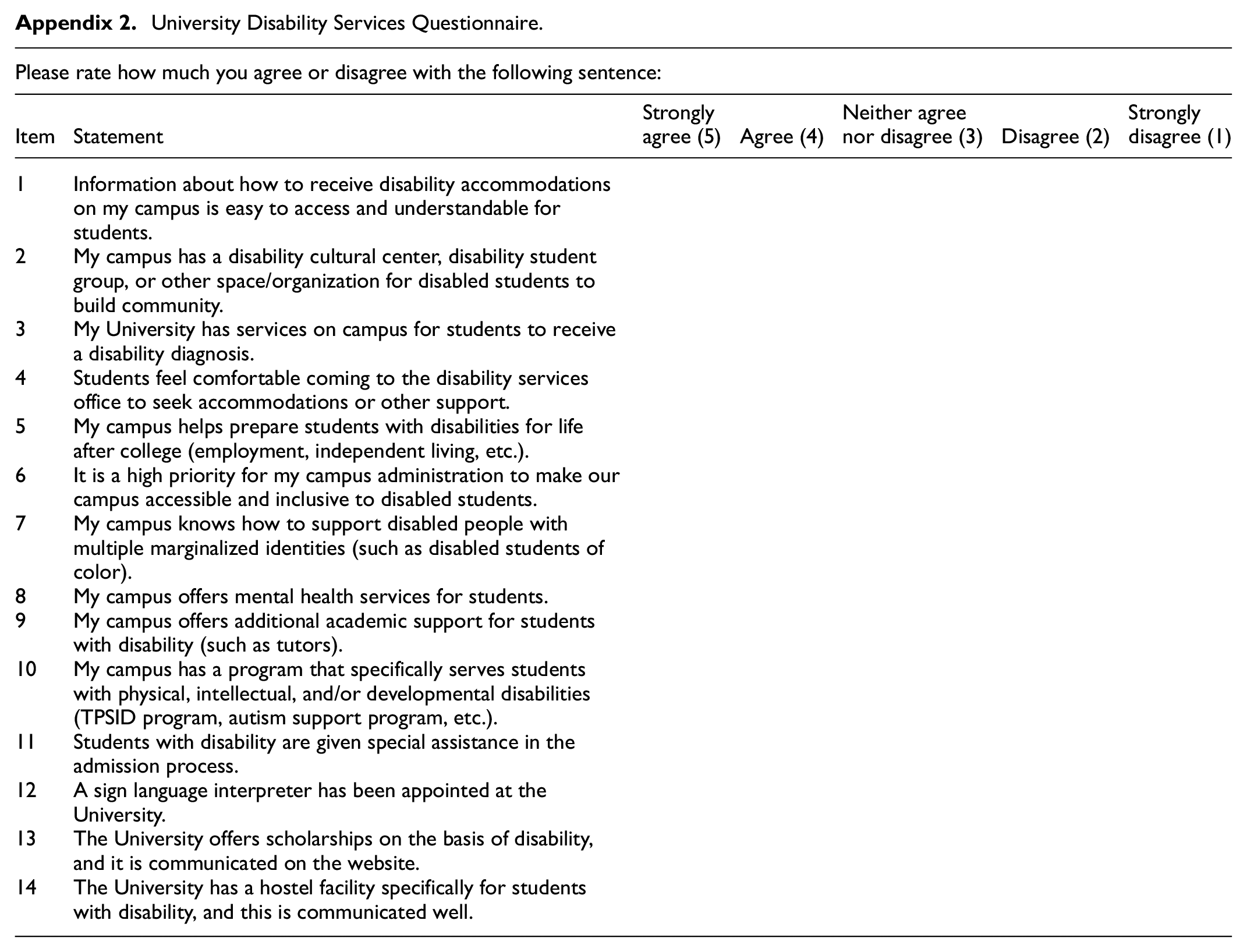
| Please rate how much you agree or disagree with the following sentence: | ||||||
|---|---|---|---|---|---|---|
| Item | Statement | Strongly agree (5) | Agree (4) | Neither agree nor disagree (3) | Disagree (2) | Strongly disagree (1) |
| 1 | Information about how to receive disability accommodations on my campus is easy to access and understandable for students. | |||||
| 2 | My campus has a disability cultural center, disability student group, or other space/organization for disabled students to build community. | |||||
| 3 | My University has services on campus for students to receive a disability diagnosis. | |||||
| 4 | Students feel comfortable coming to the disability services office to seek accommodations or other support. | |||||
| 5 | My campus helps prepare students with disabilities for life after college (employment, independent living, etc.). | |||||
| 6 | It is a high priority for my campus administration to make our campus accessible and inclusive to disabled students. | |||||
| 7 | My campus knows how to support disabled people with multiple marginalized identities (such as disabled students of color). | |||||
| 8 | My campus offers mental health services for students. | |||||
| 9 | My campus offers additional academic support for students with disability (such as tutors). | |||||
| 10 | My campus has a program that specifically serves students with physical, intellectual, and/or developmental disabilities (TPSID program, autism support program, etc.). | |||||
| 11 | Students with disability are given special assistance in the admission process. | |||||
| 12 | A sign language interpreter has been appointed at the University. | |||||
| 13 | The University offers scholarships on the basis of disability, and it is communicated on the website. | |||||
| 14 | The University has a hostel facility specifically for students with disability, and this is communicated well. | |||||

Ethical Considerations
This study was approved 3 April 2024 by Bioethics Committee of Scientific and Medical Research, University of Jeddah, protocol #UJ-REC-235.
Funding
The authors disclosed receipt of the following financial support for the research, authorship, and/or publication of this article: This work was funded by the University of Jeddah, Jeddah, Saudi Arabia, under grant No. (UJ-20-104-DR). Therefore, the authors thank the University of Jeddah for its technical and financial support.
Declaration of Conflicting Interests
The authors declared no potential conflicts of interest with respect to the research, authorship, and/or publication of this article.
Data Availability Statement
Data were collected 15 May to 4 June 2024, and are available from the senior author, L.G.A., upon reasonable request.