




Abstract
Postsecondary transition planning and programing is a fundamental process that allows students with disabilities (SWDs) to engage in adult roles such as higher education, employment, and independent living successfully. Despite the importance of the role of teachers regarding the effective implementation of transition practices and principles, teachers’ transition attitudes in Botswana are not clearly understood. Therefore, the purpose of this study was to explore teachers’ attitudes concerning the effective implementation of transition practices and principles to SWDs in Botswana secondary and vocational schools. The study further examined the differences between teachers on their attitudes toward delivery of transition services for SWDs based on demographic variables of gender, age, education qualification, teaching experience, school type, current position in school, and school region. A quantitative research approach entailing the use of a paper survey to collect data was adopted in this study. A total of 1,186 teachers participated in this study and mean scores were calculated to determine teachers’ transition attitudes. Moreover, t tests and one-way ANOVA tests were conducted to determine teachers’ attitude differences based on demographic variables. The findings of this study showed that generally teachers had somewhat positive attitudes toward transition practices and principles for SWDs. Furthermore, significant differences were noted on teachers’ attitudes based on all demographic variables except gender. The results indicate the importance of positive transition attitudes as well as the need to develop a national transition framework to guide and improve the transition process in Botswana.
Introduction
The main focus of education programs for the youth, despite living with a disability or not, is to make it a point that they are well-prepared and fully-fledged to assume adulthood and engage in full community participation. However, educators, researchers, and practitioners have continually realized the difficulties associated with attaining appropriate post-school outcomes for youth with disabilities in comparison to their peers without disabilities regardless of several attempts to bridge this gap (Cobb et al., 2013; Test et al., 2009; Xu et al., 2014). Thus, students with disabilities (SWDs) have been found to have a lower likelihood to live independently and participate in postsecondary education and employment than their peers without disabilities. For example, Newman et al. (2011) found that 60% of youths with disabilities in the United States of America (USA) were able to engage in and complete at least one postsecondary course within 8 years of completing high school education, whereas 67% of same-age peers without disabilities attained the same results. Moreover, within 8 years of high school completion, SWDs participated in employment more than their peers without disabilities, despite statistically significant differences noticed in students with more severe disabilities (Newman et al., 2011). Likewise, results from a national survey carried out in Botswana in 2015/2016 showed that there were about 2.7% of individuals with disabilities out of a population of about 2.1 million (Statistics Botswana, 2018). The survey recorded the proportion of employed individuals with disabilities as 34.9% in comparison to 82.5% of employed economically active individuals aged at least 18 years. Youths with disabilities who graduated from higher education institutions were found to have the lowest engagement rate in employment (5.2%) while employment participation rates of those who completed primary, junior secondary, and senior secondary education were noted as 31.1%, 27.0%, and 5.5% respectively. Furthermore, only 0.4% of individuals with disabilities were able to complete higher education while 35.5% never attended school, 33.0% completed primary school, 12.4% completed junior secondary school, and 4.0% completed senior secondary school.
Transition planning for SWDs is a complex matter that has not only paused challenges to developed countries such as the USA, but also to developing countries like Botswana where it has not been adequately researched. As a result, there is a shortage of in-depth and comprehensive transition programs which has somewhat led to minimal postsecondary school and employment participation estimates for youth with disabilities in Botswana. Transition programing and planning in many developing countries is bothersome due to the fact that SWDs continually drop out of school and fail, they are housed by their parents nearly their entire lives, and they have challenges concerning getting employed despite being qualified (Dogbe, 2015). As a developing country, numerous factors have been attributed to the negative school experiences and poor academic and post-school outcomes for youth with disabilities in Botswana. These factors include limited numbers of highly qualified teachers, compacted curriculum courses and content, lack of support materials, poor assessment strategies and procedures, inappropriate student placements, insufficient individualized planning attempts, limited collaborative efforts between schools and communities, unsatisfactory collaborative work between schools and parents, and inadequate collaborative efforts and coordination within and between the Ministry of Education structures (Dart, 2007; Dart et al., 2002; Kisanji, 2003).
Policy and Practice of Special Education in Botswana
In Botswana, a formal approach to special education started in 1969, following the foundation of the first resource center for blind students in Mochudi by the Dutch Reformed Church (Abosi, 2000). As a result of this event, other missionary organizations also founded institutions for individuals with diverse disabilities in several regions of Botswana. For example, the Lutheran Church started a learning institution for individuals with hearing impairments and in 1971 the Camphill Community set up a residential school that addressed the needs of individuals with mental and physical disabilities. In its recognition of the presence of individuals with disabilities, the Government of Botswana formulated national policies geared toward supporting their unique needs. A major shift concerning addressing the educational needs of SWDs was the development and approval of the Revised National Education Policy (RNPE) by the National Assembly in 1994. This policy sets out the government’s intention and commitment to provide education to all individuals including those with disabilities. The RNPE clearly stipulates the importance of educating and training all people beginning from childhood to adulthood, as well as the need to provide them with relevant, equitable, and quality education. As one of its significant goals, the policy calls for effective preparation of all students for life, citizenship, and work. Although the government emphasizes the need for developing stronger links between education and employment, the policy fails to provide explicit guidelines on what should take place in preparing SWDs for adulthood and the employment arena.
In 1984, the Ministry of Education established a special education unit that was later upgraded to a division in 1994, and this marked a critical step regarding coordination of special education services for SWDs (Abosi, 2000). In its continued effort of showing concern in the welfare and education of SWDs, the Government of Botswana established and supported special schools and resource centers, as well as the start of a special education program at the University of Botswana meant to train teachers to support the educational needs of learners with disabilities. Today, the Department of Special Support Services is responsible for formulating policies and strategies that aid with implementation of special education services as well as ensuring that accessibility barriers to a high-quality education and training are removed through delivery of comprehensive special education programs and services (Ministry of Basic Education, 2021). Within the Department of Special Support Services, there is a division known as the Central Resource Center tasked to conduct assessments for determining students’ eligibility for special education. Based on assessment findings, students’ placement options may include special schools, special units, stimulation centers, vocational schools, or regular schools. Despite the presence of various disabilities in Botswana, students who are provided with special education services in schools are primarily those with sensory impairments (hearing and visual), learning disabilities, intellectual disabilities, and physical disabilities.
Based on professional literature and education reports, the Government of Botswana’s original intent on education was integration, and with time the focus changed to inclusive education (Brandon, 2006; Chhabra et al., 2010; Mangope, 2002). The Government of Botswana then developed the Inclusive Education Policy in 2011, with critical goals that encompass advocating for all learners to complete basic education and progress, where appropriate, to senior secondary school and/or postsecondary education or to vocational education; calling for teachers to develop requisite skills and have resources that facilitate effective learning of students with distinct abilities; and emphasizing the need for collaboration between the government, Non-Governmental Organizations (NGOs), parastatals, and private sector to establish and support an inclusive policy structure (Government of Botswana, 2011). Along the same vein, the Tertiary Education Policy was developed to increase the gross enrollment ratio of students to higher education by more than double in 2026 (Government of Botswana, 2008). Achievement of the aforementioned goals entails government’s commitment to ascertaining that notable strides are reached to modify students’ education, introduction of appropriate accommodations, enhancement of skills acquisition and vocational training, as well as provision of appropriate teaching/learning materials and resources.
Unfortunately, there is no policy or law that mandates the development of an Individualized Education Plan (IEP) for a learner with disability in Botswana. While the RNPE promotes individualized planning for SWDs, there are no guidelines on how it should be developed and implemented. Nonetheless, special education teachers in schools work with other professionals and students’ parents to develop IEPs based on international practices as learnt from the University of Botswana and colleges of education. IEP components include a student’s present level of performance, annual goals, short-term objectives, progress monitoring and reporting, special education services, related services, supplementary aids and services, as well as the extent to which a student participates alongside those without disabilities. Moreover, the transition component is required for inclusion for SWDs beginning from the age of 16 indicating how a student will be supported to transition successfully to post-school settings. Even so, due to a lack of a legal mandate to guide the development and implementation process of an IEP, it is difficult to hold teachers accountable for non-compliance with international standards. Consequently, numerous schools do not have structured and comprehensive transition programs. Ookeditse (2018) noted that while transition activities took place in some schools in Botswana, teachers were not fully aware and knowledgeable of transition principles and practices.
Despite commendable progress emanating from the inception of national policies regarding educational access, equity, and enhanced education quality in Botswana, little has been attained in transition programing and practices for SWDs. The paucity of research on postsecondary transition principles and practices for SWDs attests to the need for diverting attention to conduct research in this area. Implementation of national policies (especially the Inclusive Education Policy) has been a challenge. Implementation challenges include most teachers favoring the inclusion of learners with mild disabilities over those with severe to profound disabilities, limited preparation of special education teachers, inadequate resources, and large teacher to student ratio in each class (Mukhopadhyay et al., 2012). Again, notwithstanding the numerous efforts of policy makers in Botswana to improve the lives of individuals with disabilities, the lack of a legal transition framework means a lack of clear guidelines that are legally binding regarding the transition of SWDs.
Conceptual Framework
Halpern (1994) defined postsecondary transition for youths with disabilities as “a change in status from behaving primarily as a student to assuming emergent adult roles in the community” (p. 117). Several studies have examined best transition practices for youths with disabilities (e.g., Greene, 2009; Landmark et al., 2010; Thoma et al., 2002; Young, 2007). Although several transition models for people with disabilities have been proposed, Kohler’s Taxonomy for Transition Programming (Kohler, 1996) has been examined and found to be a well-researched and comprehensive transition model (Beamish et al., 2012; Kohler & Field, 2003; Test et al., 2009). Again, despite several researchers accepting Kohler’s transition model as a framework of quality transition practices and even adopting the model as a research instrument, many of its components have not been tested in the context of Botswana to determine the extent to which they are utilized and applicable concerning the transition of SWDs. Kohler’s transition model encompasses numerous variables such as program structure, student-focused planning, student development, family involvement, and interagency collaboration. Teachers’ roles are a critical aspect of this model whereby teachers are expected to play a key role as facilitators of transition activities in a collaborative framework with families, students, the community, and external agencies.
Findings from transition research conducted over the past three decades have shown that post-school outcomes of adolescents with disabilities are improved when educators, students, families, the community, and external agencies work together to implement a transition-focused education (Kohler et al., 2016; Morningstar & Mazzotti, 2014). Student-focused planning is key in the transition planning process and it involves development of a student’s individualized education plan (IEP) and the student’s participation in its development as appropriate. Student-focused planning activities include development of a student’s goals and objectives guided by appropriate assessment information with the aim of informing planning, level of student involvement, decision-making, and student’s progress monitoring (Kohler & Field, 2003). Student-focused planning activities are critical in developing and reinforcing students’ self-determination skills as students are given adequate opportunities to practice and apply these skills. During elementary and initial secondary education years, teachers are expected to provide guidance and support to transition-age youths, while also hoping that students become more proficient as they progress through high school (Kohler & Rusch, 1996; Morningstar et al., 2010). However, if the experiences and perceptions of teachers who coordinate transition supports and services for secondary SWDs are not known, it becomes difficult to make necessary adjustments to improve students’ post-school outcomes (Lubbers et al., 2008). This makes it critically important to consider Kohler’s Taxonomy for Transition Programming as a conceptual model for this study as all of its essential components are highly dependent on teachers’ active engagement.
Teachers’ Transition Beliefs
The planning and preparation of SWDs to participate fully in higher education employment, community engagement, and independent living are usually left to the teachers. Regrettably, inadequate research has been conducted on teachers’ perceptions concerning students’ preparation to assume adult roles. Teachers’ experiences and views need to be clearly understood pertaining to supporting and providing postsecondary transition services to SWDs, so that better transition programs could be developed and implemented resulting in improved post-school outcomes (Bindels-de Heus et al., 2013; Canha et al., 2013; Carter et al., 2008; Davies & Beamish, 2009; Oertle et al., 2013). A major concern is that most of the transition research for youths with disabilities has pinpointed developed countries, thereby paying little attention to developing countries like Botswana. Literature has emphasized the need for special educators to be at the forefront in the transition process of SWDs. However, Morningstar and Kleinhammer-Tramill (2005) noted that special education teachers were not fully prepared to provide transition services to SWDs as required by the Individuals with Disabilities Education Act (IDEA) of 2004. Benitez et al. (2009) conducted a study consisting of more than 500 secondary school special education teachers in 31 states where they investigated teachers’ perceptions regarding the extent to which they were proficient in providing transition support and services. In particular, teachers shared their beliefs concerning the extent to which they were prepared to plan and provide transition services, the extent to which they were satisfied with training, and how often they implemented transition activities. The findings of the study revealed positive relationships between level of teacher preparedness, teacher training, and frequency of participation in transition planning and delivery of services. These results indicated that teachers’ views of self-efficacy in transition planning constitute determinants relating to the special education teacher’s competence to provide transition services.
Moreover, positive views and beliefs about postsecondary transition are critical for successful implementation of transition programs by all transition team members (Dogbe, 2015; Ookeditse, 2018; Xu et al., 2014). Consequently, not only should special education teachers have positive views to effectively coordinate transition planning, but all team members as well. Unfortunately, evidence suggests that some secondary school educators believe that they are inadequately trained and equipped with appropriate knowledge and skills to support transition for SWDs effectively (Li et al., 2009; Lubbers et al., 2008; Wolfe et al., 1998). While some studies revealed that teachers had a basic understanding of the transition planning process, the same teachers felt they were insufficiently prepared to plan and deliver transition services to SWDs (Blanchett, 2001; Knott & Asselin, 1999). Also, school staff has shown diverse views concerning the appropriateness of students’ school programs in supporting them to attain their transition goals. For example, school staff reported that 39% and 43% of students’ school programs were “very well suited” and “fairly well suited” respectively for supporting students to realize their transition goals (Cameto et al., 2004). Additionally, the researchers noted that school staff indicated that 16% and 2% of SWDs school programs were “somewhat suitable” and “not at all suitable” respectively for preparing them to reach their transition goals. Such findings indicated the degree to which more stringent measures needed to be taken to make it a point that students’ educational programs were well-suited to meet their transition goals. Although 39% of school staff reported SWDs educational programs to be “very well suited” for attaining transition goals (Cameto et al., 2004), a pressing question relates to what measures schools did not put in place to increase the suitability of students’ programs to assist them to achieve their transition goals.
Teachers’ Transition Knowledge
It is imperative to take heed that successful implementation of transition services and supports is highly dependent on teachers’ clear understanding of transition practices and principles. Teachers’ knowledge and understanding of postsecondary transition depends on their ability to communicate with one another as special educators as well as with students, parents/guardians, families, and other professionals and relevant stakeholders outside the discipline (Clark, 2007; Rowe et al., 2015). Research has noted the significance of teachers’ transition knowledge for the effective preparation of SWDs to have successful post-school outcomes (Morningstar & Mazzotti, 2014; Test et al., 2009). Special education teachers are required to plan, coordinate, and deliver transition supports and services to SWDs (U.S. Department of Education, 2011). However, research has reported limited knowledge among special educators in secondary schools, thereby negatively affecting the effective implementation of transition programs (Benitez et al., 2009; Knott & Asselin, 1999). Consequently, limited transition knowledge and poor implementation skills may be heedlessly leading to the undesirable post-school outcomes of SWDs (Morningstar & Mazzotti, 2014).
Poor post-school outcomes for SWDs have been attributed to reluctance by some special education teachers to provide appropriate transition services (Curry & Jones, 2014). Some of the reasons regarding special education teachers’ reluctance to provide transition supports and services to SWDs include lack of particular kinds of certification, inadequate transition planning training, and the perception of teachers having insufficient overall knowledge necessary to deliver transition services (Held et al., 2004; Lee-Tarver, 2004). A critical research area in transition planning relates to transition knowledge held by professionals, especially teachers (Lubbers et al., 2008). Literature has pointed out the need to train teachers with particular emphasis on managing transition plans. Hasbrouck et al. (1999) argued that it is essential to provide teachers with adequate support and guidance to improve their delivery of instructions to meet the needs of SWDs. The researchers further concluded that teachers’ failure to manage inclusive education also resulted in some teachers assuming the role of consulting teachers, thus providing training to general education teachers in assessment and implementation approaches for SWDs. One of the serious concerns among researchers is whether the majority of teachers engaged in the delivery of transition services for SWDs have adequate knowledge to implement best transition practices. Teachers’ lack of training in the transition process may also be contributing to the self-efficacy of special educators in planning and coordinating transition activities. It is necessary to enroll in the teaching profession with full certification and not via a substitute path which may result in special education teachers believing that they are insufficiently equipped to deliver transition services effectively (Morningstar & Clark, 2003). Special education teachers should have fundamental transition skills, competencies, and knowledge of content that exceed the understanding, capacity, and knowledge the majority of secondary special educators undergo during undergraduate training programs so as to implement the transition process successfully (Morningstar & Clark, 2003; Wehmeyer, 2003).
Purpose of Study
The purpose of this study was to explore teachers’ attitudes concerning the effective implementation of transition practices and principles to SWDs in Botswana secondary and vocational schools. This study addressed the following research questions: (a) What are the attitudes of teachers toward successful delivery of transition services for SWDs in Botswana? and (b) What are the differences between teachers on their attitudes toward delivery of transition services for SWDs based on demographic variables of gender, age, education qualification, teaching experience, school type, current position in school, and school region?
Method
Research Approach
A quantitative research design was used to examine differences in teachers’ beliefs and knowledge about transition practices. Creswell (2015) noted that a quantitative research design represents post-positivist philosophical postulations. For example, determinism suggests that it is necessary to investigate how variables relate with one another to help respond to questions and hypotheses using surveys and experiments.
Research Settings
The research settings for this study were Government Funded junior secondary schools (JSS), senior secondary schools (SSS), and vocational schools (VS) in two neighboring school regions in Botswana namely Kgatleng and South-East. The school regions were selected due to fact they represent different levels of special education service provisions in rural, semi-urban, and urban areas in Botswana. Additionally, the reason for selecting Kgatleng region was due to the fact that it is the first region in Botswana where special education started and has a longstanding history of supporting the educational needs of SWDs, especially those with visual impairments.
Of all the 11 secondary schools in Kgatleng (i.e., 10 JSS, 1 SSS) and 2 VS selected to participate, 1 JSS declined participation. Another selected region was South-East as the capital city Gaborone lies in the center of the region, hence, a higher likelihood of the availability of special education teachers. There were 27 secondary schools (i.e., 21 JSS, 6 SSS) and 4 VS in the South-East regions. Despite the expectation for all the 27 secondary schools and 5 VS to participate in the study, only 15 JSS, 3 SSS, and all 4 VS agreed to participate. Therefore, a total of 24 JSS, 4 SSS, and 5 VS were included in the sample.
Research Design
A cross-sectional survey research method was used to gather teachers’ transition beliefs and knowledge. A survey design is key to providing a quantitative or numeric description of changes, attitudes, or views of a particular population by carrying out research on the population sample. Thus, a survey design is crucial in making generalizations from a sample to a population, in order to make conclusions about certain characteristics, behaviors, or perceptions of the population (Creswell, 2012). Rindfleisch et al. (2007) stated that a cross-sectional survey gathers data from a selected population at one point in time in a comparably short time span. Paper surveys were used to collect data for this study.
Participants
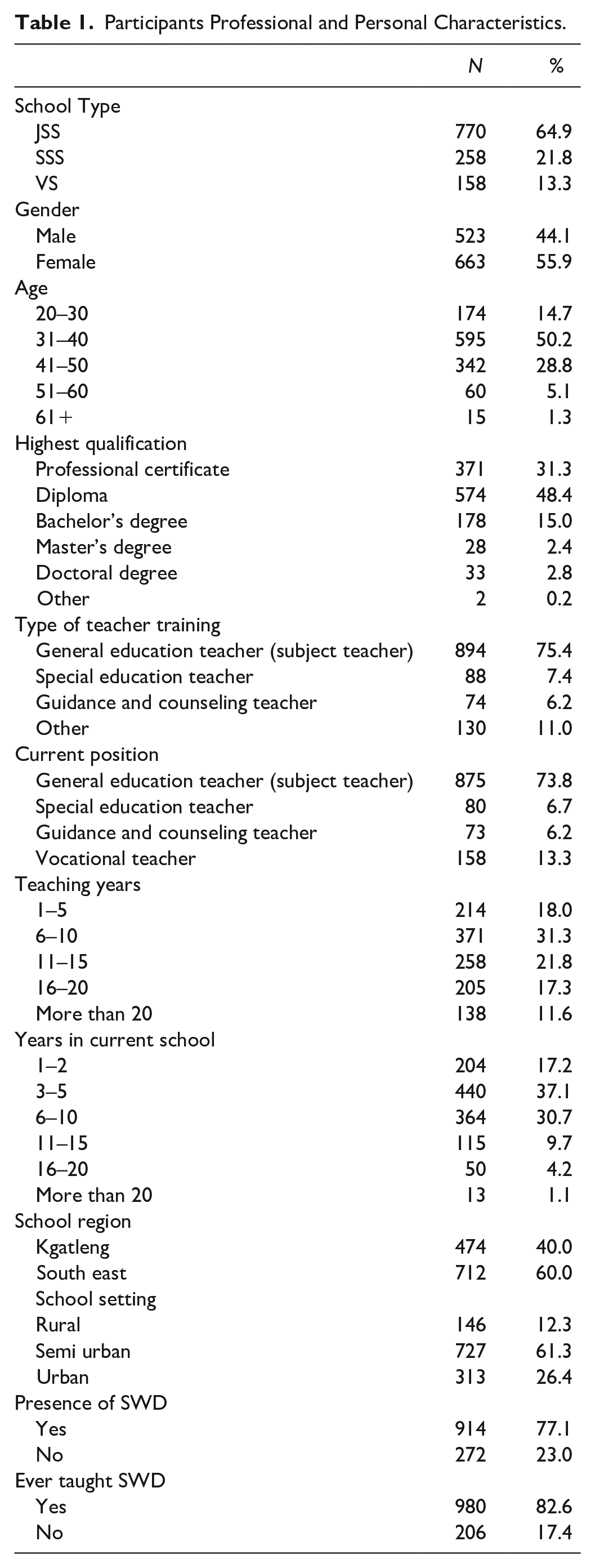
The participants consisted of general education teachers, special education teachers, and guidance and counseling teachers. The sample of this study consisted of all teachers (N = 1,760) teaching at three levels of education (JSS, SSS, VS). However, only 1,186 teachers completed the survey, resulting in a return rate of 67% (see Table 1).
Participants Professional and Personal Characteristics.
Instrument
A 27 items survey instrument was specially designed by the first author of this research based on review of contemporary literature in the area of transition and disability (Dogbe, 2015). The surveys consisted of a 4-point Likert scale (i.e., 1 = Strongly Disagree, 2 = Disagree, 3 = Agree, 4 = Strongly Agree) and the integral components of the instrument included participants’ demographic characteristics and participants’ knowledge and beliefs toward transitions of SWDs. The instrument was given to seven experts in special education to validate and it was then fine-tuned based on their feedback. Pilot testing was done on a convenient sample of 30 participants and the reliability coefficient (Cronbach alpha) was calculated. The Cronbach reliability coefficient of the Likert Scale for the pilot study was calculated and it was found to be .91. None of the pilot testing data were used in this study.
Data Collection Procedure
The researchers sought ethical approval from two Institutional Review Boards (the researchers’ place of study and place of work). In addition, permissions were obtained from the Ministry of Basic Education, Ministry of Tertiary Education, Research, Science and Technology, Ministry of Employment, Labour Productivity, and Skills Development, regional directors of Kgatleng and South East, and school headmasters and principals before collecting data. Letters were mailed to the headmasters and principals of the selected schools stating the study purpose and inviting teachers to participate in the study. During data collection, participants were given informed consent forms to read, opt to agree or decline participating in the survey, sign and date the consent form. The survey completion time was 20 to 25 minutes and the full administration period took about 3 months. A total of 1,760 questionnaires were administered and 1,186 were received.
Data Analysis
The survey items and responses were coded and analyzed using SPSS Version 25. The descriptive analysis of data for the independent and dependent variables indicated the frequencies, percentages, means, and standard deviations for these variables. Specifically, demographic variables relating to participants’ gender, age, highest education qualification, teaching experience, school region, and position were considered. Both independent t test and One-way Analysis of Variance (ANOVA) were used to analyze the influence of independent variables on the dependent variables.
Findings
A total of 1,186 teachers responded to the survey. Table 1 indicates that teachers from JSS represented 65% of the sample, and the majority of the respondents (63%) were between the ages of 31 and 40 years. A small number (17%) of the respondents indicated that they never taught a student with disability and only 23% of teachers had SWDs in their class. Of the total dataset, the male to female ratio was 9:11 (male = 523, female = 663), with the majority (n = 55%) aged between 30 and 35 years. A significant number of participants had already completed a diploma (n = 574, 48.4%) and 15% (n = 72) held an undergraduate degree. Participants were asked to indicate if they had SWDs in their class and had taught a student with disability. A large number of respondents (77%) indicated having SWDs in their class. Regarding previous experience of teaching SWDs, the vast majority (96%) had taught such students.
Attitude Toward Transition for SWDs
The objective of this research was to find secondary school teachers’ as well as vocational teachers’ perceptions toward transition. The mean score per item (see Table 2) as well as mean score of the scale were calculated. Higher means indicated favorable attitudes toward transition. The mean item score of the scale was found to be 3.32 suggesting that participants generally held somewhat positive attitudes toward the transition of SWDs. It is important to note that teachers had positive attitudes toward transitions slightly on the higher side of the scale. A t test and one-way analyses of variance (ANOVA) were computed to determine if significant differences were present in participants’ items mean scores on total scale.
Ascending Mean Scores per Item on Teachers’ Perceptions Toward Transition Scale.

A t test was run for gender, school region, presence of SWDs, and on whether teachers had ever taught SWDs. It was found that except gender the other three variables yielded statistically significant differences. For example, the mean and standard deviation of teachers who had SWDs were (M = 3.35, SD = 0.54) whereas those who did not have SWDs were (M = 3.06, SD = 0.58). Comparison of mean scores of teachers’ attitude toward transition of these two groups were found to be statistically significant, (t = 7.634, df = 1,184, and p < .05). Similarly, the means and standard deviations of having experience or none in teaching SWDs were calculated. The mean and standard deviation of those who were experienced in teaching SWDs were found to be (M = 3.34, SD = 0.54) whereas those who did not have experience were (M = 3.03, SD = 9.12). An independent t test was run, and it was found to be statistically significant (t = 7.11, df = 1,184, and p < .05). This means that, having SWDs as well as experience in teaching such students led to favorable attitudes. In addition, teachers’ opinions from two school regions were also sought. It was found that teachers from Kgatleng region had a slightly higher mean item score (M = 3.39, SD = 0.55) than South-East region teachers (M = 3.22, SD = 0.56), and the differences were found to be significant (t = 5.15, df = 1,184, p < .001). A series of ANOVA tests were computed to determine if significant differences in participants’ mean attitude scores existed in relation to the demographic variables. Only two variables from the rest of the independent variables were found to relate significantly to participants’ scores to the total scale.
One-way ANOVA was used to analyze variables such as school settings, age range, education qualification, type of teacher training attained, current position, years of teaching experience, and school settings. Most of these variables yielded a significant difference between the means on the transition scores. Table 3 displays the mean scores, standard deviations, F-statistics, p values, and post-hoc Tukey level of interaction. One-way ANOVA was run for seven independent variables. Most of the variables were found to be significantly different. A post-hoc Tukey analysis was done to find the level of interactions that were statistically significant.
Results of One-Way Analysis of Variance Along With Post Hoc Results.
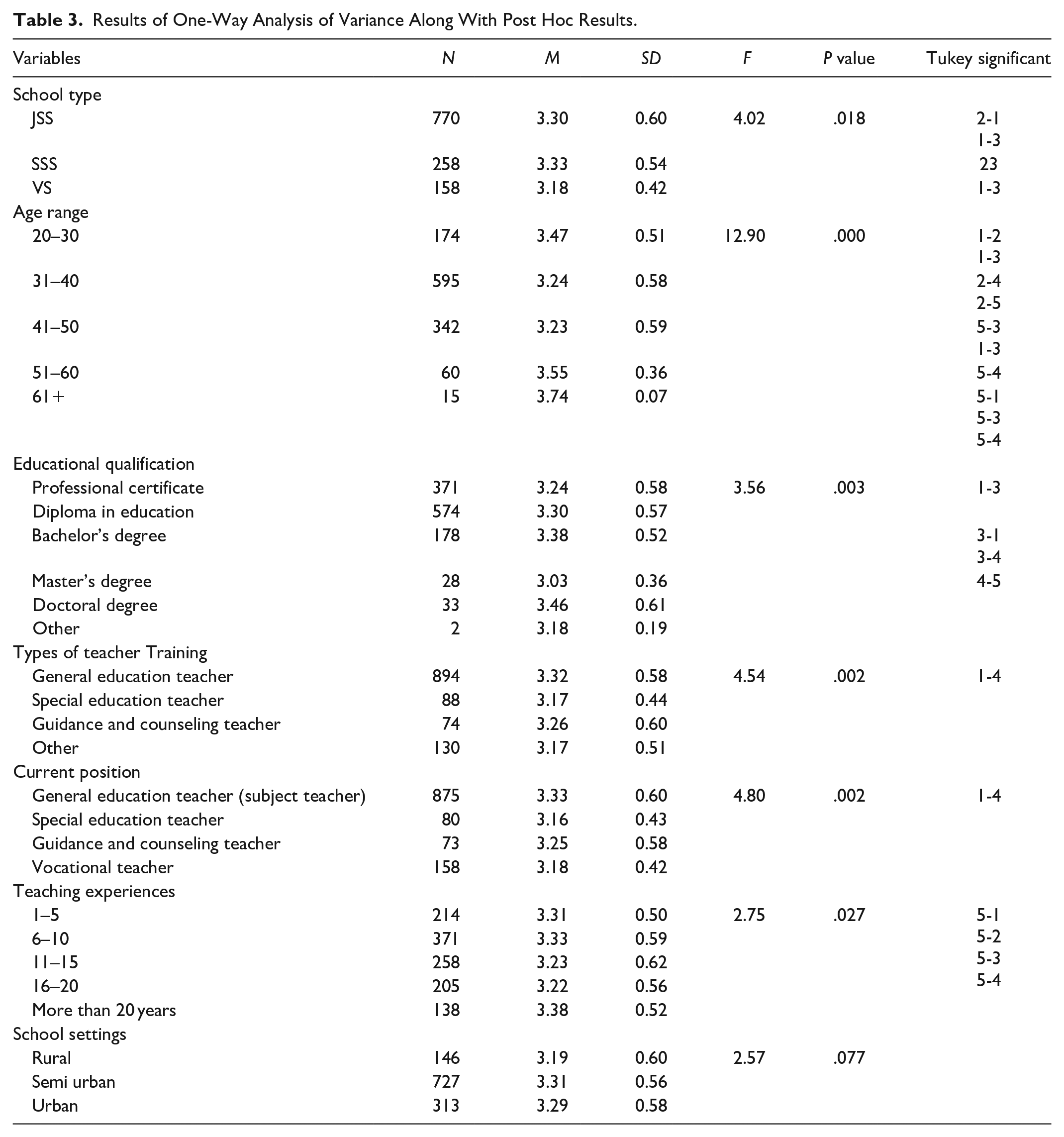
The findings from the one-way ANOVA showed that there were statistically significant differences among teachers by school type regarding their attitudes toward transition for SWDs (F = 4.02, df = 2, p < .05). A Tukey post-hoc test revealed that SSS teachers had more positive attitudes toward transition than JSS and VS teachers, with VS teachers exhibiting the lowest positive transition attitudes. Regarding participants’ age range, statistically significant differences were found between teachers on their attitudes toward transition (F = 12.90, df = 4, p < .001). A Tukey follow-up test showed that participants aged more than 61 years had more positive transition attitudes for SWDs than those aged below 60 years. In addition, participants were found to differ significantly from one another on transition attitudes based on their educational qualification (F = 3.56, df = 5, p < .01). Based on Tukey post-hoc, teachers who held a professional certificate had less positive attitude toward transition than those with bachelor’s degree. Again, teachers with a doctoral degree held more positive views toward transition than those with a master’s degree.
It is also worth noting that participants exhibited statistically significant differences in their attitudes toward transition for SWDs based on the type of teacher-training they attained (F = 4.54, df = 3, p < .05). The only difference noted from a Tukey follow-up was that teachers trained as general education teachers expressed more positive attitudes toward transition than those trained in other areas (excluding special education and counseling). Moreover, there were significant differences observed on participants’ transition views based on their current position in school (F = 4.80, df = 3, p < .01). For example, general education teachers held more positive transition attitudes than vocational teachers. Regarding teaching experience, statistically significant differences were noted among participants’ transition attitudes for SWDs (F = 2.75, df = 3, p < .05). Participants with more than 20 years of experience had significantly better attitude toward transition. However, no statistically significant differences were found regarding participants attitudes toward transition by school setting (F = 2.57, df = 2, p > .05).
Discussion
The objective of this research was to explore attitudes of teachers toward successful delivery of transition services for SWDs in Botswana. The findings from teachers’ perceptions toward postsecondary transition planning and programing for SWDs revealed somewhat positive attitudes. The results indicate that secondary and vocational teachers were favorable toward delivery of transition services and were generally supportive of transition principles and practices. A high percentage of participants felt that appropriate provision of transitional services was important. Teachers held positive views concerning all aspects of Kohler’s Taxonomy for Transition Programming (i.e., student-focused planning, program structure, student development, family involvement, interagency collaboration). For example, teachers agreed that it was necessary for them to develop collaborative relationships with students, families, the community, and external agencies if their students were to enjoy successful transition as noted by Kohler et al. (2016). In addition, teachers’ mean scores suggest that they held in high regard the view that transition planning required developing a written plan specific to address each individual’s unique needs as reflected by specific and attainable goals and objectives as well as to equip students with requisite knowledge and skills corresponding to their strengths, abilities, and preferences. These are interesting results as all of Kohler (1996) transition components have been identified from literature as predictors of positive post-school outcomes (Morningstar & Mazzotti, 2014; Rowe et al., 2015).
The results of this study are consistent with the findings of Test et al. (2009) who found that secondary teachers in the United States agreed with the benefits of successful delivery of transition services for SWDs. Teachers in this study reported that postsecondary education and employment were key goals of the transition process and that it was necessary to conduct regular assessments and monitoring of students’ academic and functional goals to ensure that they attained these crucial outcomes. Although there are no comprehensive transition programs and service delivery methods in Botswana, the findings of this research are promising because teachers showed that they had some commendable knowledge regarding the transition process. Research on transition has noted the need for teachers, who are identified as the cornerstone of transition to possess adequate knowledge relating to pedagogy, content, and learners in order to deliver transition services effectively (Eggen & Kauchak, 2006).
This study also sought to find out if demographic variables influenced participants’ transition attitudes. Thus, a large number of demographic variables (i.e., school region, educational qualification, teaching experience, presence of students with a disability in class) were found to be significant. For example, teachers from Kgatleng region were found to hold more positive views about transition for SWDs than those from South-East region. A possible explanation for this variation could be due to the fact that Kgatleng region has a long-standing history of providing special education services to SWDs, especially regarding learners with visual impairment. Thus, schools from Kgatleng may have adopted better transition service delivery strategies over the years despite lack of a national transition framework. Again, teachers in vocational service providers had significantly lower attitudes toward transition compared to other two groups of teachers. This means professional development programs may need to be organized for teachers in the vocational training centers. It is also not surprising that SSS teachers held more positive transition attitudes than JSS and VS teachers. Despite the importance of all transition stages, the transition from SSS (high school equivalent) participation in adulthood is a particularly crucial time in a person’s life. Several researchers have corroborated the importance of high school transition and argued that this was an unpredictable phase that youths encountered immediately following exiting high school as they prepared to assume adult roles in the society, hence requiring more attentive focus (e.g., Halpern, 1994; Madaus, 2005; Morningstar & Mazzotti, 2014).
Similarly, age-range of the participants also influenced their attitude toward transition. Thus, as the age of the participants increased, they showed more favorable attitudes toward transition. Interestingly, participants who held bachelor’s and doctoral degrees were found to be associated with positive opinions toward transition, although there was no clear liner relationship obtained on this variable. Having positive attitudes for the participants with bachelors’ degree could be attributed to the training that they had acquired during their formal training in education, resulting in significantly higher mean scores toward transition. It is important to highlight that in Botswana, guidance and counseling teachers particularly deal with the issues related to career counseling on a day-to-day basis in junior secondary and senior secondary schools, and a large number of participants with bachelor’s degree underwent basic training in special education or guidance and counseling. This is worth emphasizing since literature has noted the importance of counselors and special educators in the transition process. For example, training in special education is critical for equipping teachers with requisite knowledge and skills necessary to spearhead the transition process effectively (Clark, 2007; Rowe et al., 2015). Along the same vein, a key role of counselors has been identified as empowering SWDs for self-sufficiency and independence (Rubin & Roessler, 2008), which is a fundamental goal of transition.
The findings of this research suggest that teachers may belief the importance of appropriate transitional service delivery even though they may not have all the necessary knowledge and skills as these components are not a significant part of the teacher preparation programs in Botswana. It is worth noting that most educators in this study did not have any comprehensive background training focusing on transition for SWDs. The above findings of this study also coincide with previous research on issues surrounding training of teachers, in particular the importance of preparing teachers (Curry & Jones, 2014). Similarly, Lubbers et al. (2008) reported in their study that teachers indicated that providing transitional training was challenging due to large class sizes and students’ range of abilities.
Limitations
One of the limitations of this study was the presence of unequal group sizes of participants across most independent variables (e.g., age, gender, current position, education qualification, teaching experience). Thus, relatively large differences within distinct participants’ groups were evident and these unequal group sizes may have resulted in some general power loss, despite the large sample size therefore decreasing the generalizability of the findings to the population of SWDs in Botswana. Moreover, the use of purposeful and census sampling to choose respondents may have led to a less representative sample of the population of SWDs, thus calling for the use of random sampling in future research. Finally, only quantitative methods were used in this study. Gathering and use of qualitative data could have been key in providing plausible explanations for observations and trends noted in quantitative data. Klingner and Boardman (2011) stated the importance of using a mixed methods research design, arguing that it enhances the breadth and depth of the findings, consequently making it easier for researchers to defend their findings as well as for readers to have a better understanding of results. Hence, future research could also include collection of qualitative data to provide credible explanations to the findings. Both quantitative and qualitative data should also be gathered from SWDs and administrators who are in charge of schools to appreciate their transition views. Moreover, expansion of the current study to all school regions could increase the generalizability of results to the population of SWDs.
Conclusion
A starting point to improve teachers’ transition attitudes and to provide transition services effectively in Botswana is to formulate a national legal transition framework for SWDs. This framework will serve as a critical step that will allow for effective delivery of transition services, since clear guidelines and procedures are important in enhancing the provision of transition supports and services. Clear direction on the implementation of transition practices and principles is a prerequisite for students to reach successful post-school outcomes. This dream can only become a reality if the government of Botswana identifies addressing the needs of individuals with disabilities as a priority area in the National Transformation Strategy. Government efforts would be futile unless collaborative efforts with other key partners (e.g., the private sector, Non-Governmental Organizations (NGOs) for persons with disabilities, political, customary, and religious leaders, and parents or students’ families) become eminent so that persons with disabilities are given ample and equal opportunities to participate fully in the society. Moreover, teachers’ knowledge and competencies regarding the effective delivery of transition services for SWDs cannot be overemphasized, thus advocating for concerted efforts to introduce comprehensive transition courses in teacher training programs in higher education institutions as well as to introduce more professional development activities in secondary schools to equip teachers with what it takes to implement transition practices successfully.
Although the findings of this study suggest that teachers have positive attitudes toward transition for SWDs, these attitudes are meaningless unless they are paired with successful development and implementation of students’ transition plans. The fact that transition keeps on evolving makes it especially necessary for teachers to develop new ways of overcoming challenges they encounter in the pursuit of addressing the unique transition needs of SWDs. Taking into account the economic effects of the Corona Virus (COVID-19) in Botswana and the government’s continued efforts to eradicate the HIV/AIDS pandemic among others, diversion of more financial resources into special education may present serious challenges to the economy. However, change of attitudes toward persons with disabilities is one critical way to minimize discrimination and stigmatization, consequently leading to equalization of opportunities across the lifespan—a key area that the National Disability Coordinating Office could embark on more aggressively while soliciting additional resources from the private sector and other contributors to the economy.
Footnotes
Declaration of Conflicting Interests
The author(s) declared no potential conflicts of interest with respect to the research, authorship, and/or publication of this article.
Funding
The author(s) received no financial support for the research, authorship, and/or publication of this article.
