




Abstract
University mottos have been demonstrated to convey educational philosophies, but few studies have investigated the educational philosophies reflected by university mottos from countries along the “One Belt, One Road” (OBOR) route, with applying the analytical approaches like text mining and natural language processing (NLP). This present investigation constructed a database of university mottos from 1,535 universities in 61 countries along the OBOR route and applied NLP technology to explore the similarities and differences of educational philosophies among the universities along the OBOR route. Methods of NLP used in this article included text mining, cluster analysis, and Latent Dirichlet Allocation (LDA) topic model. The social network analysis (SNA) model was used to further analyze the interconnection and exchange of educational philosophies expressed through university mottos. Based on the five identified topic categories, we concluded that countries along the OBOR route have the same basic educational philosophy for higher education but have different emphases due to cultural differences, such as the different emphases on virtue education, collectivism, and individualism. Education for sustainability is another focus of higher education philosophy reflected by the topic categories of university mottos, which is consistent with the United Nations Sustainable Development Goals, for example, quality education. In addition to demonstrating the BRI impact on educational philosophies of countries along the OBOR route, this present investigation could also contribute to the growing body of knowledge about international cooperation and communication of higher education under the framework of BRI, for a globalized, shared and sustainable education in the post-COVID era.
Keywords
Introduction
China’s Belt and Road Initiative (BRI), also known as “One Belt, One Road” (OBOR), is one of China’s foreign policy and economic initiatives launched by the Chinese government in 2013. “The conception of the initiative ostensibly derives from the ancient ‘Silk Roads’ via which exchange of Chinese and European goods took place through Central Asia” (Garlick, 2019, p. 7). Lu, Rohr et al. (2018), in their research about the relationship between improving multimodal transport connectivity and promoting multilateral trade and economic growth under the impact of BRI, write:
The BRI is geared towards encouraging connectivity, economic flow, job opportunities, investment and consumption, cultural exchanges, and the spirit of regional cooperation between Asia, Europe and Africa by creating jointly built trade routes emulating the ancient Silk Road. (Lu, Rohr et al., 2018, p. vii)
In addition to the foci of regional connectivity and economic integration, international exchange and cooperation in higher education, which is another important strand of BRI, has also drawn researchers’, educators’ and policy makers’ attention in recent years. The Chinese Ministry of Education issued the “Education Action Plan for the Belt and Road” in July 2016, which is crucial to paving the way for China’s cooperation with OBOR countries in higher education. “Leading programs like the Silk Road Scholarship were launched as part of the support for the Belt and Road Initiative” (Ministry of Education, 2018). The BRI University Alliance, launched in 2015, has expanded from 47 universities in eight countries to 173 universities in 27 countries, forming a Belt and Road community of higher learning (Zhang, 2021). Gu and Teng (2020) argue that with both the challenges and opportunities in the post-COVID era, the collaborative work, and cross-cultural exchanges in the education sector with the member countries of the European Union (EU) and the developing countries along the OBOR route should be continuously strengthened. For instance, the BRI University Alliance has implemented educational initiatives, such as special scholarship programs and Chinese-foreign cooperatively run schools, to attract international students from OBOR counties to further their studies in Chinese universities and to enhance people-to-people and cultural exchange (Gu & Teng, 2020; Zhang, 2021). In the research into the impact of BRI on global higher education, Peters (2020) writes, “squeezed out of college places in their home countries and drawn by Chinese scholarships, students from nations along the route of Beijing’s massive infrastructure plan are pouring into China, reshaping regional education, and affecting global higher education…Chinese universities become ‘magnet institutions’ for BRI developing countries” (Peters, 2020, p. 589). Sacks (2021) also writes:
BRI is now a truly global endeavor: thirty-nine countries in sub-Saharan Africa have joined the initiative, as well as thirty-four in Europe and Central Asia, twenty-five in East Asia and the Pacific, eighteen in Latin America and the Caribbean, seventeen in the Middle East and North Africa, and six in South Asia. These 139 members of BRI, including China, account for 40 percent of global GDP. Sixty-three percent of the world’s population lives within the borders of BRI countries.
With the continuous advancement of BRI and China’s emphasis on achieving globalized, modernized, and world-class education, “Chinese universities are getting more involved in international activities and academic exchanges” (Qiao & Ma, 2019, p. 469). As the Chinese Ministry of Education (2018) puts it, “China is on the brink of a fresh era and entering a new stage of development…China aims to establish a world-class modern education system with Chinese characteristics and make the Chinese Dream of national rejuvenation a reality.” Under the impact of BRI, Chinese universities’ core values, cultures, and philosophies in terms of education have been able to interact and merge with those of BRI partner countries more actively, deeply, and broadly.
Wang (2011) writes, “education can enhance human capital, increase the individual’s productivity and contribute to economic development” (Wang, 2011, pp. 113–229). So, as noted above, “cross-culture exchanges between institutions of higher learning, knowledge sharing, and the consensus that humanity has a shared future also have been playing an increasingly prominent role in the advancement of BRI” (Zhang, 2021). Zhou (2017), when reviewing China’ way toward building top universities and developing world-class education system, argues that “a philosophy of education is the guiding principle for any country to achieve the goal of providing its citizens with a world-class education” (Zhou, 2017, p. 28). The online Macmillan Dictionary defines the word “motto” as “a short statement that expresses something such as a principle or an aim, often used as a statement of belief by an organization or individual” (Macmillan Education, London). In higher education, university mottos are often the core of university cultures (Li et al., 2015), which represents “the spirit of the university and highlights the university’s educational philosophy and educational goals” (Qiao & Ma, 2019, p. 469). In other words, university mottos can be treated as the special representation form and the “concentrated reflection of university educational philosophy” (Xu, 2017, p. 451), showing the aim of the cultivating students and the running style of universities. Previous research on university mottos, both domestic and abroad, has mainly focused on three main aspects: (1) the cultural connotations and moral values inherited, transmitted and innovated via university mottos (e.g., Ding & Leming, 2007; Li, 2021; Li et al., 2015; Qiao & Ma, 2019; Xu, 2017; Yin, 2020; Ying, 2012; Zhou & Tao, 2015); (2) the branding and marketing values of university mottos in constructing university identities, philosophies, characteristics and attractors with the desire of making universities as well as higher education more competitive, modernized and globalized (e.g., Bratianu & Stanciu, 2009; Ma, 2016; Shahnaz & Qadir, 2021; Zhou, 2017); and (3) the comparison of values and spirits transmitted by Chinese universities’ mottos and western universities’ mottos (e.g., Gao, 2010; Guo, 2012; Yang & Xu, 2008; Zhang, 2009). It seems safe to conclude that university mottos are linguistic vehicles that can be used to analyze universities’ cultures, values, educational philosophies, and goals. China’s BRI not only has provided opportunities for regional economic integration and development, but also has served as a bridge for deepening mutual understandings between different countries and for constructing a shared knowledge community in terms of exchanging educational philosophies and values, cultivating talents, and disseminating cultures (Cai, 2017; Ji et al., 2017; Peters, 2020).
Text mining and natural language processing (NLP) are two analytical methods which have been recently used in the field of education. “While the main goal of NLP is to use theoretically motivated range of computational techniques for analyzing and representing naturally occurring texts at one or more levels of linguistic analysis, text mining is focused more on the processes that derive high-quality information from text” (Ahadi et al., 2022, p. 1). Currently, text mining techniques are mainly used in document classification and topic modeling. For instance, Marín et al. (2018) presented a thematic analysis of the field of educational technology in higher education, which involved the separation of three topics: universities, education, and technology. Bohr and Dunlap (2018) used topic modeling to identify key topics and trends within the field of environmental sociology; they identified 25 core topics and examined their prevalence, co-occurrence, impact, and prestige over time. As for the topic or thematic modeling with applying Latent Dirichlet Allocation (LDA) modeling, Moro et al. (2015) analyzed 219 journal papers about the trends in business intelligence applications in the banking industry from 2002 to 2013. The results of the LDA modeling for classifying 19 topics with no clear categories, showed that the top five topic items were credit, prediction, neural networks, retention, and fraud. Zhu and Liu (2021) applied LDA modeling to classify the topics of disaster-related social media data during the typhoon Mangkhut in 2018 and identified four topics: (1) general response, (2) urban traffic, (3) typhoon conditions and impacts, and (4) animals and humorous news. To date, there is little research on using text mining or NLP techniques when analyzing educational concepts, for example, a large volume of university mottos in the form of text data. So, we turn to research on the exchange and communication of educational philosophies expressed through university mottos between OBOR countries, including China, by using methods of text mining and NLP, considering the continuous impact of BRI and the impact of information technology and computer science on educational research. We used university mottos as the raw data and the linguistic vehicles to study the exchange and communication of educational philosophies in higher education across the BRI countries, hoping to contribute to the knowledge about the impact of a shared understanding of educational philosophies in higher education among different countries on the progress of the BRI project. Three research questions are addressed in this article:
1) In what ways do the university mottos reflect the educational philosophies of universities?
2) What are the topic categories of educational philosophies expressed through university mottos in countries along the OBOR route?
3) Is there an exchange or communication of educational philosophies of universities in these countries along the OBOR route?
Materials and Methods
Collecting University Mottos from OBOR Countries
To answer the above-mentioned research questions, we collected 1,535 university mottoes from 61 OBOR countries, which is a large volume of data. For efficiency and accuracy, this article combines web crawling with Python and manual retrieval to collect university mottos from the Internet. “A web crawler is a computer program that traverses hyperlinks and indexes them” (Yu et al., 2020, p. 1). “Web crawling can be used in web mining field to automatically discover and extract information from the World Wide Web (WWW)” (Shamrat et al., 2020, p. 1253). So, this article uses “motto” and “
We first collected a list of university mottos from universities located in countries along the OBOR route. For universities in China, we used the list of ordinary institutions of higher learning in China published and updated by the Ministry of Education (2021a, 2021b) and hoped to collect around 900 university mottos. In this article, we still include 6 universities in Hong Kong, 2 universities in Macau, and 61 universities in Taiwan province, P. R. China, for data collection purposes. For universities outside of China, we used the list of foreign institutions of higher learning published and updated by the Ministry of Education (2021a, 2021b) and hoped to collect around 700 university mottos from countries that have signed contracts for cooperation with China under the economic framework of “One Belt, One Road.” We would like to clarify that this present investigation only includes higher education institutions that can provide courses and degrees at and beyond the undergraduate level, for saving time and energy; and it is difficult to grab information about the mottos of foreign universities in some foreign countries (i.e., Bhutan, Malaysia, Montenegro, Palestine, Turkmenistan), because of possible technical issues at the time of data collection. Some foreign universities may not provide English mottos. For example, we found that the Izmir University of Economics in Turkey only has the Turkish motto “Geleceği Yönetmek.” We found one case as such when automatically grabbing information about mottos of foreign universities, so we ignored the university motto like this. In this present investigation, we translated Chinese university mottos into English counterparts manually. As noted above, the data collection in this present investigation mainly relies on automatically grabbed texts, so there may also be some garbled texts. We made two decisions when dealing with situations where garbled texts are grabbed: (1) when the garbled text is in small sample size, a manual retrieval is conducted to double-check and repair the text; (2) when the garbled text is in large sample size or when the value of the searched keywords for a university’s motto is null, the garbled text is deleted directly.
In total, this present investigation collected 909 university mottos from China and 626 university mottos from 60 foreign countries along the OBOR route. The dataset of 1,535 university mottos collected from 61 countries along the OBOR route is treated as large enough to build a thesaurus of university mottos for this present investigation. The sample size of collected Chinese university mottos is much larger than that of English university mottos collected from foreign OBOR countries, which accounts for 59.22% of the total dataset. Among the 60 foreign OBOR countries where the 626 university mottos are collected from, Philippines (45/1535 = 2.93%), Pakistan (23/1535 = 1.50%), Thailand (21/1535 = 1.37%), India (20/1535 = 1.30%), and Iraq (20/1535 = 1.30%) are the top five countries in terms of the amount of collected effective university mottos. There are 145 countries and 32 international organizations which have established cooperative relations with China by the end of 2021 under the framework of “One Belt, One Road” (https://www.yidaiyilu.gov.cn/index.htm). In this article, 61 countries, including China, are targeted to explore the exchange and communication of educational philosophies in higher education among countries along the OBOR route. Table 1 lists the 61 OBOR countries, including China, involved in this present investigation to collect and analyze university mottos from countries along the OBOR route.
OBOR Countries Where University Mottos were Collected from.

Constructing the Thesaurus of University Mottos from OBOR Countries
As noted above, the collected Chinese university mottos are translated into their English counterparts, to analyze and compare educational philosophies in universities between different countries along the OBOR route. The corresponding author of this article, who is bilingual in Chinese and English and is an English lecturer at tertiary level, translated the 909 Chinese university mottos into English in a verbatim manner, with manually referring to the information regarding university mottos on the English version of the official websites of some Chinese universities. For instance, the university motto of Sun Yat-sen University on the official English website is “Study Extensively (
For the ease of comparison between the educational philosophies expressed through university mottos of Chinese universities and foreign OBOR countries, we cleaned and uniformed the format of the collected and translated text data. First, the special symbols, such as spaces, “!,”“,,”“&,” and “-,” were transformed into regular expressions (RE) that can be used to specify a search pattern in the text. Special symbols will interfere with subsequent word vector model calculations, so special symbols need to be converted into pure characters with no operational meaning. Second, we used dynamic programing (DP) to find the path with maximum probability, and then conducted the maximum segmentation and combination based on the frequency of the root, for the purpose of word segmentation. We constructed a thesaurus of university mottos from OBOR countries labeled as U after the above-mentioned operation process, which contains 10,735 words. In the thesaurus labeled as U, some words have synonyms or derivations, for instance, “honesty” is the noun form of the root “honest,” and “bravely” is the adverb form of the root “brave,” and these words have similar meanings though expressed via different parts of speech. So, we further reduced the thesaurus labeled as U to 10,649 words according to the Hidden Markov Model (HMM): Let

be the set of names of 1,535 universities in 61 countries along the OBOR route. The information matrix of the university mottos from 61 countries along the OBOR route

The information matrix of the university mottos from 61 countries along the OBOR route is then constructed. In this information matrix
Analysis Model of Educational Philosophies Based on Natural Language Processing Technology
As noted above, the rapid development of computer science and the digital economy has pushed today’s society into the era of big data. Research using educational data mining is growing significantly in recent years. Sentiment analysis and text analysis of retrieving information through machine learning and natural language processing to obtain evidence for decision-making in educational research are main research directions involved in educational data mining, which plays an important role in the field of educational research and social sciences. “Today’s natural language processing systems can understand concepts within complex contexts and decipher ambiguities of language to extract key facts and relationships, or provide summaries” (Linhuamatics, 2022). Given the large volume of our text data, which is constructed into a thesaurus of university mottos from OBOR countries labeled as U, we decided to use the natural language processing technology to analyze our text-based data in a more efficiently and accurately way. Sections 2.3.1 and 2.3.2 explain the backgrounds and procedures of the chosen data analysis methods at length.
Term Frequency–Inverse Document Frequency algorithm
Term Frequency–Inverse Document Frequency (TF-IDF) has been the commonly used term weighting technique in text mining and document processing tasks (Kim & Gil, 2019), which is a statistical method to assess the importance of specific words to a large volume of documents (Chen et al., 2020; Khan et al., 2019). For instance, Zhang et al. (2011) compared three keyword weighting schemes for text representation, namely TF-IDF, “Latent Semantic Indexing” (LSI), and multi-word. Chen, Zhang et al. (2016) conducted a comparative study of two-term weighting schemes, TF-IDF and “Term Frequency and Inverse Gravity Moment” (TF-IGM) and used the TF-IDF weighting scheme as a practical benchmark. Kim et al. (2019) applied TF-IDF weighting and “Affinity Propagation” (AP) clustering on a patent file of a Korean electric vehicle company and validated the proposed method. Qaiser and Ali (2018) applied TF-IDF to check the relevance of keywords to documents in a corpus and compared the advantages and disadvantages of the TD-IDF scheme. It seems that, by now, there has been little research using the TF-IDF algorithm to assess the importance of massive documents, that is, a large volume of university mottos collected from countries along the OBOR route, based on specific words. In this article, we applied the TF-IDF algorithm that is commonly used in information retrieval and text mining to the field of educational data mining, to grasp keywords reflecting educational philosophies of higher education in the above-mentioned thesaurus of university mottos from OBOR countries labeled as U. The TF-IDF algorithm can effectively avoid those words that are irrelevant to the research focus and improve the effectiveness of identifying relevant keywords in a large volume of text data. The TF (Term Frequency) means the frequency of keywords in the text under investigation and can be expressed by the equation (Khan et al., 2019):

Equation (3) indicates the frequency of keywords in the text and indicates the number of all words in the text

In Equation (4),

The TF-IDF algorithm considers both the frequency of the keyword and the ability of the keyword to distinguish between documents. The larger the TF-IDF value of a word, the more suitable it is to become a keyword for a document. The TF-IDF algorithm can effectively extract keywords and filter out common or irrelevant words. The limitation is that the text information may not be utilized to the full extent (Zhang et al., 2011). So, the process of extracting keywords by using natural language processing (NLP) technology, may need some manual work depending on specific research data and contexts.
Latent dirichlet allocation topic modeling
Latent Dirichlet Allocation (LDA) is an extended application of the hierarchical Bayesian model (Blei et al., 2003), that can be used to identify latent topic information in a large volume of collected documents or corpus. It is based on the concept of considering a document as a collection of words and each document as a combination of multiple topics, each of which consists of multiple words. LDA has the advantages of supervised learning, flexibility in scaling and a significant increase in computational speed; and the effectiveness of LDA has been widely recognized (Fernandes & Bala, 2013; Ó Séaghdha & Korhonen, 2014). In this article, we applied the LDA modeling to the thematic analysis of educational philosophies in higher education in the 61 targeted countries along the OBOR route. The processing principle is, first, document
We assumed that the set of documents in the information matrix

Each word in the set of document
Social network analysis
The methods explained in Sections 2.3.1 and 2.3.2 are used to analyze the collected university mottos in terms of keywords and topic categories, which answers our first two research questions on how educational philosophies can be expressed via university mottos and what the major topic categories of educational philosophies are. Here, the social network analysis (SNA) approach is used to further build a social network map of those high-frequency keywords in the university mottos and the corresponding regions from which the university mottos are collected.
Social network analysis (SNA) is a quantitative analysis method developed based on graph theory and mathematical methods to portray the relationships, patterns, and types of networks, and to measure various structural features of networks. This method has been widely used in the fields of economics, sociology, geography, demography, etc., which aims to discover patterns of interaction between social participants in social networks (Abraham et al., 2009). SNA techniques have also been widely used in business data mining (Domingos & Richardson, 2001; Leskovec et al., 2007; Richardson & Domingos, 2002). In addition, SNA is an emerging approach to health research, such as the use of SNA to study the consistent relationship between network variables (e.g., alcohol consumption, smoking, homesickness, stress) and the health of university students (Patterson & Goodson, 2019). In the field of educational research, the SNA approach has been used to focus more on the relational patterns and the quality of analysis, such as the analysis of interrelationships between teachers or students (Borgatti et al., 2009). The SNA approach allows for a deeper exploration of relationships and structures in learning and teaching (Moolenaar, 2012; Sweet, 2016). Hogan et al. (2007) suggest that the SNA approach can provide a visual tool that provides visual analysis and practical feedback on the degree of mutual aid and collaboration in educational research. For instance, Baker-Doyle (2015) constructs a trimodal SNA model of teacher learning research. Spillane and Shirrell (2017) explore the use of SNA approach to analyze the social network relationships of school leaders.
The correlation analysis from the perspective of topics and keywords of university mottos is conducted to answer the third research question on the exchanges and communications (i.e., similarities and differences) between the educational philosophies of universities in countries along the OBOR route. It should be noted that since the collected university mottos are in the form of text data, this present investigation directly uses the university mottos as linguistic vehicles for analysis. First, let the connection coefficient

In Equation (7),
Results and Discussions
Word Frequency and Topic Words of the University Mottos
The top 20 words used in Chinese university mottos and the top 20 words used in English university mottos collected from the other 60 OBOR countries are selected for comparative analysis in this article. As noted above, the thesaurus U of university mottos contains 10,649 content words, including the translated English version of 909 Chinese university mottos consisting of 7,572 English content words, and the 626 English university mottos consisting of 3,077 English content words.
Table 2 shows that the ideas expressed through Chinese university mottos are often about “virtue,”“truth,” and “learn,” with “
Top 20 Words and Expressions used in University Mottos.
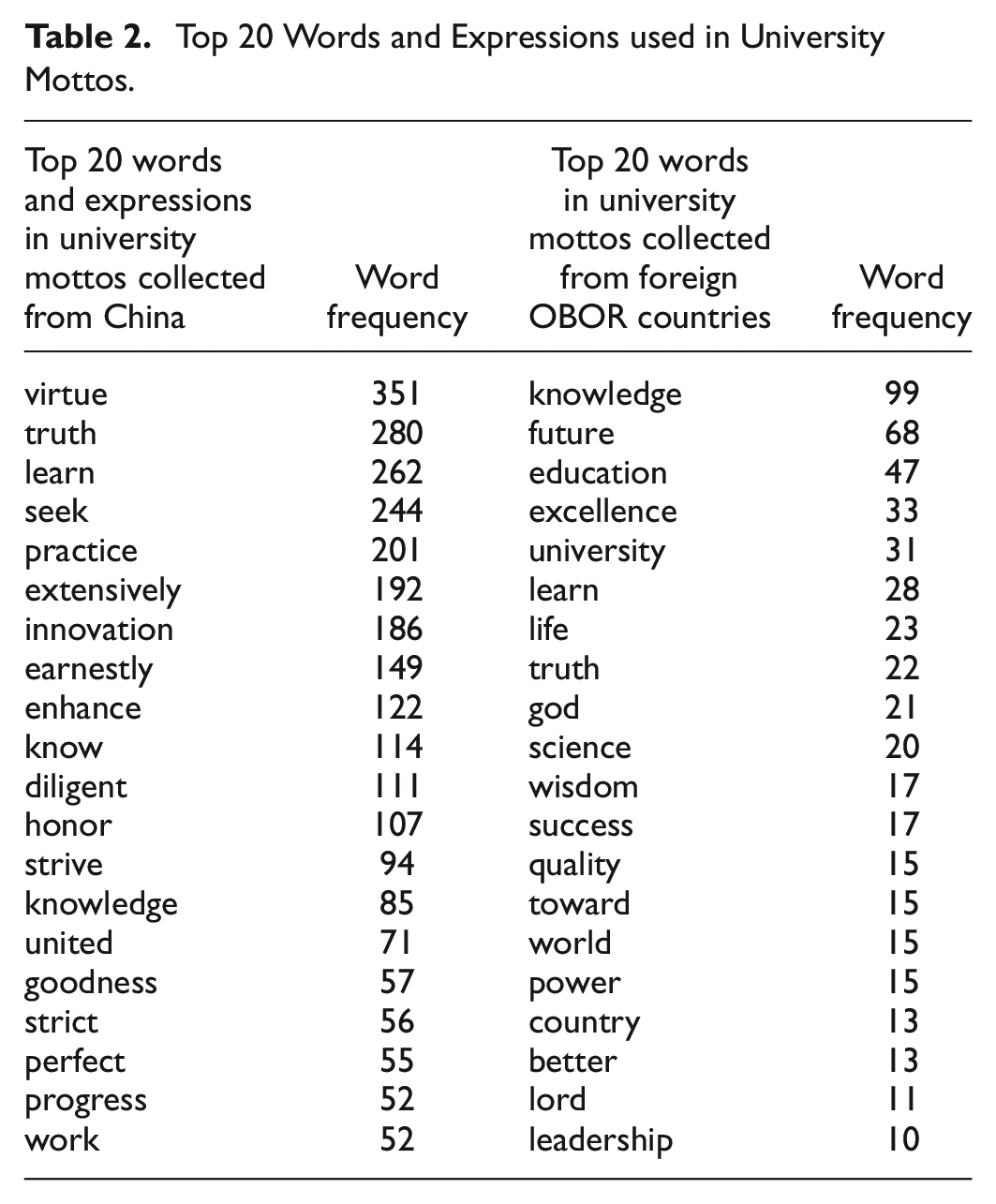
Table 2 and Figure 1 shows that, the educational concepts, or core values of Chinese universities, expressed through university mottos, is concentrated in the aspects of virtue and moral education, knowledge learning and the truth-seeking from practice. Qiao and Ma (2019) writes, “most Chinese universities used two-character and four-character idioms, which were more concise, symmetrical, catchy, and easy to remember” (Qiao & Ma, 2019, p. 471), such as the two-character expression “

Word cloud map of frequently used words in Chinese university mottos.
As shown in Table 2, the ideas expressed through English university mottos collected from the other 60 OBOR countries are often about “knowledge,”“future,” and “education,” with “knowledge” as the topic word occurring 99 times, “future” as the core concept occurring 68 times and “education” as the topic word occurring 47 times. The word cloud map of the frequently used words in university mottos collected from the 60 foreign OBOR countries in Figure 2 shows more clearly about the preferred topic words.

Word cloud map of frequently used words in university mottos collected from 60 foreign OBOR countries.
Table 2 and Figure 2 shows that the educational philosophies contained in university mottos in 60 foreign countries along the OBOR route focus more on the pursuit of knowledge and truth, and the striving for a better future. In terms of educating people, the core values often focus on the leadership and learning ability of students. The university mottos also embody the universities’ characteristics. The mottos of universities specializing in agriculture, medicine, art, etc., and mottos of women’s universities often reflect the characteristics of these professional universities. For example, the motto of the Silpakorn University in Thailand is “Art is long, Life is short” and the motto of the Central Women’s University in Bangladesh is “Power to Women.” University mottos in foreign countries along the OBOR route also have a strong religious dimension, with words such as “God,”“Allah,” and “Lord” often being used. For example, the motto of the Sultan Sharif Ali Islamic University in Brunei is “Observe your duty to God and it is God that teaches you.” In total, there are 23 countries have university mottos with the word “God” and 11 universities have a motto that includes the word “Lord.” As noted above, most of the university mottos of the countries along OBOR route have its English versions, but in fact the similarities concerning key ideas or core values expressed through university mottos concerning educational philosophies are not too much.
When comparing the topic words in both Chinese university mottos and the university mottos from foreign OBOR countries, we found that the educational philosophies expressed through university mottos in countries along the OBOR route, including China, have both similarities and differences. First, as shown in Table 1, Figures 1, and 2, the high-frequency topic words such as “truth” and “knowledge” can be found in university mottos from China and foreign OBOR countries. Second, the major difference in educational philosophy between Chinese universities and foreign OBOR countries is that the high-frequency topic words in Chinese university mottos focus more on virtue and moral education, and the high-frequency topic words in university mottos of foreign OBOR countries put more emphasis on knowledge, future and education.
Topic analysis of educational philosophies based on TF-IDF and LDA topic classification as mentioned in Sections 2.3.1 and 2.3.2, we further converted the thesaurus of university mottos to TF-IDF word frequency vector and used the LDA topic model for topic classification. After the LDA topic model is modeled, it is necessary to evaluate the quality of the model, based on which to judge whether parameters or algorithms need to be adjusted. Since the number of topics and the meaning of topics cannot be predicted in advance during the modeling process, it is necessary to assume the number of topics and evaluate the quality of the LDA model under different numbers to determine the final number of topics. Computing perplexity and consistency are two commonly used evaluation methods to evaluate the overall performance of a model. Perplexity refers to the uncertainty of which topics are identified by the trained model in text analysis. The smaller the perplexity value, the smaller the uncertainty and the better the final clustering result. Consistency refers to the degree of discrimination between different topics, and the greater the degree of discrimination, the stronger the consistency. Topic consistency is often used to measure topic quality, and estimate topic number, which is another main optimal model for determining the topic number. Working in accordance with Blei et al.’s (2003) research, we calculated the log-likelihood rate according to the number of iterations and the number of topics, determined the number of iterations and the number of topics, and then carry out the training to determine the parameter mode. The log-likelihood is calculated from the model distribution on the training set. Figure 3 shows the log-likelihood ratios at different iterations from the number of two topics to five topics.

Iterative likelihood for different number of topics.
Figure 3 shows, as the number of iterations increases, the log-likelihood decreases with the number of topics and eventually tends to be smooth. On this basis, we select the number of topics with relatively high consistency. In this article, we construct the LDA model when the number of topics is selected to be five, and the topic is divided. As shown in Table 3, we select the top 15 keywords with the highest TF-IDF values under different topics.
Top 15 Keywords with the Highest TF-IDF Values Under Different Topics.

In this article, we use the weight values of different topics of the first 100 keywords to determine the LDA topic classification of a specific document. The best LDA topic classifications show higher weight values and a more even distribution across topics. Figure 4 illustrates the weight values calculated for different topics using the LDA model.

The weight distribution of each topic under the LDA model.
In Figure 4, we assume that
Table 4 shows 15 representative keywords for each topic found using the LDA topic classification model, with topic categories matched with each group of representative keywords accordingly.
Different Topic Categories Found Using the LDA Model.

In Table 4, the purpose of the representative keywords in university mottos under the topic L1—political and religious education, is to explain key questions about several elements of educational philosophy, such as country, nation, God, leadership, lord, etc. The educational philosophy implied by the keywords with high TF value under the topic L2—humanistic and spiritual education, is to advocate that school teaching and education should be people-oriented, focus on serving students, and focus on the cultivation of humanistic spirit. The keywords with high TF value under the topic L3—knowledge and culture education, demonstrate the pursuit of higher education goals and the pursuit of knowledge, culture, and moral requirements in the educational philosophy of higher education institutions, which shapes the inner spirit of people. The keywords with high TF value under the topic L4—education for sustainability, reveal the concept of sustainable development and internationalized thinking in the educational philosophy of higher education institutions, for the purpose of advocating the concepts of people-oriented and sustainable development as the core values for higher education. The keywords with high TF value under the topic L5—traditional moral education, reveal the moral requirements in the educational philosophy of higher education institutions and the shaping of the inner spirit. This is also the topic which is related to the largest number of keywords in university mottos, through which the educational concepts of higher education institutions in countries along the OBOR route are expressed and conveyed.
University mottos can reflect the purpose and philosophy of education. It can be found form the university mottos of Chinese universities that, the educational philosophy of Chinese universities is to cultivate outstanding citizens with innovative thinking, noble morality, practical learning, and practice, to serve the country and society. China’s educational philosophy attaches great importance to the cultivation of people’s morality and thinking and is more inclined to collectivism. By contrast, The universities mottos in foreign countries along the OBOR route place more emphasis on the pursuit of knowledge, truth, and science. The concept of educating people contained in these university mottos is more focused on personal abilities, such as leadership, academic ability, etc. The educational philosophy of universities in foreign countries along the OBOR route is more focused on how to cultivate better people and become better and more influential universities. The education concept of these universities also attaches great importance to the cultivation of virtues, loyalty, and serving the motherland. However, compared with Chinese universities, foreign OBOR countries’ emphasis put on this aspect is relatively low. The educational philosophy of universities in foreign countries along the OBOR route is more inclined to individualism, emphasizing personal development.
Although there are many differences between the mottos of Chinese universities and that of universities in foreign countries along the OBOR route, there are still some similarities concerning topics and topics. University motto is the external condensed form of university’s education philosophy. University mottos in China and in foreign OBOR countries both advocate the pursuit of truth and knowledge, and advocate learning and practice. The topic of virtue which frequently occur in university mottos of Chinese universities essentially belongs to the category of ethics, including social constraints and moral criticism, and is used to judge whether individual behavior conforms to norms. This shows that most of the university mottos of Chinese universities are used as admonitions. Similarly, universities in countries such as Thailand, Romania, Albania, the Philippines, and Vietnam also use “virtue” as the high-frequency word in their university mottos. Geographically, countries such as Thailand, Romania, Albania, the Philippines, and Vietnam are relatively close to China. Historically, the ancient “Maritime Silk Road” also leads to these countries. From the perspective of economic and trade exchanges, in recent years, China’s trade exchanges with countries such as Thailand, Romania, Albania, the Philippines, and Vietnam have increased year by year. The LDA topic model, in Figure 5, shows that topic L5—traditional moral education accounts for the highest proportion in the university mottos in countries along the OBOR route, including China, accounting for 62.15%. L1 accounted for 9.69%; L2 accounted for 7.4%; L3 accounted for 7.33%; and L4 accounted for 13.43%.

LDA topic model proportion.
We also found that the motto of the Azerbaijan Tourism Management University is “The silk road of education runs through Azerbaijan tourism and management university.” Azerbaijan Tourism Management University was established in 2006, when the Belt and Road Initiative has not been formally proposed. However, the motto of Azerbaijan Tourism Management University can show the influence of the “Silk Road” on the exchange of educational concepts. “The Belt and Road” is not only the “Belt and Road” for economic and trade exchanges, but also the “Belt and Road” for educational exchanges.
Social Network Analysis of Educational Philosophies Based on LDA Topic Classification
As illustrated in Section 3.2, we conduct keyword analysis on the results of LDA topic classification and use the first 50 TF-IDF weights to represent the relationship between featured words. Figure 6 shows the network connection of keywords between different topics.

The keyword network diagram of documents grouped by different topics.
Table 4 and Figure 6 show that, the five topics are: L1—political and religious education; L2—humanistic and spiritual education; L3—knowledge and culture education; L4—education for sustainability; and L5—traditional moral education. According to the Fruchterman-Reingold algorithm (Fruchterman & Reingold, 1991), which is a force-guided layout algorithm, the average degree of the directed graph in Figure 6 is calculated as 2.216. The higher the degree of a node, the more nodes connected to him, and the more critical the node is. In Figure 6, the topic subjects of L5 and L4 have a strong correlation with keyword nodes. To be specific, the node connections are relatively sparse, and there is no cross-connection between keywords and topics. The Modularity value of the five topics calculated according to the community detection algorithm is 0.406. Figure 6 shows that there is a strong correlation between L5 and L1, L4, and L2, and an indirect link with L3. The results of LDA topic classification and the results of network structure analysis indicate that the higher education in the countries along the OBOR route, including China, is rooted in virtue and moral education, takes the concept of sustainable education as philosophy, pays attention to the cultivation of cultural knowledge and personal behavior, and put emphasis on the functional attributes of higher education, such as the political, knowledge, and culture education.
In this current investigation, we conduct a keyword analysis with a network graph for the first 50 TF-IDF weights of specific keywords and relevant topic categories, to present the relationship between featured keywords and topic categories. Network analysis can identify the degree of interconnectedness between key featured words and identify specific topics. The network analysis of featured keywords is an important tool for text mining, which shows the characteristics of keywords and the social network of countries along the OBOR route and different universities.
Conclusions
In this article, we applied the standard operating procedures of text mining technology to 1,535 university mottos collected from 61 OBOR countries, including China, mainly based on natural language processing (NLP) methods. The NLP methods mainly include constructing corpus, generating word cloud maps, extracting featured vocabulary and keywords, using the LDA model for topic classification, and using the social network analysis method to analyze the network structure of the keywords and topic categories in university mottos collected from 61 OBOR countries. We explain the relationship between featured words through advanced NLP technology and statistical analysis methods, to confirm and obtain reasonable artificial intelligence analysis results. Based on the collected text data of 1,535 university mottos, we first conduct NLP segmentation, retrieve the 50 keywords with the highest TF-IDF value for the research purpose, and then classify the 1,535 university mottos into five topic categories based on the LDA model. The topic categories are L1—political and religious education (9.69%); L2—humanistic and spiritual education (7.4%); L3—knowledge and culture education (7.33%); L4—education for sustainability (13.43%); and L5—traditional moral education (62.15%). We then conduct correlation analysis between the five topic categories and the top 50 keywords with the highest TF-IDF values, analyzing the exchange and communication of educational philosophies of the 1,535 universities in 61countries along the OBOR route. Our findings are: (1) the educational philosophy of Chinese universities and universities in foreign countries along the OBOR route is inclined to the pursuit of knowledge and truth, that is, the pursuit of virtue education; (2) although the cultural backgrounds of China and the foreign countries along the OBOR route are different, the basic spirit of the university is the same, which is to pursue knowledge, explore science, and encourage learning and innovation; (3) China’s educational philosophy emphasizes on collectivism and the educational philosophy of foreign countries along the OBOR route tends to be individualistic; (4) China’s Belt and Road Initiative (BRI) is also a “Belt and Road” for educational exchange and communication. Because of the economic, culture exchanges and some historical reasons, the exchanges along the OBOR route, have also promoted the exchange of educational views among the countries along the route. For instance, the mottos of Chinese universities focus on the meaning of admonition, which is the virtue and moral education. There are still some universities in Thailand, Romania, Albania, the Philippines, and Vietnam, whose mottos are using the word “virtue” as the high-frequency topic word, though deeply influenced by European and American cultures. Though not covering university mottos from all the OBOR countries, we believe that this current research could contribute to the understanding of educational philosophies, educational values, and viewpoints of universities in and out of China and contribute to the advancement of international cooperation and communication in higher education under the framework of BRI. The impact of China’s educational philosophies in higher education, for example, Confucianism, on foreign OBOR countries’ education and culture, with the progress of BRI, can be a direction for future research since BRI has been a global endeavor for economic globalization and shared education.
We also found that the philosophies of higher education reflected by the university mottos along the OBOR route fundamentally focus on education for sustainability (L4), which is somewhat in accordance with the United Nations Sustainable Development Goals 4 (quality education), 8 (decent work and economic growth), 9 (industry, innovation, and infrastructure), and 12 (responsible consumption and production) (United Nations, 2015). Higher education institutions play an organizational role in global economic, social, and environmental sustainability (Alturki & Aldraiweesh, 2022; Crawford & Cifuentes-Faura, 2022). However, the COVID-19 pandemic has led to a pause in the implementation of sustainable development strategies at some university institutions (Aristovnik et al., 2021; Bao, 2020; Jiang et al., 2021). For instance, teachers and students had to adapt to online teaching methods during the lockdown periods (Bao, 2020; Jiang, et al., 2021). Digital access and technological capacity of teachers and students affect the equity and inclusion in quality education. So, quality education was directly challenged by the COVID-19 pandemic. Meanwhile, the COVID-19 pandemic has stimulated rapid innovation in higher education institutions by pushing university policy makers to conduct reform in both curriculum and pedagogy for sustainable development (Crawford & Cifuentes-Faura, 2022; Crawford et al., 2020), which may lead to the change of university philosophies along the OBOR route in the post-pandemic era. Policy makers in OBOR countries and countries all around the world may need to continuously seek for international cooperation in the field of education, economy, technology, and culture exchange, for sustainable development.
Notwithstanding the above discussion and conclusions, the limitations of this present investigation should be acknowledged. First, we have involved 1,535 universities in 61 countries along the OBOR route. Universities from other developed countries are not included. Further studies could therefore include a more representative sample to validate and generalize our findings and increase the interpretability of the results. Second, this present investigation is a quantitative study mainly employing the method of NLP. Possible changes and developments triggered by the COVID-19 pandemic on university mottoes are ignored due to the funding and time constraints. We thus call for more scholarly attention to the impact of COVID-19 pandemic on higher education, such as the evolution of university mottos and the educational philosophies of those newly built (Chinese-foreign cooperatively run) universities in the post-COVID era, by using methods of text mining and NLP. Our present investigation may serve as a starting point for future research of this trend.
Footnotes
Acknowledgements
The authors would like to extend special gratitude to Prof. You Shibing from the School of Economics and Management, Wuhan University, for his suggestions about the design of this study. The gratitude is also extended to Beijing Xiaoshu Technology Co., Ltd for some technical support.
Declaration of Conflicting Interests
The author(s) declared no potential conflicts of interest with respect to the research, authorship, and/or publication of this article.
Funding
The author(s) disclosed receipt of the following financial support for the research, authorship, and/or publication of this article: This work was supported by the Research Start-Up Funding from the Zhongnan University of Economics and Law under Grant No. 31722141214, the Research Start-Up Funding from the Yangtze University under Grant No. 8021002902, the National Social Science Foundation under Grant No. 20&ZD132, and the Fundamental Research Funds for the Central Universities, Zhongnan University of Economics and Law, under Grant No. 2722022BQ059.
