




Abstract
The study focuses on service co-creation in the sharing economy, where platform operators mediate the relationship between customers and potential service providers. Service co-creation consists of information sharing, interaction, and responsible behavior that customers undertake voluntarily or willingly to create an experience of value. Based on S-D logic, a theoretical model of service co-creation was developed and tested through structural equation modeling using survey data from 627 respondents in Sydney, Australia. The results provide strong empirical support for the hypothesized relationships between service co-creation, its determinants and impact on customer satisfaction. The implications on theory development and for property owners and platform operators are discussed.
Keywords
Introduction
The onset of web platforms powered by digital technologies has energized the peer to peer marketplace over the past decade. Among the pioneers are Airbnb, providing accommodation rentals, and Uber, providing a ride-hailing service for a fee. These platforms are frequently touted as success stories in galvanizing the sharing economy (Martin, 2016). Falling within Belk’s (2014) definition of the “sharing economy” and “collaborative consumption” both encompass the involvement of people and the underlying economic motivation for sharing underutilized resources and differing only in terms of emphasis, that is, the former on the producer and the latter on the consumer (Johnson & Neuhofer, 2017).
Airbnb has emerged as one of the most successful accommodations sharing platforms within the tourism and hospitality industry. The concept of accommodation sharing originated in San Francisco in 2007. Co-founders Chesky and Gebbia created a website to rent out room space and breakfast, followed by an official launch in 2008 as Airbnb, with a platform that now enables others to advertise their spare rooms or houses as short-term accommodation. Airbnb has spread worldwide to nearly 200 countries with an estimated valuation of almost $30 billion (Carson, 2018; Martin-Fuentes et al., 2018). On the other hand, the founders of Uber, Kalanick, and Camp, initially envisioned a service that would operate on a timeshare basis allowing customers to order a limo service using an app. As of 2018, Uber was the leading ride-sharing operator worldwide with a market value of $72 billion. In 2019, it reported net revenue of $14.1 billion (Mazareanu, 2020) in an industry that has grown to $56.87 billion in 2021. By 2025, the ride-sharing market is expected to reach $108.15 billion (Businesswire, 2021). Uber is a major player in the world’s three largest ride-sharing markets, namely, the USA, China, and Europe (Nguyen & Ha, 2022). Uber, the current market leader in ride-sharing, is competing in approximately 900 cities in 69 countries (Mazareanu, 2020).
In addition to Airbnb and Uber, there are other profit-based peer to peer online asset-sharing platforms, such as Lyft, Couchsurfing, Ola, Sheba, Go Catch, and Taxify. These platforms capitalize on society’s attraction to mobile technology and online sharing (Teubner & Flath, 2015) while at the same time stimulating gains in efficiency through the mobilization of underutilized assets. The rise of these platforms has transformed many aspects of the tourism and hospitality sector, affecting different stakeholders, including tour operators, hoteliers, destination marketers, and car rental companies (Sánchez Cañizares et al., 2016). As it has changed the way people travel, there is concern among traditional hotels and taxi operators about the competition they pose.
This research was motivated by the rapid acceleration in popularity of the sharing economy, ongoing concerns about competitive fairness, and long-run sustainability. In a peer to peer sharing scenario, the relationship between a service provider and customer deviates from the traditional business model. The service providers are not industry specialists. They lack professional training and are loosely affiliated with the platform operators. Moreover, the services on offer emanate from assets obtained not for business but rather for personal use and when underutilized. However, these providers face the challenge of providing services that meet customer needs for the sharing economy to survive or thrive.
The rise of the sharing economy also suggests that customers value the opportunities for peer-to-peer engagement, responsiveness, and flexibility. Since “value” is experientially and contextually perceived and determined by customers, service providers predefine their service bundles’ tangible and intangible features (Vargo & Lusch, 2004). Service providers and platform operators want to know the answers to such questions as: What drives customers to engage in a peer-to-peer relationship? What benefits and results do they expect? What roles are they willing to play? How can we serve them better?
The current study aims to examine the role of customers in a peer-to-peer sharing economy. Its central proposition is that customers take a proactive rather than a passive role in co-creating the home or ride-sharing experience they want. Guided by this proposition, the study attempts to address the following research questions:
i. What activities do customers undertake to obtain the service experience they want? To what extent do these activities impact the value they derive from the experience?
ii. What resources do they need, and what is their primary motivation to engage in co-creating a home or ride-sharing experience?
iii. How do customers assess the value of their co-created experience? Are they concerned about the outcome or the process, and how important is one relative to the other? What effects does each have on customer satisfaction and post-experience behavior?
The first question addresses the concept of co-creation, while the second and third focus on the antecedents and outcomes of co-creation, respectively.
The study makes the following contributions: First, it developed and empirically tested a theory-based service co-creation model of consumer behavior in the sharing economy. The results support the notion that the customer is a co-creator of value. In addition, co-creation is influenced by the customer’s cost-saving motive and the operant resources of both the customer and service provider. Second, unlike in previous studies where service value is viewed as a univariate construct, this study provides statistically significant evidence that it has two dimensions, namely, process and outcome. Distinguishing between the two highlights the co-creation nature of collaborative consumption, which also fills the gap in the literature about the relative impact of each on customer satisfaction. Third, the study establishes the relative effect of outcome and process value on customer satisfaction and post-experience behavior. Lastly, the current study contributes to the continuing evolution of the S-D logic framework’s transcending view of markets and marketing from a sharing economy perspective. Applying the S-D logic in the sharing economy within tourism and hospitality helps provide a better understanding of co-creation in a sector that is deemed critical and complex (Rihova et al., 2018).
Overall, the potential contributions of the study are improved marketing strategies and management practices, research advancement, and theory development. It is anticipated that the current research will help all significant stakeholders better understand customer behavior in ways that will help the sharing economy develop and prosper.
Review of Literature
Themes and Perspectives
The early studies on the sharing economy in the tourism sector explored the psychological perspective of sharing, legal and financial issues, the characteristics of peer to peer sharing, and the various contexts such as house and car sharing (Heo, 2016). Participation in this peer to peer process seemed to have originated from economic motives based on ownership of underutilized resources by operators and a price motive on the part of the customers. However, subsequent studies appeared to also reflect the changes in attitudes toward environmental and other socioeconomics impacts (Hamari et al., 2016). Research published between 2000 and 2019 identified motivation as one of the popular themes, with economic benefits found to be a key factor. However, service quality and satisfaction were also highlighted (Kuhzady et al., 2020). Amid the fast-growing interest in the sharing economy, Heo (2016) noted the absence of research on the theoretical underpinnings of the sharing phenomenon, while other scholars emphasized the need to focus on the role of consumers and higher-order customer engagement (Chathoth et al., 2016; Cheng, 2016).
Understanding the sharing economy as a concept was quite naïve (Dredge & Gyimóthy, 2015) and was in its emerging state of conceptualization (Martin et al., 2017). The lack of a robust theoretical base was exemplified by a specific theoretical framework in more than 40% of the 71 sharing economy journal articles reviewed by Prayag and Ozanne (2018). There was a lack of understanding of host-guest relationships, consumption practices, and consumer behavior (Cheng, 2016). In ride-sharing, empirical studies were scarce, with many research questions about actual participation unanswered (Boateng et al., 2019).
Previous studies viewed the customer’s role in the sharing economy in hospitality and tourism from different perspectives. In a comprehensive review, Altinay and Taheri (2019) identified nine overarching theories, namely, theory of planned behavior, complexity theory, social exchange, norm activation exchange, transaction cost, social comparison, social cognitive, stimulus organism response (SOR) theory, and value co-creation and service-dominant logic. This range of frameworks reinforced the observation that the sharing economy is a complex construct encompassing interrelated concepts that attracted researchers from different disciplines (Klarin et al., 2021). Cognizant of these theories, the current study adopted the S-D logic framework for reasons discussed in the next section.
Service-Dominant Logic
Service dominant logic is a framework for explaining and understanding value creation. The framework consists of 10 foundational premises. One of these premises is that the customer is always a co-creator of value which emphasizes the collaborative nature of value creation (Vargo & Lusch, 2016).
The foundation of the sharing economy lies in the customer who continually creates value with service providers who, in peer-to-peer sharing, are consumers themselves. Where different parties produce valued outcomes, the concept of value co-creation, a foundational premise of the service-dominant logic framework (Prahalad & Ramaswamy, 2004), becomes applicable and relevant. Despite this seemingly obvious match between an empirical phenomenon and an extant theory, only two studies have applied the S-D logic lens to the sharing economy. These few studies include the research focusing on Airbnb by Johnson & Neuhofer (2017) in Jamaica and Jiang et al. (2019) in the USA. Both studies provided encouraging results supporting the S-D logic in the sharing economy.
According to its founders, Vargo and Lusch (2016), the S-D logic framework is evolving as it is continuously reviewed and updated. The framework has found applications in various service industries, including conventional hotel and travel services (e.g., Eletxigerra et al., 2021; Grissemann & Stokburger-Sauer, 2012) and sustainable tourism (Font et al., 2021). However, recognition of its relevance in the sharing economy has been limited. The palpable lack of empirical evidence on the S-D logic in the sharing economy is a gap the current research attempts to fill.
Conceptual Background
Cocreation in the Sharing Economy
The economic exchange of services within the sharing economy has brought a paradigm shift to a new logic wherein platform operators engage in an interactive relationship with customers and other actors for value co-creation (Sundararajan, 2013; Vargo & Lusch, 2004). A key ingredient propelling this interactive process of peer to peer collaboration has been the advancement of digital technologies and ICT capabilities, which have resulted in the development of digital platforms (Hamari et al., 2016). Digital platforms allow customers to express their preferences with swift feedback, thereby actively participating in the creation of value along with the service provider as opposed to past practices where the value created is assumed to be embedded in the good or service by the producer before the exchange (Johannessen & Olsen, 2010).
Value co-creation is founded on the operant resources of the platform operator and property and car owners on the one hand, and the customer such as knowledge, skills, competencies, experiences, and participation on the other (Edvardsson et al., 2011; Prebensen et al., 2013). Vargo and Lusch (2016, p. 7) extend the essence of operant resources to include the “strategic benefit” to the service provider in a peer to peer exchange that co-creates value by acting on operand resources that are static and require transformation to become valuable.
Participation in this peer to peer collaborative process may have originated from economic motives based on ownership of underutilized resources by operators and a price motive on the part of the customers (Hamari et al., 2016). Other research points to the operator’s value proposition and subsequent customer satisfaction measured by how well expectations were met (Tussyadiah, 2016). Essentially, the motivations are social, and thus both operant and operand resources should be viewed as embedded in society. Within this context, a theoretical framework underlying service exchange following from S-D logic implies extensive collaboration between the service provider and customer to create strategic benefit for firms and beneficial experience for customers in a subjective sense (Edvardsson et al., 2011).
Figure 1 encapsulates the antecedents and outcomes of service co-creation in the sharing economy based on S-D logic. Central to this framework is service co-creation, which is the set of activities that customers actively undertake to create the service experience of value. The factors hypothesized to influence these activities and their resulting outcomes are discussed in the following section.

Antecedents and outcomes of service co-creation in the sharing economy.
Factors Affecting Participation
Platform operators provide a service connecting consumers with operand resources. Customers such as tourists bring operant resources such as time, effort, money, and knowledge into the co-creation process to access operand resources via a web platform operator by participating in home-sharing or ride-sharing. The value potential of the operand resources, that is, homes and cars, is enhanced into value-in-use. The customers’ skills and access to information via a web platform form their value foundation. When products such as cars or houses are used, the value created becomes more significant to both the customer and the operator (Grönroos, 2008). The study by Alves et al. (2016) demonstrated that operant resources positively and effectively contribute to the variation in customer co-creation activities and found that the influence of these resources is boosted by the efforts operators make to educate their customers. Thus, the following hypotheses:
H1: A customer’s operant resources have a positive effect on service co-creation.
H2: An operator’s operant resources have a positive effect on service co-creation.
Cocreation requires customers’ knowledge, skills and time, and psychological inputs (Chathoth et al., 2013), which create some costs to the customer. The exploratory study conducted by Tussyadiah (2015) on drivers and barriers of collaborative consumption in travel identified cost as a significant consideration. Similarly, Sacks (2011) provided anecdotal evidence that the sharing economy is preferred by consumers when it allows them access to the desired product with lower costs.
Guyader (2018) identifies peer to peer exchanges such as ride and home-sharing as a collaborative consumption style wherein participants aim for monetary gains or personal benefits. For Millennial, a utilitarian value aligned with cost benefits has significantly impacted their attitude toward collaborative consumption and purchase intention (Hwang & Griffiths, 2017). According to Barnes and Mattsson (2017), economic drivers play the most crucial role for customers deciding to use collaborative consumption. Economic reasons could reduce the need for ownership of goods while having access to them (Rudmin, 2016). Accordingly, the following hypothesis is proposed:
H3: The cost-saving motive of a customer has a positive effect on service co-creation.
Factors Affecting Satisfaction
From the customers’ perspective, obtaining value is the core purpose of buying a product or service for the money paid (Holbrook, 1994). The value perceived by the customer is vital in marketing because it can affect the direction and level of satisfaction consumers derive from a purchase (Spreng & Olshavsky, 1993).
The current study adopts the S-D logic view of value, which departs from the marketing concept of value adopted in previous co-creation studies in tourism (e.g., Prebensen & Xie, 2017). Unlike the traditional view, which refers to value as a means-end chain (Woodruff, 1997), benefit-sacrifice ratio (Zeithaml, 2018), or experience outcome (Hirschman & Holbrook, 1982), the current study takes into account the fundamental propositions of S-D logic that the customer is always a co-creator of value and that “value is always uniquely and phenomenologically determined by the beneficiary” (Vargo & Lusch, 2016, p. 8). The phenomenological view suggests that value consists of process value and outcome value (Gummerus, 2013). Process value includes the benefits derived from the activities and resources involved in value creation. In contrast, outcome value or “value realization” (Vargo & Lusch, 2016) focuses on how customers make value assessments and the perceived outcomes. While processes tend to be continuous, outcomes are tied to a specific point in time (Gummerus, 2013), usually toward completing the value creation process.
Participation in the service co-creation process determines the value customers derive from the service. They determine whether a value is generated and whether or not the process contributed to their well-being or made them feel better-off (Grönroos, 2008). Creating value while interacting with the service provider and co-creating the service is referred to as “value in use” in the S-D logic framework (Vargo & Lusch, 2016). Service co-creation enhances understanding between a service provider and customer, contributing to a favorable attitude toward the service (Haumann et al., 2015). Customer engagement involves effective and meaningful communications that enable service providers to appropriately and promptly respond to customers’ needs (Baumeister & Leary, 1995).
In home and ride sharing, co-creation can generate higher value through service customization as customers provide direct inputs, resulting in a uniquely personalized experience (Chathoth et al., 2013). The interactions between tourists and home or car owners that tend to be direct and personal could be perceived as a positive or negative value. It is possible that while the interactions have been pleasurable, the outcome value may not be as favorable. For instance, a study on B2B marketing by Luu et al. (2016) found that the positive experience perceived during a service encounter was more valuable than the ultimate benefits perceived as a result of the service delivery.
Based on the above discussion, it is proposed that participation has a positive effect on value-in-use and that value-in-use can be meaningfully measured in terms of process and outcome value, and thus, the following hypotheses:
H4: Service co-creation has a positive effect on service outcome value.
H5: Service co-creation has a positive impact on service process value.
Satisfaction is the customer’s response to evaluating the perceived difference between some comparison standards, such as expectations, and a product’s perceived performance (Yi, 1990). Satisfaction is an essential concept as it impacts the consumption of goods and services, the future selection of a travel destination, and the intention to revisit or repurchase (Prayag & Ryan, 2012; Williams & Soutar, 2009). Additionally, as customers are increasingly acting as an information source through social media and web platforms, the importance of satisfactory travel experiences cannot be ignored (Llodrà-Riera et al., 2015).
Previous studies have shown that satisfaction is influenced by service quality, destination image, motivation, and perceived value of vacation experience (Prebensen et al., 2013). Few studies on co-creation have linked participation and customers’ co-creation roles with increased tourist satisfaction (Lee, 2012). A quantitative study involving a general service context such as a hotel, medical doctor, and education services found value co-creation to explain a reasonable variance in customer satisfaction (Ranjan & Read, 2016). In a study on adventure tourism, tourists’ participation in service co-creation enhanced satisfaction by creating value in the experience (Prebensen & Xie, 2017), while another study (Grissemann & Stokburger-Sauer, 2012) showed that the degree of co-creation positively affects satisfaction and loyalty with the service provider. Thus, the following hypotheses:
H6: Service outcome value has a positive effect on satisfaction.
H7: Service process value has a positive effect on satisfaction.
Satisfaction and Post-Experience Behavior
Previous studies have reported a positive relationship between customer satisfaction and repurchase intentions (Anderson & Sullivan, 1993) and between customer satisfaction and post-purchase behavior (Wang et al., 2004). Customers with a higher level of satisfaction tend to have a stronger intention to repurchase and recommend the purchased product (Zeithaml et al., 1996), including peer to peer accommodation services (Birinci et al., 2018). From the sharing economy perspective, the vital point is whether customers’ experiences affect their future behavior, either through reuse or recommendations (Prebensen et al., 2014). Hence, antecedents via the perceived value of experience must be linked to post-experience behavior. Accordingly, the following hypothesis is proposed:
H8: Satisfaction has a positive effect on post-experience behavior.
Method
Measures
The constructs in this study were measured using scales adapted from existing literature. Customer’s operant resources were measured by five items reflecting the intangible knowledge-related elements of a consumer’s accommodation and transport service purchase behavior. Adapted from Prebensen et al. (2014), the scale covered knowledge about digitized sources of information and process-oriented knowledge and skills such as “I know how to book a home/ride sharing service through the internet.” The operator’s operant resources construct was measured using five items from Melancon et al. (2010) as perceived by their customers. The cost-saving motive scale, adapted from Dall Pizzol et al. (2017) and Tussyadiah (2016), centered on the economic reasons for using a home or ride sharing service.
Service co-creation in this study refers to the customers’ active participation in performing the expected and necessary tasks for a successful service experience. Customers’ co-creation activities included three dimensions associated with co-production: information sharing, interaction, and equity (Ranjan & Read, 2016). Information sharing involved providing essential information to the customer, resulting in a better service experience than without (Enz & Lambert, 2012). Interaction refers to the interpersonal relations between customer and service provider necessary for successful co-creation (Ennew & Binks, 1999). Equity which is the sharing of control through customer empowerment, was operationalized as “responsible behavior” (Ennew & Binks, 1999). Responsible behavior includes customer’s willingness to cooperate (Bettencourt, 1997; Xie et al., 2008), assumption of responsibility as part-time employees (Bowen, 1986), and compliance with the basics (McColl-Kennedy et al., 2012), which were reflected in such items as “I performed all the tasks required” and “I fulfilled my responsibilities as a guest or passenger.” The wording of the scale items for these three dimensions was adapted from Yi and Gong (2013). Unlike Yi and Gong (2013), the scale items were deemed reflective, similar to the approach adopted by other studies (e.g., Ng et al., 2010).
Service value was measured in terms of process value and outcome value. The former covers the value obtained during the sharing experience, such as having an enjoyable time, feeling good, and being happy. On the other hand, service outcome value is about the benefits gained or received from the experience. The measurement scales for these constructs were adapted from Thuy et al. (2016) and Sweeney and Soutar (2001). Finally, the measurement scales for satisfaction and post-experience behavior were adapted from Buonincontri et al. (2017) and Barnes and Mattsson (2017), respectively. A summary of the measurement scale statements is shown in Appendix.
Data Collection
Data collection was through a survey using Qualtrics as the online platform. The questionnaire consisted of the measurement scale items for the various constructs and relevant demographic and socio-economic variables. The respondents were recruited by The Online Research Unit, an accredited global online data collection agency with the most extensive geo-demographic consumer panel in Australia. The respondent needed to be 18 years or older and a resident of the Greater Sydney region. Of those who met the sampling criteria, only those who have used a home-sharing and ride-sharing service in the past 12 months were allowed to complete the survey. These criteria comprised the qualifying questions that were used to screen potential respondents.
The online questionnaire was pre-tested before it went live. Arrangements were made to regularly pause the survey to check that the criteria for sample selection and quota for each service were met. Due to privacy concerns, a “Do not wish to disclose” option was added to the questions about gender and income. As a result, as shown in Table 4, about 11% of the sample elected not to disclose their income.
Keeping in mind that self-reported measures can lead to common method variance (CMV) issues, appropriate steps were taken in the questionnaire design phase. As Podsakoff et al. (2003) suggested, some procedural remedies were adopted. The scale items were carefully worded to avoid ambiguity and ensure that each statement was simple, specific, and concise. Different scale endpoints and a varied number of response categories were used throughout the questionnaire. For example, the scale endpoints for the operant resources (predictor) measures were “Does not describe me” and “Describes me extremely well”; two of the criterion (co-creation) measures had the end descriptors “Not at all” and “Large extent” while others had “Strongly disagree” to “Strongly agree.”
The number of response categories was also varied. Some constructs (e.g., operant resources, cost-saving, and service co-creation) had five response categories. Others (e.g., outcome value, satisfaction, and post-experience behavior) had seven. The Likert scale range for each construct is shown in Table 3. Positively worded items were interspersed with negatively worded ones, and all response categories had verbal labels. Also, the answers were anonymous. The respondents were assured that there were no right or wrong answers and that their response should reflect their actual behavior or experience. As Podsakoff et al. (2003) suggested, these procedures would help reduce respondents’ evaluation apprehension and minimize CMV.
Results
Sample Characteristics
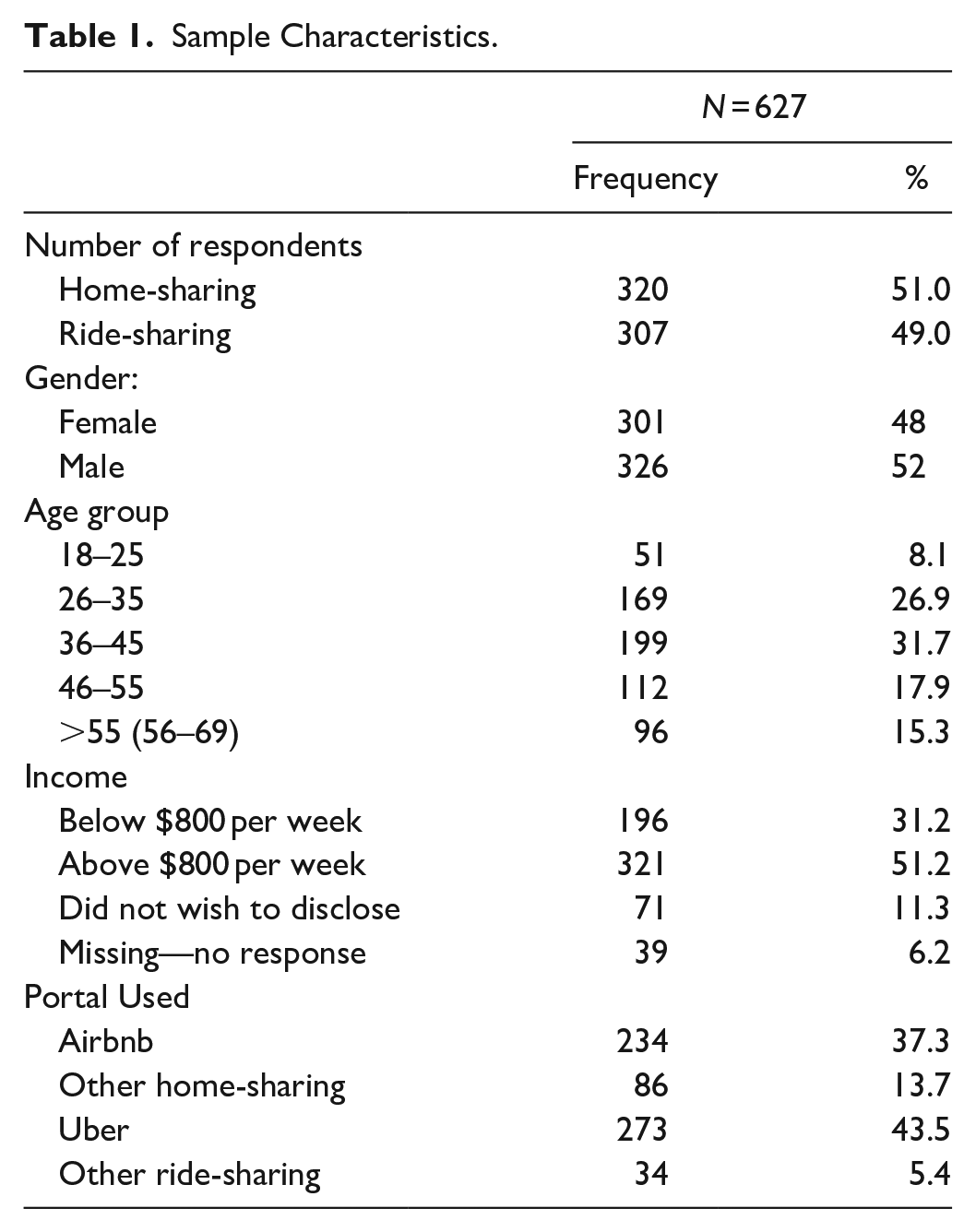
The sample consisted of 627 respondents, of which 51% and 49% answered the online survey for home and ride sharing services, respectively. The respondent for each service had used their nominated service at least once in the last 12 months. Information about their gender, age, and portal used are shown in Table 1.
Sample Characteristics.
Measurement Model Assessment and Refinement
The overall measurement model consisted of seven first order and one second-order constructs with 30 and 12 reflective indicators, respectively. Considering that the measurement scales were adapted from the existing literature, CFA was conducted to test how well the measurement theory matches the data (Hair et al., 1998).
The model was refined based on the initial CFA results by excluding the items with low standardized loadings (<0.50). The estimated indices for the overall sample are as follows: χ2 = 620.01, df = 319, p = .000, CMIN/df = 1.94, CFI = 0.977, TLI = 0.977, and RMSEA = 0.039. The fit indices (see Table 2) for the overall and two sub-samples show a good fit between the theoretical measurement model and the data.
Measurement and Structural Model Fit Indices.

The standardized loadings of all items are in the range of 0.54 to 0.99. The AVE values are in the .50 to .99 range, indicating satisfactory convergent validity (see Table 3). The CR values ranging from .74 and .99 are higher than what Kline (2016) considers acceptable standards for exploratory research.
Construct Reliability and Validity.

The squared correlation coefficients of the 28 pairs of constructs shown in Table 4 are smaller than their respective AVE values, indicating no problem with discriminant validity (Fornell & Larcker, 1981).
Discriminant Validity.

Note. Values below the diagonal represent the squared correlation coefficients; values along the diagonal represent the average variance extracted (AVE).
Common Method Variance (CMV)
In addition to the steps taken to control for CMV in the questionnaire design phase, post hoc statistical tests were also conducted. The most widely used Harman’s single factor test showed that at least seven factors were necessary to account for the variance in the variables. This outcome indicates that the amount of CMV present is not substantial (Podsakoff et al., 2003).
A further test was undertaken using the correlational marker technique Lindell and Whitney (2001) developed. According to this technique, the best estimate of CMV is represented by the smallest observed positive correlation between substantive and marker variables (Richardson et al., 2009). Using the Lindell and Whitney (2001) test, all the observed variables in the current data set were subjected to binary correlation analysis. It was found that the smallest correlation was between the items “Using X allows me to live thriftily” and “I was not happy during the home/ride-sharing service experience,” which had an estimated correlation coefficient of .005 with a p-value of .894. This statistically not significant correlation that technically equals zero represents the best estimate of CMV in this study.
Structural Model Estimation Results
The structural model was estimated using maximum likelihood. The hypotheses test results for the overall and subsamples are shown in Table 5.
Hypotheses Test Results.

Process value items negatively stated.
p < .001.
The model, as earlier described, consists of three antecedents to service co-creation, namely, customer operant resources, operator’s operant resources, and cost-saving motive (H1–H3).
Co-creation is proposed to affect service process and service outcome value (H4–H5), which in turn affects satisfaction (H6–H7), and, subsequently, post-experience behavior (H8).
The results for the overall sample showed a good fit between the proposed model and the data. The indices are as follows: χ2 = 789.33, df = 336, p = .000, CMIN/df = 2.349, CFI = 0.965, RMSEA = 0.046, and TLI = 0.958. The standardized loadings shown in Table 5 indicate that both the customer’s and operator’s operant resources are statistically significant in determining service co-creation. The third antecedent, cost-saving motive, likewise has a significant coefficient.
Table 5 also shows that service co-creation has a significant effect on both process value and outcome value, which in turn affect satisfaction and, finally, post-experience behavior. The data from the combined sample of 627 home-sharing and ride-sharing respondents provide statistically significant support for hypotheses 1 to 8 at α = .05.
Cross-Service Analysis
The analysis was replicated on each of the two services, that is, ride-sharing and home-sharing using their respective data. The indices for the measurement model in Table 2 show a good fit between the model and the data, implying metric invariance between the two sub-samples. Likewise, the structural model’s fit indices show that the overall model is supported by the data, thereby establishing the model’s validity for both services.
The estimated structural model results also show that the three antecedents of service co-creation explain 51% of the variation for ride-sharing, 58% for home sharing, and 55% for the two services combined. In terms of satisfaction, the proposed model explains 72% of the variation for ride-sharing, 81% for home-sharing, and 76% for both services. The results for post-experience behavior are in the range of 77% to 79%.
The standardized path coefficients for the hypothesized relationships shown in Table 5 indicate strong support for the proposed model for both sharing services except for minor differences. The levels of significance of the effects of customers’ operant resources (H1) and cost-saving motive (H3) on service co-creation are slightly lower in the ride-sharing sample (p = .002 and .009, respectively). On the other hand, the hypothesized relationship between process value and satisfaction is significant only at the .065 level in the home-sharing sample. All other hypotheses are supported at α < .001 in both sub-samples. Both the measurement and structural models were estimated using the software package SPSS AMOS 25.0.
Discussion
The study’s results support all eight hypotheses, confirming the co-creation model with only minor statistical differences between the home and car sharing sectors. The statistical support for H1 and H2 shows that the operant resources of both customers and operators contribute positively to service co-creation. However, the latter tend to have a greater influence than the former. The more positively customers perceive the operator’s knowledge, the greater their participation in co-creating their home and car sharing experiences. This finding is consistent with that of traditional hotels (González-Mansilla et al., 2019). Those that allow or encourage customers to play an active role in service design and delivery tend to attract higher levels of co-creation.
The hypothesis about the cost-saving motive (H3), as shown in Table 5, is supported in both sectors, albeit at a slightly lower p-value in home-sharing. The significant impact of cost-saving is consistent with Boateng et al. (2019) and Zervas et al. (2017). In previous studies on car sharing (car2go) and online platform accommodation sharing (Airbnb), Möhlmann (2015) found a significant relationship between cost-saving and satisfaction. The ability of the sharing economy to provide accommodation and transport services at a lower cost is a competitive advantage traditional hotel and taxi operators are fearful of (Altinay & Taheri, 2019).
In the current study, the value of service co-creation was measured in terms of both process and outcome. This bi-dimensionality supports the view that value-in-use is created during usage and that value is not determined only at the end of the process (Grönroos & Voima, 2013; Parasuraman et al., 1985). Distinguishing between process and outcome is essential in the sharing economy because its experiential value could affect the likelihood of choosing a sharing option (Möhlmann, 2015).
The hypothesized positive effects of co-creation on the outcome (H4) and process values (H5) are statistically significant in the home and ride-sharing samples. The greater impact on outcome value is confirmed in both sectors. Likewise, the results show that both process and outcome significantly affect satisfaction (H6 and H7), although the p-value for ride-sharing is slightly higher than .05. Outcome value has a relatively greater impact on customer satisfaction in home-sharing than in ride-sharing, possibly because it is more time-intensive and requires a higher financial outlay. These results contrast with those in B2B service encounters where process plays a more prominent role (Luu et al., 2016). These findings clearly suggest the need to distinguish between process and outcome values. These are obviously two different aspects of a service experience. Finally, the hypothesized positive effect of satisfaction on post-experience behavior (H8) is supported in both the home and ride-sharing sectors. Those satisfied with their co-created sharing experience would say positive things and encourage or recommend Airbnb, Uber, and other sharing services to their friends and relatives.
Theoretical Contributions
The current research extends the literature on S-D logic and contributes to theory development in several ways. First, it conceptualizes participation in the sharing economy as a co-creation phenomenon wherein the customer is an active party or actor in generating their accommodation or travel experience type, quality, and outcomes. The tourist or traveler brings operant resources into the process, which in a digitized sharing context rest primarily on internet knowledge and skills. The strong empirical support for the proposed model provides convincing evidence that the fundamental propositions of S-D logic (Vargo & Lusch, 2016) is applicable and relevant in developing a better understanding of customer behavior in the sharing economy.
Second, the co-creation activities of the tourist or traveler were systematically identified and tested. As a co-creator, the customer is actively engaged in information sharing, interaction, and the tasks required to co-create the service (McColl-Kennedy et al., 2012; Ranjan & Read, 2016). Based on extant literature and empirically supported by the data, these activities highlight the practical aspects of service co-creation. It answers the research question about how customers co-create a service of which they are a beneficiary.
Third, unlike previous studies (e.g., Opata et al., 2021), the current study provides a more explicit explanation about the link between value co-creation and customer satisfaction. It also distinguishes between the outcome value and process value (Luu et al., 2016). These empirically supported theoretical details provide deeper insights into the concept of value co-creation and its application in services marketing.
Managerial Implications
The results have several implications for service providers and platform operators. A critical sense from H1 is that service providers can expand their customer base by targeting customers with lesser operant resources through their platform operators. For instance, attracting those with less internet experience may be achieved by making registration and bookings easier with more straightforward instructions and user-friendly websites. Furthermore, easy to use platforms contribute to technology satisfaction which studies (e.g., Siyal et al., 2021) have shown to create system loyalty or repeat customers.
The strong support for H2 implies that future promotions by property owners and platform operators should emphasize their flexibility and capability to customize and meet the varying needs of customers. As the platforms give tourists access to a wide range of properties and vehicles of various sizes and equipment, the likelihood of finding one that matches their requirements is high. The results also strongly suggest that process value in terms of the enjoyment and social benefits gained during a sharing experience should be highlighted in addition to cost-saving when promoting a sharing service.
In creating a satisfying co-creation experience, information sharing implies that operators should encourage or make it easy for tourists to provide relevant and vital information that will accurately indicate their needs and preferences. This implication is consistent with the suggestion from previous studies that tourism service providers should facilitate information seeking by their customers (Eletxigerra et al., 2021). Unlike in a traditional hotel or taxi service where the customer expects to be served, the results imply that service operators in a sharing economy could leverage the finding that customers are willing to do their part in co-creating an enjoyable sharing experience.
Limitations and Future Research
While the study contributes to the sharing economy literature, it inevitably has some limitations. The sample consisted of domestic home and ride-sharing customers only. It is possible that if international travelers were involved that the results would be different. Although the sample size is reasonably large at 627 respondents, it was not large enough to determine whether or not the results would be different for various sub-samples, such as high versus low-income respondents. The model focused mainly on the economic or cost-saving objectives in terms of motives. Future research should address these limitations, especially that some studies (Böcker & Meelen, 2017; Curtis & Lehner, 2019) have linked customer motives to sustainability and social identity. It would also help to apply the same framework to other services such as food delivery (Furunes & Mkono, 2019) or intangible services such as expertise and ability (Rafael et al., 2019) and to take the perspectives of platform operators, homeowners, and car owners (Hartl et al., 2020).
A post hoc unforeseen limitation is that sharing economy platforms and services have been severely disrupted by restrictions associated with COVID-19. Lockdown/stay-at-home orders have seriously curtailed and, in more extreme situations, stopped all Airbnb and Uber activities. Notwithstanding current issues and challenges with tourism and hospitality being markedly impacted by COVID-19 conditions, recovery within the industry could benefit from the innovation of critical services or enhanced customer participation in value co-creation under the S-D logic framework.
Conclusion
The sharing economy has evolved from a casual source of supplementary income for the home and car owners with underutilized capacity into a global service industry. The popularity of platform-based service providers led by Airbnb and Uber has amplified the need for a theory-based consumer behavior model in the sharing economy.
The current study contributes to both sharing economy and S-D logic literature an empirically tested model of service co-creation. The model identifies the factors contributing to and the consequent outcomes from co-creation. Unlike in a traditional hotel and taxi service where the customers wait to be served, they are ready, and keen to help co-create the service they want in the sharing economy. Participation in co-creation is, however, influenced by the customer’s capabilities and cost-saving motive and the perceived capacity of the service provider. Although the benefits gained tend to outweigh the quality of the experience, both contribute significantly to customer satisfaction and subsequently to post-experience behavior.
This Australian study empirically validates the foundation premise that customers are active co-creators of value. It also confirms the relevance and applicability of the S-D logic framework to the sharing economy. It is envisioned that future research will contribute to developing this perspective and advancing its applications in the peer-to-peer sharing economy.
Footnotes
Appendix

| Customer’s operant resources |
| I have used my experience from previous trips to make my most recent home/ride sharing hassle-free |
| I know how to book a home/ride sharing service through the internet |
| I know how to handle a situation in which accommodation/transportation is overbooked a |
| I know how to search for accommodation/transportation information in the internet |
| I predominantly organized the home/ride sharing trip by myself |
| Operator’s operant resources |
| X b was knowledgeable about the procedures, policies, and practices of a [transport/accommodation] service a |
| X is worse than a [taxi/hotel] in relation to their ability to tailor the service to individual customer needs a |
| X is worse than a [hotel/taxi] in relation to their ability to provide good service to their customers a |
| The operator of X knows a great deal about [transport/accommodation] services |
| X have a good knowledge of the [transport/accommodation] sector |
| Cost saving motive |
| I use X because by doing so, I can cut costs |
| Participating in the sharing economy does not benefit me financially—(reverse coded) a |
| I use X because it is cheaper than other [transport/accommodation] services |
| Using X allows me to live thriftily |
| Service outcome value |
| X gave me what I need a |
| X provided me the benefits I want a |
| The benefits I received from X were good |
| The service I received from X was reasonable |
| Service process value |
| X gave me a bad experience |
| I did not feel good during the [car/house sharing] experience |
| I did not have an enjoyable time |
| I was not happy during [car/house sharing] experience |
| Satisfaction |
| I am really glad I used X home/ride sharing service My experience with X has met my expectations Overall, I am satisfied with my home/ride sharing experience |
| All in all, I feel that this home/ride sharing experience has enriched my life |
| Information sharing |
| I clearly explained what I wanted from the host or property owner |
| I communicated with the [driver/property owner] prior to my trip a |
| I provided the necessary information so that X could perform his/ her duties well |
| I gave the driver/host specific information regarding my trip a |
| Personal interaction |
| I was not friendly to the host/driver (reverse coded) a |
| I was polite to the host/driver |
| I was courteous to the host/driver |
| I did not act rudely to the host/driver |
| Responsible behavior |
| I performed all the tasks required by X |
| I complied with all the conditions of X a |
| I fulfilled my responsibilities as a guest/passenger |
| I did not follow the instructions or directives of the host/driver (reverse coded) a |
Items deleted due to low (<0.50) CFA factor loadings.
[X] refers to the sharing platform used by the respondent.
Declaration of Conflicting Interests
The author(s) declared no potential conflicts of interest with respect to the research, authorship, and/or publication of this article.
Funding
The author(s) received no financial support for the research, authorship, and/or publication of this article.
Ethical Approval
Western Sydney University Human Ethics Review Committee—Reference Number H12396
