




Abstract
This research paper examined the continued intention of college students to use DiDi mobile car-sharing services in China. The unified theory of acceptance and use of technology (UTAUT) was used as the theoretical framework while the data analysis was completed with SPSS. The results have demonstrated that performance expectancy, reliability, efficiency, and security and privacy were significant predictors of the continued intention to use mobile car-sharing services. Contrary to our expectations, effort expectancy was not a significant determinant of the continued intention to use mobile car-sharing services. In addition to these direct effects, the moderating impact of trust in the internet was also examined. The moderating analysis showed that trust in the internet showed no significant moderating impact on the relationship between performance expectancy, effort expectancy, reliability, efficiency, and security and privacy and the continued intention to use mobile car-sharing services. The implications of these findings are discussed.
Introduction
The concept of car-sharing service is considered as an important option as compared to other means of sustainable transportation and mobility (Paundra et al., 2017). The car-sharing industry is based on the sharing economy principles. The development and availability of information and communication technology (internet and web technologies) have provided the foundation for the adoption/facilitation of sharing economy principles, which permit individuals to communicate, coordinate, and build trust and confidence with others (Albinsson & Yasanthi Perera, 2012; Belk, 2014; John, 2013; Martin, 2016). The sharing economy principle is an economic arrangement between or among individuals who share and use underutilized resources or assets (Bardhi & Eckhardt, 2012; Cohen & Kietzmann, 2014; Zervas et al., 2017) for mutual benefits. The sharing economy is also defined as the peer-to-peer action which involves acquiring, giving or sharing the access to goods and services, experiences, knowledge and collaboration via online services to ensure societal well-being/welfare (Fraiberger & Sundararajan, 2017; Gargiulo et al., 2015; Hamari et al., 2016). Extended, the sharing economy is seen as an integrated and collective system of entrepreneurs and consumers who attempt to leverage technology to share and maximize the use of resources, save money, and generate capital (Cohen & Shaheen, 2018). The car-sharing services can be categorized into online and offline services (Cheng et al., 2018). The online services involve the services conducted online, reservation, electronic payment as well as user reviews and offline services when the individual user is picked up in the car (Cheng et al., 2018).
Car sharing is a situation where a car is utilized by many or several other people (Fleury et al., 2017). Car sharing is also considered as the shared use of a vehicle fleet for members on a need-and-demand basis, and a shared car could be in the form of round trip, one way, peer to peer, and fractional (Martin & Shaheen, 2016; Stocker et al., 2016). The round-trip car sharing enables the user to start and end a trip at the same vehicle location, whereas the one-way car-sharing enables members to start a trip and end a trip at different locations (Martin & Shaheen, 2016). In addition, the peer-to-peer car-sharing operates like the round-trip car sharing but in this case the vehicle flight is usually owned/leased by private individuals and facilitated by a third-party operator (Martin & Shaheen, 2016). The fractional car-sharing model enables consumers to co-own a vehicle and share its costs and use (Martin & Shaheen, 2016). The car-sharing concept enables the individual to enjoy and have access to a private car within a period of time without necessarily having to own it (Baptista et al., 2014; Shaheen et al., 2002). Car sharing is not expensive as compared to the use of personal cars; individual users can travel within short distances than with a personal car, and it can reduce the number of cars on the roads (Fleury et al., 2017; Seik, 2000). Users can get access to vehicles by payment of fees and usage rate which is calculated based on the distance to be covered (Baptista et al., 2014). Car sharing can be substitute mobility for those who do not have or own a private car or means of transport and complement to public transportation which provides options for commuters (Ferrero et al., 2017; Fleury et al., 2017; Shaheen & Cohen, 2013). Car-sharing services have an impact on both environmental sustainability and personal efficient and rational mobility of the user (Baptista et al., 2014; Paundra et al., 2017). A shared car has the potential to remove about nine to 13 private cars off the roads which consequently reduces the level of air pollution, traffic jam, and increase in the number of parking spaces (De Luca & Di Pace, 2015; Efthymiou et al., 2013; Martin et al., 2010). Car-sharing can also ensure shared mobility for consumers. Shared mobility is an innovative transportation strategy that enables users to have short-term access to a mode of transportation on a needed basis (Cohen & Shaheen, 2018).
Data show that the proportion of online car users in the Chinese market were aged between 25 and 30 years and is the highest, accounting for 30.2% of the total users, and the proportion of net car users aged 25 to 35 is 50.9%. In terms of gender, the proportion of male users is higher than the proportion of female users (AiMedia, 2018). It was also indicated that, in the Chinese online travel market in 2017–2018, over 80% of users are willing to accept the use of online car travel. In the survey on the reasons for choosing to use the network to travel, 71.3% of the online car users indicated that they use the online car services because it saves time and 47% said because online cars have more favorable price and also the better riding environment is a major contributing factor for the users to use online car travel (AiMedia, 2018). DiDi is one of the car-sharing services in China. DiDi which was founded in 2012 is a Chinese-owned car-sharing services that combine artificial intelligence and autonomous technologies to provide services such as taxi hailing, car sharing, bike sharing, e-bike sharing, and express to its numerous consumers through their smartphones. The DiDi platform is the most widely used car-sharing services in China, and its sharing services range from round trip, one way, peer to peer, and fractional. The services are available to the broader Chinese community/society of which the university is part. It has been indicated that as of February 2016, a little over 84% of China’s mobile transportation ride-share orders were made through DiDi Chuxing (Statista, 2019). DiDi had since its inception expanded its operation to other regions of the world such as Australia, Brazil, Japan, and Mexico. It is estimated that about 550-million people use DiDi services and operates in about 400 Chinese cities such as Beijing, Shanghai, Changsha, Guangzhou, Shenzhen, Hangzhou, Ningbo, and Harbin. At the end of 2018, the annual volume of DiDi auto services reached 37-billion RMB ($5 billion). It has 21-million registered drivers of which 2.3 million are women (10%). In 2017, the platform provided more than 7.43-billion mobile travel services to 450-million users in more than across various cities in China (AiMedia, 2018). It is further estimated that the daily orders reached 25 million on the DiDi platform (AiMedia, 2018).
The purpose of this study is to examine the continued intention of college students to use the DiDi mobile car-sharing services in the city of Ganzhou. College students are considered one of the important market segments for car-sharing service providers due to the fact that they have an extremely dynamic life and exhibit certain characteristics such as frequent movement, low car ownership, heavy usage of smartphones, sharing propensity, commuting to the city center, and multi-mode oriented usage (Martin & Shaheen, 2011; Rotaris et al., 2019). Car-sharing services, therefore, provide opportunities for college students to have access to cars for easy sustainable mobility without having to own one. This study thus seeks to contribute to the car-sharing economy literature by exploring the moderating impact of consumer trust in the internet on performance expectancy, effort expectancy, service reliability, service efficacy, and security and privacy and the continued intention to use DiDi mobile car-sharing services. The research questions to be explored are as follows:
The rest of the research paper is presented in this manner: Research theoretical framework and hypotheses development, research model, research methodology, results and data analysis, discussion, conclusion, and limitations of the study.
Research Theoretical Framework and Hypotheses Development
UTAUT Model
The unified theory of acceptance and use of technology (UTAUT) model is an extension of the technology acceptance model (TAM) developed by Davis (1989) and Davis et al. (1989). The UTAUT model examines the influence of information technology and its related applications on individual adoption behavior (Venkatesh et al., 2003). The UTAUT model is an integration of other technology adoption models such as TAM, theory of planned behavior (TPB), theory of reasoned action (TRA), and the innovation diffusion theory (IDT). The UTAUT model has been applied extensively covering different areas such as e-government (Faulkner et al., 2018; Mansoori et al., 2018; Verkijika & De Wet, 2018), m-government adoption (Alomari, 2018), electronic voting machine (Chauhan et al., 2018), e-commerce adoption/online/mobile shopping (Chopdar et al., 2018; Gupta et al., 2018; Singh & Matsui, 2018), mobile payment (Cao & Niu, 2019), health information systems/e-health/m-health (Bawack & Kamdjoug, 2018; Hoque & Sorwar, 2017; Jewer, 2018), internet banking/online banking (Abbas et al., 2018; Rahi et al., 2018; Zendehdel et al., 2018), and e-learning (Khan, 2018; Lashayo & Johar, 2018; Lawson-Body et al., 2018) to examine the user behavior toward new technologies. The UTAUT model has three main determinants of the behavioral intention to use. These are performance expectancy, effort expectancy, and social influence while facilitating conditions determine both the intention to use and actual user behavior (Venkatesh et al., 2003). These relationships between these four constructs and the behavioral intention to use are moderated by gender, age, education, experience, and voluntariness of use (Venkatesh et al., 2003).
Performance Expectancy
Performance expectancy is defined as the individual user confidence that the use of new information technology and its related applications will contribute to his or her job performance (Venkatesh et al., 2003). The extent to which a consumer is convinced that using an online service will aid in achieving the expected services will have an impact on their intention to adopt and use such technological services like the carpooling services. Studies have shown that performance expectancy is a significant predictor of the behavioral intention to use (Fleury et al., 2017; Huang & Chen, 2017; Lan & Zhu, 2016; Leicht et al., 2018; Rahi et al., 2018). Consequently, H1 was proposed.
Effort Expectancy
Effort expectancy is considered the user understanding that using new technology will be ease of use (Venkatesh et al., 2003). The manner in which a new technology service is adopted and used is largely dependent on the consumer’s ability to navigate and use such technologies without any troubles or challenges which will have an effect on their behavioral intention to use. Previous studies have demonstrated that effort expectancy has a positive significant impact on the behavioral intention to use (Fleury et al., 2017; Huang & Chen, 2017; Lan & Zhu, 2016; Leicht et al., 2018; Rahi et al., 2018). Accordingly, H2 was proposed.
Reliability
Reliability is one of the dimensions of service quality. Reliability is considered the extent to which an expected service is delivered or performed accurately and dependably (Parasuraman et al., 1985, 1988). The reliability of service quality has the potential to have an enormous effect on the survival of businesses, and it is considered the most important dimension in the SERQUAL (Baumann et al., 2007; Kassim & Souiden, 2007; Omar et al., 2015). Some characteristics or attributes of reliability dimensions are the accurate delivery of service, complete order of service, being truthful, keeping service promise, accurate online booking, and website availability (Omar et al., 2015). The extent to which car-sharing services are reliable will have a consequent effect on the decision of users to continue to use such services. Studies have shown that the reliability of service quality is a significant predictor of the intention to use (Hoque & Sorwar, 2017; Ramamoorthy et al., 2018). Accordingly H3 was proposed.
Efficiency
Efficiency from the customer perspective is the availability of effective systems to enjoy service delivery. Car sharing has the capacity to enhance the mobility efficiency of the consumer (Alencar et al., 2019; Mattia et al., 2019; Tuominen et al., 2019). Efficiency has been demonstrated to have direct significant impact on consumer satisfaction (Hammoud et al., 2018). Accordingly, the extent to which car-sharing services are considered by the consumer to be efficient in terms of contributing to getting to the desired destination in and on time can influence their intention to continue to use such services. Hence, H4 was proposed.
Security and Privacy
The security and privacy protection of the consumer is an important contributing factor for the consumer to engage in any online service provision or technology. The fear of misuse of information provided during interaction online to other unauthorized persons is of importance to the consumer. As technology expands and grows, it becomes increasingly vital for organizations to be put in place measures to protect consumers’ information in order to prevent security and privacy breach (Skolmen & Gerber, 2015). The level of uncertainty expressed by the consumer with regard to security and privacy of personal information can impede or hinder the adoption of new technologies as well as online services adoption (Skolmen & Gerber, 2015). Studies have indicated that issues of security and privacy have an impact on the intention to adopt and use (Ando et al., 2016; Lallmahamood, 2007; Vasileiadis, 2014; Wang & Lin, 2017). Consequently, H5 was proposed.
Consumer Trust in the Internet
Trust in the internet has been indicated as the major determinant of the adoption of e-services and new technologies (Carter & Bélanger, 2005; Warkentin et al., 2002). Consumer trust in the internet in terms of its ability to protect his or her transactions from being breached by third parties is fundamental to drive the adoption of technologies such as DiDi car-sharing services. Previous studies have indicated the positive impact of trust in the internet on the behavioral intention to use (Alalwan et al., 2018). Trust in the internet has been explored to moderate significantly the impact of attitudes toward use and the intention to use online services (Mangin et al., 1970). In addition, trust was demonstrated to moderate first the impact of perceived risk on consumer satisfaction and second the impact of perceived risk and the consumer re-purchase intentions (Chen et al., 2015). In this study, we are testing the trust in the internet as a moderator, moderating the impact of performance expectancy, effort expectancy, reliability, efficiency, and security and privacy on the intention to use DiDi mobile car-sharing services. Accordingly, H6, H7, H8, H9, and H10 were proposed.
Research Model
Based on the research hypothesis developed, this study will explore the research model depicted in Figure 1. Performance expectancy, effort expectancy, reliability, efficiency, and security and privacy are expected to have a direct impact on the continued intention to use DiDi mobile car-sharing services. The consumer trust in the internet is expected to moderate the impact of these factors on the continued intention to use.

Research model.
Research Methodology
The data for this study were acquired through a research question that was developed and administered online. The survey was developed on an online website (www.wenjuan.com) and then shared through the Chinese social media platform such as WeChat for respondents (students) within the university community (Jiangxi University of Science and Technology in Ganzhou) to complete. The study was focused on Jiangxi University of Science and Technology because of, first, the authors’ familiarity and knowledge of this institution and the City in which this university is located and, second, the author’s observation of the higher frequency with which the students of the university use the DiDi car-sharing services. The constructs of the instrument were adapted from previous studies but were modified to reflect the content of this study. Performance expectancy, effort expectancy, and behavioral intention to use were adopted from Venkatesh et al. (2003); reliability and efficiency from Alawneh et al. (2013) and Asad et al. (2016); security and privacy from Alawneh et al. (2013) and Sikdar et al. (2015); and trust in the internet from Dutton and Shepherd (2006) and Wangpipatwong et al. (2005). Questionnaire items were first developed in English before it was translated into Chinese. The items were measured on a 5-point Likert-type scale ranging from 1 = strongly disagree to 5 = strongly agree. The questionnaire items used are attached as appendix.
Piloting and pretesting was undertaken before the data collection section online. Piloting and pretesting of the questionnaire were necessary to avoid likely problems that respondents may have in responding to the questions and also to anticipate any challenges that may arise with the data analysis. It was also aimed at assessing their understanding of the problem, the format of the questionnaire, the response time, and the nature of the scales used. The feedback received during the piloting and pretesting to about 70 students who would be respondents were helpful in restructuring some of the items in the questionnaires which reduced the level of ambiguity. It took about 3 months (October-December 2018) for the data to be gathered online. After the specified period for the completion of the online questionnaire, a total of 225 responses were elicited out of the targeted sample size of 500 students. This accounted for 45% of the targeted number of respondents. The sample size was calculated using three variables such as the population (36,000 students—estimated number of students at the university) size, the margin of error (5%), and confidence level (95%). With this calculation (see, for formula, https://www.sur-veymonkey.com/mp/sample-size-calculator/), the minimum estimated sample size should be 381 but we extended and rounded it up to 500 sample size. The captured data were analyzed with SPSS.
Results and Data Analysis
Demographic Statistics
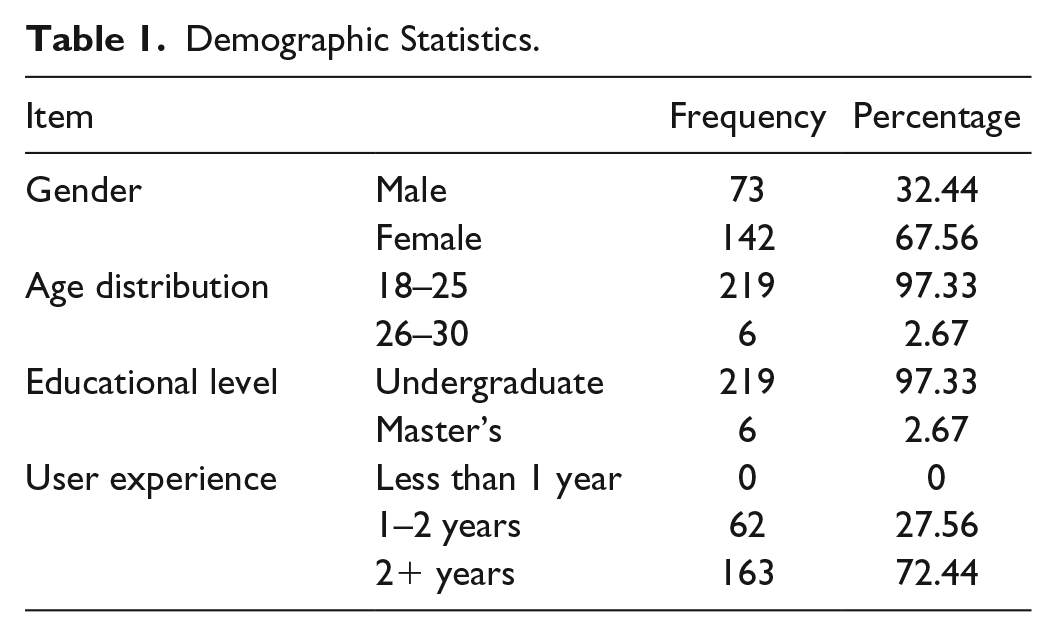
The demographic statistics of the respondents are shown in Table 1. The majority of the respondents were female students (67.56%). Also, the majority of the respondents were between the ages of 18 and 25 years (97.3%) while the majority of them were undergraduate students (97.3%). In term of years of experience with the DiDi mobile car-sharing services, the majority indicated that they have had two years and above (2+) experience using the DiDi mobile car-sharing services (72.4%).
Demographic Statistics.
Descriptive Statistics
Before the statistical examination of the constructs proposed in this article, a simple descriptive analysis of the mean, variance, and related relationships of the variables was conducted. The results of the descriptive statistics and correlations of the variables are shown in Table 2. As indicated in Table 2, there is a significant positive correlation between the variables such as performance expectations, effort performance, reliability, efficiency, privacy and security, trust in the internet and continued intention to use. The above results provided the basis for the analysis of the relationship between the relevant variables in this study. In general, the outcome of the descriptive analysis and correlation between the variables basically met the hypothetical expectations of the study.
Descriptive Statistics and Correlation Analysis.
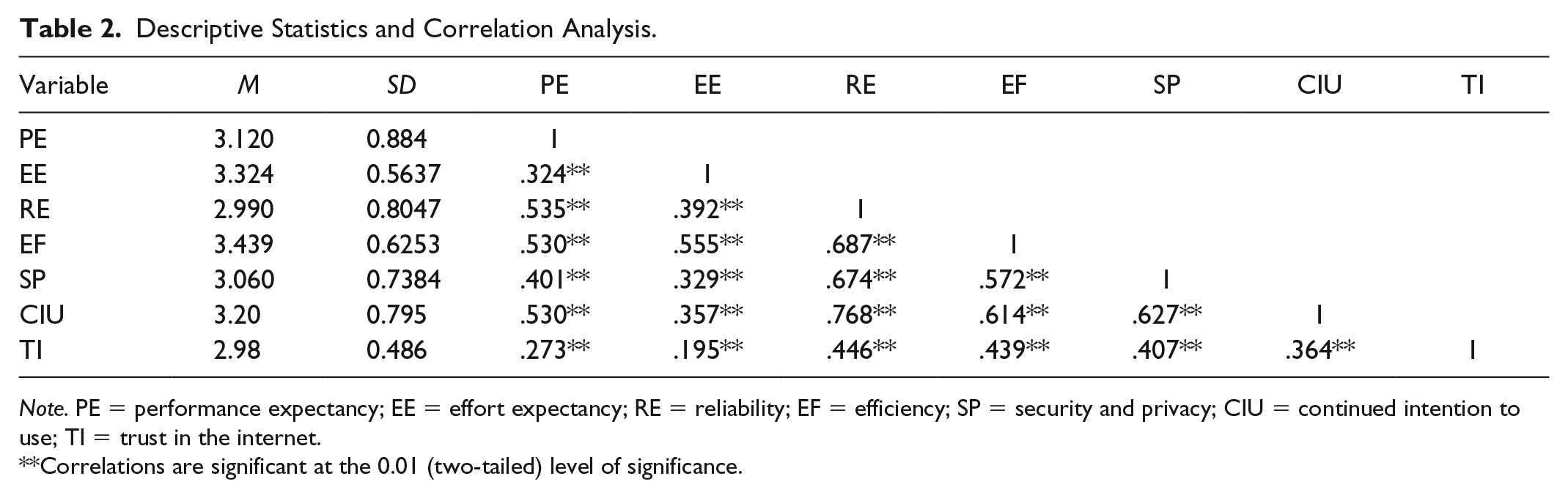
Note. PE = performance expectancy; EE = effort expectancy; RE = reliability; EF = efficiency; SP = security and privacy; CIU = continued intention to use; TI = trust in the internet.
Correlations are significant at the 0.01 (two-tailed) level of significance.
Measurement Model
The results of the quality criterion, reliability, and validity of the constructs used in this study are shown in Table 3. The reliability and validity of the constructs were determined through the analysis of the composite reliability, Cronbach’s alpha, average variance extracted (AVE), and factor loadings. The reliability indicator for factor loadings for each item is recommended to be .70 (Hair et al., 2010). The indicator reliability for Cronbach alpha and composite reliability are respectively recommended to have values above .70 and .80 (Henseler et al., 2009). In addition, the values for AVE should have a minimum value of 0.50 (Hair et al., 2010). As indicated in Table 3, all the recommended values for the indicator reliability for factor loadings, Cronbach’s alpha, composite reliability, and AVE were all met. In addition, the discriminant validity of the constructs was also conducted by using the Fornell–Larcker criterion principle. The results of the discriminate validity are shown in Table 4. The Fornell–Larcker principle states that there is discriminant validity if the square root of the AVE (shown in bold in Table 4) is greater than the paired intercorrelations between the latent variables. As indicated in Table 4, the entire diagonal variables (square roots of the AVE) are higher than their equivalent off-diagonal values (paired intercorrelations). So it can be concluded that criteria for the Fornell–Larcker criterion was met and consequently affirming the discriminant validity of the scales used in this study.
Construct Validity and Reliability Analysis.
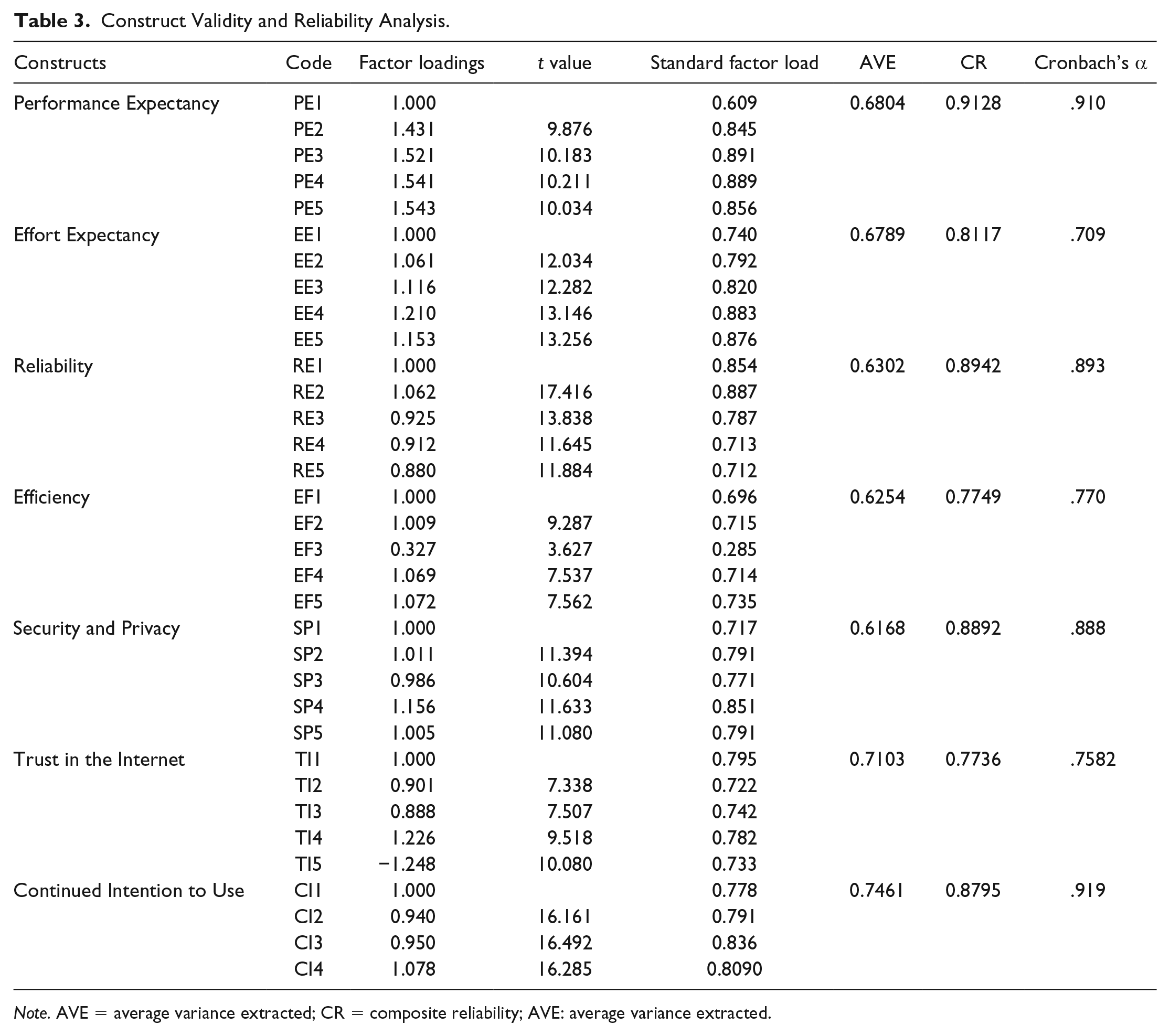
Note. AVE = average variance extracted; CR = composite reliability; AVE: average variance extracted.
Discriminant Validity.
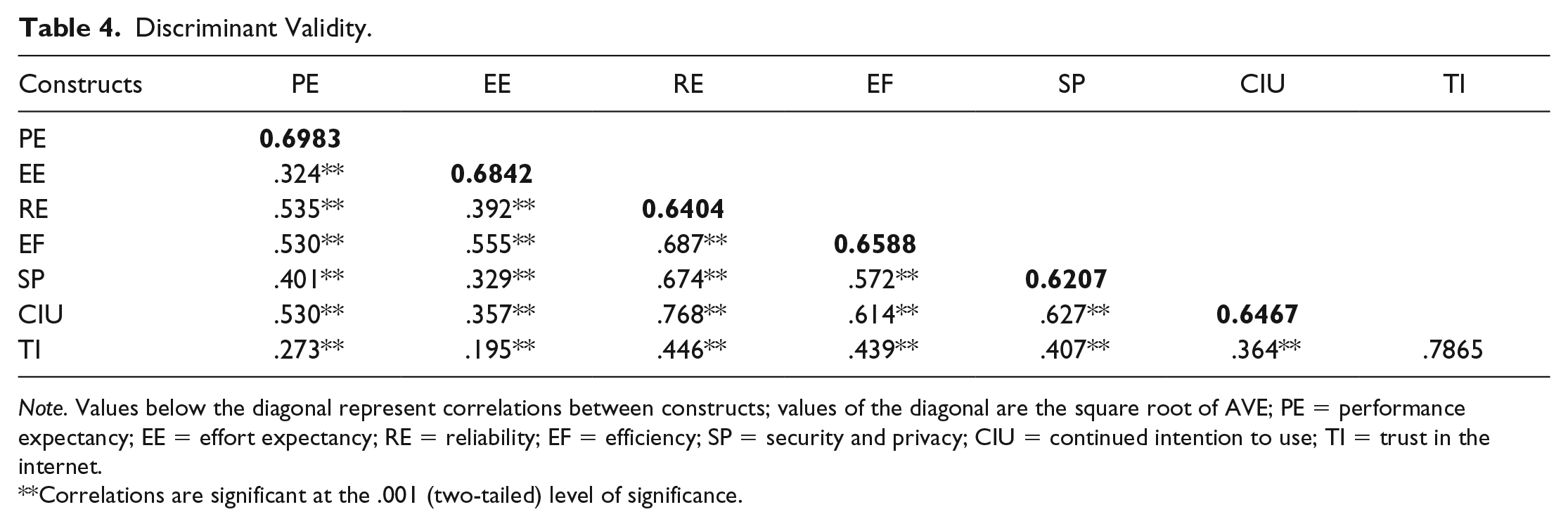
Note. Values below the diagonal represent correlations between constructs; values of the diagonal are the square root of AVE; PE = performance expectancy; EE = effort expectancy; RE = reliability; EF = efficiency; SP = security and privacy; CIU = continued intention to use; TI = trust in the internet.
Correlations are significant at the .001 (two-tailed) level of significance.
Structural Model
Direct effects
The results of the direct relationships between the variables considered in this study are shown in Table 5. All the direct relationships were statistically supported except for one of the relationships which was not supported. The results have shown that performance expectancy (β = .150, p < .05), reliability (β = .536, p < .05), efficiency (β = .152, p < .05), and security and privacy (β = .232, p < .05) were all significant determinant of the continued intention to use DiDi mobile car-sharing services. Accordingly, H1, H3, H4, and H5 were supported. It was, however, shown that effort expectancy does not predict significantly the continued intention to use DiDi mobile car-sharing services (β = −.048, p > .05). H2 was therefore not supported.
Main Effect Results Hypotheses.

Note. PE = performance expectancy; CI = continued intention to use; EE = effort expectancy; RE = reliability; EF = efficiency; SP = security and privacy.
Moderating effects
The results of the moderating analysis conducted are shown in Table 6, and the outcomes of the moderating effects are summarized in Table 7. The hierarchical regression method of analysis was adopted to examine the moderating effect of the trust in the internet on the relationship between performance expectancy, effort expectancy, reliability, efficiency, and security and privacy and the continued intention to use. This was tested with SPSS 23 software. As the test of moderating effects involves the interaction between the constructs, it is imperative that the extent of multicollinearity between the interaction term and the original variables is examined. To avoid the problem of multicollinearity, the relevant variables were normalized to have a mean of 0 and a variance of 1. To ensure the reliability and accuracy of the results that are guaranteed, three important statistical tests were further conducted for each construct. These tests are multi-collinearity, sequence-related, and heteroscedasticity problem tests.
Regression Coefficient.
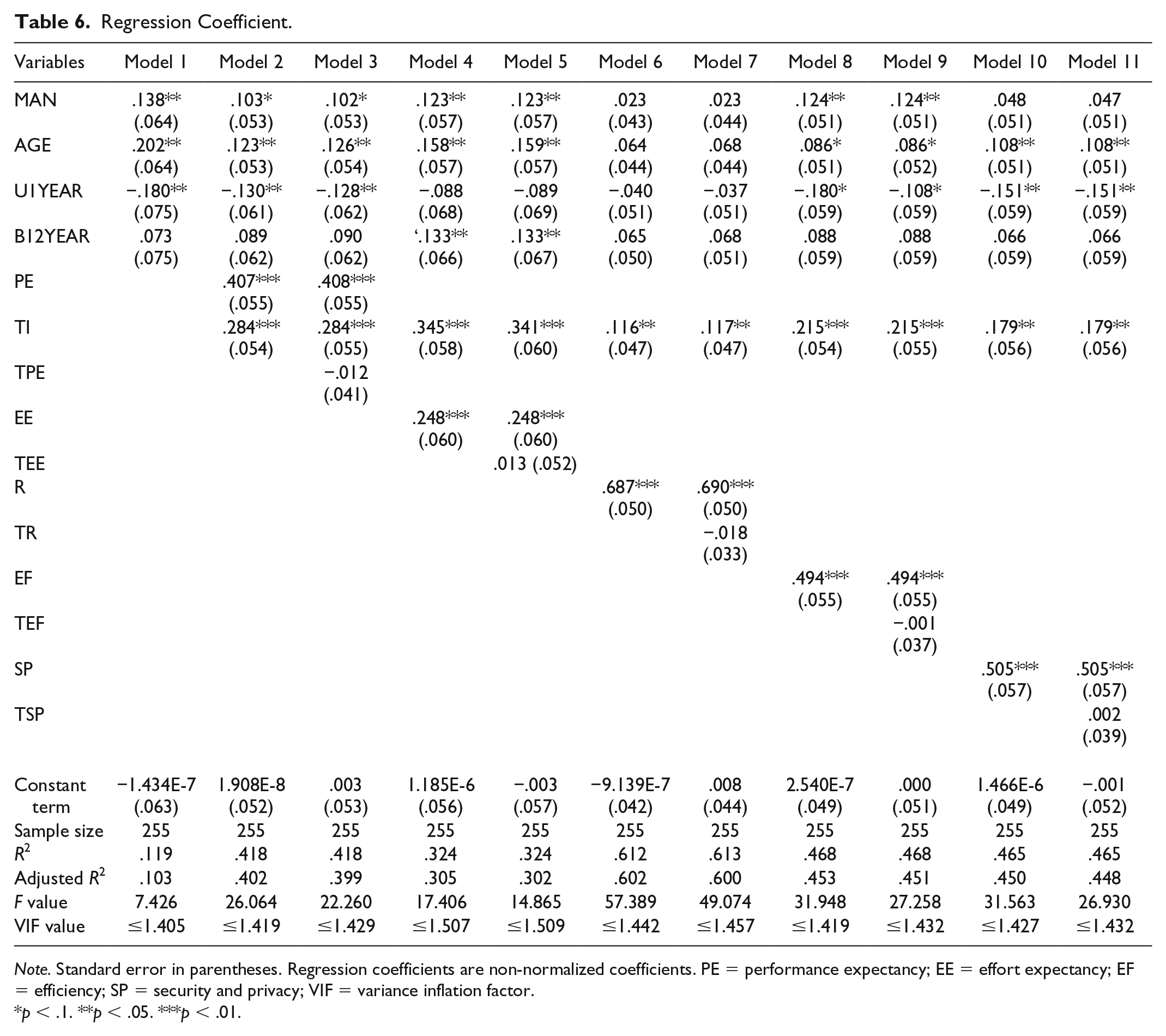
Note. Standard error in parentheses. Regression coefficients are non-normalized coefficients. PE = performance expectancy; EE = effort expectancy; EF = efficiency; SP = security and privacy; VIF = variance inflation factor.
p < .1. **p < .05. ***p < .01.
Moderating Effect Results Hypotheses.

Note. PE = performance expectancy; TI = trust in the internet; CI = continued intention to use; EE = effort expectancy; RE = reliability; EF = efficiency; SP = security and privacy.
Multi-collinearity problem test
The first test was multi-collinear problem test. Multi-collinearity means that the correlation between explanatory variables in a linear regression model is too high, making the model estimation to be distorted or difficult to estimate accurately. Common methods for testing multiple collinear problems are divided into two categories. First, the correlation coefficient judgment method generally considers that when the correlation coefficient between variables is lower than .8, it then means that there is no serious multi-collinearity problem. The analysis indicated in Table 6 shows that the correlation coefficients between the variables are less than .8, which indicates that there is no multicollinearity problem. Second, if the variance inflation factor (VIF) is less than 10, there is no multicollinearity problem. After testing the VIF index of each regression model in this study as shown in Table 6, it can be said that the VIF was less than 10. Based on these two assumptions we can, therefore, conclude that there is no serious multicollinearity in this study.
Sequence correlation problem test
The second test was the sequence correlation problem test. Sequence correlation problems have to do with the high correlation between samples of different periods. Theoretically, there is no sequence correlation problem, but this study is still tested using the Durbin–Watson (DW) value. It is generally considered that the DW value is between 1.5 and 2.5, which indicates that there are no sequence correlation problems between variables. After testing, the DW values of each regression model in this study, the results indicated that the values are between 1.5 and 2.5 as shown in Table 6. Therefore, it is believed that there is no sequence correlation problem in this study.
Test for heteroscedasticity problem
The third test was the test for heteroscedasticity problem. The heteroscedasticity problem is the variance of the explanatory variable exhibits a regular trend of the variable as the explanatory variable changes and is usually judged by using a scatter diagram. Our observation showed that the normalized residuals do not exhibit certain regularity with the standardized prediction values, and thus mean that there is no heteroscedasticity problem. Therefore, it was determined that there were no heteroscedasticity problems in each of the models in this study.
The results of the moderation effects
The hierarchical regression approach was used to determine the moderation impact of trust in the internet on the relationship between performance expectancy, effort expectancy, reliability, efficiency, security and privacy and continued intention to use. The results are divided into 11 models. The results are shown in Table 6. Model 1 is the basic model, including only the control variables such as age, gender, and user experience. The adjusted R2 is .103, indicating that Model 1 can explain 10.3% variation of the dependent variable, and the VIF value of each variable is less than 1.405. This is indicative that there is no multicollinearity problem in Model 1. Model 2 adds two variables, expected performance and trust in the internet, based on Model 1. The adjusted R2 is .402, indicating that Model 2 can explain 40.2% of the variation of the dependent variable, and the VIF values of each variable are smaller than 1.419, indicating that Model 2 does not have a multicollinearity problem as well.
Model 3 is a product term that increases the expected performance and trust in the internet based on Model 2. The adjusted R2 is .399, indicating that Model 3 can explain 39.9% of the variation of the dependent variable, and the VIF values of each variable are smaller than 1.429, indicating that Model 3 does not have a multicollinearity problem.
Model 4 adds two variables of effort performance and trust in the internet based on Model 1. The adjusted R2 is .305, indicating that Model 4 can explain the variation of the dependent variable by 30.5%, and the VIF value of each variable is less than 1.507 which indicates that there is no multicollinearity problem in Model 4.
In addition, Model 5 adds the product of effort performance and trust in the internet based on Model 4. The adjusted R2 is .302, indicating that Model 5 can explain the 30.2% variation of the dependent variable, and the VIF values of each variable are smaller than 1.509, which also indicates that Model 5 does not have a multicollinearity problem.
Also, Model 6 adds two variables, reliability and trust in the internet, based on Model 1. The adjusted R2 is .602, indicating that Model 6 can explain the variation of the dependent variable by 60.2%, and the VIF values of each variable are less than 1.442. This also means that there is no multicollinearity problem in Model 6.
Again Model 7 is a product term that increases the reliability and trust in the internet based on Model 6. The adjusted R2 is .600, indicating that Model 7 can explain the variation of 60% of the dependent variable, and the VIF values of each variable are smaller than 1.457, an indication that Model 7 does not have a multicollinearity problem.
Model 8 adds two variables, efficiency and trust in the internet, based on Model 1. The adjusted R2 is .453, indicating that Model 8 can explain the 45.3% variation of the dependent variable, and the VIF values of each variable are less than 1.419 which means that Model 8 does not have a multicollinearity problem.
Model 9 is a product term that increases the efficiency and trust in the internet based on Model 8. The adjusted R2 is .451, indicating that Model 9 can explain the 45.1% variation of the dependent variable, and the VIF values of each variable are less than 1.432. This is an indication that Model 9 does not have a multicollinearity problem. Furthermore, the Model 10 adds two variables of security and privacy and trust in the internet based on Model 1. The adjusted R2 is .450, indicating that Model 10 can explain the 45% variation of the dependent variable, and the VIF values of each variable are less than 1.427. This meant that Model 10 does not have a multicollinearity problem. Finally, Model 11 adds the product of security and privacy to the trust in the internet based on Model 10. The adjusted R2 is .448, indicating that Model 11 can explain the variance of 44.8% of the dependent variable, and the VIF value of each variable is less than 1.432. An indication that Model 11 does not have a multicollinearity problem.
Summary of the moderating effect of trust in the internet
Based on the above model analysis of the moderating impact in Table 6, the summary of the main results of the moderating effects is shown in Table 7. The results have demonstrated that trust in the internet does not moderate significantly the impact of performance expectancy (β = −.012, p > .05), effort expectancy (β = .013, p > .05), reliability (β = −.018, p > .05), efficiency (β = −.001, p > .05), and security and privacy (β = .002, p > .05) on the continued intention to use. Accordingly, H6, H7, H8, H9, and H10 were all not statistically supported.
The depiction of the validated research model is illustrated in Figure 2. The validated model accounts for about 79.7% of the factors predicting the continued behavioral intention to use DiDi mobile car-sharing services.
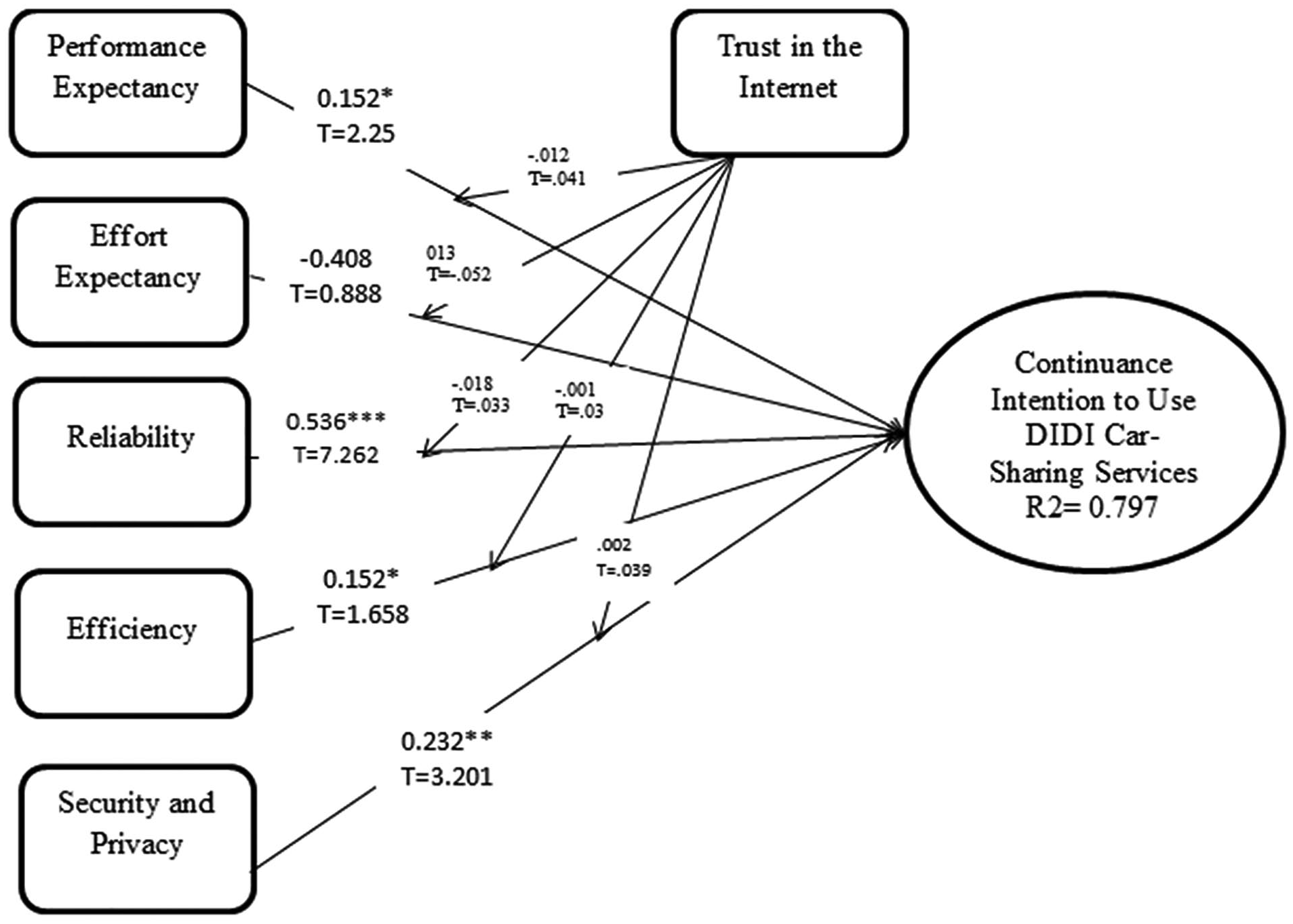
Validated research model.
Discussion
This study adopted the UTAUT model to investigate the factors influencing the continued intention of college students in China to use DiDi mobile car-sharing services. The results emanating from the data analysis have indicated that factors such as performance expectancy, reliability, efficiency, and security and privacy were significant determinants of the continued intention of college students to use the DiDi mobile car-sharing services. Against our anticipation, it was found that the effort expectancy of mobile car-sharing services was not a predictor of the continued intention to use the DiDi mobile car-sharing services. In addition, this study integrated the trust in the internet as a moderating variable on the relationship between performance expectancy, effort expectancy, reliability, efficiency, and security and privacy and the continued intention to use DiDi car-sharing services. The moderating analysis indicated that all the proposed moderating effects were not statistically supported. That is, trust in the internet does not moderate significantly and respectively the impact of performance expectancy, effort expectancy, reliability, efficiency, and security and privacy on the continued intention to use.
The significant impact of performance expectancy on the continued intention to use supports other studies which also have indicated the positive relationship between performance expectancy and intention to use car-sharing services (Fleury et al., 2017; Liang et al., 2018; Madigan et al., 2016, 2017). Customers or clients of mobile car-sharing services would continue to use mobile car-sharing services only if they find the mobile car-sharing services to be useful in being able to make bookings timely 24/7 and get to their destination without delay. In contrast, the nonsignificant impact of effort expectancy on the continued intention to use contradicts previous studies that have demonstrated that effort expectancy is a significant predictor of the intention to use car-sharing services (Fleury et al., 2017; Madigan et al., 2017). On the surface, this finding may seem a little surprising, but the reason for the nonsignificant impact of effort expectancy on the continued intention to use may be due to the overfamiliarity and indulgence with DiDi mobile car-sharing services. This overfamiliarity and indulgence with the features of the mobile car-sharing services over the years makes the issue of complexity or difficulties a less problem or concern for users. As shown in this study (Table 1), the respondents have indicated that they have had more than 2 years of experience in using the DiDi car-sharing services. This long usage of the DiDi mobile car-sharing services may account for the reason why in this case effort expectancy was not significant in determining the continued intention to use. It is also an indication that the more users interact or get familiarized with new technologies, the easier or fewer challenges they would have or encounter in using such new technologies.
Furthermore, our finding on the significant impact of reliability and efficiency on the continued intention to use DiDi car-sharing services is an indication that consumers or passengers will be attracted to continue to use mobile car-sharing services only if they believe that such systems are highly reliable and can provide the best efficiency in the service quality of the car-sharing services. Also, the findings on the positive significant impact of security and privacy on the continued intention to use mobile car-sharing services are in line with previous findings which indicated that issues of security and privacy are predictors of the intention to use (Kaur & Rampersad, 2018). Mobile car-sharing services that provide protection for passengers by making sure that the security and privacy of the individual is a top priority would attract passengers to continue to use mobile car-sharing services.
The nonsignificant moderating effect of trust in the internet on the relationship between performance expectancy, effort expectancy, reliability, efficiency, and security and privacy and the continued intention to use is an indication that the inclusion of trust in the internet as the third construct does not contribute or strengthen the impact of these factors on the continued intention to use the DiDi car-sharing services. The literature so far has indicated that there is no study that has examined the moderating effect of trust in the internet on performance expectancy, effort expectancy, reliability, efficiency and security and the intention to use. Hence, results of the moderating effect of this study seem to be the unique contribution of this study.
Practical Implications
The first implication of this study is that performance expectancy of mobile car-sharing services to meet the daily mobility needs of passengers and clients should continue to be an important issue for car-sharing service providers because the usefulness of car-sharing services to satisfy the mobility aspirations of consumers would lead to corresponding continued intention to use such services. Second, car-sharing service providers should endeavor to provide car-sharing services that are easy to use, cost-efficient, and reliable which will serve as the best alternative to owning cars. Providing car-sharing services that are efficient and reliable will not only encourage the continued intention of passengers to use mobile car-sharing services but also serve as a good alternative means of obtaining sustainable mobility instead of owning a car.
Third, the development, design, and implementation of security and privacy measures (protocols) by car-sharing service providers that ensure that protection of passengers and car owners’ personal information such as identity, location, address, and destination are important steps toward encouraging the continued intention to use mobile car-sharing services. The implementation of both technical and organizational security and privacy measures in the deployment of car-sharing services would ensure that consumers are guaranteed of their data protection and safety. Some of the information that needed protection is the basic personal data, communication data (emails, telephones), bank information and credit card history, booking information, and payment data. Addressing and tackling the security and privacy issue surrounding car-sharing services would provide the basis for car-sharing services users to have the highest confidence to continue to use the car-sharing services.
Conclusion
The car-sharing economy is an important innovation to provide an efficient means of transportation for persons who do not have access to a readily available car or transport for both personal and business usage. College students are one of the major categories of people who may engage the services of mobile car-sharing services particularly with reference to the DiDi car-sharing services in China. This study has shown that per the perspectives of the college students studied, factors such as performance expectancy, reliability, efficiency and security, and privacy are important predictors determining their continued intention to use mobile car-sharing services. However, effort expectancy does not influence their continued intention to use mobile car-sharing services. Furthermore, we have established that trust in the internet does not moderate the impact of performance expectancy, effort expectancy, reliability, efficiency, and security and privacy on the continued intention to use mobile car-sharing services. These findings have provided the empirical basis for car-sharing services providers to deliver tailor-made services to meet the sustainable mobility expectations of customers, in this case, college students. Also, this study has contributed to the car-sharing adoption and economy literature by demonstrating that though trust in the internet is considered to impact the adoption of technology-driven services, it does not, however, moderate the impact of performance expectancy, effort expectancy, reliability, efficiency, and security and privacy on the continued intention to use mobile car-sharing services.
Limitations and Future Research
The first limitation of this study is that the sample size may not be representative, and hence the interpretation and generalization of the result findings should be done with caution. Second, the model, factors, and method used in this study could be replicated in other studies but the findings may not necessarily support the findings in this study. Third, only two predictors of the intention to use in the UTAUT model were applied in this study. Fourth, the factors determining the continued intention to use car-sharing services cannot be covered in just a single study. Hence, future study would attempt to examine the direct impact of consumer trust on the adoption of car-sharing services.
Footnotes
Appendix
Declaration of Conflicting Interests
The author(s) declared no potential conflicts of interest with respect to the research, authorship, and/or publication of this article.
Funding
The author(s) received no financial support for the research, authorship, and/or publication of this article.
