




Abstract
The current research explored the antecedents and consequences of the memorable experiences of Chinese tourists in duty-free shopping. Utilitarian (i.e., savings, quality, and convenience) and hedonic (i.e., value expression, exploration, and entertainment) benefits were proposed to enhance the memorable experiences of these tourists. Unlike previous studies, this study examined the antecedents and consequences of memorable experiences in the field of duty-free shopping for the first time. Based on these theoretical relationships, a research model with 11 hypotheses was developed and the hypotheses tested with data collected from 523 Chinese tourists with shopping experiences at duty-free shops in Korea. The results of structural equation modeling analysis indicated that savings, quality, exploration, and entertainment benefits play important roles in the formation of memorable experiences. Additionally, memorable experiences were found to be an important predictor of brand attitude and brand preference. Moreover, brand preference had a positive influence on WOM.
Introduction
Duty-free shops play a key role in invigorating domestic economies by attracting foreign tourists and creating employment as well as developing the tourism industry. These shops also serve as sources of foreign exchange for countries which lack other tourist attractions. According to data from the Korea Duty Free Shops Association (2020), Korea has approximately 50 duty-free shops engaged in fierce competition with one another. Aggressive marketing strategies are required to attract tourists in this competitive market. Moreover, duty-free shops in Korea are highly dependent on Chinese tourists, who make more than 70% to 80% of total purchases (The Asia Business Daily, 2019). Shop operators and marketers need to fully understand the needs of these Chinese tourists as a main customer segment in order to expand their market share and maintain sustainable businesses.
Shopping is as a vital activity for tourists (Tsang et al., 2011) and a critical motivator of travel. When tourists are satisfied with their shopping, they tend to feel satisfied with their travel (I. A. Wong & Wan, 2013). As Chinese tourists have become important drivers of shopping tourism, many studies have focused on Chinese shopping tourism, including their shopping behavior (Davis, 2013; Mai & Zhao, 2004; Tai, 2008), shopping motivation (Tsang et al., 2014), and shopping value (M. J. Choi et al., 2016). Additionally, because consumers utilize information from their shopping experiences when making purchase decisions (Schwarz, 2004), duty-free shops need to provide memorable shopping experiences for Chinese tourists. Although researchers have studied memorable experiences are related to satisfaction (Brakus et al., 2009), purchase decision (Ratnayake et al., 2010), and repurchase intention (Risitano et al., 2017), no previous study has focused on memorable shopping experiences for Chinese tourists in duty-free shops.
Although duty-free shopping accounts for a major portion of tourism activities, few consumer behaviors studies have explored what consumers value in their duty-free shopping experience. Therefore, this study will identify the shopping benefits that are the antecedent variables of memorable experience in duty-free shops, and brand attitude, brand preference, and word-of-mouth as the consequent variables. We expect to expand the scope of existing studies by investigating the relationships among the antecedent variables and consequent variables of memorable shopping experiences and verifying the structural relationships among those variables. In addition, this study will identify significant factors of tourists’ shopping benefits that lead to memorable experiences in duty-free shopping and will clarify the role of memorable experiences in affecting brand attitude and preference, which lead to word-of-mouth as an effective marketing tool. These findings will emphasize to duty-free shop managers the importance of understanding tourists’ shopping benefits. Also, these findings will offer useful information about Chinese tourists’ shopping behaviors and their expectations, suggest specific directions to promote word-of-mouth, and help duty-free shop practitioners develop appropriate marketing strategies for enhancing memorable shopping experiences for their targeted markets. Therefore, the study attempts to identify the antecedent variables and consequent variables of memorable experiences related to duty-free shopping. Specifically, it explores (1) the effect of shopping benefits, including utilitarian and hedonic benefits, on memorable experiences and (2) how memorable experiences influence three managerial outcomes: brand attitude, brand preference, and WOM. The following sections review existing literature on relevant concepts, propose a theoretical model, formulate hypotheses, present results of empirical tests, and discuss theoretical contributions and practical implications.
Theoretical Background
Studies on Chinese Shopping Tourists
The range of tourism activities has broadened as tourists have expanded their focus to shopping, experiences, beautiful scenery, and hotels (M. J. Choi et al., 2016; Meng & Xu, 2012), and shopping has become a significant element in the tourism industry (Liu & Wang, 2010). As tourists tend to revisit tourism destinations when they are pleased with their shopping experience (Huang & Hsu, 2009), it is essential that tourism marketers understand the shopping behavior of tourists. China has experienced considerable economic growth over the past decades, and Chinese tourists account for a significant part of Korea’s tourism industry. The contribution of Chinese tourists’ duty-free shopping to tourism in Korea continues to increase according to Chinese economic development. The number of Chinese touring for pleasure was 30.3% higher in November 2019 than in November 2018 (Asia Economy, 2019). Korea duty-free shop sales in November 2019 increased 34% compared with the same period of 2018, and overall sales to foreign tourists increased more than 43% over 2018 (Business Post, 2019). Furthermore, more than 80% of customers who visit duty-free shops in Korea are Chinese tourists (Asia Economy, 2019). As more Chinese tourists visit Korea, the duty-free shop market in Korea has great potential for growth. Given the increasing number of Chinese tourists and their growing economic power, practitioners need more information about their shopping behaviors and the factors that influence them. Also, marketers need to know what Chinese tourists want and how to provide it (Wu et al., 2011).
Previous studies of Chinese tourists’ shopping activities have focused on shopping behavior, motivation, and value. For example, Davis (2013) found that Chinese consumers attach more importance to their shopping experience than to their purchase of goods and services. T. M. Choi et al. (2008) found that Chinese tourists give weight to salespersons’ service delivery level and support when they purchase products. Tsang et al. (2014) investigated Chinese tourists who visit Hong Kong and their shopping experiences, and identified brand image as one of the factors that influence their purchasing behaviors. In addition, Mai and &Zhao (2004) argued that Chinese consumers’ shopping behaviors differ from those of Western consumers; accordingly, foreign businesses must consider their shopping behavior in order to succeed. However, few previous studies have investigated what benefits Chinese tourists want from shopping. Shopping benefits are antecedents of shopping experience; therefore, this study focuses on Chinese tourists’ shopping benefits in the field of duty-free shopping. By expanding the understanding of Chinese tourists’ shopping benefits and experiences from this study, this study will propose managerial suggestions for marketers to successfully operate duty-free shops. Further, the findings of the study will be able to help managers of duty-free shops to design marketing plans to successfully attract Chinese tourists.
Shopping Benefits
Many researchers have studied consumer behavior with the goal of satisfying consumers, building their loyalty, and encouraging them to repurchase products and services and recommend to others. If products and services provide more benefits to consumers, organizations have competitive and financial advantages (Smith & Wright, 2004). Among the many factors that impact customer satisfaction, this study specifically focuses on expanding our understanding of shopping benefits, and hence firstly exploring shopping values as a broader concept.
Shopping Values and Benefits
According to Lai (1995), consumers perceive and assess product benefits through consumption behaviors in order to achieve consumption values. Both shopping benefits and shopping values are measured by the same general dimensions (utilitarian vs. hedonic) that have been well established in consumer behavior studies. The utilitarian dimension includes functional, task-related and instrumental values, while the hedonic dimension includes pleasure-seeking values (Babin et al., 1994). Specifically, utilitarian value focuses on the efficiency and effectiveness of products and services, such as savings, functions, and quality (Pallas et al., 2014), and hedonic value is related to intangible value and emotional feeling (Babin et al., 1994). Utilitarian value is impacted by factors such as monetary savings, selection, and convenience, while hedonic value is impacted by factors such as entertainment, exploration, and place attachment (Kesari & Atulkar, 2016). Consumers’ shopping values influence their satisfaction (Babin et al., 2005), influence their shopping experiences, and can contribute to tourists’ shopping attitudes and purchase intentions (Yu & Littrell, 2005).
Previous researchers have conducted many studies on the effect of shopping values on behavioral intention, loyalty, etc. For instance, Chiu et al. (2014) examined the relationships of both values with online buyers’ repeat purchase intentions. They found that the factors of utilitarian values include monetary savings, convenience, wealth of product information, and various product offerings, whereas those of hedonic values include social enjoyment, adventure, keeping up with trends, gratification, and enjoyment. They also confirmed that the effect of utilitarian values is stronger than hedonic values, although both influence the intention of repeat purchase. Ozturk et al. (2016) presented the research finding that utilitarian value more strongly affects consumers’ intention to continuously use mobile hotel booking technologies than does hedonic value. On the other hand, some studies have shown that consumers with hedonic shopping values are more satisfied than are those with utilitarian shopping values (Arnold & Reynolds, 2003; Jones et al., 2006). For example, Shafiee and Es-Haghi (2017) found that hedonic value affects shopping well-being, which leads to mall loyalty. In addition, Chung (2015) found that hedonic shopping value positively influences both repatronage intention and interest in stores, whereas utilitarian shopping value influences only repatronage intention.
This study focuses on shopping benefits, which are categorized as utilitarian benefit and hedonic benefit (Lai, 1995; K. E. Voss et al., 2003). Utilitarian benefits relate to practical benefits as well as functional attributes of a purchase (Chitturi et al., 2007). Utilitarian benefits are associated with quality, functions, and technical aspects; therefore, the benefits can produce more favorable evaluations of product and service quality (Caceres & Paparoidamis, 2007). On the other hand, hedonic benefits are derived from sensory attributes and from experiential and entertaining benefits (Batra & Ahtola, 1991; Dhar & Wertenbroch, 2000). Hedonic benefits are related to fun, pleasure and positive feelings arising from the shopping experience (Koo et al., 2008); therefore, positive emotions can generate more positive evaluation of the shopping experience (Wang, 2009). Consumers are more inclined to buy products and services offering hedonic benefits (Wirtz & Lee, 2003). Also, positive emotions driven by hedonic benefits encourage customers to revisit and recommend a place (Thompson et al., 2018).
The concepts of both benefits introduced by Chandon et al. (2000) were adapted for this study. Utilitarian benefits are classified as quality, savings and convenience, and hedonic benefits are classified as exploration, value expression, and entertainment. The sub-dimensions of utilitarian benefits are defined as follows. First, savings benefit refers to consumers’ consciousness of price (Ailawadi et al., 2001) and economic advantages, including discounted rates (Chandon et al., 2000). Second, quality benefit refers to consumers’ perception of product quality (Ailawadi et al., 2001) and greater utility from products (Sinha & Banerjee, 2004). Third, convenience benefit refers to elements that facilitate the shopping process, such as reducing the time needed to find information on a product or to make a decision (Seiders et al., 2000). The sub-dimensions of hedonic benefits are defined as follows. First, value expression benefit means that consumers perceive social recognition (Ailawadi et al., 2001) and derive self-esteem from the shopping process (Gaston-Breton & Duque, 2015). Second, exploration benefit means consumers’ tendency toward mavenism, innovation, and pursuit of variety (Ailawadi et al., 2001; Chandon et al., 2000). Third, entertainment benefit means the degree to which consumers enjoy shopping (Ailawadi et al., 2001) and find it exciting (Arnold & Reynolds, 2003).
Studies on Shopping Benefits
Existing studies focusing on the concepts of benefits, satisfaction, and repurchase intention have been conducted. For example, Chitturi et al. (2008) distinguished satisfaction from delight based on Oliver’s (1997) definition of delight as a higher level of emotional arousal than satisfaction. They examined how these benefits affect customers’ delight and satisfaction and found that when consumers’ utilitarian expectations are fulfilled, they feel satisfied; however, when their hedonic expectations are fulfilled, they feel delighted. Additionally, Chiu et al. (2014) and Ozturk et al. (2016) suggested that high levels of utilitarian and hedonic values have a positive relation to the intention of repeat purchase. Similarly, Doong et al. (2012) examined how utilitarian and hedonic motivation affects passengers’ intention to engage in in-flight duty-free shopping. They found that their utilitarian motivation affected purchase intention, whereas hedonic motivation did not. Moreover, Wang (2017) suggested that utilitarian benefits have more influence on perceived quality, but hedonic benefits have more influence on the intention of purchase in the field of retail food packaging. Additionally, Kaltcheva and Weitz (2006) examined consumers’ benefits, tendency to purchase, and revisit intention, and found that when consumers had a recreational and motivational orientation and sought hedonic benefits, they demonstrated a strong tendency toward purchase and revisit intention.
Memorable Experiences
Memorable experience is a meaningful variable to predict consumer behaviors after purchasing products or services (Adongo et al., 2015). Memorable and positive experiences are closely related to behavior, consumption decisions, evaluation, trust, and preferences of consumers (Braun-LaTour et al., 2007; Lechner & Paul, 2019; Ratnayake et al., 2010). Memorable experience is an essential element in creating value in the tourism industry (Cornelisse, 2018; Mittal et al., 2022; Shafiee et al., 2021; Williams, 2006). For tourists to feel satisfied, they should feel positive emotions that lead to memorable experiences, which in turn impact their decision making process in the future (Chandralal & Valenzuela, 2015). That is, tourists’ memorable experiences are closely connected to satisfaction with their trip and intention to revisit a particular destination (J. H. Kim et al., 2010; Rasoolimanesh et al., 2022). In tourism field, a memorable experience means a favorable memory that a tourist recalls long after the travel activity (J. H. Kim et al., 2012; Kruger et al., 2013). Skavronskaya et al. (2020) found that novelty leads to memorable tourism experiences, and J. W. C. Wong et al. (2019) identified that three factors of memorable tourism experiences (ethnic interaction, ethnic entertainment, and scenery) influence satisfaction, WOM, and revisit intention. Memorable experience is also an important factor in hotel service (Ariffin & Maghzi, 2012). Sthapit (2019) identified factors such as staff’s kind attitudes, comfortable conditions of rooms, breakfast quality, and location as antecedents of a memorable experience. Additionally, memorable experience with a brand has a positive impact on positively associated to customers’ loyalty (Brakus et al., 2009) and satisfaction (Nysveen et al., 2013), and significantly affects consumers’ decision to purchase a brand (Ratnayake et al., 2010). According to Xie et al. (2017), having an excellent experience with a brand is closely associated with building a good relationship with this brand’s customers. Moreover, consumers’ experience with a brand can affect their word-of-mouth or repurchase intention (Risitano et al., 2017). Furthermore, a few studies emphasized the significance of memorable experience in the field of shopping (Bonfanti & Yfantidou, 2021) and examined the impact of memorable shopping experience on the intention to revisit (Islamiyati & Chairy, 2021). Creating memorable experiences is essential to building the competitive advantage that companies need in order to survive in the market (Gentile et al., 2007; Schmitt, 2009) because consumers use information from their experiences when they make purchase decisions (Schwarz, 2004). Moreover, marketers need to understand the behaviors and characteristics of tourists of different nationalities, then develop specific marketing strategies for the targeted market (Kruger & Saayman, 2017). Nevertheless, few researchers have investigated what makes a memorable experience for the sustainability of duty-free shops in the tourism industry. To further extend the literature, this study focuses on the antecedent variables and consequent variables of memorable experience in the field of Chinese tourists’ duty-free shopping. According to previous research, we expect that memorable experience with shopping positively influences behaviors and attitudes in the shopping process.
Shopping Benefits and Memorable Experiences
Memorable experiences can be understood as experiences that go beyond simple customer satisfaction. Although memorable experiences are critical factors to customers’ future behavior intention, only a few studies have investigated the association between shopping benefits and memorable experiences. Accordingly, this study focuses on the causal effect between shopping benefits and memorable experiences by expanding the range of the literatures to study the relationship between shopping benefits and satisfaction. Based on previous research, this study classifies shopping benefits into utilitarian benefits and hedonic benefits, which have been confirmed as key factors to affect consumers’ satisfaction and behavior. Therefore, both utilitarian and hedonic benefits should be considered in building marketing strategies because both types of benefits influence consumers’ shopping experiences. Furthermore, the memorable experience has been confirmed as a vital element in the shopping process from the previous studies. Usually, products or services provide both benefits; however, consumers perceive different degrees of utilitarian and hedonic benefits when they purchase and use products or services. Hence, this study can provide useful information about which benefits duty-free shops should invest in when promoting memorable experiences by identify the effect of utilitarian and hedonic benefits on memorable experiences. Few studies have been conducted on the antecedent variables of memorable experiences, and no previous research has focused on how Chinese tourists’ pursuit of utilitarian and hedonic benefits affects their memorable experiences in duty-free shops. This study will help marketers in attracting Chinese tourists and forming strong relationship marketing with them by identifying significant antecedents of memorable experience.
Utilitarian Benefits and Memorable Experiences
To give consumers satisfactory shopping experiences, operators need to identify what customers want to get from the shopping process. Studies on utilitarian benefits and shopping experiences are presented as follows. For example, Chandon et al. (2000) confirmed that consumers who sought utilitarian benefits tended to feel satisfied when they obtained a fair-quality product with monetary savings and convenience. Similarly, Yu and Littrell (2005) found that tourists’ utilitarian value in shopping for handicrafts is a powerful element in process-orientated shopping experiences. They suggested that retailers need to focus on utilitarian values, such as quality, functions, usefulness, and price, even if they serve tourists who prefer process-orientated shopping experiences such as spending more time in stores and enjoying the process of shopping in the store. Moreover, Carpenter and Fairhurst (2005) found that only utilitarian shopping value affected customers’ satisfaction in fashion brands. As such, utilitarian benefits are expected to be critical factors to impact memorable experiences. Utilitarian benefits are classified as savings, quality, and convenience benefits based on previous research, then, the hypotheses are formulated as follows:
Hedonic Benefits and Memorable Experiences
Positive and pleasurable feelings related to hedonism can help consumers retain a memorable experience (K. Kim et al., 2012). For instance, Jiang and Lu Wang (2006) suggested that consumers’ pleasure is a critical factor when they feel satisfaction in a hedonic service situation. Moreover, Wei et al. (2019) found that hedonism is one of the significant elements for Chinese tourists’ memorable experience, and Dagustani et al. (2018) developed a measurement of memorable tourism experience that hedonism is included. Also, some studies have suggested that experiences of hedonic benefits lead to more positive expressions like satisfaction, loyalty (G. B. Voss et al., 2010), and word-of-mouth (Pallas et al., 2014) than do utilitarian benefits, possibly because hedonic benefits are based on emotional connections with products or services and satisfaction or loyalty are induced by the positive emotions (Pallas et al., 2014). As such, hedonic benefits are important elements to influence memorable experiences. Hedonic benefits are classified as exploration, value expression, and entertainment benefits founded on previous studies, then, the hypotheses are formulated as follows:
Effect of Memorable Experiences on Brand Attitude
This study then attempts to investigate a causal influence of memorable experiences on positive brand attitude. Attitude means a person’s overall appraisal and feelings toward an object and is a variable to predict behavior (Ajzen, 1991). Specifically, brand attitude denotes one’s predisposition toward a brand and includes consumers’ overall evaluation of the brand (Keller, 2003). Shamim and Mohsin Butt (2013) found that if consumers have a more powerful experience with brand, then they develop a more favorable brand attitude, and confirmed the causal impact of experience on brand attitude. Also, Borghini et al. (2009), and Dolbec and Chebat (2013) suggested that consumers can obtain symbolic and experiential benefits from an experience, and then the experience has an impact on their brand attitude. That is, it can mean that positive experience with shopping is also closely associated with brand attitude. According to presented studies, the hypothesis is formulated as follows:
Effect of Memorable Experiences on Brand Preference
Understanding consumer behavior requires an understanding of brand preference (Ebrahim et al., 2016), which is an antecedent of behavioral intention (Hellier et al., 2003). Brand preference is a behavioral disposition that reflects brand attitude (Ebrahim et al., 2016). Experiential appeals are critical in enhancing brand preference (Zarantonello & Schmitt, 2010), that is, consumers form preferences for a brand that offers them memorable experiences (Goode et al., 2010). Therefore, memorable experiences are important factors in inducing brand preference and can lead to future purchase behavior (Gentile et al., 2007). In other words, consumer experiences are fundamental to preference (Hoeffler & Ariely, 1999). Several studies have been focused on the relationship between memorable experience with brand and brand preference. Brakus et al. (2009) confirmed the experience with brand as a key factor that affects consumer preferences. Similarly, Ebrahim et al. (2016) suggested that experience with brand positively effects brand preference. Additionally, Stach (2017) suggested that intensely memorable experiences of consumption significantly influence brand preference. Accordingly, the hypothesis is formulated as follows:
Effect of Brand Attitude on Brand Preference
Also, this study identifies the causal impact of brand attitude on brand preference. Studies confirmed that brand attitude is a critical factor affecting brand preference (Hwang & Ok, 2013; Prentice & Handsjuk, 2016). For instance, Boubker and Douayri (2020) investigated brand attitude and brand preference of consumers who purchase dairy products and identified a causal impact of brand attitude on brand preference. Additionally, Hwang et al. (2019) found that consumer attitude positively impacts brand preference in the context of fast food restaurants. As such, consumers have a more tendency to prefer the brand when they show a good attitude toward a brand. According to the presented studies, the hypothesis is formulated as follows:
Effect of Brand Attitude and Preference on Word-of-Mouth
Word-of-mouth is a representative sub-concept of behavioral intentions. It is defined as people’s informal communications about services and products, which positively impacts their intention to purchase (Jalilvand & Samiei, 2012). Several studies have confirmed that word-of-mouth is a critical variable to affect consumers’ future behaviors and an effective communication tool to develop marketing strategies. For instance, Tjhin et al. (2021) suggested that word-of mouth affects repurchase intention. Tripathi (2017) investigated the relationships among satisfaction, word-of-mouth, and loyalty. Ngoma and Ntale (2019) found an association between word-of-mouth and relationship marketing, while Ladhari (2007) confirmed an association between positive emotions like pleasure and arousal and word-of-mouth, and Karjaluoto et al. (2016) identified brand love is positively related to word-of-mouth.
Brand attitude and brand preference are key predictors of word-of-mouth. For instance, Butt (2014) found that brand attitude positively impacts behavioral intentions, and Shamim and Mohsin Butt (2013) found that brand attitude directly influences purchase intention. In addition, brand preference positively affects behavioral intentions (Ebrahim et al., 2016; Wang, 2010) and word-of-mouth (Jalilvand et al., 2016). According to the presented studies, the hypothesis is formulated as follows:
Proposed Model
This study proposes a conceptual model based on the 11 hypotheses (see Figure 1).

Proposed conceptual model.
Methodology
Data Collection
The survey was performed by an online survey company that specializes in online panel survey data collection and has about 2.6 million panel members. The online panel survey is inherently stronger than traditional survey methods given its low data collection cost, easy selection of target samples, and purposive time scheduling for collecting data (Granello & Wheaton, 2004). The target samples for this study were selected by using three screening questions to ensure that all respondents were aged 18 years or above, had visited Korea at least once since 1 January 2016, and had purchased an item in a Korean duty-free shop during the travel. Most Chinese tourists in Korea visit large duty-free shops to purchase souvenirs, such as cosmetics, clothes, food, or luxury products, when they are in Seoul and international airports (ChosunBiz, 2017; The Asia Business Daily, 2019). Therefore, most Chinese tourists who had visited Korea were suitable subjects for this study.
In addition to verifying the suitability of the subjects using the three screening questions, a manipulation check was applied by comparing two ages: age as given in an open-ended question on the first page and birth year as given in an open-ended on the last page. Any mismatch between these two answers was used to identify those insincere respondents who simply offered random or fake answers merely to receive a voucher in exchange for their participation in the survey. The answers to the two questions asking about the frequency of visiting Korea since 1 January 2016 were also compared. Of the 1,000 questionnaires collected through the online panel survey, only 523 were used for the data analyses (the rate of usable questionnaires: 52.3%) ruling out 477 questionnaires that contained insincere answers and after performing a Mahalanobis distance check and visual check. In addition, this study employed Statistical Package for the Social Sciences (SPSS) for descriptive analysis and Analysis of Moments Structures (AMOS) for confirmatory factor analysis and structural equation modeling.
Measurement
The following measurement items were used to measure the proposed concepts. First, utilitarian benefits (i.e., savings, quality, convenience) and also hedonic benefits (value expression, exploration, and entertainment benefits) were measured using 18 items derived from previous research (Chandon et al., 2000; Gaston-Breton & Duque, 2015). Memorable experiences were measured by employing three items derived from Hwang and Lee (2018) and Stokburger-Sauer and Teichmann (2013). Six items for measuring brand attitude were extracted from Brennan and Bahn (2006) and Hwang and Hyun (2017). Brand preference was measured by using three items adapted from Hellier et al. (2003) and W. Kim et al. (2012). Word-of-mouth was measured by using three items adapted from Zeithaml et al. (1996) and Hennig-Thurau et al. (2002). A five-point Likert-type scale was used to measure all the items (1, indicating “strongly disagree,” to 5, indicating “strongly agree”).
Data Analysis
The Profile of Respondents
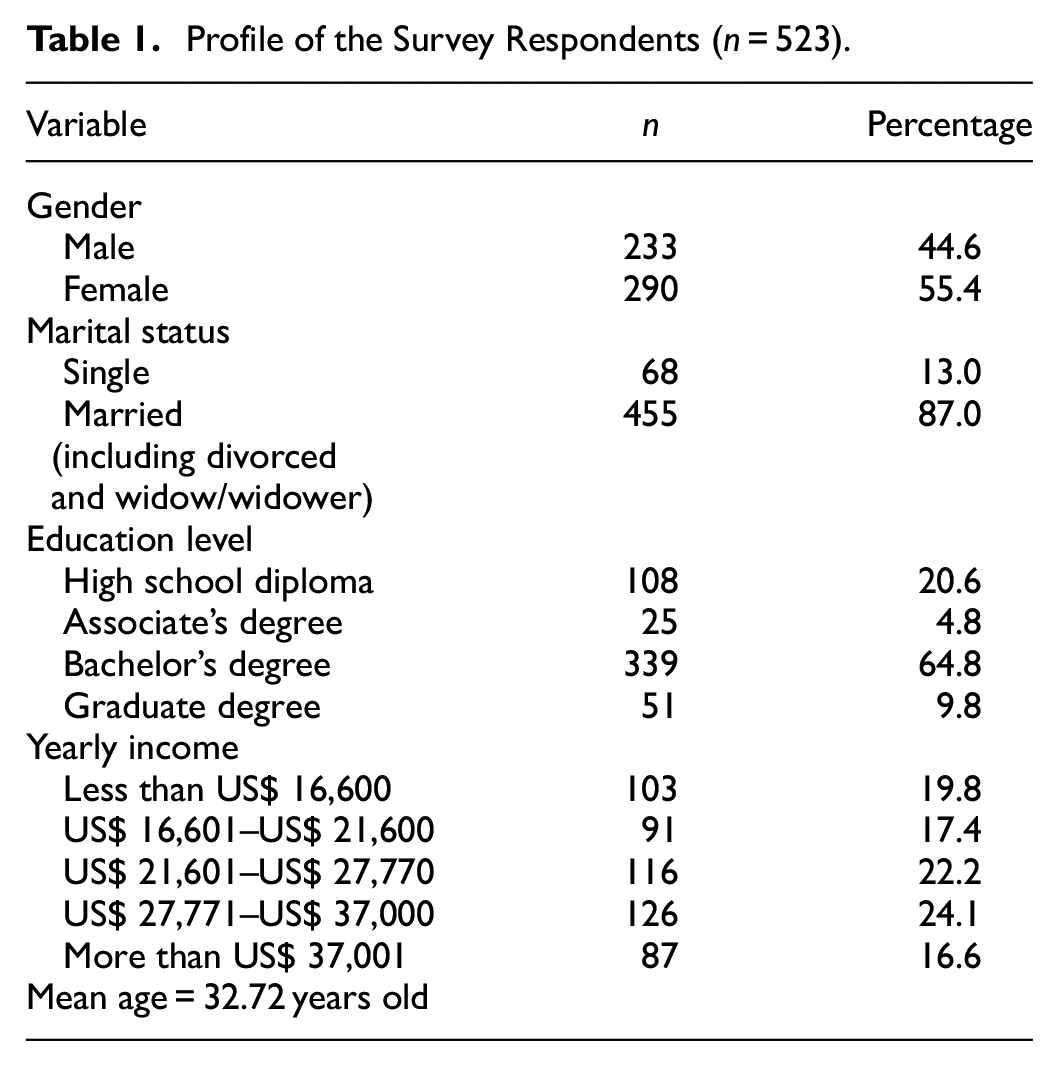
Table 1 presents the profile of the 523 survey respondents, 44.6% of whom were male and 55.4% female. Their average age was 32.72 years. The majority of the respondents had a bachelor’s degree (n = 339, 64.8%) and were married (n = 455, 87.0%). Nearly half the respondents had an annual household income between USD 27,771 and USD 37,000 (n = 126, 24.1%) or between USD 21,601 and USD 27,770 (n = 116, 22.2%). Additionally, the majority of the respondents (n = 417, 79.7%) had visited Korea more than twice, visited Korea for leisure (n = 462, 88.3%), and had an average shopping budget of USD 2,900.
Profile of the Survey Respondents (n = 523).
Confirmatory Factor Analysis (CFA)
CFA was conducted to evaluate the measurement model. The measurement model showed a satisfactory model fit (χ2 = 719.883 [df = 437, p < .001], NFI = .948, IFI = .981, CFI = .981, TLI = .977, RMSEA = .032). The model fit indexes were all higher than 0.9 (Byrne, 1998), whereas the RMSEA value was lower than .10 (Bagozzi & Yi, 1988). Table 2 indicates the measurement items along with the standardized factor loading values.
Confirmatory factor analysis: Items and loadings.

All factor loadings are significant at p < .001.
As shown in Table 2, all standardized loadings of the measurement items were higher than .5 and were significant at p < .001. All average variance extracted (AVE) values of the constructs were higher than the conventional cut-off value of .50 (Hair et al., 1998), as shown in Table 3. The high levels of standardized loadings and AVE values confirmed a strong convergent validity (Fornell & Larcker, 1981).
Descriptive Statistics and Associated Measures.

AVE = average variance extracted; SD = standard deviation; NFI = normed fit index; IFI = incremental fit index; CFI = comparative fit index; TLI = Tucker-Lewis index; RMSEA = root mean square error of approximation.
Composite reliabilities are along the diagonal.
Correlations are above the diagonal.
Squared correlations are below the diagonal.
All AVE values were larger than the squared correlation between a pair of constructs, confirming the discriminant validity, as shown in Table 3. The composite reliability values were greater than the .7 threshold (Hair et al., 1998), confirming the high reliability of the measurement items used for each construct.
Structural Equation Modeling
SEM was performed to assess the proposed hypotheses. The overall fit of the proposed model was suitable (χ2 = 744.586 [df = 459, p < .001], NFI = 942, IFI = .977; CFI = .977; TLI = .973, RMSEA = .035). Figure 2 shows the SEM results with the standardized regression weights. Table 4 presents the results of the hypotheses test in detail. The SEM results statistically supported 8 of the 11 hypotheses.

Standardized path coefficients.
Standardized parameter estimates for the structural model.

NFI = Normed Fit Index, IFI = Incremental Fit Index, CFI = Comparative Fit Index, TLI = Tucker-Lewis Index, RMSEA = Root Mean Square Error of Approximation
*p < .05
Specifically, savings (β = .123, p < .05), quality (β = .352, p < .05), exploration (β = .170, p < .05), and entertainment (β = .371, p < .05) benefits had positive effects on memorable experiences, thereby supporting hypotheses 1, 2, 5, and 6. However, against expectations, convenience (β = .020, p > .05) and value expression (β = .028, p > .05) benefits had no influence on memorable experiences. Therefore, hypotheses 3 and 4 were not supported. In addition, memorable experiences positively affected brand attitude (β = .966, p < .05) and brand preference (β = .704, p < .05), thereby supporting hypotheses 7 and 8. Hypothesis 9, which proposed the relationship between brand attitude and brand preference, was also supported (β = .312, p < .05), but Hypothesis 10, which suggested the positive effect of brand attitude on word-of-mouth, was not (β = .036, p > .05). Finally, brand preference positively impacted word-of-mouth (β = .942, p < .05), thereby supporting hypothesis 11.
Discussions and Implications
Theoretical Implications
The current research identifies antecedents and consequences of memorable experiences of tourists in duty-free shopping. The study offers important theoretical implications. First, the results revealed that two sub-dimensions of utilitarian benefit, namely savings and quality benefits, are important factors that affect memorable experiences. Specifically, savings benefits positively influence memorable experiences, suggesting that when Chinese shoppers feel that they are saving money while shopping, they tend to have memorable experiences at the duty-free shop. Quality benefit also plays a critical role in forming memorable experiences. When Chinese shoppers purchase a high-quality product at a duty-free shop, they report highly memorable experiences. The importance of utilitarian benefit and its influence on outcome variables have been studied in other industries (Chiu et al., 2014; Gaston-Breton & Duque, 2015; Kesari & Atulkar, 2016). For example, Kesari and Atulkar (2016) found that utilitarian benefit helps to enhance customer satisfaction. Unlike previous studies, this study confirmed and extended the existing literature by finding the important role of utilitarian benefit in the formation of memorable experiences in the context of duty-free shopping for the first time. This finding differs from previous research and stands out as one of the originalities of this study. However, unlike our expectation, the results indicated that there is no significant relationship between convenience benefit and memorable experiences. This result can be attributed to the following reasons. Duty-free shops in Korea have difficulty entering various products due to space constraints. Therefore, duty-free shops should sell products that take into account the characteristics of Chinese purchases.
Second, the SEM results revealed that two types of hedonic benefit, namely exploration and entertainment benefits, can enhance memorable experiences. Chinese shoppers tend to develop good memories when they are given an opportunity to purchase new brands and products and derive enjoyment from their shopping. This study is somewhat similar to previous studies (Ailawadi et al., 2001; Kaltcheva & Weitz, 2006; Reid et al., 2015), suggesting the importance of hedonic benefit in consumer behavior. Unlike prior studies, this study first applied the concept of hedonic benefits to the field of duty-free shopping, and found the effect of hedonic benefits on memorable experiences, which is considered a significant theoretical implication of this study. The data analysis result also revealed that value expression benefit did not significantly affect memorable experiences. We assumed that recently, consumers do not feel high value at duty-free shops because they can purchase various products through online. Therefore, duty-free shops should establish marketing strategies to sell products that are difficult to obtain on the market, such as limited editions.
Further, this study clarified the importance of memorable experiences in duty-free shopping. Specifically, the results showed that memorable experiences positively influence brand attitude and brand preference, which had positive effects WOM. In the competitive duty-free shopping market, understanding how memorable experiences are formed for Chinese tourists is critical to improving their brand attitude and preference in order to enhance word-of-mouth. When Chinese shopping tourists derive memorable experiences from duty-free shopping, they tend to develop favorable attitudes, prefer to do their shopping at duty-free shops in general, and would recommend duty-free shops to others. These results are similar to those of previous studies (Brakus et al., 2009; Ratnayake et al., 2010; Xie et al., 2017) which suggested that memorable experiences significantly impact development of brand attitudes and preference. While existing studies have identified the role of memorable experiences in other areas, the current research is the first attempt to examine the importance of memorable experiences in the field of duty-free shopping.
Practical Implications
This study has the following practical implications. First, managers of duty-free stores should focus on utilitarian benefits, such as savings on tax-free merchandise and quality products, when developing their marketing strategies. To encourage tourists to shop at duty-free shops, managers should emphasize savings benefit. One way to accomplish this goal is by holding sales events for foreigners. For example, the Shilla I-Park duty-free shop, which is one of Korea’s most popular duty-free shops, organizes sales events for Chinese tourists during the Qixi Festival or the Chinese Valentine’s Day (Dong, 2018). Such special sales help Chinese tourists develop fond memories of this duty-free shop. However, such special sales need to be limited in the number of times because they can be burdensome to the seller. Given that quality benefit is an important predictor of memorable experiences, managers of duty-free shops also need to focus on product management. For instance, duty-free shops should feature famous brands that offer guaranteed quality, and should check product quality by regularly conducting product testing/evaluation.
These results also provide important managerial implications. Chinese tourists are naturally more interested in shopping for brands that are unavailable in their country. Therefore, duty-free shops should offer new brands that have excellent quality despite not being famous worldwide; such relatively unknown brands can stimulate foreigners’ curiosity. Furthermore, new brands need to be publicized. For example, Chinese shopping tourists are more likely to notice new brands if duty-free shops advertise these brands at the entrance of their establishments or resting spaces. In addition, given the positive relationship between entertainment and memorable experiences, Chinese tourists need to have fun while shopping. For example, the Shinsegae Duty-free Shop, which is one of the largest duty-free shops in Korea, has organized several events where they provide gold bars to foreign tourists via lucky draws (Yunhap News, 2019). Because of the popularity of K-pop in China, this shop also organized a fan meeting with a Korean idol group exclusively for Chinese shopping tourists (Seoul Finance, 2018). Such entertainment events can help Chinese tourists enjoy their shopping, and thereby have memorable experiences at the duty-free shop.
Limitations and Suggestions for Future Study
Even if this study has suggested significant theoretical and practical implications, the following limitations need to be considered. First, the survey was performed on Chinese shopping tourists who have shopped at duty-free shops in Korea. Therefore, the findings of this work may not apply to other regional or national contexts. Second, the current research focused on duty-free shops; therefore, the findings should be applied to other types of shopping mall only with caution. Third, demographic characteristics affect shopping behavior (Fang et al., 2016; Panzone et al., 2016). The proposed study model should be adapted in future studies by adding demographic characteristics, such as gender and age, as control variables. Lastly, a convenience sampling approach used in this study is known as one of the most common approaches in the field of social science, but it cannot fully represent the entire population.
Footnotes
Declaration of Conflicting Interests
The author(s) declared no potential conflicts of interest with respect to the research, authorship, and/or publication of this article.
Funding
The author(s) received no financial support for the research, authorship, and/or publication of this article.
