




Abstract
Organizational learning during and post-crisis is well established in the management literature but consideration of learning for crisis and the sources of information perceived to be useful for crisis management planning have not previously been examined. This study evaluates data from 215 U.K.-based small- and medium-sized enterprises (SMEs) about the perceived value of 11 sources of information between planning (i.e., firms with a crisis management plan) and non-planning respondents. For planning firms, the information sources considered to be useful are exclusively experience-based, and when information sources become less idiosyncratic and episodic, planning firms’ evaluations of their value begin to approximate the ratings given by non-planning firms. Furthermore, the concepts of relative value distance and value distance from threshold are original features of this study and offer new ways to evaluate the value of information sources for organizations wishing to provide information and support to improve business resilience and business continuity.
Keywords
Introduction
Events such as the Brisbane floods, the North American winter storm (Groundhog Day Blizzard), and the Sendai earthquake and tsunami in early 2011 offer stark reminders of the environmental and economic impact of large-scale natural disasters on local communities within which many small- and medium-sized enterprises (SMEs) operate. Four consecutive nights of rioting in a number of major English cities affected 48,000 businesses, the vast majority of which were SMEs (Moore, 2011). Alongside seemingly more mundane problems such as the loss of electricity, mains water supply, telecommunications, and postal services, small businesses in particular face threats to their business continuity that can ultimately threaten their survival. This article focuses on the information that could be used by managers during the process of planning for serious disruptions. In particular, the study examines the differences in the perceived usefulness of 11 specific information sources and the variations that exist between SMEs with plans to respond to serious incidents and interruptions (hereafter referred to as planning firms) and those without such plans (non-planning firms).
The article provides a background to crisis management and the paucity of germane research about SMEs in this context. In particular, the vulnerability of SMEs to business interruptions and factors relating to the low uptake of formal planning in this context are considered to provide a context for the study and to undergird the importance of such planning within broader SMEs’ risk management planning and resilience development. Following this, the article proceeds to consider how learning for crisis is contextualized within the broader organizational learning from crisis literature. Having established the contextual and conceptual boundaries of the study, the author formally articulates three research questions and explains the research methodology used. Following presentation of the data and discussion, the article draws a number of conclusions that have important implications for SME owners wishing to adopt formal planning for business interruptions, and for national and local policy makers, industry associations, and business support organizations and agencies (such as enterprise agencies, chambers of commerce, and local enterprise partnerships) wishing to provide guidance and support that is deemed to be valuable and useful by these end users.
Crisis Management and SMEs
Calling them “an inevitable and permanent feature of modern societies,” Mitroff and Anagnos (2001, p. 1) suggest that crises present leaders and managers with situations that require an immediate response that is either planned or improvised. Crisis events are largely defined in terms of their low probability of occurrence, high impact, and ambiguity (Billings, Milburn, & Schaalman, 1980; Hermann, 1963; Pearson & Clair, 1998; Weick, 1988). Potential crises may emit warning signals that formal crisis management is designed to understand and act on in the form of preventive or defensive actions (Fink, 1986; Mitroff & Anagnos, 2001). Organizations without such preparations to prevent or defend are likely to have higher levels of disruption, damage, and loss from the crisis and a longer period of recovery in the post-crisis phase (Richardson, 1994; Smith, 1990; Turner, 1976). Here, we use the term crisis management planning to refer to activities that may be formally implemented through processes such as emergency planning (Crichton, Ramsay, & Kelly, 2009; Ramsay, 1999), indecent management (Flin & Arbuthnot, 2001; Njå & Rake, 2008), disaster management (Larsson & Enander, 1997; Shaluf, Ahmadun, & Said, 2003), or business continuity planning (Alesi, 2008; Lindstrom, Samuelsson, & Hagerfors, 2010). Whichever of these approaches is adopted, crisis management planning sets in place predetermined plans and/or resources for the restoration of processes in the event of an acute and unexpected interruption or incident. 1
In the context of the United Kingdom, small- and medium-sized enterprises play a hugely significant economic role. With over 4.86 million SMEs in the United Kingdom in 2013 (Department for Business Innovation and Skills, 2013), firms with fewer than 249 employees account for 48.1% of private sector turnover and 59.3% of private sector employment. SMEs constitute 99.2% of all private enterprises in the United Kingdom. In general operational terms, small firms are more vulnerable to failure than larger corporate entities with nearly one third failing within 3 years of start-up (DTI Small Business Service, 2007). SMEs are particularly vulnerable to large-scale crisis events. For instance, over 450 businesses were affected by the Irish Republican Army’s bombing of Manchester’s Arndale shopping center in 1996. Within 6 months of the attack, 250 firms had ceased trading, most of which were SMEs (Herbane, 2010). More recently, Duncan, Yeager, Rucks, and Ginter (2011) have highlighted the disproportionately high impact that natural and man-made disasters in the United States have had on small- and medium-sized firms, leading to their observation that given the inevitability of a disaster striking, operational continuity planning is essential for organizational survival.
There is evidence to support the assertion that small- and medium-sized firms are more vulnerable to the effects of an acute crisis. One series of influences on an organization’s vulnerability to crisis is the organizational components that (Pauchant & Mitroff, 1992) present as a layered “onion” model of crisis with an outer core of technology followed by organizational structure and human factors to the inner layers of organizational culture and top management psychology. For SMEs, each of these components differ from larger firms in terms of their usage, complexity, and redundancy (surplus resources that can be marshaled for a crisis response). The presence of resource redundancy is considered an important precursor to higher resilience to crisis (Boin & Schulman, 2008; Crandall, Parnell, & Spillan, 2010) although Perrow (1999) argues than redundancy occasionally serves to preserve poorly designed systems in large firms that are vulnerable to failure. There is support for the role of such plans in significantly reducing recovery lead times (Fink, 1986) and SME managers have been found to strongly associate crisis management planning with increased business resilience during a crisis (Herbane, 2010). Despite this, however, a number of studies have found that SMEs are less likely to undertake formal crisis management planning than large firms and that a small proportion of SMEs have formal plans to deal with business interruptions. Despite some methodological differences, a number of studies since 2003 have highlighted these differentials in the presence of formalized plans and processes to deal with business interruptions (see Herbane, 2010; Woodman, 2006). Most recently, the study by Woodman and Hutchings (2010) found that 29% of U.K. SMEs have formal dedicated business continuity plans. Furthermore, in the U.K. context, resulting from the Civil Contingencies Act of 2004, there is a recognition of the vulnerability of, and support needed for, SMEs in the duties of local authorities and other bodies in providing advice and assistance about business continuity planning (Herbane, 2011, Cabinet Office, 2005, p. 2).
Organizational Learning From Crisis Versus Organizational Learning for Crisis
In the timeline of a crisis with pre-, trans-, and post-crisis phases, this latter phase (at which point operational recovery from the crisis has been achieved and the organization is able to fulfill the majority of its pre-crisis contractual and commercial obligations) is the locale for organizational learning and process improvement (Karakasidis, 1997; Smith & Elliott, 2007; Toft & Reynolds, 1997; Weick & Sutcliffe, 2003). The main focus is to learn from the precursors, genesis, and manifestation of the crisis to identify opportunities to improve the resilience of the firm to the reoccurrence of the crisis, and to evaluate the preparations for, and responses to, the crisis once it arose and the management team took the formal decision to implement the crisis management plan. Opportunities are also presented to learn about participants’ situational awareness and post-crisis stress (Paton, 2003). Crises may act as triggers to crisis-induced learning (Deverell, 2009), and learning can take place intra-crisis through incident command structures rather than simply inter- or post-crisis (Moynihan, 2009). Beyond the boundaries of the organization that encountered the crisis, post-crisis learning about crisis can take place through public inquiries and accident investigations (Elliott, 2009; Elliott & McGuinness, 2002; Smith, 2007; Vaughan, 1997). Moreover, crises may be characterized as “ill-structured messes” due to the high interaction of problems within a complex system. These traits mean that stakeholders differ in their understanding of the constituent problems of a crisis, making it “inherently controversial” (Mitroff, Alpaslan, & Green, 2004, p. 175). Distinguishing between passive learning (knowing) and active learning (knowing followed by corrective action), Toft and Reynolds (1997) propose that crisis preparedness is enhanced by transferring knowledge from one setting to another where there are “strong isomorphic similarities” (p. 55) because of similarities in behavioral patterns. This isomorphic learning should promulgate changes both to explicit plans/recovery processes and the assumptions held by actors about their ability to response to an incident. A consequence of this for SME owners is whether information about the impact of incidents on SMEs may form a type of “iconic” learning, which as Toft and Reynolds (1997) put it “is a learning event in itself” (p. 550).
The propensity for organizations to be exposed to a crisis has occupied a large amount of attention in the literature (La Porte, 1996; La Porte & Rochlin, 1994; Perrow, 1984; Reason, 1997; Rijpma, 2003; Shrivastava, Sonpar, & Pazzaglia, 2009), within which studies have also examined their resistance to change (Toft & Reynolds, 1997) and the influence of information asymmetries in crisis prevention (Fauchart, 2006) that are problematized when the crisis is dispersed across locations and points in time—in other words, the crisis is not a single “big-bang” incident taking place in a single location. Roux-Dufort (2009) refers to crisis proneness resulting from “an undercurrent accumulation of organizational imperfections (anomalies, vulnerabilities [. . .]) that lay a favourable ground for crises to occur” (p. 5) coupled with management ignorance (deliberate or otherwise) of these imperfections. This processual view of crisis, Roux-Dufort suggests, highlights the importance of managers using knowledge of events to develop and enhance their understanding of how vulnerabilities foment. His account proposes that managers may fail to seek information and support to understand and address organizational vulnerability because of the cognitive dissonance that would arise from reconciling “business-as-usual” with “risk of failure.” This failure fuels anomalies, then vulnerabilities, and subsequent disruptions. Set within the context of Turner’s disaster incubation theory (Turner, 1978; Turner & Pidgeon, 1997), Roux-Dufort (2009) further reinforces the failures of foresight thesis and the critical role of maladaptive behaviors that include political dysfunctions and cognitive impediments to effective information collection and analysis. Limited cognition through rigid adherence to simple assumptions about the organization and its environment has been associated with crisis-prone organizations (Pauchant & Mitroff, 1992) and crisis-prone managers who exhibit faulty assumptions due to defense mechanisms and personality disorders (Mitroff & Pauchant, 1990).
Smith and Elliott’s (2007) meta-analysis of the organizational learning from crisis literature identified eight barriers to learning: rigidity of core beliefs, values, and assumptions; ineffective communication and information difficulties; denial, centrality of expertise, and the disregard of outsiders; peripheral inquiry and decoy phenomenon; cognitive narrowing and fixation (reductionist); maladaptation, threat minimization and environmental shifts; lack of corporate responsibility; and a focus on single-loop learning. These barriers are said to hinder the use of information in subsequent planning for crises and influence the degree of crisis preparedness that the organization possesses. Synthesizing organizational learning with a chronological view of crisis (pre-, trans-, and post-crisis stages), a valuable distinction is made between learning for crisis, learning as crisis, and learning from crisis, respectively. Learning for crisis involves pre-crisis scenario planning, modeling, and simulation in order that managers can learn from past events (including those affecting other organizations) to enhance their own provisions for crisis recovery. This crisis phronēsis—experience- and action-driven wisdom based on the experience of crisis—is essential in the drive toward greater business resilience and, ultimately, business survival.
A further reason why managers may choose not to seek information from specific parties is informed by literature focusing on risk perception. Assessments of risk are mediated by the degree of trust placed in the source of information and knowledge. Trust in the information has been found to increase where experiential, judgmental, or practiced activities are concerned, and where different constituencies in the production and use of knowledge share the same practices (Lane, 2011, 2012). This signals the importance of how and by whom the knowledge is produced and how this combination of reputational and experiential factors determines the credibility of the source and managers’ volition toward the sources for support and guidance. Furthermore, Frewer, Howard, Hedderley, and Shepherd (1998, p. 193) suggest that trust about information “may as important a determinant . . . as the content of the risk information,” and the neutrality of the source is essential in offsetting the potential for distrust. Such literature cites disagreements between scientists, governments, and the public about the environmental hazards set against the benefits of retaining or introducing new technologies. Within the context of the present study, trust and assessments of risk may be influenced by disagreements in the perceived value of the practices embedded within support and guidance. Not only is trust central to social capital for public engagement (Kapserson, Golding, & Kasperson, 1999), thereby affecting the effectiveness and asymmetries of risk communication, the fragility of trust reflects the relationships between parties (such as between information provider and receiver) and thus risk diagnosis and management (Slovic, 1999).
While attention has been given to the meaning of the experience of crisis through the process of “sense making” during the trans-crisis stage, and the roles of commitment, capacity, and expectations in attenuating the crisis (Weick, 1988), little attention has been given to how and whether organizations can learn about planning for serious disruptions prior to their occurrence other than learning for crisis in the form of the study of antecedents and simulation of the crisis response. Given the lower levels of adoption of formal crisis management planning in the form of business continuity planning in SMEs (Pearson & Woodman, 2012) and the deterrent effect of complex planning guidance (Duncan et al., 2011) on its adoption, relatively little is known about how they embark on the process of learning about an unfamiliar activity that is intended to guide an organization at the time of its greatest potential vulnerability. As managers of SMEs scan the information environment for sources, which sources and information providers are used and perceived to be useful, and what does this tell policy makers about SMEs information and support needs as they start their processes of learning for crisis prevention and recovery? Moreover, studies of organization learning from crises are firmly rooted in a large firm perspective rather than the individual learning and behavior processes (Kolb, 1984) of the owner manager as the principal (and often only) strategic decision maker that prevails in a small- and medium-sized enterprise context. Information is a precursor to organizational learning and planning processes, and can influence the bounded awareness of decision makers (Bazerman & Chugh, 2006) and paradigm blindness (Wheatley, 2006), yet little is known about attitudes to sources of information about crisis management planning in SMEs. Accordingly, the study sets out to address the following questions:
What are the sources of information that the managers of SMEs deem important for crisis management planning?
How do the perceptions of information sources differ according to their source and nature?
How do perceptions vary between SMEs with crisis management planning in place and those without it?
Method
The data used in the study were collected through the use of a postal questionnaire that was sent to a representative sample of 1,000 U.K. SMEs chosen randomly from the Bureau van Dijk 2010 FAME database of 20,914 firms that meet the definition of a small- or medium-sized firm according to the European Commission. Recommendation 2003/361/EC (European Commission, 2010) specifies a small firm as having a turnover per annum/balance sheet total less than €10 million and less than 50 employees. A medium-sized firm has a turnover per annum of no greater than €50 million, a balance sheet total of not more than €43 million, and between 51 and 250 employees (in addition, the European Commission defines a “micro” firm as having turnover/balance sheet totals less than €2 million and less than 10 employees). Data were collected as part of a wider study in U.K. SMEs (Herbane, 2013) but the data are used and presented for the first time in this study (i.e., there is no data overlap with other published work).
The data were derived from a questionnaire that comprised of questions about the company’s size, age, and the presence of formal crisis management plans. Respondents were asked to indicate the company’s experience of seven different crisis types based on Mitroff and Alpaslan (2003) classification of crises (physical, personnel, external criminal, information, natural, economic, and reputational), which in turn echoes a number of other classifications in the extant (Burnett, 1998; Gundel, 2005; Mitroff, Pauchant, & Shrivastava, 1988). The instrument was designed to elicit ratings (using a five-point Likert-type scale ranging from strongly agree to strongly disagree) for a variety of sources of information that were deemed to be useful to a manager for crisis management planning. This study focuses on data relating to the respondents’ evaluations of the usefulness (actual in the case of planning firms and potentially in the case of non-planning firms) of the following 11 information sources; businesses in the same economic sector, organizations outside the firm’s sector, the media, local authorities, colleagues within the business, central government, business support agencies, important clients, industry associations, legislation and regulations (including standards), and the firm’s experience of crisis.
The targeted respondent was the Managing Director of the company, and each one was sent a personalized covering letter to accompany the questionnaire and postage-paid return envelope. The mailing resulted in 215 usable responses, giving a response rate of 22.4% (in 42 of the 1,000 firms in the sample, the addressee had left the company). To examine for potential non-response bias, mean scores for early and late responses were examined (Armstrong & Overton, 1977) with resulting t-tests no significant differences between early and late responders for the variables used in this study. Furthermore, the response rate is argued to be acceptable given that other seminal and recent studies with similar methodological characteristics such as senior managers as the target respondent (Hunt & Chonko, 1987), sensitive subject matter (Mitroff et al., 1988), and respondent organization and sample frame size (Fraj-Andrés, Martinez-Salinas, & Matute-Vallejo, 2009; Huurne & Gutteling, 2008). Respondent firms ranged in size from 2 to 247 employees (M = 39.68, median = 28, SD = 40.60) with a median firm age of 10 years (min = 2, max = 160, M = 15.84, SD). Only 22% (n = 47) of respondents indicated that they had a formal crisis management plan with mean spending of £10,181 per annum on crisis planning activities. Testing for non-response bias, the measures of company age, and the number of employees for a random selection of 50 respondent and 50 non-respondent firms were tested using the Independent Samples Kolmogorov–Smirnov test with resulting p-values for age and employees at .446 and .270, respectively (p > .05).
Results and Discussion
Contrasts Between Planning and Non-Planning Firms
Table 1 presents respondents’ ratings about the actual or potential usefulness of 11information sources for crisis management planning. The independent-samples t-test was employed to test for significant differences in the responses of SMEs with crisis plans (“planning,” n = 47) and SMEs without crisis plans (“non-planning,” n = 168). With the exception of the media, the mean scores of the 10 remaining information sources differed significantly at the .05 level.
Evaluations of Information Sources—Planning Versus Non-Planning SMEs.

p < .05.
The data show that planning and non-planning firms rank experience-based information sources (colleagues, firm experience of crisis, important clients, other firm’s experience of crisis in their sector, other firm’s experience of crisis outside their sector) among the most important in terms of their perceived usefulness for crisis management planning. For planning firms, these experience sources constituted the top five ranked information sources and for non-planning firms, these sources occupied positions two to six in the rank order, with the highest ranking taken by a generic external source—the media. This similarity in ranking is, however, moderated by the observation that none of the ratings for information sources from non-planners rise above the midway point of the Likert-type scale. Only the experience of crisis and the media had scores that were higher than the arithmetical midway point (2.5). Thus, while the rankings suggest only minor differences between planning and non-planning firms, the ratings given to each information source reveal a lack of importance attached to all 11 information sources by non-planning firms as opposed to 6 information sources deemed to lack relative importance for planning firms. The data suggest that the experience of crisis and information from the general media are the most likely to be inputs to crisis management planning for those current non-adopters. The similarity in rank order also supports the proposition that non-planning firms also consider experience to be a potentially useful source of information; what differs is that they currently attach a far lower importance to it than their planning counterparts (rather than such sources appearing at the lower end of the ranking order for non-planners).
Irrespective of the presence of a crisis management plan or otherwise, organizations in the study attached a low level of importance to information from government/public agencies such as central government, local authorities (city and county councils), and business support agencies such as with these sources ranked as the three least important among both types of firms. Moreover, even for planning firms, the rankings were distant from the midpoint on the measurement scale, making these sources by far the least important for those SMEs that have undertaken the process of plan development. This triumvirate of government/public information sources is discernibly separated in importance to a mid-ranking group of information sources that include the media, industry associations, and legislation, regulations and standards. The ratings for these sources mark a transition to those that are deemed useful by respondents in the study.
Industry-level influence is stronger in terms of the value of operational information from other organizations in the sector and organizations downstream in the supply chain than with the influence from industry-level formalities such as associations, standards, regulations, and legislation. For planning firms, the value of the media as an information source that may highlight issues affecting specific industries has a rating that sits between these industry-level formalities. Industry-level operational information sources are considered to be important for planning firms and are central to the predominant group of important information sources that are based around the experience of crisis rather than formal industry-level influences on behavior. The greater value placed on experiential rather than generic information and know-how culminates in the highest value placed on information arising from the organization’s own experience of crisis, colleagues within the firm, and from other firms in the same sector.
Information Value Distances
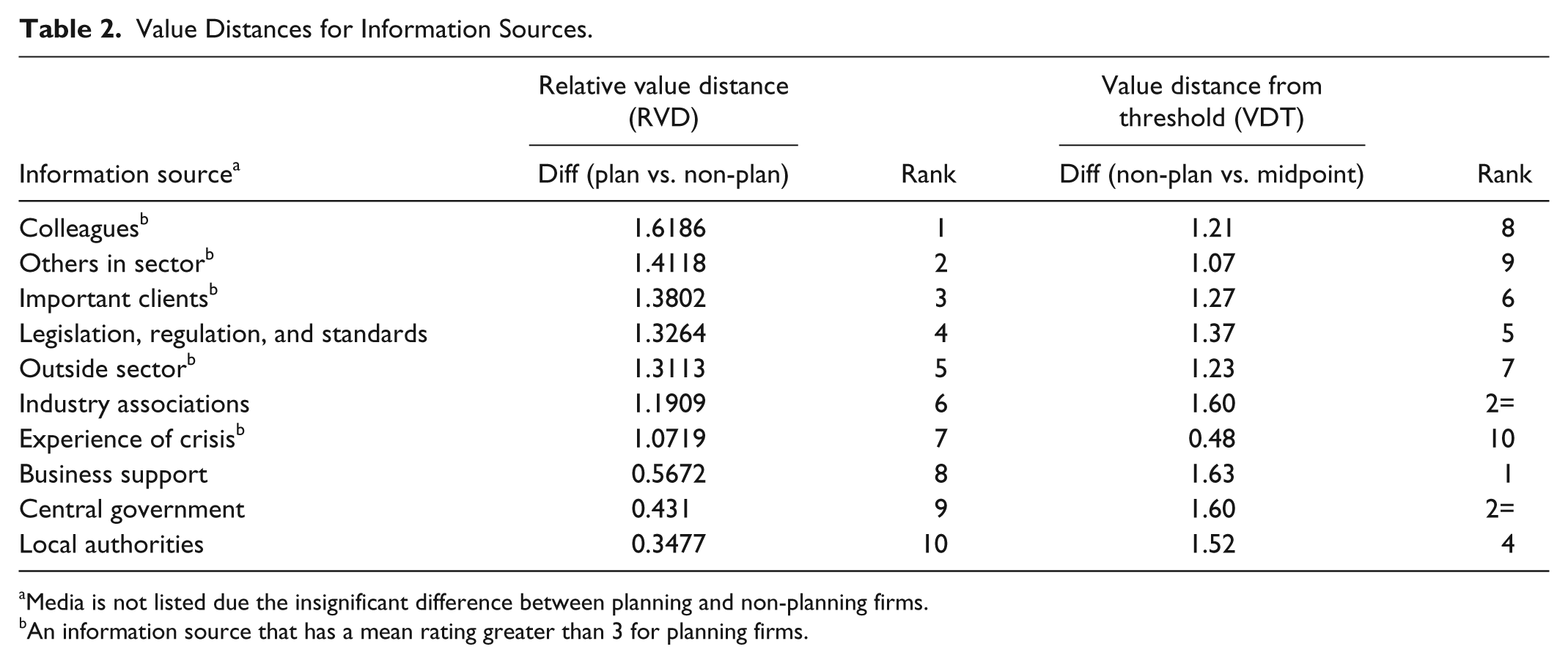
Using data from the information sources valued by respondent firms in Table 1, examination of the differential between the mean rating given by planning and non-planning firms for each information type (referred to as the relative value distance [RVD]) along with the differential between the scores for information types for non-planning firms and the midpoint on the scale at which a rising score indicates an increasing level of perceived usefulness (known as value distance from threshold), provide further insight into the perceived differences between each information source (Table 2).
Value Distances for Information Sources.
Media is not listed due the insignificant difference between planning and non-planning firms.
An information source that has a mean rating greater than 3 for planning firms.
The data indicate that the largest RVDs between planning and non-planning firms for information sources tend to be the experience-derived sources (colleagues, firm experience of crisis, important clients, other firm’s experience of crisis in their sector, other firm’s experience of crisis outside their sector), although legislation, regulation, and standards has the fourth highest RVD. The organization’s prior experience of a crisis had small value distances between planning and non-planning firms, and between the non-planning firm score and the midpoint. This corresponds with the association between experience of a crisis as a stimuli for the adoption of CM planning, after which the intention to avoid or prevent crises relegates the importance of this source of information given the formalized intention to avoid the occurrence/recurrence of interruptions (though recognizably useful nonetheless).
The RVDs for information sources such a business support agencies, general government, and local authorities are smaller. Given these sources’ comparatively lower ratings for usefulness by planning firms (rated below the midpoint on the rating scale), the smaller value distances should not be interpreted as an indication that little is required to change non-planning firms’ views of the value of the information source. Instead, it highlights the question of whether—in the light of bounded rationality—managers in a small firm context should prioritize the sources that planning firms value and value most. Table 2 also presents the difference for each information source against the midpoint of the scale for non-planning firms to highlight which sources are perceived to be most and least distant from the point at which they are deemed to be useful. This generates a measure of value distance from threshold. Here, the data reveal that didactic sources have the greatest value distances from the threshold of information value (3) whereas experiential sources rank 6th to 10th in value distance from threshold. Combined with our understanding that these experiential sources are considered the most useful information sources by planning firms, there is little distance between the ratings assigned by non-planning firms and the threshold of information value, whereas didactic sources rank first to fifth in their distance away from the threshold of information value. This echoes the findings in Herbane (2010) which, albeit a small sample study, highlighted small firms’ negative views about information and guidance provided for small business support.
For planning firms, the information sources considered to be useful are exclusively experience-based and derived from the immediate or wider operational context in which the organization resides and this reinforces the importance of iconic and isomorphic learning (Toft & Reynolds, 1997). Once information sources become less idiosyncratic and episodic to more generic and prescriptive in nature, planning firms’ evaluations of their value begin to approximate the ratings that non-planning firms give to these less unimportant sources. Only the experience of crisis as a source of information came close to being deemed useful for non-planners as it had for planning firms.
Why might experience-based information be preferred? One explanation is that information about the technicalities of planning may no longer necessarily be a requirement for firms with plans in place, and firms in this position no longer need to be convinced of the need for planning. In addition, firms may already have introduced crisis management planning because of need to comply with established industry practices, regulation, legislation, and standards. In such cases, compliance would be driven by guidelines and standards (such as British Standard (BS) 25999/International Standard (ISO) 22301 for Business Continuity, ISO 17799 for Information Security, and ISO24672 Guidelines for Information and Communication Technology Disaster Recovery Services) that prescribe processes, activities, and structures for emergency management and business continuity. In contrast to the number 1 ranking for the media as a source of information for non-planning firms, the media ranked 7th of the 11 information sources for planning firms. As noted above, this corresponds with a preference for experience-based information sources. The different position of the media in the ranking of sources provides a further indication that firms with crisis management plans in place value information sources that are more context-specific whereas non-planners, having not yet come to appreciate the value of experiential information sources (once plans are in place) rate media as a useful information source. A further reason may be found in the literature on trust and risk communication cited earlier where experiential information is imbued with higher levels of trust (and subsequent acceptance and use) than other sources of information.
Post-adoption, generic information is much less important since planning firms already have an appreciation (or, at the very least, an understanding) of the need for planning. Experience-oriented information sources such as the firm’s own experiences of crises, insights from colleagues, important clients, and other firms within and beyond the industry may present dynamic inputs to the process of recursive learning (Elliott & Macpherson, 2010), which allow for the adjustment of provisions set within crisis management plans. Experiences also serve as reminders of the need for such planning, the need for renewal of plans, and the hazards that a business has faced or might encounter. Such experience-related information act as stimuli to the process of unlearning (Nystrom & Starbuck, 1984).
Conclusion
The main contribution of this study is to highlight and address a notable gap in the body of crisis management literature, where post-crisis organizational and institutional learning is long established, but consideration of how organizations can learn to introduce crisis management planning (and where new information sources are important) is largely ignored. In adopting a learning for crisis perspective, this study has established that experiential information is perceived by SME owner managers to be more important than generic advisory information. These preferences are observed between planning and non-planning firms. With planning in place, these organizations indicated a strong preference to experiential information sources as determined by the measure of RVD. The additional measure of value distance from threshold highlights the large distance that some sources are perceived to be from becoming useful for firms wishing to introduce planning to deal with serious interruptions and incidents. Planning firms’ preference for experience-oriented information about crisis management and business continuity planning raises questions about how SMEs might be supported in both the initial development and renewal of their knowledge about these planning activities so that such feedback and learning can improve their adaptive capacity (Staber & Sydow, 2002) as a continuous and dynamic learning process through which complexity and uncertainty are better understood. Support networks and forums for business continuity are well-established in a local government context (e.g., Local Resilience Forums) and for large firms in specific sectors such as financial services (e.g., The Business Continuance Group), and the role of industry associations and business support agencies in bringing together SMEs to share experiences and practices within and across areas of economic activity would appear to be a valuable way to encourage greater firm-level and local economy business resilience.
A number of directions for future research arise from this study. These include exploration and examination of why the valued information sources for planning firms are distinguished from the less valued ones—Is it the act of planning that has shifted these perceptions or other factors? Could distinctions be due to some sources being perceived to be more useful as precursors to planning and others more useful as stimuli to maintain and develop crisis management plans within the organization? Second, what are the features of the sources of information that planning firms find useful and what is it that non-planning firms consider not useful, visible, or accessible? Examination of each information source in more detail (e.g., within media type, specific regulation, legislation, and standards) will also illuminate our understanding of the comparative importance of these institutional influences for planning and non-planning firms. An emerging point of debate is whether agility (due to flexibility, rapid decision making, and flatter structures) and resilience are mutually exclusive properties in SMEs that characterize their propensity for, and response to, serious interruptions and incidents (Gao, Sung, & Zhang, 2013; Sullivan-Taylor & Branicki, 2011). Are SMEs better able to respond to the deleterious effects of “surprises” that lead to improvisation and bricolage (Bechky & Ockhuysen, 2011) than to defend from or prevent such events using formal structures and knowledge? What role does information availability, type (experience versus didactic), and perceived value play in this context?
As the imperative for business resilience cascades across the British economy and beyond, policy makers and business support agencies are increasingly seeking to engage with SMEs to support their resilience and enterprise growth. Given the insights derived from this study, the dissonance between information provision and informational needs may reduce the value that such engagement could achieve. Accordingly, where business support agencies volunteer (or are compelled) to provide support to SMEs in relation to crisis management/business continuity planning, careful assessment should be given to whether the information that they provide loses relevance for firms with or without plans, and how their information provision might be refined to provide information that is differentiated in terms of the transition of an SME between the absence and presence of formal processes to deal with crises.
Footnotes
Declaration of Conflicting Interests
The author(s) declared no potential conflicts of interest with respect to the research, authorship, and/or publication of this article.
Funding
The author(s) received no financial support for the research and/or authorship of this article.