




Abstract
Learning business Chinese through digital materials has become an inevitable tendency with the growth of the internet and impact of the COVID-19 pandemic. Despite the increasing research-based publications and practices relating to Chinese language textbooks, there is a dearth of assessment indicators weight systems constructed by alternative research tools and statistical methods to evaluate the quality of the growing digital business Chinese materials. To the best of our knowledge, no literature review has been published on using the analytic hierarchy process (AHP) method to construct the assessment indicators of digital business Chinese materials. Therefore, this study aims to fill this gap by reviewing the existing, but limited, literature and providing recommendations for developing a checklist—based on the assessment indicators weight system—to evaluate digital business Chinese materials. The preliminary PC2U (Production, Content, Use, and Usefulness) assessment indicators are constructed based on the current research on business Chinese, CLTML, and relevant assessment indicators. In addition, the analysis hierarchy process (AHP) is used to construct the weight system. The results show that it is crucial to prioritize the access of digital business Chinese content. Of the three criteria in the content dimension, learning needs and credibility are equally important, and both are more important than data update. The assessment indicators are not only beneficial to fill the knowledge gap on business Chinese research, but also helpful for publishers and teachers to compile and select high quality digital business Chinese materials.
Keywords
Introduction
Learning business Chinese through digital materials has become an inevitable tendency with the growth of the internet and impact of the COVID-19 pandemic. Scarpetta and Quintini (2020) indicated that the COVID-19 crisis has resulted in a significant increase in digital learning by adults, and much of the training that had started as face-to-face learning in classroom environments is being pursued online. This provided impetus for trainers to develop more digital materials, which are cost-effective, time-effective, and eco-friendly. While the notion of business Chinese language learning using digital materials is not a novel idea, rapid developments of digital technology and the severity of the COVID-19 have increased the demand for learning it digitally.
The digital context of business Chinese language learning has prompted the need for featured, hacker-resistant, authentic, reusable, and useful digital materials for online learning, in-person courses, or at-home learning. These features and functions are crucial for those who are non-native Chinese speaking businessmen/women (NNCSB)—as self-directed adult learners—to learn business Chinese by digital materials “whose subject matter is communicative interaction which includes a business-cultural aspect.” Additionally, these features and functions require distinguishing such materials from their paper versions. However, after comparing existing business Chinese textbooks with similar book titles in Chinese, such as rendering business either as commerce into 商業 (shāngyè) or 經貿 (jīngmào), or as business in use into 商用(shāngyòng)/商務(shāngwù), and digital versions, including “Business Chinese” online, “Far East Business Chinese” (遠東商務漢語/Yuǎndōng shāngwù hànyǔ).
App, and “Business Chinese” App, this study found little concerted effort in this direction. Moreover, the gradual increase in digital business Chinese materials has not been competitive in the quality of production, content, usage, and usefulness, except for software and technical improvements. To construct learners’ knowledge schema, Mayer and Moreno (2003) proposed coherence and signaling principles—based on the cognitive load theory of multimedia learning (CLTML)—for designing e-learning materials. The coherence principle refers to eliminating unnecessary information in multimedia materials to reduce cognitive load and improve learning outcomes. The signaling principle refers to appropriate cues that allow learners to focus on important points of multimedia content, aiming to limit learners’ attention from being attracted toward unimportant or irrelevant information, thereby reducing external cognitive load. CLTML has been widely applied in e-learning (Asraj et al., 2011; Curum & Khedo, 2021; Davids et al., 2015; Kirschner et al., 2018; Lambert et al., 2009; Mayer, 2001; Mayer & Moreno, 1998, 2003; van Merriënboer & Ayres, 2005; Westlake, 2019). These studies revealed that materials that had not considered characteristics of leaners’ cognitive load were difficult to learn (Sweller & Chandler, 1994). However, previous relevant research (Cai & Chen, 2014; Chen & Lee, 2012a; Chiu, 2020; Chung, 2018; Li, 2011; Liao, 2019; Li & Chen, 2016; Tu, 2011; Wonchul et al., 2017) and practices (Liu et al., 2013a, 2013b; Liu, Chen et al., 2014; Liu, Zhou et al., 2014) do not delve deep into the problems of cognitive load faced by learners when applying the e-materials and cognitive load caused by the characteristics of Chinese language, nor are they concerned about the assessment indicators for digital business Chinese materials.
Despite the increasing research-based publications and practices relating to Chinese language textbooks, including Chinese language for business purposes, there is a dearth of assessment indicators weight systems constructed by alternative research tools and statistical methods to evaluate the quality of the growing digital business Chinese materials. To the best of our knowledge, no literature review has been published on using the analytic hierarchy process (AHP) method to construct the assessment indicators of digital business Chinese materials. Therefore, this study aims to fill this gap by reviewing the existing, but limited, literature and providing recommendations for developing a checklist—based on the assessment indicators weight system—to evaluate digital business Chinese materials. However, before proceeding with the AHP method and recommendations, this study attempts to set the stage by presenting the current research on business Chinese, CLTML, and assessment indicators for (digital) materials to contribute toward drafting the preliminary assessment indicators for digital business Chinese materials.
For this study, several references to business Chinese, CLTML, and the construction of assessment indicators are included to frame the general discussion; this is necessary because digital business Chinese materials are a subset of the Chinese as a second and foreign language education, and there have been few publications on specifically applying the AHP method to constructing assessment indicators weight systems for such materials. Mostly, the relevant references discussed in this study deal with research findings and arguments on business Chinese, CLTML, and construction of other assessment indicators, which are closely related to the preliminary assessment indicators formerly analyzed by the AHP method.
Literature Review
Current Research Performance on Business Chinese
With respect to the previous research findings, Li (2011) explored the needs of business Chinese L2 learners and found that the learners from a middle to advanced level needed to learn the following topics: introducing business associates, negotiating prices, conducting market surveys, interviewing skills, signing contracts, ordering products/meals. All of these topics would provide a learner with the ability to learn business Chinese, enter the workplace, and successfully communicate. Moreover, understanding a company’s organization and operation and introducing clients to the company are top priorities for most learners. Chen and Lee (2012a) explored the cultural content of contemporary business Chinese textbooks for beginners and found that the textbooks emphasize contemporary social and economic phenomena, economic and trade systems, and the proportion of contemporary social and economic cultural content far exceeds the description of traditional historical culture. In addition, “what one should and should not say” and “what one can and cannot do” in the Chinese workplace are found to have the utmost importance. Furthermore, Chen and Lee (2012b) analyzed the vocabulary in 10 intermediate business Chinese textbooks and found that vocabulary on “trade” and “finance” occupied the largest part in the textbooks. Their findings reflect that most NNCSB go to China for trade and financial management. The NNCSB need business-related Chinese vocabulary and knowledge to do these jobs. Thus, it is necessary to list the vocabulary in the textbooks. Zheng (2012) indicated that China’s economy has been reformed and liberalized since 1978, and with this China’s economic status has become increasingly important in the world. Consequently, new business Chinese words and translations have emerged rapidly and caused business Chinese L2 learners to spend more time learning the new words. Guan (2012) believed that translation can be regarded as a comprehensive application of listening, speaking, reading and writing skills, or as a supplement to the four skills after exploring the application of translation tasks in business Chinese teaching. Translation can be used not only to practice, consolidate and strengthen vocabulary, sentence, and grammar knowledge, but also to effectively detect learners’ comprehension of Chinese language.
According to Yan’s (2013) Master’s thesis, compared with teaching textbooks, self-learning textbooks were rare. In her thesis, “History and the present state of teaching business Chinese in Taiwan,” she suggested adding information on Taiwan’s economic background and market in textbooks and included an analysis of such course materials. According to Liao’s (2011) thesis, “A study on intermediate spoken communication course for business Chinese: Analysis, design, and implementation,” learners are highly affirmative of the teaching design for business Chinese oral communication, and this method allowed learners to accurately grasp the deeper meaning of speech acts, to cultivate capabilities of appropriate responses, and to immerse in real business Chinese situations. Vu (2011) found that the Vietnamese learners of Chinese have a strong demand for “business Chinese,” and they expect to study “authenticity” in business Chinese textbooks, as discussed in Vu’s thesis, “The Research about the need and development of business Chinese in Vietnam.” In connection with the assessment indicators for business Chinese materials, Chung (2018) constructed 43 evaluation indicators categorized into material content and design, based on 5Cs (Communication, Cultures, Connections, Comparisons, and Communities), for business Chinese textbooks. Liao (2019) adopted the Fuzzy Delphi method to construct 33 evaluation items, including learners’ needs, material content, teaching objectives, and audio and video presentation.
In the digital Chinese teaching materials and methods, Liu et al. (2013a) conducted a teaching experiment for a class of six Chinese L2 learners who studied Chinese language for about 1 to 2 years. The results showed that the digital Chinese material in this experiment helped to improve the layout, improve audio and video effects, create a learning website for learners to study freely, and provide teachers with teaching manuals and discs according to the teacher’s and learners’ feedbacks. Later, Liu, Chen et al. (2014) conducted an observational study to understand 16 Chinese L2 learners’ feedback after the learners studied the digital Chinese material. The observations and surveys indicated that dialogues were practical for learners who were interested in practicing business Chinese (listening and speaking) via role playing, and the material was suitable for business Chinese L2 learners above the intermediate level. As for Chinese L2 learners in non-degree programs, approximately 63% of learners believed that digital Chinese material was suitable for intermediate level learners, and approximately 37% of learners thought that the material was suitable for intermediate high-level learners. These learners expressed that dialogues were practical and studying negotiation knowledge via in-class role playing was interesting (Liu, Zhou et al., 2014).
We found that little research focuses on digital Chinese materials, and the quality and quantity of the materials need to be improved. Adding the elements of Taiwan’s economic background and market conditions was suggested; furthermore, the “authenticity” of the business was emphasized. According to literature reviews on published business Chinese, compared with paperback textbooks on business Chinese, the number of e-materials was limited; it was undoubtedly a flaw for Taiwan as a technological island. Although creating digital Chinese materials was distinguished from compiling paperback textbooks, it was impossible to maximize the learning effect of adult learners by only digitizing the content from paperback textbooks and creating excessive animated information, without considering that the learning content exceeded adult learners’ loads of absorbing Chinese knowledge (Cai & Chen, 2014). To solve this problem, this study constructed the assessment indicators of digital Chinese materials for the NNCSB.
The CLTML and Inspiration
With the advent of the information society, e-materials have become increasingly diverse. Effective digital Chinese material should be consistent with business situations, such that NNCSB can effectively absorb and understand business Chinese language, allowing for immediate use in real-time business situations. Generally, effectively absorbing and understanding knowledge was related to the cognitive load of personal information processing (Mayer, 2001; Mayer & Moreno, 2003). Mayer and Moreno (1998) found that the working memory of the human cognitive structure was divided into internal and external loadings. The content of learning material belonged to internal loading, while the design and layout of learning material belonged to external loading.
The learner’s internal loading will be low if the information of the material to be processed is pure and independent. In contrast, if the information received by the learner is too complicated or requires a lot of information to simultaneously interact for producing meaning, the learner’s internal loading will become overwhelmed. Thus, if the content of learning material cannot be modified more simply, it would not lower the learner’s internal cognitive loading (Sweller et al., 1998). For instance, at present, the business Chinese textbooks published in Taiwan and China emphasize improving learners’ cross-cultural communication skills. Tu (2011) recommended that the content of Business Chinese language textbooks must be changed in response to changes in the overall business environment because the economic cooperation and interaction between China and the West have changed. The changes included importing and exporting accessories, trading electromechanical products, high-tech products, and automatic data processing equipment. Although the focus of the textbooks varies, the content contains four themes: (1) “social and economic conditions”; (2) “economic and trade norms”; (3) “communication style”; and (4) “folk etiquette” (Chen & Lee, 2012a). Li (2011) found that business Chinese L2 learners have a great need for learning resume and curriculum vitae writing and job interviewing skills. The previously mentioned content was required to compile into business Chinese materials, in addition to vocabulary, grammar, and sentence patterns. Assumably, for the working memory of NNCSB, the design and layout of digital business Chinese materials belong to external cognitive loading, which directly affects the effectiveness of working memory. Once the external cognitive loading of a learner is reduced, there is an increase in available space in the learner’s working memory. This suggests that vocabulary, grammar, sentence patterns, and business Chinese knowledge, such as social and economic culture, trade, and communication style, which must be learned in digital Chinese language learning materials at different levels, are fixed, and authors need to reduce the external loading of learners by designing user-friendly layouts and interfaces in e-textbooks. In this case, more meaningful information is fed into the learner’s working memory. In other words, if the learning content is fixed, it is necessary for e-textbook compilers to further consider improving the layout and interface of the learning material to reduce the external loading of the learners and increase their working memory space.
On the technical level, nevertheless, the current text content was directly digitized without the consideration of subjects’ characteristics to design a human interactive interface of learning functions (Li & Yang, 2016; Tseng et al., 2007). Personalization, analytics, and an affordable user-interface are features of digital textbooks; however, less than half (45%) of the faculty agreed that digital courses materials provided significant value added content, which unavailable in print (Railean, 2017). These problems highlight the difficulty of using the benefits of digital teaching materials and the impossibility of providing teaching content. Chen (2011) highlighted that up to date, many digital textbooks, of which layout, interface, and broadcast speed were still traditional and unidirectional learning functions. Tang (2012) conducted a content analysis on 30 online Chinese language materials and found that most of the materials provided learners with exercises of listening, speaking, reading, and writing, but most of them were copied from paper books and transferred to webpages without bidirectional and interactive learning functions. Such learning webpages were not very effective. Although the benefits of e-learning were found to be greater than the traditional methods of teaching and learning in the discussions on computer and education, there were some undeniable limitations. However, it seemed that no universal standards for assessing the quality of e-materials on business Chinese language were provided for teachers’ decision on materials used and for publishers’ compilation of the materials. This study believes that while e-learning materials are praised for their advantages, such as convenience, flexibility, and immediacy, they might have their limitations for some learners.
It was imperative to develop suitable digital business Chinese materials based on learners’ knowledge schema and cognitive structure. If business Chinese materials were only digitized, without considering CLTML, it may be impossible for the NNCSB to learn business Chinese language. Similarly, if only learning volumes are valued, and the learning volumes exceed what NNCSB can absorb, it is difficult to effectively reduce their external cognitive loading. To develop a set of quality e-materials on business Chinese language, what evaluation indicators should be used for measurement? This is a question that teachers and publishers found deeply concerning. Evidence has suggested that considering L2 learners’ cognitive characteristics helps lower their cognitive load (Nawal, 2018). This study, therefore, aimed at constructing the assessment indicators of digital Chinese materials on the basis of CLTML, emphasizing the fact that accessibility, interaction, simple operation, and interface of usage is friendly to NNCSB.
The Current Assessment Indicators for Digital Materials and Courses
Digital foreign language materials are key interactive elements in teaching via Internet technology. They are digitalized tools with dazzling and impressive sound and light effects and make learning effective, by integrating teaching principles and learners’ characteristics (Li & Yang, 2016). In order to allow learners to acquire knowledge effectively, Chapelle (2001) believed that clear content and interactive learning must be considered in the production of digital materials. In studies on digital materials assessment, Peng and Hsiung (2015) established three standard modules (digital, material, and nature of science); eight dimensions (material presentation, interface operation, instructions for use, framework, content, science knowledge, and exploration); 23 sub-dimensions; and 51 indicators for evaluating high quality science via the Delphi technique to collect experts’ suggestions. Li and Yang (2016), through content analyses and interviews, found limitations of school hardware and software, production costs, teacher acceptance, and lack of interaction to be problems existing in the current digital textbooks in elementary schools. Kazaine (2017) used content analysis to summarize four quality criteria—formal, didactic, media, and usability—as well as 27 sub-criteria distributed in the four criteria influencing the quality of teaching materials. Işik (2018) developed a checklist for qualifying, external and internal evaluation, with a total of 229 indicators, for English language teaching (ELT) materials to survey if ELT teachers were satisfied with adopting ELT materials for their students. Tarkowski et al. (2019) suggested considering quality of content, curriculum match, pedagogical models, practices proposed, learning outcomes, and users’ evaluation when compiling open digital materials.
Furthermore, Cai and Chen (2014) addressed digital adult Chinese materials, and other studies (Chiu, 2020; Li & Chen, 2016; Wonchul et al., 2017) focused on general Chinese materials on assessment indicators for Chinese materials, in addition to Chung (2018) and Liao’s (2019) studies mentioned previously. Cai and Chen (2014) generalized four main indicators, nine sub-indicators, and sixty items through three-time Delphi surveys to evaluate the quality of websites regarding digital Chinese learning for adult learners. Li and Chen (2016) designed a prototype tool with four levels based on second language acquisition—(1) Language, (2) Cognition, (3) Teaching Approach, and (4) Students—including 17 indicators and 80 items. Wonchul et al. (2017) reviewed research studies on Chinese textbook evaluation checklists conducted in China and Korea to create the checklist with 45 question items. Chiu (2020) found that the evaluation indicators in textbooks for general Chinese students and those for Indonesian students were basically similar. However, the Indonesian vocabulary, grammar, and culture presented was helpful to study language points and comprehend respective cultures.
In practice, American universities, such as Penn State, Lincoln, and Cheyney, conducted the Innovation in Distance Education (IDE) project funded by an AT&T Foundation grant to initiate distance education (Kashyap, 2014; Malik, 2015; The Pennsylvania State University, 1998), which defined five practice categories (learning goals and content presentation, interactions, assessment and measurement, learner support and services, and instructional media and tools) and 25 guiding principles. The current iteration of the iNACOL National Standards for Quality Online Courses provides a list of 52 standards divided among five sections: content (13 standards); instructional design (11 standards); student assessment (7 standards); technology (11 standards); and course evaluation and support (10 standards) (Kennedy et al., 2018; Michigan Virtual University, 2016). Quality Matters in the MarylandOnline, Inc. (MOL) provided schools with the quality matters rubrics and eight standards: (1) course overview and introduction, which was clarified to the learner at the beginning of the course; (2) learning objectives (competencies), describing what learners could do upon completion of the course; (3) assessment and measurement, which were integral to the learning process and were designed to evaluate learner progress in achieving the stated learning objectives or mastering the competencies; (4) instructional materials, enabling learners to achieve stated learning objectives or competencies; (5) course activities and learner interaction, facilitating and supporting learners’ interaction and engagement; (6) course technology, supporting learners’ achievement of course objectives or competencies; (7) learners’ support, implying that the course facilitates learner access to institutional support services essential to learners’ success; (8) accessibility and usability, wherein the course design reflected a commitment to accessibility and usability for all learners. More than 1,300 colleges and universities worldwide used the rubrics and standards to design and review course, regardless of the media used (Kennedy et al., 2018; Quality Matters, 2021; Texas A&M International University, 2021; University of South California, 2020). Notice of call for proposals for Digital Chinese language materials and course development project by Taiwan Ministry of Education clearly listed that learners, course objectives, content outlines, teaching materials and methods, learning evaluation, and promotion are necessary standards for applicants (Office of Global Mandarin Education, 2020).
Synthesizing the current research and assessment indicators, in addition to user-friendly layout and interface discussed previously in CLTML, this study found that criteria with indicators, such as material features (e.g., Cai & Chen, 2014; Chiu, 2020; Chung, 2018; Işik, 2018; Liao, 2019; Office of Global Mandarin Education, 2020; Quality Matters, 2021; Wonchul et al., 2017), security (e.g., Cai & Chen, 2014; Michigan Virtual University, 2016; Quality Matters, 2021), credible and valid content (e.g., Cai & Chen, 2014; Chapelle, 2001; Chiu, 2020; Chung, 2018; Işik, 2018; Liao, 2019; Office of Global Mandarin Education, 2020; Quality Matters, 2021; Tarkowski et al., 2019), data updates (e.g., Cai & Chen, 2014; Kennedy et al., 2018; Michigan Virtual University, 2016; Quality Matters, 2021), learning needs and results (e.g., Cai & Chen, 2014; Chiu, 2020; Chung, 2018; Liao, 2019; Li & Chen, 2016; Michigan Virtual University, 2016; Quality Matters, 2021; Wonchul et al., 2017), and usage frequency (e.g., Cai & Chen, 2014; Kennedy et al., 2018; Quality Matters, 2021) have been commonly considered and categorized into different but similar dimensions depending on academic interests and practical purposes. Therefore, the arguments and suggestions summarized in references were helpful for this study to develop the preliminary assessment indicators for digital business Chinese materials.
The Preliminary Development of the Assessment Indicators for Digital Business Chinese Materials
Undeniably, the developed standards and assessment indicators of digital materials in research and practice have established general rules that appear to be applicable to assess any digital material, with some of them specific to other subjects and users depending on developers’ research interests. However, effective evaluation indicators must be tailored to digital materials for different subjects and users to check the quality. For example, e-users’ habits for digital interfaces were not considered in the assessment indicators for print materials, and the uniqueness of business Chinese as a professional subject was not considered in the assessment indicators for digital materials and general Chinese materials. Therefore, it was crucial for this study to construct the preliminary PC2U assessment indicators based on the current research on business Chinese, CLTML, and relevant assessment indicators. The PC2U stands for Production, Content, Use, and Usefulness, respectively. Table 1 lists the dimensions and criteria of digital business Chinese materials, and Figure 1 shows 11 criteria and 63 indicators in the PC2U.
The Dimensions and Criteria of Digital Business Chinese Materials.


The framework of PC2U.
Research Method
Analysis Hierarchy Process and Super Decision
Constructing evaluation indicators aimed to set educational goals, examine educational quality, and provided users in education with reference information (Johnstone, 1981; Mayston & Jesson, 1991). This study aimed to construct the weight system of the PC2U assessment indicators for digital business Chinese materials and provide educational developers with a set of measurement standards for such digital materials to examine the quality. To this end, the analysis hierarchy process (AHP) was used to establish the weight of indicators. Figure 2 shows an example of the design of the AHP questionnaire for the AHP analysis.

An example for an AHP questionnaire.
Suppose there were three indicators in an AHP questionnaire. Respondents were asked to check which indicator was more important, and how much more important was it in comparison with the other. After collecting the respondents’ answers, the Super Decision software (Figure 3), offered by Creative Decisions Foundation (http://www.superdecisions.com/downloads/), was used for the AHP analysis. During the AHP analysis, it was necessary to check for inconsistencies was necessary (Mu & Pereyra-Rojas, 2017; Saaty, 2016). Inconsistency measured the logical inconsistency of respondents’ judgments, and the inconsistency ratio, in general, should be <0.1 to be considered reasonably consistent (Saaty, 2016).

The Super Decision’s operational interface.
Expert Option
The AHP is a widely used method by decision makers and researchers to derive priority scales by measuring through pairwise comparisons and relying on the judgments of experts (Russo & Camanho, 2015). Hence, the expert option is necessary for constructing the weight system of the PC2U assessment indicators for digital business Chinese materials, according to their professional knowledge and experience. Table 2 shows the background of 10 collective TCSOL (teaching Chinese to speakers of other languages)-related experts.
The Background of 10 Collective TCSOL-Related Experts.
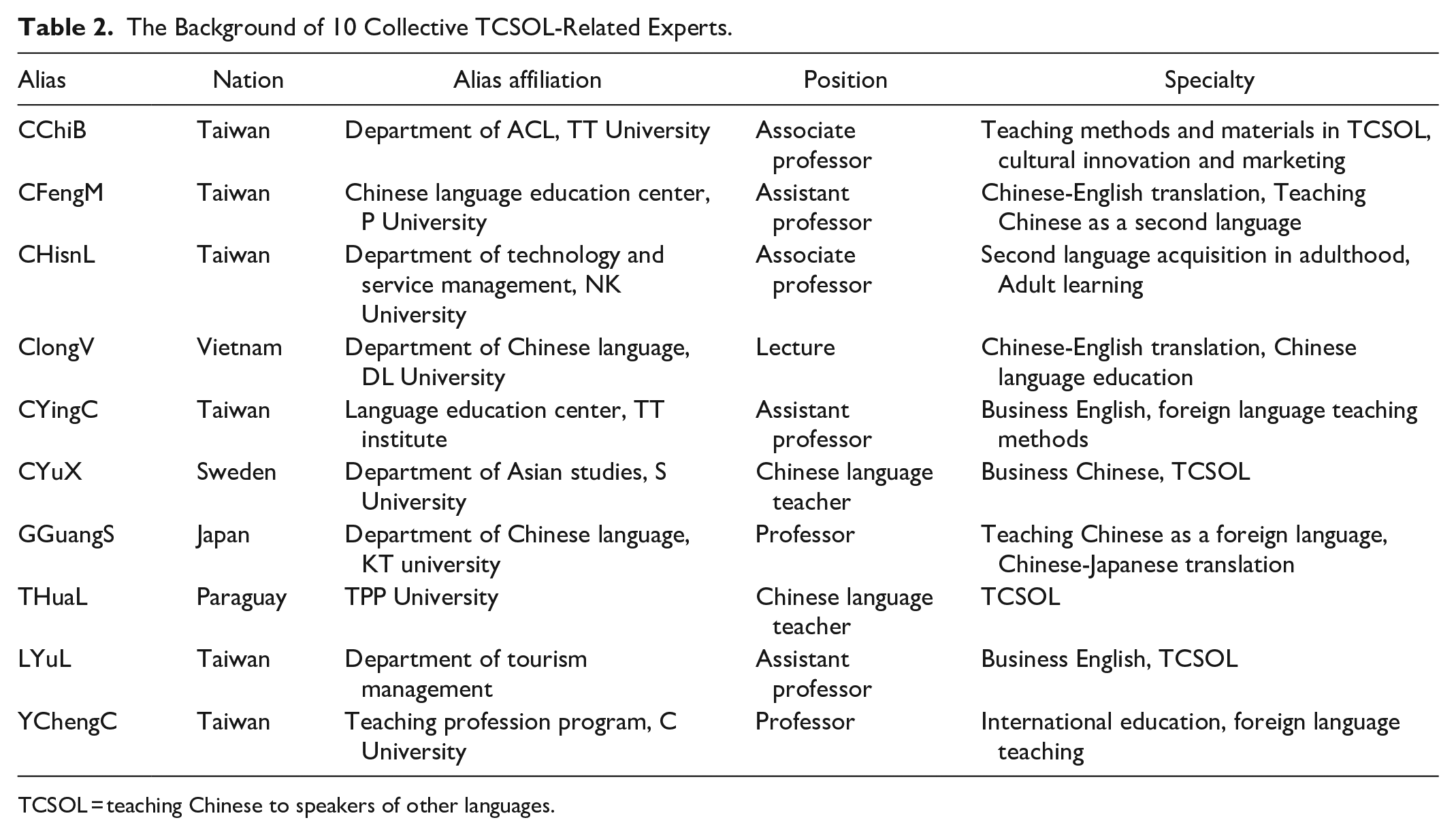
TCSOL = teaching Chinese to speakers of other languages.
Results and Discussions
This study utilized the AHP to construct the weight system for the PC2U assessment indicators, including four dimensions (production, content, usage, and usefulness), 11 criteria (material features, security, credibility, data update, learning needs, accessibility, interaction, simple operation, interface, learning results, and usage frequency), and 63 indicators, which were based on the current research on business Chinese, CLTML, and relevant assessment indicators. The assessment indicators weight system of digital business Chinese materials and its ranking are shown in Table 3.
The Assessment Indicators Weight System of Digital Business Chinese Materials and Its Ranking.
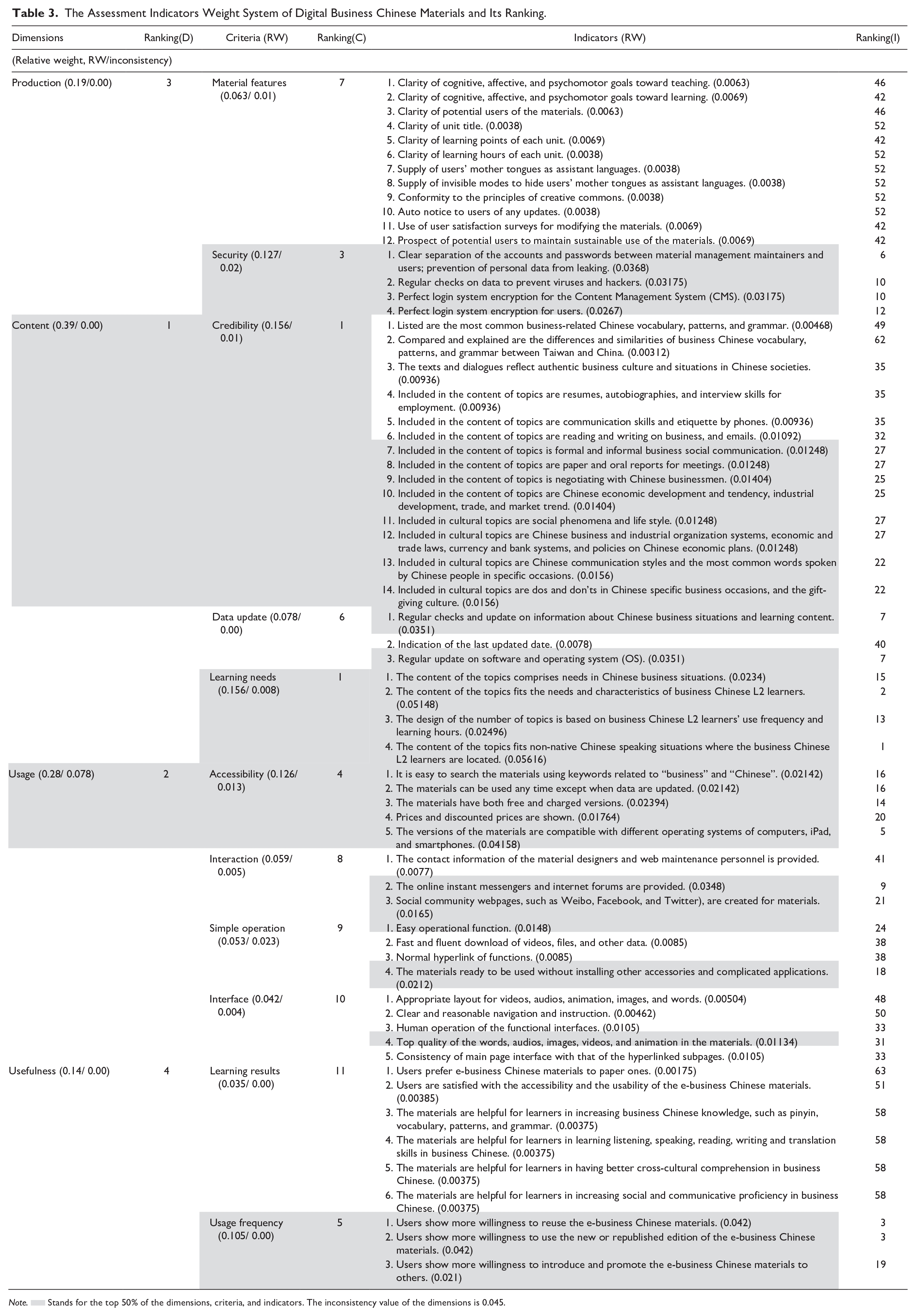
Note.  Stands for the top 50% of the dimensions, criteria, and indicators. The inconsistency value of the dimensions is 0.045.
The Weight System in Dimensions
As shown in Table 3, the inconsistency value is 0.045, which is less than 0.1, implying that the level of consistency is acceptable. It is of foremost priority, with respect to the four dimensions, to access digital business Chinese content, including credibility, data update, and learning needs. Its weight score is 0.39, higher than the other three. The second priority is the usage, including accessibility, interaction, simple operation, and interface; its weight score is 0.28. The last two are production, containing material features and security, and usefulness, containing learning results and usage frequency; the RWs are 0.19 and 0.14, respectively. Content as an index, according to various developing foreign language textbook checklists (Cai & Chen, 2014; Chung, 2018; Ghaderi Doust, 2016; Karimnia & Jafari, 2017; Liao, 2019; Wonchul et al., 2017), is a key evaluative item; the results of these studies are consistent with the findings of the present study.
The Weight System in Criteria
As shown in Table 3, with respect to the three criteria in the content dimension to assess digital business Chinese, learning needs is as important as the credibility criteria, and the RW of both is 0.156 higher than others. The learning needs criterion implies that the topics and content are consistent with business places and meets the needs and characteristics of NNCSBs. The credibility criterion implies listing frequently-used business Chinese vocabulary, grammar, and patterns, different usages between Taiwan and China, and real-life business situations. The inconsistency value of the content equals 0.00, which means the level of consistency is consistent. For schools and teachers, selecting and utilizing e-learning resources have not only managed to create space for effective learning, but also been able to cater to students’ diverse needs (Egbert, 2017). Learning needs play a vital role in developing language textbooks, but students’ real needs are not considered in these textbooks (Moiinvaziri, 2014). From this, it can be seen that considering learning needs is significant, regardless of the type of teaching textbook.
Few are opposed to the importance of listing frequently used and correct Chinese vocabulary, grammar, and patterns in Chinese language textbooks, as well as digital business Chinese materials. Regarding real-life business situations, Gilmore (2007) found that using authentic materials in foreign language learning has a long history, even though debates exist between authentic and contrived materials. This study found the importance of credibility to assess digital business Chinese materials reaches a consensus.
With technological advances, various computer operating systems were developed. Unlike print textbook, the anti-virus software was essential when computers were connected to the internet (Savage & Barnett, 2015); thus, the security criterion, including anti-virus, anti-hacker, and users’ data loss prevention, was necessary to access digital business Chinese materials. Table 3 shows that the RW of the security criterion is 0.127, which was ranked third. The result proved that considering the security criterion was a priority over the material features. In addition, the inconsistency value of the production dimension equals 0.00, which means the 10 scholars and experts’ consensus is unanimous.
Different from print textbooks of business Chinese language, the accessibility, interaction, simple operation, and interface criteria are aimed for digital business Chinese materials. Accessibility means providing an easy search for materials, both free and charged versions beyond time and space limit. As shown in Table 3, with respect to the four criteria in the usage dimension to access digital business Chinese, the accessibility (RW = 0.126) is more important than the other three, and it ranks fourth among all criteria. Weir (2012) deemed that accessing content anytime from anywhere, with no simultaneous user restrictions, online availability ahead of print, easy searchability, and linking to cited materials are the potential benefits of online resources. This study also found that the advantages of digital business Chinese materials, especially accessibility, should be considered.
The usage frequency criterion in this study describes NNCSBs’ high willingness to reuse e-business Chinese materials, and the learning results criterion describes users’ preference of e-business Chinese materials over paper materials and users’ satisfaction with the accessibility of e-business Chinese materials. The features of e-materials as open educational resources include adaptability and reusability (Huertas et al., 2018). Reusing is important for materials to remain sustainable (Danso, 2018). With respect to the usage frequency and learning results criteria in the usefulness dimension to assess digital business Chinese, this study found that the usage frequency criterion (RW = 0.105) ranked fifth, which is higher than the learning results criterion. The inconsistency value of the usefulness dimension is 0.00, which means the consensus is consistent.
The next priorities in order of importance include the following: data update (RW = 0.078); material features (RW = 0.063); interaction (RW = 0.059); simple operation (RW = 0.053); interface (RW = 0.042); and learning results (RW = 0.035).
The Weight System in Indicators
Table 3 shows that the inconsistency of the 11 criteria for 63 indicators is <0.1, which means the level of consistency is acceptable.
Compiling Country-specific Chinese language learning materials has become valued since Jianxi Cui proposed such a concept (Cui, 2005; Dong, 2017), and there is little doubt of the importance of learning needs in compiling foreign language materials. This study found that the content of the topics fits non-native Chinese speaking situations where the business Chinese L2 learners are located geographically (RW = 0.05616) and the content of the topics fits the needs and characteristics of business Chinese L2 learners (RW = 0.05148) hold the positions of the first and second priority, respectively; thus, the argument is proven.
Assessing and evaluating e-book usage was a complex and challenging task, but the availability of reliable usage statistics to support purchase decisions was vital (Conyers et al., 2017). In addition, digital textbooks that are frequently used can remain sustainable. This study also found that the third priority is given to users show more willingness to reuse the e-business Chinese materials (RW = 0.042); this is equally important to users show more willingness to use the new or republished edition of the e-business Chinese materials (RW = 0.042).
Accessibility is a key item to evaluate e-materials’ quality (Estabrook & Arashiro, 2004; Kazaine, 2017; Rahrouh et al., 2018; Schoor & Körndle, 2012). There are five indicators in the accessibility criterion in this study, and as shown in Table 3, the versions of the materials are compatible with different operating systems of computers, iPad, and smartphones holds the fifth priority (RW = 0.04158).
Security was an indicator to evaluate the effectiveness of open textbooks (The Open University of Hong Kong, 2016). Recently, the popular video-conferencing program Zoom failed to prevent personal information from leaking (Iyengar, 2020; Wakefield, 2020). For information security, the Taiwan Ministry of Education immediately issued official documents to prohibit schools from using Zoom for online teaching. It is thus clear that security is vital to digital devices. This study found that two indicators, clear separation of the accounts and passwords between material management maintainers and users, and prevention of personal data from leaking ranked sixth. Through a Delphi survey, Cai and Chen (2014) found that update digital Chinese materials for adults anytime, anywhere is subordinate as an indicator. E-materials contain newer content was a selective indicator in the 2012 certification indicators of digital learning materials of the Taiwanese Ministry of Education. Nevertheless, being able to provide an immediate data update is one of the advantages of e-materials, and this study found regular checks and updates on information about Chinese business situations and learning content was equally important to regular update on software and operating system (OS), both of which resulted in RW of 0.0351 and ranked seventh. Bikowski and Casal (2018) found that students can have high expectations and feel engaged throughout the term when using a customized interactive digital textbook, and it was important to consider making e-textbooks interactive to better engage students (Li et al., 2018; Maag, 2016; Vilar & Zabukovec, 2017). With respect to the three indicators in the interaction criterion of the usage dimensions to access digital business Chinese, it was found that the online instant messengers and internet forums are provided was the ninth in priority (RW = 0.0348). The 10th priorities were awarded to regular checks on data to prevent viruses and hackers (RW = 0.03175) and perfect login system encryption for the Content Management System (CMS) (RW = 0.03175). The remaining indicator rankings are shown in Table 2.
Each assessment indicator has its own value to improve the quality of digital business Chinese materials. Presently, the profession has begun to note the need to identify effective assessment indicators for Chinese (e-) materials. The studies of Cai and Chen (2014), Chiu (2020), Chung (2018), Li and Chen (2016), Liao (2019), and Wonchul et al. (2017) are examples of such efforts. Despite these gallant efforts to exemplify practices of constructing assessment indicators for Chinese (e-) materials through qualitative or quantitative approaches, little emphasis has been placed on the usefulness of these assessment indicators in the 21st century, beyond research methods and tools to compare these indicators’ priorities. Specifically, efforts are lacking in terms of preparing an effective checklist with weights for assessing digital business Chinese materials. In fact, it is helpful to provide teachers with systematic checklists to evaluate the quality of materials and decide whether to use them (Işik, 2018). Therefore, this study contributes to constructing the assessment indicators weight system for digital business Chinese materials by using the analytic hierarchy process methods and suggests that a checklist, based on Table 3, can be developed for Chinese language institutes, researchers, teachers, and publishers to evaluate the quality of digital business Chinese materials.
Conclusion
Practical Application
Using ideas from earlier sections, such as the proposed assessment indicators weight system, this study presents recommendations for Chinese language teachers and publishers to use the system as a checklist to review the quality of digital business Chinese materials, whether they are published or used as textbooks in class.
According to the RW ranking, the top 50% of the dimensions, criteria, and indicators are recommended as required standards, while other remaining indicators are suggested as selective. In the production dimension, there are two criteria: material features, including 12 selective indicators, and security, including four required indicators. In the content dimension, there are three criteria: credibility, including 14 indicators (eight as required and six as selective); data update, including three indicators (two as required and one as selective); and learning needs, including four required indicators. In the usage dimension, there are four criteria: accessibility, including five required indicators; interaction, including three indicators (two as required and one as selective); simple operation, including four indicators (two as required and two as selective); and interface, including five indicators (one as required and four as selective). In the usefulness dimension, there are two criteria: learning results, including six selective indicators; and usage frequency, including three required indicators.
In the rating standard, “A” means that the material is superior to the verification standard in the item; “B” means that the material meets the verification standard in the item; “C” means that the material does not meet the verification standards in the item; “N/A” means that the material does not show anything that corresponds with the item, or what is shown in the material cannot correspond with the item. In the scoring standard, if the material reaches “A” in an item, it is a required indicator weighted to calculate with six points and is a selective indicator calculated with three points; if the material reaches “B” in an item, it is a required indicator weighted to calculate with four points and is a selective indicator calculated with two points; if scored as “C” in an item, it is calculated by one point, regardless of whether it is a required or selective indicator; and finally, if scored as “N/A” in an item, it is calculated with zero points, regardless of whether it is a required or selective indicator.
Limitation and Suggestions for Future Research
This study initially invited 10 collective TCSOL-related experts (eight in the academic TCSOL and two in the practical TCSOL) to answer the AHP questionnaire for constructing the assessment indicators weight system for digital business Chinese materials. The common advantage of the AHP method and the Delphi Technique is that both rely on the judgments of experts to reach a consensus. The AHP method uses a measurement through experts’ pairwise comparisons to derive priority scales, whereas the Delphi technique refers to a research method in which experts are asked to express their opinions and score each item to obtain a consensus through a four-time survey. The two research methods have their respective contributions to survey research; therefore, both could be combined for future research.
Second, the AHP assumes that each component in different hierarchies must be independent, but most of the components are mutually dependent in real world. Such an assumption in evaluating decision-making problems does not meet human values and activities in real world (Saaty & Begicevic, 2010). To improve the limitations of AHP, the Analytical Network Process (ANP), also developed by Saaty to solve the AHP limitation, considers mutual influences between each component and adjacent levels to use the “supermatrix” to comprehensively analyze components interacting and influencing each other to calculate its mixed weight. Therefore, future research should utilize the ANP to make the evaluation model more complete, instead of using the AHP.
Third, it is advisable to invite those with practical Chinese experience to participate in a future study of constructing assessment indicators. In addition to the theoretical foundation for the development of the assessment indicators for digital business Chinese, experienced Chinese language teachers’ and publishers’ views play an important role to examine the assessment indicators. Thus, future studies should invite more experienced and practical TCSOL teachers, as well as publishers, to participate in the follow-up study and bridge perspectives between theory and practice.
Studies on constructing the assessment indicators for TCSOL materials must be ongoing. Using digital devices to teach Chinese language is trending, especially since the outbreak of the COVID-19 pandemic. However, there are still few rigorous and empirical studies on constructing the assessment indicators for digital TCSOL materials, specifically, the weight system for digital business Chinese materials, even though most non-native Chinese speakers study Chinese for business purposes. Although the population of Chinese learners has gradually extended from adults to teenagers, children, and preschool children, adult Chinese L2 learners remain the majority. Hence, this exploratory study can reap the benefits of digital business Chinese materials in a future study. The TCSOL field is concerned with target learners. Age, nationality, and Chinese language level are key independent variables to influence Chinese L2 learners’ performance. If only a single set of criteria is used to measure all digital Chinese materials, its applicability can be debatable. Therefore, future studies can refer to this study, as well as previous research results on assessment indicators for digital language materials, while constructing assessment indicators weight systems for digital Chinese materials for various Chinese L2 learners.
Footnotes
Acknowledgements
This research paper was made possible through the help and contribution of various people. Especially, I would like to express my very great appreciation to my like-minded friends, Maureen H. Chang (Stanford University) and Dr. Feng-Mei Chao (Chinese Language Education Center, Providence University) for their proofreading during the development of this research paper, as well as Section Editor and Reviewers for their valuable and constructive comments, and Editage ( ) for English language editing, to improve my research paper. I would also like to thank the ten collective TCSOL (teaching Chinese to speakers of other languages)-related experts for their help in answering my questionnaire of analytic hierarchy process. Their willingness to give their time so generously has been very much appreciated. I would also like to extend my thanks to Creative Decisions Foundation for the free Super Decision software, so that I can conduct analytic hierarchy process by it. Finally, I wish to thank my family for their support and encouragement throughout my research.
Declaration of Conflicting Interests
The author(s) declared no potential conflicts of interest with respect to the research, authorship, and/or publication of this article.
Funding
The author(s) disclosed receipt of the following financial support for the research, authorship, and/or publication of this article: This work was supported by the National Taichung University of Education [grant number F106202].