




Abstract
In recent years, the development and iteration of information technology have prompted the financial industry to transform and upgrade to financial technology (FinTech), which has received emerging attention from the global financial industry. While the FinTech industry is growing rapidly around the world, however, few studies have foucusd on the shortage of talent and difficulties in recruiting talent. First, this paper clarifies the shortage of FinTech talent through expert interviews and a questionnaire survey of 112 financial industry enterprises in Shanghai, China. Following, based on role theory, we construct a talent capability evaluation index system using 5 primary and 17 secondary indicators. Based on the exploration above, a gray optimization model is designed to support talent recruitment strategy for FinTech enterprises. The results indicate that Chinese FinTech talent should have composite abilities with outstanding professional technical skills and learning abilities, innovation and teamwork ability, project experience, and international vision. This study provides methodological guidelines for global FinTech talent evaluation and recruitment strategies and broadens the application of role theory and gray clustering theory.
Keywords
Introduction
In the Covid-19 post era, the daily activities of the public remain restricted, which increases the vulnerability of banks and other financial institutions as they face increasing risks and competitive pressures among their peers, while reducing their profitability (Yan & Jia, 2022). With the increasing demand for information technology from enterprises and individuals, financial institutions are gradually promoting the digital transformation of finance in response to the inherent requirements of the development of the digital economy, increasing investment in big data and quantum information technology to meet consumer-related financial needs (Amankwah-Amoah et al., 2021; Papadopoulos et al., 2020), as well as enhancing digital strength through financial technology (FinTech), which has placed new requirements on financial talent in the development of the digital and online economy. FinTech is a convergent development and joint innovation of technological innovation and financial capital (H. Wang et al., 2022; Yu, 2022), a core driver of the new financial industry, and an important part of the new infrastructure in modern financial management (Guo & Polák, 2021). How to effectively use FinTech to promote the autonomous innovation capability of society and enhance core competitiveness has become a global hot research issue (Bajwa et al., 2022; Hasan et al., 2020). Professional talent, as the core subjects of financial enterprises, are the basis and key to realize the innovative development of the financial industry and even the whole social economy (G. Li et al., 2022). Therefore, the demand for digital talent in the financial industry has shown a blowout growth, and focusing on the combination of financial and technological development has become a breakthrough for the innovative growth of financial talent (Zhang et al., 2018). Without focusing on the acquisition of human capital, it will be difficult for enterprises to produce value-creating FinTech applications with high innovation capacity (Gomber et al., 2018).
Regarding this emerging field, accelerating the training of high-quality talents and recruiting experienced talents is urgent. Currently, although some research has pointed out the changes in talent demand and types of talent needs brought about by FinTech innovation (Ge et al., 2022; Y. Xiao, 2022), and explored the talent training mode in the FinTech field (Jia et al., 2023; Liu, 2018; Xue et al., 2021). There are also recent studies based on the survey of existing talents in the FinTech industry, discussing talent development paths (Santoso et al., 2021), but most of the related research stays at the descriptive case analysis level and lacks systematic discussion on the talent evaluation indicator system and recruitment strategies from a quantitative perspective. For instance, although gray system theory has been widely used in other fields, it is rarely reflected in the field of talent recruitment. To fill this gap, we intend to solve this problem through further empirical research and systematic analysis. Then what are essential qualities that FinTech talent should have? To answer this question, we attempted to discuss the interdependence between role expectations and industry stability from role theory perspective (Gong et al., 2020; Han & Gu, 2021; Kanwal et al., 2022). When FinTech talent accept the goals and values of the social system, this will facilitate their roles in the social environment (C. Yang et al., 2022; J. Yang et al., 2022). It is accordance with the relationship between occupational role attributes and social expectations. In addition, Shanghai has been committed to building an international financial center. According to the 31st Global Financial Center Index report, Shanghai ranks the fourth place among 126 centers worldwide. It was evaluated from a comprehensive consideration of business environment, human capital, infrastructure, financial industry development level, reputation, etc. Moreover, Shanghai occupies leading positions at second place for FinTech offering worldwide (Wardle & Mainelli, 2022). Moreover, in order to achieve the goal of becoming an international financial center in line with China’s economic strength as well as the international status of RMB and moving to the forefront of global financial centers by 2020, Shanghai Municipal People’s Government has formulated and released the “Implementation Plan for Accelerating the Construction of Shanghai Financial Technology Center.” Gathering leading domestic and foreign FinTech companies and attracting high quality FinTech talent is one of the important goals. Therefore, this study clarified the current situation for extreme shortage of FinTech talent based on the current demand for talent in Shanghai financial industry. Further, to help authority attracting FinTech talent worldwide more efficiently, based on role theory, this paper constructed a talent capability evaluation index system through AHP and built a gray optimization model of talent recruitment strategy. It aims to promote the innovation for the recruitment system of FinTech talent.
The main contributions of this paper are as follows: First, this study enriches the research results regarding FinTech human resources management from the perspective of role theory. Secondly, this study utilizes social surveying, AHP (Analytic Hierarchy Process), and gray clustering methods to construct a systematic talent management framework. Thirdly, this study provides multiple managerial implications for enterprises and authorities to promote the development of FinTech talent evaluation and recruitment innovation.
This study proceeds as follows. Section 2 presents survey on FinTech talent shortage. Section 3 provides the design of the evaluation index system for FinTech talent. Section 4 conducts the gray optimization model of FinTech talent recruitment strategy. Section 5 presents the conclusion, acknowledges the limitations and suggests future research directions.
Literature Review
Role Theory
The genesis of role theory research traces its origins back to the analysis of character portrayals in drama or stage plays. This theory was later incorporated into societal issue research (Solomon et al., 1985). Extant studies have approached the topic from perspectives of role essence and role expectations (Franke et al., 1997; Lynch, 2007). Further, based on role theory, some scholars have scrutinized the differentiated assessment criteria premised on distinct positions, directly evaluated employees’ performance across organizations, and elevated the informational quality of performance appraisals in order to solve performance management issues of FinTech talents (Harnisch, 2012). Other researchers have analyzed the issues of the sustainable development of employee responsibilities during the corporate growth process, emphasizing a focus on long-term business objectives over short-term targets (Qian et al., 2018). We posit that exploring from the perspective of employee roles could facilitate understanding of talent requirements and evaluation standards in the innovative field of financial technology.
Analytic Hierarchy Process (AHP)
AHP is a method that measures through pairwise comparison and relies on expert judgment to derive a scale of priorities (Saaty, 2008). The AHP seeks to define priorities through a systematized practice, supports complex decision-making, and is one of the most widely used multi-criteria decision tools to date (Vaidya & Kumar, 2006). The hierarchical structure of the AHP method enables measurement and integration of various factors in complex decision-making processes in a tiered manner. Its three main functions are: structuring complexity, measurement, and synthesis (Forman & Gass, 2001). Specifically, to address the complexity of the decision-making process, it identifies all different factors influencing the decision and organizes them into a hierarchical structure of homogeneous factor clusters (Forman & Gass, 2001). Ratio scale measurement is achieved through comparisons of these factors. The weight of each factor in the hierarchy is discovered in the comparison process of each factor with its superior factors. The priority (weight) of the entire hierarchy is obtained by multiplying the priority of a factor at each level by the priority of the first factor (parent factor). The advantage of AHP lies in its ability to measure and integrate the numerous factors in the hierarchy (Russo & Camanho, 2015).
Based on this, AHP has become a popular fuzzy multi-criteria decision-making method (Kubler et al., 2016). It has been applied across various industries, addressing problems such as supplier selection (Awasthi et al., 2018), technology choice (Balusa & Gorai, 2021), and sustainability management (Calabrese et al., 2019). In recent years, it has also been increasingly employed in talent evaluation and management, such as incentivizing innovative technology talents and screening management talents.
Gray Clustering
Based on the differences in clustering objectives and methods, gray clustering can be divided into two categories: possibility function and correlation (Fraley & Raftery, 1998). In response to the problem of differing indicator meanings and large numerical differences in actual clustering, researchers have proposed constructing a gray fixed-weight clustering model by assigning fixed values to the weights of various clustering indicators. In addition, by determining the gray centroid to construct the corresponding triangular possibility function, the range of indicator boundaries can be expanded, thereby enhancing the practicality of the clustering function (J. Wang et al., 2014). When the clustering coefficients tend to be consistent, the normalization method and importance consideration are used to determine the gray class to which the object belongs (Murtagh & Legendre, 2014). Due to the impact of the possibility function on clustering, the reasonable values of different indicator weights can be clarified through the classification distinctiveness of the possibility function (Gelbard et al., 2007). Gray relational clustering implements cluster analysis by constructing a correlation matrix of feature variables and builds a multi-objective optimization clustering model (Y.-C. Yuan et al., 2016). Based on the mechanism of gray relational analysis, a gray absolute correlation degree model containing three variables: objects, indicators, and time can be constructed (Luo & Huihui, 2019). These studies have expanded the research and application scope of gray relational clustering.
In practical applications, the gray clustering evaluation model has received widespread attention and is used for performance evaluation in various fields such as environment, production, transportation, and technology. For instance, a study analyzed Beijing’s environmental monitoring data over 10 years through gray clustering, discussing environmental safety levels (Dou, 2016). Another study used the gray clustering evaluation method to determine the safety evaluation indicators of flat intersections, validating the consistency between the comprehensive weighting gray clustering evaluation method and traditional evaluation methods (C. Li et al., 2015). With continuous in-depth research on gray clustering theory, some studies have attempted to apply it to the performance evaluation of corporate management innovation (T. Li et al., 2014), while others have explored role behaviors through gray models (Chen et al., 2022). However, relevant research using gray models for talent capability evaluation is still scarce.
Financial Technology Talent Evaluation and Recruitment Strategy
In recent years, research on the competency requirements of financial technology talents has made certain progress. Kowalski et al. (2021) analyzed from an innovative perspective that comprehensive coordination capability and daring to innovate are among the essential competencies of FinTech talents. X. Li (2015) discussed the optimization of incentives for employees in FinTech companies from aspects such as enhancing the attractiveness of salary benefits, optimizing the fairness of performance assessment, increasing employee training opportunities, and promoting fair promotion and development opportunities, in order to promote the common progress and development of both the company and FinTech talents. Sun et al. (2018) explored new teaching models such as the school-enterprise cooperation in FinTech, in conjunction with the overall situation of the finance and technology industries, providing a good talent guarantee for the development of FinTech. Y. Yuan and Jiang (2021) analyzed the talent policies in different regions in China and the aggregation of FinTech talents, proposing policy suggestions such as perfecting the education and training mechanism and salary incentive distribution mechanism of FinTech companies, and implementing more open talent introduction policies.
Through the collation of existing literature, it is found that: The academic community has reached a consensus on the demand for FinTech talents, but the systematic and standardized indicators for the ability evaluation of FinTech talents have not yet been formed. The existing research on FinTech talent introduction strategies is mainly based on policy-level case analysis, and conceptual models and quantitative calculation methods have not yet been established.
Empirical Analysis
In order to objectively reflect the current demand status of the shortage of talent in the financial field in Shanghai and increase the validity and reliability of the survey results, this study employed a sequential approach encompassing literature analysis, semi-structured expert interviews, questionnaire testing, and revisions to design a survey questionnaire on the shortage of talent in the financial industry in Shanghai. According to the basic requirements of shortage catalog development, questionnaire survey and data analysis, the research and development process of shortage catalog was completed in four stages from May 1, 2022 to September 10, 2022.
Questionnaire Design
Firstly, based on the results of literature review and taking into consideration the current level of financial development in China and the goals of Shanghai’s “14th Five-Year Plan” for financial talent, a semi-structured interview outline was formulated. We invited 10 experts from the academic and practical fields of finance in Shanghai for the interviews. Among them, three were finance professors from renowned Chinese universities, and seven were mid-to-high-level managers from banks, securities firms, fund management companies, insurance companies, third-party payment companies, internet wealth management companies, and government regulatory departments. All of them had >10 years of industry experience, aiming to comprehensively and truthfully reflect the current industry situation and demands through their perspectives. Based on this, the initial version of the survey questionnaire on the current shortage of talent in the financial sector in Shanghai was developed. The questionnaire is divided into three sections: first, the basic information of respondents. Second, the types of shortage financial talent in 50 sub-categories of five major categories (including the ability needs and performance requirements of each sub-category). Following, the supplementary suggested by experts. Furthermore, we distributed the questionnaire to eight experts with extensive practical experience. Among them, two were finance professors from universities, and six were from bank, securities firm, fund management company, third-party payment company, internet wealth management company, fund management companies, and industry associations. After 10 days, we invited them to rate the questionnaire’s validity, using a score of 1 to indicate it was reasonable and 0 to indicate it was unreasonable. They were also requested to provide justifications for their ratings and offer modification suggestions. Based on the results of this testing, we made adjustments to the questionnaire items and renumbered them to ensure clear language and objective problem descriptions. Additionally, we ensured that the questionnaire did not explicitly state the research’s logic to prevent response bias resulting from implied causal relationships. Through the aforementioned steps, the final version of the survey questionnaire was developed.
Sample Selection and Data Collection
This study aims to tap into the urgent need for financial talent in the Shanghai, respondents must have relevant work experience and preferably be experts in relevant segments of the industry with a forward-looking perspective. Consequently, a systematic layout and strict specifications were carried out in terms of sample selection and procedural design steps. First, selecting 10 experts from the expert interviews and trial questionnaires as the initial interviewees, and adjusting the specific steps of conducting the study and formulating notes moderately according to the questionnaires feedback. Second, clarifying the research objectives according to the relevant financial institutions, enterprises and research institutions involved in this study, such as banks, securities companies, fund management companies, insurance companies, third-party payment companies, government regulatory agencies and research institutions. Our research team will distribute the returned questionnaires through the Wenjuanxing platform.
The questionnaire survey was conducted from August 10, 2022 to September 1, 2022. On the recommendation from the project focal point management unit, experts from banks, securities companies, fund companies, insurance companies, corporate finance departments, trading institutions, and government regulators in Shanghai were selected as interviewees. Moreover, to increase the theoretical nature of the survey, professors and experts from renowned universities and research institutions at home and abroad were invited to be interviewed. A total of 112 units were participated, including China Banking and Insurance Regulatory Commission (Shanghai Office), Shanghai Equity Exchange, Shanghai Stock Exchange, China Development Bank (Shanghai Branch), Oriental Securities Limited Company, Fortune Fund Management Limited Company, Shanghai Electric Group Finance Limited Company, Taiping Pension Insurance Limited Company, Huifu Limited Company, New Jersey Institute of Technology, and Fudan University. A total of 334 survey questionnaires were ultimately obtained.
Data Analysis
Experts rated the five subcategories of talents based on a seven-point scale, ranging from 1 to 7, with increasing scarcity. Descriptive statistical analysis was conducted on the data, and the scores were sorted in ascending order. To ensure data accuracy, we utilized Box Plots to identify and eliminate outliers. The results are as follows: for the 5 major categories and 50 subcategories of talent in the financial field listed by the research team, the mean scores provided by the experts were all greater than 4. The three subcategories with the lowest scores were financial institution marketing talents (4.74 points), trust business talents (4.76 points), and fund manager talents (4.80 points), respectively. The three subcategories with the highest scores were big data mining application talents in finance (5.88 points), cloud computing application talents in finance (5.92 points), and artificial intelligence application talents in finance (5.98 points), respectively. Furthermore, the reliability and validity of the questionnaire results were examined using SPSS 22.0 and AMOS 21.0.
Firstly, an analysis of internal consistency reliability was conducted. Both Cronbach’s α and CR values exceeded 0.7, and all CITC values were above 0.5, indicating good internal consistency of the scales (Hair et al., 2010). Secondly, a validity analysis was performed. Initially, the KMO value and Bartlett’s sphericity test were examined. The results indicated that the KMO values for all five subcategories exceeded 0.7, and the p-values were less than .05, meeting the analysis requirements. Following Hayes (2017), we employed the non-parametric bootstrap method to estimate the population median θ using the sample median, and calculated the 95% confidence interval (−2σ + α, 2σ + α) to obtain the quartiles Q1 and Q3, as shown in Table 1.
Bootstrap Confidence Interval Estimates.
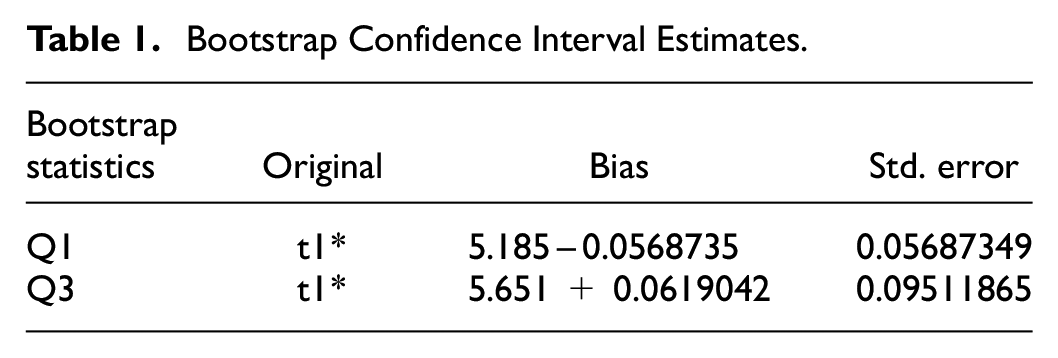
Based on the analysis of results and expert interviews, two percentile values of 5.125 and 5.710 were obtained. The final valid data was divided into three categories based on the degree of scarcity. Among them, there were 13 items classified as extremely scarce (26%), 27 items classified as moderately scarce (54%), and 10 items classified as mildly scarce (20%). Subsequently, a test was conducted on the classification results. Based on a one-way between-subjects ANOVA using a single-factor completely randomized multigroup design, the mean scores provided by the experts were analyzed. The results showed a significant difference among the three stratified data groups: F(3,27) = 21.936, p < .001. Therefore, the stratification results met the requirements of the one-way ANOVA test, indicating significant differences between the hierarchical levels. The results showed that FinTech talent represented by artificial intelligence application, big data mining application, cloud computing application, financial information infrastructure development and operation, and blockchain financial application were extremely shortage financial talent.
Evaluation Index System for FinTech Talent
Evaluation Index System Construction
According to the central claim of social role theory, the social reality represented by group derives from the typical roles occupied by organizational members (Koenig & Eagly, 2014). Therefore, when establishing the FinTech talent evaluation index, we refer to the relevant policies of the domestic and foreign talent evaluation index system (Ji et al., 2021; Jing, 2022). And we focused on the analysis of the basic information and ability qualities of candidates. According to role theory, talent role orientation is determined by the society expectations embedded (Stryker & Serpe, 1982).
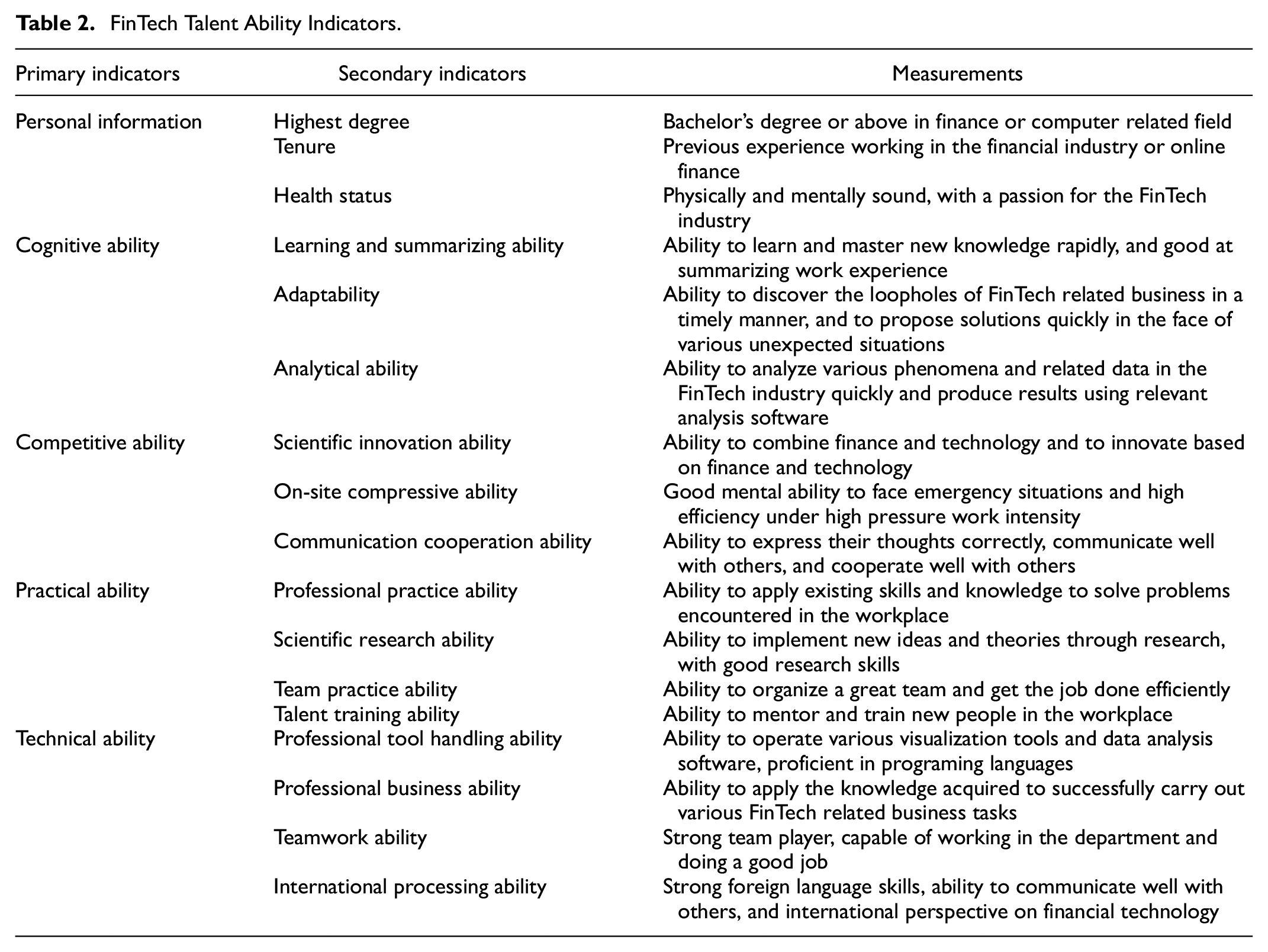
According to the attributes of FinTech industry and based on the survey, we tentatively suggested that FinTech talent need to have rich financial theoretical knowledge and be familiar with information technology applications. Additionally, in the current VUCA era, the FinTech industry exhibits rapid technological changes, requiring practitioners to possess the abilities for learning innovation and practical operation, resilience, and environmental adaptability. Moreover, FinTech business is generally carried out in the form of project-based organization, which requires participants obtaining the ability of collaborative cooperation (Izzo et al., 2022). Therefore, based on the five categories of extremely shortage talent, we constructed the evaluation index from two-dimensional perspective of ability demand and performance experience. Drawing on the findings of existing literatures (Boudreau & Ramstad, 2005; Ferris et al., 2008; Murphy, 2020; Wu et al., 2021), 5 primary indicators and 17 secondary indicators were extracted. They were presented to evaluate the competence of FinTech talent through primary selection and screening by using gray relational analysis, as shown in Table 2.
FinTech Talent Ability Indicators.
Evaluation Index Weights Calculation
The weights reflect the relative importance degree of the influencing factors, and it has an important influence on the evaluation results (Chang, 1996; Ürer Erdil et al., 2021). Based on the hierarchy of FinTech talent capability indicators constructed above, this paper used analytic hierarchy process (AHP) to determine the weights of talent capability evaluation indicators. Following, 10 experts were invited to score the primary and secondary indicators (1–9 points), and the comparative method was used to construct the item judgment matrix and calculate the evaluation index weights, as shown in Table 3.
Judgment Matrix of Primary Indicators.

Based on the results for each primary indicators, the eigenvectors and weights of the judgment matrix were calculated. Next, the row product of the judgment matrix and the nth root was derived, followed by the calculation of the weights.


The results were shown in Table 4.
Primary Indicators.

Next, the consistency test was performed by first asking for the maximum eigenvector of the judgment matrix:

The consistency metric was calculated:

Concluding with consistency judgments, if
By analyzing the fifth order judgment matrix, the CI value was 0.031, the RI value was 1.120 and the CR value is 0.028 < 0.1, which indicated that the judgment matrix of this conclusion was consistent and the weights were in accordance with the requirements. The weights of each index were shown in Table 5.
Weight Values of Each Indicator.

Gray Optimization Model for FinTech Talent Recruitment
From the above analysis, we found that there are multiple factors to consider when recruiting talent for a company. And these factors that may influence recruitment are complex and variable, moreover the information of these factors are small and uncertain. Gray clustering theory provides a methodology basis to solve the question with small amount of data and uncertain information, which is in line with the qualitative characteristics of enterprise talent recruitment evaluation index (Lin et al., 2018; Ming-Yuan, 2012). In this paper, we use the grayness to characterize the interval gray number from a practical situation, and construct a gray clustering model with the observed values and the possible degree function turning points as the interval gray number by using the improved interval gray number algorithm as the theoretical basis. This method can improve the reliability of the operation results by exploring the clustering vector of each interval gray number theoretical domain in the operation process and reconstructing the gray expressions of the operation results.Then, this study built a gray optimization model of talent recruitment strategy based gray clustering theory (Duan & Nie, 2022; L. Xiao et al., 2016).
Gray Categortion and Evaluation Index Values
This paper determined the numbers of gray categories s from three aspects: the number of objects, the number of evaluation index and the evaluation accuracy. From the perspective of objects numbers, the number of evaluation objects of talent was usually from 2 to 5, and the numbers of gray categories was delineated between 3 and 5. Meanwhile, there were more ability index of FinTech talent, the value of the gray index should be controlled in certain range. Further, the accuracy of the evaluation for FinTech talent ability indicators was highly required. In addition, the numbers of gray categories s should not be taken too small. Based on the discussion, the gray clustering method was used to divide the gray categories into four categories, that is, s = 4.
The index of FinTech talent was qualitative, the expert scoring method was used to determine its value range from 1 to 10. P experts were invited to rate m indicators of n objects based on the classification criteria. X t ij represented the rating of the indicator jth of the ith object by the tth expert. To reduce the influence of personal factors, the average of expert ratings xij was taken as the observed value of the ith object under the indicator jth.
Decision-Making Model for Talent Recruitment Strategy
Based on the gray optimization clustering coefficients, the gray optimization clustering coefficients Dik of object i (i = 1,2,3,…,n) were calculated according to the gray categories k(k-1,2,3,…s) of the gray optimization clustering coefficients Dik. The gray optimization clustering vector of object i was:

The gray optimization clustering coefficient matrix was:

According to the principle of maximum affiliation and formula (7)

It was found that the talent evaluation object i belongs to the gray category k*. when there were multiple objects belonging to the gray category k*, the values of Dik* and Djk* need to be further judged. If Dik* ≤ Djk*, it means that object j was better than i under k* gray category, and it was suggested to choose object j as the proposed talent. Finally, the objects were ranked comprehensively according to the gray categories of superiority and inferiority, as shown in Figure 1.

Procedure diagram of FinTech talent ability index evaluation model.
Conclusion and Discussion
The emergence and evolution of Covid-19 has accelerated the digital transformation of finance, and it is an inevitable requirement of the times to promote the integration and application of financial industry and information technology on a global scale. The development of the FinTech has changed the talent demand structure of new financial industry, thus it is of great theoretical significance and practical meaning to explore the competency characteristics of FinTech talent (J. Wang et al., 2022). Based on role theory, this paper explores the evaluation index. and recruitment strategies for FinTech talent with taking the example from Shanghai, China.
Through expert interviews and questionnaire surveys, this study finds that FinTech talent represented by artificial intelligence application, big data mining, cloud computing application, financial information infrastructure development and operation, and blockchain financial application are extreme shortage. They are the main targets of financial talent recruitment. This paper extracts and constructs talent capability evaluation index system, including 5 primary indicators and 17 secondary indicators, through two sub-dimensions of capability demand and performance experience. Further, the exploratory recruitment strategy is proposed through an improved gray optimization model.
Compared to traditional financial professionals, FinTech talents should have the following characteristics: (1) Outstanding professional technical skills and learning abilities. Due to the high-risk nature of the financial industry, practitioners are required to have cognitive and predictive abilities for risk. The development of this ability, in addition to accumulation of project experience, can be supplemented and strengthened through the use of information technology. Therefore, they should possess a combined knowledge of the financial industry and internet technology. Consequently, under the current social organizational structure and technological development conditions, only talents with a “finance + technology” composite knowledge system can possess stronger analytical abilities, to better solve professional FinTech problems and manage financial risks more efficiently. This is precisely a manifestation of the integration of business capabilities and professional tool handling abilities. At the same time, learning ability forms the foundation for continuous improvement of professional skills and analytical abilities. (2) Innovative spirit and teamwork ability. In the new era of knowledge sharing and dissemination, the demand for innovative talent is increasing in all industries around the world. As an emerging industry with cross-fertilization, the FinTech industry has a high threshold of knowledge and technology, with innovative characteristics. In addition, FinTech business are usually carried out in the form of project-based organizations, which requires talent to have innovative thinking skills and teamwork abilities. By increasing the innovation climate of project organizations, the knowledge contribution and knowledge collection among project members can be enhanced, thus promoting the organizational effectiveness of FinTech projects (Ding et al., 2022). Mutual encouragement and support among project organization members, moderate recognition from leaders, adequate resource availability, innovative project features, and a free and positive team concept can create a suitable work innovation atmosphere, effectively enhancing team members’ willingness to transfer knowledge to others, which in turn enhances individual performance and members’ job satisfaction in project-based organizations and can produce better collective performance of tasks (Pavez et al., 2021; Siddiquei et al., 2022). (3) Rich project experience and international perspective. According to the definition from the International Financial Stability Board, the supply-side drivers of FinTech innovation are evolving new technologies and changing financial regulatory requirements, and the demand-side influences are changing business and consumer preferences (Han & Gu, 2021). It requires project managers to obtain sufficient technical knowledge and project management experience. Besides, the environmental adaptability, resilience, stress tolerance, and health status of practitioners are also worth paying attention to. It is noteworthy that there exists an interactive relationship between talents’ abilities. For example, the acquisition of learning ability depends on individual internal factors and external influences, that is, it is affected by the individual’s knowledge capacity reserve and team atmosphere. And the individual’s experience and international perspective will determine the practitioner’s knowledge capacity. Moreover, according to related studies on FinTech practitioners in Italy and Indonesia, cultivating talents with a sense of innovation and the ability to accurately grasp current FinTech technologies is the inevitable path for the sustainable development of the FinTech industry, which is also consistent with our key viewpoint. In a word, we have built a more comprehensive talent capability evaluation index system, hoping to provide intellectual support for talent management in the global FinTech industry.
Based on the talent evaluation index system, companies can evaluate and select potential talents according to the gray optimization model. This is not only an exploration and development of the gray clustering theory but also provides references for recruitment management in the FinTech field. Its research results can provide a technical path for enterprises to evaluate and select FinTech talents, and also make relevant suggestions for the training of FinTech talents.
Limitation and Further Research
However, there are still some limitations that can guide future research. Firstly, the respondents of this study are from Shanghai, China, which is a limiting factor. The boundary of the research object can be extended to other domestic and foreign cities with developed FinTech industries in the future to obtain more representative research results. On this basis, detailed comparative analyses across regions and cultures can be carried out to achieve more enriched research findings that balance both universality and specificity. Secondly, due to the relatively small amount of data in the FinTech industry, it is suggested that as the FinTech industry continues to develop, talent capability evaluation indicators and sub-dimensions can be obtained through data mining and big data analysis techniques to further improve the scientificity and accuracy of talent evaluation and recruitment management. Thirdly, based on the type of FinTech industry, the relevant research results of neural networks can be referred to, further exploring recruitment strategies to meet the talent needs of different types of enterprises, and proposing more specific and accurate talent management and recruitment strategies. Meanwhile, considering tighter integration of talent evaluation and recruitment strategies with corporate management and development strategies could provide more meaningful talent management schemes for enterprises. Lastly, more flexible and innovative talent development mechanisms can be explored to satisfy the abilities and qualities needed for the rapid development and change of the FinTech industry.
In conclusion, the talent capability evaluation index system and recruitment strategies proposed in this study provide insights and methods for talent management in the FinTech industry. Future research can continue to explore and innovate based on this foundation, providing stronger support and guarantees for the sustainable development of the FinTech industry.
Supplemental Material
sj-docx-1-sgo-10.1177_21582440231212256 – Supplemental material for Research on FinTech Talent Evaluation Index System and Recruitment Strategy
Supplemental material, sj-docx-1-sgo-10.1177_21582440231212256 for Research on FinTech Talent Evaluation Index System and Recruitment Strategy by Xue Ding, Mengling Qin, Linsen Yin, Dayong Lv and Yao Bai in SAGE Open
Footnotes
Acknowledgements
The authors are grateful to the editor and anonymous reviewers valuable suggestions that have significantly improved this study.
Authorship Contribution statement
XD and LY contributed to conceptualization, methodology, investigation, data analysis, modeling, original draft writing and funding acquisition. MQ, DL, and YB performed review and editing. All authors have read and agreed to the published version of the manuscript.
Declaration of Conflicting Interests
The author(s) declared no potential conflicts of interest with respect to the research, authorship, and/or publication of this article.
Funding
The author(s) disclosed receipt of the following financial support for the research, authorship, and/or publication of this article: This research was funded by Shanghai FinTech Research Center Funding (2022-JK07-A), and Shanghai Educational Science Research Funding (C2022295).
Ethics Statement
It is not applicable.The research in this paper does not involve animal and human studies.
Informed Consent Statement
The data in this research has been collected and analyzed anonymously. We ensured the respondents that the interview, questionaires and case study have been conducted only for academic purposes, and there is no personal identification. The interview and survey data have obtained the written consent of the participants.

Supplemental Material
Supplemental material for this article is available online.
Data Availability
The original contributions presented in this study are included in the article, further inquiries can be directed to the corresponding author.
References
Supplementary Material
Please find the following supplemental material available below.
For Open Access articles published under a Creative Commons License, all supplemental material carries the same license as the article it is associated with.
For non-Open Access articles published, all supplemental material carries a non-exclusive license, and permission requests for re-use of supplemental material or any part of supplemental material shall be sent directly to the copyright owner as specified in the copyright notice associated with the article.
