



Abstract
The present large-scale mixed-method study examined English language classroom anxiety and enjoyment in Chinese young students in relation to gender and grade level. Quantitative and qualitative data were collected from 709 primary and secondary school students from a province in south China. Major findings were: (1) Around one third of the participants felt anxious when speaking English while more than half felt joyful in the English class. The same pattern applied for male and female students and those in grades 4 to 8; (2) significant gender difference in anxiety occurred in grade 4 and that in enjoyment occurred in grade 8; (3) the students tended to be more anxious and less joyful in the English class as their grade levels increased, with grade 7 being a dividing year of the (inverted) u-curve; (4) anxiety and enjoyment were significantly correlated with each other for students in grades 4 to 8; (5) both learner- and teacher-related variables were identified as causes for anxiety and enjoyment; and (6) the students reacted differently when feeling anxious or joyful in class: When feeling/becoming anxious, they often suffered a lot (e.g., becoming dumbfounded, sweating, trembling, and not knowing what to do or say, etc.); when feeling joyful, they often became more attentive and active in class and studied English harder. It is hence clear that English language classroom anxiety and enjoyment are two independent dimensions of emotion and that fostering positive emotions facilitates SL/FL learning.
Introduction
Among various contributors to second/foreign language (SL/FL) learning, emotion is one of the most influential factors and has been much researched (Dewaele & MacIntyre, 2016; Horwitz, 2001). According to Boudreau et al. (2018), emotion is complex and multi-faceted and emerges in response to a specific event or environmental cue. Some emotion is negative which largely interferes SL/FL learning, while some is positive which helps facilitate the latter (Dewaele & Alfawzan, 2018). As the representative of negative emotion, foreign language anxiety (FLA) has become a major research topic since the 1970s. Defined by Horwitz et al. (1986, p. 127) as “a distinct complex of self-perceptions, feelings, and behaviors related to classroom language learning arising from the uniqueness of language learning process,” FLA has been measured and investigated both quantitatively and qualitatively in diverse SL/FL contexts (Dewaele & Thirtle, 2009; Ewald, 2007; Horwitz, 2001, 2016; Liu, 2006, 2009; MacIntyre & Gregersen, 2012). Most of the studies target adult ESL/EFL (English as a second language/English as a foreign language) learners. As more research is done on FLA, researchers begin to be interested in the role of positive emotion in SL/FL learning, represented by foreign language enjoyment (FLE) (Dewaele & MacIntyre, 2014, 2016). As FLE is becoming a bourgeoning topic of research in the recent decade (Boudreau et al., 2018; Dewaele & MacIntyre, 2014, 2016; Dewaele et al., 2018), more research is required to further understand its role in SL/FL learning and its interaction with other variables, including FLA. It is especially so considering the large number of SL/FL learners and huge variety of learning contexts and learner populations. Coupled with relatively limited research on young learners, the present paper aimed to examine English language classroom anxiety and enjoyment in Chinese young learners in primary and secondary schools (grades 4–9) in relation to gender and year of study, to pursue a better understanding of both positive and negative emotions in young learners of English.
Literature Review
FLA refers to the subjective feeling of tension, apprehension, nervousness, and worry associated with an arousal of the automatic nervous system associated with the learning of SLs/FLs (Horwitz et al., 1986; MacIntyre & Gardner, 1989). It is situation-specific and affects SL/FL learning to varying degrees (MacIntyre & Gardner, 1989). Anxious students may engage in negative self-talk, ruminate over a poor performance, have difficulty in processing information, and even have a mental block in SL/FL contexts (MacIntyre & Gardner, 1991; Tobias, 1979).
Of various types of FLA, the most frequently researched FLA is foreign language classroom anxiety (FLCA), which is often measured by the Foreign Language Classroom Anxiety Scale (FLCAS), a 33-item five-point-Likert scale developed by Horwitz et al. (1986). Mainly covering three dimensions of FLCA: speech apprehension, fear of negative evaluation and test anxiety, the FLCAS has then been widely applied in empirical studies in varying SL/FL contexts (Akkakoson, 2016; Ay, 2010; Bensalem, 2018; Dewaele & Thirtle, 2009; Ewald, 2007; Gkonou, 2014; Gopang et al., 2017; Horwitz, 2016; Liu, 2018a, 2018b). These studies have shown the existence of FLA in many SL/FL learners and a consistent negative relation between FLA and SL/FL learning outcomes, as confirmed in Teimouri et al. (2019). Most of the studies also reveal that speaking is the most anxiety-provoking SL/FL activity and is a strong predictor of SL/FL speaking performance and overall performance. For example, Gkonou (2014) used an adapted version of FLCAS to investigate speaking anxiety on 128 Greek university EFL students, which showed that English speaking anxiety was negatively correlated with learners’ self-perceived oral proficiency. Similarly, a negative relationship has also been generally found between anxiety and other aspects of SL/FL learning outcomes such as listening (Chang, 2008; Liu, 2018a), reading (Lu & Liu, 2015; Wu, 2011), and writing (Cheng, 2002; Woodrow, 2011), in spite of some mixed findings (Brantmeier, 2005; In’nami, 2006).
As more research on FLA is done, FLA has proved to be related to various variables such as age (Cheng, 2002; Dewaele & MacIntyre, 2014; Donovan & MacIntyre, 2004; Liu, 2018b), gender (Kitano, 2001; Matsuda & Gobel, 2004), experience abroad (Thompson & Lee, 2013), SL/FL proficiency (Dewaele & Thirtle, 2009; Liu, 2006), willingness to communicate (Donovan & MacIntyre, 2004; Liu, 2017), as well as teachers (Dewaele et al., 2018; Ewald, 2007). Some findings are consistent while some are mixed and even contradictory. For example, it is generally agreed that more skilled use of FL learning strategies helps downscale FLA (Chang, 2008; Liu, 2018a).
Of these various variables, gender is relatively more researched in relation to FLA, yet mixed findings have been found (Alsaleh, 2018; Donovan & MacIntyre, 2004; Jafarigohar & Behrooznia, 2012). For example, Alsaleh (2018) demonstrated that male students exhibited more anxiety than their female peers, while other studies found that females tended to be more anxious (Donovan & MacIntyre, 2004; Jafarigohar & Behrooznia, 2012; Park & French, 2013). Meanwhile, Matsuda and Gobel (2004) found that male and female university students majoring in English in Japan displayed similar levels of FLA, and Bensalem (2018) reported no correlation between gender and FLA among college-level EFL students. Furthermore, though most research on FLA target adult and senior high school SL/FL learners, as reviewed in Teimouri et al. (2019), the existing research on young SL/FL learners also revealed mixed or contradictory findings about FLA and age (Dewaele & MacIntyre, 2014; Liu, 2018b). For example, Liu (2018b) found that younger learners were less anxious, while Dewaele and MacIntyre (2014) reported that teenagers suffered more from FLA than participants in their twenties. This might be because, though the participants in both studies were young learners, they were at different ages with varying cultural backgrounds. Teimouri et al.’s (2019) meta-analysis of existing research on FLA and language achievement showed an increase in students’ anxiety from junior high schools to senior high schools to colleges and attributed this increase to age and contextual factors. This, as discussed by the researchers, might be that although learners generally become more cognitively competent in dealing with anxiety as they grow older, new educational contexts may create new experiences and obligations on the students that may cause more anxiety. All these mixed findings further confirm the complex and dynamic nature of FLA which often interacts with various individual and contextual factors (Gkonou et al., 2017).
Concurrently, in order to help learners reduce FLA, researchers interested in exploring causes for FLA identify a range of contributors, including low SL/FL proficiency, lack of practice, personality, fear of making mistakes, lack of confidence, unpleasant experiences, lack of skills, familiarity with learning activities, peer pressure, little/no preparation, task difficulty, and classroom environment (Ashraf, 2019; Dewaele & MacIntyre, 2014; Gopang et al., 2017; Liu, 2017, 2018a, 2018b; Liu & Xiangming, 2019; Shabani, 2012). Consequently, researchers propose a number of coping strategies to help reduce/eliminate FLA, including boosting learners’ confidence, maintaining a harmonious and democratic classroom atmosphere, building sound student-teacher relationships, scaffolding tasks, and being empathetic (Ashraf, 2019; Gopang et al., 2017; Horwitz et al., 1986; Liu, 2018a, 2018b; Shabani, 2012).
As FLA has become a well-established research topic in SL/FL teaching and learning, pioneering research has been done by Dewaele, 2017; Dewaele et al., 2018; Dewaele & Alfawzan, 2018; Dewaele & Dewaele, 2017; Dewaele & MacIntyre, 2014, 2016) to boost positive emotions, mainly foreign language enjoyment (FLE), to increase learners’ engagement in and appreciation of SL/FL leaning. To measure FLE, Dewaele and MacIntyre (2014) developed a 21-item 5-point Likert Foreign Language Enjoyment Scale (FLES) to measure learners’ positive emotions toward their learning experiences, peers and teacher, and applied it in subsequent studies (Dewaele, 2017; Dewaele et al., 2018; Dewaele & Alfawzan, 2018; Dewaele & Dewaele, 2017; Dewaele & MacIntyre, 2016). These studies show that though negatively correlated, FLE and FLA are two independent emotional constructs. For example, Dewaele and MacIntyre (2014) revealed a moderate negative correlation between FLE and FLCA, which was confirmed in subsequent studies (Boudreau et al., 2018; Dewaele & Dewaele, 2017; Dewaele et al., 2018). Dewaele and Alfawzan (2018) investigated the effects of FLE and FLCA on FL performance of 189 secondary school pupils from two schools in Greater London and a group of 152 Saudi learners of English. Results showed that FLE had a stronger effect than FLCA on learners’ FL performance.
Similar to FLA, FLE is also found to be related to a considerable number of variables, such as gender (Dewaele et al., 2016), age (Dewaele & MacIntyre, 2014; Dewaele et al., 2018), degree of multilingualism (Dewaele et al., 2018), attitudes toward the SL/FL (Dewaele et al., 2018), and attitudes toward SL/FL teachers and types of SL/FL activities (Dewaele & MacIntyre, 2014; Dewaele et al., 2018). For example, Dewaele et al. (2018) administrated an adapted 10-item FLES and 8-item FLCAS to 189 British high school students learning various FLs. The study showed positive effects of age on learners’ FLE and females’ advantage in exhibiting higher FLE. It also revealed that learner variables (e.g., age, gender, FL proficiency levels, and attitudes) were more often linked with FLE and FLCA than the teacher-related variables (e.g., attitudes toward teachers, teachers’ FL use).
Rationales for the Study
As reviewed, though FLA has been widely researched, FLE as a newly emerging topic is much less examined, so is the interaction of FLA and FLE, given the large number of learners and huge diversity in learner populations and learning contexts. In addition, though different variables such as gender and age do not have a fixed effect or interplay on FLA and FLE, they do interact and work as a complex web penetrating into learners’ entire process of SL/FL learning. These make it worthwhile to further research FLA and FLE in relation to diverse learner- and context-related variables. Moreover, the recent decade has witnessed more studies on FLA and FLE in young learners (e.g., Ay, 2010; Dewaele & Alfawzan, 2018; Dewaele et al., 2018; Gürsoy & Akin, 2013; Liu, 2018b). For example, Liu’s (2018b) mixed-method study of English speaking anxiety on 199 Chinese seventh to ninth graders aged 13 to 15 showed that the participants generally did not feel anxious when speaking English. She also found that anxiety had a negative effect on students’ English speaking performance, and that differences occurred in anxiety levels, causes for and effects of anxiety among the learners in different grades. Even so, research on FLA and FLE in young learners is still scarce given the large number of young SL/FL learners and their limited access to SL/FL. It is worthwhile also because of their age, which may make their feelings and perceptions of FLA and FLE different from adult SL/FL learners’.
For these reasons, the present study aimed to examine English language classroom anxiety and enjoyment in Chinese young learners in grades 4 to 9 with an age range of 9 to 16 in terms of levels of, causes for and effects of anxiety and enjoyment. Another aim was to identify differences in anxiety and enjoyment between male and female students and among those in different grades. To fulfill these aims, the following questions were formulated:
(1) Is there any gender difference in English language classroom anxiety and enjoyment, respectively?
(2) How do English language classroom anxiety and enjoyment change in relation to students’ grade levels, respectively?
(3) How do English language classroom anxiety and enjoyment correlate with each other across grade levels?
(4) What are the causes and effects of students’ English language classroom anxiety?
(5) What are the causes and effects of students’ English language classroom enjoyment?
Research Design
Context
In most provinces in China, students start to learn English formally in grade 3 at age 8, with two English lessons per week predominantly focusing on reading and speaking. Though normally primary school students continue to junior middle schools according to their places of residence, students with excellent academic reports can continue at well-established middle schools and/or better classes of a middle school. Thus, more English lessons are offered and more grammar is taught in class to students in grade 6, the final year of the primary school, which makes English learning more challenging. Grade 7 is the first year and grade 9 is the last year of junior middle school. All junior middle school students have to take the Senior Middle School Entrance Examination (administered and taken once a year) so that they can continue to a senior middle school accordingly. The higher the examination score, the better senior middle school a student can go. English is a required subject of the examination, so junior middle school students, especially those in grade 9, generally have to study English harder and face more challenges. The present study was conducted in a state-owned primary and middle school in a province of south China, where all English courses were taught by Chinese teachers of English.
Participants
A total of 709 (380 male and 329 female) students in grades 4 to 9, aged between 9 and 16 (mean age = 11.87, SD = 1.64), from a primary and a junior middle school in a province in south China, participated in the present study. As shown in Table 1, of all the respondents, 144, 123, 82, 179, 100, and 81 were fourth, fifth, sixth, seventh, eighth, and ninth graders, respectively.
General Information of the Participants.

Instruments
The participants answered the 26-item English Language Classroom Anxiety and Enjoyment Questionnaire and a 3-item Background Information Questionnaire concerning gender, age, and grade level.
The 26-item English Language Classroom Anxiety and Enjoyment consisted of the 14-item English Speaking Anxiety Scale (ESAS), the 8-item English Language Classroom Enjoyment Scale (ELCES), and 4 open-ended questions. With a reliability score of .891 in the present study, the 14-item ESAS was adopted from that used in Liu (2018b) which was adapted from the FLCAS developed by Horwitz et al. (1986), intending to measure students’ speaking English anxiety (ESA) in class. Example items were “I am never sure of myself when speaking English in class” and “I become nervous and upset when speaking English in class.” The ESAS was used because speaking generally proves to be the most anxiety-provoking activity and the classroom teaching focused on speaking and reading in the present context, as described above.
With a reliability score of .751 in the present study, the 8-item ELCES was adapted from the 21-item Foreign Language Enjoyment used in Dewaele and MacIntyre (2014), aiming to measure students’ English language classroom enjoyment (ELCE). To better fit the present situation, only those items reflective of feelings in the English language class were selected. Example items were “It’s cool to know a FL” and “I enjoy my English class.”
The four open-ended questions were: (1) I do/don’t feel anxious in the English class, because _____, (2) If I am anxious in the English class, I ______, (3) I do/don’t feel joyful in the English class, because _____, and (4) If I feel joyful in the English class, I ______.
Procedure and Data Analyses
All the questionnaire items were translated into Chinese, double checked and then distributed to the students by their course teachers. The students answered the items and a consent form in their free time anonymously and submitted the questionnaires and forms to their teachers the next day. In total, 709 valid questionnaires were finally collected, which were then analyzed via SPSS 20. Independent samples t-tests were run to explore gender differences in ESA and ELCE, means and standard deviations were computed to reveal ESA and ELCE levels, and one-way ANOVA was conducted to examine differences in ESA and ELCE among students in different grades. In addition, correlation analyses were run to identify how ESA and ELCE were related to each other.
Reponses to the open-ended questions were coded according to themes, which could be any unit of a text like a word, a phrase, an idea, or a topic (Richards, 2009). Coded themes in the present study were mainly ideas such as feeling anxious, poor English and answering questions. All the coding and analyses were first done by two trained research assistants independently respectively, with an inter-rater coefficient of 0.901. Then the themes were further examined, regrouped, and classified into larger themes according to their semantic relevance, as presented in the Appendix. When coding the responses, a number was given to each respondent in each grade, which was used when the respondents’ remarks were reported in this paper.
Results and Discussion
Gender Differences in ESA and ELCE Levels
Table 2 shows that the whole sample scored 2.65 on ESAS and 3.25 on ELCES, suggesting that around one third of the participants felt anxious when speaking English while more than half felt joyful in class. The same pattern was observed for both male and female students of the whole sample and those in different grades, as evidenced by their mean scores reported in Table 2.
Independent Samples t-test Results of ESAS and ELCES Between Genders.

Note. Effect size of Cohen’s d: small = d ≤ 0.2; medium = d = 0.5; large = d ≥ 0.8 (Cohen, 1988). SD = standard deviation; ESAS = English Speaking Anxiety Scale; M = male; F = female; ELCES = English Language Classroom Enjoyment Scale; For the whole sample, ESAS mean = 2.65 (SD = 0.96), and ELCES mean = 3.25 (SD = 0.73).
p ≤ .05.
Moreover, as seen from Table 2, female students scored higher on ESAS than their male counterparts in the whole sample, grades 4 and 9 but lower in the other grades. They also scored higher on ELCES than male students in the whole sample, grades 4, 5, 6, 8, and 9 but lower in grade 7. Nevertheless, statistically significant difference in ESAS occurred only in grade 4 (t = −2.26, p < .05, d = 0.387) and that in ELCES occurred only in grade 8 (t = −2.40, p < .05, d = 0.477), as evidenced by independent samples t-test results reported in Table 2. Namely, female students in grade 4 felt significantly more anxious when speaking English in class than did male students, and those in grade 8 felt significantly more joyful in English language class than their male counterparts. This, nevertheless, remained unexpected and unknown. A follow-up study would have helped explain this mystery.
Concurrently, different from the finding in a number of studies on FLA (Donovan & MacIntyre, 2004; Jafarigohar & Behrooznia, 2012; Liu, 2009; Park & French, 2013), female students in most individual samples in the present study generally tended to suffer lower or similar levels of English speaking anxiety, as found in Alsaleh (2018) or Matsuda and Gobel (2004). This might be attributed to the fact that because of family planning, the ratio of male and female students in grades 1 to 12 classrooms tends to be close to 1 and the status of women has been gradually enhanced in recent decades in China. Meanwhile, as the family structure greatly changes and society develops in recent decades, it has become more and more natural for male and female Chinese to communicate with one another in public situations, which reduces the anxiety imposed on female Chinese by the traditional culture (e.g., women should be quiet, silent, and submissive, etc.). All of these reasons also helped explain why female students reported feeling slightly more joyful than their male peers in all grades except for grade 7, as found in Dewaele et al. (2018).
Changes in ESA and ELCE Levels of Students in Grades 4 to 9
As seen from Table 3, students in grades 4 to 8 scored below 3 (2.30–2.96) on ESAS and 3.12 to 3.39 on ELCES, suggesting that around one third of the students in each grade felt anxious when speaking English while more than half felt joyful in class, similar to the whole sample. Contrary to their peers in other grades, the ninth graders scored 3.26 on ESAS and 2.94 on ELCES, indicating that more than half of them felt anxious when speaking English and almost half felt joyful in class. This was largely due to the fact that students of grade 9, the bridging year to senior middle school, were under the pressure of which senior middle school they could go and whether they could be admitted into their dream schools. All these would depend on their scores in the Senior Middle School Entrance Examination, meaning that ninth graders were also under test anxiety to varying degrees. This further confirms that test anxiety is an important component of foreign language classroom anxiety (Horwitz et al., 1986).
ANOVA Results of ESAS and ELCES Among Grades 4 to 9.
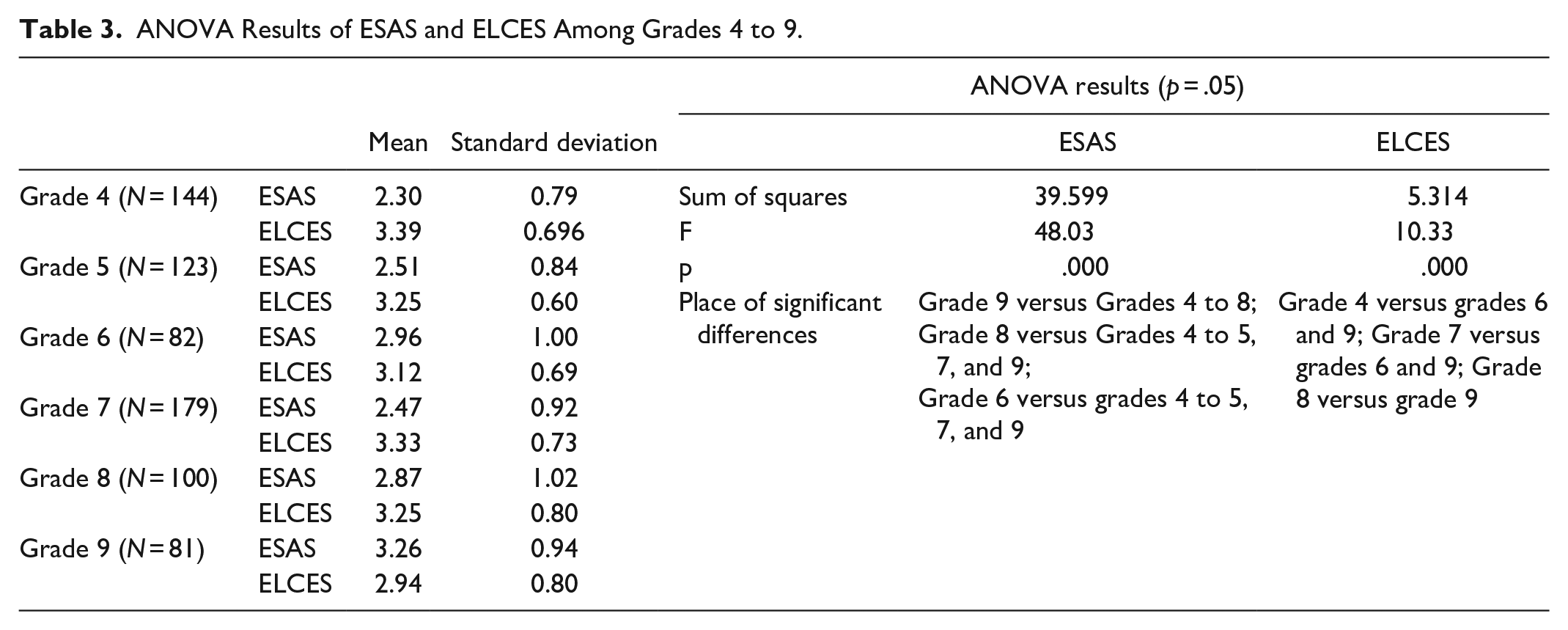
Concurrently, as seen from Table 3, grade 4 students scored the lowest on ESAS but the highest on ELCES, while the opposite was true for their grade 6 peers. Meanwhile, Table 3 demonstrates a contrasting pattern for ESAS and ELCES scores across grades: The ESAS scores rose from grade 4 to grade 6, dropped at grade 7, and then rose again to grade 9; the ELCES scores decreased from grade 4 to grade 6, rose at grade 7, and then decreased again to grade 9. This meant that the students tended to be more anxious and less joyful in the English class as their grade levels increased, with grade 7 as a dividing year of the (inverted) u-curve. This was probably because seventh graders did not have to take any important English examinations as they just started a new journey of study. Statistically significant differences were observed for both ESAS and ELCES among students in grades 4 to 9. As proved by the ANOVA results reported in Table 3, significant differences in ESAS occurred in three groups: Grade 9 students reported to be significantly more anxious about speaking English in class than their peers in grades 4 to 8; grade 8 students were significantly more anxious than their peers in grades 4, 5, and 7, but significantly less anxious than their grade 9 peers; grade 6 students were significantly more anxious than their peers in grades 4, 5, and 7, but significantly less anxious than their grade 9 peers, as were grade 6 students. Likewise, significant differences in ELCES also occurred in three groups: Grade 4 students reported to be significantly more joyful in class than their peers in grades 6 and 9, as did grade 7 students; grade 8 students were significantly more joyful than their grade 9 peers.
Clearly, the higher the grade level, the more anxious the respondents were, largely consistent with the finding in Liu (2018b) which found that the ninth graders worried significantly more about making mistakes and speaking English unprepared than their seventh and eighth peers. Qualitative data revealed a generally rising pattern of percentages of students reported feeling anxious from grade 4 to grade 9: 21 (14.58%) fourth, 20 (21.5%) fifth, 14 (17.07%) sixth, 41 (23.84%) seventh, 23 (23.47%) eighth, and 35 (43.75%) ninth graders reported feeling anxious when speaking English in class (see Appendix). This was mainly because as their grade levels increased, their pressure of the Senior Middle School Entrance Examination increased, and the difficulty of English lessons increased as well, which reached the highest in grade 9. Meanwhile, it was understandable that grade 4 students were the least anxious in that they were the youngest, started to learn English a year ago, and were free of any important examination yet. By contrast, since grade 7 students had just experienced a series of hard(er) training and tests for their dream schools or classes and still had two more years to fight for the Senior Middle School Entrance Examination, they were more relaxed compared with their peers in grades 6 and 8 to 9. All these findings further attest to the role of tests in provoking, increasing and decreasing anxiety in students (Bruch et al., 1983; Horwitz et al., 1986). As discussed in Bruch et al. (1983), students become cognitively less competent in processing information and doing poorly if they are anxious about tests, especially high-risk tests. Meanwhile, this might be partly because the learners had to face new experiences and more demanding obligations and thus became more anxious as they moved to higher grades, as discussed in Teimouri et al. (2019). These two factors worked together to increase students’ anxiety to the highest in grades 6 and 9, respectively.
All these also explained why the students’ ELCES scores decreased from grade 4 to grade 6, rose at grade 7 and then decreased again to grade 9, with grade 7 as a dividing year of the inverted v-curve. Statistical analyses also showed that grade 9 students were significantly less joyful than their peers in grades 7 to 8 while grades 4 and 7 students were significantly more joyful than their peers in grades 6 and 9, indicating that age/grade level is an important factor affecting language classroom enjoyment (Dewaele & MacIntyre, 2014; Dewaele et al., 2018; Donovan & MacIntyre, 2004). In addition, all these findings suggest that there is a strong relation between language classroom anxiety and enjoyment (Dewaele & MacIntyre, 2014; Dewaele et al., 2018) and that important tests are an important factor affecting the two (Horwitz, 2001; Horwitz et al., 1986; Liu, 2009).
As shown in Table 4, ESAS was significantly inversely related to ELCE for the whole sample (r = −.279, p ≤ .01) as well as for students in all grades (r = .207 to .377, p ≤ .01) except for grade 9 (r = .038). This meant that for all samples except for grade 9, the more anxious a student felt about speaking English in class, the less joyful he/she was in class, and/or vice versa, as found in Boudreau et al. (2018), Dewaele and MacIntyre (2014) and Dewaele et al. (2018).
Correlations Between ESAS and ELCES.

p ≤ .01. *p ≤ .05.
Causes and Effects of English Language Classroom Anxiety
As reported in the Appendix, 144 fourth, 93 fifth, 82 sixth, 172 seventh, 98 eighth, and 80 ninth graders responded to the open-ended questions. Among them, 21 (14.58%) fourth, 20 (21.5%) fifth, 14 (17.07%) sixth, 41 (23.84%) seventh, 23 (23.47%) eighth, and 35 (43.75%) ninth graders reported feeling anxious when speaking English in class. Except for grade 9, the numbers and percentages were slightly lower than those reported in Table 3.
The Appendix shows that common causes for anxiety in students across grades were:
(1) fear of answering questions (e.g., not daring to answer questions, not knowing/being sure of answers, fear of giving wrong answers, worry of being unable to answer questions, etc.),
(2) fear of being punished by the teacher (e.g., being criticized or scolded, being beaten on hands, etc.),
(3) not understanding what the teacher said (e.g., not understanding the words or even every word the teacher said), and
(4) fear of being laughed at,
(5) inadequate preparation,
(6) fear of the teacher (e.g., scolding or criticizing students), and
(7) poor English (e.g., not knowing words and grammar, etc.).
For example, as a seventh grader remarked, “I’m nervous. I’m afraid I’ll be laughed at and discriminated against if I can’t answer the questions. I’m afraid other students would say ‘Hah, you even can’t answer such a simple question’. I’m afraid that they will think I’m a loser of English learning, and then won’t be friends with me, be sarcastic of me, lose confidence in me, and then dislike me . . .” (No.76).
In addition, some grade 5 students were anxious in English class also because they worried about being unable to go to a good/dream middle school, some respondents from grades 5 and 9 worried about being unable to learn English well, and some grades 6, 7, and 9 students were afraid of being the focus of attention. Some grades 6 and 8 students attributed their anxiety to English being difficult, while some grades 7 and 9 respondents attributed their anxiety to low self-confidence, fear of making mistakes, and disliking English. Peer pressure was another cause for the anxiety in some grades 7 and 8 respondents, who worried that their peers were better in English. Some grade 9 students were anxious due to the fear of being embarrassed and being unable to speak English.
All these causes were largely consistent with those in previous studies (Ashraf, 2019; Bailey, 1983; Dewaele & MacIntyre, 2014; Gopang et al., 2017; Liu, 2018a, 2018b; Shabani, 2012). And most causes were learner-related, which could be mainly grouped into linguistic and psychological categories. The teacher-related factors mainly involved teachers being harsh and readily punishing students with extra work, sharp criticism, and even physical planking. This shows that in many places of China, the traditional culture still prevails that strict teachers cultivate good students. Hence, teachers can do whatever they can to their students, including physical punishment.
When feeling or becoming anxious, the respondents often had to face a series of difficulties (see the Appendix): Not knowing what to do/say (becoming dumbfounded), becoming fearful or even panicked, forgetting what they knew, becoming distracted and not wanting to study, feeling upset and embarrassed, becoming unhappy, worried and sensitive, failing or not daring to answer questions. Their brain went blank, their hearts beat faster and even pounded, and their hands and legs trembled as well. To some fourth graders, when suffering from anxiety, they made mistakes, their hands sweated, and their tummies ached a lot. Some fifth graders would try to grasp pens or couldn’t find their pens, some seventh graders found it difficult to understand what the teacher said thereafter, and some ninth graders broke into cold sweat. For example, “I feel my heart is beating very fast, I would grasp a pen” (No.88, grade 5). All these sufferings have been reported in the current literature as well (Bailey, 1983; Gopang et al., 2017; Liu, 2006, 2009, 2018b; Liu & Xiangming, 2019; Shabani, 2012), confirming that FLA has bad consequences on SL/FL learning, although it might sometimes be a motivator as found in the present study and others (Liu, 2006, 2009).
To hide their embarrassment and anxiety, some students smiled, talked continuously to others, or drew on their textbooks. Some tried to relax themselves by breathing hard and adjusting their feelings, or asked the instructor or peers for help, so that they could overcome anxiety and study better. All these indicate that students need help to monitor their feelings and become more relaxed and confident, which should be the focus of future research.
Causes for and Effects of English Language Classroom Enjoyment
As shown in the Appendix, 111 (77.08%) fourth, 59 (63.44%) fifth, 58 (70.73%) sixth, 154 (89.53%) seventh, 77 (78.57%) eighth, and 50 (62.5%) ninth graders reported feeling joyful in English class, higher than the means reported in Table 3. The commonly reported causes for feeling joyful across grades were: Liking English, the English class, and/or the English teacher, being attentive, speaking/learning English being cool and fun, English being useful and important, being praised, being able to answer questions correctly, learning English making a better person, being able to learn knowledge, understanding what the teacher said, being good at English, desiring to study English well, and the teacher being nice and humorous. The following were typical remarks, “I’m happy. I have learned much English in the English class. If I learn English well, I can spend my holidays abroad and communicate with foreigners there when I grow up” (No.62, grade 4), and “I’m happy, because what the teacher teaches is very useful. So I know many things, and we will use English when we grow up” (No.70, grade 5). Holding the belief that nobody is perfect, some seventh graders felt joyful in class and thought it natural to make mistakes and be punished sometimes by the teacher during the process of learning a foreign language. In some grades, there was a rule that doing well in a certain English task won extra points for the doer, which made some students happy in the English class.
All these causes were related to the positive aspects of the learner who was willing to study hard and learn English well and held positive attitudes toward English and its learning environment, as well as the teacher who was nice, responsible and often praised students, as discussed in Boudreau et al. (2018). Partially consistent with that in Dewaele et al. (2018), these findings showed that most of the causes were learned-related while some were teacher-related, similar to those for anxiety when speaking English in class discussed above. These findings further indicate that how a teacher conducts teaching and manages the classroom can be an influential factor affecting students’ feelings in the English class (MacIntyre & Gregersen, 2012; Young, 1991).
When feeling joyful, the students would become more focused, more hardworking, happier, more active, more confident and more efficient in learning English, as reported by the participants of the present study (see Appendix). They would also have a sense of achievement and share their happiness with their parents and classmates. Some forth and seventh graders would even jump around and share their happiness with their parents and classmates. Though only seventh graders expressed the idea clearly, all the respondents actually had a sense of achievement, which made them even happier and more excited, and motivated them to study better and become better persons. As the respondents confided, “I’m happy. I can talk to my teacher and classmates, . . . . The class is rich in activities, which makes me very happy” (No.84, grade 7), and “I’m happy. I think it pretty cool to learn a foreign language. If I learn English well, I will be able to communicate better with foreigners, and know people who come from abroad” (No.89, grade 7). Apparently, positive emotions not only make a person happy in class, but greatly increase his/her active engagement in, interest in, enthusiasm for and motivation to study the subject. This may be why Boudreau et al. (2018) claim that introducing positive emotions into SL/FL learning could extend far beyond that of reducing or undoing the effects of negative emotions.
Conclusions and Implications
The present large-scale study investigated English language classroom anxiety and enjoyment in Chinese young learners in grades 4 to 9 in relation to gender and grade level. Analyses of both quantitative and qualitative data revealed the following major findings:
(1) female students generally reported feeling less anxious and more joyful in the English language class than their male peers, yet statistically significant difference in ESAS occurred only in grade 4 and that in ELCES occurred only in grade 8;
(2) the students tended to be more anxious and less joyful in the English class as their grade levels increased, with grade 7 being a dividing year of the (inverted) v-curve. And statistically significant differences were observed for English language classroom anxiety and enjoyment among students in grades 4 to 9;
(3) English language classroom anxiety and enjoyment were significantly correlated with each other for students in grades 4 to 8;
(4) a number of linguistic, contextual and psychological variables were identified as causes for English language classroom anxiety. When feeling or becoming anxious, the respondents often confronted a series of difficulties, like becoming dumbfounded, sweating, trembling and not knowing what to do or say; and
(5) a number of linguistic, contextual, and psychological variables contributed to English language classroom enjoyment. When feeling joyful, the students would become more attentive and active in class and study English harder.
Meanwhile, survey data revealed that around one third of the whole sample, of male and female students, and of those in grades 4 to 8 felt anxious when speaking English in class, generally consistent with the finding in previous studies on adult or young SL/FL learners (Akkakoson, 2016; Ay, 2010; Dewaele & MacIntyre, 2014; Dewaele & Thirtle, 2009; Ewald, 2007; Liu, 2018a, 2018b). Yet qualitative data revealed that fewer students in each grade reported feeling anxious. This might be because students in this new ear had more access and exposure to English brought about by developments in technology (e.g., internet, video, and film resources in English) in recent years, different from the students 10 years ago who had limited access and exposure to English and thus were more anxious when speaking English in class (Liu, 2006).
The present study also revealed that more than half of the participants, male or female, grade 4 or 9, felt joyful in the English class. This finding might be attributed to the following two reasons: (a) Most of the participants were still young and were not under the urgent pressure of studying hard for a good/dream junior or senior middle school, and (b) many students reported enjoying the class in that they liked English and the English teacher.
These findings clearly suggest that English language classroom anxiety and enjoyment are two important and independent emotional factors, affecting students’ classroom behavior and English learning. Consequently, it is necessary for both instructors and learners to take measures to reduce or avoid anxiety and foster enjoyment in the English language class. To cope with anxiety, instructors and learners can work together to create and maintain a harmonious and friendly classroom atmosphere, build a sound student-teacher relationship, boost learners’ confidence, design challenging yet accomplishable tasks, clarify characteristics of English learning (e.g., making mistakes is a natural part of the process, etc.), and share experiences and feelings with one another, as proposed in the current literature (Ashraf, 2019; Bailey, 1983; Gopang et al., 2017; Liu, 2006, 2018a, 2018b; Shabani, 2012; Young, 1991). In addition, to help students develop positive attitudes toward them and their teaching and feel proud of themselves, it is crucial for instructors to be friendly, helpful, and ready to praise students as much as possible as well as to adopt little physical punishment. This is especially important for students in grades 6 and 9 who are under great(er) pressure of continuing to a good/better junior or senior middle school, since the present study revealed that high-risk tests were a deciding factor for anxiety. For this purpose, these students often have to work (much) harder (e.g., taking more lessons and doing more practice tests, etc.) to get high(er) marks in examinations, and their instructors are often more demanding and stricter with students as well, as found in the present study. If the instructors can smile more, scaffold tasks, support, encourage, and praise students more, students may feel more joyful and motivated to study harder, as revealed in the present study and in Dewaele et al. (2018). Meanwhile, instructors can design activities that are slightly above students’ English competence, which can not only drive students anxious but also motivate them to study harder in that certain degree of anxiety is facilitating (Liu, 2009).
Learners also need to do what they can (e.g., getting prepared, having more practice, remaining focused in class, etc.) to prepare themselves for effective learning in class. As found in the present study and in Dewaele et al. (2018), most causes for both language classroom anxiety and enjoyment were learner-related, meaning that teachers were not the main source of students’ anxiety and enjoyment in class. Students had better make more efforts (e.g., watching English films and videos, reading English books, playing English games, and talking to friends in English, etc.) to adjust their own perceptions of and attitudes toward English learning and the English instructor so that they can have better experiences of and more positive feelings about learning English. To be less anxious and more joyful in class, it is especially important for students in grades 6 and 9 to relax themselves, be attentive in class and show support to one another, as suggested by the participants in the present study. Accordingly, they can study better as well.
Limitations and Suggestions for Future Research
The present research clearly indicates that English language classroom anxiety and enjoyment are closely interrelated yet two independent constructs, both of which have great impacts on students’ classroom behavior and SL/FL learning. Therefore, both should be researched more in relation to various learner and teacher variables to really facilitate students’ experiences and outcomes of SL/FL learning (Boudreau et al., 2018; Dewaele & Dewaele, 2017; Dewaele et al., 2018). Meanwhile, though both the present study and the current literature showed that English language classroom enjoyment facilitated learning (Dewaele et al., 2018; Li, 2020; Li & Xu, 2019), as a newly bourgeoning topic of research in SL/FL learning, it deserves more research to better understand its causes, effects, and interactions with other variables. Moreover, the respondents in the present study answered the questions in their spare time and thus might have discussed the answers with their peers or parents. This might have prevented the researchers from obtaining more and true responses from the participants. Though the responses to the open-ended questions demonstrated diverse and individualistic ideas, future research had better ask participants to answer questions within a designated time period and classroom. In addition, the present study observed the u-curve pattern from grades 4 to 9 for both English language classroom anxiety and enjoyment, and attributed it to the start of a new study journey and absence of important English examinations. This, nevertheless, needs to be confirmed with students in other contexts. It is the same with the difference in English language classroom anxiety and enjoyment levels between fourth grader, eighth graders, and those in other grades.
Footnotes
Appendix
Declaration of Conflicting Interests
The author declared no potential conflicts of interest with respect to the research, authorship, and/or publication of this article.
Funding
The author received no financial support for the research, authorship, and/or publication of this article.
