



Abstract
As emotional factors gain increasing prominence in second language acquisition (SLA), few studies have offered a comprehensive bibliometric synthesis of this evolving research area. To address this gap, the present study analyzed 931 articles indexed in the Social Sciences Citation Index (SSCI) from 2000 to 2024. A combination of bibliometric software tools including VOSviewer, CiteSpace, and Biblioshiny were applied to examine patterns in publication output, contributing journals and authors, national distributions, keyword networks, and emerging thematic directions. Furthermore, influential authors and core journals were identified using Lotka’s law, which highlights the disproportionate contribution of a small group of researchers, and Bradford’s law, which identifies the journals that publish the majority of relevant studies. Currently, research in this field is structured around four major themes: affective variables and learner behavior; the integration of positive psychology constructs; individual differences and emotional performance; and the neurocognitive perspective of language learners’ emotions. Looking ahead, the evolutionary trajectory reveals a shift from a predominant focus on negative emotions toward a more balanced, multifaceted perspective. This study aims to contribute a comprehensive bibliometric perspective to the growing body of literature on the emotional dimensions of second language learning.
Plain language summary
Emotions have emerged as crucial variables in second language acquisition (SLA). Despite this recognition, bibliometric studies providing a systematic overview of hot topics and evolution of this research area are sparse. This study aimed to bridge this gap by conducting an in-depth bibliometric analysis to chart the development of emotions in SLA from 2000 to 2024. The findings revealed that the study of emotions in SLA had experienced rapid growth over the past two decades, with China and the United States leading in scholarly output. Prominent scholars, including Dewaele J.-M. and MacIntyre P.D., etc. have been instrumental in advancing this field. Influential journals such as System and Modern Language Journal have significantly contributed to the academic discourse. The co-occurrence of keywords presented four main thematic clusters, illustrating the overview of major research areas. Additionally, the evolutionary analysis indicated a shift from focusing primarily on negative emotional constructs to a more balanced exploration of both positive and negative emotions as well as a growing interest into diverse types of emotions by adopting more advanced quantitative or mixed methods and conducting more longitudinal studies. Implications and limitations were also discussed.
Keywords
Introduction
Emotions are fundamental to human life, affecting our everyday functioning and well-being, including learning in the field of education. According to Pekrun et al. (2002), emotions are conceptualized as multi-component configurations involving interrelated affective, cognitive, physiological, and motivational processes, and are characterized by their valence (positive vs. negative) and activation (activating vs. deactivating). Positive emotions can be classified into activating ones such as enjoyment, hope, and pride, and deactivating ones such as relief; negative emotions, likewise, include activating types like anger, anxiety, and shame, and deactivating types like hopelessness and boredom. They jointly shape their effects on learning, achievement, and well-being (Pekrun, 2006).
Research on emotions in second language acquisition (SLA) examines how emotions affect language learners’ motivation to acquire and use a new language, language learning outcomes, in-class and out-of-class dynamics, overall linguistic proficiency, etc. (Alrabai, 2022; Khajavy & Aghaee, 2022; Li & Li, 2023; Méndez López & Fabela Cárdenas, 2014; Resnik & Dewaele, 2020). In recent years, the field has witnessed a paradigmatic shift from predominantly negative affective constructs, such as anxiety, to a broader inclusion of positive emotions. This transition was largely influenced by the introduction of positive psychology into SLA (MacIntyre & Gregersen, 2012; MacIntyre & Mercer, 2014), which emphasizes the frequent interplay between positive and negative emotions in language learning, challenges the traditional dichotomous view and calls for a more nuanced understanding of learners’ emotional experiences. By fostering emotional strengths—particularly enhancing positive emotions while reducing negative ones—educators can potentially improve language learning outcomes. Understanding these emotional factors is crucial for developing effective learning strategies and teaching methods and creating supportive learning environments that cater to the emotional needs of second language learners.
Over the last two decades, emotions have become an increasingly central topic in SLA. Recent review articles have examined this topic from a range of perspectives (Dewaele & Li, 2020; Papi & Khajavy, 2023; Shao et al., 2019). For example, Shao et al. (2019) conducted a retrospective analysis of four decades of emotion research in L2 learning, elaborating on the theoretical and methodological evolution. Dewaele and Li (2020) proposed a three-phase developmental framework of emotion studies in SLA and synthesized key themes and paradigms. Papi and Khajavy (2023) concentrated on L2 anxiety, identifying three dominant research streams: conceptualization and measurement, effects on learner outcomes, and underlying sources. From a different angle, Aydın and Tekin (2023) applied a systematic scoping approach to explore the intersection of SLA and positive psychology, while Y. Wang et al. (2021) articulated seven key positive psychology variables in L2 education, including grit, resilience, and enjoyment. Grit, defined as sustained passion and perseverance for long-term goals (Duckworth et al., 2007), and resilience, the capacity to maintain high academic performance in adverse situations (Rudd et al., 2021), are crucial for understanding learner success. While enjoyment has been a central focus, the roles of grit and resilience have been comparatively under-explored, representing a significant area for future investigation. Yu (2022) added to this by reflecting on the “emotional turn” and the rising attention to emotional intelligence. Collectively, these reviews provide valuable insights into the field’s theoretical development, core affective constructs, and shifts in research orientation. However, these narrative or systematic reviews, while rich in synthesis, do not provide a visual or quantitative mapping of the intellectual structure of the field. Moreover, they focus on selected themes or constructs and do not offer a comprehensive, data-driven analysis of influential authors, journals, institutions, and research themes and trends over time.
Accordingly, this study aims to fill the gap by employing tools like VOSviewer and CiteSpace to visualize and scrutinize the research on emotions in SLA over the past two decades. Specifically, the project seeks to methodically examine publication trend, key authors, leading countries and journals, major themes, and evolutionary trajectory, with the goal of uncovering the holistic intellectual framework of this area. Consequently, this study put forwards the following research questions:
Who are the key authors, and what are leading publishing countries and major journals in the field of emotions in SLA from 2000 to 2024?
What are the primary research themes related to emotions in SLA from 2000 to 2024, and what specific aspects do these themes concentrate on?
What has been the developmental trajectory of research on emotions in SLA from 2000 to 2024?
Literature Review
The study of emotions in SLA has evolved significantly over the years, with researchers increasingly recognizing the critical role that emotions play in language acquisition. The scholarly attention toward emotions roughly began with the introduction of the Affective Filter Hypothesis (Krashen, 1985) and the conceptualization of Foreign Language Classroom Anxiety (FLCA) by Horwitz et al. (1986). FLA is a specific type of anxiety experienced by learners in the context of acquiring and using a second or foreign language. It can manifest through feelings of nervousness, apprehension, and self-doubt when speaking, listening, or participating in language-related activities. Subsequent research up to the early 2010s predominantly focused on the negative emotional construct of anxiety and its influence on second language learning outcomes. Research during that period was greatly influenced by the affective filter hypothesis, which posited that negative emotional factors such as anxiety and lack of confidence hindered SLA; however, it overlooked the role of positive emotions and failed to explain the underlying emotional mechanisms (Li et al., 2024). The extensive exploration of language anxiety overshadowed the recognition of other distinct emotions in SLA (Shao et al., 2019).
Another landmark development in the field of emotions in SLA was observed with the emergence of positive psychology. Positive psychology was introduced and promoted by Martin Seligman during his presidency of the American Psychological Association (Seligman & Csikszentmihalyi, 2000). Positive psychology is a branch of psychology that focuses on the conditions and processes that enable individuals and communities to thrive (Gable & Haidt, 2005). It is rooted in the idea that individuals strive to live meaningful and fulfilling lives, foster their best attributes, and enhance their experiences in various areas like love, work, and leisure (Positive Psychology Center, 2024). Unlike traditional psychology, which often concentrates on mental illness and dysfunction, positive psychology emphasizes the positive aspects of human nature (Park et al., 2016). Positive psychology began to attract much scholarly attention in SLA and was explicitly introduced into the field (MacIntyre & Gregersen, 2012; MacIntyre & Mercer, 2014). Among positive emotions, foreign language enjoyment (FLE), has emerged as one of the most prominent hues in the field alongside anxiety (Dewaele & Li, 2020). To measure the construct, Dewaele and MacIntyre (2014) created a scale to assess students’ enjoyment in foreign language classrooms and it was updated several times later (Dewaele & MacIntyre, 2016; Dewaele et al., 2018; Li et al., 2018). Saito et al. (2018) highlighted the role of enjoyment in L2 learning, showing that students’ enjoyment significantly predicted short-term development and was also linked to potential long-term gains, while anxiety negatively impacted long-term outcomes. This finding underscores the significance of positive emotions in enhancing the performance of L2 learners, suggesting that L2 teachers should aim to enhance students’ enjoyment and other advantageous affective experiences, such as hope, pride, and contentment. By acknowledging the significant role of positive emotions, researchers and educators should create more effective and enjoyable language learning experiences (Alrabai, 2022; Kralova et al., 2022).
In summary, the study of emotions in SLA has transitioned into a critical and dynamic area of research. As the study of emotions in SLA continues to develop and adapt in response to shifting educational paradigms, it is essential to accurately track its progress, identify key research areas, and anticipate future directions using bibliometric techniques, thereby ensuring the relevance and applicability of research findings to contemporary challenges.
Methodology
Data Retrieval
This study employed the Social Sciences Citation Index (SSCI) from the Web of Science core collection as the primary data source, for the following reasons: (a) The Web of Science is widely recognized as a leading database for bibliometric research due to its structured metadata, such as titles, authors, affiliations, keywords, citations, and impact factors, and its compatibility with tools like VOSviewer and CiteSpace (Carvalho et al., 2013; Gaviria-Marin et al., 2019). (b) The focus area of L2 learners’ emotions falls under the social sciences field of studies, making SSCI an appropriate choice. It is worth noting that ethical approval was not required for this study, as all data were retrieved from publicly accessible academic databases. The data were handled and interpreted in accordance with academic integrity guidelines and standard practices in bibliometric research.
The dataset was obtained through specific search strategy: TS=((“second language learning” OR “foreign language learning” OR “L2 learning” OR “second language acquisition” OR “L2” OR “SLA”) AND (“emotion$” OR “anxiety” OR “enjoyment”)). It merits mentioning that anxiety and enjoyment were purposefully included in the search string. In terms of anxiety, it is a central topic in this filed (Cheng, 2017; Dewaele et al., 2008; Horwitz et al., 1986). Regarding enjoyment, it also merits inclusion for it is one of the most important affective factors besides anxiety (Dewaele & Li, 2020). The search covered the period from January, 2000 to June, 2024 and identified 1,150 potentially relevant articles across various categories for manual screening (see Table 1).
Summary of Data Source and Selection.

In this study, the Preferred Reporting Items for Systematic Reviews and Meta-Analyses (PRISMA) guidelines were followed for the manual screening of the retrieved 1,150 articles. The detailed process is illustrated in Figure 1, following the PRISMA guidelines (Page et al., 2021). The screening involves four key steps: identification, screening, eligibility, and inclusion. Initially, duplicate articles were checked with none duplicate found. Subsequently, 40 articles were excluded because they were either non-English or categorized under literature types such as proceeding papers, book reviews, corrections, editorials, meeting abstracts, or retractions. The remaining articles underwent a thorough review, and those not falling within the categories of Linguistics, Language and Linguistics, Education and Educational Research, Psychology, Educational Psychology, or Multidisciplinary Psychology, or those unrelated to the study of emotions in SLA context, were also excluded. This ensured that all included articles were directly relevant to the research topic.

PRISMA diagram.
As detailed in Table 2, the collection of 931 articles spanning 130 journals was contributed by 1,508 authors from 746 organizations across 59 countries, emphasizing broad interest and global engagement with the research topic. Furthermore, 30,820 cited references within these publications displayed the extensive research foundation.
Summary of Descriptive Statistics.

Instrument
Bibliometrics is the application of mathematical and statistical methods to analyze scholarly publications, focusing on database coverage, search options, metrics, etc. (Thompson & Walker, 2015). Its origins can be traced back to the early 1900s’ psychologists who began systematic counting of publications to contribute to the advancement of their discipline (Godin, 2006). Since then, it has been evolving to a diverse research area. Particularly, with the help of modern computer technology, graphical and visual results can better supplement literature analysis. The employment of this method can be seen in various fields, including health care (Thompson & Walker, 2015), tourism (Ülker et al., 2022), management (Bratianu & Paiuc, 2022), linguistics (Yang et al., 2023), etc. to identify academic trends and assess research performance.
Bibliometrics features measuring the influence of research articles on future research by counting the number of times they are cited after publication (Cooper, 2015). It also evaluates the impact of research outputs, providing an analysis of written publications and helping identify related research, author networks, and connections between institutions (Blakeman, 2018). It could be argued that the method enhances methodological rigor and reduces potential researcher bias in scientific literature reviews by synthesizing perspectives from multiple scholars (Zupic & Čater, 2015). Overall, bibliometric analysis serves as a vital tool for charting the current landscape of scientific knowledge within a specific field and for identifying key information to support research activities (Oliveira et al., 2019).
This study conducted a bibliometric analysis mainly using VOSviewer (1.6.20) and CiteSpace (6.3.R1). Both are computer programs for constructing and viewing bibliometric maps. Each software has its own advantages, and they complement each other functionally. CiteSpace uniquely provides timezone view and timeline view based on its algorithm, allowing clear delineation of the process of knowledge evolution and the historical span of a cluster. This helps to understand the development process and trends in the field (Chen, 2006). In contrast, VOSviewer offers an intuitive interface that supports versatile visualizations (label, density, and cluster views) of various entities such as authors, journals, and keywords (van Eck & Waltman, 2010). In addition, Biblioshiny, an R package for Bibliometrix (Aria & Cuccurullo, 2017), was employed to identify and visualize core contributors. Specifically, Lotka’s law and Bradford’s law were applied through built-in algorithms within the tool, enabling systematic detection and graphical representation. Lotka’s law explains the distribution of author productivity within a specific field, indicating that only a small number of authors contribute a large number of publications, while the majority publish only a few. Similarly, Bradford’s law suggests that a small set of journals contributes the majority of publications in a field, helping delineate the core sources of scholarly output.
Result and Discussion
The Development Trend of Research Publications
The quantity of publications serves as a key metric to gauge the progress in a research area. Observing the annual publication counts provides insight into the overall vitality and emerging trends within the field. The graph illustrates the change of publication volumes in the domain of L2 learning emotions from 2000 to 2024 (see Figure 2).

Time trend of the annual publications.
From the year 2000 to 2012, the publication numbers remained low, typically oscillating around a small base of publications per year. This period was marked by modest activity, with annual publications never exceeding 15. During this period, the field saw slow and steady growth, indicating the nascent stage of research activity. In 2013, the number of yearly published papers exceeded 15 for the first time. The period between 2013 and 2020 marked the beginning of a phase of accelerating growth with the record counts climbing from 17 up to 51, but did not reach 100. It reflected a broader recognition of the importance of emotional factors in language learning. A significant uptick was noticed after 2020, as evidenced by a substantial increase in the number of publications. The annual publication counts surpassed 100 from 2021 onwards, reaching a peak of 205 publications in 2023 and is expected to remain around the level in the following year. This milestone of growth signified an expanding body of knowledge, and a vibrant research community dedicated to exploring this area, underscoring the field’s established importance and continued scholarly engagement and reflecting its evolution into a significant area of study within the broader landscape of language education research.
Quantitative Analysis of the Authors
Analyzing the publication volume of authors illustrates the core scholars and dominant research areas within a field. What is worth mentioning is that the misspellings of authors’ name were found in the raw data. For example, there existed Derakhshan, Ali and Derakhshesh, Ali, which were then combined into the former one. Table 3 lists the most important authors with their publication count, total citations, and average citations per paper, while Figure 3 presents their cooperation network.
Top Five Authors in the Research Field.


Co-occurrence of authors.
Jean-Marc Dewaele stands out as the most prolific author in this domain, with 27 publications. His research has garnered significant attention, accumulating a total of 2,424 citations, resulting in an impressive average of 89.78 citations per article. He has extensively studied how emotions are expressed and experienced in different languages (Dewaele, 2007, 2008, 2010) and dedicated great efforts into researching anxiety and enjoyment (Dewaele & Alfawzan, 2018; Dewaele et al., 2018; Jiang & Dewaele, 2019; Li et al., 2018). He closely works with other highly productive and cited scholars, especially those from China, like Chengchen Li in the fifth place, forming a major cluster of cooperation. Miroslaw Pawlak and Mariusz Kruk also establish an influential co-authoring group, with each contributing 24 papers, amassing over 600 citations with around 30 citations per publication. Their research interest lies in foreign language learning boredom, willingness to communicate, etc. (Kruk, 2022; Kruk et al., 2022; Pawlak & Mystkowska-Wiertelak, 2015; Pawlak et al., 2016). Ali Derakhshan, ranking sixth in terms of publication counts, closely cooperates with them but pays more attention to teachers’ emotion (Derakhshan et al., 2022; Greenier et al., 2021; Pawlak et al., 2021; Y. Wang et al., 2022; Xie & Derakhshan, 2021).
Remarkably, P. D. MacIntyre ranks fourth in terms of publication numbers but takes the leading role regarding average citations, which could be explained by the fact that he is the one who introduces positive psychology into SLA studies, marking a significant emotional turn in this research filed (MacIntyre & Gregersen, 2012; MacIntyre & Mercer, 2014). He plays a critical role in extending positive psychology and explores emotions in SLA from diverse perspectives (Dewaele & MacIntyre, 2024; Macintyre et al., 2019, 2020, 2022).
Figure 4 illustrates the distribution of author productivity based on Lotka’s law using Biblioshiny. The x-axis represents the number of documents written, and the y-axis shows the percentage of authors. The majority of authors (around 81.8%) have published only one paper. Authors who have published two papers constitute around 10.1% of the total, and this percentage continues to decrease as the number of publications increases. This is consistent with Lotka’s law, which predicts a high proportion of single-publication authors. Only a small fraction of authors have published more than 10 papers and are confirmed to be crucial as they contribute a significant portion of the total research output in the field.

Author productivity by Lotka’s law.
Quantitative Analysis of the Countries and Institutions
To identify the top contributing countries in second language learners’ emotions research, this study analyzed publication data from various nations. Table 4 lists the top five countries in this field. China leads with 328 publications and 6,255 citations, averaging 19.07 citations per paper. The United States follows with 180 publications and 5,948 citations, averaging 33.04 citations per article. Iran and United Kingdom are in the third and fourth position correspondingly with each’s publications around 100. Canada ranks fifth with 55 publications but gains the highest average citation of 52.64 among all the five countries. Overall, most countries in the list are developed countries but China as a developing country takes the lead.
Top Five Countries in the Research Field.

The collaboration network (see Figure 5) highlights strong international partnerships among these leading countries. China and the United States, the most prolific contributors, exhibit extensive collaboration networks, engaging frequently with countries like New Zealand, Japan, Saudi Arabia, and South Korea. Iran shows significant collaborative links with Turkey and Poland, enhancing its research impact. The United Kingdom, with notable collaborations with Germany, France, and Spain, underscores its central role in European research. Canada’s connections with both North American and European countries further amplify its research influence. Poland collaborates actively with other eastern European nations. South Korea’s ties with China and the United States underline its growing research contributions in this field. This analysis demonstrates a well-connected global research community, advancing the study of emotions in SLA through robust international collaborations.

Co-occurrence of countries.
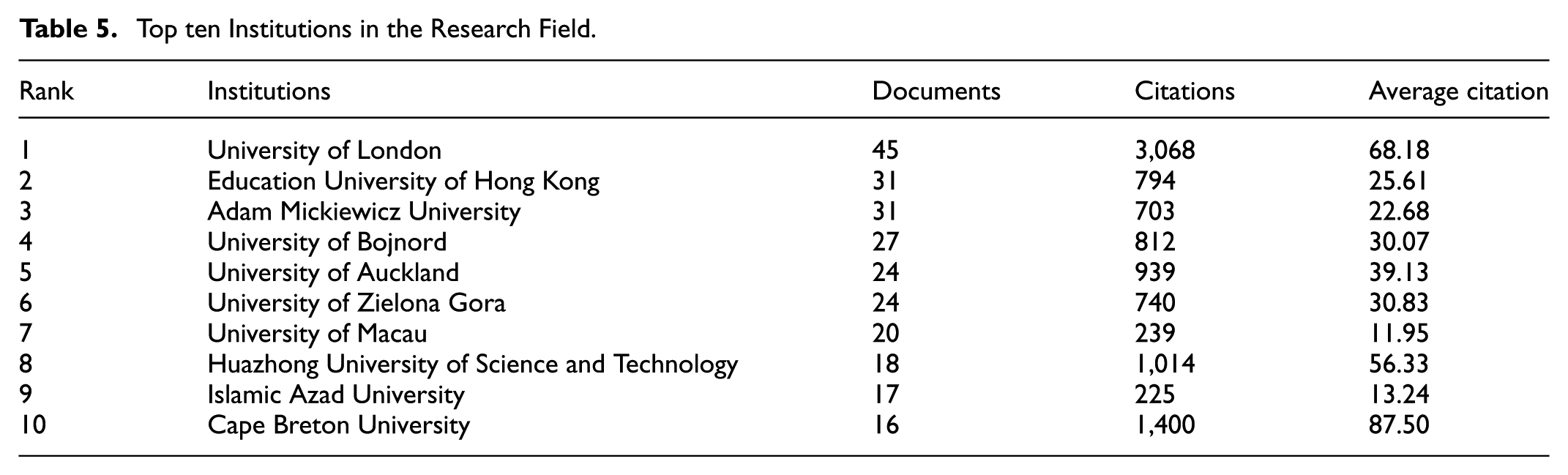
We then analyzed the top 10 institutions and presented the result in Table 5. University of London with 45 publications is the largest contributor in this field. It is also the second most highly cited institution with an average citation of 68.18, indicating its high productivity and quality of research outputs. The Education University of Hong Kong and Adam Mickiewicz University follows, with 31 publications respectively and almost same level of average citations. In addition to the Education University of Hong Kong, University of Macau and Huazhong University of Science and Technology, ranked seventh and eighth separately, are also based in China. Adam Mickiewicz University and University of Zielona Gora in Poland, are ranked third and sixth successively, while University of Bojnord and Islamic Azad University in Iran are in the fourth and ninth place respectively.
Top ten Institutions in the Research Field.
Quantitative Analysis of the Journals
Journals play a crucial role in disseminating high-quality research papers. It is widely accepted that two key metrics for assessing a journal’s impact are the number of published papers and the number of citations those papers receive. A higher volume of publications and citations often correlates with greater influence within a field (Dzikowski, 2018). In our study, ten prominent journals in the research area were evaluated, with a focus on their publication volume and average citations per paper (see Table 6).
Top 10 Journals in the Research Field.

Table 6 highlights that Frontiers in Psychology is the leading journal with 135 publications. It signifies the strong interest of the journal in the interdisciplinary research between psychology and education. It has garnered 1,890 citations in total, averaging 14.00 citations per paper. This may be explained by its free access to its database as an open access journal and can be exposed to more researchers compared with traditional journals. The other notable journal with 98 publications is System, in the second position with 3,112 citations and an average of 31.76 citations per paper. Its impact factor is 4.9, the second highest in the list, only after Computer Assisted Language Learning with an IF of 6. Language Teaching Research follows closely in the third position with 59 documents and 19.31 average citations. The two journals are dedicated to research about language education and pay much attention to the effect of emotions on the learning process and outcomes. Journal of Multilingual and Multicultural Development is concerned with language development in multilingual context. It takes the fourth place in terms of publication counts, indicating the close connection of emotional research to multilingualism. Modern Language Journal, though in the fifth ranking, owns the highest average citations of 56.84, indicating its highly influential status and substantial scholarly attention. Notably, among the top 10 journals, the former 4 are categorized as core sources based on Bradford’s law (see Figure 6). They are the most productive journals where a large number of articles in this field are published.

Core sources by Bradford’s law.
Co-occurrence Analysis on Keywords
Keywords serve as concise representations of research foci, and their co-occurrence reflects how concepts are thematically linked within the field. To identify major research themes in the study of emotions in SLA, we conducted a co-occurrence analysis using VOSviewer. Keywords with a minimum occurrence threshold of six were retained to ensure conceptual significance and visualization clarity. In a keyword co-occurrence view, each node represents a keyword, with larger nodes indicating higher frequency, and thicker lines reflecting stronger co-occurrence relationships. Nodes located at the intersection of clusters or with multiple strong connections serve as core bridging concepts.
As shown in Figure 7, four thematic clusters emerge. These clusters are color-coded, with keywords that frequently appear together forming tightly linked groups. Larger nodes—such as anxiety, students, performance, emotions, and foreign language enjoyment—indicate terms with high frequency and centrality, shaping the core of each cluster.

Co-occurrence of keywords.
The Red Cluster
This cluster mainly deals with the interplay of affective factors like motivation, attitude, and anxiety on language learning. Motivation can be intrinsic (driven by internal rewards like enjoyment or interest) or extrinsic (driven by external rewards like grades or praise). Motivation and attitudes are highly correlated. Gardner’s (1985, 2000) socio-educational model emphasizes the importance of attitudes and motivation in SLA. The model posits that positive attitudes can enhance learners’ motivation, and this motivation, in turn, promotes successful language learning. Motivation also serves as an important influencing factors of foreign language learners’ emotions, and vice versa. Highly motivated learners might experience more positive emotions because they are more likely to set achievable goals and feel competent in their abilities. Positive emotions can enhance motivation, making learners more likely to engage in and persist with learning tasks. Conversely, negative emotions (e.g., anxiety, boredom) can diminish motivation and negatively impact learning outcomes. Dörnyei (2001) provides practical insights into how teachers can create motivating learning environments to sustain learners’ motivation. In addition, different types of motivation can lead to different emotions. For example, it was found that mastery-approach-focused students reported higher levels of activated positive emotions after the task, while avoidance-oriented students experienced more deactivated negative emotions before the task and a decline in emotional activation afterward (Zhou, 2016).
Notably, willingness to communicate (WTC) is a language learning outcome closely related to affective variables in SLA. It is caused by both communication apprehension and perceived communicative competence, which are in turn influenced by underlying traits such as introversion and self-esteem (MacIntyre, 1994). Elahi Shirvan et al. (2019) analyzed 22 studies with a total of 4,794 participants in a meta-analysis and found that there is a small negative correlation between L2 WTC and language anxiety and a moderate positive correlation between L2 WTC and motivation. In other words, when learners feel less anxious about themselves and their abilities or more motivated, they are more likely to take risks and engage in communication.
Additionally, model is another frequent keyword in this cluster, which indicates that many theory-driven models concerning foreign language learning emotions were proposed. Quantitative methods like regression analysis or structural equational modeling in validating correlational or causal relations among affective variables and language learning outcomes become mainstream. Various educational settings like classroom, in-class, out-of-class, informal digital learning emerging in this group also represent researchers test these relations in diverse context to strengthen the models’ external validity and generalizability (Lee & Lee, 2020b, 2021).
The Blue Cluster
This cluster presents a different research focus from the red cluster. It was owing to the borrowing of positive psychology into this field. Since then, studies on foreign language learners’ emotions have gradually moved beyond the previous focus on negative emotions, increasingly emphasizing the importance of positive emotions. Enjoyment, as one of the most typical and prevalent positive emotions experienced by foreign language learners, has garnered growing scholarly interest. The demand to define and measure constructs of positive emotions like FLE, L2 grit or resilience and test hypothesis among variables was also noticed. Key words like SEM, predictors, and validation indicate the development of psychometric measurements and their application. FLE scale was an example. Dewaele and MacIntyre (2016) validated a two-factor structure of the FLE scale and then Dewaele and Dewaele (2017) revised it to a three-factor structure, consisting of FLE-Social, FLE-Private, and a positive atmosphere (Li et al., 2018). This may explain why keywords like teacher or EFL teacher come up as important nodes. Teachers as an important source of FLE, play a critical role in creating an enabling learning environment for language learners.
The Green Cluster
This cluster is dedicated to students’ emotions with a close examination of individual differences and language performance. Piniel and Albert (2018) explored how emotions vary among advanced language learners across different language skills, highlighting the role of individual emotional experiences in language proficiency development. Yu (2022) discussed the importance of integrating educational technologies with an understanding of learners’ individual differences to enhance the emotional well-being. L. Wu and Halim (2024) analyzed how different tasks impact learning emotions and how these emotions, in turn, affect language fluency, complexity, and accuracy in writing. The findings suggest that the emotional responses to language tasks can have a measurable effect on students’ writing output. It also observed consistent result in speaking. Aubrey (2022) examined how anxiety and enjoyment fluctuated on a second-by-second basis during L2 speaking tasks and found that they were differentially related to breakdown fluency, with anxiety more strongly associated with increased pausing.
In addition, it was found that foreign language learning emotions was common in research of corrective feedback. Rassaei (2015) explored how FLA influences learners’ perceptions of two types of oral corrective feedback: recasts and metalinguistic feedback and concluded that low-anxiety learners were more successful at noticing and recognizing the corrective focus of both recasts and metalinguistic feedback compared to high-anxiety learners, which suggests that anxiety negatively impacts their ability to benefit from corrective feedback. These studies indicate emotions affect the effectiveness and quality of learners’ language use, as well as their intake from corrective feedback.
The Yellow Cluster
This cluster explores research on the neurological and cognitive aspects of emotions in language learning, as reflected by keywords such as attention, activation, arousal, cognition, and memory. Early studies in this area focused predominantly on understanding bilingual and multilingual speakers. Swain (2011) underscored the inseparability between emotion and cognition in language learning. Dewaele (2013) showed that language choice in bilinguals often corresponds to emotional valence, reinforcing the emotional dimension of multilingualism. Similarly, Vanek and Tovalovich (2022) found electrodermal evidence of differing emotional reactivity between native and non-native language processing in bilinguals.
More recent work deepens this understanding by emphasizing both neurocognitive measures and dynamic variability in bilingual emotion processing. Jończyk et al. (2025) used EEG to show that bilinguals exhibit reduced neural sensitivity to negative content when producing L2 compared to L1 words. Notably, this suggests that emotional dampening in L2 is not limited to comprehension but also affects expressive language use. Sharif and Mahmood (2023) identified a critical gap in bilingual emotional neuroimaging research through a systematic review of 52 studies. They argued that affective neurolinguistics requires greater methodological integration with bilingualism and neuroscience to improve both research outcomes and educational applications. Theoretically, P. Wang et al. (2024) employed Complex Dynamic Systems Theory (CDST) to frame emotional development as non-linear and context-sensitive, revealing the dynamic natures of language learners’ emotions. This theory moves the field beyond static models and offers more nuanced insights into how emotions interact with cognitive factors like attention and memory in L2 learning.
Collectively, these studies illustrate that emotions in language learning are not only interwoven with cognition but also mediated by neurobiological mechanisms and contextual dynamics. This evolving body of work affirms the integrative view that emotional resonance, cognitive engagement, and linguistic processing are dynamically co-constructed in multilingual minds.
Evolution Analysis of keywords
To illuminate the temporal dynamics of SLA emotion research, we utilized the time-zone view function of CiteSpace, which enables the visualization of temporal patterns in keyword emergence. Figure 8 illustrates this timeline, based on keywords with a minimum occurrence threshold of 20. In time-zone visualization, larger circles denote more frequently occurring keywords, and lighter-colored labels indicate more recent entries, allowing readers to trace both the prominence and recency of thematic focuses.

Time zone view of keywords.
According to Figure 8, in the pre-2004 period, the map is dominated by several large, centrally located nodes such as anxiety, motivation, achievement, students, and classroom, which are shown in darker colors, indicating early and sustained frequency. Around 2005, the field begins to exhibit greater thematic richness, as seen in the increasing number of medium-sized nodes such as self-efficacy, beliefs, individual differences, and personality. The second major shift occurs around 2012, visually evident through the appearance of lighter-colored, right-positioned keywords like positive psychology, enjoyment, resilience, engagement, and validation. These terms signal the entry of a new conceptual paradigm, driven by the rise of positive psychology in SLA. Therefore, the boundaries of 2004 and 2012 are identified and three developmental stages were formed.
Germination Phase (2000–2004): In the first phase of the analysis depicted in the visualization, the keywords “anxiety,”“motivation,”“attitude,”“achievement,”“student,” and “classroom” are represented by notably large circles. The keywords are relatively independent, representing the germination period. The color gradation of these circles transitions from deep purple to pale yellow, illustrating both a high frequency of occurrence and a lengthy duration across the timeline. This visual representation indicates that these terms are consistently hot topics. For example, the prominent and sustained presence of “anxiety” in the literature underscores an enduring interest from researchers (Horwitz, 2001, 2010; Papi & Khajavy, 2023; Sudina, 2023; Xue & Noels, 2025). Furthermore, the multiple links with terms in the other phases indicates that they set the groundwork for future research, akin to a seedling period in the field’s growth.
Exploration Phase (2005–2012): This period sees a deeper investigation into certain topics like “willingness to communicate,”“individual difference,”“personality,” and “context,” suggesting an increased focus on personal and contextual factors influencing emotions. Researchers during this phase began to explore how these individual traits like emotional intelligence, age, gender, education level, and parents’ influence (Dewaele et al., 2008; Yan & Horwitz, 2008), as well as environmental circumstances such as collaborative classrooms and distance learning contexts (Imai, 2010; Pichette, 2009) affect learners’ emotional experiences and language learning outcomes. This also corresponds to a period where the role of personal identity in motivating or hindering language acquisition became more prominent (Ushioda, 2011). The integration of these elements into the research narrative underscores a growing recognition of the complexity of language learning as a deeply individualized, context-sensitive process.
Development Phase (2013–present): This period marks a significant development after the introduction of positive psychology into SLA research around 2012, as evidenced by the surge in the keyword “positive psychology” (Alrabai, 2024; Aydın & Tekin, 2023; Driver, 2024; Ebn-Abbasi et al., 2024; Li, 2020; Macintyre et al., 2019). This indicates a pivotal shift in the research on foreign language learners’ emotions, moving from a focus on negative emotions to an emphasis on both positive and negative emotions. There is also a burst in studies on positive learner variables such as “foreign language enjoyment,”“L2 grit,” and “resilience.” While FLE has received considerable attention, research on grit and resilience is still emerging, highlighting a trend toward a more diversified and comprehensive understanding of the emotional landscape of SLA. The keyword “validation” during this phase underscores the importance of psychological measurement tools such as scale development and validation as research in positive emotions deepened. This need reflects the growing complexity and depth of the field, where accurate and reliable measures are crucial for advancing understanding and interventions. Additionally, the keyword “strategy” reveals the significance of learning and teaching strategies in the study of second language emotions (Bielak & Mystkowska-Wiertelak, 2022; Taheri et al., 2019), suggesting that effective strategies are essential for fostering positive emotions and enhancing language learning outcomes.
This phase exhibits two distinct characteristics. First, there is a concurrent exploration of both positive and negative emotions, with researchers maintaining a robust enthusiasm for studying negative emotions such as anxiety while simultaneously advancing research on positive emotions (Li et al., 2025; Yuan & Liu, 2025). Notably, there has been a growing interest in the dynamic nature of emotions in L2 learning. This perspective emphasizes that emotions are not static but fluctuate (Gregersen et al., 2014; Shirvan et al., 2025). Furthermore, positive and negative emotions frequently coexist during language learning, challenging traditional dichotomies (MacIntyre & Mercer, 2014; Shao et al., 2020).
Second, there is a diversification of emotional types along with a refinement of research contexts and methodologies. Scholars are exploring a range of negative emotions, including distress, shame, guilt, and burnout as well as positive psychological constructs such as buoyancy, grit, resilience, pride, excitement, and enthusiasm (Collie et al., 2015; Derakhshan et al., 2022; Khajavy & Lüftenegger, 2024; König, 2021; Mastrokoukou et al., 2024; Soleimani et al., 2019; Teimouri, 2018; H. Wu et al., 2024). Additionally, the research settings extend beyond the classroom, encompassing various course types and different skill training scenarios (Lee & Chen Hsieh, 2019; Lee & Lee, 2020a). In terms of research methods, on the one hand, advanced statistical instruments have been employed to measure constructs and validate multiple variables’ correlational and causal relations (Duan et al., 2024; Zhang, 2023). On the other hand, more mixed-methods and longitudinal studies have been conducted to offset the drawbacks of solely cross-sectional quantitative research and offered deeper insights into learners’ emotional experiences (Elahi Shirvan & Taherian, 2021; Guo, 2021; Kruk et al., 2021). These methods allow researchers to capture the complexity of emotions and their impact on language learning in more detailed ways.
Conclusions, Implications, and Limitations
This study has charted the intellectual landscape of research on emotions in second language acquisition (SLA) from 2000 to 2024 using advanced bibliometric tools such as VOSviewer and CiteSpace. By synthesizing data from 931 publications, the analysis has illuminated key contributors, prominent institutions, influential journals, thematic clusters, and developmental trajectories within this evolving domain. Although this study adopts objective bibliometric tools, we recognize that choices such as search string construction, inclusion criteria, and keyword interpretation were shaped by our prior knowledge of the field. To reduce potential bias, we applied PRISMA screening, cross-validated keyword themes with key review articles (Dewaele & Li, 2020; Shao et al., 2019), and iteratively revisited our interpretations. Through this reflexive process, we aimed to construct a framework that is not only grounded in data but also sensitive to the interpretive nature of mapping knowledge domains in SLA.
This enriches the theoretical understanding of emotional factors in language learning and provides a clear framework for both researchers and practitioners to appreciate the impact and significance of these emotions. Over the past two decades, research on emotions in SLA has undergone a substantial transformation. Countries like China and the United States have emerged as global leaders in output, supported by prolific scholars such as Jean-Marc Dewaele and Peter D. MacIntyre, whose foundational work has shaped the contours of the field. Influential journals, including System and The Modern Language Journal, have served as primary outlets for this growing body of knowledge. The identification of core contributors and sources, supported by Lotka’s and Bradford’s laws, reinforces the concentration of scholarly influence within a relatively small set of actors and venues.
Conceptually, the field has broadened from a predominant focus on negative emotional constructs—particularly anxiety—toward a more holistic and nuanced engagement with both positive and negative emotions. Research has diversified across themes such as willingness to communicate, individual differences, neurological underpinnings, and the role of enjoyment, grit, and resilience, often framed through the lens of positive psychology. This thematic expansion is further complemented by methodological enrichment, with a shift toward mixed-methods and longitudinal designs offering more layered insights into learners’ emotional experiences.
The implications of these findings extend beyond mapping the field—they offer practical guidance for stakeholders. For researchers, this study provides a comprehensive framework for situating future inquiries, identifying gaps, and aligning with emerging trends. Educators can draw on the identified emotional constructs to inform pedagogical strategies that enhance learner engagement and well-being. Journals and institutions may also benefit from recognizing where concentrated expertise resides and where collaborative opportunities may be forged.
Nevertheless, several limitations should be acknowledged. This study relied exclusively on the SSCI database, which was selected for its high-quality metadata and compatibility with bibliometric tools. However, this reliance may have excluded relevant studies indexed in broader databases such as Scopus or Google Scholar, thus limiting the scope and representativeness of the findings. In addition, SSCI predominantly indexes English-language journals, which may introduce language bias by omitting significant research published in other languages. The decision to focus solely on peer-reviewed journal articles also excluded other formats—such as book chapters, dissertations, and conference proceedings—that may offer valuable region-specific or emerging perspectives.
To build on this work, future studies are encouraged to adopt a multi-database strategy that includes multilingual and multimodal sources to capture a more diverse and representative global research landscape. Moreover, a comparative bibliometric analysis across different regions or linguistic contexts (e.g., East Asia vs. Europe) could uncover how socio-cultural factors influence research development. Beyond mapping trends, further research could employ content analysis or systematic review techniques to deeply examine how key emotional variables (e.g., FLE, anxiety, resilience) are conceptualized and measured across time.
Footnotes

Ethical Considerations
Ethical approval was not required as the study did not involve human participants.
Consent to Participate
Informed consent was not required as the study did not involve human participants.
Funding
The authors received no financial support for the research, authorship, and/or publication of this article.
Declaration of Conflicting Interests
The authors declared no potential conflicts of interest with respect to the research, authorship, and/or publication of this article.
Data Availability Statement
All data analyzed during this study will be provided on reasonable request.