



Abstract
This study adopted both variable- and person-centered methods to investigate Chinese primary school students’ foreign language enjoyment (FLE) and foreign language classroom anxiety (FLCA) as well as factors associated with these emotions, such as language proficiency, gender, grade level, school type, access to foreign teachers and after-school tutoring. Data were collected from 381 students in the fourth and sixth grades of two primary schools in China. Descriptive statistics and latent profile analysis were applied to assess participants’ FLCA and FLE, while one-way ANOVAs and multinomial logistic regression were run to examine the association of various learner-internal and learner-external factors with FLE and FLCA. The participants reported a medium level of FLE and a relatively low level of FLCA, leading to the identification of three distinct profiles: “intense-enjoyment and scant-anxiety” (44%), “medium-enjoyment and medium-anxiety” (54%), and “scant-enjoyment and intense-anxiety” (2%). Our findings indicated that students’ language proficiency, grade level, school type, and after-school tutoring were significantly correlated with their FLE and FLCA levels, as well as their profile membership. However, the study yielded mixed results regarding the impact of access to foreign teachers and the frequency of English lessons per week. These findings contribute to a more nuanced understanding of the emotional experiences of young learners in foreign language learning contexts and provide pedagogical implications for developing more tailored instructional strategies to address the diverse emotional needs of students.
Keywords
Introduction
Foreign Language Classroom Anxiety (FLCA) and Foreign Language Enjoyment (FLE) represent pivotal emotions commonly experienced within language acquisition processes, significantly influencing second language acquisition (SLA) dynamics (Dewaele & MacIntyre, 2014; MacIntyre, 2017). To date, a large number of studies have been conducted on them, showing that levels of FLCA and FLE are closely related to a wide range of learner-internal and learner-external variables including gender, age, education level, language learning experience, motivation, language proficiency, attitude toward the teacher, among many others (e.g., Alrabai, 2022; Botes et al., 2022; C. Li & Li, 2023; Liu & Hong, 2021).
Despite the wealth of scholarship on FLCA and FLE, three key gaps remain to be addressed. Firstly, mixed findings were reported when English as a foreign language (EFL) learners in China were compared with learners from other contexts in terms of their levels of FLCA and FLE (e.g., Dewaele & MacIntyre, 2014; Jiang & Dewaele, 2019; Liu & Hong, 2021). Secondly, much of the existing research on FLCA and FLE among Chinese EFL learners has focused on university students or middle school students (e.g., Jiang & Dewaele, 2019; C. Li, Huang, & Li, 2021). The largest cohort of English learners in China, the primary school students, have largely been understudied, probably because the increased focus on academic performance in higher grade levels has led researchers to concentrate more on older students. Thirdly, as studies investigating FLCA and FLE have predominantly utilized variable-centered quantitative methods, few endeavors have been made to explore the phenomenon via the person-centered approach.
To address these gaps, this study adopts an integrated approach, combining both variable-centered and person-centered methodologies, to examine the FLCA and FLE of Chinese EFL primary schoolers. It is hoped that the study will offer more insights into the emotional landscape of EFL young learners, thereby contributing to the enhancement of foreign language pedagogy in China and similar contexts worldwide.
Literature Review
Emotions and Second Language Acquisition
SLA research used to focus primarily on cognitive elements, leaving the construct of emotion “poorly studied, poorly understood, seen as inferior to rational thought” (Swain, 2013, p. 205). However, at the turn of the millennium, there has been a growing recognition of emotions as vital components in language learning and teaching. Defined as “the primary human motive” that “functions as an amplifier, providing the intensity, urgency, and energy to propel our behavior” (MacIntyre, 2002, p. 61), emotions have drawn increased interest along with the growing adoption of principles from Positive Psychology (PosPsy) within the SLA community (Derakhshan, 2022; MacIntyre & Gregersen, 2012).
Central to PosPsy is the Broaden-and-Build theory (Fredrickson, 2001; Fredrickson, 2003), which posits that positive and negative emotions function independently, each serving distinct purposes. Negative emotions play a constructive role in discerning, delineating, and confronting extraneous stimuli; nonetheless, they possess the potential to narrow people’s mindsets and induce deleterious behavioral outcomes. Positive emotions, by contrast, can “broaden people’s momentary thought-action repertoires” and facilitate the augmentation of their individual and social resources (Fredrickson, 2003, p. 333). Specifically, the activation of positive emotions can yield five notable benefits: (1) fostering novel experiences and advancement by broadening individuals’ attention and cognitive scope; (2) mitigating the detrimental effects instigated by negative emotional arousals; (3) bolstering resilience amid challenging circumstances; (4) helping build personal resources; (5) contributing to an increased level of long-term well-being (Fredrickson, 2001).
The tenets upheld by PosPsy in general and the Broaden-and-Build theory in particular carry significant implications for SLA research, which delves into a broader spectrum of emotions and their correlations with both L2 learning and teaching (Dewaele & MacIntyre, 2014; C. Li, 2020; Mercer & MacIntyre, 2014). In the past, SLA researchers mainly focused on negative emotions (with anxiety being the predominant construct under scrutiny) and were dedicated to teasing out their obstructive impact on language learning (e.g., Dewaele et al., 2018; Liu, 2006; Welesilassie & Nikolov, 2022). Over the past decade or so, there has been a growing trend among SLA scholars toward adopting a more holistic view of emotions and tapping into such positive emotions as flow, pride, passion, and resilience (e.g., Dewaele & MacIntyre, 2024; Ross & Stracke, 2016; Teimouri et al., 2019). A multitude of benefits associated with positive emotions on language learning have been identified, including learners’ elevated awareness of language input, enhanced resilience, and augmented motivation (Dewaele et al., 2022; MacIntyre et al., 2019).
Foreign Language Classroom Anxiety (FLCA) and Foreign Language Enjoyment (FLE)
FLCA and FLE are widely recognized as frequently experienced emotions among language learners around the globe, whether they are advanced learners or beginners (Dewaele & MacIntyre, 2014; MacIntyre, 2017). These two emotions have drawn extensive scholarly attention that expanded geographical and methodological boundaries since PosPsy infiltrated the field of applied linguistics (Dewaele et al., 2019).
FLCA, characterized by “the subjective feeling of tension, apprehension, nervousness, and worry associated with an arousal of the automatic nervous system” within foreign language instructional settings (Horwitz et al., 1986, p. 125), has been linked to various adverse outcomes such as hindered linguistic processing, diminished academic achievement, and decreased motivation for target language communication (Botes et al., 2020; Horwitz et al., 1986). Regarded as a constructive counterpart to FLCA, FLE refers to “a complex emotion, capturing interacting dimensions of challenge, and perceived ability that reflect the human drive for success in the face of difficult tasks” (Dewaele & MacIntyre, 2016, p. 216). Deemed as “the emotional key to unlocking the language learning potential of adults and children alike” (Dewaele & MacIntyre, 2014, p. 261), FLE promotes language learning by, for instance, heightening learners’ awareness of language input, mitigating the adverse impacts of negative emotions, fortifying resilience amidst challenges, and nurturing connections with peers and instructors in language classrooms (e.g., Boudreau et al., 2018; C. Li et al., 2018; C. Li, Dewaele, & Jiang 2019; G. Li, Sun, & Jee 2019).
In response to the recent call for a more holistic approach to SLA emotion research, scholars have conducted in-depth investigations into the intricate interplay between FLCA and FLE. The pioneering empirical study to juxtapose FLCA and FLE was carried out by Dewaele and MacIntyre (2014). They surveyed the FLCA and FLE of 1,746 language learners from different regions around the globe and found a negative correlation, though at a moderate level, between FLE and FLCA. The finding suggests that the two emotions were fundamentally independent dimensions (Botes et al., 2022). Following this line of research, a large number of empirical studies have examined these two emotions in tandem, focusing on diverse issues and topics such as constructs and measurements (e.g., Jin & Zhang, 2021; C. Li, Zhang, & Jiang, 2021), their correlates and predictors (e.g., Dewaele & Saito, 2024; C. Li & Han, 2022; C. Li & Li, 2023), and their trajectories of development (e.g., Pan & Zhang, 2023; Saito et al., 2018; Wu, 2024).
Of the researched themes, the antecedents of FLCA and FLE appear to be critically important and highly germane to the present study. A number of variables, conceptualized as learner-internal and learner-external ones, were found to be closely related to the two distinct emotional experiences. The learner-internal variables include age, gender, emotional intelligence, target language proficiency, and instruction level, etc. (Dewaele et al., 2016; Dewaele & MacIntyre, 2014; C. Li, 2020; C. Li & Li, 2023, 2024). By contrast, the learner-external variables include teacher characteristics (e.g., enthusiasm, predictability, teachers’ use of the foreign language), ranking in the foreign language class, and cultural backgrounds (e.g., Alrabai, 2022; Dewaele & MacIntyre, 2014; Saito et al., 2018).
An intriguing area meriting more research pertains to how internal and external factors might influence language learners’ FLCA and FLE. Dewaele and MacIntyre (2014), for instance, discovered that “participants who already mastered more languages, who had reached higher level of education, and who were older reported significantly more FLE and significantly lower levels of FLCA” (p. 262). Moreover, higher levels of FLCA and FLE were reported by female participants. Most notably, learners from North America reported the highest levels of FLE and the lowest levels of FLCA, whereas an opposite pattern was observed among Asian foreign language learners. Drawing upon the same dataset, Dewaele et al. (2016) carried out a subsequent investigation into gender differences in FLE and FLCA, revealing that female participants exhibited significantly higher levels of FLE and FLCA than their male counterparts.
Using a sample of 189 secondary school students studying different target languages from two schools, Dewaele et al. (2018) systematically explored how learner-internal variables (i.e., age, gender, foreign language proficiency level, comparative class ranking) and learner-external factors (i.e., teacher-related factors) could predict FLCA and FLE. With regard to learner-internal variables, female participants again showed significantly higher levels of FLCA and FLE. Favorable perceptions of the target language and more advanced language proficiency were found to be significantly correlated with higher levels of FLE and lower levels of FLCA. As to learner-external variables, teacher variables were found to have no predictive effect on FLCA but significantly impact FLE. Overall, the teachers’ frequent use of the target language and time spent on speaking were more likely to trigger students’ FLE; by contrast, teachers’ predictability tended to induce less FLE.
A limited but growing body of research has explored the FLE and FLCA levels of Chinese EFL learners. For instance, Jiang and Dewaele (2019) examined how FLE and FLCA were related to several variables pertaining to teachers and learners, drawing on data collected from 564 undergraduate students. The study revealed that gender did not display a significant correlation with either FLE or FLCA. FLCA was more likely to be induced by learner-internal factors (e.g., learners’ proficiency in English, attitudes toward English), while FLE demonstrated a stronger association with learner-external variables related to teachers (e.g., teacher friendliness, predictability and strictness).
In a similar vein, C. Li, Huang, and Li (2021) explored the impacts exerted by one learner-internal variable (i.e., emotional intelligence as an individual trait) and one learner-external variable (i.e., classroom environment) on FLCA and FLE in the Chinese EFL context. Analyzing data collected from 1,718 Chinese middle school students and 1,295 Chinese college students, the study found that both variables significantly predicted FLE and FLCA and that participants with more positive perceptions of classroom environment and higher emotional intelligence tended to exhibit elevated levels of FLE and diminished levels of FLCA. Furthermore, similar to Jiang and Dewaele (2019), C. Li, Huang, and Li (2021) also found FLE to be more strongly related to learner-external variables (i.e., classroom environment), and FLCA to be more strongly related to learner-internal variables (i.e., trait emotional intelligence).
Notably, research on SLA emotions in the Chinese EFL context is still in its infancy, with only a paucity of research addressing FLCA and FLE holistically. Scrutiny of these studies reveals a predominant focus on university students or middle school students (Geng & Jin, 2023; Jiang & Dewaele, 2019; C. Li, Huang, & Li, 2021; C. Li & Li 2023, 2024; Z. Li & Xing, 2024; Wu, 2024) and scant attention has been directed toward primary school students, who constitute the largest English learning population in China. To our knowledge, the sole study examining Chinese primary school students’ FLCA and FLE is Liu and Hong (2021). Drawing on a sample of 709 students from both primary and secondary school spanning from Grade 4 to Grade 8, the study investigated the interplay between students’ FLCA and FLE in relation to grade level and gender. The findings indicated that female students in general scored higher than their male counterparts on both FLE and FLCA. An inverse relationship between students’ grade levels and FLE and a direct relationship with FLCA were identified. Students’ grade levels were found to be negatively correlated with FLE but positively correlated with FLCA.
The reviewed studies yield several noteworthy observations. Firstly, the majority of variables examined as potential contributors to foreign language learners’ FLE and FLCA pertain to teachers and learners; institutional variables that might be correlated with foreign language learners’ emotions, such as school type, frequency of English lessons per week, and the presence of foreign teachers, have remained largely unexplored or underexplored (Budzińska, 2018; Dewaele et al., 2019). Secondly, despite a growing consensus, there are still discrepancies in the findings regarding the levels of FLCA and FLE, as well as the factors influencing them. Thirdly, a substantial portion of the current studies on FLCA and FLE among Chinese EFL learners have primarily targeted university and middle school populations, (e.g., Jiang & Dewaele, 2019; C. Li, Huang & Li, 2021; C. Li & Li, 2023; Wu, 2024). Primary school students, who make up the largest cohort of English learners in the Chinese EFL environment (Liu & Hong, 2021), have largely been neglected in this line of academic endeavors.
Combining Variable-Centered and Person-Centered Approaches
The aforementioned review shows that a host of studies have investigated the predictors of FLCA and FLE across different L2 contexts around the globe. However, these studies mostly adopted a variable-centered methodological approach. The variable-centered approach is fundamentally concerned with scrutinizing the relationships among variables and is deemed “useful for understanding the differences between people and what characteristics go with what characteristics in a group of individuals” (Block, 1971, p. 13). The variable-centered approach (e.g., descriptive statistics, one-way ANOVAs, and multinomial logistic regression) allows researchers to uncover patterns and correlations between variables—such as age, gender, language proficiency, and motivation—and to understand their impact on outcomes like FLCA and FLE. By contrast, the person-centered approach focuses on recognizing and understanding distinct groups within a population based on how they function and interact with their environment. This approach is grounded in the premise that individuals within a group may display similar patterns of behavior or share specific characteristics, which sets them apart from other groups. As pointed out by Magnusson (2003), the person-centered approach is particularly adept at “the identification of groups of individuals who function in a similar way at the organism level and in a different way relative to other individuals at the same level” (p. 16). As such, its analytic models can yield information concerning the underlying patterns that may be common among certain individuals and are well suited for identifying “types of individuals who share particular attributes or relations among attributes” (Laursen & Hoff, 2006, p. 379).
Cognizant of the strengths of the person-centered approach, researchers in education have increasingly utilized it to examine profiles in science and mathematics, and general academic performance (e.g., Miller et al., 2021; Schmidt et al., 2018). The person-centered approach has also been increasingly adopted to examine SLA-related research topics, such as second language learner motivation, engagement, and self-efficacy (J. Li et al., 2022; Wang et al., 2021; Yu et al., 2019). J. Li et al. (2022), in particular, employed a person-centered method to investigate individual differences in EFL students’ motivation and engagement and their relationship with a host of language learning factors, including FLCA and FLE. Four profiles were identified, namely “Motivated and Engaged,”“Moderately Motivated and Engaged,”“Demotivated but Engaged,” and “Demotivated and Disengaged” ones.
Mervielde and Asendorpf (2000) advocate a more balanced view toward variable- and person-centered approaches, contending that variable- and person-centered methodologies are able to provide alternative perspectives for data interpretation. A combination of both may shed more light on individual and group differences (Van Leeuwen et al., 2004).
Based upon the literature review outlined above, this study employed both variable- and person-centered quantitative methods to investigate FLCA and FLE within the Chinese primary school setting. Specifically, it sought to address the following research questions:
(1) What are the mean levels of Chinese primary school students’ FLE and FLCA, respectively?
(2) Are their FLE and FLCA levels significantly correlated with various learner-internal and learner-external variables?
(3) What distinct latent profiles of FLE and FLCA can be identified among Chinese primary school students using latent profile analysis (LPA)?
(4) Are their FLE and FLCA profiles significantly associated with various learner-internal and learner-external variables?
Methods
Participants
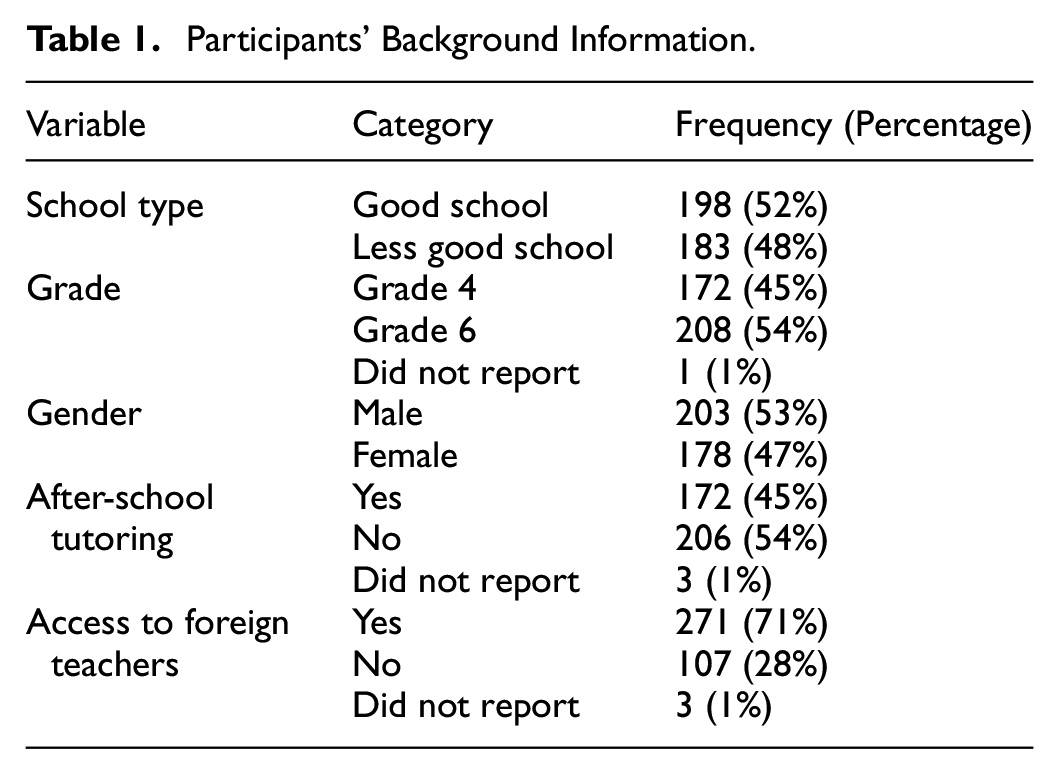
The participants of this study included 381 students (178 females, 203 males) from a privileged school (52%) and a less privileged one (48%) in Xi’an, Shaanxi, China. Among the participants, 172 were fourth graders (45%) and 208 were sixth graders (54%) (see Table 1). Affiliated to a university specialized in foreign languages, the more privileged school was renowned for its emphasis on English teaching and learning. Foreign teachers were available to the students. The less privileged school was located in an economically disadvantaged area in Xi’an. Although English was a compulsory subject, its status was lower compared to the other two core subjects, Chinese and Mathematics, as fewer instructional hours were allocated to the English classes. No foreign teachers were available to these students. The privileged school offered seven English classes per week to both fourth graders and sixth graders, whereas the less privileged school offered five classes to Grade 4 students, and three classes to Grade 6 students. Nearly half (45%) of the participants reported attending after-school tutoring, and 271 of them (71%) stated they had been taught by foreign teachers.
Participants’ Background Information.
Instruments
The data collection questionnaire utilized in the study was structured into three sections. The first section elicited demographic information about the students, including gender, age, grade level, and school affiliation. The second section was related to students’ English learning experiences, encompassing the number of weekly English lessons attended and their corresponding English proficiency scores. To assess students’ enjoyment and anxiety in the English classroom setting, the third section of the questionnaire comprised 18 items adapted from the “Classroom Emotion Questionnaire” (Jiang & Dewaele, 2019), which consisted of two scales: the Foreign Language Enjoyment (FLE) scale and the Foreign Language Classroom Anxiety (FLCA) scale. The FLE scale comprised 10 items that measured students’ positive feelings in the context of English learning (e.g., “It is cool to know English as a foreign language”). The FLCA scale included eight items that assessed students’ anxiety (e.g., “Even if I am well prepared for the English Listening and Speaking class, I feel anxious about it”). In both scales, each item was supposed to be rated on a five-point Likert scale (ranging from 1 = “strongly disagree” to 5 = “strongly agree”).
The main structure and content of the original “Classroom Emotion Questionnaire” were retained. Minor revisions were made to enhance the relevance of the questionnaire items to the students’ overall English learning experience. A key adjustment was concerned with replacing the phrase “English Listening and Speaking class” with “English classes” to broaden the context of the items and make them applicable to English learning in a more general sense, not limited to any specific skills. For instance, the item “Even if I am well prepared for the English Listening and Speaking class, I feel anxious about it” was changed into “Even if I am well prepared for the English class, I feel anxious about it.” In addition, the items were all rephrased in simple Chinese and piloted among students with similar backgrounds to ensure young learners’ comprehension of the questionnaire.
Data Collection and Analysis
Both the students and their parents were briefed about the purpose of the study, the option to refrain from participating, and the assurance of confidentiality and anonymity. The data were collected in classroom settings at both the privileged and less privileged schools, where the teachers helped with the distribution and collection of the questionnaires. The students completed the questionnaires on paper during class time, typically within a 10 to 15 min period. The teachers, who were instructed not to interfere with the students’ responses, remained in the classroom to assist with the process; and the students were reassured that their teachers would not have access to their responses. In addition, the first author was available to address any questions. Then the researchers coded and anonymized the collected data.
Data analysis was carried out in two stages. In the first stage, confirmatory factor analysis (CFA) was undertaken to check the construct validity of the FLE and FLCA scales, alongside the computation of Cronbach’s alpha coefficients to estimate their reliability. Then, a series of t-tests were run to evaluate whether students’ FLE and FLCA differed by each categorical variable (i.e., school type, gender, after-school tutoring, access to foreign teachers), respectively; and Pearson correlations were calculated between the continuous variables to explore whether and how students’ English scores and numbers of English classes per week were associated with their enjoyment and anxiety in the English classroom. Notably, the standardized English scores within each class were utilized in subsequent analyses, given that participants were recruited from two grades across two schools.
In the second stage, latent profile analysis (LPA) was conducted using Mplus 7.0 (Muthén & Muthén, 2012) to discern the optimal number of latent profiles of English learners’ FLCA and FLE. Multiple indices were scrutinized to ascertain the model that best fit the data, including Akaike Information Criterion (AIC), Bayesian Information Criterion (BIC), and ample-size adjusted BIC (ABIC), Bootstrap Likelihood Ratio Test (BLRT), and Lo-Mendell-Rubin Likelihood Ratio Test (L-M-R LRT). Lower AIC, BIC, and ABIC values and significant BLRT and L-M-R LRT values are indicative of a better fit (Spurk et al., 2020). Entropy was also checked to evaluate the model fit, with higher entropy (up to 1) suggesting better fit, ideally surpassing 0.80 for good fit and ranging between 0.60 and 0.80 for acceptable fit (Clark & Muthén, 2009).
A one-way ANOVA was performed to determine if there was a significant difference between the three profiles in FLE and FLCA, respectively. Significant differences in FLE and FLCA between the three profiles would mean that the LPA had successfully identified three distinct profiles of FLE and FLCA. Finally, multinominal logistic regression analysis was run to probe whether school type, grade, gender, after-school tutoring, access to foreign teachers, number of English classes, and English scores were significantly associated with students’ profile membership with regard to FLCA and FLE. Multinominal logistic regression models the prediction of membership of at least three categorical outcomes, which fit well with our purpose of investigating the prediction of students’ profile membership (Field, 2017).
Results
CFA and Reliability Estimates
The CFA results showed that both FLE (χ2 = 80.87, df = 32, p < .01; RMSEA = 0.06; CFI = 0.96; IFI = 0.94) and FLCA (χ2 = 45.28, df = 20, p < .01; RMSEA = 0.06; CFI = 0.98; IFI = 0.97) scales had acceptable construct validity. The internal consistency estimates for both FLE (Cronbach alpha = .807) and FLCA (Cronbach alpha = .871) were acceptable.
Variable-Centered Analyses
To answer the first two research questions, several variable-centered analyses were run. Table 2 presents the descriptive statistics for the continuous variables and the correlations among them. The findings indicate that overall, the participants reported a medium level of FLE (M = 3.923, SD = 0.610) but a relatively low level of FLCA (M = 2.654, SD = 0.900). The results also revealed that all continuous variables were significantly correlated with one another. Specifically, FLCA demonstrated a significant negative relationship with FLE (r = –.432 p < .01), number of classes (r = –.202, p < .01), and English scores (r = –.236, p < .01), whereas FLE was positively related to the number of classes (r = .317, p < .01) and English scores (r = .171, p < .01).
Correlations Among Continuous Variables.

Note. **Correlation is significant at the .01 level (2-tailed).
Table 3 displays the results of the t tests. As shown in the table, school type, gender, grade, after-school tutoring, and access to foreign teachers were all significantly associated with students’ perceived enjoyment in English class. Specifically, female students, fourth graders, and students enrolled in the privileged school reported significantly higher levels of enjoyment in comparison to their counterparts—male students, sixth graders, and students attending the less privileged school, respectively. Moreover, students engaged in after-school tutoring reported a significantly lower level of enjoyment compared to those without such tutoring. However, students with access to foreign teachers scored significantly higher on FLE than those without such access. By contrast, concerning students’ perceived anxiety in English class, only school type, grade level, and access to foreign teachers emerged as significant factors. In particular, students from the less privileged school and the sixth graders reported a significantly higher level of anxiety than students from the privileged school and the fourth graders, respectively. Students lacking access to foreign teachers reported a significantly higher level of FLCA than their peers having such access. No statistically significant effect of gender or after-school tutoring was found on anxiety.
Results of the t Tests.
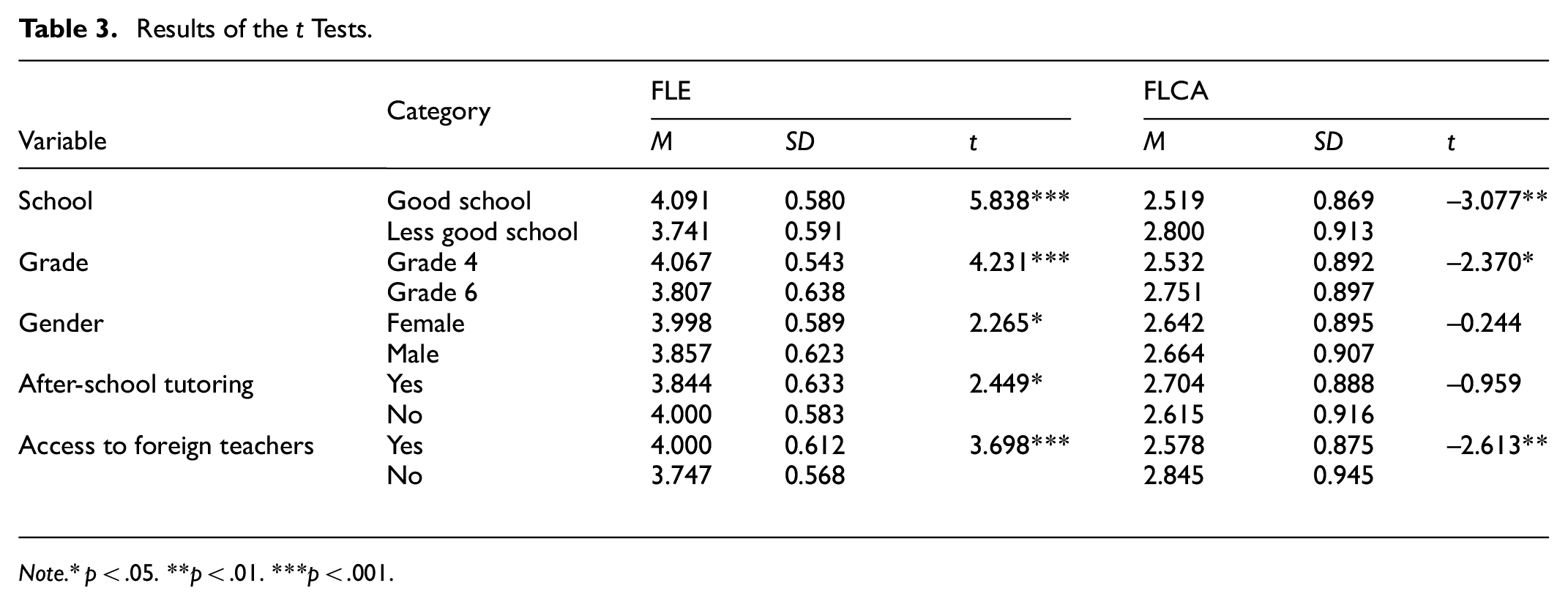
Note.* p < .05. **p < .01. ***p < .001.
Person-Centered Analyses
To address the third research question, latent profile analysis (LPA) was conducted to ascertain the optimal number of profiles underlying enjoyment and anxiety. Various models were tested, ranging from two to five classes, to determine the most suitable solution. Table 4 presents the model fit statistics for the LPA. Notably, the 3-profile solution had lower AIC, BIC, ABIC (Spurk et al., 2020), but higher entropy than the 1-profile and 2-profile solutions (Clark & Muthén, 2009). Additionally, although the BICs for the 4-profile and 5-profile solutions were slightly higher than that of the 3-profile solution, the entropy for the 5-profile solution was much lower than that for the 3-profile solution and the L-M-R LRT was non-significant for the 4-profile and 5-profile solutions. These outcomes collectively indicate that the 3-profile solution fit the data better than the alternative solutions.
Enjoyment and Anxiety Profiles.

Note. The bold entries indicate the best fit.
Based on the mean scores of the three identified groups on FLE and FLCA, the three groups were categorized as: the “intense-enjoyment and scant-anxiety” group (high levels of FLE, M = 4.302 and low levels of FLCA, M = 1.850; profile 1, n = 167), the “medium-enjoyment and medium-anxiety” group (medium levels of FLE, M = 3.683 and medium levels of FLCA, M = 3.243; profile 2, n = 205), and the “scant-enjoyment and intense-anxiety” group (low levels of ELE, M = 2.356 and high levels of FLCA, M = 4.153; profile 3, n = 9).
Table 5 presents the comparisons of the means on FLE and FLCA across the three profiles. As shown in the table, the three groups differed significantly in both FLE [F (2, 378) = 130.517, p < .001] and FLCA [F (2, 378) = 345.810, p < .001]. Scheffe post hoc tests indicated that each group differed significantly from the other two groups in both factors (p < .001 for all comparisons). Specifically, the “intense-enjoyment and scant-anxiety” group scored the highest on FLE, followed in order by the “medium-enjoyment and medium-anxiety” group and the “scant-enjoyment and intense-anxiety” group. Conversely, the “scant-enjoyment and intense-anxiety” group scored the highest on FLCA, followed in order by the “medium-enjoyment and medium-anxiety” group and the “intense-enjoyment and scant-anxiety” group.
Comparison of the Means of Enjoyment and Anxiety Across the Three Profiles.

To answer the fourth research question—factors associated with the profiling, a multinominal logistic regression was run to model the relationships between the predictors and the students’ profile membership. The model was significant (χ2[14, N = 381] = 91.138, Nagelkerke’s R2 = .274, p < .001) and correctly classified 70.4% of the cases. Table 6 presents the results from the multinominal logistic regression. As shown in the table, several factors had a significant parameter for distinguishing the three groups. The odds ratios showed that with a one-unit increase in English performance, the change in the odds of being classified into the “intense-enjoyment and scant-anxiety” group as opposed to the “medium-enjoyment and medium-anxiety” group was 3.209. This means that students with one unit increase in their English performance were 3.209 times more likely to be classified into the “intense-enjoyment and scant-anxiety” group. Likewise, the results also indicate that students with higher English proficiency were less likely to be categorized into the “scant-enjoyment and intense-anxiety” group than into the “intense-enjoyment and scant-anxiety” group. However, students’ English proficiency was not a significant factor in differentiating the “scant-enjoyment and intense-anxiety” group from the “medium-enjoyment and medium-anxiety” group.
Multinominal Logistic Regression Results.

Note. †p < 0.10; *p < .05; **p < .01; ***p < .001. aProfile 1 = The Intense- Enjoyment and Scant- Anxiety Group; Profile 2 = The Medium-Enjoyment and Medium-Anxiety Group; Profile 3 = The Scant- Enjoyment and Intense-Anxiety Group.
The latter group in each pair is the reference group.
p < 0.10; *p < .05; **p < .01; ***p < .001.
The odds ratios for the school type suggest that students from the privileged school were far less likely (1/69.623) to be classified into the “scant-enjoyment and intense-anxiety” group as opposed to the “medium-enjoyment and medium-anxiety” group than their peers from the less privileged school. As for grade level, the odds ratios indicate that Grade 6 students were considerably more likely to (1/0.056, 1/0.041) be classified into the “scant-enjoyment and intense-anxiety” group than their peers in Grade 4 as compared to the other two profiles. Finally, the odds ratios also suggest that students with after-class tutoring were less likely (1/1.665) to be classified into the “intense-enjoyment and scant-anxiety” group as opposed to the “medium-enjoyment and medium-anxiety” group than their peers without such tutoring.
Discussion
Levels of FLCA and FLE
The participants demonstrated a medium level of FLE (M = 3.92) but a relatively low level of FLCA (M = 2.65) in their English classes. These findings indicated that Chinese young EFL learners were not particularly anxious in the English classroom. This finding differs from that of Hu et al. (2021), which found that Chinese primary school students’ anxiety levels were “comparable to, and in some cases higher than, those found among adult learners” (p. 14). More research is warranted to account for these divergent findings. Additionally, the finding that Chinese primary school EFL learners tended to enjoy English classes resonates with the findings of Liu and Hong (2021). This tendency toward a higher level of enjoyment might be attributed to the comparatively less stressful English learning environment prevalent in primary schools. It might also be related to the unique methodologies often adopted by teachers of younger learners, which tend to prioritize the establishment of vibrant and interactive classroom atmospheres, especially with the aid of multimedia technology to enhance student engagement (C. Li, Dewaele, & Jiang 2019; G. Li, Sun, & Jee 2019).
A moderate negative correlation was found between participants’ FLE and FLCA. This finding supports the previous observation that FLE and FLCA represent independent dimensions rather than opposing ends on a continuum (Botes et al., 2022; Dewaele & MacIntyre, 2014; Geng & Jin, 2023; Wu, 2024). In other words, Chinese primary school EFL students with higher FLE might experience lower FLCA, yet the presence of one does not necessarily mean the absence of the other, indicating a nuanced relationship between enjoyment and anxiety in the language learning context.
Antecedents of FLCA and FLE
Among the variables investigated, grade level emerged as a significant factor, exhibiting a negative correlation with FLE but a positive correlation with FLCA. This suggests that younger students tend to experience higher levels of enjoyment but lower levels of anxiety in English classes than older students. These findings contrast with some European studies that found a positive correlation between age and FLE (Dewaele et al., 2018; Dewaele & MacIntyre, 2014) but align with research conducted in the Chinese context (Li, Huang & Li, 2021; Liu & Hong, 2021). The observed difference could be attributed to the educational structure in the Chinese setting, where examinations gain increasing significance as students advance to higher academic stages (Liu & Hong, 2021). Sixth-grade students might have developed a heightened awareness of the importance of English scores for their academic advancement, thereby potentially amplifying their FLCA while diminishing their FLE.
Gender was found to significantly influence FLE as female students reported markedly higher levels of FLE than their male peers. However, no gender difference was observed in FLCA. These findings indicate that female young EFL learners were more likely to derive positive emotional experiences from English classes than their male counterparts. Interestingly, the findings deviate partially from previous research outcomes. For instance, Liu and Hong (2021) detected significant gender discrepancies in FLCA among grade-4 primary school students and in FLE among grade-8 secondary school students; however, other studies (e.g., Jiang & Dewaele, 2019) did not observe such differences in either FLE or FLCA. In light of the mixed findings, more research is apparently needed to examine gender effect on foreign language learners’ emotions.
Foreign language proficiency was found to be positively linked to FLE but negatively linked to FLCA, a pattern consistent with findings reported from studies done across different contexts (e.g., Dewaele et al., 2018; Jiang & Dewaele, 2019; C. Li & Li, 2024).The relationship between language proficiency and learner emotions can be partially explained by Self-Determination Theory (SDT; Deci & Ryan, 1985), which emphasizes the importance of intrinsic motivation in affecting students’ emotional responses to learning. According to SDT, higher language proficiency enhances students’ sense of competence and autonomy. As a result, students with higher proficiency are more likely to experience increased intrinsic motivation, leading to augmented enjoyment and mitigated anxiety in language learning. In contrast, students with lower proficiency may feel a reduced sense of autonomy, which can give rise to diminished enjoyment and heightened anxiety in the learning process.
With respect to institution-related learner-external variables (i.e., school type, number of English classes per week, after-school tutoring, and access to foreign teachers), students from the privileged school, attending more English classes per week, and having access to foreign teachers reported a significantly higher level of FLE and a significantly lower level of FLCA than their counterparts. These findings suggest that studying in a supportive environment, receiving extended exposure to English, and interacting with foreign teachers may enhance students’ extrinsic motivation and cultural curiosity, thereby fostering greater enjoyment and reducing anxiety. Conversely, students engaged in after-school tutoring reported lower levels of FLE compared to those without such tutoring, although this variable was not significantly associated with FLCA levels. This observation could be attributed to the exam-centric nature of after-school tutoring in China or young learners’ innate aversion to additional academic commitments, especially after a full day of schooling.
Profiles of FLCA and FLE of EFL Young Learners
The LPA results revealed three distinct groups: the “intense-enjoyment and scant-anxiety” group, the “medium-enjoyment and medium-anxiety” group, and the “scant-enjoyment and intense-anxiety” group. Comparisons of the means of FLE and FLCA across the three profiles showed that the three groups differed significantly, lending evidence to the validity of the LPA results. Specifically, the “intense-enjoyment and scant-anxiety” group showed the highest level of FLE, followed in order by the “medium-enjoyment and medium-anxiety” group and the “scant-enjoyment and intense-anxiety” group. The reverse pattern was identified with regard to FLCA. The largest cohort of students (n = 199) fell into the “medium-enjoyment and medium- anxiety” group, representing the typical profile of EFL young learners in China. Sightly fewer students (n = 182) fell into the “intense-enjoyment and scant-anxiety” group, indicating Chinese FLE young learners’ positive emotions toward English learning.
The “scant-enjoyment and intense-anxiety” group, albeit small in number (n = 9), is particularly intriguing. This subset of learners presents a distinctive emotional profile that hints at unique challenges certain learners might encounter in their language learning process. Such challenges could stem from a variety of factors, such as low self-efficacy, lack of motivation, or negative classroom experiences, which may be further exacerbated by linguistic barriers or insufficient instructional support (e.g., Botes et al., 2022; Liu & Hong, 2021; Pan & Zhang, 2023). Further research is needed to explore the root causes and appropriate educational interventions to address their unique emotional needs.
Factors Associated With the Profiles of FLCA and FLE of EFL Young Learners
The findings showed that students’ profile membership of FLCA and FLE was significantly associated with English proficiency, grade level, school type, and after-school tutoring, but not with students’ gender, access to foreign teachers or the number of English classes taken per week. Specifically, students with higher English proficiency were more likely to be assorted into the “intense-enjoyment and scant-anxiety” group than the other two groups. As for grade level, students in higher grades were considerably more likely to be categorized into the “scant-enjoyment and intense-anxiety” group than their peers at lower grade levels as compared to the other two profiles. With regard to school type, students from the privileged school were far less likely to be classed into the “scant-enjoyment and intense-anxiety” group as opposed to the “medium-enjoyment and medium-anxiety” group than their peers from the less privileged school. In fact, six of the nine students in the “scant-enjoyment and intense-anxiety” group came from the less privileged school. A similar pattern was also identified when it came to after-class tutoring: students with after-class tutoring were less likely to be classified into the “intense-enjoyment and scant-anxiety” group as opposed to the “medium-enjoyment and medium-anxiety” group than students without such tutoring.
The Control-Value Theory of Achievement Emotions (Pekrun, 2006; Pekrun et al., 2007) provides a framework for explaining such findings. According to the theory, students’ emotional experiences are influenced by their perceptions of control over the learning process: students who feel a sense of control in their learning are more likely to encounter positive emotions, such as enjoyment; those who sense a lack of control are more prone to negative emotions like anxiety.
In the context of this study, students with higher English proficiency likely perceived themselves as more competent, and such enhanced sense of control contributed to their higher likelihood of being placed in the “intense-enjoyment and scant-anxiety” group. In contrast, students from grade six, from less privileged schools and students who had after-school tutoring were more likely to fall into the “scant-enjoyment and intense-anxiety” group. As middle school admissions approached, the six graders often experienced growing pressure marked by a greater focus on test scores. The heightened emphasis on academic performance could result in feeling lack of control over their learning, with students typically subjected to rigid test-oriented teaching at the expense of autonomous learning (Shen, 2013; Wang & Gao, 2008). Similarly, students from less privileged schools or those who had after-school tutoring might also grabble with heavily structured teaching sessions that prioritized test scores over personal learning agency. Such external pressure could induce a sense of passivity, a diminished sense of control, and hence higher levels of anxiety and lower levels of enjoyment on the part of the students.
In terms of the remaining two factors examined, namely access to foreign teachers and the number of English lessons per week, different results were generated via variable-centered and person-centered analyses. While the variable-centered analysis established significant associations between these factors and FLCA and FLE, the person-centered analysis revealed non-significant links between these variables and profile membership. One potential explanation for this disparity is that although the presence of foreign teachers and increased English class hours may theoretically contribute to heightened FLE and diminished FLCA, they may not be prominent determinants in shaping or reshaping students’ FLCA and FLE profiles. For instance, students’ attitudes toward English lessons delivered by foreign teachers may vary greatly, depending on an array of factors such as the qualifications of the foreign teachers, the teachers’ ability to manage the typically large classes in China, and their skills to deal with misbehaving students (Chen & Cheng, 2010). Similarly, the number of English lessons taken per week may be emotion-neutral, with the classroom environment playing a more decisive role in learner emotions (C. Li, Huang & Li, 2021). These factors definitely warrant more research.
Conclusion and Implications
This study adds to the literature on emotions in foreign language learning by examining Chinese primary school learners’ FLCA and FLE through a combination of variable-centered and person-centered methods. The findings show that the students had overall medium FLE and relatively low FLCA, and three profiles were identified, configuring the young learners as “intense-enjoyment and scant-anxiety,”“medium-enjoyment and medium-anxiety,” and “scant-enjoyment and intense-anxiety” ones, respectively. The study also found that four factors (i.e., language proficiency, grade level, school type, after-school tutoring) were significantly related both to students’ FLCA and FLE levels and to their profile membership. Mixed findings were generated with regard to access to foreign teachers and the number of English lessons taken per week, as variable-centered analyses showed significant relationship between the two factors and students’ FLCA and FLE levels, whereas no significant relationship was observed via person-centered analyses.
The findings of this study should be interpreted in light of the following three limitations. Firstly, the sample was drawn from two primary schools in Xi’an, China, which may have limited the generalizability of the findings. The educational environment, cultural context, and socioeconomic status of these schools could have influenced the students’ emotional responses in ways that may not be applicable to other contexts. Future research should explore data from a wider array of educational contexts. Secondly, the study did not delve deeply into how Chinese cultural factors specifically shape FLCA and FLE. This limits the cross-cultural applicability of the results and future studies are needed to examine how cultural factors might influence FLCA and FLE. Thirdly, the study relied solely on self-reported data, which may introduce bias, as students’ assessments of their emotions might not be entirely accurate. Future research could benefit from incorporating qualitative and observational data to validate and supplement insights gained from self-reported data.
Despite these limitations, the findings of this study provide several important methodological and pedagogical implications. Methodologically, the study has instantiated the feasibility of integrating variable-centered and person-centered methods in exploring SLA emotions. Variable-centered methods help elucidate the relationships between different variables and language learner emotions (Masyn, 2013). Person-centered approaches, by contrast, are capable of unveiling the diverse emotional configurations among individuals. By integrating these complementary methodological frameworks, researchers can glean richer insights and foster a deeper understanding of EFL learners’ emotional landscapes.
Pedagogically, the identification of different emotional profiles, ranging from students who experience high enjoyment with little anxiety to those who struggle with low enjoyment and high anxiety, suggests that teaching strategies should be tailored to meet students’ varying emotional needs. Specifically, educators can capitalize on the zest of students with high enjoyment and low anxiety by engaging them in activities that align with their interests and by offering them opportunities to take on leadership roles within the classroom. For students with moderate levels of enjoyment and anxiety, challenges can be incrementally introduced, in conjunction with supportive measures, to boost their engagement and reduce their anxiety. As to students experiencing low enjoyment and high anxiety, more individualized and sensitive approaches are necessary. Besides, designing more interactive and less threatening activities may be of some help, and strategies such as avoiding harsh criticism, focusing on students’ progress, and allowing the use of their mother tongue in the classroom can also be employed to create a supportive learning environment (e.g., Dewaele & MacIntyre, 2014; Hu et al., 2021; Liu, 2006).
Additionally, considering the negative correlation identified in the study between after-school tutoring and FLE, it is important to reassess homework and after-school tutoring practices and make necessary adjustments. These adjustments should ensure that such activities complement, rather than overshadow, classroom learning, and allow students to maintain a healthy balance between academic achievements and personal well-being (Botes et al., 2022). Furthermore, as Dewaele (2020) notes, “if classroom emotions were music, teachers would be conductors, and learners would be members of the orchestra” (p. 8). Therefore, efforts should be made to raise teachers’ awareness of the pivotal role played by emotions in language learning (Nunan, 2011). For instance, teacher training should be conducted to equip classroom practitioners with necessary strategies for emotional intervention. Such training should also include methods for regularly assessing the emotional well-being of their students. Armed with these insights, teachers will be better positioned to adjust their instructional methods in real-time, hence creating a more responsive and empathetic learning environment. Finally, alongside improving classroom instruction, bolstering parental involvement can also help enhance students’ emotional experiences, as effective parent support is particularly important to young language learners (Tao & Xu, 2022). For instance, regular communication between parents and teachers can be carried out to ensure that students’ emotional needs are being met both inside and outside the classroom. Parents can also be encouraged to engage in activities that promote language learning in an enjoyable, low-pressure manner, such as reading together, playing language-based games, or watching cartoon videos in English at home. These endeavors will not only support academic progress but also contribute to creating a positive and relaxed learning environment for young ELF learners.
Footnotes
Acknowledgements
The authors would like to acknowledge that several AI-assisted tools were utilized to enhance the quality of writing in revising this manuscript. ChatGPT and Kimi were employed for sentence restructuring and content clarification, and Grammarly was used for grammar and stylistic revisions. The primary aim of using these tools was to ensure clarity, coherence, and grammatical accuracy in the text. After using these tools, the authors reviewed and finalized the manuscript, and take full responsibility for the content of the manuscript.
