




Abstract
This paper presents the findings of a large-scale quantitative study, which involved surveying 1,184 undergraduates from a Thai science and technology university to assess both their general and language mindsets. The study’s primary aims were to identify the prevalence of growth or fixed among these students, explore potential statistical variations in mindsets based on gender, year level, and perceived language proficiencies, and ascertain the relationships between mindsets, gender, year level, and perceived proficiency. Additionally, the research delved into the structural dimensions of their general and language mindsets. Descriptive, inferential and factor analyses were employed for data analysis. Descriptive analysis revealed that Thai undergraduate students predominantly embrace growth mindsets in both their general and language-related beliefs. Notably, t-test showed no significant disparities were detected among the variables examined, indicating a consistent mindset across various demographic groups. Moreover, correlational analysis identified relationships between general mindset, language mindset and perceived general language proficiency. Furthermore, language mindset showed significant associations with year level and perceived general language proficiency. In terms of the factorial structure, factor analysis yielded three distinct factors of general mindset, while the language mindset exhibited a unidimensional structure. Discussions included theoretical and pedagogical implications, as well as directions for future research in language mindset.
Introduction
Understanding the mindset of students holds crucial significance within the educational landscape. The exploration of mindset is not only a means to comprehend the diverse approaches students take toward academic challenges but also serves as a window into the intricate interplay between cultural contexts and learning behaviors. In Thailand, the society places a premium on educational achievement, reflecting aspirations for personal and familial success deeply ingrained within its cultural fabric (Tipayalai & Subchavaroj, 2023). This reverence for learning is accompanied by a set of cultural norms and values that shape students’ perceptions of intelligence, talent, and academic endeavors. For instance, the notion of “jai yen” (cool heart) underscores the importance of maintaining composure and avoiding outward displays of emotion or frustration (Rutherford & Tuntivivat, 2024), potentially influencing how students navigate setbacks and challenges in their academic journey.
Mindset, as a psychological construct, plays a pivotal role in shaping students’ attitudes and behaviors toward learning. In psychological literature, mindset generally refers to an individual’s beliefs about their capabilities (Dweck, 2006). These beliefs can manifest in two primary constructs: the growth mindset and the fixed mindset (Bernecker & Job, 2019; Robins & Pals, 2002). Students with a fixed mindset perceive their intelligence and talents as static, with limited room for change (Hwang et al., 2019). In contrast, a growth mindset embodies the belief that intelligence and talents are malleable, improving through effort and perseverance (Cavanagh et al., 2018; Kim & Park, 2021). The significant educational benefits of a growth mindset are well-documented, including motivating students toward mastery, fostering engagement, and enhancing academic performance (Blackwell et al., 2007; Mangels et al., 2006; Soltani et al., 2022). While exploring the influence of mindset on students’ academic performance is essential, it is equally crucial to consider the context in which these factors operate, especially in specific educational settings (Bai & Wang, 2023).
Thai students, steeped in the vibrant tapestry of Thai culture and traditions, bring a wealth of perspectives and experiences to the mindset research. Rooted in values of perseverance, respect for authority, and a strong sense of community, Thai students often approach academic challenges with a blend of resilience and adaptability (McDonald & Nanni, 2023; Smithikrai & Smithikrai, 2024; Thanoi et al., 2023). However, amidst Thailand’s rapidly globalizing society, where proficiency in English is increasingly viewed as essential for socioeconomic advancement (Srichampa, 2015), the attitudes of Thai students toward language learning take on particular significance.
English proficiency is often associated with opportunities for higher education, career advancement, and participation in the global community. One of the primary goals among EFL students in Thailand is to pass, become proficient, or achieve competency in the English language (Imsa-Ard, 2020; Ma et al., 2019; Wanich, 2014). However, the challenges of English language education in Thailand become evident when considering the marked disparity in the quality of English language education across different regions of the country (Durongkaveroj, 2023; Pechapan-Hammond, 2020). The observed disparities underscore multifaceted concerns encompassing the accessibility of proficient educators and adequate infrastructure, equitable distribution of resources, establishment of robust accountability frameworks, facilitation of decision-making autonomy, implementation of efficient management protocols, and the perceptions harbored by educators and students alike (Durongkaveroj, 2023). Consequently, there is a pressing need for additional research endeavors to meticulously explore the distinctive hurdles faced by both learners and instructors within these varied settings (Phetsangkhad, 2023). It is crucial to note that while passing and becoming proficient in English are common goals among EFL students, these objectives are often influenced by the unique cultural underpinnings and challenges faced by Thai students (Bhattarachaiyakorn & Phettakua, 2023; Sha’ar & Boonsuk, 2021).
According to Hofstede’s (1991) cultural dimensions, it is evident that Thai students’ characteristics exhibit strong resemblances to the dimensions of collectivism, femininity, and uncertainty avoidance (Chaiyasat & Intakaew, 2023; Salsarola, 2023). A study conducted by Magnal et al. (2023) investigated the utilization of strategies by students within a foreign language classroom setting. The findings of this study indicate that Thai students exhibit a reduced inclination for employing self-motivated strategies to mitigate feelings of anxiety, low self-esteem, and negative attitudes. Additionally, their engagement in English-speaking classroom activities appears to be infrequent. These results align with the conclusions drawn in a prior investigation by Fujiwara (2014), which observed that students characterized as low achievers tend to experience shyness and avoid English speaking when uncertain about the accuracy of their utterances. Moreover, a study by Oranpattanachai (2023) demonstrated that students possessing a lower level of reading comprehension also manifest diminished reading self-efficacy and tend to evade challenging reading passages. These observed characteristics are indicative of the language mindset held by Thai students.
Building on the foundational concept of mindset, which offers a lens through which to view students’ varying approaches to challenging tasks, this research aims to deepen our understanding of mindset within the specific context of Thai undergraduate students. First, it aims to investigate the general and language-related mindsets of Thai undergraduate students, delving into how these students perceive their abilities to learn and adapt in academic settings (What are the levels of general and language-related mindsets among Thai undergraduate students?). Second, the study examines how these mindsets vary across different demographic segments, specifically analyzing the differences attributed to gender, academic year level, and self-perceived language skills (How do these mindsets vary according to gender, academic year level, and students’ self-perceived language skills?). Third, it identifies the correlations between mindsets and such variables as gender, year level, and self-perceived language proficiency, seeking to understand how these factors interrelate (Are there any significant correlations between mindsets and variables such as gender, year level, and self-perceived language proficiency?). Finally, the study aims to uncover the underlying structural dimensions that form the general and language-related mindsets of this student population (What are the underlying structural dimensions that form the general and language-related mindsets of Thai undergraduate students?). By exploring these objectives and questions, the study hopes to offer insights that may inform curriculum revisions and pedagogical strategies within the Thai context, particularly in the domain of English as a Foreign Language (EFL) education.
Literature Review
Language Mindset
In the field of psychology, the term “mindset” commonly refers to the set of beliefs individuals harbor about their own abilities (Dweck, 2006). This concept has traditionally been delineated into two distinct constructs: the growth mindset and the fixed mindset (Bernecker & Job, 2019; Robins & Pals, 2002). The underlying constructs of mindset, namely intelligence and talent, have been scrutinized in numerous studies (Dweck & Leggett, 1988; Esparza et al., 2014; McCutchen et al., 2016). Those who adopt a fixed mindset maintain that their intelligence and innate abilities in particular domains remain static or demonstrate limited changeability (Hwang et al., 2019). Aligned with this perspective, individuals often set performance goals (Yu & McLellan, 2020) and tend to exhibit heightened learned helplessness behaviors in learning contexts, primarily due to their inclination toward proving their abilities or preserving their self-esteem (Elliot & McGregor, 2001). Under the influence of such goals, students tend to fear negative judgments and avoid challenging tasks (Murphy & Thomas, 2008). Conversely, students who have embraced a growth mindset believe that their intelligence and natural abilities in specific domains are malleable and can gradually evolve through dedicated effort and perseverance (Cavanagh et al., 2018; Kim & Park, 2021). Aligned with a growth mindset, students are likely to establish mastery goals (Sorensen, 2016). They exhibit adaptability in their learning approaches since they concentrate on mastering the subject and surmounting challenges (Guo et al., 2023).
Drawing on this framework, recent research emphasizes the pivotal role of embracing a growth mindset in motivating students to actively pursue mastery objectives, yielding notable educational dividends (Blackwell et al., 2007; Mangels et al., 2006; Soltani at al., 2022). A growth mindset instills in students the belief that knowledge is attainable through diligent effort and is subject to continual improvement, fostering heightened engagement with the learning process (Liu et al., 2023). Furthermore, this heightened dedication to mastery goals consistently correlates with increased student engagement in previous investigations (Anderman & Wolters, 2006; Holzer et al., 2022; Tuominen-Soiniet al., 2012). Engagement, as a consequence of pursuing mastery goals, emerges as a critical determinant of academic performance (Wang et al., 2023), nurturing a deeper sense of commitment, perseverance, and overall belonging among students (J. S. Lee, 2014). Moreover, it cultivates sharpened critical thinking skills, all of which contribute to enhanced learning outcomes (Delfino, 2019). Hence, a strong association exists between students embracing a growth mindset, setting mastery goals, and experiencing heightened engagement and academic performance (Mulvey et al., 2023; Sadoughi et al., 2023). This link underscores the significant educational advantages of fostering a growth mindset among students.
The conceptualization of language mindset posits it as a distinct construct separate from a general mindset. This construct encompasses beliefs related to general language intelligence, second language aptitude, and age-sensitivity, as proposed by Ryan and Mercer (2012) and further examined by Lou and Noels (2019). Regarding the three dimensions, students who adopt a fixed language mindset perceive their language learning intelligence as finite, believing that their language learning abilities remain static or are resistant to development, and that language acquisition is constrained by age. In contrast, students who adopt a growth language mindset hold the belief that they can enhance their language learning intelligence, improve their language learning capabilities through diligent effort, and contend that age does not impose limitations on language acquisition (Lou & Zarrinabadi, 2022). The adoption of a “growth” language mindset offers numerous advantages to language learners, as suggested by previous studies (Bernardo, 2023; Grecco, 2023; Kaya et al., 2023).
Building upon this foundation, recent studies have further elucidated the applicability and implications of growth mindset frameworks in diverse educational contexts. Bernardo (2023) extended the scope of investigation to secondary school students engaged in English as a second language (ESL) reading tasks, unveiling persistent positive associations with growth mindset even after meticulous control for various teacher—and motivation-related factors. This underscores the enduring value of growth mindset constructs in facilitating English language acquisition among ESL learners. Similarly, Grecco’s (2023) inquiry into the efficacy of growth mindset strategies in fifth-grade writing tasks revealed a salient enhancement in students’ motivation to write, accompanied by heightened confidence and engagement. These findings underscore the utility of growth mindset interventions in bolstering student motivation and participation across different academic domains. In parallel, Kaya et al. (2023) exploration of language and mathematics mindsets in English-Medium Instruction (EMI) and Turkey-Medium Instruction (TMI) courses unveiled intriguing insights into their differential impacts on academic achievement. Specifically, their findings underscored the significant influence of language mindsets on performance in EMI courses, with growth language mindsets positively predicting achievement and fixed language mindsets exerting a detrimental effect. This suggests that students harboring fixed beliefs about language learning may encounter obstacles in comprehending academic content presented in a second language, thereby impeding their success in EMI environments. Remarkably, the study also revealed a noteworthy albeit attenuated influence of language mindsets on achievement in TMI courses, indicative of the broad-reaching effects of growth mindset orientations across diverse academic settings. Moreover, the study highlighted the formidable influence of mathematics mindsets on academic achievement across both EMI and TMI contexts. This observation challenges prior meta-analytic findings and established trends in adult learning and engineering education, underscoring the critical role of nuanced inventory assessments in capturing domain-specific beliefs and their consequential impacts on academic performance.
In furthering our understanding of the implications of growth mindset frameworks within language learning contexts, Khajavy et al. (2021) conducted a recent investigation into the interplay between grit, language mindset, and foreign language achievement. Their study revealed a moderate correlation between a growth language mindset and students’ perseverance in exerting effort toward language acquisition endeavors. This aligns with earlier findings by Papi et al. (2019), suggesting that students embracing a growth language mindset prioritize written corrective feedback as a valuable tool for enhancing their writing proficiency. Moreover, Sun and Huang (2023) shed light on the proactive feedback-seeking behaviors of students holding a growth mindset, demonstrating an enhanced capacity for self-regulation in language learning endeavors (Lou & Noels, 2017). This propensity toward self-regulation has been linked to improved academic performance, as evidenced by studies by Hassanzadeh et al. (2020) and Tapia Castillo (2023). Importantly, the cultivation of a growth language mindset has been associated with a range of positive emotional outcomes in the language learning process. Altunel (2019) and Zhong et al. (2023) highlight the connection between a growth mindset and enhanced coping mechanisms for anxiety and negative emotions, underscoring the multifaceted advantages associated with fostering a growth language mindset among language learners. This collective body of research not only enriches our understanding of the psychological underpinnings of language learning but also emphasizes the potential pedagogical benefits of promoting growth-oriented mindsets within language education contexts.
Mindsets in Thai Context
In the context of Thailand, the investigation into growth mindsets, both in a broader context and specifically within the domain of language learning, is of considerable importance for Thai English as a Foreign Language (EFL) students (Eurboonyanun et al., 2020; Limsantitham et al., 2019; Nuntasri & Chaichomchuen, 2020). Wilang (2022) extended the study of mindset by surveying 82 engineering students, assessing their perspectives on their own abilities, others’ successes, challenges, obstacles, effort, and criticism. The outcomes indicated a tendency toward growth mindsets across these dimensions, even in the face of language learning difficulties. However, the small number of participants limits the ability to generalize these results broadly.
Suanthong (2023) delved into the impact of a growth mindset on fourth-year undergraduate students engaged in project proposal writing. The outcomes suggested a positive correlation between the implementation of a growth mindset and heightened writing achievement. Furthermore, Suanthong’s study revealed that a growth mindset played a moderately significant role in alleviating students’ stress during the academic term (Ponjuntik, 2022). Examining the role of a growth mindset on stress among fourth-year undergraduate students, Ponjuntik’s (2022) findings underscored that embracing a growth mindset not only fortified students’ mental resilience but also diminished stress related to academic tasks. This aligns with Buathong (2019) and Ponjuntik (2022) study, providing consistent evidence of the positive impact of a growth mindset on students’ stress reduction.
Considering gender differences, Sosik et al. (2017) study suggested that male students are more inclined to adopt performance-avoidance goals compared to their female counterparts. In terms of language proficiency, Sawongta’s (2023) research indicated that students with higher English language proficiency exhibit a propensity to embrace a growth mindset. Interestingly, 70% of the interviewees in Sawongta’s study expressed the perception that they were more proficient in learning English compared to other subjects. These insights collectively contribute to a nuanced understanding of the multifaceted influence of growth mindsets on academic performance, stress management, and goal orientation among Thai EFL students. However, existing gaps necessitate a more nuanced approach (Masalee et al., 2021). Cultural influences on mindset formation specific to Thailand remain underexplored (Young, 2021). Further research is needed to explore how mindsets differ across diverse language proficiency levels (Sawongta, 2023). The intersectionality of gender, year level, and language proficiency on mindsets requires deeper exploration. Additionally, understanding the contextual and environmental factors shaping the underlying structural dimensions of mindsets is crucial for targeted interventions (Yeager et al., 2022). Addressing these gaps will enhance the study’s contributions to comprehending and fostering positive mindsets among Thai undergraduate students.
Intelligence and Talent
The conceptualization of general intelligence has undergone several debates. Initially, in 1904, Spearman posited that intelligence comprises a fundamental element termed “g” or general intelligence (Brody, 2004). His research indicated that diverse measures of intelligence exhibit positive correlations, suggesting a common factor influencing performance across cognitive tasks. This factor, g, is considered heritable and pivotal in individuals’ overall cognitive abilities and knowledge acquisition. However, Thurstone and Thurstone (1938) challenged Spearman’s unitary model by proposing that intelligence consists of multiple independent primary mental abilities. Their model included factors like verbal comprehension, numerical ability, and spatial visualization. Gardner (1983) further expanded this discourse by suggesting the existence of six distinct and independent intelligences, each associated with separate modular systems influenced by different brain structures. Among these intelligences, linguistic intelligence stands out. Davis et al. (2011) defined linguistic intelligence as “An ability to analyze information and create products involving oral and written language such as speeches, books, and memos.” This definition emphasizes the importance of linguistic skills in understanding and producing language. Regarding second language talent or aptitude, this term denotes an individual’s readiness, suitability, susceptibility, and inclination for learning in specific language-learning contexts (Robinson, 2005). It encompasses a blend of cognitive abilities, domain-specific knowledge, learning strategies, self-regulatory capacity, motivational orientation, and certain personality traits (Kormos, 2013; Li, 2016). Notably, language aptitude is not a fixed and innate trait but rather a dynamic interplay of individual characteristics with the learning environment (Huang et al., 2022). Wen et al. (2017) distinguished between linguistic intelligence and foreign language aptitude, indicating that while foreign language aptitude and intelligence are distinct, they share a common factor known as analytic ability. This factor explains variance in some aptitude variables and intelligence quotients (IQ), suggesting a relationship between intelligence and analytic ability. However, factors such as phonetic coding ability and memory in foreign language aptitude were found to be unrelated to the general intelligence factor. Despite these findings, further research is warranted to elucidate the relationship between components of foreign language aptitude and other cognitive abilities.
Cultural Influence on Mindset
Cultural influences play a significant role in shaping mindset transformation among individuals, including Thai undergraduate students. Thailand is traditionally regarded as a predominantly monolingual nation, the English language has taken on the role of an English as a Foreign Language (EFL) within the framework proposed by Kachru (1992), Baker (2012), Ngoc and Barrot (2023). Cultural norms and values prevalent in Thai society contribute to the development of mindset among students. Collectivism, a key cultural trait in Thailand, emphasizes the importance of group harmony and cooperation (Balthip et al., 2022; Chaiyasat & Intakaew, 2023; Hofstede, 2011). While femininity, and uncertainty avoidance depicts the less assertiveness and competitiveness, and uncertainty avoidance portrays the tolerance to ambiguity or uncertainty (Chaiyasat & Intakaew, 2023; Salsarola, 2023). This cultural value may influence students to believe in collaborative efforts and support from peers and teachers. Cultural perceptions of intelligence and success can also shape mindset transformation (Puvacharonkul & Wilang, 2020). In Thai culture, there may be varying views on what constitutes intelligence and how success is achieved. Students may internalize cultural beliefs about intelligence as fixed or malleable, depending on societal expectations and cultural narratives surrounding achievement (Chuanon et al., 2021; Wilang, 2022). The educational systems and practices in Thailand can either reinforce or challenge existing mindsets among students since the education system prioritizes rote memorization and standardized testing (Durongkaveroj, 2023; Hayes, 2010), students may develop a fixed mindset, believing that intelligence is predetermined and measured by test scores. Furthermore, role models and socialization processes within Thai culture can influence mindset transformation. Students may look up to teachers, parents, or other authority figures as role models whose attitudes and beliefs about intelligence and success shape their own mindset (Rattanaphumma, 2016). Additionally, peer interactions and social networks play a crucial role in reinforcing or challenging existing mindsets, as students may adopt beliefs and behaviors that align with their social group’s norms and values (McDonough, 2004; Sukkaew & Whanchit, 2020). In summary, cultural influences permeate various aspects of students’ lives in Thailand and significantly impact mindset transformation. By understanding how cultural factors shape mindset formation and development, educators and policymakers can design interventions and educational practices that promote adaptive beliefs about intelligence and success among Thai undergraduate students.
Methods
This study, which utilizes a mixed-method design, is a subset of a comprehensive research project investigating the general and language mindsets of Thai undergraduate students at a prestigious science and technology institution in Thailand. In the broader study, students’ mindsets were initially assessed through a survey questionnaire. Subsequently, a select group of students was intentionally chosen to participate in a language mindset intervention program. In this paper, only the survey data will be presented and discussed.
Participants in the Study
Using convenience sampling, 1,184 students consented and participated in the study. There were 429 who identified themselves as male, 716 as female, and 39 preferred not to disclose their gender. The majority were sophomores (n = 866), followed by juniors (n = 159), freshmen (n = 108), with eight in their fifth year and six in their sixth year of study. Regarding their self-assessed general English language proficiency, 947 considered themselves beginners, 215 intermediate, and 22 advanced. When it came to skill-specific proficiencies, the majority identified as beginners in speaking (n = 1,024), listening (n = 948), reading (n = 832), and writing (n = 997).
Survey Questionnaire
The online survey questionnaire utilized in this study was derived from Dweck’s General Mindset Survey (2006) and the Language Mindset Inventory (LMI) developed by Lou and Noels (2017).
Dweck’s original survey comprised 16 items that measured the general mindset, with an equal number of statements representing fixed and growth mindsets. Out of these, eight items addressed beliefs about intelligence, while the remaining eight items focused on talent. In our adapted version, we chose to include only growth mindset statements to prevent any possible confusion among the students that could result in arbitrary option selection—recognized shortcoming of this method. Additionally, a 6-point Likert Scale (6 Strongly agree—1 Strongly disagree) was implemented to discourage students from consistently selecting the neutral middle option. Cronbach’s alpha indicated a high reliability of .85.
The other mindset survey—the LMI, created by Lou and Noels includes three subcomponents that explore intelligence, aptitude, and age sensitivity in relation to language learning. Originally, this section contained 18 items, with each subcomponent assessed by six items—three reflecting a fixed mindset and three reflecting a growth mindset. In line with the earlier decision above, only the nine growth mindset statements were retained for this study. Cronbach’s alpha indicated a high reliability of .94.
Besides the mindset-related questions, the survey also collected data on the participants’ gender, academic year, self-assessed overall English language proficiency, and self-perceived English language skills in the areas of speaking, listening, reading, and writing.
The reliability of the adapted survey questionnaire was assessed via a pilot study with 30 participants. Cronbach’s alpha results for the General Mindset Survey yielded a high reliability of .93, and the Language Mindset Inventory showed an even higher reliability at .96. Subsequent results from the final study presented slightly lower, yet still robust, reliabilities of .85 for the General Mindset Survey and .94 for the Language Mindset Inventory, confirming the instruments’ reliability.
Data Collection
Upon the approval of Research Ethics by the university’s Institutional Review Board, the online survey questionnaire was distributed in various foundation English classes at the university during the first term of the 2023 to 2024 academic year. The researchers sought permission from English lecturers to allow either the researcher or research assistants to visit their classes. During these visits, a concise description of the research project was provided to the students. Following this, consent forms, which were written in the students’ first language, Thai, were handed out. Once the consent forms were distributed, the students were then instructed to scan a QR code to access and complete the survey questionnaire. The process of collecting data took approximately 20 to 30 min.
Data Analysis
To address the research questions, SPSS Version 29 was employed to perform descriptive, inferential, and factor analyses. Descriptive statistics were utilized to characterize the students’ general and language-related mindsets. Inferential statistics were employed to analyze variations in mindsets based on gender, academic year, and self-assessed language skills, as well as to identify correlations between mindsets, gender, academic year, and self-assessed language proficiency. Finally, factor analysis was used to reveal the underlying structural dimensions that influence general and language-related mindsets among this cohort of students.
Findings
General and Language-Related Mindsets of Thai Undergraduate Students
The study’s findings (see Table 1) indicate that Thai undergraduate students possess a growth-oriented mindset toward their intelligence and talent, as evidenced by the positive mean scores for all eight survey statements. This suggests that the majority of students believe their intelligence and talent can be significantly developed over time, with strong agreements particularly noted for the statements, “No matter who you are, you can significantly change your intelligence level” (M = 5.00) and “You can always substantially change how intelligent you are” (M = 4.92). While there was a slight decrease in the mean score for the statement, “No matter how much intelligence you have, you can always change it quite a bit” (M = 4.07), it still indicates an overall agreement with the growth mindset. The findings highlight that students are generally positive and optimistic about their potential for growth and development in both their intelligence and talent.
General and Language Mindsets of Thai Undergraduate Students.

Regarding their language mindset beliefs, Thai undergraduate students exhibit a strong growth mindset regarding language learning, as evidenced by high mean scores across various statements. They believe in their capacity to significantly enhance their language intelligence, irrespective of their starting abilities. This conviction extends to the process of learning new languages, where they feel confident in their continual ability to improve, regardless of current proficiency levels. Additionally, students largely reject the idea that age acts as a barrier to linguistic advancement, emphasizing a belief that language skills can be honed at any age.
Mindsets According to Gender, Year Level and Self-Perceived Language Skills
Table 2 provides a comprehensive analysis of students’ beliefs in two areas: their general mindset and their mindset about language learning. These insights were drawn across various demographic variables, shedding light on the potential influence of background on these beliefs. When assessing these beliefs based on gender, males, out of a sample size of 429, demonstrated a general mindset belief score of 35.82 and a language mindset score of 42.24. Females, who made up a larger portion of the sample at 716, showed slightly stronger beliefs. Their general mindset score stood at 36.05, and their language mindset score was 43.97. Interestingly, the students who chose not to specify their gender (a group of 39 individuals) held beliefs that were closer to those of females, recording 36.17 for general mindset and 43.43 for language mindset.
Mindsets Based on the Students’ Background Variables.

Considering academic progression, first-year students, from a group of 108, seemed to be the most optimistic about language learning, registering the highest score of 45.00. As students moved forward in their academic journey, a decline in mindset scores was observed. This dip was most notable in fifth-year students who, from a small sample of eight, scored 31.50 in general mindset and 34.87 in language learning beliefs. However, a resurgence in confidence appeared in the sixth-year students, with scores of 39.83 and 44.66 for general and language mindsets respectively. Delving into perceived proficiency in English, advanced learners, from a sample of 22, held the strongest general mindset at 38.00. Yet, their language mindset score of 44.04 was slightly outpaced by intermediate learners, who scored 44.93 in the language mindset from a more substantial group of 215.
When the study zoomed in on specific language skills, it revealed that intermediate speakers led the pack in language mindset with a score of 45.94. Intermediate writers, too, showcased commendable scores of 36.61 and 45.32 for general and language mindset, respectively. Advanced writers trailed just a bit with their language mindset score at 44.29. Listening and reading skills offered some intriguing insights: advanced listeners and readers topped the scores in both categories, showcasing the strong correlation between high proficiency and positive beliefs. It is evident that students, irrespective of their background variables, generally lean toward a positive mindset, particularly concerning language learning. However, specific proficiency areas and academic year levels undeniably play roles in shaping these beliefs, leading to fluctuations across the board.
When leveraging ANOVA to scrutinize the differences in students’ mindset beliefs, the results were revealing. Contrary to expectations, the analysis did not pinpoint any significant disparities in both general and language mindset beliefs across different factors. Whether evaluating based on gender, year level, or even perceived general and specific English language proficiencies, the mindset beliefs of students remained consistent. This suggests that these variables do not substantially influence the mindset beliefs of students in this context. It’s a testament to the uniformity in mindset across different student groups, hinting at a broader, possibly institutional or cultural, influence on these beliefs rather than individual demographic, or proficiency-based factors.
Relationships of Mindsets, Gender, Year Level, and Self-Perceived Language Proficiency
The analysis uncovers intricate relationships between students’ proficiencies and mindset beliefs through correlation coefficients (see Table 3). Delving into these relationships reveals insights into the dynamics between gender, year level, and various proficiency measures. A subtle but noteworthy observation emerges when analyzing gender’s influence on proficiency. Specifically, as the gender variable alters, say from male to female, a slight decline in both speaking and reading proficiency is observed, each with a correlation of −.06. This trend is found to be statistically significant, underpinning the need to consider gender as a factor when gauging proficiency levels.
Relationships of Variables in the Study.

Correlation is significant as the 0.05 level. **Correlation is significant as the 0.01 level.
Intriguingly, year level plays a pivotal role in molding students’ proficiency and mindset. With the ascent in year level, a slight decrement in general proficiency is discerned, marked by a −.06 correlation. Concurrently, listening and speaking proficiencies exhibit a similar decline, each tethered to a −.07 correlation. Perhaps most striking is the pronounced negative correlation of −.09 between year level and language mindset. This suggests that as students traverse their academic journey, their language learning enthusiasm potentially wanes as they focus on their major of study.
General proficiency emerges as a beacon for other proficiencies. Those scoring high in general proficiency are consistently observed to fare well in listening, speaking, reading, and writing proficiencies, substantiated by correlations of .66, .62, .58, and .61 respectively. This strong interlinkage reinforces the notion that general proficiency is a holistic indicator, echoing performance in specific skills. Listening proficiency further amplifies its importance by being robustly tied to speaking, reading, and writing proficiencies. The correlations here are particularly striking, with values of .70 for both speaking and reading, and .68 for writing. This underscores that students adept in listening typically excel in other language facets as well. Furthermore, the interplay between speaking and reading proficiency is palpable, resonating through a .65 correlation. This implies a mutual reinforcement where prowess in one skill bolsters the other.
Lastly, the synergy between general and language mindsets is evident. A robust .61 correlation underscores that students harboring a constructive general mindset are predisposed to also nurture a favorable stance toward language learning.
Underlying Structural Dimensions of General and Language Mindsets
The analysis of factor loadings and the corresponding items in Table 4 suggests a thematic categorization for each factor. Factor 1 (Talent Malleability Belief) is centered around the concept of talent, the first factor predominantly encapsulates the idea that talent is not a static trait but can be nurtured and developed. The statements associated with this factor underscore the flexibility and growth potential of an individual’s talent, suggesting that talent can be significantly augmented or refined over time. Factor 2 (Intelligence Malleability Belief) pivots on the malleability of intelligence. It accentuates the notion that intelligence is not a fixed attribute but is susceptible to enhancement. The items associated with this factor emphasize the transformative potential of one’s intellectual capacities, asserting that with effort, one’s level of intelligence can be considerably modified. Factor 3 (General Potential for Change), distinct from the first two factors, addresses a broader perspective. It underscores the universality of change, implying that regardless of one’s current level, both intelligence and talent have the potential for growth. This factor resonates with a holistic belief in the inherent adaptability and evolution of both talent and intelligence.
Underlying Structural Dimensions of General Mindset Among Thai Undergraduate Students.

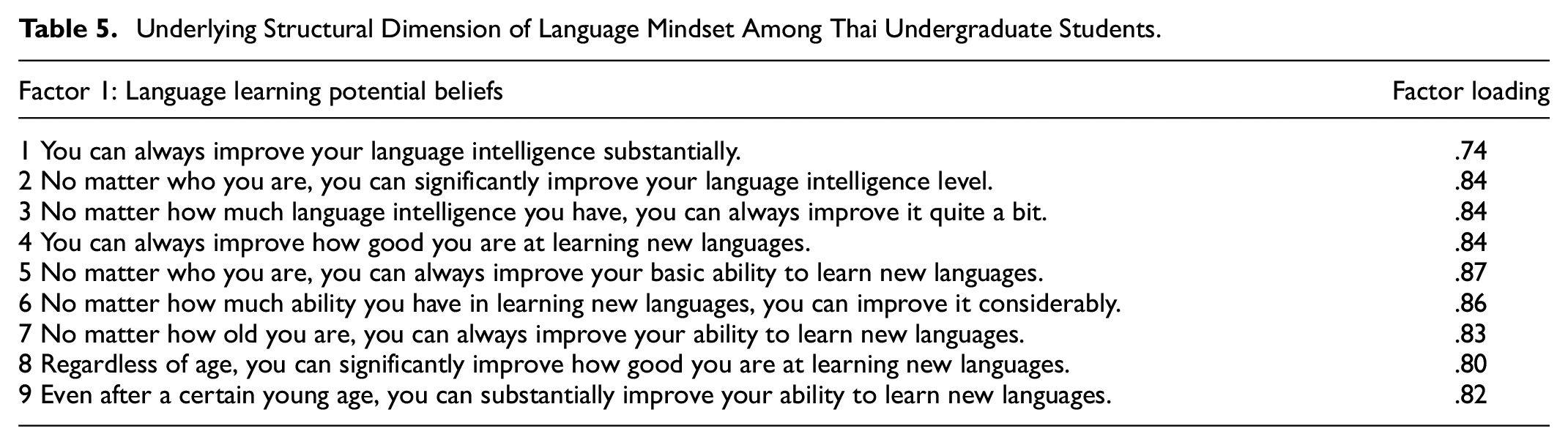
The findings in Table 5, which is related to the unidimensional factor “Language Learning Potential Belief” present several intriguing insights. Firstly, all the items display significant factor loadings, with values ranging from .74 to .87. This suggests that respondents overwhelmingly concur with the idea that one’s language-related abilities can always be honed and improved, regardless of their starting point or current proficiency level. Furthermore, the emphasis on age within the items, specifically items 7, 8, and 9, underscores a pivotal element of this belief system: the conviction that age doesn’t inherently limit one’s capacity to enhance their language skills. This perspective challenges the widespread notion that the ability to acquire new languages diminishes as one grows older, proposing instead that age is not a definitive barrier to linguistic advancement. Moving beyond just inherent linguistic aptitude, the items also delve into the importance of continuous effort in the language learning journey. They encapsulate both the intrinsic components of language learning, like language intelligence and foundational ability, and the extrinsic ones, such as the endeavors one invests in mastering a language. This layered representation accentuates the idea that the belief in question isn’t solely anchored in inherent talent. Instead, it equally values the persistent efforts one makes toward bettering their language skills. Additionally, the uniformity in the factor loadings indicates a holistic mindset among the respondents. It demonstrates their confidence in their potential to not only make strides in certain facets of language acquisition but also in their overarching ability to grasp and master new languages.
Underlying Structural Dimension of Language Mindset Among Thai Undergraduate Students.
Discussion
The exploration into the mindsets of Thai undergraduate students unveils an encouraging landscape of growth-oriented beliefs. These students hold a positive outlook on their ability to develop intelligence and talent, with the conviction that dedicated effort can lead to substantial improvements over time. The high mean scores reported for statements affirming the malleability of intelligence and talent reflect a cultural or educational ethos that promotes continuous personal development. The slight dip in agreement with the potential for change in intelligence could be indicative of nuanced beliefs about intelligence as a trait, but the overall trend remains strongly in favor of a growth mindset. This perspective is mirrored in the domain of language learning, where students show a robust belief in their ability to enhance language skills irrespective of starting levels or age. These findings carry implications for educational strategies, suggesting that fostering such mindsets could be integral to student motivation and learning outcomes. Educators might leverage this prevailing growth mindset to encourage students to embrace challenges and persist through difficulties, especially in language acquisition.
Mindset and Other Variables
The detailed analysis of mindset beliefs across gender, year level, and self-perceived language proficiency reveals subtle variations. While mindset scores generally decline with advanced year levels, indicating a possible shift in focus or motivation, the resurgence in sixth-year students’ scores suggests that maturity or proximity to graduation may renew confidence in language learning. Moreover, the consistency in mindset beliefs across different demographic and proficiency groups indicates a shared cultural or institutional perspective among these students. The incidence of a growth mindset among the participants mirrors that found in Thai engineering students (Wilang, 2022). This uniformity points to an overarching influence that transcends individual differences, highlighting the potential impact of collective attitudes on educational experiences among Thais (Chaiyasat & Intakaew, 2023; Salsarola, 2023). In total, the strong association between general and language mindsets suggests that fostering a positive general outlook could be key in supporting language learning efforts. The study’s insights into the dynamics of mindset, gender, year level, and proficiency underscore the complex interplay of factors that educators and policymakers must navigate to cultivate an environment that supports growth and learning.
Distinct Dimensions of General Mindset Among Thai Undergraduate Students
Thai undergraduate students’ perspectives on the three dimensions of general mindset—Talent Malleability Belief, Intelligence Malleability Belief, and General Potential for Change—can be deeply contextualized within the interplay of their cultural, educational, and socio-economic backgrounds (Bernardo, 2023). The notion of Talent Malleability Belief is notably influenced by Thailand’s rich cultural fabric. Thai culture, like many Asian societies, places significant value on hard work and resilience (Hofstede, 1991). This cultural milieu creates an environment where students are more inclined to believe that talents can be nurtured and honed through consistent effort and dedication. Furthermore, the array of extracurricular activities offered by Thai educational institutions serves as practical arenas where students can see firsthand the transformation of raw potential into refined skill (Srithep, 2023). On the other hand, the Intelligence Malleability Belief is largely shaped by the evolving landscape of the Thai educational system (Ngoc & Barrot, 2023; Pechapan-Hammond, 2020). Traditional pedagogies, grounded in rote learning, might inadvertently promote a perception of fixed intelligence. Yet, as the nation’s educational paradigm shifts toward fostering critical thinking and problem-solving skills, students are increasingly exposed to the concept that intelligence can be developed and refined. This evolving perspective is further bolstered by the profound cultural reverence for learning and educators in Thai society. As students navigate their undergraduate journey, the academic trajectories of their peers serve as tangible proof that intelligence is malleable and can be enhanced with the right inputs. Lastly, the dimension of General Potential for Change finds its roots in Thailand’s philosophical and socio-economic milieu. Buddhism, with its teachings on life’s transience and the continuous journey of personal evolution, offers a foundational perspective that permeates the general Thai worldview (Princess Maha Chakri Sirindhorn, 2018). Moreover, Thailand’s economic dynamism, marked by opportunities for upward mobility, provides real-world instances of change, highlighting the fluidity of life’s circumstances. The winds of globalization, bringing with them a medley of global ideas and cultural nuances, further expand Thai students’ horizons, introducing them to diverse global perspectives on growth and transformation (Srichampa, 2015). In essence, the tapestry of Thai undergraduate students’ beliefs about talent, intelligence, and change is intricately woven with threads from their cultural, educational, and socio-economic contexts. Yet, it is also adorned with individual patterns shaped by personal experiences and global exposures, creating a complex and dynamic mosaic of mindset beliefs (see Cavanagh et al., 2018; Hwang et al., 2019; Lou & Noels, 2017; Lou & Zarrinabadi, 2022).
The Unidimensional Structure of Language Mindset in Thai Context
The beliefs of Thai students regarding English language learning are intriguingly unidimensional which is different from earlier studies (Bernardo, 2023; Grecco, 2023; H. Lee et al., 2023; Lou & Noels, 2017). Delving into the intricacies of this mindset provides a broader understanding of their approach to language acquisition. Thailand’s increasing integration into the global community, especially in terms of trade, tourism, and diplomacy, has led to a heightened emphasis on English proficiency (Srichampa, 2015). The Thai education system has responded by placing a premium on English language instruction. In many Thai government schools, English is often presented as a singular skill that can open doors to global opportunities, rather than a multifaceted linguistic and cultural endeavor. This focus streamlines students’ perception of English, leading them to view their progress in English proficiency as a linear path to success. Another factor to consider is the methodology employed in English language instruction in Thailand. Historically, many schools have adopted rote learning techniques, emphasizing memorization over comprehension (Pechapan-Hammond, 2020). This traditional method might inadvertently promote the view that language acquisition is about mastering a set of rules rather than navigating the complexities of communication. As a result, students might perceive English learning as a single-dimensional task of memorizing vocabulary and grammar rules. Furthermore, the Thai language’s structure, which is significantly different from English, presents a unique set of challenges (Chuenchaichon, 2022). The clear demarcation between the two languages could further reinforce the unidimensional perspective. Students might feel that mastering English is a distinct endeavor, separate from their native linguistic experiences.
Understanding the general and language mindset is contextual as discussed from the findings of this large-scale study among undergraduates in Thailand. Perhaps results would be different if other contextual variables are included. Apart from the context, the adaption of growth mindset items only may have an impact as well. A mixed of growth and fixed mindset statements may yield separate findings.
Concluding Remarks
The intricate beliefs of Thai undergraduate students about talent, intelligence, and the potential for change offer a valuable roadmap for reimagining educational practices. By aligning pedagogical strategies with these beliefs, educators can create more resonant, effective, and transformative learning experiences, preparing students not just for academic success but also for the multifaceted challenges of the 21st century.
Theoretical Implications
The elicited distinct beliefs in the malleability of talent and intelligence among Thai students offers substantial support to Dweck’s Mindset Theory, suggesting its cross-cultural validity and the specific influence of a culture that prizes effort. This contributes to a nuanced understanding of mindset that distinguishes between domains of talent and intelligence, potentially affecting learning behaviors and outcomes in unique ways. Furthermore, these beliefs resonate with the incremental theory of intelligence, indicating that Thai students may view intelligence as a quality that can be developed with time and effort, a perspective likely to affect their academic engagement and resilience. This alignment underscores the broader impact of such beliefs on language learning approaches and perseverance, enriching theoretical perspectives on intelligence and educational outcomes.
Pedagogical Implications
This investigation provides valuable insights that carry significant pedagogical implications for educators, curriculum designers, and policymakers. Harnessing these understandings can pave the way for more effective and inclusive educational practices that resonate with the inherent beliefs and values of Thai students.
First and foremost, recognizing the prevailing belief in Talent Malleability offers educators an opportunity to foster a growth mindset within classroom environments. Since students are already inclined to believe that talent can be nurtured, educators can design curricula that emphasize process-oriented feedback over result-oriented evaluation. By highlighting the importance of effort, strategy, and persistence, teachers can reinforce the idea that growth is possible, encouraging students to embrace challenges and view failures as learning opportunities rather than limitations. Furthermore, given the understanding of Intelligence Malleability, there is an opportunity to move away from traditional rote learning methods and instead introduce pedagogies that nurture critical thinking, problem-solving, and analytical skills. By creating environments where students are encouraged to question, analyze, and synthesize information, educators can foster deeper understanding and more enduring learning. The emphasis should shift from mere content absorption to the development of cognitive skills, preparing students for real-world challenges and fostering lifelong learning. The belief in the General Potential for Change (a distinct factor elicited in this study) underscores the need for holistic educational experiences. Beyond academic pursuits, it’s crucial to integrate opportunities for personal growth, ethical reasoning, and socio-emotional learning. Practical skills, entrepreneurial thinking, and adaptability should be integral components of the education system. Exposure to various career pathways, internships, and real-world projects can give students a more practical understanding of how their education translates to real-world applications.
As with the unidimensional factor, “Language Learning Potential Belief,” it reflects a consistent and strong belief in the potential to improve language learning abilities regardless of inherent talent, age, or current skill level. The pedagogical implications of such a mindset can be instrumental in shaping effective English language education for Thai students by considering the following:
Personalized Learning Pathways—Recognizing the belief in continuous improvement regardless of one’s current ability level means that educators can create personalized learning pathways for students. Rather than a one-size-fits-all approach, teaching can be tailored to the individual’s current proficiency level, ensuring that all students, whether beginners or advanced, feel challenged and engaged.
Emphasis on Lifelong Learning—With students believing that age is no barrier to language acquisition, educators can promote the concept of lifelong learning. This perspective can be especially motivating for adult learners or those who may have felt they missed the “optimal” age for language learning.
Incorporating Growth Mindset Strategies—Given the strong belief in the malleability of language abilities, teaching strategies that emphasize a growth mindset can be particularly effective. Praising effort over innate ability, emphasizing the value of mistakes as learning opportunities, and fostering a classroom environment where challenges are embraced can resonate deeply with students’ pre-existing beliefs.
Use of Success Stories—Highlighting stories of individuals who, despite initial challenges or starting late, have become proficient in English can be inspiring. Such narratives align with the students’ belief in the potential for improvement and can serve as motivational tools.
Future Research Directions
Future research directions arising from this study’s limitations present opportunities for expanding the understanding of language mindset. One avenue is to explore whether the underlying construct of the language mindset observed among Thai undergraduate students resonates similarly across diverse cultural backgrounds. A comparative analysis involving multiple cultures could reveal universal aspects of language mindsets or highlight culture-specific attitudes and beliefs.
Additionally, examining the perspectives of students who possess a fixed mindset regarding language learning could provide a more comprehensive view of student beliefs and their impact on language acquisition. Understanding the contrast between growth and fixed mindsets can offer deeper insights into how mindset influences language learning strategies, resilience in the face of challenges, and overall academic performance.
To delve deeper into the nuances of language mindsets, future studies might employ mixed-method or qualitative research designs. Such approaches would allow for rich, in-depth data collection, capturing the complexities of students’ attitudes, beliefs, and emotional states that quantitative measures alone may not fully illuminate.
Finally, investigating the relationship between language mindsets and other affective factors like anxiety and motivation could be highly informative. By examining how mindsets correlate with emotions that often accompany language learning, researchers can gain a clearer picture of the psychological landscape that students navigate. Understanding these relationships could lead to the development of targeted interventions designed to bolster confidence, reduce anxiety, and enhance motivation in language learners.
Footnotes
Acknowledgements
This work was supported by (i) Suranaree University of Technology (SUT), (ii) Thailand Science Research and Innovation (TSRI), and (iii) National Science, Research and Innovation Fund (NSRF) (NRIIS number 189601).
Declaration of Conflicting Interests
The author declared no potential conflicts of interest with respect to the research, authorship, and/or publication of this article.
Funding
The author disclosed receipt of the following financial support for the research, authorship, and/or publication of this article: This work was supported by (i) Suranaree University of Technology (SUT), (ii) Thailand Science Research and Innovation (TSRI), and (iii) National Science, Research and Innovation Fund (NSRF) (NRIIS number 189601).

Ethical Approval
This study was approved by the Institutional Review Board of Suranaree University of Technology.
Data Availability Statement
Data sharing not applicable to this article as no datasets were generated or analyzed during the current study.