




Abstract
The prevailing approach to studying justice in the workplace has focused on recipients and observers of justice. This approach, however, fails to consider the experience of other parties including those who communicate justice. To understand the experience of communicating fairness, we investigated how justice, injustice, and necessary evils differentially affect guilt and stress. In addition, we explored how communicating bad news compares to these experiences. Across two studies, we found evidence showing that guilt and stress were affected by what was being communicated, such that injustice and necessary evils provoked more guilt and stress than justice. These findings highlight how justice broadly affects communicators psychologically and physiologically.
Keywords
The study of organizational justice has largely been oriented toward the study of victims or targets of others’ behaviors and decisions (Rupp, 2011). This research has shown that victims’ perceptions of outcomes (i.e., distributive justice), procedures (i.e., procedural justice), interpersonal interactions (i.e., interpersonal justice), and information sharing (i.e., informational justice) impacts attitudes and behaviors (Cohen-Charash & Spector, 2001; Colquitt et al., 2001). Recently, researchers have considered other parties to fairness, including those who observe (i.e., third-parties; Skarlicki & Kulik, 2005) and are responsible for fair treatment in the workplace (i.e., actors; e.g., Graso et al., in press). However, researchers have yet to assess the experience of those who must communicate decisions and actions of others within a workplace.
Communicators, such as middle managers, may be charged not with decision-making but with the dissemination of decisions, outcomes, or events that are subsequently judged as fair or unfair. 1 Through their role as conduits, they act both as participant and observer, yet possess neither an actor’s responsibility for the event at hand (see Scott et al., 2009) nor a third-party observer’s non-complicity (Skarlicki & Kulik, 2005). Extensive research on interactional justice has examined the process of communicating decisions in a fair manner (e.g., Bies, 2015). However, this research is often oriented toward the impact of managers’ actions on recipients’ perceptions of fairness in messages (e.g., Bies & Shapiro, 1987). Although some studies have been dedicated to prescriptions on how to communicate with employees—particularly during layoffs (e.g., Smeltzer & Zener, 1992) and with bad news broadly (Bies, 2013), few studies to our knowledge have assessed the experience of communicating with others in an organization—especially as it pertains to their own perception and experience of fairness. Until more direct assessment of communicators is carried out, organizations remain in the dark regarding these employees.
We address this issue by drawing on the deontic perspective. Individuals have moral motives to see justice maintained and react strongly and negatively when it is not (Folger, 2001; Folger & Cropanzano, 2001). Injustice should therefore provoke negative reactions (i.e., moral anger/outrage; O’Reilly & Aquino, 2011) from communicators. Moreover, certain situational features may mitigate the experience of communication (see Molinsky & Margolis, 2005). Communicating a necessary evil (i.e., harm inflicted for a greater good) in particular may provoke a moral calculus that minimizes communicators’ negative reaction to injustice (see Folger & Cropanzano, 2001). Although their reactions may take many forms, we focus specifically on communicators’ guilt and stress (see Guo, Rupp, Weiss, & Trougakos, 2011).
In two studies, we explored the experience of communicating justice. In doing so, we contributed to growing work on various parties impacted by fairness (e.g., Graso et al., in press; Scott et al., 2009). While other researchers have explored the impact of feedback on decision-makers’ guilt (Oc et al., 2015) and interpersonal fairness in communicating decisions (e.g., Whiteside & Barclay, 2018; see also Bies, 2015), few studies have examined how communicating injustice or related events could provoke guilt or stress. Moreover, given the number of individuals who occupy middle-management roles (see Korn, 2013) in which communication of decisions is likely, this process may expose many employees to affective strain. As such, we not only present a different approach to the study of communication and justice, but also shed light on an experience that affects a multitude of workers.
Communicating Fairness
Communicators are responsible for disseminating information related to justice to others—justice meaning here any experience that pertains to fairness, including experiences of injustice. They must convey information regarding outcomes, behaviors, and decisions to a recipient whose experience of justice is impacted by those outcomes, behaviors, and decisions. Indeed, past empirical research in the domain of organizational justice shows that supervisors can have a direct influence on how survivors experience a layoff (Bies et al., 1993; Brockner et al., 1990; Lipponen et al., 2018). It must be noted that while research on communicators’ perceptions of and reactions to justice is limited, a large body of research on fairness in organizational communication has been cultivated over decades. As argued in foundational works on interactional justice (e.g., Bies, 1987; Bies & Moag, 1986), the provision of information is critical to maintaining fairness. In addition, content of communications (e.g., explanations; (Bies & Shapiro, 1987; Sitkin & Bies, 1993) and their adequacy (Shapiro et al., 1994) may temper perceptions of injustice. The impact of communication on recipients’ perceptions of fairness has also extended into other related arenas, such as pay communication (e.g., Day, 2011; Marasi & Bennett, 2016) and feedback medium (e.g., Westerman et al., 2014).
This research, however, only illuminates the management of fairness by communicators rather than their experience of fairness. Although a great deal of research has proliferated on various parties to fairness (Rupp, 2011), organizational messengers inhabit a space that is unique from others currently studied in the realm of organizational justice. Communicators are distinct from actors as they do not bear direct responsibility for outcomes they communicate. Actors, on the other hand, evaluate situations, make decisions, and act in ways that are judged for their fairness (Graso et al., in press). As such, communicators, much like third-party observers (Skarlicki & Kulik, 2005), typically do not possess any causal role in events being communicated. However, communicators are distinct from third parties because they have some complicity in the provision of fairness. Namely, their responsibility includes communicating decisions and actions in a fair manner (see Bies, 2015). As such, communicators are not strictly confined to a participative or an observational role, but rather possess characteristics of both. They are middle-management conduits for upper level actors and while they bear witness to the justice directed at others, they still participate in the provision of that justice.
The Deontic Perspective
What, then, is the experience of communicators as they share information with others in the workplace? Researchers have highlighted three primary motives that drive justice concerns: instrumental, relational, and moral motives (Cropanzano, Rupp, Mohler, & Schminke, 2001). While instrumental and relational motives explain why people are concerned with their own fair treatment (i.e., due to self-interest and interpersonal concerns, respectively), moral motives explain more universal concerns for fairness. The deontic perspective (Folger, 2001) suggests that fairness is viewed as an end to itself and as universally important for maintaining civil society. When injustice occurs, values and norms are compromised, consequently provoking negative “deontic” reactions from others. Deontic reactions can take many forms, as “deontic phenomena include reactions to perceived unfairness,” (Folger, 2001, p. 4). Affective responses are particularly likely to emerge in the face of wrongdoing (Folger & Cropanzano, 2001; Folger & Skarlicki, 2008) including moral outrage, righteous indignation, or “moral anger.” Although the term “anger” is used to describe this reaction, O’Reilly and Aquino (2011) acknowledge that anger is but one of many emotions that emerges in response to injustice (see also Weiss et al., 1999). Namely, moral anger refers not just to a specific emotion but rather multiple emotions—emotions that “lead people to think negatively about the perpetrators of injustice and want to see them punished,” (O’Reilly & Aquino, 2011, p. 531). Moral anger toward the offending party would therefore be expected when communicators observe injustice.
Communicators, though, occupy a participatory role in delivering injustice. As agents of an organization (Colquitt et al., 2001; see also Fassina et al., 2008), those responsible for communicating decisions may perceive themselves as also complicit in the outcomes that have befallen recipients of their messages. They may therefore experience moral emotions that reflect thoughts about themselves rather than others when communicating fairness-related outcomes or events. When a deontic reaction (Folger, 2001)—namely, moral anger (O’Reilly & Aquino, 2011)—turns inward, it would reflect underlying motives to ensure that one’s wrongs are addressed. We therefore anticipate that communicators will experience guilt.
As a moral emotion (Eisenberg, 2000), guilt reflects negative feelings regarding harm one has caused (Baumeister et al., 1994). Although no research to our knowledge has examined communicating justice and its impact on guilt, Oc and colleagues (2015) demonstrated that negative feedback prompted guilt from actors following their decisions. Liao and colleagues (2018) also showed that abusive supervision led to guilt among those behaving abusively. A large body of research has also indicated that acting unfairly or immorally in general may provoke feelings of guilt (see Baumeister et al., 1994). Even if communicators do not perceive their own behaviors as wrong, guilt can be provoked by observations of another’s wrongdoing or harm toward another (Spencer & Rupp, 2009). Moreover, research has shown that even when individuals do not bear direct responsibility for harm that befalls another, they may still experience guilt (e.g., Brockner et al., 1985, 1986). As such, though communicators do not bear the full responsibility of actors, they might nevertheless experience emotions pertaining to moral trespasses when they communicate injustice; specifically, guilt.
Stress of Communication
Conservation of resources (COR; Hobfoll, 1989) suggests that stress should emerge when resources are threatened, depleted, or fail to be replenished when deployed. Applied to communicating fairness, COR suggests that communicators should experience stress. When communicating non-valenced information, such as when a meeting will take place, managers must put forth some effort that would utilize available resources. In addition, communicating a message over which one has no control may deplete available resources as a loss of autonomy can negatively impact psychological stores (Moller et al., 2006; see also Johnson et al., 2014). Indeed, research on bad news delivery shows that it can be anxiety-inducing (Ptacek et al., 2004) even long after delivery has taken place (Eberhardt McKee & Ptacek, 2001). Middle-managers also experience stress due to the boundary-spanning quality of their roles and the limitations to which they can retaliate or respond to their experience (Anicich & Hirsh, 2017). Empirical research has also suggested that enactment (e.g., Johnson et al., 2014) or communication of decisions one has partaken in (Whiteside & Barclay, 2018) impacts and is impacted by regulatory resources.
The demands (and therefore stress) experienced during communication may therefore be compounded when injustice or rather a lack of fairness is present in particular. Injustice may specifically deplete resources (see Maslow, 1948; Ryan & Deci, 2000; Williams, 1997) by failing to meet certain needs (see Cropanzano, Byrne, et al., 2001). As such, stress may emerge when communicating injustice. When it comes to justice, though Johnson and colleagues (2014) showed that procedural justice can be draining while interpersonal justice can be replenishing for actors and communicators may lose resources through cessation of control (Moller et al., 2006), the positive experience of communicating justice may offset the negative impact of communicating a decision generally (see Bono et al., 2013). We therefore argue that stress is likely to be greater when communicating injustice compared to communicating justice.
Communicating Necessary Evils
The assessment of fairness by communicators thus far has been implied rather than explicitly outlined. However, communicators’ assessment of whether an injustice has taken place has a critical influence on guilt and stress. To illuminate this process, we draw on fairness theory (Folger & Cropanzano, 2001). Fairness theory suggests that judging whether injustice has taken place—and would provoke deontic responses (Folger, 2001)—involves consideration of three criteria: Is there injury or harm (harm)? Could the acting party have behaved in alternate ways (avoidability)? Were norms of moral or ethical conduct violation by the decision (moral violation)? If all three criteria are satisfied, injustice will be perceived.
Nevertheless, this assessment may not be straightforward. Different factors can shape the evaluation of these criteria (see Ganegoda & Folger, 2015), as individuals may use different standards in their assessment (Folger & Cropanzano, 2001; see also Rupp et al., in press). Of the three criteria, variability in standards used to evaluate moral violation may have a particular impact on communicators’ perceptions of and subsequent reactions to delivering justice. Moral concerns figure prominently in reactions to injustices perpetrated (Folger, 2001), especially among those not directly targeted by those injustices (see Cropanzano, Byrne, et al., 2001; Cropanzano, Rupp, et al., 2001). However, when multiple moral standards come into play (e.g., equity/equality; utility/hedonism), it is unclear how communicators will respond—especially if one standard is satisfied while another is violated. We argue that when one moral standard is satisfied it may serve to mitigate the effects of another being violated. Specifically, if a moral standard is upheld in the course of an injustice, it may ameliorate a communicator’s response.
To explore this, we draw on necessary evils. Necessary evils refer to situations in which harm is inflicted for a greater good (Molinsky & Margolis, 2005). In other words, though a beneficial end may be desired, achieving it involves harming another. Necessary evils, as those behaviors that require harm to achieve a good, therefore, draw upon two distinct moral principles that may influence the evaluation of justice. The first principle is “do no harm” or primum non nocere (see Smith, 2005). Individuals are bound, according to this standard, not to harm one another in their interactions. The second principle is that of utility (see Mill, 2001), which refers to maximizing good in a situation. With a necessary evil, both of these principles are evoked. The presence of harm violates the “do no harm” principle. The presence of good, however, may suggest that utility has been maximized.
Since justice involves moral principles being upheld while injustice involves those principles being violated (see Folger & Cropanzano, 2001), the presence of both a moral norm upheld and a moral norm violated should elicit communicator reactions that fall somewhere between those provoked by injustice and justice. Specifically pertaining to necessary evils, harm may satisfy the moral violation counterfactual and elicit a negative deontic response. The necessity or utility of the act, however, would fail to satisfy the moral violation counterfactual, and consequently, may inhibit or minimize such a deontic response. Not only would it inhibit the deontic response, but may also minimize drains on communicators’ resources.
Study 1
Study 1 Methods
Study 1 participants
Participants were introductory psychology students (N = 142) at a large, public Midwestern U.S. university. The sample was 63.1% male; 62.7% White, 28.2% Asian, 3.5% Hispanic/Latino, 4.2% Black/African American, and 1.4% Multiethnic or Biracial. English was the native language for 81.7% of participants. Average age was 19.8 years. Of these participants, 25 were screened out for not paying attention (e.g., “Select disagree for this question”) or indicating during their communications that they did not understand what was going on, leaving a sample of 117 participants.
Study 1 procedures
Participants went to a waiting room where another participant (confederate) was waiting. These two were escorted by an experimenter to two separate rooms across a small, narrow hallway from one another. The experimenter told them the study focused on communication and obtained informed consent. It was explained that they would play three, 2-min rounds of solitaire on their own, but that their points would be combined at the end of each round. It was also explained that participants could individually earn a double bonus of their final tally of points after the rounds were through in one of two ways. The first was to be given the role of a deliverer (i.e., communicator), which automatically gave the participant the double bonus. The second way was to be given a double bonus by the experimenter. Participants were told that the deliverer would be responsible for telling the other player if s/he received a double bonus. The participant was always chosen to be the deliverer. It was explained that points would be converted into raffle entries for a US$100 Amazon gift card, with different raffles for deliverers and recipients. Participants were told that as this was a study on communication, they should communicate with each other throughout the experiment via instant messaging. If the participant did not initiate conversation, the confederate would send predetermined prompts (e.g., “Hey. What do you think?”).
The experimenter then went into the confederate’s room to “set up” the experiment, after which s/he returned to the participant’s room and attached a galvanic skin response (GSR) sensor to the participant’s left index and middle fingers. The experimenter set up the experiment and left the room. The participant played three, 2-min rounds of solitaire on a computer. In between each round, the experimenter pulled up an online survey assessing guilt for the participant to complete. Following this, the experimenter returned with the participant’s and the other player’s score. The experimenter determined the confederate’s fictitious scores based on the addition or subtraction of a predetermined amount from the participant’s score each round. Due to these instructions, the confederate’s final total score was roughly equivalent to the participant’s final total score.
At the end of the third round, the experimenter informed the participant that s/he had been chosen to be the deliverer. The experimenter told the participant that s/he had to deliver the experimenter’s recommended decision regarding the partner’s double bonus. The participant was told they would have 5 min to communicate the decision. The confederate was instructed to respond to the information delivered by the participant with, “Thanks. Why?” After delivery, the experimenter returned and pulled up a final questionnaire that included measures of justice and emotions. 2 Once the questionnaire was complete, GSR sensors were removed. The participant was debriefed and offered an opportunity to discuss the experiment with the confederate.
Study 1 manipulations
Justice communication manipulation
The justice communication manipulation occurred via information the participant was required to communicate to the confederate. In all three conditions, the experimenter started out by saying “Even though you’ve been given this role, you need to deliver my recommended decision to get the double bonus.”
As the participant was given a double bonus for being a deliverer, this set up the expectation that the other participant/confederate should receive similar treatment for their similar work (i.e., equity; Adams, 1965). Recall that according to fairness theory (Folger & Cropanzano, 2001), injustice should be perceived when three criteria are met: an avoidable (a) harm (b) takes place that violates a moral norm (c). Also, recall that conflicting moral implications should attenuate deontic reactions, hence creating situations perceived as “necessary evils.” We manipulated these aspects of delivery to create conditions of justice, injustice, and necessary evils.
In the justice, condition, the experimenter stated, “The other player performed similarly to you, so I think the other player should get the double bonus.” Based on the criteria described above from fairness theory (Folger & Cropanzano, 2001), this fails to meet the harm condition, as the confederate participant is not harmed by getting the double bonus. Although the language of the experimenter (e.g., “I think”) and the framing of the choice as a decision implies avoidability, this criterion is not sufficient for injustice to be perceived. Finally, with regard to the moral violation, no moral principles were violated in this scenario.
In the injustice condition, the experimenter stated, “The other player performed similarly to you, but I don’t think the other player should get the double bonus.” The participants assigned to this condition encountered information sufficient to satisfy each of the criteria outlined in fairness theory for the perception of injustice to take place (Folger & Cropanzano, 2001). First, the confederate not receiving a bonus when the participant does creates relative deprivation, which should be sufficient for harm per Folger and Cropanzano (2001). Similar to the justice condition, avoidability is implied in the fact that the allocation of the bonus is based on the experimenter’s evaluation of the other participant’s performance rather than being predetermined. Finally, the confederate participant not receiving a bonus for similar performance was designed to violate expectations of equity and equality (i.e., moral norms).
In the necessary evils condition, the experimenter stated, The other player performed similarly to you, however, I don’t think the other player should get the double bonus because I can only give a certain amount of raffle entries each day to each player role and if every participant gets a double bonus, I won’t be able to give them to others in the future. Also, if the other player gets a double bonus, I might have to stop running participants for the day.
According to our arguments, necessary evils reflect situations in which avoidability and harm should be satisfied. When it comes to moral violations, however, necessary evils both satisfy and fail to satisfy this condition as they involve harm and some benefit. First, the confederate not receiving a bonus when the other participant did created relative deprivation. This deprivation should have triggered perceptions of harm. The necessary evils condition also suggested avoidability in that the experimenter’s evaluation of the other participant’s performance as it did in the other experimental conditions. Finally, with regard to moral violation, the participant encountered information that would satisfy and dissatisfy the condition. First, the participant was told that the other player would not receive the bonus even though they performed similarly to the other participant. This implies inequity and inequality, both of which violate moral norms. However, the participant was told that the choice was made in consideration of being able to give bonuses to others and to continue running the experiment. Considering this circumstance, the participant should conclude that the decision actually upheld the moral standard of utility.
Study 1 Measures
Demographics
Information on participants’ gender, race, age, and whether English was their native language was collected during the final questionnaire.
Manipulation check
The justice communication manipulation was checked using a four-item measure of justice adapted from Spencer and Rupp (2009; see also Nicklin et al., 2011). The items were selected to reflect perceptions of fairness. They were: “The other participant lost something with regard to the delivery of a bonus,” “The decision with regard to the delivery of the bonus was morally/ethically right” (reverse-coded), “The other participant should have been treated in a more morally or ethically right way,” and “There were moral or ethical violations during the delivery of the bonus.” Items were responded to on a 5-point Likert-type scale (1 = Strongly disagree, 5 = Strongly agree). Items showed poor internal-consistency reliability (α = .62), but this is to be expected given that items were not meant to reflect an established scale and were rather a subset from a scale. Given the item design, higher scores equate to more injustice.
Guilt
Guilt was measured similarly to Shaver and colleagues (1987). Participants were asked at four different times to rate how they felt now on a 5-point scale (1 = Not at all, 5 = Very much). Guilt was assessed with items referencing feeling “guilty,” “sorry,” and “regretful.” These items were couched within a large set of items asking about other emotions (e.g., sadness). Alphas at each time point were above conventional standards (α > .85).
Stress
Although multiple physiological measures of stress are available (e.g., cortisol), we chose to assess stress via skin conductance GSR sensors. The GSR sensor provided raw data obtained nearly continuously (~50 readings per second) throughout the experiment that reflected resistance to an electrical current. As sweat decreases resistance, high values (originally in kOhms) reflected low physiological arousal and stress. Given the output and baseline variations among participants, the raw data were converted such that large negative z-scores indicated lower stress and large positive z-scores indicated higher stress. Although data were collected continuously, all observations were averaged for each distinct phase of the experiment (e.g., Task 1, Survey 3, Communication Notice, Communication, etc.).
Study 1 Analyses and Results
Manipulation check
A one-way ANOVA showed a significant effect of the justice communication manipulation on perceptions of injustice, F(2, 116) = 24.7, p < .001. Consistent with expectations, post hoc Tukey HSD comparisons showed that participants assigned to the injustice condition (M = 3.16, SD = .50) perceived more injustice compared to those assigned to the justice condition (M = 2.35, SD = .52; p < .001, 95% CI = [.52, 1.10]). Those assigned to the necessary evil condition (M = 2.93, SD = .54) perceived more injustice than those assigned to the justice condition (p < .001, 95% CI = [.31, .86]). Although there was not a significant difference between the injustice and the necessary evil condition (p = n.s.), it trended in the expected direction (95% CI = [−.06, .51]).
Hypothesis testing
We used repeated-measures ANOVA (see Table 1) to test Hypotheses 1a–c. 3 Our choice of repeated-measures ANOVA was not grounded in an expectation of change over time but rather was utilized to demonstrate more strongly that the experience of communication provoked different affective and physiological responses based on the manipulations rather than overall baseline between-group differences. For guilt, we analyzed changes in responses from participants following each round of Solitaire (i.e., Task 1, Task 2, Task 3; see Figure 1) and following communication (i.e., post-communication). For stress, we analyzed average GSR scores for pre-communication, communication, and post-communication (see Figure 2).

Study 1 Stress scores.
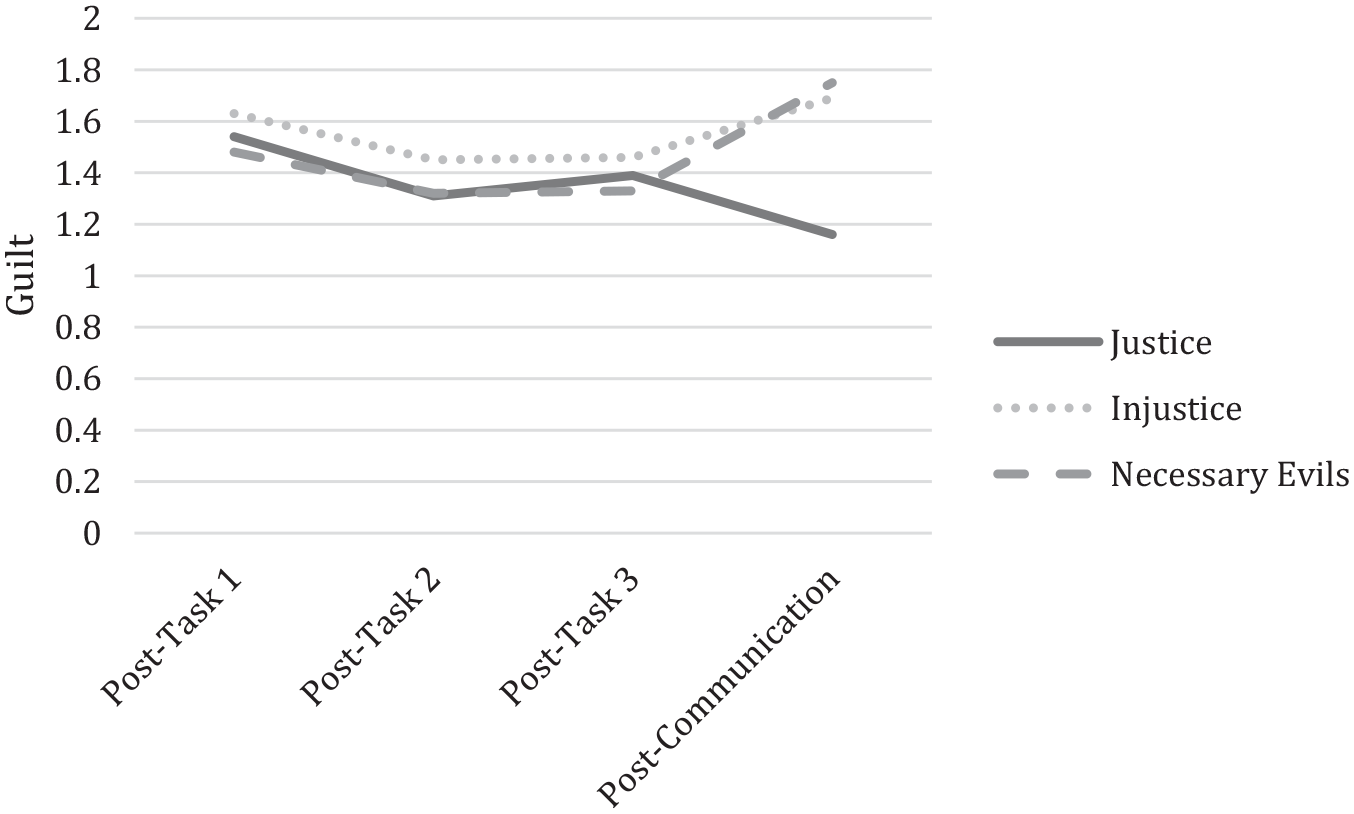
Study 1 Guilt scores.
Study 1 Means, Standard Deviations, and ANOVA.

Note. Means and standard deviations (in parentheses) are presented in the columns. ANOVA = analysis of variance.
Due to missing data, n = 29. bDescriptive statistics were for untransformed scores, while ANOVA was conducted for transformed scores.
Guilt scores were non-normal, such that despite the robustness of ANOVA to violations of normality, transformations were necessary. An inverse function improved normality, though it led to a violation of homogeneity of variance post-communication (Levene’s test, p < .001). In spite of this, we ran a repeated-measures ANOVA for the effect of justice communication on the inverse measure of guilt as other tests can be used to assess group differences when homogeneity of variance is violated.
For Hypotheses 1a–1c, we expected a significant within-subjects interactive effect of justice communication with time. This effect would suggest that over time guilt and stress changed due to the experience of communication. A significant time x justice communication interaction was detected for the inverse measure of guilt, F(6, 342) = 5.75, p < .001, partial η2 = .09, and for stress, F(4, 144) = 2.99, p < .05, partial η2 = .08.
To probe this, we conducted tests for simple main effects. First, we examined whether there was a main effect of justice communication manipulation at different time points within the experiment when measures of guilt and stress were taken. Doing so enabled us to determine if the manipulation produced differences between groups at specific points in the experiment. These analyses showed that there were only significant effects of the manipulation post-communication for guilt, F(2, 114) = 9.17, p < .001, partial η2 = .139; Welch’s test 4 : F(2, 69.6) = 11.7, p < .001, and stress, F(2, 74) = 4.05, p < .05, partial η2 = .10.
We examined these further. Due to concerns over homogeneity of variance, a Games-Howell post hoc comparison was used to assess this effect on the inverse measure of guilt. Tukey HSD post hoc comparisons were explored to assess these differences with stress. Recall that an inverse transformation was applied to the measure of guilt, which means that statistical effects are in the opposite direction of the effects described in our findings. Those assigned to the injustice condition reported more guilt (p < .01, 95% CI = [−.32, −.06]) and stress (p < .05, 95% CI = [.02, .49]) post-communication relative to those assigned to the justice condition. Those assigned to the necessary evils condition experienced more guilt when compared to those in the justice condition (p < .01, 95% CI = [−.33, −.09]). Other comparisons between conditions were not significant.
Building upon these results, which suggest that communication of injustice may increase guilt and stress, we assessed whether there were significant simple main effects of time for guilt and stress within each justice communication condition. These analyses would allow us to determine if differences in guilt or stress observed after communication occurred due to the experience or were simple manifestations of baseline group differences. For those assigned to the justice condition, guilt decreased over time, F(3, 120) = 5.87, p < .01, partial η2 = .128; post-communication vs. post-Task 1: p <. 01, 95% CI = [.06, .21]; post-communication vs. post-Task 2: p < .05, 95% CI = [.01, .13]; post-communication vs. post-Task 3: p < .01, 95% CI = [.04, .16], while stress was greatest during communication, F(2, 42) = 8.20, p < .01, partial η2 = .28; communication vs. pre-communication: p < .01, 95% CI = [.17, .57]; communication vs. post-communication: p < .01, 95% CI = [.13, .67]. For those assigned to the necessary evils condition, guilt increased over time, F(3, 120) = 7.25, p < .001, partial η2 = .153; post-communication vs. post-Task 1: p < .05, 95% CI = [−.20, −.01]; post-communication vs. post-Task 2: p < .001, 95% CI = [−.23, −.07]; post-communication vs. post-Task 3: p < .001, 95% CI = [−.24, −.08], while stress also increased over time, F(2, 56) = 21.8, p < .001; partial η2 = .44; communication vs. pre-communication: p < .001, 95% CI = [.29, .62]; communication vs. post-communication: p < .001, 95% CI = [.20, .52]. Finally, with regard to those assigned to the injustice condition, stress increased over time, F(2, 46) = 12.6, p < .001; partial η2 = .35; communication vs. pre-communication: p < .001, 95% CI = [.27, .60]; post-communication vs. pre-communication: p < .001, 95% CI = [.12, .52]. 5
Study 1 Discussion
The results of Study 1 provided support for Hypothesis 1a, as communicating injustice was found to lead to more stress and guilt post-communication as compared to justice. There was similar support for Hypothesis 1c, as necessary evils were found to lead to more guilt post-communication relative to justice. However, there were no significant differences between injustice and necessary evils, failing to provide support for Hypothesis 1b. The simple main effects analysis suggested that those communicating injustice and necessary evils continued to experience stress post-communication and experience more guilt over time. However, guilt decreased over time and stress peaked during communication for those communicating justice. Although not explicitly articulated in Hypotheses 1a–1c, these results support the argument that observed affective responses were due to the experience of communication.
Despite these findings, this study was not without limitations. We utilized a design in which participants were given the role of deliverer with no explanation as to why. It is possible that those individuals may have interpreted that this was due to merit or deservingness which could influence the extent to which they experienced guilt over the recipient’s payout of raffle entries (see Adams, 1965) such that it may be diminished if they feel it is deserved. Given our design, it is also possible that participants may have succumbed to experimenter demand when responding as repeated measures of our variables may have indicated what we were interested in assessing. We also did not consider other types of messages (e.g., bad news) to be communicated.
We therefore conducted a second study in which we considered individuals put into hypothetical situations in which their position did not have any connection to their prior actions or those of another. To the issue of experimenter demand, we contextualized guilt items in a larger item set and measured them fewer times. In addition, we considered bad news. Bad news refers to the transmission of information involving harm and loss (Bies, 2013). Bad news and injustice are related, yet distinct phenomena. The harm in bad news is not inherently unfair. It is when harm is also avoidable and violates moral norms (Folger & Cropanzano, 2001) that bad news becomes injustice. When bad news is considered as a form of harm, it may provoke perceptions of injustice due to its violation of the “do no harm” principle (Smith, 2005). As such, it might evoke deontic responses. Indeed, delivering bad news is stressful and anxiety inducing (Ptacek et al., 2004), an effect that continues after communication has occurred (Eberhardt McKee & Ptacek, 2001). In this study, we therefore explored how bad news would differ from other experiences—particularly injustice—and offer the following research question:
Study 2
Study 2 Pilot Study
We ran a pilot study using participants from Amazon’s Mechanical Turk as facilitated through TurkPrime. Compensation was US$0.15 (rate: US$1.58/hr with average completion time of 5.7 min). The initial group of participants (N = 291) were screened for failing to meet attention checks (e.g., “Please select similar for this question,” “Select fair for this question,”) and careless responding (e.g., incomplete surveys, those whose response times were below 200 s, those who displayed patterns of invariant responding; see Meade & Craig, 2012), leaving 114 participants. They were 79.8% White, 76.3% female. Average age was 41.6 years and average tenure in current organization was 4.82 years; 81.6% were currently employed or self-employed, and 23.8% considered their roles to be supervisory. Participants were presented with the justice communication conditions (as described below) and asked to indicate whether they thought the situation described was “Fair,” “Neither fair nor unfair,” or “Unfair” on a scale from 1 to 3, respectively. The data were reverse-coded for ease of interpretability. The results suggested that the fair manipulation (M = 2.72, SD = .63) was significantly more fair than the injustice, M = 1.28, SD = .54; t(114) = 17.0, p <.001, necessary evil, M = 1.65, SD = .78; t(114) = −11.2, p < .001, and bad news manipulations, M = 1.92, SD = .58; t(114) = 11.0, p < .001. The injustice manipulation was significantly less fair than the necessary evil, t(114) = −4.84, p < .001, and bad news manipulations, t(114) = −9.87, p < .001. Finally, the necessary evils manipulation was significantly less fair than the bad news manipulation, t(114) = −3.32, p < .01.
Study 2 Methods
Study 2 participants
Participants (N = 368) were recruited from Amazon’s Mechanical Turk (MTurk), as facilitated by TurkPrime. The survey, which was advertised as a study asking about experiences communicating in the workplace, was only made available to supervisors/managers, as those individuals are more likely to understand the experience of communicating decisions made by others. The survey was not available to those who did the pilot survey.
Although we had an initial screening, participants still provided information on their employment status. We therefore removed all participants who indicated they were not working, not in a supervisory or management role, and had not been working at their organization for more than a year. Given the online convenience sample used, we utilized aggressive data quality screening procedures (DeSimone et al., 2015). We removed subjects based on a consideration of multiple factors including survey completion, attention checks (e.g., “Select strongly disagree”), nonsense answers (e.g., “Yes,” “Good”), response times (i.e., removed those who responded in less than 60 s), and invariant responding (see Meade & Craig, 2012). A total of 171 participants remained. Respondents were 45.6% female; 70.2% White, 5.26% Black/African American, 1.17% American Indian/Alaska Native, 20.5% Asian, <1% Biracial/Multiethnic, and 2.3% “Other”; 5.3% were Hispanic/Latino. Average age was approximately 38.1 years. Average tenure was 8.65 years with their current employer, and 5.54 years in their current position.
Study 2 procedures
The study was delivered online through MTurk. After consenting to participate and providing demographic information, participants were asked to put themselves in the shoes of a supervisor about to meet a subordinate (Jordan) regarding their bonus (see Appendix). They were then presented with information regarding the subordinate’s bonus (communication manipulation). 6 Then, participants responded to measures of guilt and stress as they would have felt them in the meeting with the employee after which they provided a hypothetical response. They then responded to the same measures of guilt and stress indicating how they would feel after the meeting, and responded to manipulation checks. Participants were provided with a short debriefing. They were compensated US$1.00 for their participation (rate: US$5.71/hr given an average completion time of 10.5 min). 7
Study 2 experimental manipulations
Justice communication manipulation
Each scenario presented information pertaining to the three criteria for injustice according to fairness theory (i.e., harm, avoidability, moral violation; Folger & Cropanzano, 2001). To minimize the effect of Jordan’s outcome valence on perceptions of fairness (e.g., the more negative the outcome, the more unfair the act), we made the outcome for Jordan constant and instead changed the framing around it. As such, Jordan received the same bonus in each scenario.
Participants assigned to the justice condition were informed: “Based on the new criteria used by the division director, Jordan has been given the same bonus grade as last year. This is not surprising given that Jordan’s performance was assessed as being the same as last year.” The criteria for injustice, according to fairness theory (Folger & Cropanzano, 2001), would not be satisfied in this situation. Although there is avoidability as Jordan’s bonus can be changed, no harm is present, and no moral violations are present as Jordan receive an unsurprising grade given his or her performance (i.e., equity).
The participants assigned to the injustice condition were informed: “Based on the new criteria used by the division director, Jordan has been given the same bonus grade as last year. This is surprising given that given that Jordan’s performance was assessed as being better than last year.” The framing of the bonus grade suggests that it was surprising and not proportional to his or her performance. This not only violates a moral principle (equity) but also suggests deprivation (harm) as Jordan’s performance should have produced a higher bonus grade. Moreover, as there are new criteria, this could have been avoided.
The participants assigned to the necessary evils condition were informed: Based on the new criteria used by the division director, which were implemented for the purpose of keeping the division within budget and preventing layoffs, Jordan has been given the same bonus grade as last year. This is surprising given that Jordan’s performance was assessed as being better than last year.
As in the previous study, the necessary evil manipulation involved harm and avoidability, as well as different moral standards being upheld or violated. Pertaining to harm, avoidability, and moral violation, the same elements are present as in the injustice condition. Moral standards, however, may be upheld when considering that the criteria change occurred to prevent layoffs (i.e., utility).
Finally, participants assigned to the bad news condition were informed: “Based on the new criteria used by the division director, Jordan has been given the same bonus grade as last year. This is bad news for Jordan.” We chose to make our manipulation of bad news explicit given that—per Bies (2013)—the perception of bad news is subjective and dependent on perceived loss. Given that we kept Jordan’s outcome constant to minimize the effect of valence, we had to rely on explicit framing for bad news (i.e., “This is bad news.”) rather than implicit discussions of harm.
Study 2 measures
Justice communication manipulation check
A similar four-item measure of injustice as described in Study 1 was used. Reliability was acceptable (α = .71). In addition, justice communication type was also checked by asking participants to rate their agreement with three statements (e.g., “Overall, Jordan’s bonus grade was fair” “The decision with regard to Jordan’s performance and subsequent bonus grade was fair,” and “When it comes to the bonus grade given, Jordan was treated unfairly”-reverse coded; α = .93). All questions were responded to on a 5-point scale (1 = Strongly agree, 5 = Strongly disagree). Both measures were recoded such that higher scores translate into more fairness/justice.
Guilt
Guilt was measured using the same measure as in Study 1 (αt1 = .89, αt2 =.90; ωt1 = .89, ωt2 = .90). All items were responded to on a 5-point scale (1 = Not at all, 5 = Very much).
Stress
Stress was measured using the 10-item Worry-Emotionality scale by Morris et al. (1981). The items were adapted for the situation (i.e., a meeting with a subordinate; αt1 = .94, αt2 = .96; ωt1 = .94, ωt2 =.95). A sample item is “I feel panicky.” All questions were responded to on a 5-point scale (1 = Strongly agree, 5 = Strongly disagree); as such, higher scores reflect lower stress. All items—where appropriate—were recoded so as to improve interpretability (i.e., higher scores equate to more stress).
Demographics
Information on participants’ gender, ethnic/racial background, age, current employment status, and tenure was collected.
Study 2 Results
Manipulation checks
Responses were analyzed using a one-way ANOVA with justice communication as the independent variable.
When looking at the measure of justice based in fairness theory, there was a significant main effect of justice communication type, F(3, 167) = 4.81, p < .01. However, Tukey HSD post hoc comparisons showed that only justice (M = 3.66, SD = .84) was significantly more fair than injustice (M = 3.21, SD = .86; p < .05, 95% CI = [.02, .89]), necessary evils (M = 3.19, SD = .86; p < .05, 95% CI = [.03, .93]), and bad news (M = 3.00, SD = .67; p < .01, 95% CI = [.17, 1.16]). The general measure of fairness produced similar results, F(3, 166) = 7.13, p < .001, with Tukey HSD post hoc comparisons showing that only justice (M = 3.43, SD = .40) was seen as significantly more fair than the injustice (M = 3.10, SD = .53; p < .01, 95% CI = [.09, .58]), and necessary evils (M = 3.02, SD = .51; p < .001, 95% CI = [.17, .67]), and marginally more fair than the bad news conditions (M = 3.18, SD = .32; p = .09, 95% CI = [−.02, .53]).
Measurement
A confirmatory factor analysis (CFA) was run on all outcome measures using the lavaan package in R. We examined two different models for each time point to assess the factor structure of the guilt and stress measures. At Time 1, the two-factor model (CFI = .92, RMSEA = .11, SRMR = .06) fit the data better than the one-factor model (CFI = .80, RMSEA = .17, SRMR = .10). At Time 2, the two-factor model (CFI = .92, RMSEA = .12, SRMR = .07) fit the data better than the one-factor model (CFI = .81, RMSEA = .19, SRMR = .11). We also utilized semTools in R to assess average variance extracted (AVE). The AVE for guilt at Time 1 was .74, while the AVE for stress at Time 1 was .63. The AVE for guilt at Time 2 was .75, while the AVE for stress at Time 2 was .69.
Hypothesis testing
To test Hypotheses 1a–1c, we performed a two-way repeated measures ANOVA assessing the impact of justice communication on guilt and stress (see Table 2). As previously mentioned, though repeated-measures ANOVA can examine time effects, our goal was to provide evidence that the manipulations were responsible for differences observed.
Study 2 Means, Standard Deviations, and ANOVA.

Note. Means and standard deviations (in parentheses) are presented in the columns. ANOVA = analysis of variance.
Results did not reveal a significant time × justice communication interaction for guilt nor stress. There was a significant effect of time for both guilt, F(1, 167) = 17.8, p < .001, partial η2 = .10, and stress, F(1, 167) = 15.9, p < .001, partial η2 = .09. An examination of the overall means from both time points for guilt suggested that it decreased from expected levels during communication (M = 2.41, SD = 1.03) to post-communication (M = 2.20, SD = 1.03). A similar pattern was found with expected stress during (M = 2.54, SD = 1.04) and following (M = 2.28, SD = 1.09) communication.
We also examined between-subjects effects of the justice communication manipulation provided by the repeated measures ANOVA. This provides an assessment of the effect of our manipulation (i.e., the between-subjects factor) when examining the average score across time points for the dependent variable. Given that participants provided anticipated responses for communication and post-communication, it is possible that they would not report markedly different responses depending on time point in the hypothetical scenario as they may have expected that their guilt and stress would persist even after communicating with their subordinate. As such, an examination of average scores across time points appeared appropriate. For both guilt, F(3, 167) = 6.96, p < .001, partial η2 = .11, and stress, F(3, 167) = 5.72, p < .01, partial η2 = .09, there were significant between-subjects effects. For guilt, Tukey HSD post hoc comparisons revealed that those assigned to the fair condition (M = 1.79, SE = .14) were less guilty than those assigned to the unfair (M = 2.59, SE = .13; p < .001, 95% CI = [−1.29, −.305]), necessary evils (M = 2.36, SE= .14; p < .05, 95% CI= [−1.08, −.055]) and bad news (M = 2.55, SE = .17; p < .01, 95% CI = [−1.32, −.195]) conditions. For stress, Tukey HSD post hoc comparisons similarly revealed that those assigned to the fair condition (M = 1.93, SE = .14) were less stressed than those assigned to the unfair (M = 2.65, SE = .13; p < .01, 95% CI = [−1.22, −.215]), necessary evils (M = 2.44, SE = .14; p = .06, 95% CI = [−1.02, .012]), and bad news (M = 2.67, SE = .17; p < .01, 95% CI = [−1.30, −.160]) conditions.
When examining between-subjects effects further, we examined subjects’ reports of anticipated stress and guilt in the moment of communication (as opposed to following). We conducted one-way ANOVAs assessing the impact of justice communication condition on guilt and stress separately. Consistent with the repeated measures ANOVA, we found significant effects of the conditions for both guilt, F(3, 167) = 5.50, p < .01, η2 = .11, and stress, F(3, 167) = 4.56, p < .01, η2 = .08. For guilt, Tukey HSD post hoc comparisons revealed that those assigned to the fair condition (M = 1.85, SD = 1.00) were less guilty than those assigned to the unfair (M = 2.70, SD = .936; p < .001, 95% CI = [−1.37, −.334]), necessary evils (M = 2.53, SD = .994; p < .05, 95% CI = [−1.22, −.147]), and bad news (M = 2.61, SD = .985; p < .01, 95% CI = [−1.36, −.175]) conditions during communication. For stress, Tukey HSD post hoc comparisons similarly revealed that those assigned to the fair condition (M = 2.07, SD = 1.02) were less stressed than those assigned to the unfair (M = 2.76, SD = .990; p < .01, 95% CI = [−1.22, −.153]), necessary evils (M = 2.66, SD = 1.03; p = .06, 95% CI = [−1.14, −.041]), and bad news (M = 2.69, SD = .982; p < .01, 95% CI = [−1.23, −.014]) conditions during communication.
Study 2 Discussion
In this study, we extended our research and examined whether bad news can provoke the same response as injustice. We found some support for Hypotheses 1a and 1c, but not Hypothesis 1b. While there were overall between-subjects differences across time points and during the hypothetical communication such that guilt and stress were lowest in the justice condition relative to the unfair and necessary evils conditions, no significant differences between other conditions emerged. Such a finding may be attributable to the difficulty of a vignette provoking the same reactions to an in-situ experience, as well as the possibility that injustice and necessary evils are not experientially different.
In terms of Research Question 1, analyses of between-subjects effects suggested that compared to the justice condition, guilt and stress were higher among those assigned to the injustice, necessary evils, and bad news conditions. However, this does not suggest that bad news provoked significantly different responses from participants when compared to injustice and necessary evils. As such, we found no difference between necessary evils and injustice in terms of impact on communicators as well as no significant difference with the impact of bad news.
General Discussion
While researchers have focused on how justice is experienced by various parties (see Rupp, 2011), scholarly work on the experience of justice for communicators has been limited. Given the role of communicators as mouthpieces for other organizational actors, they occupy a position that is not adequately understood by extant literatures. Using the deontic perspective (Folger, 2001), we explored whether communicators would react to the fairness of what they communicated.
Across both studies, results were consistent with the deontic perspective (Folger, 2001) and past empirical work (e.g., Barclay et al., 2005; Judge & Colquitt, 2004; Weiss et al., 1999). Namely, our findings suggested that affective experiences of communicators are influenced by the fairness of what they communicate. Our results, however, were not consistent with our theorizing on competing moral standards. The mitigating circumstances of a necessary evils did not significantly lessen negative emotional and physiological outcomes relative to injustice. While these findings are inconsistent with our arguments, they do hint at support for other arguments articulated in fairness theory suggesting that harm might be sufficient for injustice to be perceived (Folger & Cropanzano, 2001) and to provoke a deontic reaction.
Our research also contributed to understanding communicating justice and therefore the experience of justice broadly. Little work has been dedicated to communication in the field of organizational justice, opting instead for victims (see Rupp, 2011), observers (e.g., Skarlicki & Kulik, 2005), or even actors (e.g., Graso et al., in press). We open up this avenue and provide some evidence that communicators experience both guilt and stress that corresponds to the fairness of what they communicate. We also contributed to growing research on different experiences of fairness by examining the communication of bad news in conjunction with justice, injustice, and necessary evils. Our findings provide initial evidence that delivering bad news is different than communicating justice, but may not be significantly different from injustice or necessary evils. Our study therefore provides emergent insight into how communicating bad news may be experientially similar to communicating injustice.
Limitations, Directions for Future Research, and Practical Implications
Limitations to the current research should be noted. First, though we grounded our arguments in the deontic (i.e., moral) perspective, we did not examine nor rule out alternative mechanisms accounting for our observed effects. Indeed, theorizing on motives for fairness (e.g., Cropanzano et al., 2001) has suggested that instrumental and relational motives may also influence reactions to justice. Per instrumental motives, a loss of autonomy may have influenced our observed effects—particularly in Study 1. Considering the job demands-resources model (Demerouti et al., 2001), having a loss of autonomy by virtue of complying with the experimenter may have deprived participants of a psychological resource that would enable them to deal with messages they were required to share, particularly when those messages included an injustice or necessary evils. Similarly, the relational motive may be affected or evoked during communication. Specifically, communicators may experience concerns with damaging a relationship (see Cropanzano & Rupp, 2008) when delivering justice-related information. Future studies should therefore rule out these alternative explanations directly by measuring and controlling for instrumental and relational mechanisms.
Second, the experimental setup presented some limitations with regard to the extent to which we can make generalizable claims (Shadish et al., 2002). We must however note that experiments are considered valuable in the field of organizational justice—particularly for burgeoning areas of inquiry (see van den Bos, 2001). Moreover, as Highhouse (2009) argues, “Generalizing across organizations requires theory testing, and theory testing requires generalizable causes and effects,” (p. 556). In other words, the ability to generalize across organizations requires experimental designs. As such, though it may hinder generalization to organizations, such a sacrifice may be valuable in service of more appropriately exploring communication.
In addition, the experimental setup in these studies might not have influenced participants as much as could be observed outside of the laboratory. Unlike managers who have stronger connections to their employees, an undergraduate who just met another student or a supervisor talking to a fictitious subordinate may not feel invested in the situation as an actual supervisor would. Indeed, having a well-established relationship with the recipient may be required for communicators to have stronger responses to their situation. Future research should address this issue by using field samples to assess managers’ emotions and stress during communication with established subordinates.
Moreover, interacting in person might be necessary to provoke affective responses during communication. There are multiple media through which communication can take place (e.g., email, text, phone, face-to-face) that can affect perceptions of fairness (e.g., Westerman et al., 2014; see also Rupp et al., in press). Such requisite conditions may therefore explain why an impact of communication (i.e., a within-subject change between pre- and post-communication) was observed in Study 1, but not Study 2. Although such findings may prove useful in the post-COVID-19 era in which a great deal of communication is done virtually (see Chong et al., 2020; Gallup, 2020), future research should address this issue by using face-to-face interactions to assess how in-person dynamics can make the communication of fairness more salient.
In addition, our work may not have captured the dynamic nature of communication. Interactions between supervisors and employees involve a back-and-forth that influences psychological processes and outcomes (see Meinecke et al., 2017). Oc and colleagues (2015), for example, showed that recipient reactions to a decision impacted actors’ subsequent guilt about that decision. Subsequent scholarly work should therefore consider how the interplay between communicators and recipients, especially after communication of justice, may impact the experience of guilt and stress on the part of communicators.
Finally, our manipulations may not have produced desired effects. Although pilot testing suggested that participants were able to distinguish between manipulations in terms of fairness, this may not have translated to the experiment. In Study 2, participants were presented with more stimuli (e.g., survey items) that could have encouraged them to rely on heuristics (see Lind, 2001) rather than a more nuanced understanding of the vignettes. Indeed, each justice communication manipulation may have violated perceptions of procedural justice (Leventhal, 1980) due to the change in evaluation criteria described. Only the fair condition had a distinct effect relative to the other conditions, possibly due to the favorable outcome described. Although research has shown guilt emerges when procedural injustice is coupled with outcome favorability (e.g., Krehbiel & Cropanzano, 2000), it is possible that heuristic processing may have encouraged participants to rely on outcome favorability as an indicator of fairness in the presence of procedural injustice and therefore responded accordingly. In addition, it is unclear whether allocations that are high in outcome favorability but low in distributive justice (e.g., overcompensation; see Adams, 1965) would have evoked the same effects from participants—especially if heuristic processing is at play. 8 Future studies should therefore attempt to minimize heuristic processing as well as control for perceptions of procedural justice and outcome favorability (see Brockner et al., 1995).
Regarding practical implications for the communication of fairness, this research suggests that sharing an outcome that is seen as unfair, even when justified by other circumstances, will have an impact on stress and emotions. With this knowledge, organizations might be encouraged to alleviate stress put on managers by minimizing the number of unjust acts or necessary evils they must communicate. Furthermore, it may be beneficial to minimize the number of parties who have to disseminate justice altogether. Rather than implicating an intermediary, organizations could ensure that only those directly responsible for the outcome be involved in the delivery of these outcomes. Given the impact of communication on organizational processes (e.g., restructuring, rare events) and perceptions of those processes (Kernan & Hanges, 2002; see also Beck & Plowman, 2009), alleviating communicators of their emotional burden may serve to improve the implementation of these processes organization wide.
As negative physiological and affective responses emerge during communication and might be displayed by managers, organizations might also prepare their employees with emotion regulation training (Hülsheger et al., 2015) to ensure that they display appropriate emotions and behaviors when communicating with others. The organization may also invest in fairness training (see Richter et al., 2016) that may encourage interpersonally sensitive treatment in communicating justice thereby providing some protection against the impact of communicating injustice and related events. Companies can focus trainings not only on middle-management, but also on individuals in roles requiring the sharing of information that could be seen as unfair, a necessary evil, or bad news (e.g., customer service representatives; see also Molinsky & Margolis, 2005).
Finally, organizations might take note that even when there are extenuating circumstances around an event (i.e., a necessary evil), communicators might still react negatively to those events. In constructing narratives, an organization might consider that even when an event is done for the sake of a greater good, it may not produce any difference in affect or stress relative to something that is done with no greater good in mind. While this flies in the face of recommendations stemming from research on interpersonal justice and explanations for events (see Bies, 1987, 2015) communicators might not react as positively to them. Communicators may be privy to decision processes and might not buy in to the explanation an organization puts forth for why harm takes place. Organizations should therefore find other ways to deal with injustice other than justifying the event, such as providing communicators with tools to deal with the emotions and stress that they will inevitably experience.
Conclusion
Our research seeks to broaden the field of organizational justice by focusing on those who must communicate justice, injustice, necessary evils, and bad news. As managers and supervisors often deliver communications on behalf of their organization, it is important to understand how these experiences affect them. This research shows that communicating injustice, necessary evils, and bad news will have an impact on emotions and stress. This research also suggests that communicators may respond strongly to events when harm is present. As this represents a first step in the study of communicating justice-related information, we hope that this research provokes more scholarly interest regarding other understudied parties in the field of organizational justice.
Footnotes
Appendix
Declaration of Conflicting Interests
The author(s) declared no potential conflicts of interest with respect to the research, authorship, and/or publication of this article.
Funding
The author(s) received no financial support for the research, authorship, and/or publication of this article.
Compliance With Ethical Standards
There was no funding provided for this manuscript.
Ethical Approval
All studies conducted received ethical approval from the appropriate institutional review board.
