




Abstract
This article describes “chronic relative underperformance” (CRU)—a special example of P-E misfit. It investigates literature on giftedness, underachievement, underemployment, workplace boredom, and boreout, and connects these to clinical psychological views on mentalization. The intent is to develop thoughts that are useful in the understanding of why some employees fail to thrive, even though they are performing seemingly well enough as regards to the targets of the employer, and offer a frame of reference that can lead to further understanding of this condition. CRU is an issue that is hardly described within the literature. Recognizing CRU in the workforce and taking steps to counter its effects may lead to a more efficient and elegant way to reach organizational, and personal, goals.
Keywords
Introduction
Mark, one of the senior psychologists, who according to his manager Ellen has been an almost perfect employee, making more than enough face-to-face time with clients, having his files complete, and also always willing to give a helping hand to colleagues, walks into her room. “Hi Ellen,” he says: “I wanted to tell you, I have another job, I have been offered a position as team manager at the Community Mental Health Centre.” Ellen is quite surprised about this, she had not seen this coming. “Oh,” she says: “I did not know that you were looking at another job.” “Well,” answers Mark, “It is not that I do not like it here, but I felt I needed a change, to do something different. I don’t know . . . perhaps I got a bit bored.”
What can be derived from this sketch is that there is a tension, with at its base the notion that what the workers want to put into their work (work and perhaps also not work-related talents) is not what is felt to be seen as the most important by others. Their talents are underutilized; part of their abilities are not brought into the work process. Often the set of skills and abilities that an employee is supposed to have according to the employer is constrictive. So, to use the concepts by Weber et al. (1922), there is a tension between instrumentally rational (zweckrational) and value rational (wertrational) expectations or goals, or between delivering production and delivering a performance.
The purpose of this article is to invite the reader to explore some thoughts on the theoretical field of underutilization of talents of workers by the organization they work in, and the consequences thereof, guided by relevant literature across the domains of organizational psychology on one hand, and clinical psychology on the other hand. What we want to achieve with this is that this will engage a reflective mode, and hopefully reassess some of the thoughts, convictions, or beliefs that the reader may have held on these matters.
When discussing whether a person is a match for a function most of the time, what is meant is the assessment of whether the individual applying has enough qualifications for the job. The issue of “over-qualification” is not often addressed explicitly. We will use the next idea as a guide: Underutilization of the talents of an employee will eventually lead to chronic relative underperformance.
This article will contribute to the literature in several ways. It will introduce the concepts of relative underperformance (RU) and chronic relative underperformance (CRU) as state and more importantly trait factors in the pathway to adverse repercussions within a work environment. We will align this concept to the person–environment (P-E) fit model (e.g., Caplan, 1987), and show that even though at face value RU and CRU are a form of P-E misfit, the formalized model does not incorporate these instances of misfit seamlessly. We will comment on concepts such as workplace boredom, burnout, and boreout. Within this context, we will explore literature on overqualification, because it is reasonable that someone who is more than qualified for his job is not asked to perform to his abilities. A third addition to management literature is that, throughout this article, bridges are made between psychological concepts (coping, defense, self) as used within management research and as used within clinical psychology. The intent is to move understanding to a less mechanical view of humankind to a vision of humankind as a sociobiopsychological being within an evolutionary context, with of course consequences for the models used to manage people and organizations. In a way, this connects to the critique on “modern” (neoliberal) views on the work–worker–client relationship, as exemplified in AGILE and their “Manifesto” (Beedle et al., 2001; Denning, 2018)—a set of explicit values that govern decisions, instead of overdeveloped management structures—as well as with the critique of the Rhineland model on these issues (Peters & Weggeman, 2018).
Chronic Relative Underperformance
RU means that, even though from the perspective of work (or school) or self, the person is doing well, he is underperforming as to his level of abilities. 1 These abilities may be of any kind, cognitive, affective, or even physical. The point in this is that, though underutilizing talents is at first an action or just a factual situation, if prolonged over time, the result can become from a state to a state of being (trait), which might be called a prodrome of disease, and might also be described as a fixed mindset (Dweck, 2006). When this is the case, we would like to speak of CRU. To the knowledge of the authors, no specific research field has discussed or developed theories about CRU, though some fields, as mentioned above, do touch upon the subject. Above, we mention that CRU is a state of being, which develops over time. The question we asked was as follows: What makes that someone persist in RU, why does he not do something to escape from this situation? This is the step from CRU as something teleological to trying to gain some understanding of the mind behind the observable and concrete behavior. No one starts life as an underperformer or underachiever (or underproducer, for that matter). It sort of creeps into the personality development, based upon more or less traumatic events. It is an acquired state of being, which results from a misfit between the subject and the environment, starting from early in life as a result of inadequately marked mirroring, and resulting in insufficient agency and a misconstrued sense of self (Fonagy et al., 2004), according to mentalization theory.
The kind of people we have in mind are those who are performing rather well, but in one way or another fail to thrive, who might have a sense of being capable of more, but not getting there, some sort of constant dissatisfaction. Management may perceive them as having potential, but not using it, or they may exist below the radar. In clinical psychological psychodynamic terms, it may be described as a neurotic, self-defeating solution.
When one gets into a situation, where what is asked of you is hardly a challenge, and there is little attention given to this by the people who are setting the goals (which means that in the work–person relation, you—in mentalization theory terms—are not being mirrored markedly), using some empathic insight leads to hypothesizing that one will feel somewhat frustrated, though one may not exactly be aware as to the why. The other person is content with the achievements. During the weeks that an employee endures this, he might get bored a bit, or develop some behavior that is interpreted as “attention deficits,” or “laziness.” However, still, the grades are fine, the goals are met. The above needs some elaboration, as the situation appears to be that the concept of CRU has hardly been discussed in scientific literature. Database searches give zero hits when an exact query is made and hits on the unexpected underperformance of athletes because of overtraining. The situation changes somewhat if we change the word “underperformance” to “underachievers,” though this literature is mostly on the subject of academic achievement. The problem with the literature on underachievement is that it mainly focuses on schools, education, and it is a main topic in the research literature on high-gifted children.
There are some insights from the literature on gifted achievers, underachievers, and dropouts that may be helpful in understanding CRU. Remember, however, that there are qualitative differences between the high-gifted and the normally gifted; and in CRU, we are also addressing the normally gifted. The external world is far more adapted to the normally gifted, than to the needs of the highly gifted—and their needs do differ (Peterson, 2009). In America, the estimates are that 25% to 30% of the dropouts at high school are from the population of highly gifted or talented young people (Seeley, 1984). Research indicates that giftedness increases the chance of dropout (Blaas, 2014). Kim (2008) argues that intelligence and creativity are not mutually exclusive, and according to him, it may be that the highly intelligent and at the same time highly creative children are more prone to clashes with the traditional school systems. The issue of definitions is essential here, traditionally high gifted is defined as an IQ of above 130. Renzulli (2002) defines it as the coming together of (a) high intelligence (not necessarily meaning an IQ of 130 or above), (b) creativity, and (c) a strong drive (task commitment). Moreover, Gardner (1987) maintains that creativity in a domain is only possible when you are highly developed in that domain, that giftedness can be on different domains, and therefore a high IQ does not equal high giftedness. Taking this seriously, we must realize that CRU has a relation with different domains and that the same person may be underachieving in domain A, but not in domain B. High IQ, as tested with the traditional instruments such as the Wechsler Adult Intelligence Scale (WAIS), restricts itself mainly to the domain of academic achievement, which is echoed in the findings that high IQ mainly predicts academic achievement and not success in life (Keulenaar, 2012). Gardner (1983, 1993, 2002) defines intelligence in several domains and identifies several types of intelligence and, as referred to above, describes that creativity needs a higher intelligence to be present.
Kim (2008), in his article on underachievement and creativity, mentions several problems that creative children can have. We will summarize these, and at the same time “extrapolate” them to the situation outside of school, following the concept of the developmental line described by Anna Freud, going from play to school to work (Freud, 1965). Kim starts his discussion of the malevolent aspects of creativity—creativity as a curse. Below, his findings are reproduced and paraphrased (where possible) to give them a wider range, extending from school to adult and work life. Where necessary, comments are added in italics to mark them as our additions or comments on the subject:
1) Within traditional environments, creativity may not be an asset, but a nuisance. In environments where everything is, and the lowest to maintain standard is the (enforced) norm, there is no room for doing things differently, and those prone to think out of the box become a nuisance. Obedience is the rule, routine, and conformity the norm. This combination can then suppress creativity and lead to underperformance. Most school environments are like this; in mental health care (in the Netherlands), there is an enormous external pressure to do things “by the book,” with systems in which you have to account for every action.
2) Teachers prefer students who achieve results and who please the teachers. Disruptive and unconventional students are less liked. Teachers like obedient, conforming, socially acceptable, logical thinking, and responsible students, who are easy to manage. The same may well be true of managers. Teachers may even misidentify the highly energetic and creative students as having attention deficit disorder. We propose that, in most organizations, employees who achieve results and please the managers are preferred as well. However, the student–teacher relationship is different from the employee–boss relationship, and work is often less dependent on the joint attention of the employees for the manager, excluding perhaps the team meetings, where policy is discussed, or new protocols.
3) Creative people may put out a constant flow of wild and silly ideas. If the teacher and class (boss and colleagues) tend to see the person as “silly,” then his ideas will not be perceived within a positive framework. When the pressure to conform becomes too high, this may drive the person to nonconformity. Creative behavior might even be perceived as aggressive or hostile, leading to the rejection of promising ideas. From the creative person’s perspective, he may feel that he is not taken seriously and not listened to, neither when he ventilates that a proposed solution will not work, nor when he proposes his vision of how it could work.
4) A high degree of sensitivity, a capacity to be disturbed, and divergent thinking are traits of the creative personality. Highly creative persons, as opposed to the person with normal or low creative capacities, experience deeper feelings, stronger needs to self-express, greater need for autonomy, and so on. These characteristics also mean that they are at risk of ridicule. Peer pressure may lead to social conformity, leading to a decline in creativity.
5) When highly creative persons are suppressing their creativity and become too conforming, then the development toward a lack of confidence in their thinking takes place, making them dependent on other people to make decisions. With young people, the dangers are severe when this situation is prolonged and may lead to breakdown. Often, people do not want to be “different.” So they “adapt.”
What seems to become clear from this is that an important factor in CRU is the suppression of creativity, or in other words, the implicitly or explicitly enforced denial of core needs of the person. Creating useful things is one of the core needs of high-gifted people (Kooijman-van Thiel, 2015). The blocking of this core part of the self and the energy needed for this, which is not based upon a volitional form of self-regulation, will lead to the collapse of vitality and what may be called ego depletion (Ryan & Deci, 2008). Psychodynamic theory teaches us that suppressed needs do not go away by themselves; keeping them in the unconscious demands the expenditure of psychic energy and psychological mechanisms, which distort reality to some extent. In the most favorable case, the situation is handled by sublimation; more severe (immature) forms of defense mechanisms are, for instance, denial or reaction formation (Freud, 1936; Vaillant, 1992). What kind of defense mechanisms a person is capable of is dependent on his personal development and psychological maturity, and this is dependent on the experiences and environment during his course of life. What is extremely important to keep in mind while discussing these matters is that humans are social creatures. From birth on, we are inclined to make relationships and learn from them (Cooper & Redfern, 2016; Gergely et al., 2007). Our attachment systems, even though developed well during infancy and childhood, can be compromised at a later age as well. “Not been seen” for what and who you are is conceived to be a major stressor, which undermines the attachment systems, reinforces the alien self (Fonagy & Luyten, 2018), and can make you start doubting yourself at any age.
To sum things up,
the more intelligent you are (regardless of the definition of intelligent), the more likely it becomes that you are not challenged (enough) by the environment to perform to your capabilities;
the more intelligent you are, the more are the chances that you may express yourself in a creative way;
the more creative you are (regardless of the definition of creativeness), the more prone you are to encounter negative side effects by the environment.
One of the big problems when discussing CRU is that it is incredibly different to measure. The underperformance is relative to what the person is capable of while performing satisfactorily according to the external standards. How to measure a psychological or cognitive potential when on a daily basis there is no problem? It asks the question about hidden talents, about potential not observed or expressed. For the moment, we will proceed “as if” there is a way to measure these hidden talents, to be able to think about it. For this discussion, we therefore assume that a person has hidden talents and expressed talents.
We also have to tone down what is meant by talent, because starting from theory on giftedness, the reader may be misled. Taking into account the warning by Persson (2017), that talent is scarce, so only a few people have talents, we would like to emphasize that when using the concept talent, we do not mean very exceptional abilities, we mean that there is some potential for something. This article is written with the normal employee in mind, with a range of abilities, skills, and “talents,” which may or may not be used within the work environment. It is not about the exceptionally gifted (and therefore creative) employees, about whom Persson is talking. Nevertheless, when thinking about, for instance, outpatient mental health care, these employees are mostly university schooled or beyond, and in several ways, what he describes applies to them, perhaps in a milder way: The impression to date is surprisingly that employers, both academic and business-oriented, assume they want talent but at the same time they only seem to be willing to accept talent on the following terms:—if it fits into a rigid structure;—if it is motivated by extrinsic (usually monetary) rewards;—if it is competitively inclined;—if it conforms to the organization and follows orders without question or criticism;—if it is insensitive to logic when required (Persson, 2017),
which again reflects the opposite rationales for doing things as described by Weber et al. (1922, pp. 24–25).
The P-E Fit Theory
Literature has a lot to say about the consequences of a misfit between a person’s capacities and the demands of his work. This misfit will lead to stress, which in its turn can lead to health problems or performance problems (Edwards & Cooper, 1990). This is the P-E fit theory (Caplan, 1987; Edwards & Shipp, 2007). The connection between stress and health problems is one that has had a long history starting with Selye (1946, 1950), and elaborated upon by the groups of Lazarus (Lazarus & Folkman, 1984; Monat & Lazarus, 1977), Sarason (Sarason et al., 1978), and others (Dohrenwend & Dohrenwend, 1974). They focussed upon life events and social support, but for our purposes, we are more interested in the more chronic stress regarding P-E misfit and its impact upon performance (including health).
In its most elementary form, P-E fit can be described as the match between a person’s characteristics and those of his environment, both in the broadest sense. There is a positive relation between (better) fit and several things positive for an organization and its workers, such as lower turnover (Greguras & Diefendorff, 2009), proactive behavior (Erdogan & Bauer, 2005), well-being (Yang et al., 2008), and commitment (Behery, 2009). One might say, the better the fit, the better the chances of survival of both the individual and the organization. A meta-analysis has been done by Kristof-Brown et al. (2005). In its original conceptualization, P-E fit was somewhat mono-dimensional, which has led to all sorts of subdivisions, such as person–job fit (Behery, 2009; Brkich et al., 2002; Carless, 2005; Hecht & Allen, 2005; Leon et al., 2008; Park et al., 2011; Resick et al., 2007; Sekiguchi & Huber, 2011), ethical fit (Ambrose et al., 2007), or person–group and person–supervisor fit (Kristof-Brown et al., 2005). Edwards saw that there were some significant problems in how P-E fit was handled in the literature, stating that even though the theoretical, traditional, and intuitive arguments are abundantly present, it still lacked in sound empirical evidence (Edwards & Cooper, 1990) and the studies have several methodological and theoretical problems.
Edwards et al. (1998) give a conceptual overview of P-E theory, defining its core constructs and examining its basic mechanisms. In this paragraph, these will be summarized and commented upon. As the fundamental premise of P-E fit theory is the notion that stress arises from a misfit between person and environment, it is, of course, obvious that one of the distinctions is between the person and the environment. Considering these two concepts, we are in dark waters immediately, as there is no clear definition given of what a person is and what environment is. This tension finds itself in the second distinction between the objective and the subjective, leading to the next matrix (from Edwards et al., 1998):
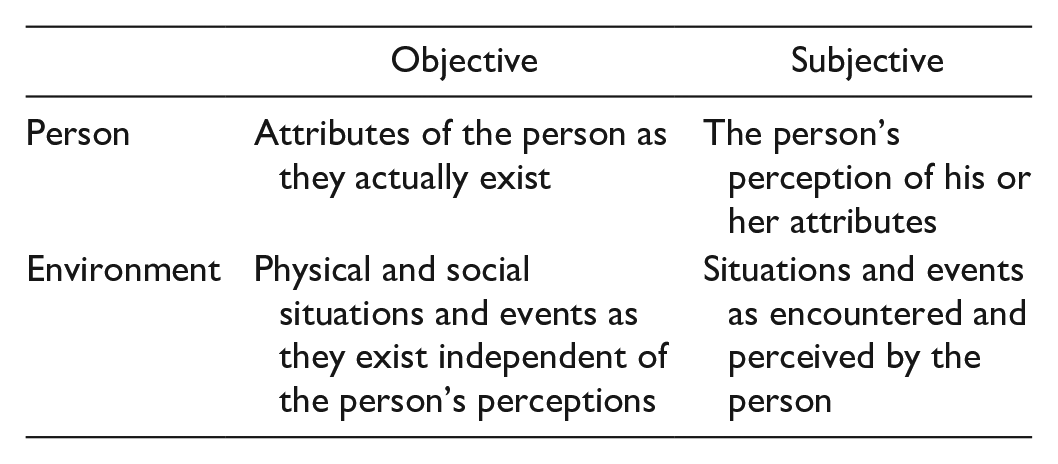
This results in different types of P-E fit:
Objective P-E fit, in which there is a fit between the “objective person” and the “objective environment.”
Subjective P-E fit, which is the fit between the perception of the person of himself and his perception of the environment.
Contact with reality, meaning to what degree the objective environment is perceived as such by the person (subjective environment).
Accuracy of self-assessment, which is the match between the “objective” attributes of the person and his perception of the same.
The definition of the subjective environment as the person’s perception of the environment and the inclusion of “social situations” in the objective environment leads to an interesting question. What if the person has a totally accurate perception of his abilities (the objective and subjective person are in perfect concordance), and the perception of the person is that he is “not seen” in his true potential by the environment (which would be the “subjective” environment)? In that case, the “objective environment”—independent of the person’s perception—is dead wrong, and therefore not objective.
In other words, we propose, there may be a differently defined matrix:
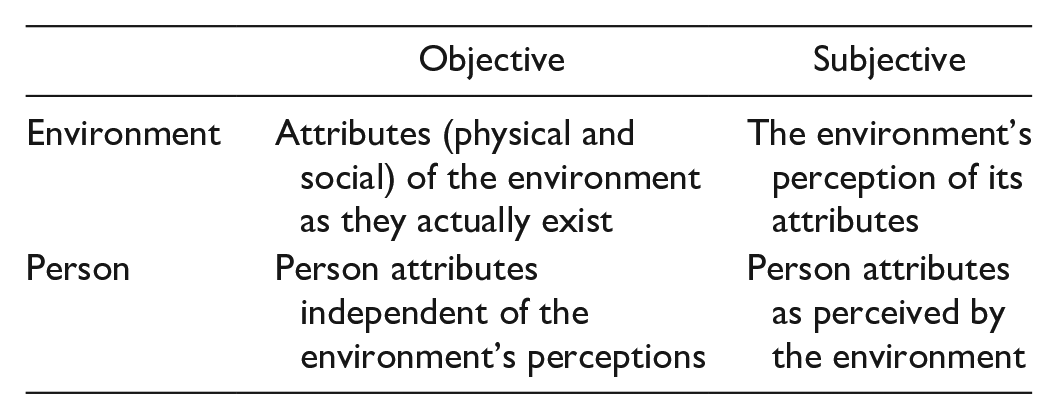
This matrix can be construed like this, because in the definition of environment, “social situations” are included. This is logical because the human animal is mainly a social animal, which can exist, develop, and perform because of the relatedness to other humans (see Fonagy & Allison, 2004, on mentalization and how the agentive self is formed). What becomes clear by describing this parallel matrix is that, in the original matrix, there is a bias toward the thought that the environment is always right. We will have to keep these somewhat awkward definitions in mind.
Edwards et al. (1998) mention a third dimension between types of fit. On one hand, the fit between the demands of the environment and the abilities of the person, and on the other hand, between needs of the person (demands of the person) and the supplies of the environment (abilities of the environment).
Demands include quantitative and qualitative job requirements, role expectations, and group and organizational norms.
Abilities include the aptitudes, skills, training, time, and energy the person may muster to meet the demands.
Needs are biological and psychological requirements, values learned, and motives of the person.
Supplies refer to extrinsic and intrinsic resources and rewards that may fulfill the person’s needs.
The model is summed up in Figure 1.
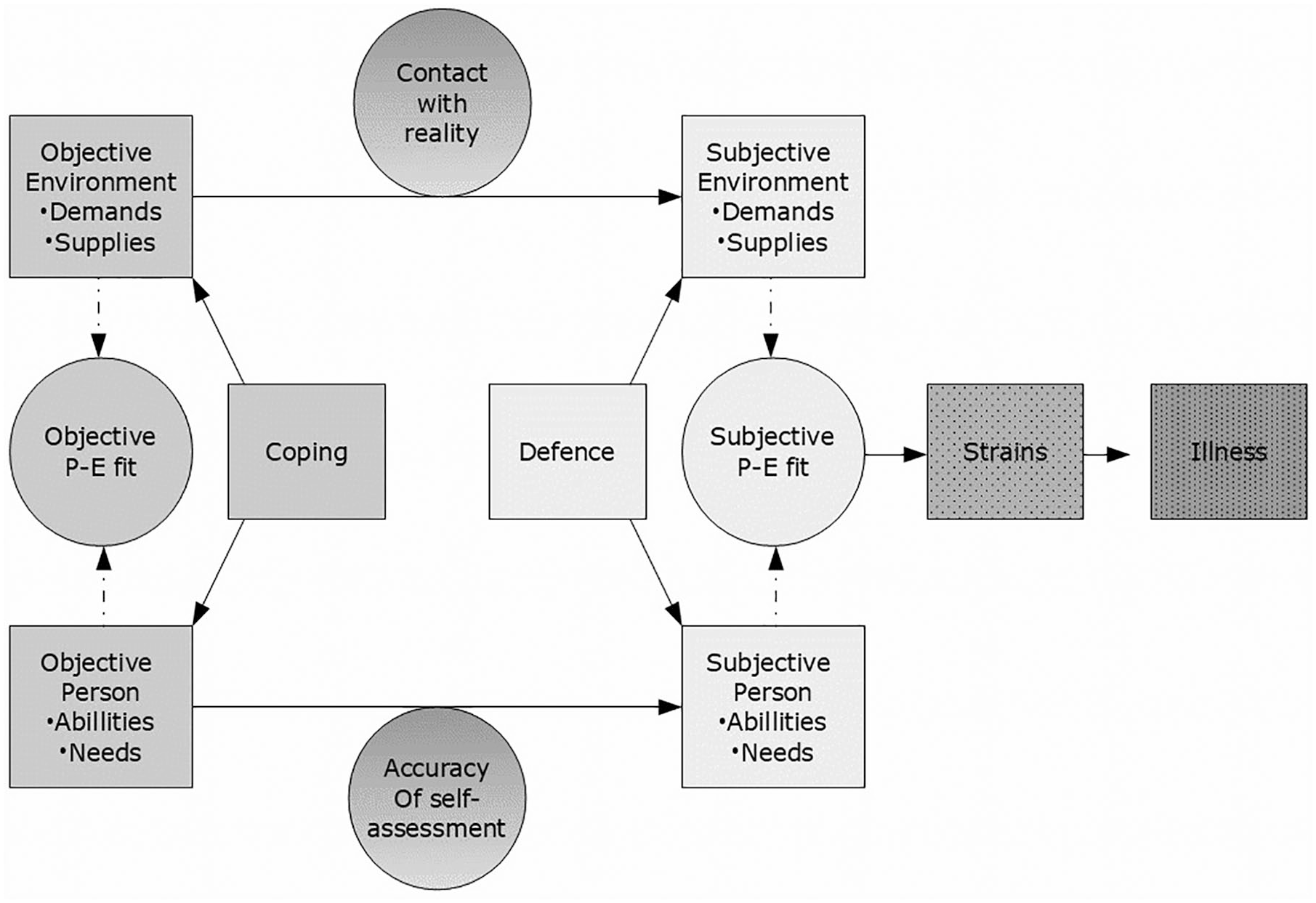
P-E fit model.
From the figure, it can be derived that Edwards and his colleagues propose two ways of handling to reconcile the differences between supplies and demands. On the left side, the “objective” one, they have put the term “coping,” on the right side, the term “defense” is used. Coping has a positive connotation—at least in normal language—and defense a negative one. This is explicitly not intended by Edwards et al. (1998), and they define coping as the efforts to improve objective P-E fit, and defense as attempts to enhance subjective fit through cognitive distortion, which in cases can be quite adaptive. 2
Trying to define CRU into these terms, applying logic, means the following:
The objective P-E fit is in any case flawed. The person has abilities and so on, which are not recognized by the environment as such, and if recognized, not acted upon. The objective environment may have a not entirely objective view of the person.
The subjective P-E fit is prone to be less useful as well; the additional point with CRU is that, more often than not, the subject has suppressed his needs, which means he has an inaccurate perception of them. A person can only respond to misfit between needs and supplies if he is aware that such a misfit exists, according to Cable and Edwards (2004). Clinical psychology, however, teaches that many of our actions are automatic and sub- or unconscious.
However, there is a misfit between the person and the environment when we are speaking of CRU; the types such as described here as subjective and objective P-E misfit, and something like subjective environment–person misfit.
It is safe to conclude that the misfit in CRU is mainly to be situated in the P-E psychological needs fulfillment tradition, and not as such within the P-E value congruence tradition. As explained by and Cable and Edwards (2004), the mainstream psychological need fulfillment theory restricts itself to the nonbiological needs, but rather those that are acquired by our development through life. These needs are compared with the environmental supplies, such as extrinsic and intrinsic resources and rewards. Also, the person needs to be aware of these supplies, Cable and Edwards (2004) argue, so it is about perceived environmental supplies. When the person perceives that what is supplied does not fulfill his needs, they tend to become dissatisfied. When supplies increase, satisfaction increases. The results of excess supplies depend on the type of needs and can have a different impact.
As mentioned above, the perception of the environment about the talents of the person is a main feature of the definition of RU. In this article, we focus on what happens because of the lack of use of the person’s talents by the environment (either actively or passively). It is important to realize that in this case, “the environment” is the collection of relationships within the work setting, including all expectations about those relationships. From the perspective of the worker, it is not the abstract organization that does not recognize him for his potential, but probably a specific person, perhaps one with explicit or implicit power, and all the intricacies of interpersonal wishes and needs. 3
The conclusion so far is that with CRU, there is indeed a form of P-E misfit, however, one that has not explicitly been taken into account by the classic PE-misfit model, based upon a somewhat one-sided view on objectivity. When considering the alternative matrix, it is usable.
Overqualified and Skill Underutilizations
According to Brynin (2002), there is more than enough evidence on the existence of workers having higher qualifications than their job’s demand. This may be the result of a social tendency to produce too much education, and it seems to be a structural part of the modern (neoliberal) economy. Many people are underemployed (Maynard et al., 2006), by which is meant holding “a job that is in some way inferior or of lower quality.” Overqualification, a form of underemployment, may be defined as the surplus of skills, education, and experience not required for or used by the current employment situation (Maynard et al., 2006). Overqualification fits into the person–job fit model, according to Maynard et al. (2006), because having more education, skills, abilities, experience, is also a lack of fit between demands and abilities. They found that overqualification is strongly associated with intentions to quit one’s job. Intentions do, as they conclude, not always translate into actual behavior. There are several aspects that could explain this, such as a serious drop in salary when changing jobs, or not feeling able to leave the family business (of which the employee might be conscious), or other factors of the fulfillment of the psychological contract. We want to propose that one of the mechanisms to explain not taking action might be CRU.
Elloy (2012), departing from the concept of worker empowerment, found that when the abilities of the workers were actually used within their work, they would feel more empowered. He states that, if an individual is to experience a sense of competence and feel confident about his/her skills, one has to be given the opportunity to use these skills and abilities. (Elloy, 2012, p. 628)
Oppositely, one would argue, that not having that opportunity will undermine the feeling of empowerment. There might be a relation with CRU, intuitively there is, and the constant state of not being able to use abilities within the work setting, leading to CRU, might be described as the internalized feeling of disempowerment. However, giving the power to the workers, and putting responsibility as low as possible in the organization, does not necessarily mean that CRU will be prevented.
The conclusion would be, that evidently, overqualification forces an employee in the state of RU, which may become chronic. However, these studies on overqualification still focus on very work-related abilities and talents, although one of the thoughts behind our concept of CRU is that also not directly work-related abilities that are not in some way seen and incorporated within work may lead to state RU and develop into a CRU.
Boredom, Workplace Boredom, and Boreout
We concluded from the wording of the two kinds of misfit that the direction thereof is in one direction: The demands are greater than the abilities, or the supply falls below the needs. However, it seems feasible to hypothesize that when the abilities exceed the demands that this leads to a need that is not supplied for, which leads to the theme of boreout (Fisherl, 1993; Loukidou et al., 2009; Rothlin & Werder, 2007; Skowronski, 2012; Wan et al., 2014; Watt & Hargis, 2010; Whiteoak, 2014).
According to Rothlin and Werder (2007), it is fairly common that people are talking about how stressful their job is, but when the discussion proceeds, it may become clear that [d]as Gegenteil ist der Fall. Sie sind unterfordert, desinteressiert und unendlich gelangweilt—keine Spur von Herausforderung oder Interesse an dem, was sie täglich tun.
So, they proceed, many people are not suffering from stress, but rather the lack of (healthy) stress, not from burnout, but boreout.
Ist ein Arbeitnehmer unterfordert, desinteressiert und unendlich gelangweilt und versucht zudem—paradoxerweise—diesen Zustand aktiv zu erhalten, dann leidet er eindeutig am Boreout. (Rothlin & Werder, 2007)
The precursor of boreout—evidently—is boredom. The key word in the above definition is the active maintaining of the situation, and not prone to searching for solutions to make an end to boredom.
Boredom
Boredom has been an issue of interest for a very long time, and in a sort of sublimated way even crept into literature in, for example, Alexandre Dumas’ series of books on the Musketeers, or Oscar Wilde’s A Picture of Dorian Gray in the form of ennui (existential boredom). Fenichel (1951) starting from the definition by Lipp of boredom as . . . a feeling of displeasure due to the conflict between a need for intensive psychological activity and a lack of stimulation or inability to be stimulated thereto (p. 349)
added that besides that need, there is also an inhibition of the intense psychological activity; one does not know how one should or could be active and often stimulation in the outside world is sought to ameliorate the situation. Also, the lack of stimulation felt does not necessarily correspondent with reality. He concludes that, boredom is characterised by the coexistence of a need for activity and activity-inhibition, as well as by a stimulus-hunger and dissatisfaction with the available stimuli. Thus the central problem of the psychology of boredom is the inhibition of both the drive to activity and the readiness to accept the craved-for stimuli. (Fenichel, 1951, p. 349)
He then argues that the drive–tension is present (i.e., the displeasurable state of boredom leads to the need to alleviate this tension), but the drive–aim is absent, because of suppression—one of the main defense mechanisms of the ego—and more probable than not further defended against reemerging by more elaborate defense mechanisms. What we may conclude from this short detour to the psychodynamic theory on boredom is that it is quite a complex state of being, and it reflects and expands upon the tension, which is described as a paradox by Rothlin and Werder (2007). Within the psychodynamic context, boredom is connected to defenses against drives and wishes and can be seen as a neurotic solution to conflict, which may interfere with mental health. Obviously, this can be an internal or external conflict—and both are related to relations and how these are mentalized. That the solution is a neurotic one implies that even though it may appear that the situation is actively maintained, it is mostly maintained by unconscious ego involvement.
In their work on boreout, Rothlin and Werder (2007) treat the reader with lots of—probably amusingly intended—anecdotes about the employees having the condition of boreout. These descriptions tend to depict these employees as actively playing the system, as if they lack a conscience, in other words, they act in a not-civilized way. What can be said about the theory on boredom presented above is the opposite of that. Neurotic conflicts presuppose the functioning of a conscience (the superego).
Elpidorou (2018) attempts to address the state of boredom, which must precede the trait of boredom (chronic boredom, in which case, boredom proneness), what is researched most, and he says that there is strong evidence that boredom is an emotion or at least an affective state in its own right and should be distinguished from other emotional states. 4 He argues that boredom has an important function in self-regulation, that it has the power to move us away from uninteresting, unfulfilling, or meaningless situations. He finds that boredom is not a negative only, but has a positive effect as well: Boredom promotes movement. This is, therefore, not the same concept boredom as we discussed above, but sooner an experience of tediousness or langeweilen. Elpidoro thinks that because boredom is an aversive state, one wishes to escape, and that wish drives into action. What he evidently does not take into account here, if we still follow Fenichel’s (1951) understanding, is that experience of boredom is a neurotic solution, and that it is set into place to defend against wishes by inhibition. It is an inhibition of drive aims, and breakdown of intrinsic motivation. Boredom is not the situation that you do not like what you are doing now, but that you cannot commit yourself to any other alternative as well.
Workplace Boredom
Workplace boredom is defined by several authors (van der Heijden et al., 2012) as . . . an unpleasant affective state resulting from the underuse [our italics] of a person’s physical or cognitive capacity at work (p. 350).
and this definition does not reflect the richness of the proposals above, nor is it complete, because in this definition, the pathway to the unpleasant affective state is not described, and leaves room for different unpleasant affective states, such as anxiety. Research on the factors that cause workplace boredom, again according to van der Heijden et al. (2012), focus on factors such as work underload or monotony, as well as boredom-proneness differences. Melamed et al. (1995) state that work underload, as opposed to repetitive work, is not clearly conceptualized. The existing definitions at that time all shared too many elements with the definition of repetitiousness. Jobs with work underload are those in which attention needs to be high, whereas stimulation is low; the examples given are, for instance, watchkeeping or guarding. The definition that they come up with is work presenting no apparent cycle and making no demands on pace, necessitating sustained attention throughout the work period, and requiring that the worker be ready to respond to certain predetermined events (Melamed et al., 1995, p. 30),
which indeed sounds very boring, but does not connect to our idea of CRU. Perhaps it is better to use the term workplace tediousness for this kind of research.
Summing Up and Conclusion
We started this article with a sketch of how an employee may be caught in a situation where his talents cannot be brought into play. Taking this as a starting point, we have been looking at the concept of CRU and theoretical fields connected to this. In this section, we attempt to wrap this together and come to some propositions.
Considering a function that someone holds, and the expectations connected with these, an employee can either perform according to these specifications or not. In the second instance, he is underperforming.
When a person is more or less on the level of the expectations of the environment and the job specifications or if he is doing better, he (or she, of course) is performing.
If the employee is doing obviously better than the expectations of the environment or the job specifications, he is probably overqualified for this job. However, the job does not fit well. As Maynard et al. (2006) suggested, this kind of underemployment may lead to a higher job turnover, but the situation does not always lead to (observable) behavior, in which case—also according to the PE-fit model—a defense mechanism (including what in the P-E fit model is called coping) has to intervene to ensure some psychic equilibrium.
In some cases where a person is overqualified, he or she has adjusted his behavior adapting in a way (using conscious and unconscious defense mechanisms) to the lower standards, resulting in a situation that we have named RU. RU that is not explicit tends to lead an underground life. The manager is not aware of it, because production parameters are met. The employee may or may not be aware of it.
If the person or his work environment do not spot CRU, there is the danger of this becoming a more or less permanent situation CRU. In this situation, the person’s self-image as agentive in the world is compromised, and drive aims and activity are inhibited—which is beyond boredom, a condition of inhibited drive aims—which leads to severe difficulties to escape this situation. The danger of this happening is higher in environments where creativeness is suppressed and autonomy discouraged.
One of the points of CRU is that we have to recognize that employees might have more talents or skills and abilities not requested by their job descriptions. Some of these, however, are just those who lead to that nagging feeling of not being able to fulfill one’s potential, and therefore not being able to meet the expectations of the ego ideal, leading to feelings of guilt and or shame (according to the psychodynamic model). In these cases, one might raise the point that something has gone wrong in the selection process, leading to an overqualified person getting the job. A selection process, which takes into account that a surplus of capacities and abilities (job and not job related) may be present and not only offering a job but a developmental career based on these assessments may be helpful to lessen the effects of trait CRU, though not always.
We propose that being in a state of unrecognized CRU for too long—based upon the mechanisms described above, through the pathway of developing trait CRU—will eventually lead to dropout, burnout, boreout, or in any case to a form of underperformance, in other words, not contributing to the (development of the) goals of the organization or attributing to the performance levels, and possibly ending his professional (sub)career prematurely, or being able to reinvent himself, which is according to Weggeman (2008) the last phase in a career (where the employee mainly talks about how everything used to be better). This proposal can be used to generate testable hypotheses, for instance, on the relation of CRU and dropout, burnout, production, days sick, times sick.
We propose that one of the main protective factors against adverse effects of RU—from the perspective of what one can do from an organizational point of view—is taking a mentalizing stance, and strive for seeing persons for what they are. Employees are human beings, and human beings are wired from birth for having relationships. It is the relations that mostly makes or breaks the job. Being markedly mirrored by those important to you—which includes managers and colleagues—will enable you to reflect upon yourself, instead of maintaining a fight–flight–freeze stance. This relates to managing styles more along the lines of gemba kaizen (Imai, 1997), the Rhineland model (Peters & Weggeman, 2018), or AGILE (Denning, 2018), and is in opposition to the neoliberal capitalist anglo–saxon model (as well as to the classic behavioristic model). An organization, in which new ideas are being encouraged and welcomed by both management and team members, may be seen as one having a culture where creativeness can strive (Amabile, 2006).
A person may enter an organization, already burdened by the trait of CRU. This is a challenge for those people doing the job interviews and HRM in general. In mental health care, it is considered best practice to take an extensive developmental history. It may be very helpful to know about the educational history of a person (skipped classes, dropping down or out, and rare extracurricular feats, any breaking off of the developmental line). These might be indications of CRU. Sometimes, people have hobbies on a level that far surpasses the level of work they may have to do.
We think that the concept of CRU, and the mechanisms that we tried to describe, are useful for the understanding of how the performance of employees can be perceived as satisfactory, but that it is wise to keep an open mind and not to take adequately performing employees for granted. There is even room for improvement, and the possibility of talent hitherto unused that can be put to use for the organization and the individual employees as well. Of course, these hypotheses will have to be put to the test. There is a need for research on how to establish that a person is relatively underperforming or whether he or she has hidden talents (how to measure those), as well as on how we can determine whether a person has developed trait CRU. Research is also needed on the managerial culture in an organization (e.g., supporting creativeness) and its effects on promoting or suppressing CRU.
One of the things we hope we have sufficiently accomplished in this article is the connecting of organizational and management theory with important theoretical concepts from clinical psychology, and especially with the current thoughts on development of the self and mentalization, as exemplified by Fonagy and his colleagues (Fonagy et al., 2004; Fonagy & Luyten, 2018; Gergely et al., 2007). The theory of mentalizing might be very helpful when dealing with difficulties in organizations and teams (Bleumer, 2015). We want to emphasize that understanding organizations starts with understanding the basics of the human condition in a psychological and relational way, embedded in his sociological surroundings. If we do not see each other for what we are, chances are that the sum will not be more than its parts.
Footnotes
Declaration of Conflicting Interests
The author(s) declared no potential conflicts of interest with respect to the research, authorship, and/or publication of this article.
Funding
The author(s) received no financial support for the research, authorship, and/or publication of this article.
