




Abstract
In this article, we propose and test a model of downward abusive communication. According to the model, a superior’s display of abusive communication toward his or her subordinates is caused by a lack of downward communicative adaptability. Superiors from various organizations completed an online survey, which measured their downward communicative adaptability and downward abusive communication. The results of a regression analysis provided support for the model. We conclude the article with a discussion of the practical and theoretical implications of our findings.
Keywords
Introduction
According to Tepper, Moss, and Duffy (2011), 13% of U.S. workers have experienced abusive supervision. Abusive supervision can take a variety of forms including public denigration, explosive outbursts, rude remarks, embarrassment of employees, the silent treatment, rude non-verbal behaviors, and invasion of personal privacy (Tepper, 2000). Research suggests that abusive supervision has a broad spectrum of potential negative effects, including alcohol dependence (Bamberger & Bacharach, 2006), psychological distress (Liu, Liao, & Loi, 2012; Rafferty, Restubog, & Jimmieson, 2010), diminished job and life satisfaction (Tepper, 2000), depression and emotional exhaustion (Yagil, 2006), employee aggression (Burton & Hoobler, 2011; Mitchell & Ambrose, 2012), increased job turnover (Tepper, 2000), and less meaningfully interpreted work (Rafferty & Restubog, 2011).
Abusive supervision not only has the potential to adversely affect employees but also has harmful effects on their familial relationships. For example, Carlson, Ferguson, Perrewé, and Whitten (2011) found an inverse association between employee exposure to abusive supervision and employee family functioning. Similarly, Hoobler and Brass (2006) discovered “that subordinates who perceived higher levels of abusive supervision had family members who perceived higher levels of undermining [from the subordinate] at home” (p. 1130).
The problems stemming from abusive supervision have generated increased emotional and financial costs for employees and their organizations, which justifies further inquiry into the causes of downward (i.e., flowing vertically from superior to subordinate) abusive communication. According to our model, a superior’s display of abusive communication toward his or her subordinates is caused by a lack of downward communicative adaptability.
Understanding the properties of downward communicative adaptability and downward abusive communication is key to linking them together in a causal sequence. Our review of the literature focuses on defining and characterizing each of these variables, as well as examining how they are thought to be causally linked to other personal and social variables. After establishing this conceptual foundation, we explain our rationale for linking downward communicative adaptability and downward abusive communication as cause and effect. We then report the results of a statistical test of our proposed model. Our article concludes with a discussion of the theoretical and practical implications of our findings.
Theory and Research
Abusive Supervision
According to Tepper (2000), abusive supervision refers to “subordinates’ perceptions of the extent to which their supervisors engage in the sustained display of hostile, verbal and non-verbal behaviors excluding physical contact” (p. 178). Abusive supervision shares conceptual overlap with Ashforth’s (1994) notion of petty tyranny. Ashforth (1994) described the petty tyrant as “an individual that lords his or her power over others” (p. 772). In addition, Ashforth (1994) indicated that petty tyrants may make arbitrary decisions, take credit for others’ accomplishments, blame others for their own mistakes, fail to consult with others, and emphasize their authority and status differences over their subordinates.
Researchers have investigated a range of individual difference variables as potential causes of abusive supervision, including personality characteristics (Ashforth, 1997; Neuman & Baron, 1998), demographic characteristics (Douglas & Martinko, 2001; Dupré & Barling, 2006; Ng & Feldman, 2008), and supervisors’ beliefs (Ashforth, 1997; Hoobler & Brass, 2006).
One line of research has investigated personality characteristics as potential causes of abusive supervision. For example, Neuman and Baron (1998) found that individuals who fall into the “Type A” personality pattern were more likely to lose their temper, display more aggression, and engage in more conflict at work than those with a “Type B” personality pattern. Moreover, the personality factor of neuroticism accompanied by a Type A personality pattern yielded more aggressive tendencies than neuroticism paired with a Type B personality pattern. In addition, Neuman and Baron (1998) discovered a direct relationship between negative affectivity and the likelihood of exhibiting aggressive behavior. In a related study, Ashforth (1997) found that a manager’s tolerance for ambiguity was negatively associated with his or her display of petty tyranny.
Researchers have also investigated demographic characteristics as possible determinants of abusive supervision. For example, Dupré and Barling (2006) found that males engaged in more workplace aggression than females. In contrast, Douglas and Martinko (2001) found no significant biological sex differences in workplace aggression. With regard to employee age, Ng and Feldman (2008) determined that older workers were less likely to engage in workplace aggression than their younger counterparts.
Investigators have also examined the impact of cognition on the display of abusive supervision. One set of supervisor beliefs is known as the “psychological contract” (Hoobler & Brass, 2006, p. 1126). A psychological contract consists of rights that an employee may feel he or she is entitled to even if such rights are not formalized in a handbook or policy. Hoobler and Brass found that when a supervisor felt as if his or her psychological contract was violated, his or her subordinates reported higher levels of abusive supervision emanating from that supervisor. In related work, Ashforth (1997) examined the relationship between Theory X orientation and petty tyranny. According to McGregor (1960), a Theory X manager assumes that it is necessary to control and direct subordinates, otherwise they will refuse to adequately perform their duties. Ashforth (1997) discovered that the average of two subordinates’ ratings of their mutual supervisor’s level of petty tyranny correlated positively with their supervisor’s Theory X beliefs.
Taken together, the studies reviewed above suggest that the personal characteristics of a supervisor influence his or her display of abusive supervision. Given that abusive supervision is inherently a communicative phenomenon, we narrowed our research on its causes to a relatively stable individual difference variable that pertains to an individual’s level of communication competence—communicative adaptability (Duran, 1983, 1992).
Communicative Adaptability
According to Spitzberg and Cupach (1989), social communication competence is “the ability of a person to interact effectively with other people” (p. 61). Duran (1992) claimed that “Communicative adaptability is . . . one component of social communication competence” (p. 255). Duran (1983) defined communicative adaptability “as the ability to perceive socio-interpersonal relationships and adapt one’s interaction goals and behaviors accordingly” (p. 320). In essence, communicative adaptability refers to the set of analytical skills and “repertoire of behaviors that enables one to adjust to various communication contexts” (Duran, 1992, p. 255).
Researchers have examined the effects of communicative adaptability on a range of interpersonal processes and outcomes including interpersonal attraction (Burleson & Samter, 1996), friendship formation (Duran & Zakahi, 1988; Gareis, Merkin, & Goldman, 2011), and conflict management (Schumacher, 1997).
In a 1996 study, Burleson and Samter investigated the effects of partners’ levels of communicative adaptability on their interpersonal attraction. They found that individuals were attracted to others with approximately the same level of communicative adaptability as themselves. In a related study, McCroskey and Richmond (2000) found support for their hypothesis that supervisor responsiveness (an aspect of communicative adaptability) was “positively correlated with subordinates’ perceptions of the supervisors’ credibility and attractiveness” (p. 281).
Beyond research on interpersonal attraction, investi-gators have studied how communicative adaptability influences friendship formation, a skill thought to be vital to the adjustment of international exchange students. According to Gareis et al. (2011), exchange students who come to the United States often complain of a lack of connection and friendship with host nationals. Gareis et al. found that an exchange student’s communicative adaptability was positively related to his or her number and quality of friends. Similarly, in research on college students’ interpersonal relationships, Duran and Zakahi (1988) found “a causal relationship between communicative competence and roommate satisfaction” (p. 142).
Particularly germane to the present study, Schumacher (1997) investigated the relationship between subordinates’ ability to effectively adapt their communication and their approaches to dealing with conflict in the workplace. Schumacher found a direct relationship between subordinates’ communicative adaptability and their use of non-confrontational strategies (i.e., avoiding or downplaying the issue). In contrast, Schumacher found an inverse relationship between subordinates’ communicative adaptability and their use of control strategies.
Linking Downward Communicative Adaptability to Downward Abusive Communication
Theoretical connections
A compelling theoretical rationale for linking downward communicative adaptability to downward abusive communication must address how diminished communicative adaptability contributes to subordinate perceptions of abusive communication. To bridge this gap, we explore the dimensionality of Duran’s (1983, 1992) notion of communicative adaptability, and examine how supervisor deficits in those cognitive and behavioral skills may yield downward abusive communication.
Duran (1992) asserted that communicative adaptability has six underlying dimensions that “enable an individual to adapt appropriately to various interaction contexts” (p. 255). The six dimensions of communicative adaptability are “social composure,” “wit,” “appropriate disclosure,” “articulation,” “social experience,” and “social confirmation” (Duran, 1992, pp. 255-256).
Duran (1983) described an individual with social composure as “a calm, relaxed communicator who experiences little communication anxiety in social situations” (p. 320). The social composure dimension of communicative adaptability “measures how cool, calm, and collected an individual is in a social situation” (Duran, 1992, p. 256). Wiemann’s (1977) research suggests that when a sender is anxious, his or her anxiety may evoke anxiety in the receiver. Similarly, research on empathic listening suggests that human service professionals can unwittingly experience affective states similar to those of their clients—a phenomenon known as emotional contagion (Miller, Stiff, & Ellis, 1988). In light of these findings, we reason that a supervisor with low social composure could elicit emotional distress in his or her subordinates, and in doing so, reinforce subordinate perceptions that their supervisor is abusive.
The second variable underlying communicative adaptability is wit. Duran (1992) claimed that wit “not only measures how humorous a person is, but also the use of humor to diffuse social tension” (p. 256). According to Duran (1983), “The primary function of humor within the communicative adaptability construct is to diffuse anxiety and tension. Humor as a response to incongruity, embarrassment, or aggression serves to reduce the arousal of individuals in social situations” (p. 321). In this way, we believe that a supervisor’s failure to use humor to mitigate or nullify verbally aggressive messages directed at his or her employees by organizational members (e.g., the supervisor him or herself, coworkers, other supervisors) could intensify employee perceptions of a hostile work environment.
Appropriate disclosure is the third dimension of communicative adaptability. According to Duran (1992), “Appropriate disclosure measures an individual’s sensitivity to the cues of the other which indicate how intimately one should disclose” (p. 256). Research suggests that the perceived appropriateness of self-disclosure is jointly influenced by the intimacy level of the content disclosed as well as the biological sex of the interactants. As an example, Caltabiano and Smithson (1983) found that “disclosure intimacy was negatively sanctioned in male-male interactions and future friendship was jeopardized. Both males and females, however, were attracted to intimate opposite-sex persons” (p. 127). Based upon their findings, we believe that supervisors with diminished sensitivity regarding how intimate their employee-directed self-disclosures should be are more likely to be perceived as abusive than are supervisors with increased sensitivity to intimacy content cues.
The next dimension is articulation. According to Duran (1983), “The articulation dimension consists of: correct pronunciation, fluent speech, proper grammatical construction of sentences, appropriate word choice, and clear organization of ideas” (p. 321). Put more simply, articulation “measure[s] an individual’s ability to clearly express his or her ideas” (Duran, 1992, p. 256). Importantly, Duran claimed that appropriate articulation facilitates accurate interpretation of messages. However, “A speaker who is dysfluent, unorganized, or uses inappropriate words serves to distract attention from the content of his/her messages” (Duran, 1983, p. 321). Consequently, we reason that as a supervisor’s articulation decreases, the level of fidelity between message sent and message received may decrease, and thus the likelihood of a supervisor’s message being misinterpreted as abusive may increase.
The fifth dimension underlying communicative adaptability is known as social experience. Duran (1992) conceptualized social experience as an individual’s cumulative “experience with communication in novel social contexts” (p. 255). He claimed that such experience contributes to “the development and refinement of a social communication repertoire . . . [which, in turn] . . . enables an individual to interact in various social contexts with different individuals” (Duran, 1992, p. 255). Accordingly, we believe that a supervisor with relatively little social experience is likely to have a more limited repertoire of socially appropriate responses to draw upon when interacting with his or her subordinates, and, as a consequence, may be more likely to exhibit abusive downward communication.
The last dimension of communicative adaptability is social confirmation, which Duran (1992) defined as “the acknowledgment of the other’s line or projected self-image” (p. 256). Duran claimed that “Social confirmation aids in the adaptation to the relational context by virtue of recognizing and confirming the projected social image of one’s [interactional] partner” (p. 256). Research by Cissna and Sieburg (1981) suggests that a supervisor’s failure to endorse the validity of an employee’s projected self-image may be experienced by the employee as disconfirming. In this way, we reason that supervisors who exhibit a low level of social confirmation are more likely to be perceived as abusive than are their high-social confirmation counterparts.
Breaking the concept of communicative adaptability into its constituent elements, and explaining how supervisor deficits in those elements may contribute to subordinate perceptions of abusive communication, provides a theoretical rationale for the model advanced herein. Additional justification for the model derives from the results of studies that have examined associations between communicative adaptability (or communication competence more generally) and variables related to superior–subordinate relational quality.
Empirical connections
One aspect of superior–subordinate relational quality is the level of satisfaction that organizational members derive from communicating with one another. Madlock (2008) investigated relationships among supervisor communication competence, supervisor leadership style, subordinate job satisfaction, and subordinate communication satisfaction. Madlock found that supervisor communication competence was positively related to both subordinate job satisfaction and communication satisfaction. Although Madlock found that supervisor leadership style was significantly correlated with supervisor communication competence, he discovered that communication competence, as opposed to leadership style, was the stronger predictor of subordinate communication satisfaction.
In addition to potentially affecting the communication satisfaction of subordinates, the communication competence of a supervisor may also influence the degree of antagonism that a supervisor displays toward subordinates in conflict situations. For example, McKinney, Kelly, and Duran (1997) found significant associations between participants’ scores on the Communicative Adaptability Scale (CAS; Duran, 1983, 1992) and their scores on the Conflict Management Message Style (CMMS) instrument (Ross & DeWine, 1988). The CMMS measures three conflict styles: a relatively antagonistic self-oriented style, a relatively agreeable other-oriented style, and an issue-oriented style (Ross & DeWine, 1988). McKinney et al. (1997) found that participant scores on five of the six CAS dimensions (the exception being wit) were all significantly negatively correlated with their scores on the more antagonistic, self-oriented conflict style, whereas the CAS dimension of social confirmation was significantly positively correlated with their scores on the more agreeable, other-oriented conflict style.
Taken together, the empirical work of Madlock (2008) and McKinney et al. (1997) suggests that there is a direct relationship between superior communicative adaptability and subordinate perceptions of superior–subordinate relational quality. Their research findings, coupled with the theoretical framework discussed earlier, provide the foundation for our model (Figure 1). To subject our model to an empirical test, we advance the following hypothesis:

A model in which a deficit in downward communicative adaptability causes downward abusive communication.
Method
Participants
The sample consisted of 173 superiors. Of the 173 superiors, 84 were female, 84 were male, and 5 did not report their biological sex. All participants were at least 18 years old and ranged from 18 to 74 years of age (M = 39.19 years, SD = 14.34 years). The racial composition of the superiors was as follows: White, non-Hispanic (83.8%); Alaska Native (4%); Multiracial (4%); Hispanic (2.3%); Black/African American (1.7%); Asian (1.2%); and Pacific Islander (0.6%). The superiors worked in departments that varied considerably in size (M = 49.19, SD = 136.70), and the number of employees under each superior also varied (M = 13.62, SD = 24.91).
Procedures
Organizations were contacted and asked to send a mass email message to all their superiors (managers and supervisors). The email message included a link to the online consent form and survey items. Survey responses were automatically entered into an SPSS data file, and were subsequently statistically analyzed. Participants had the option to enter their email addresses for inclusion in random drawings for five, US$50 Amazon.com gift certificates.
Measures
Downward communicative adaptability
Sager and Wallace’s (2012b) DCAS was used to measure downward (i.e., from superior to subordinate) communicative adaptability from a superior’s perspective. The items in Sager and Wallace’s (2012b) DCAS were adapted from the items in Duran’s (1983) CAS.
Duran’s (1983) CAS contains 30 items that measure the six aforementioned dimensions of communicative adaptability. A high score on the CAS indicates a high level of adaptability. Past research provides support for the internal consistency reliability and factorial validity of the CAS. For example, Duran (1992) found adequate mean alpha values for all six CAS dimensions across multiple samples, with average Cronbach’s alpha values ranging from .74 to .84. Evidence for the factorial validity of the CAS is provided in Duran’s (1983, 1992) studies.
Sager and Wallace’s (2012b) DCAS contains 30, 9-point, Likert-type items (1 = never and 9 = always). Two example items from the DCAS are “When I am talking with an employee, I think about how the employee feels” and “I am verbally and non-verbally supportive of individual employees” (Sager & Wallace, 2012b, p. 2). In the present study, the 30-item DCAS had a Cronbach’s alpha value of .72.
Downward abusive communication
Sager and Wallace’s (2012a) DACS was used to measure downward abusive communication from a superior’s perspective. In creating the DACS, Sager and Wallace (2012a) first reviewed the item content in Tepper’s (2000) Abusive Supervision Scale, and then generated a new scale (i.e., the DACS) that differs from Tepper’s (2000) scale in three main respects.
First, Tepper’s (2000) scale measures abusive supervision from an employee’s perspective, whereas the DACS measures downward abusive communication from a superior’s perspective. Second, the DACS items measure a superior’s reported use of specific communication behaviors, whereas Tepper’s scale includes a number of items that measure generalizations rather than specific communication behaviors. Third, the DACS items are phrased in a less negatively valenced manner than are the items in Tepper’s scale.
Tepper’s (2000) original Abusive Supervision Scale consists of 15, 5-point, Likert-type items. A high score on Tepper’s scale indicates a high level of abusive supervision. In a 2000 study, Tepper found the internal consistency reliability for his scale to be .90.
Sager and Wallace’s (2012a) DACS contains 15, 9-point, Likert-type items (1 = never and 9 = always) that operationalize the item content in Tepper’s (2000) scale in terms of specific communication behaviors. “I interrupt individual employees when they are speaking” and “I honor the agreements that I make with individual employees” are two examples of items from the DACS (Sager & Wallace, 2012a, p. 2). The second example item would be reverse scored. In the present study, the 15-item DACS had a Cronbach’s alpha value of .82.
Results
To control for the potential effects of demographic variables on downward abusive communication, we tested our model using hierarchical multiple regression analysis (see Table 1). Prior to conducting the analysis, the categorical variables of race and biological sex were converted into dummy variables. The racial category of White non-Hispanic/Caucasian was not coded to enable comparisons against this group.
Hierarchical Multiple Regression of Downward Abusive Communication Onto Race, Age, Sex, and Downward Communicative Adaptability.
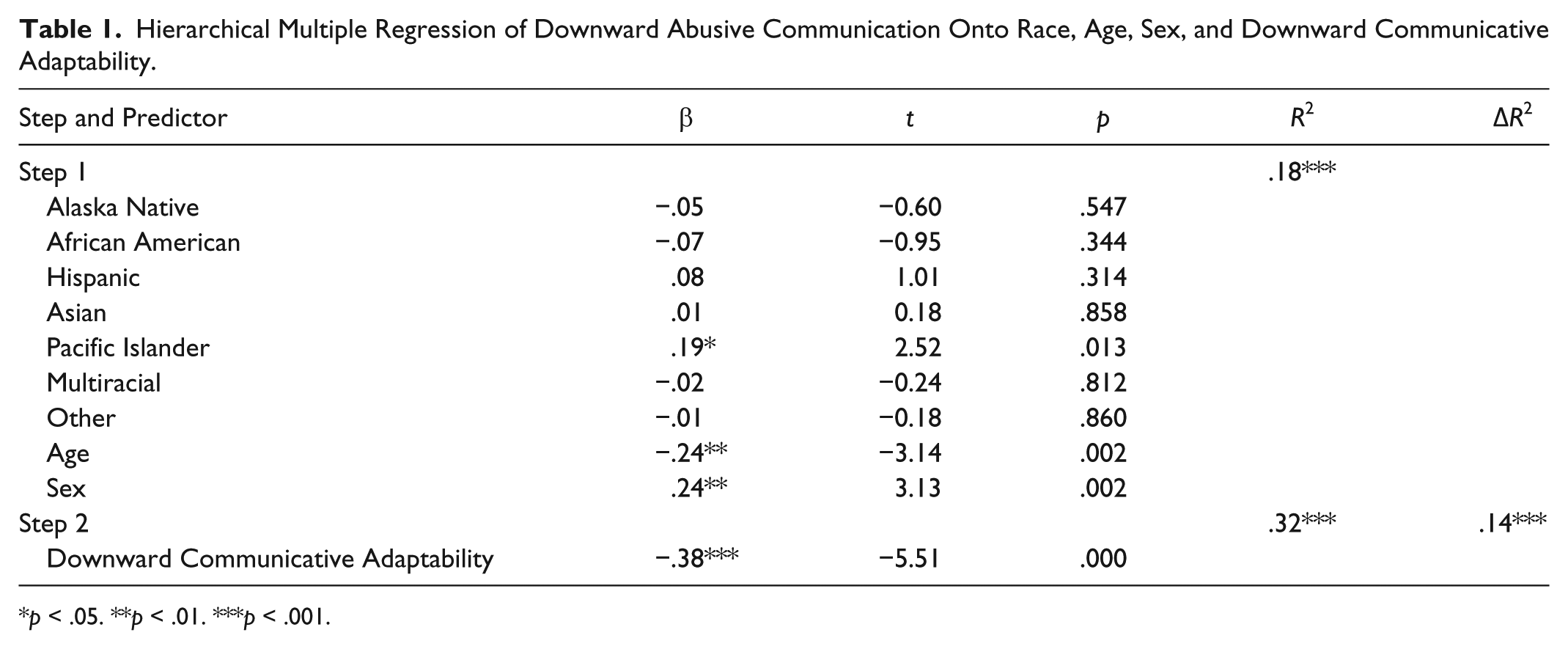
p < .05. **p < .01. ***p < .001.
Block 1 of the analysis consisted of the race, sex, and age of the superiors. As a set, these demographic variables explained a significant proportion of the variance in downward abusive communication, R2 = .18, adjusted R2 = .13, F(9, 150) = 3.69, p < .001. Superiors who classified themselves as Pacific Islander reported exhibiting more downward abusive communication than did superiors who classified themselves as White non-Hispanic/Caucasian (β = .19, p = .013). In addition, male superiors reported exhibiting more downward abusive communication than did female superiors (β = .24, p = .002). Finally, age was a significant negative predictor of downward abusive communication (β = −.24, p = .002).
Block 2 contained downward communicative adaptability, which accounted for an additional 13.9% of the variance in downward abusive communication, ΔR2 = .14, F(1, 149) = 30.39, p < .001. The combination of demographic variables and downward communicative adaptability explained a significant proportion of the variance in downward abusive communication, R2 = .32, adjusted R2 = .27, F(10, 149) = 7.01, p < .001. Support was found for our hypothesis. In particular, after controlling for the effects of demographic variables, downward communicative adaptability was a significant negative predictor of downward abusive communication (β = −.38, p < .001).
Discussion
Competent communicators are capable of adjusting and adapting to others in ways that satisfy intentions, and of displaying social skills and behaviors that express and promote constructive interactions (Keyton et al., 2013). These skills and behaviors involve “message production (e.g., generating verbal messages), message processing (e.g., interpreting communication from others), interaction coordination (e.g., synchronizing communication in interaction with others), and social perception (e.g., using communication to make sense of social reality)” (Keyton et al., 2013, p. 154). Given that abusive supervision is inherently a communicative phenomenon, we reasoned that a deficit in a key element of communication competence—communicative adaptability—would account for a significant proportion of the variation in downward abusive communication.
According to the model proposed in this article, there is an inverse relationship between a superior’s downward communicative adaptability and his or her downward abusive communication. To estimate the proportion of variation in downward abusive communication that was uniquely attributable to downward communicative adaptability, we tested our hypothesis via hierarchical multiple regression analysis. As hypothesized, after controlling for demographic variables, we found that downward communicative adaptability was a significant negative predictor of downward abusive communication.
The basic principle that can be distilled from our model is that a superior’s adaptation of a message tends to decrease the likelihood that a subordinate will experience a negative affective reaction to that message. Conceptualizing the absence of a negative affective reaction as a positive one, our model bears theoretical resemblance to models of the effects of person-centered messages (Burleson, 1987). According to Burleson and Caplan (1998), person-centeredness exists when messages signify “an awareness of and adaptation to the subjective, affective, and relational aspects of communicative contexts” (p. 289). Messages that are high in person-centeredness are listener-centered, emotionally focused, and non-judgmental—all characteristics central to the display of empathy (Rogers, 1957).
Accounting for the variation in their effects, comforting messages containing low levels of person-centeredness (low message adaptation) may challenge the valence and intensity of the other’s feelings; whereas comforting messages containing high levels of person-centeredness (high message adaptation) may acknowledge and confirm the other’s feelings (Burleson, 2007). Whether it be abusive communication or comforting communication, the affective reaction to a message appears to hinge partly on the degree of message adaptation.
The negative predictive relationship discovered in this article suggests that superiors who are better able to adapt their downward communication are less likely to exhibit downward abusive communication. Consequently, organizations could benefit by selecting highly communicatively adaptive individuals for supervisory positions. This begs the question, how do prospective employers know that an applicant for a supervisory position actually practices high communicative adaptability? Hullman (2007) argued that accurate measurement of communication competence entails both self-assessment and observer-based assessment. Therefore, prospective employers should utilize both modes of assessment in the applicant screening process.
A limitation of this study is that superiors may have been reluctant to report the full range and extent of their communicatively abusive behavior due to the social desirability bias. Future research could reduce the impact of such bias. For example, researchers could unobtrusively observe and subsequently code the communication that takes place between superiors and subordinates. Alternatively, they could attempt to quantify and statistically control for this sort of response pattern through the use of an additional survey designed to detect socially desirable self-presentation, such as the Marlowe–Crowne Social Desirability Scale (Crowne & Marlowe, 1960).
Conclusion
The present findings suggest that when superiors are unable to adapt their communication to their subordinates, they are lacking a social skill that is an important element of successful human interaction—a deficit that may reduce their ability to function successfully in a position of authority. The ability to adapt one’s communication can promote constructive patterns of interaction, which is one step toward preventing abusive communication in the workplace. Organizational leaders, for their part, need to recognize the practical significance of superior communicative adaptability if they wish to effect long-lasting changes in superior–subordinate interaction patterns.
Footnotes
Authors’ Note
The present article was derived from Elizabeth A. Wallace’s master’s thesis, which was written under the direction of Kevin L. Sager. Substantive conceptual, theoretical, and data analytic changes were made to the original master’s thesis, and additional literature review was integrated into the thesis, prior to submitting this work for publication in Sage Open.
Declaration of Conflicting Interests
The author(s) declared no potential conflicts of interest with respect to the research, authorship, and/or publication of this article.
Funding
The author(s) received no financial support for the research and/or authorship of this article.