




Abstract
The influence of Michigan leadership behaviors in organizational variables has been conducted in the Western context. However, limited studies have been conducted in the Vietnam context, particularly in the primary school sector. This study aims to examine the impact of Michigan leadership behaviors on organizational citizenship behaviors (OCBs) in Vietnamese primary schools. In addition, this research aims to challenge the mediating role of organizational justice (OJ) and person–organization fit (POF) in the relationship between Michigan leadership behaviors and OCBs. A total of 282 responses were collected from various primary schools in Vietnam. Exploratory factor analysis, confirmatory factor analysis, and linear regression analysis were used to answer the research question. Findings partially supported our hypotheses as two Michigan leadership dimensions significantly influence OCBs, and OJ mediates the relationship between relationship-oriented leadership behavior (ROL) and OCBs. This study opens the main gaps in the current leadership studies, including the influence of Michigan leadership behaviors on OCB, its role in promoting OJ, and the underlying mechanism through which Michigan leadership behaviors contribute to OCB with the mediation of OJ.
Keywords
Introduction
Human resources are currently regarded as the main factor contributing to organizational success (Aboramadan et al., 2020; Alqudah et al., 2022; Rubel et al., 2018). In the past decades, many researchers debated on the role of human resources in the manufacturing, service, and information technology sectors. Previous studies suggested that human resources are costs that should be eliminated in times of a crisis (Malik & Sanders, 2021; Sorribes et al., 2021; Zhu, 2005). However, recent studies observed a reverse trend as human resources have changed from a cost cutoff to a benefit for organizations (Foster & Akdere, 2007; Kim & Park, 2019; Wang et al., 2009). Human resources are targeted as primary resources, whereas other factors such as research and development, products, and services are secondary priorities.
Given that individuals have realized the importance of human resources in the modern world, their attitude toward their work environment can contribute to organizational success (Hamouche, 2021; Tran, 2023b). Social exchange theory provides fundamental knowledge on the causal relationship between employees and organizations in exchanging resources and benefits (Cropanzano & Mitchell, 2005; Jehanzeb & Mohanty, 2019; Meira & Hancer, 2021). In the contemporary world, organizations consider their workforce as the main factor contributing to their existence and thus respect and value their employees’ opinions and attitude (Aboramadan et al., 2020; Alqudah et al., 2022; Rubel et al., 2018). Furthermore, determining the factors that can significantly affect employee satisfaction, attitude, and behaviors is necessary. Such factors include leadership behaviors, organizational citizenship behaviors (OCBs), organizational justice (OJ), and the person–organization fit (POF).
Leaders play an essential role in shaping employees’ well-being, attitude, actions, and commitment to the organization (Anser et al., 2021; Chen and Yang, 2012; Tran, 2021a, 2023a). Numerous studies explored the implications of leadership on employees a organizations in various aspects (i.e., job satisfaction, commitment, performance, and organizational culture; Bass & Avolio, 1994; Choi et al., 2016). In the field of leadership style, the Michigan leadership studies are regarded as antecedents of recent studies (Judge et al., 2004; Northouse, 2018).
Organ (1988) considered OCBs as a tool for guaranteeing and maintaining social and cultural aspects that favor performance outcomes. OCBs include optional behaviors that are unofficially identified or compensated but contribute to the success of a system. OCBs relate to behaviors beyond the job description that are informally rewarded but lead to organizational success. Moreover, in the modern world, OCBs contribute to the effectiveness of organizations by fostering workplace efforts, facilitating social coordination with corporations, and influencing employees’ behaviors linked with organizational objectives and operations (Boiral & Paillé, 2012; Coldwell & Callaghan, 2014; Snape & Redman, 2010).
Although prior studies investigated the influence of various antecedents of OCBs, most studies emphasized indirect aspects such as job satisfaction (Ng et al., 2021), organizational commitment (Nurjanah et al., 2020), work–family conflict (Pan et al., 2022), and personal traits (Pletzer et al., 2021). However, little attention has been paid to the effect of leadership on OCBs. Whereas some scholars indicated that leadership features (e.g., servant leadership, transformational leadership, and transactional leadership) have a significant influence on OCBs (Kim & Park, 2019; Malingumu et al., 2016), only a few studies examined the role of leadership behaviors in employees’ citizenship behaviors (Abdullahi et al., 2020; T. Farid et al., 2020). Moreover, no prior studies have investigated this issue in the Vietnam context, especially in the primary school sector. Indeed, although Vietnamese primary schools have a long history that is in line with the country’s history, no studies have investigated these organizational variables. When this sector has an important role to educate further Vietnamese generations, conducting studies that investigate whether local teachers and workers have proficient workplaces is necessary. This concern comprises the main problem statement of this study. Thus, understanding these factors affecting primary schools is needed. This research aims to fill this gap by determining whether behavioral leadership dimensions (e.g., TOF and ROF) significantly affect OCBs in Vietnamese primary schools.
In terms of mediation in the relationship between leadership and OCBs, previous studies confirmed the role of organizations (e.g., organizational trust and organizational commitment) and individuals (e.g., personality; Kim & Park, 2019; Newman et al., 2017; Nguni et al., 2006). However, empirical studies have yet to prove the mediating role of OJ and POF in the relationship between leadership behaviors and OCBs, particularly in primary schools. Therefore, whether justice outcomes and the fit between individuals and organizations have a significant impact on the OCB level are questionable.
The majority of concepts describing these organizational variables have been developed in the Western context. Therefore, their adaptabilities in other context such as Vietnam are questionable. Prior studies highlighted the differences between Western and Vietnamese cultures (Tran, 2013). Collectivism and communism are the core characteristics in Vietnam. This finding implies that Vietnamese individuals are prepared to sacrifice their personal benefits for the collective good (Trung & Van, 2020). Vietnamese people regard local organizations as a second family, and members are expected to create harmonious, friendly, and positive relationships among themselves.
By contrast, individualism and capitalism are the core characteristics in the Western countries, which highlight the values of personal rights in society (Hofstede, 2001; Vauclair et al., 2017). In Western organizations, employees create a formal, cooperative, and positive relationship with colleagues (Xu et al., 2023). However, organizations are not the second family of employees and do not affect their private lives. These differences between Western and Vietnamese cultures contribute to the differences in the organizational variables between the Western and Vietnam contexts, particularly in the primary school sector. Therefore, the objective of this research is to investigate the relationship between the Michigan leadership behaviors, OCBs, OJ, and POF in Vietnamese primary schools. The main research question of the study is as follows: What is the relationship between Michigan leadership behaviors, OJ, POF, and OCBs in Vietnamese primary schools?
This research aims to contribute to the field in various ways. First, this study investigates how Michigan leadership behaviors, OJ and POF, affect OCBs. This research regards OJ and POF as mediators between Michigan leadership behaviors and OCBs to further explore the relationship between the behaviors of leaders and their followers. Second, this study presents a theoretical framework to link the four variables based on social exchange theory. This research broadens working adults’ perception of the relationship between Michigan leadership behaviors, OJ, POF, and OCBs. Third, while prior research investigates these organizational variables in the Western context, this research opens the scope of this field in the Vietnamese context, particularly in primary schools. Furthermore, the study results can help policymakers, researchers, leaders, and practitioners in primary schools understand how to boost the influence of leadership behaviors and facilitate justice and the fit between individuals and organizations to improve employees’ citizenship behaviors.
Theoretical Background and Hypotheses Development
Primary Schools in Vietnam
Vietnam, as member of the Association of Southeast Asian Nations, is one of the two communist nations in the region (the other is Laos). The country has a population of approximately 98.2 million people, two thirds of whom live in the countryside. Vietnam has three megacities, that is, Hanoi (the capital) in the north, Da Nang at the center, and Ho Chi Minh in the south. Vietnamese is the official language of the country, followed by English and Chinese. The Social Republic of Vietnam was officially established in 1945, which confirmed the dominance of the communist party in the Vietnamese government.
During the 20th century, Vietnam was a poor agricultural country, as a victim and survivor of wars with China, France, and the United States (McHale, 2002). Nevertheless, the government’s public opening of the economy in 1986 reformed the country’s economy from state-centralized systems to private-centralized systems (Tran, 2023c). Consequently, the country experienced remarkable economic development, becoming a promising market in the region. Therefore, Vietnam is a potential setting for educational growth. Vietnam’s per capita gross domestic product has increased from $500 in 1990 to approximately $2,000 in 2018, resulting in a significant decline in poverty rates (Tran, 2023d). The economic growth has also benefited the educational sector, resulting in an increase in primary schools and pupils.
The Ministry of Education governs the primary schools sector in Vietnam. Several initiatives have been implemented to enhance the quality of teaching and facilities, but investigating the behavior of staff in primary schools has received insufficient attention. In detail, organizational variables affecting work productivity in primary schools (e.g., leadership behaviors, OJ, POF, and OCBs) are questionable because no prior studies have investigated these factors in this sector. Consequently, this study aims to examine the impact of leadership behaviors on the citizenship behaviors of teachers and workers in Vietnamese primary schools.
Michigan Leadership Behaviors
Previous research confirmed the consistency of the Michigan leadership studies in implying stress in Germany (Nguyen et al., 2012), job satisfaction in the USA (Alsarrani et al., 2021; Barry, 2022), and organizational commitment in Egypt (M. I. Farid, 1997). Such studies extended the scope of behavioral leadership to two leadership behaviors, namely, task-oriented leadership behavior (TOL) and relationship-oriented leadership behavior (ROL). The former comprises job fulfillment, goal-focused achievement, and clear job duties. When superiors adopt TOL, they logically systematize the organization (Sakkar Sudha & Shahnawaz, 2020). Therefore, subordinates clearly understand their tasks as their job description becomes highly coherent and appropriate. Leaders can select the appropriate employees to fulfill certain job tasks, inducing a feeling of responsibility in each employee to fulfill his/her duties (McShane & Von Glinow, 2002; Tran, 2021b, 2023e).
By contrast, ROL emphasizes subordinates’ satisfaction, group cohesion, and sympathy (Demircioglu & Chowdhury, 2021; Tran, 2021b, 2023e). ROL enables employees’ self-expansion through support and joint coordination (Dansereau et al., 2013). When superiors adopt ROL, they emphasize the cooperation, individual perspectives, and opinions, thereby increasing subordinates’ satisfaction and commitment to the organization. Previous studies examined ROL to foster the information process between leaders and employees (Breevaart & de Vries, 2021; Oaklander & Fleishman, 1964). Therefore, leaders can easily transmit job tasks to employees. In turn, employees can immediately provide feedback on their perceptions and ideas to their leaders. Overall, ROL can facilitate employee satisfaction and job task optimization.
However, the Michigan leadership studies received many negative comments due to their methodology and Cronbach’s alpha values (Schriesheim & Kerr, 1974). Recently, researchers showed an interest in exploring the validity of the classical Michigan leadership studies. Several studies confirmed the rationality of the literature and examined the relationship between the two types of leadership behaviors and organizational outcomes (i.e., stress, performance outcomes, employee self-regulatory focus, and job satisfaction) (Choi et al., 2016; Tran, 2021b, 2023e). These findings suggested that Michigan leadership theory deserves further investigation.
Organizational Citizenship Behaviors
OCBs are behaviors that can enhance communal and psychological settings that facilitate organizational outcomes (de Geus et al., 2020; Organ, 1994). Blau (1964) examined social exchange theory to explain the rationale behind OCBs. This conceptual framework asserts that an individual has a casual association with his/her organization, which leads to positive attitudes and behaviors as OCBs. This concept is worth investigating, because it often goes beyond official conduct.
The literature challenged the identified factors predicting OCBs in an organization (de Geus et al., 2020; Kim & Park, 2019). Organizational variables were confirmed to have a positive influence on OCBs, including job satisfaction (Ng et al., 2021), organizational commitment (Nurjanah et al., 2020), work–family conflict (Pan et al., 2022), and personal traits (Pletzer et al., 2021). By contrast, few studies investigated the negative associations between organizational variables and OCBs and concluded that high OCB levels tend to induce stress and work–family conflict among employees (Alalsheikh et al., 2022; Pan et al., 2022).
Coleman and Borman (2000) divided OCBs into three levels, including the OCBs of individuals (OCBI; e.g., courtesy and altruism), OCBs of organizations (OCBO; e.g., conscientiousness and loyalty), and task-related OCBs (OCBT; e.g., job persistence and effort). OCBI concerns how to avoid task issues by repeating, notifying, and helping colleagues solve problems. OCBO requires employees to adhere to rules and meet standard requirements and expects employees to obey leaders and organizations without criticism. Meanwhile, OCBT refers to employees’ effort and persistence to fulfill their work duties. The relationship between the three levels of OCBs and organizational variables are complex when OCBI strongly interacts with organizational motives, whereas OCBO experiences are linked with organizational concerns (Rioux & Penner, 2001). Together, this study challenges the three types of OCBs.
Organizational Justice
OJ involves employee morality recognition in the organization (Cropanzano et al., 2005; Graso et al., 2020; Hoang et al., 2022). Previous studies identified two dimensions of OJ, namely, procedural, and distributive justice (Erdogan & Liden, 2006). Specifically, procedural justice links with the perceived morality of “the means” directed to generate a result (Alamir et al., 2019; Ruano-Chamorro et al., 2022). Procedural justice exists when superiors rationally establish proper regulations in the organization and transmit rules and reasons, whereas distributive justice concerns the bonuses and compensation that employees can receive (Ambrose et al., 2005).
Person–Organization Fit
Previous studies revealed that POF can occur when one of the two factors, namely, a person or an organization, satisfies the other’s needs or when a person and an organization share the same characteristics (Hoffman & Woehr, 2006; Sudibjo & Prameswari, 2021). POF exists when an organization or a person satisfies the other’s needs. Specifically, the organization provides the benefits that satisfy employees, and the employees must reach the organization’s requirements.
POF highlights the fit between employees and their organization which relates to compliance between the employees’ perceptions, behaviors, personality, and values and the organization’s vision, objectives, values, and environment (Al Halbusi et al., 2021; Sudibjo & Prameswari, 2021). Furthermore, a person’s fit with his/her organization can stem from various aspects, such as value fit, personality fit, and supply and demand fit (Kerse, 2021; Chung, et al., 2019). This study selects value fit as the core value between a person and an organization, given the breadth of attention it gained in several studies (Al Halbusi et al., 2021; Van Loon et al., 2017).
Michigan Leadership Behaviors and OCBs
The relationship between Michigan leadership behaviors and OCBs has yet to be investigated. Few studies explored the effects of leadership aspects (e.g., spiritual leadership, servant leadership, transformational leadership, and the path–objective concept) on OCBs (Abdullahi et al., 2020; Chen & Yang, 2012; T. Farid et al., 2020; Podsakoff et al., 2000). Chen and Yang (2012) indicated that spiritual leadership strongly affects OCBI by facilitating altruistic values, OCBO by strictly requiring adherence to rules, and OCBT by strengthening employees’ efforts in performing tasks. Some scholars argued that transformational leadership can significantly predict OCBs based on the causal social relationship between superiors and subordinates (Abdullahi et al., 2020; T. Farid et al., 2020).
Servant leadership positively affects OCBs, as servant leaders generally listen to employees’ opinions, create opportunities for employees to contribute to the working process, and encourage employees to follow the rules (Elche et al., 2020; Thao et al., 2020). As servant leaders typically care about employees’ needs and facilitate their career advancement, servant leadership establishes moral circumstances in which the employees are prepared to sacrifice themselves to serve their leaders. Thus, this leadership style increases employees’ citizenship behaviors, such as loyalty, work efforts, and rule adherence.
Although several studies emphasized the significant role of leadership in predicting OCBs, the effect of Michigan leadership behaviors on OCBs has received little attention, particularly in primary schools. Specifically, the correlation between TOL, ROL, and OCBs is questionable. Thus, this study aims to fill this gap by determining whether Michigan leadership behaviors significantly influence OCBs and subsequently proposing the following hypotheses:
H1. Michigan leadership behaviors influence organizational citizenship behaviors positively and significantly.
H1a. Task-oriented leadership behavior influences organizational citizenship behaviors positively and significantly.
H1b. Relationship-oriented leadership behavior influences organizational citizenship behaviors positively and significantly.
Mediating Effect of Organizational Justice
Various studies have explored the relationship between leadership and OJ. Transformational leadership significantly predicts procedural justice, whereas transactional leadership positively enhances distributive justice (Lim & Moon, 2022). Alamir et al. (2019) determined that the leadership behaviors have a considerable positive impact on procedural and distributive justice. Meanwhile, Farh et al. (1997) concluded the existence of a significant correlation between the two variables in China. Thus, although several studies have highlighted the significant role of leadership in predicting OJ, the association between leadership behaviors and OJ has received little attention. Specifically, the correlation between TOL, ROL, and OJ is questionable in primary schools. Hence, this study aims to fill this gap by determining whether Michigan leadership behaviors significantly influence OJ.
The association between OJ and OCBs was investigated in various studies (Jafari & Bidarian, 2012; Jnaneswar & Ranjit, 2021; Rahman & Karim, 2022). Jnaneswar and Ranjit (2021) suggested that OJ can predict OCBs and mediate the relationship between organizational commitment and OCBs. Rahman and Karim (2022) challenged the two organizational variables in the tourism context and suggested that procedural justice strongly and positively affects OCBs. The authors also examined the two variables in the hospital setting and obtained similar results. Employees’ positive views on fair bonuses and compensation can facilitate OCBs. Özbek et al. (2016) challenged the association between OJ and OCBs in the public and private sectors, which confirmed a positive correlation between the two variables. Thus, the present study assumes that OJ positively facilitates OCBs.
With the development of behavioral leadership perceptions, OJ is expected to facilitate OCBs for employees and primary schools. Specifically, OJ is hypothesized to play a mediating role in the influence of Michigan leadership behaviors on OCBs. Considering that no previous studies have explored such outcomes, the present study investigates whether OJ mediates the relationship between Michigan leadership behaviors and OCBs in primary schools. Therefore, the below hypotheses are as follows:
H2. Organizational justice plays a mediating role between Michigan leadership behaviors and organizational citizenship behaviors.
H2a. Organizational justice plays a mediating role between task-oriented leadership behavior and organizational citizenship behaviors.
H2b. Organizational justice plays a mediating role between relationship-oriented leadership behavior and organizational citizenship behaviors.
Mediating Effect of Person–Organization Fit
Several studies suggested that various types of leadership can significantly predict POF (Al Halbusi et al., 2021; Sudibjo & Prameswari, 2021). According to Al Halbusi et al. (2021), transformational leadership positively strengthens the collaboration between employees and organizations. Sudibjo and Prameswari (2021) indicated that ethical leaders form fair working environments, which set equal values for the employees and organization. In turn, moral value can promote the fit between employees and their organization. Therefore, leadership is concluded to have a possible significant influence on POF.
When a fit exists between a worker and the organization, his/her belief in the organization may facilitate positive citizenship behaviors. Employees will believe that their organization implements standard rules and thus will follow these criteria. Previous studies supported this argument, and Jehanzeb (2020) proposed that the POF enhances OCBs. Jehanzeb (2020) suggested that a fit between a person and an organization can increase employees’ motivation, satisfaction, and OCBs. Meanwhile, Zhao et al. (2021) asserted that POF positively affects OCBI and OCBO. When individuals can fulfill their job tasks and have authority to conduct their work, they will positively perform their duties. Thus, a person who fits an organization displays proper citizenship behaviors.
Hence, this study investigates whether POF plays a mediating role in the relationship between Michigan leadership behaviors and OCBs in primary schools. In line with the above theoretical and practical results, this study proposes the following hypotheses:
H3. Person-organization fit plays a mediating role between Michigan leadership behaviors and organizational citizenship behaviors.
H3a. Person-organization fit plays a mediating role between task-oriented leadership behavior and organizational citizenship behaviors.
H3b. Person-organization fit plays a mediating role between relationship-oriented leadership behavior and organizational citizenship behaviors.
Theoretical Framework: Social Exchange Theory
This study uses the social exchange concept as the conceptual framework to examine the association between the four constructs. The concept is the first one that explores the casual leader–follower relationship in the workplace (Blau, 1964; Cook et al., 2021; Fan et al., 2021). Leaders with proper behaviors can improve employees’ performance, which will lead to employees’ positive perception of the organization and ensure that the employees will be loyal with the organization.
The purpose of this study is to determine how Michigan leadership behaviors affect OCBs in primary schools, and whether POF and OJ facilitate the relationship between these two variables. The study formulates all the hypotheses on the basis of social exchange theory. In detail, this theory examines the reciprocal relationship between leaders and workers within an organization (Blau, 1964; Cook et al., 2021). When leaders select suitable behaviors, they might support employees to perform tasks efficiently, encouraging them to take part in a social exchange. Specifically, a positive perception of employees toward their leaders can improve their efforts and loyalty to the organization, which is exchanged with proper citizenship behaviors to their leaders and organizations. When a leader behaviors are supported by POF and OJ, they can also guide employees toward suitable behaviors and attitudes. Prior studies confirm that a fit between leaders and organizations will lead to a propensity for desirable citizenship behaviors (Abdullahi et al., 2020; Chen & Yang, 2012; T. Farid et al., 2020; Podsakoff et al., 2000). Moreover, creating a fair, respectful, and morally working environment can increase their commitment to the organization. Thus, they will engage in citizenship behaviors to benefit their workplace (Ensher et al., 2001). From the perspective of the social exchange concept, leaders with proper behaviors will lead to employees’ loyalty, commitment, and performance. Figure 1 presents the research framework developed in this study.

Research model.
Methodology
Participants and Procedure
The self-administration technique is used to collect responses from participants in Vietnamese primary school for two reasons. First, using validated questionnaire from previous studies reduces any potential bias and mistakes. Second, this approach protects the confidentiality of respondents, allowing them to express honest responses. The original questionnaire is in English. Accordingly, a local expert was requested to translate the questionnaire into Vietnamese. In the next step, two academic experts who are proficient in both languages assessed the accuracy of the questionnaire. In the last step, the author translated the Vietnamese questionnaire back into English. As a result, no differences were found between the two versions.
A formal statistic on the number of primary schools in Vietnam is lacking. Nonetheless, when the majority of Vietnamese adults have been working in the three major cities, namely, Hanoi (the capital city, located in the north), Vinh (in the middle), and Ho Chi Minh (in the south), it can lead to a demand for quality primary schools. Therefore, the author collects data in these areas to confirm the generalization of findings. The human resource departments (HRMs) were contacted via face-to-face meetings and via email to attain the study objectives. A research protocol is sent to the HRMs to explain the structure of the research. When the primary schools accepted the protocol and plan, a printed survey, informed consent form, and guide for completing the survey were provided to the HRMs, who then sent them to potential teachers and employees. Only full-time staff who had at least 1 year of working experience were selected to fulfil the surveys. Participation in the survey was voluntary. All the answers and respondents’ information were kept confidentially. The survey was conducted from January to March in 2023.
A total of 600 surveys were sent to eight primary schools, including three schools in Hanoi, three schools in Vinh, and two schools in Ho Chi Minh. Two types of respondents were selected in this study, including teachers and workers. While the former comprised individuals who have been directly teaching pupils, the latter has been involved in other tasks, such as human resource, marketing, accounting, and so on. A total of 387 surveys were collected after 3 months, and 105 invalid surveys were removed due to a lack of responses and repetitive errors. Finally, 282 surveys were collected for the analysis, representing 72.8% of the total surveys. Regarding the demographic information, 68.6% were female; the majority of the sample ranged from 20 to 30 (52.1%) and qualified for bachelor’s degrees (62.6%). Subordinates accounted for 79.4%, while 20.6% were supervisors. The respondents in Hanoi, Vinh, and Ho Chi Minh cities were 37.8%, 31.6%, and 30.6%, respectively (see Table 1 for the demographic characteristics).
Demographic Characteristics of the Sample.

Measures
Using a five-point Likert scale, all items were challenged using a closed questionnaire from strongly disagree (1) to strongly agree (5). Participants are allowed to fill only one answer in each item. Moreover, a black space is added at the end of the questionnaire for respondents to add feedback if necessary. This research used Northouse’s questionnaire (2018) to measure Michigan leadership behaviors. This survey comprises twenty items. Specifically, the odd-number items link to a task-oriented leadership (TOL) score, whereas the even-number items refer to a relationship-oriented leadership (ROL) score. A sample item is “Tells group members what they are supposed to do.” POF was measured with fifteen items adapted from Judge (1994). A sample item is, “This organization pays based on individual performance.” OJ was measured with seven items (Parker et al., 1997). A sample item is, “People with the most knowledge are involved in resolving problems.” Finally, OCBs were measured with twenty-one items created by Williams and Anderson (1991). The first seven items are labeled as OCBs of individuals (OCBI). The middle seven items are labeled as OCBs of organizations (OCBO), and the last seven items represents to task-related OCBs (OCBT). A sample item is “Help others who have been absent.”
Data Analysis
We used SPSS version 22 to calculate the statistics. In detail, linear regression analysis was selected to challenge the hypotheses. Before examining the hypotheses, confirmatory factor analysis (CFA) was chosen to investigate the construct’s convergent validity, consistency reliability, and discriminant validity. Specifically, the research challenged the congruence indices using the cutoff criteria such as comparative fit index (CFI) > 0.9, Tucker-Lewis index (TLI) > 0.9, standardized root mean square residual (SRMR) < 0.08, and root mean square error of approximation (RMSEA) < 0.07.
Results
The findings of CFA highlighted an acceptable result for the data (SRMR = 0.071; TLI = 0.960; CFI = 0.981; RMSEA = 0.068). The consistency reliability was tested through Cronbach’s α and composite reliability (CR). Table 2 indicated that all Cronbach’s α results are above .70, suggesting that they are valid for analysis. Similarly, all the findings of the CR ranged from 0.607 to 0.891, which were higher than the 0.6 threshold value, and thus confirmed good internal consistency reliability (Fornell & Larcker, 1981). Almost all the factor loadings of all variables were above .60 and significant, except for item 1 and item 8 in the OJ questionnaire, which was below .60. As a result, two items were removed from the data analysis.
Reliability and Validity Tests.

Thus, all valid items distributed evidence of the convergent validity for further analysis. Also, the average variance extracted (AVE) of four constructs was between 0.512 and 0.667, which exceeded the standard value of 0.5 thresholds for a proper level of convergent validity. Table 2 highlights the four constructs’ factor loadings, Cronbach’s α, CR, and AVE. In addition, Harman’s test was selected to challenge the validity of standard method variance. As a result, the constructs evaluated by the first factor were 46.575%, below 50%, highlighting that the existing research did not have a significant standard method variance issue.
Table 3 indicated four significant variables’ mean, standard deviations, and relationships. The mean scores for all the variables were between 3.585 and 4.192, with the standard deviations between 0.055 and 0.785. The correlations highlighted that leadership behaviors significantly relate to OCBs and OJ but insignificantly link to POF. As a result, all relationships were in the proper direction, which approved the preliminary results for further analysis.
Means, Standard Deviations, and Correlations Among Study Variables.
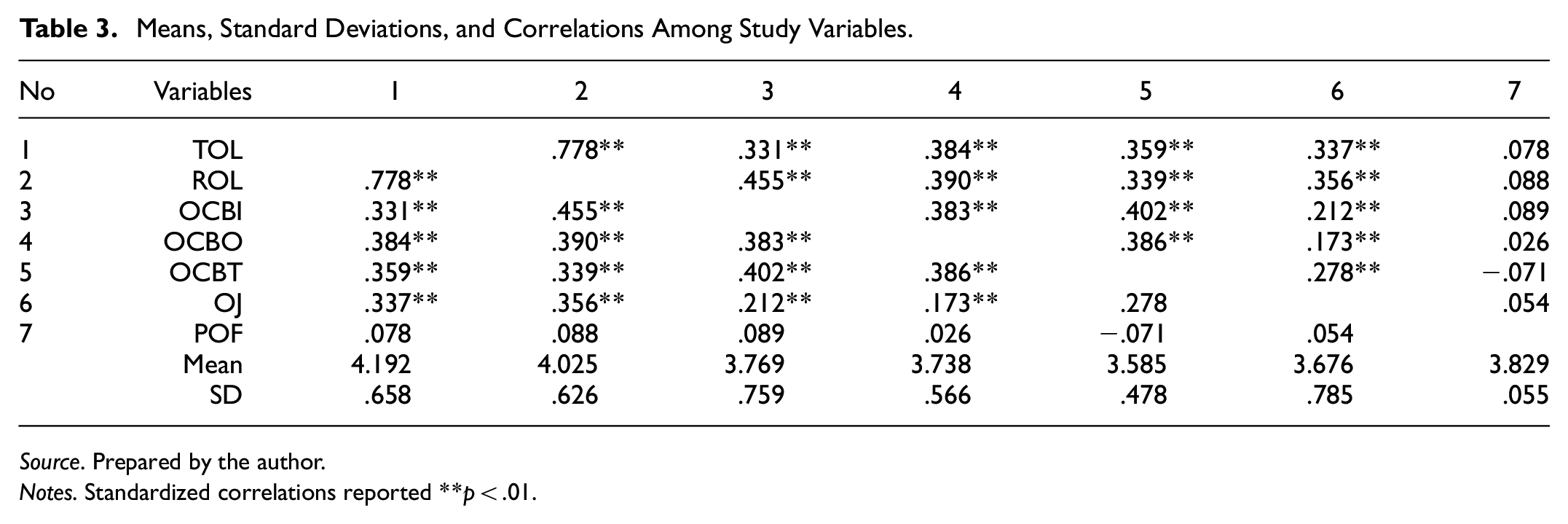
Source. Prepared by the author.
Notes. Standardized correlations reported **p < .01.
Linear regression was used to investigate the hypotheses in Table 4. For H1, all the dependent variables were entered to challenge their main influence on OCBs. Findings in Table 4 suggest that TOL significantly positively influences OCBO (Model 3, β = .205, p < .05), OCBT (Model 5, β = .241, p < .05), but it insignificantly influences OCBI (Model 1, β = −.059, p > .05). Thus, H1a was partially supported. ROL significantly positively influenced OCBI (Model 1, β = .501, p < .05), OCBO (Model 3, β = .231, p < .05), OCBT (Model 5, β = .152, p < .05). Thus, H1b was supported. This result is in line to previous studies (Anser et al., 2021; Chen & Yang, 2012; Khan et al., 2020; Thao et al., 2020), which confirms the role of leadership in OCBs. Altogether, H1 was partially supported.
Results of Linear Regression Analysis.

Source. Prepared by the author.
Note. Standardized correlations reported.
p < .05. **p < .01
According to Baron and Kenny (1986), four criteria are utilized to challenge the validity of mediation, (1) the independent variable significantly affects the dependent variable, (2) the independent variable significantly affects mediating variable, (3) mediating variable significantly affects the dependent variable, and (4) independent variable insignificantly affects dependent variable via mediating variable. To evaluate the mediating role of OJ, the results indicated that TOL insignificantly influences OJ (Model 7, β = .150, p > .05), which fails to meet the second criteria. Thus, OJ insignificant mediated the relationship between TOL and OCBs, and H2a was rejected.
In other cases, H1 highlighted the significant implication of ROL on OCBs, which approved the first criteria. Next, ROF significantly affected OJ (Model 7, β = .239, p < .05) and OJ significantly OCBI (Model 2, β = .057, p < .05), OCBO (Model 4, β = .039, p < .05), OCBT (Model 6, β = .165, p < .05), which approved the second and third criteria. After the study added OJ, the effect of ROL on OCBI (Model 2, β = .438, p > .05), OCBO (Model 4, β = .376, p > .05), and OCBT (Model 6, β = .106, p > .05) became weaker and non-significant, which suggested the full mediation of OJ in the relationship between ROL and OCBs. To further strengthen the validity of the mediation, the Sobel test was utilized (Sobel, 1982), and the findings approved the mediating role of OJ between ROF and OCBI (Z = 2.201, p < .05); OCBO (Z = 2.017, p < .05); and OCBT (Z = 2.404, p < .05). Bootstrapping was selected to further test the validity of mediating role of OJ, and the results were significant (p < .05). Altogether, H2b was supported, and H2, in general, was partially supported. This result is in line to prior studies (Khaola and Rambe, 2021; Shimamura et al., 2021), which confirms the significant influence of OJ as a mediator in the relationship between leadership and OCBs. Indeed. OJ is a key factor to support leaders to establish proper citizenship behaviors.
To evaluate the mediating role of POF, the results indicated that TOL (Model 8, β = .025, p > .05) and ROL (Model 8, β = .069, p > .05) insignificantly influenced POF, which failed to meet the second criteria. In addition, POF insignificantly influenced OCBI (β = .089, p > .05), OCBO (β = .026, p > .05), OCBT (β = −.071, p > .05), which disapproved the third criteria. Bootstrapping was selected to further test the validity of mediating role of POF, and the results were insignificant (p > .05). Therefore, POF insignificant mediated the relationship between TOL, ROL, and OCBs. Thus, H3a and H3b were rejected, and the H3, in general, was rejected. This finding contradicts to previous research (Ashfaq & Hamid, 2021; Kaur & Kang, 2021; Ruiz-Palomino and Martinez-Canas, 2014), which confirms the mediating role of POF in the relationship between leadership and OCBs. Perhaps the small sample size may influence these results. Thus, the findings should be researched again in future studies.
Discussion and Implications
This study explores the effect of Michigan leadership behaviors on OCBs and the mediating role of OJ and POF in the relationship between the two variables. This study is the first to examine the relationship between Michigan leadership behaviors, OCBs, OJ, and POF in primary schools. Although previous studies (Anser et al., 2021; Chen & Yang, 2012; Khan et al., 2020; Thao et al., 2020) confirmed the significant effect of leadership aspects on OCBs, this study is the first to explore the role of Michigan leadership behaviors in OCBs in primary schools. This study also opens the scope of exchange theory in several ways. First, the study confirms the role of Michigan leadership behaviors on OCBs, except for the insignificant relationship between TOL and OCBI. Suitable leadership behaviors can boost employees’ morale and well-being, which in turn can be exchanged with proper citizenship behaviors.
Second, this research extends social exchange theory by identifying the role of OJ as a mediator in the relationship between Michigan leadership behaviors and OCBs. Specifically, this research is the first to examine the role of OJ in supporting the relationship between leadership behaviors and OCBs. When leaders use relationship orientation and treat employees fairly, they can boost employees’ happiness and working results. In turn, employees will develop suitable citizenship behaviors in exchange for leader’s efforts. By contrast, OJ cannot enhance the link between TOL and OCBs, which confirms that TOL is not suitable in Vietnamese primary school’s workplaces.
The study results also confirm the failure of social exchange theory when POF does not significantly mediate the link between the Michigan studies leadership behavior and OCBs. Specifically, although prior studies (Bouckenooghe et al., 2015; Haider et al., 2022; Kerse, 2021) confirmed the strong influence of leadership on the POF, the current study obtains contradicting results and shows that Michigan leadership behaviors have no impact on the POF. The POF also fails to impact OCBs, contrary to the literature (Ashfaq & Hamid, 2021; Kaur & Kang, 2021; Ruiz-Palomino & Martinez-Canas, 2014). This result is interesting and thus deserves further investigation.
This research attempts to contribute to the rich body of literature in various ways. First, this research extends the scope of leadership studies by refreshing Michigan leadership theory. In addition, this study expands the social exchange concept, indicating that leadership behaviors can contribute to various outcomes, including OJ and employees’ citizenship behaviors. This research succeeds in overcoming the shortcomings of the Michigan leadership concept by providing practical evidence strengthening the impacts of TOL and ROL on OCBs. Moreover, by indicating that OJ can develop the relationship between ROL and all levels of OCBs, this study succeeds in strengthening social exchange theory.
Second, another theoretical contribution is that the findings provide empirical evidence that OJ is the missing link in the relationship between Michigan leadership behavior and three levels of citizenship behaviors (i.e., OCBI, OCBO, and OCBT) in primary schools. The findings show that ROL directly and indirectly affects the three levels of OCBs through OJ. Thus, this research strengthens social exchange theory by confirming the positive association between OJ and citizenship behaviors.
When a primary school upholds justice in the workplace, employees will engage in positive behaviors and develop attitudes and act as model citizens. When primary schools facilitate a moral code of conduct for employees, employees will follow it strictly. Although prior studies emphasized the relationship between leadership and OCBs (Anser et al., 2021; Chen & Yang, 2012; Khan et al., 2020; Thao et al., 2020), this research extends the scope of this field by highlighting the mediating role of OJ.
This research can contribute to primary schools in two ways. First, leaders should emphasize employees’ desires and citizenship behaviors that can benefit the primary schools. Specifically, leaders are expected to adjust their behaviors rather than requiring employees to change their behaviors. The results indicate that the two types of Michigan leadership behavior significantly affect employees’ citizenship behaviors. Specifically, relationship-focused leaders seem to have a more substantial impact on employees’ OCBs than task-focused leaders. Therefore, practitioners should establish a code of conduct to increase employees’ satisfaction, group cohesion, and sympathy to enhance their citizenship behaviors. For example, a leader with a high level of ROL will likely foster employees’ courtesy and altruism, conscientiousness, loyalty, and persistence.
Second, this study recommends primary schools to provide opportunities to workers to engage in citizenship behaviors by implementing OJ intervention (e.g., fair rewards, compensation, and code of conduct). Specifically, OJ and leadership behaviors can positively influence organizations and individuals. From an organizational perspective, identifying fair and moral activities will help leaders gain employees’ beliefs, thereby increasing their commitment to and engagement in the organization. From an individual perspective, a fair workplace can increase employees’ well-being.
Limitations and Recommendations for Future Research
This research has several limitations. First, given that the responses were collected at a specific time period, the causal influence of the findings requires careful consideration. Thus, ambiguous causality may exist in this research (Baumgartner & Thiem, 2017). Future studies should select different time points for collecting the data to indicate the causal relationship between the constructs. Second, a self-report research design can contribute to a standard method variance that influences the relationship among the research constructs (Bagozzi & Yi, 1990). On the one hand, the risks of standard method variance are solved using Harman’s test. On the other hand, further research should collect data in other Vietnamese provinces.
Third, when Vietnam is labeled as a high power distance, collectivist, and conservative culture, local people are more engaged in relationship-oriented behaviors, fair activities, and group cohesion. This finding would explain the significant direct effect of ROL on OCBs. Further research should broaden the sampling scope to cross-cultural studies to better understand the adaptability of the current results. Finally, this research explores our comprehension of the relationships between leadership behavior, OJ, POF, and OCBs in primary schools. We expect that the existing results can facilitate future research to advance our comprehension of human resources in the workplace.
Footnotes
Acknowledgements
Quan Hoang Nguyen Tran is a lecturer of Business Administration at Greenwich Vietnam, FPT University, Hanoi, Vietnam. He is also a doctoral researcher in Economics and Business Administration at the University of Tartu, Estonia. He is currently undertaking research into organizational culture, organizational behavior, and leadership. His research has been published in the Asia Pacific Business Review, Sage Open, International Journal of Organizational Analysis, and the Best Paper Proceedings of the 2022 Academy of Management Annual Meeting.
Declaration of Conflicting Interests
The author declared no potential conflicts of interest with respect to the research, authorship, and/or publication of this article.
Funding
The author received no financial support for the research, authorship, and/or publication of this article.

Data Availability Statement
Data sharing not applicable to this article as no datasets were generated or analyzed during the current study.