




Abstract
This study aims to evaluate the positive impacts of renewable energy usage on the economic growth and financial development. For this purpose, an evaluation has been performed with VAR analysis. In the analysis process, annual data for the period between 1990 and 2015 is used. The findings show that renewable energy usage and financial development do not have a powerful influence on the economic growth. However, it is identified that renewable energy usage has a positive impact on the financial development. Hence, it is strongly recommended that renewable energy usage should be encouraged by policy makers in the country. Nonetheless, to understand the main indicators of economic growth, many different factors should be taken into consideration. It is seen that owing to the use of environmentally friendly energy, the size of the financial sector increases. It is obvious that environment-friendly energy usage attracts the attention of the financial investors. In this context, it would be appropriate to give some incentives to renewable energy investors. Within this framework, issues such as tax reduction, location support, and low interest loan opportunities will make renewable energy investments more reasonable.
Introduction
Energy has important functions in every aspect of our lives. This increases the need for energy sources. Energy is an element used both in people’s social life and in the production process of companies. In a situation where energy is not sufficiently supplied, the quality of life of the people living in the country will decrease significantly. In addition to the mentioned issue, it is a significant input of the industrial production (Dinçer, Yüksel, & Martinez, 2019). Therefore, the production capacity of the country is seriously low if there is not enough energy available. This mentioned problem will also negatively affect the economic development of the country, as it will reduce investments (Mikayilov et al., 2020). It is such an indispensable need for countries that although a country does not have energy resources, they must be imported. However, importing energy has some disadvantages such as exchange rate risk and political risk (Yüksel et al., 2019). Therefore, states are seeking to provide energy resources with their own resources.
Energy can be analyzed in two different types. Non-renewable energies are energy from fossil fuels. The most important advantage of these energy types is that they are inexpensive to use. In other words, in a country where it is a non-renewable energy source, it is possible to evaluate this source at a very low cost. However, there are some disadvantages of non-renewable energy sources (Qi et al., 2020). First, such energy sources often pose a problem of carbon emissions, which means that non-renewable energy types cause environmental pollution. This situation seriously threatens people’s health. As a result of air pollution, people in the country have a high risk of having respiratory diseases. This situation will lead to both a decrease in the labor force in the country and an increase in health costs. In addition to this problem, non-renewable energy usage also reduces the continuity of the supply of energy resources (Zhou et al., 2020). Another disadvantage of these types of energy is that countries will not be able to use them if they do not have the reserves.
Renewable energy sources are energy types that derive their source from nature. Therefore, it is accepted that renewable energy sources will never run out. Wind energy is an example of renewable energy types. This energy is defined as the movement energy of the air flow forming the wind. Another example of renewable energy source is solar energy. This energy is defined as the conversion of the energy obtained from the sun into electrical energy through various technologies. In addition to the specified energy types, hydroelectric energy means obtaining electricity by using the movement power of water. In addition, thanks to geothermal energy, electrical energy is obtained from the steam power of very high temperature underground water. On the contrary, biomass energy is another renewable energy alternative. In this type of energy, electricity is obtained from the high temperature obtained as a result of incineration of waste.
It is possible to talk about the many advantages of using renewable energy sources. Primarily, renewable energy sources take environmental factors into account. During the use of these energies, carbon emission problem can be minimized. This situation is also crucial for the positiveness of the country’s image. The main reason for this is the increased sensitivity to environmental factors worldwide. International financial institutions are reluctant to lend to countries with high air pollution. As can be seen from here, carbon emission also has economic losses to countries (S. Wang et al., 2019). In addition, renewable energies do not have limited resources, such as fossil fuels. Factors found in nature such as wind, sunlight, and water allow the sources of renewable energies to be continuous. Hence, it is believed that renewable energy leads to economic development. This will also contribute to increasing the energy supply security of countries. In addition, countries can be free from being dependent on other countries in terms of energy (Yüksel et al., 2020).
Turkey is a country which has a dependency on the fossil fuels. This situation creates economic and environmental problems for Turkey. First, because of this situation, Turkey has to import energy from other countries. This issue leads to current account deficit problem for this country. Similarly, it also increases political dependency of Turkey to these countries. In addition to this condition, using fossil fuels creates carbon emission problem. Due to this situation, health problems in the country can be increased. While considering these issues, it is obvious that Turkey should take some actions to minimize the dependency on the fossil fuels. Therefore, it should be evaluated that how much renewable energy can affect economic growth and financial development. Hence, it is quite significant that the relationship between renewable energy usage with economic growth and financial development should be examined. In the literature, there are some studies focused on the renewable energy usage with current account balance and economic development (Aissa et al., 2014; Dinçer, Yüksel, & Martinez, 2019). Some of them also evaluated the impact of renewable energy consumption on the carbon emission (Ben Jebli & Ben Youssef, 2015; Sebri & Ben-Salha, 2014). On the contrary, the significant risks in the renewable energy investments were also analyzed by some researchers (Qiu et al., 2020; S. Wang et al., 2019). It is obvious that there is a need for a new study that investigates the relationship between renewable energy usage with both economic and financial development.
In this study, the relationship between renewable energy use and economic growth and financial development is analyzed. In this context, annual data for the years between 1990 and 2018 in Turkey is included in the study. In addition to this situation, a model is proposed for Turkey with the help of VAR methodology. The main research question in this study is whether the use of renewable energy sources contributes to economic development and financial development. Therefore, it is possible to mention two different hypotheses in this study. Primarily, it is considered that the use of renewable energy will contribute to financial development in Turkey. The most important reason behind this hypothesis is that foreign investors invest due to the positive image of a country with low air pollution. The second hypothesis of this study is that the use of renewable energy increases economic growth in the country. The theoretical reason for this is that, thanks to the use of renewable energy, both the investments increase, and the imports decrease. As a result, it will be possible to increase the economic growth in the country.
It is possible to mention the many contributions of this study to the literature. First of all, the impact of renewable energy on economic growth and financial development in the country is a very important issue. It is believed that the findings will be very beneficial for both academicians and policy makers for their studies. In this way, it will be possible to present suitable strategies for the country to develop further economically and financially. In addition to the issues mentioned, the VAR method offers several advantages. Thanks to this method, the relationship among the factors can be determined more clearly. Hence, the main motivation in this study is evaluating this significant topic with an original methodology. On the contrary, it is a developing economy, which is important for the world economy in Turkey. The location power potential to be taken into consideration when both developed countries, Turkey’s economy is likely to be more important for the world economy in the coming years. Therefore, focus on Turkey’s economy is also improving the quality of work in the study.
This study has four different sections. This first part is related to the general information regarding the concepts of energy and renewable energy. On the contrary, the second part includes the literature review by evaluating similar studies. Moreover, the third part gives information about the analysis for Turkey. In this context, first, the data is defined, and analysis results are shared. In the final section, the results of this study will be shared with the studies in the literature. Furthermore, necessary strategies are proposed for Turkey to have more effective economy and financial market.
Literature Review
There is a wide literature for the subject of renewable energy. Dinçer and Yüksel (2019b) made a study to understand the main indicators of renewable energy investments. In this framework, first, they selected necessary criteria by making a detailed literature review. After that, these criteria are weighted by using hesitant fuzzy decision making trial and evaluation laboratory (dematel) approach. In addition, hesitant fuzzy topsis (technique for order preference by similarity to ideal solution) approach is also used to rank the different renewable energy alternatives. They reached a conclusion that learning and growth is the most significant item in this context. In addition, solar and wind are the most ideal renewable energy alternatives to make investment. Dinçer and Yüksel (2019a) also underlined the importance of competition in the market regarding this issue. Amri (2016) explored the relationship between renewable energy consumption, economic growth, capital stock, and trade for 72 developing and developed countries. The results show unidirectional causal relationship from renewable energy consumption, capital stock, and trade to economic growth. They also found that renewable energy consumption, capital stock, and trade have a positive impact on economic growth at 1% significance level.
In addition to these studies, Dinçer et al. (2019) focused on the renewable energy usage and current account balance. Within this context, E7 economies are considered. They reached a result that renewable energies play a key role to reduce energy imports so that current account deficit problem can be reduced. Ben Aissa et al. (2014) analyzed the link between renewable energy consumption, gross domestic product (GDP), and trade using data over the period of 1980–2008 for 11 African countries. The results of study indicated the existence of unidirectional relationship running from renewable energy consumption and trade to GDP in the long run. In addition, the results revealed absence of link between renewable energy consumption and economic growth and between renewable energy consumption and trade in short run. Yüksel and Ubay (2020) aimed to find the leading indicators of renewable energy consumption. It is identified that increase in natural gas prices leads to higher consumption of renewable energy.
Sebri and Ben-Salha (2014) analyzed the relationship between renewable energy consumption, GDP, CO2 emissions, and trade in the case of BRICS Brazil, Russia, India, China, South Africa countries using data over the period of 1971–2010. The estimation results showed bidirectional causal relationship between renewable energy consumption and GDP and between trade and renewable energy consumption. Ben Jebli and Ben Youssef (2015) investigated renewable energy consumption, GDP, CO2 emissions, and international trade for 24 sub-Saharan Africa countries using panel cointegration techniques to data spanning from 1980 to 2010. The results indicated that there is unidirectional causality running from trade to renewable energy consumption. They also found existence of indirect short-run causality running from CO2 emissions and GDP to renewable energy consumption. Ben Jebli and Ben Youssef (2015) also revealed the existence of unidirectional causality running from trade and GDP to renewable energy consumption for Tunisia.
Moreover, Qiu et al. (2020) focused on the significant risks in wind energy investments. In this scope, E7 economies are examined. In the analysis process, a model is proposed by using interval type-2 fuzzy DEMATEL. In addition, a comparative analysis has also be conducted by using interval type-2 fuzzy TOPSIS and VIKOR (Vise Kriterijumska Optimizacija I Kompromisno Resenje) approaches regarding the ranking of the countries. They concluded that volatility in exchange rates and interest rates have a strong influence on the wind energy investments. However, S. Wang et al. (2019) evaluated different renewable energy investment alternatives. For this purpose, different fuzzy multi-criteria decision-making models are considered. It is identified that environmental effects and earnings are the most significant criteria that affect the decision of renewable energy investments.
In addition, there are also lots of studies in which the impact of renewable energy usage on economic development is evaluated. Based on the empirical studies on the causal relationship between renewable energy consumption and economic growth, there is evidence to support bidirectional or unidirectional causality, or no causality, between renewable energy consumption and economic growth. For example, Ocal and Aslan (2013) studied the link between economic growth and renewable energy consumption for Turkey. They revealed that there is unidirectional causality running from GDP to renewable energy consumption by using data phase between 1990 and 2010. Sadorsky (2009) for 18 emerging countries, Pirlogea and Cicea (2012) for Romonia, Selim et al. (2014) for OECD (Organisation for Economic Co-operation and Development) countries found the presence of unidirectional causality running from economic growth to renewable energy consumption. On the contrary, studies such as Apergis and Danuletiu (2014), Fotourehchi (2017), Ito (2017), Magazzino (2017), Khobai and Le Roux (2018), and Can and Korkmaz (2019) found unidirectional causality running from renewable energy consumption to economic growth.
In addition, Shahbaz et al. examined the link between renewable energy consumption, GDP, capital, and labor by using Pakistani data over the period of 1972–2011. The estimation results approved existence of bidirectional causal relationship between renewable energy consumption and GDP. Al-mulali et al. (2013) concluded the same result by using multivariate panel data model for Latin American countries. Moreover, Ohler and Fetters (2014) underlined the bidirectional link between renewable energy consumption and GDP for OECD countries in their studies as well. In addition, several studies such as, and Paramati et al. (2017) and Amri (2016).
Furthermore, Payne (2009) explored the casual relationship between economic growth and renewable energy consumption for the United States. He used annual data during the period of 1949–2006 and found absence of link between economic growth and renewable energy consumption. In addition, some studies, like Menegaki (2011) for 27 European countries, Smiech and Papiez (2014) for 17 European Union members, Bélaïd and Youssef (2017) for Algeria, and Ozcan and Ozturk (2019) also, indicated no causality between renewable energy consumption and economic growth.
As a result of the literature review, it is seen that the popularity of renewable energy is increasing. In this context, this issue has been discussed from different angles. In some of the studies, the effects of renewable energy on the current account deficit were discussed. Similarly, many researchers have aimed to produce strategies for increasing renewable energy. There are many risks in front of countries that are dependent on fossil fuels. First of all, increasing carbon emissions create environmental problems in the country. In addition, countries that cannot have their own energy source have to constantly import the energy they need from abroad. This situation causes countries to experience current account deficit problem. Therefore, it is very important to increase renewable energy projects. In this context, it is necessary to determine the relationship between the use of renewable energy and financial and economic development. By understanding which of these variables have a primary effect on each other, it will be possible to produce more specific strategies. In summary, there is a need in the literature for a new study that deals with both aspects of the interaction between these variables.
An Analysis for Turkey
In this title, first, the data and variables used in the study are explained. After that, the theoretical background of VAR methodology is defined. In the final stage, analysis results are shared.
Data and Variables
In this study, it is aimed to understand the effects of renewable energy usage on the economic growth and financial development in Turkey. With respect to the renewable energy (RE) usage, renewable energy consumption as a percentage of total final energy consumption is considered. On the contrary, regarding economic growth (EG), annual percentage growth rate of GDP at market prices is used. Finally, as for financial development (FD), total values of stock traded and bank loans given as a percentage of GDP are taken into consideration. All data are obtained from World Bank (World Bank, 2020). However, annual data of these variables between 1990 and 2015 is considered in the analysis process.
Thanks to the use of renewable energy, it is possible to reduce the country’s dependence on foreign energy (Haiyun et al., 2021). Therefore, the country’s current account balance will be positively affected (Karatop et al., 2021). This will contribute positively to the economic development of the country (Zhao et al., 2021). Therefore, the effect of renewable energy use on economic growth is expected to be positive. Parallel to this, the increase in the country’s economic growth will attract the attention of foreign investors (Cohen et al., 2021). As a result, it will be possible to increase foreign direct investments in the country. In addition, thanks to this positive image of the country, portfolio investors will also prefer to buy the stocks of companies in this country (Xie et al., 2021). As a result, it is expected that the financial development in the country will be ensured thanks to the use of renewable energy (Liu et al., 2021). On the contrary, the technological competence of the country is very important to increase renewable energy projects. In addition, a developed financial sector will contribute to increasing renewable energy investments (Menyeh, 2021). In summary, it is foreseen that renewable energy projects can be increased with the economic and financial development of the country (Li et al., 2021).
Analysis Results
In this study, the relationship between three different variables is examined. For this purpose, VAR methodology is taken into consideration (Schultz, 2020). This method aims to find the relationship between the factors. It has some preconditions (Koop et al., 2020). First, the stationary forms of all variables should be used in the analysis. In addition, the error terms should have normal distribution to propose a VAR model (Afonso & Ibraimo, 2020). After that, the variances of the error terms should be similar. In addition, there should not be autocorrelation in the VAR models (Yu et al., 2019). VAR model has some significant advantages. For instance, multiple variables can be evaluated at the same time with the help of VAR methodology (Ao, 2010; Aunsri & Taveeapiradeecharoen, 2020). In addition, the impact of an exogenous shock of one variable in the system on the others can be investigated by using this approach (Luo et al., 2019). Moreover, owing to the different analysis, such as impulse response and variance decomposition tests, more specific evaluations between the variables can be made (Deng et al., 2020). This situation can be very helpful to reach more appropriate and effective results (Lanne & Luoto, 2021). On the contrary, it is also possible to mention some limitations of this methodology. For instance, in this approach, the relationship between many variables is examined. Therefore, the interaction between both historical and current data of this large number of variables is analyzed. Thus, as the model expands, it can be difficult to separate the effects of explanatory variables (Lin et al., 2021; Ye et al., 2021). In addition, this method aims to understand the effects of past shocks. However, in this analysis, in which a large number of variables are used, a large number of data can be studied. This situation makes it difficult to determine the effect of shocks clearly (Caruso et al., 2020; Skare et al., 2021).
First, stationary analysis is performed to see whether the variables have unit root or not. For this purpose, Augmented Dickey Fuller (ADF-Dickey and Fuller, 1981) unit root test and Phillips Perron (PP-Philips and Perron, 1988) tests are taken into consideration. The analysis results are demonstrated in Table 1.
Unit Root Tests Results.

Note. In this table, k represents optimal lag order. In addition, ***, **, and * demonstrate rejection of the null hypotheses at the 1%, 5%, and 10% significance levels, respectively. ADF = Augmented Dickey Fuller; PP = Phillips Perron; FD = financial development; EG = economic growth; RE=renewable energy.
Table 1 indicates that all variables are non-stationary at their levels but they are stationary at first difference, being integrated of order one, I(1). Therefore, our conclusion allows us to proceed to the cointegration test. The Johansen test (Johansen, 1988) is used to test the cointegration link. To apply the Johansen test, the optimal lag number should first be determined. For this purpose, optimal lag number is defined. Thus, different information criteria are taken into consideration, such as Final Prediction Error (FPE), Akaike (AIC), Schwarz (SC), and Hannan Quinn (HQ). The results are given in the appendix (Table A1). According to these results, it is defined that the optimal lag is 1. After that, VAR model is created with these three different variables. Hence, three different models are created. These models are defined below.

Next, it is controlled whether the preconditions of VAR methodology are satisfied. The first precondition is related to the normality situation. It means that error terms in the method should have normal distribution. For this purpose, Cholesky test is considered. The probability values of normality analysis for three different models are .0614, .0853, and .0600. Because all values are greater than .05, it is identified that residuals are normally distributed.
Second, autocorrelation analysis is performed as a precondition of VAR analysis. It can be defined as the relationship between error terms. In this framework, LM test is taken into consideration. The results are given in Table 2.
LM (Lagrange Multiplier) Test Results.

Table 2 indicates that there is no autocorrelation problem in this VAR model. The main reason is that all probability values are greater than .05. On the contrary, the final precondition of VAR method is that there should not be heteroscedasticity problem which can be defined as different variances of the error terms. In this framework, White test is considered. As a result, the probability value is .2075. As this value is higher than .05, it is concluded that there is no heteroscedasticity problem. After satisfying all preconditions, AR root graph is created. This graph is illustrated in Figure 1.

AR root graph.
Because all three points are located inside the circle, it is defined that the VAR has good properties as it is stable. Next, we employed the Johansen test and both the trace and the max-eigenvalue test statistics indicate one cointegration relationship among the variables. Therefore, we conclude that there is a cointegrating relationship among the variables. We do not provide the Johansen test results here in order to save space (they are available upon request). In the next process, the significance of the variables and whole model is defined. The analysis results are stated in Table 3.
Analysis Results of VAR Model.
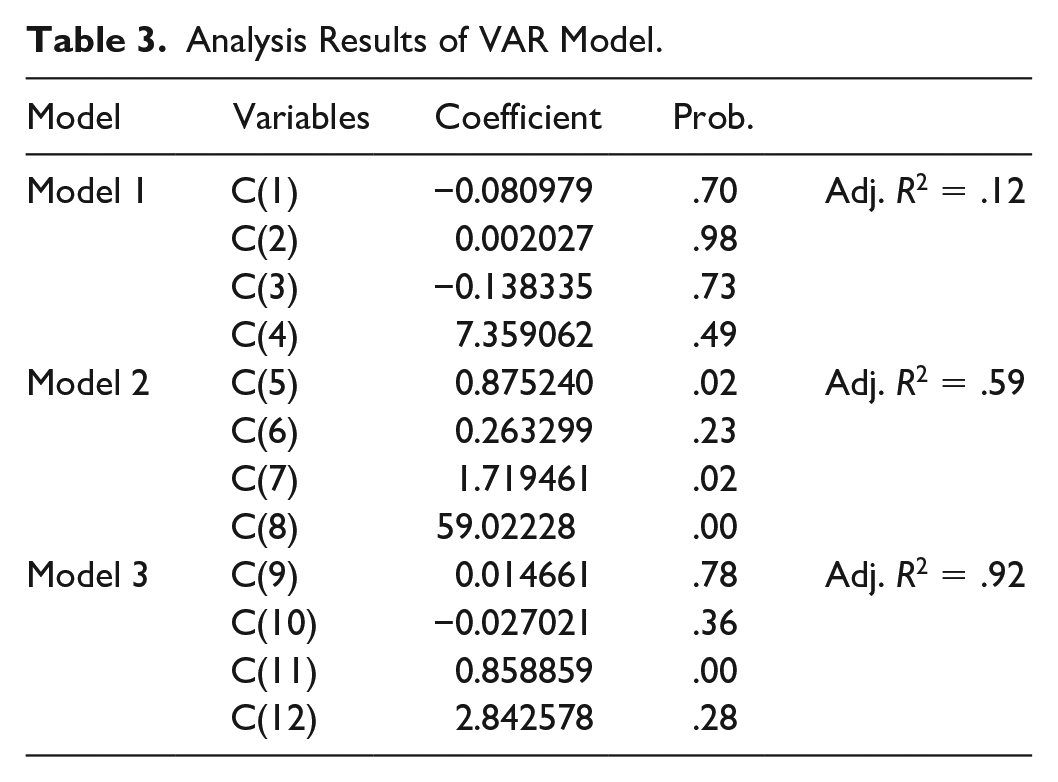
Table 3 gives information that in the first model, there is no significant variable because all probability values are greater than .05. On the contrary, in model 2, C(5) and C(7) are significant. In the final process, variance decomposition tables are created. These tables are demonstrated in Tables 4 to 6.
Variance Decomposition of EG.

Note. EG = economic growth; FD = financial development; RE = renewable energy.
Variance Decomposition of FD.

Note. EG = economic growth; FD = financial development; RE = renewable energy.
Variance Decomposition of EG.

Note. EG = economic growth; FD = financial development; RE = renewable energy.
Table 4 states that economic growth is mainly affected by its own values. However, financial development and renewable energy do not have significant influence on the economic growth in Turkey. On the contrary, Table 5 indicates that financial development affects its future values. Moreover, renewable energy usage has also impact on the financial development. In addition to these issues, Table 6 shows that financial development contributes to the renewable energy usage.
Conclusion
This study aims to evaluate the relationship between renewable energy use with economic growth and financial development. For this purpose, annual data for the years between 1990 and 2018 in Turkey is included in the study. Moreover, a model is generated for Turkey with the help of VAR methodology. Because there are three different variables, three different VAR models are created. In this study, two different hypotheses were tested. The first hypothesis of the study is that renewable energy investments contribute to the development of the financial system. Renewable energy use increases the image of the country because it reduces air pollution. This situation will contribute to the arrival of foreign investments in the country, especially considering the increase in environmental awareness worldwide. In this way, it will be possible to improve the financial system. The second hypothesis of the study is that the use of renewable energy contributes to economic growth. With the use of renewable energy, the amount of investment in the country will increase. On the contrary, foreign dependency on energy will decrease as countries can use their own energy. This condition will contribute to reducing energy imports. Considering these issues, renewable energy use is expected to have an impact on the country’s economic growth.
It is determined that there is no significant relationship between economic growth and renewable energy usage. Similar to this situation, it is also seen that financial development does not have an influence on economic growth as well. However, it is also concluded that both economic growth and renewable energy usage have positive influence on the financial development. According to the variance decomposition analysis results, it is identified that financial development and renewable energy do not have significant influence on the economic growth in Turkey. Furthermore, it is concluded that renewable energy usage has also impact on the financial development. Similar to this issue, it is also defined that financial development contributes to the renewable energy usage.
This study has mainly two different hypotheses. First, it is thought that renewable energy usage has a positive influence on the economic growth. Moreover, the second hypothesis is that renewable energy usage contributes to the financial development. By considering the results, it can be understood that the first hypothesis cannot be proven whereas the second hypothesis is corrected. Based on these results, it is recommended that renewable energy usage should be encouraged to have more effective financial development. In other words, it is identified that as a result of the use of environment-friendly energy, the size of the financial sector increases. It means that when environment-friendly energy is preferred in the country, it attracts the attention of the financial investors.
Many different researchers in the literature reached similar conclusions. For example, Chen et al. (2020) and Marinaș et al. (2018) focused on the impacts of renewable energy usage on the economic developments. They identified that there is no significant relationship between these variables. Moreover, Anton and Nucu (2020), R. Wang et al. (2020), and Ji and Zhang (2019) also made evaluations for this subject by considering different countries. They underlined that renewable energy has an important contribution to the financial development. However, there are also some studies that found relationship between renewable energy usage and economic development. Temiz Dinç and Akdoğan (2019) and Zeren and Akkuş (2020) claimed that renewable energy usage has a positive impact on the economic growth. Different views in the literature indicate that the impact of renewable energy on the economic development can vary based on the conditions.
When these findings are taken into consideration, it is obvious that some specific actions should be taken to improve renewable energy investments in Turkey. This is also true for other developing countries, along with Turkey. In this context, it would be appropriate to make tax deductions to renewable energy investors. In this way, the cost of renewable energy investments will decrease. With the help of this situation, it will be possible to attract the attention of investors in this direction. In addition to the issues mentioned, it would be appropriate to offer these investors with low interest loans. In this way, renewable energy projects with high initial investment costs will become more reasonable. On the contrary, choosing the appropriate location for renewable energy investments is very important. In this context, it would be appropriate to provide these investors with government support. The improvements of the renewable energy investment projects have a positive influence on the financial development. In other words, when policymakers generate appropriate policies to increase these projects, financial investors become more motivated to make investments in the country.
The main limitation of this study is focusing on only Turkey. In the future studies, different country or country groups can be taken into consideration. For instance, a comparative analysis can be performed between developing and developed countries to understand this relationship according to the country type. In addition to this condition, different methodologies can be used. For example, considering Pedroni panel cointegration and Dumitrescu Hurlin panel, causality analysis may be very helpful in the analysis. Furthermore, ARDL method can also be used so that it can be possible to find the causality even the variables are integrated at different order. Moreover, different variables can also be taken into account in the future studies. Within this framework, the relationship between renewable energy usage and current account balance can be taken into consideration in the future studies. Another limitation of this study is that the data set is limited. There is no data for Turkey before 1990 regarding the aforementioned variables. In this context, in the analysis made, the data between 1990 and 2015 period had to be taken into consideration.
Footnotes
Appendix
VAR Lag Order Selection Criteria.

| Lag | LogL | LR | FPE | AIC | SC | HQ |
|---|---|---|---|---|---|---|
| 0 | −190.3131 | NA | 19877.72 | 18.41077 | 18.55999 | 18.44315 |
| 1 | −162.9589 | 44.28768* | 3509.587* | 16.66275* | 17.25962* | 16.79229* |
| 2 | −158.1343 | 6.432884 | 5575.940 | 17.06041 | 18.10493 | 17.28709 |
| 3 | −149.5735 | 8.968455 | 6903.172 | 17.10223 | 18.59441 | 17.42607 |
| 4 | −143.8820 | 4.336345 | 13768.99 | 17.41733 | 19.35716 | 17.83833 |
| 5 | −136.1704 | 3.672207 | 34871.18 | 17.54004 | 19.92752 | 18.05818 |
Note. FPE = final prediction error; AIC = Akaike information criterion; LR = Likelihood Ratio; SC = Schwarz criterion; HQ = Hannan Quinn; NA = not applicable.
It gives information about the optimal lag.
Declaration of Conflicting Interests
The author(s) declared no potential conflicts of interest with respect to the research, authorship, and/or publication of this article.
Funding
The author(s) disclosed receipt of the following financial support for the research, authorship, and/or publication of this article: This work was sponsored in part by Social Science Planning Fund of Liaoning Province of China (L15AJL001, L16BJY011, L18AJY001), Scientific Research Fund of The Educational Department of Liaoning Province (2017LNZD07, 2016FRZD03), and Scientific Research Fund of University of science and technology Liaoning (2016RC01, 2016FR01).
