



Abstract
Environmental pollution and climatic variations are due to CO2 emissions and considered an important global issue. The key aim of this study was to investigate the dynamic association among CO2 emission, energy use, and economic growth in China. Secondary data was used in this study ranging from 1971 to 2014, and data stationarity was verified by applying the Augmented Dickey-Fuller unit root test. The autoregressive distributed lag (ARDL) bounds testing approach and Granger causality test with vector error correction model was used to check the causal connection amid the study variables. Outcomes expose that energy use, economic growth and gross domestic product has positive coefficients through long-run analysis with p-values (.062), (.000), and (.100), respectively, that validate the significant association with CO2 emission. Furthermore, the outcomes of short-run analysis also uncover that energy use, economic growth, and gross domestic product have a significant association with CO2 emission in China. Potential conservative policies are needed from the Chinese government to reduce CO2 emissions and resources to resolve the problem without impacting the economic progress.
Introduction
Sustainable environmental and economic development provide stability and have had a positive influence in the previous economic and political success. The plan for maintaining a sustainable environment is suggested, with a solid main evaluation about reliance on non-renewables to decrease poverty and energy protection, without regard for the rate of economic development. Furthermore, a better understanding of CO2 emissions and their relationship to economic development provides useful information for conservation policy efficiency and energy usage. Such measurements show the many experience outcomes that have positive implications. Some studies confirm and indicate that policies and actions are critical to compensating for any economic loss caused by CO2 emissions, while others demonstrate ambiguity due to a lack of evidence relating CO2 emissions and economic development (Alola, 2019; Amjad Chaudhry, 2010; Joo et al., 2015; Magazzino, 2016; Paramati et al., 2017).
Environment can use renewable energy and recycle it indefinitely. These are the most important renewable energy sources due to their rich and clean features (Kaur et al., 2020; Khatib et al., 2015; Mahmood et al., 2019; Nurunnabi et al., 2019; Zhou et al., 2018). Furthermore, renewable energy generation may be seen as a means of operating and sustaining growth. In terms of renewables and advanced technologies, clean energy policy should not be seen as a defensive instrument, but rather as a method for meeting growing community demands, such as improving energy production and reducing the impact of global fossil energy consumption. Renewable energy contributes mainly to the closeness of social and environmental advantages, such as improved education and employment possibilities, as well as a decrease in poverty and gender disparities. Environmental contamination and reduced CO2 emissions can clean energy more effectively than fossil fuels. It has helped to reduce the effects of climate change and environmental degradation (Bahrampour et al., 2020; Cucchiella & D’Adamo, 2013; Hussain & Rehman, 2021; Valentine, 2011; Zamboni et al., 2009).
The growing environmental impact of renewable energy sources on greenhouse gases and fossil fuels has significant implications for the energy market’s transformation to reduce CO2 emissions and combat climate change (Alam et al., 2011; Carvalho et al., 2013; Lorente & Álvarez-Herranz, 2016; Wang, Fang et al., 2014). The relationship between population growth, economic development, and CO2 emissions is being considered in the intensification of CO2 emissions and their backdrop. Renewable energy is essential to authorities and policymakers not only for implementing energy-related regulations, but also for promoting carbon emission reduction and industrial energy growth. No doubt, energy has vital role to foster the economic growth of any country. The current study makes a unique contribution to the existing literature regarding the association of CO2 emission, energy consumption, and economic growth. As, several research studies have been uncovered and performed to explore the connection between energy consumption substitution, renewables, economic improvement in carbon emissions, and the complicated impact of renewable energy via unintentional connection with global trade and non-renewable energy (Goh & Ang, 2018; Lee, 2013; Rehman, Ma et al., 2021; Sebri & Ben-Salha, 2014; Shahbaz et al., 2013; Shezan et al., 2018; Weimin et al., 2021), but in this study we have investigated the dynamic association among CO2 emission, energy use and economic progress in China by using the time series data, and stationarity of this data was verified by employing the unit root test. An ARDL (Autoregressive Distributed Lag) bounds testing method and granger causality test under VECM model was used to check the dynamic association amid variables via short- and long-run analysis.
Previous Literature
An integrated approach to CO2 emission and economic progress can support to deliver substantial strategy outcomes and address the problems of misinterpretation. The detailed work demonstrates the connection between economic efficiency and energy consumption has developed in detail. In recent decades, the global economy has changed several times (Knox et al., 2014). Nevertheless, economic progress has increased, and in various economies, the ideology of divergence is accountable for increasing the carbon emission and reducing natural resources. The manufacturing, social and economic causes, and CO2 emissions are similar in many ways, including petrol, coal, gas, fuel, and deforestation. Nonetheless, the connection amid economic progress and energy takes a balanced environment toward economic development (Alam et al., 2012; Javid & Sharif, 2016; Kofi Adom et al., 2012; Pablo-Romero & De Jesús, 2016; Sanglimsuwan, 2011). In order to implement effective sustainability and energy policies, it is imperative to acknowledge the actual presence of interactions between economic development and energy use. In recent decades there have been many empirical investigations that show the connection between CO2 emissions, increased energy use, urban development, and sustainable growth (Ben Mbarek et al., 2018; Chaudhary & Bisai, 2018; Chen et al., 2017; Chiu, 2017; Han et al., 2018; Hassine & Harrathi, 2017; Obradović & Lojanica, 2017; Rehman, Ozturk et al., 2019; Song et al., 2018; Yang et al., 2017; Zhao et al., 2017).
Energy is, without a doubt, the cornerstone for rapid social and economic growth. During the previous decades, fossil fuels had been a significant contributor to electricity. Furthermore, not only the global energy crisis affects the usage of fossil fuel, but also the pollution of the atmosphere. New energy sources are developed through an assessment to rising CO2 emissions in directive to encounter energy demand. Energy plays a critical role in effectively reacting to climate change and meeting the demand in order to achieve a balanced development in the energy market from renewable sources (Lian et al., 2019; Maleki et al., 2017; Okoye & Solyalı, 2017; Zhou et al., 2018). Renewable energy is a viable choice for clean energy systems due to technical advancement and progress (Mongkolsiri et al., 2019; Shezan, 2019). Renewable energy is a dynamic way of reducing the impact of fossil fuels on the environment and climate change. Furthermore, renewable energy is an essential instrument for achieving energy security in (Azevedo et al., 2019; Wang et al., 2018; Wang, Ke et al., 2014; Wang, Liang et al., 2014). The rapidly growing demand for energy, particularly in the global climate due to CO2 emissions, faces tremendous environmental challenges. A rapid rise in the emissions is primarily caused by fossil-fuel burning (Ben Jebli & Ben Youssef, 2017; Dong, Sun, Jiang et al., 2018; Jardon et al., 2017; Li & Su, 2017). Renewable energy is the cleanest energy consumption system by replacing fossil fuels and thereby reducing the CO2 emissions. Moreover, global warming is becoming ever more effective in the form of fossil fuels and a fully connected approach to sustainable growth (Bhattacharya et al., 2017; Dogan & Seker, 2016; Zhang et al., 2017).
The time-series data were used by different authors to test the casual connection by using different techniques in this area. Although the results of these studies are far from being conjuncture, and it is easy to infer that disputes emerge from ancient studies showing the correlation between CO2 emissions, energy utilization and economic progress. Moreover, various studies explored the conjunction of economic growth, renewable energies, and CO2 emissions in one way, and several studies indicate that economic development and CO2 emission are jointly and neutrally has a causal association. New investigations have discovered empirical issues and found that there have been mistakes in unit root testing, cointegration, or absence of required factors (Bilgili et al., 2016; Hu & Lin, 2008; Lv, 2017; Mele, 2019; Sebri & Ben-Salha, 2014). In decision making and deciding how future economic and social success will be directed, it is crucial to study the connection between the various environmental and economic factors. Previous research used various techniques to examine environmental and economic factors such as foreign direct investment inflows, economic growth, renewable energy, and carbon dioxide emissions (Arain et al., 2020; Sharif, Mishra et al., 2020). The effect of information and technology innovation, economic development, and carbon emissions has garnered a lot of attention in the environmental literature during the last two decades. The researchers are split into two groups. The first group of research thinks that information technology has made a beneficial contribution to environmental improvement by increasing energy efficiency and lowering carbon emissions (Mishra et al., 2020; Razzaq et al., 2021).
Over the last few decades, global warming has a huge effect on global climate change and also has been the most important environmental disruption. The effect on the development of resources, jobs, and capital increases the human activities that are critical for the global economy’s growth (Ahmed et al., 2016; Asumadu-Sarkodie & Owusu, 2016). CO2 emissions are mainly attributed to the emissions from animals, plants, and other causes, and mutual by-products of energy usage. Inappropriately, CO2 emissions remain the detrimental to a sustainable world, and concentrate internationally on climate change discussions. But the rivalry between sustainability and natural resources, particularly among humans, is linked to environmental degradation. The main cause of environmental pollution is still called CO2 emissions (Aye & Edoja, 2017; Inglesi-Lotz & Dogan, 2018; Kan et al., 2019). Renewable energy is becoming more important, and this kind of energy is designed to decrease greenhouse gas emissions. The majority of countries’ energy policies aim to generate clean energy for economic growth (Alimi et al., 2017; Ghezloun et al., 2012; Spetan, 2016). Energy has recently been recognized by researchers as a key issue for economic development, job creation, and capital accumulation (Ben Aïssa et al., 2014; Loizides & Vamvoukas, 2005). However, energy is the primary source of CO2 emissions that cause climatic variation and global warming. It is also suggested that an energy management plan be implemented in order to decrease CO2 emissions and create a more sustainable environment (Martinho, 2016).
Greenhouse gases dominate the ecosystem. With a warming atmosphere, the average temperature of snow melting in glaciers is increasing throughout the globe. Environmentalists and politicians want to create successful regulations that connect CO2 emissions to economic growth (Ziabakhsh-Ganji & Kooi, 2012). The alliance intends to take the lead in discussions on current policy goals and other recent environmental problems, such as CO2 reductions, resources use, and economic sustainability (Ohler & Fetters, 2014; Pao et al., 2011; Salim et al., 2014; Shaari et al., 2014). In this situation we should get the best options from the partnership between financial progress, economic development, energy, and CO2 emission could also boost economic growth. Further, a country must launch new carbon-dioxide-reducing policies and be enriched with the objective of boosting economic growth (Dogan & Turkekul, 2016; Khan et al., 2017; Saidi & Hammami, 2015). The trends of the variables from 1971 to 2014 are illustrated in the Figure 1.

Trends of the variables.
Methodology of Study and Data Sources
Data Sources
Time-series data from 1971 to 2014 were included in this analysis and were taken from the World Development Indicators (https://data.worldbank.org/country/CN). Study used following variables as: CO2 emissions, economic growth, energy use, and gross domestic product, respectively. Figure 2 illustrates the roadmap of methodology for this study.

Study roadmap.
Empirical Model
The subsequent model was defined to check the association between variables:

Here

In its logarithmic form, we may write the equation (2) as:

The logarithmic form of all variables are illustrated in the equation (3). Where, t denotes the time aspect and coefficients of the model are
Testing the Alliance Amid Variables Through Long- and Short-Run
The correlation among the study variables can be tested by following the Pesaran et al. (2001) ARDL (Autoregressive Distributed Lag) method. Several cointegration tests developed in the last few decades, including Engle and Granger (1987), Johansen (1988), for the maximum probability test, and expanded further by Narayan (2004). The cointegration method should be either zero or one, except in the order 2. In addition, the ARDL approach shows how the long- and short-run association can be evaluated with the use of the UECM. The model is shown individually in both long and short-term dynamics. The correlation amid variables via lon-run can be demonstrated as:

Where

Equation (5) specifies the parameters of the error correction model (ECM) through short-run. Z, X, B, and U shows the lag orders in the equation.
Investigating the Cointegration Persistence
We used the unit root test of Dickey and Fuller (ADF) (Dickey & Fuller, 1979) to validate the variables’ consistency, which is not pre-tested by the ARDL standard. The ADF test can be specified as:

The variables G examined for the test are described in equation (6). ∆
Causality Connection Amid Variables via Vector Error Correction Model
The significance of model through long- and short-run accomplishments among prescribed variables under the ARDL model has been tested for the cointegration consistency. Results show the pattern of the correlation among variables that cannot be defined. The causal check in vector error correction model also tracks the variables sources by demonstrating their significance across the current values. Engle and Granger (1987) dvelopmed the VECM model for the categorization and direction of causal association. In the long-run analysis, a short-run test will be carried out with an error correction term (ECT) in the given model if the variables combined via the autoregressive distributed lag (ARDL) approach or by the vector error correction model (VECM). However, if the subjected variables are not cointegrated, the short-term study will rely on a standard vector-autoregressive (VAR) model. The interpretation of vector error correction model is as follows:
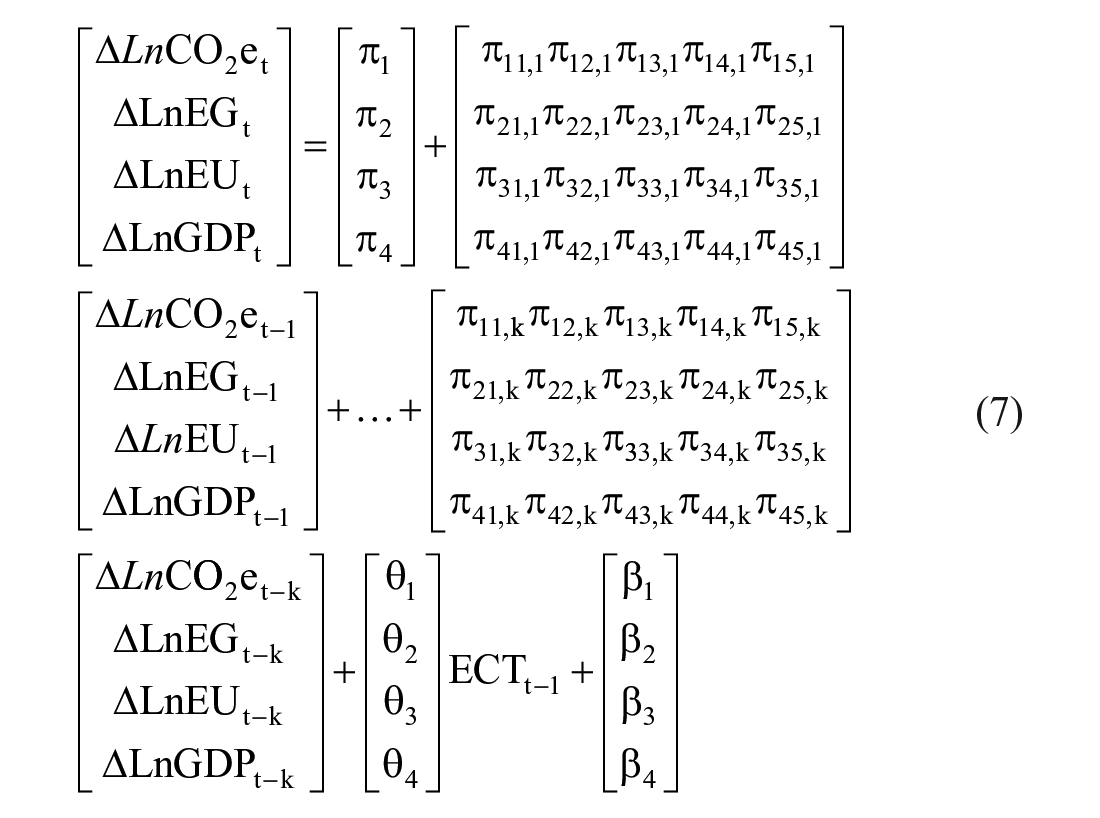
In the equation (7), Δ is operator used to indicates difference, β display the characterization of error term, and “
Results and Discussion
Descriptive Analysis and Unit Root Test
Table 1 explains the outcomes from descriptive analysis, which reveals that the probability values and Jarque-Bera statistics are normally distributed for all variables. In addition, the ADF test results are stated in Table 2.
Descriptive Analysis Results.

Unit Root Test Outcomes.

In the order 2 none of these variables are used, the effects of the ADF (Augmented Dickey-Fuller) unit root test suggest. In comparison, the properties of the ARDL cointegration check are seen in the Table 3, which defines the value point at 1%, 5%, and 10%.
Bounds Test to Cointegration Results.

Covariance Analysis
The covariance analysis outcomes are depicted in Table 4, which revealed the existence of a significant correlation amid CO2 emission, energy use, economic growth, and gross domestic product.
Covariance Analysis Results.

Long- and Short-Run Evidence
The findings of the long and short-run interaction are shown in Tables 5 and 6.
Outcomes of Long-Run Analysis.

Short-Run Dynamics Results.

Table 5 demonstrates the long-run analysis results, and focusing on the variables’ association which shows that economic growth, energy utilization, and the GDP has significant linkage with CO2 emission in China with coefficients (0.313), (1.152), and (1.473) and their p-values (.062), (.000), and (.100) respectively. Due to increasing industrialization and urbanization, the world has seen unprecedented economic growth. The world’s energy consumption is rising over time, with geothermal heat, solar energy, water, biomass, and wind, all contributing (Dong, Sun, & Dong et al., 2018). Energy is seen as a critical issue for human existence during the next 50 years. Today, fossil fuels are the primary source of much of the energy that will be depleted in the next decades. In response to declining fossil fuel supplies, the world continues to expand renewable energy sources (Ellabban et al., 2014; Mohsen et al., 2015). The energy supply system is based on the use of fossil fuels. Global clean energy demand has pushed renewable energies alongside traditional fossil fuels, while fossil fuel supplies are running out, increasing energy demand. To address environmental problems, energy production must be fundamentally shifted from conventional fuels to renewable energy. The growing supply of renewable energy to produce energy plays an important part in recent technology and may benefit from the use of renewable energy to solve environmental issues (Chen et al., 2017; Lehtola & Zahedi, 2019; Rehman, Rauf et al., 2019).
Global carbon dioxide has risen fast since the first industrial revolution, and human activities have been the main cause. By means of technology, globalization, encompassing commodities, and services, has increased the number of human activities. Globalization is essential for growth on the economic front. As far since environmental protection is concerned, however, most of the human activities caused by globalization, as they demand increased energy usage in manufacturing and transport, and subsequently generate carbon dioxide and other greenhouse gases (Khan et al., 2020; Sharif, Afshan et al., 2020). Environmental deterioration is one of today’s most serious problems. Researchers and academics have been quite concerned about the issue of environmental deterioration. The globe has seen significant economic growth in previous decades, owing to advancement and development (Aziz et al., 2021; Rehman, Ulucak et al., 2021; Sharif, Godil et al., 2020). It is therefore firmly established that China has made incredible efforts to address the environmental degradation problems and meet its sustainable and non-fossil fuel requirements. The dynamic correlations amid variables are represented in the Figure 3.

Dynamic correlation amid variables via long- and short-run.
Figure 3 clearly illustrates the dynamic linkages amid CO2 emission, energy utilization, economic growth, and GDP through short- and long-run depiction. Outcomes generally show a dynamic causality between variables.
The outcomes of short-run evidence of Table 6 illustrate that the value of R2 is about 99%. This finding indicates the disparity in CO2 emission and describes 99% variations amid autonomous variables. F-statistic joint reported expose the significance at the level of 1%. The DW value is (2.158), which is not comparable to the DW standard value, but sufficient to make the autocorrelation between projected variables. Furthermore, short-run dynamics also show that the CO2 emission is closely linked to all variables. The outcomes of stability and diagnostic test are presented in Table 7.
Stability and Diagnostic Tests Results.

Figures 4 and 5, which display the significance level at 5% and confirm the long- and short-run dynamics of the stability test, show additionally the stability tests for cumulative sum and cumulative sum of squares.
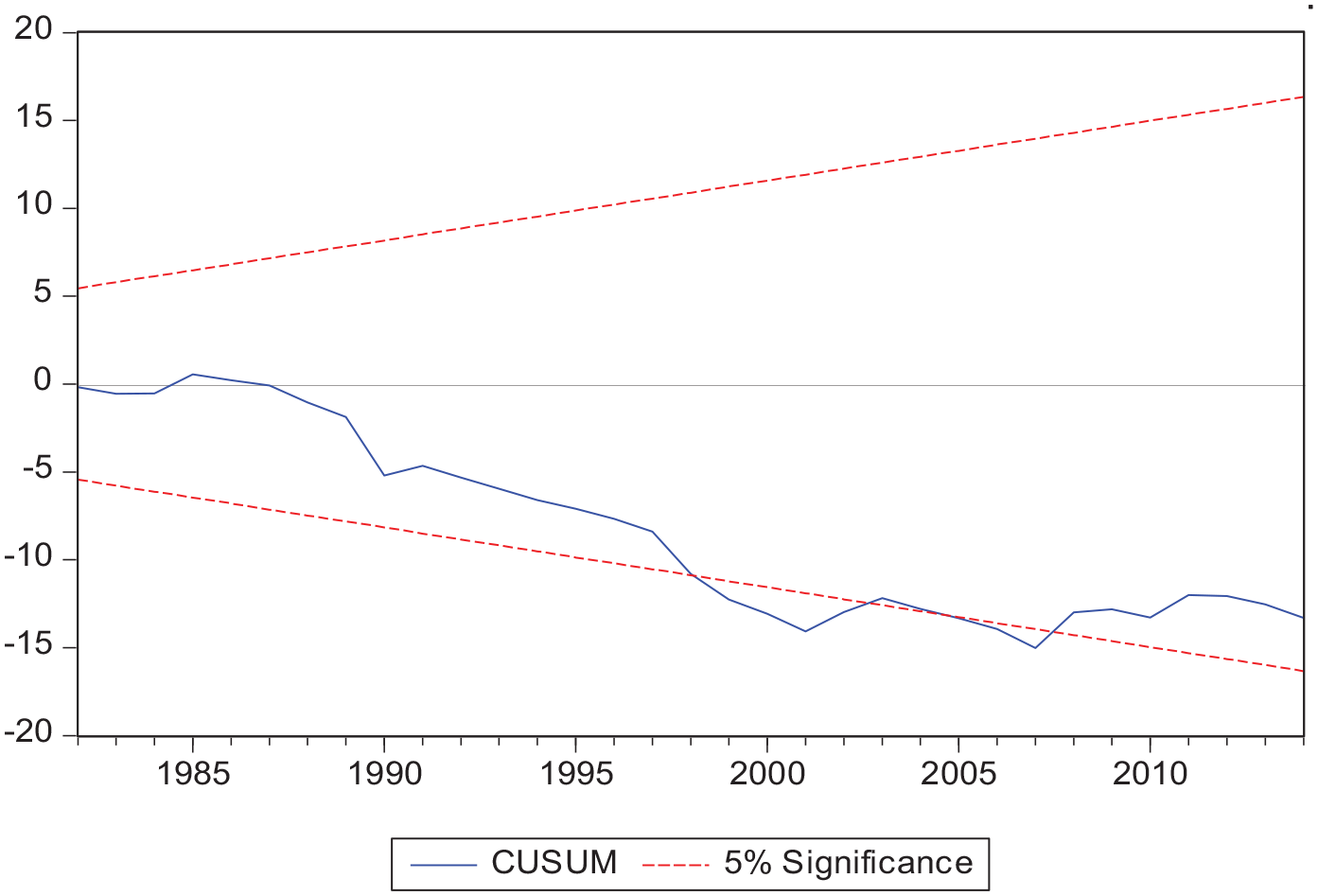
Graph of cumulative sum.

Graph of cumulative sum of squares.
Granger Causality test
The effects of Granger’s short-run causality test outcomes are depicted in Table 8, and the inclusion of cointegration provides the association of variables that used to assess the directional casual through regressors. The ARDL approach reveals a long-run connection amid study variables. Furthermore, the short-run granger interconnections also illustrate the key implications for guiding the final inferences, and indicators have shown the bidirectional relationship amid CO2 emission and all other variables, including economic growth, energy use, and GDP of China. The VECM of Granger, therefore, demonstrates the solid relationship between the subjected variables.
Causality Results.
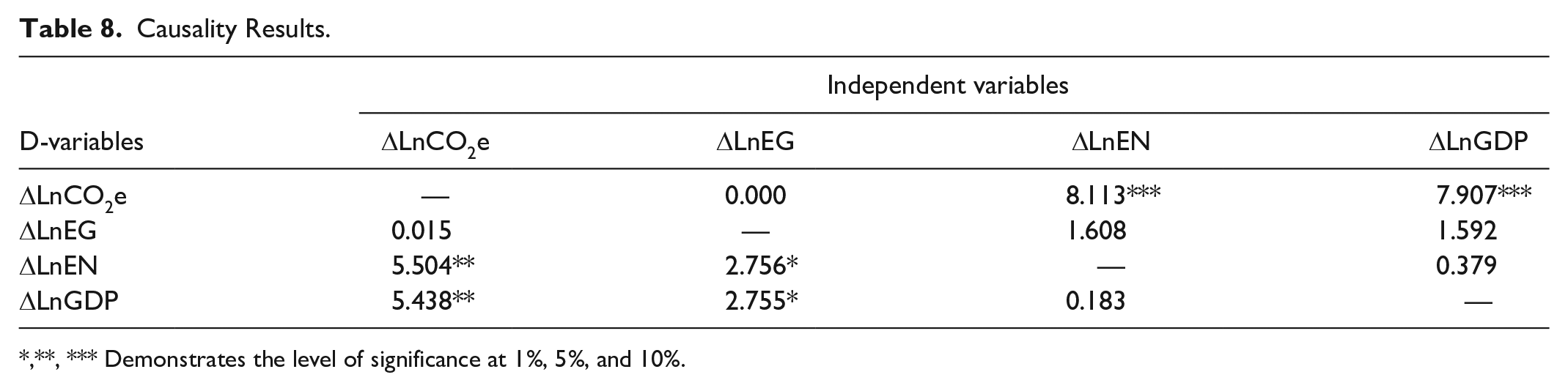
,**, ***Demonstrates the level of significance at 1%, 5%, and 10%.
Variance Decomposition Analysis and Impulse Response Function
Figures 6 and 7 demonstrate the impulse response function and variance decomposition analysis. The impulse response function, which is depicted in the Figure 6 shows that the retort of CO2 emission downward by itself in the next 5 periods, and later it showed a stable prediction up to the 60th period. Furthermore, the variance decomposition analysis is illustrated in the Figure 7. The variance decomposition analysis illustrates that the retort of CO2 emission downwards in the next 5 stages and then up to the 60th stages showed a steady prediction. The pattern of CO2 emission decreased over the whole period from 100 to 77, and further retrograde variables, such as economic growth, energy use, GDP, are shown to be decreasing tendency and subsequently to be smooth until the end of the 60th period.

Impulse response function.
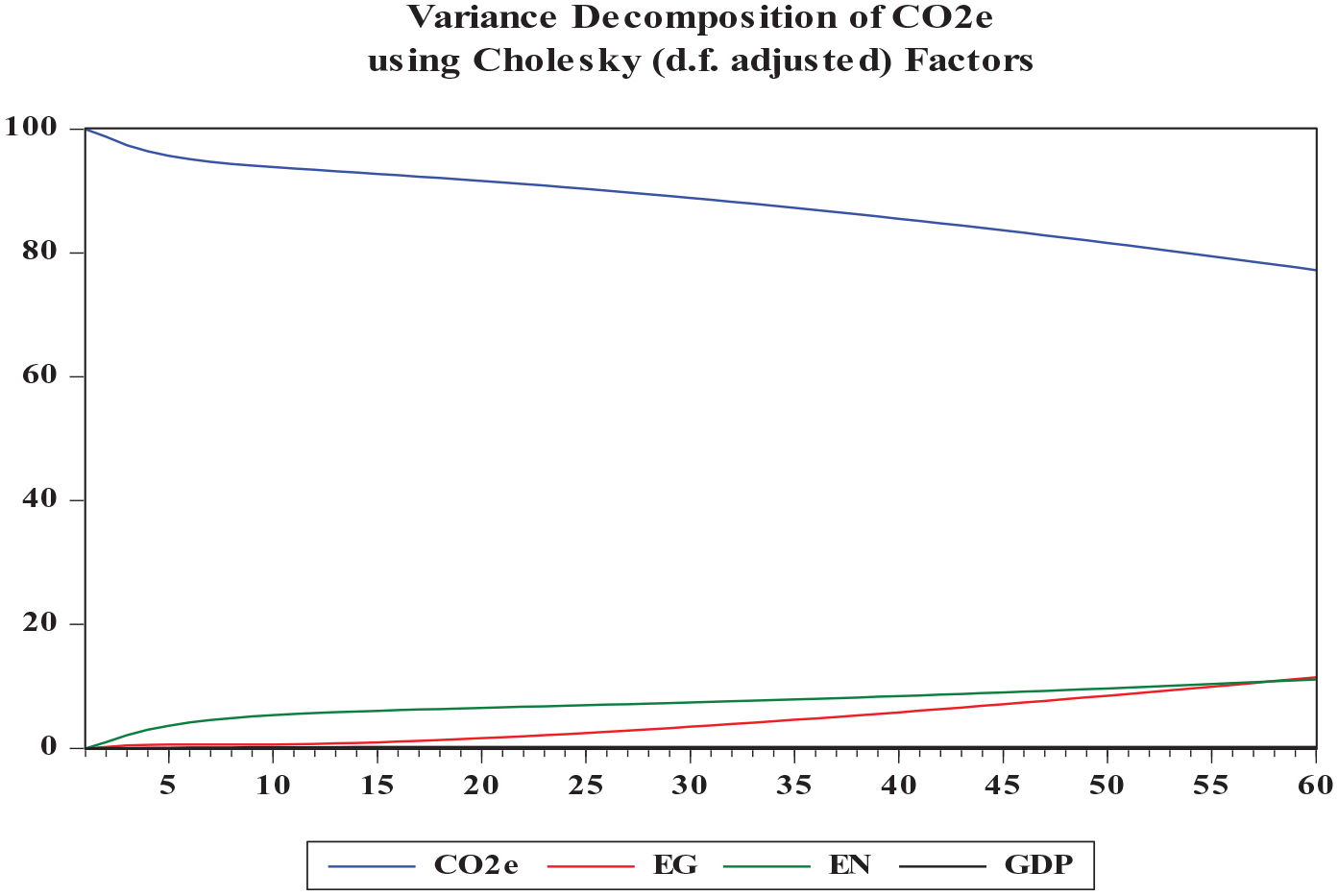
Variance decomposition analysis.
Conclusion and Policy Recommendations
The main objective of this study was to examine the dynamic association among CO2 emission, energy use and economic growth in China by taking time series data varies from 1971 to 2014. Variables stationarity was verified by applying an ADF unit root test, while ARDL technique with Granger causality tests with VECM were used to investigate the dynamic association amid variables. Outcomes revealed that economic growth have a positive association with CO2 emission. Similarly, results also show that energy usage and the gross domestic product have a significant relation to carbon dioxide emission in China. Therefore, it is evident that the China has made exceptional efforts to resolve the problem and converge its reliance on renewable energy sources instead of fossil fuel energy on environmental degradation.
The results suggest that the Chinese government requires policies to reduce CO2 emissions without affecting its energy use and economic development. Overall, Chinese carbon emission peaks should be attained via qualified urban development, rational industrial structural upgrading, improved energy structures, and promotion of energy-saving technology. The primary goal is to accomplish it. Coordination of all of these comprehensive activities is required. Furthermore, regional variations and spatial spillovers should be thoroughly considered. If these measures are effectively integrated, not only will the new normal economic development be accomplished, but the projected peak carbon emission target will also be met. China is now witnessing greater energy demand growth, which includes increased daily oil production and coal resources.
China’s energy policy is primarily focused on energy conservation, natural gas incentive, expanded natural gas supply, and technological cost, while promoting renewable energy development. Currently, the government promotes domestic exploration, grows regional business, builds storage facilities, and ensures that countries producing foreign crude oil sign long-term supply agreements. In order to enhance economic intensifications, conservative methods on reducing CO2 emissions and energy consumption must also be adopted. Because China is a major emitter of carbon dioxide, new conservative strategies to reduce emissions are needed. CO2 emissions are also anticipated, as a rising global problem today, to be focused on decreasing CO2 emissions from all countries in order to prevent deterioration of environment. In accordance with the current Kyoto Protocol and the Paris agreement, Chinese government officials, energy and environmental players should take concrete measures and also reinforce their commitment to the energy and environment accords. In much more recent years, investment is required in renewable energy sources proven to be more competent and environmentally friendly, such as photovoltaic, solar, hydro, wind, and biomass energy.
Footnotes
Declaration of Conflicting Interests
The author(s) declared no potential conflicts of interest with respect to the research, authorship, and/or publication of this article.
Funding
The author(s) disclosed receipt of the following financial support for the research, authorship, and/or publication of this article: This research is supported by the College of Economics and Management, Henan Agricultural University under funding no. 30501287.
