



Abstract
The university period provides a critical developmental transition from adolescence to adulthood. During this period, young people establish patterns of behaviors and make lifestyle choices that affect their current and future health. Using the social constructionist paradigm that examines the development of masculinities as a mutual construct of individual, social, cultural, and historical context, this article explores the interactions between masculinities and sexual behaviors of young men at the University of KwaZulu-Natal, South Africa. The study used a qualitative approach and employed purposive sampling to recruit 36 young Black male students aged between 18 and 30 years. Four focus group discussions consisting of 8 to 10 participants were conducted according to the current year of study of male students. Data were transcribed, coded, and analyzed thematically. Our results show that the freedom and independence acquired from being away from home enabled students to enact their masculinities freely. Our findings further reveal that an individual has multiple masculinities which are often exerted to suit the present discourse they are in at any given point.
Introduction
Universities provide space for young men to explore their masculinities and sexual behaviors. However, there are different types of masculinities that are complex, and their description has been highly contested (Ratele et al., 2010). Masculinities are not fixed or static, and are socially constructed by the individual, the society, and the environment. They are multiple and fluid in nature, and different versions exist in different contexts (Talbot & Quayle, 2010; Watson, 2015). Therefore, a version of masculinities that is valuable for one society can be of no value or of a different value in another context (Talbot & Quayle, 2010).
Like any social institution, the university presents spaces and opportunities for the enactment and exploration of masculinities, sexual definitions, and freedom, whereas for some, a chance to be adventurous (Fentahun & Mamo, 2014; Peltzer & Promtussananon, 2005; van Staden & Badenhorst, 2009). This setting is also enabling to shape their beliefs, attitudes, and perceptions about the self and the other. For young men, this might be critical for the exploration of different forms of masculinities from the self’s and others’ point of view (Brooms et al., 2018). This social space provides opportunities for young men to evaluate or reevaluate their masculine norms according to the context they are in. What this means is that the university is a space that provides opportunities for young men to express themselves in ways which they might not have expressed themselves in a different context.
In the university context like in other social institutions, an individual has multiple masculinities that are often in sync or contradictory to one another. While young men might behave in certain ways outside the university setting, they might behave in ways they consider to be conforming to the university culture. This means that a university as a social space provides opportunities for your people to define themselves as individuals, in a social space and in relations with other people and as part of the institution.
Previous studies have hypothesized that young men’s sexual behaviors significantly relate to their conformity to traditional hegemonic masculine norms, such as risk-taking (Ngidi et al., 2016), self-reliance (Okoror et al., 2016), and emotional control (Malinga & Ratele, 2016), and that they are punished or shamed when they do not conform to traditional masculine norms (Ratele, 2014). These constructions of masculinity appear to be connected to a variety of sexual behaviors (Barker & Ricardo, 2005; Macia et al., 2011). The prevailing ideals of hegemonic masculinity have given little room for men to acknowledge vulnerability especially when it comes to HIV testing and seeking help (Jewkes & Morrell, 2010). However, hegemonic masculinities are not the only form because there are other categories such as subordination, complicity, and marginalization which may prevail in the same space and are critical in defining young men’s sexual behaviors.
We acknowledge that although the literature on hegemonic masculinities is largely focused on male domination of women, particularly in sexual terms, there are alternative less dominant masculinities such as pleasure of caring for others, receptiveness, empathy, and sympathy that are presented in men’s self-care and the care for others. We know that we have young men who possess these types of masculinities that are critical in the fight against HIV infection. Therefore, improved understanding of complexities such as social pressures that are faced by young men in constructing their masculine identities can contribute toward the development of interventions that aim to empower young men with alternative masculinities that are non-violent, non-abusive, less risky versions of masculinity and those that are more life-affirming and life-enhancing to the benefit of all (Shefer et al., 2010). This assertion is supported by Hamlall (2018) who indicates that in South Africa there are men who have adopted masculinities that counter hegemonic practices such as support for gender equality, the opposition of violence against women, and having multiple sexual partners.
Masculinity has also been conceptualized as a construct which includes gender role stereotypes, namely, the “sex role model,” which reflects stereotypes about the beliefs and behaviors typically attributed to males and females. The sex role model largely portrays male sexual needs as naturally uncontrollable, dominance over women as normative, and having multiple sexual partners as evidence of sexual prowess (Barker & Ricardo, 2005; Lynch et al., 2010; Zuma et al., 2016). Rather than a single standard of masculinities which all boys and men are taught to aspire, masculinities vary across age and racial, ethnic, and social contexts. In the African context, such portrayal of men perpetuates negative perceptions toward men, which recognizes them as sexual predators (Bhana & Pattman, 2011). The impact of these negative stereotypes affects the way males engage with gender equality; thus, men who adhere strongly to these stereotypes may feel compelled to be sexually aggressive and/or coercive to maintain their need for dominance within their intimate relationship. Gender inequality and men’s perceived sexual superiority over women are central to HIV infection (Bhana & Pattman, 2011). Such stereotypes also act as barriers to men’s health-seeking behaviors affecting uptake of HIV services (Skovdal et al., 2011). Hence, hegemonic masculinities need to be taken into account in the design of messages and interventions to improve HIV prevention, testing, and treatment among men.
The university period provides a critical developmental transition from adolescence to adulthood, during which young people establish patterns of behaviors and make lifestyle choices that affect both their current and future health (Bernales et al., 2016; Marcell et al., 2011). However, very little research has centered on the relationships between different types of masculinities and sexual behaviors of young Black males attending institutions of higher learning, particularly in the South African context. This study provides an opportunity to understand constructions of masculinities and their impact on sexual behaviors among young Black men at a university using many social categories, such as ethnicity, socioeconomic status, age cohorts, culture, societal norms, family values, religious beliefs, and peer groups. This is critical in acknowledging that in this context distinct sociological differences exist. This study explores the interactions between masculinities and sexual behaviors of young men at the University of KwaZulu-Natal (UKZN).
Method
This article presents findings from a larger qualitative study that explored how cultural norms associated with sexuality and masculinity influence the sexual behaviors of young Black male students at the UKZN. Qualitative methods allowed for the way people interpret and make sense of their lived experiences (Mohajan, 2018) and allowed for the capture of subjective experiences of young Black male students with respect to how university influences their construction of masculinities and their sexual behaviors.
Participants
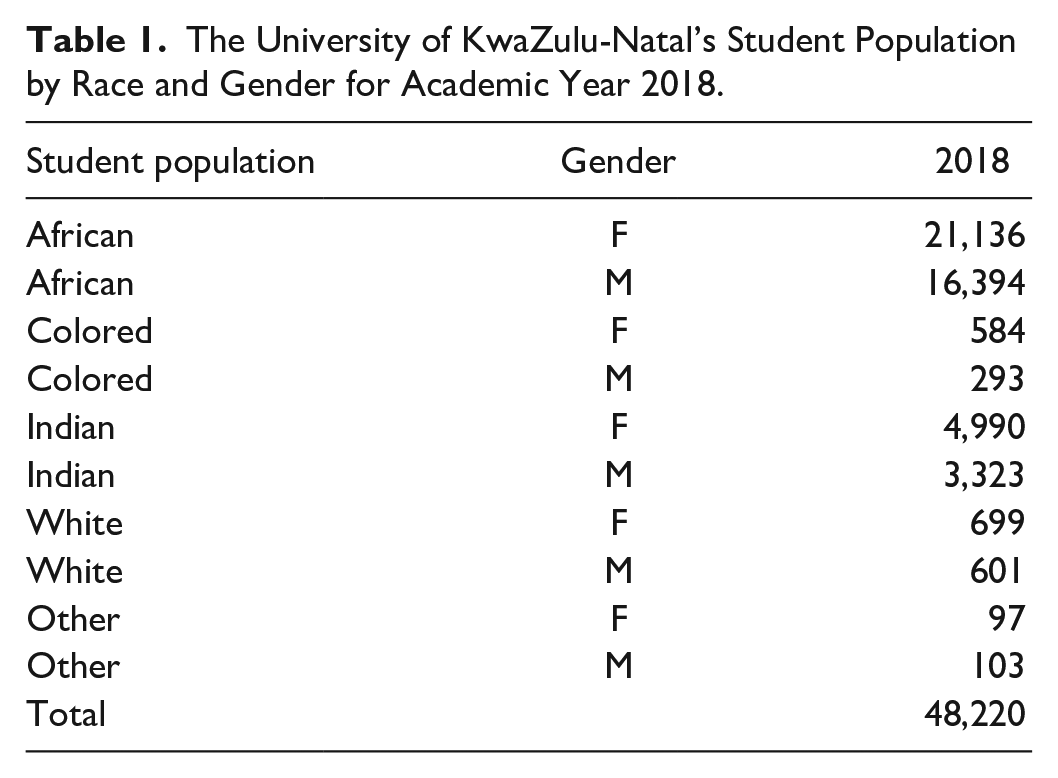
The study was conducted at the UKZN. The UKZN was formed on January 1, 2004, after the merger between the University of Durban-Westville and the University of Natal. It comprises five campuses, namely, Howard College campus, Westville campus, Pietermaritzburg campus, Edgewood campus, and the Nelson Mandela Medical School. The university enrolls approximately 40,000 students each year. The UKZN student population is representative of regional demographics. All the campuses are multicultural and comprise students of all the race classification (Black, White, Colored, and Indian). The university also attracts students from other parts of Africa and other continents. The rationale for selecting the UKZN as a study site was because of its attraction for a large number of students from diverse social and cultural backgrounds across South Africa and other parts of sub-Saharan Africa. This cross-cultural diffusion made UKZN a rich study site. The study was conducted at Howard College Campus because it is the largest and home to most of the faculties at the institution. Table 1 presents UKZN student population by race and gender (Singh, 2019).
The University of KwaZulu-Natal’s Student Population by Race and Gender for Academic Year 2018.
The study employed a purposive sampling technique to recruit Black male students who were between the ages of 18 and 30 years. The inclusion criteria were that all participants had to be Black (regardless of ethnicity), identify themselves as male (regardless of the sexual orientation), had to be studying at the university (both undergraduate and postgraduate students were included), and had to be between the ages of 18 and 30 years. Although all men of all sexual identities were invited to be part of the study, this article reports on particular types of heterosexual masculine identities.
Procedure
The participants were recruited from four colleges at the campus, namely, College of Agriculture, Engineering and Sciences; College of Health Sciences; College of Humanities; and College of Law and Management studies. To recruit the participants, the researcher (S.K.) designed posters and flyers with the study description and contact details of the researcher. With permission granted by the university, the researcher distributed these posters and flyers across the campus. A total of 36 participants were recruited for this study.
Instruments
Focus group discussions (FGDs) were used to collect the data. A total of four FGDs were conducted with male participants who were between the ages of 18 and 30 years (see Table 2). FGD took approximately 90 min to complete. This method was found to be useful as it enabled the researcher to capture dynamic perceptions, understanding, beliefs, and attitudes of young men through group interactions. Unlike individual interviews, FGDs provide an added dimension of interactions between participants (Maldonado et al., 2013). Also, this method further allowed the researcher to understand how young men express their views and how they make sense of their lived experiences as young men in a university space. As such, similarities and differences were captured from the group discussions. The following questions were asked during FGD: (a) understanding of manhood, (b) construction of sexual behaviors and masculine identities within a university setting, and (c) factors that influence masculinities and sexual behaviors. All FGDs were conducted in English, audio-recorded, and transcribed.
Description of Black Male Students’ Focus Groups.

Ethical Consideration
Ethical approval was obtained from the UKZN’s Humanities and Social Sciences Research Ethics Committee (HSSREC) (Protocol Number: HSS/0255/018D). The study information sheet was read to all participants and they were also given study information sheets containing details about the study. All participants were requested to sign a written informed consent form before they were enrolled in the study. The study information sheet and consent form explained that the researchers will maintain confidentiality of any information provided for the purposes of this study.
Participants were informed that their real names would not be used at any point of the study and only pseudonyms will be used where necessary. Participants were also reminded of their rights to withdraw from the study at any time, in case they felt uncomfortable or felt that the study was an inconvenience to them and that withdrawal from the study would not have any negative repercussions for themselves or their studies.
Data Analysis
Data were analyzed thematically, guided by the thematic analysis framework (Braun & Clarke, 2006). The first author read and re-read all the transcripts to familiarize themselves with the data and get a better sense of themes emerging from the data. After familiarization with transcripts, codes were generated as guided by the study questions and produced through the use of Atlas.ti 8. Further categorization of codes into emerging themes was conducted by the first, second, and third authors focusing on connections between the emerging themes until consensus was reached.
Results
In this article, we were interested in exploring the role that the university setting has in shaping the masculinities and sexual behaviors of young men. In doing so, we asked them to reflect on their subjective experiences of being in the university space and how that has shaped the way they enact and negotiate their masculine identities and sexual behaviors. Two major themes emerged in relation to the intersection between masculinities and sexual behaviors, namely, (a) the role of the university environment in shaping constructions of masculinities and sexual behaviors and (b) the role of social and peer influences in perpetuating risky sexual behaviors.
University Environment and Negotiating Masculinities
Our data show that the university environment provided opportunities for young men in the study to explore their masculinities and negotiate their sexual behaviors to suit this context. The participants described the redefinition of their masculinities both at the university and off-campus, in accordance with the new status that they received from being enrolled at the university and also from the freedom and independence acquired from being away from home, and in particular parental guidance and supervision. One participant stated that At home, you have to follow your father’s rules . . .there are principles and there are certain things that you can and cannot do. When I am home I am a reversed boy who does not even talk to girls, but this environment enables one to talk to girls even when you are shy. I feel like here I am a man. I can do what I want and no one will question or reprimand me. I make my own rules, I have my own room and I can invite whoever I want. (FGD 3, third year student)
In the South African context, having one’s own place to sleep is held in high regard especially among Black males who usually view this as the epitome of being “a real man.” Having one’s own place provided some of these young men with heteronormative forms of masculinities, with one participant stating that “unlike some people who (are) staying at home; like it becomes difficult for them to use the home as the place to smash (have sex). At university you have your own space and privacy” (FGD 2, second year student).
The university was also linked to the developmental trajectory from being a “boy” to becoming a “real man,” who can make decisions independently and thereby solidify one’s enactment of masculinity and sexual behaviors. This is noted from one of the dialogues that took place in FGD 3, where one participant stated that The university has provided opportunities for us to be “real man,” to be able to look after yourself, budget and know how to spend your money. This space has given us an opportunity to be responsible in terms of keeping yourself in check—no one forces you to attend class, no one tells you to write your assignments and exams. You have to know that you are a grown-up. Speaking about sexual behaviours, it is true guys; university provides us with the freedom to explore sexually. However, one has to be careful who he explores with because these days’ people die. (FGD 3, third year student)
This excerpt shows how some young men may construct their own masculinities and sexual behaviors according to how others conduct themselves in this case and their fear of HIV infection and death. The university environment did not only enable heteronormative masculinities in terms of providing spaces and opportunities for sexual exploration but also was seen as a context that “diminished” other young men in terms of their sexual standing. This was noted by one participant in FGD 1 who stated that Being a first year student at this university made me feel less of a man. In my previous High School, I could get any girl I wanted because I was a senior. Now you see as a first year if you approach a girl in your class and you want to date them, they usually reject you. These girls want older guys who have money, can take them out to clubs. Even if you are going out with a girl in the first year she might refuse to sleep (have sex) with you but she might be sleeping (having sex) with an older man or she will be sleeping (having sex) with both of you. You have no power to fight this if you are a first year. It is what it is. (FGD 1, first year student)
This narrative highlights the link between inability to provide financially and difficulties in establishing sexual relationships for young men at the university. The lack of financial power also renders young men vulnerable to insecurities and suspicions about cheating when in relationships. This was supported by a participant in FGD 2 who indicated that We do not have power over university girls because we cannot afford to provide for them. I cannot provide for my girlfriend right now. My parents look after me so where will I get money to look after another person? But you see these “blessers” (older men, with financial means) will provide for the girls financially, they will buy them iPhones. As a student, I have no financial power to do that so I cannot complain or even ask where they got the phone from. (FGD 2, second year student)
The findings show some young men are presenting vulnerable masculinities because of their inability to provide financially. Vulnerable masculinities are constructed outside of the idealized hegemonic masculinity which is constructed on the basis of heterosexual prowess, invulnerability (strong, strength, unemotional), violence, and the ability to provide economically (Bhana & Mayeza, 2019; Shefer et al., 2015). For some of these young men, notions of being a “real man” are tied in their ability to take a woman out and shower her with gifts. Vulnerable masculinities are also presented by these young men in different ways; therefore, the acknowledgment of young men’s vulnerabilities is very important in resisting the uniform representation of young men (Shefer et al., 2015). Our study further highlights that some young men are also vulnerable to risky sexual behaviors with older women. This is emphasized by one participant who said, University provides platforms which you do not get at home. Here at varsity (university), young men are not embarrassed to be “Ben 10s” (younger men in a relationship with older women). You can have your “sugar mamma” (older woman in a relationship with a younger man) who provides you with all your needs financially and all you give her are sexual favours and attention when she needs it. The problem is that these older women are controlling and want you to do everything at their own time. You cannot say no when they want to see you. I don’t care though as long as she gives me the money. (FGD 2, second year student)
However, although vulnerable because they do not have control over the relationships with older women, young men portray a sense of agency in the decisions they make to be in these “intergenerational transactional relationships.” For them, these relationships are a source of income and pleasure. Intergenerational relationships are not a new phenomenon; they have existed for years in many parts of the world (Brouard & Crewe, 2012). In South Africa, these types of relationships have become a norm, especially among young women. Young women engage in sexual relationships with older men in exchange for material things such as clothes and expensive phones. In these relationships, gender power dynamics are commonly challenging especially when it comes to women negotiating condom use, which can put them at risk of HIV infection (Shefer & Strebel, 2012).
In supporting this assertion, another participant also highlighted that the university space provides them with opportunities to enjoy the “best of both worlds” when he stated, You see here at varsity (university) you can have the best of both worlds. You can be a Ben 10, while you also have your proper girlfriend. The money you get from your sugar mamma you will use it to impress your real girlfriend. You see with “big mamma” I listen to all her demands and do everything she says because she is paying the bills. However, with my real girlfriend, I am a “real man.” I make the rules. The problem is that for both of them I cannot have sex with a condom. “Big mamma” does not like condoms although I would want to use it because she is married and I do not know what her husband does behind her back. With my real girlfriend, I cannot use a condom because I trust her and she trusts me, so she will suspect I have been up to no good if I suggest wearing a condom. (FGD 3, third year student)
Young men at the university are therefore renegotiating their masculinities to suit their current circumstances in multiple concurrent relationships with older women and those in the same age group as themselves. These complex relationship scenarios highlight the two faces of masculinities enacted by young men at university, one of being submissive and the other of being in control. Vulnerable masculinities present themselves in both cases though. The relationship with older women takes away young men’s agency in terms of negotiating for safe sex practices, whereas relationships with women in their same age group also render them vulnerable, as they cannot negotiate for safe sex practice because of perceived trust and fear of being suspected of promiscuity. These instances put young men and their sexual partners at risk of HIV and/or sexually transmitted infection (STI).
While these intersections between the university environment, masculinities, and risky sexual behaviors were more apparent among participants in their second and third year of study, they were less common among first year and postgraduate students. Most first year students indicated how they follow the teachings of their parents and where they came from in terms of cultural and religious beliefs and values of what it means to be a man. One participant stated, I have always been brought up to know the importance of education. I know that for me to achieve my goals here at the university I have to protect myself from a lot of things including HIV and drugs. You see as a man; you need to know where you are coming from. You have to understand your background and how you were brought up. You cannot just go to university to die. A lot of people at home are looking up to you to be the first one in the family to get a degree and a good job so that you look after others in the family. As a man, one has to be responsible and know the main reason for coming to university. (FGD 1, first year student)
This participant statement resonated with many of the statements made by first year students. These participants equated manhood with responsibility and one’s ability to know their priorities at university, such as aiming to do well so that they can be able to give back to their families. Another aspect that came out of this FGD 1, which has its roots in the upbringing of these young men, is that of “respect for oneself and the protection of the other.” One respondent noted that I was brought up to respect myself as a man and to protect women and therefore this is an important part of who I am. I feel that if you do not respect yourself no one else will respect you. It is also important to protect women. You need to do what you would want your sister or daughter to also have in her relationship. You see you cannot just go sleeping around (having sex) with every other woman. Imagine if you get the virus (HIV) you will spread it to everyone you are sleeping with. Imagine if that happens to your sister, how would you feel? That’s why you need to protect women. (FGD 1, first year student)
Masters and PhD students, particularly those aged between 25 and 30 years, indicated the importance of protecting oneself and being able to control the company they keep and decisions they make in terms of how they would like to be viewed as mature men at university. One participant highlighted, At this age, you are a man who should be respected by the community, including at the university. You are no longer a small boy so people should see this from your actions. You have to choose the right company and you should not be seen as a playboy who brings different women to his room all the time. This is a time for you to settle down and focus on the important things in life, such as choosing the right woman to spend your life with and shaping your career. (FGD 4, postgraduate student)
What we can deduce from our data is the different intersections between home and the university environment with regard to masculinities and sexual behaviors among young men in their different stages of university life. First year students linked their university experience to alternative forms of masculinities, particularly those of respect for oneself and protection of the other. One may attribute this to their being relatively new in the university environment, without having gone through a lot of socialization and interactions with other beliefs and behaviors of other university students. Second, third year and honors students, on the contrary, presented an impression of both hegemonic and vulnerable masculinities, represented by the idea of “conquering” the other and being submissive at the same time. This presents a sense of masculinities and sexual behaviors renegotiated to suit the university environment. For the masters and PhD students, our results highlight the move from hegemonic masculinities to alternative masculinities driven more by the “sense of maturity,” the “need to be responsible,” and “focus on planning one’s future” with a life partner.
Social Expectations and Peer Pressure
The university space presents social expectations and norms different from other community contexts. Our data show that young men at university continuously socialize according to the latest social expectations and norms, in terms of their behavior, friends, hangout places, how they dress, and what they eat. In this context, our results indicate that masculinities are not static but dynamic, always changing according to the space one is in, the opportunities one has, and the time afforded to the person.
The university space provided these young men with opportunities to articulate their sexual and masculine identities in their own terms and according to what is socially expected. However, the expectations put on these young men at university lead them to engage in risky sexual behaviors to fit in the university context. One participant noted, As a young man at university, you are expected to behave in a certain way when it comes to girls. You cannot only stick with one girl. Guys will laugh at you. You need to explore. Here there are different races, tribes, and provinces to choose from . . . You will find Swati, Zulu, Xhosa girls and you hit and smash and move (have sex and move on) to the next one, you see; you have different options unlike back at home. (FGD 4, postgraduate student)
The above sentiment was supported by another participant who stated, “You need to have multiple sexual partners to be seen as a man. You need to be seen
It was only the virility of a man that was celebrated; however, women had to have self-control as men were perceived as lacking it. This was indicative of the socialization of some of these young men, who have been raised to value sexual experience while on the contrary judging and shaming women. Yet, for some, the young men also preferred having sexual relationships with women who were sexually more experienced while regarding virgins as suitable for marriage: “I prefer a woman with experience, a girl who has never had sex is too much of a responsibility those girls are wife material” (FGD 3, third year student).
The desire for public display of affection was also mentioned as important if one wants to prove their commitment to a certain girl and show them that they are not cheating them with someone else. Reflecting on this, one of the participants explained, You see people kissing, hugging and holding hands on campus, it’s something that happens unlike when you go back home. Here you do this to show the girl that she is the only one. However, even if she is the only one, you cannot do this at home. At home, you tend to be reserved. It is not something that you can just do, you need to respect people and you just can’t be walking around with a girl. (FGD 1, first year student)
This statement brings about two issues in terms of the intersections between masculinities and social expectations and norms. The first one is that one is expected to show a public display of affection to a girl to declare to the university community that they are in a monogamous relationship. The second one is because one is away from home so that they can do whatever they please as no one from their home will find out. This presents young men with “double lives” as they live imbedded within these social norms, with narrative or conversational constructions of what was perceived to be acceptable behavior for young men in universities. Participants indicated that their peers would constantly talk about sex and even question them about their own sexual conquests. So to fit in and feel like part of the group, participants indicated that they had to engage in sexual activities. The pressure from peers led some of these young men to conduct themselves in ways they would not normally do when at home. This was due to their understanding that not subscribing to these dominant masculine ideals in their context would result in social disapproval and deriding from their peers. One participant noted, Here at res (idents), you find a bunch of guys chilling and talking about sex, some will just call their girlfriends to visit them. . .so it will be only you and you end up deciding to have sex because everyone is doing it and they will even ask you if you had sex . . . you will need to have something to say as well. Here it is not like back at home things are different. (FGD 2, second year student)
Some participants noted that they had succumbed to such pressures to avoid humiliation and rejection from their friends. One participant highlighted, “I knew I had to lose my virginity!!! This is because when I told them I was a virgin they laughed at me. I made sure that this year I lost my virginity” (FGD 3, third year student). Similarly, another participant stated, “You should lose your virginity. If you are a boy you should dream of having sex! No, you have to jump and lose that thing! Among us as guys, there is
The social expectations and norms aligned to hegemonic masculinities at the university encouraged young men to engage in risky sexual practices. These practices were enacted through willing participation in unprotected sex, even when knowing their sexual partner is HIV-positive. According to some of these young men, sexual desire was so overpowering that it took away their agency for condom use. One participant stated, I am afraid of HIV I do not want to lie, I’m afraid of it but there are those people that have bad luck. Not because I am special, but sometimes luck really works [for me] and I’m not used to it
referring to condoms (FGD 1, first year students). Another participant recounted, “Most of the time especially with sex, I always have the guts and have sex without a condom” (FGD 3, third year student). Momentary pleasure outweighed the risks for some of these participants, even with a sexual partner that put them at risk: When a girl comes to me and says she wants me to sleep (have sex) I will not refuse even if the girl is HIV positive . . .with us guys, we don’t refuse anything!! If a girl comes to me and wants to have sex, I will give her what she wants! As men, we never refuse to have sex! If you want “it,” we will give it to you. (FGD 2, second year student)
Consequently, such social expectations and norms linked to hegemonic masculinities encourage risky sexual behaviors that render young men vulnerable and at increased risk of HIV infection. On the contrary, the ridiculing of young men who want to protect themselves and not engage in sexual relationships highlights the power dynamics, not only between men and women but also between men themselves. Young men end up seeing the need to prove to other men their masculinity and allegiance to a certain group through engagement in risky sexual behaviors.
Discussion
This article explored intersections between masculinities and sexual behaviors among young men at institutions of higher learning in KwaZulu-Natal, South Africa. We identified two major themes: (a) university environment, negotiating masculinities, and sexual behaviors, and (b) masculinities, social expectations and norms, peer pressure, and risky sexual behaviors. This study found that like in all social spaces, versions of masculinities at institutions of higher learning are socially constructed, highly fluid in nature, changing not just over time but from place to place, and reflecting the way in which subject and power positions shift (Barker & Ricardo, 2005; Mackenzie et al., 2017). The social constructionist theory argues that cultural norms and masculinities are purely the result of intersecting historical, social, and cultural factors at a particular moment in time (Addis et al., 2016; Burr & Dick, 2017). It views masculinities as a social context–dependent socio-cultural construct that changes over time. Consequently, individuals were likely to embrace more than one discourse of what constituted appropriate behavior.
This conflation of masculine norms is witnessed by young men’s different behaviors when they are at university, when they are at home with their families, and when they are with their friends or sexual partners. These multiple masculinities point to the complexities of human beings and their relationships with various spaces, people, and contexts. Our study is consistent with heterogeneous notions of men, showing that there is no such thing as a “typical” young man. With men possessing multiple masculinities, we cannot and should not expect men to be homogeneous. We know that some men might exert dominant masculinities over others in different spaces while enacting subordinate masculinities in other settings. A young man might present a “macho” character at a university setting and subordinate masculinities in a home context.
In South Africa, gender role norms and social expectations are among the strongest underlying social factors that influence sexual behaviors among men (and women) (Ricardo et al., 2006). Consistent with other studies, our study shows that prevailing norms about masculinities and sexual behaviors suggest that young men are knowledgeable and experienced with regard to sexual relationships (Brooms et al., 2018; Fleming et al., 2016; Stern et al., 2015). Men, like women, have power and voice in their sexual and intimate relationships. There is a growing acknowledgment that men consider their health to be important in making sexual decisions. These notions of positive masculinities among young men point to important steps taken in the fight against HIV infection and promotion of treatment and care.
Our results show that despite relatively high levels of awareness around the HIV epidemic among young men at the university, there continues to be low levels of safer sex and misconceptions about both preventive behaviors, including condom use, and the disease itself. In some cases, young men report the conflicting pressures they experience, between their knowledge about HIV and AIDS and safer sex behavior and their behavior, or between what they say they should do and what they actually do. This resonates with findings from a study that cited peer influence as an important factor in sexual risk-taking among students (Ngidi et al., 2016). Peer groups were perceived to be where young men attain knowledge about how they are supposed to behave and where individuals were pressured to act according to expected group norms (Swain, 2006). In this regard, we argue for more sexual and reproductive health centered on the young men’s needs. We need to move away from blaming young men for the HIV epidemic, particularly in relation to their female counterparts, and promote their protection, prevention, and treatment in the HIV cascade.
Not much empirical evidence is available on best practices in terms of approaches and interventions on managing intersections between masculinities and sexual behaviors among young men at institutions of higher learning in South Africa. Lessons from the study, however, suggest several principles to promote positive forms of masculinities and health-protective behaviors: (a) a high degree of self-reflection and spaces to rehearse new behavior; (b) tapping into young men’s sense of responsibility and positive engagement as partners; (c) incorporating new information and ideas into the rite of passage processes and traditions that historically served as positive forms of social control; (d) engaging families, peer groups, university institutions, and social networks to promote positive forms of masculinities and safer sexual behaviors; and (e) mobilizing the university communities around the immediate vulnerabilities of young men.
There are some limitations related to the qualitative nature of the study. Although in some respects focus groups offer a supportive environment to participants, the group context may also create a sense of discomfort or distress especially when discussing sensitive issues such as sexual behaviors. The group setting might have prompted some of the participants to express their views based on socially accepted norms of “what it means to be a man” to conform and impress other male participants in the group (Stern et al., 2015). Other study participants may have been in spaces with people they might have known, which might have been influenced their answers. Hence, some participants might have not answered honestly because of fear of judgment by others. Nevertheless, FGDs were conducted by an experienced moderator who could counteract discomfort or distress and their impact when and if they do arise.
The sample size and qualitative methods utilized for this study do not allow for generalizability of the findings. However, the qualitative element of the study (i.e., smaller groups) allowed for rich narratives to come to the fore. Nonetheless, expanding this line of inquiry to a larger sample, among other men from other universities and men from other racial groups, might provide an even deeper understanding of the dynamic nature of masculinities in such contexts. The strength of the focus group approach is the possibility for participants to develop ideas collectively, bringing forward their own priorities and perspectives grounded in their actual experience. Therefore, our study contributes to the literature toward understanding the interactions between masculinities and sexual behaviors of young Black men in a university setting.
Conclusion
The university setting is a very important space for the transition of many young people from dependency to independence. This environment and phase can make or break young people. It is therefore critical that these institutions of higher learning play a critical role in promoting positive gender norms around what it means to be a young man or woman. Institutions of higher learning should broaden gender policies and their implementation to recognize the gender-specific needs and realities of young men and to support strategies for their meaningful involvement in the promotion of positive masculinities and healthy sexual behaviors while acknowledging that they are not a homogeneous group. This includes investing in male-friendly HIV prevention strategies and reaching young men with messages that promote changing of inequitable gender norms and risky sexual behaviors.
Footnotes
Acknowledgements
Authors thank all study participants for their time and the University of KwaZulu-Natal for giving us permission to conduct our study.
Authors’ Note
I hereby submit the paper entitled “The intersections between masculinities and sexual behaviours among young men at University of KwaZulu-Natal, South Africa” to be considered for publication as an original article in Sage Open. I confirm that this work is original and has not been published elsewhere nor is it currently under consideration for publication elsewhere. Sinakekelwe Khumalo is now affiliated to Department of Anthropology and Development Studies, University of Zululand, South Africa.
Declaration of Conflicting Interests
The author(s) declared no potential conflicts of interest with respect to the research, authorship, and/or publication of this article.
Funding
The author(s) disclosed receipt of the following financial support for the research, authorship, and/or publication of this article: The support of the DST-NRF Centre of Excellence in Human Development toward this research is hereby acknowledged. Opinions expressed and conclusions arrived at are those of the authors and are not necessarily to be attributed to the CoE in Human Development. The support of the College of Health Sciences of the University of KwaZulu-Natal through PhD studentship bursary awarded to the first author (S.K.) is also acknowledged.
Ethical Approval
Ethical approval was solicited from UKZN’s Humanities and Social Sciences Research Ethics Committee (HSSREC) (Protocol number: HSS/0255/018D).
