




Abstract
Despite a commitment to non-racialism in the South African Constitution and anthropology’s steadfast position that race is a social construction, race is still a highly valued ideology with real-life implications for citizens. In South Africa, racialism particularly affects heterogeneous, multigenerational, multiethnic creole people known as “Coloureds.” The larger category of Coloured is often essentialized based on its intermediary status between Black and White and its relationship to South Africa’s “mother city” (Cape Town, where the majority of Coloured people live). Through research on Coloured identity in KwaZulu-Natal, South Africa, I show how the nuances of personal and collective histories, spatial constraints, and education affect the identities of youth and elders differently from their Cape counterparts. By incorporating a photo-voice methodology, which I called Photo Ethnography Project (PEP), participants produced their own visual materials and challenged essentialized versions of themselves (specifically) and South Africa (in general). Through three public displays of photography and narratives, youth in three communities answered the question of what it means to be Coloured in today’s rainbow nation.
In 1994, the world witnessed the dismantling of the last bastion of White supremacy on the African continent: the South African Apartheid state. At that time, Bishop Desmond Tutu branded South Africa the “Rainbow Nation,” a moniker the country embraced. As a national metaphor, Tutu’s reference to the rainbow followed the idea of the American “melting pot,” which implied diversity, multiculturalism, acceptance, and cohesion (Palmer, 2015, p. 136). According to Pumela Gqola (2001), South African citizens were transformed into “rainbow children of God” (p. 98). Tutu was not denying difference; rather, he was attempting to use the analogy to foreground his belief in the ability of all South Africans (Black, White, Coloured, and Asian) to co-exist in spite of and because of difference. With the end of Apartheid and the new democratic dispensation, this was a possibility for the first time. Nombuso S. Dlamini (2005) suggests that the biblical power of the rainbow metaphor invokes a period of safety, such as that which occurred after the great flood (p. 3). Thus, the rainbow became a “symbol of reconciliation,” a notion many critiqued. Both Dlamini (2005) and Gqola (2001) agree that the colors of the rainbow are used to evoke the racial and cultural diversity of the nation, but where Dlamini leans toward a positivity that expresses the interconnectedness of people from different traditions, Gqola sees the metaphor as restricting any constructive discussion thereof. For Gqola, race is highlighted for its own sake, and the overlay remains unexplored. Some scholars have worried that the analogy is a dangerous one because rainbows are temporary illusions (Møller, Dickow, & Harris, 1999, p. 274). Like rainbows, however, identities are sometimes fleeting, and their racialized color lines blur like the illusionary groupings and boundaries of race. Coloured people sometimes affectionately use the metaphor to directly represent themselves as a distinct ethnic people based on the breadth of human genetic and cultural variation within the group. However, many South African citizens—including Coloureds—often neglect a very real part of belonging to a multicultural nation, namely, representation and self-determination.
Numerous anthropologists, sociologists, and historians 1 focus on identity involving these multigenerational culturally and genetically blended communities in South Africa known as “Coloureds”; however, these studies typically focus on people residing in the Cape Province (at the southern-most tip of Africa). My work investigates identity formation among youth of similarly “mixed-race,” or creole people living in smaller pockets of KwaZulu-Natal (KZN) province in the northeast of the country. Furthermore, my application of the term creole to Coloured people is an attempt to move away from the essentialization of Coloureds as defined as “mixed-race.” Although creolization is widely applied to cultures and languages in the Caribbean, Latin America, and West Africa, I find this concept useful in describing the ethnogenesis of Coloureds as a distinct ethnicity and sub-culture in South Africa. Specifically, my research involved speaking to self-identified Coloureds and people whom I knew from previous family visits to be Coloured.
To call Coloured people “creole” or “creolized” deviates from the prescribed racialized classification of them as “mixed-race,” thereby also circumventing the idea of “purity” among people and cultures. Recognizing that creolized societies, communities, and peoples merge two or more “formerly distinct” ethnic or cultural entities over multiple generations in new spaces to create unique social orders, human beings, and/or languages in heterogeneous styles, structures, and contents disengages race as a primary focus. In this way, I challenge the West’s obsession with the idea of racial purity. I follow the example of Western scholars that examine the normalization of “mixing” in the Caribbean and other parts of the world as a paradigm shift that reconsiders earlier human “aberrations” that defined mixed race. As Viranjini Munasinghe (2006) states, “The rest of the world is becoming more like the Caribbean” (p. 551). Finally, using ethnographic material from my fieldwork, I stress the importance and richness of utilizing mixed methodologies, which entail participant observation and one-on-one and group interviews along with employing and empowering participants to collect and display their own ethnographic materials. In this way, I deconstruct the idea that written histories and literature are the only valued ways to transfer knowledge. Furthermore, I stress that alternative venues of identity expression and oral histories are equally valuable in that they offer a fuller display of human diversity and reality that allows greater access to the public and community members that may be more visually literate and less academically inclined.
While I share creole scholar L. Rain Cranford-Gomez’s (2008) intention to open a “dialogue and interaction” of “shared histories, narratives, and possible cooperation,” I avoid the investigation of “creole identity as revisiting the racial mixing . . . from a metis/mestizo perspective” (p. 94). After all, as many layman and scholars have pointed out, human beings are all “mixed.” Instead, I focus on the ways creoles weld unique cultural and genetic attributes together, which they then differently preserve and adapt to new circumstances with new multifaceted meanings (Spitzer, 2003, pp. 58-59). According to Baron and Cara (2003), “Creole forms are never static,” thus, they are never fully formed. They are continually changing based on the current conditions and interactive context(s). Creole communities lack absolute cultural transparency in favor of fluidity, blurring, and dynamism of cultural, linguistic, and genetic boundaries—much as Coloureds across South Africa do—to create greater heterogeneity and at times distinction from other peoples. This observation, however, adds to the confusion of what makes creole Coloured culture.
Even the etymology of the terms Coloured and creole are unclear and shifting. In colonized and Apartheid South Africa, a Coloured person meant anyone who did not appear to be or was not accepted as a White person or a native. The category became an overarching umbrella. Coloured people of South Africa were also distinguished from colored people in the Americas, which referred to members of the African Diaspora (this point was highlighted in various Apartheid legislations). The nomenclature designated a people “in between,’’ a leftover from the former regime’s Population Registration Act of 1950 that defined these people as being neither Black nor White (Palmer, 2015). It seems Coloureds represented a wild card for colonial architects.
Similar to Coloured, creole referred to a variety of people and cultural phenomena. Virginia R. Domínguez (1977) cites ways the Spanish conquistadores used their term criollo to refer to the children of European or African parentage born in the West Indies. In 1929, according to Domínguez, the term creole in French literature was reserved only for White people. To create difference, Black people born in Mauritius, Reunion, or Haiti were creole Negro. Baron and Carr (2003) make the point that although creolization is traditionally associated with the New World, Caribbean, and Latin America, it has been increasingly considered a global phenomenon occurring anywhere cultures contact (p. 4). Ulf Hannerz (1987) explains the way “this world of movement and mixture is a world in creolisation” to help understand how globalization produces diversity rather than homogenization. He continues saying that a “concept of creole culture . . . may be our most promising root metaphor” (p. 555).
Hannerz notes that while the concept tended to pay particular attention to specific racial or ethnic categories in particular places, its application gradually shifted to language.
Many people have drawn parallels between language and biology when speaking of creoles. It is assumed that just as many speakers of creole languages have “mixed” African, European, Asian, and in some cases Amerindian ancestry, the languages they speak are likewise simply a combination of a bit of European vocabulary with some African or Asian syntax and semantics. (Muysken & Smith, 1995, p. 9)
However, Pieter Muysken and Norva J. Smith (1995) also note that creole studies developed as a separate field over 100 years ago with Schuchardt’s (1842-1927) articles “to account for more complex set of developments in the history of the Romance languages than was possible in the Neogrammarian preoccupation with the regularity of sound change” (p. 8). They argue that until 1965, creole studies were marginal because of the “mixed characters of these speech varieties.” In fact, the richness of language as a creole is exemplified by John E. Reinecke’s (1975) annotated bibliography, which is broken into 17 sections. Reinecke compiled various resources on creole languages around the world. Creoles and pidgins ranging from European and Asian-based dialects to African and Amerindian-based vernaculars are compiled in this 876-page resource. Each section is preceded by an introduction to the theme with sources ranging from books and bibliographies to collective works and even includes general and miscellaneous works. Regardless of the resources, however, Muysken and Smith (1995) contend that because of the small sizes of the speaking populations, creoles were frequently not accorded the status of language and typically overlooked.
Similarly, creole classified people were ignored because they lacked a distinctly definable culture. To illustrate the conditions under which creole languages developed Salikoko S. Mufwene (1996) uses the principle of “founder population to explain ways linguistic structural features of creoles have been predetermined to a large extent . . . by characteristics of the vernaculars spoken by the populations that founded the colonies” (p. 84) where they developed. In referencing the founding populations in the West Indies, Mufwene describes the “European colonies often started with large proportions of indentured servants and other low-class employees of colonial companies”(p. 84). In their examination of creole languages, Muysken and Smith (1995) argue that “creole languages develop as the result of a ‘linguistic violence’” as well as a social violence because “of a break in the natural development of the language” and “the natural transmission of a language from generation to generation” (p. 4). Slavery, colonial patriarchy, war, displacement, and mercantilism across the Americas and Africa fed into the processes of creolization, whether linguistic or humanistic.
To an extent, Mufwene’s description of people that contributed to Caribbean creoleness mirror accounts from the British and Dutch colonial territories in South Africa. Representations of indigenous people by travelers passing through the colonial territories illustrate the racist stereotypes present from the onset of contact. Stereotypes used sexuality to describe, define, categorize, and symbolize “Otherness” of indigenous inhabitants. Orthodox, Calvin Boers linked sex and an excess of melanin with sin and damnation. The fear of surrounding Bantu nations (of which Zulu are classified) exacerbated their prejudices. Preserving “racial purity” into the 20th century became a “sacred duty . . . linked, illogically enough with the survival of ‘Western Civilization’” (van den Berghe, 1960, p. 71). Coloureds were seen as aberrations. In 1902, anti-miscegenation laws in Cape Colony prohibited sexual relations between White prostitutes and Africans. British colonies, like Natal, in South Africa adopted a similar law in 1903. The Immorality Act of 1927 forbade sexual intercourse between Europeans and Africans. Therefore, throughout much of South African rule sexual relations between groups and the resulting children were deemed illegal. The offspring suffered the violent consequences of being illegitimate based on their being intercultural. However, “[C]reole cultures like creole languages . . . draw in some way two or more historical sources, often originally widely different” (Hannerz, 1987, p. 552). Similarly, Muysken and Smith (1995) maintain that to classify a language—and I argue a people—as a creole we need to examine their “history, either linguistic or social, and preferably both” (p. 5).
Hannerz frames creole as a set of global process with heterogeneity, interconnectedness, and creativity. Following his example promotes a shift from a lesser than narrative of exclusion to one of inclusion that scholars of South African Coloureds build upon. In Zimitri Erasmus’s (2001) edited volume, “Cultural creativity, creolized formations shaped by South Africa’s history of colonialism, slavery, segregation and apartheid” (p. 14) among Coloureds of the Cape are emphasized. Erasmus problematizes and unpacks the generalized understanding of the classification as a mix of “purer” cultures. More recently, Helene Strauss (2009) observes that post-Apartheid South Africa allows all people to explore alternative forms of self-creation by choosing their designation. With this background, I formed my interview questions to puzzle out whether Coloured South Africans would shed the label in favor of “African” based on their partial African heritage, the particular spaces they occupy on the continent, and the cultural practices they uphold in an effort to declare indigeneity and the right to be included in all arenas of South African social life. In a sense, I was questioning the fragility or strength of this identity.
Finding literature about Coloureds in KZN was difficult. Most of the literature was from the Apartheid era. Little had been done on contemporary identity in KZN. Searches using the words “Coloured” and “KwaZulu-Natal” often brought up literature that mentioned Coloureds in passing reference to their larger, more easily defined ethnic counterparts (Zulu, Indian, or Afrikaner), or in the context of Apartheid legislation. Other times, searches referenced the former nomenclature for African Americans. I did, however, find a great deal of information on Cape Coloureds, since most of the scholarly literature revolved around the history of early culture contact between indigenous Khoisan, settler Europeans, and imported Indo-Asian and African slaves. Scholars tended to focus on the political ethnogenesis of an intermediate racial/ethnic group or the dysfunction associated with poverty and gangsterism that plagues many working-class communities (including my field-sites). While there were numerous master’s theses and doctoral dissertations written on KZN Coloureds, most remained on local library shelves yet to be digitized. I had to go to the source for the information, but until then, I examined the ethnogenesis of other more recent ethnic groups in relation to Coloureds. For instance, when Virginia R. Domínguez described Creole people in Louisiana in 1977, she could have been describing Coloureds:
The Creole population of Louisiana is an enigma to most outsiders, even within the city of New Orleans itself. Who are the Creoles and how does one define Creole? The term Creole has been systematically used to designate a sector of the New Orleans population ever since the city was founded. Since then, however, both the definition of the term itself and the group so identified have changed appreciably. Thus there has been systematic structural opposition along with considerable variation in content. (p. 94)
The limits and breadth of previous scholarship guided my inquiry to find who these people were in relation to Cape Coloureds and other creolized people. (a) Why were KZN Coloureds absent in academic literature? and (b) How did their absence in general discussions and displays of the nation affect their identity? Looking at Coloureds in comparison with instances of cultural and genetic blending in the Americas made me wonder to what degree people were passing as other ethnicities or were holding on to a separate Coloured identity in contemporary South Africa? In this way, my questions were biased not only by the literature I was exposed to but also what my dissertation committee knew.
When I finally made it to the field in 2008 and 2010, I was ready with my questions. I found some of my older informants denied a Coloured identity in favor of the larger national identity as a way to hold the New South Africa to its promise of building a non-racial society. Others denied a Coloured identity based on their role in the Black Consciousness Movement and/or the anti-Apartheid struggle of the 1970s and 1980s. Alternatively, in attempts to help grow the young democracy, many Coloureds, especially those employed in the government sector or those working closely with indigenous communities, 2 claimed a non-racial or Black identity. Similarly, others simply claimed a national identity, choosing to designate themselves as “South African.” For these people, denying Colouredness was an act of resistance by many who saw the category as an “Apartheid imposed identity.” When questioning people about their culture, they often answered negatively with, “We have no culture” or positively with, “We are a mix of African, Indian, and European.”
Regardless of what people called themselves, at the end of the day, these people of blended ancestry and cultures are bound by space, experience, memory, and family to the extent that even when they move from “traditional rural homesteads” or formerly legislated townships to another location, they often return to the places and faces where they feel comfortable and where they know people will relate to their experiences. It appears those Coloureds that took a “public rejectionist stance” privately acknowledged and embraced a separate Coloured identity (Adhikari, 2009). Some people went go so far as to call themselves brainos (brown people) when communing with relatives and friends. These examples of self-identification challenge the belief that “so-called” Coloureds suffer from identity crisis or that being Coloured is a false identity. That Coloureds maintain familial and community ties that reinforce their creoleness and that they privately acknowledge their Coloured status expresses their contempt for South Africa’s non-racialism. In addition, recognizing their Colouredness runs counter to their political Blackness. “Formulated and enacted by folks who lack political power yet who aim to establish autonomy, creole cultural forms are often subversive social and political tools” (Baron & Cara, 2003, p. 5). The non-racial creole metaphor, like the Coloured presence in South Africa, denotes an idealized version of reality where all people have a space within the national boundaries. Baron and Cara (2003) argue that the creole metaphor has become a powerful identity marker in the postcolonial Western world and south western Indian Ocean—particularly in Mauritius. Creoleness is an outlook on the world self-identified as Creole.
Colourful Meanings
In 1903, the South African Native Affairs Commission (SANAC) went about naming subaltern subjects in South Africa and placing them in boxes. The search for appropriate definitions such as “indigenous inhabitants” or “coloured people of mixed race” excluded acknowledgment of what people called themselves. Rather, all names came from the dominant discourse found in missionary and traveler logs or letters, government documents, and, later, academic studies. In essence, the naming process silenced the Other, which turned them into subjects to be governed (Palmer, 2015). Building on SANAC, the Apartheid government designated seven sub-categories of Coloured people: Cape Coloured, Cape Malay, Griqua, Indian, Chinese, Other Asiatic, and Other Coloured. According to Thriven Reddy (2001), the aim of subdivisions was to enhance the meaning of the larger Coloured category by making it all-encompassing. Everyone could be legible when classified. Al J. Venter (1974) notes historically the speed at which the unique blending of various distinct ethnic cultures and peoples occurred, giving rise to the Coloured category, allowed for different attitudes and cultural practices to develop in relation to place. According to Mohammad Adhikari (2006), a separate “Coloured identity crystalized in the late nineteenth century” in relation to the emancipation of indigenous Khoisan and imported Black, West African slaves. During the mining revolution, the presence of newly liberated slaves, an influx of Bantu speaking Nguni tribes, and the growth of “mixed populations” created a perceived resource shortage. Many of the creole people (that came to be “Coloureds”) acculturated to the Cape colony to win privileges over newcomers. Other groups departed toward the east and north in search of greater freedoms. It was these urban free people of color that felt the need to assert their uniqueness in the face of migrating competition (Adhikari, 2006). Differently, in the British run Natal colony (today’s KZN), indentured servants from East India and China, merchants and explorers from the British Isles and their descendants intertwined Christian patriarchy and Hindu ritual with Nguni spirituality and languages to form a uniquely creolized group (Palmer, 2015). Creolization of people in KZN occurred quickly in rural areas (for the most part) and gave rise to a blended people that lived symbiotically but separately from other ethnic groups. Much of this knowledge, however, remains untapped in the stories and experiences of elders and small communities.
People’s lived experiences differ in that many citizens feel polarized because of their racial designation and political disenfranchisement. When people are discriminated against or made to feel less than other groups, marginal identities usually come to the forefront (J. Jansen, personal communication, March 7, 2014), as is often the case with Coloureds living in KZN. I repeatedly heard complaints from parents and youth that Coloured people have limited representation in schools and that Coloureds are marginalized by reverse Apartheid policies that favor previously disadvantaged groups for employment. When presenting questions about Coloured representation in high school history classes, Lilly Rose, a long-standing resident of Wentworth, a working-class Coloured area in Durban responded,
Well, when we did history the Coloured man that always came up was Adam Kok, and the only thing that came up about him was his drinking (laugh). So . . . it’s always been a stigma, and that’s one of the stigmas we fight that Coloureds are prone to go to the bottle for everything. And we’re not all like that. We’re not all like that . . . (Interview, February 23, 2011)
Lilly stresses the point that Coloured people should not be pigeonholed. She maintains that schools, in part, reinforced stereotypes of being primitive and degraded:
So that was our history about Coloureds and obviously being the Hottentots; those that were in the dessert and stuff. It was always the thing of the fact that they had no clothes on. It was I think the Coloureds history at that time you know was always very degrading about Coloureds. But mostly I’d say of the people I mean Adam Kok himself it probably wasn’t even the way it was put, it was probably a one occasion . . .
Lily’s reference to Adam Kok 3 is purposeful for two reasons. First, Lily grew up and schooled in areas close to Kokstad and no doubt was in contact with members belonging to this creole/Coloured community—the Griqua. Second, Adam Kok is one of South Africa’s most famous Khoi-descended creoles that led an exodus out of Cape Town. With his invocation, Lily addresses the stereotype of the disenfranchised, drunkard, and former slave that led a band of outlaws and misfits beyond the civilized territory overseen by the Dutch East India Company (VOC). In fact, Lily’s statement, “It probably wasn’t even the way it was put” is correct. History has it that this manumitted slave of the Dutch governor was provided land outside Cape Town in the 18th century. With territories beyond the VOC’s administration, Kok delivered refuge to deserting soldiers, runaway slaves, and remaining members of various Khoikhoi tribes whose lands had been usurped. As literate Christians, this group outlawed polygyny and established missions. In 1813, director of the London Missionary Society, John Campbell, helped draw up a constitution for Griqualand’s recognition by the Cape Colony. It was Campbell’s proposition that the Basters change their name to a shortened version of ≠Karixurikwa (one of the Khoi clans from which many were descended) to appeal to the ears and tongues of the Afrikaners. The name change was not to imply that they were “pure,” rather it was in recognition of a common genetic thread (Palmer, 2015, pp. 68-69). Furthermore, the name implies an origin uniquely indigenous and simultaneously settler. Griqua is a truly creole identity, one that was separate from but united with other creole communities based on similar categorization of being Coloured. A people subject to separate “Coloured provisions”—like education institutions, labor quotas, and political divisions—during Apartheid, as well as similar marginalizing forces under the New South Africa that drew and forced Coloureds together.
I asked the members of the youth groups I worked with the same question. Shanice Pulvirenti, a 17-year-old from the same area where Lily grew up and schooled, responds, “We used to live in caves. Khoisan people [giggle]. And we used to speak a funny language I dunno what it’s called the clicking language [explosive laugh] The San people. Because that’s what I can really remember” (S. Pulvirenti, interview, July 6, 2011). Another student from the same school, Izzy Jacobs, a distant relative of Lily, related the way this history affected her personally: “I used to be called a Khoi San in primary school. They used to tease me and say I’m Khoi San because I’m Coloured. But there’s never really been Coloured history that I’ve learned about” (I. Jacobs, interview, July 16, 2011). When asked, “So how did that make you feel?” Izzy responded, “I knew I wasn’t Khoi San so I never really worried.” The observations made by these three participants that Coloureds in KZN are conflated in people’s minds with Khoi San creates a mythical connection between all creole people inside and outside the Cape area. Often because people share a categorization they are then, in Shanice’s words, “painted with the same brush.”
Method
In my own work with KZN Coloureds, I engaged alternative presentation forums because little ethnographic material was published or consumed by the communities. Incorporating a photo-voice methodology in my research, I pushed a public, participatory slant whereby participants produced their own materials and challenged essentialized versions of themselves (specifically) and South Africa (in general). This was done in conjunction with the support of my Rotary Ambassadorial Scholarship, a now defunct program, and inspired by similar projects I conducted as a high school history teacher in New York City. Through four public displays of photography and accompanying narratives, young members in three communities answered what it means to be Coloured in the New South Africa. In working with teens to become photo-ethnographers, the work became a joint-venture between participants and the researcher. I will focus on Wentworth, Durban, and Harding, Umuziwabantu municipality, because they were the most successful. Efforts to work with the youth in eShowe, Umlalazi, were stymied since the youth did not fully participate in the project. Perhaps their lack of motivation stemmed from their school exams coincided with our visits. Although the eShowe teens showed up to meetings, it was evident from looking at their photographs that they had taken photos on their way to the meetings; thus, many on a number of occasions they would have less than 10 photos whereas the youth from Harding and Wentworth had in excess of 50. The youth contributed along the path to each display. In each instance, from taking the photos, choosing images to be represented, and arranging them to being present at the shows, mingling with audience members, and giving speeches, the efforts were collaborative.
The strength of the images and narratives, however, potentially lose their power and accessibility beyond the scope of neighborhood community centers and galleries under the funding constraints of traditional text journals and books. Alternative pursuits and involvements, however, are not seen as contributing to the academic canon and bear little weight among theorists. But what is worthy of entering as history? Graham Connah (2007) defines it as a Eurocentric notion of compartmentalization of the study of Africa’s past originating elsewhere. Outsiders are constantly attempting to define African people, in particular people that do not fit a particular model (p. 39). As Cranford-Gomez (2008) notes, Western history links historic record-making and meaning-making system to alphanumeric writing despite their being a longer practice of oral tellings and material culture as primary sources of information sharing by families and communities. The two knowledge systems often remain distinct. Public inaccessibility to oral scholarly presentations because of expense, location, or jargon further limit the audience to academics and knowledge becomes privileged. To make this and other similar work speak to a broader audience, alternatives such as Internet exhibitions, blogs, or journals allowing illustrations and photos enable people free access. Each of these has the potential to focus attention on the people rather than the researcher by having the two parties actively engage in unfettered forums. In this way, people begin to address the specific issues important to communities rather than what the researcher feels is important or the direction of the discipline.
Between 2010 and 2011, I met with the three groups of approximately 10 teenagers in three separate areas on a weekly (and sometimes daily) basis. My mother is a South African “Coloured” from a large family. Her lineage stems from John Dunn, dubbed the first “White Zulu chief” in KZN. One of my uncles married a descendant of Henry Francis Fynn, one of the first British citizens that met King Shaka Zulu in 1824. Fynn, who studied medicine and impressed the king with his knowledge and skills, was subsequently given access to a large tract of land on KZN’s south coast. His male descendants later became chiefs of the area until Apartheid. These familial connections and recognitions of local history allowed me to draw on a number of relatives that were willing to assist in a variety of ways. This insider knowledge coupled with my American exoticness gained me almost instantaneous trust. That I had family or extended family in many of the areas put people at ease because they knew where I was coming from. I conducted the meetings with the assistance of my husband and fellow researcher Joe Učíhręháh Stahlman. That he is First Nations added intrigue to our presence, and many ethnographic doors were open when people found out he was a “Red Indian.”
Together, we had the youth journal opinions, discuss their neighborhoods, culture(s), families, and other issues they deemed important. After preliminary meetings with the teens and gaining parental permission, we passed out digital cameras to participants and asked them to take photos based on our discussed themes. We also asked them to interview friends and relatives. One of the many strengths of this method was empowering the youth to tell their own stories through a medium in which they commonly engaged. Most of them had cell phones with cameras and were already taking pictures of each other, things that attracted them, and things that amazed them. It also gave them a chance to explore their neighborhoods and environment with fresh eyes. My role as the researcher was to facilitate group and individual activity, to encourage them to focus their attention and lenses, and to answer questions that helped them analyze their places in their world. This was done through journaling activities, question and answer sessions, and visits by professional photographers and researchers (see Figure 1 and 2).

Meeting and sharing in Wentworth, South Africa, by F.T.P. 2011.

Change of venue. Wentworth, South Africa, by F.T.P. 2011.
Between photo sessions, we continued meeting with the groups to monitor the process and to engage in peer critiques of the photographs. Everyone possessed multiple opportunities to express their likes and dislikes of other people’s photos. Likewise, the photographer was encouraged to explain the reason for the photo and their associated feelings linked to the photos. We asked the youth to give us tours. Toward the beginning of our times together, we went out with each group at least twice to get a feel of their neighborhoods and assist the photographic process. They enjoyed being the experts and happily showed us their homes, places where they felt safe, and places they feared. This was especially true for the group in Wentworth, Durban. The fear of gangs and crime was a common theme in the community, and we often heard from people in the school and around the neighborhood of the troubles young boys were getting into because of drugs. Despite this, they were interested in learning more about their communities, and they took advantage of their positions as experts to share with each other and us their personal experiences, family histories, struggles, and achievements.
For some of the youth, especially those in rural Harding, Umuziwabantu Municipality, our meetings gave them something to do. Because our meeting time coincided with their winter holiday, our participants were excited to have something different to do that would get them out of the house. One of the many complaints they had was that their town offered few extracurricular activities. In other instances, our arrival and meeting times coincided with exam time which meant the youth did not have time to focus on PEP.
Umuziwabantu Municipality: “It’s Hard in Harding, Eh?!”
Upon arriving in Harding, one of the first people I contacted was Pastor Roland from the Apostolic Faith Mission (AFM) church. Many Coloured folk attended his services along with local Zulu and Xhosa people. There were also a number of other African nationals in the congregation. Services were conducted in English while hymns were also sung in isiXhosa or isiZulu (the predominant ethnic groups in the area). AFM church ran a youth group, a good place to recruit. I visited the pastor at his church to get the names of four teens to participate in the camera project. He agreed to round them up and have them meet with us during the designated time. He also offered us space to meet. To broaden my recruit pool, I also contacted a teacher, Mrs. Carr, from the formerly Coloured school in town. Mrs. Carr’s mother was a member of the same Umhlatuzana Rotary Club I attended in Durban. When her mother heard I was going to Harding, she enthusiastically offered her daughter’s contact information. We were both surprised that we each had connections in such a small, rural town. Mrs. Carr agreed to recruit a few students from her class.
Altogether, eight participants gathered. The teens knew each other because they all went to the same school, some attended AFM church, and others played on the same football team. After introducing ourselves, the project, and gaging interest, we sent the students home with permission slips to be signed by their parents. With the formalities out of the way, we conducted our first working meeting. I requested that the eight participants describe their town the same way I had done with the first group. The majority of the descriptions were negative, using words like “boring” and “dirty” to describe their town (see Figure 3).

Umuziwabantu Youth Center by F.T.P., July 2011.
“Everyone knows everybody,” stated one boy.
“The bad thing about that is that everyone’s in your business,” followed Rene Patterson, the daughter of one of the pastor’s assistants.
When I asked whether that was a good or bad thing, TyTy, a light-skinned near-6-foot-tall teenage girl answered, “Cuz if you do something everybody’s talking about it.”
“They add their own spices,” continues Shanice Pulvirenti, a pretty, brown-skinned teen that lived with her grandmother.
When I ask about there being anything good in Harding, the space was filled with silence. So I continue my line of questioning, “What else about Harding?”
“There’s too many drunkards in this place” TyTy blurts out as she shakes her head and laughs nervously. When I ask for clarification she responds, “There’s too many people that drink here.”
Breylin Bishop, a young man of 17, counters TyTy with, “I describe it as just a friendly place.”
But while everyone awaits the answer of another young man nicknamed Siya, Breylin turns to his friend and says, “It’s Hard in Harding ehy?!” Everyone laughs, and one person moans, “Awe!” in resigned agreement.
After a few more comments, I ask whether Harding is a nice place to grow up. TyTy vigorously shakes her head. “Umm umm, umm umm!” she vocalizes while making a slicing motion with her hand beneath her chin to signify her disagreement with my question. When questioned further she says, “There’s too many raw things in this town.” She continues to shake her head “No.”
The “rawness” TyTy refers to are the numerous bars on the main street and the crudeness of the languishing patrons outside for all to see. Joe then asks, “So what’s bad about it?”
Shanice pipes up, “They grow up in the wrong environment. They see all the wrong things being done, and people don’t hide it . . . ”
This was the introduction to Harding as seen by the youth, a place of despair to escape. After getting their opinions, we showed the group some photos from the group in Wentworth. The Harding kids were surprised that their peers in Wentworth produced such professional looking images. Another surprise was that a few of the Harding teens knew some of the Wentworth group from extracurricular activities (see Figure 6).
Sessions
One theme we explored was “beauty.” As usual, I gave the students a prompt to think about and jot a few notes. They obediently complied. At the end of around 10 min, I asked, “Who would like to start sharing?”
After one of student spoke, 10 s went by when Breylin volunteered to read what he wrote:
ahemmm
Beauty, beauty is a water lily
A flame, a feather from a parrot.
Beauty is something you don’t just see
Something that catches your eye.
Things that we do
Nature’s beauty
The beautiful landscapes,
The lush of trees
The high clouds in the sky
The gentle winds the dams
The gushing ocean
And the white snow
Everything has its own way of showing or revealing its beauty
That is why . . . (inaudible)
What did you guys think of what he said?
Woah!
That was really nice
What was nice about his words?
Wow, I mean WOW! I don’t know what to say. I don’t want to say mine.
He had a lot of description.
Do you do poetry?
No
Well you do now! Did you see Rene’s face? Her jaw dropped. [Laughter] So lemme ask you a question, can you find that in Harding?
Afterward, we walked around town to see if we could capture some of the sentiments they reported in their interpretation of beauty.
During our final meeting, a couple months later, I posed the question, “Has this project made you think differently about Harding?” I asked Joe to pick someone. He chose Katie Fischer—one of the younger members of the group, age 14. Although young, Katie was a good observer. She exuded confidence and spoke her mind about her concerns in Harding. She also had a great eye for photo composition (see Figure 4).
This project has made me see Harding in a different way because I normally wouldn’t just walk around town and walk around the taxi rank looking at all the different things that make up Harding. Looking at how people, you know, go take animals, or whatever they do to the animals and then dry the skins, and sell it. It [PEP] made me see that people make a living also in very different ways, cuz others have jobs, and then you get the people that just sit in town, and sell stuff. And some days are good. Some days are bad. It also made me see nicer parts of town like the picture that Siya took I didn’t even know it was Harding. So, it’s made me look at Harding in a different way.
Katie, pick someone
Siya
Well anyway for me it’s more or less done the same thing. Look at Harding in a different way. It also made me notice what I didn’t see about Harding. That it’s not only a dusty area. You can also have fun in Harding. Like I enjoy uhh, I had fun looking around taking pictures. Something I don’t do often. So, yah, this was an eye opener for me. That Harding can be a place to be.
Okay, good, your pick!
It was like there’s more to Harding than just dusty roads and just potholes. I wouldn’t just walk around and take pictures of people I don’t know but now, the place where we went to Shanice’s area like that’s a nice place. There’s much more to Harding than just dusty roads and Potholes!
I still see Harding as the same place I grew up. Me I like walking. I always walk around Harding. I see the same things nothing changes. But I enjoy staying here because I have fun.
This project has made me see Harding in a different way because I never seen the beauty of it. The scenery and . . . whatever. [Laughter]
Okay
Harding is a very boring place, very boring. But you can do things to occupy yourself. I enjoyed it. Didn’t you enjoy it?
I like the way you’ve been speaking lately.
How is it?
It’s so . . . It sounds like he’s a motivational speaker or something
He’s changed . . .

Bride by Katie Fischer, age 14, 2011.
Whether individual attitudes about the town changed or not, peers saw a change in each other. They also came to the realization that where they were could be improved and could offer more if they took the time to observe. For some, they saw new places or saw the same old places with new eyes. In a sense, PEP gave them a sense of agency, a sense that they could do something.
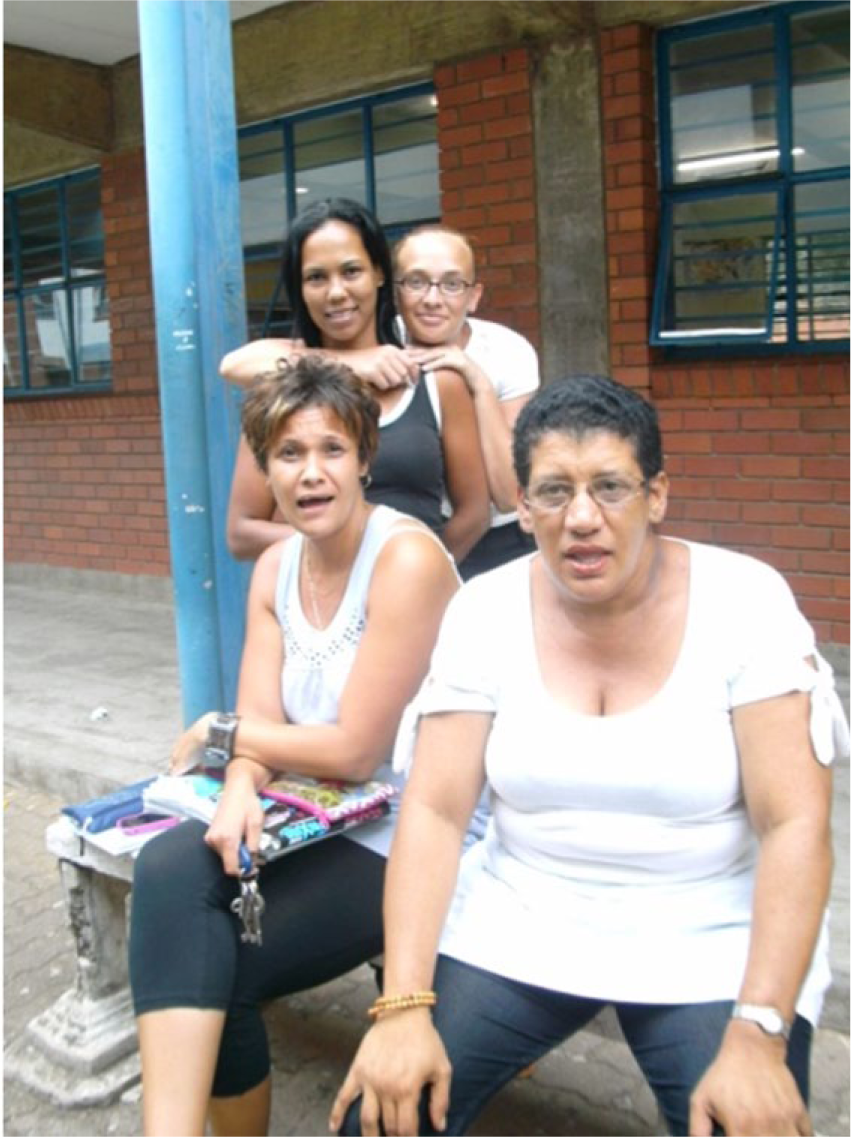
Having the youth gather information and observe their families and friends altered the power dynamic between the professional researcher and informant. Using photography created a more open and honest portrayal of the people. The images they brought back were full of daily life that was engaging, and their vocal input was thoughtful and profound (see Figure 5). Later, as a group, we chose the best images to be exhibited. We displayed their work in community centers in their neighborhoods and a final collective exhibition in an art gallery in central Durban. Initially, the audiences were mainly people from the communities, but people from other demographics joined by the final exhibitions. Audience members were in awe that these youngsters, with no formal training, were able to take such poignant photographs. This was their chance to challenge official ideas that Coloureds only exist in the Cape and are urban gangsters. PEP gave the youth the ability to talk back to stereotypes in ways that were sometimes playful and disarming (see Figure 6).

Youth of Ghosttown by “Benji,” age 17, 2011.

Untitled by Jenay Jasson, age 16, 2011.
Displays
At one of the community exhibitions in Wentworth, Durban, I approached the father of one of the participants as he analyzed a participant’s self-portrait. At first he pointed out obvious objects in the foreground; the books, the dumbbell in the girl’s hand, and the weights and calculator on her desk. He also noticed the awards and medals in the background. One thing he showed me that I missed was a mattress pushed up against the wall, behind the desk where the girl was sitting. The presence of that mattress, the bunk beds behind her, and the lack of space between her seat and the beds meant to him; “Even in a cramped space we are strong and can achieve!” He was so excited by the photo and the way it represented the Coloured community—full of tenacity and determination. The photo inspired him to relate his own struggles as a Coloured man and his own steadfastness in the face of adversity within the new government in the rainbow nation (see Figure 8).
In contrast, at the final show in a central Durban gallery, an outsider viewing the same photo interpreted the same photograph in a very different way. Instead of focusing on all the items surrounding the young girl, her attention was drawn to a T-shirt reading “Destination Black!” with the silhouette of a person doing a kick that was draped over the armoire. When I approached the middle-aged White woman to get her opinion, she stared at the photo and immediately focused on the T-shirt’s writing without acknowledging any of the other paraphernalia. “Look they’re all trying to be black!” The woman, of British descent in her late 40s, apparently missed the trophies and medals placed within view. She also missed the silhouette of a person doing a kick on the T-shirt and the black belt with white strip hanging beside it; all indicators that the young woman in the photograph was a martial artist. Instead, this White woman took the words out of context and, in so doing, the mental dross of racial fear surfaced.
Final Exhibition
After months of interviews, driving, and preparation, the final show was ready. Through the efforts a daughter of a Rotarian that worked at an art gallery, we were able to display the photos at The Collective Art Gallery on Durban’s trendy Florida Road. At the unofficial opening of the show, we invited Rotarians from Pinetown, my host club, people from the community, friends, and family. People were overwhelmingly supportive. Jean Choudree (a community liaison) expressed how nice it was to see the positive nature of the photos, the family orientation, and that the pictures were coming out with the message “We are Coloured and we are here.” She said it was very strong and each photo could be a story (see Figures 7-10). Many people were surprised that the images on display were from high school students. Ms. Choudree’s friends, a young Coloured family with her, expressed their enjoyment because the exhibition,
“Didn’t portray a bunch of stereotypes.”
Untitled by Natasha Jasson, age 17, 2011.

Self-portrait by Michaela Ruiters age 16, 2011.

Family by Taryn Deckford, age 14, 2011.

Family Portrait by Che’leigh Miller, age 16, 2011.
A reporter from an independent newspaper covering the opening at The Collective commented, “Being part of this project was a great experience for these youth and they learnt so much about their communities and themselves as well.” One PEP participant confided to the reporter “that she used to be withdrawn and unfriendly but that has since changed. Her participation in the project made her open up to other people.” Another participant, Tatum Lambert, told the reporter,
People believe that when you come to Wentworth you will see young girls walking around pregnant, people drinking and smoking around every corner but it is not like that, there are some people in Wentworth that want to make a life for themselves.
On reflecting upon the project Natasha Jasson said,
This project has made me learn more about myself as a Coloured and what other people think and expect of me. It has made me make new friends and learn more about other people. It has allowed me to go out and tour . . . in a different way, both more creative and more seriously in the sence [sic] that I didn’t know a lot about . . . The project made me look at everything and everyone around me in a different way.
At the same time, they also wanted to make people aware that there are real-life problems with in the communities, problems that might parallel those in other communities.
Conclusion: Connecting the Coloured Dots
According to Baron and Cara (2003), the term creole has been co-opted to apply universally, especially in the face of increased globalization, migration, international commerce, diasporas, and cyberspace. Each aspect has the power to contribute to culture contact and creolization.
Cultures that seem Europeanized on their surface, as Coloureds do, may actually be deeply creole, masked by camouflages that are themselves “tricks” of creolization. One main issue that concerns this particular working class, creole communities living in KZN province is representation. Their concern for education and employment directly correlate with sociopolitical presence of community leaders. As a minority demographic in South Africa, Coloureds are often overlooked, especially in parts of the country where territory was not designated for them.
Because they are the result of multigenerational, multiethnic unions—which varied between culturally and legally sanctioned marriages to morally and socially disparaged carnal liaisons (depending on prevailing attitudes)—their histories are as varied as the families that make up the communities. However, the point of convergence that unifies these communities is the ambiguity of who they are as a people and the overlapping structures that service or oppress them. Although each family may have different proportions of African, Asian, or European genes, the fact that they have them and that they have been classified as Coloured unifies them. That they accept publically or privately this identity unifies them. Furthermore, the familial ties by blood and marriage further concretize Coloured communities. This is why PEP was so important for the families and youth involved, for the bystanders watching the meetings, and for the audiences viewing the final exhibitions. Although their stories have yet to be legitimized in schools, popular media, academic literature, or government discourse, Coloured people create their own narratives. When given the opportunity to engage the outside world, these people readily welcome the opportunity to educate and learn. This project aided a larger project in academia that allows people to be heard at multiple levels.
How we define text, as both a word and potential object to be “read,” is vitally important in in academic programs. How we read histories of peoples, and therefore our ability to make knowledge of a people, is contingent on how we define text. (Cranford-Gomez, 2008, p. 94)
KZN Coloureds are a unique creolizing of linguistic, religious, moral, and genetic markers. While British colonialism and Apartheid aided in creating separate Coloured categories through SANAC, censuses, and Apartheid legislation (the Population Registration Act, Immorality Act, and Group Areas Act) that prevented mass assimilation into the contributing ethnic groups, Coloured identity continues after over 20 years of South Africa’s full democratization. Hendricks (2001) notes that identities were conferred to Coloureds in general through a “process of differentiation” (p. 32), which often resulted in the internalization of differentiation based on their liminal identities and status. Because Coloureds in KZN were subjected to the same race-based legislations that affected other people of color, a separate identity for Coloured people became more than a top-down process. People gave meaning to lived experiences and became active participants in defining group boundaries. In areas where Coloured people lived, Apartheid physically forced together dispersed groups of heterogeneous people through racial classification. Simultaneously, Apartheid legislation like the Group Areas Act divided existing communities and redefined them to fit racial parameters. These spatial determinants became highly important in the formation of identity and memory.
Generally speaking, all people experience and form memories in relation to the places they play, work, and live. For youngsters especially, the spaces of home and feelings of togetherness help them grow up and build confidence and independence. The blending of sights, smells, sounds, touch, and taste link people to a space and a community creating memories and in the end an identity (Field, 2001, p. 100). The affiliated memories and present actions in particular spaces give different agency to individuals to maintain and decide what relationships and identities to nurture. For instance, the independent fierceness of their Zulu and Swazi ancestors, the frontier spirit of their Afrikaner and British progenitors, and the ingenuity of their East Indian relations created a steadfast ability to maintain a separate Coloured identity, while embracing elements of the foundation cultures. Despite KZN-Coloured proclivity to English, unlike their Cape counterparts that speak Afrikaans, and despite the facts that they wear Western clothing and participate in a global economy, if one scratches the Europeanized surface of a Coloured community, family, or individual, the outsider will find a deeply creole people upon closer examination. The appearance of assimilation, whether under Afrikaner or African domination is the camouflage that enabled the group to survive both colonial and postcolonial projects. Like Baron and Cara say these are the “tricks of creolization” or what James C. Scott (1985) would call weapons of the weak. In KZN, since the creolization process occurred in rural areas, pockets of what would become Coloured people were founded on familial bonds. Coloured families congregated during celebrations and intermarried. Despite greater freedoms of intermingling between distinct peoples and cultures in “the bush,” these peoples and cultures who had multiple cultural and biological origins often came together to form distinct communities. Where KZN Coloureds diverge from Cape Coloureds is the history of slavery (which is a large focus in the Western Cape), the mercantilist ties to the VOC, and the slow-growing urban population that created a separate creole people. With this said, there was and continues to be a constant give and take between the Cape and KZN that stems from cultural material as well as an exchange of people.
Each exhibition showed the interconnectedness of multiple Coloured communities in KZN and beyond. In one instance after visiting the final exhibit in Durban, Diane Botha (one of my key informants that lived in Johannesburg) called to express her support. After complimenting the efforts of the youth, she revealed her surprise at seeing her former bridesmaid’s photo hanging in the show. The narratives and conversations that were sparked because of the exhibitions revealed tangible evidence of a cohesive Coloured community. The photo exhibits and the interviews brought out stories and connections that were not readily apparent when observing or interviewing people. In some cases, by attending or participating in the shows, it reunited friends and family and reconnected them with places of origin. The PEP enabled the youth to be part of a collection of storytelling they would not normally be patient enough to hear. The exhibitions gave youth and elders common ground. In other instances, it helped open students up to dormant talents (see Figure 11).

Self-Portrait by Tatum Lambert, age 16, 2011.
In many cases, South African education institutions are overburdened, teachers overworked, and students are under tremendous pressure from peer and familial responsibilities. Schools try to teach the basics, and teachers hope for success. Coloured children see little representation in the curriculum or government, so they look to family members and community for models. According to Bronwynn Anderson (2009), “What is signified by the term Coloured is varied, heterogeneous and intricately intertwined with the social location” (p. 45). Differences reflected among individual families are demonstrated in their historical backgrounds, phenotypical characteristics, and cohesive, though troubled, identities. South African educators have yet to find a way to unpack the history and policies that lead to a creole people. “The specific cultural context of Coloured determines and defines certain character traits and behaviours, and the way in which space and identity are mutually constitutive provides a backdrop for understanding the distinctiveness” (Anderson, 2009, p. 45) of KZN Coloureds. Some ways of expressing these identities are seen as positive, while others negative. These multiple ways of being were captured by the youth without judgment. The photos reflected life and their identities, however raw it might have appeared. Whether the exhibition was in a church hall, a center for the elderly, or at a professional gallery, when the youth and their family saw the photos up on the walls, they were proud and excited to see their work printed out and on display because they became their own models and creators.
Footnotes
Declaration of Conflicting Interests
The author(s) declared no potential conflicts of interest with respect to the research, authorship, and/or publication of this article.
Funding
The author recived financial support for this research from Rotary International Foundation (2009/2010) and the Fulbright-Hays Dissertation Fellowship (2010/2011).