




Abstract
Pornography use has become more commonplace since the advent of high-speed Internet, yet there is little investigation that is exclusively targeted to women’s use of pornography. Given the paradox of viewing mainstream Internet pornography, which often portrays the objectification of and violence toward women, we compared heterosexual collegiate women (n = 168) who use Internet pornography with women who do not on several different attitudes and behaviors that are central to women’s sexual development and wellbeing. Women who use Internet pornography had a higher endorsement of rape myths, a higher number of sexual partners, and engaged in more body monitoring. However, there were no differences in attitudes toward women between pornography users and nonusers. Results are interpreted through sexual scripting and objectification theories.
“Pornography” and “sex” are reported to be the most heavily searched terms on the Internet, comprising roughly 25% of all searches (Carroll et al., 2008). Among pornographic search terms in Google, “free rape porn” has become one of the fastest growing search terms since 2005 (Makin & Morczek, 2015), suggesting that online exposure to violence against women is becoming more socially acceptable. The Internet has become the central vehicle for distribution of pornography, which has altered the way individuals use pornography in three major aspects. First, the Internet makes pornography available, because nearly everyone has Internet access; second, the use of pornography has become anonymous, because one can access Internet pornography without anyone else knowing about it; third, the Internet makes pornography affordable, because one no longer has to purchase a VHS or DVD as the majority of Internet pornography is free (Cooper, McLoughlin, & Campbell, 2000). The increased accessibility of Internet pornography could explain why a study of high school students in the United States found that students are exposed to pornography online a few times per month, compared with exposure to pornography in movies or magazines a few times per year (Chang et al., 2016). However, there are meaningful differences in the nature and dynamics of pornography use between the sexes.
In general, prior work on Internet pornography use among men has found that more Internet pornography use is associated with more sexual preoccupation, less realistic attitudes toward sex, less enjoyment of real-life sexual experiences, and more reliance on Internet pornography to become sexually aroused or maintain arousal with a partner (Bridges, Sun, Ezzell, & Johnson, 2016; Peter & Valkenburg, 2008; Sun, Bridges, Johnson, & Ezzell, 2016; Tsitsika et al., 2009). However, despite the growing body of research devoted to the study of female sexuality (Hensel, Fortenberry, O’Sullivan, & Orr, 2011), very little research focuses on Internet pornography use among heterosexual women specifically. This lack of research is most likely due to reports that men use pornography more than women (Hald, 2006; Hald & Stulhofer, 2016). However, the lack of female focus may also be due to studies demonstrating that popular pornography portrays violence toward and objectification of women (Bridges, Wosnitzer, Scharrer, Sun, & Liberman, 2010; Klaassen & Peter, 2015), evident in the ways the female body is displayed and genuine female pleasure is largely ignored. Thus, the notion of women consuming such material is not as easily conceivable as men consuming such material. Moreover, the sexual double standard, or the belief that men are naturally oriented toward sexual behavior, whereas women are not, remains omnipresent in our current culture (Bordini & Sperb, 2013), contributing to pornography use among women being more taboo than it is for men. Thus, the act of using Internet pornography as a woman, both in terms of its portrayal of women and its use to stimulate sexual arousal, can be a paradoxical act, warranting research which examines differences in sexual attitudes and behaviors among women who do use Internet pornography compared with women who do not.
Sexual Socialization of Women
Sexual scripting theory posits that sexuality goes beyond biology, explaining that cultures develop unique traditions and rules that make-up a “script,” similar to a script that an actor would use to perform in a play. According to sexual scripting theory, humans use sexual scripts to perform sexuality as dictated by cultural norms (Gagnon & Simon, 2005). Via social learning, observations of how others act sexually through real life and/or fictional experiences in media, a sexual script is formed-which directs subsequent behaviors as well as psychosexual development (Ward, 2003). Traditional media (e.g., film, magazines, and television) have been identified as a primary source of gender and sexual socialization specifically via sexualized imagery (L’Engle, Brown, & Kenneavy, 2006; Ward, 2003). Given that Internet pornography is inherently more sexually explicit than traditional media (Štulhofer, Buško, & Landripet, 2010), and has greater accessibility (due to mobile phone access) than traditional media (Vanden Abeele, Campbell, Eggermont, & Roe, 2014), it is likely a primary agent of sexual socialization and in part, contributes to the formation of sexual scripts among today’s media-saturated youth.
Content analyses of the most popular pornography over the last 10 years consistently report aggressive depictions of sexuality and power differentials between men and women across mediums. For example, 48.8% of scenes contain verbal aggression consisting of insults, threats, and coercive language and 88.2% of scenes contain physical aggression such as slapping, forced gagging during fellatio, and choking (Bridges et al., 2010). Indeed, Internet pornography has been found to portray more instances of sexual violence than pornography in magazines or DVDs (Barron & Kimmel, 2000). Internet pornography has also been found to depict women as submissive sexual objects more often than men, particularly in amateur pornography (Klaassen & Peter, 2015). The acceleration of sexual aggression in Internet pornography is demonstrated by the growing popularity of rape porn searches and rape sites with many of them hosting real webcam footage depicting sexual assault against women (Gossett & Byrne, 2002; Makin & Morczek, 2015). The ubiquity of this kind of material is alarming as sexual objectification theory posits that through repetitive representations of sexualized girls and women within a culture, boys learn to treat women as sexual objects, and girls learn to perceive themselves as sexual objects (Fredrickson & Roberts, 1997; McKinley & Hyde, 1996). Thus, due to the content of popular pornography (Barron & Kimmel, 2000; Bridges et al., 2010; Gossett & Byrne, 2002; Klaassen & Peter, 2015; Makin & Morczek, 2015), consistently consuming such objectifying and sexually aggressive media could begin a process by which individuals view women as sexual objects and violence toward women as normative. This process could explain why a recent meta-analysis revealed that viewing pornography was positively associated with real-life sexual aggression (Wright, Tokunaga, & Kraus, 2016). However, given the aggressive and often disturbing content of popular Internet pornography, there is a need to evaluate differences in women (and not just men) who do or do not use Internet pornography.
Limitations of Prior Studies on Pornography Use Among Women
Much of the prior and current literature primarily focuses on men’s pornography use, with fewer studies also investigating gender differences in pornography use. Although there has been a plethora of work which examines women’s use of other sexualized media, such as music videos, less research examines pornography use specifically among women, despite some evidence that women are the fastest growing demographic of pornography users (Nielson/Net ratings, 2011). Indeed, a survey by Marie Claire magazine (“Women’s Porn Habits Study,” 2015) showed that 31% of women watch Internet pornography once a week or more, although a current empirical report shows that roughly 9% of women watch Internet pornography once a week or more (Bridges et al., 2016). Although it is difficult to obtain accurate statistics of how many women use Internet pornography and at what age they begin using it, on average, adult women report using pornography about once per year (Bridges et al., 2016), with 62.1% of women reporting first exposure to Internet pornography before the age of 18 (Peter & Valkenburg, 2016; Sabina, Wolak, & Finkelhor, 2008). The present study aims to fill the gap between market research statistics and male-focused academic research to bolster a greater understanding of Internet pornography use among women.
Prior work regarding the impact of various media exposures on female sexual socialization indicate that women are affected differently than men. In a longitudinal study which included men and women, findings demonstrated that men’s use of pornography was linked to later body dissatisfaction, yet women’s use of pornography was unrelated to their body dissatisfaction (Peter & Valkenburg, 2014). Another study demonstrated that women who thought they were “addicted” to online sexual activities were much more drawn to online stories about sex and interacting in sex chat rooms, whereas men were more attracted to pornographic images (Schneider, 2000). In an experimental study conducted by Behm-Morawitz and Mastro (2009), female college students were randomly assigned to either play a sexualized female character or a nonsexualized female character in a video game. Participants who played the sexualized character reported less self-efficacy after playing, implying that sexualized depictions of women may affect how women view themselves and their competency in the real world. In addition, women who have internalized sexualized mass media are more likely to be higher in body surveillance than women who have not internalized sexualized mass media (Calogero & Thompson, 2009). Therefore, both experimental and correlational work has shown an effect or linkage between sexualized imagery and women’s psychosexual development, warranting more research in this area.
It has also been shown that women have a distinct psycho-physiological experience from men while viewing pornography. In a meta-analysis, men and women had comparable levels of physiological arousal measured by genital blood volume, yet women were more likely to rate a pornographic scene as disturbing, wrong, or degrading, regardless of their state of physiological arousal (Allen et al., 2007). Gender differences in physiological and psychological arousal to pornography suggest that either women find pornography arousing but feel a social pressure to report that they do not, or that women can be physiologically sexually aroused by something they find morally wrong psychologically. In a recent study of Internet pornography users and non-Internet pornography users, female pornography users reported being more aroused and had higher indicators of sexual craving when shown pornographic images than non-Internet pornography users (Laier, Pekal, & Brand, 2014). In addition, elevated levels of severe psychological symptoms (e.g., depression and anxiety) and sexual dysfunction both predicted tendency toward cybersex addiction among the pornography users (Laier et al., 2014). This finding suggests that pornography may be used by women who are more psychologically distressed or that pornography use may not be beneficial to women’s psychological well-being. Thus, it is important to research women’s use of Internet pornography as it seems to pose a psychological and physiological paradox compared with men’s use of Internet pornography.
Pornography Use and Sexual Behavior
Prior research on pornography use and sexual behavior has mostly been conducted among adolescents and male adults. For example, correlational research among adolescents has shown that exposure to pornography is associated with more frequent sexual activity (Braun-Courville & Rojas, 2009; Peter & Valkenburg, 2016) and less frequent use of contraceptives (Peter & Valkenburg, 2016; Wingood et al., 2001). Early exposure to Internet pornography is associated with early onset of sexual behavior (Kraus & Russell, 2008). Furthermore, exposure to pornography accounts for more of the variability in an adolescent’s decision to have sex than parents, religion, or school (Kingston, Malamuth, Fedoroff, & Marshall, 2009). Among male adults, Internet pornography use is positively associated with having multiple sex partners, engaging in paid sex, and engaging in extramarital sex (Wright & Randall, 2012; Wright, Tokunaga, Kraus, & Klann, 2017). However, less is known about the association between Internet pornography and sexual behavior among adult women. Understanding how Internet pornography use and sexual behavior are associated among women would lead to a new understanding of female sexuality, given that sexual behavior is more normative during young adulthood (compared with adolescence), yet pornography use remains taboo for women (compared with men) (Bordini & Sperb, 2013; Tolman & McClelland, 2011).
Pornography Use and Attitudes Toward Women and Sexual Aggression
Research on pornography use prior to the Internet focused on violence toward women and endorsement of rape myths, with the bulk of this research focusing on the role pornography plays in perpetration of sexual violence. In one seminal study, Zillmann (1988) found that prolonged exposure to pornography among men in an experimental setting fostered a preference for explicit content that featured some degree of violence. Furthermore, prolonged exposure to both violent and nonviolent pornography decreased sensitivity toward victims of sexual violence, increased men’s belief in their own propensity for forcing particular sex acts on reluctant female partners, and increased men’s belief that they are capable of committing rape. Therefore, it is not surprising that across 22 studies worldwide, pornography use (both offline and online) is positively associated with actual acts of sexual aggression (Wright et al., 2016). After the advent of high-speed Internet, Sabina et al. (2008) found that boys below the age of 18 who had repeated exposure to pictures of sexual violence were more likely to view acts of sexual aggression positively. Similarly, in a survey of Dutch adolescents, exposure to Internet pornography, but not other mediums of audio-visual sexualized depictions, was positively associated with a stronger belief that women are sex objects (Peter & Valkenburg, 2007). Thus, exploring differences in attitudes toward women and sexual aggression among female pornography users and nonusers is needed to further elucidate differences that may have not been revealed in studies that included men, which would have required multiple interactional tests, limiting power of detection.
Pornography Use and Body Monitoring
Women who have a positive body image are higher in sexual assertiveness and sexual esteem, lower in sexual anxiety, and experience fewer sexual problems than women with a negative body image (Weaver & Byers, 2006). Furthermore, greater dissatisfaction with genital appearance is associated with more body monitoring during physical intimacy with a partner, which is in turn associated with lower sexual esteem, sexual satisfaction, and motivation for avoiding risky sexual behavior (Schick, Calabrese, Rima, & Zucker, 2010), suggesting that self-perception of the female body is an indicator of sexual well-being. In terms of media, prior work has found that female adolescents who consume more music television in turn self-objectify and experience more anxiety and lower body esteem (Grabe & Hyde, 2009). In contrast, a study investigating Internet pornography specifically, showed that Internet pornography use is unrelated to young women’s body satisfaction (Peter & Valkenburg, 2014). However, no research to our knowledge has investigated how adult women differ in the monitoring of their bodies based upon their Internet pornography use. Such knowledge would lead to a more thorough understanding of the role sexualized media play in women’s body monitoring.
Current Study
In an attempt to expand on previous research on pornography use and female sexuality, the current study examines differences in sexual behavior, attitudes toward women, endorsement of rape myths, and body monitoring among collegiate women who do or do not use Internet pornography. Prior work has predominately focused on other sexualized media (e.g., music videos and magazines) among women or Internet pornography use among men, with very little work examining Internet pornography use among women exclusively. In accordance with sexual scripting and objectification theories as well as prior studies of adolescents and male adults, we hypothesize that women who use pornography will have more sex partners, more negative attitudes toward women, a higher endorsement of rape myths, and be higher in body monitoring than women who do not use pornography.
Method
Participants and Procedure
The participants (n = 168) were heterosexual female college students from introductory psychology classes at a northwestern university who participated in this study to fulfill a course requirement. Participants ranged in age from 18 to 29 years old, M(SD) = 21.3(1.9), and 52% identified as European American, 16% Asian American, 13% Latina American, 13% Multiracial/Ethnic, and 6% African American. They did not receive any payment for their participation. Participants completed the following paper and pencil questionnaires for measurement of all study variables alone in a private room.
Measures
Internet pornography use
This variable was measured with two items created for this study to indicate how often a participant has been intentionally viewing pornographic websites in the recent past. Pornographic websites were defined for the participants as “websites containing content showing genitals and sexual behavior in unconcealed ways with the aim of arousing the viewer.” Participants were asked, (a) “How frequently did you visit pornographic websites online within the last 3 months?” Participants answered on a 5-point Likert-type Scale. Participants could indicate, never, more than once per month, more than once per week, several times per week, or everyday; (b) “How frequently did you visit pornographic websites online within the last 12 months?” Participant scores were then averaged together to provide one score which was a mean of the two items above. Given the zero-inflated distribution, participants with a zero were coded as zero, and participants with an average of one or higher were coded as one to create a dichotomous variable which indicates that a participant either consumes pornography or does not.
Number of sex partners
This variable was measured by an item created for this study. Participants were asked, “How many partners have you had oral, vaginal, or anal sex with in your lifetime?” Participants could indicate any numerical value in response. Oral sex was defined as “A mouth making contact with genitals.” Vaginal sex was defined as “A penis entering a vagina.” Anal sex was defined as “A penis entering an anus.”
Attitudes toward women
This variable was measured with the Attitudes Toward Women Scale (Spence & Helmerich, 1972). This scale measures attitudes toward women in the areas of vocational and intellectual roles (“There are many jobs in which men should be given preference over women in being hired or promoted”), freedom (“A woman should not expect to go to exactly the same places or to have quite the same freedom of action as a man”), independence, dating and courtship (“A woman should be as free as a man to propose marriage”), etiquette and drinking (“Intoxication among women is worse than intoxication among men”), language (“Swearing and obscenity are more repulsive in the speech of a woman than of a man”), sexual behavior (“Women should be encouraged not to become sexually intimate with anyone before marriage, even their fiancés”), and marriage (“Women should worry less about their rights and more about becoming good wives and mothers”). There were a total of 15 questions. A 5-point Likert-type Scale with anchors from strongly disagree to strongly agree was used to measure attitudes toward women. Higher scores indicate more positive/contemporary attitudes toward women and lower scores indicate more negative/traditional attitudes toward women. This measure had acceptable reliability in the current sample (α = .75).
Endorsement of rape myths
This variable was measured with The Acceptance of Modern Myths About Sexual Aggression Scale (Gerger et al., 2007). There were a total of 30 questions. A 5-point Likert-type Scale with anchors from strongly disagree to strongly agree was used to measure attitudes toward sexual assault. Higher scores indicate higher endorsement of the beliefs that women should be responsible for preventing their own rape (“Any woman who is careless enough to walk through ‘dark alleys’ at night is partly to be blamed if she is raped”), women cause sexual aggression through their dress or behavior (“When a single woman invites a single man to her flat she signals that she is not averse to having sex”), sexual assaulters are punished justly (“Nowadays, men who really sexually assault women are punished justly”), some acts of sexual aggression are warranted (e.g., “It is a biological necessity for men to release sexual pressure from time to time”), and sexual violence is exaggerated (“The discussion about sexual harassment on the job has mainly resulted in many a harmless behavior being misinterpreted as harassment”). This measure had acceptable reliability in the current sample (α = .88).
Body monitoring
This variable was measured with the eight-item Body Surveillance subscale of The Objectified Body Consciousness Scale (OBCS; McKinley & Hyde, 1996). Items (e.g., “I often worry about whether the clothes I am wearing make me look good”) were rated with a 5-point Likert-type Scale with anchors from strongly disagree to strongly agree. Item responses were averaged, and higher scores reflect more body monitoring thoughts and behaviors. This measure had acceptable reliability in the current sample (α = .89).
Results
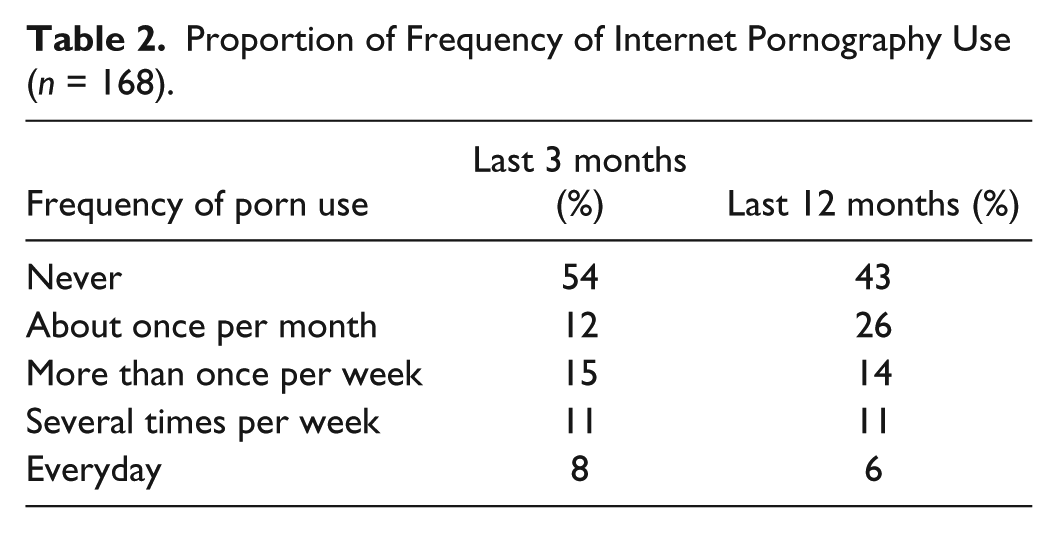
Table 1 displays the descriptive statistics for each measure. Table 2 displays the percentage of pornography use within the last year. Table 3 includes the Pearson correlation coefficients for study variables. More frequent pornography use was associated with higher endorsement of rape myths, having more negative attitudes toward women, having more sex partners, and more body monitoring. Participants who had higher endorsement of rape myths monitored their bodies more, had more negative attitudes toward women, and used more pornography.
Range, Mean, and Standard Deviation for All Measures (n = 162-168).
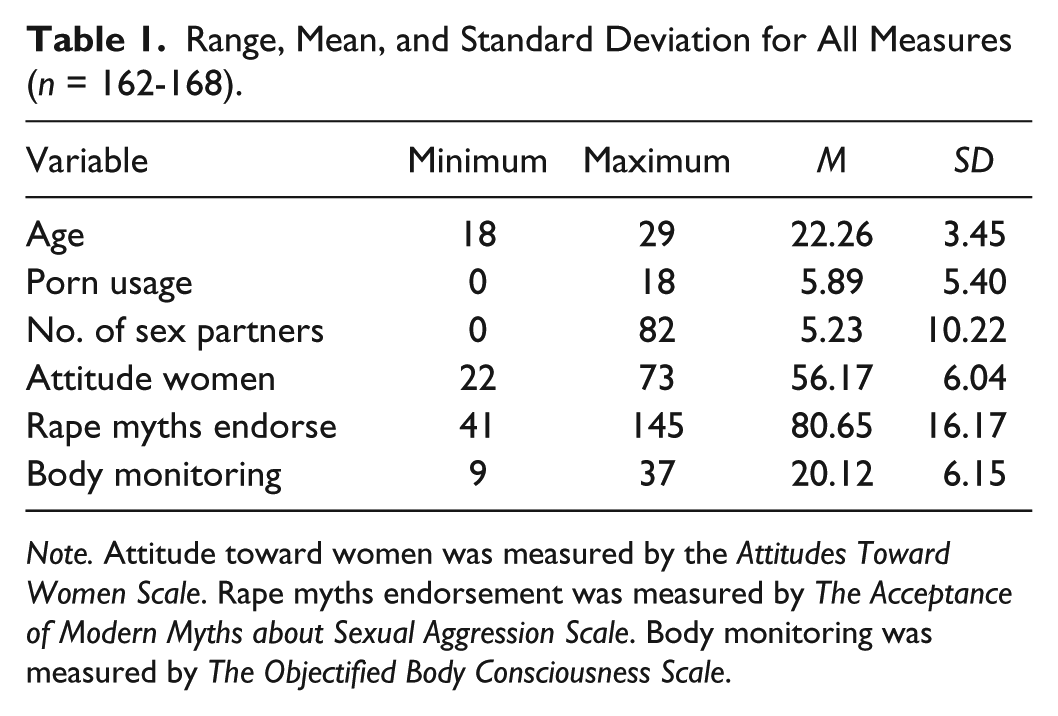
Note. Attitude toward women was measured by the Attitudes Toward Women Scale. Rape myths endorsement was measured by The Acceptance of Modern Myths about Sexual Aggression Scale. Body monitoring was measured by The Objectified Body Consciousness Scale.
Proportion of Frequency of Internet Pornography Use (n = 168).
Intercorrelations Between All Study Variables (n = 103-168).

Note. Attitude women = Attitudes Toward Women Scale; Rape myth endorse = The Acceptance of Modern Myths about Sexual Aggression Scale; Body monitoring = The Objectified Body Consciousness Scale.
p < .05 alpha level. **p < .01 alpha level.
MANOVA Results
In addition to a correlation procedure, a MANOVA procedure (Barker & Barker, 1984) was applied to distinguish group differences in attitudes toward women, endorsement of rape myths, number of sex partners, body monitoring, and pornography distress between participants who used pornography and participants who did not. Wilks’s Lambda criterion was used to evaluate multivariate significance. A Bonferroni correction was applied to decrease the chance of a Type I error, and to distinguish statistical significance from a trend.
Table 4 displays the MANOVA results. The Omnibus test indicated that participants who did not use pornography differed significantly from participants who did use pornography, F (4, 164) = 13.92, p < .01. One-way ANOVAs were employed as follow-up tests. In support of our hypothesis, those who used pornography had significantly more sex partners (M = 20.14, SD = 14.51) than those who did not use pornography (M = 4.66, SD = 3.86); those who used pornography (M = 87.63, SD = 16.60) had a higher endorsement of rape myths than those who did not use pornography (M = 76.79, SD = 16.93); those who used pornography (M = 25.66, SD = 4.12) were higher in body monitoring than those who did not use pornography (M = 10.23, SD = 3.23). Contrary to our hypothesis, those who used pornography (M = 55.63, SD = 7.12) did not have more negative attitudes toward women than those who did not use pornography (M = 60.75, SD = 7.15).
Multivariate Analysis of Variance Summary for Pornography Use Among Women (n = 162-168).

Note. Attitudes toward women was measured by the Attitudes Toward Women Scale. Endorsement of rape myths was measured by The Acceptance of Modern Myths about Sexual Aggression Scale. Body monitoring = The Objectified Body Consciousness Scale.
p < .05. **p < .01.
Discussion
This study aimed to provide a closer look at differences in a variety of factors between collegiate women who do and do not use Internet pornography. Analyses of these self-reported data yield several interesting results. Women who do use Internet pornography are more likely to endorse rape myths, have more sex partners, and are higher in body monitoring than women who do not use pornography. However, participants did not differ on their attitudes toward women based upon their pornography use status. Although it cannot be concluded that Internet pornography use caused these outcomes, these results suggest that women who do use Internet pornography have a different sexual attitude and behavior profile than women who do not use Internet pornography, thus future research that examines directional influence in this area is needed.
Our finding that participants who use more Internet pornography also have more sex partners compared with participants who do not use Internet pornography complements prior work which demonstrates that viewing sexualized media in movies, television, and magazines is associated with more sexual behavior among female adolescents (Brown et al., 2006). Admittedly, Internet pornography use and the choice to have more sexual partners could be the result of these women believing that they are challenging the sexual double standard which suggests men should be more overtly sexual than women (Bordini & Sperb, 2013). In addition, given that it is normative to engage in sexual behavior in young adulthood (Tolman & McClelland, 2011), it is difficult to determine if a higher number of sex partners is actually a sign of risk without a more comprehensive measure of sexual safety precautions taken among young adults. Therefore, future research on female sexual behavior or sexual health should include Internet pornography use to understand its role in the context of a wide array of sexual behaviors.
Contrary to our hypotheses, women who used Internet pornography did not differ in their attitudes toward women than women who did not use Internet pornography. However, in the correlation procedure, more Internet pornography use was associated with more negative/traditional attitudes toward women, suggesting that frequency of use might be driving the association. Given that participants with higher Internet pornography scores (e.g., 10-15) were coded the same as those with lower scores (1-10), the variance in Internet pornography use was significantly reduced in the group differences test. Thus, future research should aim to assess the frequency of a variety of sexual media use with a comprehensive and contemporary measure of attitudes toward women.
Consistent with our finding of a higher endorsement of rape myths among women who do use Internet pornography compared with women who do not, meta-analyses show that exposure to sexually explicit material can cause trivialization of sexual aggression in experimental research and that consumption of sexualized material is associated with more positive attitudes toward violence against women in correlational research, with more violent content having a stronger effect (Allen, Emmers, & Gebhardt, 1995; Mundorf, D’Alessio, Allen, & Emmers-Sommer, 2007; Wright et al., 2016). Moreover, college women report that they expect to experience some form of sexual violence just for being female, whereas men do not expect to experience sexual violence (Maas, Shearer, Gillen, & Lefkowitz, 2015). Our results, in conjunction with these other studies, suggest the need for education that can use sexual media examples to teach young people how to be critical of media that sexualizes violence against women and knowledgeable about the reality of sexual violence and rape myths to insure they do not grow up trivializing sexual violence perpetrated against women.
Our finding that participants who used Internet pornography engaged in more body monitoring is similar to other work which found women’s perceptions of their own bodies (in their own or a partner’s eyes) can be negatively affected as a result of using pornography (Albright, 2008). However, our results do not necessarily align with prior work which shows that Internet pornography consumption was associated with more body monitoring, negative body image, as well as anxiety and avoidance in romantic relationships among college men, but not women (Tylka, 2015). However, in that study, self-objectification mediated the association among college women such that women who see themselves as objects and consume pornography engage in more body monitoring, hold a more negative body image, as well as anxiety and avoidance in romantic relationships, than women who do not self-objectify (Tylka, 2015). With prior work demonstrating that adolescents who view sexually explicit media have a higher endorsement of women as sex objects (Peter & Valkenburg, 2007), it is possible that body monitoring is serving more as a proxy self-objectification in our study. Objectification theory posits that one of the consequences of viewing sexual objectification is sexual self-objectification, which is the process of taking the “viewer perspective” on the self and perceiving oneself as a sexual object instead of thinking of oneself as a multidimensional human being (Fredrickson & Roberts, 1997). Thus, future research that tests self-objectification as a mediator of Internet pornography use and other outcomes such as the endorsement of rape myths would be valuable to extend the understanding of these associations and the consequences of Internet pornography use.
Limitations and Future Directions
Although this study contributes to the literature by testing differences in sexual and body monitoring behaviors, attitudes toward women and sexual violence among women who use Internet pornography and women who do not, there are a few limitations that deserve mention. First, our sample was an all-female collegiate sample, therefore results cannot be generalized to noncollege-attending women. Second, themes of aggression and humiliation toward women in the Internet pornography used by the participants were not measured. Given Mundorf et al.’s (2007) finding that aggressive content is a significant contributor to viewing sexual aggression more favorably, measuring aggression levels of the content the participants viewed would have likely contributed to the interpretation of the current results. Third, due to the cross-sectional design of this study, we cannot determine a causal direction between attitudes or behavior and Internet pornography use. For instance, it could be just as likely that women who have a higher endorsement of rape myths seek Internet pornography. It could also be that women who have a higher sex drive express it through pornography use and sexual behavior with more partners. Therefore, future research should investigate these associations longitudinally to provide evidence for a direction of effect. Fourth, the current study did not measure the quality or safety of the sexual experiences that these women were having with their partners. For example, a woman who has a high number of sex partners she is using contraception with, feels respected by, and is receiving pleasure from, could be someone who is high in sexual competency and not high in risky sexual behavior. Therefore, future research should have a more nuanced measure of sexual behavior in conjunction with pornography use. Finally, the Attitudes Toward Women Scale (1972) is an older measure which may not be a reliable one given the advancement in women’s roles over the last two decades. Future research utilizing an updated measure may find differences in the association between attitudes toward women and Internet pornography use.
Conclusion
Pornography has never been as accessible and popular among young women as it is today (Carroll et al., 2008; Vanden Abeele et al., 2014). The Internet has made pornography use mainstream and commonplace (Cooper et al., 2000), providing a new source of sexual socialization that warrants further investigation into its influence on attitudes about sexuality and women. Results suggest that female college students’ Internet pornography use is relatively common. Given associations between pornography use and sexual behavior, pornography is potentially becoming another way that young women explore their sexual curiosity, in a cultural context that sends them mixed messages about their developing sexual selves (Bordini & Sperb, 2013; Klaassen & Peter, 2015; Tolman & McClelland, 2011). It is unclear the extent to which these women actively choose to consume Internet pornography, as opposed to complying with their partners’ desires for them to consume it. However, given the violence and degradation toward women in popular Internet pornography (Bridges et al., 2010; Klaassen & Peter, 2015) and associations between Internet pornography use and endorsement of the rape myth and body monitoring, it could be that pornography use is contributing to self-objectification among women. Therefore, future work should consider the content of pornography consumed, participants’ interpretation of what they are viewing, and a wider range of sexual behaviors to fully understand the role of Internet pornography in the sexual lives of women.
Footnotes
Acknowledgements
We would like to thank Dr. Lisa Bohon and Dr. Michele Foss-Snowden at Sacramento State University for their contributions to this article.
Declaration of Conflicting Interests
The author(s) declared no potential conflicts of interest with respect to the research, authorship, and/or publication of this article.
Funding
The author(s) disclosed receipt of the following financial support for the research, authorship, and/or publication of this article: This research was supported by the National Institute on Drug Abuse (F31DA039603). The interpretations of the findings do not neccesarily reflect the views of the funding agency.