



Abstract
This research analyzes the maturity level of business processes with the application of the Process and Enterprise Maturity Model (PEMM) in the light of Enterprise Architecture (EA). This is qualitative research, cross-sectional, and in the form of a multiple case study performed in science and technology parks in Brazil. A questionnaire conducted by semi-structured interviews, non-participant observations, and document analysis to gather information on the processes was applied to achieve the proposed objective. The finding revealed that 75% of the analyzed parks show signs that processes’ maturity results in optimal performance (Level 3) and can be integrated with other internal processes, maximizing the performance of these parks. Only one park was at Level 2, indicating that business processes led to better results when implemented from one organization. This study shows that even when enterprise capability is at Level 3, this does not help the process enablers rise from Level 2 to Level 3. This study’s originality lies in its showed that the maturity level of the analyzed parks and in making comparisons to identify discrepancies and future actions, considering their responsibility to transfer knowledge from science and technology institutions to the public and private sector.
Introduction
The business process is a well-documented theme in the literature. It is the definition of activities in the organizational environment, which together perceive the aims of the business (Weske, 2007). Thus, the business process can be defined as the execution steps of how an organization creates, presents, disseminates, and adds value to its actions in the organizational environment. The development strategies for any system or process are complex and require technical, social, economic, and knowledge skills to carry out practical activities (Patidar et al., 2018). It is a structure based on strategy, taking into account the different systems and procedures adopted. The purpose is to help link processes to aggregate resources to benefit actors (Correia et al., 2021; Osterwalder & Pigneur, 2010).
A methodology that enables the mapping and treatment of impacts resulting from change is necessary to guarantee that the strategy is implemented at all levels and areas in an orchestrated fashion (Romero, 2013). Enterprise Architecture (EA) is a means or methodology to describe business structures and processes that connect these structures (Antunes et al., 2011; Cavalcanti, 2009). EA is constructed through continuous improvement, mainly considering the organizational maturity related to the model, the business’s formalization, and an understanding of the importance of information systems to the organization (Sessions, 2007). EA is the understanding of the company’s vision and strategic plan in business development actions that correspond to the organization’s objectives so that it can create, in the future status, a business structure with principles and models compatible with its need for improvement (Gartner, 2014).
In the literature, found that in technological innovation environments, studies point to the theme of business models (Zott et al., 2011). Science and technology parks are included in these environments as instruments that induce sustainable and innovative development (ANPROTEC, 2008). The main objective of a science and technology park is to promote a culture of innovation and competitiveness, thus increasing the wealth of the region where it operates within and among technology-based companies and institutions (ANPROTEC, 2008). A science and technology park manages and stimulates, through institutional arrangements and quality installations, transferring technology and knowledge between research institutes, universities, companies, and the market (Bellavista & Sanz, 2009). Furthermore, it promotes the emergence and development of innovative companies installed through the process of creating companies, which is the incubation process.
In the context presented, science and technology parks can be considered relevant sources of creation and the qualification of technology-based businesses, characterized by the substantial aggregation of technology and innovation in products, processes, and services (Bellavista & Sanz, 2009). Therefore, parks must be managed by professionals who encourage and work the sharing of technology to promote actions and attitudes to improve the capacity of organizations installed and participate in the same business network (Ministério da Ciência, Tecnologia e Inovação [MCTI], 2013). Based on what was presented, the following question may be asked: what is the maturity level in science and technology parks considering the business processes developed in parks located in Brazil from the viewpoint of EA?
In the literature on the theme, some works carried out through systematic review were presented, such as (a) performance measurement (Patidar et al., 2018) and (b) performance measurement and maturity level (Jääskeläinen et al., 2020). Based on the application of maturity models, the research field is more precisely in software engineering and software development. Some examples of applications in these areas are consulting services, mechanical design and innovation activities, and the separation of duties in ERP systems (Wendler, 2012). More precisely, on the application of PEMM, a widely seen application is in the areas of health, textiles, hospital organizations (Buzzi, 2013), and petrochemical and oil products (Moreira, 2010). However, none of these studies deal with the application of PEMM to science and technology parks (Correia et al., 2021). In this context, there is a research gap on the implementation of the PEMM in science and technology parks, with a focus on the EA.
This article contributes to the literature by presenting related evidence of the maturity level of science and technology parks in an emerging Latin American country, allowing comparisons to be made between existing parks and identifying discrepancies and future actions, considering their responsibility to transfer knowledge from science and technology institutions for the public and private sector in Brazil. This analysis allows experience gathering about the park’s performance about the executed business processes. Second, it identifies attribute deficiencies, allowing a vision of where it is necessary to develop business processes in search of better performance (Hammer, 2007). Studies of science and technology parks have focused more on aspects of their economic impact, job creation, stimulus for nascent businesses, and their surroundings’ economic recovery, which are equally essential (ABDI, 2007). Thus, understanding the reality of science and technology parks can help create methodological support for safe guidelines about their management.
Theoretical and Empirical Framework
Business Architecture
The concept of Enterprise Architecture (EA) is the form of articulation or modus operandi of the various systems, structures, processes, and strategies that constitute a company (Nadler, 1994). Therefore, EA includes the integration of an organizations’ structure and organizational systems, taking into account the techniques and abilities, applications, and business processes in the corporate environment (Iyer & Gottlieb, 2004; Lankhorst, 2009). Based on the EA, it is possible to schematize an organization, starting with a business plan structured from a strategy, mapping the business activities, and aligning with the strategic plan. Then comes structuring information through specific systems that mechanize these business activities and identify the technological infrastructure available to manage these specific information systems (Belloquim, 2011; Correia et al., 2021).
An approach that centers on the management of businesses’ performance, which favors the creation of value and competitive advantages, is a Business Architecture (BA) structure (Mackay et al., 2008). BA creates the frameworks for EA, where the following aspects should be mapped: business processes and the people involved, the relationship between each, conceptions and the environment that govern its management models and evolution (Romero, 2013). In literature, business processes consist of tasks that, when performed in an appropriate sequence and according to the business rules, produce a determined outcome (Lomow & Newcomer, 2004).
According to Hickman (1993), the business process can be considered a group of logical activities associated with the use of the organization’s resources to conceive and develop a service or product. In the same line, the business process can be considered related activities, carried out logically to generate the defined result by an organization. Along the same lines, authors such as Beest et al. (2019), show that the business process has the ultimate goal of creating value for final customers.
Business processes define organizational goals, the products that the company hopes to produce, and the limitations and restrictions to be considered to achieve the goals and build a bridge between the organization’s present and future (Correia & da Veiga, 2019; Spewak, 1992). However, to focus on support for decision-making, through BA, business processes need to meet the requirements of reliability, integrity, and availability (Johnson et al., 2007). This action is necessary to identify the organizational metaprocess from which the other processes are developed from managing the business processes (Roman et al., 2017).
The Business Process methodology is arrived at through the Business Process Management (BPM) approach. According to Elzinga et al. (1995), BPM is performed through management techniques, methods and tools, and rigorous controls. The purpose is to customer satisfaction and the quality of the product, achieved through improved operations. In this line, authors such as Ko et al. (2009) highlight that BPM aims to enhance business processes quickly and assertively. To implement BPM is essential to analyze the following phases: (a) design, (b) modeling, (c) execution, and (d) monitoring and optimization for evaluating business processes (Elzinga et al., 1995; Van Der Aalst, 2004). These phases are also presented by Bystrzanowska and Tobiszewski (2018).
In addition to these fundamental phases, maturity models in BPM have attracted considerable attention from researchers. In recent years, BPM professionals and researchers have developed maturity models in different organizational contexts (Röglinger et al., 2012; Van Looy et al., 2011). These broadly include the Business Process Orientation Maturity Model (BPOMM; Aydiner et al., 2019; McCormack, 2001). The Open Group Architecture Framework (Alaeddini & Salekfard, 2013; The Open Group, 2009), Capability Maturity Model Integration (Rosemann & Bruin, 2005), PEMM (Hammer, 2007), the OPM3—Organizational Project Management Maturity Model (by Project Management Institute, 2003), and the BPMM (Object Management Group, 2008), which are among the most commonly referenced in the literature. Maturity models are theoretical models with pre-defined levels of maturity degrees for business process classes that show how these processes can evolve and meet the desired maturity level (Tarhan et al., 2015). The proposed model, which was developed based on a study of diverse companies over two decades, Hammer (2007) utilizes a broad scope and a high detail level.
In the literature (Carvalho et al., 2019), PEMM addresses the organization’s capability to manage specific processes and manage organizational resources by process management. PEMM can be applied to all organizational processes, allowing a single approach for the whole organization, an easy exchange of experiences, and rapid comparison results (Moreira, 2010). For this reason, it was selected for use in this study.
The advantage of PEMM is its flexibility and ease of application. In any scope of the business, it is possible to use this model to assess how the organization’s processes should be (Oliveira, 2017). Therefore, using the PEMM in this study is justified because it is a model that helps companies examine how to execute a process correctly. It identifies the people working on execution, the infrastructure of the elements used, the metrics used to assess strategies, and which executives are responsible for performance. Unlike other maturity models found in the literature, PEMM can be applied to any organizational method, in addition to processes involving the software and technology sectors. Also, it presents explanations of how to use it, limitations, real examples of use, and empirical evidence of the method for its application (Oliveira, 2017).
PEMM can measure the organization’s level of process maturity by selecting specific processes and measuring the organization’s level of process management maturity as a whole. In this way, a specific analysis of the organization’s processes, dissemination and sharing of knowledge about these processes and control of the results obtained is possible (Hammer, 2007). Another important differentiator of this model compared to others is that it is freely available to any company that wants to use it (Oliveira, 2017).
To facilitate understanding the model, Hammer (2007) isolated two distinct groups of attributes necessary for the exceptional performance of business processes: five process enablers and four organizational capabilities, as shown in Table 1. The process facilitators are design (projection and guidance on how the process should be carried out); executors (the skills and knowledge of the people who manage the process); owner (the senior executive’s ability and knowledge of the process and its results); infrastructure (management and information systems that support process execution and metrics (how the company performs process performance measurement) (Carvalho et al., 2019). The evaluation of the five enablers in the context of a given process defines the stage at which its management is found in the organization (Hammer, 2007). Thus, in the same company, different methods could be at different maturity levels.
Process and Enterprise Maturity Model.

Source. Moreira (2010) adapted from Hammer (2007).
Likewise, when it comes to enterprise capabilities, the following aspects are evaluated to define the maturity level of the organization: (a) leadership, (b) culture, (c) expertise, and (d) governance (Carvalho et al., 2019).
To AbdEllatif et al. (2018), the logic is that the higher the levels of enterprise capabilities, the higher the process enablers’ performance levels. In other words, more robust enterprise capabilities pave the way for stronger enablers and vice versa. The four strength levels of the process enablers and enterprise capabilities are shown in Table 2 (Hammer, 2007). The enablers’ strength indicates the degree of maturity of the process or the capacity to promote high performance over a long period.
Strength Levels of PEMM.

Source. Buzzi (2013) adapted from Hammer (2007).
Note. PEMM = Process and Enterprise Maturity Model.
The methods, process enablers, and enterprise capabilities present a framework that allows the company to analyze its business processes’ maturity and receptivity to changes. The first set of attributes are the process enablers that achieve isolated processes and show how a process can perform. They are interdependent—in the absence of one, the others will be ineffective. The second group is related to organizational capabilities. It provides the creation of an environment to auxiliary in the process development. In this context, the model indicates a path to follow to instill processes in the company, which reduces anxiety and eliminates confusion (Moreira, 2010).
With the concept of business processes and their phases explained, BA is defined as part of its business strategy (Lankhorst, 2009). Also included as a framework of EA, in which business processes and the people involved must be mapped and the relationship between each one (Romero, 2013). Thus, instead of adopting a separate set of representations to shape the organization as a whole, EA gives business models preference and indicates how to develop an appropriate business infrastructure to execute corporate strategy. Therefore, in the light of Ross et al. (2006), these models provide a foundation for the organization’s planning and growth.
Science and Technology Parks
Due to the need to produce innovation, the relationship between the various active partners involved, and the relevance of information and knowledge management in the current organizational environment, the interest in spaces favorable to innovation emerged, especially for technology-based companies (Correia et al., 2021; Henriques et al., 2018). These spaces, called innovation ecosystems, emerged as instruments to encourage innovation in creating and developing technology-based companies and businesses. Different forms of innovation habitats have appeared and may be configured as business incubators, business condominiums, science and technology parks or centers, or technopolis. For this study, science and technology parks will be studied (Correia et al., 2021; Zen et al., 2004).
In taxonomical terms (Vedovello et al., 2006), parks can be classified into two groups. The first group is science and technology-based (S&T) parks, considering the indicators, the characteristics, and the parameters of the park and the local on the basis and sharing of knowledge in universities, S&T institutions, and R&D centers, competencies in human resources, investments in R&D, educational system, and so on. The second group is enterprise-based parks; considered parameters, indicators, and characteristics of the park and region in terms of the existing enterprise base are density of innovative enterprises, entrepreneurial culture, innovation culture, creation of start-ups, revenues generated by innovative enterprises, and so on (Giugliani, 2011).
Consequently, associations emerged that unite initiatives linked to science and technology parks (Giugliani, 2011). Based in Spain, the International Association of Science Parks (IASP, 2014) has members from over 70 countries and has formed partnerships with associations on other continents—its main efforts are discussed on the theme of science parks. Other recognized institutions include the United Kingdom Science Parks Association (2014), Association of University Research Parks (2013), the Asian Science Park Association (2014). In Brazil, the ANPROTEC (2008)—National Association of Entities for the Promotion of Innovative Ventures. This zest and synergy have demonstrated and ratified the widespread recognition, in a wide range of countries, of enacting public policies focusing on this area, making the issue important as a vector of development founded on knowledge and innovation (ABDI, 2007).
The science and technology parks collaborate with the region’s development, supporting and stimulating local economic activity, generating job and income opportunities for qualified professionals through the emergence and development of their commercial and export activities based on high value-added products and services (Correia & Gomes, 2014; Zouain & Plonski, 2006. Further Buarque (2002) states that at least three pillars must support the promotion of economic and local development:
The organization of society, which contributes to the elaboration of local social capital (that is, how the local community is organized and cooperated) along with the creation of institutional spaces for management and negotiation;
Productive chain with added value to increase local competitive advantage through articulation and expansion of economic activities;
The efficiency of the local public management through reformulation and decentralization.
These pillars are related to sharing and distributing social goods, such as the generation of knowledge through education programs and technological capacities (Correia & Gomes, 2014).
The parks emerged as a particular space for developing an innovation environment, stimulating the physical grouping of technology-based companies to facilitate business relationships with the partners involved (Luger & Goldstein, 1991). Ultimately, the competitive advantage of the location stands out. The location is higher to the scientific quality, which constitutes a science and technology park (Castells & Hall, 1994).
Burtseva (2018) states that the development of parks minimizes the risks of the complex evolution of regions and countries through:
Innovation risks in the region are reduced due to the involvement of industrial parks through modern facilities and production and transfer of advanced technologies;
The region’s commercial and technological risks are reduced due to the participation in the creation, construction, and management of industrial parks and companies—international leaders;
The threats between the State and private partners—investors are distributed through the vision of applying public-private partnership instruments for investments offered to industrial parks;
Social and personal risks are reduced with the generation of qualifications and employment in the development of publishing materials and informative and educational instructional programs, internships, and postgraduate training.
Guadix et al. (2016) claim that the main objective of this type of institution is not just economic. From the standpoint of a public institution, cultural and social purposes become an appropriate investment. They encourage the creation and development of technology-based companies, promote partnerships with universities and research centers, and generate employment and income. Therefore, they establish a detailed assessment to understand how it works to create action plans and models that can follow the creation of new parks or develop those still at an early stage of growth. These authors suggest that the influence of the incubation of new startups is essential for analyzing interested companies. In this context, the interest of new companies in the parks should not only be based on whether or not there are incubators. Instead, having an initiative is a crucial factor for opening new incubated companies.
International projects are relevant in fundraising through partnerships with high-performance R&D companies, universities, and technology centers. These projects enable the creation and development of new products and services in sectors with market potential. Regarding intellectual property, science and technology parks must be aware of the number of patent registrations and the number of countries that register their inventions, and whether the patent has unique or shared ownership. Another way of studying is to analyze royalties resulting from sales or startups created from this knowledge (Guadix et al., 2016).
A science park is an industrial complex that provides scientific and technologically based products and services. The science and technology parks are rigorously planned, articulated, and concentrated in an environment that contributes to creating, producing, and developing techno-scientific research in the R&D centers associated with the parks (ANPROTEC, 2008). It is an ecosystem that favors and contributes to a culture of innovation, competitiveness, creation of companies based on the development of technology and knowledge transfer to increase the production of wealth in the region. In this sense, by observing the concepts (ANPROTEC, 2008; IASP, 2014), there is no perceived difference between the two groups. The ideas lead to a relationship with the physical space and the property projected through the park’s development (Xie et al., 2018). Their purpose is to encourage the increase in the scope of a region by developing innovations and competitiveness between the park’s institutions. They use the transfer of technology and knowledge between institutions to promote this development, and, in both cases, the park is built on a specific administrative and functional structure.
The specific administrative and functional structures are formed by a network of actors (partners) such as government (different levels), civil society organizations, research centers, and universities. This complex network must contribute to the cooperation and development of partner activities to perform and maintain a continuous negotiation process and alignment of the stakeholders. However, this network tends to become destabilized, ineffective, and causing possible damage (Sampaio Filho & Santos, 2017). Thus, the exploration of the political roles that science parks play in society, according to Kourula and Delalieux (2016), is a flourishing corporate social responsibility (CSR) research trend.
In 1979, Carroll differentiated four types of CSR: (a) economic, (b) legal, (c) ethical, and (d) discretionary (Jamali, 2008). Carroll (1979) described the first category as economic responsibility, which must grant investment to shareholders and owners. It is important to promote new resources, create new jobs and provide adequate remuneration to workers. It also stands out to contribute to technological advancement, innovation, and the creation of new products and services. Legal liability is the second part of the definition and encompassing expectations and perceptions of the need for the legality of the organization’s actions. In this aspect, society believes that companies fulfill their organizational objectives, especially the economic ones within the legal requirements to which companies are subject in a region (Jamali, 2008).
In the context presented, ethical responsibility overcomes the limitations of the law by creating an ethical ethos by which companies can live (Solomon, 1994). Third, it informs how businesses must be moral and ethical by actions of right, just, and fair. Thus, ethical responsibility is expected from organizations by members of society because it is something moral that is not necessarily described in the law as respecting employees, avoiding and preventing social damage, and avoiding damage to the environment. And the last type of responsibility is when companies have a more excellent range of judgment and discretionary choice in decisions about philanthropic contributions and specific activities aimed at society (Jamali, 2008).
In the current perspective of the business environment, in which more and more CSR actions are required, Jamali (2008) states that in the mid-1980s, some concepts emerged to address what is now known as stakeholder theory (Freeman, 1994; Freeman & Reed, 1983). The work of Freeman (1994) contributed to a redefinition of the nature of companies to involve and act in partnership with new external stakeholders, in addition to the traditional ones: customers, shareholders, suppliers, and employees—validating, in turn, new forms of managerial action (Jonker & Foster, 2002).
Thus, based on this theory, organizations should proactively manage this network of partners with different interests by increasing access to all priority and defined stakeholders and access to communities and environment as secondary stakeholders (Simmons, 2004). The stakeholder theory, however, allowed a better understanding of the organization’s responsibilities. Thus, this view turned attention to considerations beyond direct profit maximization through the suggestion that it cannot meet shareholder needs without satisfying to some degree the needs of other stakeholders (Jamali, 2008).
To meet stakeholders’ expectations, companies and institutions like science parks need philanthropic representation in communities. Farooq et al. (2020) claim, based on Asrar-ul-Haq et al. (2017) and Harter et al. (2002), that companies need to pay more attention to the attitudes and behavior of employees to promote their outstanding contribution to the achievement of organizational goals. In this way, they can grow and develop to achieve corporate objectives through committed, engaged, and satisfied employees in the workplace (Farooq et al., 2020).
To expand theoretical support about CSR and people management, it is necessary to determine the role of the organization’s self-determination and its attributions, leading to a definition of the motivational effects to bring a balanced approach to internal and external volunteering in CSR programs. Corporate volunteering (CV) can be seen in the workplace with positive results in attributive employability (Rodell, 2013; Skudiene & Auruskeviciene, 2012). In this sense, it is crucial to create and develop new CSR programs involving the CV to achieve organizational goals and targets (Farooq et al., 2020).
This study is based on the theme of EA and its elements as a process of knowledge and dissemination of the strategic plan of science and technology parks, based on business processes, through the BA. Through this process, benefits are attributed (Foorthuis et al., 2015) to the organization as a whole. It can better align and measure business processes’ level of maturity, reacting quickly and adapting more quickly to the internal and external environment’s uncertainties. Thus, BA can help configure new control and support mechanisms for treating these environments based on the political roles (CSR) that science parks play in society.
Methodological Procedures
This work examined the maturity level of business processes based on the PEMM proposition in the light of EA. This research was carried out in four science and technology parks located in southern Brazil. The mapping of business processes took place based on the requests of the parties involved. In this sense, it was not possible to map informal documents in this analysis. Furthermore, in this sense, to maintain the robustness of this research, it was necessary to plan and conduct interviews with managers so that the answers could be analyzed in-depth, in parallel with the careful analysis of the documents presented by the interviewees. Thus, it was possible to propose mapping parks processes to explore the degree of maturity through the PEMM.
In this study, primary data were used, with interviews and questionnaire application, proposed and validated in the literature by Hammer (2007). The selection of sample participants was made up of technology parks managers. This study also used secondary data based on the analysis of literature and documents, such as statutes, regulations, and internal resolutions of the parks. In addition, information was collected on the website and publications of the projects developed by the studied parks. The questions used (Hammer, 2007), as already mentioned, are based on: leadership (involvement and engagement of senior executives in process management); culture (the adoption of values such as responsibility, customer, attitude to change, and teamwork); governance (Alignment of mechanisms for the management of BPM initiatives and organizational processes) and expertise (skills in, and methodology for, process redesign) (Tarhan et al., 2015).
The documentary analysis method consisted of the text’s interpretative comprehension, making it possible to make valid inferences for the research conducted through content analysis. The data analysis technique was chosen because it allows the description and inculturation of meanings after coding and categorization in an objective and systematic manner (Maciel et al., 2012). The main function of content analysis is to establish inference about specific content. The concept of inferring can be considered as logically deducing. This analysis is an intermediate procedure between the description, which comprises identifying the main characteristics of the characteristics of the analyzed content, and the interpretation, which understands the meaning of the text’s features (Bardin, 2011). In a content analysis, we first describe what is being analyzed, then inferences are made to arrive at an interpretation of the analyzed content (Bardin, 2011). The units of analysis were defined considering the problem that leads this study and the constructs involved. Details about the analysis units and other information regarding this study can be found in the research protocol (see Supplemental Material).
The existence of a study protocol is related to data organization and study reliability. Therefore, all steps performed by the researcher must be recorded (Yin, 2010). The choice criteria of the object of study were that the parks had: (a) Be in the operation phase based on the procedures presented by MCTI (2013) and ANPROTEC (2008); (b) Present location in southern Brazil, limited to the state of Paraná; (c) Present at least one manager responsible for the activities and understanding of the business processes; (d) It is necessary to have implemented at least the management model, and finally (e) to make the data available for research. According to the premises presented, the object of study was defined, according to the choice of the following analysis units, as shown in Table 3. In total, there are six parks in operation in Paraná. However, there was no answer to research participation authorization from two parks: Itaipu Technological Park and Unicentro Techno-Scientific Park.
Analysis Units.

Source. Search data. Adapted from the Correia et al. (2021).
Note. PUCPR = Pontifical Catholic University of Paraná.
To characterize the technology parks belonging to this research sample, we requested general information obtained through the respective managers’ material. We analyzed the parks’ institutional websites and publication of academic works by the parks:
(a) Pato Branco Technology Park: an initiative created in 1998, this Technology Park, located in city Pato Branco / PR, has a scientific, technological, educational, and cultural character. This Technology Park has the purpose of contributing to the social, economic, technological, and scientific development of the city where it is located through the structuring and sustainable management of a business environment capable of enhancing scientific and technological research activities. The introduction of innovations and technology transfer and creating and consolidating world-class enterprises in the development of scientific and technological research and new technologies, products, and processes also constitute the Technology Park’s objectives.
(b) Tecnoparque Technological Park—Pontifical Catholic University of Paraná (PUCPR): The Curitiba Agency for Development and Innovation S / A, a mixed economy entity, was founded on December 14, 2007, to promote the economic activity of Curitiba, through the development of infrastructure, the business base, and technology and innovation, with an emphasis on public-private partnership. Tecnoparque—PUCPR is a space dedicated to transferring and developing new technologies and participating in the PUC Agency. It allows the installation on the PUCPR campus of technology-based companies, in particular its R&D units. It is in the heart of the city of Curitiba, enjoying municipal programs to encourage research and product development, and offering real opportunities to take advantage of the qualified labor, who have either left or are still at the Pontifical Catholic University of Parana.
(c) Curitiba Software Park was founded in 1996 by Curitiba city, in conjunction with a local private initiative. This Park was presented as the first technology park in Brazil. It was created to generate actions based on the development of innovation for the selected region. The purpose was to transform the city into a center of excellence in communication and information technology, supporting the business potential development of companies established in the region.
(d) Western Agro-industrial Technology Park was created in April 1993 by FUNDETEC, Foundation for Scientific and Technological Development. It is a public foundation of the Municipality of Cascavel, expanded in December 1996 with the creation of the Western Agro-industrial Technology Park, with representatives from the City Council, business people, and the Western State University participating in its Superior Council, which has campuses in the cities of the region.
Park activities are divided into four essential business processes: (a) administrative processes, (b) project support, (c) space management, and (d) mediation with strategic partners. Supplemetal Material present the data collection. The interviews with the managers of the parks analyzed took an average of one hour. The documentary analysis carried out with documents relevant to this study’s purpose (statutes, by-laws, and internal resolutions of the parks studied) analyzed an average of three documents from each park. The questionnaire was applied face-to-face with parks managers to characterize the environment, general information about management performance, and obtain answers on the maturity level (Hammer, 2007).
The result was calculated from the park’s maturity assessment undertaken by the managers to analyze the model. Each item of PEMM evaluation is classified using a color (AbdEllatif et al., 2018): green (at least 80% correct), yellow (between 20% and 80% correct), and red (less than 80% correct). Based on the perception related to the maturity of the business processes executed in the analyzed parks, all the items were responded to by the managers by indicating colors according to their perception. After receiving the spreadsheet, for each color, a value of “0” was given to red cells, “5” to yellow cells, and “10” to green cells. It is also possible to color each cell green, yellow or red, depending on the answers given, as analyzed individually (Hammer, 2007). With the values indicated by each corresponding color, the arithmetic mean of the assessment items was calculated to define the business process at the park, at the level of the process enablers (P1, P2, P3, and P4) and the enterprise capabilities (E1, E2, E3, E4).
An analysis of the level of the process enablers with P1 strength, with a mean between 0.1 and 2.5, indicates that the process is reliable, predictable, and stable. P2, with a mean of 2.6 to 5.0, shows that the process has superior results, implemented from one end of the organization to the other. P3, with a mean of 5.1 to 7.5, indicates that the process generates optimal performance because it can be integrated with other internal processes, maximizing company performance. P4, with a mean of 7.6 to 10.0, indicates the better process, crossing organizational boundaries and interacting with customers and suppliers. About the level of enterprise capabilities, an E1 strength (mean of 0.1 to 2.5) indicates that a park has E1 capability in leadership, culture, expertise, and governance, putting the entire process at Level P1. E2 (mean of 2.6 to 5.0) indicates that a park with E2 capability in leadership, culture, expertise, and governance puts the whole process at Level P2. E-3 (mean of 5.1 to 7.5) indicates that a park with E-3 capability in leadership, culture, expertise and governance, puts the entire process at Level P3, and E4 (mean of 7.6 to 10.0) indicates that a park with E4 (a) culture, (b) expertise, (c) governance, and (d) capability in leadership, puts the entire process at Level P4.
Results and Discussion
Managerial Insight
The maturity level, based on management and business processes, identified at the science and technology parks in question, such as (a) space management, (b) support for projects, (c) administrative process, and (d) strategic partnerships mediation, is analyzed using PEMM. This analysis provides knowledge of the parks’ performance about the business processes that are executed and identifies the attributes in which the company is deficient, enabling determining where it is necessary to develop business processes in search of better performance (Hammer, 2007). The park’s understudy results are shown in Table 4 (see Annex 1) regarding the evaluation of the maturity of the processes executed at the respective parks in terms of process enablers and enterprise capabilities as perceived by the managers.
Applied PEMM.


Source. Research results.
Note. PEMM = Process and Enterprise Maturity Model.
The predominant color of the Western Agro-industrial Technology Park in PEMM is yellow in almost all the items evaluated, indicating that between 20% and 80% of the statements were considered correct, especially for all the items of the Human Resource System, Activity, Awareness, Process Model, Responsibility and Methodology.
Regarding the Human Resources system, there is a partial application of rewards, training, and development for the staff involved in the park’s business processes, bearing in mind that the team of the Western Agro-industrial Park is formed by municipal public management and does not receive or promote training to perform its activities in the park. Concerning Activity and Responsibility, there is no person responsible for the processes that are executed. The park’s team has a board of directors that work jointly to develop activities with no specific person responsible for the processes. As for Awareness, the park’s management team has a partial vision of this, from the viewpoint of processes, but recognizes the need to improve its operational performance. The park’s Process Model is not clearly defined, but the park manager identifies its business processes as the processes that were mapped in the previous section. There is no team designated to redesign processes regarding Methodology, but there is a partial vision of integrating all the park’s business processes to improve it.
The color red indicates that fewer than 80% of the statements are true and predominant in the Information System item, denoting no ICT system built from the components of the specific or functional areas that support the park’s business processes. The red color predominance indicates that the park does not have specialists trained to redesign and implement processes. Despite this, the color green, indicating that at least 80% of the statement is true, is found for the Identity item. This item reveals that, at the park, there is a person responsible for the business processes, the managing director, in charge of improving process performance, and these processes are a priority for this director in terms of allocating time and resources to reach the goals and objectives of the park. Regarding Expertise, the predominant color is green, indicating that those who carry out processes have considerable knowledge of the park’s sector and projections. It is important to highlight that the surveyed managers influence the work to be carried out to move the performance of the entire park.
Pato Branco Technology Park had similar results to the Western Argo-industrial Park, with the color of its PEMM being predominantly yellow for almost all the evaluated items, indicating that the statements were considered 20% to 80% correct. All the Human Resource System, Activity, Awareness, Process Model, Responsibility, and Methodology may be highlighted. The Human Resource item is also partially applied, with the application of a system of rewards, training, and development of the staff involved in the park’s business processes, as the team is made up of people from municipal public management and does not receive or promote training to develop its activities in the park. Furthermore, the positions and profiles are only partially described because all park staff are linked to the boards of Pato Branco.
About Activity and Responsibility, yellow was the predominant color because there is no one at the park responsible for the executed processes. The team has directors linked to the secretariat, and they work jointly to develop activities, with no one person specifically responsible for business processes. Concerning Awareness, the management team has a partial vision concerning processes but recognized the need to improve the park’s operational performance. The Secretariat of Science, Technology and Innovation of the region (Correia & da Veiga, 2019), which manages the park, understands the processes and how they are used to promote the park’s development. The park’s process model is not clearly defined, but the park manager identifies business processes as the processes mapped in the previous section. There is no team assigned to redesigning processes regarding the Methodology item, but there is a partial vision of integrating all the park’s business processes to improve it.
The color red, indicating that under 80% of the statements are true, was predominant in the Information System item, which denotes that there is no ICT system built from the components of the specific or functional areas that support the park’s business processes. In the Personnel item, the color red predominance indicates that there is no group of specialists at the park trained in the redesign and implementation of processes. However, green (indicating that at least 80% of the statements are true) was the result for Identity. This item revealed that there is someone at the park responsible for its business processes. This is the Secretary of Science, Technology and Innovation, who is in charge of improving processes’ performance. These processes prioritize the Secretariat of the municipality in allocating time and resources and setting the park’s goals and objectives. The predominant color for Expertise was green, showing that the executors of processes are very familiar with the sector in which the park operates and its trends.
In the Technologic Park case, the three colors (red, yellow, and green) were predominant for PEMM evaluation items. With statements being at least 80% correct, the color green is principal for the process enablers in the Identity, Activity, and Authority items. For enterprise capabilities, the things Responsibility, Teamwork, Focus in the companies and Postures. Regarding Identity, the manager stated that there is a person in charge, and there is leadership for processes. These people face the task of contributing, in general, to improving the performance of business processes in parks. The person in charge of processes is the manager himself. To him, processes are a priority in terms of allocating time and attention to the park’s goals and objectives. The Activity item is similar to the previous item. Being responsible for processes, the manager has the authority to form a team to redesign a process and the implementation of a new project. Therefore, he identifies and documents the process and passes the information on to all those involved.
Regarding enterprise capabilities, the responsibility item indicates that the manager, being in charge of business processes, shares responsibility for the park’s performance, which can be attributed to the administration process’s positive results. For the Teamwork item, at least 80% of the statements are correct because, according to the manager, teamwork is the norm among process executors and everyday practice for those involved. Furthermore, Tecnoparque uses collaboration with the companies installed there and with the actors involved to develop the park. Due to this partnership, the companies’ focus is a determining factor for the park’s activities to generate added value for the companies and advantages for them to remain in the park. Despite this, Tecnoparque has uncertainties and physical and financial limitations and limitations in terms of support about meeting all the needs of the companies in the park. About change, the Posture dimension indicates that the park’s managerial team is prepared, if necessary, to promote changes about the executed activities to develop and expand its business processes.
The color yellow, indicating that the statements were considered correct 20% to 80% of the time, highlighted the Expertise and Training items. The Expertise item was partially confirmed because the executors can describe the general flow of the process. This occurs because business processes are formally defined, and activities happen when there is demand. Furthermore, those involved in the processes do not know how the work they perform affects the park’s companies’ performance, others’ work in the process, and the performance goals. Still, they know the park’s sector very well and the context in which it operates. The executors partially master problem-solving and improvement techniques in the Training item, although they can make necessary changes. The process executors partially master decision-making in the park’s businesses because a management council works jointly with the managerial institution and is responsible for its decision-making. Therefore, a single member’s decisions are not made but rather by a group involved, including the p does not make decision Sark’s process executors.
The red color highlighted in Table 4 shows that fewer than 80% of the statements are accurate, which was predominant for the Uses, Alignment, and Methodology items. The Uses item in process enablers, according to PEMM, means using the right indicators. The Alignment item in organizational capacities indicates that managers must be committed and involved in the process approach. The Methodology item, also in the organizational capabilities associated with knowledge, supports the reengineering of processes with techniques and methods capable of leveraging the processes.
The Uses item highlights that in the park’s management team there are no managers that use process indicators to monitor performance, identify the causes of problems and obstacles, and promote advances in their specific area. Thus, the goals for business processes, which are defined in the park’s strategic planning, have no performance indicators to aid their evaluation. According to the manager, it is necessary to define indicators so that the managerial team can measure what is being developed and thus promote actions to make improvements and advances in the park. The Alignment item indicates that the team involved in the park’s business processes is not enthusiastic about the management of processes, as they are not clearly defined and do not play a leadership role in processing initiatives. The manager stated that at Tecnoparque, he would assume this leadership to aid the park’s business processes. Up to the time of the interview, Tecnoparque had not created and standardized formal business processes for the redesign of processes, nor had it integrated the standard process for process improvement.
The predominant color for the Software Park in almost all of the items evaluated in PEMM is yellow, indicating that the statements were considered between 20% and 80% correct, especially for Uses, Information System, Documentation, Authority, and Responsibility. The Uses item indicates that the managers partially use process indicators to monitor performance, identify problems, and promote advances in the park’s specific areas. Moreover, they partially update these indicators and goals for use in strategic planning. The Information System item indicates that the Software Park has a partial ICT system built from components of the specific and functional areas and only by the park’s companies to support their business processes. The Park uses what is necessary from these systems of the incubated companies for management. The Documentation of the process is restricted to the specific area, in the case of Documentation of the park’s management, but the managers identify interconnections between the sectors involved in executing processes. The Authority item indicates that the person responsible for the process partially assembles a team to redesign and implement a new project. This is only partial because the person responsible for the process makes decisions with the park’s management team and management council. The Responsibility item indicates that those responsible for the process partly share responsibility for the park’s performance. This responsibility is also shared with the management team and those responsible for the installed companies.
Red color, indicating that under 80% of the statements are valid, is not very predominant in PEMM results, which is a positive factor reflecting that the model’s evaluation items’ statements are true or partially correct. The color green indicates that at least 80% of a statement is correct, predominant in Expertise, Training, and Conduct. Colleagues are involved in the process and the performance goals demanded by the park. In the Training item, the executors master problem solving and improvement techniques for methods.
Furthermore, they are skilled in teamwork and self-management and master the implementation of changes necessary to develop processes. The Conduct item indicates that the executors attempt to follow the design of processes, execute them correctly and work to allow other individuals involved in the process to operate effectively. After these results were obtained, the arithmetic mean was calculated to gauge the processes’ maturity level at the four parks in question, as shown in Table 5.
The Maturity Level of the Parks.
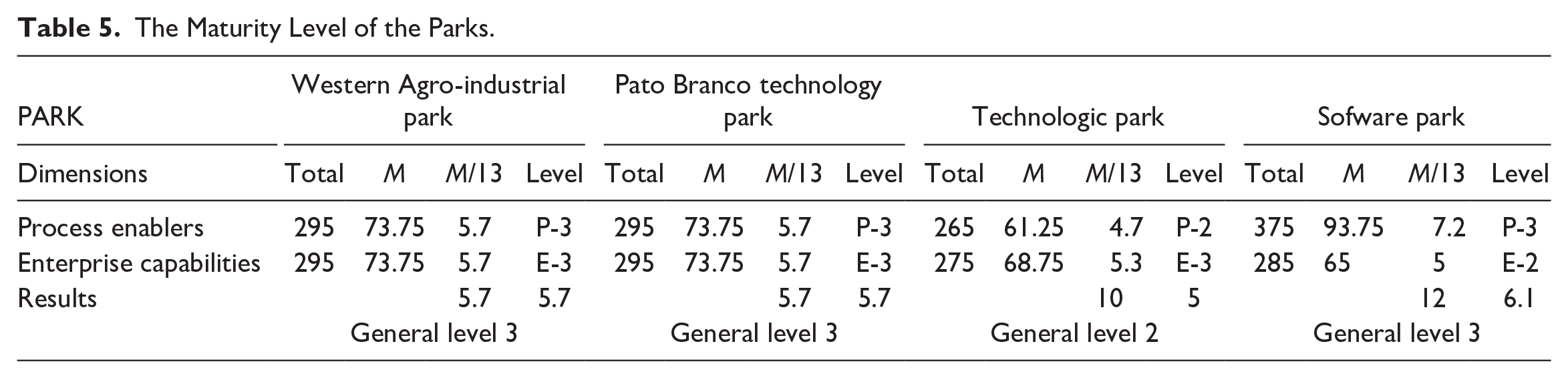
According to the analysis, the maturity level of the process enablers and enterprise capabilities, calculated at the Western Agro-industrial Park, Pato Branco Technology Park, and the Software Park, is Level 3, with a mean of 5.1 to 7.5. This level means that the parks’ maturity and processes generate optimal performance because it can be integrated with other internal processes, maximizing the parks’ performances, and parks with enterprise capability E-3 in leadership, culture, expertise, and governance put the whole process at level P-3. The Software Park’s enterprise capabilities were at Level 2, and it is necessary to improve these results about leadership, culture, expertise, and governance of the park.
Tecnoparque has a maturity level of 2 for the process enablers, while its enterprise capabilities are at Level 3. This shows that with E-3 capabilities, it cannot provide the necessary support to raise the process to Level P-3. This level means that business processes lead to superior results when implemented from one end of the organization to the other. The superior outcomes are seen in execution for projects and in the evaluation of partnerships in business, aided by the administrative process and space management, which are available to install companies.
The identification of maturity Level 3 at the Western Argo-Industrial Park, the White Duck Technology Park, and the Software Park, and Level 2 at Technopark can allow the managers to observe and evaluate the performance of the maturity level of their business processes (Moreira, 2010). This result indicates a path for managers to follow to institute and formalize processes at the parks, which must have a well-specified project. However, the employees who carry out the process will not know what to do, given the complexity (Hammer, 2007). The managers who implement the project must have the necessary abilities. Untrained employees will not be able to implement and monitor the project. There has to be a manager in charge, an experienced executive responsible for ensuring better results. In the opposite sense, the manager will get lost in executing and implementing the process.
The parks need to align its infrastructure, including (a) information technology and human resources systems aligned with the CSR perspective, managing the return on investment; (b) job creation and fair remuneration for employees; (c) search for new feature formats; and (d) promoting the creation of new products and services, emphasizing technological advancement, innovation, and the creation. In addition, it is necessary to meet the economic mission, respecting established laws, doing what is fair and proper, not leaving aside philanthropic contributions to repay society based on CSR programs. Finally, parks should use instruments to measure the performance of implemented processes overtime routinely. Otherwise, the expected results may not meet the expectations of the parties involved.
Conclusion and Future Scope
This article evaluated the maturity level of business processes in four science and technology parks in Brazil. The Process and Enterprise Maturity Model, proposed by hammer (2007), was used. In addition, the maturity level analysis took into account the Enterprise Architecture (EA). The results showed that 75% of the parks under study presented signs that their processes’ maturity generates optimal performance (Level 3) because they can be integrated with other internal processes, maximizing these parks’ performance. Only 25% of the parks were at Level 2, which means that business processes lead to superior results, implemented from one end of the organization to the other, demonstrating that even with enterprise capabilities at Level 3, it is not possible to raise the process enablers from Level 2 to Level 3.
This article makes essential contributions to the literature. The first contribution lies in the fact that the maturity level analysis found at the four parks in question is necessary because it also considers how long it has been operational. The second contribution is that for the maturity levels identified, a certain length of time is required, from the effective beginning of the business processes to achieve the expected results, for the actors’ involvement and the park’s consolidation as an innovative environment. Thus, the needs, competencies, and park management processes were mapped with their challenges and limitations. The third contribution is that it is necessary to consider that the managing institution’s decisive actions are fundamental for good management to attract and conquer new ventures from the beginning of the project. In this line, it is also essential to seek financial and political support, attract investors and seek national and international partnerships. It is important to have dedicated teamwork to science and technology parks and encourage the business processes with the parts involved, especially with managing institutions. This analysis allowed the knowledge of the park’s performance about business processes, through the process enabling and organizational capacities, to use possibilities for improvement in processes mapped toward excellence in process management.
Future studies on this topic are essential for a better contribution to the area of technology parks. These studies can encourage the generation of knowledge from the innovation ecosystem. It is crucial to corroborate with new themes such as strategy, cooperation, and technology transfer, new technology ventures, and analysis of the implementation of performance indicators to help managers of this innovation ecosystem. Research in this same study environment analyzed in this article is also suggested. For this, new stages and design and implementation must be considered, taking into account new action plans that help the development of the enterprise in a new phase, in addition to the results found in this research.
It is also important to suggest studies that evaluate the modeling of processes to identify activities and procedures that must carry out. In addition to the activities for the park’s operation and business processes, defined the axes of action as a whole: the actions and activities performed related to activities by function, position, positions, or department of the parks. It is important that, with this and the evolution of the parks, more business processes are modeled for future research, and the managers of these environments can obtain all the information necessary to integrate their processes with the information systems.
Supplemental Material
sj-pdf-1-sgo-10.1177_21582440211037303 – Supplemental material for Analysis of the Maturity Level of Business Processes for Science and Technology Parks
Supplemental material, sj-pdf-1-sgo-10.1177_21582440211037303 for Analysis of the Maturity Level of Business Processes for Science and Technology Parks by Ana Maria Magalhães Correia, Claudimar Pereira da Veiga, Carlos Otávio Senff and Luiz Carlos Duclós in SAGE Open
Supplemental Material
sj-pdf-2-sgo-10.1177_21582440211037303 – Supplemental material for Analysis of the Maturity Level of Business Processes for Science and Technology Parks
Supplemental material, sj-pdf-2-sgo-10.1177_21582440211037303 for Analysis of the Maturity Level of Business Processes for Science and Technology Parks by Ana Maria Magalhães Correia, Claudimar Pereira da Veiga, Carlos Otávio Senff and Luiz Carlos Duclós in SAGE Open
Footnotes
Acknowledgements
We thank the anonymous reviewers and Editor of the SAGE Open for their significant contribution to the final version of this article.
Declaration of Conflicting Interests
The author(s) declared no potential conflicts of interest with respect to the research, authorship, and/or publication of this article.
Funding
The author(s) received no financial support for the research, authorship, and/or publication of this article.

Supplemental Material
Supplemental material for this article is available online.
References
Supplementary Material
Please find the following supplemental material available below.
For Open Access articles published under a Creative Commons License, all supplemental material carries the same license as the article it is associated with.
For non-Open Access articles published, all supplemental material carries a non-exclusive license, and permission requests for re-use of supplemental material or any part of supplemental material shall be sent directly to the copyright owner as specified in the copyright notice associated with the article.
