



Abstract
Various management approaches have been proposed to maintain good organizational performance on a continuous basis, with corporate performance management (CPM) and business process management (BPM) being two major groups. While the conceptual connection between CPM and BPM might see obvious, their actual empirical connection with performance remains poorly understood. In this article, we address this gap and develop a theoretical model that explicates the causal paths from CPM via BPM toward organizational performance in terms of a set of hypotheses. Based on a survey, we find that the effect of CPM on organizational performance is largely mediated by CPM-BPM orchestration and process performance. With this study, we respond to recent calls for novel studies in this area and highlight the impact of well-orchestrated CPM and BPM initiatives on organizational performance.
Keywords
Introduction
Various management approaches have been proposed to maintain good organizational performance on a continuous basis. In this context, two major groups of management approaches can be distinguished: those that are anchoring at the strategic level and at the operational level. The first group, often referred to a corporate performance management (CPM) (Bourne et al., 2017; M. Franco-Santos et al., 2012; Wieland et al., 2015), heavily relies on performance measurement systems based on frameworks like the balanced scorecard. The second group, often referred to as business process management (BPM), focuses on operations to achieve good performance (Dijkman et al., 2016; Melchert et al., 2004).
It can be easily imagined that in a well-managed organization, both CPM and BPM complement each other in obtaining good organizational performance. However, the connection between both CPM and BPM and eventually performance remains poorly understood, as Bellisario and Pavlov (2018) emphasize. Indeed, the connection between the two management approaches and performance is complicated for the following reasons. First, the connection of each approach with performance has been studied separately with mixed results (Aho, 2009; Dijkman et al., 2016; M. Franco-Santos et al., 2012; Sharma et al., 2014), largely finding a dependence on that the way the systems are used (Franco-Santos et al., 2012). Second, several authors (McAdam et al., 2014, 2017; Melnyk et al., 2004, 2014; Micheli & Mura, 2017) highlight that the main function of CPM is actually creating organizational alignment between the strategy and the operations (Anand & Gray, 2017), which will only eventually lead to good performance (Croom et al., 2016). Third, CPM and BPM initiatives are often driven separately by different departments in practice even though there is doubt whether such a separation can be achieved in a meaningful way (Bourne et al., 2013; Braam & Nijssen, 2004; Nudurupati & Bititci, 2005; Pavlov et al., 2017). Fourth, it has been observed that strategically desired behavior at the operational level does not readily develop (Bourne et al., 2014).
Although there seems to be agreement in the literature that a strong alignment between strategy and operations is important (Bourne et al., 2017; Croom et al., 2016; Ensslin et al., 2017; Ferreira & Otley, 2009; Micheli & Mura, 2017), it is surprising that most research looks at CPM, BPM, and performance from an insulated perspective (Bellisario & Pavlov, 2018; Bititci et al., 2011; Croom et al., 2016; Ferreira & Otley, 2009; McAdam et al., 2017). In a recent study, Ensslin et al. (2017) find that only a small fraction of articles on performance consider both CPM, BPM, and their orchestration. The little empirical evidence available shows BPM does not readily support the alignment between organizational strategy and business processes (Bititci et al., 2011; Pádua & Jabbour, 2015), partially due to separation (Smith & Bititci, 2017), partially due to environmental dynamics (McAdam et al., 2014).
In this article, we address this gap in empirical research concerning the mutual impact of CPM and BPM on organizational performance. We draw on the theoretical foundations of the Resource Orchestration Theory (ROT), which states that resources must be effectively managed, that is, accumulated, bundled, and then leveraged, to gain a competitive advantage (Chadwick et al., 2015). However, the resource orchestration theory provides managers with only very general guidelines on how to organize the work of human resources in concert with each other and synchronize processes in order for a company to optimize its performance (Chadwick et al., 2015). Sirmon et al. (2011) argue that the role of managers is the most underdeveloped element of the theory. This study contributes to a better understanding of this role by discussing the orchestration of CPM and BPM initiatives and teams in the context of the impact of CPM on organizational performance. From this perspective, we are responding to the call for further research and in-depth examination of how orchestration contributes to value creation (Sirmon et al., 2011).
More specifically, our contribution is a theoretical model that explains the causal paths from CPM via BPM to organizational performance in terms of a number of hypotheses. This article draws on two domains of the literature (CPM and BPM) to provide insights into the field. We developed a survey instrument to empirically investigate these hypotheses. For the data collection, we use a sample of medium and large enterprise organizations with more than 50 employees in the three European Union (EU) countries (Austria, Croatia, and Slovenia), which yielded 202 data points. The results explain the complex nature of the impact of CPM on organizational performance. It is achieved through CPM–BPM alignment, which requires the definition of process key performance indicators (KPIs) based on a process-oriented business strategy in collaboration with process stakeholders, clear responsibilities for process-oriented goals measured by these KPIs, and an aligned reward system. Thus, we show that the impact of CPM on organizational performance is largely mediated by CPM–BPM orchestration and process performance. With this study, we are responding to recent calls for studies on the alignment of both strategy and operations (Bourne et al., 2017; McAdam et al., 2017) and highlight the impact of well-orchestrated CPM and BPM initiatives on organizational performance.
The research significance of this article is therefore twofold. First, it adds to the resource orchestration theory by discussing how the general guidelines of the theory can be operationalized in a given context and shows that a suitable bundle of resources that enrich processes (Sirmon et al., 2007) can actually give rise to organizational performance, and suggests mechanisms for achieving performance improvement through orchestration of resources. Second, we add to a better understanding of the theoretical argument that strategy creates impact through changes in business processes and information systems (Melchert et al., 2004), looking at CPM and BPM together, which has been underresearched thus far.
The article proceeds as follows. In the next section, we discuss the theoretical foundations of CPM, its relationships with BPM, and the orchestration of the two initiatives. We conclude with a research model and hypotheses. The next section describes the research design and methodology. We then present the results and discuss the findings. The article concludes with a summary of the results and suggestions for future research.
Theoretical Foundations and Hypotheses Development
This section provides an overview of research on CPM. Then, we discuss BPM and its relationship with CPM. Finally, we present our research model.
Corporate Performance Management and Organizational Performance
A key factor of organizational performance is the successful execution of the strategy using appropriate methods and management processes (Frolick & Ariyachandra, 2006; Mbep et al., 2015). CPM is recognized as encompassing such an approach (Mbep et al., 2015; Striteska et al., 2016). CPM is nowadays commonly regarded as a collection of management processes that rely on financial, strategic, and operating business measures to enable an organization to efficiently utilize its resources, support its decision-making, provide alignment within and between organizations, facilitate implementation of the strategy and, in turn, accomplish its desired objectives and those of its stakeholders (Antony & Bhattacharyya, 2010; Bourne et al., 2017; M. Franco-Santos et al., 2012; He et al., 2016; Moullin, 2007). They are supported by “the use of tools and techniques such as scorecards, measures, targets, performance reviews and incentives that are developed centrally and cascaded throughout the organization” (Bourne et al., 2017).
Different variants of CPM systems have been implemented in practice (Aguinis et al., 2011; De Toni & Tonchia, 2001). A paradigm shift has been noted in the move from performance measurement system design to performance management, that is, how to use measurement to manage the organization’s performance (Bourne et al., 2014; Pavlov & Bourne, 2011; Smith & Bititci, 2017) through communication between stakeholders, diagnosing reasons for the current situation, and learning and improving (Afy-Shararah & Rich, 2018), that is, from structural and technical aspects to include cultural and behavioral aspects (Bititci et al., 2015). Therefore, the strong emphasis on measurement is accompanied by strategy management, communication, influence behavior, and improvement (M. Franco-Santos et al., 2007). Its implementation requires the coordination of multiple stakeholders (Bourne et al., 2003) and the explicit specification of CPM methods and processes as well as enabling information technology (Aho, 2012). This makes CPM a multifaceted concept. Furthermore, traditional accounting-based performance measures have mostly been replaced as part of implementing holistic, balanced, and multidimensional or multicriteria measurement frameworks (Bourne et al., 2014; Ravelomanantsoa et al., 2018) that rely on using financial as well as nonfinancial performance measures (M. Franco-Santos et al., 2012), such as those that reflect quality, time, and flexibility, and are linked to both the organization’s strategic goals and the operating results (Ravelomanantsoa et al., 2018) to achieve a strategic alignment.
A well-established way to assess the CPM practices in an organization and their level of formality, sophistication, and embeddedness is to use maturity models (Bititci et al., 2015). Generally, a maturity level represents an organization’s “capabilities as regards a specific class of objects and application domain” (Röglinger et al., 2012). In this study, we use the maturity model developed by Aho (2012) since we find it one of the most comprehensive CPM maturity models covering both structural and behavioral factors (Bititci et al., 2015) and encompassing the expected positive CPM practices identified in the literature and mentioned above, it is also well documented and developed using scientific research methods. It builds on four dimensions that represent management activities or practices that are critical for leveraging or inhibiting CPM:
Management & Organization refers to the governance of CPM. This component addresses strategic decision-making, practical management issues, and the expected benefits for an organization (Aho, 2012).
Technology describes the extent to which Information Technology (IT) drives CPM processes. From an IT perspective, performance management is one of the latest business functions that is being automated by software applications in the organization (Eckerson, 2012). IT integrates applications and processes (Eckerson, 2012) and is therefore a key enabler for successful CPM (Limburg et al., 2017).
People & Culture encompasses how employees are trained and empowered. This is embedded in a general approach to communication and overall trust and commitment to CPM (Pulakos, 2009). The importance of behavioral and cultural aspects for CPM is documented by Karim (2015) and Pavlov et al. (2017).
CPM Processes relates to the way CPM processes are defined and performance is measured. The design of these processes, their IT support, and well-considered and communicated metrics are shown to be a relevant factor in CPM success (Hunt, 2011; Kang et al., 2016; Melnyk et al., 2004).
CPM practices are assumed to bring various benefits. Yeoh et al. (2014) highlight better strategy execution, improved process efficiency, and fact-based decision-making. Nudurupati and Bititci (2005) agree with the two last points they list. Furthermore, CPM’s positive effect on people’s strategic focus has been proven (M. Franco-Santos et al., 2012) and should, in turn, lead to improved performance. Many organizations have built on these assumptions and invested heavily in CPM implementation over the last three decades (Koufteros et al., 2014). However, the existing research has produced mixed results, with hardly any clear evidence emerging in support of CPM practices’ positive impact on financial performance (Biron et al., 2011; Bourne et al., 2013; Koufteros et al., 2014).
Yet, we need to test the following hypothesis to show there is a nonsignificant, direct relationship between CPM maturity and organizational performance and to also show the mediating role of CPM–BPM orchestration, as elaborated below:
Orchestrating Corporate Performance Management and Business Process Management
The hesitancy regarding the link between CPM maturity and organizational performance raises another question: How to achieve the appropriate implementation of CPM? One deficiency identified in the literature is the strong focus on the functional organization structure (List & Machaczek, 2004). To avoid such shortcomings, CPM can build on BPM.
BPM is a structured management approach that uses methods, policies, metrics, management practices, and software tools for improving the performance of business processes (Dumas et al., 2013; Rahimi et al., 2016). Like with CPM, the main purpose of BPM is to help increase organizational performance and its competitive position, although its chief focus is on optimizing the operations (Van Looy et al., 2013) based on aligning the resource capabilities with the organization’s strategic aims and objectives (Croom et al., 2016). BPM capabilities have been proven as important mediators also for other relationships between resource capabilities and organizational performance, particularly in the IT capabilities context (Peng et al., 2016), particularly the impact of business intelligence on organizational performance is mediated by BI-BPM orchestration (Suša Vugec et al., 2020). It is often described as a life cycle entailing: process identification, discovery, specification, analysis, design, implementation, operation, and monitoring (Brocke et al., 2016; Rahimi et al., 2016).
Numerous studies underline the importance of the relationship between BPM and CPM and emphasize the alignment of strategic objectives and operational-level activities (Croom et al., 2016; Ensslin et al., 2017). Afy-Shararah and Rich (2018) emphasize that CPM “should support and focus operations management, yet it can also become an inhibitor when mismatches exist between corporate need and operations management measurement,” but the traditional CPM systems have mainly disregarded the need for “end-to-end” process management where the performance management takes account of the interdependences between various functions of the enterprise (Ravelomanantsoa et al., 2018). In the same manner, Vivares-Vergara et al. (2016) note that organizations need to understand and exploit the strategic importance of operations. Furthermore, Ferreira and Otley (2009) recognize the management of structures, processes and relationships through which the organization operates as constituting one of the CPM key success factors. Bhattacharya and David (2018) even suggest process mapping as a facilitator for a suitable performance measurement.
Based on the above discussion, one might expect results from CPM only if the concept is implemented in the correct way, where the strategic aims are aligned with the business operations. We therefore further investigated possible ways of achieving such an alignment to better understand how CPM maturity can lead to improved organizational performance. Questions of how are typically approached by using mediation analysis where the goal is to establish the way in which one variable influences another variable via one or more mediator variables (Hayes, 2017).
Insufficient results of CPM are often explained by pointing to the shortcomings of CPM implementations (Aguinis et al., 2011; Hourneaux et al., 2017; List & Machaczek, 2004) and limited understanding of the success factors (Biron et al., 2011). CPM implementation not only requires strategic changes, but also the effective renovation and reorganization of business processes in an organization from the perspective of value (He et al., 2016). Indeed, recent research stresses the benefits of integrating CPM and BPM (Bellisario & Pavlov, 2018; Blasini & Leist, 2013; Kohlbacher & Gruenwald, 2011; Kueng, 2000; Melchert et al., 2004; Wieland et al., 2015). Bellisario and Pavlov (2018) suggest performance management might be mediated by the configuration of processes.
However, the natural connectivity of CPM and BPM is frequently left unrealized. Even when the two initiatives are driven by different organizational units—as is often the case (Hammer et al., 2007; Krause, 2003; Melchert et al., 2004)—they must at least be well orchestrated.
To address this issue, the study intends to investigate whether and how the orchestration of these two initiatives affects organizational performance. In developing our research model, we build upon the ROT first mentioned by Sirmon et al. (2011). The ROT is quite novel and closely associated with structuring a resource portfolio, the bundling and leveraging of resources to build the organization’s capabilities and gain a competitive advantage (Chadwick et al., 2015; Sirmon et al., 2011). Orchestration may be defined as “the combination of resources, capabilities, and managerial acumen that ultimately results in superior firm performance” (Chadwick et al., 2015). It means that multiple groups must cooperate and contribute to realizing the firm’s goals and achieving a competitive advantage (Sirmon et al., 2011). Although each element of resource management is individually important, success with these elements lies in their synchronization and coordination (Sirmon et al., 2011). Baert et al. (2016) stress the importance of resource orchestration practices for the allocation of scare resources between the exploitation of existing activities and exploration toward radical innovation. This approach explicitly emphasizes the role of managers’ actions and the importance of management’s commitment to resource management.
Considering the novelty of the ROT, a preliminary Google Scholar search is conducted with the aim to learn about the size of empirical research studies in the field. The search for articles containing “resource orchestration theory” and “empirical research” keywords resulted in less than 15 articles, among which none applied to BPM and/or CPM initiatives. The very small number of articles implies that the ROT is still an emerging theory with the potential for researchers to explore its applicability to practice. These results impel our research to uncover whether orchestrating CPM and BPM capabilities positively influences organizational performance.
Although the ROT focuses on “resource orchestration,” our study extends the context and introduces the idea of CPM and BPM initiatives’ orchestration. According to the ROT, what matters is not the CPM or BPM initiative, but the alignment of these two independent variables. Therefore, in the context of this research, the general characteristic of the CPM-BPM orchestration concept is that two initiatives are intensively coordinated or implemented as one initiative to synchronize the realization of organizational goals.
To understand and study the importance of CPM–BPM orchestration for organizational performance, we need to further concretize what orchestration means in the setting of implementing these two initiatives. Various authors discuss different elements of the orchestration of CPM and BPM and its impact on process/organizational performance. Table 1 summarizes the findings of 14 key articles on this topic. Kueng (2000) approaches such orchestration from the BPM side. The article is one of the first to suggest that (a) KPIs should be related to both the corporate strategy and the process goals; and (b) they should be developed collaboratively by process stakeholders on different levels. Krause (2003) discusses the limits of approaches to CPM in practice. The article proposes that CPM be defined from the perspective of the desired business process structure. Process performance measurement may reveal potential dysfunctions in the models and contribute to the appropriate management of processes (Froger et al., 2019). It is one of the BPM critical success factors and crucial for achieving sustainable improvement of business processes (Trkman, 2010). Melchert et al. (2004), Hammer (2007), Hammer et al. (2007), Pavlov and Bourne (2011), Blasini and Leist (2013), and Ensslin et al. (2017) agree that process performance measures should be connected to the strategic goals. Smart et al. (2009) emphasize that CPM–BPM orchestration requires not only process strategy but also governance concerning process architecture, process ownership, process measurement, and process improvement. Several authors interpret process performance management (PPM) as an operational refinement of CPM that smoothly integrates with BPM (Ensslin et al., 2017; Heckl & Moormann, 2010; Nenadál, 2008). The ideas of Niven (2002), Kuwaiti (2004), Kohlbacher and Gruenwald (2011), Kohlbacher and Reijers (2013), and Wieland et al. (2015) are largely covered by this summary.
Main Findings From Prior Studies on CPM–BPM Orchestration and Its Impact on Organizational Performance, in Chronological Order.

Note. BPM = business process management; CPM = corporate performance management; PPM = process performance management.
All of these findings suggest that mature CPM implementation should be connected with BPM. In particular, PPM is shown to be an important element linking the two concepts (Blasini & Leist, 2013; Ensslin et al., 2017; Kohlbacher & Gruenwald, 2011). Since improving the performance of business processes and other BPM activities is carried out by BPM teams, it is likely that mature CPM contributes to CPM–BPM orchestration because the CPM team is interested in cooperating with process owners and other members of the BPM team to be able to implement a process-oriented strategy. Moreover, some articles suggest that different elements of CPM–BPM orchestration affect process performance (Kueng, 2000; Pavlov & Bourne, 2011; Smart et al., 2009) or organizational performance (Kohlbacher & Gruenwald, 2011; Kohlbacher & Reijers, 2013; Pavlov & Bourne, 2011). Abubakar et al. (2019) show the impact of the connection between the knowledge-creation process and rational decision-making on organizational performance. Since CPM is by definition about rational business decision-making, we can reasonably conclude that orchestration with BPM, which leverages knowledge creation and the exchange of knowledge between teams (Abubakar et al., 2019), in turn has an impact on organizational outcomes, primarily the success of business processes. This is also suggested by the ROT, which stresses the importance of management in ensuring that multiple groups cooperate and contribute to realization of the firm’s goals, especially since both initiatives have similar main goals and ways for achieving them through strategic alignment, although often driven by different organizational units and with different starting points.
This leads to the following hypotheses:
It is therefore expected that the impact of CPM maturity is transmitted on organizational performance through CPM–BPM orchestration. Yet, since improved process performance results in improved organizational performance (Melville et al., 2004; Van Looy & Shafagatova, 2016), it is likely the impact of CPM–BPM orchestration on organizational performance is mediated by process performance. Summarizing the above discussion, we may formulate the mediating role of BPM–CPM orchestration as follows:
Figure 1 shows the resulting research model with the direct relationship between CPM maturity and organizational performance, which is expected to be nonsignificant, and the expected mediation effect of CPM-BPM orchestration and Process performance.

The conceptual research model.
Research Design and Methodology
In this section, we describe the development of a measurement instrument for the construct of CPM–BPM orchestration. We then describe the overall design of the survey instrument and, finally, the data collection and analysis.
Development of an Instrument to Measure CPM–BPM Orchestration
In creating the CPM–BPM orchestration construct, we followed the procedure of MacKenzie et al. (2011). A summary of all phases is shown in Figure 2.

Summary of all phases (MacKenzie et al., 2011) in creation of the CPM–BPM orchestration.
To conceptualize CPM–BPM orchestration, we conducted a review of the relevant literature, yielding the publications summarized in Table 1. These findings were supplemented with exploratory research according to established guidelines. Three Slovenian companies were involved in a series of interviews, in two cases as part of a broader study on BPM implementation (Buh & Indihar Štemberger, 2016; Buh et al., 2015). In addition, we reviewed documents related to strategic direction and some other documents related to the organization of BPM and CPM initiatives in Company 1 and Company 2 in the analysis to ensure triangulation.
The first company (hereinafter “Company 1”) is a provider of a series of waste treatment services with around 400 employees. The company was selected because it was implementing BPM and CPM in an orchestrated way (Buh et al., 2015). A key interview partner was the former CIO, who later became the Chief Process Officer (CPO) due to his knowledge of both CPM and BPM (Expert 1).
The second company is a large insurance company with approximately 2,400 employees (“Company 2”). This company was selected because it was implementing BPM and CPM not together, but as separate initiatives (Buh & Indihar Štemberger, 2016). We interviewed the Head of the Organizational Development, HR and BPM Department (Expert 2).
The third company (“Company 3”) is a large manufacturing company with around 2,000 employees. It is a supplier to the European automotive industry and a well-known regional producer of tools, appreciated by professional and amateur craftsmen. We selected this company because the head of the strategy development department (Expert 3) was conducting an assessment of the orchestration of the company’s CPM and BPM initiatives.
During the in-depth, semi-structured interviews, we discussed several topics with the experts. First, we asked about their interpretation of the CPM and BPM concepts and how they were being implemented in their companies. Then, we asked for their opinion on the importance of orchestration, and how they would measure it. Table 2 summarizes the key results. Expert 1 describes the top-down alignment of both initiatives, whereas Expert 2 describes potential for improvement. Expert 3 points to the relevance of maturity in both CPM and BPM.
Main Findings of the Exploratory Research.

Note. CPO = Chief Process Officer; BPM = business process management; CPM = corporate performance management.
Based on the literature review and exploratory research, we specified the conceptual theme (MacKenzie et al., 2011) of the construct CPM–BPM orchestration as:
Very intensive communication between CPM and BPM teams and managers exists or the same people do CPM and BPM.
Processes play an important role in strategy development and implementation (strategic KPIs are cascaded to process KPIs, PPM is an essential part of CPM, people are rewarded based on process-oriented goals).
The techniques appropriate for the development of measures phase are of an exploratory research nature, particularly literature searches and interviews with experts (Revilla-Camacho et al., 2019). Thus, we started to generate possible questions from the literature. The literature review yielded a set of 35 question items concerned with CPM–BPM orchestration. We combined them based on similarity and statements made in the interviews to produce six statements. We then tested the items with CPM and BPM managers, leading to some statements being reformulated, merged, or eliminated. In part, the experts found items too similar. In the end, we converged on the three measures very similar to the items shown in Table 3. The measures presented in Table 3 were namely further improved during the scale evaluation and refinement phase, as described in more detail in the following section.
Measures of CPM/BPM Orchestration.

Note. CPM = corporate performance management; BPM = business process management; KPIs = key performance indicators.
Validation and norm development phases of creating CPM–BPM orchestration construct are described in following sections.
Survey Design
To develop the constructs and their scales and further validate the scale, we followed the procedure of MacKenzie et al. (2011). We elaborated conceptual definitions of our constructs, developed measures for items that represent the construct, specified the model specifications, evaluated and refined the scales, assessed the scale validity, and developed the norms for the scales.
Our questionnaire built on the previous theoretical basis to assure content validity. For most constructs, existing measurement instruments established in previous studies were used or measurement instruments were developed based on existing models. Only for CPM–BPM maturity did we have to define our own measurement instrument because a comprehensive model or measurement instrument did not exist yet. To ensure face validity, the questionnaire was pre-tested (Cooper & Schindler, 2003) using a focus group involving selected university staff and Information System (IS) academics from the field who were excluded from the subsequent research. This was also part of the scale evaluation and refinement phase for the CPM–BPM orchestration construct. Construct validity, by analyzing factorial validity using collinearity and cross-loading analysis; and reliability, by analyzing the internal consistency of the constructs (Straub et al., 2004), were tested and the results are presented in the next section.
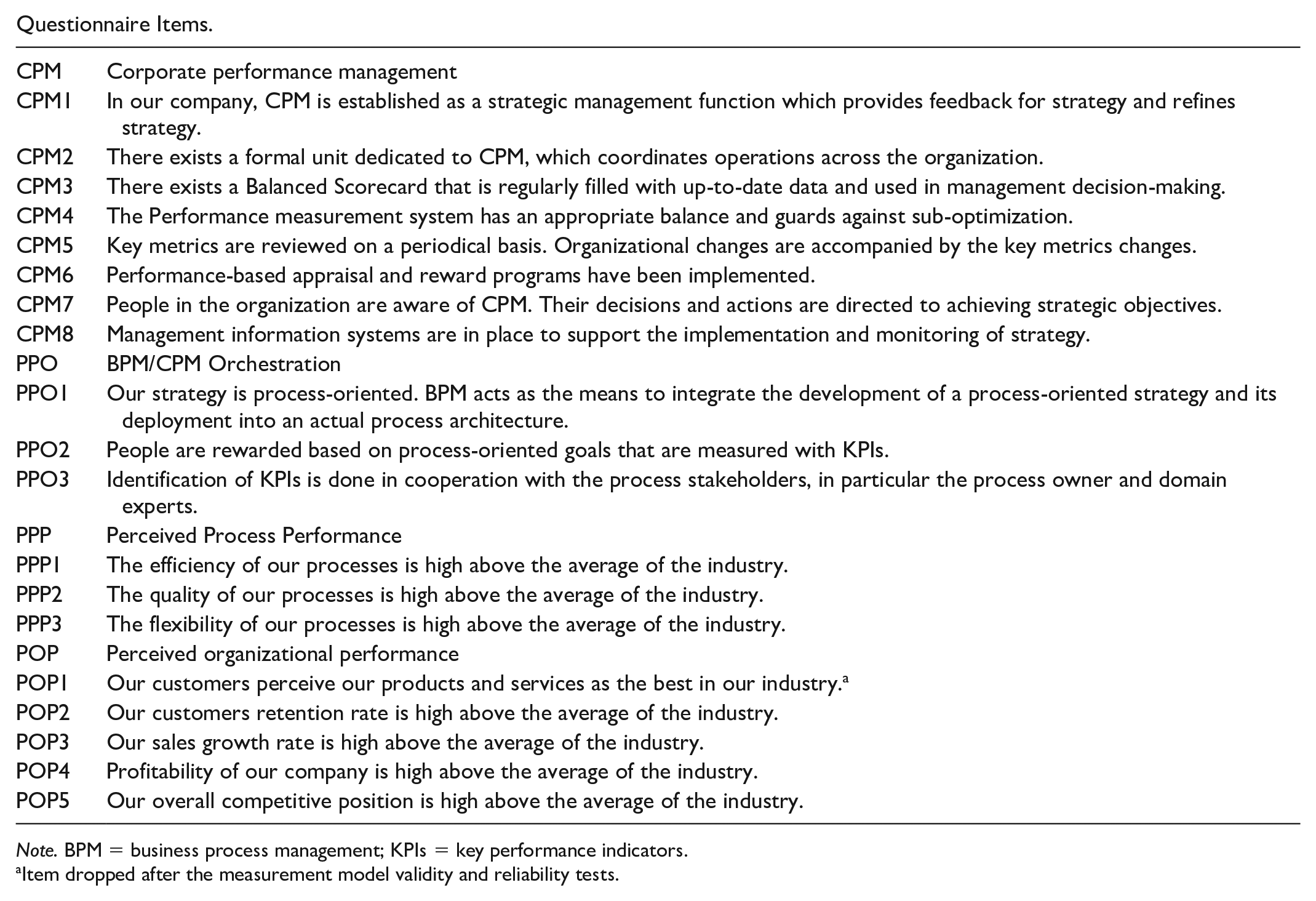
The final measurement model included 18 manifest or observable variables loading on to four latent constructs: (a) CPM maturity; (b) CPM–BPM orchestration; (c) Perceived process performance; and (d) Perceived organizational performance. We used a structured questionnaire with 5-point Likert-type scales, with anchors ranging from totally disagree (1) to totally agree (5) for all items used in our study. The complete questionnaire with all the survey items is included in the appendix.
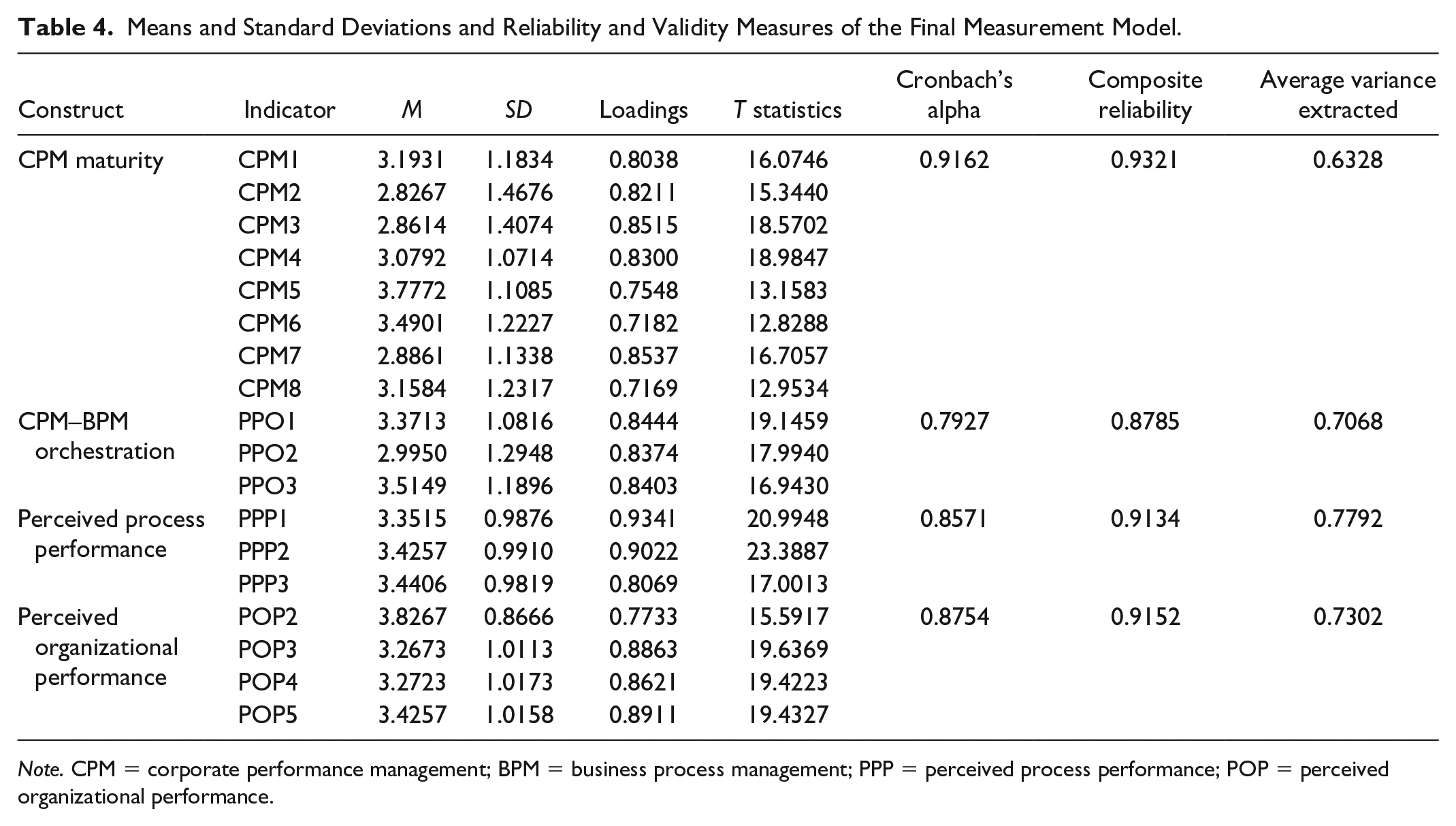
For the CPM maturity construct, the measurement items were developed based on the Performance Management Index model (Aho, 2009). They comprehensively describe all four components of CPM maturity that are critical for enabling or inhibiting CPM (Aho, 2009, 2012). This part of the questionnaire consisted of eight five-item Likert-type scale questions for management and organization, CPM processes, people and culture, and technology. The measurement model resulted in one factor with high reliability, as shown in Table 4.
Means and Standard Deviations and Reliability and Validity Measures of the Final Measurement Model.
Note. CPM = corporate performance management; BPM = business process management; PPP = perceived process performance; POP = perceived organizational performance.
For the CPM–BPM orchestration construct, we used the items presented in Table 3 to formulate questions. This was followed by evaluating and refining the scale and assessing its validity and reliability (MacKenzie et al., 2011; Straub et al., 2004), which is reported below.
Perceived process performance was measured with the same construct as in He et al. (2016), namely with process efficiency, quality and flexibility that is based on the Devil’s Quadrangle (Dumas et al., 2013) which represents its main dimensions and the primary goals of process optimization. The three items are presented in the appendix and resulted in a single factor with high reliability.
For perceived organizational performance, we relied on established research. There is no general consensus in what organizational performance is (Moretti & Biancardi, 2020). While some authors examined organizational performance using both financial and market metrics (Flynn et al., 2010; Qrunfleh & Tarafdar, 2014), Sink and Tuttle (1989) investigated how an organization can improve its performance in terms of seven criteria: profitability, productivity, quality of work life, innovation, quality, effectiveness, and efficiency. Similarly, Khan et al. (2019) used eight items of efficiency, growth, and profit. The study by Richard et al. (2009) reveals a multidimensional conceptualization of organizational performance related chiefly to stakeholders, heterogeneous product market circumstances, and time. Despite the complexity and multidimensionality of the organizational performance construct, its aim is to analyze the results of an organization (i.e., the results of its processes) as measured against its intended goals and objectives, that is, against its strategy. Measurement of perceived organizational performance that is based on the research participants’ perceptions of firm performance (M. Franco-Santos et al., 2012) enabled us to encompass the entirety of its multidimensional nature. For the purpose of this research, the measurement instrument for measuring organizational performance was extracted from the work of Law and Ngai (2007) where we used five items related to product and service quality, customer retention rate, sales growth rate, profitability, and overall competitive position. However, the first reliability and validity test showed the manifest variable POP1 loaded poorly on to its latent construct and was dropped from the final model for this reason. Since all reliability and validity measures in the final model showed a substantial increase, it was appropriate to discard the indicator with low standardized loadings (Henseler et al., 2009).
Data Collection
The data were collected via a survey of a randomly selected sample of 1,477 medium- and large-sized business organizations with more than 50 employees in EU countries, namely Austria, Croatia, and Slovenia, registered in the public legal records of the respective countries. The questionnaires were sent by regular post as well as electronically. Introductory letters were provided to the participants that explained the aims and procedures of the study, assuring anonymity of the information collected, and that no information would be revealed in individual form. Questionnaires were addressed to top management in the organizations contacted. Two rounds of call-up were conducted yielding an overall sample of 202 fully completed surveys.
Data Analysis
Since a single source of data was used, the data were first tested for potential common method bias using Harman’s single factor test (Podsakoff & Organ, 1986). The fact that in exploratory factor analysis based on the unrotated solution a single factor explained at most 45% of the variance suggests there was no indication of substantial common method bias. In addition, we applied common latent factor technique and got common variance of 35%, which additionally suggests that no severe common method bias is present (Eichhorn, 2014).
To conduct the data analysis, partial least squares (PLS), a multivariate or component-based structural equation modeling (SEM) technique, was used. This methodology is widely used in the IT and IS fields as it is suitable for predicting and theory-building because it examines the significance of the relationships between the research constructs and the predictive power of the dependent variables (Chin, 1998; Henseler et al., 2009). The estimations and data manipulations were performed using SmartPLS (Ringle et al., 2007) and SPSS.
Results
In this section, we present our study results. First, we summarize the descriptive statistics and measurement validation. Second, we inspect correlations of the latent variables and show the estimates for our structural equation model. Third, we report the results of our serial mediation analysis.
Descriptive Statistics and Validation of Measurement
First, we report descriptive statistics. Table 4 summarizes the average means and standard deviations of the survey variables. The highest average means are found in the Organizational performance construct and the lowest in the CPM maturity construct. The means for all measures (the average mean is 3.29) are around 0.79 scale points to the right of the center of the scale, suggesting a slightly left (negative) skewed distribution. The CPM maturity construct indicators on average show the highest standard deviations, whereas the Perceived process performance indicators have the smallest variability.
We examined the reliability and validity measures for our reflective measurement model (also see Table 4). In the final model, all Cronbach’s alphas clearly exceeded the 0.7 threshold (Nunnally & Bernstein, 1994). Without exception, at around 0.9, the latent variables’ composite reliabilities were higher than 0.8, showing the high internal consistency of the indicators measuring each construct and thus confirming the construct reliability (Henseler et al., 2009; Nunnally & Bernstein, 1994). Average Variance Extracted (AVE) was generally around 0.7, thereby exceeding the threshold of 0.5, demonstrating the convergent validity of the constructs (Fornell & Larcker, 1981). The measurement model’s reliability and convergent validity were also confirmed by computing standardized loadings for the indicators and Bootstrap t-statistics for their significance. All standardized loadings of the indicators in the model exceeded the 0.7 threshold (see Figure 3) and without exception were found to be significant at the 0.001 significance level, hence confirming the high indicator reliability and convergent validity (Henseler et al., 2009; Hulland, 1999).
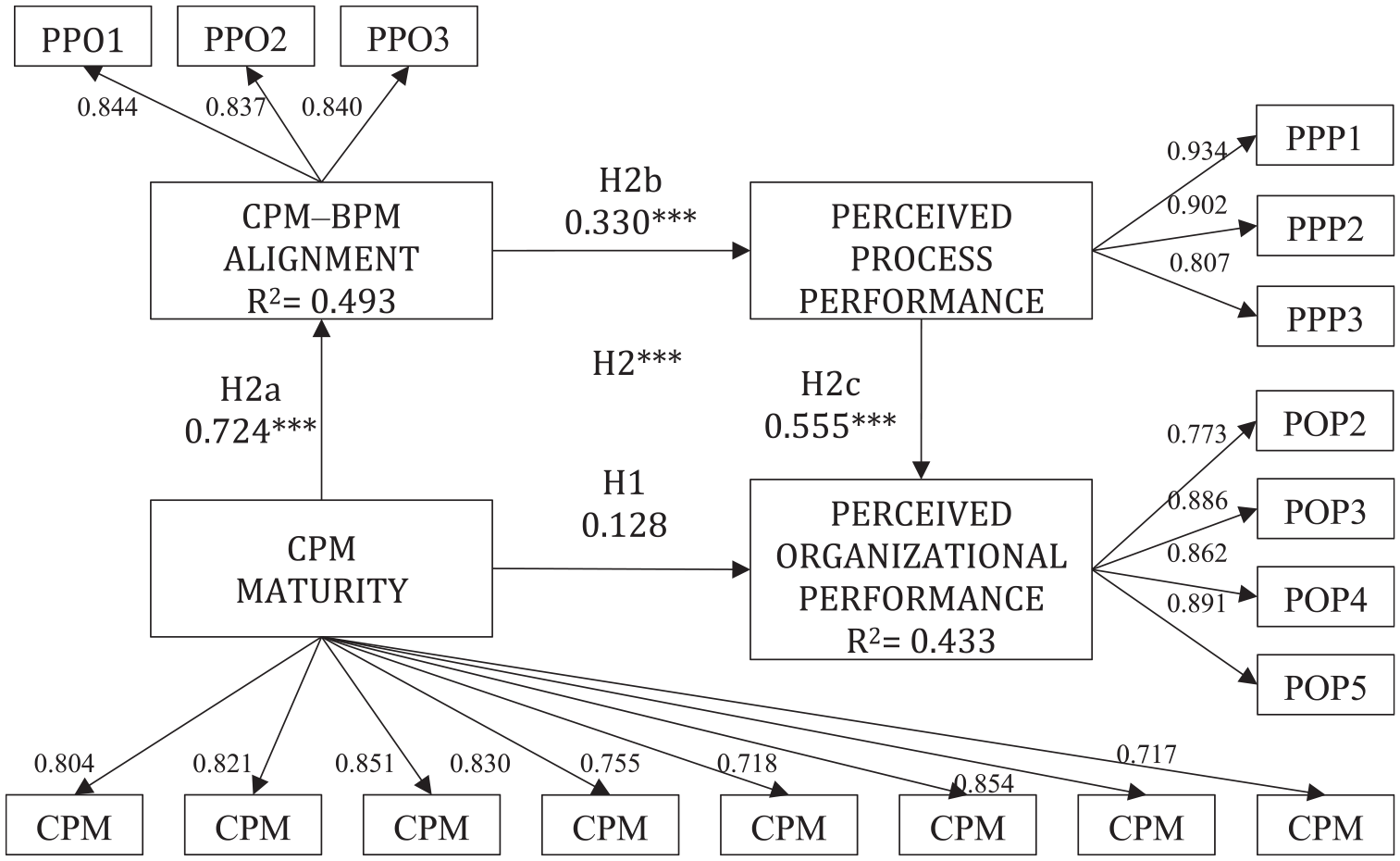
Structural model results.
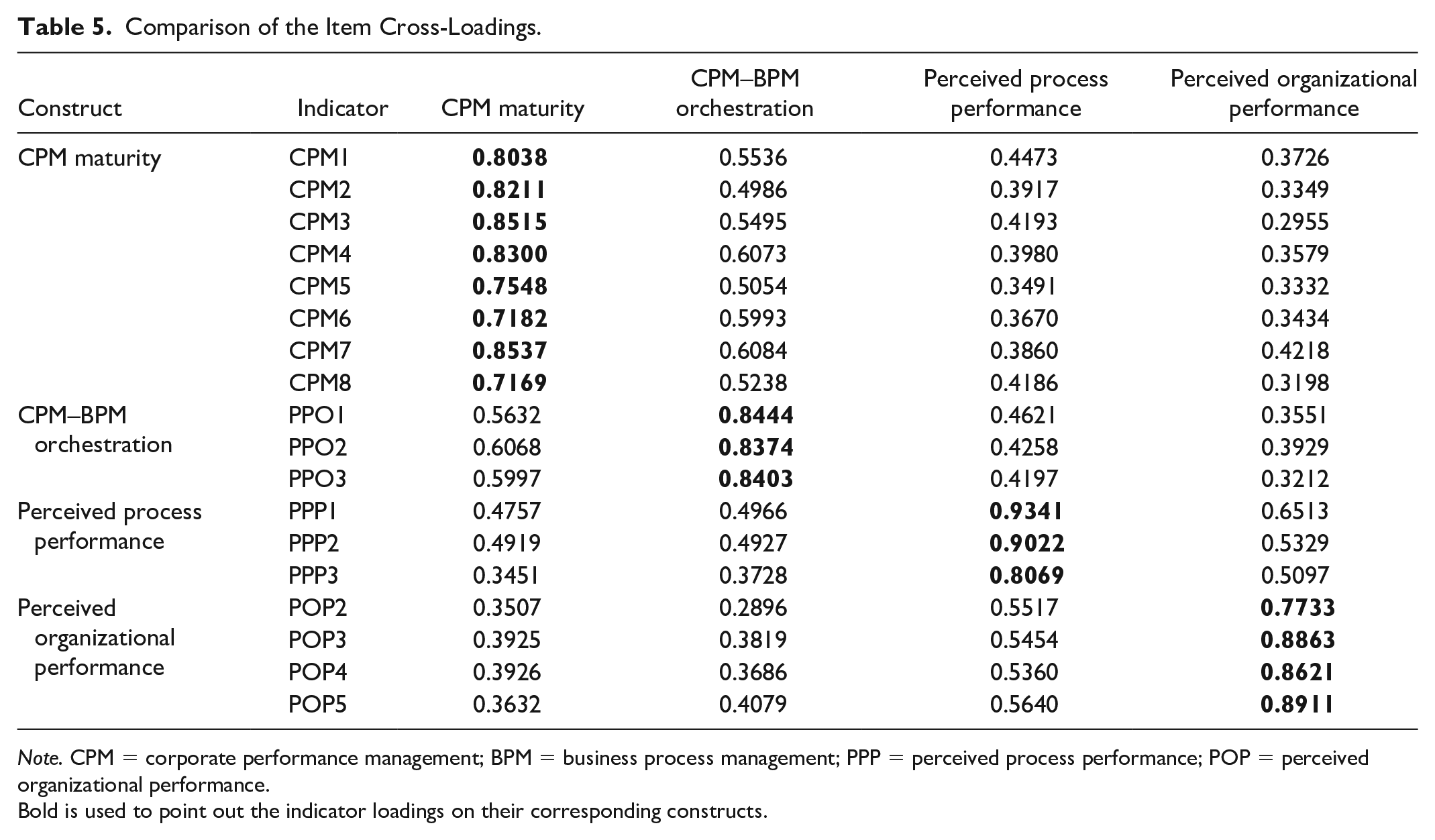
The assessment (see Table 5) of the indicator loadings on their corresponding constructs indicated that the manifest variable correlations with their theoretically assigned latent variables are in an order of magnitude larger than other loadings on other constructs (Gefen & Straub, 2005). Therefore, all the item loadings met the first criteria of discriminant validity (Henseler et al., 2009).
Comparison of the Item Cross-Loadings.
Note. CPM = corporate performance management; BPM = business process management; PPP = perceived process performance; POP = perceived organizational performance.
Bold is used to point out the indicator loadings on their corresponding constructs.
Estimates of the Structural Equation Model
Next, we compared the square root of AVE for each construct with the correlations for all other constructs in the model (Henseler et al., 2009) (see Table 6). The square roots of AVE for the constructs were significantly higher (and also substantially larger than the threshold of 0.5) than the correlations between the constructs, thus confirming they are sufficiently discriminable by the second procedure (Chin, 1998; Fornell & Larcker, 1981).
Correlations Between the Latent Variables and Square Roots of the Average Variance Extracted.

Note. CPM = corporate performance management; BPM = business process management.
Bold is used to point out the square roots of AVE for the constructs, which makes these easier to compare with the correlations between the constructs.
We then estimated the inner path model. We tested the significance of the hypothesized relationships between the constructs by bootstrapping with 1,000 replicates. The structural model was then assessed by examining the coefficient of determination (R2) of the endogenous latent variable, the estimates for the path coefficients of relationships in the structural model, and their significance levels (via bootstrapping) (Chin, 1998).
As shown in Figure 3, the influence of CPM maturity, CPM–BPM orchestration and Perceived process performance together explain 43.3% of the variance in Perceived organizational performance. Furthermore, the influence of CPM maturity on CPM–BPM orchestration explains 49.3% of the variance in CPM–BPM orchestration. Moreover, the influence of CPM maturity and CPM–BPM orchestration explains 30.5% of the variance in Perceived process performance. Since the exogenous variables explain a moderate to high proportion of the variance of the endogenous variable, we may conclude the model holds sufficient explanatory power and is capable of explaining the constructed endogenous latent variable (Henseler et al., 2009).
The direct impact of CPM maturity on Perceived organizational performance is not statistically significant (
Testing Serial Mediation
Besides testing the statistical significance of the impact of CPM maturity on Perceived organizational performance via bootstrapping to check the mediation effect, we tested the mediation using Sobel’s test for serial mediation (Sobel, 1982). To test that the impact of CPM maturity on Organizational performance is mediated by CPM–BPM orchestration and Perceived process performance (H2), we followed the procedures explained in Hayes (2017) provided by Howard (n.d.).
To calculate the indirect effect of CPM maturity on Perceived organizational performance through CPM–BPM orchestration and Perceived process performance, the following formula can be used:

where a is the CPM maturity → Perceived process performance effect, b is the CPM–BPM orchestration → Perceived process performance effect, c is the Perceived process performance → Perceived organizational performance effect, SEa is the standard error of a, SEb is the standard error of b, and SEc is the standard error of c. Once the z-value is calculated, the z-value is calculated into a p value to determine its significance (see Table 7) (Howard, n.d.).
Sobel’s Test for Serial Mediation.

Note. SE = standard error; CPM = corporate performance management; BPM = business process management.
Table 8 summarizes all the hypotheses along with the results.
List of All Hypotheses and the Results.

Note. CPM = corporate performance management; BPM = business process management.
Discussion With Implications and Future Research
In this section, we discuss the implications of our findings. In essence, we observe that the impact of CPM Maturity on Perceived organizational performance appears to be largely mediated by CPM–BPM Orchestration and Perceived process performance. Our findings hold important implications for research.
First, we developed the construct of CPM–BPM orchestration, which we utilized in our survey. This construct builds on prior research that stresses the importance of different elements of the two initiatives’ orchestration for the impact on organizational performance (Hammer et al., 2007; Krause, 2003; Melchert et al., 2004; Pavlov & Bourne, 2011). It reflects aspects of a process-oriented strategy, of the need to measure process performance based on process-oriented goals and strategic KPIs identified in cooperation with explicitly appointed process owners and other process stakeholders, and people who are rewarded based on process-oriented goals.
Second, our results provide empirical evidence of how CPM maturity can translate into organizational performance. Our survey results show the direct impact of CPM maturity on Organizational performance is not statistically significant, and therefore H1 is not confirmed. This finding is in line with expectations of other research that point to the complex relationships between organizational performance and its influencing factors. Kamasak (2015) investigates the complex interaction of different resource sets and capabilities that influence organizational performance. Al-Dhaafri et al. (2013) note that various management programs have been found to exert a significant effect on organizational performance, “but the results regarding the effect of these practices and strategies have been inconclusive in the management literature.” Richard et al. (2009) discuss a multidimensional conceptualization of organizational performance and conclude that it relates to three pillars: (a) internal and external stakeholders; (b) the heterogeneity of organizational resources, environments, and strategic choices; and (c) the variation of performance over time. Due to the complexity of their relationship, it remains difficult to assess the direct impact of higher CPM maturity on organizational performance.
With our survey, we find evidence of the mediating role of CPM–BPM orchestration in this context. The support for our H2a is aligned with prior studies that point to BPM being the link to organizational strategy (Hung, 2006), where the orchestration of CPM and BPM initiatives can help in achieving the alignment of the operational and strategic levels (Bellisario & Pavlov, 2018), which is acknowledged as one of the key success factors in CPM initiatives (Bourne et al., 2017; Croom et al., 2016; Ferreira & Otley, 2009; Micheli & Mura, 2017). The support for H2b and H2c with CPM–BPM orchestration positively influencing Process performance and Process performance positively influencing Organizational performance completes the full mediation chain (Hayes, 2017). Our results thus confirm what was suggested by Abubakar et al. (2019), namely that the exchange and creation of knowledge, which in this case increases with the orchestration of both initiatives, influences the organizational outcome. Simons (1994) claims that the corporate management practices of planning and measurement directly influence process performance because they represent different forms of control mechanisms. Planning can be considered a “feedforward” mechanism in that it helps to ensure that employees conduct activities that accomplish business objectives. Measurement is a feedback mechanism to permit ongoing course correction. Both control mechanisms work in tandem to enable organizational success. However, the impact is higher when CPM practices are enhanced with their execution through BPM practices, where KPIs are defined with process stakeholders and clear responsibilities for process performance. These findings but also add to the body of knowledge of the field because these issues were previously investigated and/or were evidenced only partly, or only specific aspects of the CPM–BPM relationship and its influence on organizational performance were taken into account. Furthermore, it additionally explains how CPM improves organizational performance, which has been identified as a relevant research question in previous works (Pavlov et al., 2017). It also responded to the call to answer the question of how to improve the alignment of the strategic and operational levels (McAdam et al., 2017), particularly in cross-functional processes (Bourne et al., 2017) that BPM is focused on, in a situation where organizations often organize CPM and BPM separately due to issues of complexity despite their natural relationship and interdependences (Pavlov & Bourne, 2011). Our findings thus responded to multiple research questions in prior researches. It also adds to the resource orchestration theory (Chadwick et al., 2015; Sirmon et al., 2011) in the particular context of CPM and BPM implementation, where it shows the path to the coordination of both initiatives and its importance for a superior organizational performance.
Our findings also hold implications for practice. The results highlight the benefits of an integrated and well-aligned approach to CPM and BPM on process performance and organizational performance. Moreover, the results of our research encourage managers to coordinate the efforts of various groups and initiatives in bridging the gap between strategy formulation and its implementation (Kaplan & Norton, 1996; Krause, 2003), particularly between strategic priorities and operational capabilities (Croom et al., 2016). According to Gębczyńska (2016), translating strategy to the operating level is a challenge for many companies. To overcome this problem, the process measurement system must be designed in cooperation with process stakeholders and then used for process control, improvement, and optimization by process owners. Therefore, the organizations should develop the strong conjunction of CPM and BPM by establishing clear responsibilities for processes, a manageable number of process performance metrics and well-defined measurement practices (Cleven et al., 2011). However, it is only possible to orchestrate the two initiatives when the level of BPM maturity is high enough at least to the point where the processes are planned to be measured. The results of this study show that it is crucial to approach BPM initiatives strategically from the very beginning. Organizations should therefore develop the strong conjunction of CPM and BPM by establishing clear responsibilities for processes, a manageable number of process performance metrics, and well-defined measurement practices (Cleven et al., 2011). Thus, the results could expand managers’ awareness about the potential benefits and encourage them to start practicing a multidimensional CPM-BPM approach.
Conclusion
In this article, we investigated the importance of CPM and BPM for maintaining the organization’s performance. Our research was motivated by the partly inconclusive results from prior research. We addressed this research problem by developing an instrument for measuring CPM–BPM orchestration and an overarching survey that looks for its connections with organizational performance. Our results show the effect of CPM on organizational performance is mediated by the orchestration of CPM and BPM and, in turn, by process performance. These findings have strong implications for research and practice.
Although this study provides valid and generalizable results concerning the role of BPM–CPM orchestration, it also has some limitations that should encourage future research in this area. First, only one respondent per organization evaluated the statements of the structured questionnaire across the entire scope of CPM, BPM, orchestration, process, and organizational performance. Subsequent research could include several respondents from each organization to reduce the risk of a lack of knowledge about one field. Next, this research was carried out using a mixed-method approach because case studies and surveys are considered complementary methods that can assure more reliable results when applied together (Mingers, 2001). Several in-depth interviewees were conducted to supplement the findings connected to CPM–BPM orchestration from the literature, while data were collected via a survey. Although the results of our quantitative empirical research were tested, validated, and discussed, the usefulness of our conclusions could be further explored in case studies. The benefits of using case survey methodology lie in its ability to provide richer and subtler explanations than statistics, especially where there is interdependence between the variables and a complexity of variables (Eisenhardt, 1989; Hunter & Schmidt, 2004; Opdenakker, 2006).
This study focused on the empirical analysis and presentation of preliminary results concerned with the role of CPM–BPM orchestration on process performance. Future research could also further elaborate on the theoretical and practical implications of the presented findings and look deeper into possible interaction effects. Future research might also investigate CPM–BI orchestration as well as BI–BPM orchestration by looking at the coordinated impact of all three initiatives on process and further on organizational performance (Melchert et al., 2004). Besides, the concept and the features of the PPM system could be investigated more deeply because it should further improve the alignment of the strategic initiatives with the corporate strategy and improve the overall process performance (Cleven et al., 2011; Milanović Glavan & Bosilj-Vukšić, 2017; Robson, 2004). A possible direction for further work would be also to investigate the extent to which the application of the ROT contributes to better business processes performance and organizational resilience in the context of the post-COVID-19 world (Craighead et al., 2020). Organizations in pandemic conditions, but also after it, make decisions that affect changes in business processes and require rapid and efficient adjustments, with the aim of improving process and business performance (Van Looy, 2021). Such agility requires coordinated decision-making (Batra, 2020) and consequent orchestration of resources; therefore, the findings of this research can also serve as a basis for further research in the context of post-COVID-19 conditions.
Footnotes
Appendix
Questionnaire Items.
| CPM | Corporate performance management |
| CPM1 | In our company, CPM is established as a strategic management function which provides feedback for strategy and refines strategy. |
| CPM2 | There exists a formal unit dedicated to CPM, which coordinates operations across the organization. |
| CPM3 | There exists a Balanced Scorecard that is regularly filled with up-to-date data and used in management decision-making. |
| CPM4 | The Performance measurement system has an appropriate balance and guards against sub-optimization. |
| CPM5 | Key metrics are reviewed on a periodical basis. Organizational changes are accompanied by the key metrics changes. |
| CPM6 | Performance-based appraisal and reward programs have been implemented. |
| CPM7 | People in the organization are aware of CPM. Their decisions and actions are directed to achieving strategic objectives. |
| CPM8 | Management information systems are in place to support the implementation and monitoring of strategy. |
| PPO | BPM/CPM Orchestration |
| PPO1 | Our strategy is process-oriented. BPM acts as the means to integrate the development of a process-oriented strategy and its deployment into an actual process architecture. |
| PPO2 | People are rewarded based on process-oriented goals that are measured with KPIs. |
| PPO3 | Identification of KPIs is done in cooperation with the process stakeholders, in particular the process owner and domain experts. |
| PPP | Perceived Process Performance |
| PPP1 | The efficiency of our processes is high above the average of the industry. |
| PPP2 | The quality of our processes is high above the average of the industry. |
| PPP3 | The flexibility of our processes is high above the average of the industry. |
| POP | Perceived organizational performance |
| POP1 | Our customers perceive our products and services as the best in our industry. a |
| POP2 | Our customers retention rate is high above the average of the industry. |
| POP3 | Our sales growth rate is high above the average of the industry. |
| POP4 | Profitability of our company is high above the average of the industry. |
| POP5 | Our overall competitive position is high above the average of the industry. |
Note. BPM = business process management; KPIs = key performance indicators.
Item dropped after the measurement model validity and reliability tests.
Declaration of Conflicting Interests
The author(s) declared no potential conflicts of interest with respect to the research, authorship, and/or publication of this article.
Funding
The author(s) disclosed receipt of the following financial support for the research, authorship, and/or publication of this article: The research presented in this article was financially supported in part by the Croatian Science Foundation under the project No. IP-2014-09-3729—Process and Business Intelligence for Business Performance and in part by the Slovenian Research Agency under the research program No. P2-0037—Future internet technologies: concepts, architectures, services, and socioeconomic issues.
