




Abstract
The increasing digitalization of economies has highlighted the importance of digital transformation and how it can help businesses stay competitive in the market. However, disruptive changes not only occur at the company level; they also have environmental, societal, and institutional implications. This is the reason why during the past two decades the research on digital transformation has received growing attention, with a wide range of topics investigated in the literature. The following aims to provide insight regarding the current state of the literature on digital transformation (DT) by conducting a systematic literature review. An analysis of co-occurrence using the software VOSviewer was conducted to graphically visualize the literature’s node network. Approached this way, the systematic literature review displays major research avenues of digital transformation that consider technology as the main driver of these changes. This paper qualitatively classifies the literature on digital business transformation into three different clusters based on technological, business, and societal impacts. Several research gaps identified in the literature on DT are proposed as futures lines of research which could provide useful insights to the government and private sectors in order to adapt to the disruptive changes found in business as a result of this phenomenon, as well as to reduce its negative impacts on society and the environment.
Introduction
Globalization in recent decades has placed increasing pressure on businesses to change. This requires businesses to efficiently integrate to not only stay alive, but thrive in competitive environments. Efficient integration can only be achieved through digital processes and collaborative tools (White, 2012). With this being the case, the importance of digital transformation (DT) has increased. Research emphasizes that DT should be included into the existing business perspectives, as this topic addresses much more than just technological shifts (Bouncken et al., 2021), and affects many or all segments of business: Successful business transformation is achieved by simultaneously exploiting and exploring what it offers to achieve organizational agility (Hess et al., 2016).
Disruptive changes, understood as changes in a company and its operating environment caused by digitalization, possibly leading to the current business becoming obsolete (Parviainen et al., 2017), trigger DT in different environments due to rapid or disruptive innovations in digital technologies. These changes create high levels of uncertainty, and industries and companies try to adapt to these new environments through different options, for example, when banks implement e-banking to gain competitive advantages over their competitors. Innovative agile businesses introduce transformation requirements into their strategies to maintain their positions in competitive markets. By doing this, they respond to new opportunities and work to become resilient against risk (Bondar et al., 2017). This implementation emphasizes the importance of DT for staying competitive in a digital economy (Liu et al., 2011). Digitalization also provides productivity improvements, cost reductions, and innovations that also “influence” DT (Hess et al., 2016). Several researchers from different disciplines have contributed to the evaluation of DT and its opportunities and challenges (see, e.g., Burton-Jones et al., 2020; Hai et al., 2021). Moreover, DT not only produces changes in an industry, but impacts societies as well. Therefore, as the importance of DT becomes clearer and clearer, it is simultaneously accompanied by high expectations placed upon it.
Given the increasing importance of DT and its effects on companies and societies, this paper provides an overview of the current state of the art in DT literature. An analysis of co-occurrence based on selected keywords was conducted to achieve this. The 39 most influential publications will be analyzed through a qualitative literature review examining DT in the context of digital business transformation. Technology here is considered a driver of DT, and is understood as having societal and institutional implications.
This paper is organized into several sections. The first section introduces the publication selection process—methodology, criteria, terms, and software used—and the results obtained from conducting the bibliometric co-occurrence analysis, which identifies three main clusters in the literature. In addition, this section highlights the growing interest in digital transformation and specifies the definitions surrounding this concept. The third section describes the three clusters found: digital business transformation—which is subdivided into two areas of research: business processes and organizational implications—, technology as a driver of DT and institutional and societal impacts. Finally, the last section concludes and comments on the results, including the limitations and further research possibilities.
Foundations
Review Approach
This study’s research design consists of (a) a bibliometric co-occurrence analysis combining the results with (b) a systematic literature review (e.g., Kraus et al., 2020) to provide a holistic view of the current state of DT research.
The literature analysis undertaken enhances the understanding of DT by identifying and examining the main research avenues in the field. The dataset for both analyses was gathered and compiled using the online Scopus database. The research was carried out with articles published or accepted for publication up to the year 2020, and featuring in journals of the academic areas of business, management and accounting, economics, econometrics and finance, and decision sciences. The terms used for the research were: “Digital* Transform*” and “Digital* change*” in their titles, abstracts or keywords. The survey yielded 832 articles.
This research first conducted a co-occurrence analysis using the VOSviewer software (van Eck and Waltman, 2010) which graphically visualized the node network of information (Donthu et al., 2020; Mas-Tur et al., 2021). VOSviewer makes the interpretation of bibliometric maps easy, even when large maps are considered (Castillo-Vergara et al., 2018; Cobo et al., 2011; Jeong et al., 2016; Mas-Verdu et al., 2021).
Conducting the co-occurrence analysis based on the keywords mentioned, the literature was divided into three clusters: digital business transformation (A), technology as a driver of DT (B), and institutional and societal implications (C). Figure 1’s bibliometric map shows the connections between DT, keywords, and different clusters. Here, both the interconnection lines between the nodes and their size represent the strength and importance of the links (Donthu et al., 2020; López-Rubio et al., 2021). It’s seen that DT is strongly related to technology including big data, artificial intelligence, or data analytics, indicating that technology can be considered as a key driver as well as an instrument for achieving a competitive advantage through DT.

Bibliometric map of digital transformation.
DT is similarly linked with digital strategy, supply chain management, leadership, value creation, or entrepreneurship. This could suggest that a strategy focused only on DT is insufficient, even while it remains crucial to consider other aspects in this process as also comprising the strategic organization of a company.
Figure 2 provides an overview of DT research. Although the first article considered in the literature review was published in 1981, the number of publications started to noticeably rise only in the first decade of the 21st century, especially in the last 5 years, with the majority of the articles published in 2020. Figure 2 shows that the research field has received continual attention; from 2018 on, the growth of scientific production has been exponential. Moreover, it can be assumed that this development will continue in the coming years, as seen with the polynomial regression line. Recent trends in addressing digital innovations are leading to more research in this area on for example, artificial intelligence or e-commerce.

Chronological development of publications used for the literature review.
The literature analysis was based on a sample of 39 articles. The articles used for the literature review came from the following journals: MIS Quarterly Executive (8), MIT Sloan Management Review (3), MIS Quarterly: Management Information Systems (2), Business Horizons (2), Economic Letters (1), INFORMS Journal on Computing (1), Strategy and Leadership (1), IEEE Engineering Management Review (1), California Management Review (1), Journal of Industrial Information Integration (1), European Research Studies Journal (1), Internet Research (1), Production Planning and Control (1), International Journal of Innovation and Learning (1), International Journal of Retail and Distribution Management (1), Information and Organization (1), American Cartographer (1), Electronic Commerce Research and Applications (1), Journal of Management Information Systems (1), Human Systems Management (1), International Journal of Electronic Commerce (1), Business Strategy Review (1), Technovation (1), Management Decision (1), International Journal of Enterprise Information Systems (1), International Journal of Information Systems and Project Management (1), Journal of Business Strategy (1), and Business Information Review (1). The selection criteria for these 39 articles were: the academic areas and the impact in terms of citation. The priority areas were business, management and accounting, economics, econometrics and finance, and decision sciences.
The total of 39 articles was qualitatively arranged into clusters relating to their research on DT, and corresponding to a business, technological, and/or societal level of analysis. This kind of qualitative procedure is subjective by nature, and depends on the estimation of the researcher.
Digital Transformation
Although there is a global focus on researching and understanding DT, with authors striving to precisely define the topic, no established definition of DT is in place, and any boundaries that could help define it remain blurred. Existing explanations describe among other things a wide range of business contexts and digital technologies. Table 1 summarizes the common definitions of DT:
Digital Transformation Definitions.

The rising importance of this topic requires a formal categorization in academic literature. Here, DT is extensively perceived as a driver of change in all contexts, most notably in the context of business, and influencing all aspects of human life based on the use of technologies. The DT concept needs to be differentiated from digitization. Also described as “digitalization” in some research (Hagberg et al., 2016; Hess et al., 2016; Parviainen et al., 2017), DT refers to changes arising from digital technologies, whereas digitization refers to the conversion of information from analog to digital form, and the automation of processes through information technologies (Hess et al., 2016). The term “transformation” comprises the understandability to take the required actions when organizations face new technologies; it is not to be confused with simple change (Singh & Hess, 2017).
Literature Review on DT
Descriptive Analysis
Jensen (1981) is considered the first peer-reviewed scientific article dealing with the topic of DT, and highlights the subtopic of technology and data management in digitized systems. Over the last decade, DT has received increasing attention in research. The literature review revealed that scholars worldwide are examining a diverse range of topics in a variety of industries; within diverse contexts and states of development; and from theoretical viewpoints. Our literature analysis achieved three distinct clusters (A, B, and C) comprising the DT research streams: literature discussing digital business transformation (A), technology as a driver of DT (B), and institutional and societal implications (C).
Digital Business Transformation
Cluster A places an emphasis on the fundamentals of digital business transformation that can be subdivided into two areas of research: business processes and organizational implications. This cluster centers on how the business ecosystem is affected by DT. Digital technologies not only impact the transformation of products, business processes, or sales, but entire business models as well (Hess et al., 2016). Therefore, the following two subsections present possible combinations of business strategies that may yield to the achievement of competitive advantages—such as customer engagement and rapid implementation of IT strategies—and the drivers of digital transformation in companies’ organization systems.
Business processes
A well-established area in the literature on business processes is constituted around strategies. The mere experimentation with and implementation of digital technologies is insufficient for transformation because digital strategies additionally have to be formulated (Sebastian et al., 2017). Some researchers argue that DT requires an alignment of a company’s multiple strategies to a digital business strategy combining both business strategy and IT (see, e.g., Bharadwaj et al., 2013; Matt et al., 2015). Other authors advocate that an independent DT strategy is essential (Hess et al., 2016). Addressing this, Lanzolla and Anderson (2008) state that digital interactions, digital distribution, and ubiquitous digital reach are trends that companies have to prepare for when facing ongoing DT. Hence, rising digital interaction is necessary in light of how consumers have increasing possibilities to create and interact with content at any time. Moreover, production technologies are increasingly available for open content which, in turn, decreases the barriers to content distribution. Controlling digital distribution is therefore crucial because content can be distributed through various open-access digital communication channels. Similarly, capitalizing on digital reach means building networks based on communities of interests rather than geographical location (Lanzolla & Anderson, 2008).
Another important contribution in this area is made by Gray et al. (2013) who, based on a case study from the healthcare industry, explain how IT is used to evoke new value for the enterprise and the ecosystem through value chains, value shops, and value networks to gain a competitive advantage. The authors show how, in consumer-centric industries, obtaining strategic value through center-edge DT is made possible by the digitally activated customer. The shift from the center (e.g., the enterprise with its supply chain) to the edge (e.g., the customers with digital connection) of the enterprise requires managing IT deployment and organizational transformation (Gray et al., 2013). Hess et al. (2016) provide a holistic approach for developing a DT strategy by analyzing recent DT plans or methods of German media companies, as well as providing further guidelines for DT strategy implementation. In the forthcoming decade, IT and digital technologies will strategically contribute to business and, therefore, potentially/probably be used to achieve a competitive advantage. Companies unable to rapidly develop and implement DT strategies and new digital business models are unlikely to keep pace and compete with the new digital reality. In their conceptual framework, Hess et al. (2016) develop the digital transformation framework (DTF) that identifies four key dimensions for a company-wide DT strategy formulation: the use of technologies, changes in value creation, structural changes, and how to finance DT.
From a study of 25 large, long-established companies, Sebastian et al. (2017) recognize customer engagement and digitized solutions as two digital strategies for DT. The customer engagement strategy follows the approach to building customer loyalty and trust through innovative and personalized customer experiences, such as offering opportunities for interaction. Customer needs can here be identified and personalized by data analytics, whereas social media is leveraged to develop communities of interests. To gain a competitive advantage with the digitized solutions strategy, a company’s value proposition is reformulated by integrating a combination of products, services, and data. With the existing capabilities provided by digital technologies, the strategy seeks to anticipate customer needs. Parviainen et al. (2017) provide a similar approach by suggesting four necessary steps to benefit from DT. First, a company needs to analyze recent trends to decide which position to take toward the change impact of digitalization. Second, the current state in regard to the desired positioning and digitalization impact is also reviewed. As a third step, the authors propose defining concrete actions to close the gap between the current state and desired position of the organization. The fourth step seeks to implement and validate the actions with technical support.
There is an extensive body of literature examining the developments in customer value propositions and customer relationship management (CRM), with a particular focus lying on e-commerce and the retail industry. Kauffman et al. (2010) describe IT-facilitated changes in business network-based value creation and e-commerce, with the example of the travel and hospitality industry undertaking DT. Traditional outsourcing is being replaced by flexible and dynamically reconfigurable business networks, with information availability and customer engagement simultaneously increasing, thus enhancing the value of business networks. With improved informedness, customers also demand more individually tailored products and services that call for flexibility in production. IT-driven changes enable business network-based value creation to become a feasible and valuable business model. This as a result makes business networks a critical source of value and competitive advantage. With the emergence and growth of the Internet and social media, research regarding omni-channel retailing has emerged in the literature (Hagberg et al., 2016; Hansen & Sia, 2015), with a focus on customers’ facilitated ability to seamlessly shift between channels. Addressing this, Hansen and Sia (2015) discuss the challenge to deliver a seamless customer experience across online and offline channels, as well as how to integrate DT toward an omni-channel retailing strategy. Organizations need an online presence to reach out to digitized customers. Hence, globally aligning the online brand, enhancing e-commerce support for B2B partners, building an omnichannel customer community, and complementing the physical store experience are considered key thrusts leading to DT.
Another contribution in this field was made by Hagberg et al. (2016) who show that, by integrating digital technologies in retailing, a transformation of existing processes, activities, and actors, as well as introductions of new types of processes, products, and services emerges. Although digital changes in retailing and digitalization are not considered new developments, today’s digitalization changes involve consumers. Hagberg et al. (2016) analyze via an exploratory framework that goes beyond e-commerce how retailing and the retail industry are transformed by digitalization. The authors describe how digitalization transforms elements of the retailer-consumer interface, that is, elements of exchanges, actors, offerings, and settings. For instance, elements of exchanges include changes in communication channels (e.g., social media), proliferation of transactions (e.g., digital payment), and new forms of distribution (e.g., QR codes). The digitalization of actors consists of an intermixing of humans and digital technologies, with increasingly blurred boundaries leading to new actors, roles, and relationships. The digitalization of offerings enables changes to products and services, expanded offers, and new forms of pricing. Changes from traditional retail settings to more digital technologies see a shift to home and fixed stores, new business areas such as in busses or trams, and a general intermix of digital and physical arenas (Hagberg et al., 2016). Berman (2012) suggests continuously and simultaneously transforming the customer value proposition and the organization of operations for delivery to succeed in DT. Due to its focus on customer preferences, the operating model must be realigned by integrating every business activity and optimizing the management of data relations.
Addressing transformational changes in the big data management of digitized industries, Gölzer and Fritzsche (2017) provide implications for operations management. In a digitalized industrial scenario, adapted decision processes, an extended repertoire of data and data management, and big data treatment must be considered when facing new dynamics of data management. Bierwolf (2016) offers a different perspective, and proposes rethinking project management in the era of DT in reaction to the question of why a large percentage of IT-driven projects still fail. The author recommends embracing challenges and supporting the advancement of technology. Bierwolf (2016) encourages learning “how to dare” when stepping into a project with limited knowledge or experience as it will ultimately be rewarded; learning on the job to gain informal learning; as well as learning from formal training and peer experience which, in turn, will lead to new opportunities.
Other studies provide contributions from the field of business models addressing DT. Remane et al. (2017) define digital business models relying on digital platforms and emerging when digital technologies cause fundamental changes in value creation. Digital business models consist of value proposition, interface, service platforms, as well as an organizing, and revenue model. In a digital age, businesses need to reconfigure the customer value proposition and what they offer customers (Berman, 2012). The reshaping of customer value proposition can be achieved by using information and data analytics to enhance, extend, or redefine the customer experience. Berman (2012) suggests rethinking what customers value most to recognize new possibilities in an effort to set the own company apart from the competition. Businesses can take advantage of the possibility to innovate and integrate technologies to reshape their business models. Leading companies realign customer value propositions for greater customer interaction. By being constantly connected online, customers’ buying decisions are affected by a wide range of new choices and the tremendous influence of social networks that serve as independent buying and information advice.
In research, business models are analyzed from different perspectives in several disciplines, and thus serve a variety of objectives and definitions (Li, 2020). Nevertheless, a business model can be comprised of a complex multi-dimensional concept, verified in studies as a statement, description, representation, architecture, conceptual tool or model, structural template, method, framework, pattern, or set (Li, 2020). Westerman and Bonnet (2015) assume that companies of all sizes are able to question their business models, seek new digital opportunities, and transform the way they do business. In this regard, digitalization is not supposed to be a technological issue, but a transformational chance instead. Addressing the sharing economy as a recent consumer behavior phenomenon, Kathan et al. (2016) describe its influence on existing business models while discussing business model adaption. For instance, Internet-based and social technologies facilitate connectivity, enabling consumers to resell, provide access to, or exchange goods. The transformation of consumer behavior has the potential to change companies’ business models. Concerning changes caused by the new economic trend, the authors suggest evaluating how the sharing economy affects customer value proposition, and how to redesign value proposition and business models in the direction of being more commercially—and service-oriented. Bruskin et al. (2017) studied business performance management models, comparing classical and digital models in regard to DT indicators. Digital technologies force market participants to face challenges regarding how to build a business model and position themselves in the digital ecosystem. The management, methodological, and information fields are here considered major barriers to DT. Using advanced business analytics, new business systems of digital performance management can be designed and applied to promote the digital management of a corporation.
Another stream of research centers around enterprise architecture (EA). Existing frameworks of EA have to be adapted to appropriately cope with DT. Masuda et al. (2018) discuss adaptive EA and how it is aligned with the IT strategy in DT. As a result of new trends in IT—such as cloud computing, mobile IT, or digital IT—, EA is necessary when facing technical challenges (Masuda et al., 2018). Bondar et al. (2017) describe enterprise architecture as a discipline driving change within organizations. EA and DT affect each other and, hence, a successful implementation of EA creates a strong input for DT. Instead of separating a design-time and run-time of a process in workflow management, EA follows the concepts of templates that can be adjusted by end users at run time. EA enables DT and, as consequence, organizations are better prepared to introduce DT into their strategies, easily reducing overlapping work processes. Similarly, EA increases business agility and supports organizations in building digital capabilities such as access to information or high degrees of automation and flexibility.
Figure 3 illustrates how companies combining multiple strategies with a digital business strategy can obtain different capabilities, knowledge, and resources which in turn will improve their reputation. This achieves a competitive advantage that enables companies to obtain a larger market share due to the differentiated products and services they offer compared with their competitors. Organizations that introduce DT as a part of their strategy consequently obtain the respective benefits thereof and are able to advantageously remain in the market.
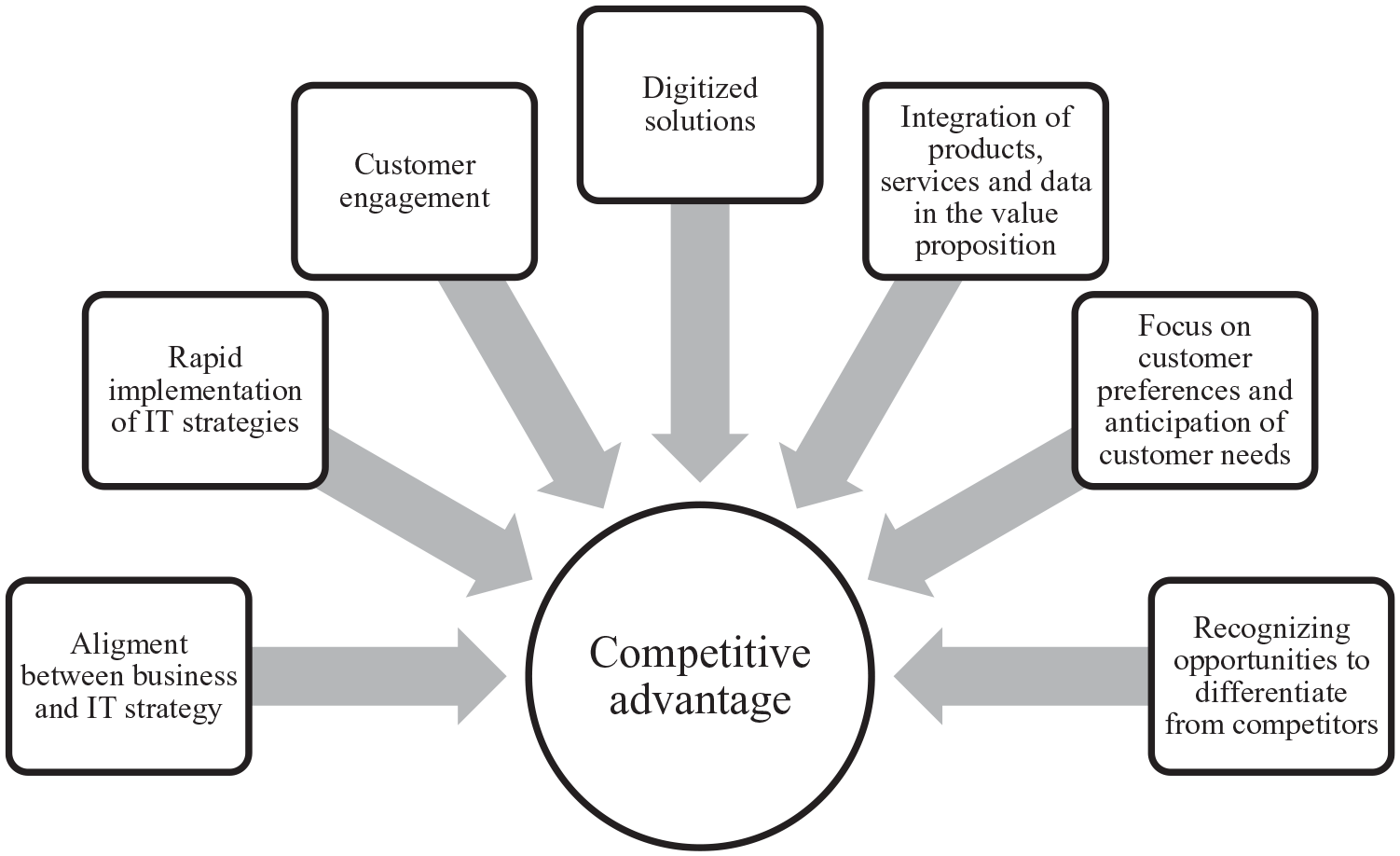
Combinations of business strategies that can yield a competitive advantage.
Organizational implications
Liu et al. (2011) define organizational transformation as a complex, revolutionary, and continuous process that demands fundamental changes in the organizational structures and systems leading to reassessments of organizational norms and values. Andriole (2017) provides a different perspective on organizations’ technology transitions by claiming that not every company, business process, or business model implicitly needs DT. For instance, transforming an existing business model to a more novel and innovative one may be possible, but not necessarily as profitable as the traditional business model. Moreover, successful companies often do not accept change, and employees are resistant to digital change, which leads to difficulties in implementing DT in the organization. Although DT delivers efficiencies, innovation, and competitiveness, the process should not be underestimated because, like every corporate initiative, it contains risks.
Looking at the levels of resources and capabilities, Liu et al. (2011) developed a resource fit theory based on a case study combining the resource-based theory and strategic fit perspective. The authors here show that competitive advantage originates from the better utilization of resources rather than better resources. According to them, resources and capabilities, as well as external demands, have to be analyzed in managing DT. Berman (2012) offers DT capabilities that enable flexible operation and responsiveness to fast-changing customer value propositions. Here, companies have to deliver business model innovation and drive customer and community collaboration. Moreover, companies with DT capabilities are required to integrate cross-channel, obtain insights from analytics, optimize the digitally facilitated supply chain, and enable a networked workforce (Berman, 2012). Using the example of traditional manufacturing organizations, Dremel et al. (2017) describe how DT demands the establishment of big data analytics capabilities in response to changes in product value propositions. This requires modifying decision-making processes and, therefore, organizational transformation. With big data analytics capabilities, product manufacturers are able to leverage digital technology to change offerings based on value propositions and improve organizational performance (Dremel et al., 2017). For instance, digitization that leads to disruptive product innovations challenges traditional car manufacturers to adapt to new customer value propositions such as embedded electronic systems or digital services. DT here requires managing data that is analyzed and exploited by big data analytics capabilities that are understood as a key competitive advantage. Analyzing customer data to gain new insights requires the organizational capability of agile intra-organizational collaboration and the integration of IT competencies. In addition, organizational structures and technology infrastructures must be re-allocated to support the inclusion of IT and data analytics in decision-making processes. Exploiting data analytics transforms the business for example, through introducing service charges based on usage or by providing as-a-service analytics.
Other important contributions in this area focus on a resource-based view (Chen et al., 2016; Karimi & Walter, 2015). Chen et al. (2016) examine a resource-based perspective of how DT affects organizational performance by the implementation of a web portal as a non-physical IT resource. Industry-specific IT resources are valued because they reduce costs, supporting sustainable competitive advantages as a result. Portal users perceive higher organizational performance regarding its usefulness as a human IT resource, and portal interface and service-oriented portal functions as intangible IT resources. The service-oriented functions—such as maintenance services, B2B functions, as well as cloud computing—show notable impacts on organizational performance. In a factor-based study of the newspaper industry, Karimi and Walter (2015) address the resource-based view and discuss the role of dynamic capabilities in regard to digital disruption. Disruptive digital innovations change traditional operating models, requiring dynamic capabilities to respond accordingly. Moreover, building digital platform capabilities as dynamic capabilities is considered fundamental in responding to digital disruption.
A related stream of research is concerned with answering who is responsible for guiding DT. The DT process calls for strong support from the top management team (TMT), because DT not only has to be implemented, but secured and communicated as well. The complexity of DT projects can challenge executives (Andriole, 2017). Accordingly, Kohli and Johnson (2011) address DT in the latecomer oil and gas industry, showing the importance of chief information officers’ (CIOs) and chief executive officers’ (CEOs) leadership in undertaking digitization. In contrast to the retail or banking industry, the oil and gas industry is considered a latecomer with digitization and DT progress and, therefore, is under pressure to agilely react to price and demand volatility. Here, the CIO and the TMT should target operational processes and embed digital technologies to gain supply chain visibility. Here, information is captured, integrated, and delivered, and new information system (IS) governance policies are established to redesign the organizational structure of the IS. In addressing DT in the context of a new omnichannel strategy, Hansen and Sia (2015) indicate that organizational changes require evolving the role of the CIO and leveraging the role of the chief digital officer (CDO). CIOs’ technical competences must be updated when it comes to managing the IT systems customers interface with, in extending boundaries of influence, and possibly when transitioning to the position of CDO. Moreover, until recently, CIOs were responsible for digital innovation while simultaneously struggling to extend their roles from pure technologists to business strategists (Singh & Hess, 2017).
Another possibility is a change to the CIO’s role, becoming a chief innovation officer who promotes business innovation through digital technologies. The digital department is in charge of delivering customer experiences, collaborating not only with IT, but all business units. When IT is assimilated into the core business, the role of CDO might become less relevant since the digital mentality is already included in ordinary business functions (Hansen & Sia, 2015). Based on six case studies, Singh and Hess (2017) determine how chief digital officers promote the DT of their companies, the main factors that drive the employment of CDOs, and the role types that CDOs primarily play. The authors identified the entrepreneur, the digital evangelist, and the cross-functional coordinator as the three role types of CDOs that capture IT competency, and change management, inspiration, and digital pioneering skills, as well as resilience as main competencies. Moreover, responsibilities associated with DT have a high level of complexity and demand a different mindset; they are skills that go beyond simply digitizing resources. For this reason, CDOs are employed to ensure DT as a strategic priority by exploiting opportunities presented by new digital technologies. In contrast, Gerth and Peppard (2016) provide a different perspective of the role of CIOs as they investigate their derailment. Their arguments are based on the ongoing digitization drive which leads organizations to be even more dependent on information technology to run business and stay competitive. Although spending on IT has increased, CIOs employed to lead an organization in its use of IT and achieve digitization benefits sometimes fail in the development of projects, and thus are replaced by CDOs due to the complexity of the role and failure to meet the organization’s expectations. Research describes misunderstandings of the transitions and ambiguity in defining IT success and role expectations. Poor relationship management with peers, and pushing change at the wrong pace are seen as causes of CIO derailment. Gerth and Peppard (2016) argue that CIOs must take certain actions to mitigate the risk of derailment, which clearly includes a clear understanding of the CEO’s vision for IT, recognizing the ambiguity of the CIO role, delivering on service and solution commitments, building a relationship strategy, proactively defining IT success, managing the pace of change, and speaking the language of the business. Hansen et al. (2011) focus on the necessity of IS leadership to rapidly adapt DT and demonstrate how organizations can use the participatory process model (PPM) to merge DT approaches with IS leadership roles. IS leaders should share the same mindset with business leaders to adequately adopt new approaches. In addition, leaders should follow four steps of identifying views and interests, analyzing agreements and disagreements, debating consequences, and building a reposition strategy. IS leadership should therefore focus on the value of IT, the strategic orientation of IT, and IS leadership roles such as the IT orchestrator or IT mechanic.
Another issue that falls into the scope of this cluster deals with knowledge management and the scope of human and digital networks. Here, Gottschalk (2006) discusses inter-organizational knowledge management and states that user involvement is essential to supporting e-business. According to the author, knowledge management can be considered a driver of DT and requires knowledge management systems. Because businesses operate in knowledge-rich environments, the pooling of knowledge resources is of growing importance because organizational boundaries must be expanded while using electronic information to include customers. Open innovation has emerged as a crucial concept in academic research, industrial practice, and the public policy domain (Bogers et al., 2018). External as well as internal ideas and paths to markets should be used and combined into platforms to create value and innovation. The core of open innovation is the ability to establish an ecosystem where people, organizations, and sectors can enhance co-creation. The open innovation process is linked to knowledge management across organizational boundaries. Accordingly, inflows and outflows of knowledge improve innovation success through digital technologies. Bringing together new digital technologies and scientific components means a combination of hardware and software emerges, displaying a positive impact on economic growth. Throughout innovation processes, open innovation is increasingly used to exchange knowledge, ideas, and technologies with external actors such as suppliers, customers, and competitors (Trantopoulos et al., 2017). Katsamakas (2014) notes the increasing prevalence of organizational networks enabled by IT. A feature of DT is that competition shifts from the firm level to the level of networks of interdependent firms. According to Katsamakas (2014), IT is used to reduce investment costs (e.g., the cost of sharing information), affects competition, and facilitates information sharing and coordination, all of which enable the creation of value networks. Moreover, the impact of social networking continues to grow, with social media being developed as a key means of collaboration and communication. Consequently, the demand for information and connectivity is rising which, in turn, requires data analysis by powerful computer systems that provide further possibilities to interpret data (Berman, 2012).
Table 2 shows the need for support from the different key agents on the company level. In addition, a specific and well-defined structure for obtaining accurate lines of action is crucial for every individual in an organization that can take part in the DT process. Doing this will achieve an adequate combination of the business and IT strategies and their subsequent implementation.
Drivers of Digital Transformation in Organizations.

Technology as a Driver of Digital Transformation
Cluster B emphasizes the influence of technologies regarding DT. A further aim of investigation could be for example, to determine the possibilities and challenges that result from new technologies and how they affect established structures.
The effective use of investments in IT and technology is necessary to generate business benefits and performance (Gerth & Peppard, 2016). Creative industries play a potential role in facilitating innovation and entrepreneurship across different economic sectors (Li, 2020). According to Li (2020), digital technologies facilitate the development of a wider range of new business models and not only transform them, but also serve as a new channel for information or interaction with customers and other stakeholders. With digital technologies, business models can not only be transformed, but also used to automate or extend. They, therefore, enable both new business models, as well as reconfigurations of traditional business models. Sebastian et al. (2017) contribute the idea of how social technologies, mobile technologies, analytics, clouds, and the Internet of Things (IoT) are considered new digital technologies. Similarly, cloud services are a major technology development that add value, especially to digital workplaces, by providing location-independent access (White, 2012). Moreover, the research conducted by Bondar et al. (2017) shows that traditional systems engineering and management approaches are inadequate and insufficient for a system-of-systems (SoS). The advances in network communication and human-machine interface demand a reliable interoperability between component systems in a SoS environment because traditional functional decomposition is no longer valid.
Jiang and Katsamakas (2010) analyze the Internet and e-book technology as drivers of book industry DT. e-book technology has enabled a new way to supply books to consumers rather than merely purchasing them from online or brick-and-mortar shops. An increase in e-book sales and a decrease in paper book sales demonstrate how e-book technology has disrupted the entire industry. The DT here not only results in the transformation of how people read books, but additionally guides them with new offers for book delivery and competition. For companies whose success was achieved pre-digitally, digital technologies represent either game-changing opportunities or existential threats (Sebastian et al., 2017). Regarding this, Sebastian et al. (2017) suggest an operational backbone and a digital service platform as technology-enabled assets to complement DT strategies, especially in the early stages. Operational backbones are technologies that encourage efficiency and operational excellence, whereas a digital service platform, such as platform-as-a-service (PaaS) is considered a technology encouraging business agility and rapid innovation.
The majority of the literature analyzed addresses new information technologies (NIT). New information technologies such as the Internet, broadband networks, and mobile communications have the potential to transform business and need to be understood in regard to how and when to apply them (Gottschalk, 2006). In their case research of 20 large companies, Andal-Ancion et al. (2003) emphasize the importance of how to employ new information technologies the correct way in a particular industry. They identified a set of 10 drivers of new information technologies. Instead of just investing vast amounts in new information technologies such as websites or broadband networks, companies now highlight that the practice of funding technologies is done in strongest accordance with their strategies and abilities to make their business competitive. By considering the most important factors of customizability and information content as drivers of NIT, companies can estimate the potential transformation success of their industries. Andal-Ancion et al. (2003) mention electronic deliverability as a driver of NIT, as in some industries information can be delivered electronically, while in others it cannot. For instance, airline companies let customers purchase their tickets online, whereas car manufacturers only provide initial information on the Internet, still wanting their customers to test-drive their vehicles before buying them. Information intensity plays an additional role, as the amount of it varies due to the enablement of new technologies to evaluate data. Products and services with a higher information intensity inherently have more potential to benefit from. Concerning customizability, NIT allow an adoption offering on behalf of customer value expectations, along with aggregation effects permitting bundled service impacts. Andal-Ancion et al. (2003) describe search costs and real-time interfaces as drivers of NIT, particularly in regard to customer and information processing. Contracting risks and missing competencies can be resolved by transparent pricing and outsourcing IT operations. Other reasons to use new information technologies are the opportunity for network effects and standardization benefits. Andriole (2017) provides a different insight into the use of new technologies: In some cases, it may be easier to use already-existing technologies to transform the business, rather than using emerging or disruptive technologies. Airbnb for instance leveraged mainstream networking technologies like mobile phones and apps to optimize gains based on consumer preferences.
An additional and crucial contribution in this area was made by Trantopoulos et al. (2017) who addressed IT and innovation. The authors provide a knowledge-based view on how external knowledge sources and IT are used to influence the performance of process innovation. According to a survey, the goals of major investments in IT are to reduce costs, and obtain efficiency, operational results, and business process improvement by exploiting technologies. Moreover, IT enables innovation by utilizing internal knowledge, as well as increasing the ability to exploit external knowledge. The authors conceptualize IT as facilitating the use of external knowledge with data access systems and network connectivity. Data access systems allow for knowledge platforms which lead to the transformation and recombination of information. Similarly, network connectivity facilitates greater knowledge absorption from external sources through for example, electronic communication platforms. Increasing mobile connectivity and the creation of social networks lead to an exponential growth of data, which in turn requires business analytics to evaluate rational information in order to take advantage of it (Berman, 2012). IT technology does not yet provide solutions to big data management because the rapid growth of information data leads to technical complexity. So even though the importance of analysts to examine this data is often indicated in the literature, specialized staff to actually do this is still uncommon in business (White, 2012).
Research addressing this topic has also dealt with information and data management. Jensen (1981) discussed detecting urban land use change via digital change detection algorithms. The systematic collecting of digital data and computer-assisted analysis enables changes to be monitored. As a result, the transformation of land use planning occurs by using technology for effective data collection and meeting information needs. Significant contributions were provided by Gölzer and Fritzsche (2017) by focusing on data-driven operations management, as the introduction of new digital technologies leads to changes in data management. The increasing importance of the interplay between big data and DT affects business structures. Consequently, the information systems design for processing data is no longer independent from exploiting data in business contexts, which leverage big data as a key focus of an organization’s operations management. For this reason, business structures develop through new data processing solutions that are based on the potential to generate value streams. Today’s industry, also referred to as Industry 4.0, includes big data solutions for processing large amounts of data in production. In recent years, the increasing amount of data has required dynamic forms of data processing, something going well beyond simply considering data as a passive resource. In their findings, the authors suggest categories for data processing requirements, such as data models, integration, and content, as well as decision—, knowledge—, and real-time processing and network safety. White (2012) mentions how digital technology provides a range of opportunities to those willing to change their businesses to take advantage of it, and that significant changes to the IT landscape in the last decade can be observed. Addressing digital workplaces, White (2012) emphasizes the importance of effective information management, as dramatic growth in information volumes has yet to be accompanied by capable information management. According to the author, the consumerization of technology and expectations of the work environment result in pressure to deliver adequate information. White (2012) describes four technologies allowing desirable digital workplaces: mobile technology, big data, cloud computing, and search-based applications. Providing this kind of digital environment can transform the way in which work is accomplished in terms of individual and organizational productivity and competitiveness.
Figure 4 summarizes the literature above. It considers technology as a key driver of DT, and the different advantages that organizations and companies can obtain by introducing these techniques into their strategies and ways they operate. Considering how and when to apply them is and will remain a key factor.

Advantages of introducing technology into business strategies.
Institutional and Societal Impacts
Cluster C presents the new emerging field of institutional and societal implications regarding DT. Due to this topic’s increasing presence in research, this paper seeks to provide a broader and more forward-looking view of it. Besides the investments needed to transform open initiatives into new technologies and business models, transformation depends on how societies innovate and how DT makes science more open, collaborative, and global (Bogers et al., 2018).
Hinings et al. (2018) advocate the need for new theories in the age of DT, which in turn lead to institutional change, providing an institutional perspective as a result. With DT, novel actors and constellations threaten, replace, or complement existing rules within organizations and fields. In their conceptual paper, the authors employ institutional change literature associated with DT, showing an institutional perspective offering insights on how these novel arrangements gain social approval. How innovations obtain legitimacy and how organizations are influenced by socio-cultural aspects have important implications for the study of DT. Legitimacy turns out to be a socio-cultural issue when radical, transformational change disrupts embedded organizational structures and values; transformational change means institutional change.
In regard to the DT of workplaces, White (2012) identifies the importance of designing and managing DT that has an ethnological and cultural perspective. A digital workplace enables employees to share information in the organization and partner organizations on a location-independent basis. The author criticizes how employees that are part of multiple networks are more likely to be interrupted by a virtual working environment, including channels of communication in real-time and location-independent working.
Addressing internal security threats, Bai et al. (2012) propose a model applicable to any DT that inherits confidential data with security vulnerability, especially in health care, online banking, electronic systems, and inter-organizational data interchange. Bai et al. (2012) investigate internal information breaches originating from accessing private information about individuals to execute organizational workflow. Because the amount of private information disclosure while exploiting private data for profit continues to grow, the authors suggest considering process-wide security aspects by outsourcing workflows to both optimize the efficiency of workflow staffing and minimize data exposure within complex workflows. A variety of privacy-related regulations provide clear guidance that facilitates organizations in identifying and incorporating conflict sets in their workflows. Although automated data processing diminishes privacy risks because private data is in this case not manually exploited, they create additional threats by accumulating a long-term wealth of information stored in one computing system.
Arntz et al. (2017) discuss the risk of automation among the advances in the field of artificial intelligence (AI) and robotics. According to them, economic and public debates on new technologies substituting for human labor are overestimated; they emphasize the adaptability of jobs in DT instead. In their study, they claim that the majority of jobs involve non-automatable tasks, and workers in highly exposed occupations (e.g., bookkeeping and accounting) perform tasks such as problem-solving or influencing that machines otherwise struggle with. Nevertheless, although the exposure of automation should be measured at the level of jobs rather than occupation, one in ten jobs are in fact susceptible to exposure.
Majchrzak et al. (2016) discuss the role of information and communication technologies (ICT) and societal challenges. For instance, IS researchers are supposed to adopt appropriate definitions of the ICT artifact. Moreover, researchers focusing on technology affordances and constraints theory can explain (1) why and how technology used in different contexts may have different outcomes or (2) how technology affords individual entrepreneurship. In a similar way, authors are asked to inspect the negative consequences of ICT use, for example, the outcome of ICT and the role of online information in promoting hate crimes. The authors conclude that ICT can have both positive and negative effects, and suggest the opportunity to offer policy recommendations.
Table 3 exhibits the main implications of DT on institutions and society. It furthermore sheds light on the considerations relevant to reducing the negative impacts and fostering the positive influences that DT may have at both the societal and institutional level by identifying the conflict sets in the different areas.
Main Institutional and Societal Implications of Digital Transformation.

Conclusion and Limitations
The past decade and last 4 years, in particular, have seen an increase in the number of publications dedicated to DT. Although the research that has been conducted focuses on various fields, the literature remains limited. This paper performed a detailed analysis of the current accomplishments in DT research, taking into consideration the relevant publications. To examine the field’s current state, a systematic literature review was performed based on the sample of 39 high-quality peer-reviewed scholarly articles. Although the clusters presented in this paper do not represent most of or the only important streams in DT research, they do in fact provide a direction on major avenues in the current research base.
The majority of research is established in Cluster A, which covers the topics regarding changes DT triggers in business processes, as well as organizational implications. It represents the most fundamental research streams discussing influence strategy, enterprise architecture, customer value proposition, customer relationships, business models, operations models and management, resources and capabilities, leadership with an emphasis on CIOs and CDOs, as well as knowledge management including open innovation and the scope of networks. Businesses are under pressure to rethink their customer value propositions, operations, and business models. However, the path to DT varies by industry (Berman, 2012). The development of new digital business models has already changed industries such as media and retail (Remane et al., 2017). Industries regarded as starters in DT include media and entertainment, while banking and retail, followed by healthcare, are considered savvy industries. Finally, oil and gas are considered latecomers. The changes triggered by DT in the literature most notably discuss the retail industry and e-commerce.
Cluster B covers the research dealing with technology as a driver of DT, including the current state of digital technologies and how to manage their associated increases in data. It focuses on new IT and IS. Moreover, technology accompanying and influencing DT aspects does not stand alone. It instead must be re-engineered among rising data relevance and information management. Here it’s important to consider that digital innovations and technologies that disrupt industries are not necessarily triggered solely by startups. Moreover, not every company needs to digitally transform in order to be profitable and stay competitive. In any case, DT delivers both opportunities and challenges to all parties involved; organizations will of course continue to be willing to introduce digital change strategies to be more competitive and achieve higher market shares.
Cluster C summarizes the current research stream emphasizing institutional and societal DT impacts. DT allows a more open, collaborative, and global science leading to improvements in society. Nonetheless, the emergence of novel actors in the environment triggers changes within organizations and companies that replace existing norms and rules. Economic actors and the environment in which they operate need to proactively be able to adapt to the new situations presented by disruptive changes. However, not all individuals possess the knowledge and skills to achieve this, making it crucial to train employees accordingly, as they may be affected by the new virtual working environments created by DT.
Figure 5 summarizes and illustrates the three clusters emerging from the literature analysis.
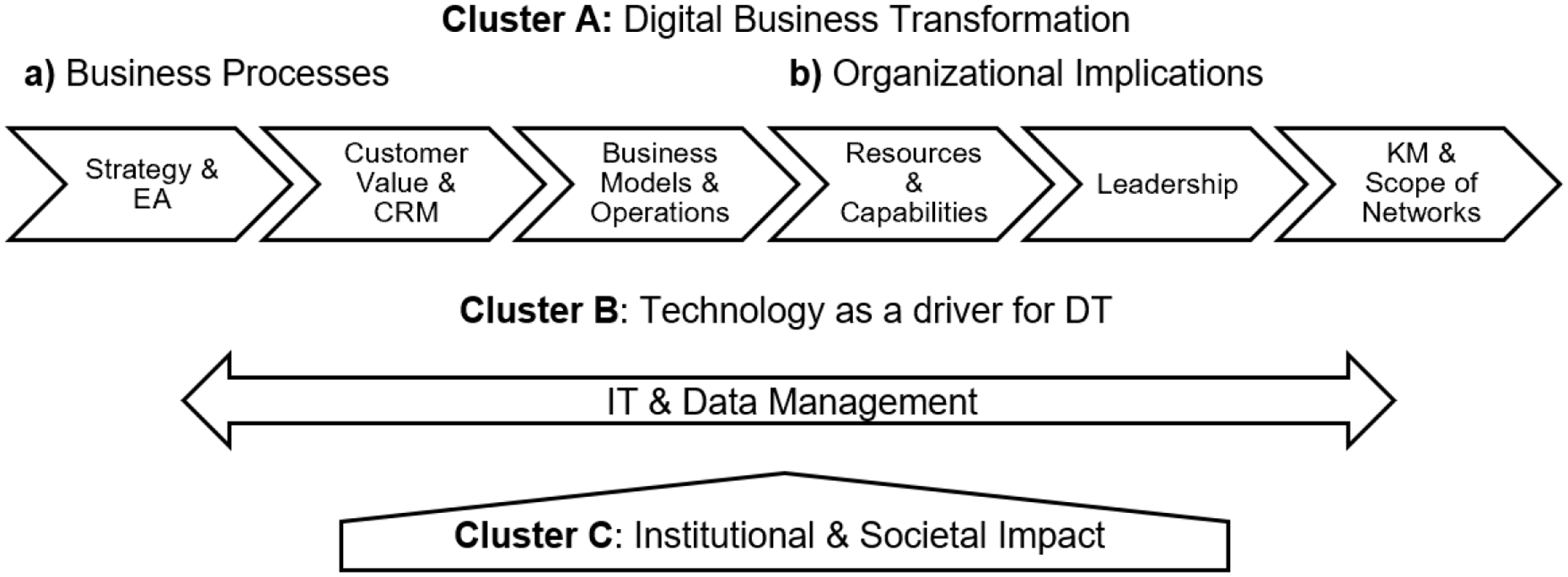
Digital transformation in clusters A, B, and C.
Limitations
As with all research, this study has its limitations. It is conceptual, based on a literature review of the topic of DT, collecting and classifying different papers according to the three aforementioned clusters. Moreover, it does not include all research done on DT, and the literature selected is always also based on the authors’ subjectivity within the research process. Bibliometric analysis also entails the limitation that articles tend to be cited more often over time, and not in the very first years after publication, and that self-citations tend to partially generate biased results (e.g., Mas-Tur et al., 2020; Rovelli et al., 2021).
Future Research Implications
The current literature offers a broad range of research on digitalization. However, more literature is needed to uniformly define DT, which could provide the government and private sectors with the knowledge and abilities to rapidly adapt to the disruptive changes found in business as a result of DT, reducing its negative impacts accordingly. In addition, the DT of latecomer industries such as oil and gas can be addressed in future research; the literature currently offers a wide spectrum of already-digitized established industries such as retail or media to provide a reference point for DT research on the oil and gas sectors. Similarly, Liu et al. (2011) apply a cultural entrepreneurship study to determine how organizations deal with these kinds of challenges, and propose examining the emergence of new digital infrastructures in the context of the blockchain phenomenon. The framework for organizational DT can be extended by applying multiple case studies with cross-case comparisons. Generally speaking, research on how to manage DT and its associated costs will be a key element for the future. Recent research has called for wider perspectives where fundamental paradigm shifts and societal impacts in wider contexts should be considered (Parviainen et al., 2017). There is a need for new theories in the current age of radical change in innovation and DT; an emphasis on their socio-cultural aspects could be very insightful. Regarding institutional change, research on how for example, crowd-based platforms gain legitimacy will additionally enhance the understanding of DT.
Footnotes
Declaration of Conflicting Interests
The author(s) declared no potential conflicts of interest with respect to the research, authorship, and/or publication of this article.
Funding
The author(s) disclosed receipt of the following financial support for the research, authorship, and/or publication of this article: Norat Roig-Tierno wish to thank Project GV/2019/063, funded by the Generalitat Valenciana, for supporting this research.
