




Abstract
The current research empirically investigated whether total quality management (TQM) as a multidimensional construct (organic and mechanistic) has a better explanatory power toward innovation performance dimensions with the mediating effect of business innovation capability (BIC) and moderating effect of business innovation culture. After an in-depth examination of the literature, a holistic TQM–BIC–innovation performance framework is being developed based on theoretical knowledge as well as empirical justification. This would help scholars and practitioners to comprehend ways through which quality and innovation are integrated. To this end, structural equation modeling–partial least squares (SEM-PLS) is used for analyzing the data. It has been found that both soft and hard TQM trigger innovation performance and firm BIC mediates this relationship. Lastly, the role of business innovation culture in enhancing firm’s radical innovation performance was empirically established. Thus, developing BIC and business innovation culture in a TQM-based firm could trigger innovating performance.
Introduction
Today, the long-practiced notion of quality as a competitive strategy (Hoang et al., 2006) has been surpassed by innovation (Schniederjans & Schniederjans, 2015) as an order winning criterion (Tidd et al., 1997) for manufacturing firms to compete and survive (Tidd et al., 1997). Where some scholars took a firm stand that quality is no more a winning criterion, others restrained themselves from such thinking as they felt that quality will always be there. Innovation will keep on growing in demand (Leavengood et al., 2014). One reason they thought is that to live in a dynamic setting, it has become essential that organizations must be proficient enough to keep up their pace with market-driven demands while catering to future market challenges (Gibson & Birkinshaw, 2004). However, challenges can get in the way as testified by Toyota’s recall and Samsung over the last few years. Despite emphasis laid by these firms on quality over the decades, questions raised today are as follows: Could these highly quality-oriented top companies foray into innovation-compromised quality? Or, making any attempt toward quality and innovation is predestined to fail?
There is a palpable tension between total quality management (TQM) and firm innovation performance. As innovation has caused a tremendous shift in the global marketplace, the biggest concern now for most corporate executives is whether TQM, with its control and metered processes, strangulates creativity and innovation. It has opened doors to a new debate, both in academia and among the industrial experts and in-house research and development (R&D) units, on ways through which organizations can cultivate innovation while using TQM. It has also been argued by scholars that TQM has inherent characteristics of consistency, standardization, and control that are obstacles in the way to innovation. In contrast, some argue that quality requirements imposed during prototyping for conformance and manufacturability contribute to better product design (Pisano & Shih, 2009), which is not possible in the absence of risk taking, change, difference, and accepting failures as are inherent to innovation.
In light of the above, the proposed model in this study is built upon the strong theoretical foundation of resource-based view (RBV) and dynamic capability perspective. The different TQM practices act as resources (bundle of resources) that are being transformed through “capability,” namely, business innovation capability (BIC), to produce sustained competitive advantage (innovation) for the firm. Innovation capability embraces the formation and development of new ideas, new product development (NPD), new manufacturing processes, and new services (R. Brown, 1992). It has been further emphasized that the only way to create a competitive strength for an organization is the capability to innovate. The resources-based view strongly advocates that sustained competitive advantage rests in the internal and external blend of a complex integration strategy, and that is why it is difficult to imitate (Maritan & Peteraf, 2011). Therefore, developing new capabilities and improving the old ones would help in adjusting to imbalances with competitors through training or integrating different specialties that will make employees meet the creativity and flexibility in the work environment. Thus, innovation is a dynamic capability, that is, “a learned and stable pattern of collective activity through which the organization systematically generates and modifies its operating routines in pursuit of improved effectiveness” (Zollo & Winter, 2002).
As TQM strategy is potentially a helpful tool for fostering learning and increasing a company’s competitive advantage (Hendricks & Singhal, 2001; Martínez-Costa & Jimenez-Jimenez, 2008), this learning ability can stimulate organizational innovation capability and maintain a competitive advantage in the turbulent environment (Crossan & Hulland, 2002; Nonaka & Takeuchi, 1996), thus helping organizations to cope with rapidly changing markets that demand the development of technological innovation and shorter product lifecycles that persistently challenge the competitive advantage (Prajogo & Sohal, 2003; Tidd et al., 1997).
Regarding innovation capability and business performance, a resource-based view suggests that a company with strong innovative capability can lead to superior competence due to the tendency that innovative capability cannot be perfectly imitable (Chen et al., 2010). Moreover, this study provides a more holistic model for understanding the relationship between TQM (organic and mechanistic) and innovation performance through BIC. This study contributes to a multidimensional view of TQM in exploring different paths to innovation from different dimensions of TQM, namely (organic and mechanistic), through BIC, which is also a missing link that this study is focused on. Lastly, the moderating effect of business innovation culture between a firm’s BIC and innovation performance further enhances our understanding of the role of innovation culture toward innovation performance.
Literature Review and Hypothesis Development
TQM–Innovation Performance Relationship
TQM is a manufacturing program that aims at managing the entire organization in a way that excels on all dimensions of products and services that are important to customers (Bouranta et al., 2019; Mehta et al., 2019). It is defined as both a philosophy and a set of guiding principles that represent the foundation of a continuously improving organization (Krajewski et al., 2013). In addition to this, the main objective of TQM is to generate improved product quality to improve firm performance (Modgil & Sharma, 2016). TQM–innovation performance relationship is strongly advocated by two viewpoints, where one strongly backs the idea that TQM does not provide a fertile ground for innovation to flourish (Zeng et al., 2015), whereas the other claims that the two are compatible and if executed simultaneously can help a firm in achieving excellence. According to Zeng et al. (2015), the proponents with positive view claim that structural flexibility, autonomy, teamwork, and knowledge transfer as well as control, which is an inherent part of any TQM program, facilitate innovation cultivation in firms. The opposite school of thought highlights the fact that two of them, if implemented together, can result in a disaster (Ferdows & De Meyer, 1990). In light of the multiple opposite opinions as above, studies investigating the TQM–innovation performance relationship are inadequate. Furthermore, the mixed outcomes of these studies have made this relationship more complex. Hoang et al. (2010) and Prajogo and Sohal (2004b), based on a case study from Australian and Vietnam manufacturing and service firms, respectively, established that TQM sets good conditions for innovation to flourish. Zu et al. (2008) emphasized on understanding the role of individual TQM practices in generating performance, particularly innovation performance. Terziovski and Samson (1999) studied the strength of this relationship in a sample of manufacturing firms from Australia and New Zealand. The result of the study showed that when the effect of industry type is not present, there exists a significant positive relationship between TQM and innovations (new products), whereas the same relationship is insignificant if the industry type is controlled. Furthermore, the authors failed to obtain a positive association in the manufacturing sector as a whole, and found that the relationship might be industry-specific and cannot be generalized for all types of industries. Others such as Prajogo and Hong (2008), Prajogo and Sohal (2003), and Hoang et al. (2006), in an empirical study, found causal impact between TQM and product innovation. A study by V. H. Lee et al. (2010) in the electrical and electronics (E&E) industry and by Ooi et al. (2012) among Malaysian manufacturing and service sector concluded that TQM is positively associated to innovation (product) and has a positive impact on innovation performance, respectively. Martínez-Costa and Martínez-Lorente (2008) and Zehir, Ertosun, et al. (2012) also empirically demonstrated that TQM is a strong predictor of innovation performance (either product or process or both). Similarly, another study by Harris et al. (2013), among 606 manufacturing small- and medium-size enterprises (SMEs) in North West European Pheripial Region, found that TQM has a significant positive impact on incremental innovation, but as far as radical innovation is concerned, no significant evidence of causality was detected. Moving forward in the same context, one of the well-known studies had been conducted by Singh and Smith (2004) among 418 manufacturing firms in Australia. The results of this study failed to obtain any sound statistical evidence of a causal link between TQM and innovation.
Satish and Srinivasan (2010) investigated how TQM practices influence different innovations such as the product, process, and R&D innovations in Indian large and medium-size firms. Overall results indicated a variation in the causal impact of different TQM practices either exclusively or in combination with different innovation performance measures. It is pertinent to mention here that it is quite a challenging task to establish whether hard or soft TQM practices are better contributors to the innovative success of the firm. As to some firms, hard practices are more positive contributors, whereas to some, soft are more dominant contributors toward innovation success (Zirger & Maidique, 1990). Again, the rarity of studies is a big hurdle in the understanding of the causal relationship between different TQM practices and their impact on different innovation types. To date, a compressive study is still lacking, and literature on the effect of TQM practices on innovation is quite scattered.
For instance, Jiang et al. (2012), Ooi et al. (2012), and Zehir, Ertosun, et al. (2012) as well as Hoang et al. (2006) demonstrated through an empirical analysis that human resources (HR) management positively affects innovation performance. L.Q. Wei et al. (2011), among 223 Chinese enterprises, pointed out that strategic human resource management (SHRM) has a positive impact on firms’ product innovation, and this relationship is stronger for firms with a developmental culture. Zehir, Ertosun, et al. (2012), as well as Ooi et al. (2012), in an empirical analysis, found a positive effect of customer focus on the innovation performance of the manufacturing firms. Govindarajan et al. (2011) collected the data from managers of top companies who have dedicated to mainstream customers, and found that there exists a positive impact of this effort on the introduction of radical innovations. Similarly, managing your suppliers has gained substantial attention in larger firms such as automotive, aerospace, and telecommunications (Chung & Kim, 2003). Ooi et al. (2012), in a study of Malaysian manufacturing firms, concluded that supplier management has a positive causal effect on a firm’s innovation performance. Wagner (2010), in a study of innovation in supplier–customer relationships, found that supplier–customer homophile is positively related to the customer firm’s NPD. M. Song and Di Benedetto (2008), in an empirical study, found that supplier involvement is key to the radical innovation performance of the firms. Chung and Kim (2003) among Korean automobile and electronics industries suppliers ended up with the conclusion that supplier connection certainly affects innovation and financial performance of a firm. M. Song and Thieme (2009), in a detailed study of 205 incremental and 110 radical NPD projects, highlighted that supplier involvement in activities such as market intelligence gathering for new products has greater impact on development of radical as well as incremental product innovations. Jones and Linderman (2014) in an international study of 238 manufacturing plants from eight countries across the machinery, electronics, and transportation parts supplier industries concluded that new process design is positively related to innovation. Researchers like Kim et al. (2012) in a study of Canadian firms while investigating the impact of Process management on innovation, found that process management has a significant positive effect on different innovations such as radical product, radical process, incremental product, incremental process and administrative innovation. Hoang et al. (2006), in an empirical study, revealed that process management has a positive effect on number of new products developed by the firm. Similarly, Ooi et al. (2012), in Malaysian manufacturing firms, found that process management as an important component of TQM has a significant effect on innovation performance.
Furthermore, Moura et al. (2007), in Portugal’s footwear industry, found a nonsignificant relationship between TQM practices and technological innovation. This claim again opens up the debate about whether the TQM element’s impact on innovations is more industry-specific as the results contradict previous studies. In other words, a more nonuniform pattern is observed, dictating that the relationship might be more complex and needs further investigation.
In line with the above, another area that is quite underdeveloped and where scarcity of research exists is innovation in SMEs. SMEs add to the noncustomized contributions due to their innovative capacities (Lin & Chen, 2007). However, the empirical studies in SMEs are again extremely limited, and inconsistency in the results does exist. For instance, Carlos Pinho (2008), in a study of Portuguese manufacturing SME, has concluded that there is no statistical evidence that confirms the effect of TQM on innovation. McAdam and Armstrong (2001), using a case study analysis in SMEs, concluded that SMEs have a major threat from larger, more agile companies encroaching on their markets. This has elevated the levels of market pressure on SMEs to innovate. Therefore, the only option for SMEs is to enhance their innovation capability for new product and process development. The case study data showed that quality is critical for developing large-scale innovation and also triggers innovation. Again, lack of studies is a hurdle that needs to be addressed.
We argue that there exists an alternative explanation that remained underexplored and could better answer this debatable question. We contend that TQM is multidimensional (organic and mechanistic), which has, according to Martínez-Costa and Martínez-Lorente (2008), the possible explanation to the contradictory effect of TQM on innovation, and could be because of the firm’s emphasis on implementing organic and mechanistic aspects of TQM.
The organic TQM is the behavioral side of management (Rahman, 2004) or “human factors” (Rahman & Bullock, 2005), which is related with management concepts and principles such as leadership, employee empowerment, and culture (Thiagaragan et al., 2001; Vouzas & Psychogios, 2007). C.B. Fotopoulos and Psomas (2009) have acknowledged organic TQM factors as they were detected in recent studies, which are leadership, strategic quality planning, employee management and involvement, supplier management, customer focus, process management, knowledge, and education.
On the other side, the “mechanistic” means quality improvement tools and techniques (Vouzas & Psychogios, 2007). Flynn et al. (1995) named these quality management practices as “core quality management practices,” which refer to tools and techniques such as product/service design, process management, quality data, and reporting. The mechanistic practices include production and work process control techniques, which ensure the proper execution of such processes (among others, process design, the “just in time” philosophy, the ISO 9000 norm, and the seven basic quality control tools; Evans & Lindsay, 2002).
Lewis et al. (2006a, 2006b) examined the use of “hard” (analytical) factors as opposed to “soft” (human-centered) factors. Their research concluded that a holistic approach was best to ensure proper TQM implementation. Among other studies that used TQM as mechanistic versus organic practices (Abdullah & Tarí, 2012; C. V. Fotopoulos & Psomas, 2010; Kaynak, 2003), we also found either mechanistic or organic practices contributing toward the firm’s performance. In other words, both organic and mechanistic TQM play an important role in leveraging organization performance.
Other studies conducted by different researchers (Demirbag et al., 2006; Fening, 2012; Ismail Salaheldin, 2009; Malik et al., 2010; Rahman, 2004) in different countries, SMEs have also empirically demonstrated TQM having a causal impact on SME performance. Prajogo and Sohal (2004a), adopting a different approach divided the TQM into organic and mechanistic (soft and hard) TQM practices in their study considering innovation as a higher order construct comprising of (product and process) innovation, concluded that organic TQM has a better explanatory power toward innovation. In contrast, mechanistic TQM has a better explanatory power toward quality. Their study raised serious questions about whether mechanistic TQM elements have any role in innovation performance in organizations. Later on, Prajogo and Sohal (2006), with a sample of 194 managers from Australian companies, found that TQM is strongly related to quality performance but not statistically significant to innovation. Feng et al. (2006), with a sample of 252 firms, with 194 from Australia and 58 from Singapore for both manufacturing and nonmanufacturing, presented a cross-country comparative analysis, and found TQM to be a multidimensional construct with organic and mechanistic properties. The results demonstrated that mechanistic TQM (hard TQM) is more related to innovation, whereas organic TQM (soft TQM) is more related to quality. This study reversed the previous findings, and one probable explanation is that TQM implementation does differentiate the hard and soft aspects (Samson & Terziovski, 1999). Based on the ambiguity, further empirical analysis is required to resolve this issue, and hence the first set of working hypotheses is developed as follows:
Relationship between TQM and firm’s BIC
Today’s organizations are in a continual pursuit to develop capabilities that could help them in innovating new products and services (Al-kalouti et al., 2020) as they are vital for long-term prosperity and success (Saunila & Ukko, 2012). BIC captures firms’ ability to create new ideas to produce new products and improve their processes to smooth better results (Hult et al., 2004; T. S. Lee & Tsai, 2005; Neely et al., 2001; Perdomo-Ortiz et al., 2006; Taherparvar et al., 2014; Wang & Ahmed, 2004). It also refers to the “implementation or creation of technology as applied to systems, policies, programs, products, processes, devices, or services that are new to an organization”. Tura et al. (2008) have identified it as openness/creativity, knowledge/expertise, and operationalization capability.
BIC is a multifaceted construct (Perdomo-Ortiz et al., 2006). Zhu et al. (2007) as well as H.-C. Lee and Liu (2008) used innovation capability as a higher order construct. Whereas, Yam et al. (2010) elaborated it as technological innovation capabilities (R&D and resource allocation capabilities). Prajogo and Ahmed (2006) as well as Zhang et al. (2009) measured innovative capability through R&D capability. R&D capability refers to the enterprise’s ability to reframe the present knowledge and produce new knowledge. Guan and Ma (2003) further elaborated the definition and defined it as processes that enable the firm to invest in new technology along side converting exciting technology to develop new products and services.
Li and Chen (2010) used innovation capability attributes such as strategic planning capability, technology capability, and marketing capability. Therefore, for this research, we use H.-C. Lee and Liu’s (2008) approach of defining innovation capability as a higher order construct with organizational, R&D, marketing, and manufacturing capabilities.
Extending further and using the theory of RBV, we argue that to generate innovations, a firm should have the necessary capability to innovate. As TQM strategy is potentially a helpful tool for fostering learning and increasing a company’s innovation performance (Martínez-Costa & Martínez-Lorente, 2008; Terziovski & Samson, 2000), this learning ability can stimulate organizational innovation capability and maintain a competitive advantage in the turbulent environment (Nonaka & Takeuchi, 1996). For many, like Perdomo-Ortiz et al. (2006), the answer to contradictions and long-term survival is hidden in the innovation capability development trajectory of the firm. Furthermore, both soft and hard TQM factors play a positive role in the development of innovation capability. Therefore, for firms having TQM implemented is not enough, they must also focus on developing innovation capabilities to nurture innovation performance.
As far as the relationship between TQM and BIC is concerned, Perdomo-Ortiz et al. (2006) emphasized that the different dimensions in which TQM is developed and implemented in the organizations are determining factors for building a BIC. Therefore, the role-played by different TQM practices is crucial in developing a firm’s BIC. Zehir, Müceldili, et al. (2012) in a Turkish-based firm, found leadership as a soft factor of TQM, positively associated with the firm’s capability to innovate. Schweitzer (2014), in a study among 369 strategic business alliances, found that innovation capability is influenced by transformational as well as transactional leadership behavior. The intensification of competition among firms in different industries due to globalization and specialization processes have made these firms to reaccess their current core capabilities and resources and mobilize other resources from suppliers (Cousins & Spekman, 2003). As innovations are the result of interaction among different parties from different organizations (Steinle & Schiele, 2002; Trott & Hartmann, 2009), knowledge absorption from the supplier not only helps in enhancing the manufacturing firms knowledge assets but also helps in enhancing the innovative capability of the manufacturer through an exchange of knowledge and learning during the improvement of old products or NPD (Lazzarotti & Manzini, 2009; Steinle & Schiele, 2002). Research has also revealed that in the process of innovation, mobilization of capabilities from the supplier side increases the likelihood of product and project success of the manufacturers (Primo & Amundson, 2002). There is a body of literature in which firm-level technological advances are conceptualized as a learning process that hinges critically on HR practices (W. M. Cohen & Levinthal, 1989). Past research also recognizes knowledge and people competencies are valuable assets for firms because they are firm-specific, socially complex, and path dependent (Collins & Clark, 2003). A recruit would bring “new” knowledge and skills into the firm and could help improve the stock of technically qualified workforce. Silva and Leitão (2007), using a logit model in Portugal, found that personal qualification has a significant positive effect on firms’ innovation ability.
Similarly, Lund Vinding (2006), in Danish enterprises, found that firms with higher levels of HR management practices are having higher levels of innovation capability. Perdomo-Ortiz et al. (2006, 2009) empirically demonstrated the significant positive effect of HR practices on a firm’s BIC.
Ramani and Kumar (2008) suggested customer relationship management (CRM), which is always focused on organizations, is essential for developing innovation capability. A high level of frequent interaction between a consumer and the producer helps in collecting valuable information from the customers for developing new products (Droge et al., 2004) through developing innovation capability by meeting the needs of a targeted market (Ottum & Moore, 1997). Early customer involvement in NPD improves innovation capability, resulting in products and services for particular target markets (Lagrosen, 2005).
A firm’s formal strategic planning process is a critical aspect (Jarzabkowski & Balogun, 2009) that influences planning decisions by providing evidence of customer needs, exposing new technologies, or shedding light on the future market or technological trends, which are important inputs in the innovation process (Zahra et al., 2002). From dynamic capabilities, perspective bundles of innovation strategies shape the ability of enterprises to invent, develop, introduce, and commercialize innovative products (Branzei & Vertinsky, 2006). In the face of environmental uncertainty, business leaders are emphasizing that firms have to develop planning flexibility (Titus et al., 2011), which is one best way to obtain a strategic fit (Grant, 2003; Wiltbank et al., 2006). In other words, such flexibility helps the firm to plan for unpredicted breakthroughs that might come up with the changing consumer demands. Hence, any formal strategic plan with flexibility factor incorporated helps to overcome organizational inertia and open avenues for explorative innovations as routines are revitalized as per the new strategic plans (Zhou & Wu, 2010). Based on the above discussion, it is evident that TQM (organic and mechanistic) can influence BIC. Therefore, the next set of working hypotheses are proposed as follows:
Relationship between BIC and innovation performance
Different past studies have reported a positive relationship between a firm’s innovation capability and performance (Armbruster et al., 2008; Cho & Pucik, 2005; Koellinger, 2008; Tsai & Tsai, 2010). C. Lee et al. (2001) emphasized that firms need to upgrade their innovation capability to sustain a competitive advantage constantly. Calantone et al. (2002) and Lawson and Samson (2001) strongly advocated that organizational performance is highly dependent upon firms’ capability to innovate. Wallin et al. (2011) suggested longer run innovation capability of the companies is something that is going to determine the competitiveness in the market place. Yeşil et al. (2013), in an empirical study, found that innovation capability has a positive impact on organizations’ innovation performance.
Yam et al. (2010) indicated that in new product introduction, different technological innovation capabilities (R&D and resource allocation capabilities) of an enterprise have a significant contribution. Although Garcia-Morales et al. (2007) emphasized that the greater a firm’s innovation capability, the more prospects it has and will receive a better response from the market, Prajogo and Ahmed (2006) as well as Zhang et al. (2009), in an empirical analysis, found that innovative capability (R&D capability) positively affects innovation performances. Q. Li and Chen (2010) study the relations between innovation capability and NPD performance in the small- and medium-sized manufacturing business in China’s Zhejiang Province. They concluded that innovation capability attributes such as strategic planning capability, technology capability, and marketing capability positively influence the NPD performance of these manufacturing SMEs. Similarly, H.-C. Lee and Liu (2008), in an empirical study, found that innovation capability as a higher order construct (R&D capability, manufacturing capability, marketing capability, organizational capability) has a positive impact on a firm’s innovation performance.
Di Benedetto et al. (2008), among firms from the United States, Japan, and China, concluded that marketing capability is an important dimension of a firm’s innovation capability, and strongly affects a firm’s radical innovation. Although Yusr et al. (2012) reported that marketing and organization learning capability act as mediators between TQM and innovation performance among Malaysian manufacturing companies, Y. T. Song and Ding (2013), in another empirical study, concluded that quality management has a significant positive influence on innovation through the mediating effect of R&D capability. Similarly, Hung et al. (2011), in high tech companies, found conclusive statistical evidence of organizational learning capability having a mediating effect between TQM and innovation performance. Hence, the following working hypotheses are proposed:
The Moderating Role of Business Innovation Culture
Culture as a key factor of competitiveness (Earley, 2002) is a vital construct that affects both individual- and organizational-related process and outcomes (Yeşil & Kaya, 2013). Organizational cultures affect employee behavior, learning, development (Bollinger & Smith, 2001), creativity and innovation (Ahmed, 1998; Martins & Terblanche, 2003), and performance (Zain et al., 2009). These studies reveal a broad range of organizational culture outcomes, and yet its impact on innovation is scarcely studied (McLean, 2005; Yeşil & Kaya, 2013). The organizational culture encourages (or discourages) a variety of behaviors but routinely overlooked source of innovation success is achieving cultural fit (Lau & Ngo, 2004). This goal will not only increase the workers’ ability to innovate but also enhance a firm’s success by forming new ventures (T. E. Brown & Ulijn, 2004). Different studies in the past such as Kotter (2008) and Rose et al. (2008) have pointed toward the role-played by a strong organization culture toward a superior financial performance in the organization. In these studies, organizational culture has been considered as an organizational resource or asset that influences performance (Prajogo & McDermott, 2011). RBV theory also stresses culture of the organization as a distinctive identity and incomparable capability that builds up firms competitive advantage (Barney, 1986, 1991).
Edwards et al. (2002), as well as Martins and Terblanche (2003), emphasized that organizational culture is a valuable enabler of innovation. Similarly, another study by Weihong et al. (2008) ended up finding that the openness of corporate culture plays a key role in a moderator between innovation capability and firm performance. An innovative culture denotes such common values that are shared, beliefs and assumptions of the people working in the company that could aid the process of innovation (Martín-de Castro et al., 2013).
When an organizational culture or climate encourages the employees’ innovation capacity, tolerates risk, and supports personal growth and development, the organizational culture may be labeled as “innovation culture” (Menzel et al., 2007). According to O’Cass and Ngo (2007), it is the innovative culture of the organization that pushes its employees to become innovative and opens challenging avenues for others with the latest offerings. For instance, adhocracy culture, which is characterized as a dynamic, entrepreneurial, innovative, and creative workplace, emphasizes on NPD and change (Tseng, 2010; Yeşil & Kaya, 2013). Therefore, it could be argued that an organization with such an innovation-stimulating culture could leverage higher innovation levels in the firms. Martín-de Castro et al. (2013), in an empirical analysis, found a strong moderating effect of innovation culture on product innovation. Thus, one of the purposes of this study is to examine how innovation culture as a moderating variable can enhance a firm’s innovation performance. Therefore, the next set of hypotheses is proposed as follows:
Research Framework
The following research framework is built upon the above-presented literature to examine the association between TQM practices, BIC, and firms’ innovation performance. The links between TQM, BIC, and innovation performance are illustrated in Figure 1.

Research framework.
Method
Survey Instrument
The measurement instrument was adopted from literature, which established its validity and reliability in past studies. All the constructs have been operationalized using 5-point Likert-type scales because they take less time and are easy to answer (Frazer & Lawley, 2000). The TQM (organic and mechanistic) measures were mainly adopted from Ooi et al. (2012), Su et al. (2008), and Yong Xiang et al. (2010). Business innovation culture was adopted from O’Cass and Ngo (2007), Škerlavaj et al. (2010), and Y. Wei et al. (2013). The six innovation performance dimension measures were mainly adapted from the studies of Gunday et al. (2011), Kim et al. (2012), and Y. Li et al. (2008). The BIC measures were adopted from Guan and Ma (2003), which is a higher order construct comprised of R&D, marketing. SPSS Version 22 and Smart PLS by Henseler et al. (2009) were used for analysis purposes.
Sample and Procedure
A survey of Pakistan’s manufacturing companies was conducted. These companies were chosen from the list provided by the Federal Bureau of Statistics (FSB) Islamabad, Pakistan. The unit of analysis for this study is the manufacturing organization of Pakistan, having TQM implemented in the organization and having done innovation over the last 3 years. For this purpose, two screening questions were also added to the survey. The respondents were senior executives such as the quality manager, production manager who were generally involved in different production- and innovation-related activities and were the representatives of these firms, and hence the respondents to the survey of this study. A cross-sectional sample survey field study was employed in this research as data were collected at a single point in time. Furthermore, a representative sample in the probability sampling design is important for wider generalization purposes. Krejcie and Morgan (1970) developed a table to easily determine the sample size, according to which the required sample size is 379. Estimating the expected response rate was an important step. The low response rate in some previous studies had been noticed. Therefore, the sample size was increased by 40% to undertake the threat of sample attrition, as suggested by Salkind (2007). Therefore, a total of 531 questionnaires were distributed in proportion to the size of each stratum. In this study, simple random sampling is used, which guarantees equal and independent representation of the data chosen. Random numbers from each stratum were generated using SPSS that enable us to select the sample from 18 strata. From each stratum, the firms were assigned numbers and later on selected firms randomly through SPSS. A total of 531 firms were selected randomly from 18 strata based on the proportion of each stratum. The questionnaires were distributed to these 531 manufacturing firms in Pakistan via postal mail. Of the 531 surveys sent out, 210 were returned, yielding a response rate of 39.5%. The data collection took 5 months with extensive time and dedication to the researcher. Of the 210, not all returned surveys were useful, and only 200 usable completed surveys were taken for further analysis, thus giving a 37.6% usable response rate.
Survey Results
Profile of the respondents
The total number of respondent companies in this survey is 200. As shown in Table 1, about 68% were locally owned firms and 24% foreign owned, whereas the remaining were having mixed ownership. About 60% of firms had domestic and foreign sales. Only 13.5% had only foreign sales; 80.5% of the firms in the sample were ISO certified for more than 3 years; 80% of the firms have TQM practices implemented in their organization for more than 3 years. There were more males (92.5%) than female respondents (7.5%). About 28.5% of the respondents were production managers, 20% were plant managers, 34.4% acquired the post of general managers, whereas 9.5% were quality control managers. About 7.5% were other that included operations manager, product managers, and senior department executives. The respondents were well-educated professionals, mostly having bachelor’s (40.5%) and a master’s degree (58.5%). They were also having good experience with the current firm, and hence could be considered suitable to fill up the required survey.
Demographic Profile of the Sample.

Source. Prepared by the researcher.
Note. ISO = International Organization for Standardization; TQM = total quality management; SME = small- and medium-size enterprises.
Measurement model
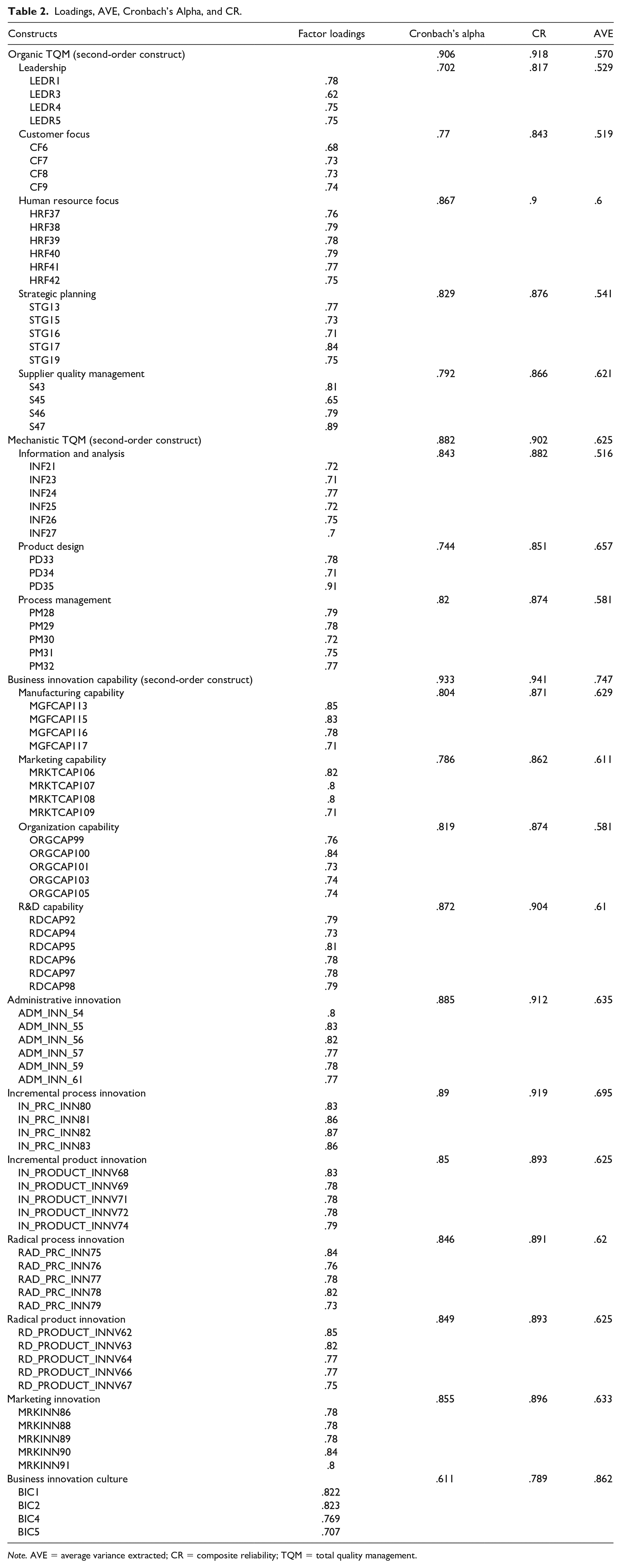
In this research, we used confirmatory factor analysis (CFA). Using Podsakoff et al.’s (2003) criterion, common method bias that was established as the ratio of principal factor variance to total variance is 35.56%, which is less than 50%. Cronbach’s alpha is between .702 and .885 as suggested by Kline (2011), and composite reliability (CR) values are also within the limits as prescribed by Fornell and Larcker (1981), although Nunnally and Bernstein (1994) also recommended values as low as .6 as acceptable as shown in Table 1.
Furthermore, all loadings were above .5 (more than 50%; Hair et al., 2006; Table 2), and HTMT value is below .90, discriminant validity has been upheld between two reflective constructs (Hair et al., 2016) as shown in Table 3. The variance inflation factor (VIF) was found to be less than 2 as per the established criterion of Hair et al. (2016), and hence the measurement model shows a good fit.
Loadings, AVE, Cronbach’s Alpha, and CR.
Note. AVE = average variance extracted; CR = composite reliability; TQM = total quality management.
HTMT Criterion for Discriminant Validity.

Note. HTMT = Heterotrait-Monotrait.
Analysis of structural model
Control variables
Initially, two control variables (i.e., company size and company age) were included in the model (see Table 4). It was inferred that organization size had a positive effect on radical product innovation (β = .131, t = 2.565, p < .01). Besides, company age had a significant negative effect on radical process innovation (β = −.133, t = 2.929, p < .003); consequently, nonsignificant paths were removed, and significant paths were kept for further analysis.
Control Variables.

Structural analysis
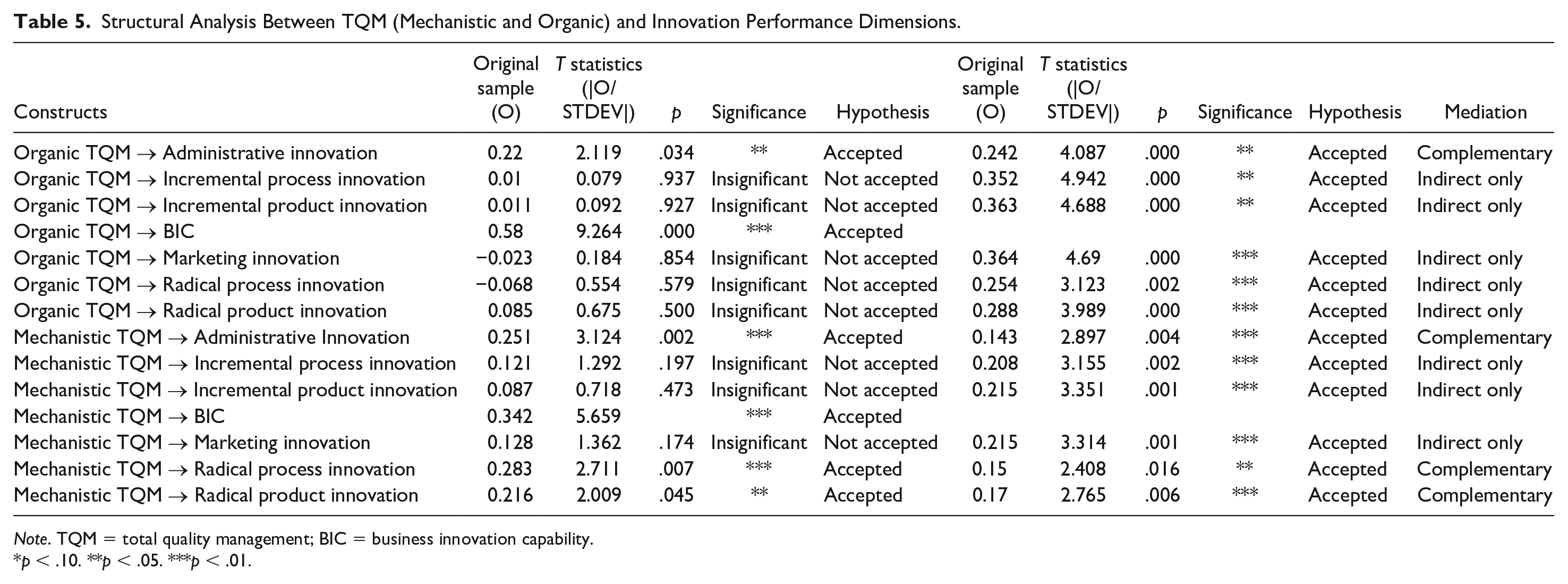
The indirect effect of organic TQM on incremental process, incremental product, marketing, radical process, and radical product innovation was exerted through BIC with β = .352, p < .05; β = .363, p < .05; β = .364, p < .01; β = .254, p < .01; β = .288, p < .05, respectively; whereas, the direct paths from organic TQM to incremental process, incremental product, marketing, radical process, and radical product innovation were found to be nonsignificant, thus making indirect-only effect. The indirect effect of organic TQM on administrative innovation is found to be significant (β = .242, p < .05), whereas the direct path is also significant (β = .22, p < .05), thus making mediation to be complementary.
The direct path from organic TQM to BIC is found to be statistically significant with β = .58, p < .05, also the direct path from BIC to administrative innovation, incremental process, incremental product, marketing, radical process and radical product is also found to be significant (β = .417, p < .01; β = .607, p < .01; β = .627, p < .01; β = .628, p < .01; β = .438, p < .01; β = .496, p < .01).
As can be inferred from Table 5, there are six significant mediated effects with three as indirect-only effects and three as complementary mediations. The direct path from mechanistic TQM to BIC is found to be statistically significant with β = .342, p < .01, also the direct path from BIC to administrative innovation, incremental process, incremental product, marketing, radical process, and radical product is also found to be significant (β = .417, p < .01; β = .607, p < .01; β = .627, p < .01; β = .628, p < .01; β = .438, p < .01; β = .496, p < .01).
Structural Analysis Between TQM (Mechanistic and Organic) and Innovation Performance Dimensions.
Note. TQM = total quality management; BIC = business innovation capability.
p < .10. **p < .05. ***p < .01.
The effect of mechanistic TQM on incremental process, incremental product, and radical process innovation was exerted through BIC, β = .146, p < .01; β = .155, p < .01; β = .108, p < .05, respectively. The indirect effect of mechanistic TQM to administrative innovation, marketing innovation, and radical product innovation were also found significant with β = .121, p < .01; β = .155, p < .01; β = .141, p < .01. The direct path from mechanistic TQM to administrative innovation, radical process, and radical product innovation was also found significant with β = .251, p < .01; β = .283, p < .01; and β = .216, p < .05, making the mediation as complementary mediation.
According to J. Cohen (1988), if the value of f2 is .02, it is considered as small, .15 as medium, and .35 as large. Chin et al. (2003) state that a low effect size f2 does not necessarily imply that the underlying moderator effect is negligible: Table 6 shows the f2 values for the main effect and interaction effect. Sometimes, a very little interaction effect becomes important under extreme moderating conditions; “if the resulting beta changes are meaningful, then it is important to take these conditions into account” (Chin et al., 2003). Therefore, the bootstrap procedure with 2,000 re-samples was run to find out which of the six interaction effects are significant. The results are summarized in Table 6.
R2 Main Effect and Interaction Effect Model and Effect Size.

After running the structural analysis, it was inferred that business innovation culture moderates the relationship between BIC and radical product innovation (.059, p < .10) as shown in Table 7. Thus, Dawson (2014) suggested that to follow up for the significant interactions, and interaction plot should be drawn. To interpret the interaction plots, the gradient of the slopes is studied. As can be seen in Figure 2, the line labeled High innovation culture has a steeper gradient compared with the low innovation culture, indicating that the positive relationship is indeed stronger for when innovation culture is high. Thus, our hypothesis is supported as that was what we hypothesized before the analysis.
Results of the Moderator Analysis.

p < .10.

Interaction plot.
Discussion
In light of the empirical evidence of this research, it is established that TQM-based management practices (organic and mechanistic) on different innovation performance dimensions, namely, administrative, radical product, radical process, incremental product, incremental process, and marketing innovation performance take place due the promise that these practices build BIC. Our results are in line with the past studies that BIC is an important ingredient for innovation performance (Cavusgil et al., 2003; Yusr, 2016; Yusr et al., 2013). Therefore, organizations must develop BIC as it helps in deploying resources with a new capacity to create value (Yang et al., 2009).
Another important finding of the current research is that organic TQM plays a superior role in enhancing BIC as compared with mechanistic TQM. The support of this argument is also present in RBV theory that stresses how valued resources build a firm’s capabilities that make it unique to its competitors. Therefore, our study presents organic and mechanistic TQM as two composite constructs that enhance a firm’s capability to innovate that further triggers the innovation performance of the firms. In addition, our findings support the conclusions of Abrunhosa and Sa (2008), Prajogo and Sohal (2006), and Singh and Smith (2004) that TQM practices alone do not affect a firm’s innovation performance as much as if TQM is considered a multidimensional construct, and this is more indirect through BIC. Furthermore, it is sustained in light of the empirical findings of the full mediating role of BIC on the association among TQM (organic and mechanistic) and administrative, radical product, radical process, incremental product, incremental process, and marketing innovation performance. Practically, manufacturers in Pakistan need to recognize the importance of the combination of TQM resources (organic and mechanistic) to generate BIC, and then upgrading them along with the market dynamics could potentially sling the firm in a state, where attaining a strategic fit might become difficult for other firms. Therefore, in the face of environmental pressures where firms are striving with internal resources to obtain a strategic fit for gaining competitive advantage through innovation, the development of BICs is the bridge between TQM and innovation performance from the mediating perspective. Lastly, organization culture (business innovation culture) is not only important to foster innovation but also for the organization to take advantage of the competitive advantage that results for the organization due to its innovative capability (Matos, 2008).
Limitations and Future Research Direction
Like other studies, this study is not free of limitations and provides future avenues for research. The sample comprised the majority of companies who were ISO 9001 certified and have TQM principles in place. The companies were well aware of the concepts of TQM and other technological innovations. Yet, firms awarded any other national quality award might have been left out in this study. If the study is replicated with those firms, probably results would be more interesting. Second, longitudinal design studies will overcome time lag problems. Third, future studies must conduct more in-depth studies on how individual innovation capabilities can play a key role in TQM practices and innovation performance dimensions. This effort would further validate the outcome of this study and advance our understanding of TQM and innovation. Lastly, no kind of objective measurement item was used to analyze innovation. Hence, future scholars need to work on more objective and comprehensive measurement items for extending this research.
Conclusion
Hence, our results strongly dictate that TQM is not just an organization’s magic bullet through which it attains sustainable competitive advantage; rather, it nurtures firms’ BIC trajectory through its practices such as HRM, leadership commitment, and supplier quality management. Consequently, a durable competitive advantage is shaped by this key organizational resource by thoroughly understanding the logical sequence between quality objectives and innovation objectives. In other words, firms must be able to evolve from quality control approaches to those centered on continuous learning. Having ISO certification and implementing TQM are grounds for developing a firm’s BIC. Managers need to pay attention to the role that each TQM element, either soft or hard, can play in enhancing a specific kind of innovation. They need to further focus on how each soft and hard factor within their domains is closely interrelated to force a specific kind of innovation to be worked out. They need to come up with a culture of innovation, where people are heard, respected for their ideas, and given autonomy to become creative through knowledge seeking and implementing it within the organization. Hence, managers need to define what innovation means for their company clearly. Lastly, business innovation culture is another important resource for the organization. Our study empirically tried to prove the theoretical fact that the RBV view of culture considers organization culture as a source of the strategic advantage as it promotes learning, and innovation, and helps firm in achieving excellence.
Footnotes
Declaration of Conflicting Interests
The author(s) declared no potential conflicts of interest with respect to the research, authorship, and/or publication of this article.
Funding
The author(s) received no financial support for the research, authorship, and/or publication of this article.
