




Abstract
This article provides an overview of some recent findings on consumer attitudes and other vital antecedents of purchase intention of branded meat. Based on a sample of 349 respondents in Pakistan, this study tests a model including factors associated with branded meat purchase intentions. SPSS, version 21.0 (Statistical Package for Social Sciences) and AMOS (Analysis of Moment Structure) were used for data analysis. Structural equation modeling (SEM) is a statistical modeling method of analysis that enables the testing of a series of separate yet, interrelated constructs and regression equations, allowing for the study of multiple relationships at once. Consumer attitude, subjective norms, and perceived behavioral control are the most critical factors in forming consumers’ intentions toward buying and consuming branded meat. The overall mediating role of brand trust is less driven by subjective norms and perceived behavioral control, more by consumer attitude than branded meat products. The findings can help public policymakers and managers to understand consumers’ branded meat purchase tendencies and help promote healthier consumption habits.
Introduction
Branded meat has earned a reputation in Pakistan as a means to increase consumer health. Compared to traditional meat sellers (i.e., butchers), branded meat contains nutrition value (Henchion et al., 2014). These days, consumers think about hegenic consumption and keenly seek out evidence to help make vigorous consumption choices. Health information has been proven to impact food choices (Botchway et al., 2015; Szakaly, 2006).
Meat is a preferred source of proteins in diets all over the globe (Verbeke et al., 2010). According to Food and Agriculture Organization of the United Nations (FAO; 2017), meat production has increased five times compared to the 1960s. It is currently more than 330 million tons compared to 70 million tons. Meat production has surged as the world population has doubled since 1960, where it was approximately three billion, and now it has reached seven billion McGuire (2015) reports showing an increase in per capita meat consumption in Pakistan. For instance, in 2000, per capita, meat consumption was 11.7 kg, whereas, in 2009, it becomes 14.7 kg per capita, and stats showing that it will be 32 kg per capita in 2020.
Extant research reveals that consumers have started branded purchase intentions (PIs) for various reasons (Nam et al., 2010). Consumers look for safe and quality meat products (Henchion et al., 2014), health consciousness, convenience, and/other reasons. Similarly, Nabi et al. (2019) has shown unhealthy and dead chicken supply in Punjab province. Ajzen (1991) proposed the “theory of planned behavior,” which “states that intention toward attitude, subject norms, and perceived behavioural control, together shape an individual’s behavioural intentions and behaviour.” Theory indicates that consumer purchase behavior is linked with intentions as well as perceived behavioral control (PBC; Matzler et al., 2008).
Food marketers help consumers make effective decisions by providing information through food labels (Watson et al., 2013). However, health warnings generate positive feelings toward branded meat which often restrict consumers toward traditional meat buying. Despite that, in developing countries, traditional meat buying has emerged tremendously—reports showing that this unhygienic meat consumption has raised several health problems. They are particularly causing heart problems and have sparkled government attention.
Due to this, branded or packed meat consumption is increasing and at the same time offering opportunities to meat producers. Besides, brand trust (BT) plays a vital role in food choices as consumers decide what they know about the health claims or the nutritional features (Lusk & Briggeman, 2009; Thilmany et al., 2008). Studies have shown that consumers evaluate food through hedonic elements or cues such as product name (Irmak et al., 2011) and the packaging color (Mai & Hoffmann, 2015; Nam et al., 2010; Shakil & Majeed, 2018).
However, research on branded meat PIs is inconsistent. Fewer studies have explored consumer buying behavior in branded meat PIs (Nam et al., 2010). Research on hand highlights the sacristy of underlying factors about branded meat PIs among Pakistani consumers. Therefore, research is necessary to uncover factors that can affect branded meat PIs. The unavailability of recourses, especially in urban areas, has further stressed the need for branded meat PIs research. As discussed earlier, BT plays a significant role in consumption decisions, equally and for a long-term relationship (Shahzad et al., 2019; Tonkin et al., 2015). Nevertheless, the underlying connection is never discussed earlier. Previous evidence shows that buying decisions are associated with consumer personal and social beliefs (Shahzad et al., 2015). Most studies described this fact but to what extent this is true in branded meat products. There is a shortage of knowledge about branded meat PI, although it holds a wide-ranging market share due to its usefulness. Therefore, the underlined investigation will study the current relationship and fill the literature gap by identifying factors affecting branded meat consumption.
Consumer’s health problems stress the need to understand the role of health consciousness on branded meat consumers in Pakistan. There is a shortage of knowledge among Pakistani consumers. According to FAO, Pakistan’s annual meat PIs with yearly consumption is at 14 kg per person. The resulting rise of diseases among Pakistani consumers due to unhygienic meat consumption guides experts in Pakistan to endorse healthy consumption lifestyles. Therefore, our investigation will increase the body of knowledge by identifing the factors affecting meat PIs in the Pakistani context. It aims to examine drivers that can initiate branded meat consumption. Specifically, it seeks to know effect of health consciousness, attitude, subjective norms (SBN), PBC, and BT in branded meat PI in Pakistan. The study findings would be helpful to public policymakers and managers to understand consumers’ branded meat PIs and help promote healthier consumption habits.
Literature Review
Theory of Planned Behavior and PI
Consumers are predominately looking for behavioral changes to prevent further aggravation of health problems, and those in favor of environmental sustainability are constantly looking for proactive behaviors. The persistence of health problems due to the unhealthy consumption of meat is increasing. Meat is a prime source of protein diets across the globe (Verbeke et al., 2010).
A frequently used model to predict buying behavior and PI is the theory of planned behavior (TPB; Ajzen, 1991). This widely accepted theory has been used in several studies to understand how consumers make food choices (Honkanen et al., 2006). In their research, authors recommended that further research be carried out by adding other variables to the TPB model to understand different aspects of buying behavior.
The TPB has mainly been used to recognize consumption tendencies (Armitage, 2001; Conner & Godin, 2007). According to TPB, consumers perform a specific behavior when they have positive intentions toward that typical behavior shaped by their “attitude, subjective norm, and perceived behavioural control” (Ajzen, 1991).
An individual’s decision-making involves buying something known as PI (Shah et al., 2012). Intent to purchase something is directly related to the consumers’ attitudes, behavior, and perceptions. Research studies have found PI to be a viable construct of buying behavior. Consumers make sequential choices when buying things because they create a sense to do.
Past research has studied PI with context to meat buying behavior. Olsen (2004) used the TPB to recognize PI toward fish consumption. McCarthy et al. (2004) investigated how PI toward beef among Irish consumers results in buying behavior. PI was also investigated among the Spanish consumers of lamb meat and how it manifests into buying behavior (Gracia & Maza, 2015).
The TPB infers that the purpose to act is dictated by the choices of people who shape their frame of mind to the demonstration. Subjective standards are seen as social weights that may direct the achievement or disappointment of behavior and, in this way, require an endorsement. In like manner, behavior frequently relies upon the accessibility of significant chances and assets, for example, time, vitality, aptitudes, and collaboration of others, and these are on the whole alluded to as real behavioral (Ajzen, 1991). The idea of purchasing aims and intentions shows the potential activities of shoppers in transient future acquiring choices or, all the more explicitly, the future predictions of purchaser purchasing behavior. This is called purchasing intentions (Fandos & Flavian, 2006). The behavioral reason for desires is a proportion of the recurrence of decision-makers to direct a particular behavior (Ajzen, 1991).
Researchers distinguished perceived-behavior guidelines and practices as the most significant elements for anticipating juvenile social inclinations for smart dieting in Denmark. Studies broke down the impacts of the TPB on conceivable deliberate games, just as the role of brand notoriety and exemplary commitment as arbitrators between TPB develops and intentional reason. Collins and Mullan (2011) examined the worth behavior of foods grown from the ground utilization and the wanton idea of nibble utilization of snacks dependent on the hypothesis of planned behavioral conduct.
Conduct motives processes are the result of the interconnection between the decision-maker assessment of behavior outcomes (dispositions), the cultural impacts of the leader’s understanding (abstract standards), and the leader’s trust in the presence of adequate assets and social impetuses (Collins & Mullan, 2011). Three particular referents dictate expectations, such as individual practices, social desires, and accepted planned behavioral control (Ajzen, 1991).
Hypothesis Development
Health Consciousness
Health consciousness is described as the degree to which a person is willing to take health actions (Becker et al., 1977). Being healthy is one of the foremost aspects of individual life. With rising concerns about health and growing fitness challenges, there is a general increase in health consciousness among people, including what foods and drinks they consume (Rankin et al., 2018).
Health consciousness has corresponded to “self-awareness about an individual’s health and the willingness to be involved in wellness and health-promoting behaviours.” It is evident to state that health-conscious individuals actively look for information related to how to improve health and comply accordingly (Ditlevsen et al., 2019). Health information has proven to impact food choices and other intentional and attitudinal variables in the studies of food sciences (Szakaly, 2006). Literature suggests that health information enhances consumer expectations and awareness about the healthiness of a food item, leading to more positive attitudes toward it. In the same way, health claims positively impact consumers’ choices and upsurge their intentions to buy the product (Lorinczi, 2008). Extant literature studies have shown that consumers look for hedonic properties of the foods that they are consuming from hedonistic cues like the product name (Irmak et al., 2011) and the color of its packaging (Mai & Hoffmann, 2015).
This is the reason why providing information about nutritional value is fundamental. Also, vendors have become highly aware and provide food with high nutritional value. Thus, health consciousness may impact attitudes, and ultimately, food choices (Hoque et al., 2018). Keeping in mind the values and preferences of health-conscious people, fast food companies have begun introducing new products. Also, there have been menus with completely health-focused items (Sobal et al., 2014).
On the contrary, to make individuals take responsibility for their diets and help them make well-informed choices for nutritional food, food marketers have introduced several communication strategies. The most common approach is one that involves food labels. Food labels provide essential elements that help conscious people control their diets (Watson et al., 2013). To assist health-conscious consumers in this challenging task, a labeling scheme that uses the color-coding system has been recently used and tested in the United Kingdom. Green, amber, and red signals display whether the product contains medium, high, low fat, salt, or sugar. This allows for quicker identification of better options.
Furthermore, this approach makes it easier for health-conscious people to make better food choices and to compare one item with the other. The restaurant industry has not overlooked the ever-increasing health concern in the marketplace. Keeping in mind the values and preferences of health-conscious people, fast food companies have begun introducing new products. Also, there have been menus with completely health-focused items (Sobal et al., 2014).
Health concerns can be intellectualized as a cognitive or a rationally derived predecessor of eating nutritious food. The latest trends in the food industry show the ever-increasing health concerns of the consumers and consumers’ rising interest in the health-related elements of food (Rozin, 1996). As consumers have become more interested in healthier eating, healthy food consumption has also been raised accordingly. Also, restaurants now feature food items that are healthy, organic, fresh, keeping the preferences of health consciousness in mind (Nemeth et al., 2019).
Hence, these hypothesis can be formulated:
H1: Health consciousness could have a positive effect on branded meat PI in Pakistan.
H2: Health consciousness could create a positive attitude toward branded meat in Pakistan.
Attitude
To understand how the individual makes decisions, it is essential first to understand their intention. According to Gracia and Maza (2015), sense to perform a particular behavior by an individual is dependent on three factors, their attitude toward the behavior, perceived social pressure, which is known as the SBN, and an individual’s perception about their abilities and sense of control over their behavior.
Attitude explains an individual evaluation of specific behavior, whether it is good or bad for them. This evaluation is based on personal beliefs about what will result from doing that particular behavior (Ajzen, 1991). Attitude has also been defined as the measure of favorable and unfavorable toward the purchase of a specific product (Ajzen, 1991). Study “describe purchasing behaviour as assessing purchasing a product concerning its favourable or unfavourable”.
Numerous studies have used the TPB to understand how to perform a specific behavior. Essential elements can determine a person’s attitude toward food and its choice. For instance, people have an affirmative perception for personalizing nutrition by observing its benefits concerning the body, health, fitness, and weight. According to TPB, attitudes are among the most prime aspects defining plans to implement a specific behavior.
Zagata (2012) also found that the primary determinant intended to conusme hygenic food is a favorable attitude. Other studies have also shown that attitude has a strong influence on PI. Study found attitude as strong predictor of the PI of halal products. Olsen (2004) also validated this through research on Spanish consumers and fish meat buying behavior. Another investigation carried out showed that “intention to buy food is linked to individual attitude, social pressure, and perceived behavioral control, meaning the theory of planned behavior applies to understand the determinants of branded meat purchase intention.” Research also found that eating healthy foods is related to how individuals behave to dietary and lifestyle requirements. Most frequect frameworks to understand and measure attitude is Fishbein behavioral model (Wu, 2003). Through the Fishbein model, attitudes are estimated based on an individual’s feelings and beliefs about a particular object. “An individual’s attitude towards a product, service, or entity is the strength of their faith that they hold attributes that they want that object to have along with their feelings about those attributes.” Attitude is measured as the product of a “belief’s strength and evaluation of the object’s attributes”. The theory states that individuals will perform a behavior if they have a dense intention to perform that specific behavior but only when they have favorable attitudes (Ajzen, 1991).
H3: Attitude toward branded meat positively influences branded meat PI.
SBN
It discussed to as a faith that a significant individual or a set of people will support and favor a specific behavior at that moment (Ajzen, 1991). These beliefs concentrate on perceived pressure from society from particular referents increased by the individual’s tendency to conform to referees. SBNs measure the importance of other food choices when enacting or not expressing one specific selection and the willingness to follow these references. The theory describes how easy or difficult it is to behave in an individual’s performance by measuring SBNs associated with it (Prapavessis et al., 2015).
Social pressures from others and other motives behind a particular food category that follows their views shape an individual’s SBN. Various studies have found a strong relationship between consumers’ willingness to buy or choose foods and personal criteria (Dean et al., 2008; Thøgersen, 2009). Their research pointed out that there is strong evidence that SBN plays a far more prominent role in generating positive PI than previously believed. Studies have found that individuals undertake criteria such as willingness toward their food choices (Voon et al., 2011).
Consumer personality is defined as a consumer’s need to conform to their social peers. Consumer consumption decisions are influenced by the society he or she is living in and the social norms. Social norms encourage people to change their behavior to conform to societal norms and values. An individual’s personality to external influence would dictate their ability to be either influenced or not (Bashar et al., 2013).
Consumers look toward others to review and validate their choices, encouraging them to make choices that they did not initially want to complete in public (Beek, 1988; Chomvilailuk & Butcher, 2014; Ratner & Kahn, 2002). For instance, Ratner and Kahn (2002) have report that consumers seek variety in their consumption decisions when they are in public compared to private. They also report that consumers pursue varity in public as they want to conform to other’s reviews favorably. Chomvilailuk and Butcher (2014) also confirmed that consumers see variety when making consumption decisions in public. Their research study focused on sequential choice decisions making in the presence of others. They found that individuals will tend to balance their goals with their external group, which leads them to a different choice and less personal satisfaction. Research conducted by Bittner and Kulesz (2015) revealed that consumers tend to self-regulate themselves to choose healthy foods versus unhealthy foods if social cues are introduced in an environment.
Past research shows that interactive encouragement would be branded as a normative and informational influence (Bashar et al., 2013). Normative influence is described as “an individual’s willingness to comply or conform to their social group influence in exchange for rewards or punishment.” On the contrary, information influence focuses on product attributes when an individual is making consumption decisions. Authors used social influence as a moderating variable in their study on how consumers make impulsive buying decisions. Another research used normative influence role on wine brands buying behavior (Orth & Kahle, 2008). Khare (2014) used the influence of consumer personality to interactive influence on how consumers make decisions regarding fashion. Another study conducted in Turkey validated the usage of the personality scale on a universal level (Ebren, 2009).
SBNs have two aspects, personal standards and social norms. Individuals’ feelings toward their ethical and moral responsibility toward carrying our specific behavior are known as personal norms. Subjective criteria that promote typical behavior include internal factors such as individual attitude that individual project behaviors (Kaynak & Ekşi, 2014). Zlatevska and Spence (2016) found the effects of consumer desires and eating behaviors. They have reported that personal consumer preferences determine consumer PIs (Kaynak & Ekşi, 2014).
On the contrary, the social norm is the pressure an individual feels to conform to external social influence on whether to perform a particular behavior or not (Verbeke & Vackier, 2005). It indicates that consumer with similar socio-cultural values and background form social norms (Shahzad et al., 2015). Studies have reported that social norms affect consumer PIs (Eshghi et al., 2017).
Therefore, the following hypotheses can be postulated:
H4: SBN significantly influences branded meat PI.
PBC
It is “The perceived difficulty or ease of enacting the behaviour” (Liem & De Graaf, 2004). The commonly approved act is that the “complete set of achievable control beliefs measures behavioural control, which is perceived.” These philosophies relate to an individual’s conception of the current opportunities and resources demanded to enact a particular behavior and monitor the level of significance of such opportunities and resources for the attainment of results (Ajzen, 1991).
In the context of food selection behavior, many past researchers determined the association between intention to enact a specific behavior and PBC (Pawlak & Malinauskas, 2008; Sparks et al., 2001; Tarkiainen & Sundqvist, 2005; Wong & Mullan, 2009). Research stated that self-efficacy concerning an alteration of habits related to dietary is a factor of positive nature that influences individual food choices. However, past researches discovered that the shaping of behavioral information regarding food choices is impacted by perceived control of behavior. This is predicted that external factors facilitate or intervene in how an individual behaves (Ajzen, 1991).
Various factors may interfere between behavior and intention. Therefore, an excellent behavioral disposition does not automatically lead to a more desirable activity. The TPB often recognizes nonmotive factors such as time, skill, and money as a possible influence on behavior. However, there is theoretically the resources, expertise, and time needed to conduct any action. A person’s commitment to act is driven by the action taken, influenced by one’s senses. This understanding of a person’s ability to perform such activities is known as “perceived-behavioural-control” (Aertsens et al., 2009).
Investigating the online purchasing conduct behavior, constitute that social-control was seen as the most imminent indicator of fish-burger utilization in countries, that is, Norway and Spain contrasted with other factors of TPB. Khalek (2014) considered the youthful purchaser’s attitude toward the halal-food Malaysia stores and inferred that the influence of perceived or planned behavior in the young consumers had significantly affected their decision to pick halal-food outlets.
Ajzen (1991) highlights that when an individual chooses a food, his or her behavior is triggered by intents, which in turn are affected by beliefs and attitudes about individuals’ control possibilities, own attributes, and about the decisions of others whose views seem significant to the involved individual. According to Bandura et al. (1999) further elaboration on the choices of an individual regarding food, climate, and weather conditions also mold the behavior and then directly alter the food preferences.
H5: PBC significantly influences branded meat PI.
Mediating Role of BT
BT is “the willingness of the consumer to rely on the ability of the brand to perform its stated function” (Chaudhuri & Holbrook, 2001). As defined, “trust is the extent to which a customer has faith that their self-confidence in a particular brand gratifies their needs and wants” (Carroll & Ahuvia, 2006). Belief, as a rule, is the “ability to depend on a gathering because of convictions about the qualities and conduct of that gathering, even with the risks” (Jevons & Gabbott, 2000). Counterpart’s truthfulness and trustworthiness, support trust (Morgan & Hunt, 1994). BT plays an important role in consumer relationship building. The relationship between BT and consumer decision-making is widely established. Trust is an “eagerness to rely upon another gathering because of the desire coming about because of the gathering’s unwavering quality, kindness and capacity”.
In addition to this, more attachment to a brand from a customer leads to more brand loyalty. Besides, it is significant to attain customer loyalty due to its relation to preference, purchase, allegiance, and commitment. Based on the literature on social psychology, there are two kinds of BT which apply to the product or the brand, and they are termed affective trust and cognitive trust.
Cognitive trust relies upon good logical reasons. That is why the aim of the trust is a qualified trust. In addition, this kind of trust emphasizes examining the competence and consistency of the products or the brand, which leads the person to reach a logical decision (Kitapci et al., 2011). Furthermore, as per Munuera-Aleman et al. (2003), the brand’s reliability is the initial point for describing the term BT. In a recent study, BT was seen as a vital factor to build consumer trust in vegetable buying behavior. Trust in food brands ascribes to the confidence that is invested. It implies that consumer trust is straightforwardly influenced by confidence in the food framework (administrative bodies and market players) and belief in food stuffs and brands. In contrast, where the customer is happy with the brand or trusts a particular retailer, the confidence (possibility of dissatisfaction and uncertainty) converts into trust (information and conviction). An essential element of public faith in food is considered a matter of confidence in food actors and price labels.
Brand validity is portrayed as the authenticity of the data present in the brand, which enables customers to comprehend that the brand has the capacity and eagerness to deliver consistently what is advertised and promoted. Brands help purchasers assemble quality guidelines by urging customers to depend on their past involvement in the product. Pleasing customer experience after one buy can make ready for potential repurchase.
To investigate whether BT mediated between the customer psychographics and branded meat buying intention, we propose that:
H6, 9: BT significantly mediates between health consciousness attitude and branded meat buying intention.
H7, 10: BT significantly mediates between SBN and branded meat buying intention.
H8, 11: BT significantly mediated between PBC and branded meat buying intention.
Theoretical Framework
Accordingly, Figure 1 provides a conceptual model of the variables and relationships under study. The proposed theory indicates branded meat PI as the dependent variable and BT as the mediator variable. Moreover, health consciousness, attitude toward branded meat, SBNs, and PBC are proposed as predicting branded meat PI variables. BT is projected as a mediating force in the relationship between attitude toward branded meat, SBNs, PBC, and branded meat PI.

Theoretical framework.
Research Methodology
We have utilized a quantitive approach to recognize factors measuring branded meat buying intentions in Pakistan. As the objectives of this research and the chosen research design, this study has used a positivist philosophical approach. Study population includes individuals who buy branded meat from grocery stores. The researcher’s deemed the urban population as most demonstrative and reachable consumer group within this group. For sample generalizability and representativeness, cities selected from Pakistan are as follows: (a) Karachi, (b) Islamabad, (c) Lahore, and (d) Rawalpindi. These cities were consit on major urban population. The sample was drawn based on convenience sampling as convenience sampling is cost-effective. According to Nunnally (1978), “a convenience sample size should be above or near 300 to prevent biases and errors.” Accordingly, a total of 400 questionnaires were circulated across the four cities mentioned above; the sample size of this study is estimated to be around 384.
A structured questionnaire was developed and distributed among the targeted sample; this particular form was used to greater reach. The questionnaire consisted of two sections. The first section consists of demographic questions. In the second section, respondents were asked to rate the importance of various factors concerning branded meat buying intentions using academically validated scales from the vast literature. Consumer response was recorded on a 7-point Likert-type scale whereby 7 = strongly agree and 1 = strongly disagree. The scales were adopted from intention, attitude, SBN, and PBC (Ajzen, 1991). For health consciousness, the scale was adapted from literature. For BT, the scale was adopted from Munuera-Aleman et al. (2003), who used it to apply it to customer buying behavior.
The data for this study were collected from the period of October 2019 till December 2019. The respondents were approached in Lahore, Karachi, Islamabad, and Rawalpindi. A total of 400 respondents were closed, out of which 349 were correctly filled and used for data collection.
Data Analysis
Demographics
The respondents were 102 (29.2%) male whereas 247 (70.8%) were female. The distribution of respondents for age shows that 52 (14.9%) were between the ages of 30 to 39 years old. The age bracket of 40 to 49 years old was the largest group of respondents being 207 (59.3%) followed by the age group of 50 to 59 years old 84 (24.1%) and then 60 to 69 years old who were only 6 (1.7%).
The frequency distribution of the respondent’s educational background is represented in Table 1. It shows 195 (55.9%) were masters, whereas 96 (27.5%) hold a Bachelor’s degree.
Respondents’ Demographic Characteristics.

Note. Sample size: 349 respondents, RS. Pakistani Rupee.
In terms of the monthly incomes of the targeted sample, the majority of the respondents earned more than 100,000 rupees per month, with 199 (57%). At the same time, 147 (42.1%) of their annual income is between 50,000 to 100,000 per month.
The sample represents all cities, with 13.46% from Islamabad, 20.3% from Rawalpindi, 24.6% from Lahore, and 41.5% from Karachi.
Measurement Model
SPSS, version 21.0, and AMOS were used for data analysis. The following indices were used, including “comparative fit index (CFI), relative χ2 (CMIN/df), root means square residual (RMR), and goodness of fit index (GFI).” The following results (AGFI = .821, CFI = .91, GFI = .87, CMIN/df = 1.131, RMSEA = .054, RMR = .038, and TLI = .871) show data correctness indicating the model fitness. According to Hair et al. (2016), discriminant validity determines the extent of similarity or difference between two or more constructs, while convergent validity established whether the items constituting a construct converge or not. For convergent validity, authors argue that the path coefficients should be at least 0.5 while the covariance between constructs for discriminant validity should not be greater than 0.85 (Hair et al., 2016).
All constructs and variables were tested for both convergent validity and discriminant validity. For reliability purposes, “measures of composite reliability (CR) and the average variance extracted (AVE) values were considered” (Farah & Shahzad, 2020). To accept the convergent validity of all variables, “the cut-off value of the CR for all variables must be above .60, and the AVE values above .50” (Sekaran & Bougie, 2013, p. 160). The CR and Cronbach’s α reliability values are presented in Table 2, with all measures being greater than .7 (Bagozzi & Yi, 1988), indicating good internal consistency. Moreover, the AVE of the constructs achieved a cut-off value of .5, and all factor loadings for the tested items were significant at p = .001. Discriminant validity was tested using Fornell and Larcker’s (1981) approach. According to Sekaran and Bougie (2013, p. 160), discriminant validity occurs when two variables are predicted to be uncorrelated. Moreover, the multicollinearity variance inflation ion factor’s (VIF) threshold values criteria should be less than 5.
Convergent Validity Results.
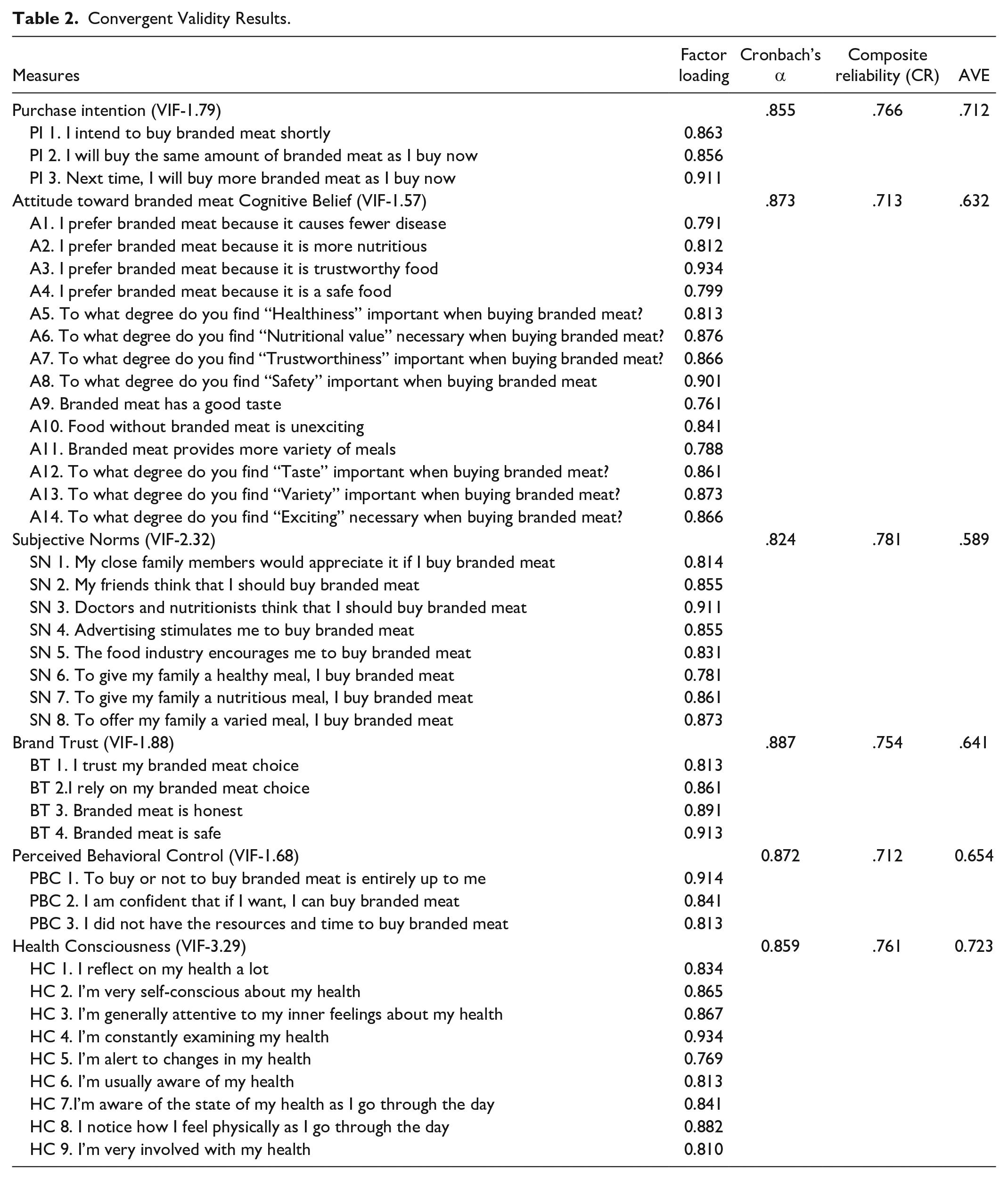
Pearson’s correlation coefficient evaluates the relationship between variable values: health consciousness, BT, attitude toward branded meat, SBNs, PBC, and PI. The main goal of correlation analysis is to figure out the relationship between each variable. This test also helps the researcher understand the strength between each variable, the direction, and how significant the level of relationship is. The results are provided in Table 3.
Discriminant Validity Results.

Note. All correlations are significant at the p = .01, Square-root AVE scores are displayed in parentheses.
Structural Model and Hypothesis Testing
Structural equation modeling (SEM) offered the essential measurement of meat PIs tendencies and how relationship attitude leads to PIs (Figure 2). “SEM is a statistical modelling method of analysis that enables the testing of a series of separate, yet, interrelated constructs and regression equations, allowing for the analysis of multiple relationships at once” (Xiao et al., 2020). From the results presented in Table 4, the robust relationship was found to exist between attitudes and BT, where the beta coefficient was 0.718 (p = .000 < .05), and this was upheld by the relationship between attitudes and PI, with a beta coefficient of 0.623 and the p value was less than .000 < .05. The third most robust relationship was the relationship between health consciousness and attitudes, whose standardized coefficient was 0.225 (p = .01 < .05). Two other factors that had a significant association with PI were SBNs, whose beta coefficient was 0.140 (p = .000 < .05), as well as BT, with a beta coefficient of 0.106 (p = .022 < .05). However, two constructs did not have a significant relationship with PI, and these were PBC and health consciousness, whose p values were more effective than .05. There was a negative relationship between PBC and BT for the BT since the path coefficient was negative (−0.270; p = .000 < .05).
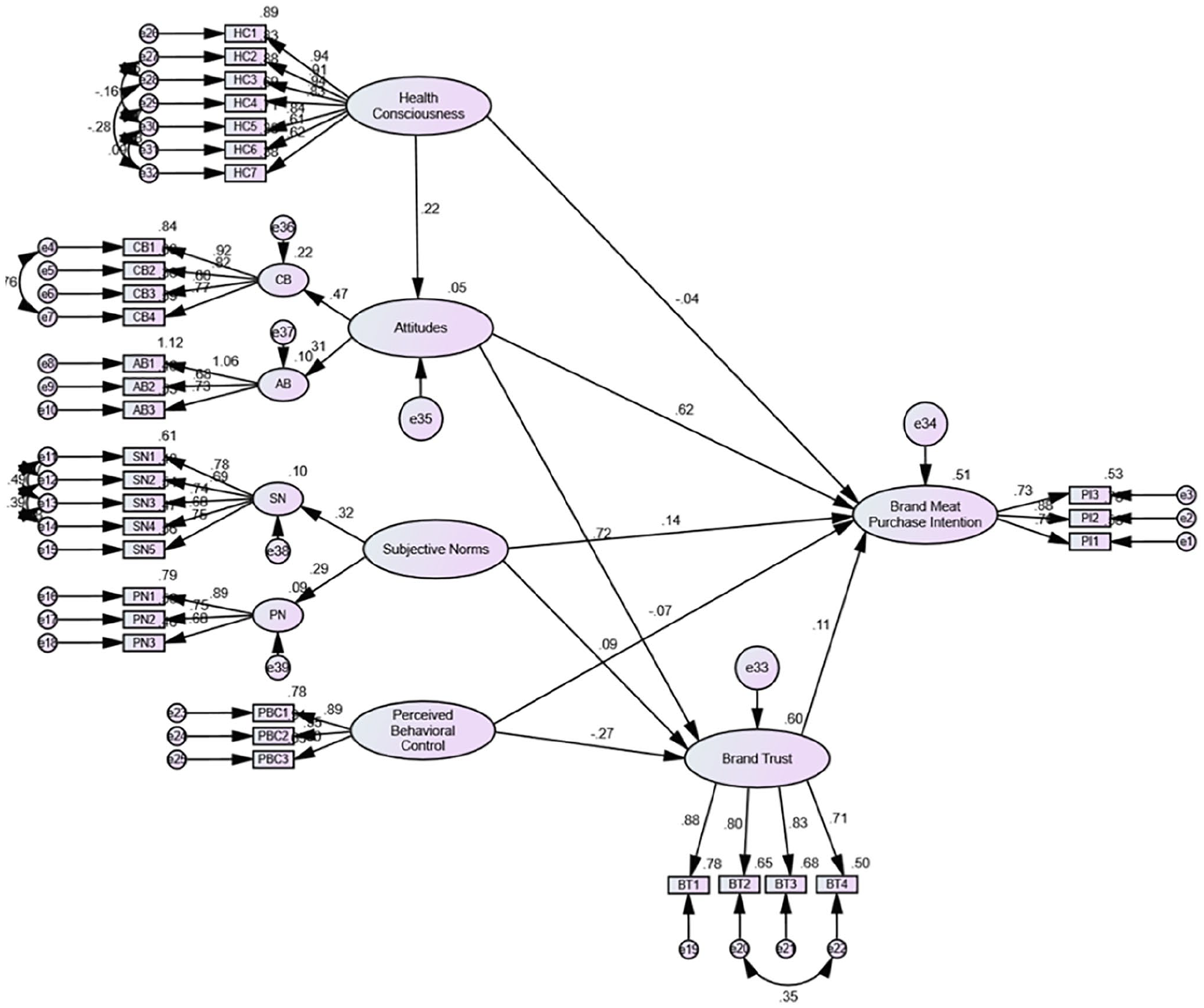
Structural equation model path coefficients.
SEM Estimates.

Note. CR = 1.96 (α = 0.05 level).
The corresponding R2 statistics for the above hypotheses are presented below. From the findings, the R2 for PI was .513, and it followed that the constructs explained 51.3% of the variation in the PI, which is a very high effect.
From the results above, the indirect effect of PBC on PI, being mediated by BT (−0.024) was marginally lower than the direct effect of PBC on BI (−0.056). As the p value was .093 > .05, this means that the mediation effect was not significant. However, the indirect impact of AT on PI being mediated by BT was .158. Since the p value was .000 < .05, this meant that the mediation effect of BT on the relationship between AT and PI was statistically significant. For the mediation effect of BT on the relationship between SBN and PI, this did not result in a considerable difference from the direct impact (p = .528 > .05), which meant that the mediation effect was not significant.
Discussion
This study has investigated the phenomenon of branded meat PI on the constructs of health consciousness, attitude toward branded meat, SBNs, and PBC to predict better-branded meat PI and the role of BT in the relationship (Hoque et al., 2018; Lorinczi, 2008; Rankin et al., 2018). The study has found that health consciousness evokes branded meat PI. In Pakistan, due to increased health concerns, the consumer prefers branded meat consumption. Young consumers, especially women, prefer branded meat instead of purchasing it from local open markets (Shakil & Majeed, 2018). Consequently, consumer health motives and disease-prevention intentions induce branded meat PI. Furthermore, the findings identify a significant effect of health consciousness on attitude toward branded meat PI. SBNs and consumer behavioral control toward their health concerns positively drive consumer perception toward branded meat PI, whereby BT in this relationship plays a significant role (Hoque et al., 2018; Lorinczi, 2008; Rankin et al., 2018).
This study offers several theoretical and practical implications. Our analysis has expanded the understanding of branded meat PIs among Pakistani consumers. It also provides practical implications for marketers and policymakers searching for customer loyalty to indulge BT in increasing their market share. This study reveals that health consciousness and consumer attitude plays an essential role in these factors. Among Pakistani consumers, the prevalence of health issues is increasing due to unhygienic meat consumption. This situation has enforced branded meat PIs in Pakistan, highlighting the importance of branded meat consumption. Marketing companies can intimate the importance of healthy eating by prompting branded meat PI.
This study discloses that BT mediates and connects attitudes toward branded meat, SBNs, PBC, and branded meat PI (Fukuda et al., 2020). This is because BT can increase the possibility of PI (Kitapci et al., 2011). Research on consumer purchase behavior in food products reveals that consumers health believe strong indicators of product adoption (Prapavessis et al., 2015).
Conclusion
This study has investigated the phenomenon of consumer attitude and their intention to purchase branded meat products. Results have shown that mentality toward branded meat and BT significantly influences PI, whereas PBC and health consciousness are not significant. This displays that a positive attitude toward branded meat affects consumer buying decisions. Moreover, the study highlights the positive effect the SBN has on PI.
Health consciousness was not found to be significant with branded meat PI (H1). Nonetheless, this study indicates that health consciousness does not associate with attitude (H2), but the attitude has a positive effect on purchase branded meat (H3) (Rankin et al., 2018). Future studies can use attitude as mediating force to test actual behavior.
Furthermore, attitude breeds a positive association toward branded meat PIs (H2). This is an indication for retailers to use health messaging that displays nutritional benefits with consumers and shapes their attitudes toward branded meat.
This study also reveals that BT mediates the relationship between attitude and branded meat PIs (H3). In contrast, it does not mediate the relationship between PBC (H4) and SBN (H5). This implies, attitude, personal criteria, and PBC pave the way toward branded meat PIs. However, in line with the TPB (Ajzen, 1991), attitude generates positive feelings toward branded meat PIs, while BT mediates this relationship. This study shows that health consciousness has a significant role in influencing attitudes toward branded meat. This underscores the research carried out by Hoque et al. (2018), Lorinczi (2008), and Rankin et al. (2018), who stated that health consciousness influences food choices.
In conclusion, it is recommended that branded meat is driven by attitude, SBNs, and PBC. However, BT in food plays a vital role in several consumer segments (Hoque et al., 2018). Branded meat serves consumers’ demand for healthy food. Branded meat is provided with more nutritional value consumption than a lot of other traditional meat. This is not only because of conflicts in preferences but also because it is perceived as risk-free.
The meat producers have a long way to go as concerns helping health consciousness consumers with new, better, and more convenient branded products. The competition among meat producers is fierce these days. Understanding consumer’s preferences are challenging for both consumer and producers. Consumers’ hold hedonic preferences, stimulus, and behavior vary across the consumer segments and market—this eventual enforcing consumer research in finding new insights from different contexts.
This study has offered several valuable contributions in marketing and consumer behavior, and it also provides some limitations. The sampling design could be changed to find some new insights. The target population of this study was mainly the young segments. Other segments would provide exciting insights. Further research can consider different food product categories that have not been studied concerning PI and purchase behavior (Shakil & Majeed, 2018). Moreover, this study was conducted in Pakistan. Future research can be accomplished with other types of contexts to offer more generalizable insights.
Footnotes
Declaration of Conflicting Interests
The author(s) declared no potential conflicts of interest with respect to the research, authorship, and/or publication of this article.
Funding
The author(s) disclosed receipt of the following financial support for the research, authorship, and/or publication of this article: This work was supported from the 2018 Special Project for Cultivation and Innovation of New Academic, Qian Platform Talent [2018]5772–012.
