




Abstract
Academic libraries are undergoing a paradigm shift in the current ICT era. Obstacles in information services, particularly regarding facilitating secure and transparent real-time data access, continue. Blockchain technology-based services (BCTBS) could boost novel solutions and have the potential to boost dissemination and retrieval security, transparency, and information access in academic libraries. This study focused on investigating the elements fostering the adoption of BCTBS in academic libraries using the TOE framework and TAM. This study employed a quantitative approach and a survey-based research design. An internet-based survey was designed to get responses from library personnel across postgraduate colleges, public and private universities (Pakistan). This stratification ensured representation from diverse library environments within the country. We targeted key personnel having direct involvement in process decision-making. A survey questionnaire was meticulously designed based on the hypothesis to analyze the librarian’s willingness to adopt BCTBS in academic libraries. The collected data comprised 258 respondents and were used for rigorous analysis on PLS-SEM (Partial Least Squares Structural Equation Modeling), Smart-PLS (v.4.1.0.3). In this study, we found that the application of BCTBS adoption in academic libraries of Pakistan is significantly influenced by the following elements/factors such as Comparative Benefit (CB), Suitability (SUIT), Institutional Strategy (IS), and Trust (TRU). PEOU (Perceived ease of use) and PU (Perceived Usefulness) have a significant mediating effect and have a strong foundation among the elements of TOE and TAM toward the Adoption Readiness BCTBS in academic libraries. Furthermore, statistical analysis strengthened reliability and validity by using PLS-SEM for data analysis, which provides solid insights into the determinants influencing BCTBS.
Plain Language Summary
The study titled “An analysis of Elements Fostering Adoption of Blockchain Technology based Services in Academic Libraries: TOE and TAM Framework Study” investigates how academic libraries can successfully adopt blockchain technology. The researchers utilized two theoretical frameworks: the Technology Acceptance Model (TAM), which focuses on users’ perceptions of technology, and the Technology-Organization-Environment (TOE) framework, which examines the broader context influencing technology adoption. The study involved a mixed-method approach, collecting data from 338 participants, including librarians and system analysts. Key findings indicate that perceived usefulness and supportive policies are crucial for libraries considering blockchain adoption. The benefits highlighted include improved access to resources, enhanced security for user information, and better collaboration between users and library staff. However, the research also identifies significant challenges to adoption, such as high infrastructure costs, privacy concerns, and a general lack of understanding of blockchain technology among library professionals. Overall, the study aims to provide insights that can help libraries navigate the complexities of integrating blockchain into their services effectively.
Keywords
Introduction
Blockchain technology provides information sharing and access with security and transparency. A new distributed database is created using consensus methods, peer-to-peer networks, cryptography, and smart contracts in this cutting-edge technology. Due to its disruptive potential, blockchain technology has drawn interest from education, engineering, finance, business, supply chain management, healthcare, and IT. All of these firms are investing heavily in research. Consider blockchain’s disruptive potential. Today’s fast-tracked information communication technology (ICT) requires institutions and organizations to differentiate by skillfully eradicating mediators, fraud risks, and other human involvement matters (David et al., 2022). The procurement process evolved into what is now known as Procurement 4.0 (Govindan et al., 2022). Blockchain technology offers an ideal solution to enhance trust, streamline communication, and deliver desired value across multiple interactions and transactions (Matyskevic & Kremer-Matyskevic, 2020). BCT’s reliability and strength enable automated decision-making, increased harmonization among stakeholders, and transformative industrial processes. The internet’s disruptive impact in past decades, blockchain is anticipated to transform commercial frameworks in the near future (Weking et al., 2020).
The retail and commerce sector is expected to grow the fastest due to blockchain’s ability to enhance transaction security and transparency, improving customer experience and loyalty (Hanif & Shah, 2025; Taherdoost & Madanchian, 2023). Existing literature reveals the implementation of blockchain technology in broader supply chain contexts, economic advantages, and business services purchasing across various sectors. For instance, the agriculture supply chain has rapidly adopted blockchain to address economic costs, food safety, & environmental impacts (Barbosa, 2021; Dinesh Kumar et al., 2020; Gupta & Shankar, 2024; Lakkakula et al., 2022; W. Liu et al., 2021; Menon & Jain, 2021; Sander et al., 2018). Moreover, studies have focused on BCT’s contributions to circular economy practices, business sustainability, economic growth, and productivity (Bigerna et al., 2021; Deshpande et al., 2020; S. A. R. Khan et al., 2021; Prakash & Ambekar, 2020; Rien Agustin & Susilowati, 2019; Trequattrini et al., 2024). The technology’s features enable procurement resilience and eliminate intermediary and transparency issues (Aghaei et al., 2021; Rajendran, 2021; Rane & Narvel, 2021; M. Sharma et al., 2021).
The importance of blockchain Technology-Based Services (BCTBS) also helps librarians overcome obstacles, and libraries will undoubtedly positively impact communities and change the 21st century (S. Sharma & Batth, 2020). The applications of “blockchain technology” are expanding quickly. Libraries and librarians in the ICT era must realize that stroking BCTBS into practice is crucial to enhancing library services. Libraries should investigate how blockchain technology might be used for content storage, preservation, and exchange. In addition to improving the security and transparency of information retrieval and dissemination, using BCTBS in libraries will also help acquire library materials, which may improve the upkeep and distribution of library collections. BCTBS can protect patron records while assisting library users and protecting research data privacy. Data security and transparency have increased due to libraries using BCTBS for secure patron authentication and authorization (Hanif & Shah, 2025; Haque et al., 2023). In order to give library patrons secure and transparent services, it also needs to investigate the implementation of “blockchain technology” in libraries for authentication and authorization of online library service systems (I. Ali & Warraich, 2024; G. Zhao et al., 2024). Furthermore, blockchain technology facilitates communication between patrons and library staff (Abid, 2021). This research study employed the TAM model and TOE frameworks to conscientiously evaluate the fundamental determinants fostering the adoption of BCTBS in academic libraries of Pakistan. The research aims to deliver a nuanced consideration of the multifaceted elements that drive or hinder the application of BCTBS in these postgraduate public and private libraries. This research study offers a holistic perspective on the adoption procedure by integrating TAM, which focuses on PU and PEOU, with TOE, which examines “technological, organizational, and environmental” contexts.
The study demonstrated that the TRU is a substantial predictor of both PU and PEOU, while PEOU significantly influences CB and IS. Furthermore, the mediating functions of PU and PEOU were proven with a path coefficient of β = .289 (t = 3.810, p < .001). PEOU, for example, demonstrated a strong mediating influence between IS and AR. The R2 values showed significant explanatory power for PEOU, PU, and AR, which were .433, .546, and .276, respectively. Additionally, moderate to minor predictive relevance was shown by the Q2 values for PEOU (0.264), PU (0.343), and AR (0.239). These results highlight the model’s reliability and validity and the important roles of TRU, IS, and CB in promoting blockchain adoption. The findings of this research will contribute to the academic discourse on technology implementation in educational settings and support the practical implementation of BCTBS in enhancing the efficiency, transparency, and security of library operations in academic libraries in Pakistan.
Literature Review and Development of Hypothesis
Historical Development of Blockchain Technology in Different Fields (2008–2024)
The prior research demonstrated that the blockchain systems can be generally categorized into public/permissionless (e.g., Bitcoin) and private/permissioned (e.g., Hyperledger Fabric) models, each offering distinct benefits and restrictions (Ahmed et al., 2022; Dhillon & Sivabalan, 2025; Honar Pajooh et al., 2021; Kim et al., 2020; Sumathi & Jaya, 2025; Zheng et al., 2017; Zhong et al., 2020). Although “public blockchains” focus on decentralization and transparency. Its open-access nature concentrates it unsuitable for handling sensitive library operations, such as library patrons’ data privacy, proprietary resource tracking, and controlled digital library loaning (Karthick et al., 2025; Mahlaba et al., 2022; Ogbara & Okwu, 2023; Omame & Alex-Nmecha, 2021; Sumathi & Jaya, 2025). In contrast, “permissioned blockchains” mainly consortium or private architectures determine a strong alignment with library and information science requirmnets by offering following three critical features: (a) “granular access control,” ensuring only authorized entities (e.g., librarians, consortium members) can validate transactions in compliance with data protection regulations (Andoni et al., 2019; Karthick et al., 2025; Mahlaba et al., 2022; Nachiappan et al., 2025; Ogbara & Okwu, 2023; Sumathi & Jaya, 2025); (b) “immutable yet auditable record-keeping,” which supports provenance tracking for library archival materials and digital library rights management (Bhatia et al., 2020; Karthick et al., 2025; Ogbara & Okwu, 2023; Pradeep et al., 2021; Sumathi & Jaya, 2025); and (c) “operational efficiency,” help to achieved through smart contracts that automate library workflows such as interlibrary loans, overdue library fine calculations, and digital library license enforcement (Ahmad, 2024; Karpagalakshmi et al., 2025; Karthick et al., 2025; Maheswari & Gopinath, 2025; Omame & Alex-Nmecha, 2021; Sumathi & Jaya, 2025).
That is why it has been elaborated that the “Hyperledger Fabric” is the most suitable permissioned blockchain framework for library and information science applications due to its modular architecture (Baset et al., 2018; Honar Pajooh et al., 2021; Maheswari & Gopinath, 2025; X. Zhao et al., 2022; Zhong et al., 2020). It also relates to its two predominantly relevant features: “channel-based data isolation” (enabling confidential transactions for patron records or acquisition budgets) and “enterprise-grade security protocols” (utilizing cryptographic hashing and pluggable consensus mechanisms like Raft to prevent tampering (Hanif & Shah, 2025; Maheswari & Gopinath, 2025; Mukne et al., 2019; Omame & Alex-Nmecha, 2021; X. Zhao et al., 2022). To demonstrate the practical implementation of these technical advantages, we have incorporated concrete LIS use cases, including: (a) provenance verification for special collections through immutable audit trails (Dias et al., 2024; Tunstad, 2019; Westerlund et al., 2018); (b) automated digital rights management via smart contract-enforced licensing terms (Abu Sirhan et al., 2019; Y. Liu et al., 2021; Omame & Alex-Nmecha, 2021; Panagou & Vavalis, 2020; Tamilselvan, 2024); and (c) decentralized metadata sharing among library consortia while maintaining institutional data sovereignty (Maheswari & Gopinath, 2025; Sumathi & Jaya, 2025; Verma, 2025; X. Zhao et al., 2022).
Furthermore, considerable adjustments may need to be made to contract law to account for online and computer agreements (De Filippi & Hassan, 2018). They claimed that although legal code has been used as legislation for many years, it must now be modified to accommodate computer code. “From Code is Law to Law is Code” is how they describe it. For Blockchain technology to be transparent to all parties participating in a contract, it will be necessary to see and visualize it (Sundara et al., 2017). To examine new goods and services, legal issues, and how management teams will deal with a new organizational paradigm (Smith, 2016). It discusses “Bitcoin: Economics, technology, and governance” (Böhme et al., 2015). A wide range of academic and professional domains, including “technical fields, economics, law, public policy, finance, accounting, and others,” have been affected by Bitcoin and Blockchain (Holub & Johnson, 2018). While many research studies emphasize using the “blockchain technology” application in several aspects. This has been applied by many researchers in different fields for better understanding, such as healthcare (Elvas et al., 2023; Hovorushchenko et al., 2023; Mettler, 2016; P. Zhang et al., 2018). Therefore, blockchain technology can address various issues in the library sector with appropriate applications for security, transparency, and efficient information storage in a distributed, tamper-resistant environment. Moreover, the library system can gather, preserve, and disseminate authoritative information without several technical hurdles (Figure 1).

Library operations through blockchain technology.
Development of Hypothesis
TOE (Technology, Organization, and Environment) Context
A strong theoretical basis for analyzing the implementation of newly developed technologies is provided (Cantisani, 2006; Tornatzky et al., 1990). The TOE framework takes an integrated approach by considering three important contexts: firstly, technology, secondly, organization, and thirdly, environment. So, this study uses the TOE framework to inquire into factors that encourage the adoption of blockchain technology in academic libraries in Pakistan. The study aims to provide a thorough knowledge of the hurdles and enablers related to blockchain adoption by examining the technological, organizational, and contextual factors.
Technological Context
Firstly, the technological context in this study, adopting “blockchain technology,” is assessed based on the intrinsic characteristics that may impact its acceptance within academic institutions. Key aspects include blockchain technology’s CB and SUIT. The comparative benefit refers to the perceived benefits of blockchain over traditional systems, such as increased efficiency, security, and transparency. However, the suitability relates to how well blockchain fits into existing library systems and operations (Al-Okaily et al., 2023; Ameyaw et al., 2023; Damanpour et al., 2009; Hanif & Shah, 2025; María Ruiz-Jiménez & del Mar Fuentes-Fuentes, 2013). These elements are critical in evaluating the CB and SUIT for using technology in library systems.
Organizational Context
Secondly, the organizational context investigated the internal aspects inside academic libraries, which also influence the adoption of blockchain technology. This includes aspects like “Higher Management’s encouragement and willingness.” It reflects the extent to which a library is prepared to implement new technologies and the top management support denotes the commitment and endorsement that is required to adopt latest technologies like blockchain, as they influence the library’s ability to effectively implement and sustain blockchain technology (Hassan et al., 2023; Shahadat et al., 2023). These organizational features significantly affect whether or not the adoption process goes smoothly.
Environmental Determinants
Thirdly, the environmental context refers to external elements influencing blockchain uptake in academic libraries. This encompasses institutional strategy and trust in technology. Institutional strategy refers to the breadth and quality of information available concerning blockchain technology, which can influence decision-making processes. Trust entails believing in the technology’s security, transparency, and effectiveness, which is required for its adoption and integration (Amini & Jahanbakhsh Javid, 2023; Capestro et al., 2024; Ghaleb et al., 2021; Hanif & Shah, 2025). The TOE framework transcends a singular perspective, offering a captivating multi-act play that unveils the complexities of IS/IT adoption. By acknowledging the intricate interplay between the technological allure, the fertile organizational reinforcement, and the dynamic external landscape, the TOE framework empowers researchers and practitioners to compose a more nuanced and impactful adoption strategy, particularly for emerging technologies like blockchain-based services in academic libraries.
Comparative Benefit and Suitability Determinants
Based on the research, the technology’s “Comparative Benefit” can elucidate some of the inclination to embrace blockchain technology-based services (BCTBS) when they are superior to the organization’s current service. The study examines the working definition of comparative benefits is “the degree to which a blockchain technology innovation is perceived to be better than the idea it supersedes.” Another research found that its adoption is more likely because of a greater “Comparative Benefit” (Amini & Jahanbakhsh Javid, 2023). This study emphasized the Comparative Benefit’s determination in the innovative process versus a traditional and existing system in academic libraries (A. U. Khan et al., 2022). By emphasizing comparative benefit as both a technological and strategic driver, this research theorizes that this factor influences how librarians perceive the ease and usefulness of BCTBS. Therefore, we propose that perceived comparative advantages over traditional systems positively influence perceived ease of use (PEOU) and usefulness (PU) of blockchain-enabled services in academic libraries. As a result, we’ve proposed the following hypotheses:
On the other hand, suitability is “the degree to which an innovation is perceived as consistent with potential adopters’ existing values, past experiences, and needs (Rogers et al., 2014).” This study defines suitability as “the extent to which new technology-based services are consistent with existing systems, services or practice,” As a result, it is believed that the greater the suitability of technology services, the more likelihood of technology adoption (Senali et al., 2023) and expressed that compatibility was significant in both PEOU and PU. Building on this foundation, this research study contributes by evaluating how the construct of suitability functions specifically within the context of blockchain adoption in academic libraries. Systemic integration, legacy systems, and institutional norms heavily shape innovation outcomes in this setting. We hypothesize that a higher degree of perceived suitability will positively influence PEOU and PU to BCTBS. Therefore, we have proposed the following hypotheses:
Encouragement and Willingness of Higher Management
Like in other management fields, the literature on IT adoption has also acknowledged that Encouragement from Higher Management is important in initiating and adopting various technologies. Some studies used the TOE framework to investigate the effect of encouragement from higher management and the institutional willingness to adopt some new technologies. As the inadequate scalability & complexity in its usage drives further behavioral confrontation to “blockchain technology” adoption (García, 2021; Lahkani et al., 2020; Prakash & Ambekar, 2020). For the higher management, encouragement & support in the services innovative process plays a crucial role in encouraging management practices, and even there is adapting to environmental turbulence, as well as including social, economic, and political changes (Sajjad et al., 2022; X. E. Zhang et al., 2023). According to the current literature, there is a “positive relationship” between “Encouragement from Higher Management” and the effectiveness of PU and PEOU in adopting new information technologies in libraries. Institutional willingness pertains to the presence of two determinants: proficient individuals and sufficient financial resources required to adopt new technologies in the institutions (Blanco-Encomienda & Rosillo-Díaz, 2021; Lutfi et al., 2023). According to some studies, the availability of competent personnel influences an organization’s openness to adopting updated technologies in their institutions (Katebi et al., 2022; Katebi et al., 2024; Z. Liu et al., 2022). Furthermore, the more knowledge and experience, allowed new technology adopters to make good use of new technology (Rafique et al., 2018; Hwang et al., 2022; Renukappa et al., 2022). By framing EWHM as a multidimensional construct in the context of academic libraries in Pakistan, our study contributes by operationalizing this factor as a driver of PEOU and PU in blockchain adoption. Accordingly, we propose that managerial encouragement supported by institutional capacity positively influences librarians’ perceptions of BCTBS adoption readiness. So that for this study, it is a positive sign to adopt new innovative services with sufficient resources, such as a skilled workforce and financial capital conducive to academic libraries in Pakistan. So, we have proposed the following hypotheses:
Institutional Strategy
In this study, institutional strategy refers to the extent to which librarians believe that the effect of institutional strategy leads to innovative services utilization. According to some studies, institutional strategies, norms, and guidance will influence people’s perceptions of the complexity and practical significance of emerging technologies (Lu & Deng, 2022; Yang et al., 2018). The policy of technology, as well as the practice promoted under the strategy of the related government institutions, is beneficial to libraries toward the new technology adoption (Hussain & Ahmad, 2021; Bertot et al., 2010; Patrucco et al., 2022). Moreover, it asserted that institutional regulations & strategies associated with security, privacy, and facilitating conditions were significant determinants to embrace innovative technologies (O. Ali & Osmanaj, 2020; Batubara et al., 2018; Hanif & Shah, 2025; Yeoh, 2017). While existing literature provides valuable insights into institutional enablers of digital adoption, few studies have contextualized this within the library and information science (LIS) environment, especially concerning blockchain technology. Our study addresses this gap by positioning Institutional Strategy as a central organizational variable that influences PEOU and PU of BCTBS. Specifically, we argue that institutional alignment through strategic commitment, resource allocation, and regulatory clarity facilitates smoother adoption and greater user confidence. Accordingly, stronger IS positively influences librarians’ readiness to adopt blockchain-based services. So, the librarians are likely to exhibit greater willingness to embrace technology if the government mandates their compliance with standards & protocols toward the blockchain technology adoption. Hence, we have proposed the following hypothesis:
Trust
Trust is a fundamental concept of a positive relationship in many circumstances, as discussed (Kloutsiniotis & Mihail, 2018; Saad, 2016). Trust can help to allow more efficient transactions by encouraging win-win collaboration tactics. Trust can directly influence behavioral intention by boosting performance expectancy and decreasing ambiguity about the result of IT usage. When an identity issuer is perceived as trustworthy, citizens will collaborate, even with low trust in new technology (Jaeger & Fleischmann, 2007). Individuals with a higher level of trust in more likely to support organizations’ adoption of new technology (Al-Okaily et al., 2023). In the study, trust is defined as the degree to which academic libraries regard BCTBS as a dependable IT service provider capable of overcoming technological difficulties. While prior research has addressed trust as a general enabler in digital transformation, our work advances this understanding by investigating its specific role in shaping PEOU and PU within academic library settings. Libraries, often risk-averse and bound by data privacy concerns, must assess the utility of new technology and the trustworthiness of its architecture and implementation. By situating trust within the context of academic libraries in Pakistan, a nuanced understanding of how institutional confidence in blockchain infrastructure can enhance readiness for adoption is provided. We hypothesize that trust positively influences PEOU and PU, thereby playing a critical role in shaping librarians’ attitudes toward BCTBS. So, we have proposed the following hypothesis:
Technology Acceptance Model (TAM)
Perceived Ease of Use (PEOU)
Perceived Ease of Use (PEOU) well defines the Technology Acceptance Model (TAM) as a person’s impression toward the effort essential for technology utilization (Brown, 2002; Davis, 1989; Rahmi et al., 2018). Previous research has found that PEOU in the context of Technology-Based Systems utilized in university libraries refers to the perceived difficulty of learning, maintaining, and implementing these systems (Lengoatha, 2022; Safdar et al., 2023). Moreover, PEOU significantly influences technology adoption intentions through perceived utility (PU), both directly and indirectly, as discussed by Davis (1987). So that the adoption rates of BCTBS may be hampered by its complexity and the academic librarian’s limited knowledge of its benefits, this research encompasses this established literature by applying the PEOU construct specifically to the adoption of blockchain technology-based services (BCTBS) in academic libraries. While existing research has examined PEOU concerning traditional digital platforms, few have explored how it influences adoption readiness when the innovation is a decentralized and complex infrastructure like blockchain. We argue that the perceived complexity of blockchain and librarians’ limited prior exposure may present unique challenges that PEOU and slow adoption momentum could inhibit. Therefore, we propose that PEOU has a significant positive influence on both adoption readiness and perceived usefulness in the context of BCTBS. Thus, we have proposed the following hypothesis.
Perceived Usefulness (PU)
Perceived Usefulness (PU) is defined in the Technology Acceptance Model (TAM) as “the extent to which an individual comprehends the improvement in performance and efficiency gained as a result of the use of a specific new technology or service as discussed”Abdullah et al. (2016), Eze et al. (2021), Rahmi et al. (2018). Resources can be pooled, network access can be extended, efficiency can be improved, information security can be enhanced, and transparency can be achieved using new technology-based systems. These advantages could help libraries to gain a competitive edge and boost efficiency and productivity (Clohessy & Acton, 2019; Hanif & Shah, 2025). Understanding the advantages of using BCTBS in Pakistani academic libraries is referred to as PU in this study. While prior studies have explored PU across various sectors, few have applied this construct specifically to blockchain technology-based services (BCTBS) within academic libraries, particularly in developing country contexts. This research addresses this gap by examining how librarians in Pakistani academic institutions, PU, transform core library functions such as lending, cataloging, digital rights management, and resource sharing. By situating PU within the specific operational and cultural realities of academic libraries in Pakistan, this study contributes to a more nuanced understanding of how perceived benefits influence readiness to adopt blockchain. Moreover, when librarians recognize blockchain’s capacity to streamline these routine workflows, improve transparency, and safeguard institutional assets, they are more likely to support its implementation. Accordingly, we propose that PU positively influences Adoption Readiness (AR) for BCTBS. Therefore, the following hypothesis was under contemplation:
Adoption Readiness
The Technology Acceptance Model (TAM) states that perceived usefulness and ease of use are the main determinants influencing a person’s readiness to adopt a new technology. In essence, the decision-making process culminates in the intention to utilize a technology, which represents a person’s readiness to adopt and interact with a new technology or service (Katebi et al., 2024; Na et al., 2022). To gain a better understanding of the adoption process within academic libraries in Pakistan, this study looks at the determinants that influence the adoption readiness to use Blockchain Technology-Based services (BCTBS). Lastly, based on the related literature review, TOE and TAM, we have proposed the following conceptual model for this research (Figure 2).

Conceptual model.
Methodology
Construction of Questionnaire & Sampling
To investigate the determinants influencing the adoption of Blockchain Technology-based services (BCTBS) in Pakistani academic libraries, this study employed a quantitative research approach and created a conceptual model (Figure 2) that consisted of all the relevant determinants. Furthermore, data was collected through a meticulously designed, structured internet-based survey. A stratified random sampling technique ensured the sample population represented the diversity of Pakistani academic libraries. The target population comprised key library personnel directly involved in decision-making processes concerning library technology adoption across both public universities and postgraduate government and private colleges and universities in the country. The questionnaire itself underwent a rigorous development process. First, a comprehensive literature review identified relevant variables and indicators based on existing research on technology adoption in libraries and similar technology implementations. Second, the questionnaire items were carefully crafted to align with the research hypotheses formulated for this study. Finally, the wording of the survey prioritized clarity and ease of understanding for the target population. A seven-point Likert scale was employed to measure participants’ responses on key constructs, facilitating accurate and efficient data collection while minimizing ambiguity (Joshi et al., 2015; Taherdoost, 2019; Tastle et al., 2005). Participation in the survey was voluntary. However, participants were given the option to receive a summary of the research findings upon completion of the survey. This approach mitigated potential response bias (Lesser et al., 2001; Robb, 2020; Wu et al., 2022).
Procedure for Data Collection
To ensure the quality of the data collection instrument, eight senior librarians from various Pakistani postgraduate institutes and universities evaluated the questionnaire items for content validity (Lahmami, 2020; Robb, 2020). This initial assessment verified the construct validity and reliability of the instrument by eliminating redundancy and ensuring the integrity of the opinions captured. An internet-based survey was tactically disseminated for data collection targeting librarians from postgraduate public and private universities and colleges. Social network service platforms like Facebook and WhatsApp groups relevant to this research domain were leveraged to reach the target population of this study. A random sampling method ensured the respondents’ representativeness, and 300 responses were received. The final analysis was employed on 258 completed questionnaires, which reflected a standard and robust 86% response rate (Hussain et al., 2022; Rehman et al., 2023).
Statistical Techniques and Analysis
Structural equation modeling (SEM) was used to assess the proposed hypotheses using SmartPLS. The presented hypothesis was evaluated using structural equation modeling (SEM) and analyzed using SmartPLS 4. As a flexible method for analyzing complex frameworks (Cepeda et al., 2024; Din et al., 2024; Hair et al., 2021; Ringle & Sarstedt, 2016), PLS-SEM analysis was conducted using Smart-PLS 4.1.0.3 (Cepeda et al., 2024; Huang & Gooi, 2022; P. N. Sharma et al., 2022; Tiderman et al., 2024). The number of hypotheses supporting a construct affects the minimum sample size required to attain R2 values of .10, .25, .5, and .75 in the PLS-SEM-based model, as well as to express that the 144 samples are the minimum sample size required, assuming a 5% error and a minimum R2 of .1. The entire volume of data collected for this study far exceeds the required minimum, guaranteeing the validity and dependability of the conclusions. So that for this study, the sample size of 258 exceeded the recommended minimum sample size for PLS-SEM analysis, given the number of hypotheses and desired R2 values, which ensured data reliability and validity (Sarstedt et al., 2021).
Data Analyses and Results
Descriptive Analysis
The analysis of the demographic data of this study’s respondents showed in Table 1, which reveals a significant gender disparity, with men outnumbering women 72% to 28%. The age distribution of respondents revealed that the majority of the sample (74%), who are younger, are between the ages of 22 and 35. Of the remaining participants, 26% are between the ages of 36 and 55, with 6% being 55 years or older. The education viewpoint stated that one of the sample’s most remarkable characteristics is its high educational attainment.
Demographic Information of the Respondents.

A highly professional cohort is indicated by the fact that the majority of respondents, 53%, have postgraduate degrees in library science, either MLIS (Master in Library and Information Science) or MA in library science. The study found that the jobs of Chief Librarian (12%), Assistant Librarian (11%), and Librarian/Library Manager (66%) were the most often performed professional tasks. The study found that working at a library requires a significant time commitment; 73% of respondents said they worked 5 to 10 hr daily. Lastly, 103 of the total 258 respondents working in public university libraries, which is the most frequently mentioned institutional affiliation among the participants, making up 40% of the total sample size followed by Government colleges with 38%.
Measurement Model Assessment
The measurement model was assessed to establish the reliability and validity of the various constructs used in this study. Using Smart-PLS 4, Convergent validity was determined by assessing factor loadings, Cronbach’s alpha, composite reliability, and average variance extracted (AVE). Smart-PLS and CFA were used in this work to verify that the measurement model suited the data. The Fornell-Larcker criterion was used to verify discriminant validity, elaborated by (Hair et al., 2022; Ali et al., 2025a). It is evident that all factor loadings were significantly higher than the suggested threshold value of 0.70, indicating a strong correlation between the individual items and their corresponding constructs (Cefis & Carpita, 2024; Hair et al., 2020).
For every construct, Cronbach’s alpha and CR values exceeded the 0.70 threshold (Hair et al., 2020), indicating sufficient internal consistency. Any values below this cutoff should be looked into carefully in case they can be excluded. There was enough internal consistency for each construct, as indicated by Cronbach’s alpha and composite reliability scores of more than 0.70 (Hair et al., 2021). Average variance extracted (AVE) values beyond the required 0.50 indicate significant convergent validity (Cheung & Wang, 2017). The Fornell-Larcker criterion values below the 0.90 threshold demonstrate discriminant validity (Fornell & Larcker, 1981). The structural and measurement models should be evaluated to study the PLS-SEM research (Ali et al., 2025b). Measurement model assessment includes tests of discriminant validity, convergent measures, and reliability (Z. Liu et al., 2020). The assessment of the structural model was also examined by considering the significant t-value and coefficient of determination (R2). The final point is the structural model’s predictive significance, also analyzed by the Q2 index. In this investigation, Smart PLS 4.0 was employed (Cook & Forzani, 2023; Purwanto, 2021). These results lend credence to the measurement model’s validity and dependability.
Multicollinearity Issue and Common Method Variance
In the survey research sample, Common method variance (CMV) bias is a prominent issue because it is linked to the validity and reliability of the collected data. Exogenous and endogenous variables of the study were collected simultaneously from the same respondents to the questionnaire throughout the data collection procedure, which raises the possibility of common method bias (CMB) in the collected dataset (Kock et al., 2021; Ali et al., 2025a). Firstly, as recommended in many research studies, Harman’s Single-Factor test for CMV was employed to ensure the quality and reliability of research findings (Anwar, 2018). This method was used to enter all variables for a single-factor test in SPSS. We found that the first factor described 47.9% of the variance, below the 50% criterion. It confirmed that the dataset has no CMV issues.
Secondly, a full collinearity variance inflation factor (VIF) test for the existence of CMV was conducted in this work. It has been claimed that a VIF score of more than 3.3 indicates aberrant collinearity and may be a sign of common method bias in factor-based PLS-SEM algorithms (Kock, 2015; Rasoolimanesh, 2022). By indicating which coefficients are impacted by collinearity, VIFs provide a significant benefit (Akinwande et al., 2015; Vörösmarty & Dobos, 2020). We evaluated and found that all Variance Inflation Factor (VIF) values shown in Table 2 indicated that all variables in the inner model formed by a comprehensive collinearity test are less than 3.3, indicating the absence of common method bias in the model and strengthening the data analysis.
Variance Inflation Factor (VIF) Values CMB.
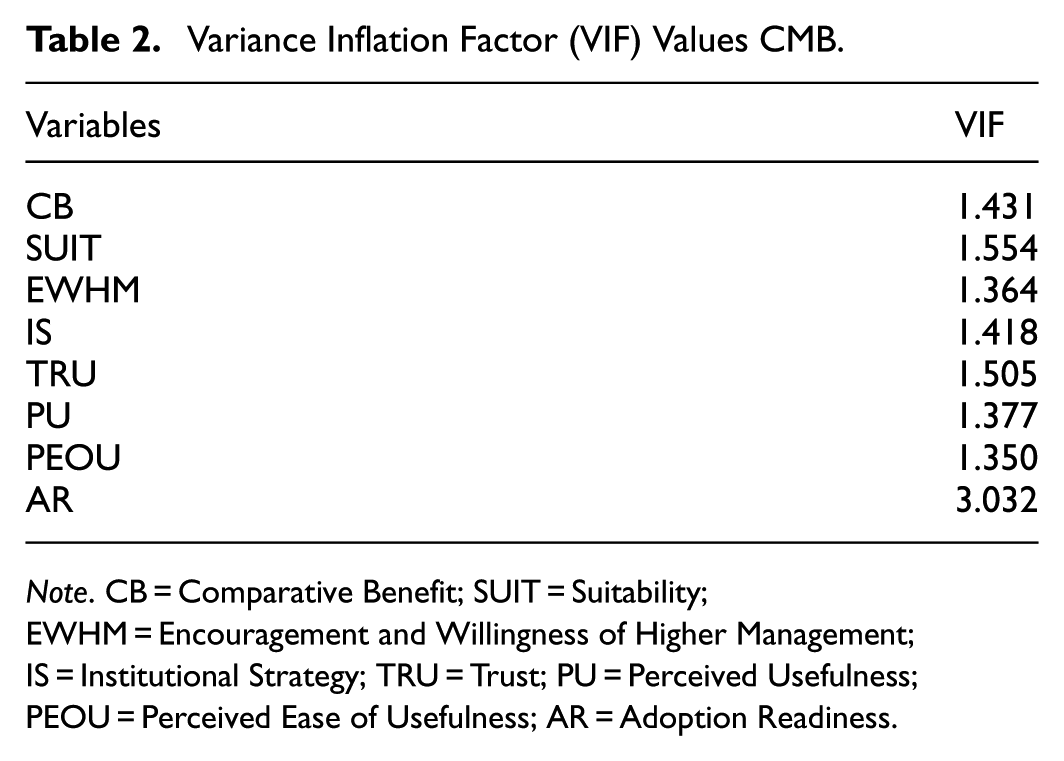
Note. CB = Comparative Benefit; SUIT = Suitability; EWHM = Encouragement and Willingness of Higher Management; IS = Institutional Strategy; TRU = Trust; PU = Perceived Usefulness; PEOU = Perceived Ease of Usefulness; AR = Adoption Readiness.
Construct Reliability and Validity
The reliability and validity of the constructs in our model were assessed using several key metrics, including item loadings, Cronbach’s alpha, composite reliability (rho_a and rho_c), and the average variance extracted (AVE) method, which was used to evaluate the convergent validity shown in Table 2.
Results in Table 2 and Figure 3 demonstrate strong internal reliability and convergent validity across the constructs. Item loadings for Comparative Benefit ranged from 0.703 to 0.921, with an AVE of 0.683, composite reliability (rho_c) of .895, composite reliability (rho_a) of .859, and Cronbach’s alpha of .84, all of which indicate strong convergent validity and high reliability. SUIT exhibited item loadings between 0.789 and 0.833, Cronbach’s alpha of .739, composite reliability (rho_a) of .749, composite reliability (rho_c) of .850, and AVE of 0.655, reflecting adequate reliability and validity. EWHM had shown item loadings from 0.579 to 0.836, Cronbach’s alpha of .836, composite reliability (rho_a) of .861, composite reliability (rho_c) of .885, and AVE of 0.609, indicating acceptable reliability despite the slightly lower loading of EWHM1. IS items loaded between 0.757 and 0.856, with a Cronbach’s alpha of .762, composite reliability (rho_a) of .780, composite reliability (rho_c) of .862, and AVE of 0.676, supporting the construct’s reliability and validity. TRU demonstrated high reliability with item loadings of 0.858 and 0.916, Cronbach’s alpha of .734, composite reliability (rho_a) of .764, composite reliability (rho_c) of .881, and AVE of 0.787. PU had item loadings from 0.766 to 0.850, Cronbach’s alpha of .737, composite reliability (rho_a) of .748, composite reliability (rho_c) of .851, and AVE of 0.655, indicating satisfactory reliability and validity. PEOU displayed item loadings between 0.750 and 0.845, Cronbach’s alpha of .725, composite reliability (rho_a) of .733, composite reliability (rho_c) of .845, and AVE of 0.646, confirming adequate reliability and validity. Lastly, AR displayed very high item loadings from 0.939 to 0.959, with Cronbach’s alpha of .944, composite reliability (rho_a) of .944, composite reliability (rho_c) of .964, and AVE of 0.899, indicating excellent reliability and convergent validity. Hence, all the above results collectively support the robustness of reliability and validity of the measurement model.

Measurement model constructed by the authors using SmartPLS 4.
Discriminant Validity (Cross Loading of Each Item)
Table 3 presents the correlations between each indicator and the relevant constructs in this cross-loadings matrix, further proving the measurement model’s validity and reliability. Adoption readiness indicators AR1, AR2, and AR3 had relations of moderate correlation with other constructs within the range of 0.406 to 0.508, while their loadings were high: 0.946, 0.959, and 0.939 respectively toward Comparative Benefit, Encouragement and Willingness of Higher Management, Institutional Strategy, Perceived Ease of Usefulness, Perceived Usefulness, Suitability, and Trust.
Construct Reliability and Validity.
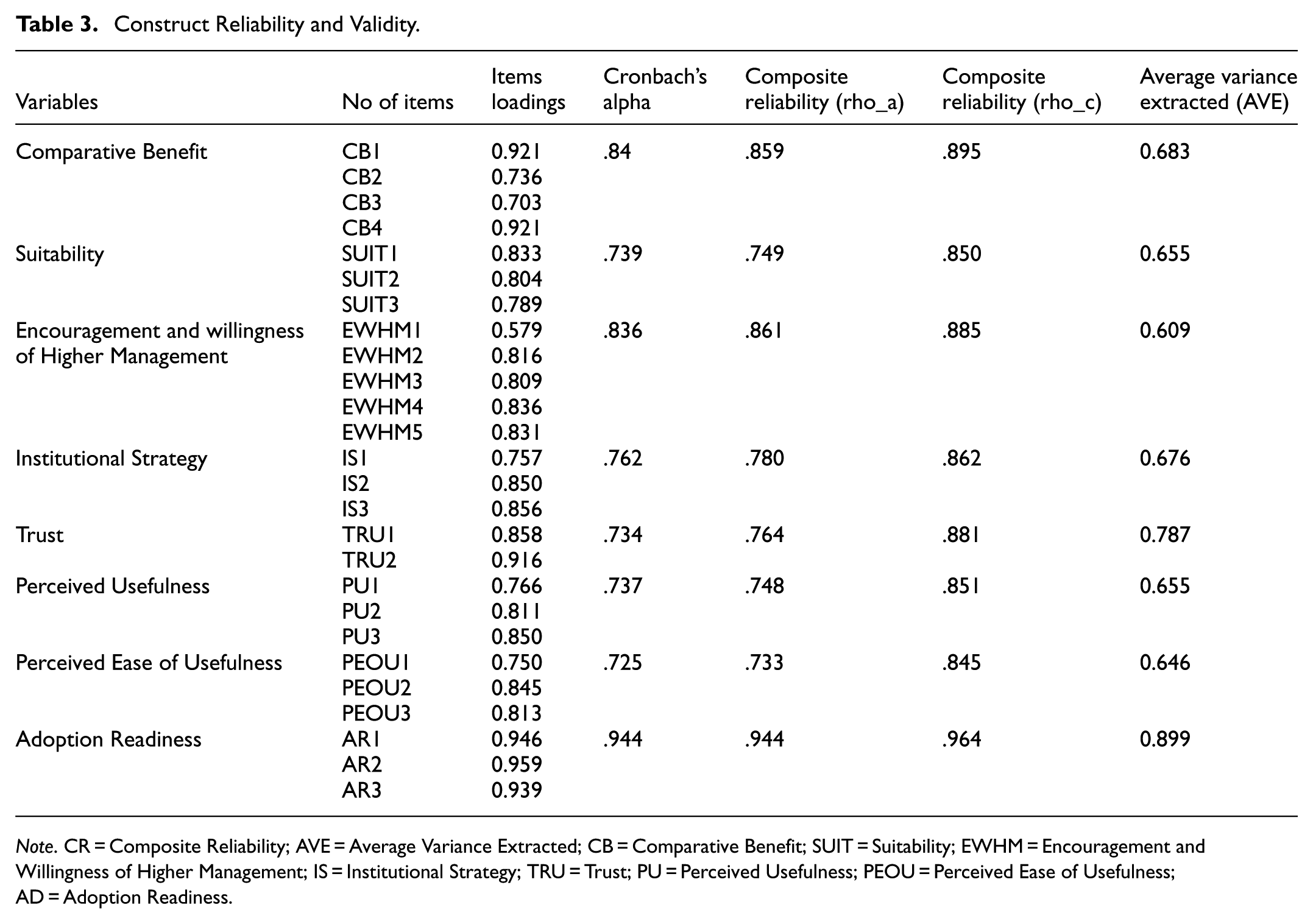
Note. CR = Composite Reliability; AVE = Average Variance Extracted; CB = Comparative Benefit; SUIT = Suitability; EWHM = Encouragement and Willingness of Higher Management; IS = Institutional Strategy; TRU = Trust; PU = Perceived Usefulness; PEOU = Perceived Ease of Usefulness; AD = Adoption Readiness.
While CB2 and CB3 had lesser loadings of 0.736 and 0.703, respectively, the CB build indicators, CB1 and CB4, had very high loadings of 0.921. Moderate correlations were also shown between these indicators and EWHM, IS, and SUIT, suggesting some overlap across these categories. The EWHM indicators displayed a variety of loadings, namely from 0.579 (EWHM1) to 0.836 (EWHM4). These loadings show moderate to high correlations with other constructs, specifically IS and SUIT, underscoring the interdependence of these elements. The IS indicators had modest correlations with other constructs, including PEOU and PU, ranging from 0.237 to 0.551, and significant correlations within the construct, as indicated by their loadings of 0.757 (IS1), 0.850 (IS2), and 0.856 (IS3).
According to the PEOU indicators, perceived utility and ease of use are connected. They demonstrated loadings of 0.750 (PEOU1), 0.845 (PEOU2), and 0.813 (PEOU3), with substantial associations with PU and TRU. Strong construct dependability and moderate correlations with other constructs, especially PEOU and TRU, were demonstrated by the loadings of PU indicators, which ranged from 0.766 (PU1) to 0.850 (PU3). Suitability indicators showed strong correlations within the construct and moderate correlations with CB and EWHM, demonstrating the importance of suitability in the entire model. They displayed high loadings of 0.833 (SUIT1), 0.804 (SUIT2), and 0.789 (SUIT3).
Trust is crucial for the system’s perceived utility and usability, as demonstrated by the TRU indicators TRU1 and TRU2, which had high loadings of 0.858 and 0.916, respectively, and substantial relationships with PU and PEOU. These findings guarantee that the constructs appropriately reflect the underlying theoretical ideas and their interactions, as well as the measurement model’s validity and robustness.
Discriminant Validity (Fornell-Larcker)
As a commonly used and widely recognized criterion in social science research, discriminant validity, Fornell-Larcker criteria were applied and assessed using the Fornell-Larcker criterion in Table 4, which proved that all the constructs “Adoption Readiness; Comparative Benefit; EWHM; Institutional Strategy; Perceived Ease of Use; Perceived Usefulness; Suitability & Trust” were proving that the Fornell-Larcker criterion was satisfied. This criterion compares the correlations between each construct and other constructs with the square root of AVE for each construct. The AVE of 0.948 for AR is higher than its correlations with CB and EWHM, where the coefficients are 0.470 and 0.514, respectively. At the same time, another measure is the AVE of 0.827 for CB, which is greater than its correlations with AR and EWHM, where the coefficients are 0.470 and 0.608, respectively. Table 5 demonstrates that the pattern holds for all constructs; the diagonals are the correlations, and the off-diagonals are the square root of the AVE for each construct. Since the square root of each construct’s AVE is higher than its highest correlation with any other construct, for example, AR’s AVE, 0.948, is higher than AR’s correlation with CB, 0.470, discriminant validity is affirmed and supports the theoretical framework. This reinforces the overall validity of the measurement model, as the establishment of discriminant validity assures one that the constructs are measuring what they purport to measure concerning the underlying theoretical concepts.
Cross-Loading of Each Item.

Note. Each row’s italic-bold value indicates the factor loading for that indicator. These statistics not only exceed the required threshold of 0.05, but they also surpass the cross-loading values observed for other constructs.
Discriminant Validity (Fornell-Larcker).

Structural Model Assessment
Summary of Hypothesis Testing (Path Coefficient and t-Test & p-Value)
Utilizing the Smart-PLS program, we estimate the PLS-SEM model. The figure values correspond to t-values. At 5%, statistical significance is indicated by values greater than 1.64 (one-tail test). Next, PLS-SEM relied on the bootstrapping method to ascertain the statistical significance of the path coefficient. All conceptual paths were significant (statistically significant) at p-values < .001 and are presented in Table 5. Another manner to assess the accuracy of the prediction of the PLS path model is by considering values of R2 and Q2, as indicated by (Guenther et al., 2023; Khattak et al., 2024; Russo & Stol, 2022). So, all the values are tabulated in Tables 6 and 7. According to Hair et al. (2022), the Q2 value, while 0 = small, 0.25 = medium, and 0.50 = large, along with the R2 value ranging from 0 to 1, indicates strong explanatory power. The importance of predictive relevance to R2 and Q2 is also illustrated in Figure 3. R2 represents the coefficient of determination, which refers to the extent to which the dependent variable, at a given time, would change due to independent factors; it measures the predictive effectiveness (Hair et al., 2022; Ali et al., 2025a). About R2 values for the endogenous latent construct, the research recommends .75, .5, and .25 as significant, moderate, and weaker, respectively (Figure 4 and Table 8).
Path Coefficient, t-Test & p-Value.

Note. β = Beta Coefficient; S.D. = Standard Deviation; t-Statistics; p-Value; CB = Comparative Benefit; PEOU = Perceived Ease of Usefulness; PU = Perceived Usefulness; EWHM = Encouragement and willingness of Higher Management; IS = Institutional Strategy; AD = Adoption Readiness; SUIT = Suitability; TRU = Trust.
R-Square (R2).

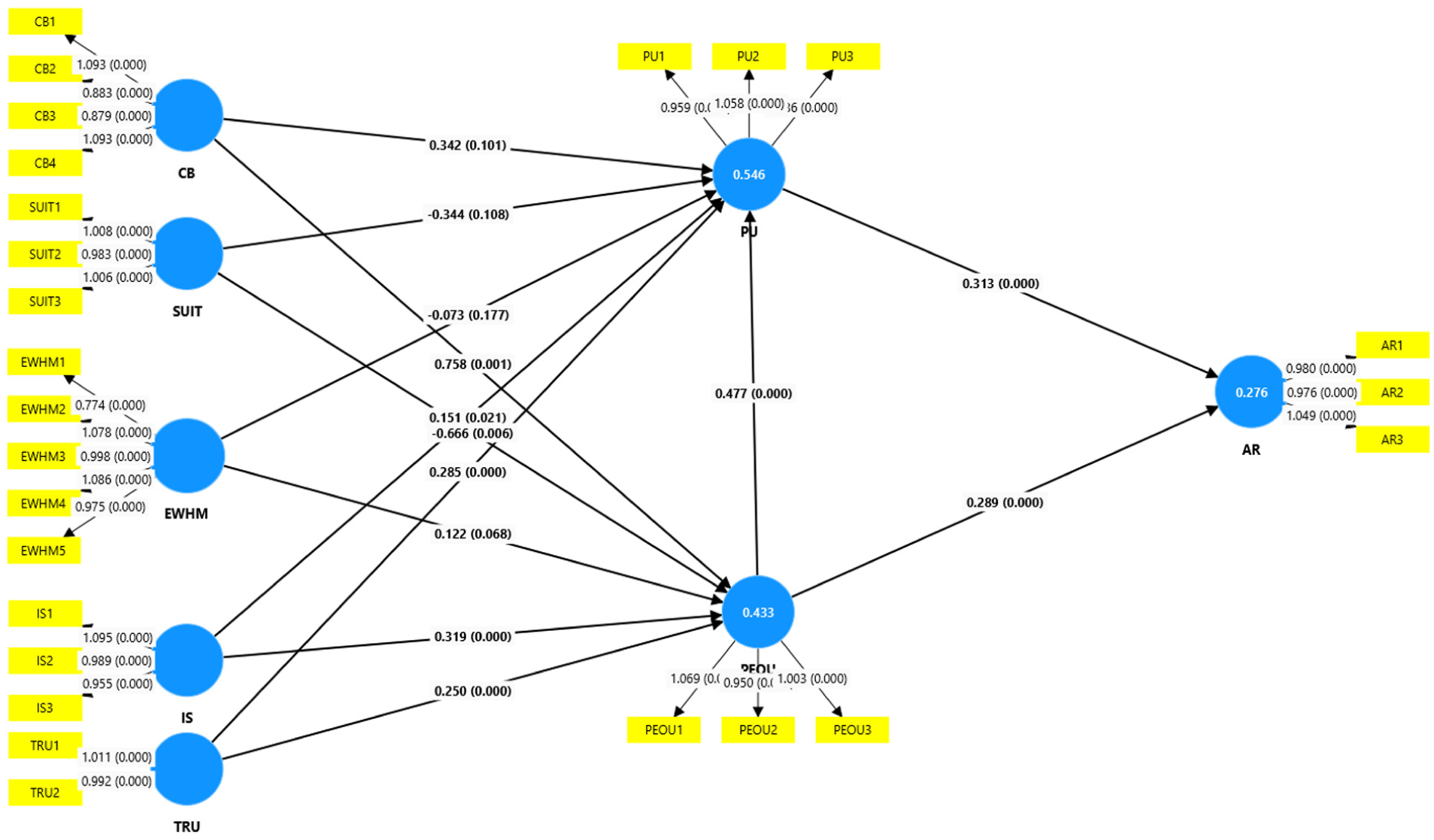
Structural model constructed by the authors using SmartPLS 4.
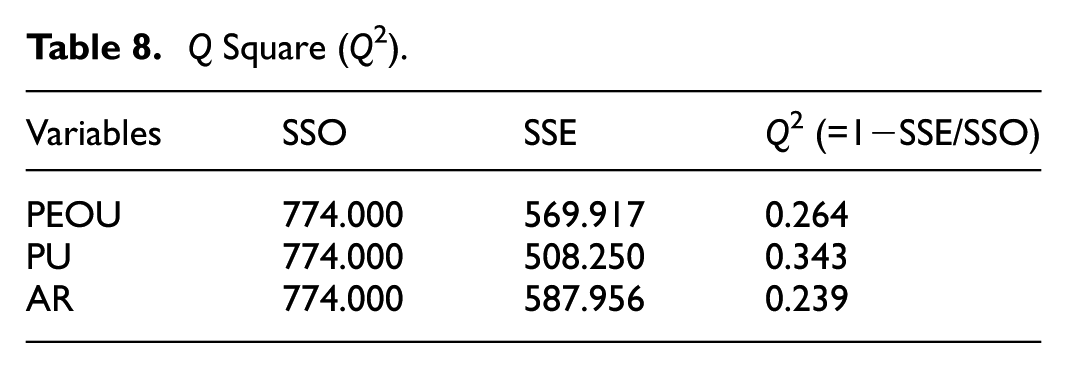
Q Square (Q2).
The structural model was evaluated to test the proposed hypotheses, with the path coefficients (β), t-statistics (|O/STDEV|), and p-values indicating the significance of the relationships in Table 5.
The path analysis reveals that the perceived ease (PEOU) of use and perceived usefulness (PU) are the primary determinants of BCTBS adoption in academic libraries in Pakistan. Determinants such as comparative benefit (CB), institutional strategy (IU), and trust (TRU) have a positive influence on perceived ease of use (PEOU). Nevertheless, institutional strategy (IU), perceived ease of use (PEOU), and trust impact perceived usefulness (PU). Significantly, perceived ease of use (PEOU) and perceive usefulness (PU) directly influence adoption readiness. Furthermore, it underscores the importance of BCTBS for libraries to provide adequate organizational support and build trust to facilitate technology adoption in Pakistan.
Assessment of R Square and Q Square (R2 & Q2)
R Square (R2)
The model’s explanatory power was evaluated using the R-square (R2) values in Table 6 for the endogenous constructs, indicating the amount of variance explained by the independent variables (Nadella & Pillai, 2024). The R2 value for Perceived Ease of Usefulness (PEOU) was .433, with an adjusted R2 of .422, suggesting that 43.3% of the variance in PEOU is explained by the independent variables. For Perceived Usefulness (PU), the R2 was .546, with an adjusted R2 of .536, indicating that 54.6% of the variance in PU is explained by the predictors. Adoption Readiness (AR) had an R2 value of .276 and an adjusted R2 of .270, meaning that 27.6% of the variance in AR is accounted for by the model.
Q Square (Q2)
Predictive relevance was assessed using Q-square (Q2) values, in Table 7 derived from the Stone-Geisser criterion (Stone, 1974), and used by Hair et al. (2017, 2022), which evaluates the model’s predictive accuracy through a blindfolding procedure. The Q2 values for the endogenous constructs were as follows: The Q2 values for AR, PU, and PEOU were 0.239, 0.343, and 0.264, respectively. Given that none of these values is 0, the model’s predictive significance for these constructs is deemed sufficient. For every endogenous construct, the Sum of Squares Observed (SSO) and the Sum of Squares Error (SSE) were displayed in a comprehensive analysis of the Q2 values. With an SSO of 774.000 and an SSE of 569.917 for PEOU, the Q2 value was 0.264. With an SSO of 774.000 and an SSE of 508.250 for PU, the Q2 value was 0.343. With a Q2 value of 0.239 for AR, the SSO was 774.000 and the SSE was 587.956. These results highlight how well the model predicts and explains the variability in the important constructs.
Main Hypothesis Findings and Discussion
Main Hypothesis Findings
This research model-based findings indicate that the adoption of BCTBS in Pakistani academic libraries is influenced by several critical variables, including Comparative Benefit (CB), Suitability (SUIT), Institutional Strategy (IS), and Trust (TRU). PEOU is highly influenced by Comparative Benefit (CB; β = .758, t-value = 2.987, p-value = .001), indicating that CB is crucial in determining how users perceive ease of use. Suitability (SUIT) negatively impacts PEOU (β = −.666, t-value = 2.522, p-value = .006), indicating that perceived mismatches between the technology and organizational needs can hinder ease of use. Institutional Strategy (IS) positively affects both PEOU (β = .319, t-value = 4.282, p-value = .000) and PU (β = .151, t-value = 2.031, p-value = .021), demonstrating the importance of strategic alignment. Trust (TRU) significantly influences both PEOU (β = .250, t-value = 3.995, p-value = .000) and PU (β = .285, t-value = 5.961, p-value = .000), reaffirming its essential role in technology adoption. Both Perceived Ease of Use (PEOU) and Perceived Usefulness (PU) are significant mediating variables that impact the inclination of academic libraries in Pakistan to adopt blockchain technology. PEOU is a significant predictor of both Adoption Readiness (AR; β = .289, t-value = 3.810, p-value = .000) and PU (β = .477, t-value = 7.892, p-value = .000). Perceived Usefulness (PU) significantly influences AR (β = .313, t-value = 3.899, p-value = .000), underscoring its prominent importance in the adoption process. Our research findings support our hypotheses, showing that PU is the most influential factor in determining the intention of library personnel to adopt blockchain technology, followed by PEOU. Furthermore, enhancing PU and PEOU through strategic initiatives, clear communication of benefits, and fostering trust is essential for successful BCTBS adoption. The results validate the centrality of PU in driving adoption readiness, with PEOU also playing a significant role.
Discussion
This research study reviews the critical determinants that could affect the adoption of BCTBS in Pakistani academic libraries. Considering the variables CB, SUIT, IS, and TRU, among others, that affect PEOU and PU, we find valuable insights that can guide the success in adopting blockchain technology in such a context. As per the Summary of hypothesis testing (Path Coefficient and t-test & p-value) and Table 6 Comparative Benefit (CB) has a significant influence on PEOU (J. L. Chen, 2011; Lou & Li, 2017; Setiyadi et al., 2019; Ullah et al., 2021; Wandira et al., 2024). The relationship is positive and strong between the perceived benefit that blockchain technology offers over existing systems and the library personnel’s ease of use. It proves that communication about the benefits of BCTBS adoption is essential to enhance its perceived usability.
So on, suitability (SUIT) indicating a positive effect on PEOU and PU (J. Chen et al., 2024; Gholami et al., 2018; Legesse et al., 2024; Ullah et al., 2021; Wandira et al., 2024). This implies that blockchain technology is viewed as user-friendly if it is believed to be appropriate for the requirements and procedures of academic libraries today. Consequently, to enhance this, the organizations need to make sure that the blockchain technology is implemented in a way that suits the unique needs and procedures of the library. The effects of Institutional Strategy (IS) are a positive influence on both PU and PEOE (J. Chen et al., 2024; Gholami et al., 2018; Ullah et al., 2021). This emphasizes how important institutional support and strategic alignment are in raising the perception of PEOU and PU of blockchain technology adoption. Successful adoption of blockchain technology is more likely to occur at institutions that include it in their strategic goals and offer the required resources and assistance.
Both PU have been strongly influenced by trust (TRU). This is consistent with previous research that highlights the value of trust in adopting new technology (Bøe, 2018; Gholami et al., 2018; Wandira et al., 2024). Ensuring blockchain technologies’ security, transparency, and dependability can significantly increase the trust of library patrons and encourage adoption. Adoption Readiness (AR) has been directly influenced by Perceived Ease of Use (PEOU) and perceive usefulness (PU) (Gholami et al., 2018; Hanif & Shah, 2025; Tevera & Ruhode, 2024). This suggests that attempts to make BCTBS easier to use & less complicated can increase adoption rates.
The most important element in determining whether library personnel intend to use BCTBS is perceived usefulness (PU), and it has a considerable impact on AR (Gholami et al., 2018; Tevera & Ruhode, 2024; Wandira et al., 2024). This emphasizes the need to show the real-world advantages and advancements that blockchain technology can offer to library operations, and librarians consider its usefulness in their daily routine tasks in libraries. The conclusion of this study is further supported by the evaluation of R2 and Q2 values (Hair et al., 2017, 2022; Nadella & Pillai, 2024). A considerable amount of the variance in these constructs is explained by the model, according to the R2 values for PEOU (.433), PU (.546), and AR (.276). The model appears to have strong predictive relevance based on the Q2 results for AR (0.239), PU (0.343), and PEOU (0.264).
This research reveals the in-depth variables influencing Pakistani academic libraries’ adoption of BCTBS in their institutions. The results underscore the significance of augmenting perceived utility and user-friendliness through deliberate endeavors, lucid dissemination of advantages, and cultivation of trust. Libraries may increase the efficacy and efficiency of their operations by taking steps to address these problems, which will increase the possibility that BCTBS implementation will be successful. These observations can be an excellent resource for academic libraries and legislators who want to apply BCTBS successfully.
Conclusion
In conclusion, this research demonstrated that the key factors influencing the adoption of BCTBS in academic libraries, such as CB, significantly enhance users’ PEOU of BCTBS systems. Similarly, IS was revealed to positively impact PEOU and PU, demonstrating that a well-defined institutional policy can facilitate BCTBS in academic libraries. Moreover, TRU also emerged as another critical factor, strengthening the PEOU and PU and elaborating on the librarian’s trust in BCTBS in libraries. Additionally, this study revealed that PU and PEOU are strong drivers of AR and buttress their fundamental role in accepting BCTBS in libraries. Though the EWHM did not display its significant influence, it signifies that the passive leadership support may be inadequate without concrete execution related strategies. Interestingly, SUIT status is supportive but revealed a negative impact on PU and PEOU, suggesting a potential misalignment between blockchain capabilities & current library systems or processes in academic libraries of Pakistan. The study highlights that institutional preparedness, perceived benefits, and trust are key drivers of BCTBS adoption. At the same time, organizational support and suitability require further attention to ensure successful implementation in academic libraries. However, the results indicate that organizational support mechanisms and technology-library fit require further attention and refinement. Academic libraries considering BCTBS implementation should focus on developing robust institutional strategies, enhancing user trust, and carefully evaluating the compatibility of BCTBS solutions with their unique needs and routine workflows. Future research could explore additional contextual factors, examine these relationships in different cultural or organizational settings, and also emphasize examining the behavior of librarians regarding this by applying the TPB (Theory of Planned Behavior).
Theoretical Implications
The research offers significant theoretical contributions by being one of the unique studies that integrates the Technology-Organization-Environment (TOE) framework with the Technology Acceptance Model (TAM), specifically within the context of blockchain technology adoption and in Pakistani academic libraries. This combination provides a comprehensive understanding of the factors influencing the adoption of Blockchain Technology-Based Services (BCTBS) among library personnel. Previous studies indicate that user behavior toward technology adoption is influenced by various factors (Albayati et al., 2023). By merging TOE and TAM, this study sheds light on the inclination of academic library staff to embrace BCTBS. Additionally, the research enriches the TAM model by incorporating external factors such as government policy, compatibility, trust, and relative advantage, offering more profound insights into the interrelationships within the proposed model. The study also contributes to the trust research domain by examining trust as a key external factor in the TOE framework. This research lays a foundational framework for future studies on BCTBS adoption in academic libraries worldwide, particularly highlighting the Pakistani context.
Practical and Managerial Implications
The findings of this research have practical implications for academic libraries in Pakistan, particularly in promoting the adoption of BCTBS. Library administrators can use these insights to develop strategic plans aligning BCTBS adoption with organizational objectives, enhancing service delivery, and meeting user needs more effectively. This study provides guidance on resource allocation to support BCTBS initiatives, identifies potential barriers to adoption, and suggests strategies for overcoming them. Implementing BCTBS is anticipated to enhance libraries’ technical efficiency and social value, supporting the development of “Future Learning Centers.” The study also lays the foundation for creating a conceptual model that elucidates the interplay between various factors, establishing a comprehensive framework for assessing BCTBS effectiveness in academic libraries. It emphasizes the importance of factors like relative advantage, compatibility, government policy, and trust, demonstrating how these can be leveraged to foster successful BCTBS adoption. The research thus provides a valuable resource for administrators, policymakers, and library personnel to make informed decisions regarding BCTBS implementation in Pakistani academic libraries.
Limitations and Future Research Paradigm
Despite the novelties presented by this research, several limitations should be acknowledged. Firstly, the study was conducted solely in Pakistan, focusing on academic libraries, including public and private institutions in first-tier and second-tier cities with higher educational and academic levels. These findings may not be generalizable to other developed countries, different institutions, or public and community libraries. This issue necessitates further international or interlibrary research. Secondly, the scope of blockchain technology extends beyond evaluating actual services to include securing and transparently transmitting data, which was not fully addressed in this study. Thirdly, the sample comprised only civil library personnel working in academic libraries. Although the sample of 258 respondents covered all provinces of Pakistan, it may not be sufficient to yield more precise results. A more extensive examination by other institutions and stakeholders is recommended.
This research opens up opportunities for future studies to verify and broaden the findings in more global contexts and across different types of libraries, including public and community libraries. Incorporating additional theories of innovative acceptance into the developed model could yield new insights. Future research should prioritize conducting qualitative studies to understand the determinants influencing blockchain technology adoption in libraries, followed by quantitative assessments. Exploring the correlations between variables examined in this study, particularly those related to the TOE framework, could offer a more comprehensive understanding of the determinants of implementing blockchain technology-based services in academic libraries. Additionally, investigating the application of the proposed model in institutions or organizations outside of academic libraries in Pakistan could be an intriguing area for future research. In conclusion, while our study presents significant findings on adopting blockchain technology in academic libraries in Pakistan, there is ample scope for further research to enhance and expand these insights.
Footnotes
Acknowledgements
The authors express gratitude to all respondents who contributed to this study for their significant support. A special Gratitude is expressed to Professor Li Gang for his mentorship, perceptive critiques, and steadfast assistance during this project. His skills and mentorship were important in developing this study, and his commitment and support are highly valued.

Ethical Considerations
The School of Information Management, Nanjing University, did not require ethical approval for this study. This study was conducted in accordance with the principles of the Declaration of Helsinki. The research involved academic library staff in Pakistan (not patients or medical professionals) and focused solely on evaluating librarian behavior, posing no ethical risks.
Consent to Participate
Informed verbal consent was obtained from all participants prior to their involvement in the study. Written consent was not deemed necessary as this study did not involve sensitive or personal data, and participation posed no foreseeable risks.
Funding
The authors received no financial support for the research, authorship, and/or publication of this article.
Declaration of Conflicting Interests
The authors declared no potential conflicts of interest with respect to the research, authorship, and/or publication of this article.
Declaration of Generative AI Use
In the course of preparing this work, the author employed Quill Bot and B. AI to improve the language and readability for the audience. Subsequent to employing these tools, the author meticulously evaluated and revised the content as required and accepts complete accountability for the final published work.
Data Availability Statement
Data sharing is not relevant to this paper, as the dataset utilized in this study is not publicly available due to privacy and confidentiality obligations to the participants. Ensuring respondent anonymity was of utmost importance in this research; hence, the raw data cannot be publicly accessible. However, the related author may request it under suitable circumstances.