




Abstract
Exposure to images on the impact of climate change has been shown to trigger low-carbon awareness and behaviors in individuals. In this study, pre-exposure to photographs of climate change impact, low-carbon awareness, and behaviors of a control group and an experimental group were not significantly different. However, following exposure, the two groups showed significant differences in terms of low-carbon awareness and behavior. Moreover, the experimental group was found to have better low-carbon awareness and behavior than the control group without exposure. Therefore, exposure to climate change impact photographs may play an important role in promoting low-carbon awareness and behavior. The findings have significant implications for climate change and low-carbon policy-making.
Introduction
Climate change is a global environmental hazard. It involves unique and involuntary exposure for many regions and thus, has several severe consequences (Liu, 2019; Patz et al., 2007), such as global water and food security crises (Hanjra & Qureshi, 2010). In China too, which is the world’s largest emitter of CO2, climate change is an urgent problem. Therefore, the Chinese government has formulated numerous policies for low-carbon development. These policies mainly focus on low-carbon energy, the low-carbon economy, and traffic management. However, there are relatively few policies targeted toward improving residents’ awareness and behavior. Previous studies have revealed that residents’ behaviors could have a significant impact on low-carbon development (Bai & Liu, 2013; Liu et al., 2018). In the United States, employing the consumer lifestyle approach, Bin and Dowlatabadi (2005) estimated that over 80% of the energy used and CO2 emitted are a consequence of consumer demand and economic activities to support this demand. The business sector is the major direct emitter of carbon emissions—especially carbon-intensive firms (Cadez & Czerny, 2016) which manufacture products for or provide services to end consumers. These firms in turn have the power to influence the business sector via their economic choices, and thus, residents as consumers create market pressure, forcing companies to reduce greenhouse gas emissions. Thus, residents’ low-carbon awareness and behavior are important (Cadez et al., 2019). In China, with an increase in residents’ incomes, greenhouse gas emissions from the residential sector are on the rise.
Therefore, governments should formulate policies to influence residents’ awareness and behaviors. Effective formulation and implementation of such policies require not only capital and technology, but also a clear understanding of the psychological characteristics of residents’ behavioral patterns. Furthermore, the factors affecting their characteristics are very important. Previous studies have revealed that images can trigger conscious consideration and prompt the implementation of relevant actions (Domke et al., 2002; Popp & Mendelson, 2010).
However, subsequent literature analysis suggests that the effects of repeated exposure to climate change-related photographs have been rarely examined. Specifically, there are few empirical analyses based on China. Consequently, the contributions of this study are as follows: (a) we contribute to the understanding of low-carbon awareness and behaviors by analyzing the effects of repeated exposure to climate change-related photographs in China, and (b) we reveal how to improve residents’ low-carbon awareness and behaviors through exposure to photographs. The results can aid in decision-making for low-carbon development and government climate change policies.
The rest of this paper is organized as follows. Section 2 reviews the relevant literature. Section 3 outlines the methodology. The results are discussed in Section 4. Finally, Section 5 provides the concluding remarks and policy implications.
Literature Review
The gradual climate change process and the uneven distribution of adverse impacts make this phenomenon complex. This, in turn, leads some individuals to doubt the occurrence of climate change (Markowitz & Shariff, 2012). Leiserowitz (2006) argued that images of climate change help individuals understand it and change their perceptions. Dramatic images of the impact of climate change have been found to capture people’s attention efficiently (O’Neill, 2013; Sollberger et al., 2017), echoing the findings of Leviston et al. (2014). In addition, it is easy for individuals to engage with images (Braasch, 2013). Furthermore, according to Nicholson-Cole (2005), participants are more affected by national and local imagery than other types of images. According to Carvalho and Burgess (2005), media organizations play an important role in shaping individuals’ climate change awareness. Recent studies have also explored climate imagery in diverse fields, such as environmental NGO communication (Doyle, 2007), newspapers (DiFrancesco & Young, 2011), and scientific reports (Schneider, 2012).
Previous studies have explored individual and household-related low-carbon behaviors. According to Schipper et al. (1989), more than half of energy use is influenced by residents’ daily activities. Similar studies in the United States (Jones & Kammen, 2011), Australia (Lenzen, 1998), Germany (Weber & Perrels, 2000), and India (Pachauri & Spreng, 2002) have aimed to understand household energy consumption patterns by focusing on individuals’ behaviors (Chen & Li, 2019). Specific categories of low-carbon behaviors have also been explored, including conservation (Martinsson et al., 2011) and transportation (Axsen & Kurani, 2012).
There is no standard definition of residents’ low-carbon awareness in existing studies. However, environmental awareness includes low-carbon awareness. Existing studies have defined environmental awareness as a multi-dimensional concept (Abdul-Wahab, 2010; Nawi et al., 2019; Nemcsicsné Zsóka, 2008). It usually includes environmental values, attitudes, and knowledge. Some studies have included eco-centric values in the category of environmental awareness (Barr et al., 2005). Attitudes are the stable psychological tendencies of individuals regarding specific objects. This psychological tendency implies an individual’s subjective evaluation and resulting behavior (Bohner & Dickel, 2011). A low-carbon attitude refers to an individual’s subjective evaluation of low-carbon issues and related behaviors (Clark et al., 2003). Another dimension of low-carbon awareness is low-carbon knowledge, including knowledge of the meaning and sources of low carbon (Abrahamse et al., 2007; Kaplowitz et al., 2012).
The influencing factors of low-carbon awareness and behaviors have also been analyzed. Most studies have attempted to explore how environmental awareness affects environmental behavior (Kaffashi & Shamsudin, 2019). It is worth noting that an increasing number of studies has analyzed whether environmental awareness definitely affects environmental behavior (Ozaki & Sevastyanova, 2011). Macro environmental factors and individual factors have an impact on low-carbon awareness and behavior (Li et al., 2019). Some of these influences are incentives, and others are obstacles. For example, economic costs are an obvious hindrance (Cadez & Guilding, 2017; Ozaki & Sevastyanova, 2011). Other obstacles are lack of relevant knowledge (Young et al., 2009), insufficient skills (Stern, 2000), and professional assistance (Niemeyer, 2010). Economic incentives can significantly affect residents’ low-carbon behavior (Liu et al., 2017; Wright et al., 2008). Social morality, values, and culture also have an impact on residents’ environmental behavior, including low-carbon behavior (Chan et al., 2010). Finally, the environment around residents, which includes colleagues and friends, has an impact on their environmental awareness and behavior (Pickett-Baker & Ozaki 2008).
Based on the literature review, few studies have attempted to understand the effects of repeated exposure to climate change-related photographs on individuals. Therefore, from an aesthetic perspective and by employing such images, this study focused on analyzing the effects of exposure on residents’ low-carbon awareness and behaviors in China. The results are likely to aid in decision-making for propagating and promoting such awareness and, consequently, people’s behaviors.
Methodology
This study employed a pre- and post-exposure design to explore low-carbon awareness and behaviors as well as climate change impact photographs using a control group and an experimental group. The control group was not exposed to photographs during the experiment, whereas the experimental group was exposed to photographs. Both groups’ low-carbon awareness and behaviors were measured using a questionnaire survey.
Measurement of Low-Carbon Awareness and Behaviors
Data on each participant’s low-carbon awareness and behavior were obtained on two separate occasions: before and after exposure to climate change-related photographs. The participants completed a questionnaire that assessed low-carbon awareness and behaviors. Churchill’s (1979) method of designing constructs was employed to establish measures for both awareness and behaviors.
The measurement items were generated based on a literature review. Low-carbon behaviors consist of private and public behaviors (Stern, 2000). The dimensions of low-carbon awareness included value, attitude, and knowledge. The low-carbon value consisted of two items (Gagnon Thompson & Barton, 1994; Liu, 2019). The present study used eight items to measure low-carbon attitudes (Dunlap et al., 2000). Low-carbon knowledge was measured in terms of relevant facts and low-carbon behavior (Liu et al., 2017; Schahn & Holzer, 1990). The measures for both barriers and motivators were derived from Stern (2000) and the questions were reworded to include low-carbon issues. Awareness barriers and motivators were measured using a five-point Likert-type scale. Eight experts reviewed the items, which ensured accuracy.
After establishing the framework of factors and items, we validated the questionnaire using confirmatory factor analysis and Cronbach’s α to measure reliability according to survey data. In confirmatory factor analysis, loadings of 0.5 or above are acceptable (Hair et al., 2010), and thus, those with factor loadings below 0.5 were deleted. For reliability, Cronbach’s α should be 0.7 or above (Nunnally, 2010), and the items that did not fulfill this condition were deleted. Thus, the reliability and validity of the questionnaire, including the dimensions and items, were ensured (Figure 1 and Appendix).

Dimensions and items of the questionnaire.
Pre-Exposure Low-Carbon Awareness and Behaviors
The participants (n = 168) were volunteer undergraduate students at Tianjin University. The interviewees were informed about the nature of the interview and experiment and were assured of confidentiality. Thus, the control group was not exposed to a placebo. Interviews (I) were conducted in April 2017. The experimental group was comprised of randomly selected participants who were exposed to climate change-related photographs, and the control group comprised the rest of the participants. The classes were pre-determined by the university, and the classification into the control/treatment groups was randomized. The experimental group consisted of 84 participants, of which 74 (39 male and 35 female) completed the questionnaire. Ten questionnaires that were not valid because questions were not fully answered were excluded from the analysis. The control group also consisted of 84 participants, of which 69 (29 male and 40 female) completed the questionnaire. According to the data obtained from the questionnaire survey, the low-carbon behavior of the two groups did not differ significantly, Wilcoxon–Mann–Whitney (WMW) test, and W = 2217.5, p = .48>.05, (Figure 2).

Pre-exposure average marks of low-carbon behavior in the experimental and control groups.
The analysis of the questionnaire results also indicated that there was no statistically significant difference in low-carbon awareness between the two groups (W = 1955, p = .07 > .05) (Figure 3).

Pre-exposure average marks of low-carbon awareness in the experimental and control groups.
As can be seen from Figure 4, in terms of low-carbon barriers, there was no statistically significant difference between the two groups (W = 2413.5, p = .89 > .05).

Pre-exposure average marks of low-carbon barrier in the experimental and control groups.
The analysis results revealed that the scores of the two groups for low-carbon motivators showed significant statistical differences (W = 1922, p-value = .04 < .05). Therefore, the experimental and control groups showed no statistically significant differences in scores on low-carbon awareness, behavior, and barriers. However, there are significant differences in the low-carbon motivator scores. To effectively analyze the effects of exposure to photographs showing the impact of climate change, we selected three variables with no significant difference between the two groups for analysis, including low-carbon awareness, behavior, and barriers.
Exposure to Climate Change Impact Photographs
It was Collier (1957) who first mentioned the use of photographs in interviews. Because of their realistic representation, photographs offer the possibility of observing and discussing actual events and subjects with other observers (Chapman et al., 2016), and have been widely and successfully employed in the sociological version of visual research, psychology (Sustik, 1999), education (Smith & Woodward, 1999), and organizational studies (Buchanan, 1998; Özüm & Temel, 2018). The photographs used in this study provide a general depiction of climate change impacts. Based on the different consequences of climate change, namely food security (Bocchiola et al., 2019; Tao et al. 2009), infectious diseases (Ebi et al., 2013), extreme weather events (Howe et al., 2014), natural landscapes (Duane et al., 2019; Ramakrishnan, 1998), and rising sea levels (Boateng, 2012; Mukul et al., 2019), we used eight photographs [Based on network pictures, Getty Image, Reuters, Global Population Speak out, Thinkstock, and China Meteorological Administration], we made improvements and designs in the photos used in this study.) (see Figures 5 and 6), which included location differences and children or animals, among other elements. For example, photograph B featured polar bears, which are facing a severe survival challenge, and is the most iconic global climate change image functioning as a primary visual cue (Doyle, 2007). However, climate change also has effects at the national and local levels, and photographs A, G, and H represent local city and national situations.

Climate change-related photographs (I). (A) Rising sea levels mean Tianjin city will be flodded. (B) Glacier ablation. Polar bears face severe survival challenges. (C) Yunnan Jade Dragon Snow Mountain (1998). (D) Yunnan Jade Dragon Snow Mountain (2003).

Climate change-related photographs (II). (A) Climate change. Floods and storms will occur frequently. (B) Insect borne infectious diseases increased. (C) Climate change results in grain yield reduction. (D) Climate change; Frequent extreme high temperatures; Drought intensified.
All photographs were shown to the participants in Microsoft PowerPoint. Of the experimental group, 84 participants viewed the photographs once a week. Following Malamuth and Ceniti (1986), participants were exposed to each of the 8 photographs for 9 to 10 min each week. Throughout the exposure period (4 weeks), the participants in the control group were not given any materials by the researchers. The two groups belonged to different campuses of Tianjin University (Beiyang campus and Jinnan campus). The participants had not taken related classes or conducted related projects; thus, the effects of unmeasured intervention could be minimized. After exposure, to mitigate the effect of confounding factors such as attendance, we added the following question to the questionnaire: “Is this the second time you answered this questionnaire?” Only questionnaires that recorded “yes” answers were considered valid.
Results and Discussion
Results
Differences between control and experimental groups
After the 4-week exposure period, each participant answered the questionnaire. The experimental group returned 67 valid questionnaires, and the control group also returned 67 valid questionnaires. We conducted an analysis of variance on the data. The test of within-subjects effects was used, which can effectively explore the difference between the two groups. According to the results of Mauchly’s test of sphericity, Mauchly’s W = 0.916, p = .003<.05, which does not meet the standard assumptions and requires correction. Thus, the three correction methods of Greenhouse–Geisser, Huynh–Feldt, and lower-bound were used for calibration. The results are presented in Table 1. Participants’ low-carbon characteristics (summation of awareness, behavior, and barrier scores) have a p value of less than .01 (the last column of Table 1), which indicates that in the experimental group, participants’ low-carbon characteristics were significantly different before and after the treatment. In addition, the interaction between participants’ low-carbon characteristics and exposure was also statistically significant.
Low-Carbon Characteristics’ Test of Within-Subject Effects.

Only the experimental group was exposed to the photographs, and the results in Table 2 show the differences between the experimental group and the control group in their low-carbon characteristics after the treatment. According to these results, the test of within-subject effects (p= = .01 < .05) revealed significant differences in the effects of exposure to climate change impact photographs.
Test of Within-Subjects’ Effects for the Experimental and Control Groups After Treatment.

Low-carbon characteristics of experimental group after exposure
Pairwise comparison is a widely used statistical method that can effectively compare the differences between groups. A variety of statistical analysis software, such as R, can be used to directly calculate the results. Table 3 (the last column) reveals whether the two groups have a pairwise p value of less than .05, which indicates a significant difference. The exposed experimental group showed better low-carbon characteristics (see the mean difference in Table 3).
Pairwise Comparisons of the Control and Experimental Groups.

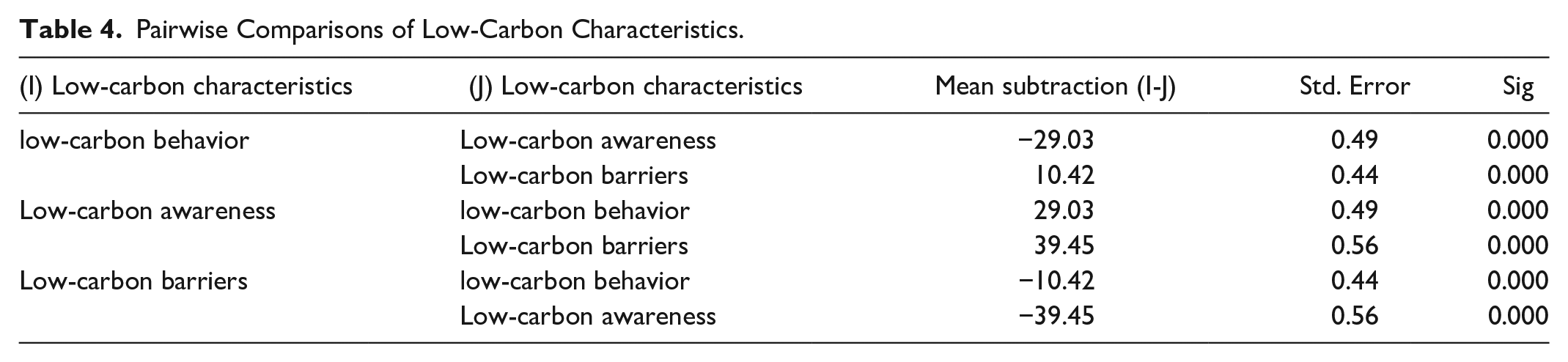
Low-carbon characteristics include low-carbon behavior, awareness, and barriers. As Table 4 shows, there are significant statistical differences among low-carbon these three elements (p < .01; the last column). In addition, the mean subtraction indicates that participants’ low-carbon awareness score was higher than their low-carbon behavior score.
Pairwise Comparisons of Low-Carbon Characteristics.
According to Table 5, the control group’s (without exposure) low-carbon behavior is significantly different from that of the exposed experimental group (p < .01) (the last column). Moreover, according to the mean subtraction (I − J) in Table 5, the experimental group’s low-carbon behavior is better than that of the control group. We reached similar conclusions regarding awareness and barriers. Therefore, the low-carbon characteristics of the exposed experimental group are better than those of the control group (without exposure).
Pairwise Comparisons of Low-Carbon Characteristics With and Without Exposure.

Low-carbon awareness scores are higher than low-carbon behavior scores
According to the results of pairwise comparisons presented in Table 6, low-carbon awareness, behavior, and barriers of both the control group and the experimental group were significantly different (see the last column of Table 6). Furthermore, according to the mean subtraction (I − J) in Table 6, both groups’ low-carbon awareness scores were higher than the low-carbon behavior scores.
Pairwise Comparisons of the Experimental and Control Groups in Low-Carbon Characteristics.

Discussion
The data analysis shows that after exposure, the two groups had significant differences in low-carbon awareness and behavior. After exposure, the experimental group had better low-carbon awareness and behavior, which provides supporting evidence that vivid and emotive photographs can communicate meaning (Campbell, 2007; Joffe, 2008) for cognitive processing systems (Domke et al., 2002) and have a significant effect on triggering awareness (Hicks & Lloyd, 2018). When the participants viewed the photographs, they became mindful and started searching for hidden meanings and associations. The photographs helped them engage in the process of constructing meaning, especially when the social value of the photographs was recognized (Kusumaningputri & Widodo, 2018; López-Sintas & Pérez-Rubiales, 2012). As such, exposure to climate change-related photographs can be considered a technique of social influence, similar to a social norm or normative influence, to promote low-carbon awareness and behavior.
Furthermore, norms can be classified as descriptive and injunctive norms (Cialdini et al., 1990; Yitmen & Verkuyten, 2020), indicating what other people do and what they think someone should do, respectively. The photographs presented to the experimental group are a form of signaling. This implies descriptive and injunctive norms, which should mitigate climate change and improve low-carbon awareness and behavior. Furthermore, according to Lindenberg and Steg (2007), normative influence results from situational cues, which could push individuals toward a specific goal, such as the normative goal of making someone sensitive to how to act appropriately. Such a normative goal could improve low-carbon awareness and behavior because it frames participants’ biospheric values with situational cues from exposure to climate change-related photographs. Meanwhile, when other participants present low-carbon awareness and behavior signals as the appropriate way to act, they subsequently can affect the behavior of others, which partly echoes the findings of Keizer et al. (2008).
The results of the data analysis also indicate that regardless of exposure, participants’ low-carbon awareness scores are higher than their low-carbon behavior scores; thus, a gap exists between low-carbon awareness and behaviors. Barriers would hamper the process of translating low-carbon awareness into low-carbon behaviors. There is no consensus in previous studies (Liu et al., 2019; Manoli et al., 2007; Shetzer et al., 1991) on whether awareness leads to behaviors. Psycho-emotional barriers related to the denial of certain aspects of climate change, such as claiming that there are no alternatives to current behavior, may lead to a lack of personal engagement or refusal to initiate changes (Lorenzoni et al., 2007). Another obstacle to action is a type of system justification in which the current system is perceived as fair, implying that the status quo should be preserved (Jost et al., 2012). Other studies (Feygina et al., 2010) have echoed the findings that system justification tendencies are linked to a greater denial of ecological problems and less willingness to introduce pro-environmental behaviors.
Whether low-carbon awareness can be transformed into low-carbon behavior is also affected by the cost of transformation. Low-carbon behaviors often require people to change their accustomed behaviors, which involves costs. If the cost of transformation is too high, it restricts the transformation of low-carbon awareness into low-carbon behavior. Whether people around an individual take related actions also affect the ease of transformation. If the people surrounding an individual adopt low-carbon behaviors, then that individual would be driven to change. Therefore, the transformation from low-carbon awareness to low-carbon behavior is affected by many factors and is a complicated process.
Conclusions and Policy Implications
This study explored the effects of repeated exposure to climate change-related photographs on college students’ low-carbon awareness and behaviors. These elements were tested using a questionnaire survey. Subjects were randomly assigned to the control or experimental group. The experimental group was exposed to eight photographs related to climate change over a 4-week period, while the control group was not exposed to any stimuli. After exposure, the experimental and control groups were asked to complete the questionnaire again. Exposure to climate change stimuli was found to significantly affect the subjects’ low-carbon awareness, motivators, and barriers. However, the score for the subjects’ low-carbon behaviors increased only slightly. These findings suggest that sustained exposure to climate change-related photographs may promote low-carbon awareness and may be a useful method to encourage low-carbon behaviors.
These findings have meaningful implications for policymakers. Exposure to climate change-related photographs has been shown to promote subjects’ low-carbon awareness. Therefore, the results may encourage policy designers to increase exposure to climate change-related photographs in universities or public areas. In addition, these photographs can be published on the internet—in particular, on the official websites of governments at all levels. As an increasing number of people use mobile phones to surf the internet, these photographs can be published on various social platforms, including Facebook and WeChat.
The conclusions also have reference values for the design of climate change-related photographs. Such photographs should show the consequences of climate change intuitively and vividly, starting with a scene that the individual is familiar with and highlighting disasters caused by climate change. For example, climate change causes sea-level rises and flooding in coastal cities. The landscape of famous scenic spots is changing due to climate change with reduction in food production, child hunger, spread of disease, and so on. These photographs can directly impact individuals’ outlook, affect their awareness, and eventually encourage them to change their behavior.
Finally, some limitations of this study are worth mentioning. The participants were college students; thus, the sample might not be representative of the entire Chinese population. Furthermore, there is systematic bias owing to differences in content and grade of the two classes. In other cases, the experimental results may differ, such as for the elderly or people with only high school education. We aim to carefully analyze how the conclusions are applied to environmental campaign research in the future. Despite these limitations, this explorative study extends the research on low-carbon awareness and behaviors related to climate change and low-carbon policy design, especially for low-carbon awareness and behavior of students on campuses.
Footnotes
Appendix
Declaration of Conflicting Interests
The author(s) declared no potential conflicts of interest with respect to the research, authorship, and/or publication of this article.
Funding
The author(s) received no financial support for the research, authorship, and/or publication of this article.
