



Abstract
This study assessed smallholder farmers’ perceptions, adaptation constraints, and determinants of adaptive capacity to climate change. The study used severity and problem confrontation index estimations to examine the farmers’ perceptions of climate warming and barriers to climate adaptation. The results indicated that the farmers were cognizant of climate change and its adverse impacts on their livelihood. It was evident that most surveyed rice farmers perceived changes in climatic conditions to affect rice production adversely. The farmers claimed that unpredictable weather conditions, limited farm size, inadequate farm labor, scarce water resources, high cost of farm inputs, and insufficient information on weather conditions had impeded their adoption of climate change adaptive strategies. Based on the results of the principal component analysis, economic resources, physical resources, information, human resources, and technology significantly influence smallholder farmers’ responsive ability to climate warming. Therefore, policymakers must design policy frameworks and measures that consider these significant factors explaining farmers’ constraints to climate change adaptation.
Introduction
There is a consensus by the entire global community on the reality of global warming as a critical environmental problem because of the overwhelming scientific evidence (Chambwera & Stage, 2010; Mallick et al., 2005). China and the rest of the globe are vulnerable to the increasingly severe effects of global warming as greenhouse gas emissions continue to rise at an alarming rate (Intergovernmental Panel on Climate Change [IPCC], 2007; Kim, 2011). China is one of the Asian economies most vulnerable to climate change (Burck et al., 2009). In the past century, the country has witnessed a discernible increase in the annual average temperature of 0.5to 0.8 °C, which was slightly higher than the average world increase in temperature during the same period (Ding et al., 2007). As a result, China’s annual mean temperature may rise by 2.3 to 3.31 °C by 2050 (People’s Republic of China, 2007). According to Ren (2007), precipitation will increase by 5% to 7% in 2050 across the provinces of China. Qin (2015) argued that persistent climate warming would increase extreme weather events like glacier retreat, rising sea levels, water shortages, droughts, and food scarcity. Due to frequent climatic events, the water resources required for agricultural activities are diminishing in China (Duan & Phillips, 2010; Xia, 2012). The negative consequences of climate change on China’s agriculture are more problematic, both for China and for the rest of the world. Empirical studies (Solomon et al., 2007; Xiong et al., 2007) have discovered that constant climate warming will cause rainfed rice, wheat, and maize production to be reduced by 20% to 36% within the next 20 to 80 years in China. Furthermore, in most southern Chinese provinces, rainfall variability adversely influences rice output (Tao et al., 2006, 2008; Zhang et al., 2010; Zhang & Huang, 2012).
Climate change impacts on agriculture have had and will continue to have severe repercussions for the economy and food security. These repercussions, to some extent, will endanger the stability of emerging countries (Mbilinyi et al., 2013; Shemsanga et al., 2010), which is particularly true for China. Climate change is one of several issues facing farmers in their production (Munasinghe, 2001). Moreover, climate change impact on the environment affects the sustainability of farmers’ livelihoods as it interacts with existing pressures on their livelihoods (IPCC, 2013).
Adaptation is the most appropriate and responsive strategy for farmers to minimize the adverse climate change impacts. Farmers’ ability to perceive changes in climatic conditions is a critical prerequisite for efficacious climate change adaptation (Devkota et al., 2017; Dietz et al., 2005; Dijksterhuis & Bargh, 2001; Gbetibouo, 2009; Hou et al., 2015, 2017; Moser & Ekstrom, 2010; Wyer & Albarracín, 2005). Most farmers perceive the changes in climatic conditions and adapt accordingly to curtail the negative climate change impacts on their farming activities (Deressa & Hassan, 2009; Ishaya & Abaje, 2008; Mertz et al., 2009; Thomas et al., 2007). Comprehending how farmers observe climate change and what factors affect their adaptive behavior is crucial in designing appropriate policies to ensure efficient adaption (Abid et al., 2015; Mertz et al., 2009; Weber, 2010). The choice of adaptation strategies by farmers hinges on social and economic factors in several countries (Abid et al., 2015; Arunrat et al., 2017; Bahinipati & Venkatachalam, 2015; Beermann, 2011; Bryan et al., 2013; Deressa & Hassan, 2009; Duan & Hu, 2014; Hassan & Nhemachena, 2008; Khanal et al., 2018; Maddison, 2007; Mariano et al., 2012; Masud et al., 2016; Obayelu et al., 2014; Tessema et al., 2013; Uddin et al., 2014; Wang et al., 2015). Factors such as access to extension services and credit facilities, educational attainment, belief in climate change, experience with climate change impacts, and awareness of climate change issues influence farmers’ decisions to adapt to climate change (Khanal et al., 2018). However, previous studies have rarely analyzed the impact of farmers’ perceptions on climate adaptation in the study area, despite the essence of the problem. Notably, climate change adaptation is a location-specific phenomenon and, therefore, requires the adoption of place-based strategies (Fischer et al., 2002; Hassan & Nhemachena, 2008; Kurukulasuriya & Mendelsohn, 2008; Lobell et al., 2008; Seo et al., 2009). Okonya et al. (2013) argued that evidence of how recent changes in climatic conditions affect the lives of local people is required because models cannot compute local perceptions of climate variability. In many farming communities on the fringes of Chengdu, farmers are predominately involved in producing staple crops such as rice. Rice farmers are generally prone to these climatic risks (Alam et al., 2013; Chang, 2002; Mabe et al., 2012).
If farmers’ perceptions influence their adaptive behavior, then it seems logical that barriers confronting farmers to adapt to climate change may affect their adaptive capacities. Farmers suffer from numerous problems: land tenure, reductions in crop yields, poverty, missing markets, capital, and other economic resources. These problems tend to undermine farmers’ resilience to climate change (Collier & Dercon, 2009; Morton, 2007). Also, obstacles exist to adapting to global warming due to limited funding, insufficient institutional capacity, inadequate technical know-how (IPCC, 2007; Jones & Boyd, 2011), and the dearth of fathoming issues regarding global warming (Gifford et al., 2011). Consequently, it has become progressively necessary to investigate farmers’ perspectives on long-term global warming and the challenges they experience in adapting to it.
Adaptation involves building adaptive capacity to increase the propensity or ability of a human communal system to cope with climatic changes and implement adaption decisions (Adger et al., 2005). Farmers’ adaptive capacity involves their ability to apply adaptation measures to address the adverse effects of global warming on food production (Mabe et al., 2012). The adaptive capacity assessment commences with identifying its determinants as a simple function of economic resources, infrastructure, information and skills, institutions, technology, and equity (IPCC, 2001). Adaptive capacity differs among farmers, depending on specific characteristics that are unique to each farmer. Farmers are inclined to adopt strategies to minimize climate change impacts if they are pragmatic. Some farmers possess a higher adaptive capacity to climate change than others (Mabe et al., 2012). The development of adaptive capacity is a productive way of expediting climate adaptation, particularly for smallholder farmers in developing economies like China. This study examined smallholder farmers’ perceptions of and adaptation barriers to climate change, and also mainly depended on the core methodologies of Eakin and Bojorquez-Tapia (2008), Peñalba and Elazegui (2013), Defiesta and Rapera (2014), Abagat et al. (2017), Abdul-Razak and Kruse (2017), and Thathsarani and Gunaratne (2018) to point out that farmers’ responsive ability to minimize climate warming impacts is a function of economic resources, physical resources, information, human resources, and technology in Chengdu, China. Knowledge of how farmers perceive the variations in climatic conditions and extreme climate events as well as what factors impede their adaptive behavior is a valuable contribution to implementing policies aimed at ensuring effective adaptation to climate warming (Defiesta & Rapera, 2014; Mertz et al., 2009; Weber, 2010).
Study Methodology
Study Area
Chengdu is the provincial capital city of Sichuan, China. It is in central Sichuan. Its territory ranges in latitude from 30°05′N to 31°26′N whereas its longitude ranges from 102°54′E to 104°53′E stretching for 192 km from east to west and 166 km from south to north, administering 12,390 km2 of land. Chengdu shares borders with Meishan (in the South), Ziyang (in the Southeast), Ya’an (in the Southwest), Deyang (in the Northeast), and the Ngewa Tibetan and Qiang Autonomous Prefecture (in the North). The area is characterized by a few rivers such as Fu, Jin, and Sha Rivers. It is also surrounded by Longquan Mountains and Penzhong Hills in the east, and to the west lie the Qionglai Mountains. Chengdu (and, for that matter, Sichuan Province) is China’s critical agricultural production base. Figure 1 shows the location of the study area.

The map of the study area: (A) China, (B) Sichuan, and (C) Chengdu.
Target Population and Sample Size
The target population for the study consisted of both the male and female heads of rural farming households residing on the fringes of Chengdu. Rural household farmers live in harmony with climate change. As such, they tend to have detailed information on climate warming, adaptation constraints, and factors influencing their adaptive capacity to climate change. Given that, rural household farmers with knowledge of the subjects of this study were the units of analysis. Therefore, the target population for the study area was estimated at 9,012 rural rice farmers.
The issue of determining an adequate sample size is a crucial controversy in any survey-based study (Akhtar et al., 2019). Hoe (2008) postulated that a sample size of 200 presents an adequate amount of statistical strength for data analysis. Moreover, sample size assumes a pivotal role in attaining consistent, substantial estimates and explanations of results and in achieving reliable estimates and descriptions of meaningful outcomes (Hair et al., 2010). Therefore, to attain an adequate and appropriate sample size from the target population of 9,012 rural farming households, the study adopted the formula by Yamane (1967), which is expressed as

where

Thus, the study set the sample size of smallholder rice farmers on the fringes of Chengdu (China) at 383.
Sampling Techniques and Data Characteristics
This study used purposive and quota sampling techniques. The purposive sampling technique postulates that the selected participants are the key individuals who can provide the required information for the survey (Kemper et al., 2003; Onwuegbuzie & Leech, 2007; Palinkas et al., 2015; Tansey, 2007). In this vein, the study purposefully selected smallholder rice farming households in Dayi, Xinjin, Qionglai, and Pidu who live in harmony with climate change as the units of analysis. To ensure that different characteristics of the elements or units selected are represented in the sample by the same proportion of the population, the researchers further used the quota sampling technique. Quota sampling involves knowing the main characteristics of the sampled population and the traits most relevant to the study. The sample size comprised 46, 170, 56, and 111 smallholder rice farmers from Pidu, Qionglai, Xinjin, and Dayi, respectively. Household-level data on socioeconomic characteristics, farm characteristics, institutional access, perception of climate warming, and barriers to climate change adaptations were garnered from the household survey conducted by the researchers on the fringes of Chengdu between March and April 2019.
Estimation Strategies
In this section, the study used the severity index (SI) to explore smallholder farmers’ perspectives on climate warming. Also, the problem confrontation index (PCI) was applied to identify and analyze the most critical problems that thwart farmers from adopting appropriate measures to adapt to climate warming effects. Finally, the study employed a principal component analysis (PCA) approach to analyze the components that explain smallholder farmers’ adaptive capacity to climate change in the study area.
Severity Index (SI) estimation
The study deployed the SI technique, which follows from Majid and McCaffer (1997), Isa et al. (2005), Longe et al. (2009), and Masud et al. (2017), to measure the strength of the rice farmers’ perspectives on climate warming. The farmers were provided several statement options, including strongly disagree (0), disagree (1), neutral (2), agree (3), and strongly agree (4). Thus, the responses of the farmers were displayed on a 0- to 4-point Likert-type scale. The data gathered for the study were analyzed using statistical tools for frequency, percentage, and SI estimations:

where

Problem confrontation index (PCI)
This study addressed the problem confrontation of farmers in adopting climate change adaptation strategies. The study used a 4-point Likert-type scale for estimating problem confrontation scores. The farmers were required to respond to 11 climate-related issues in the adaptation process. Each problem was assigned scores of 3, 2, 1, and 0 to indicate high problem, medium problem, low problem, and no problem at all, respectively. The application of PCI is appropriate because it helps to identify and analyze the most critical problem confrontation (Alam & Rashid, 2010; Hossain et al., 2011; Masud et al., 2017; Roy et al., 2014; Uddin et al., 2014). The PCI is estimated as follows:

where PCI = problem confrontation index, PH = number of farmers having high problem, PM = number of farmers having medium problem, PL = number of farmers having low problem, and PN = number of farmers having no problem
Principal component analysis
The study used the PCA to estimate the determinants of rice farmers’ ability to respond to climate warming. PCA is a multivariate approach that is used to ascertain patterns in high-dimensional data. PCA assists in extracting the data in a manner that their similarities and disparities can be illustrated. The merit of PCA is that it reduces the number of dimensions to compress the data. Each element is assessed as the weighted aggregate of the p variables. The ith factor is, thus (Langyintuo & Mungoma, 2008),

where

where
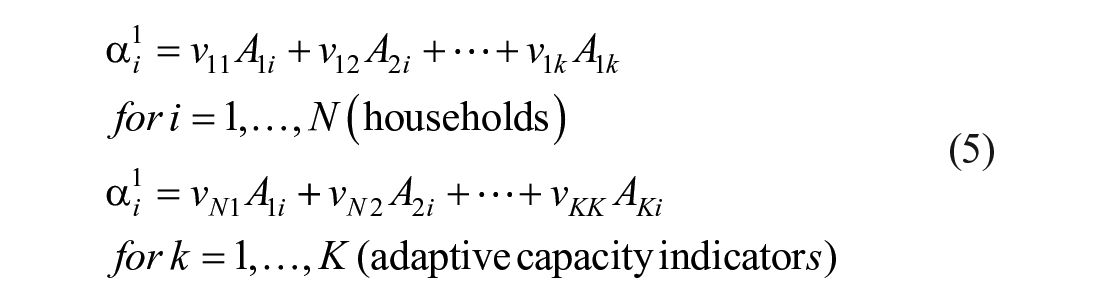
where
The PCA works this out by constructing precise linear combinations of the variables with variance explained in the first-factor loadings
By inverting Equation 3, we obtain estimates for each of the K-principal components’ factor loadings from the model:

where

The assigned weights then help to construct an overall “wealth index” by applying the following formula:

where
The Choice of Adaptive Capacity Indicators
In total, 17 specific indicators were utilized to evaluate the adaptive capacity of smallholder farmers. The previous studies considered these indicators to represent each component of small-scale farmers’ adaptive capacity. The adaptive capacity of each smallholder farming household was characterized using five components, as depicted in Table 1.
Components and Indicators of Adaptive Capacity of Smallholder Farming Households in Chengdu.

Source. Authors’ construct.
Empirical Results and Discussions
Characteristics of the Respondents
Table 2 shows the survey findings regarding the respondents’ personal, social, and economic qualities. The outcomes indicated that out of 383 respondents, 70.5% were males, with 29.5% representing females. The study found smallholder farmers in Chengdu to be, on average, 54 years old. The ages of 23 years and 78 were the minimum and maximum ages, respectively. The study discovered that 5.7% were 35 years old or younger; 16.7% were within the age range of 36 to 45, 34.7% were between the ages of 46 and 55, and 42.8% were over 55 during the study period. Thus, the results suggest that most rice farmers are older and highly sensitive to any climate stress.
Descriptive Statistics.

Source. Field survey, 2019 (Authors’ construct).
Note. FBO = farming-based organizations.
Among 383 farmers sampled for this study, 46.7% had primary education, whereas 40.5% went through junior high school. Also, 9.9% of the farmers had completed senior high school, whereas 2.9% of the respondents had received a vocational education. Education reduces sensitivity to climate stress as it can provide alternative adaptation options for victims of climate change. However, more than 87.2% of respondents recorded a low level of education, which indicates that these respondents are highly sensitive to climate change.
The average household size for farmers surveyed was four members, with one and eight indicating the minimum and maximum, respectively. The study revealed that 55.6% of the respondents had up to four household members, whereas 44.4% of them had five to eight household members at the time of the survey. Overall, the study recorded a mode of five household members.
Most farmers (94.3%) indicated that their farmlands were allocated to them by the Chinese government, whereas 5.7% of them rented farms for rice production within the farming environs of Chengdu. Also, out of the 383 farmers surveyed, 16.4% indicated that they had joined or were members of farming-based organizations. It was, however, evident that an overwhelming 83.6% of the smallholder farmers were not involved in any farming-based organization.
The study discovered that the rice farmers have been farming for a year minimum and a maximum of 58 years. Of the 383 rice farmers, 13.6% had 1 to 9 years of farming experience, 13.2% had been farming for about 10 to 19 years, and 30.8% of the sampled rice farmers had 20 to 29 years of farming experience. However, most farmers (42.3%) have been engaged in rice farming for at least 30 years in the study area.
On average, 70 (1.3%) farmers out of the 383 sampled rice farmers indicated that they received agricultural extension services and support, whereas 313 (81.7%) responded unfavorably to receiving any form of agricultural extension supports or services. The services rendered by extension officers help improve farmers’ responsive ability by disseminating the correct information on relevant farming practices. According to Deressa et al. (2009), providing climate information to farmers tends to raise their awareness of weather risks. Hassan and Nhemachena (2008) and Bryan et al. (2013) indicated that farmers are more likely to adopt adaptation measures to minimize the effects of global warming if they have access to agricultural extension services. Because most farmers cannot access these services, it suggests that they may have a low adaptive capacity to climate change.
Smallholder Farmers’ Perceptions of Climate Change
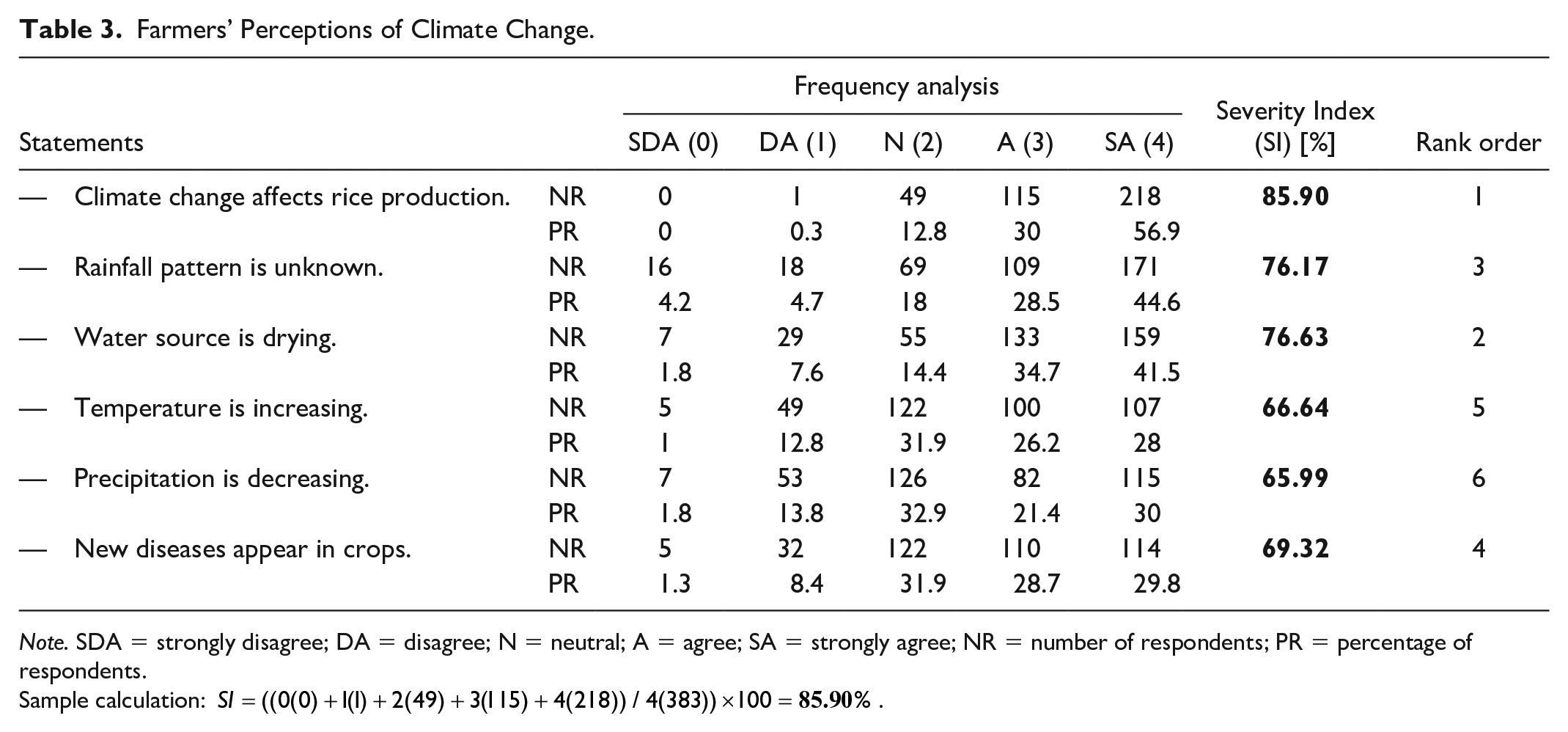
According to Leiserowitz (2007), perception is essential because how farmers perceive the associated risks of the climate forms the background within which policies are supported or disregarded. Farmers’ opinions of changes in climatic conditions are a crucial preindicator in the adaptation process (Adger et al., 2009). For this reason, respondents were asked how they are susceptible to changes in climatic conditions in their vicinity. Table 3 presents the survey results on the rice farmers’ perceptions of climate change.
Farmers’ Perceptions of Climate Change.
Note. SDA = strongly disagree; DA = disagree; N = neutral; A = agree; SA = strongly agree; NR = number of respondents; PR = percentage of respondents.
Sample calculation:
This study examined the level of rice farmers’ perspectives on climate warming using the SI. The severity indices obtained for the rice farmers’ views of climate warming varied from 66.64 to 85.90. The estimated severity indices were within the concurred opinion range of
The assessment of how farmers perceive climate warming provides a suitable adaptation system (Kim, 2008). It is, therefore, essential as an initial step to promote a better understanding of the looming dangers of climate warming (Alam et al., 2009). The findings of farmers’ perception of climate change showed that the index of the concurred viewpoint range is
Smallholder Farmers’ Constraints to Climate Change Adaptation
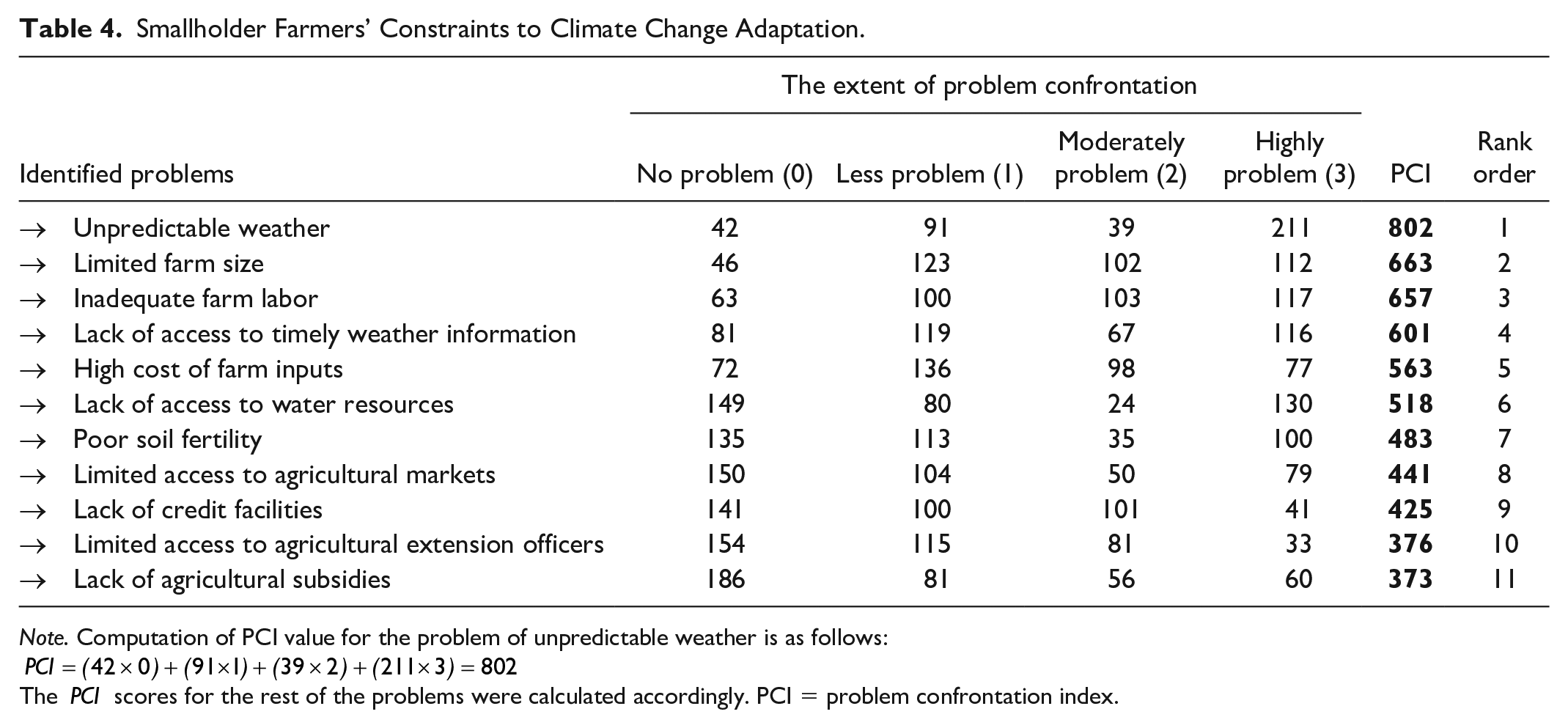
Climate adaptation is challenging for farmers due to unpredictable weather, high farm input costs, incomplete weather information, insufficient water resources, agricultural subsidies, and inadequate credit facilities, as shown in Table 4. Smallholder farmers’ problems with climate adaptation in the study area were measured by categorizing the problematic items in rank order. Next, the farmers were asked to indicate the extent of problems they are confronted with in adapting to climate warming, where farmers mentioned the degree of confrontation of each issue. The study determined the severity of each problem facing the small-scale rice growers by ranking the problem confrontation indices.
Smallholder Farmers’ Constraints to Climate Change Adaptation.
Note. Computation of PCI value for the problem of unpredictable weather is as follows:
The
The results displayed in Table 4 identified unpredictable weather conditions as the most crucial barrier to adaptation strategies, which had a PCI value of 802. Other factors, such as the high cost of farm inputs, insufficient water resources, limited farm size, inadequate farm labor, and limited access to timely weather information, were also considered severe problems. Besides, as reported in Table 4, poor soil fertility, limited access to agricultural markets, and the absence of credit facilities were claimed by farmers as moderate constraints. In contrast, limited access to agricultural extension officers and a lack of farming subsidies were minor obstacles to climate adaptation. On the whole, smallholder farmers in Chengdu face various impediments, such as unpredictable weather conditions, limited farm size, inadequate farm labor, scarce water resources, the high cost of farm inputs, and insufficient information on weather conditions, in their efforts to adapt to climate change. The results are in line with the findings obtained by Moser and Ekstrom (2010), Birkmann and Von Teichman (2010), Jones and Boyd (2011), and Masud et al. (2017).
Determinants of Smallholder Farmers’ Adaptive Capacity to Climate Change
The study subjected all the 17 items from the reliability analysis to factor analysis. Initially, the PCA indicated seven components with eigenvalues more than one, explaining 60.9% of the total variation (as presented in Table 5). However, five components were extracted and deemed significant in explaining the indicators of small-scale farmers’ responsive ability to climate warming after the inspection of Monte Carlo PCA for parallel analysis (Watkins, 2000) and scree plot. These extracted five components explained 48.3% of the variance. The study used a parallel analysis to juxtapose the five significant components that define the farmers’ adaptive capacity to climate change. Here, we systematically compared the random eigenvalues computed for the parallel analysis with the corresponding eigenvalues of the PCA (total variance explained) to determine the statistically significant eigenvalues in the PCA. According to previous simulation studies (Hayton et al., 2004; Ledesma & Valero-Mora, 2007; Preacher & MacCallum, 2003), the parallel analysis criterion is accurate and computationally intensive in determining the number of factors to be derived, which is a critical decision in exploratory factor analysis through the PCA. Table 5 presents the total variance explained and Monte Carlo PCA for parallel analysis results. The total column gives the eigenvalue, or amount of variance in the original variables accounted for by each component. The % of variance column shows the ratio, expressed as a percentage of the variance, accounted for by each component to the total variance in all the variables. The cumulative % column provides the proportion of variance accounted for by the first n components (Koko & Essis, 2012; Papaioannou et al., 2011).
Total Variance Explained and Monte Carlo PCA for Parallel Analysis Results.

Source. Authors’ construct using field data, 2019.
Note. PCA = principal component analysis.
The second technique employed in this study to choose the five significant components that explain the farmers’ responsive ability to climate warming was the scree plot approach. The scree plot is produced by plotting the number of principal components against their corresponding eigenvalues. Thus, it is a schematic depiction of the variation rate in the magnitude of the eigenvalues for the principal components. This technique helps to detect a distinctive break of slope in a plot of the amount of variance explained by each component (see Figure 2). At the fifth component level, the break-in slope indicated the significant and maximum number of factors that explain most of the variance in the five data sets on farmers’ responsive ability to climate warming. Thus, Components 6 and 7 are subsequently left out of further analysis based on all the techniques explained earlier.

Scree plot of eigenvalues for the variables of adaptive capacity.
The following important task was to categorize the selected significant components extracted from a Variance Maximization (Varimax) Factor Analysis Rotation with Kaiser Normalization to facilitate data interpretation. The categorization of the elements was based on previous literature detailed in section “the choice of adaptive capacity indicators” and the extent of loading the observed variables for each derived component. Therefore, the researchers were able to identify what observed variables fell under a particular extracted component given the respective percentage of variance. An observed variable was said to belong to a specific derived component if it explained more variation than any other component. The results of the Varimax Rotated Factor Analysis as presented in Table 6 indicate that five main components, namely, economic resources (component 1), physical resources (component 2), information (component 3), human resources (component 4), and technology (component 5), were extracted as critical components of smallholder farmers’ responsive ability to climate warming.
Components and Indicators of Adaptive Capacity to Climate Change.

Source. Computation from field data, 2019.
The influence of the variables that belong to the extracted components explaining the farmers’ adaptive capacity was measured by dint of their factor loadings; the value of each element loadings represents the strength of the impact of the observed variables on an extracted element. According to Tabachnick and Fidell (2007), a factor loading significantly contributes to the derived component of the study if it exceeds 0.30. Therefore, all the items explaining each derived component on the scale loaded appropriately upon the PCA in this study.
At the household level, insufficient economic resources will negatively influence households’ capability to adapt to climate warming impacts regarding reinvesting in their farming activities (Thathsarani & Gunaratne, 2018). The study found that items related to economic resources, such as diversity of income sources, remittances received, credit accessed, and government subsidies, were all seen to increase the adaptive capacity of farmers. Similar results were obtained by Armah et al. (2010), Frank and Buckley (2012), and Defiesta and Rapera (2014). From the findings displayed in Table 6, economic resources accounted for the highest percentage of the variance (14.43%) with an eigenvalue of 2.453. This result suggests that Component 1 is the most significant determinant of smallholder farmers’ ability to respond to climate warming.
Besides, the lack of or limited access to physical resources intensifies the incapacity to circumvent climate-related risks. It multiplies the vulnerabilities to which an individual or a household is exposed (Shahbaz, 2008). The results indicated that physical resources explained 9.84% of the variance with an eigenvalue of 1.673. It took account of variables such as farmers’ accessibility to irrigation infrastructure, farmland size, farm machines (implements), and the nature of farmland ownership that help enhance farmers’ ability to adapt to climate change. Evidence suggests that access to physical resources leads to better livelihoods by reducing their vulnerability to climate change (Aase et al., 2013; Arimi, 2014; Defiesta & Rapera, 2014; Eakin et al., 2011; Egyir et al., 2015; Ellis, 2002; Jones et al., 2010; Mondal et al., 2015; Yu et al., 2013).
Information is essential in developing farmers’ ability to adapt to climate warming to ensure a sustainable future. The study reported that information also accounted for 9.435% of the variance and had items like participation in farmer-based organizations, access to agricultural extension services, and access to climate/weather information that measured Component 3 (information) as an indicator of responsive ability to climate warming. This outcome suggests that farmers who have better access to climate information and agricultural extension services, coupled with their participation in farmer-based organizations, are better equipped to implement adaptive measures to minimize the consequences of climate warming. The study agrees with Frank and Buckley (2012), Lo and Emmanuel (2013), and Egyir et al. (2015). These studies indicated that farmers having access to climate information and agricultural extension services and participation in farmer-based organizations have a higher ability to adopt strategies to adapt to climate warming.
In addition, farming households’ human resources help build responsive abilities against the detrimental impacts of global warming, particularly for acquiring and disseminating relevant and current information regarding their farming activities (Thathsarani & Gunaratne, 2018). Human resources accounted for 7.833% of the variance from the findings, with an eigenvalue of 1.332. Three variables (farming experience of the household head, educational level of the household head, and farm labor) that measured the human resource endowment of the smallholder farmers were satisfactorily loaded in Component 4. The study found that farm labor, farming experience, and educational attainment positively correlate with farmers’ adaptive capacity. These items demonstrate how improved human resources can aid in the development of farmers’ responsive abilities to climate warming. The study supports the results obtained by Deressa et al. (2008), Eakin et al. (2011), and Defiesta and Rapera (2014).
Finally, technological resources accounted for 6.777% of the variance. It measured how smallholder farmers can adopt recent agricultural innovations in their farming activities in Chengdu (China). As a critical element of farmers’ responsive ability to climate warming, technology had three items that explained the least proportion of the variance. The study found that farmers with more knowledge of agricultural technologies such as soil fertility retention techniques, soil moisture retention techniques, and climate-resilient rice seeds can cope with climate warming effects. The study is consistent with the results of Mabe et al. (2012), Frank and Buckley (2012), and David et al. (2013).
Conclusion and Policy Recommendations
This study analyzed smallholder farmers’ perceptions, adaptation constraints, and determinants of climate adaptive capacity. The study adopted a cross-sectional survey of 383 sampled farming households on the fringes of Chengdu (China), where the rural household farmers live in harmony with climate change. The findings showed that most farmers are aware of climate change and its adverse impacts on their livelihoods. Most farmers perceived unpredictable rainfall patterns, rising temperatures, and declining precipitation. In addition, most surveyed rice farmers have perceived changes in climatic conditions to affect rice production adversely. Therefore, smallholder farmers must develop knowledge and skills to use climate-resilient rice varieties to adapt to climate change effectively. Moreover, providing reliable and timely weather information is crucial to effectively help farming households adapt to climate change. This suggestion calls for the Chinese Meteorological Department and the Ministry of Agriculture and Rural Affairs to engage intensively in the timely provision of weather information and extension services to enhance the responsive ability to climate warming among small-scale farmers in Chengdu.
Among the critical constraints against smallholder farmers’ adaptation to climate change in the study area were unpredictable weather, limited farm size, lack of access to timely weather information, inadequate farm labor, lack of access to water resources, poor soil fertility, high-cost farm inputs, limited access to agricultural markets, lack of credit facilities, limited access to agricultural extension services, as well as a lack of farming subsidies. Therefore, it is incumbent on the respective governmental and nongovernmental organizations to put in place policy frameworks and measures that consider these significant factors explaining farmers’ constraints to climate change adaptation. Also, in this study, farmers claimed to have a problem with accessing credit facilities. The Sichuan provincial government can and should develop interventions that encourage agricultural credits for smallholder farmers. This recommendation results from empirical evidence indicating that credit availability is one of several factors influencing smallholder farmers’ responses to climate warming.
Furthermore, the study discovered that economic resources, physical resources, information, human resources, and technology all play a significant role in smallholder farmers’ responses to climate warming. To this end, policymakers ought to design policy measures that focus on building the capacity of smallholder farmers, institutional support, and ensuring that agricultural extension officers work intensively with smallholder farmers.
The understanding of climate adaptive capacity is still in its infancy (Vincent, 2007). Therefore, this study contributes a different argumentative trajectory to the existing studies on climate change by assessing smallholder farmers’ perceptions, adaptation constraints, and determinants of climate adaptive capacity. Methodologically, this study used PCA to determine the indicators of smallholder farmers’ responsive ability to climate warming. Ducusin et al. (2019) proposed this methodology to help exclude other indicators of climate vulnerability that do not show correlation. This current study has filled in the lacuna of using PCA in determining the indicators that influence smallholder farmers’ responsive abilities to climate warming.
Further studies should consider the preliminary outcomes of this study as a benchmark for determining key factors that can affect the adaptive capacities to climate adaptation strategies to develop a more robust understanding of the adaptive behaviors of smallholder farmers. This study opens the door to ongoing and comprehensive studies on the determinants of smallholder farmers’ adaptive capacities to climate adaptation strategies, which can inform policymakers, particularly in China, to tailor interventions to facilitate adequate climate adaptation, which will reduce smallholder farmers’ susceptibility to the impacts of changing climatic conditions.
Finally, future studies must not concentrate only on related factors as captured in this study but expand into understanding adaptive capacity among small-scale farmers from a gendered perspective. This suggestion is in line with the fact that differences in resource access and control among men and women small-scale farmers influence adaptive capacity disparities. According to Ibrahim (2014), issues relating to gender and global warming are crucial in the development plan. Therefore, further research must examine the factors influencing the adaptive capacities to climate change between men and women smallholder farmers.
Footnotes
Declaration of Conflicting Interests
The author(s) declared no potential conflicts of interest with respect to the research, authorship, and/or publication of this article.
Funding
The author(s) received no financial support for the research, authorship, and/or publication of this article.
