




Abstract
Social entrepreneurship is the procedure of social mission that helps the society using innovative ideas and merging resources to develop economic and social values. This study aims to identify the role of social mission and social innovation on sustainable enterprise development with the mediating role of social network, and the moderating role of government regulations. The nature of our study is cross-sectional, and structural equation modeling is used on a sample of 486 social entrepreneurs from 27 countries with the help of online survey data. The results illustrate that social mission and social innovation are positively related to sustainable enterprise development. Besides, findings indicate that social network has a partially mediating role in the relationship between social mission and social innovation on sustainable enterprise development. Moreover, this study states that government regulations also have a positive influence and significant moderating effect on sustainable enterprise development. Our findings might be helpful for social entrepreneurs to create a more positive social impact on society and business enterprise’s growth.
Keywords
Introduction
Entrepreneurship is the essential driver of economic growth, employment creation, and wealth for any nation (Akter et al., 2020; Li, Murad, Shahzad, Khan, Ashraf, & Dogbe, 2020). Several countries focus on enhancing entrepreneurial activities to increase financial and economic development (Javed et al., 2019; Rehman et al., 2019). The term social entrepreneurship is illuminating and getting fame in its regions of improvement, but it could be innovative in developed countries’ environment (Saebi et al., 2019). Social entrepreneurship is a vital element in the business education environment and contributes to the overall welfare of society, even in epidemic situations (Littlewood & Holt, 2018; Weerawardena & Mort, 2006). Social entrepreneurship is producing social and economic values (Alvord et al., 2004). It is associated with individuals and teams by developing the social and environmental needs of society in normal and abnormal ecological situations. However, in previous studies, the importance of social entrepreneurship has been acknowledged by researchers and practitioners (Chell et al., 2016; Wu & Si, 2018; Zhao & Wry, 2016).
The role of social entrepreneurship emphasizes the unsettled social issues at the international level, increases human progress all around the world, and enlightens the quality of life span (Alarifi et al., 2019; Noruzi et al., 2010). Prior researchers acknowledged that social entrepreneurship is a powerful instrument to decrease unemployment and poverty, solve environmental problems, and empower human resources in the world (Wu & Si, 2018; Zahra et al., 2009). Prior researchers have encouraged social entrepreneurs to highlight the issues of society and solve these issues where it is more prominent (Bacq & Eddleston, 2018; Booth et al., 2019).
The main objective of social organizations has been linked to attaining organizational sustainability (Hockerts, 2018). Sometimes organizations are facing the issue of funds that motivate organizations to shift in other commercial activities to produce essential economic and financial resources (B. Lee & Kelly, 2019). Enterprise sustainability is associated with social entrepreneurship. As suggested by Doherty et al. (2014), for the achievement of social and economic sustainability, social enterprises must struggle to raise and enlarge their businesses conferring to commercial organizations. Organizational sustainability is attaining business victory in today’s industrial world without compromising the current and future needs, and it involves social, environmental, and economic sustainability.
The gap of this study consists of a different perspective. There are many factors of social entrepreneurship that are emphasized by several researchers (Bandyopadhyay & Ray, 2019; Jenner, 2016). Prior studies demonstrated that social networking contributes to sustainable enterprise development (Edgeman & Eskildsen, 2012; Michael & Pearce, 2009; Nga & Shamuganathan, 2010). Meanwhile, Javed et al. (2019) stated that social innovation, social mission, and financial retunes have a positive and significant influence on sustainable enterprise development. However, previous literature broadly ignored the impact of social entrepreneurship as a different label having a unique way of managing the organizations and their effect on enterprise development (Roy & Karna, 2015).
Numerous studies examined social entrepreneurship’s role in business sustainability using qualitative methods (Braunerhjelm & Hamilton, 2012; Pangriya, 2019; Sundaramurthy et al., 2013), and quantitative studies have empirically less examined in the existing literature. Therefore, to fill this gap, this study aims to extend the social entrepreneurship model using the quantitative method by testing the social entrepreneurship factors, social mission, and social innovation on the mediating role of social network and moderating effect of governmental support on sustainable enterprise development.
Literature Review
Social Entrepreneurship
Social entrepreneurship is an approach by individuals, teams, and start-up companies in which they develop, fund, and implement solutions to economic, political, social, cultural, and environmental issues (Dees, 1998; Rawhouser et al., 2019; Salman, 2018). Social entrepreneurship also refers to the commercialization of the environment, leading to developing the global economies and addressing the social problems and leverage resources (Ashraf et al., 2019). Social entrepreneurship is a procedure of social mission to help the society using innovative ideas and to merge resources to develop economic and social values (Rey-Martí et al., 2016). Looking into previous literature, social entrepreneurship has integrated into an essential area of research in the field of entrepreneurship and sustainable enterprise development (Ali et al., 2019; Choi & Majumdar, 2014). According to Ferreira et al. (2017), social entrepreneurship has a common heritage for developing economic and social values among individuals and groups. Social entrepreneurship is also called a social economy organization (E. S. Lee & Jung, 2018). However, in recent decades, governments and other institutions are even stepping up to support social enterprises for creating jobs and managing social issues from different hazards. As suggested by Steinerowski and Steinerowska-Streb (2012), social enterprise combines other entrepreneurship resources with the aid of positive change in the system. It offers an innovative organization that is more effective and socially acceptable.
Sustainable Enterprise Development
Sustainable enterprise is an organization that can expect and meet the desire of current and future generations of individuals and stakeholders by making and innovating new business strategies that accelerate positive social change and reserve ecological integrity as well as improving business performance (Danubianu & Teodorescu, 2017). However, every organization makes the best strategy to achieve sustainable business growth. According to Schaltegger and Burritt (2018), sustainable enterprise development defined as enterprise ability to meeting the stakeholder's current needs without compromising on fulfilling their future needs. Prior researchers indicated that sustainable enterprise development is the procedure to develop shareholders’ worth by economic, social, and environmental perfection (Bansal et al., 2019; Rahdari et al., 2016). Sustainable enterprise development is also called a triple bottom line because it not only focuses on economic sustainability and productivity; it also focuses on social, economic, and environmental sustainability (Elkington & Rowlands, 1999). Therefore, every enterprise must accomplish financial targets without harming society and the environment (Ali et al., 2020).
Enterprises with sustainable development strategies are getting a competitive advantage, worthy reputation, superior performance, maximum profitability, effective value creation, and operational supply chain (Ageron et al., 2012; Bos-Brouwers, 2010; Garay & Font, 2012). Hence, for achieving better sustainable enterprise development in the context of global social entrepreneurship, such factors, namely, social mission, social innovation, social network, and governmental policies, are neglected in the previous literature. As suggested by existing studies, sustainable enterprise development incorporated three dimensions; social sustainability, economic sustainability, and environmental sustainability (Dwyer, 2005; Gallo & Christensen, 2011; Marconatto et al., 2019).
Social sustainability is a process that stimulates happiness within the organization and its members while supporting the ability of future generations to sustain a healthy society (Sudusinghe & Seuring, 2020). In social sustainability, enterprises are responsible for their employees and stakeholders (Morrison, 2003). Numerous studies argued that social sustainability is related to business social issues with shareholder’s demands; economic, environmental, and health safety issues; child labor; working hours; and social well-being (Desa & Kotha, 2006; Zahra et al., 2014). Enterprises are giving more attention to social sustainability because of their stakeholder’s pressure and their demands regarding the current and future needs.
Economic sustainability discusses the practices that support long-term economic growth without damaging the social, economic, and environmental characteristics of the community (Spangenberg, 2005). According to Common and Perrings (1992), financial sustainability is defined as an ability to gain revenue for its long-term survival. However, economic viability is also considered internal economic stability and enterprise productivity (Shyle, 2018). Therefore, for achieving financial sustainability, social enterprises must adopt the policy of cost recovery mechanism and the actual mission of social value creation.
Environmental sustainability is defined as responsible interaction with the environment to evade natural resource reduction and allow for ecological eminence (Ellram & Murfield, 2017). It is also associated with protecting the natural environment from where enterprises get their inputs and deliver their output for maintaining its sustainability (Kandaurova et al., 2015). There are some adverse effects of business enterprises on the natural environment in noise, pollution, and exploitation of natural resources (Winn et al., 2011). According to Standing et al. (2008), environmental sustainability contains three paths: eco-efficiency, eco-equity, and eco-effectiveness. Eco-efficiency refers to a minimum or no ecological destruction in the natural environment, whereas eco-equity refers to a fair distribution of natural environment and resources among present and future peers. Eco-effectiveness relates to conformity to natural environment standards that the enterprises adopt to maintain its sustainability. Thus, enterprises with sustainable environmental practices gain a more competitive advantage compared with those enterprises that create pollution in the natural environment.
Research Model and Development of Hypotheses
Social Mission and Sustainable Enterprise Development
Social mission is a process of developing a social enterprise with the aim of social practices (Landrum & Edwards, 2009; Prabhu, 1999). Social organizations are working under the boundaries for gaining profit and nonprofit-oriented activities (Salman & Jamil, 2017). The relationship between social enterprises and sustainable enterprise development is consistent with profit-oriented ventures (Beckmann et al., 2014). The social mission has an exceptional trait of social entrepreneurship and associated with the aim of an active and robust mission; if the social mission is not clear, it will create a problem in social enterprises and decrease the profitability ratio (Felício et al., 2013).
Social mission is helpful for sustainable enterprises to run smoothly and create social impact on society development (Fortier & Viens, 2018). Social enterprises have several objectives and they frequently need to show their social implications and viable enterprises. For the achievement of sustainable enterprise development, social enterprises must address all the relevant practices that are associated with the economic, social, and environmental factors of the social entrepreneurial mission.
Furthermore, the social mission delivers an effective strategy to connect to the external people while keeping internal people safe and sound during environmental disaster situations (Sonnenwald & Pierce, 2000). The social mission provides an effective direction to achieve sustainable enterprise development without damaging the natural environment (Kolk & van Tulder, 2010). Hence, social mission helps individuals in questionable circumstances, community development, and protects the natural environment. Thus, based on the following discussion, we have predicted the following hypothesis:
Social Innovation and Sustainable Enterprise Development
Social innovation is related to new social practices that meet social needs and desires in a better way than the existing solutions (Pol & Ville, 2009). It is also linked with the process of innovation in products, services, and technology to meet social needs in different environmental concerns (Weerawardena et al., 2021). Social innovation plays a vital role in solving social problems with novel and innovative ideas that contribute to social value results (Sharma, 2017).
Social innovation helps tackle the economic, social, and environmental challenges faced by enterprises and follow the critical community needs during the disasters (Betts et al., 2018). Moreover, the objective of social entrepreneurship is to generate new and innovative ways for sustainable enterprise development, and social innovation helps organizations in achieving its social innovation through new value creation, innovative product, and process (Guclu et al., 2002). Social innovation influences sustainable enterprise development and attains social needs without harming the natural environment (Baker & Mehmood, 2015). Therefore, enterprises with the aim of social innovation are more likely to create economic and social values. Hence, we have proposed the following hypothesis:
Social Network and Sustainable Enterprise Development
Social networks are the process of expanding the number of one’s business and making social contacts by using different social media to interact with others or find people with similar interests to one’s own (Weber & Kratzer, 2013). According to Greve and Salaff (2003), social network is associated with a group of individuals and enterprises where they can share innovative ideas and resources. However, many enterprises did not sustain, which cannot focus on information regarding the market and did not connect socially with the environment (Barraket et al., 2017). Furthermore, due to changes in the environment by different uncertainties, enterprises are focusing on developing individuals’ partnerships with the help of social network for achieving competitive advantage (Anderson et al., 2019). Enterprises with social networking could help entrepreneurs stay connected with finding opportunities and resources in the available market as well as supporting in forming connections with individuals and society (Suryandharu et al., 2019). Social network also contributes to create an environment where individual and enterprises can share information for attaining sustainable enterprise development (Ülgen, 2019).
A social network is an essential factor that influences the performance of social enterprises. It helps individuals to provide an opportunity for social business start-ups and create values for society (Dempsey et al., 2011). Therefore, enterprises with social networks are more innovative, cost-efficient, time-efficient, and provide effective solutions to stakeholders in the process of achieving sustainable business growth (Bellostas et al., 2016). Thus, social network offers an opportunity to use social media as a tool to accomplish economic and social sustainability (Farooq et al., 2018).
Mediating of Social Network
Previous literature argued that social networking positively influenced social entrepreneurship and sustainable enterprise devolvement (Meyskens et al., 2010). According to Chen et al. (2018), social networking is the best tool for achieving maximum sustainable development. Based on a resource-based view, studies have focused on the impact of social network on sustainable enterprise development (Mercedes Leon-Sanchez & Jaen Jimenez, 2013; Neumeyer & Santos, 2018). It is believed that resource-based view firms possess resources, a subset that assists them in achieving a competitive advantage, and a subset of those that lead to more significant long-term performance (Helfat & Peteraf, 2003). Therefore, social network organizes valuable resources, including the construction of valuable connections, direction, and resource allocation in intensive systems, which in turn can help the individuals to accomplish their personal and organizational goals.
Moreover, social network and enterprise development have gradually focused on the degree of closeness between social mission and social innovation, which enable social entrepreneurship to identify opportunities (Singh et al., 1999). Furthermore, M. Lee (2015) measured social network as a predictor to determine the influence of business sustainability. The findings suggest that social networks are positively associated with the development of business enterprises. Likewise, Zuwarimwe and Kirsten (2010) examined the role of social network on sustainable enterprise development growth from social entrepreneurship. The results indicate that secure social network enhances social entrepreneurs’ level to create a positive influence on sustainable enterprise growth. Javed et al. (2019) believed that social networks were formed through information sharing and group cooperation and encouraged social entrepreneurs to promote the social mission, social innovation, and enterprise development. Thus, we have the following hypotheses:
Moderating of Government Regulations
Previous studies demonstrated that the role of government regulations has a positive effect on countries’ sustainable enterprise development (Lamoureux et al., 2019; Obaji & Olugu, 2014; Songling et al., 2018). The prior study examined the moderating role of government regulations in the relationship between business start-up and entrepreneurship development ((Li, Ahmed, et al., 2020). The findings suggest that government regulations for entrepreneurship have a significant moderating effect on entrepreneurship development. According to Smallbone et al. (2010), governments are involved in the social entrepreneurship process and help individuals to build a social network for the sustainability of enterprises. Sometimes due to uncertain environmental situations, enterprises are facing many issues in productivity, and governments help them to sustain their worth through providing necessary facilities, for example, rebate in tax collection. Moreover, van Stel et al. (2007) studied the relationship between entrepreneurship and governmental regulations among 41 countries and found that minimum capital is a prerequisite to start a new business and its sustainability of enterprise development. Therefore, government regulations and policies are essential factors in developing social entrepreneurship and all business-related actions necessary for sustainable enterprise development (Oni, 2012).
Furthermore, government regulations are varying in different countries for the development of social entrepreneurship; for example, some countries support social entrepreneurship to produce jobs and decrease unemployment, and meanwhile, others focus on creating competition and innovation in the enterprise (Michael & Pearce, 2009). Thus, it suggested that government regulations have to enhance in favor of entrepreneurs for developing social entrepreneurship and sustainable enterprise development. Therefore, we have proposed the following hypotheses:
Based on the development of hypotheses, we have drawn Figure 1, which highlights the role of social mission, social innovation, and social network to strengthen sustainable enterprise development with the support of government regulations.
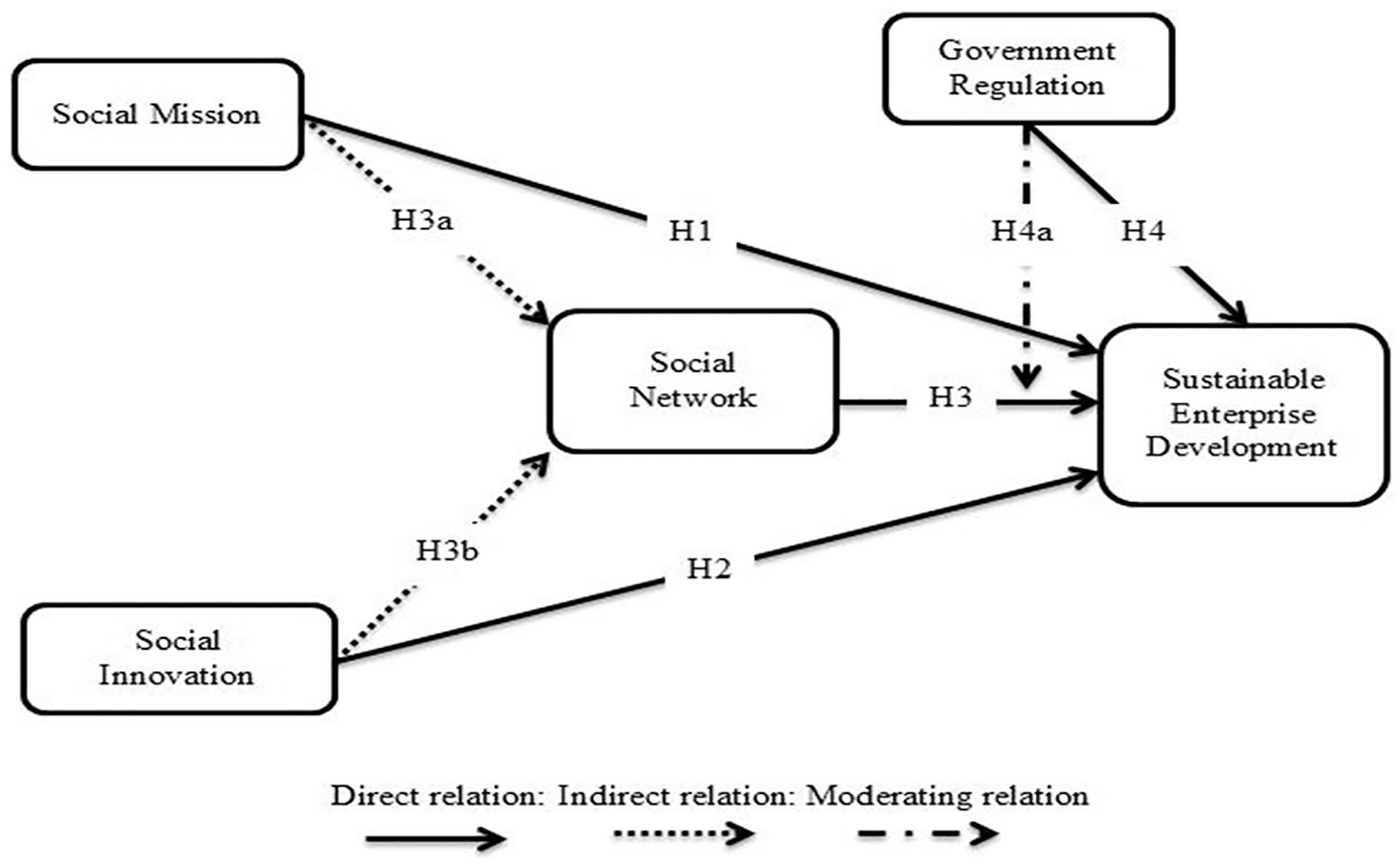
Proposed research model.
Research Methodology
Context Selection
The nature of this study was cross-sectional and purely based on the web-based questionnaire. Primary data were collected from 27 different countries using Google Docs, as recommended by Granello and Wheaton (2004) that this is the latest technique used for data collection and an effective way of collecting data in minimum time and scarce resources. A list of more than 150 social entrepreneurs and enterprises was found on Facebook, Twitter, and LinkedIn. The relevant groups of social entrepreneurs and social enterprises were 49, and every group has more than 100 members of social entrepreneurs. For data collection, we sent a request to group administrators, and after their approval, we sent a questionnaire link and asked them to share this link in their groups. A total of 20 group admins shared questionnaire link in their groups. We ensured them that data are solely used for academic purposes and the information would be kept confidential. The total number of members of these 20 groups were 3,271. Furthermore, we collected data of 512 social entrepreneurs, and after the screening of data, 26 questionnaires were discarded due to incomplete filling of forms. Finally, 486 surveys were marked adequate by social entrepreneurs and considered for further analysis with a participation rate of 15.65% of the total population.
Sample Description
Table 1 shows the sample description of the respondents; concerning gender, there were 290 (59.7%) males and 196 (40.3%) females. The age range of respondents was categorized into four groups: 18 to 30 (137 [28.2%]), 31 to 40 (192 [39.5%]), 41 to 50 (126 [25.9%]), and 51 and above (31 [6.4%]). According to their education, Concerning the education of the respondents, we have classified them into four categories: undergraduate (238 [49.0%]), master’s (140 [28.8%]), diploma and others (98 [20.2%]), and MS/PhD (10 [2.1%]). Moreover, the job experience of participants was also classified into four categories: 1 to 3 years (217 [44.7%]), 3 to 6 years (162 [33.3%]), 6 to 9 years (93 [19.1%]), and more than 9 years (14 [2.9%]). Furthermore, 250 (51.4%) participants were married, and 236 (48.6%) were single. The majority of the participants from Pakistan (54 [11.1%]), America (37 [7.6%]), and Canada (29 [6.0%]). Furthermore, other nationality participants were also reported in the demographical information section.
Demographic Information.

Scales
To measure the social mission, we have adapted four items. A sample item is, “It is important for our enterprise to addressing the societal issues.” To measure social innovation, we have adopted four items. A sample item is, “Our enterprise always looks for a sustainable solution to social society.” To measure social network, we have adapted five items. A sample item is, “Our enterprise’s social network can disseminate social information.” To measure the variable of sustainable enterprise development, we adapted 11 items, including social, environmental, and economic sustainability. A sample item is, “Our enterprises address unsolved problems on a priority basis.” Social mission, social innovation, social network, and sustainable enterprise development measures were taken from the study by Javed et al. (2019). Government regulation was measured using four items and adapted from the study by Li, Ahmed, et al. (2020). A sample item is, “Government regulations are consistently favoring new companies of social entrepreneurship.” All the responses were measured through a 5-point Likert-type scale ranging from 1 (strongly disagree) to 5 (strongly agree). Furthermore, we have controlled gender, age, education, experience, and marital status.
Results
To test the hypotheses, structural equation modeling (partial least squares structural equation modeling [PLS-SEM]) is used. This technique is widely used in management research to estimate the theoretical and casual modeling relationship analysis (Hair et al., 2012; Li et al., 2019; Li, Murad, Ashraf, Syed, & Riaz, 2020).
Measurement Model
The measurement of the model includes factor loading, Cronbach’s alpha, and composite reliability. The results of the factor loading, Cronbach’s alpha, composite reliability, and average variance extracted are shown in Table 2. As suggested by previous researchers, the values of Cronbach’s alpha should be greater than .70, and the values of composite reliability must be greater than .80 (Li, Murad, Shahzad, Khan, & Ashraf, 2020; Neneh, 2019; Verkijika & De Wet, 2018). Therefore, Cronbach’s alpha and composite reliability for the social mission were .941 and .958, respectively; for social innovation .933 and .952, respectively; for social network .926 and .945, respectively; for sustainable enterprise development .950 and .956, respectively; and for government regulation .908 and .935, respectively. Thus, all the values met the suggested criteria for assessing the reliability of the measurement model. Moreover, convergent validity was evaluated through the average variance extracted (AVE) using standards set by Bagozzi and Yi (1989), and the values of AVE should be greater than 0.50. Hence, the AVE for the social mission was 0.851, for social innovation was 0.833, for social network was 0.774, for sustainable enterprise development was 0.666, and for government regulation was 0.783. Consequently, all the values of AVE were greater than 0.50 and thus met the suggested criteria as well.
Measurement of Model.

Note. CR = composite reliability; AVE = average variance extracted; VIF = variance inflation factor.
Discriminant Validity
Discriminant validity was assessed using both Fornell–Larcker and Heterotrait–Monotrait (HTMT) ratio criteria, and the results are shown in Tables 3 and 4. According to Fornell–Larcker criteria, square root of the AVE is called discriminant validity and the values of correlations were below the output of discriminate validity (Fornell & Larcker, 1981). Per HTMT ratio criteria, the values must be less than 0.85 (Henseler et al., 2016). Thus, the highest achieved HTMT value was 0.507, which was below the suggested value of 0.85. Hence, all the measurement constructs meet the criteria for discriminant validity.
Discriminant Validity (Fornell–Larcker Criteria).
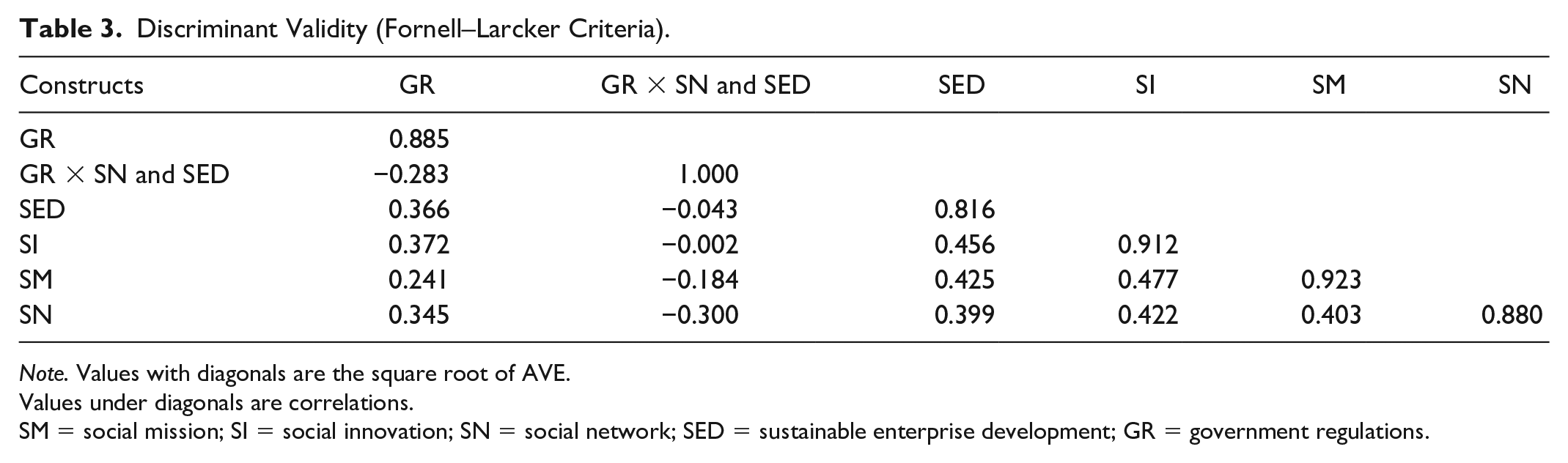
Note.Values with diagonals are the square root of AVE.
Values under diagonals are correlations.
SM = social mission; SI = social innovation; SN = social network; SED = sustainable enterprise development; GR = government regulations.
Discriminant Validity (Heterotrait–Monotrait Ratio Criteria).

Note. GR = government regulations; SN = social network; SED = sustainable enterprise development; SI = social innovation; SM = social mission.
Common Method Bias
Harman’s single-factor test was applied to check the common method bias variance in the study (Podsakoff et al., 2003). Per Harman (1976), common method bias exists only when one factor emerges from factor analysis and explains greater than 50% of the eigenvalue of the variance. Therefore, we have used the un-rotated matrix and produced five factors and first-factor eigenvalue, explaining 40.95% of the variance. Thus, common method bias was not considered a problem in this study.
Structural Model
The structural model assessed 5,000 subsamples using bootstrap method through Smart-PLS software (Chin, 1998; Hair et al., 2012). The fitness of the structural model was evaluated by the standardized root mean square residual (SRMR) value and determination coefficient (R2). According to Henseler et al. (2016), a good model must have an SRMR value of less than 0.08. Therefore, the value of SRMR was 0.050, which shows an acceptable and adequate level of structural model fitness. Besides, Table 5 shows the results of the structural model, which explained 23.1% variance in social network and 34.2% variance explained in sustainable enterprise development. As suggested by Chin (1998), desired R2 values must be greater than .1 or 0.
Strength of Model.

Note. SN = social network; SED = sustainable enterprise development.
Furthermore, for the predictive relevance of the model, we have applied cross-validated redundancy measure Q2 for assessing the model (Stone, 1974). According to Falk and Miller (1992), Q2 should be greater than zero. Table 6 shows that the values of Q2 exceeded 0.1 and the positive predictive significance level of the model.
Cross-Validated Redundancy.

Note. SN = social network; SED = sustainable enterprise development; SSO = sum of squares of observations; SSE = sum of squares of prediction errors.
Testing of Hypotheses
The results of the structural model are shown in Table 7 and Figure 2. H1 demonstrates that social mission positively related to sustainable enterprise development. The findings reveal that social mission has a positive and significant effect on sustainable enterprise development (β = 0.235, t = 4.882, p = .000). Thus, H1 was accepted. Moreover, H2 explains that social innovation positively associated with sustainable enterprise development. The outputs illustrate that social innovation has a positive and significant impact on sustainable enterprise development (β = 0.178, t = 3.005, p = .003). Hence, H2 was supported. Meanwhile, H3 indicates that social network positively linked to sustainable enterprise development, and results show that social network has a positive and significant impact on sustainable enterprise development (β = 0.197, t = 3.922, p = .000). Therefore, H3 was accepted. Furthermore, H4 illustrates that government regulations positively related to sustainable enterprise development. The findings specify that government regulations also have a positive and significant influence on sustainable enterprise development (β = 0.208, t = 3.957, p = .000). Thus, H4 also supported it. Finally, our results present that all the control variables have an insignificant effect on sustainable enterprise development.
Path Coefficients and Hypotheses Testing.

Note. SM = social mission; SED = sustainable enterprise development; SI = social innovation; SN = social network; GR = government regulations.

Structural model.
Mediation Analysis
To test hypotheses, H3b and H3c positively mediate the relationship between social mission, social innovation, and sustainable enterprise development. The results show that social network positively and significantly has an indirect effect on the relationship between social mission, social innovation, and sustainable enterprise development (β = 0.052, t = 2.962, p = .003; β = 0.059, t = 2.886, p = .004). In addition, mediation analysis also assessed through variance accounted for (VAF), which indicates the ratio of indirect effect to the total effect. According to Hair et al. (2010), if the value of VAF is more excellent below 0.8, it represents the partial mediation. If the value of VAF is more significant than 0.8, it indicates the full mediation. Therefore, Table 8 highlights the results of VAF, which is within the threshold value below 0.8. Thus, we can confirm that the social network partially mediates the relationship between social mission, social innovation, and sustainable enterprise development. Hence, H3b and H3c were accepted.
Mediation Analysis (Social Network as Mediator).

Note. VAF = variance accounted for; SM = social mission; SED = sustainable enterprise development; SI = social innovation.
Moderation Analysis
We have predicted that government regulations positively moderate the relationship between social network and sustainable enterprise development (H4b). The findings indicate that government regulations have a positive and significant moderating effect on the relationship between social network and sustainable enterprise development (β = 0.086, t = 3.016, p = .003). Therefore, H4b was supported. Figure 3 shows that government regulations moderated the slope for the connection between social network and sustainable enterprise development reflected by the fact that the relationship became more robust when government regulations for sustainable enterprise development are high.

Interaction of GR × SN and SED.
Discussion and Implications
Our findings suggest that social mission is the most influential factor in enhancing sustainable enterprise development. Individuals with a high commitment to social mission perform are more likely to perform well in the social organizations and help achieve a competitive advantage. These kinds of social entrepreneurs are motivated to perform their tasks, and it is hard for the market forces to avert them from their social mission. Similarly, we found that social mission is a positive predictor for sustainable enterprise development, and our results are consistent with the prior study (Muscat & Whitty, 2009). Moreover, a recent cross-sectional quantitative study examined the role of the social mission on sustainable enterprise development and found that social mission positively influenced sustainable enterprise development. Therefore, our findings suggest that social mission has a strong influence on sustainable enterprise development and results are commented (Javed et al., 2019), which indicated that social enterprises assist social entrepreneurs in solving economic and social issues.
Meanwhile, we found that social innovation positively influenced sustainable enterprise development. Social innovation is the dynamic factor of social entrepreneurship. Social innovation is the strongest element for measuring economic sustainability and helpful in tackling the economic, social, and environmental challenges faced by enterprises (Melville, 2010). This result aligns with the previous findings (Aksoy et al., 2019; Dawson & Daniel, 2010). Furthermore, our findings show that social network positively affects sustainable enterprise development and the results are in line with Dempsey et al. (2011) and Littlewood and Holt (2018), who outlined that social network is the necessary factor of social entrepreneurship for achieving competitive advantage.
Consequently, social network enterprises help entrepreneurs connect with identifying opportunities and resources in the available market. Social network supports the entrepreneur’s social mission and social innovation in forming connections with the individual to tackle social and environmental issues. Finally, our findings indicate that government regulations moderate the relationship between a social network and sustainable enterprise development. This result is also in line with the previous outcome by Songling et al. (2018) who proposed that governments are involved in the social entrepreneurship process through social network to sustain business enterprises.
The study has practical implications for policymakers, researchers, and social entrepreneurs. Our study tested the social entrepreneurship factors that help sustainable enterprises achieve maximum profitability and protect organizations from different environmental hazards. The study found that social mission has an exceptional trait of social entrepreneurship, which is associated with the aim of capable and robust mission. Therefore, individuals with a high commitment to social mission are more likely to perform well in the social organizations and are helpful in achieving the competitive advantages. It is also indicated that social entrepreneurs resolve social issues that are directed by governments or business sectors during epidemic situations with the help of human resource innovative ideas, new product development, and competencies to accomplish sustainable enterprise solutions. Social entrepreneurs can influence on social innovation through social networking among enterprises, which enhances their market value. Finally, our findings will assist the social entrepreneurs in creating competitive pressure in the market through social missions, innovative environment, and practices that will boost the economy and social enterprise development.
Conclusion
This study aimed to address the importance of social entrepreneurship factors, social mission, social innovation, and social network on achieving sustainable enterprise development with the support of government regulations during social and uncertain environment situations. This study collected data through online survey from the social entrepreneurs of several countries who are involved in social development activities. The overall results of the study show that social mission, social innovation, and social networks are the critical factors for sustainable enterprise development. Moreover, enterprise sustainability is the best predictor to solve all social, economic, and environmental issues. In this modern era, every enterprise wants to achieve sustainability through effective and efficient business activities and become a business necessity to stay competitive. Furthermore, this study suggested that sustainable enterprises are not limited to environmental development; they are also related to social and economic sustainability. Many researchers have examined the importance of sustainable enterprise using different factors such as marketing, human resources, and strategic management to contribute to social entrepreneurship literature. However, minimal empirical studies have investigated the importance of social entrepreneurship and its factors on sustainable enterprise development.
Limitations and Future Direction
This study has some limitations and future directions for upcoming researchers. First, we have measured only three social entrepreneurship factors and one moderating indicator to address the importance of sustainable enterprise development. Future researchers can take other social entrepreneurship elements, such as the need for achievement, locus of control, and risk-taking in the upcoming studies. Second, we have used the social network as a mediator and government regulation as a moderator variable. Future researchers can take other sustainable human resource and management practices to add more knowledge to the existing research. Third, ours was a cross-sectional study and was purely based on a questionnaire collected from an online survey. Future research can use this model on longitudinal design research to more generalize the results.
Footnotes
Acknowledgements
“A Study on the Type Preference, Influencing Factors, and School-Based Policies of Academic Entrepreneurship of University Teachers” was supported by the Zhejiang Provincial Philosophy and Social Science Leading Talent Cultivation Project (No. 21QNYC20ZD).
Author Contributions
W.J. and M.M. conceived the study, edited the data, performed the analysis and interpretation, and drafted skeleton of the manuscript and critically review the manuscript. C.L. and F.S. contributed to constructing the model, performing the analysis, and interpreting model results, and S.F.A. intensively edited the language of the manuscript. All authors approved and read the final manuscript and participated in the critical appraisal as well as revision of the manuscript.
Declaration of Conflicting Interests
The author(s) declared no potential conflicts of interest with respect to the research, authorship, and/or publication of this article.
Funding
The author(s) received no financial support for the research, authorship, and/or publication of this article.
Ethical Approval
This study was carried out in accordance with the recommendations of the Ethical Principles of Psychologists and Code of Conduct of the American Psychological Association (APA). All participants gave consent in accordance with the Declaration of Helsinki. The review board of Jiangsu University exempted the research from ethical approval, as it was a survey-based study. The authors are affiliated to a Chinese institution although they are Pakistani by origin, and the study was conducted under the supervision of a Chinese professor.

Availability of Data and Material
The data set supporting the conclusions of this article is available upon request.