




Abstract
Drawing on the 2021 CGSS data, this paper investigates whether and to what extent the use of Internet new media (measured by frequency and engagement) affects entrepreneurship among Chinese residents. Endogenous Switching Probit (ESP) probability model is used for estimation. In addition, the robustness test, mechanism test and heterogeneity analysis are further carried out. Conclusions: (1) The entrepreneurial probability of residents who use Internet new media is 4% higher than that of residents who do not use Internet new media, and the probability of residents who use Internet new media in high frequency is 9.05% higher than that of residents who use Internet new media in low frequency, that is, Internet new media promotes residents’ entrepreneurship. The robustness test results further confirm the reliability of this conclusion. (2) The use of Internet new media can promote residents’ learning and the formation of social networks to promote entrepreneurship. (3) The adoption of Internet-based new media significantly enhances entrepreneurial activity among residents aged over 60, whereas usage frequency exerts a stronger positive influence on those under 60.
Introduction
With the continuous advancement of the digital era, new media based on Internet technology, such as network media, mobile phone media and network TV, have developed rapidly (Haibin et al., 2021). Compared with traditional media such as newspaper, radio and television, Internet new media is more efficient and convenient. Users can quickly search the information they need through the Internet and obtain a large amount of text information (Zhiying et al., 2021). The emergence of Internet new media facilitates people’s lives and improves residents’ happiness (Huang & Fu, 2024). The past decade has witnessed remarkable growth in China’s Internet infrastructure, with penetration rates climbing from 42.1% in 2012 to nearly 80% in 2023 (Figure 1). This expansion, facilitated by technological innovation and economic development, has enabled the rapid adoption of new media platforms nationwide.

Internet penetration rate (%).
The emergence of the Internet has undoubtedly provided new possibilities for entrepreneurship. The Internet has provided a deeper and systematic impact on the value of the startup market. On the one hand, the Internet may change the competition and open up many new ways for differentiation and value-added services (Mohelska & Sokolova, 2016), which provides new ideas for the company’s marketing strategy. It can promote the intelligent development of the company’s marketing. On the other hand, the interconnection function of the Internet promotes the efficient dissemination of information (Morales-Parada & Andés, 2012) and promotes the flow efficiency of information, which provides entrepreneurs with convenient access to information for business decisions. In other words, the innovation of Internet technology will affect the business decision-making behavior of entrepreneurship. In addition, the e-commerce platform built based on Internet technology provides a new development mode for entrepreneurship. The e-commerce platform’s sophisticated AI infrastructure enables dynamic coordination of human capital and technological assets. By enhancing these channel capabilities, the platform significantly lowers barriers to market access for entrepreneurs across various sectors (Deng et al., 2024). This interconnection enables entrepreneurs to share information, experience and other resource elements with each other, thus building a new entrepreneurial pattern. Therefore, through the use and integration of these levels, entrepreneurs can more effectively navigate the dynamic and complex ecosystem, thereby improving their competitiveness and success opportunities, which is the systematic change that the Internet has brought to entrepreneurship.
Based on China’s national conditions, “mass entrepreneurship and innovation” has stimulated the innovation potential and entrepreneurial vitality of the whole society (W. Song, 2025), and entrepreneurship is an important way to solve the employment problem and increase residents’ income (Norziani et al., 2015). So, in the face of China’s domestic employment structural contradictions and increasingly prominent regional problems, can Internet new media represented by online TV, electronic magazines and podcasts promote entrepreneurship among Chinese residents? What is the mechanism of action? Are the effects the same for residents of different ages? Studies on these aspects are still relatively lacking. Therefore, this paper uses the data of China General Social Survey (CGSS) in 2021 to empirically analyze the relationship between Internet new media and residents’ entrepreneurship. The main contributions of this paper are as follows: First, the application of Internet new media is measured from the two perspectives of “whether to use” and “frequency of use.” As far as we know, few previous studies have conducted such studies from the perspective of Internet new media((Xiong et al., 2024), so this paper can fill the gap in this aspect. Second, previous studies on the impact of digital products on entrepreneurship were mostly conducted from macro or rural areas, while this paper conducted relevant analysis from all residents based on micro data. The third is to start with the function of the Internet, analyze the influence mechanism of learning and social interaction brought by the Internet on entrepreneurship, and then analyze the new business forms of entrepreneurship brought by the Internet new media. The overall framework of this paper is: this part is divided into introduction. The second part is to Systematically examines existing scholarship, critically analyzing gaps and limitations in previous research. The third part is theoretical analysis and research hypothesis. The fourth part is the research design, introducing the data sources, variable selection, model construction, etc. The fifth part analyzes the empirical results, and the sixth part Summarizes key findings, discusses theoretical and practical implications, and suggests directions for future research.
Literature Review
Past scholars have conducted certain research on the Internet and residents’ entrepreneurship. The research object of this article is residents’ entrepreneurship, and the literature closely related to this article is first and foremost the research on the factors influencing family entrepreneurship. Then there is the relationship between the Internet and family entrepreneurship.
On the one hand, regarding the research on the factors influencing residents’ entrepreneurship, the main research results include: First, the development of the digital economy (Xiong et al., 2024) and more convenient access to digital services will promote family entrepreneurship (C. Li, D. Li, et al., 2024). Secondly, digital fintech formed by the combination of the digital economy and traditional finance has gradually become a new driving force influencing residents’ entrepreneurship (Y. Song et al., 2024). The digital financial capabilities of residents can promote entrepreneurship (Yu & Lianyun, 2020), and it can promote the possibility of entrepreneurship (Fengfu et al., 2023). Now, the inclusiveness of digital finance has received increasing attention, and digital inclusive finance can promote resident entrepreneurship and entrepreneurial performance (Jinshun and Luyao, 2023); Third, housing is another important factor affecting household entrepreneurship. Households with complete housing are more likely to start businesses, but households with higher housing investment will generate more housing loans, thus inhibiting entrepreneurship. Preventing housing speculation can significantly increase the possibility of local household entrepreneurship (Sun et al., 2024; Xiaobing et al., 2023); Fourthly, the situation of family members is another important factor affecting entrepreneurship. A high proportion of family members will hinder family entrepreneurship (Yiwei et al., 2021). With the aging of the population, the increase of family support burden will reduce the success rate of household entrepreneurship (Jie & Zhijian, 2022). In addition, personality traits have a significant impact on entrepreneurship (Huan & Ying, 2024). Development financial institutions can promote household entrepreneurship, which is of great significance for poverty alleviation (Ting et al., 2023). In emerging economy contexts, the co-development of skill acquisition and asset accumulation serves as a dual engine for stimulating microenterprise creation among family units (W. Li & Wu, 2018).
Most scholars focus their research on rural areas. Among the factors mentioned above, fintech, digital inclusive finance, digital village construction and other factors will affect rural residents’ household entrepreneurship (Deng et al., 2024; Tian et al., 2019; Zhe et al., 2023; Zhou et al., 2023), and digital transformation can improve the entrepreneurial performance of rural households (J. Li, Wang, & Soh, 2024). Financial literacy can also promote rural households’ entrepreneurial performance (Jingmei & Tiancheng, 2021; Silin et al., 2023), financial knowledge can affect agricultural and non-agricultural entrepreneurship of rural households (Su et al., 2024).
However, most of the above-mentioned studies have focused on family endowments and the development of the digital economy, while there is a lack of research on the role of media in residents’ entrepreneurship. On the other hand, as the Internet developed, the Internet itself and its derivatives have also had an important impact on residents’ entrepreneurship. However, at this stage, few studies focus on the relationship of Internet and residents’ entrepreneurship. Existing studies include: First of all, Internet can promote residents’ entrepreneurial decision-making (Chufang, 2022). And the impact is heterogeneous, its impact will increase with the increase of wealth level (Limin et al., 2023). Moreover, the mobile Internet has an inverted U-shaped influence on entrepreneurship of farmers with different learning abilities (Zhang et al., 2021), and the derivative Internet products generated by the development of the Internet also promote entrepreneurship. E-commerce platforms based on the Internet stimulate residents’ entrepreneurial enthusiasm (Mei et al., 2020).
In summary, while existing literature has extensively examined determinants of entrepreneurial behavior from multiple perspectives, and several studies have investigated Internet development’s role in entrepreneurship, research specifically analyzing Internet-based new media’s influence remains underdeveloped. This study directly addresses this critical gap in the literature.
Theoretical Analysis and Research Hypothesis of the Relationship Between Internet New Media and Entrepreneurship
The Impact of Internet New Media Use on Residents’ Entrepreneurship
As the Fourth Industrial Revolution unfolds, IoT systems and WSN architectures have emerged as critical enabling technologies, generating one of the largest bodies of interdisciplinary research. (Chung & Kim, 2016), which means that the research on the Internet is a hot topic at the current stage. Based on the above analysis, we can learn that the Internet has built a new entrepreneurial management system for entrepreneurs, which is a new business form brought by technological innovation for entrepreneurship. Through this technological innovation, entrepreneurs can more easily carry out decision-making information acquisition and other behaviors, which is conducive to correct decision-making, and is of great help to entrepreneurship(Rapina et al., 2023; Shulin & Kangqi, 2024).
Then, whether Internet new media can directly affect residents’ entrepreneurship can be analyzed by combining relevant theories and research results. The research on entrepreneurship as an economic phenomenon has been developing continuously (Borah & Bhowal, 2023), and scholars have devoted themselves to studying its influencing factors. Many researchers regard technology can impact economic development (Bi et al., 2024). If entrepreneurship is studied as an economic phenomenon, technological progress will inevitably have an impact on entrepreneurship. As the digital technology developed, the new Internet media is gradually affecting many aspects such as daily production and residents’ life (Jiang et al., 2022). The emerging technology of Internet new media may also have an impact on entrepreneurial economic activities. Existing research results can also further verify the correlation between the two. The development of emerging digital technologies provides new development ideas for entrepreneurship (Elia et al., 2020). The emergence of the Internet has directly promoted residents’ entrepreneurship and can affect entrepreneurial activities (Ying & Xiaoying, 2022). Figure 2 (Panels a & b) presents scatter plots illustrating the relationship between village/community-level Internet penetration (including both general Internet use and new media adoption) and entrepreneurial activity rates, derived from CGSS data. The plots demonstrate a positive correlation between these variables, suggesting that higher digital connectivity coincides with increased local entrepreneurship prevalence. In addition, the Internet and new media have the characteristics of high efficiency and convenience in information dissemination, which is of great help to residents who are searching for information needed for starting a business. According to the transaction cost theory, information search is one of the transaction costs that entrepreneurs face. Therefore, new media on the Internet can save the cost of information search, which in turn helps residents start businesses. This empirical pattern aligns with theoretical expectations about digital technologies enabling entrepreneurial opportunities. Consequently, integrating these observations with established literature, we formulate Hypothesis 1:
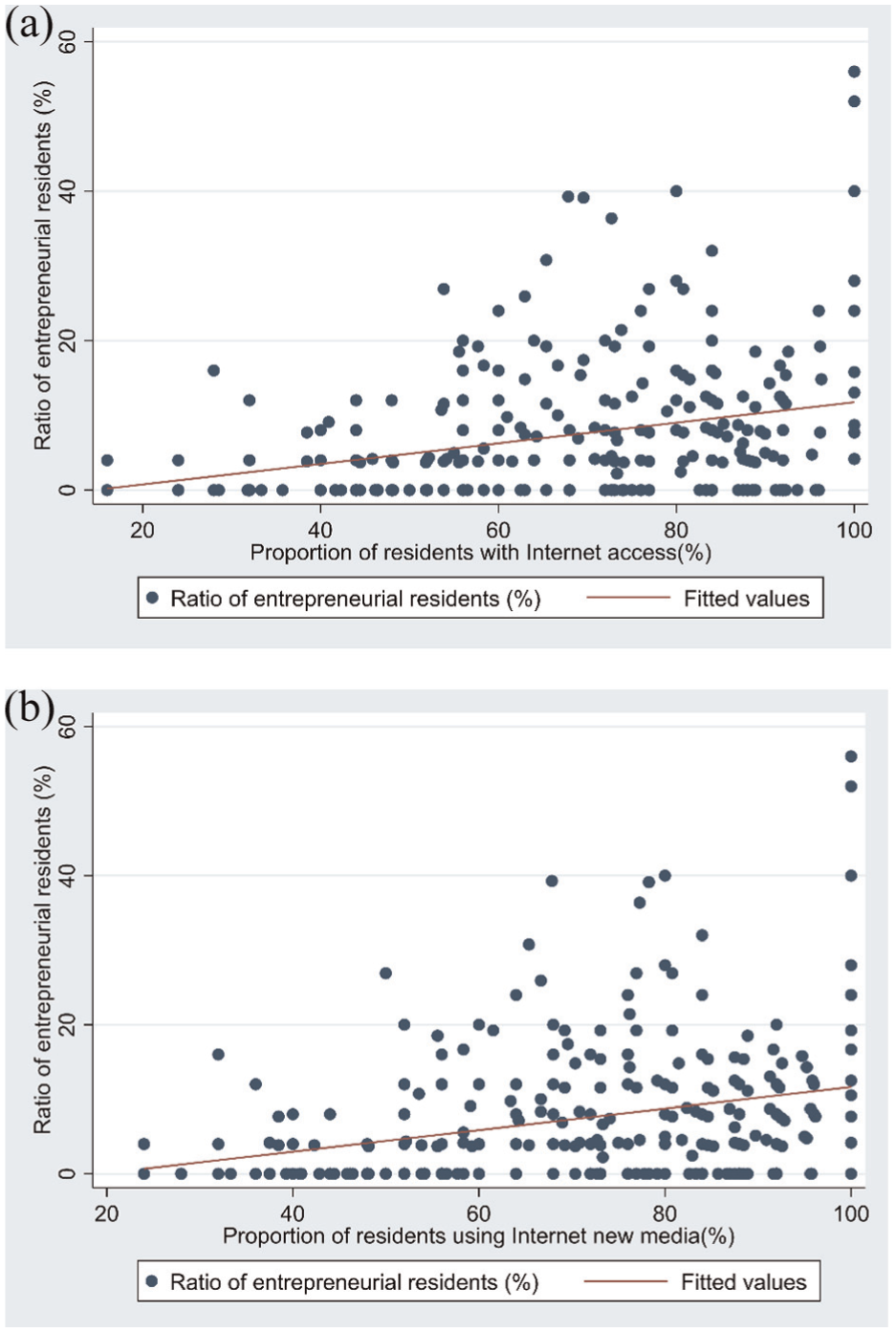
(a) The relationship between the use of Internet/Internet new media at the village (community) level and residents’ entrepreneurship. (b) The relationship between the frequency of Internet/Internet new media at the village (community) level and residents’ entrepreneurship.
Learning Function of Internet New Media and Resident Entrepreneurship
Theoretically speaking, on the one hand, from the perspective of the Internet, the emergence of Internet new media is undoubtedly an information revolution (Alessandra, 2018). The Internet of Things and cloud information platform installed on the Internet provide enterprise managers with opportunities to learn business knowledge, and the acquisition of such opportunities is convenient and efficient. On the other hand, in his paper published in 1986, Paul (1986) regarded knowledge as one of the driving forces of economic growth. As mentioned above, entrepreneurship can be regarded as a kind of economic activity, so learning may affect entrepreneurship because the two are related. Specifically, residents can learn the knowledge needed for starting a business, such as enterprise management and capital operation, through the vast amount of information and learning platforms provided by the Internet and new media. The acquisition of this knowledge can provide support in terms of knowledge and literacy for residents to carry out entrepreneurial activities more efficiently.
Some existing research results also point to the relationship between the two. On the one hand, the learning platform based on the Internet is of great help for residents to learn relevant knowledge and obtain a large amount of Internet text data (Tseng et al., 2023). Especially in the era of intelligent media, new Internet media can promote curriculum innovation and bring together courses from different platforms, making them more easily accessible (Mao, 2024). On the other hand, knowledge and experience are important factors influencing residents’ entrepreneurial decisions (Deshui & Lele, 2022). Based on the analysis of relevant theories and existing literature, we have sorted out that the use of Internet new media can promote residents’ learning, and knowledge is an important factor affecting entrepreneurship. Therefore, we propose hypothesis 2:
Social Networking Functions of Internet New Media and Resident Entrepreneurship
The innovation of the Internet at the social network level provides new opportunities for entrepreneurship. The social platform carried by the Internet can connect users who are far apart in space, so that they can communicate easily in different Spaces. At the same time, the new media equipped with the Internet can share information such as people of different social classes, their views and experiences to the public users, thus breaking the class differences and making social communication more convenient and accessible.
The online social networks (OSNs) can impact the co-dissemination of information (C. Li et al., 2023). Similarly, according to the cost transaction theory, social networks can reduce the cost of residents’ information search. This saved cost can provide more funds for entrepreneurship, thereby helping to enhance the possibility of starting a business. Social networking is an important way to gain social capital. Social capital influences the entrepreneurial decisions of both established and non-established companies. For established companies, especially newly established companies, social networks can provide them with useful social capital, thus promoting the development of the company (Grossman et al., 2012). The emergence of new Internet media provides a convenient way for the accumulation of such social capital (Smith et al., 2017). For non-entrepreneurs, Internet new media is undoubtedly an opportunity, which can bring effective social networks and social capital (Vriens & Ingen, 2018; Wang et al., 2020). Social networks can help to identify entrepreneurial opportunities and promote entrepreneurship (Ceptureanu et al., 2020). Therefore, we propose hypothesis 3:
To sum up, the empirical analysis framework of this paper can be represented by Figure 3, which describes the relationship among explained variables, core explanatory variables and mediating variables.

Frame diagram of research hypothesis.
Research Design
Data Source and Sample Selection
The micro data used in this paper comes from the 2021 China Comprehensive Social Survey (CGSS), which is to collect and establish the tracking data database of the trend of social change. And provides the data basis for this paper.
In the selection of samples, this paper excluded the samples with missing values, and selected the samples of residents between 18 and 80 years old, and finally obtained 6278 valid samples.
Variable selection and descriptive statistics
Explained variables
In terms of the definition of “whether to start a business or not,” with reference to Yin et al. (2019), this paper is based on the data characteristics of CGSS and according to the questionnaire “Which of the following situations is more in line with your current work situation?” The question constructs dummy variables that treat the answers “I am a boss (or a partner)” and “self-employed” as entrepreneurial and assign a value of 1, while the others are assigned a value of 0 and are considered non-entrepreneurial.
Core Explanatory Variables
The core explanatory variable of this paper is the use of Internet new media. At present, in China, the Internet new media is generally defined as taking the network platform as the channel for disseminating information, and providing information to the general public through digital processing technology by using the network, computers and mobile terminals. This definition is different from traditional media such as newspapers, radio and television. Internet new media include online TV, Weibo, wechat official accounts, electronic magazines, etc. From this, it can be seen that media carried by the Internet is an important category of new media, and there are also related questions about Internet media in the CGSS questionnaire. So, for the definition of the variable, according to the question “What is your use of the following media in the past year” in the questionnaire. On the one hand, regarding whether to use Internet new media, those who use Internet media (including mobile Internet access) will be regarded as using new media on the internet, and the value is 1; otherwise, the value is 0. This variable is named Internet. On the other hand, residents whose frequency of use is “never,”“rarely,”“sometimes,”“often,”“very frequent” are assigned a frequency of 1, which is regarded as high frequency, otherwise, assigned a value of 0, which is regarded as low frequency. This variable is named FINM (the frequency of Internet new media use).
Intermediary variables
The mediating variables in this paper are learning and social network. For the definition of learning, use the questionnaire “in the past year, do you often do the following things in your free time?” If the interviewee has the behavior of “learning charging,” it is considered to have learned, and the value is 1; otherwise, the value is 0; For the definition of social network, according to the questionnaire “in the past year, do you often engage in the following activities in your free time?” This problem is defined, if the behavior of “gathering with friends” is regarded as having a social network, the value is 1, otherwise the value is 0.
Instrumental variable
The instrumental variable chosen in this paper is whether the interviewee’s family members have used the Internet in the past period of time. The reason for the choice is that, On the one hand, the fact that other family members have been online does not directly affect whether respondents start a business or not. The reason is that the research subjects of this article are individual residents rather than family businesses. It is difficult for residents to directly obtain the information they want when other family members use the Internet. Moreover, due to the existence of factors such as communication costs and the effectiveness of information transmission, the cost for residents to obtain the information they need from the process of other family members using the Internet is even higher. On the other hand, due to the existence of demonstration effect, the Internet access of other family members will affect whether the interviewee has used the Internet or not, so as to contact the Internet new media. A value of 1 is assigned if someone else in the household has accessed the Internet, and 0 is assigned otherwise.
Control Variables
Refer to existing literatures (Wu et al., 2024; W. Li et al., 2021). Meanwhile, based on the characteristics of this study, this paper selects control variables from the three levels of family, individual and macro. In terms of family, four variables such as family size and family property quantity are selected, and nine variables such as gender and age are selected at the individual level. The per capita GDP of the province where the residents live in the year before the survey is selected as the regional economic level, and the urban and rural regions and location regions where the residents live are selected from the regional perspective. According to the division of administrative regions in China, the eastern region includes: Beijing, Tianjin, Hebei, Shanghai, Jiangsu, Zhejiang, Fujian, Shandong, Guangdong and Hainan. The central region includes: Shanxi, Anhui, Jiangxi, Henan, Hubei and Hunan. The western region includes: Inner Mongolia, Guangxi, Chongqing, Sichuan, Guizhou, Yunnan, Tibet, Shaanxi, Gansu, Qinghai, Ningxia and Xinjiang. Northeast China includes Liaoning, Jilin and Heilongjiang. In this paper, the northeast region is integrated into the eastern region for analysis, and the provinces where residents live are divided into three regions: east, middle and west. The specific variable names and assignments are shown in Table 1.
Control Variable Names and Assignments.

Descriptive Statistics
Table 2 provides descriptive statistics of relevant variables. Among the samples used, 8.1% of the residents are entrepreneurs, 52% of the residents have learning behaviors, 70.9% of the residents are socializing, and 69.9% of the residents use Internet new media. In terms of family size, the smallest family size is 1 person, the largest is 17 people, 42.9% of the families have a car, the average family has 1.234 houses, there is a big gap in the total family income; In terms of personal situation, 42.8% of the sample were male residents, the average age was 54.728 years old, the average educational level was between primary and secondary education, 11.9% of the residents were Party members, and there was a great difference in the number of minor children. At the regional level, 61.4% of the surveyed residents live in rural areas, 40.3% live in eastern regions, 31.9% in central regions and 27.8% in western regions.
Descriptive Statistics of Variables.

Pearson Test and Multicollinearity Test
Table 3 presents the Pearson correlation analysis results. The correlation coefficients between the dependent variables, independent variables, and mediating variables are all statistically significant at the 1% level, demonstrating strong associations among key variables that support further econometric modeling. Additionally, multicollinearity diagnostics reveal variance inflation factor (VIF) values consistently below 10, confirming the absence of significant multicollinearity and validating the suitability of these variables for regression analysis.
Pearson Test Results
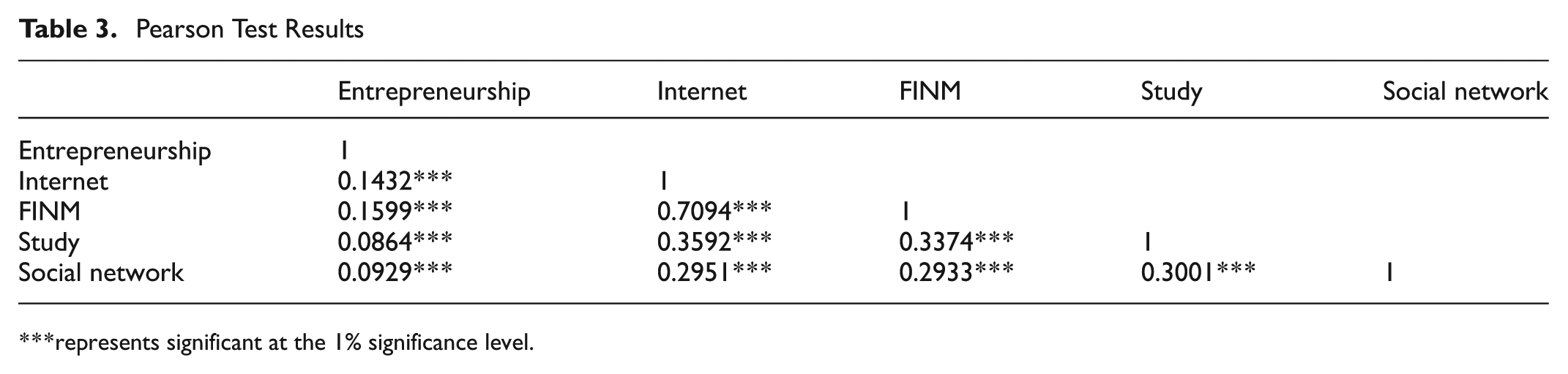
represents significant at the 1% significance level.
Model Construction
Endogenous Switching Probit Model
The explained variable in this paper is residents’ entrepreneurial decision, which is a binary variable with values of 0 and 1. Traditional OLS estimation will produce bias, while Probit model is suitable, but Probit model may produce bias estimation due to endogenous problems. Endogeneity problem is a problem worth paying attention to in econometric model. When choosing econometric model, it is easy to cause endogeneity problem due to model selection bias and mutual causation. Since it is impossible to simultaneously observe the entrepreneurial situations of the same resident in both usage and non-usage or high-frequency and low-frequency usage states, a “counterfactual” framework is constructed to set up the model. This paper refers to the endogenous transformation Probit model (ESP) proposed by Lokshin and Sajaia (2011) for verification. This model utilizes the complete information maximum likelihood method to incorporate the selective bias terms calculated in the first stage of regression into the result equation for estimation, in order to minimize the endogeneity problem caused by omitted variables as much as possible.
The model is divided into two stages. In the first stage, Probit model is used to estimate the impact of relevant control variables on residents’ Internet use, that is, the selection equation, whose formula is as follows:


Among them,
The second stage of ESP model is to estimate the impact of Internet new media usage on residents’ entrepreneurship, that is, the result equation. The model is set as follows:
When


When


Where,
The ESP model uses the maximum likelihood estimation method of complete information, and adds the inverse Mills ratio (i.e., the selectivity bias term) calculated in the first stage regression into the result equation for estimation, so as to solve the selectivity bias problem caused by unobservable variables, and minimize the endogeneity problem caused by missing variables. The estimated results obtained by this method are more effective than those obtained by propensity score matching (Lokshin & Sajaia, 2004). Based on the estimation coefficient of ESP model, three average processing effects of Internet new media use on residents’ entrepreneurial choice can also be calculated, include ATT, ATU, ATE. However, this paper focuses on the entrepreneurial effect of samples affected by the new media of the Internet, that is, only the average processing effect (ATT) of the processing group is estimated (Heckman et al., 1998).
The specific calculation process is as follows: the correlation coefficients between the random disturbance terms of the selection equation and the decision equation are set as:


Where
When
In the counterfactual framework, for a resident of
Therefore, based on the above two expected values, ATT can be calculated as follows:

Intermediary effect model
In order to further investigate the possible channels through which Internet new media may affect residents’ entrepreneurship, this paper follows the identification mechanism of “intermediary effect” (Baron and Kenny, 1986), and constructs the following recursive model to test whether core explanatory variables indirectly affect dependent variables through intermediary variables:


Empirical Results and Analysis
Empirical Results and Analysis of the Impact of Internet New Media on Residents’ Entrepreneurship
ESP Model Results and Analysis
Table 4 shows the results of the ESP model. In this paper, Stata 17 software was used to calculate the model results. Columns (1) to (3) in the table are the empirical results of whether the Internet new media is used, and columns (4) to (6) in the table are the empirical results of the frequency of Internet new media use. As for the instrumental variables, having someone in the family access the Internet will significantly increase the probability of residents using new Internet media, and will significantly increase their frequency of using new Internet media. ρ1 is significant at the significance level of 5%, indicating that there is indeed selectivity bias in the benchmark model, so it is correct to choose the endogenous transformation model. The equation independence test rejects the null hypothesis that the selection equation and the resulting equation are independent at the significance level of 1% and 5% respectively, so the ESP model is suitable.
Results of ESP Model.

, **, and * represent significant at the significance level of 1%, 5%, and 10% respectively, and the reports in () are standard errors.
The analysis reveals several significant patterns regarding Internet new media adoption and usage frequency. Family characteristics demonstrate notable influences − larger household size significantly inhibits usage, while vehicle ownership and higher total income positively correlate with adoption, suggesting wealthier families have greater access to digital technologies. Interestingly, while income boosts adoption, it shows no significant effect on usage frequency. Demographic factors exhibit complex relationships: resident age is negatively associated with adoption but demonstrates a nonlinear effect on usage frequency. Education level emerges as a strong predictor, with higher-educated individuals showing both greater adoption likelihood and usage intensity, likely due to their enhanced capacity to adopt emerging technologies. These findings align well with prior research and observed real-world patterns.
ATT Estimation Results and Analysis
Table 5 shows the results of average processing effects (ATT). According to the results, the estimated value of ATT for the use of Internet new media is 0.04, which is significant at 1% significance level, indicating that the probability of starting a business for residents who use Internet new media is increased by 4 percentage points compared with those who do not use Internet new media. For the frequency of Internet new media use, the estimated ATT value is 0.0905, which is significant at 1% significance level, indicating that the probability of entrepreneurship of residents who use Internet new media at high frequency will increase by 9.05 percentage points compared with those residents who use Internet new media at low frequency. Therefore, the use of Internet new media will promote residents’ entrepreneurship, and the higher the frequency of use, the greater the probability of entrepreneurship. Let’s say H1 is proven.
Results of Average Treatment Effects.
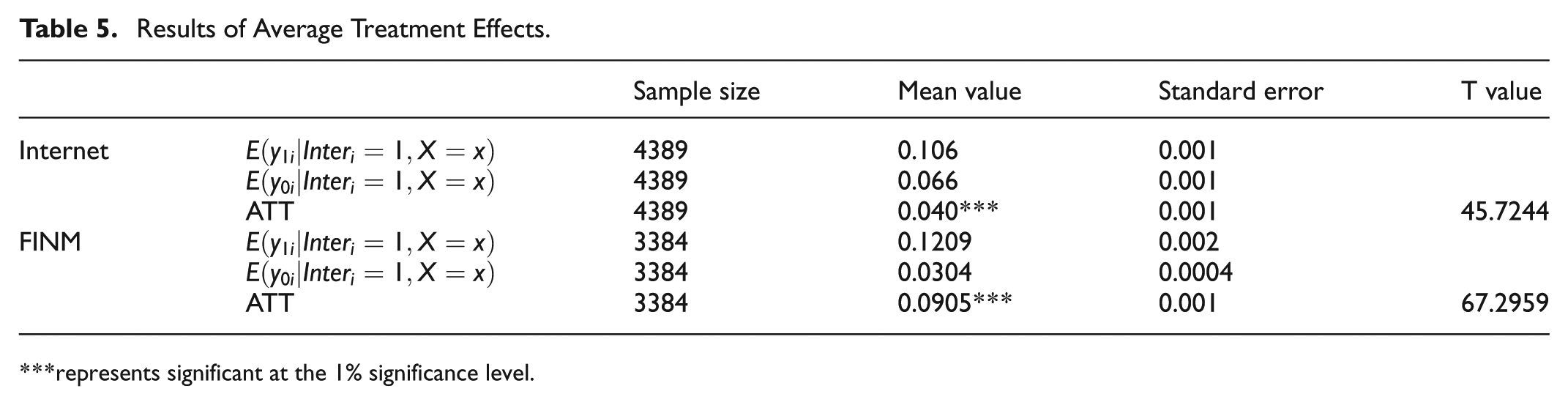
represents significant at the 1% significance level.
Robustness Test
With reference to existing studies, this paper mainly conducts robustness test from two aspects. First, the model is replaced and the instrumental variable method commonly used in the academic field to alleviate endogenous problems, that is, the IV-Probit model, is used for estimation, and the instrumental variable is still defined above. Second, refer to existing studies (Y. Li et al., 2022), change the definition of core explanatory variables, and use the question “The channel through which you obtain news” in CGSS questionnaire. If the answer is customized news for mobile phones, they are considered to use Internet new media, and the value is 1; otherwise, the value is 0. At the same time, its use frequency is defined in the same way as the above Internet new media use frequency, which is divided into high frequency (assigned 1) and low frequency (assigned 0).
Table 6 shows the robustness test results after replacing the model. The results show that all instrumental variables are significant at the significance level of 1%, while the core explanatory variables have a positive impact on residents’ entrepreneurship at the significance level of 1% and 5% respectively. Table 7 shows the results of the average treatment effect after replacing the core explanatory variables. According to the results, the ATT values of use and use frequency are 0.087 and 0.098 respectively, both of which are significant at the significance level of 1%. Combined with the results of the two robustness tests, it can be seen that the Internet new media can indeed significantly promote residents’ entrepreneurship, and the result is robust.
Robustness Test Results – Replace the Model.

and ** represent significant at the significance level of 1% and 5% respectively, and the reports in () are standard errors.
Robustness Test Results – Change of Core Explanatory Variables.
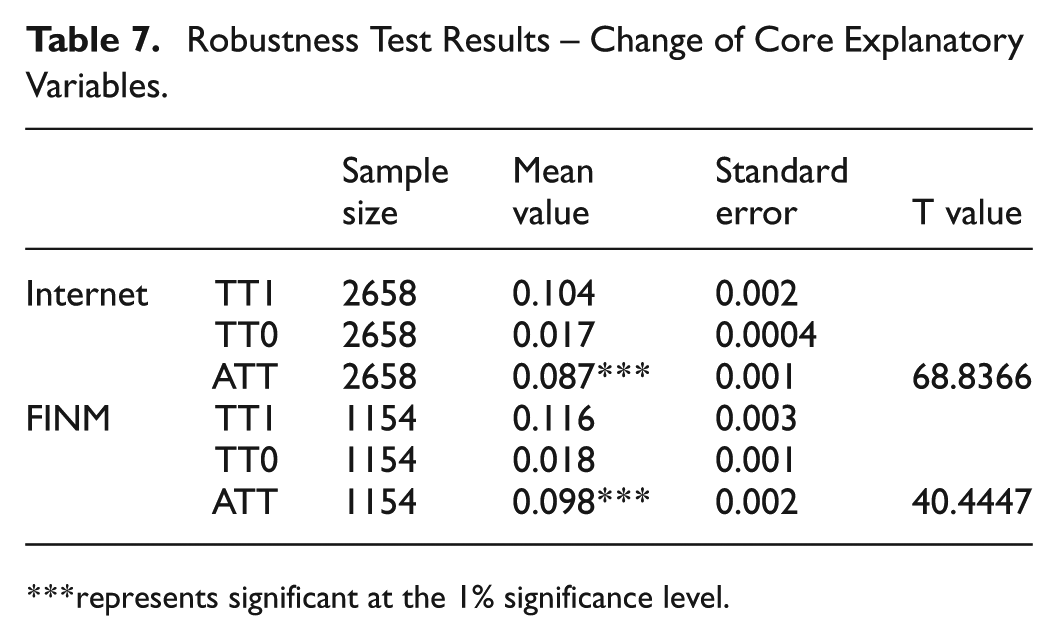
represents significant at the 1% significance level.
Impact Mechanism Analysis
Mediating Effect of Learning
Table 8 shows the mediating effect of learning between Internet new media and residents’ entrepreneurship. Columns (1) to the third in the table show that Internet new media can positively promote residents’ entrepreneurship and learning at the significance level of 1%. After adding the intermediary variable of learning to model (1), the influence of Internet new media on entrepreneurship is reduced to a certain extent. Combined with the theory of the intermediary effect model, it shows that learning does play a part of the intermediary effect in the process of promoting residents’ entrepreneurship through Internet new media.
Test Results of Mediating Effects of Study.

, **, and * represent significant at the significance level of 1%, 5%, and 10% respectively, and the reports in () are standard errors.
Columns (4) and (5) in the table show that the frequency of Internet new media use can significantly promote residents’ entrepreneurship and learning at the significance level of 1%. After adding the variable of learning to model (4), column (6) in the table shows that learning can promote residents’ entrepreneurship at the significance level of 5%. In addition, the coefficient that the frequency of Internet new media use affects entrepreneurship has decreased compared with that before adding the intermediate variables, indicating that learning plays a mediating effect in the process of the frequency of Internet new media use affecting residents’ entrepreneurship. Hypothesis 2 is tested. This conclusion is consistent with the empirical fact that the Internet new media provides an opportunity for the interconnection of everything, so that users can easily obtain the knowledge they need, thus promoting the learning of residents. Residents with entrepreneurial needs will learn knowledge related to entrepreneurship after they have access to learning channels. At the same time, there is a huge amount of information on the Internet, and users will come into contact with relevant information invisibly in the process of use, which can also be regarded as a case of learning. Therefore, the Internet promotes the learning of residents, which in turn promotes the conduct of entrepreneurship. The Sobel test was all significant at the 5% significance level, indicating that the above results are reliable.
Mediating Effects of Social Networks
Table 9 shows the impact of Internet new media on residents’ entrepreneurship when social network is taken as an intermediary variable. Columns (1) and (2) of the table show that the use of Internet new media can significantly promote residents’ entrepreneurship and the formation of social networks; column (3) of the table shows that both the use of Internet new media and social networks can positively promote residents’ entrepreneurship. In addition, the degree of influence of Internet new media is lower than that in (1), indicating that social networks play a mediating effect between the use of Internet new media and entrepreneurship.
Results of Mediating Effects of Social Networks.
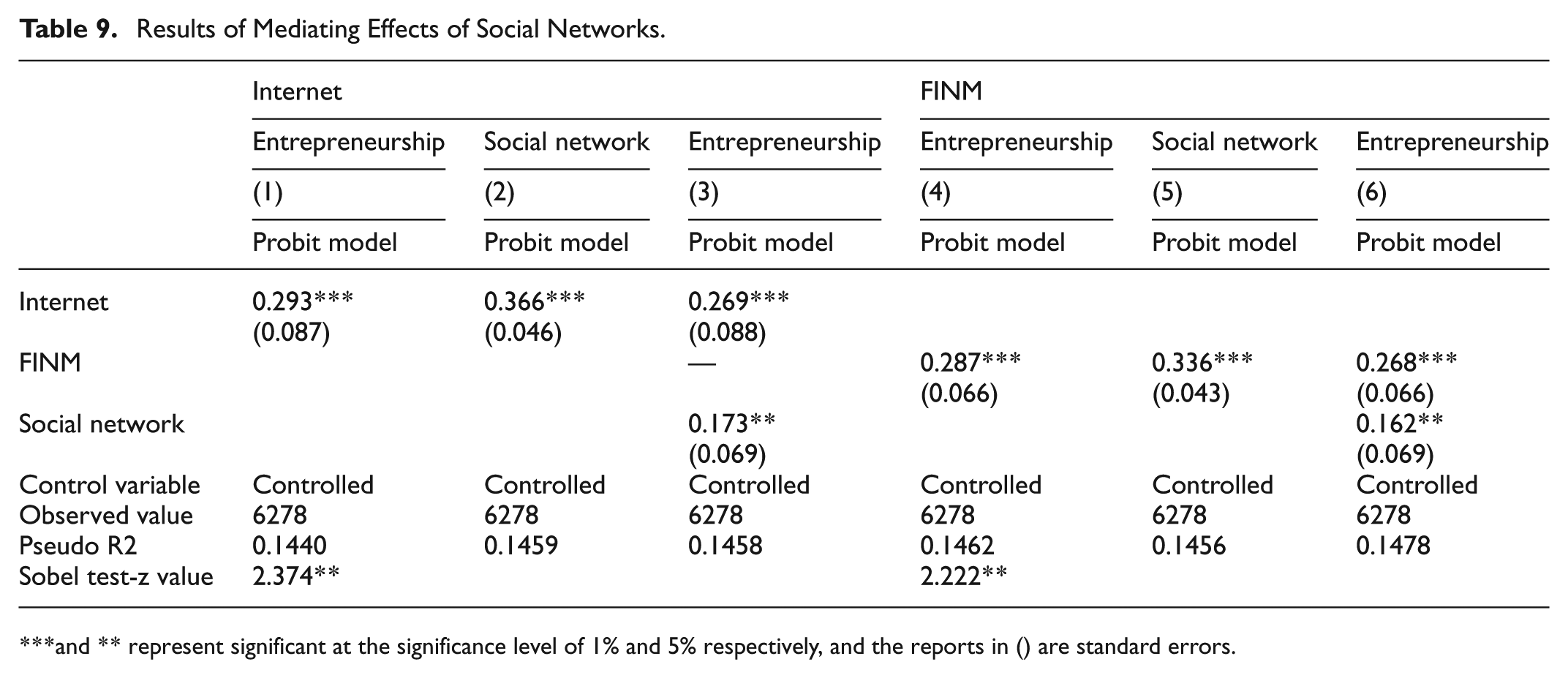
and ** represent significant at the significance level of 1% and 5% respectively, and the reports in () are standard errors.
Columns (4) to (6) in the table show the empirical results of the mediating effect of social networks on the frequency of Internet new media use and residents’ entrepreneurship. Columns (4) and (5) show that Internet new media both positively promote entrepreneurship and the formation of social networks at a significance level of 1%. After adding the mediating variable social network into model (4), The results in column (6) show that the degree of influence of Internet new media on residents’ entrepreneurship is reduced, indicating that social networks play a mediating effect. Hypothesis 3 proves. This conclusion is consistent with the empirical fact that the Internet new media provides a broad social platform through which users can make new friends and broaden the social network. Residents with entrepreneurial needs will take advantage of the expansion of this social network to communicate and cooperate with friends who have entrepreneurial experience or have similar entrepreneurial ideas, thus promoting the occurrence of entrepreneurship. The Sobel test was all significant at the 5% significance level, indicating that the above results are reliable.
Heterogeneity Analysis
This paper classifies residents based on their age. According to the retirement age in China, residents are divided into two groups (age > 60 and age ≤ 60), and analyzes the heterogeneity of Internet new media on entrepreneurship.
Table 10 shows the results of heterogeneity analysis. On the one hand, from the perspective of the use of Internet new media, the ATT value of both age groups is significantly positive at the significance level of 1%, but the ATT value of the group over 60 years old is greater than that of the group under 60 years old. This shows that the use of Internet new media has a stronger role in promoting entrepreneurship of residents over 60 years old. On the other hand, from the perspective of frequency of use of Internet new media, ATT values of the two age groups are significantly positive at the significance level of 1%, and ATT values of the group aged 60 and below are greater than those of the group aged 60 and above, which indicates that the higher the frequency of use of Internet new media, the greater the promotion of entrepreneurship of residents aged 60 and below. Based on the above two situations, the reasons may be that for the group over 60 years old, its many entrepreneurial conditions are not as good as the relatively young group. And the application of Internet new-media can compensate for their deficiencies in knowledge and other aspects. Therefore, Internet new-media plays a more significant role in promoting the entrepreneurship of the population aged over 60. With the increase in the frequency of the use of new media on the Internet, all people aged 60 and below have a higher control ability than the elderly group aged over 60, so the greater the promotion effect on entrepreneurship.
Results Based on Age Heterogeneity Analysis.

represents significant at the 1% significance level.
Conclusions and Discussion
Conclusions
Based on the data of China Comprehensive Social Survey (CGSS) in 2021, this paper empirically analyzes the impact of Internet new media on residents’ entrepreneurship by constructing an endogenous transformation Probit model, and mainly draws the following conclusions:
First of all, ESP results show that both the use and frequency of Internet new media have a positive promoting effect on residents’ entrepreneurship at the significance level of 1%. In other words, residents who use Internet new media have a higher probability of starting a business than those who do not use it, and the higher the frequency of using Internet new media, the higher the probability of entrepreneurship than those who use it at low frequency. The robustness test results show that ESP is robust.
Secondly, through the construction of a mediating effect model, it is found that learning and social networks play a mediating effect in the process of promoting residents’ entrepreneurship by Internet new media, indicating that Internet new media can promote residents’ entrepreneurship through learning and the formation of social networks.
Finally, the use of Internet new media has a greater effect on the entrepreneurship of residents over 60 years old, and the frequency of Internet new media use has a greater effect on the promotion of entrepreneurship of residents under 60 years old.
Discussion
The findings provide valuable policy insights for stimulating entrepreneurial activity to address employment challenges, particularly in rural areas where income disparities persist. This research offers evidence-based solutions for narrowing the urban-rural development gap through entrepreneurship facilitation. (Lyubing et al., 2024). Entrepreneurship is an important way to solve this gap. The emergence of Internet new media has provided new momentum for entrepreneurship and may therefore play an important role in addressing the urban-rural income gap. Compared with previous studies on the impact of the Internet on residents’ entrepreneurship, this paper highlights the role of Internet media even more. The Internet has a wide variety of functions, and studying a specific one of them can provide valuable references for better leveraging the Internet’s role in promoting entrepreneurship. Based on a large number of existing studies and fundamental economic theories such as cost transaction theory, the path by which the Internet and new media promote learning and social networks facilitate residents’ entrepreneurship is theoretically supported. Moreover, empirical tests have also proved that this action path has certain reference value.
This paper also give some suggestions: First, we should continue to accelerate infrastructure construction and increase the penetration rate of the Internet. At present, China has achieved remarkable success in Internet construction, but there is still a certain degree of regional imbalance. Therefore, efforts should be made to promote the construction of broadband and network base stations. At the same time, optimize the Internet usage fees such as data traffic and wireless network charges, and implement more people-friendly prices. Second, vigorously promote the publicity of professional knowledge to eliminate information barriers for entrepreneurship. We should continue to enhance the publicity of knowledge related to entrepreneurship. This can be achieved through promotional lectures, distributing relevant leaflets or using media such as wechat official accounts. Third, strengthen the control of the Internet environment and create a favorable environment. There is a vast amount of information in the new media of the Internet, and the quality of the information also varies to some extent. The heterogeneity analysis in this paper finds that the new media of the Internet has a greater promoting effect on users over 55 years old and female entrepreneurship. This group, especially elderly residents, may have more difficulty identifying this information product. Therefore, relevant departments should strengthen control and shape a healthy online environment. Safety publicity can be strengthened through measures such as door-to-door publicity by relevant departments, community lectures, and regular holding of related lectures.
In addition, this study also has some shortcomings and needs further research. First, new Internet media is a complex mechanism for residents’ entrepreneurial decision making. This paper only analyzes the mediating effect from the perspectives of learning and social network, so a more thorough study of its mechanism can be made in future work. Second, Internet new media provides a new development mode for entrepreneurship, so future research can focus not only on entrepreneurial decision-making, but also on entrepreneurial performance, so as to analyze the impact of Internet new media on a wider range of entrepreneurial phenomena.
Footnotes

Ethical Considerations
Our study examines the impact of Internet new media on resident entrepreneurship, using micro-survey data, without involving humans or animals.
Author Contributions
Methodology: Linsheng Chen, Zhenpeng Ma, Shiwei Xu; Investigation: Jianli Bai, Jiahui Chen; Resources: Jianli Bai, Zhenpeng Ma; Data curation: Linsheng Chen, Jianli Bai, Zhenpeng Ma, Jiahui Chen; Software: Jianli Bai; Writing—original draft: Linsheng Chen, Jianli Bai, Zhenpeng Ma; Conceptualization: Linsheng Chen, Zhenpeng Ma, Shiwei Xu; Writing—review & editing: Linsheng Chen, Zhenpeng Ma, Shiwei Xu; Supervision: Linsheng Chen, Zhenpeng Ma, Shiwei Xu; Funding acquisition: Zhenpeng Ma.
Funding
The authors disclosed receipt of the following financial support for the research, authorship, and/or publication of this article: This work was supported by Research Project of the Ministry of Education on Humanities and Social Sciences (24YJA880042). 2025 Shanghai Decision-Making Consultation Research Special Project on “Three Rural Issues” 2025-LH-SN08).
Declaration of Conflicting Interests
The authors declared no potential conflicts of interest with respect to the research, authorship, and/or publication of this article.