




Abstract
This article aims to extend the current understanding of social networking in small creative traditional sectors in developing countries. Most of the relevant studies have tended to focus on developed countries while neglecting the developing countries perspective. However, our study stresses that small craft firms—subsector of creative industries—are not only significant for income and employment generation but these businesses also are dominant in most of the developing countries. Hence, this article develops a model to demonstrate the effects of social networking on innovation and thus entrepreneurial success in small creative firms from developing countries perspective. We empirically tested our proposed research model on a sample of 254 small creative firms in the craft sector located in Bangladesh. Our results suggest that small creative firms can and do benefit from establishing a cooperative relationship with buyers, suppliers, and designers. However, cooperation with competitors does not have a significant impact on innovation. The findings of our study have substantial implications for both practitioners and policymakers interested in enhancing innovation among small creative firms mainly craft sector. In particular, we argue that a small creative firm’s innovative activity benefits from close relations with suppliers and designers.
Introduction
Since past two decades, the creative industries 1 have received an immense attention for economic development of many developing countries worldwide (De Beukelaer, 2014; Evans et al., 2014) and these industries are considered as “success stories of the new century” (Bilton, 2007). The importance of creative industries has started since the Department of Culture, Media and Sport, United Kingdom, identified several sectors as part of creative industries in 1998 (Department for Culture, Media and Sport [DCMS], 1998). The creative industries are dominated by small firms (Gundolf et al., 2018; Mueller & Abecassis-Moedas, 2017). The small craft firms 2 within the sphere of creative industries occupy an important place especially for those countries that are still in their industrialization phase due to their significant contribution to the income and employment generation. These small craft firms produce various types of culturally embedded handmade products such as textile, pottery, jewelry, woodcraft, and leather. In this era of globalization and industrialization, the small creative firms in the craft sector are faced with numerous issues including resources constraints, market competition, short product life cycle, and so on. The situation of craft firms went worsened due to introduction of machine-made substitutes, because these products are much cheaper and are available in a vast variety (Grobar, 2017; Scrase, 2003; Shafi et al., 2019; Yang et al., 2018). Thus, craft firms can hardly manage to survive in the market. In addition, these firms are deprived of advanced technology and supporting infrastructure usually available in developed countries (Mesquita & Lazzarini, 2008). Such weak infrastructure and poor institutional setting dilemmas are common in most of the developing countries (Eriobunah & Nosakhare, 2013; Hoskisson et al., 2000; Mesquita & Lazzarini, 2008; Schreiner & Woller, 2001; Yang et al., 2018).
To cover such limitations, a number of scholars has emphasized the important role of external network and innovation (Gundolf et al., 2018; Jackson & Tomlinson, 2009; Mesquita & Lazzarini, 2008; Shafi et al., 2019; Tomlinson & Jackson, 2013; Torres, 2002; Tu et al., 2014). The supply chain of the craft sector involves a wide range of actors such as craftsmen, buyers, suppliers, competitors, middlemen, wholesalers, and retailers. There is a strong relationship between these supply chain actors. Usually, the craftsmen produce the craft products and the buyer/retailers either directly buy from the producer or through the middlemen. In some cases, the wholesaler/middlemen/suppliers pay and provide the raw materials to the craftsman, who in turn gets the finished products (Yang et al., 2018). The competitors also occupy an important position in the supply chain network as they enable firms to improve efficiency by allocating resources. Through external cooperation, these firms can access complementary resources and competencies to innovate products and improve their performance (Duarte Alonso & Bressan, 2014; Gundolf et al., 2018; Shafi et al., 2019; Torres, 2002; Tu et al., 2014). The development of the small creative firms in craft sector is based on continuous improvement, innovation, and higher value-added activities (Chand et al., 2014; Mendozaramírez & Toledolópez, 2014; Shafi et al., 2019). Therefore, firms should monitor their markets and be willing to embrace innovation and produce value-added products. In small creative firms, the innovation does not solely depend upon the entrepreneur’s factors; rather, it is a matter of collective actions (Tomlinson & Jackson, 2013).
Most of the relevant studies have been conducted in developed countries (Gundolf et al., 2018; Jackson & Tomlinson, 2009; Roper & Hewitt-Dundas, 2017; Tomlinson & Jackson, 2013; Torres, 2002) and these studies have only focused on cooperation in general, but such studies did not distinguish the cooperative effect of particular partner on innovation in small creative firms in the craft sector. Moreover, in creative industries, the choice of partner seems especially important (Gundolf et al., 2018), because in the craft sector most of the activity is informal and undocumented. Furthermore, innovation in craft firms also raises concerns over its authenticity (Duarte Alonso & Bressan, 2014; Zhan et al., 2017) and there is a dearth of knowledge concerning innovation authenticity in crafts; in addition, the acceptable indicators of innovation are also not well known in the literature.
In the present study, particularly, we have focused on several strategic external sources, that is, Buyers, Suppliers, Designers, and Competitors and their effects on innovation leading to entrepreneurial success in small creative firms in the craft sector. As for the continued survival of the small craft firms, the innovation is considered as one of the necessary factors, therefore, identifying and evaluating the influence of cooperation on innovation and thus the performance of small creative firms is very important for policymakers and practitioners. We do so by drawing upon various already published articles as well as through a case study from Bangladesh.
Hence, the contribution of this study is manifold: First, we intend to provide more in-depth understanding of the social networking and its effects on innovation in small creative firms in developing country context which differs from previous studies that have focused on large firms, in particular districts, and in developed countries (Gundolf et al., 2018; Jackson & Tomlinson, 2009; Roper & Hewitt-Dundas, 2017; Tomlinson & Jackson, 2013). Second, this study discusses the controversial issue of innovation in crafts, because some scholars argue that the handicraft products contain the traditional knowledge and skills that are being passed to generation and innovation may challenge the traditional nature of these products (Duarte Alonso & Bressan, 2014; Zhan et al., 2017). Third, this study emphasizes the important role of innovation in crafts, because, for policymakers considering to provide support for small creative firms, it is essential to understand what factors promote or prevent innovation by firms, which this study aims to cover. Fourth, this study attempts to highlight the importance of small creative firms in the craft sector operating in developing countries, and some useful suggestions to help such firms to carry out their business activities successfully. Finally, this study also tests the proposed hypotheses through a case study of small creative firms in the craft sector from Bangladesh.
Theoretical Background and Conceptual Research Framework
Creative Industry in Developing Countries
The DCMS (1998, United Kingdom) identified 13 sectors as part of creative industries in 1998. Consequently, various countries have adopted this term as it has broadened the scope of creative industries beyond the arts and cultural sector. These industries have become a key factor in economic development, value, and employment creation since past two decades (Flew & Cunningham, 2010), which represents a variety of activities within the cultural creative jurisdiction at small, large, and multinational level (European Commission, 2010). The contribution of creative industries is manifold such as economic development, employment creation, value-added activities, and new business opportunities (DCMS, 2010; Hotho & Champion, 2011). Furthermore, creative industries are considered as a “dynamic sector” in global trade and a key driver of innovation and employment creation for many countries (United Nations Conference on Trade and Development [UNCTAD], 2008; United Nations Educational, Scientific and Cultural Organization [UNESCO]; and United Nations Development Programme, 2013).
The handicraft is one of the subsectors of the larger group of creative industries (UNCTAD, 2008); in this study, we are specifically interested in small creative firms in craft sector as the craftsmen mostly work at the small level in developing countries. Furthermore, this sector carries important traditional knowledge and skills and passes it to the next generation. This sector also has the potential to provide stable employment and income opportunities to diverse communities across different levels of education. The small creative firms in this sector contribute significantly to the income and employment generation. Beyond their aesthetic and cultural dimensions, this sector presents several interesting characteristics that are different from other industries such as the involvement of traditional knowledge, low investment, creation of jobs at minimal cost, and usage of low machinery and energy.
Moreover, in 2002, only 40.46% of all creative goods were accounted for developing countries, whereas 58.95% were accounted for developed countries. Since then, the developing countries have improved their export performance of creative goods, and this ratio has increased tremendously up to 52% till 2015 (UNCTADstat 3 ; see Table 1 for details of creative goods export).
All Creative Goods Export, Annual 2002–2015 (US$ in Million).

Source. UNCTADstat aggregated by the authors.
Furthermore, in developing countries, the percentage for Art Crafts creative goods export has increased since 2002 from 52.57% (9,202 million US$) to 64.07% (20,715 million US$) till 2008 (UNCTAD, 2010), whereas in developed countries, this it is decreased from 47.17% to 35.40% (UNCTAD, 2010). A closer look at the most recent available statistics indicates that, in 2015, 52% of all creative goods export were accounted for developing countries, whereas 47.40% were accounted for developed countries, and the rest of 0.60% were accounted for countries in transition (UNCTADstat). Moreover, according to the Creative Economy Report of 2010 (UNCTAD, 2010), the art crafts is the most important creative industry product and is accounted for 65% of the export share for developing countries, whereas in 2015 this share is increased up to 73.16% (UNCTADstat). Together, these statistics indicate that the creative industry in developing countries is growing significantly and crafts sector is one of the most important sectors for developing countries.
Although the importance of the small creative sector is quite well recognized in the literature, this sector is still facing several challenges (Rogerson, 2010; Yaaminey, 2018; Yang et al., 2018). The small creative sector in many developing countries is facing several issues, and employment in this sector is declining, for example, Pakistan (Yang et al., 2018). The literature has also acknowledged that the handicraft industry in many developing countries is also struggling with import competition with related substitute products and the Chinese handicraft industry is considered as a major competitor (Jamir & Sridharan, 2017 for India, Yang et al., 2018 for Pakistan, Grobar, 2017 for Peru).
Furthermore, there are several crafts around the world which are only preserved physically in the museums, but today no one is alive to pass the skills to manufacture such crafts. Still, there are several crafts which need urgent attention to safeguard as highlighted by UNESCO (2018) such as “Al Sadu (Traditional weaving skills)” of United Arab Emirates and “Noken multifunctional knotted or woven bag (Handicraft of the people of Papua)” of Indonesia. Moreover, this sector has seen a dramatic decrease in production mainly due to a shortage of cultural carriers, the unwillingness of young generation, stubborn attitude of some craftsmen for not passing the traditional knowledge to next generation, and in some cases because the activity was no longer economically viable (United Nations Industrial Development Organization [UNIDO], 2007; Yang et al., 2018). Moreover, in many developing countries, the artisans are moving out of the community to do something else rather than making craft products due to high competition with cheap machine-made substitutes (Suntrayuth, 2016; Yang et al., 2018).
Moreover, the intangible cultural heritage, such as the traditional knowledge, techniques, and skills involved in the handicrafts, is of utmost importance to keep alive the identity of the communities. Hence, the role of small creative firms in the craft sector is very important especially for those countries which are still developing. Usually, it is considered that the small firms, operated by less than 10 persons, are endangered with the rapid growth of industrialization and mechanized industries. Hence, this sector merits careful consideration for their sustainable development.
Resources Based View
Different theories state different reasons for why some firms have a competitive advantage. The resources-based view (RBV) emphasizes that, for a firm to be efficient and effective in a specific environment, there is a need for efficient management of its resources (Barney, 1991; Kraaijenbrink et al., 2010; Peteraf, 1993; Wernerfelt, 1984). Essentially, the theory sheds light on the fact that when resources are exploited internally, there will be a high possibility of sustaining a competitive advantage. The RBV emphasizes the significance of resource accumulation for growth of the firm and also stresses the heterogeneity nature of resources and highlights the necessity of resources to maintain the competitiveness in the market across firms. Furthermore, if the firm intends to develop resources internally, it can be time-consuming and costly. However, access to outside resources can be cheaper and time-saving.
When a firm possesses resources that are well managed, there might be the possibility of attaining a competitive advantage. For resource-constrained firms like handicrafts, the main benefit of this approach is to utilize the resources more carefully to achieve better results (Barney, 1991; Yang & Shafi, 2019).
Social Network
Social network refers to the “social constructions arising from exchanges and joint activities among participants in a social system” (Leenders & Dolfsma, 2015, p. 123). The social network of firms is very important to acquire the necessary knowledge, information, and resources on minimal cost (Phelps et al., 2012). Gulati et al. (2011) argue that social network is a resource that has a positive impact on firm performance. Particularly, to overcome the resources constraints, the firms usually interact with their partners to obtain external knowledge and information for competitiveness (Carpenter et al., 2012; Phelps et al., 2012). Furthermore, as the small businesses have limited resources, therefore, these businesses must rely on their partners to gain necessary resources on minimal expenses (Colombo et al., 2012; Werr et al., 2009; Witt, 2004). The entrepreneurs in small creative sectors like crafts face several constraints such as resources, skills, infrastructure, and competition with machine-made substitutes. External relationships are one of a way for small creative firms to overcome the resources deficiencies (Mazzarol et al., 2013). Typically, the social network in such firms is aimed to overcome the resources constraints and access new resources to survive and compete in the market. Moreover, it has been argued that to enable small creative firms to develop economically, the establishment of creative cluster or social networks can be helpful (DCMS, 1998; Torres, 2002). However, the literature regarding cooperation in small creative firms is scant (Duarte Alonso & Bressan, 2014; Gundolf et al., 2018); in particular, the cooperative behavior of craft enterprises in the context of developing countries has been neglected in the literature.
Although most of the entrepreneurs in small creative firms choose to perform their work in isolation, it has been argued that that creativity is a social process (Jackson & Tomlinson, 2009). Particularly, such interaction enables the entrepreneurs to learn and acquire necessary knowledge from their external environment which in turn can harness creative processes (Gundolf et al., 2018). Moreover, the external cooperation can also provide them an opportunity to improve their creativity and add value to their products. In addition, to cover the resources deficiencies, the small firms use skills and experience developed in their social environment (Tu et al., 2014). These abilities comprise external cooperation including responding to the needs and demands of their customers to gain sales opportunities (Mendozaramírez & Toledolópez, 2014; Shafi et al., 2019; Tu et al., 2014). We argue that the social network of small creative firms includes Buyers, Suppliers, Designers, and Competitors (Alexandre et al., 2015; Flanagan et al., 2018; Gundolf et al., 2018; Shafi et al., 2019; Yang & Shafi, 2019).
Link Between RBV and Social Network
In the present study, we applied the RBV and social network theories that enabled us to explain how to acquire complex knowledge and access resources from close counterparts to stimulate entrepreneurial activities. The social network theory highlights the importance of interaction between firms and emphasizes to focus on the management of business relationships to develop competence (BarNir & Smith, 2002; Leenders & Dolfsma, 2015; Xavier & Teresa, 2010). The reciprocal relationships and frequent interactions between firms are considered as a competitive advantage. While the RBV enabled us to comprehend the importance of resources to firms in achieving competitive advantage, these resources have been acknowledged to be essential for innovation.
The RBV and network theory highlights that the resources can be acquired from the network, whereas the actors in a network have accessibility to network resources (Arya & Lin, 2007). The resources accumulated from the social network of small firms can be conceived within the RBV of firms. Thus, the resources of small firms which are valuable, rare, imperfectly imitable, and nonsubstitutable serve as a source of competitiveness for firms (Barney, 1991; Kraaijenbrink et al., 2010; Peteraf, 1993; Wernerfelt, 1984). In a nutshell, we employed resource-based view and social network theories to model how coordinated efforts to articulate distinct sets of network resources and competencies allow small firms to obtain complementary resources and collective competencies, that is, resources and competencies which are not available to firms operating alone.
Innovation in Handicrafts
In the first instance, we need to clarify the term craft, specifically what we mean by craft because there is no universally accepted definition of craft (Yang et al., 2018). Hence, we follow the definition proposed by Fillis (2004), that is, Craft is taken to mean an object which must have a high degree of handmade input, but not necessarily having been produced or designed using traditional materials, produced as a one-off or as part of a small batch, the design of which may or may not be culturally embedded in the country of production, and which is sold for profit.
Furthermore, according to Scrase (2003), the handicraft products can be bifurcated in “elite crafts” and “quotidian crafts”; thus, we have only focused on those crafts that are in everyday use (quotidian crafts), because the majority of crafts falls into this category which includes various items such as handmade clothes including embroidery, purses, knitted or woven products, jewelry, and pottery. Moreover, these kinds of products are produced in reasonable quantities and for which there are many substitutes available in the market (Grobar, 2017). In addition, to be specific in terms of describing innovation, in this study, we have only focused on innovation at a smaller extent to enable these small creative firms to compete and survive in the market but without destroying the traditional motif. Because, for small firms, it is not necessary to offer an innovation that is new to the economy, but rather that is new to the firm is sufficient (Penrose, 1959), an idea that is new to a group of customers or firms and still adds value for them is adequate for firms to get a competitive advantage in the market. Hence, the innovation to a smaller extent is very important for small creative firms.
In this study, innovation is treated as “the conversion of knowledge into new products or processes or the introduction of significant changes into existing ones” (Xavier & Teresa, 2010). In the context of small creative firms in the craft sector, it can be defined as the introduction of new or significantly improved products or processes involved in the production of handicraft products.
Authenticity concern over innovation
The innovation is considered as an important factor for competitive advantage and growth of small creative firms (Engel et al., 2004; Hotho & Champion, 2011). However, in the context of the craft sector, innovation is considered as controversial and challenging. Because some scholars contend that innovation might compromise the traditional nature of crafts, and if the products are innovated so much, it will become something else (Duarte Alonso & Bressan, 2014; Zhan et al., 2017). We argue that there are numerous substitutes and related products available in the market that brought many challenges to this industry including low market. Hence, it is necessary for small firms not only to differentiate their products from those substitutes but also to adopt innovation. It has been argued that the crafts should be developed through a contemporary transformation with modern designs (e.g., Zhan et al., 2017), because not only the demand for traditional products is diminishing, but it is also challenging to find a market for such crafts. Although traditional crafts are more decorative and stick to conventional stereotype, these products are difficult to sell in the market. Moreover, the addition of innovation and modern intervention does destroy its cultural value; rather, it enhances the economic viability of the crafts (Zhan & Walker, 2018). Furthermore, a recent study conducted by Shafi et al. (2019) also endorses this notion and indicates that textile handicrafts involve innovation in terms of product improvements (design, size, shape, color, etc.), quality improvements, and replacement/modification of tools.
Product and process innovation
The product innovations, in crafts, may be seen in terms of improvements to product attributes, production quantity, and speed including ease of use (Mendozaramírez & Toledolópez, 2014). They mainly pertain to improvements/changes in size, designs, color, size, shape, texture, value addition, and so on (Chand et al., 2014; Girón et al., 2007; Mendozaramírez & Toledolópez, 2014; Sánchezmedina et al., 2011; Zhan & Walker, 2018). The product innovation involves small changes (incremental innovation) to adapt to the market demands; for instance, reduction in the size of some products helps in transportation from one place to another place (Mendozaramírez & Toledolópez, 2014).
The process innovation in crafts involve use of different materials clays, glazes and (Jackson & Tomlinson, 2009; Zhan & Walker, 2018) and modification/replacement of tools/equipment used to manufacture the products (Mendozaramírez & Toledolópez, 2014). For instance, Sánchezmedina et al. (2011) demonstrated that in the pottery sector, the innovation is also linked to the changes or replacement in tools, equipment, and machinery used as well as methods or manner of creating these products. In line with this argument, Jackson and Tomlinson (2009) reported that entrepreneurs of studio pottery in the UK are also involved in innovation and uses various clays, glazes and different techniques of firing for development of new products and designs (Jackson and Tomlinson, 2009).
Finally, the implementation of product innovation and process innovation can be valuable for craft firms. Furthermore, these modifications are not expensive but rather economical. These innovations are incremental and do not affect the traditional nature of products.
Hypotheses Development
Relationship Between Cooperation and Innovation
Cooperation with buyers
Buying and consumption of crafts make a distinct relationship of buyers 4 with craftsman. Buyers share their experience and suggest improvement possibilities in the products including new designs, features, functions, etc. that helps the craft entrepreneurs to make changes in products to adjust to the buyer’s requirements without compromising the traditional motif. Consequently, significant interaction with buyers is necessary for product innovation to achieve better firm performance and competitive advantage in the market (Gunday et al., 2011).
Previous studies indicate that the customers are good sources of idea generation and new designs; for instance, Nishikawa et al. (2013) reported that the user-generated products outperformed as compared with the designer-generated products. Furthermore, most of the female buyers in countries such as Pakistan and India demand unique designs especially in textiles and embroidery to have a different look from others.
Löfqvist (2012) studied the motivation for innovation in small handicraft firms and demonstrated that small craft firms can take benefits through interaction with customers during the innovation process. Moreover, the successful development of innovation also depends upon the interaction and responding to the needs of customers. In addition, the craft entrepreneurs continuously upgrade the techniques and skills including product development, quality, and customer satisfaction to maintain the competitive edge in the market (Barber & Krivoshlykova, 2006). Due to the short product life cycle and inconsistent demands of customers, the craft enterprises have to keep pace with the market demands by adopting fashion styles, product designs, and product colors to offer customer-specific solutions (Barber & Krivoshlykova, 2006). Hence, the enterprises have to adapt products to customer’s requirements and improve production efficiency and quality. It implies that customer cooperation can influence artisans to adopt innovation by changing and improving the production process to make changes in products according to the needs of the customers. Moreover, the literature also indicates that customers are one of the key sources of information and their ideas can help firms to improve their products (Hoyer et al., 2010). Accordingly, we propose the following hypothesis:
Supplier cooperation
Various studies indicate that the knowledge and information acquired from the suppliers and customers have a significant impact on innovation, as the information and knowledge are considered as a potential source of competitiveness. Recent studies also support this view that cooperation has a positive impact on innovation in small firms. For instance, in a study of night market microenterprises in Taiwan, Tu et al. (2014) examined the cooperation behavior of microenterprises and their effect on innovation and concluded that supplier cooperation positively affects innovation. Furthermore, Pérez Mesa (2015) finds that supplier cooperation strategies have positive effects on performance in terms of market creation, promotion, quality, training, joint supply purchases, and research ventures.
The suppliers provide embedded knowledge related to the industry which helps to integrate new knowledge, whereas the customers provide the latest knowledge which can challenge existing routines (Mesquita & Lazzarini, 2008; Yang & Shafi, 2019). For example, in the ceramic sector, the cooperation with suppliers regarding use of various clays and glazes also affects product improvement (Jackson & Tomlinson, 2009).
Furthermore, a recent study by Roper and Hewitt-Dundas (2017), based on a large number of sample of microenterprises operating in Northern Ireland, indicates that the cooperation, particularly with suppliers, has a significant effect on new-to-the-market innovation. The authors further reported that 74.8% of the samples in the study that reported new-to-the-market innovations were involved in cooperation, whereas only 25.2% were solo innovators. Cooperation with suppliers can facilitate small creative enterprises to grow by improving their capabilities. Such cooperation also decreases the risks associated with innovation as well as new market entry (Aw, 2002). From the above discussion, the following proposition is developed:
Cooperation with designers
Several studies have emphasized the role of cooperation with designers; for instance, Tung (2012) highlights the need for design intervention for sustainable businesses and stresses the importance of cooperation between artisans and designers. Furthermore, usually the small creative firms in craft sector face stiff competition with machine-made substitutes and their failure is linked toward lack of innovation. Moreover, failure of crafts has also been lined toward the lack of product innovation and design (Torres, 2002), for which the role of cooperation with designers has been stressed because “Designers are thus an interface between tradition and modernity, helping match craft production to the needs of modern living” (UNESCO, 2005).
Today, we see a number of designer and artisan collaborations to create contemporary crafts, which attracts the customers. In addition, the role of designers has also been linked toward developing innovative product ideas involving new fabrics and materials inspired by current themes based on the design forecast (UNESCO, 2005). Furthermore, the literature indicates that the artisans and designers have cooperated successfully for revival and upgradation of crafts with the help of technological resources (Alexandre et al., 2015). Moreover, the designers possess the technical knowledge and know-how concerning to the modern taste and artisans have cultural heritage skills and knowledge; thus, their cooperation can lead to the expansion of business and competitiveness. Therefore, we put forward our next hypothesis as follows:
Cooperation with competitors
Cooperation with competitors is also considered as an important part of a small firm’s cooperative strategies (Galdeano-Gómez et al., 2016). Cooperation with competitor usually involves in certain product development stages. The need for competitor cooperation also arises when the small firms receive a high number of production order and are beyond their production capacity.
Some evidence exists in the literature regarding positive and significant effect of cooperation with competitors on innovation in small firms (for instance, see Galdeano-Gómez et al., 2016; Najib & Kiminami, 2011; Quintana-García & Benavides-Velasco, 2004); however, Freel and Harrison (2006), Propris (2002), and Tomlinson and Jackson (2013) did not find a significant impact on innovation. We argue that as creativity is the core of creative firms, they are different from the traditional enterprise. In addition, the cooperation with competitors enables small creative firms to acquire heterogeneous resources that are the foundation of competitive advantage (Barney, 1991). According to the RBV, the heterogeneous resources are valuable, rare, imperfectly imitable, and nonsubstitutable (Barney, 1991; Burt, 2000). In line with this argument, Jie and Yaping (2013) found evidence regarding the existence of heterogeneous resources in cultural and creative enterprises in Tianjin, China. Similarly, a recent study conducted by Flanagan et al. (2018), on coopetition in small nascent craft breweries, reported that these firms engage in cooperative behaviors with competitors in areas such as process technology development, procurement, inbound logistics, and marketing. Therefore, we proposed that
Relationship Between Innovation and Entrepreneurial Success
Because there is a high potential for this sector to grow, the innovation efforts will yield significant benefits. Previously relevant entrepreneurial studies have focused on factors determining the successful and nonsuccessful entrepreneurs, personal traits, and so on (Stevenson & Gumpert, 1985). However, several factors that affect the success of business have been identified in the literature; for example, Polder et al. (2010) and Paige and Littrell (2002) highlighted the importance of unique and innovative product design to be a successful handicraft firm which highlights the important role of innovation on business performance. Moreover, the study of Smallbone and North (1999), focused on rural-based firms including handicrafts, indicates that the growth and survival of rural small and medium enterprises (SMEs) are based on the active implementation of product or service and process innovation. In addition, Paige (1999) demonstrated that successful craft businesses offer differentiated and unique crafts with higher quality and strong orientation to consumers ensuring customer satisfaction. The author further highlighted the importance of technology in reengineering products and processes for a successful craft business.
Although the crafts are very well preserved in museums, documents, and digital database, there is a lack of protection and preservation of traditional knowledge and skills for sustainable development of these businesses which highlights the role of innovation but without compromising the traditional motif. Because innovation is considered as one of the key factors of competence and business success. Several entrepreneurs adopted the innovation and changed the production process with the intention to decrease cost and enhance the production, sales, and profit (Sánchezmedina et al., 2011). Similarly, Engel et al. (2004) also reported the positive effect of innovation on sales growth of small firms. Thus, the innovation can lead to improvement in business performance.
Furthermore, it is essential to be innovative as it would increase the possibilities of achieving competitiveness in the market and empirical findings show that product development is related to competitive advantage. Likewise, the study of Tu et al. (2014), focused on microenterprises based in Taiwan, finds a positive relationship between innovation and entrepreneurial success. Consequently, the following proposition is developed (Figure 1):

Proposed conceptual framework.
Method
Research Setting
In Bangladesh, the preindustrial traditions are still alive, and numerous artisans are still producing creative craft pieces. The handicrafts produced in Bangladesh include pottery, metal crafts, leather crafts, basket crafts, bamboo crafts, textiles, and so on. The small creative sectors in Bangladesh are significantly contributing to the economic development of the country. Due to the industrialization, several machine-made cheap products are available in the market which has adversely affected the small creative firms. In addition, as most of the firms in the craft sector are small firms and these firms are suffering from resources constraints, thus, cooperation and innovation is one of the available alternatives to cope up with these challenges as reported in the literature (Gundolf et al., 2018; Shafi et al., 2019; Yang et al., 2018).
Sample Collection
The data were collected from key informants (owners) of small creative firms in the craft sector employing less than nine employees (excluding seasonal labor) operating in Bangladesh. A quantitative methodological approach was applied to gather data. As the primary data collection tool, we used a questionnaire to sample these small creative firms randomly.
We approached 339 small creative firms in the craft sector; only 265 expressed their willingness to take part in our research. After excluding 11 invalid and too many incomplete responses, the final sample size becomes 254 which is 74.92% response rate. The detail of the sample is presented in Table 2.
Demographic Information.

Measures
Cooperation is defined as a situation where two or more partners cooperate with each other for mutual benefits through pooling resources, skills, and capabilities rather than competition (Quintana-García & Benavides-Velasco, 2004). In measuring the cooperation, the respondents were asked to indicate the extent to which their firm engaged in cooperation with (a) buyers, (b) suppliers, (c) designers, and (d) competitors (based on the study of Tomlinson (2010)). In this study, cooperation is measured using a 5-point Likert-type scale, where 1 = no cooperation to 5 = very high level of cooperation for innovation.
Innovation
Innovation is operationally defined as the degree to which small creative enterprises change and improve their product and production process (Mendozaramírez & Toledolópez, 2014). To measure the innovation, the respondents were asked to indicate the extent to which they implemented the following innovation during the past 3 years:
Product innovation: “Changes in size/shape/decoration/texture” (four items adopted from the study of Mendozaramírez and Toledolópez, 2014).
Process innovation: “modification/replacement of tools/equipment, machinery” quality of raw materials (three items adopted from the study of Mendozaramírez & Toledolópez (2014) and one item adopted from the study of Chand et al. (2014)). The items were rated on a 5-point Likert-type scale, where 1 = not at all to 5 = very much.
Entrepreneurial success
Although entrepreneurial success has been well investigated in the literature, there is no consensus on defining and measuring entrepreneurial success (Oyeku et al., 2014). Most of the previous studies define entrepreneurial success from an economic and/or financial perspective (Gatewood et al., 1995; Masuo et al., 2001). Conversely, it has been argued that the performance of firms involves extrinsic and intrinsic factors (see Paige & Littrell, 2002). Furthermore, in general, the success is related to the accomplishment of objectives and goals, whereas the success of a business is the mixture of both financial and nonfinancial performance (Oyeku et al., 2014). Moreover, the present study is focused on small creative firms in craft sector which is somehow different from other sectors in terms of nonfinancial indicators such as reinforcing cultural identity, elevating, and preserving craft tradition (Paige & Littrell, 2002). In addition, because the nature of craft businesses is different than other businesses, the nonfinancial indicators are also important for the success of the business. In the present study, entrepreneurial success refers to the financial and nonfinancial performance of small creative enterprises. By financial performance, we mean extrinsic factors such as sales growth, employment growth, and perceived profitability (Obschonka et al., 2011), whereas by nonfinancial performance, we mean intrinsic factors such as craft and cultural orientation (Paige & Littrell, 2002).
To measure financial performance, we adopted three items from the study of Obschonka et al. (2011). Particularly, the respondents were asked to indicate the extent to which they agree with the following items: “Over the last three years, our sale has increased,” “Over the last three years, our profit has increased” and “Over the last three years, the employment in our enterprise has increased.” The items were rated on a 5-point Likert-type scale, where 1 = strongly disagree to 5 = strongly agree.
To measure the nonfinancial performance, we adopted three items from the study of Paige and Littrell (2002), the respondents were asked to indicate the extent to which they agree with the following items: “Reinforcing the region’s cultural identity,” “Preserving and elevating the craft tradition,” and “Gaining a positive reputation in the community with consumers and the within the craft industry.” The items were rated on a 5-point Likert-type scale, where 1 = strongly disagree to 5 = strongly agree.
Data Analysis
We conducted exploratory factor analysis (EFA) to examine the structure research variables. The results of the EFA analysis show the factor loadings between 0.697 and 0.881. Before further analysis of the data, we conducted confirmatory factor analysis (CFA) to examine the convergent validity of the constructs. The results show that our model has significantly good fit indices (χ2 = 164.240, df = 121, CMIN/df = 1.357, goodness-of-fit statistic [GFI] = 0.934, adjusted goodness-of-fit statistic [AGFI] = 0.907, root mean square residual [RMR] = 0.064, standardized root mean square residual [SRMR] = 0.0433, comparative fit index [CFI] = 0.980, Tucker–Lewis index [TLI] = 0.974, root mean square error of approximation [RMSEA] = 0.038) than other models (chi-square difference test). This study used Cronbach’s alpha to evaluate the reliability of the questionnaire. The value of 0.866 shows excellent reliability of the questionnaire. All of the above results indicate the appropriateness of the measurement model. On establishing sufficient validity and reliability of the measurement model, we used the structural equation modeling technique to test the hypotheses.
Results
The estimated parameters of the model are presented in Table 3 and Figure 2. We find that cooperation with buyers, suppliers, and designers has a positive significant influence on product innovation (β = .156, p < .05; β = .219, p < .01; β = .190, p < .05, respectively). In addition, the effect of cooperation with suppliers and designers was found positive significant on process innovation (β = .233, p < .01; β = .199, p < .01, respectively), but the buyers cooperation did not positively affect process innovation (β = −.51, p = .536). However, the cooperation with competitors did not significantly affect product and process innovation (β = .157, p = .103; β = .056, p = .592, respectively). Furthermore, both product and process innovations have a positive significant influence on financial (β = .332, p < .001; β = .150, p < .01, respectively) and nonfinancial performance (β = .221, p < .05; β = .439, p < .001, respectively).
Structural Equation Modeling Results.

p < .001.

Structural equation modeling (SEM) results.
Additional Analysis
Further interpretation of the path estimates indicate that cooperation with suppliers (β = .219) has the largest impact on product innovation as compared with that of buyers and designers (β = .156, β = .190, respectively). Similarly, the cooperation with suppliers (β = .233) also has the largest impact on process innovation as compared with that of designers (β = .1199). To confirm whether two coefficients are statistically different or not, we used nested model approach with one degree of freedom chi-square test to constrain the parameters to be equal. If the implied variance estimates significantly differ from each other, the value of chi square will be increased; in general, the more the implied variances differ from the sample variances, the bigger the chi-square statistic will be. Consequently, we constrained the variance of Cooperation with Suppliers and Buyers (for product innovation), Cooperation with Suppliers and Designers (for product innovation), and Cooperation with Buyers and Designers (for product innovation) to be equal (Models 1, 2, and 3, respectively) and compared their chi-square values with the original model. A similar procedure was followed for Cooperation with Suppliers and Designers (for process innovation). Assuming that the original model is correct, and by imposing additional restriction of variances, indicates that the parameters estimates of cooperation are significantly different from each other. Hence, from the above analysis, it is concluded that the supplier’s cooperation has the largest impact on product and process innovations; thus, it becomes the most important factor for innovation which is in line with the findings of Tomlinson and Jackson (2013; Table 4).
Nested Model Comparison and One Degree of Chi-Square Difference Test.
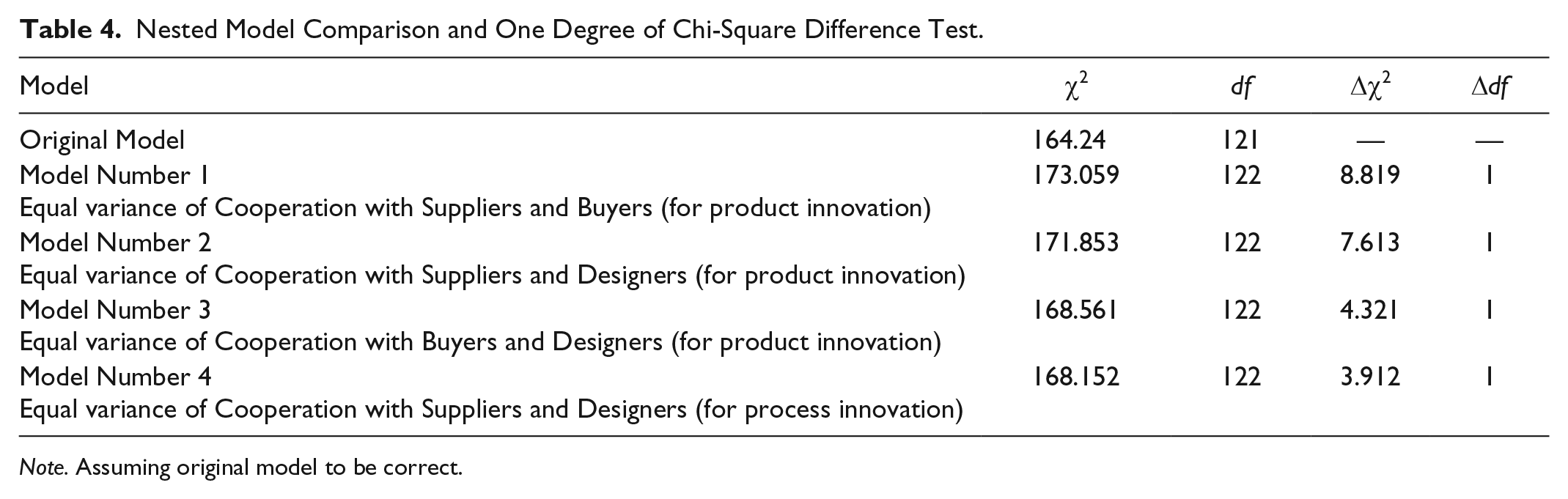
Note. Assuming original model to be correct.
Discussion and Conclusion
The small creative firms in the crafts sector not only embody the cultural heritage and traditional knowledge but also contribute to the development and sustainability of many communities in developing countries. Moreover, the intangible cultural heritage, such as the traditional knowledge, techniques, and skills involved in the handicrafts, is of utmost importance to keep alive the identity of the communities. We argued that the small creative firms in craft sector operating in developing countries employ more than 10% of labor force and are considered as the second highest source of income and employment (Grobar, 2017). Moreover, generally, these firms are left with precarious existence (Scrase, 2003) and face different issues such as poverty, financial resources, lack of education, and import competition with machine-made and substitute products, which are different than those operating in developed countries (Eriobunah & Nosakhare, 2013; Grobar, 2017; Jamir & Sridharan, 2017; Schreiner & Woller, 2001; Yang et al., 2018). We highlighted these issues and also the need for cooperation and innovation to enable these firms to survive and compete in the market. We empirically tested our proposed research model (Figure 1) on a sample of 254 small creative firms in craft sector located in Bangladesh.
The results of our case study show that cooperation with buyers has a positive and significant effect on product innovation but it does not significantly affect process innovation. Similarly, Tomlinson (2010) also reported similar results and argued that the cooperation with buyers enables firms to access the information regarding changing market tastes and demands and is fruitful for product innovation to a lesser extent, but it did not have significant influence on process innovation. The results further indicate that the cooperation with suppliers and designers has a positive and significant effect on product and process innovations. In the same way, Tomlinson and Jackson (2013) also reported that supplier cooperation is more important than buyers. Similarly, Suntrayuth (2016) also reported that collaboration with designers could help to revive craft products. In addition, Tung (2012) also reported that the collaboration with designers could cultivate the local craft industry and empower artisans to further their innovations.
The results further indicate that the cooperation with competitors does not have a significant effect on both product and process innovations; this finding is in line with the study of Tomlinson and Jackson (2013) who reported that cooperation with competitors has no significant impact upon innovation. Moreover, the production of handicraft products involves traditional knowledge and skills which are handed down from generation to generation. Hence, the cooperation with competitors may involve some risks of leakage of such traditional secrets. Therefore, the artisan may not prefer to engage in cooperation with competitors.
Furthermore, both product and process innovations have a positive and significant influence on financial and nonfinancial performance. This finding of our study is in line with the findings of Engel et al. (2004), who reported positive influence of innovation on sales growth of small firms in craft industries in Germany. Likewise, Tu et al. (2014) also reported the positive influence of product innovation on the entrepreneurial success of microenterprises (small firms). In this way, the small creative firms can acquire valuable resources to perform innovative activities and improve their business performance.
In addition, we also discussed the controversial issue concerning innovation in crafts. Despite controversies, we found that the crafts involve not only product innovations but also process innovations. The literature duly supports our propositions (for instance, see Chand et al., 2014; Mendozaramírez & Toledolópez, 2014; Sánchezmedina et al., 2011).
Our study indicates that many countries are struggling with import competition from craft-related substitutes (Jamir & Sridharan, 2017 for India, Yang et al., 2018 for Pakistan, Grobar, 2017 for Peru). Thus, the external cooperation will likely to benefit these firms as innovations will attract the new buyers and help to retain the old ones. As most of the small craft businesses are struggling with the strong competition from substitute products, several researchers have emphasized the need to differentiate the handicraft products from those substitute products (see Barber & Krivoshlykova, 2006; Scrase, 2003; Yang et al., 2018); therefore, the cooperation and innovation strategies adopted by the small creative firms could help them to offer innovative products to remain competitive in the market. Moreover, the production of new or improved products as a result of cooperation has higher chances of acceptance in the market (Tether, 2002) as compared with those innovative products produced without cooperation. Hence, this study suggests that long-term relationship with partners will yield a significant improvement in business performance. In this way, small firms can expand their business and compete in the market. These positive reactions offer some hope that small creative firms in the craft sector operating in developing countries will be able to meet the challenges through innovative activities.
Furthermore, our study highlighted that traditional products have a low market as compared with the machine-made substitute products. Moreover, traditional techniques have some limitations in terms of low productivity to attract customers. In addition, the increasing price of raw materials also forces craft producers to adopt innovation and use different materials to manufacture the products to satisfy the needs of the customers. Although the innovation is one of the necessary factors for the development of small creative firms, the handicraft products involve the traditional knowledge, skills, and cultural heritage; hence, the traditional motif should not be compromised on the basis of customers’ needs and desires. Otherwise, the product will become something else that could destroy the traditional craftsmanship (Zhan et al., 2017).
Implications for Policymakers
In terms of implications for policymakers, the small creative firms in the craft sector play an important role in employment generation, economic development, poverty reduction, and preservation of cultural heritage (UNCTAD, 2008; UNESCO and UNDP, 2013; Yang et al., 2018). These businesses require support from several actors such as buyers, suppliers, and designers. Thus, their role in the development of policies to promote external cooperation in small creative firms should be strengthened. Furthermore, this study also provides some useful insights for the policymakers considering to provide support for small creative firms especially with reference to factors that promote or prevent innovation. This study addresses the cooperation behavior of small creative firms in the craft sector by examining factors affecting the innovation, an issue which has not been well understood.
The insights and guidelines generated through this research will assist craftspeople in understanding the role of cooperation with external partners to overcome the restriction of the resources that will help them to survive and compete in the market. Moreover, as innovation plays a pivotal role in the development and is considered as a competitive advantage, hence, policymakers should also promote and encourage innovation in small creative firms as it is one of the potential sources of value and survival (Smallbone & North, 1999). In this regard, it is suggested that the relevant authorities should facilitate the entrepreneurs in craft sector to reduce social-economic problems and enable them to preserve their cultural identity and produce crafts for their livelihoods (Chand et al., 2014).
Usually, the innovation also requires some financial resources, but the small creative firms face difficulties in accessing financial resources (see Yang et al., 2018). Governments should work with regional banks to enable interest-free and/or easy access to financial resources for microenterprises. When this is done, the microenterprises can be able to invest more in innovative products and processes and also to employ more workers leading to economic development. The government must take necessary preventive measures to authenticate the traditional crafts and differentiate them from those machine-made crafts to preserve this tradition. If the products are innovated so much, then there are chances for loss of the cultural heritage and the product will become something else; careful measures need to be taken to preserve the traditional knowledge and pass such knowledge to the next generation (Zhan et al., 2017).
As a final point, the outcome of the study is also very fruitful for craftsmen interested in adopting innovation because of the opportunity to target specific customers’ needs and demands.
Limitations and Directions for Future Research
Although this study put forward interesting findings and implications for theory and practitioners, the study is not without limitations. First, the positive influence of cooperation on innovation could be craft-specific; for instance, cooperation in textile crafts is higher due to its close relationship with the fashion industry. Therefore, the researchers might be interested in investigating whether the effects of cooperation also vary within different artisanal areas. Due to a limited number of samples in our study, we could not apply group comparisons across different artisanal areas. Moreover, this study did not investigate the effect of each partner on different stages of the innovation process; future studies can consider investigating this issue. Furthermore, it will be very interesting to examine the effect of one cooperative partner on another and thereby their combinative effect on firm performance. In certain situations, more cooperation with buyers may require more cooperation with competitors to satisfy market demand. For instance, the small creative firms are sometimes required to cooperate with competitors to produce a large number of products to satisfy the demand of buyers/customers (de Pablo Valenciano et al., 2007). Thus, their combinative interaction may have a significant impact on firm performance.
In addition, the government/NGOs (nongovernmental organizations) are also actively involved in helping small creative firms for their sustainable development and also plays a key role in promoting and encouraging innovation (Dana, 1999; Grobar, 2017). Hence, future studies can consider investigating the relationship between cooperation with government/NGO and innovation in small creative firms particularly craft sector.
Footnotes
Declaration of Conflicting Interests
The author(s) declared no potential conflicts of interest with respect to the research, authorship, and/or publication of this article.
Funding
The author(s) disclosed receipt of the following financial support for the research, authorship, and/or publication of this article: This work was supported by the National Social Science Foundation Project [grant number 14XJL007].
