



Abstract
In the context of supply-side structural reform (SSSR), the central government pays more attention to high-quality economic growth. Technological innovation, standards, and quality (TSQ) are the core elements of the SSSR. Therefore, it is essential to understand the coupling relationship between TSQ subsystems and explore its economic growth effect. This study examines the coupling relationship between technological innovation, quality improvement variables, and standard settings for the listed companies in China during 2007–2016. This study assesses the coupling relationship and development difference among TSQ subsystems by developing a coupling coordination degree model. The findings show that the quality subsystem is the collaborative shortboard subsystem, and the standard subsystem plays a role in three subsystems. Moreover, ordered optimization in coupling coordination for each subsystem’s pair, TSQ subsystems achieve high-level internal coordination and resist coupling. However, the speed of the coupling among I–S–Q subsystems is less in any two subsystems. There is a positive link between the coupling coordination degree of TSQ subsystems and economic growth. Still, the effect of the coupling relationship of I–S–Q subsystems with economic growth is more significant. This study offers support for managers, policymakers, and government officials for better policies to optimize the supply structure, enhanced the manufacturing industry, and promote the economic growth of emerging economies.
Introduction
China has gained significant power in the global manufacturing sector, and it remains lower in terms of competition and innovation as compared with the United States and Germany (L. Li, 2018). In its quest to become the next global superpower, the Chinese government introduced the “Made in China 2025” initiative, which intends to combine the major qualities of better economies (Wang, Wu, & Chen, 2020). China has an export-led growth model, making an important contribution to economic growth, and many domestic investment activities are aimed at trade, especially in the manufacturing industry. With the sharp deterioration of external economic conditions and insufficient domestic demand following the global financial crisis, several structural issues are identified by factors such as inadequate high-end and excessive low-end supply. Particularly, “the required adjustments for the supply-demand balance in the country’s economy” is an essential issue for which the Chinese government took several redeeming steps. The “Supply-side structural reform” (SSSR) has been the critical component of China’s economic policy agenda since 2015. Promoting advanced industries and innovation in existing industries is also a vital feature of the SSSR, which is crucial for improving the supply quality (Boulter, 2018). To enhance the supply quality and comprehensively improve the quality level, the CPC Central Committee and the State Council Guiding Opinions on Developing Quality Improvement Actions (DQIA) push China’s economic development toward a quality era (X. Zhang et al., 2019).
According to DQIA, China should accelerate its foreign trade development mode and cultivate new foreign economic advantages with technological innovation, standards, and quality (TSQ) subsystems as its core. Scholars have excessively studied and pointed out a deeply coupled relationship between TSQ. On the coupled theory of innovation ecosystem, implementation of patent license and cooperative technology standards popularization has been primary routes of innovation coupling (L. Zhang, 2009). Integrating innovation with quality and managing for innovation has become one direction of Quality 4.0. It can be achieved and managed through quality tools and methods, such as innovation management standards or quality improvement based on innovation initiatives (Zonnenshain & Kenett, 2020). Technological innovation has introduced new products and manufacturing processes that need to monitor and ensure product quality (S. Kim et al., 2020). Developing consensus and widely adopted technology standards helps to promote technological innovation into high-level production capacity. The standards with different restrictiveness degrees raise the most stringent non-tariff measures (NTMs) and product-quality upgrading (Curzi et al., 2020). Standards play a crucial role in realizing technical interoperability and can improve efficiency and communication, facilitating global governance of multinational firms and economic growth (Blind & Müller, 2020; Ernst, 2011). To the above scenario, the Chinese standardization regime increases the transformation of technological innovation, promotes supply-side reform and quality improvement, and pushes forward high-quality economic development (H. Liu & Cargill, 2017).
In the previous researches, numerous methods have been utilized to analyze the field of TSQ relations, such as confirmatory factor analysis (D.-Y. Kim et al., 2012), descriptive methods (Shin et al., 2015), and game theory (Jiang et al., 2018). However, these methods prefer to use subjective data to analyze TSQ relations, mainly focusing on the micro-level; scholars often study one-way relationships among TSQ subsystems. No one exploring the coupling relationship among TSQ provides the sum of all non-linear relationships between the three systems’ elements. It is essential to investigate the coupling coordination degree of TSQ subsystems with objective data and the coupling coordination degree model (hereafter, CCDM) (Y. Li et al., 2012). CCDM is a new approach to describe a deeply coupled relationship among two or more systems that influence each other through interactive mechanisms (Song et al., 2018). It originates from physics fundamentals and is widely used in economic and environmental studies (J. He, Wang, et al., 2017). Specifically, a “coupling coordination degree” is constructed as the geometric mean of two or more composite indicators: one indicator reflects the development levels between subsystems. The other represents the development difference of the subsystems (Lin, 2020).
In addition, empirical evidence showing that each of the TSQ subsystems can affect foreign trade and economic growth. Stringent standards lead to quality upgrading and more evident in vertically differentiated products, one of the main determinants in export markets (Curzi et al., 2020). Technology development can be increased economic productivity (Chipidza & Leidner, 2019). According to the policies and reform strategies, one of the critical steps is investigating the dynamic state of coupling coordination between TSQ in China. Examining this relationship can help policymakers understand the dynamic state of coupling coordination of TSQ and shortboard subsystems improve before making effective policy.
The rest of the article is organized as follows. Section “Current Literature Review” is a brief literature review on the coupling relationship between enhancing quality, developing standards, and technological innovation. Section “Data and Method” assesses the coupling relationship based on the coupling coordination model. The model assesses the power function and the extent of the coupling coordination of the subsystems in detail. Section “Empirical Results and Discussion” presents the results obtained from the coupling coordination model and analyzes the coupling coordination of TSQ subsystems whether it could promote economic growth. Section “Conclusion and Implications” is a brief conclusion, which is concluded by looking at the potential restraints of this study and the direction that could be taken for future research.
Current Literature Review
Relationship Between Technological Innovation and Standards
Researchers have recognized the vast impact of standards and technological innovation on all forms of human life and society (Cui & Wu, 2016). Technological innovation results in standards, which is a crucial part of internal research and development (R&D) for any firm; standards can easily be considered an add-on to technological innovation (Shin et al., 2015). The procedure for setting, implementing, revising, and abolition a standard is carried out alongside initiating, circulating, revamping, and changing technology, which shows that technical innovation and standards are mutually affected by each other (Acemoglu et al., 2012). Standard development may involve both interoperability and technology development components, especially in standard-essential patents (SEP). Technology is recognized as an essential body to a certain standard at standard-setting (Xihua et al., 2018). Technological innovation standards could be treated as the embodiment of significant R&D efforts, enabling substantial new downstream economic activity (Teece, 2018). The data on German companies active in standardization provides empirical evidence that standardization can be used as a tool in the realization of technical interoperability, which facilitates the development and management of internal platforms (Blind & Müller, 2020).
For technological innovation, standards development can be beneficial and damaging at the same time. On one side, conclusions from innovation efforts can be restrained due to standards, and they can restrict highly progressive innovations (Blind et al., 2017). Setting standards can also create barriers for participants to enter an industry; this can result in one participant dominating the market. The presence of a monopoly can impact the efficiency of trade and people’s social well-being when it comes to technology (Y. Li & Beghin, 2017). Under the context of advanced economies, understanding that standards “stabilize” and thus “stagnate” technological innovation serves as a source of the paradoxical relationship. However, this observation based on the paradox appears differently in emerging economies (Zoo et al., 2017). Standards can offer insight for innovation in terms of order and control, hence correlating market demands with R&D (Blind, 2016). Through standardization, cohesion can be ensured for technological innovation and how it is applied, reducing loss from developing technologies that are conflicting (Jiang et al., 2018). Companies’ certification voluntarily, which transforms technology standards to company competitive advantage by improving consumers’ acceptance and recognition, facilitates corporate technological innovation (Guo et al., 2019). As a result, the affinity between different technical elements can be enhanced, offering a growth path for technology innovation (W. He & Shen, 2019). Considering that standards act as a universal global language, they offer a mechanism and protection for competing based on innovation (Png, 2017).
The relationship between technological innovation and standards occurs in two directions. A positive association between innovation and standards plays a significant role in shaping the direction of technological innovation. However, despite the growing discussion, it is the fact that researches are mainly concentrated in developed countries, with less attention to developing countries. Based on the research findings, we describe the dynamic interplay between technological innovation and standards by using CCDM and highlighting findings. We represent the dynamic interplay between technological innovation and standards by using CCDM and highlighting developing countries’ context.
Relationship Between Technological Innovation and Quality
From a theoretical and practical perspective, the interaction between technological innovation and quality management is complicated. The types of innovation can be divided into incremental innovation and breakthrough innovation within an environment of creative destruction. Breakthrough innovation of an organization operating under this quality management system may harm the reliability and quality of products, which needs to cross the quality standards’ restrictions (Leavengood et al., 2014). Incremental innovation can improve product quality by continuously refined technologies (Davis & Tomoda, 2018). The paradox between technological innovation and quality improvement under ISO 9000 standards is summarized. The most innovative organizations find their innovative activities are limited due to regulation present in these standards (Swann, 2010). Though ISO 9000 exerts a positive influence on process innovation performance, meaning while negatively affecting product innovation performance (Terziovski & Guerrero, 2014).
Other studies believed that technological innovation and quality improvement are not mutually exclusive or even positive (D.-Y. Kim et al., 2012; Roldán Bravo et al., 2017). However, it is essential to recognize that greater radicality in the innovations and other resources under this quality management system. Therefore, it is crucial to maintain a delicate balance between Technological innovation and quality improvement (Roldán Bravo et al., 2017). The benefits made possible through innovation are overruled by not fulfilling specific quality standards (Molina-Castillo & Munuera-Aleman, 2009). Besides, it is possible to use exact and stable devices for measuring systems and monitoring processes to maintain quality throughout the production process (S. Kim et al., 2020).
Do quality improvement foster or hinder technological innovation? By promoting total quality management (TQM) assumptions, there is a new way of systematically protecting technological innovation. Some studies agree that there is a positive critical impact of quality on the process and technological innovation (Shi et al., 2018). Moreover, quality management practices are divided into soft and hard quality practices, and quality management practices could improve innovation and organizational performance through questionnaires from nine Chinese provinces and cities (Khan & Naeem, 2018; Q. Zhang et al., 2016). Meanwhile, quality management and innovation are two intrinsically related concepts that appear to have an essential role in company performance (Sotirelis & Grigoroudis, 2020). In Quality 4.0, the significant quality development directions integrate innovation with quality and manage innovation through innovation management standards or quality improvements based on innovation initiatives (Zonnenshain & Kenett, 2020).
As a whole, the paradox of researchers exhibits a broad spectrum of perspectives. There is an inevitable overlap in how emerging economies are addressed in the technological innovation and quality improvement studies. Under the context of global economic integration and competition, technological innovation and quality improvement have become increasingly chief to the sustainable economic growth of emerging economies. However, the dynamic interplay between technological innovation and quality improvement, including the different stages and the coupling conditions, is not fully explored. Given this, the following will focus on two issues: first, whether and to what extent technological innovation has impacted quality improvement in different stages; second, whether the coupling coordination relationship between technological innovation and quality improvement will impact economic growth in developing countries.
Relationship Between Standards and Quality
Production standards and quality of products are related to each other and have a dependent relationship. As the core element of the National Quality Infrastructure (NQI) system, standardization provides evidence for quality management decision-making (Shen et al., 2019). Product quality is often acknowledged as a pre-condition for success in international markets and economic growth (Amiti & Khandelwal, 2013). In the international trade process, developing countries need to confront non-tariff measures restrictions by satisfying technical and quality standards and comply with administrative procedures. Moreover, some regulations conducive to international trade because of certification or reflect a pledge concerning socially important matters (e.g., standards) (de Melo & Nicita, 2018). The development of standards and enhancement of quality have a significant relationship with the growing benefits of relevant stakeholders and improving organizational influence(Tarí et al., 2020). In this manner, they would be able to take advantage of enhanced revenue with a chance to grow a business presence through enhanced quality (Nafi et al., 2016). Hence, it is critical to building excellence in terms of the assurance. Certification labeling serves its function of informing potential consumers about the commodity’s quality. Chinese consumers hold different levels of trust in different certification labeling, depending on the certifying body, and that international bodies receive the highest confidence level (Wang, Tao, & Chu, 2020).
On the contrary, understanding the dynamics of technical standards is important to forecast technology development trends and the evolution of the quality management model (Trappey et al., 2016). The development of technical standards was increased due to consumer participation demonstration and their concerns over food quality and food safety. Many developing countries lack the access and competitiveness to participate in international trade because of difficulties in complying with food safety standards and quality (Rahmat et al., 2016). After the technology standards are taken to practice, they are amended swiftly by the enterprises as per the quality application procedures, making it possible for standards to accommodate the market requirements, which guarantees that they are useful (Millerand & Baker, 2010). The quality attributes were hard to observe and measure, though the quality assurance systems, the product-designed characteristics, and production processes consistently delivered an essential role in exchange (Kotsanopoulos & Arvanitoyannis, 2017). According to TQM principles, a reliability-oriented quality control framework integrates quality control and quality certification in the manufacturing process to improve enterprise standardization level. This method’s effectiveness is verified in China’s vehicle engine manufacturing enterprise (Y. He et al., 2018). In addition, quality certification is a factor that provides a competitive advantage or an element for differentiation, and it is key strategic factor that improve firm’s performance (Hernández-Perlines et al., 2019).
To sum up, quality improvement can be achieved using advanced standards (Tarí et al., 2020). Simultaneously, one must consider the impact of this change in production cost, especially in developing countries. Does the question of improved production standards also benefit the organization? There needs to be a balance between the extent of standard development and quality improvement by considering production cost and market demand. The coupling coordination degree between standards and quality may affect economic growth, under focus during the assessment.
Relationship Between TSQ
Several studies have been raised regarding the dynamic interaction of two subsystems among TSQ. There is close attention to the interaction of the total TSQ subsystems but a lack of evidence. The management of standards consists of three steps: (1) technological innovation transformed into patenting; (2) essential patents are written into standardization; (3) standards incorporated into production and marketization (Daoping et al., 2016). Technological innovation, standard-setting, and quality improvement are carried out in order. It is also possible that any two subsystems coordinate in the meantime, such as parallel development of technological innovation and standard-setting (Blind, 2016). In terms of the innovation ecosystem perspective, innovation and development of technology systems rely on technology standards. Due to the risk of technical trade barriers, enterprises need to carry out quality certification to prove compliance with technology standards. Sometimes, adopting proper technology standards is more important than advanced technology standards (Jiang et al., 2020). In the era of Industry 4.0 and Quality 4.0, enterprises should continuously gain resources to improve the capabilities of their technological innovation, standards-setting, and quality improvement (Curzi et al., 2020). In this way, international trades and economic growth can have high efficiency and high quality.
Emerging economies are the center of this study, which raises some provocative questions about whether technological advancement is accelerated by innovation progress and whether the quality is enhanced through technology improvements and standards development (J. L. Li & Lin, 2019). Investigation and calculation of the coupling process among TSQ subsystems are critical for realizing supply-side reform and promoting high-quality economic development. However, the three systems’ dynamic mechanism is still unclear, which cannot help improve the supply-side reform through well-planned development on a broader scale. By integrating the relationship between two subsystems, a coupling framework among three subsystems, with supply-side reform as the core depicted Figure 1. Based on the coupling framework, the CCDM has been an effective method to assess the development levels and development differences among TSQ subsystems (Y. Li et al., 2012; Lin, 2020). According to empirical studies results, there is no doubt that each TSQ subsystem can affect foreign trade and economic growth (Chipidza & Leidner, 2019; Curzi et al., 2020). It is valuable to analyze the coupling coordination degree of TSQ subsystems, and their impacts on economic growth.

Coupling framework among technological innovation, standards, and quality subsystems.
The contribution of this article is the following. There is a strong relationship between technological innovation and standards (Blind & Müller, 2020), technological innovation and quality (Zonnenshain & Kenett, 2020), and standards and quality (de Melo & Nicita, 2018). However, the dynamic mechanism among the three systems, especially in developing countries, is unclear. With the help of recent research (J. Li et al., 2018), our study is one of the first evaluations of the dynamic coupling process among TSQ subsystems using the CCDM model, focusing on China from 2007–2016, quite a specific period experienced a series of quality supply reform. Second, we extend the applying the CCDM in policy evaluation, which has been widely used in economic and environmental studies (J. He, Wang, et al., 2017). The different policies have different elements, which is difficult to evaluate at the macro level but affects the policies’ optimization (Boulter, 2018). Moreover, this article purposes to assess the implementation of supply-side structural reforms policies by three CCDM models and determine the subsystems that make the most significant contribution. With the collaborative shortboard of the TSQ subsystems by the coupling coordination degree, we can understand the development coefficient’s robust development status. Finally, this study analyzes the coupling coordination degree of TSQ subsystems and their impacts on a developing country’s economic growth. Considering quality upgrading (Curzi et al., 2020) and technology development (Chipidza & Leidner, 2019), which will promote economic growth, especially in developing countries, it is vital to assure policy implementation effect and enhance policies strength.
Data and Method
Indicator System and Data Description
This article investigates the coupling coordination relationship among TSQ in China. Given these objectives, we formulated an evaluation index system from previous studies’ help, which reflected the input and output situation among TSQ. In technological innovation, value is constructed, and efficiency is created, and the innovation process can be seen as the knowledge-production process (Coccia, 2001). The knowledge-production process expresses the relationship between research and experimental development (R&D) input and R&D output within a production function (Fritsch & Franke, 2004). Therefore, this article selects three R&D indicators: personnel, equipment, and funds to measure innovation input. Besides serving as a measure of innovation input, R&D can also be considered a way to assimilate knowledge (Mohnen, 2019). With the knowledge-production process, the input knowledge is transformed into output knowledge, such as patents. Patenting is a measure of protection of intellectual property, which will bring new products or processes to the market. It considers the effort of transforming R&D performance into products and the circulation of products into their market value (Zhong et al., 2011). Therefore, we choose the patents and their achievements as the measuring indicators of technological innovation output.
There is a large potential for standards and standardization to promote innovation both for policymakers and businesses. Recently, some policy initiatives and national innovation strategies have focused on standardization as a crucial innovation policy instrument (Blind, 2009). China considers standardization to be an essential tool for bottoming line of quality safety framework and improving its innovative capacity, seeking to move from being a mere standard-taker to become a co-shaper, and in some areas as a lead shaper (Ernst, 2011). With globalization and rising trade complexity, standardization practices change from a government-centered standardization strategy to combine elements of market-led standardization (H. Liu & Cargill, 2017). In a “two-track” approach, China is setting advanced international standards by creating standards-worthy essential technological and patents (Xihua et al., 2018). China’s standardization administration would release national standards-setting and revision plans every year to meet the development needs of standardization in various fields. Therefore, this article selects three standards indicators: the number of plans to national standards settings and revisions, experts registered, and secretaries by China in the ISO and IEC to measure the standards input. Corresponding to the standard input, the number of new settings and revised standards are regarded as the output, including international standard, national standard, and provincial standard (Farrell et al., 2007; Jia & Jukes, 2013; Seaman, 2020). Moreover, China has proactively assimilated into major standard-setting bodies and is increasingly coordinating standardization within the context of the Belt and Road Initiative.
Quality is a crucial dimension of products and processes (Zonnenshain & Kenett, 2020). The Chinese government has adopted many measures to stimulate enterprises to strengthen quality management and improve product quality. The state supervision and inspection of product quality (SSIPQ) are one of the most significant measures to supervise companies, constituting deterrent forces, external pressure, and improving product quality (Wu et al., 2018; Z. Zhang, 2000). According to the NQI system, metrology is reliable quality supervision and inspection (Shen et al., 2019). Moreover, better measurement equipment and in-process metrology can improve quality control capacity (Evans & Lindsay, 2002; Savio et al., 2016). Therefore, we choose the supervision and inspection of product quality, measuring instruments’ quality as the leading indicators’ quality input. With improved product quality control capacity, the rate of qualified products can increase obviously in the manufacturing process, to meet customer and applicable statutory and regulatory requirements (Y. He, Gu, et al., 2017). Taguchi’s view on quality loss refers to the society loss after the product is put into use, and the better quality of the product, the less loss to society. Ans empirical evidence shows that the rate of quality loss can better reflect the cost caused by the quality loss, being an indicator of the economics of quality (X. Liu, Mao, et al., 2020). Furthermore, quality differences play an important role in generating the price-plant size correlations and product competitiveness (Kugler & Verhoogen, 2012). Therefore, this article selects the rate of qualified products, percentage of quality loss, and national manufacturing product competitiveness index to measure the quality input.
To access the coupling coordination analysis of TSQ, we use China’s data from 2007 to 2016. This period is chosen based on data available from databases. As data for China was available from 2007, so all variables are set to this year. This study uses 2007–2016 variable data, a unique period where China issued a series of essential policies to carry out supply-side structural reforms. With the new standard of China’s economy and the change of policy environment, three subsystems were in a state of rapid development. The characteristics and the coupling coordination relationship of TSQ subsystems presented dramatic changes. Based on the input and output perspective, an aggregated index system could be introduced to assess TSQ subsystems’ development and their impact on economic growth (L. Liu, Zhang, et al., 2020).
To the technological innovation system, the data for all input capacity indexes and output capacity indexes were collected from China science and technology statistical yearbook. For standards as an input capacity, two indexes name as number of experts registered by China in the ISO and IEC and number of Chinese secretaries registered in ISO and IEC. Data were collected from the official websites of ISO and IEC. Data for standards one index, namely number of plans to national standards settings and revisions, was collected from the national public service platform as an input capacity. For standards as an output capacity, one index, namely, number of standards published by China in ISO and IEC, data was collected from ISO and IEC. Data for standards as an output capacity two indexes, namely the number of settings and revisions national standards and number of settings and revisions provincial standard, were collected from China science and technology statistical yearbooks. We collected same for quality as input capacity three indexes, first names as number of batches in supervision and inspection of product quality, second as number of enterprises in supervision and inspection of product quality, and third as number of measuring instruments verification was collected from China Science and Technology Statistical Yearbook database. For quality, the output capacity one index, namely the rate of qualified products, was collected from China Science and Technology Statistical Yearbook database. The second, namely, the rate of quality loss, and the third, namely, national manufacturing product competitiveness index data, collected from China’s statistical yearbook and communique on the national quality competitiveness database. All data is available publicly, and trustworthy. It is depicted in Table 1. A comprehensive indicator system was composed of three levels of indicators formulated through an in-depth understanding of these subsystems’ coupling coordination relationship.
The Indicators for the Evaluation of the Technological Innovation, Standards, and Quality Level.

Power Function
The coupling system consists of three subsystems (i.e., TSQ). Each subsystem has a certain index. Let subsystem i contain n indices (namely, x1, x2, . . ., xn). A higher xij value shows a more favorable subsystem. It means that when the value of an index is positively related to the power of the subsystem, the index is positive. The power coefficient dij for each index is defined, as shown below:

Positive index (1)

Negative index (2)
where dij refers to the power coefficient index j of the subsystem i; x imax and xijmin represent the maximal and minimal values of the index j of the subsystem, respectively; and xij represents the value of the index j of the system i. dij portrays the satisfaction of attaining an objective (0 ≤ dij ≤ 1), with dij = 0 representing the least satisfactory and dij = 1 representing the excellent case.
A Comprehensive Evaluation of the Power of the Subsystems
Each subsystem’s absolute power consists of the index-aggregation of its contribution and could be calculated through integration. The calculation is shown below:

where Wij indicates the weight of index j of subsystem i, which was critical information in the comprehensive evaluation. The weight pointed to the relative significance of the index, that is, the index contribution to the subsystem’s comprehensive power evaluation. Each index’s weight was measured through the principal component analysis (PCA), which considers the index’s data distribution patterns and information overlap and mutual interference. Thus, a comprehensive evaluation of the subsystems of TSQ could be done.
Evaluation of the Degrees of Coupling Coordination Among the Subsystems
The concept of coupling coordination originates in Physics. The coupling means a rather precise and stable relationship between different parts, focusing on the balance between systems. Correspondingly, coordination emphasizes internal elements in systems, whether the evolutionary process is in harmony. It is possible to identify how technological progress, standard development and quality development develop independently and interact by applying coupling coordination. The concept of coupling coordination has widely been used in software engineering, medicine, mechanical engineering, and social sciences (Cheng et al., 2019). In line with the concept of capacitive coupling and its coefficient model (Y. Li et al., 2012), the following coupling model is formulated on the relationships among multiple systems:

where C represents the degree of coupling, and Ui alludes to the comprehensive power. The degree of coupling was derived according to the Ui of each subsystem and
The relationship between TSQ can be specified through the concept of coupling. A policymaker’s objective is to find a dynamic balancing point between standard, technological innovation, and quality. Standards promote progress in technology innovation; advancing technology helps develop standards and avoid inconsistencies and decentralization, and together, they work to enhance quality. In emerging economies, the aftereffects of this phenomenon are even more significant, considering that there are a strong motivation and ambition to boost technological progress and improvement in quality.
Coordination points toward consistency and cohesion among the various parts of the system during the transformation process. The coupling coordination model has been used to strengthen the process of appraising coupling coordination degree among TSQ subsystems, calculated as below:

D is the coupling coordination degree of TSQ subsystems. C depicts the degree of coupling. T shows the comprehensive coordination index among the three subsystems and illustrates their overall coordination effect or contribution:

α, β, and γ are unknown weights. Due to the equal importance of TSQ for high-quality economic development, It is assumed that α = β = 1/2 between each pair of subsystems and α = β = γ = 1/3 between all the three subsystems. The stage division threshold of T is consistent with C. By applying the median segmentation method, the degree of coupling coordination was divided into four stages: 0 < D ≤ 0.3, subsystems at the low-coordination coupling stage, being the unacceptable interval; 0.3 < D ≤ 0.5, subsystems at the moderate-coordination coupling stage, being the transitional interval; 0.5 < D ≤ 0.8, subsystems at the high-coordination coupling stage, being the acceptable interval; and 0.8 < D ≤ 1, subsystems at the ultrahigh-coordination coupling stage, being the sustainable interval.
To explore further and evaluate the relative development between each subsystem pair, a relative development scale model was used to estimate the development coefficient E between the subsystems:

For coupling coordination development, it is best to develop TSQ hand in hand, but this task is challenging in practice. Therefore, when 0 < Eij ≤ 0.8, Ui lags behind Uj, when 0.8 < Eij ≤ 1.2, Ui is synchronized with Uj, and when Eij > 1.2, Ui is ahead of Uj.
Empirical Results and Discussion
Comprehensive Evaluation and Analysis of the Power of the Subsystems
The study uses the power function to deal with original data for getting dimensionless standardized data. Furthermore, PCA was used to ascertain each subsystem’s indices’ weights (Table 2). As shown in Table 2, the representative indexes of the TSQ subsystem were R&D personnel full-time equivalent, Number of Chinese secretaries in ISO and IEC, and Number of measuring instruments verification, which had the most significant impact on the coupling coordination degree. Government agencies should be more concerned about these impacts while designing TSQ coupling development policy.
Weights of the Indices in Each Subsystem.
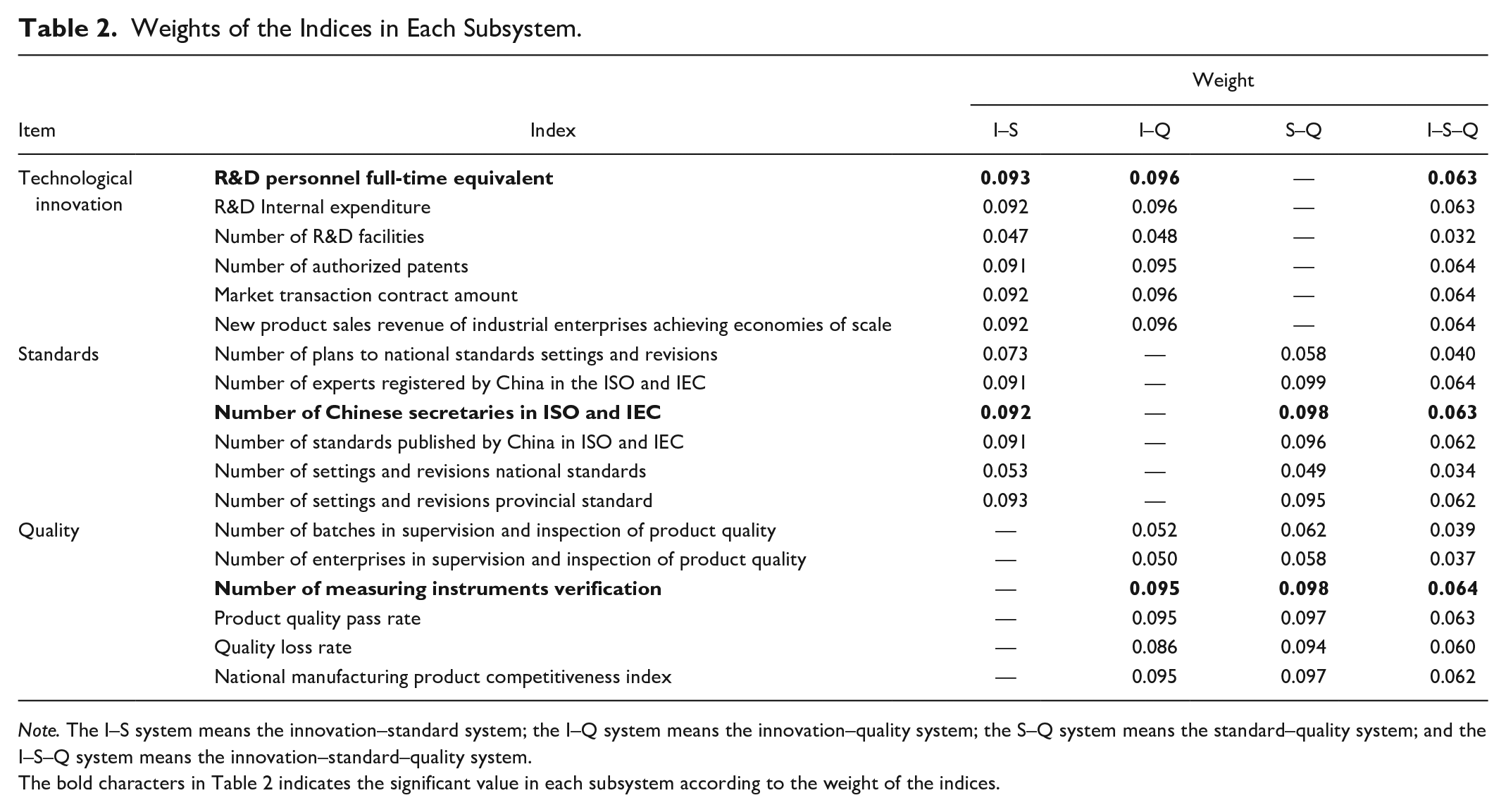
Note. The I–S system means the innovation–standard system; the I–Q system means the innovation–quality system; the S–Q system means the standard–quality system; and the I–S–Q system means the innovation–standard–quality system.
The bold characters in Table 2 indicates the significant value in each subsystem according to the weight of the indices.
The degrees of coupling in the I–S, I–Q, S–Q, and I–S–Q systems during 2007–2016 were separately calculated using Equation (3), as depicted in Table 3. On the whole, the overall evaluation values of the I–S, I–Q, and S–Q systems were all significantly more than that of the I–S–Q system. The overall evaluation value for innovation was more than that of standards and quality. While this was in sync with reality, it still captured attention, and we will discuss it in detail below. TSQ are crucial elements in the growth and transformation of the manufacturing industry in China, improving product quality and efficiency on the supply side for economic development (L. Li, 2018). That is why it is vital to perform a detailed analysis of the internal aspects that impact these three subsystems.
Comprehensive Evaluation of Technological Innovation, Standards, and Quality Subsystems.

Note. The I–S system means the innovation–standard system; the I–Q system means the innovation–quality system; the S–Q system means the standard–quality system; and the I–S–Q system means the innovation–standard–quality system. UI is the comprehensive power index of the innovation subsystem, and US is the comprehensive power index of the standard subsystem, while UQ is the comprehensive power index of the quality subsystem.
The I–S, I–Q, and I–S–Q systems’ comprehensive evaluation values increased over time, which shows the steady progression of TSQ in China. For the technological innovation system, as compared to the speed of progress in standards and quality, the speed of evolution in innovation was higher. This increase shows that the technological innovation system was more mature and more advanced than the standards system and quality system, which need to integrate innovation with quality through quality approaches and manage for innovation through quality improvements in the Quality 4.0 era (S. Kim et al., 2020; Zonnenshain & Kenett, 2020). Enterprises can also consider establishing technical standards and designing methods for supervising manufacturing processes, thereby continually develop high-quality products (Jiang et al., 2018).
The development of the standard subsystem was satisfactory. It experienced significant progress in 2012–2013, which is partially due to the introduction of thorough reforms by the Chinese government—this led to enhanced work procedures that were standardized. It developed quality standards and blended association standards into the new law of standardization. The coefficient-link with the standard subsystem was lower than that of the quality system in 2007. In 2013, the standard system coefficient was more than that of the quality system. The State Council and the People’s Republic of China put forward a plan—deepen the reform of standardization work in 2015, transforming the current standard system of single government supply into a new standard system that combined government leadership and market autonomy. Passing standardization reform in 2016, both the coefficients of standards and quality were almost perfectly coordinated.
In the case of the quality subsystem, there was a staged increase in its overall evaluation values. During 2008–2013, the observed value of 2008 was in the valley at this stage, at the same time, at the start of sustained growth. In the aftermath of the Chinese milk scandal in 2008, there was increased attention on effectively managing brands and effectively supervising products’ safety. In 2013, the Chinese government introduced the policy—Guiding Opinions on Accelerating the Promotion of Manufacturing Quality Upgrade and Promoting Sustainable and Healthy Economic Development—growing quality improvement for the manufacturing industry while also helping with the economic growth. It was designed to formulate long-term policies for the enhancement of quality in the manufacturing industry.
Most recent technological innovations present some good cases to illustrate the value of coupling coordination among TSQ systems. (1) Driven by technology, 5G has become the hottest topic among communication academics and industries. As a national standards organization, China Communication Standard Association (CCSA) has been engaged in preparing 5G standards documents. In 2018, the application working group aimed to push 5G typical applications in the vertical industry, and operators focused more on the process and quality of 5G infrastructure (S.-Z. Chen & Kang, 2018). With the coupling development among TSQ systems of 5G, China dominates the next generation of wireless technology, and the U.S. treats China as a National Security Threat (Kaska et al., 2019). (2) With a strong investment from the central governments, the Chinese high-speed railway technologies have expanded rapidly over the past decade (Z. Chen & Haynes, 2017). The construction quality and safety of high-speed railway network demand to set technology standards and implement nationwide. It is necessary to speed up the transformation of Chinese high-speed railway technical standards into international standards that can export high-speed rail technology within the Belt and Road Initiative (Hong, 2014).
Subsystem Coupling Results and Development Speed Analysis
The coupling levels (C) of the I–S, I–Q, and S–Q system first decreased and then obviously increased from 2007 to 2016 in China, with the inflection point occurring in 2010 (Table 4). The development coefficient (E) trend during 2007–2016 was fairly consistent with coupling levels.
Degrees of Coupling of the Innovation, Standard, and Quality Subsystems.
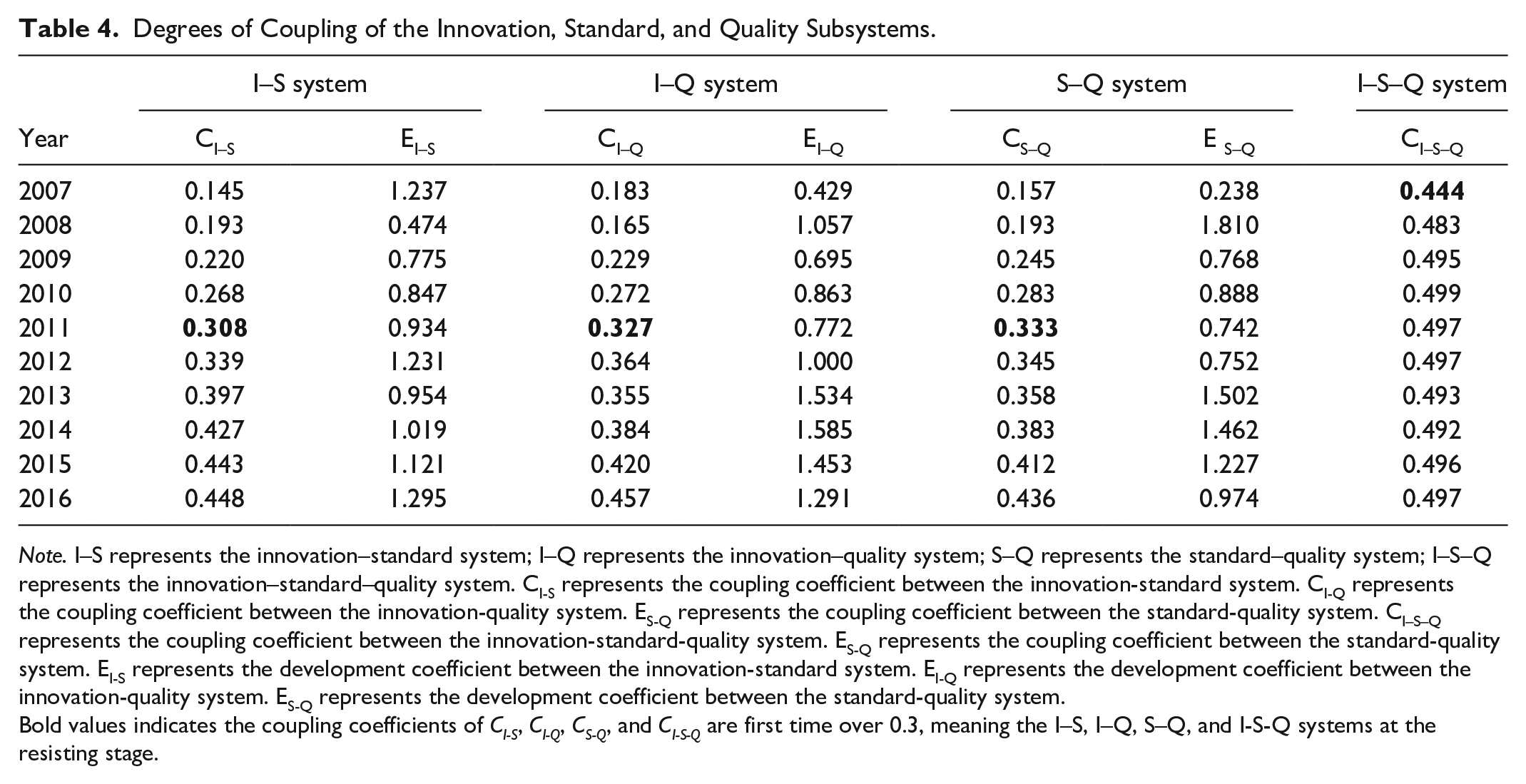
Note. I–S represents the innovation–standard system; I–Q represents the innovation–quality system; S–Q represents the standard–quality system; I–S–Q represents the innovation–standard–quality system. CI-S represents the coupling coefficient between the innovation-standard system. CI-Q represents the coupling coefficient between the innovation-quality system. ES-Q represents the coupling coefficient between the standard-quality system. CI–S–Q represents the coupling coefficient between the innovation-standard-quality system. ES-Q represents the coupling coefficient between the standard-quality system. EI-S represents the development coefficient between the innovation-standard system. EI-Q represents the development coefficient between the innovation-quality system. ES-Q represents the development coefficient between the standard-quality system.
Bold values indicates the coupling coefficients of CI-S, CI-Q, CS-Q, and CI-S-Q are first time over 0.3, meaning the I–S, I–Q, S–Q, and I-S-Q systems at the resisting stage.
Note the coupling degree (C) between each subsystem during 2007–2010; the coupling coefficient of I–S, I–Q, and S–Q systems were observed to be less than 0.3 at the low-level coupling stage. In terms of development speed (E), the average development coefficient of EI-Q (0.761) did not reach 0.8, while EI-s (0.833) and Es-Q (0.926) are larger than 0.8. The speed of innovation was less than that of standards and quality, hence restricting quality improvement and standards. Besides, the pace of the development of standards was synchronized with each other. Overall, the development speed of each subsystem showed the order of quality, standard, and innovation. It was portrayed through the insufficient supply of standards and an imbalance between supply and demand for standards, restricting enhancements to the industrial economy and causing the TSQ subsystems to deteriorate.
During 2011–2016, the I–S, I–Q, S–Q, and I–S–Q systems were observed to be at the resisting stage, where the value of C was between 0.3–0.5. The population means of EI-S (1.09) and Es-Q (1.11) were in the range of 0.8 to 1.2, revealing that the standard subsystem was synchronized with each other. EI-Q (1.27) was mostly higher than 1.2, which is evident that innovation was ahead of quality improvement. Overall, each subsystem’s development speed showed the order of innovation, standard, and quality, explaining that the innovation subsystem’s advancement would boost standards-setting and quality development. The quick encroachment of the standards system contributed positively to growing product quality while making the standards system more efficient (Blind, 2016). According to the market demand, it performed a new standard system of coordination between the government-led mandatory standards and the market-oriented voluntary standards (Blind et al., 2017).
On the whole, during 2007–2016, the three methods were found to be at the resisting stage and in a state of stable coupling development. Together, these subsystems were significantly coupled but going into a state of low-level equilibrium. The coupling coefficient of CI–S–Q is in the range of 0.3–0.5 during 2007–2016 and is restricted for going into the next stage. Considering that the quality subsystem’s development speed lagged, to survive this, the government needs to enhance the procedures used for measuring, inspecting, quarantining, and certifying to improve the quality subsystem (Camisón & Puig-Denia, 2016; Hoyle, 2009). The importance of China’s supply-side structural reform has been issued to support improving supply quality (Boulter, 2018).
Subsystem Coordination Results and Analysis
In terms of the overall coordination effect (T) between each pair of subsystems, it showed an upward trend. It presented consistency in I–S, I–Q, and S–Q subsystems, respectively entering the resisting coordination stage in 2009 and the run-in coordination stage in 2015, which shows a gradual decrease in each development difference system. The three systems’ coordination lagged behind the two systems, which were at the low-level coordination stage during 2007–2009, at the resisting coordination stage during 2010–2015, and entering the run-in coordination stage in 2016.
Looking at the coupling coordination degree (D), the three subsystems were at the moderate-level coupling coordination stage during 2007–2015 and reached the high-level coordination stage in 2016. The I–S, I–Q, and S–Q systems reached the high-level coupling coordination stage at various times, in 2014, 2015, and 2016. It is depicted as a mild imbalance in the optimization of the three subsystems. In each subsystem, the coupling speed among total TSQ subsystems was less than that of any two subsystems. It is in sync with the actual development status and needs to be taken into consideration. The empirical analysis showed that standardization is the primary motive for quality improvements, increased productivity, legal security, and technical interoperability (Blind & Müller, 2020). Standards subsystem can be useful tools to balance the development speed of the three subsystems (Table 5).
The Degrees of Coordination of Innovation, Standard, and Quality Subsystems.
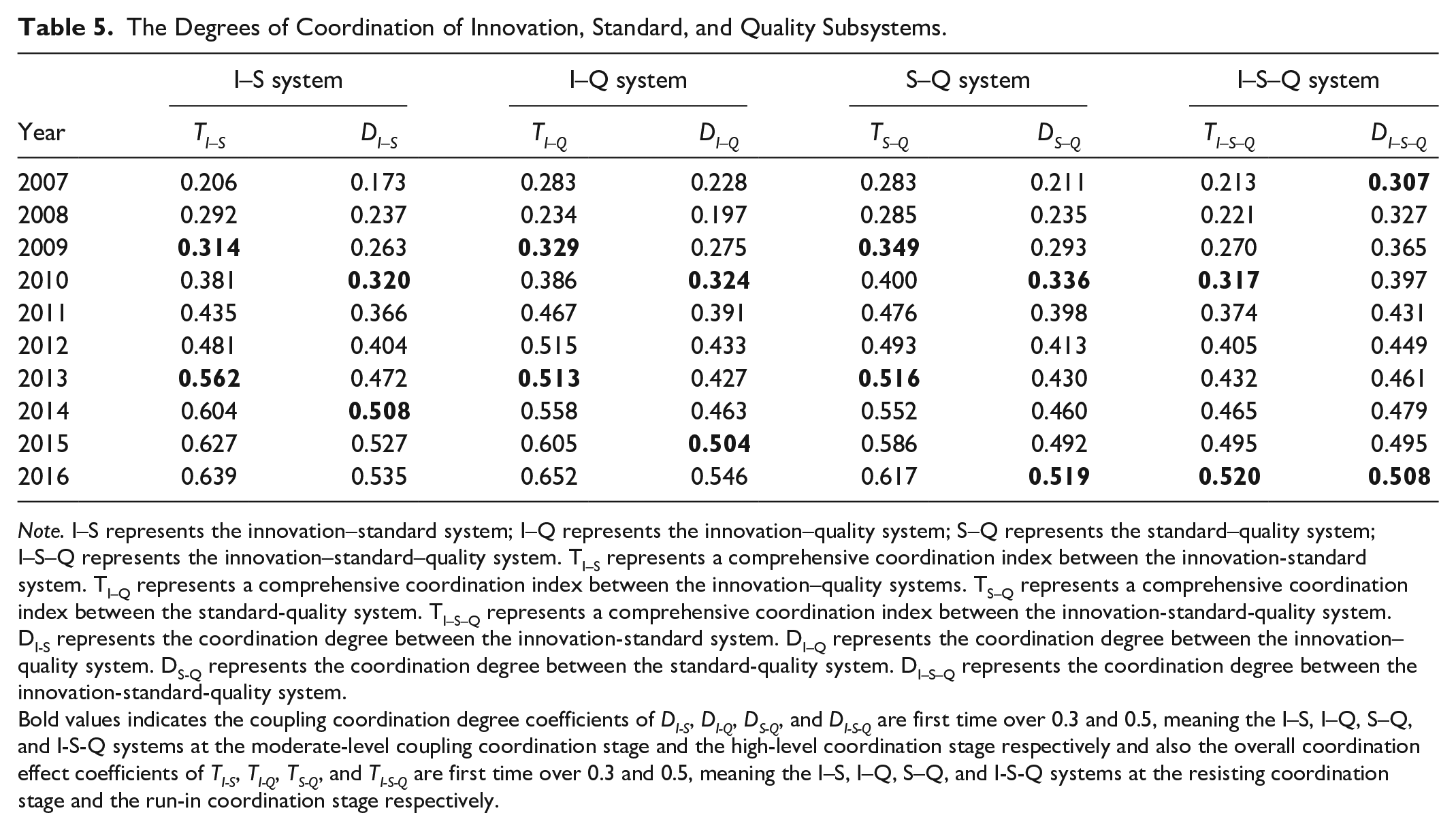
Note. I–S represents the innovation–standard system; I–Q represents the innovation–quality system; S–Q represents the standard–quality system; I–S–Q represents the innovation–standard–quality system. TI–S represents a comprehensive coordination index between the innovation-standard system. TI–Q represents a comprehensive coordination index between the innovation–quality systems. TS–Q represents a comprehensive coordination index between the standard-quality system. TI–S–Q represents a comprehensive coordination index between the innovation-standard-quality system. DI-S represents the coordination degree between the innovation-standard system. DI–Q represents the coordination degree between the innovation–quality system. DS-Q represents the coordination degree between the standard-quality system. DI–S–Q represents the coordination degree between the innovation-standard-quality system.
Bold values indicates the coupling coordination degree coefficients of DI-S, DI-Q, DS-Q, and DI-S-Q are first time over 0.3 and 0.5, meaning the I–S, I–Q, S–Q, and I-S-Q systems at the moderate-level coupling coordination stage and the high-level coordination stage respectively and also the overall coordination effect coefficients of TI-S, TI-Q, TS-Q, and TI-S-Q are first time over 0.3 and 0.5, meaning the I–S, I–Q, S–Q, and I-S-Q systems at the resisting coordination stage and the run-in coordination stage respectively.
Subsystem Coupling Coordination Results and Analysis
The I–S, I–Q, and S–Q systems have slowly been optimized from the low-level coupling stage to the resisting stage. However, the run-in stage for the systems has not been achieved. Ominously, it is crucial to observe the degree to which the innovation subsystem exceeded the other two. Improvements in the industry are restricted when there is a discrepancy between the development speed of quality and innovation (Blind et al., 2017). In the beginning, a gratifying progression was observed for the standards subsystem, and it lagged behind the technological innovation subsystem and quality subsystem during 2007–2012. It progressed in line with the technological innovation subsystem and quality subsystem during 2013–2014, given its overall evaluation value. In 2016, both the coefficient of TSQ were almost coordinated. As the essential tools and approaches, standards play a key role in integrating innovation with quality, balancing the coupling coordination relationship among three systems (Zonnenshain & Kenett, 2020).
For each of the pairs of subsystems, the extent of coordination was more significant as compared to the degree of coupling between the same pairs, depicting that the couple grew from a low-level to high-level coordination stage in a spiral pattern. A transitional level has existed among the three subsystems in terms of coupling coordination. The coupling coefficient of DI–S–Q is always in the range of 0.3–0.5 during 2007–2016, hence triggering a need for optimization for enhancing the supply quality for the development of the Chinese manufacturing industry. Understanding the dynamic state of coupling coordination of TSQ subsystems, we could know that the quality subsystem is the shortboard subsystem that should be improved before making effective policy. Made in China 2025 (MIC2025) has been proposed to enhance its manufacturing supply capabilities, focusing on quality, standardization, and brands (Wang, Wu, & Chen, 2020). The standard subsystem plays the role of bridge and tools to balance the three subsystems’ development speed, which needs to carry out the reform of standardization system, particularly pertinent for developing countries who are often standard-takers (Curzi et al., 2020) (Figure 2).
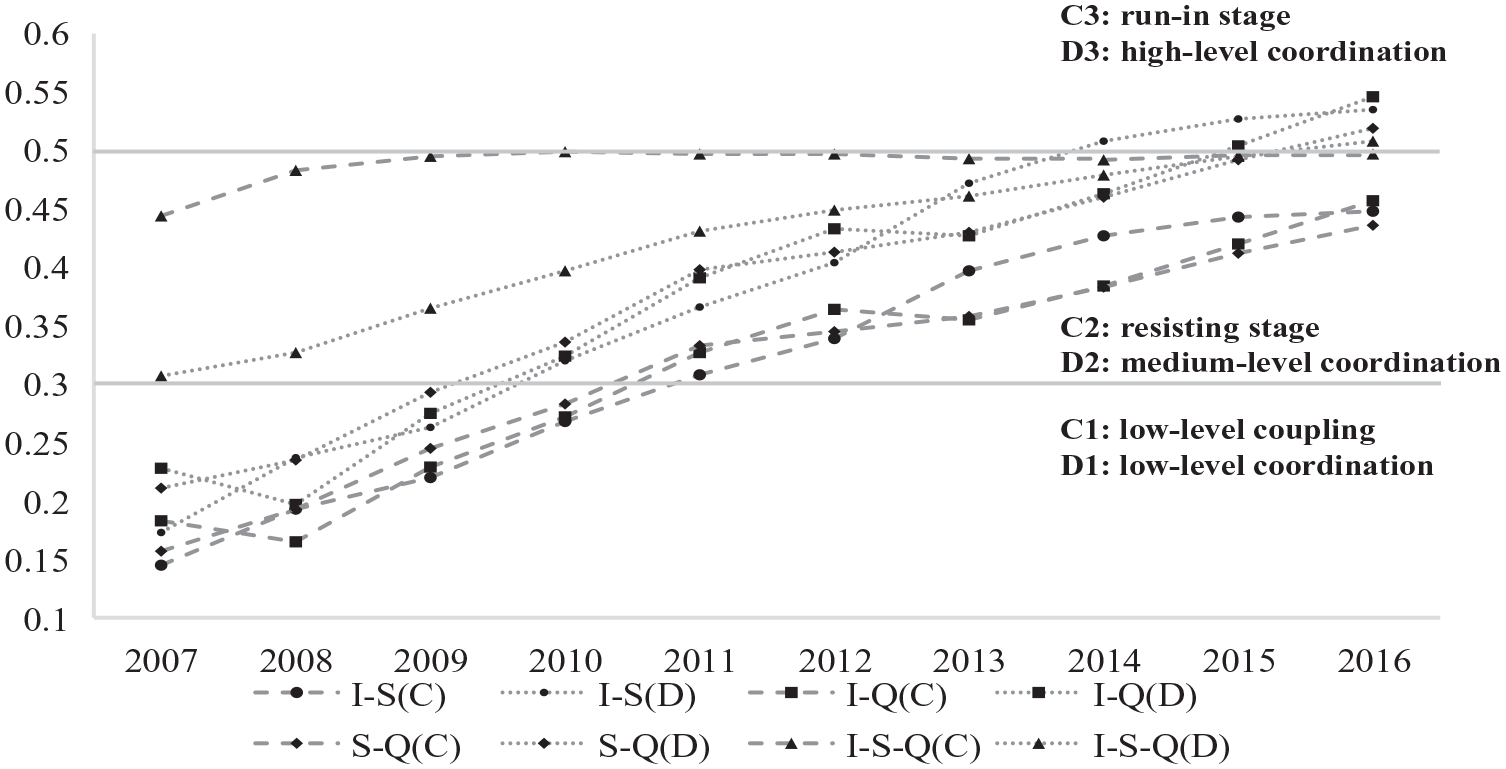
Overall subsystem coupling coordination results.
Impact Analysis of Subsystem Coupling Coordination and Economic Growth
The coupling coordination degree of TSQ subsystems is determined from the above analysis. The connection between economic growth and the coupling coordination degree of TSQ subsystems (D) can be quantified, including these explanatory variables of DI-S, DI-Q, DS-Q, and DI–S–Q. Furthermore, real GDP per capita was conducted as the dependent variable to quantify economic growth (Pece et al., 2015). The data was obtained from the China Statistical Yearbook in the period 2007–2016. The regressions method was used to estimate the connection between economic growth and the coupling coordination degree of TSQ subsystems. The empirical results are presented in Table 6.
Regression Results Between Economic Growth and Coupling Coordination Degree.

, **, and *** respectively represent statistical significance at the 10%, 5%, and 1% levels.
Models 1–4 provide evidence of a positive and significant link between the coupling coordination degree of TSQ subsystems and economic growth. Furthermore, the results indicated that the influence coefficient of DI–S–Q (8.514) was superior to DS-Q (5.659), DI-Q (5.049), and DI-S (4.642), which implies that paying attention to the coupling coordination degree of all three subsystems was more important than two subsystems for economic growth. The Adjusted R-square is a high overall model, which was explained by the fact that the conducted regression model represents the overall regression model.
There is a strong relationship between technological innovation and standards (Blind & Müller, 2020), technological innovation and quality (Zonnenshain & Kenett, 2020), and standards and quality (de Melo & Nicita, 2018). However, the dynamic mechanism among the three systems, especially in developing countries, is unclear. With the help of combined recent research (J. Li et al., 2018), our study is one of the first evaluations of the dynamic coupling process among TSQ subsystems using the CCDM model, focusing on China from 2007–2016, quite a specific period experienced a series of quality supply reform. Second, we extend the applying the CCDM in policy evaluation, which has been widely used in economic and environmental studies (J. He, Wang, et al., 2017). This is an essential extension because different policies may have different elements, which is difficult to evaluate at the macro level but affect the optimization policies (Boulter, 2018).
Moreover, this article intends to assess the implementation of supply-side structural reforms policies by three CCDM models and determine the subsystems that make the most significant contribution. With the collaborative shortboard of the TSQ subsystems by the coupling coordination degree, we can understand the development coefficient’s robust development status. Finally, this study analyzes the coupling coordination degree of TSQ subsystems and their impacts on a developing country’s economic growth. Policymakers can formulate correct and actual production strategies and policies by carefully understanding the relationships between the coupling and coordination of TSQ subsystems and economic growth (Wang, Wu, & Chen, 2020). Considering the influence of quality upgrading (Curzi et al., 2020) and technology development (Chipidza & Leidner, 2019) to promote economic growth, especially in developing countries, it is vital to assure policy implementation effect and enhance policies strength.
Conclusions and Implications
This article addressed the coupling relationship among technology advancement, standard development, and quality improvement through a CCDM. However, the dynamic mechanism among the three systems is still unclear. Before taking action to improve supply capacity, the relationship among TSQ subsystems in different stages is acknowledged. This study purposes to dynamically grasp the internal coordination and external coupling of TSQ subsystems during the development process by exploring the relationship between subsystem-coupling coordination. Based on the empirical work, the coupling coordination degree of TSQ subsystems and their overall impact on economic growth in a developing country.
The analysis results show that comprehensive evaluation values in the I–S, I–Q, S-Q, and I–S–Q systems increased over time. The technological innovation system was more mature and more advanced than the standard system and quality system. The standard subsystem development experienced significant progress in 2012–2013 due to the Chinese government’s standardization reforms. In terms of development speed (E), the technological innovation subsystem has achieved rapid development during 2007–2016. But In 2007–2010, the speed of innovation was less than that of standards and quality, hence restricting quality improvement and standards. In 2011–2016, innovation was ahead of quality improvement. Besides, the development of standards was synchronized with each other. Simultaneously, the quality subsystem’s development speed lagged, not well to meet customer requirements and generate product competitiveness.
Moreover, the coupling evaluation model shows that TSQ subsystems achieve high-level internal coordination and resist coupling. In each subsystem, the coupling speed among I–S–Q subsystems was less than that of any two subsystems. Understanding the dynamic state of coupling coordination of TSQ subsystems, the quality subsystem is the collaborative shortboard subsystem. The standard subsystem plays the role of tools to balance among the three subsystems. Technological innovation boosts standards-setting and quality development.
There is positive and significant evidence that a link between the coupling coordination degree of TSQ subsystems and economic growth. By comparing the influence coefficient of DI–S–Q (8.514), DS-Q (5.659), DI-Q (5.049), and DI-S (4.642), we can found that the effect of the coupling coordination relationship of three subsystems on economic growth is more significant than that of two subsystems. It is critical to improving the coupling coordination degree among three subsystems that can speed up the gross economy’s transformation process to a quality economy. Hence, this study provided some important theoretical implications and managerial implications for academics and practitioners.
Theoretical Implication of the Study
The results emerging from this article have some relevant theoretical implications. First, the previous research mainly focuses on the one-way effect. Many published studies investigate the relationship between technological innovation and standards, technological innovation, quality, standards, and quality. Moreover, these methods prefer to use subjective data to analyze the TSQ subsystem’s relationship, mainly focusing on the micro-level. This study assesses the coupling relationship and development difference among TSQ subsystems by developing a CCDM. Second, a relative development scale model is designed to estimate the subsystems’ development coefficient, evaluating each subsystem pair’s relative development status. We find that the quality subsystem is the collaborative shortboard subsystem. The standard subsystem plays the role of tools to balance among the three subsystems, and the technological innovation would boost standards and quality subsystems. It is evident that a positive and significant link between the coupling coordination relationship of TSQ subsystems and economic growth. This facilitates a shred of essential evidence to optimize the supply structure and promote emerging economies’ economic growth.
Managerial Implication of the Study
The outcomes of this research have some relevant managerial implications. Governmental policy-making departments may use this quality-related information and methods to draw up effective macro-control industrial policies. Insufficient market participation has resulted in the inadequate provision of standards and misplacement of standards supply and demand, preventing standards from promptly fulfilling market demands. The government should speed up the market-oriented reform process of China’s standard system from the government-centered standardization strategy to combine elements of market-led standardization. Second, we find that TSQ subsystems achieve high-level internal coordination and resisting coupling between one another by CCDM. Promoting the coupling relationship into the run-in stage is important with the effective long-term help from the SSSR policy. If producers and policymakers can improve the quality subsystem, it would be better to match the coupling coordination degree of TSQ subsystems. The TSQ subsystems solve the structural problems of excessive low-end supplies and insufficient high and mid-grade supplies in emerging economies. Finally, with continuing economic growth in China, the focus is slowly shifting toward higher quality products and high value-added products. Higher quality, not only the price, would become the focal point for both policymakers and Chinese consumers (Anwar & Sun, 2018). The coupling coordination relationship of TSQ subsystems would positively impact economic growth. Therefore, the decision-making authorities focus not only on the policy improvements but also on technological innovation, standard-setting and quality improvement, and the coupling relationship among the TSQ subsystems. This study can help in making the right and dominant policies, beneficial for the developing economies.
Limitations of the Study
Although the CCDM model in this study can investigate the dynamic coupling relationship among TSQ subsystems, several limitations are listed. First, this research focused on the internal mechanism of technological innovation, standard, quality, and the external environment of government policy and economic growth status. Still, no quantitative evaluation of its impact on the three subsystems’ coupling coordination degree is provided. There is an important function between the reform policies and each subsystem’s development, but the mechanism is not precise in this study. This study addresses Chinese conditions, a country with many unique variables and structural transformation. For the various stages of internal coordination and external coupling, we can assess the role of national policies and technologies, science, industry factors, and tax regulations to push the development of coupling stages. Besides, it is significant to add data from other countries and make a comparison among the findings.
Footnotes
Declaration of Conflicting Interests
The author(s) declared no potential conflicts of interest with respect to the research, authorship, and/or publication of this article.
Funding
The author(s) disclosed receipt of the following financial support for the research and/or authorship of this article: This work was partially supported by the National Social Science Foundation of China (NSSFC) under grant number 18BJY033.
