



Abstract
This study aims to investigate the institutional factors that contribute to helping countries successfully escape the middle-income trap, focusing on the aspect of institutional quality. The results indicate that the quality of institutions has a substantial and favorable effect on enhancing economies’ capacity to overcome the middle-income trap. In addition, the examination of institutional quality reveals that factors such as anti-corruption, government efficiency, social stability, rule of law, democracy, and market regulation all contribute positively to an economy’s capacity to overcome the middle-income trap. Therefore, to enhance the likelihood of late-developing economies overcoming the middle-income trap, governments should strengthen their reform endeavors and enhance the caliber of regional institutions.
Introduction
The world economy has gotten more fragmented and income gaps across countries have become more pronounced since the industrial revolution. Additionally, development patterns have become more diverse (Easterly et al., 1993). Over the past few decades, numerous countries have undergone a transition from the low-income to middle-income phase of development. Nevertheless, many developing countries have become ensnared in the middle-income trap, a situation characterized by stagnant economic growth and the inability to make significant progress (World Bank, 2017). What is the fundamental reason of the enduring disparity in economic progress across different countries? This has inspired academics to undertake comprehensive research on the causes and remedies of the middle-income trap.
Institutional quality is a factor widely recognized as being closely related to economic development. High-quality institutions encompass a stable political climate, a transparent legal system, and effective governance institutions. These factors create a favorable atmosphere for fostering economic activity, encouraging innovation, and stimulating economic growth (Acemoglu & Robinson, 2012). New institutional economists, represented by North (1990), also argue that individual economic behavior, factor development, and economic growth are all constrained by a country’s institutions. The development patterns and growth efficiency of a country’s economy will depend on the institutional restrictions it faces. Studies that have examined factors such as geography and culture have concluded that institutions are the primary determinant of long-term economic growth (Acemoglu et al., 2019). In modern economic development, the progress of the economy is significantly influenced by the evolution of political and economic institutions. It is within the framework of institutional turnover and the enhancement of role efficiency that the economy thrives and advances. However, this process is not a straightforward one. The quality of institutions in numerous middle-income countries is rather questionable in practice. Corruption, deficiencies in public services, disturbances to democratic processes, and social turmoil are frequently linked to countries undergoing the middle-income trap. This is illustrated by the Latin American nations that attained middle-income status throughout the 1960s. The occurrence of these issues additionally impedes the progress of regional economic growth and the potential to overcome the middle-income trap.
Consequently, employing the framework of new institutional economics, this study will make use of a binary dependent variable model to analyze the relationship between institutional quality and the economy’s ability to exceed the middle-income trap. The study findings indicate that the quality of institutions has a notable and favorable effect on enhancing the economy’s capacity to overcome the middle-income trap. Furthermore, the examination of the mediation mechanism demonstrates that the quality of institutions enhances the likelihood of an economy surpassing the middle-income trap by fostering regional economic growth. In addition, the examination of institutional quality reveals that factors such as anti-corruption measures, government efficiency, social stability, rule of law, democracy, and market regulation all contribute positively to an economy’s capacity to overcome the middle-income trap.
The rest of the paper is arranged as follows: the subsequent section presents the literature review; the third part is the research design; the fourth part is the empirical analyses and robustness tests; finally, conclusions apolicy recommendations are provided.
Literature Review and Research Hypothesis
Over the past five decades, most of the world’s countries and territories are still in the middle-income stage. Some have transitioned to low-income status, while only a small fraction (around 10% of the total) have achieved high-income status. Consequently, the likelihood of achieving economic catch-up is low as well, and it is indeed true that the middle-income trap exists. Accordingly, it is crucial to examine the mechanisms by which economies can overcome the middle-income trap.
Institutional Quality and the Middle-Income Trap
Mauro (1995) examines the influence of corruption on the growth of the economy and highlights the significance of institutional governance in countries with middle-income. The author argues that the presence of corruption and dysfunctional institutions might result in middle-income countries experiencing a state of economic stagnation, characterized by a lack of growth in income levels. In addition, Khan and Jomo (2002) investigated the correlation between resource rents and rent-seeking behaviors, and the impact they have on distorting institutions in middle-income nations, thereby impeding economic progress. Meanwhile, Easterly and Levine (2003) analyzed the middle-income trap by considering both geographical and institutional factors. The study reveals that the combination of geography and institutional governance plays a crucial role in shaping a country’s growth direction. Furthermore, it suggests that diverse geographical conditions may necessitate distinct institutional advancements in order to prevent economic stagnation. According to Rodrik (2008), the government’s ability to effectively govern institutions and guide industry toward technological advancement is crucial for avoiding the middle-income trap. To overcome the challenges of the “middle-income trap,” the implementation and development of institutional design and construction are utilized as a strategic solution.
Khan (2008) specifically examines the impact of institutional governance on the economic and social progress of nations. The author introduces the notion of “governance capacity,” highlighting its significance in enabling countries to evade the middle-income trap. Kaufmann et al. (2011) evaluate the degree of institutional governance in countries using multiple dimensions. These indicators can be utilized for the analysis of a country’s governance quality in order to comprehend its susceptibility to the middle-income trap. According to Acemoglu and Robinson (2012), efficient political systems have the potential to stimulate economic growth, but unstable or rent-seeking political systems can result in the middle-income trap. Aiyar et al. (2018) investigated the problem of growth slowdown in middle-income nations and examined the influence of institutional governance factors, such as corruption and the extent of the rule of law, on economic growth. A report by the World Bank (2017) highlighted the significance of institutional governance in middle-income countries, emphasizing that the establishment of efficient institutions can assist nations in avoiding the middle-income trap and attaining sustainable development. Tian and Chen (2020) argue that the middle-income trap arises from the challenge of transforming institutions. This is because the relationship between development and governance is not effectively managed, resulting in government failure, market distortion, and societal disarray. Consequently, progress toward transformation is hindered. They propose that focusing on this issue requires enhancing the modernization of the national governance system and its capacity. Therefore, considering the aforementioned examination of the literature, this work proposes the initial research hypothesis:
H 1: Institutional quality can increase the probability of a latecomer economy crossing the middle-income trap.
Institutional Quality and Economic Growth
North (1990) examined the impact of institutions on economic growth and posited that the effectiveness of institutional arrangements, such as safeguarding property rights, enforcing contracts, and government behavior, is crucial in advancing economic progress. He emphasizes the significance of the historical development of institutions and the influence of changes in institutions on economic performance. Economides and Egger (2009) contend that institutions play a pivotal role in shaping economic performance. They assert that disparities in income levels and growth rates among nations primarily arise from variations in institutional organization, structure, and quality. High-quality institutions have the potential to boost economic growth at the regional level, hence increasing the capacity of developing nations to overcome the middle-income trap. Efendic et al. (2011) conducted a study to examine the correlation between institutions and economic development through the utilization of Meta-regression analysis. The findings indicate that higher institutional quality has a beneficial effect on economic development, and it can effectively facilitate the transition of late-developing economies from middle-income status. Law et al. (2013) performed a Granger causality analysis on institutions and economic development using panel data from 60 countries. The findings indicate a reciprocal causality between institutions and economic development. Moreover, this relationship exhibits significant variations depending on the country’s stage of development. In high-income countries, the quality of institutions positively influences economic development, while in low-income countries, economic development has a negative impact on the quality of institutions. In high-income nations, the quality of institutions plays a crucial role in driving economic development. Conversely, in low-income countries, economic development has a negative impact on institutional quality. Similar studies are Barbara et al. (2012) and Francesca (2017).
Chinese scholars have also carried out some empirical studies on the relationship between institutional differences and national income disparities. Huang et al. (2013) utilize cross-country data to estimate the enduring influence of institutional discrepancies on income inequalities among nations. The empirical findings demonstrate that variations in institutions have a persistent and substantial impact on the disparity in wealth between nations. Furthermore, this effect exhibits a progressive increase throughout the sample period. Tao and Peng (2018) conducted theoretical analyses using the endogenous economic growth model to examine the process of transitioning from factor-driven to innovation-driven economic growth. They focused on the role of institutional quality and proposed the concept of institution-dependent economic growth. In Cheng’s (2019) study, the structural equation modeling (SEM) technique was employed to demonstrate that income disparity can be mitigated by enhancing the degree of economic development. However, this requires the implementation of appropriate institutional frameworks. Hence, this work puts out a secondary research hypothesis:
H 2: Institutional quality increases the probability of a latecomer economy crossing the middle-income trap by promoting regional economic development.
Modeling and Methodology
Model Design
In order to test research hypothesis 1, this research utilizes a binary dependent variable model for empirical analysis to investigate the influence of institutional quality and economic growth on the likelihood of an economy transitioning from the middle-income trap, based on the theoretical analysis presented above. To achieve this objective, this study formulates the subsequent econometric model:

In order to test research hypothesis 2, which examines how the intrinsic factors of the institution affect the ability of the country or region to cross the middle-income trap, this paper develops model (2):
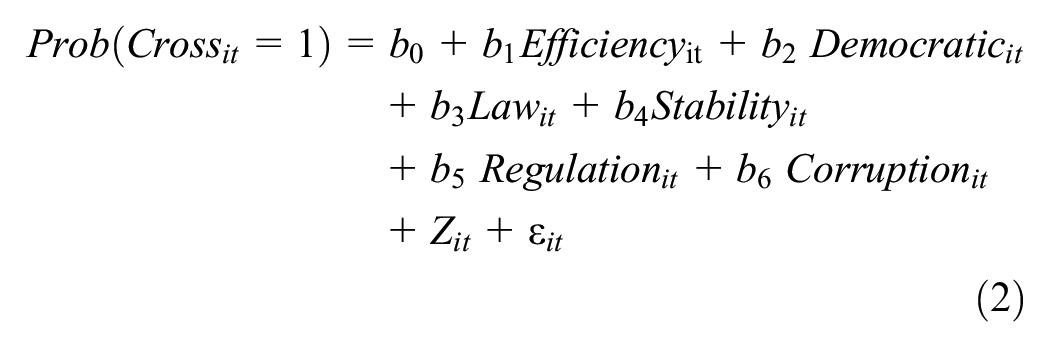
Where, the subscripts i and t represent country and year, respectively. The dependent variable Prob (Crossit = 1) signifies whether the economies have successfully exceeded the middle-income trap. With a value of 1 indicating that the economy has crossed the middle-income trap and a value of 0 indicating that the economy is still in the middle-income trap stage.
(1)The explanatory variable IQI (Institutional Quality Index) represents the quality of institutions, encompassing multiple aspects, some of which are difficult to measure. To ensure objectivity and replicability, this paper utilizes the World Bank’s Worldwide Governance Indicators (WGI) database as a proxy variable to measure institutional quality. This includes factors such as democratic institutions, the rule of law, government efficiency, market regulation, corruption control, and political stability (Bruinshoofd, 2016). An institutional quality index is then created using principal component analysis. The pertinent indicators are displayed in Table 1:
(2)Middle-income trap
Institutional Quality and Its Components.

Source. World Governance Index (WGI) database.
The “middle-income trap” is a term used to describe the situation where an economy has protracted periods of economic stagnation or recession after reaching a per capita income level that is considered average globally, which ranges from $4,000 to $12,700 in terms of GDP per capita. The World Bank initially suggested this concept in 2007. In the empirical study, we categorize the sample into two groups: a cross-group and a trap-group. The cross-group consists of 18 countries that have successfully achieved advances, and they are assigned a value of 1. The 16 countries that have become trapped in middle-income status are projected to have little growth. Using a comparative analysis of two groups of nations, we examine the existence of a consistent correlation between the level of institutional quality scores and their capacity to overcome the middle-income trap.
(3)Control variables
Zit denotes the control variables in the model. There are many factors affecting the economic development of a region, and this paper selects the urbanization level (Urb), trade openness (Openness), value added of the service industry (Service), consumption rate of the population (Consumption), capital formation rate (Capital), and innovation output (Patent) as the control variables. Those data are obtained from the World Bank’s development database (WDI) and UNCTAD database. α0 and β0 denote the constant term; εit represents the random error term.
Data Source and Sample Selection
The data on institutional quality in this paper are derived from the World Governance Index (WGI), which span the period from 1996 to 2020, with data missing for 1997, 1999, and 2001. This article conducts a comprehensive review of both domestic and international literature on the middle-income trap, and utilizes the World Bank’s (2009) definition of the relevant indicators. Based on this analysis, 16 countries that have experienced a stagnation in their economic growth in the middle-income stage are identified, while 18 nations that have successfully exceeded this stage are also identified. Among the countries that have fallen into the “middle-income trap”: there are nine in Latin America, two in Eastern Europe, two in Africa, and three in Asia; and there are 18 countries or regions that have crossed the “middle-income trap,” of which eleven are in Europe, two are in North America, and five are in Asia. Details of the countries or regions are shown in Table 2:
Sample Countries or Territories.

Data Descriptive Statistics
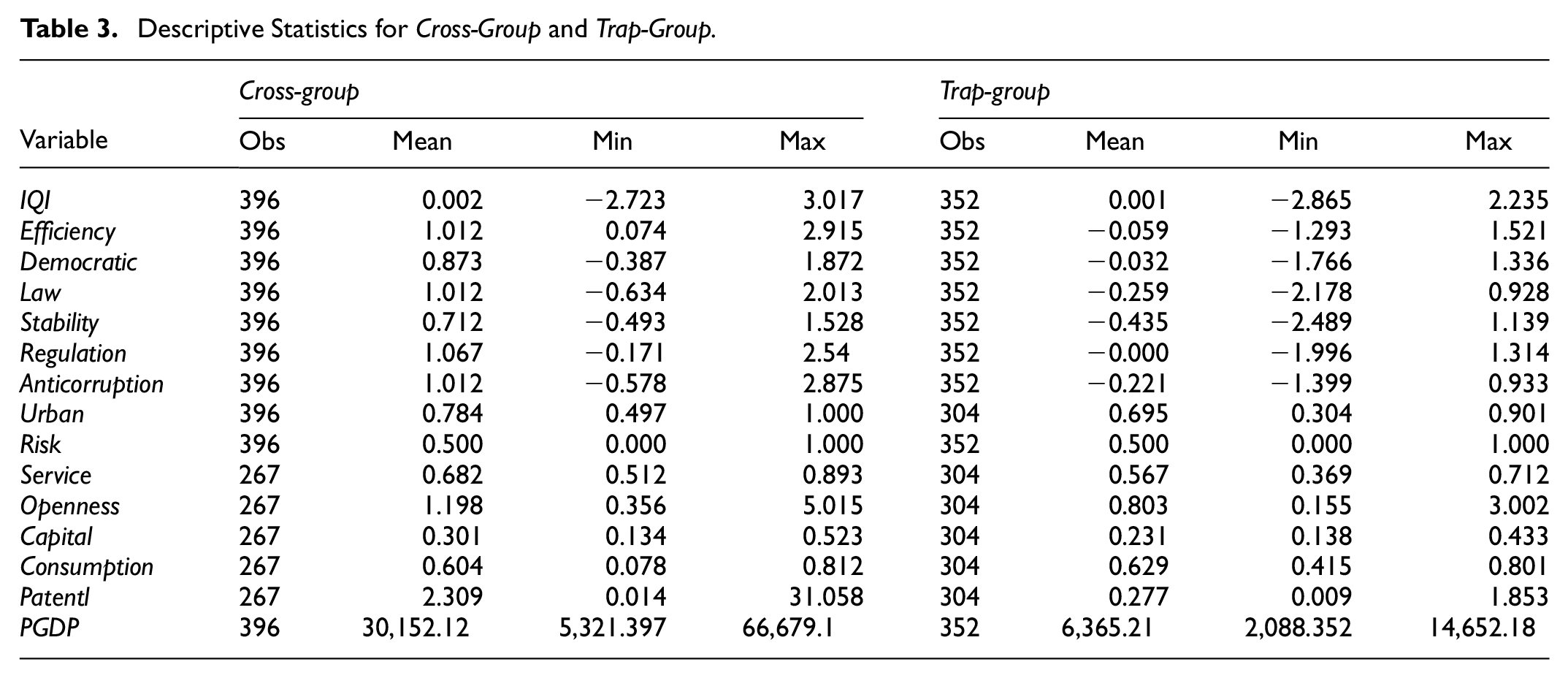
Table 3 reports the results of descriptive statistics for the variables. The table shows that the average institutional quality (IQI) for the cross-group is 0.002, with a maximum value of 3.017 and a minimum value of −2.723. Similarly, the average IQI for the trap-group is 0.001, with a maximum value of 2.235 and a minimum value of −2.865. This data demonstrates significant disparities both among economies and within the groups. The average GDP per capita for the overall group is 30,152.12, but for the trap-group it is 6,365.21. This highlights a substantial discrepancy in per capita income between the two groups. Among the six core indicators analyzed in this study, the average values of the indicators in the cross-group are all positive, while the average values of the indicators in the trap-group are all negative. This suggests that the institutional quality of the trap group is generally lower than that of the cross-group.
Descriptive Statistics for Cross-Group and Trap-Group.
Analysis of Empirical Results
Benchmark Regression
As shown in Table 4, model (1) to (2) are the empirical results based on the binary dependent variable model. The empirical results demonstrate that model (1) reveals a significant coefficient of 1.832 for institutional quality, indicating a strong positive correlation with the likelihood of an economy exceeding the middle-income trap. In other words, higher institutional quality increases the probability of an economy crossing the middle-income trap. Therefore, research hypothesis 1 is supported.
Benchmark Regression Analysis.

Note.***, **, and * represent passing the 1%, 5%, and 10% significance level tests, respectively, with t-values in parentheses.
The Influence of Institutional Structure on an Economy’s Capacity to Overcome the Middle-Income Trap
To further examine the impact of institutional structures on the ability of regions or countries to cross the middle-income trap, this paper investigates and evaluates the six sub-dimensions of institutional quality to gain a deeper understanding of how the inherent structure of institutional quality affects middle-income countries. By executing so, this research employs the binary dependent variable model to examine the six sub-indicators of institutional quality, namely anti-corruption, government efficiency, social stability, market regulation, rule of law, and democracy, individually. The coefficients for anti-corruption, government efficiency, social stability, market regulation, rule of law, and democracy are 4.016, 4.133, 5.656, 2.963, 4.091, and 4.097, respectively, as indicated in Table 5. There is a strong positive correlation between the six metrics and the likelihood of an economy overcoming the middle-income trap. Therefore, research hypothesis 2 is supported.
Sub-Structural Examination of the Impact of Institutional Quality on Economies Crossing the Middle-Income Trap.
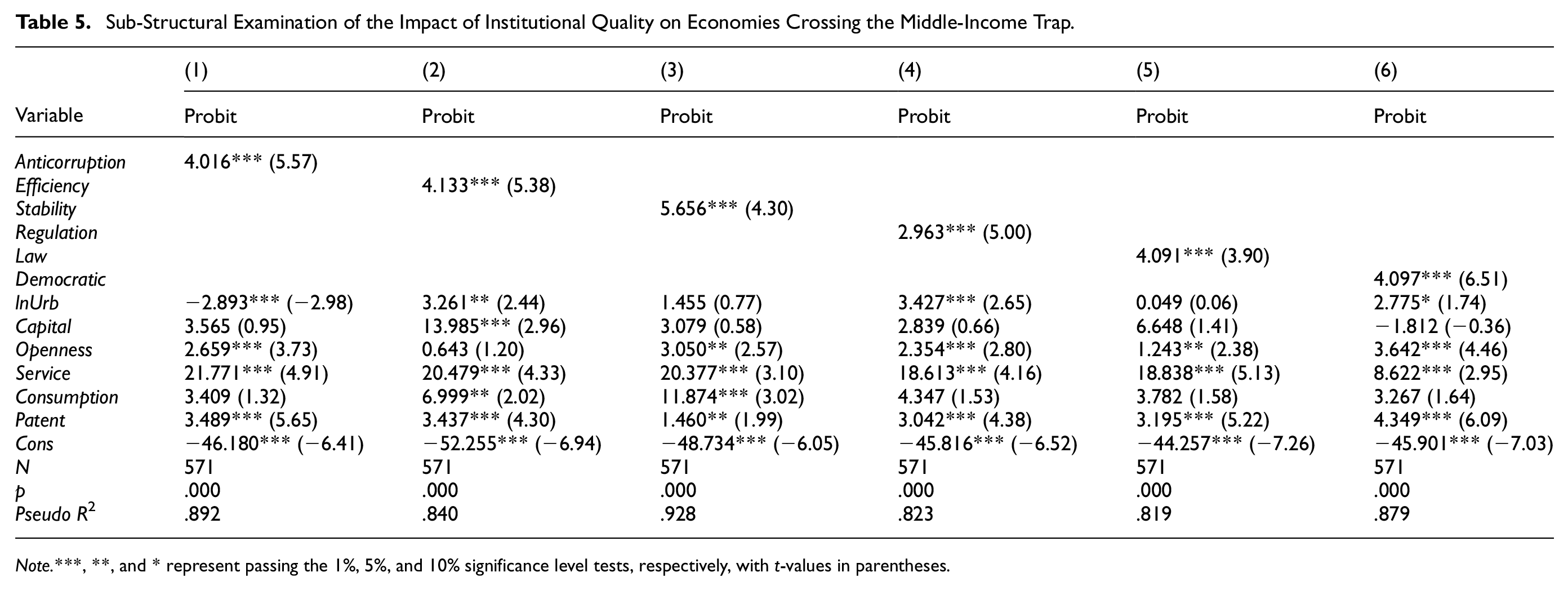
Note.***, **, and * represent passing the 1%, 5%, and 10% significance level tests, respectively, with t-values in parentheses.
More specifically, an effective government operating system (Efficiency), enhances productivity and resource efficiency in the economy, hence fostering economic growth and enabling countries to overcome the middle-income trap. Democracy typically favors political stability and social cohesion, creating a conducive atmosphere for economic progress. Democratic governments exhibit greater transparency and accountability, leading to a decrease in corruption and unwarranted intervention, as well as an enhancement in the effectiveness of governance. A developed legal system (Law) is crucial for ensuring economic stability and sustainable growth. An effective legal framework could protect property rights, enforce market regulations, enhance investor trust, and stimulate economic growth. Stability, both in terms of politics and society, is a necessary condition for overcoming the middle-income trap. A stable political environment and social order are advantageous for attracting investment, fostering economic growth, and mitigating the adverse effects of uncertainties on the economy. Efficient regulation has the potential to mitigate market failures and economic risks, protect fair market competition and consumer rights, and foster sustainable economic growth. Corruption poses a significant barrier to economic development by undercutting equitable competition, impeding the effective allocation of resources, and hampering overall economic progress. Enhancing anticorruption endeavors can bolster government, increase investment conditions, and foster economic progress.
Collectively, these factors influence, to different extents, a nation’s capacity to overcome the middle-income trap. An optimal economic system necessitates the harmonious interplay of efficiency, democracy, rule of law, stability, regulation, and anti-corruption measures to attain enduring economic growth and progress.
Mediation Effect Tests
Institutional quality, considered a non-quantifiable aspect of economic development, cannot independently generate an increase in social wealth. However, it does create a conducive setting for investment, innovation, and the progress of individuals and businesses. By facilitating growth in the real economy, institutional quality strengthens the capacity of regional development to overcome the middle-income trap. Consequently, to examine the above logical relationship, this paper empirically analyses the research method proposed by Baron and Kenny (1986), the mediated effects model, for the study. Table 6 presents the results of the analysis. In the main effect test of the model (1), the regression coefficient of institutional quality on the probability of an economy crossing the middle-income trap is 1.832, which is statistically significant at the 1% level. In the mediation effect test (2), the coefficient of institutional quality on economic growth is 0.277, which is also significant at the 1% level. Lastly, in path (3), when the mediator factor, LnGDP, is included in the model, the regression coefficient of institutional quality decreases to 1.663, and its level of significance has also decreased. The findings validate the presence of a mediating influence of economic growth, namely, the quality of institutions partially mediates the relationship between economic growth and the direction of economies that face the middle-income trap.
Mediation Effect Tests.

Note.***, **, and * represent passing the 1%, 5%, and 10% significance level tests, respectively, with t-values in parentheses.
Robustness Test
Examination of the Issue of Endogeneity
In theory, effective institutions have the potential to stimulate economic growth. However, it is important to note that these institutions can also emerge as a consequence of economic growth. Furthermore, developed economies tend to offer a more conducive climate for fostering institutions more advantageously. Essentially, the quality of institutions can be influenced by factors such as omitted variables and reverse causation, making it endogenous. One issue is that when an economy exceeds the middle-income trap, the relationship between increasing per capita income and the role of institutions in economic growth can lead to a misinterpretation of the impact of institutional quality on crossing the middle-income trap. Additionally, the measurement of institutions may have some bias, and the diverse historical and cultural contexts, as well as the varying stages of development among countries, can underestimate the effect of institutional quality on economies going beyond the middle-income trap.
Hence, to precisely assess the impact of institutions on economic growth, it is imperative to identify suitable “instrumental variables” for institutions. They are capable of elucidating alterations inside the institutions themselves (correlation of instrumental factors), but they do not have a direct or indirect impact on economic growth (homogeneity of instrumental variables). The current amount of research can be seen as an ongoing quest to identify instrumental variables for the system. Mauro (1995) employs a linguistic diversity indicator as an instrumental variable to measure the amount of corruption and governmental efficiency in the nations that were once European colonies. Mauro contends that the percentage of the population in the former colonies who presently speak the language of the Western European colonizers is indicative of the extent of Western Europe’s influence on the region. Furthermore, he posits that the contemporary market economy and democratic system originated in Western Europe. Institutions, among other entities, originated throughout Western Europe. Hence, the impact of Western Europe on the colonies can serve as one of the rationales for the efficacy of the system. Following Mauro’s (1995) research, this work also uses linguistic diversity as an instrumental variable to represent institutions. It addresses the issue of endogeneity in the initial regression by utilizing the IV-Probit approach, as demonstrated in column (1) of Table 7. This work employs a two-stage instrumental variable estimate method, specifically based on the approach proposed by Stock and Yogo (2005). The findings of the study indicate that there is no issue of weak instrumental variables. Therefore, employing linguistic diversity as an instrumental variable is justifiable, and the outcomes of the model estimation can be deemed valid. By employing the aforementioned instrumental factors, we ascertain that institutions have a substantial impact on the economic performance of various nations. The institutional effect is consistently positive across many significance tests, and the estimates demonstrate a certain level of stability.
Endogeneity Test.

Note.***, **, and * represent passing the 1%, 5%, and 10% significance level tests, respectively, with t-values in parentheses.
Robustness Tests
Considering the Time-Delay Effect
This study examines the potential time-delay effects of institutional quality on economic transformation. To account for this, the current period terms of institutional quality, and control variables are replaced with their respective lagged one-period terms. The regression results can be found in Table 8. The table demonstrates that the coefficients of the lagged one-period terms of institutional quality, as well as the control variables, exhibit the same sign and level of significance as those observed in the benchmark regression results. The control variables exhibit consistent results, suggesting the robustness of the regression findings in this paper.
Robustness Test for Considering the Time-Delay Effect.

Note.***, **, and * represent passing the 1%, 5%, and 10% significance level tests, respectively, with t-values in parentheses.
Substituting Variables
The assessment of institutional indicators has been extensively discussed in academic circles (Nedić et al., 2020). To maintain consistency in the empirical research conducted in this paper, the fundamental explanatory variables are substituted, hence mitigating any potential variations arising from different measurements of institutions. The quality of institutions is often assessed using several indicators such as ICRG (International Country Risk Guide), World Economic Freedom (WEF), and Rule of Law Index. In the robustness test, we use world economic freedom (WEF) as a proxy variable for institutions by referring to Quazi’s (2007) research methodology. The findings, as presented in Table 9, demonstrate that the institutional variables assessed by WEF continue to exert a favorable influence on economies that are susceptible to the middle-income trap, thereby highlighting the resilience of the model.
Robustness Test for Substituting Variables.
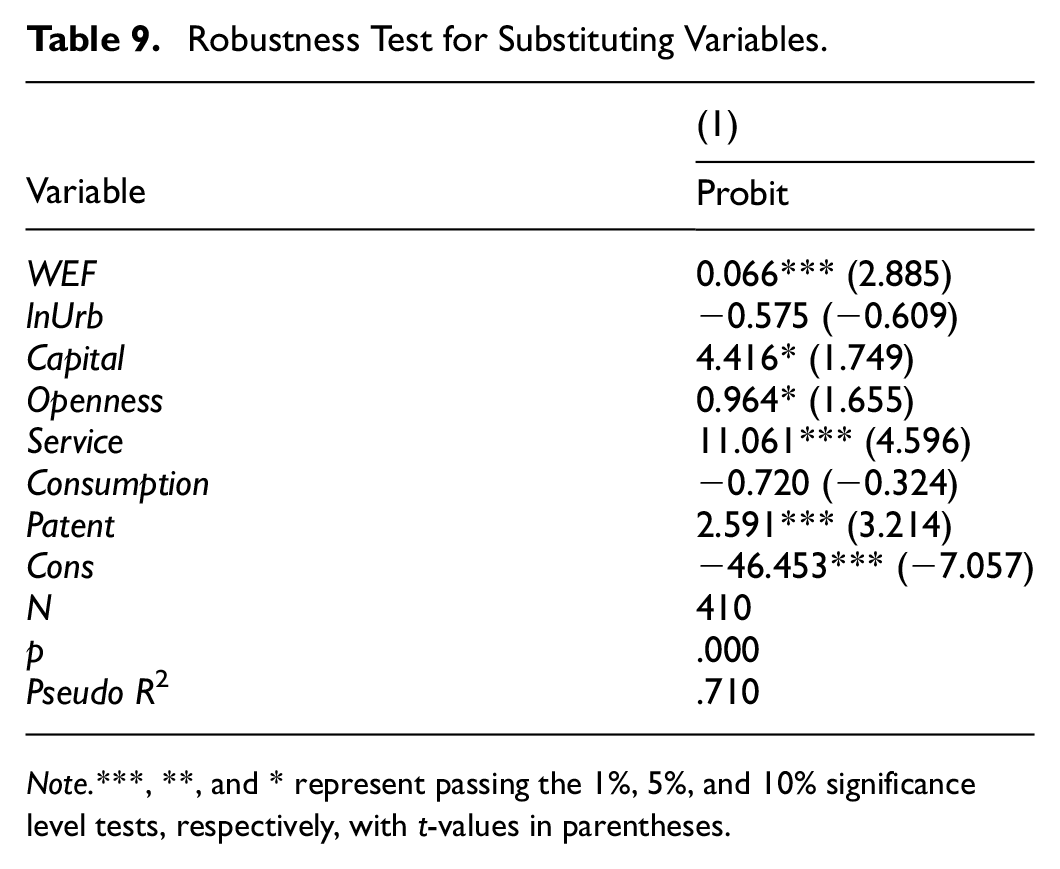
Note.***, **, and * represent passing the 1%, 5%, and 10% significance level tests, respectively, with t-values in parentheses.
Adding Control Variables
To mitigate potential endogeneity issues arising from omitted variables, this study incorporates additional variables, including economic policy uncertainty (WUI), financial crisis dummy (Crisis), and the total value of high-tech industry exports (lnHightec), into the robustness test for thorough evaluation and analysis. The empirical findings are presented in Table 10. Upon incorporating additional control variables, the coefficient and significance of the influence of institutional quality on the economy’s capacity to overcome the middle-income trap remain unaltered, indicating the model’s robustness.
Robustness Tests for Adding Control Variables.

Note.***, **, and * represent passing the 1%, 5%, and 10% significance level tests, respectively, with t-values in parentheses.
Conclusions
Summary and Recommendations
Many developing countries face significant challenges in achieving economic growth and escaping the middle-income trap. Institutional quality is a crucial factor that influences both economic growth and the capacity to break free from this trap. This study applies the framework of new institutional economics to empirically investigate the relationship between institutional quality and the economy’s ability to overcome the middle-income trap, using a binary dependent variable model. The research findings highlight the critical role of institutional quality in boosting a nation’s prospects for overcoming this trap, demonstrating that well-functioning institutions can propel economic growth and help countries exceed the middle-income threshold.
Policy recommendations aimed at assisting late-developing economies in overcoming the middle-income trap encompass the following strategies: (1) Prioritizing institution-building, reinforcing law enforcement and governance structures, and enhancing the quality and efficiency of public services to counter corruption and prevent abuse of power. This involves promoting transparent and equitable policy formulation and implementation. (2) Advocating for civil society organizations, fostering citizen participation, overseeing governmental activities, and promoting democratic practices in social governance and public decision-making. (3) Strengthening the support provided by international organizations and wealthy countries to developing countries in institution-building, as well as providing technical and financial assistance to improve the quality and efficiency of their institutions. Policies should be formulated in accordance with the level of economic development and specific conditions of each country.
Research Limitations
There are still several limitations in this paper. Firstly, to explore the impact of institutional quality on a region’s ability to escape the middle-income trap, it would be beneficial to employ a more comprehensive approach that incorporates both case studies and empirical research. An in-depth and intuitive examination of how variations in institutional quality affect economic development could be conducted through comparative case studies, focusing on Latin American countries ensnared in the trap versus East Asian countries and territories that have successfully emerged from it.
Moreover, although the World Bank’s Governance Index (WGI) offers a detailed assessment of institutional quality, there remains significant scope for enhancing the quantification of institutional quality. This paper encourages future research to integrate additional findings to refine and expand the framework of institutional quality indicators.
Footnotes

Ethical Considerations
This study does not involve human participants, medical interventions, or personally identifiable data. Therefore, formal ethical approval was not required.
Consent to Participate
Since the research is based on secondary financial and economic data from publicly available sources, informed consent was not applicable. No human subjects were involved in data collection or analysis.
Funding
The author(s) disclosed receipt of the following financial support for the research, authorship, and/or publication of this article: We acknowledge financial support from Anhui Office of Philosophy and Social Science (AHSKQ2023D140); Scientific Research Project of Higher Education Institutions in Anhui Province (Humanities and Social Sciences, 2024AH052603); Anhui Medical University School Research Fund Project (Humanities and Social Sciences): 2023xkj258.
Declaration of Conflicting Interests
The author(s) declared no potential conflicts of interest with respect to the research, authorship, and/or publication of this article.
Data Availability Statement
All data in the paper will be provided upon request.