




Abstract
This study examined the impact of mindfulness on academic emotions (AE) and cognitive flexibility (CF) among undergraduate Chinese students. Data was collected from 403 participants using three validated instruments: the Mindful Attention Awareness Scale (MAAS), the shortened Academic Emotions Questionnaire (AEQ-S), and the Cognitive Flexibility Scale (CFS). Descriptive statistics were analysed using SPSS, and path analysis was conducted using SMART PLS 4. The findings revealed a significant positive relationship between mindfulness and both AE and CF. AE also significantly mediated the relationship between mindfulness and CF. However, no significant moderating effect was found, indicating that mindfulness directly influences CF regardless of students’ emotional states. This study introduces a novel Mindful Learning Integration Framework (MLIF), which offers practical guidance for incorporating mindfulness practices into educational settings to enhance emotional well-being and cognitive flexibility. Limitations include reliance on self-reported data and a cross-sectional design, which restricts causal inference. Future research may employ longitudinal designs and consider additional variables such as motivation and study habits. Overall, the study highlights the potential of mindfulness as a foundational skill to support academic success among undergraduates
Plain Language Summary
This study looked at how mindfulness affects emotions related to studying and flexible thinking in Chinese undergraduate students. Using three surveys—the Mindful Attention Awareness Scale, Academic Emotions Questionnaire, and Cognitive Flexibility Scale—data was collected from 403 students in the Faculty of Education. Basic data analysis was done with SPSS, and more complex path analysis was carried out with SMART PLS 4. The results showed that mindfulness has a positive effect on both academic emotions and cognitive flexibility. Academic emotions also played a role in linking mindfulness and cognitive flexibility. However, mindfulness directly improved flexible thinking without being influenced by students’ emotions. This shows that practicing mindfulness in universities could help improve students’ emotional health and thinking skills. The study introduced a new framework called the Mindful Learning Integration Framework (MLIF) to better understand these connections. Limitations include the use of self-reported data and the study’s design, which limits drawing conclusions about cause and effect. Future research could use longer-term studies and add more factors like motivation and study habits to get a clearer picture. Overall, the study points to mindfulness as a useful tool for helping university students succeed academically.
Introduction
In recent years, growing attention has been paid to the roles of mental well-being (Abdullah et al., 2022; Xiang et al., 2024) and adaptive cognitive strategies (Dent & Koenka, 2016) in academic success. In high-pressure academic environments like those in China, students often grapple with stress, anxiety, and emotional strain, highlighting the need for strategies that enhance emotional regulation and cognitive adaptability. This study addresses this need by investigating how mindfulness, a state of focused, non-judgemental awareness of the present moment, can influence two critical factors in academic experience: academic emotions (AE) and cognitive flexibility (CF).
While mindfulness has been extensively explored in Western education, its impact in Chinese contexts may differ due to cultural norms, educational expectations, and differing perceptions of mental health. In Western contexts, mindfulness often aligns with an emphasis on individual self-care (McCusker, 2022) and personal development (Urrila, 2022), in contrast to traditional Chinese educational values that prioritize collectivism (Qiushuang & Dmitrievna, 2021; Zhang et al., 2024), high academic expectations (Jin, 2022; Xu et al., 2022), and perseverance (Tang et al., 2023; Xiao et al., 2021) These values emphasize collective success, academic rigour, and resilience, often embedded in a highly competitive learning environment and exam-oriented system (Liu et al., 2024).
Additionally, cultural attitudes toward emotions and coping strategies in China often shape how students experience and benefit from mindfulness practices, potentially influencing the development of academic emotions and cognitive flexibility. Thus, exploring mindfulness in a Chinese educational setting can provide unique insights into how cultural factors shape the efficacy and reception of mindfulness-based interventions, bridging the gap in the current literature.
Mindfulness has shown promising effects in various contexts, particularly in enhancing emotion regulation (Gawande et al., 2023) and reducing stress (Sousa et al., 2021), positioning it as a valuable focus in academic research. Studies have shown that mindfulness practices within educational contexts can improve students’ focus (Maddock et al., 2024), resilience (Ng & Kong, 2022), and emotional stability (Ayesha et al., 2020), contributing positively to their overall learning environment. For instance, research in China has begun to explore mindfulness as a tool to manage academic stress (Jin et al., 2024) and foster mental well-being (Lee et al., 2022; Ma, 2022), although these studies often remain limited to general psychological outcomes. Such insights reveal that, while mindfulness can benefit individuals broadly, further investigation into its specific impact on constructs such as AE and CF could provide a deeper understanding of its role in education.
Academic emotions (AE), as conceptualized by Pekrun (2006), comprise feelings of enjoyment, hope, pride, anxiety, etc. These emotions play a central role in shaping students’ learning experience, motivation (Wu & Yu, 2022), and performance (Camacho-Morles et al., 2021). Cognitive flexibility (CF), on the other hand, represents the ability to adapt one’s thinking and behaviour in response to changing situations (Howlett et al., 2021), a skill that is particularly relevant in the academic context where students frequently face complex and dynamic challenges. Exploring mindfulness as a means to support these areas among undergraduate students in China addresses a gap in the literature and could provide valuable insights into fostering adaptive skills, emotional resilience and regulation in education.
This study aims to provide a nuanced understanding of the role of mindfulness in higher education by addressing this gap. It seeks to offer evidence that could guide the development of mindfulness-based initiatives to cultivate emotionally resilient and cognitively adaptive students in Chinese universities. Additionally, to support this aim, the study proposes the Mindful Learning Integration Framework (MLIF), which provides a theoretical lens for understanding how mindfulness influences students’ emotional and cognitive development.
Literature Review
This section explores existing research and theoretical perspectives related to the study’s key concepts.
Psychological Well-Being in Educational Contexts
Recent studies have highlighted the growing emphasis on psychological well-being (Geng et al., 2022) and emotional awareness (Huang et al., 2024) in educational contexts across Asia. Educational environments are increasingly recognized not only as sites for academic learning, but also as critical spaces for developing emotional and mental health competencies (Gueldner et al., 2020). According to Gan et al. (2023), shifts in educational policies in China are beginning to prioritize not only academic achievement but also students’ mental health and emotional regulation. This shift underscores the broader understanding that students’ success is intrinsically linked to their psychological well-being, necessitating research into the factors that promote emotional stability and cognitive adaptability in academic settings.
Understanding Mindfulness
Mindfulness, defined as the attention and awareness of what occurs in the present moment without any judgement (Borjalilu, 2023), is gaining traction in educational research, owing to its potential benefits in enhancing students’ emotional and cognitive functioning. However, it is important to distinguish between mindfulness as a cognitive state and mindfulness as a practice.
Mindfulness as a cognitive state involves present-moment awareness and non-judgemental attention (Borjalilu, 2023; Enciso et al., 2024). In academic settings, this mindful state is linked with greater engagement in learning activities, leading to enhanced positive emotions (Tu & Shi, 2024) and motivation (Chen et al., 2022).
On the other hand, mindfulness as a practice involves intentional activities—such as meditation, breathing exercises, or guided attention (Cho, 2024)—that are designed to train the mind to develop and sustain a mindful cognitive state. These practices contribute not only to emotional well-being but also to the enhancement of cognitive functioning. For example, Gong et al. (2025), in a study involving Chinese migrant children, found that mindfulness training significantly improved both mindfulness and peace of mind, while also reducing negative affect and mind-wandering. Similarly, Luo (2024) reported that mindfulness interventions led to notable improvements in academic performance and motivation among Chinese students. By fostering present-moment awareness, mindfulness practices help students manage anxiety and stress—two major impediments to effective learning (Huang et al., 2024). This suggests that cultivating mindfulness within educational settings could be instrumental in promoting both academic performance and emotional health, particularly in high-stress environments, such as those prevalent in higher education.
Mindfulness and Academic Emotions
Academic emotions (AE) is another focal point of research in higher education. According to Pekrun’s (2006) control-value theory (CVT), academic emotions are influenced by students’ appraisals of their control over their academic experiences and the value they place on them. This theory posits that emotions play a pivotal role in students’ motivation and engagement, thereby affecting their learning outcome. Research has shown that emotional regulation is a critical aspect of academic success (Pekrun et al., 2011), as it affects students’ focus, motivation, and persistence in challenging situations.
Empirical studies have explored the relationship between mindfulness and emotions. For instance, Izhar et al. (2022) found that mindfulness aids emotional regulation by reducing anxiety and stress, thereby allowing students to experience a broader and more balanced range of emotions. This regulation not only enhances positive emotions, but also mitigates the impact of negative emotions, contributing to a stable and supportive emotional environment conducive to learning. These findings align with those of Kato et al. (2022) and Sünbül (2020), who reaffirmed the positive influence of mindfulness on students’ affective states and emphasized that a mindful approach can enhance emotional stability in the face of academic pressure.
Moreover, the benefits of mindfulness extend beyond individual emotion regulations. Studies have indicated that mindfulness can foster resilience among students by equipping them with tools needed to cope with the pressures and demands of higher education (Liu et al., 2022; Shi & Sin, 2024). By cultivating mindfulness, students may not only experience better emotional outcomes but also enhance their overall academic experience.
Cognitive Flexibility in Academic Settings
Cognitive flexibility (CF), the ability to adapt thinking to shifting academic demands is increasingly seen as vital for success in today’s dynamic educational landscape (Pourjaberi et al., 2023). Research indicates that higher mindfulness levels are associated with greater CF. Martinez and Dong (2020) and Sinnott et al. (2020), both found that mindfulness practices significantly enhance CF among U.S. graduate and undergraduate students, highlighting its role in fostering cognitive adaptability.
Similarly, Wen et al. (2021) observed a positive relationship between mindfulness and CF in the context of Chinese higher education, suggesting that mindfulness practices may enhance students’ ability to shift perspectives and adapt their thinking when confronted with academic challenges. This is particularly relevant in the Chinese higher education context, where students often face intense competition, high expectations, and rigid academic structures. In such an environment, the ability to remain mentally agile and manage stress effectively can be crucial to academic success. Thus, the findings highlight the potential of mindfulness not only as a tool for emotional regulation but also as a cognitive resource that supports adaptability in demanding educational settings.
Research Gap
While existing research highlights the positive relationships between mindfulness, AE, and CF, there are gaps in the literature. Much of the literature has focused on the direct benefits of mindfulness in Western contexts, with limited attention given to the unique cultural and educational dynamics of Asian countries like China. In addition, although the direct role of AE has been acknowledged, its mediating and moderating roles remain underexplored.
Recent studies conducted in Western contexts further underscore the value of mindfulness in educational settings. For instance, Flook et al. (2024) observed that mindfulness training enhances students’ CF and socio-emotional skills. Similarly, González-Martín et al. (2023), in their meta-analysis, concluded that mindfulness significantly improves the mental health of college students. Marshall et al. (2024) found that mindfulness interventions can promote student well-being and help prevent mental health issues. In a longitudinal study, McQuade et al. (2023) also reported that mindfulness practices reduced stress and improved the overall well-being of pharmacy students. While these findings highlight the potential benefits of mindfulness, they predominantly reflect Western educational settings, underscoring the need for context-specific research in non-Western environments such as China. Based on these theoretical and practical insights, this study explores the relationship between mindfulness, AE, and CF in Chinese higher education, aiming to deepen understanding within a complex educational context. In line with this, the study aimed to explore the following questions:
RQ1: What are the levels of mindfulness, academic emotions, and cognitive flexibility among Chinese undergraduates?
RQ2: Is there a significant relationship between mindfulness and academic emotions among Chinese undergraduates?
RQ3: To what extent does mindfulness affect cognitive flexibility among Chinese undergraduate students?
RQ4: Do academic emotions mediate the relationship between mindfulness and cognitive flexibility?
RQ5: Do academic emotions moderate the relationship between mindfulness and cognitive flexibility?
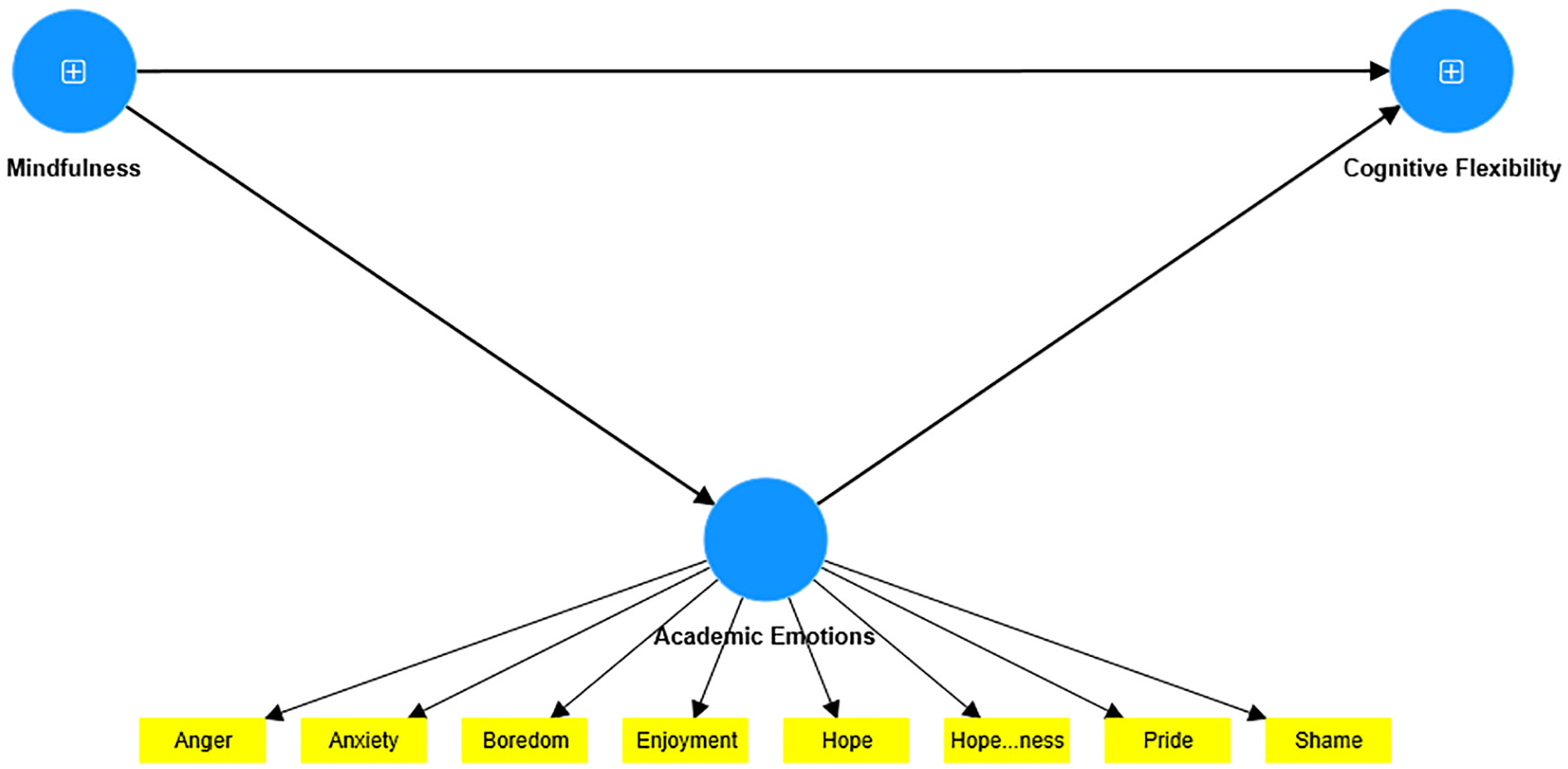
Figure 1 presents the conceptual framework, illustrating Mindfulness as the independent variable (IV) and Cognitive Flexibility (CF) as the dependent variable (DV). Academic Emotions (AE) act as a mediator and moderator, linking mindfulness and CF. Additionally, AE is a multidimensional construct that comprises Enjoyment, Hope, Pride, Anger, Anxiety, Shame, Hopelessness, and Boredom. The framework posits that mindfulness can directly or indirectly shape students’ CF. This influence is potentially moderated and mediated by students’ AE, which determines the extent to which mindfulness affects CF.

Conceptual framework.
Methodology
Research Setting and Participants
This study was conducted at a private university in China, specifically focusing on undergraduate students from the Faculty of Education. The faculty was chosen because of its critical role in preparing future educators who may face various academic challenges, making it an ideal setting for examining the relationship between key constructs.
Sample and Procedure
A two-phase sampling approach was employed. In the first phase, convenience sampling was used for the pilot study, which involved 100 participants, to test the questionnaire’s clarity and reliability, whereas the main study targeted a larger sample of undergraduate (UG) students. The Faculty of Education at the target HEI had 101,230 UG students across years 1 to 4. To determine the appropriate sample size for this study, we referred to the sample size determination table developed by Krejcie and Morgan (1970).
Given the large population, the recommendations indicate that a minimum sample size of 384 students is sufficient to achieve reliable and generalizable results. During the data collection phase, 403 responses were received from participants. This larger sample size not only exceeded the recommended minimum but also helped enhance the robustness of the findings. To ensure representativeness in terms of demographic characteristics, the sample included students from all four year levels, and efforts were made to distribute the survey broadly within the faculty via class advisors, online platforms and class-based channels to minimize sampling bias and promote diversity within the respondent pool. Consequently, all 403 completed responses were included in the data analysis, allowing a detailed examination of the research questions. Detailed demographics of the respondents are presented in Table 1.
Demographic Profile of Respondents.
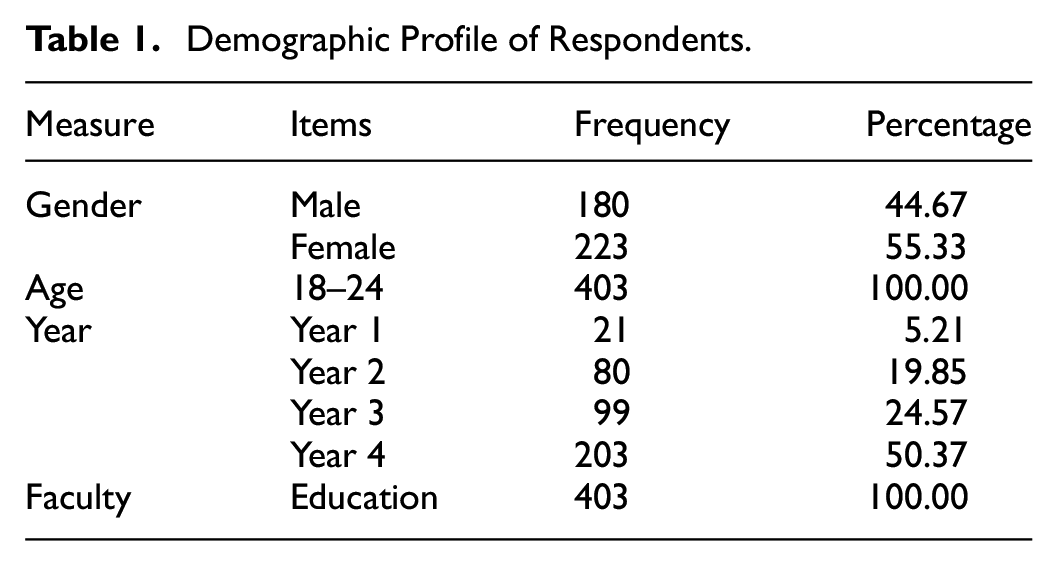
Table 1 presents the demographic profile of the respondents. The sample consisted entirely of students aged 18 to 24 from the Faculty of Education, with a slightly higher proportion of females (55.33%). Most participants were in their fourth year of study (50.37%).
Furthermore, the questionnaire was created using Microsoft Forms, generating both a link and a QR code that were shared with faculty, administrators, and lecturers in the department. Data collection was conducted through this online questionnaire distributed via WeChat, a widely used platform among Chinese students. Informed consent was obtained at the start of the questionnaire, ensuring the participants’ anonymity and confidentiality.
To minimize potential biases such as social desirability, some strategies were employed. First, participants were explicitly informed that there were no right or wrong answers, and that the purpose of the study was to understand their genuine experiences and perceptions. Second, the voluntary nature of participation was emphasized, ensuring that students felt no pressure to respond in a socially acceptable manner. Finally, the self-administered online format, without the presence of the researcher, helped further reduce evaluation apprehension and the influence of social desirability bias.
Data Analysis Procedure
SMART PLS 4 was used in this study because it is well-suited for analysing relationships between constructs, especially when working with latent variables. It is ideal for studies like this one that aim to explore complex models and propose novel frameworks. Compared to other methods, PLS-SEM works well with smaller to moderate sample sizes and focuses on maximizing the explained variance (Hair et al., 2024). It also allows for detailed mediation and moderation analysis through bootstrapping, which helped us examine relationships between different constructs in the study.
Measure
The instruments employed in the study—the Mindful Attention Awareness Scale (MAAS), Academic Emotions Questionnaire-Short (AEQ-S), and Cognitive Flexibility Scale (CFS)—were chosen because of their strong psychometric properties and validated use in educational and psychological research. This section presents a discussion of each of these instruments.
Mindfulness: Mindfulness was assessed using the Mindful Attention Awareness Scale (MAAS) (MacKillop & Anderson, 2007). The MAAS consists of 15 items rated on a scale ranging from 1 (“almost always”) to 6 (“almost never”). The mean MAAS score was calculated across all 15 items, with higher scores reflecting a greater level of mindfulness.
Academic Emotions: AE was evaluated using the Academic Emotions Questionnaire-Shortened version (AEQ-S) (Bieleke et al., 2021), which measures emotions specific to learning contexts. It was adapted and measured using a rating scale with six categories: 1 (“strongly disagree”) to 6 (“strongly agree”).
Cognitive Flexibility: CF was measured using the Cognitive Flexibility Scale (CFS) (Martin & Rubin, 1995) to assess adaptability in thought processes. It consists of 12 items rated on a scale of 1 (“strongly disagree”) to 6 (“strongly agree”).
To ensure uniformity across all scales, each measure was formatted on a 6-point Likert scale. MAAS, consisting of 15 items, was rated from “almost always” (1) to “almost never” (6), with higher scores indicating greater mindfulness. AEQ-S, comprising 32 items, and the CFS, with 12 items, were both structured on a 6-point scale ranging from “strongly disagree” (1) to “strongly agree” (6). This standardized scaling allowed for consistent interpretation and comparison of responses across constructs, streamlining the scoring process across all the instruments used in the study.
Before analysing the data, certain items were reverse-coded to ensure consistent interpretation of the responses. Reverse coding was applied to items AE13–AE32 in the AEQ-S scale to correctly interpret negative emotions so that higher scores consistently represented more intense emotions across all items. Similarly, items CF2, CF3, CF5, and CF10 in the CFS were reverse-coded to maintain coherence with the instrument’s structure and interpretative accuracy of the responses in accordance with the authors’ recommendations.
To validate AE as a multidimensional construct, an initial assessment was conducted on eight lower-order dimensions: enjoyment, hope, pride, anger, anxiety, shame, hopelessness, and boredom. Each dimension was individually evaluated using the PLS-SEM algorithm with a focus on examining the outer loadings of each indicator to confirm their contribution to the construct. During this process, five items from various dimensions were removed because of their low outer loadings (<0.60), as outlined in Table 2.
Removed AE Items.

Following these adjustments, the PLS-SEM algorithm was repeated. After this re-evaluation, all dimensions successfully met the reliability and validity criteria, as presented in Table 3.
Reliability and Validity Statistics for AE Dimensions.

Subsequently, Figure 2 was created, which represents the validated measurement model with higher-order constructs for AE, including eight lower-order constructs (enjoyment, hope, pride, anger, anxiety, shame, hopelessness, and boredom). Each dimension was shown to contribute to the overall AE construct.
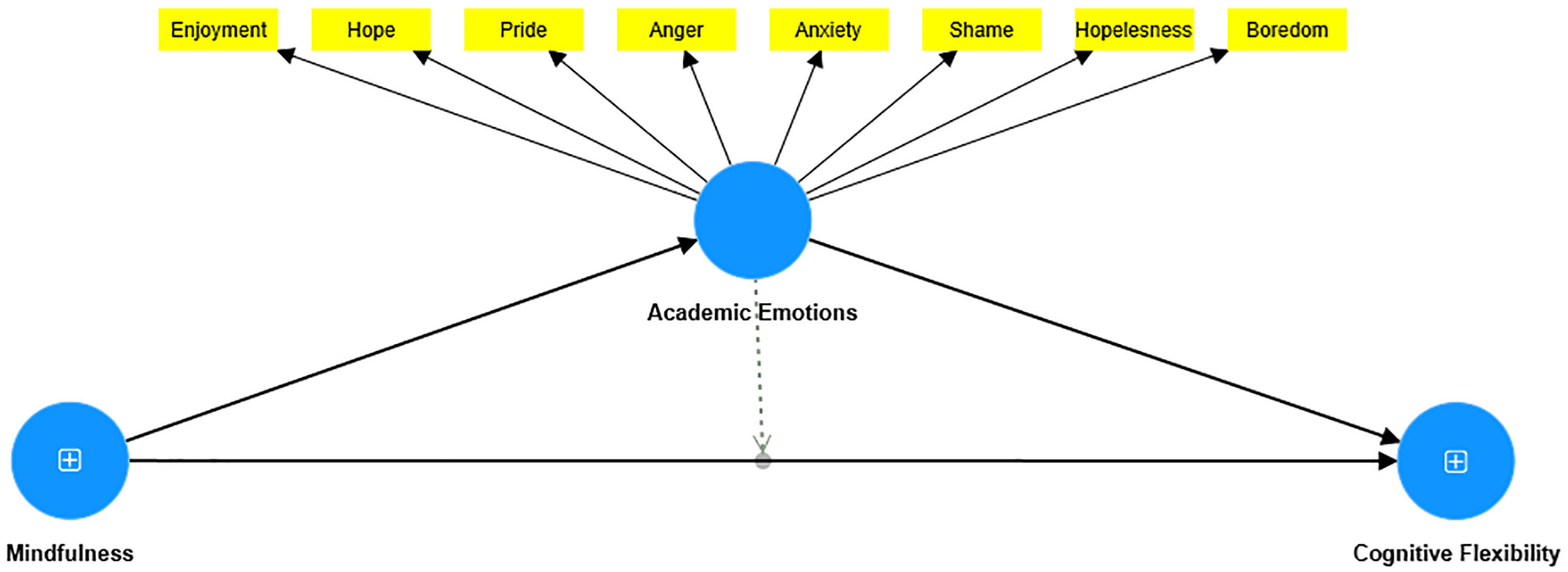
Validated measurement with higher-order constructs.
For CF, the scale initially showed strong internal consistency, with a Cronbach’s α of 0.902, although the AVE was 0.494, which is less than the ideal threshold of 0.50 (Sarstedt et al., 2021). To improve validity, the outer loadings of each item were examined and two items were removed, as shown in Table 4.
Removed CF Items.

After rerunning the PLS-SEM algorithm, the revised Cronbach’s α increased to 0.928 and the AVE improved to 0.611, thus confirming the reliability and validity of the instrument. The reliability and validity statistics for the higher-order constructs are presented in Table 5.
Reliability and Validity of Key Constructs.

Table 5 shows strong reliability and acceptable convergent validity for all constructs, with Cronbach’s alpha values above .91 and AVE scores exceeding .60. Following the pilot study, the main data collection involved distributing 450 questionnaires across multiple platforms, resulting in 403 valid responses used for analysis.
Assessment Criteria
This section describes the criteria used to assess effect levels. Questionnaire items, originally measured on a 6-point Likert scale, were reclassified into three categories—low, moderate, and high, for clearer interpretation.
Table 6 outlines the criteria for rating mean scores based on their range. Scores between 1.00 and 2.33 are classified as Low, those between 2.34 and 3.67 are classified as Moderate, and scores ranging from 3.68 to 5.00 are classified as High.
Criteria for Rating Mean Score.

In addition, effect size (f2) was used to assess the relative impact of each exogenous variable on the endogenous constructs in the structural model. According to Cohen (2013), f2 values of 0.02, 0.15, and 0.35 indicate small, medium, and large effect sizes, respectively. Larger f2 values suggest that the predictor variable contributes substantially to explaining the variance in the outcome variable. In this study, f2 values were used to interpret the practical significance of relationships within the model.
Lastly, Table 7 presents the specific metrics that were established to evaluate the structural components of the models.
Structural Model Predictive Power Assessment Criteria.
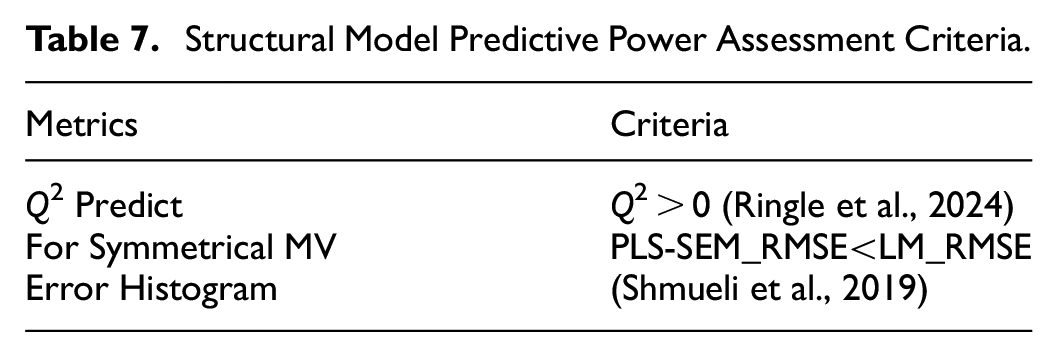
PLS-Predict, a predictive power assessment tool developed by Shmueli et al. (2019), was used to estimate the predictive relevance of the model. This tool utilizes the root mean square error (RMSE) and mean absolute error (MAE) as the primary prediction error metrics. RMSE is generally preferred when manifest variable (MV) prediction errors do not exhibit significant skewness (Shmueli et al., 2019). The predictive power of each indicator’s RMSE value was benchmarked against a naïve linear regression model (LM), aiding in the interpretation of prediction accuracy.
Data Analysis and Findings
Data analysis was performed using SPSS version 29 and SMART PLS 4. Initially, pilot data was subjected to measurement model assessment to establish the reliability and validity of the constructs. Path analysis was conducted on the main data to explore the relationships between constructs, along with mediation and moderation analyses. Finally, PLS-Predict was used to assess the predictive accuracy and reliability of the model for key outcome variables.
Measurement Model Assessment
Following Hair et al. (2021), we applied a measurement model to verify the reliability and validity of the constructs. The final 52 indicators were retained because their outer loadings exceeded the recommended threshold of 0.60. The standardized outer loadings were all above the recommended threshold of 0.6, indicating strong indicator reliability, as shown in Table 5. Table 8 presents the outer loading values for each of the indicators.
Outer Loadings of Indicators.

In addition to ensuring reliability and convergent validity (see Table 5), the discriminant validity of the constructs was established using the Heterotrait-Monotrait (HTMT) ratio following the guidelines of Roemer et al. (2021). The HTMT values are presented in Table 9.
HTMT Ratio.

Table 9 shows that all HTMT values are below the 0.9 threshold, confirming discriminant validity among the constructs (Roemer et al., 2021). The values indicate that Academic Emotions, Mindfulness, and Cognitive Flexibility are distinct yet moderately related constructs.
The next section answers each of the research questions posed at the beginning of the study.
Levels of Mindfulness, Academic Emotions, and Cognitive Flexibility
This section addresses RQ1: What are the levels of mindfulness, academic emotions, and cognitive flexibility among Chinese undergraduates?
Before computing descriptive statistics, each construct was transformed using SPSS version 29 to generate variable scores. Table 10 presents the resulting levels of Mindfulness, Cognitive Flexibility, and dimensions of Academic Emotions.
Descriptive Statistics.

Table 10 presents descriptive statistics for all key constructs, including the eight dimensions of AE—enjoyment, hope, pride, anger, anxiety, shame, hopelessness, and boredom—alongside Mindfulness and CF. Based on 403 responses, all constructs recorded high mean scores. Notably, standard deviations reveal variability in participants’ experiences, with the greatest variation observed in anxiety and mindfulness, indicating a broader range of responses in these areas.
Mindfulness and Academic Emotions
This section addresses RQ2: Is there a significant relationship between mindfulness and academic emotions among Chinese undergraduates?
To address this research question, a structural model (Figure 3) was created and bootstrapping analyses were conducted using SMART PLS 4.

Mindfulness and academic emotions.
Figure 3 illustrates the relationship between Mindfulness and AE, with the corresponding path coefficients, p-values, and R2 values.
Table 11 presents the mean, S.D, T-statistic, and p-value for the relationship between mindfulness and AE. The path coefficient of .848 indicates a strong positive relationship, suggesting that higher levels of mindfulness are closely linked to improved AE. The low standard deviation (0.015) reflects minimal variability, pointing to the consistency of this relationship. A T-statistic of 56.425 and a p-value of .000 confirm its statistical significance. The R2 value of 0.718 indicates that mindfulness accounts for 71.8% of the variance in AE, reinforcing its role as a strong and reliable predictor in this context.
Structural Model Coefficients.

Lastly, effect size was examined and is presented in Table 12.
Mindfulness and AE (Effect Size).

As seen in Table 12, the f2 value of 2.552 indicates that Mindfulness has a very large effect on AE. This suggests that changes in Mindfulness contribute substantially to variations in students’ academic emotional experiences, underscoring its significant role in shaping their emotional responses within academic settings.
Overall, the findings indicate a statistically significant and strong positive relationship between Mindfulness and AE.
Mindfulness and Cognitive Flexibility
This section addresses RQ3: To what extent does mindfulness affect cognitive flexibility among Chinese undergraduate students?
To address this research question, a structural model (see Figure 4) was created and bootstrapping analyses were conducted using SMART PLS 4.

Mindfulness and cognitive flexibility.
Figure 4 illustrates the relationship between Mindfulness and CF, with the corresponding path coefficients, p-values, and R2 values.
Table 13 presents the mean, S.D, T-statistic, and p-value for the relationship between mindfulness and CF. The path coefficient of 0.750 indicates a strong positive relationship, suggesting that higher mindfulness is significantly linked to greater CF among students. The low standard deviation (0.020) points to consistent results across the sample. A T-statistic of 37.547 and a p-value of .000 confirm the statistical significance of this relationship. Additionally, the R2 value of .563 reveals that mindfulness explains 56.3% of the variance in CF, highlighting its substantial predictive power in this model.
Structural Model Coefficients.

Lastly, effect size was examined and is presented in Table 14.
Mindfulness and CF (Effect Size).
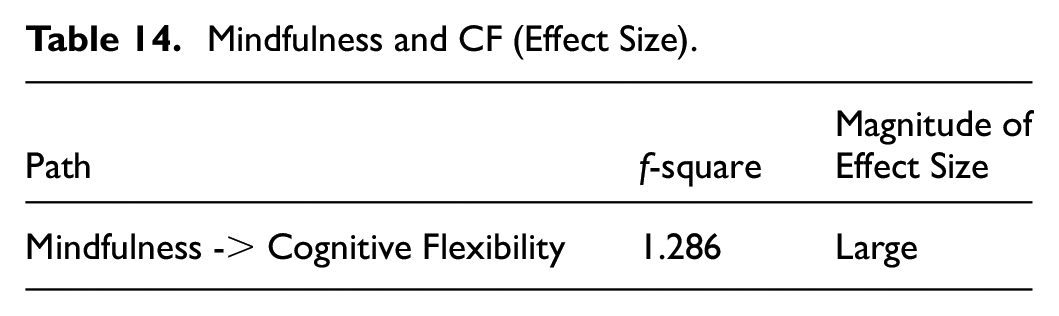
As seen in Table 14, the f2 value of 1.286 indicates a large effect of Mindfulness on CF. This suggests that Mindfulness plays a substantial role in enhancing students’ ability to adapt their thinking and approach in response to changing academic demands or challenges.
Overall, the results indicate that mindfulness affects CF to a substantial extent, as evidenced by a strong path coefficient of 0.750, f2 value of 1.286, and an R2 value of .563, which shows that 56.3% of the variance in CF is explained by mindfulness.
Academic Emotions as a Mediator
This section addressed RQ4: Do academic emotions mediate the relationship between mindfulness and cognitive flexibility?
A structural model was created, as shown in Figure 5. Bootstrapping analysis was performed using SMART PLS 4 to examine AE’s mediating role.

Mediating role of academic emotions.
Figure 5 presents the relationship between Mindfulness, AE, and CF, with AE as mediator.
Table 15 presents the specific indirect effect of Mindfulness on CF through AE, with the relevant coefficients and p-values provided for each path. The indirect effect was analysed along the Mindfulness -> AE -> CF path, resulting in a coefficient of 0.608 and a p-value of 0.000. These values indicate that AE partially mediates the influence of Mindfulness on CF, and that this mediation effect is statistically significant.
Specific Indirect Effects.

Furthermore, as seen in Figure 5, the R2 value of 0.710, indicates that 71% of the variance in CF can be explained by variations in Mindfulness and AE. This high R2 value emphasizes AE’s substantial as a mediator, reinforcing its importance in linking the constructs within the study.
Lastly, effect size was examined and is presented in Table 16.
Academic Emotions as a Mediator (Effect Size).

As seen in Table 16, the f2 value of 2.498 for the path from Mindfulness to AE indicates a very strong effect, showing that Mindfulness substantially contributes to the explanation of variance in AE. Similarly, the f2 value of 0.511 for the path AE CF reflects a large effect, suggesting that AE meaningfully influence CF. Together, these findings support the mediating role of AE in the relationship between Mindfulness and CF, highlighting both statistical and practical significance.
Academic Emotions as a Moderator
This section addressed RQ5: Do academic emotions moderate the relationship between mindfulness and cognitive flexibility?
Figure 6 presents the relationship between Mindfulness, AE, and CF, where AE is a moderator.

Moderating role of academic emotions.
Table 17 presents the structural model coefficients, highlighting the moderating role of AE in the relationship between M and CF. The direct path from AE to CF shows a strong positive effect with a coefficient of 0.703 and a highly significant p-value (.000), underscoring AE’s substantial influence of AE on CF, while the direct effect of Mindfulness on CF is also significant (coefficient = 0.135, p = .000). The interaction term (AE × Mindfulness -> CF) has a small, insignificant effect (coefficient = −0.045, p = .268). This suggests that, although AE strongly impacts CF, its role as a moderator is not statistically significant in this model.
Structural Model Coefficients.

Lastly, effect size was examined and is presented in Table 18.
Academic Emotions as a Moderator (Effect Size).

As seen in Table 18, the effect size effect size (f2) for the interaction term Academic Emotions × Mindfulness → Cognitive Flexibility was 0.003, indicating a low effect. This suggests that while the moderation path is included in the model, its unique contribution to explaining variance in CF is minimal. In practical terms, this means that AE does not meaningfully alter the strength or direction of the relationship between Mindfulness and CF.
Predictive Power of the Final Model
The PLS Predict algorithm was used to assess the predictive power of the final model and its ability to generalize new data or populations.
Figure 7 presents the final structural model, which integrates the data analysis results and key findings. Given that AE does not significantly moderate the relationship between Mindfulness and CF, the moderating effect was excluded from this model. To assess the predictive accuracy, the PLS-Predict algorithm was employed. The predictive power of the model was assessed based on the criteria outlined in the Methodology section.
Final model.
Table 19 presents a summary of the Manifest Variable (MV) prediction results, showing the predictive power of the PLS-SEM model in comparison with a linear regression model (LM) across various constructs. The table reports Q2 predict, PLS-SEM_RMSE (Root Mean Square Error for PLS-SEM), and LM_RMSE (Root Mean Square Error for Linear Model), which together offer a comprehensive view of each construct’s prediction quality.
MV Prediction Summary.

Q 2predict: Q2 predict values ranging from 0.311 to 0.560 indicate that the model demonstrates acceptable predictive relevance across all constructs. Notably, high values for enjoyment (0.559), hope (0.540), and CF (0.560) suggest the model is particularly effective in predicting these variables, highlighting its strength in forecasting key emotional and cognitive outcomes. This implies that interventions or policies targeting these outcomes (e.g., enhancing hope or enjoyment through curriculum design or learner support) can be confidently guided by the model’s results, as it demonstrates consistent predictive performance in these areas.
PLS-SEM_RMSE vs. LM_RMSE: This comparison assesses the prediction error. Generally, a lower RMSE in PLS-SEM compared with LM suggests better prediction quality by the structural model. As seen in Table 19, PLS-SEM_RMSE values are marginally lower than LM_RMSE values across all constructs, indicating that the PLS-SEM model provides a slightly better predictive accuracy than the linear model.
For example, for anger, the PLS-SEM_RMSE was 0.914, which is slightly below the LM_RMSE of 0.915. For enjoyment and CF, where predictive relevance is high (Q2predict values of 0.559 and 0.560, respectively), the PLS-SEM_RMSE values (0.668 and 0.606) were also consistently lower than their LM_RMSE counterparts (0.676 and 0.607), confirming the model’s predictive strength for these constructs. This marginal improvement in RMSE further supports the practical value of using the PLS-SEM model, as it ensures better alignment between predicted and observed values—especially important when designing student-centred programs aimed at emotional or cognitive enhancement.
Construct-Level Insights: The results show that hope has the lowest prediction error (PLS-SEM_RMSE = 0.600), suggesting that the model’s prediction is particularly strong for this construct as it achieves exact parity with LM_RMSE (0.600). Constructs such as shame and anxiety had higher prediction errors (PLS-SEM_RMSE values of 0.931 and 0.986, respectively), indicating that these constructs may be more challenging for the model to predict with precision. In practice, this suggests that while interventions targeting constructs like hope or enjoyment can rely on the model’s predictions with greater confidence, strategies addressing shame or anxiety may require supplementary approaches or more refined measurement tools.
Overall, PLS-predict results indicate that the PLS-SEM model demonstrates adequate predictive accuracy, with minor advantages over the linear regression model, particularly for constructs with high predictive relevance. These findings underscore the model’s utility in informing practical decisions within educational settings, especially for those constructs that show stronger predictive outcomes.
Discussions
This section provides an in-depth discussion of the study’s findings, connects them to the existing literature, and outlines the key conclusions drawn from the research.
Levels of Key Constructs
The findings of this study indicated that Chinese undergraduates reported high levels of mindfulness, a spectrum of academic emotions, and cognitive flexibility, suggesting that these students are potentially well-equipped with mental and emotional resources that support effective stress management, adaptive learning strategies, and resilience in academic settings.
These findings are consistent with recent studies that highlight the growing emphasis on psychological well-being (Geng et al., 2022) and emotional awareness (Huang et al., 2024) in educational contexts across Asia. Specifically, in China, shifts in educational policies have begun to prioritize not only academic achievement but also students’ mental health and emotional regulation, contributing to an environment in which mindfulness and emotional awareness are increasingly recognized (Gan et al., 2023).
The diversity of AE reported—encompassing positive emotions such as enjoyment, hope, and pride, as well as negative emotions such as anger, anxiety, and shame—resonates with Pekrun’s (2006; Pekrun et al., 2002) control-value theory of achievement emotions. Similar studies conducted in Chinese educational settings highlight a comparable emotional landscape, where students are encouraged to succeed, but often face substantial academic pressure. Research by Jiang and Dewaele (2019) and Sun (2024) reflects these mixed emotions among Chinese students, who commonly experience positive emotions in their achievements, but may simultaneously feel negative emotions such as anxiety and shame due to high academic expectations.
The dual presence of positive and negative emotions in this study aligns with the findings of Jiang et al. (2023), which emphasize that Chinese undergraduates often internalize societal and familial expectations, thus encountering a blend of motivational and stress-induced emotions. These findings highlight how an academically competitive environment influences students’ emotional experiences, fostering high levels of constructive and potentially disruptive emotions.
Relationship between Mindfulness and Academic Emotions
This study identified a statistically significant positive relationship between mindfulness and AE, indicating that mindfulness contributes to more balanced and enriched emotional experiences among students. This aligns with previous findings by Izhar et al. (2022), Kato et al. (2022), and Sünbül (2020), who collectively emphasized mindfulness’s role in fostering emotional regulation and reducing stress, thereby enhancing students’ affective states. However, the literature presents some inconsistencies. For instance, Bogaert et al. (2023) reported no significant effects of mindfulness on adolescents’ emotional well-being, suggesting that mindfulness may not uniformly benefit all populations or developmental stages. Likewise, Holopainen et al. (2024) acknowledged modest improvements in emotion regulation but emphasized the need for further investigation to determine the robustness and generalizability of such effects. Notably, Du and Ning (2024) highlighted the superior outcomes of culturally adapted mindfulness interventions over Western-based models in Chinese contexts, pointing to the potential limitations of applying universal mindfulness frameworks across diverse cultural settings. Collectively, these findings suggest that while mindfulness holds promise for enhancing academic emotions, its effectiveness may vary depending on age, context, and cultural adaptation, warranting a more nuanced and context-sensitive application in educational settings.
Relationship between Mindfulness and Cognitive Flexibility
The findings revealed a strong positive relationship between mindfulness and CF, aligning with prior research that links mindfulness to enhanced cognitive adaptability. Studies by Martinez and Dong (2020), Sinnott et al. (2020), Wen et al. (2021), Açıkgöz and Karaca (2024) consistently show that mindfulness supports students in managing complex cognitive tasks, partly by reducing stress and enhancing mental clarity. More recently, Liebherr et al. (2024) affirmed this connection through a meta-analysis, noting that mindfulness interventions often improve CF. However, they also reported that an equal or greater number of studies found no significant effects, suggesting variability in outcomes. This discrepancy may be attributed to differences in study design, population, intervention length, or contextual factors such as culture and delivery format.
Overall, while the evidence largely supports the cognitive benefits of mindfulness, these mixed findings highlight the need for more context-sensitive research to better understand when and for whom mindfulness is most effective in enhancing cognitive flexibility.
Mediating Role of Academic Emotions
The findings revealed that Academic Emotions (AE) significantly and partially mediated the relationship between mindfulness and cognitive flexibility (CF). This suggests that mindfulness enhances CF both directly and indirectly by fostering more balanced emotional states—reducing negative emotions like anxiety and boredom, while promoting positive ones like enjoyment and pride—that support greater cognitive adaptability.
This mediating effect underscores the role of AE as a pathway through which mindfulness influences CF. These results are consistent with the findings of Saleem et al. (2022) who observed that positive emotions enable individuals to generate and utilize cognitive resources more effectively. By expanding cognitive resources, positive emotions enhance flexible thinking, emphasizing the value of nurturing mindfulness and positive academic emotions in supporting students’ CF. These findings highlight the importance of incorporating mindfulness practices that enhance emotional regulation and ultimately cognitive flexibility in academic settings.
Moderating Role of Academic Emotions
In this study, AE did not moderate the relationship between mindfulness and CF, indicating that while AE plays a partial mediating role, it does not alter the strength or direction of the relationship between mindfulness and CF as a moderator would. This finding suggests that the impact of mindfulness on CF is not contingent on the level of positive or negative AE experienced by students, implying a more direct influence between constructs.
One possible explanation for this absence of moderation is that the regulatory effects of mindfulness may function independently of students’ emotional states. This aligns with findings by Martinez and Dong (2020), Sinnott et al. (2020), and Wen et al. (2021), who observed that mindfulness enhances CF regardless of affective conditions. Supporting mechanisms include improved attention (Verhaeghen, 2021), stress reduction (Borjalilu, 2023), and enhanced cognitive resources (Molina et al., 2024), all of which contribute to flexible thinking in academic settings without being contingent on emotional experiences.
Additionally, it is possible that AE, while influential in emotional and motivational domains, lacks the cognitive leverage necessary to interact meaningfully with mindfulness in shaping higher-order thinking skills such as CF. This aligns with theories suggesting that the benefits of mindfulness on executive functioning are robust enough to manifest independently of emotional context. For instance, Solati et al. (2024) found that mindfulness training significantly improved cognitive flexibility and working memory in adolescents, even without explicitly targeting emotional variables, highlighting the independent cognitive impact of mindfulness.
Consequently, these findings highlight mindfulness as a foundational skill that enhances CF, regardless of students’ emotional states. This reinforces the importance of incorporating mindfulness practices into education, especially in contexts where CF is essential for academic success, enabling students to adapt and perform effectively despite emotional challenges.
Implications
General and specific implications are presented in this section based on the key findings of the study.
General Implications
a. Enhancement of Educational Practices: The high levels of mindfulness, academic emotions (AE), and cognitive flexibility (CF) among Chinese undergraduates highlight the value of integrating mindfulness into university curricula. Institutions could enhance students’ emotional well-being and adaptability by offering stress-reduction workshops, encouraging reflective activities, and training faculty in mindfulness practices. These efforts could help foster a supportive learning environment that promotes academic success and resilience.
b. Integration of Emotional and Cognitive Strategies: The significant links among mindfulness, AE, and CF underscore the value of combining emotional and cognitive strategies in education. Emotional intelligence training could help students manage stress and build resilience, while workshops on CF—such as problem-solving, creative thinking, and collaboration—could enhance adaptability. Together, these approaches could help prepare students to meet academic and personal challenges more effectively.
c. Promoting Well-Being: These findings highlight the potential of mindfulness interventions to foster positive academic emotions and enhance cognitive flexibility. Mindfulness can support emotional regulation, resilience, and adaptability in students. Institutions may implement structured programs—such as meditation sessions, stress management workshops, and daily mindfulness practices—while training faculty to create a supportive, mindful learning culture that promotes both academic success and long-term well-being.
Specific Implications
a. Curriculum Development: Educators could incorporate mindfulness training and emotional regulation techniques into the curriculum, recognizing their positive impact on students’ CF. This could involve workshops, seminars, or dedicated courses that focus on mindfulness practice.
b. Targeted Interventions: Given that AE partially mediates the relationship between mindfulness and CF, targeted interventions could aim to enhance both mindfulness and positive AE. This could involve activities designed to foster a supportive emotional environment that encourages positive feelings such as enjoyment, pride, and hope among students.
c. Further Research Directions: The findings of this study encourage further research on the mechanisms by which mindfulness influences CF. Future studies could explore additional variables such as motivation and study habits to gain a more comprehensive understanding of these dynamics.
d. Tailored Support Programs: Since AE does not moderate the relationship between mindfulness and CF, support programs could focus more on enhancing mindfulness skills independently of students’ emotional states. This approach could empower students to improve their CF through mindfulness regardless of fluctuating AE.
e. Utilizing Predictive Models: The final PLS-SEM model’s adequate predictive accuracy suggests that similar methodologies could be employed in future studies to explore other constructs within educational psychology. This could lead to a more nuanced understanding of students’ experiences and outcomes in various educational contexts.
In summary, based on the findings presented above, a framework (Figure 8) called the ‘Mindful Learning Integration Framework (MLIF)’ was developed to integrate mindfulness practices with emotional and cognitive strategies in educational settings.

Mindful learning integration framework.
As illustrated in Figure 8, MLIF provides a novel model for understanding and applying the interconnected roles of mindfulness, academic emotions (AE), and cognitive flexibility (CF) in educational contexts. The framework emphasizes three key pillars: fostering mindful practices, developing emotional and cognitive strategies, and promoting student well-being. These components can be applied in practical ways across diverse educational settings—for instance, through structured mindfulness workshops, daily reflective practices, and creating classroom environments that support present-moment awareness. Emotional intelligence strategies such as group problem-solving, creative thinking tasks, and peer collaboration could help students regulate AE and develop flexible thinking. Furthermore, MLIF highlights the importance of mental health promotion, encouraging institutions to embed mindfulness beyond academic instruction—into students’ daily lives—to build resilience, focus, and emotional balance. As such, MLIF offers a blueprint for educators and curriculum designers aiming to enhance holistic learning experiences through integrated cognitive-emotional approaches.
Contributions of the Study
This study makes a significant contribution to the literature. First, it contributes to the growing body of literature on mindfulness by contextualizing its effects in Chinese higher education. Unlike in Western educational contexts, where mindfulness-based interventions are becoming increasingly integrated, there is limited research on how mindfulness influences outcomes and experiences in East Asian settings, particularly in China, where cultural expectations and academic environments differ markedly. Second, this study extends current research on AE and CF by examining their interconnectedness with mindfulness. Exploring these relationships not only provides insights into the potential benefits of mindfulness practices, but also sheds light on how emotional and cognitive flexibility can support students in managing academic stress and enhancing their overall learning experience.
In addition, the study advances theoretical understanding the relationship between mindfulness, academic emotions (AE), and cognitive flexibility (CF). By investigating AE not only as an outcome but also as a mediating and moderating variable, the study uncovers the psychological mechanisms through which mindfulness contributes to greater CF. This dual role of AE highlights the dynamic nature of students’ emotional experiences and their potential to shape cognitive adaptability, thereby offering richer insights into how emotional and cognitive dimensions co-evolve in academic contexts.
A key innovation of this study is the introduction of the Mindful Learning Integration Framework (MLIF) (see Figure 8), developed through empirical path analysis. This framework synthesizes the findings and presents a structured model for understanding how mindfulness, AE, and CF interconnect. MLIF provides a theoretical and practical foundation for designing future interventions and support systems that cultivate emotional regulation, cognitive adaptability, and academic resilience among students.
Limitations
This study has several limitations that should be considered when interpreting the findings. First, the research was conducted at a private higher education institution (HEI) in China, which may limit the generalizability of the results to other types of institutions, such as public universities or those in different cultural or geographical contexts. The specific characteristics and experiences of students at this private HEI may not reflect those of undergraduate students at other institutions, potentially affecting the applicability of the findings to a broader population.
Additionally, data were collected exclusively from undergraduate students at the Faculty of Education. This narrow focus may restrict the relevance of the findings to students in other disciplines or fields of study as academic emotions and cognitive flexibility may differ across various faculties. The experiences and challenges faced by students in the Faculty of Education may not be representative of those encountered by students in other disciplines, thus limiting the broader implications of this study.
Furthermore, the study employed a quantitative analysis approach, which provided valuable statistical insights into the relationships between the variables. This method highlights important trends and patterns that inform our understanding of mindfulness and academic emotions. However, integrating qualitative data could further enrich these findings by capturing the rich contextual nuances of students’ experiences. Finally, the use of self-reported data provides valuable insights into students’ perceptions and experiences, although it is essential to acknowledge that it may be subject to biases, such as social desirability or recall bias, which can influence the validity of the findings. The cross-sectional design of this study captured relationships at a specific moment in time. However, this approach may limit the ability to draw causal inferences. Including additional important variables such as motivation and study habits, future research could further enrich our understanding of the dynamics of play in this context. These limitations suggest avenues for future research, including longitudinal studies and mixed-method approaches, to further explore these constructs across diverse populations and settings, allowing for a more holistic perspective on the subject.
Conclusions
This study underscores the pivotal role of mindfulness in enhancing academic emotions and cognitive flexibility among undergraduate students in China. By illustrating how mindfulness fosters positive affective states and adaptive thinking, the findings offer compelling evidence for integrating mindfulness-based strategies into higher education. Educators and policymakers could implement structured mindfulness programs, promote emotionally supportive learning environments, and prioritize student well-being within curricula. Importantly, this research contributes to the growing body of mindfulness literature by extending its relevance to non-Western educational contexts, highlighting culturally responsive applications of mindfulness in China’s higher education system. Such initiatives can play a crucial role in supporting students’ academic success and holistic development.
Footnotes
Acknowledgements
The authors are grateful to all participants who participated in this study and sincerely thank the reviewers for their constructive feedback.

Ethical Considerations
Ethical approval was not required for this study, as only anonymized survey data were collected and no personally identifiable information was obtained.
Informed Consent Statement
Informed consent was obtained from all participants. An information sheet outlining the study’s purpose and procedures was provided at the beginning of the survey. Participants indicated their consent by selecting “I Agree” on the Microsoft Forms platform. Only those who provided consent were able to proceed with the questionnaire.
Author Contributions
LJ contributed to the conceptualization, methodology, supervision, data collection, manuscript review, and project management. CC was responsible for the literature review, data collection, and drafting the initial manuscript. APR contributed to proofreading the manuscript, data analysis and interpretation. All authors reviewed and approved the final version of the manuscript.
Funding
The author(s) disclosed receipt of the following financial support for the research, authorship, and/or publication of this article: University College London covered the open access publication charges for this manuscript.
Declaration of Conflicting Interests
The author(s) declared no potential conflicts of interest with respect to the research, authorship, and/or publication of this article.
Data Availability Statement
The datasets analysed during the current study are available from the corresponding author upon reasonable request.