




Abstract
Several investigations have focused on the relationship between personality and learning performance. However, the relationships among personality traits, motivation, emotional and behavioral engagement, and metacognitive-cognitive strategies remain unexplored. This research introduces a model based on a personality system set comprising metacognition, cognition, motivation, emotional and behavioral engagement. Five core education theories support this model. Three hundred seventy-four Mexican university students who were enrolled in a Biology and Industrial Management bachelor’s degree program participated. Personality traits mainly affect academic engagement but not motivation. Additionally, academic engagement mediates the relationship between personality traits and metacognitive-cognitive strategies. The findings show that agreeableness and neuroticism traits influence emotional engagement and disaffection. Consciousness and extraversion affect behavioral disaffection and engagement, respectively. Meanwhile, motivation affects emotional engagement, disaffection and metacognitive-cognitive strategies. Finally, openness does not affect any of the constructs. Hence, personality traits directly influence academic engagement and disaffection but not motivation and cognitive strategies.
Plain language summary
Several investigations have focused on the relationship between personality and learning performance. However, the relationship between personality traits and motivation, emotions, behaviours, and metacognition-cognition remains unexplored. This research introduces a model based on the personality systems set. Five core education theories support this model. Three hundred seventy-four Mexican university students participated, who are enrolled in Biology and Industrial Management Bachelor’s degree. Personality mainly affects emotions and behaviours but not motivation. Also, academic engagement mediates between personality traits and metacognition and cognition. The findings show that agreeableness and neuroticism influence emotions. Consciousness and extraversion affect behaviours. Meanwhile, motivation affects emotions and metacognition cognition. Finally, openness did not affect anyone of the constructs.
Keywords
The big-five traits are an empirical model of personality (Costa & McCrae, 2008; Xie & Cobb, 2020) that refer to conscientiousness (being disciplined, organized, and achievement-oriented), extraversion (higher degree of sociability, assertiveness, and talkativeness), neuroticism (related to emotional stability, impulse control, and anxiety), openness (intense intellectual curiosity and creativity and preferring novelty and variety) and agreeableness (being helpful, cooperative, and sympathetic toward others). Personality traits have been related to motivation; for example, students who are open to experience should have a better learning performance, but some other studies show no relationship. Similarly, agreeableness showed mixed results about its relationship with motivation Peklaj et al. (2015). Motivation is a process whereby goal-directed activity is instigated and sustained (Ramirez-Arellano et al., 2018). According to the expectancy-value theory of motivation (Eccles, 1983) and the recent extension (Eccles & Wigfield, 2020), the expectancy component is students’ beliefs about their ability to perform a learning task and that they are responsible for their performance; meanwhile, the value component is conceptualized as students’ goals about the importance and interest of the learning task.
Motivation is a precursor of engagement and impacts behavioral, emotional, and cognitive engagement (Acosta-Gonzaga & Ramirez-Arellano, 2021; Acosta-Gonzaga & Ramirez-Arellano, 2022). Furthermore, academic engagement is a meta-construct that includes emotional, behavioral, and cognitive dimensions (Carmona-Halty et al., 2021; Reschly, 2020; Robayo-Tamayo et al., 2020; Yang et al., 2021). Emotional engagement is the state related to students’ involvement in learning activities, such as fun, enthusiasm, enjoyment, and pride. Similarly, behavioral engagement is the motivated action that supposes students’ active participation in learning activities, such as interest, effort, involvement, and attention (Kuchinski-Donnelly & Krouse, 2020; E. Skinner et al., 2008; Thomas & Allen, 2021; Yang et al., 2021).
The cognitive theory of motivation and learning (Linnenbrink & Pintrich, 2000; Pintrich, 1988a, b; Pintrich & De Groot, 1990) defines metacognitive strategies such as metacognitive self-regulation and critical thinking that involve elaborating and organizing information using critical thinking (Pintrich & Garcia, 1991). Motivation instigates cognitive and metacognitive processes in the same way that motivation is a precursor for engagement. This precursor means knowledge acquisition demands a motivated learner to apply cognitive and metacognitive strategies (Pintrich, 1988a).
Personality traits and their influences on motivation, academic engagement, learning outcomes, and metacognition have been studied independently in recent years, but not in a comprehensive model that depict their relationships. Also, as far as the author knows, the effects of personality and motivation on students’ academic engagement and metacognitive-cognitive strategies have been scarcely studied. Thus, this study aims to introduce a model of personality, motivation and academic engagement based on Eccles’ expectancy-value theory and motivation (Eccles, 1983; Eccles & Wigfield, 2020), Skinner’ self-system model (E. Skinner et al., 2008) encompassing emotional and behavioral engagement, Pintrich’ cognitive theory of motivation and learning (Linnenbrink & Pintrich, 2000; Pintrich, 1988a; Pintrich & De Groot, 1990), and Costa’ big-five traits (Costa & McCrae, 1999, 2008). The author hypothesized that personality traits directly influence academic engagement and disaffection but not motivation and cognitive strategies.
Related Work
Personality, Motivation, and Engagement
Personality traits are valuable for establishing the relationships among conscientiousness, extraversion, neuroticism and appraisal (Cummings et al., 2019). For example, conscientiousness is related to learning motivation (Abdullatif & Velázquez-Iturbide, 2020; Brandt et al., 2020; Mammadov et al., 2021) and motivational regulation (Ljubin-Golub et al., 2019). Additionally, conscientiousness and openness are negatively related to the demotivation of English students (Pathan et al., 2021). Students with high openness use elaborative learning strategies and work to link new information with previous knowledge (Brandt et al., 2020).
Previous research has focused on engagement as a predictor of learning achievement and grades rather than as an outcome (Qureshi et al., 2016; Yang et al., 2021). Engagement is positively associated with extraversion, agreeableness, conscientiousness, and openness and negatively associated with neuroticism. Nursing students with high neuroticism have low engagement, and for those with low neuroticism and high levels of the remaining traits, engagement is significant (Villafañe et al., 2022). College students with openness, conscientiousness, and agreeableness show cognitive engagement. Additionally, cognitive engagement is more significant in students with agreeableness than in those with openness and conscientiousness (Mahama et al., 2022).
In contrast with these results, Ongore (2014) found that extraversion, agreeableness, conscientiousness and openness to experience were positively related to cognitive and emotional engagement, but neuroticism was negatively associated. Meanwhile, students with conscientiousness, extraversion, and agreeableness show emotional engagement but not cognitive engagement (Sangeetha et al., 2020).
Furthermore, neuroticism predicts university students’ cognitive and emotional engagement in English language courses (Angelovska et al., 2021). Additionally, extraversion, agreeableness and conscientiousness predict engagement, explaining approximately one-third of the variance in engagement (Qureshi et al., 2016). Similarly, agreeableness and openness predict emotional engagement in online learning (Quigley et al., 2022). Previous research has focused mainly on cognitive and emotional engagement, but behavioral engagement has been neglected.
Personality and Learning Outcomes
The relationship between personality traits and learning outcomes has been widely explored in recent years. Neuroticism, extraversion, and agreeableness are less related to academic performance (Brandt et al., 2020; Lechner et al., 2017; Zhang & Wang, 2023). However, conscientiousness (Dumfart & Neubauer, 2016; Mammadov, 2022) and openness have been found to predict students’ final grades (Mammadov et al., 2021; Meyer et al., 2019; Zhang & Wang, 2023). Additionally, Mammadov et al. (2021) found that extraversion, neuroticism and agreeableness are negatively related to learning performance.
On the other hand, Meyer et al. (2019) show that the relevance of personality traits in forecasting academic performance depends on the subject. Mammadov et al. (2021) and Meyer et al. (2019) confirm the positive role of conscientiousness and find a negative impact of extraversion on global learning achievements, which aligns with previous findings. Other studies have found a difference in the relationship between personality traits and learning achievements by gender (Kuśnierz et al., 2020; Meyer et al., 2019). Conscientiousness is a good predictor of learning achievements for females (Kuśnierz et al., 2020; Meyer et al., 2019). Thus, the impact of personality traits varies or is not significant when the gender and specific context are analyzed; therefore, these relations could be complex and dynamic.
However, personality traits alone do not capture the big picture of personality; thus, including mental skills to predict learning performance motivated the research of Bouiri et al. (2021). They found a significant correlation between mental skills (affective, cognitive, and metacognitive strategies) and learning performance.
Theoretical Framework
Systems of Primary Personality Parts and their Relationships
The personality systems framework (PSF) (Mayer & Allen, 2013) depicts how personality works and the primary functional areas of personality: energy development, knowledge guidance, action implementation, and executive management (Mayer, 2015, 2020; Mayer & Allen, 2013). Energy development includes motivational urges and emotional networks linked in knowledge guidance and containing the models of the self and the self in the world. Knowledge guidance is the cognitive process that guides behavior (Mayer, 2015, 2020; Mayer & Allen, 2013). The action implementation controls behavioral acts (Mayer & Allen, 2013). Finally, executive management monitors personality components and subsystems; thus, personality is self-regulated (Mayer, 2015, 2020; Mayer & Allen, 2013). The PSF provides a new framework for studying personality rather than a new theory; thus, it can be applied to several areas, such as educational psychology.
On the other hand, big-five traits (McCrae & Costa 1987) are an empirical model of personality traits (Costa & McCrae, 2008; Xie & Cobb, 2020) that refer to neuroticism, extraversion, openness, agreeableness, and conscientiousness. The personality traits motivated the formulation of the five personality systems (Costa & McCrae, 1999). The PSF and five factors of personality systems consider the biological basis of cognition, motivation, emotion and external situations that mold personality in a continuous dynamic process (Allen et al., 2021). Personality traits can be conceived as partial descriptors of the personality system components that give us a partial view of the personality system.
Energy development, knowledge guidance, action implementation, and executive management are the primary parts of the personality, according to PSF. They are conceptualized as a system in which subsystems interact. These essential interactions are described in this section. For example, energy development, knowledge guidance, and action implementation interact to progressively mold behavioral urges (Mayer, 2003). However, describing precisely how this dynamic process occurs is not the aim of the PSF.
Knowledge guidance contains information about the self and the world. Self-knowledge includes individuals’ internal states and their experiences throughout life, intelligence, memory, and reasoning processes (Mayer, 2005; Mayer & Allen, 2013); these cognitive mechanisms are depicted in Figure 1. Additionally, knowledge guidance contains models linking operating motivations, emotions, and cognition. The third part, action implementation, includes models of behaving in the environment and stores the methods of communicating and acting (Mayer, 2003; Mayer & Korogodsky, 2011). Executive management oversees the other three systems and is aware of internal representations and external situations. Additionally, it mainly monitors the states and conditions emanating from knowledge guidance. Therefore, executive management can focus consciousness on a course of action and its consequences. For example, executive management can encourage or limit the selection of action in a self-regulated cycle based on the awareness of negative consequences. Thus, metacognitive processes are situated in this system (see Figure 1). Energy development and knowledge guidance influence executive management by activating the monitoring of urges, emotions, and thoughts or even opposing the effort of the self-control of executive management (Mayer, 2003).

The proposed model is based on the personality systems framework, its functional areas, components, and the primary relationships in an educational context.
The PSF situates motivation, emotions (in energy development), cognition (in knowledge guidance), metacognition (in executive management), and behaviors (in action implementation) (see Figure 1). Additionally, the general relationships among the four systems imply that motivation and emotions are strongly connected in the energy development system. Furthermore, knowledge guidance and energy development mold behavioral urges; thus, emotions, motivation, and cognition are connected in this process. Similarly, executive management (where metacognition occurs) monitors the knowledge guidance, energy development, and action implementation systems in a self-regulated process. The following sections provide an in-depth foundation of the relationships within the proposed model that has its roots in PSF.
Expectancy-Value Theory of Motivation, Emotional and Behavioral Engagement
The expectancy-value theory, proposed by Eccles (1983), supports the detailed relationships between PSF elements, such as the implementation system (encompassing behaviors), energy development (motivations and emotion) and knowledge guidance (where the cognition resides). The expectancy-value theory defines motivation as the expectations of students’ beliefs about their self-efficacy success or failure on a particular task. The value construct of motivation is the value of the task from various perspectives, such as intrinsic and external. Meanwhile, the attainment value reflects how challenging students’ perceived a task to be. Intrinsic value is related to students’ perceptions of engagement in a task. The utility of the task depends on the instrumental motivation of students and is associated with students’ goals (Eccles, 1983; Pintrich, 1988a, b).
The motivations are the instigators of the emotions that guide the appropriate expression of motivation in social realms (Mayer, 2015; Mayer & Allen, 2013), such as in an educational context underpinning the relationship shown in the model of Figure 1. Additionally, self-system theory postulates that motivation is necessary to be engaged. From this perspective, motivation represents intention, and engagement is action (Reschly & Christenson, 2012; E. A. Skinner et al., 2008). The relationship between motivation and engagement could be reciprocal; however, motivation is a strong precursor of engagement (Acosta-Gonzaga & Ramirez-Arellano, 2021; Lei et al., 2024; Reeve, 2012).
Engagement is a meta-construct that comprises emotional, behavioral, and cognitive engagement (learning strategies and metacognitive self-regulation; Kim et al., 2014; King et al., 2023; Reschly & Christenson, 2012; Wolters & Taylor, 2012). Emotional engagement is the emotional state related to students’ involvement in learning activities, such as fun, enthusiasm, enjoyment, and pride. Similarly, behavioral engagement is the motivated action that supposes students’ active participation in learning activities, such as interest, effort, involvement, and attention (Nichols & Dawson, 2012; E. Skinner et al., 2008; Skinner et al., 2009; E. A. Skinner et al., 2008).
The action implementation system (encompassing behaviors) results from influencing motivations and emotions (within energy development) by knowledge guidance (where the cognition resides). Thus, engagement (in an educational context) is an emergent system from motivation, emotions (in the educational context, viewed as emotional engagement), and cognition. The proposed model depicts the relationships between motivation, emotions, and cognition with behaviors; the incoming link to behaviors is shown in Figure 1. For example, a student bored by a learning task likely disengages from classroom participation; thus, emotional engagement predicts behavioral engagement. Additionally, this disengagement can be triggered by a demotivated student (E. A. Skinner et al., 2008). However, the contribution of emotions and cognition in this process are not equal in every situation. For example, a student who perceives a learning activity as challenging could be emotionally neutral (he or she is neither bored nor having fun) but motivated to pay attention to the lecture (behavioral engagement). Similarly, in other settings, this motivated but emotionally neutral student decided to summarize the fundamental concepts introduced by the teacher, so he or she inherently listened to the teacher. In both scenarios, behavioral engagement is a consequence of motivation; in the first scenario, it is directly triggered by motivation, and in the second one, it is triggered by cognition (see Figure 1).
The relationships of the behavior in our model extends the self-system theory (E. Skinner et al., 2008; E. A. Skinner et al., 2008), where motivation and behavioral engagement have an internal dynamic (captured by the reciprocal link between emotions and behavior of Figure 1) and an external one with environmental factors. However, self-system theory neglects interactions with other vital components of personality, such as cognition and metacognition. This gap is filled by incorporating the cognitive theory of motivation and learning (Pintrich, 1988a, 1988b).
Cognitive Theory of Motivation and Learning
Metacognition is cognition about cognition (Efklides, 2017; Winne, 2018). It can be divided into self-regulation (Acosta-Gonzaga & Ramirez-Arellano, 2022; Brown, 1987; Schuster et al., 2020), such that individuals must be aware of their cognitions and be able to apply metacognitive and cognitive strategies to solve problems (Wiley & Jee, 2010). The PSF states that executive management (including metacognition) monitors energy development (such as motivation and emotion) and knowledge guidance (including cognition) with particular attention to the cognitive process. It coincides with the relationships among motivation, cognition, and metacognition proposed in the cognitive theory of motivation and learning (CTML) (Pintrich, 1988a, b). The CTML defines metacognitive strategies such as metacognitive self-regulation and critical thinking. Cognitive strategies involve elaborating and organizing information using critical thinking (Pintrich & Garcia, 1991). The CTML conceptualizes cognition and metacognition as the components that process and represent information; however, they can be separately conceptualized since metacognition is a higher-order process involved in planning, monitoring, and self-regulating the lower-order cognitive process; thus, metacognition is an executive process tightly linked to cognition (McKeachie et al., 1986). In CTML, expectancy-value theory provides the foundations for conceptualizing the relationships among motivation, cognition, and metacognition. Motivation instigates cognitive and metacognitive processes in the same way that motivation is a precursor for engagement. This precursor means that knowledge acquisition demands a motivated learner to apply cognitive and metacognitive strategies (Pintrich, 1988a), as shown in Figure 1.
We can divide the cognitive process into complex strategies, such as elaboration, comprehension, and organization, and basic strategies, such as rehearsal (McKeachie et al., 1985; Winne, 2018). These processes do not involve an accumulation of information but a synthesis and organization of information. The cognitive process influences students’ learning acquisition and modifies their prior knowledge. Using cognitive strategies requires that students be engaged in learning tasks (Pintrich, 1988a, b); thus, engagement (emotional) is tightly connected to cognition (see Figure 1). For example, students who enjoy the lesson (emotionally engaged) organize the new information (cognitive strategy). As a result, they pay attention to the class and are involved in learning activities (behavioral engagement).
In contrast, bored students can be distracted. Thus, this second example shows that cognition and emotional engagement are related to behavioral engagement. In this process, the interventions are not always sequential. Furthermore, motivation, cognition, and metacognition only sometimes operate simultaneously in the learning process (Pintrich, 1988b; Pintrich & De Groot, 1990; Pintrich & Garcia, 1994). Thus, these relationships are hypothesized in the model of Figure 1. For example, note that motivation can be linked to behaviors through cognition or emotions. There can be a third path from motivation to emotions and cognition.
Metacognitive self-regulation involves planning, monitoring, and regulating the cognitive process (Pintrich et al., 2000; Pintrich, 1988a); for example, a problem-solving task in physics demands the knowledge of equations and theoretical links between the variables of this equation to solve the specific problem. Students are aware of the academic requirements to face this task. Based on this knowledge, they decide to face the task or reinforce some of these requirements, for example, by reading the physical meaning of the equation’s parameters again or immediately computing the equation. Then, they decide to skim the problem description text to gather the information necessary to calculate the equation. However, they notice that the required information is not easy to find (monitoring); thus, they decide to apply a different reading strategy (control, self-regulation). Students who control and self-regulate their cognition promote high learning performance levels; therefore, the relationship between cognition and metacognition is reciprocal. Metacognition is influenced by motivational constructs such as perceived competence (Pintrich, 1988b). In our example, the students know that they do not have a clear understanding of the physical meaning of the equation parameters, so they review this topic. The students’ perceived competence motivates a plan that incorporates the implicit application and monitoring of cognitive strategies (Figure 1).
Although the CTML introduced the relationships among motivation, cognition, and metacognition, the interactions among well-studied emotions, cognition, and metacognition were not depicted. Efklides (2011) and Efklides (2017) filled this gap by introducing a model including relationships between emotions and cognition and between emotions and metacognition. These relationships form the basis of relationships among these constructs in the proposed model. These interactions are argued to vary with personal profile and are stable in the short and long term. Furthermore, it is posited that metacognition is directly influenced by motivation, emotions, and cognition (Efklides, 2012). In particular, Efklides (2012) suggests that metacognition is affected by emotions at three levels. In the first level, interest and anxiety are related to the learning task. The second relates to the processing of the task, such as joy, boredom, and anger. The third is the outcome of the task, such as pride and shame. Emotions provide bottom-up relevant information about the cognitive process’s self-regulation; thus, emotions play a crucial role in metacognition (Efklides, 2017).
Methods
Participants and Context
The study was conducted on the campuses of a public university in Mexico City. A total of 150 students were majoring in biology, and 252 were majoring in management. The survey results were collected from students in mathematics applied to biological sciences (biology major) and probability subjects (industrial management major) in the first semester of the 2022 academic year. A total of 402 undergraduate university students took the courses, with 140 males and 262 females. The minimum and maximum ages were 18 and 23, respectively, and the mean was 20 years. The participants provided informed consent and agreed that their responses could be used for this research. The teacher gathered informed consent at the beginning of the study. A total of 374 of the 402 students answered all the questions, as detailed later; thus, the 28 remaining students were excluded from this study. Three examinations were administered at the beginning, middle, and end of the semester. Additionally, these examinations and several learning activities, quizzes, and homework were considered to compute the overall grade of the course. The lectures were held twice a week. The academic administration office provided the overall grade of the students.
Procedure and Design
The analysis of this research is quantitative; thus, a structural equation model was employed to test the relationships among motivation, emotions and behaviors in the conceptual models shown in Figure 1. The motivation constructs were gathered using the Motivated Strategies for Learning Questionnaire (MSLQ) (Pintrich, 1991; Pintrich & De Groot, 1990), and emotional and behavioral engagement and their counterpart disengagement (SEBED) were obtained using the survey from (E. Skinner et al., 2008). The personality traits were assessed by the NEO-Five-Factor Inventory (NEOFFI) (Costa & McCrae, 1992).
The constructs gathered at a specific time for structural equation modelling (SEM) were included according to Table 1. For example, personality traits were assessed at time one, while motivation was assessed at time 2. The structural equation model follows the theoretical relationship where motivation is a precursor of engagement (Acosta-Gonzaga & Ramirez-Arellano, 2021; Reeve, 2012). Additionally, the PSF states that behaviors emerge from motivation and emotions, which coincides with Mayer and Allen (2013) and E. Skinner et al. (2008). In the educational context, a reciprocal relationship between emotional and behavioral engagement has been proposed (E. Skinner et al., 2008). The limitations of SEM analysis allow us to test only the relationship from emotional engagement to behavioral engagement or vice versa one at a time.
Schedule for Gathering the SEBED, MSLQ, and NEOFFI Several Times.

Measures
The personality traits were assessed by the NEO-Five-Factor Inventory (NEOFFI) (Costa & McCrae, 1992). The personality traits included neuroticism, extraversion, openness, agreeableness, and conscientiousness and were assessed on a 5-point scale from 0 (strongly disagree) to 4 (strongly agree). We obtained the raw scores of each trait by summing the individual scores of each question (12 items). The NEOFFI has been applied to gather personal traits in Mexican adult subjects (Rodríguez-Gonzalez et al., 2022) and university students (Brambila-Tapia et al., 2022; Hernández-Peña et al., 2023).
The motivation and metacognitive-cognitive strategies were gathered using the MSLQ (Pintrich, 1991; Pintrich & De Groot, 1990). The motivational construct comprises intrinsic goal orientation, extrinsic goal orientation, task value, control of learning beliefs, self-efficacy for learning, and test anxiety. They scored the answers to this instrument from 1 (not at all true of me) to 7 (very true of me). Metacognitive-cognitive strategies include metacognitive self-regulation, critical thinking, rehearsal, elaboration, and organization. The adaptation of the MSQL has been applied to university students in Colombia (Villarreal & Giraldo, 2022), Spain (Ramírez et al., 2022) and Mexico (Acosta-Gonzaga, 2023; Acosta-Gonzaga & Ramirez-Arellano, 2022).
E. Skinner et al. (2008) used the SEBED to assess engagement. Emotional engagement includes fun, enthusiasm, enjoyment, and pride; emotional disengagement comprises negative emotions, such as boredom, frustration, anxiety, and sadness. Positive behaviors (behavioral engagement) include interest, effort, involvement, and attention; negative behaviors include passive, distracted, disinterested, and mentally disengaged. The answers were scored using a five-point Likert-type scale, ranging from 1 (strongly disagree) to 5 (strongly agree). The adaptation of the SEBED has been used to gather engagement and disaffection data from Mexican university students (Acosta-Gonzaga & Ramirez-Arellano, 2021; Jones et al., 2023).
The NEOFFI was gathered at the beginning of the semester (time 1). The MSLQ measuring motivation was administered in the middle of the semester during the first session of that week (time 2). Then, in the second session (time 3), the SEBED was administered, measuring emotional engagement and disengagement. Then, at the first session of the second week, the MSLQ measuring metacognitive-cognitive strategies was administered (time 4). Finally, the SEBED (time 5) was employed to measure emotional engagement and disengagement. This schedule considers the temporality priority to establish the structural equation model.
Data Analysis
The model of Figure 1 was mapped to its structural equation model counterpart in Figure 2, considering the time when the construct was gathered (see Table 1) and the stages detailed in (Hair et al., 2022). Corroborating all the reciprocal relationships of the conceptual model of Figure 1 is beyond the scope of this research. The data analysis was carried out in two stages. First, the measurement model was evaluated using convergent validity (AVE), internal consistency (α, CR), and discriminant validity (Fornell-Larcker criterion). Then, we assessed the structural model to examine each hypothesis and assess its predictive power. In this stage, the relationships between openness and the other constructs were insignificant; hence, it was not included in the model of Figure 1. Since answers collected using the SEBED, MSLQ and NEOFFI are evaluated by different scales, they were centred before the SEM. The SEM aimed to establish the fit of the hypothetical constructs using SMART-PLS 4.
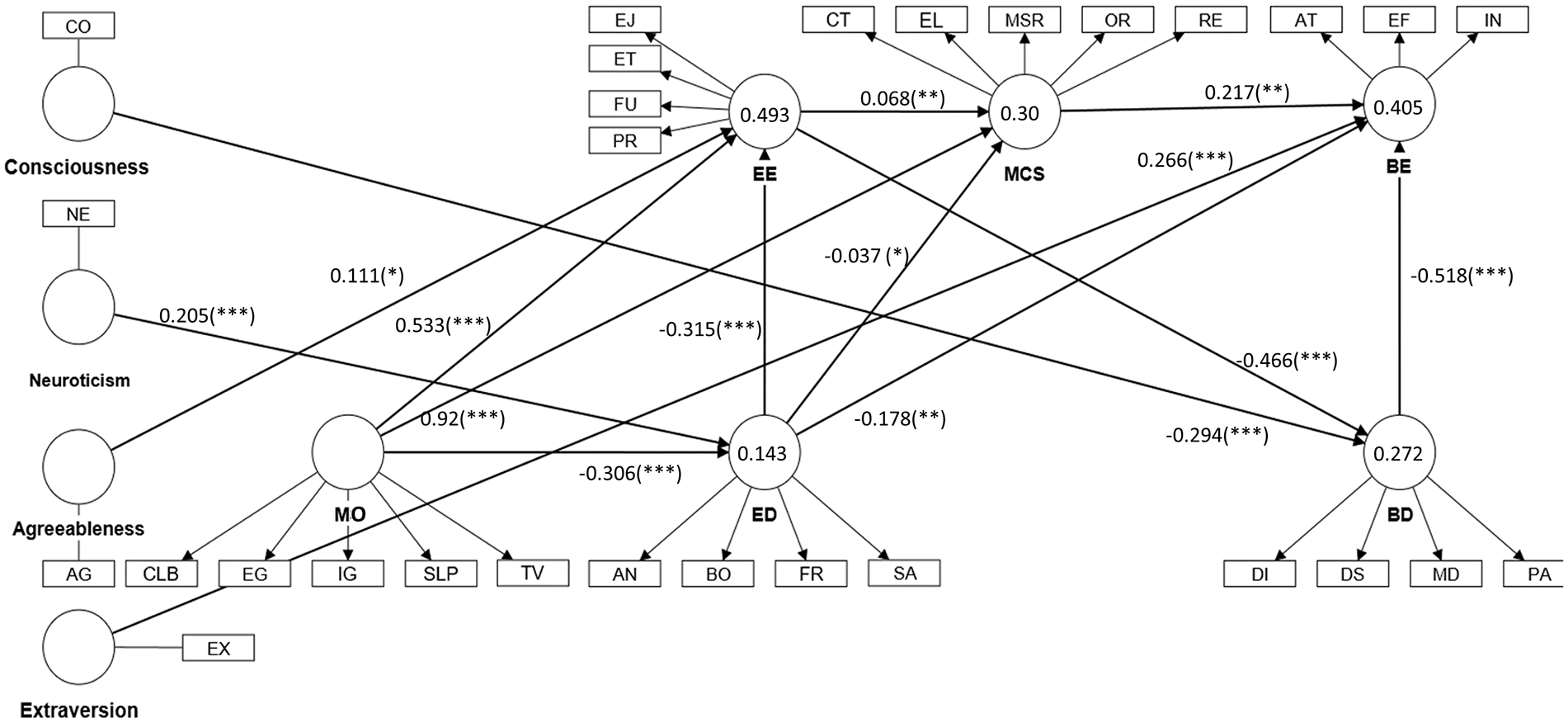
The structural model of personality traits, motivation, engagement and metacognitive-cognitive strategies.
Cronbach’s alpha (α) was used to test the reliability of each construct, and values above .70 are acceptable (Bonett & Wright, 2015; Tavakol & Dennick, 2011). Additionally, the composite reliability (CR) and average variance extracted (AVE) were used to assess convergent validity. Values higher than 0.7 for CR and 0.5 for AVE are acceptable (Hair et al., 2022, p. 121). Finally, the Fornell-Larcker criterion assesses discriminant validity (Hair et al., 2022).
Results
Measurement Model
The measurement model consisted of personality traits formed by a single item, as shown in Table 2. The mean and standard deviation of the raw score of neuroticism, extraversion, openness, agreeableness, and conscientiousness and the overall grade are shown in Table 2. Emotional and behavioral engagement and its counterpart disengagement and metacognitive-cognitive strategies are multi-items. The descriptive statistic, α, CR, and AVE of the observed variables of emotional and behavioral engagement and their counterpart disengagement are shown in Table 3. Table 4 presents the mean and standard deviation of motivation, metacognitive-cognitive strategies, and α, CR, and AVE. The Fornell-Larcker criterion is shown in Table 5; the values in the diagonal show the square root of AVE that has to be greater than the rest of the correlations off the diagonal to verify the discriminant validity. Additionally, no multicollinearity issues were found because the variance inflation factors were below 5. The results of multiple mediation analyses are summarized in Table 6. The effects of agreeableness, neuroticism, and motivation are mediated mainly by emotional engagement and disaffection.
Descriptive Statistics of Raw Scores of Neuroticism, Extraversion, Openness, Agreeableness, Conscientiousness, and Overall Grade.

Descriptive Statistics, α, CR and AVE of the Observed Variables of the Constructs Emotional and Behavioural Engagement and their Counterpart Disengagement.

Descriptive Statistics α, CR and AVE of the Observed Motivation, Cognition, and Metacognition Variables.

Discriminant Validity was Assessed by the Fornell-Larcker Criterion.

AG = agreeableness; BD = behavioural disengagement; BE = behavioural engagement; CO = consciousness; ED = emotional disengagement, EE = emotional engagement; EX = extraversion; MCS = metacognitive-cognitive strategies; MO = motivation; NE = neuroticism.
Specific Indirect Effects on Multiple Mediation Analysis.

BD = Behavioral disengagement; BE = Behavioral engagement; ED = Emotional disengagement; EE = Emotional engagement; MCS = Metacognitive-cognitive strategies; MO = Motivation.
Multigroup Analysis
The relationships described in the model of Figure 2 between students who passed and those who failed the course were compared using a multigroup analysis. For this purpose, the PLS-SEM multigroup analysis (PLS-MGA) tests whether the path coefficients differ significantly between the students who failed the course (73) and those who passed (301). Before carrying out the PLS-MGA, the measurement model invariance needs to be established by the measurement invariance of composite models (MICOM) procedure. The MICOM involves the following steps: (a) configural invariance, (b) compositional invariance, and (c) equality of composite mean values and variances. The partial measurement invariance was determined (steps one and two), as shown in Table 7.
Partial Measurement Invariance was Established for All Constructs.
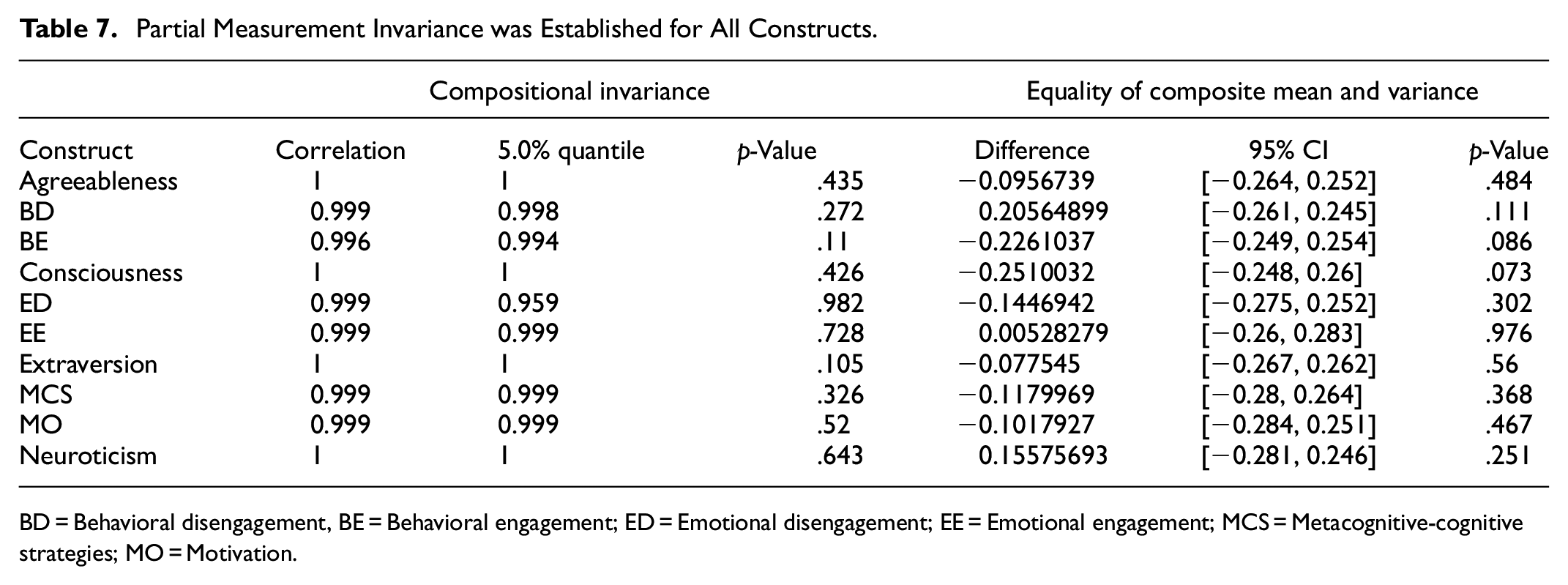
BD = Behavioral disengagement, BE = Behavioral engagement; ED = Emotional disengagement; EE = Emotional engagement; MCS = Metacognitive-cognitive strategies; MO = Motivation.
The correlations between the composite scores of the first and second groups (correlation column) with the 5% quantile reveal that the quantile is always smaller than or equal to the correlation for all the constructs. Additionally, it is supported by a p-value higher than .05, indicating that the correlations are insignificant.
The equality of composite mean values and variances (step three) was established since the differences in Table 7 are within the confidence interval (CI). Additionally, the p-value shows no significant difference between the mean of latent variables across the two groups. Hence, the measurement invariance was fully established, reflecting the suitability of the data for multigroup analysis.
Although using the permutation test is the recommended method for multigroup analysis, the multimethod (PLS-MGA, parametric test and Welch-Satterthwait test) approach provides additional confidence in the final results obtained. Table 8 shows the multimethod result of the multigroup analysis for students who failed and passed the course. The differences between BD → BE, EE → MCS and MO → MCS were significant between the two groups. Note that the p values of the permutation, PLS-MGA, parametric test and Welch-Satterthwaite test are below 0.05. Additionally, the relationships where personality traits are involved do not differ between students who failed and passed.
Results of Multigroup Analysis.

BD = Behavioural disengagement; BE = Behavioural engagement; ED = Emotional disengagement; EE = Emotional engagement; MCS = Metacognitive-cognitive strategies; MO = Motivation.
However, behavioral disaffection negatively impacts behavioral engagement, which is higher in students who passed than in those who failed. Similarly, motivation significantly affects metacognitive-cognitive strategies in students who passed more than in those who failed. In contrast, emotional engagement has a higher effect on metacognitive-cognitive strategies in students who failed than in those who passed.
Discussion
Personality traits directly affect academic engagement and disaffection but not motivation or metacognitive-cognitive strategies, which contrasts with the findings of Pathan et al. (2021) that conscientiousness and openness are negatively related to demotivation. Similarly, Abdullatif and Velázquez-Iturbide (2020), Brandt et al. (2020), and Mammadov et al. (2021) found that conscientiousness is related to learning motivation. Furthermore, students with high openness were found to use elaborative learning strategies (Brandt et al., 2020). However, our results contrast with this finding in that this personality trait did not affect the levels of motivation or academic engagement or the use of metacognitive-cognitive strategies in our data.
Disciplined and organized students are less passive and distracted in class. In contrast, neuroticism increased anxiety, boredom, frustration and sadness, as Villafañe et al. (2022) and Ongore (2014) found. Students who are cooperative, helpful and sympathetic toward others are enthusiastic and find learning activities fun and enjoyable (Ongore, 2014). Sociable, assertive, and talkative students (extraversion) show interest, pay attention and exert effort in class (behavioral engagement), which differs from the findings of Sangeetha et al. (2020) that extroverted students enjoy being with people and are enthusiastic and emotionally engaged with exciting tasks but not with behavioral engagement. Additionally, being empathetic and preferring cooperation over conflict (agreeableness) triggers positive emotions such as fun, pride, and enjoyment (emotional engagement), as reported previously (Quigley et al., 2022).
Personality traits had no relationship with motivation, as opposed to the findings of Lei et al. (2024), Pathan et al. (2021), and Peklaj et al. (2015). However, the relationships between motivation, emotional engagement, disengagement, and metacognitive-cognitive strategies were significant, consistent with previous findings (Acosta-Gonzaga & Ramirez-Arellano, 2022; Ramirez-Arellano et al., 2018). Additionally, no direct effects of conscientiousness, neuroticism, agreeableness, extraversion or openness on metacognitive-cognitive strategies were found.
The mediating analysis shows that agreeableness indirectly correlates with behavioral disengagement and metacognitive-cognitive strategies through emotional engagement. Similarly, neuroticism indirectly correlates with behavioral and emotional engagement mediated by emotional disaffection. The relationship between consciousness and behavioral disengagement is mediated by behavioral engagement. Thus, agreeableness, neuroticism, and consciousness play a substantial role in the educational context, especially through indirect effects on emotional and behavioral engagement and disaffection, as well as on metacognitive-cognitive strategies. The SEM and mediating analysis of openness suggest that this personality trait does not affect motivation, academic engagement, disaffection, or metacognitive-cognitive strategies. Hence, it was not included in the final model of Figure 2.
Competitive indirect relationships were found, suggesting that the constructs in direct impact and indirect effect have a suppressor role. For example, motivation decreases emotional disengagement; then, emotional disengagement limits the use of metacognitive-cognitive strategies (Figure 2). On the other hand, the direct effect of motivation on metacognitive-cognitive strategies fosters the latter; thus, this relationship tries to suppress the negative indirect impacts of motivation, emotional disengagement and metacognitive-cognitive strategies. The indirect path of motivation, emotional disengagement and emotional engagement is similar in that is competes with the positive direct effect of motivation on emotional engagement. Additionally, the path of emotional disengagement, emotional engagement and metacognitive-cognitive strategies has a suppressive effect on the negative impact of emotional disaffection on metacognitive-cognitive strategies. In contrast, the relationship between motivation and metacognitive-cognitive strategies and the path between motivation, emotional engagement, and metacognitive-cognitive strategies complement the positive effects of motivation on metacognitive-cognitive strategies.
The multiple mediation analysis shows that agreeableness positively affects behavioral engagement through emotional engagement and behavioral disaffection. Similarly, neuroticism positively and indirectly impacts behavioral disengagement but negatively impacts behavioral engagement and metacognitive-cognitive strategies; all these indirect effects are mediated by emotional disaffection and behavioral engagement. Hence, agreeableness and neuroticism indirectly affect academic behaviors mediated by emotional engagement and disaffection.
Furthermore, comparing the path coefficient of students who failed and those who passed suggests that learning performance does not determine a stronger influence of personality traits (consciousness, neuroticism, agreeableness, and extraversion) on academic engagement. The difference in path coefficients indicates that the negative repercussions of being distracted, disinterested and passive (behavioral disaffection) on effort, attention, and interest (behavioral engagement) are higher in students who failed the course. On the other hand, motivation strongly fosters the use of metacognitive-cognitive strategies in students who passed compared to those who failed.
Conclusion
This research demonstrated that personality traits directly influence academic engagement and disaffection but not motivation or metacognitive-cognitive strategies. Additionally, several relationships between personality traits, motivation, academic engagement and cognitive-metacognitive strategies were introduced in a conceptual model.
Academic engagement mediates the relationship between personality traits and metacognitive-cognitive strategies. The effects of personality traits on academic engagement do not differ according to academic outcomes. However, the negative repercussions of behavioral disaffection on behavioral engagement are higher in students who failed the course, highlighting the central role of behavioral disaffection in learning performance. Additionally, motivation strongly fosters the use of metacognitive-cognitive strategies in students who passed compared to those who failed. This evidence suggests that behavioral disaffection and motivation should be the targets to design interventions to decrease the former and increase the latter.
The mediating analysis shows competitive and complementary indirect relationships. First, the adverse indirect effects are limited by the direct ones. In addition, both indirect and direct relationships positively impact the target construct. The finding shows that these two mediating relationships are widely presented in the results, supporting the conjecture that complex relationships occur among personality traits, motivation, academic engagement, and metacognitive-cognitive strategies. The results support the hypothesis that personality traits directly influence academic engagement and disaffection but not motivation and cognitive strategies. It paves the way for analyzing these interactions from the point of view of dynamic systems. however, the research is limited by the constructs being measured using students’ self-reports and all participants being enrolled in the same university.
Footnotes
Acknowledgements
A special mention is given to Lawrence Whitehill, who tuned the English language of this article.
Author Contributions
Conceptualization, A.R.-A.; formal analysis, A.R.-A.; investigation, A.R.-A.; supervision, A.R.-A.; writing—original draft, A.R.-A.; writing—review & editing, A.R.-A. All authors have read and agreed to the published version of the manuscript.
Declaration of Conflicting Interests
The author declared no potential conflicts of interest with respect to the research, authorship, and/or publication of this article.
Funding
The author disclosed receipt of the following financial support for the research, authorship, and/or publication of this article: Instituto Politécnico Nacional, grant number 20240278, funded this research.
Ethical Approval
Ethical review and approval were not required for the study on human participants in accordance with the local legislation and institutional requirements.
Informed Consent Statements
The students provided their written informed consent to participate in this study.

Data Availability Statement
The data supporting this study’s findings are available from the corresponding author upon reasonable request.