



Abstract
Most of the distribution centers of chain supermarkets in China adopt the excessively simple activity-based classification (ABC) as the management method of classifying warehousing work, which often leads to an increase in operation and storage costs of the enterprise, a decrease in efficiency of the commodity circulation operation, and, eventually, a loss in enterprise growth because the goods ordered by stores cannot be delivered immediately. In addition, many studies in recent years have aimed at solving the problems of ABC classification by using the concept, method, or model of multi-criteria; however, limitations can be found in these studies. The main purpose of this study is to propose a new method, based on ABC classification, to improve the shortcomings of traditional classification methods, especially for special industries such as chain supermarkets. First, the case was classified using the ABC classification method as designed according to the actual situation of the case, and then the modified Delphi method, factor analysis, and analytic network process (ANP) decision model constructed by focus group was applied. Finally, ANP is used to put forward a specific improvement scheme and countermeasures for the storage management classification plan of the case. Last but not least, to verify the applicability of the model, an actual case was used to test the model. The results show the reference value and practicability of the proposed model. Furthermore, it can be offered as a set of systematic and scientific decision-making reference standards for managers and decision-makers of chain supermarkets when making warehouse management plans and standards.
Keywords
Introduction
In recent years, with the rapid development of the economy, the pace of life and consumption level of citizens have accelerated, and the demand for shopping is also growing. People have gradually formed the habit of buying commodities in chain supermarkets. According to statistics from The Ministry of Commerce of the People’s Republic of China (MOFCOM), the total sales of large chain supermarkets with an area of more than 6,000 square meters increased from 20.689 billion yuan in 2009 to 466.543 billion yuan in 2018. Besides, the total sales of unified distribution increased from 961.74 yuan in 2009 to 2,825 yuan in 2018. And the number of stores increased from 2,292 in 2009 to 4,760 in 2018 (MOFCOM, 2019). It is obvious that the integration of operation and storage has become the trend in supermarket operation.
Due to the characteristics of multiple varieties, small quantity, and multiple batches, China’s chain retail supermarkets, regardless of size, tend to establish a self-run distribution center to reduce logistics cost (Forward Intelligence Center, 2019). Because most of the chain supermarkets in China mainly adopt self-run distribution centers, it means that if the mode is not able to reduce cost for enterprises, massive manpower and material and financial resources will be consumed (Forward Intelligence Center, 2019). In other words, the distribution center will bear the related cost of inventory, personnel, and distribution. Inventory cost is the core influencing factor of distribution center cost, and the primary key to determine inventory cost is commodity storage management and warehouse classification method. Hence, chain supermarkets ought to choose appropriate methods of commodity storage management and storage classification, so as to reduce the costs incurred in the process of commodity distribution or storage.
Activity-based classification (ABC) is adopted in some supermarkets’ warehouses, such as A Company, which is located in Jiangsu Province, China. In the current warehouse area of the distribution center of A company, in addition to dividing the warehouse into return, receiving, shipment, sorting machine loading, and vehicle suspension areas according to the functions, the ABC method is used as the main commodity storage classification method. Whereas ABC classification can play a role in the storage and classification of product management, many scholars still put forward the disadvantages of ABC classification. Disadvantages include the classification standard is monotonous because it is done by the amount of capital accounted for by the inventory items without taking the difficulty and lead time of purchasing, supplier monopoly, production dependence, and other factors into account the procurement difficulty, procurement lead time, supplier monopoly, production dependence and other factors, which lead to unilateralism (Kattan & Adi, 2008; Kheybari et al., 2019; Lolli et al., 2014).
As most of the distribution centers of Chinese chain supermarkets adopt the comparatively simple ABC method as the management method of warehousing classification, this method often leads to certain limitations, such as (a) goods cannot be placed on the shelves immediately, (b) goods waiting for shipment cannot be sorted immediately, (c) the storage equipment utilization rate may decrease, (d) staff workload may increase, and (e) warehouse area and utilization volume may decrease. These problems are bound to cause an increase in the cost of operation and storage of enterprises, and a decrease in the efficiency of the commodity circulation operation. Finally, the goods ordered by stores cannot be delivered immediately, which will cause profit loss to enterprises. In addition, there have been many studies aimed at solving the problems of ABC classification by using the concept, method, or model of multi-criteria. In view of previous studies, there are some limitations existed, for example, (a) theories are generally proposed, (b) the proposed model method is quite complex, (c) the proposed optimization model has limitations (analytical hierarchy process [AHP], for instance), and (d) practical applications are mostly concentrated in the traditional manufacturing industry. Compared with previous studies, this study focuses more on the academic concepts, methods and models, and applies them to the distribution centers of chain supermarkets. These issues will be discussed in more detail in the literature review section, and in the case problems section.
To sum up, the main purpose of this study is to propose a new method based on ABC classification to improve the shortcomings of traditional classification methods, especially for the special industry of chain supermarkets. First, the case was classified based on ABC classification according to the actual situation of the case, and then the modified Delphi method, factor analysis, and analytic network process (ANP) decision model constructed by focus group was applied. Finally, ANP is used to put forward a specific improvement scheme and countermeasures for the storage management classification plan of the case. Last but not least, to verify the applicability of the model, an actual case was used to verify the model. The results show the reference value and practicability of the proposed model. Furthermore, it can be served as a set of systematic and scientific decision-making reference standards for managers and decision-makers of chain supermarkets when making warehouse management plans and standards.
Literature Studies
Some warehousing centers use ABC classification to classify commodities. By dividing research objects into A, B, and C through mathematical statistics, targeted management can be achieved. Among them, the cumulative frequency of A factors is 0%–80%, which is the main influencing factor; the cumulative frequency of B factors is 80%–90%, which is the secondary influencing factor; and the cumulative frequency of C factors is 90%–100%, which is the general influencing factor (Flores & Whybark, 1987; Jammernegg & Reiner, 2007). The key concept of ABC classification is to classify the main factors and the secondary factors among the many factors that affect certain things, so as to differentiate the few key factors that contribute significantly to the development of the object, and those many secondary factors that contribute little to the development of the object (Kheybari et al., 2019). Thus, ABC classification is a scientific and effective inventory management method that can sort out the main contradictions and focal points through statistics, synthesis, arrangement, and classification. Yet, this method has great limitations in the classification of commodities, which is mainly based on single index (Kheybari et al., 2019; Lolli et al., 2014). ABC classification in inventory management has been criticized for distinguishing only by the value in use. That is, when applied to the commodity classification in the distribution center, capital to take up is the sole factor used in clarifying and sequencing. In contrast, the difficulty and lead time of purchasing, supplier monopoly, production dependence, and other factors won’t be put into consideration, which may lead to unilateralism (Kattan & Adi, 2008).
A number of previous studies have addressed the problems of ABC classification with multi-criteria concepts, methods or models. Regarding concepts, for example, Douissa and Jabeur (2016) pointed out that the optimization of ABC classification based on the concept of multi-criteria classification can effectively formulate and control warehouse planning and management. Zowid et al. (2019) and Kartal et al. (2016) proposed the concept of multi-criteria and warehousing digitization to optimize the classification of ABC, which could effectively control the operation and efficiency of the storage. As for methods and models, for example, Kheybari et al. (2019) proposed to optimize the classification of ABC by entropy of multiple criteria and the technique for order preference by similarity to ideal solution (TOPSIS). Flores et al. (1992) proposed that ABC classification method could use multi-criteria AHP for effective material management and control in inventory management. Torabi et al. (2012) proposed that the optimization of ABC classification by the data envelopment analysis (DEA) model can effectively control the warehouse management that needs to be targeted for a large number of inventory items. Hadi-Vencheh and Mohamadghasemi (2011) used Fuzzy AHP and DEA to classify and optimize the raw materials on food factory production lines. Lolli et al. (2014) used AHP to optimize ABC classification, and verified the feasibility of the model with the factory case of manufacturing resistors. Balaji and Kumar (2014) used ABC classification and multi-criteria AHP to conduct inventory classification of automotive rubber parts, and then discussed the approach of controlling the storage classification and management of parts manufacturing practically.
Multi-criteria decision methods or models based on ABC classification have been proposed by several studies. The advantage is that the previous studies provide valuable references for subsequent academic research and practical application. The disadvantage is that previous studies are mostly limited to academic concepts, methods and models, moreover, the application of practical cases is mostly limited to the traditional manufacturing industry but few are applied to supermarkets. In addition, AHP is a popular tool in multi-criteria decision-making and is often used to solve complex management problems (Lin & Cho, 2020). The basic assumption of AHP is that each criterion is in a state of mutual independence (Gunduz & Alfar, 2019; Gunduz & Mohammad, 2020). However, in the real environment, there is often a non-independent interdependence between evaluation criteria, which may easily lead to distortion of the evaluation results. ANP is an important method to solve the problem of decision distortion (Atta Mills et al., 2020; Chang et al., 2007, 2011; Tian & Peng, 2020; Toros and Gazibey, 2018). Therefore, this study takes a large chain supermarket in Jiangsu province as a case, applies classification on the commodities in its distribution center based on ANP of ABC classification. In addition, the ANP multi-criteria decision model of ABC commodity storage classification was constructed by taking the related criteria of warehouse classification and management into comprehensive consideration. Finally, according to the results of the analysis, specific optimization schemes and suggestions are proposed. The procedures and steps of this study’s model evaluation follow.
Research Method
This study takes a chain supermarket in China as the research object and proposes a new method based on ABC classification to improve the shortcomings of traditional classification methods. It is expected to verify the applicability and feasibility of the proposed model through a representative case. The main reason for choosing Company A as the case is that it is the largest supermarket chain enterprise in Jiangsu, ranking top 10 among national chain enterprises for 12 consecutive years, and top four among national fast-moving consumer goods (FMCG) retailers. In 2004, the company started its self-built single logistics center, which covers an area of more than 260 mu. The center adopts advanced logistics technology, and its hardware and software are in the leading position among the exclusive logistics of domestic enterprises. At present, the annual distribution capacity has exceeded 10 billion yuan. Also, this study researched the well-known Chinese enterprise to understand and solve the general problems in the logistics distribution center of the chain supermarket system, hoping that the results of the study can help other related chain enterprises to solve the same or similar problems through the proposed method verified in the case study. This study will put forward specific suggestions on the improvement scheme of the case storage management toward the problems of the case, the construction and analysis of the model, as well as the results. They will be illustrated in the following part.
The Case Implement: Current Status and Problems
In the process of field research of the logistics center, this study discovered existing problems. The current situation of the storage classification of the case company is shown in Figure 1. The warehouses built in the distribution center of the case company are divided into 3 sections. In addition to dividing the warehouse into return area, receiving area, outbound area, sorting machine loading area, and vehicle standing area according to functions. The storage mode of the case company’s distribution center is divided by commodity categories, therefore, the three warehouses are divided into a–g areas according to the commodity categories for put away.

Layout of case company’s warehouse 1.
The staff of the receiving department checks and accepts the goods sent from the upstream supplier according to the acceptance policy of the case company. The staff of the shelf replenishment department puts away the goods according to the categories, and sends the goods to the corresponding shelves for storage. The staff of the picking department pulls out the goods on the basis of the order and some of the goods are sent to the dispatch department by the sorting operators, and the others are sent to the dispatch area to wait for the delivery audit. Finally, the staff of the shipping department checks the order after the audit and the products are loaded and ready to ship.
On the basis of the above classification method and warehousing process, the operation mode of the case company is to conduct inventory classification management only according to commodity categories. The result often causes problems such as (a) purchased goods cannot be transferred to the temporary storage cache immediately, (b) shipments cannot be sorted immediately, (c) decreased storage equipment utilization, (d) increased workload, and (e) decreased storage area and volume utilization.
Model Construction and Analysis
The model proposed, which is based on ANP multi-criteria decision model of ABC classification in this study, will be constructed in three stages. The first stage is “determination of commodity classification and evaluation indicators.” The stored goods are classified according to ABC classification, and then the modified Delphi method determines the evaluation indexes. The second stage is “confirmation of the scale validity and construction of the network structure.” According to the indicators determined in the first stage, this means verifying the scale validity by factor analysis and determining the preliminary hierarchical structure. Next, the hierarchical structure is used to confirm the correlation among the criteria through the focus group method, which will define the network structure diagram of the optimization model. The third stage is “determine the multi-criteria decision model of ABC classification.” In this stage, the case company will be analyzed through ANP according to the network model built in the second stage. Finally, the proposed model will be analyzed and concrete schemes and suggestions put forward. The study methods in this article are described as follows, and the specific research framework is shown in Figure 2. In accordance with the specific steps of the model constructed, this study will first expound the method, and then make a case analysis according to the method discussed. The details are as follows.

Research framework.
Determine inventory classification of commodities
Method
1. Commodity inventory classification based on ABC classification.
ABC classification, known as activity-based classification, is an analytical method to classify and queues things according to their main technical or economic characteristics, so as to determine the management methods in a differentiated way through distinguishing the key points from the general ones. ABC classification can distinguish and classify products, and reflect the impact of the value of each product on the total value of inventory, sales, cost, and so on. Meanwhile, it also provides a good mechanism for item identification, which greatly reduces inventory cost (Berry et al., 1997). It is usually classified according to the item proportion of the inventory (the percentage of the number of certain types of materials in the total number of varieties) and the value proportion (the percentage of the amount of such materials in the total amount). Among them, category A refers to the materials with a small proportion of projects (5%–15%) but a significant value ratio (60%–80%) that needs to be mainly managed (Werner, 2000; Wild, 2017). Category C refers to the materials that need to be managed secondary to the project, which are more important (60%–80%) but less value ratio (5%–15%). Category B refers to the items between the key materials and the secondary materials that have a large proportion (15%–30%) and a small value ratio (15%–25%) and that need regular management (Lun et al., 2010; Vollmann et al., 2005; Wild, 1998). In conclusion, this study will determine the inventory classification of goods according to the commodity classification principle of ABC classification.
2. Inventory classification criteria based on the modified Delphi method.
The main object of this study is the multi-criteria warehouse classification standard established by the case company based on the ABC classification method. The aim of this study is to find key indicators of the warehouse commodity classification standard to provide a set of reference criteria for decision-makers in this and other related industries.
Lin and Cho (2020) mentioned that the Delphi method is a technological integrated scientific research method. Experts are induced to establish a consensus based on their expertise, experience, and opinions through anonymous experts and continuous written discussions on the set topics in the process.
Delphi and modified Delphi can be divided into five steps as follows (Lin & Cho, 2020): (a) choose relevant experts. Draw up the survey outline according to the topic, prepare the materials provided to the experts, select relevant experts, and form an expert group; (b) conduct the first round of the questionnaire. Issue the first round of questionnaire. After the questionnaires are collected, the experts’ opinions will be summarized and tabulated for comparison. The indicators whose opinions did not reach consensus will be deleted; (c) conduct the second round of the questionnaire. Make up a new questionnaire after finishing sorting out the first round of questionnaires, then distribute it to the experts so that they are able to compare their opinions with others and modify their opinions and judgments; (d) conduct the third round of the questionnaire and process it as in the second round; and (e) synthesize opinions to form a consensus. If the expert group does not reach a consensus, repeat steps (c) and (d) until it is reached. This study applies the modified Delphi method. Collect relevant literature materials and summarize preliminary indicators in the first step. The second step makes up a modified Delphi method questionnaire based on the indicators summarized in the first step. The third step is to analyze the quartile difference of the expert group’s opinion distribution for each item and judge the consistency. The fourth step is to determine the final indicators for the next phase of analysis.
Analysis
1. Commodity inventory classification based on ABC classification.
ABC classification is a common inventory management strategy at present, which is mainly divided into A, B, and C categories according to the types of inventory and the amount of capital occupied.
Step 1: Collect inventory information.
This study collected the order data of A company from January 1 to December 31, 2018. Daily necessities were taken as the sample, using ABC classification to analyze, calculate the inventory amount, and classify it according to proportion.
Step 2: Determine the classification of inventory.
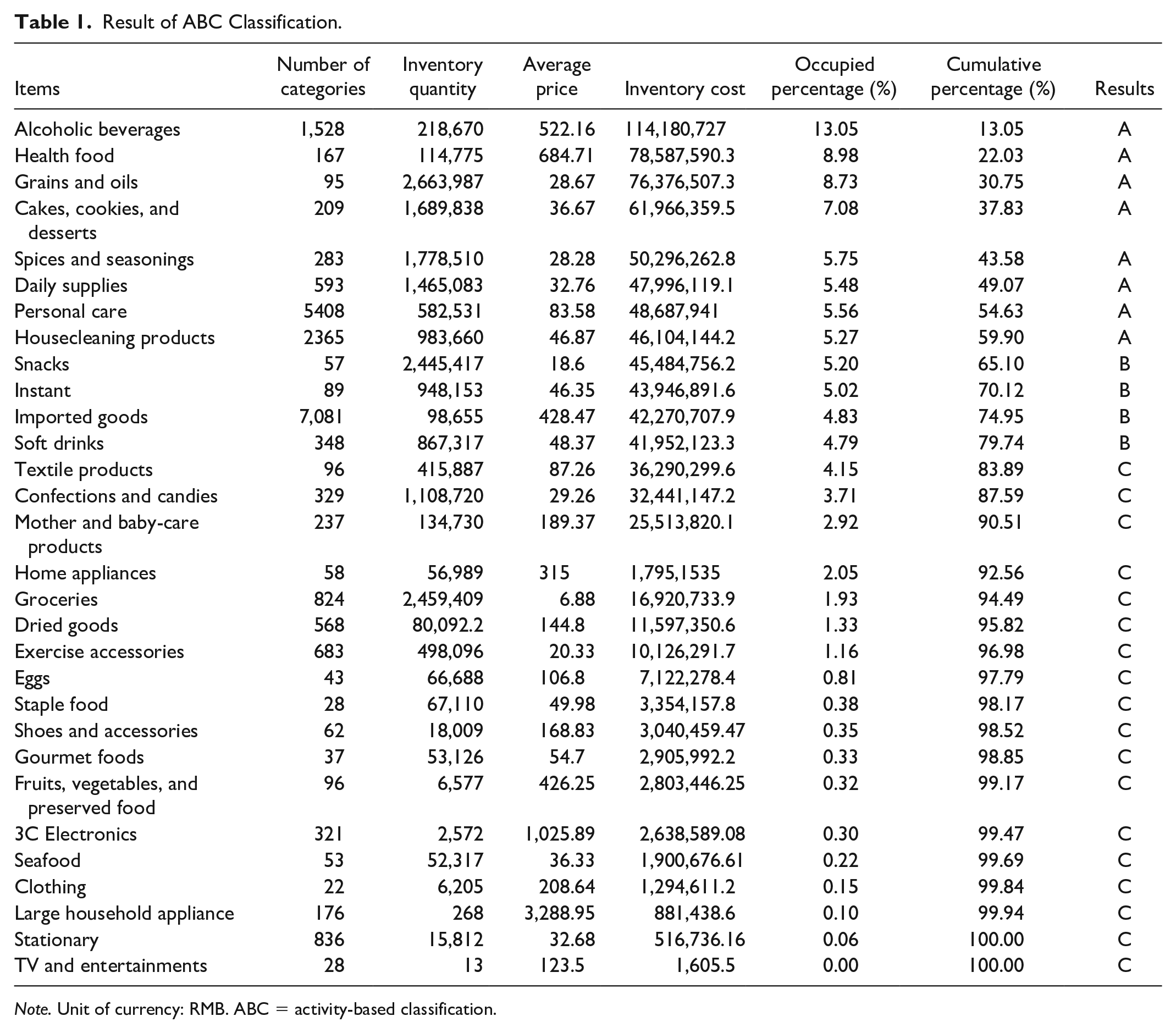
As a large chain supermarket in Jiangsu province, A supermarket has a wider variety of daily necessities stored in its distribution center than other supermarkets. The data of this study were obtained from the order department of A’s distribution center in Jiangsu Province, which is responsible for the logistics, warehousing, and distribution operations of 800 stores in 15 cities in the province. To ensure the feasibility of the study, this study took daily necessities as an example for analysis, and selected 30 commodity categories from various commodities for ABC classification. The specific classification process and results are shown in Table 1. In this study, category A is divided into the following three categories: high-priced products, daily food, and household cleaning and groceries. The collected data range is the purchase order data from January 1, 2018, to December 31, 2018. Commodities for daily use are taken as the data samples. ABC classification method is used to analyze the data, calculate the inventory amount, and sort according to the proportion.
Result of ABC Classification.
Note. Unit of currency: RMB. ABC = activity-based classification.
Among them, alcoholic beverages and health food belong to high-priced goods; grain and oil, cakes, cookies and desserts, and dried foods belong to daily food; daily supplies, personal care, and housecleaning products belong to household cleaning and groceries. Category B includes general commodities with relatively few varieties and accounts for a smaller portion of the amount. Although category C has a large variety of commodities, it accounts for the smallest proportion of inventory cost.
2. Inventory classification criteria based on the modified Delphi method.
Step 1: Collecting the literature.
Before the formal implementation of the modified Delphi method, this study first collected and sorted out a large number of documents related to warehouse classification and evaluation. A total of 46 criteria applicable to the evaluation were selected according to the characteristics of storage and related systems.
Step 2: Form a modified Delphi questionnaire.
This study uses a Likert-type scale to evaluate its importance (7 represents the most significant and 1 represents the least significant) and develops in the preliminary questionnaire of the structural opinion survey. Nine experts from industry and academia were selected to take the questionnaire. The chosen experts are (a) three business managers in charge of product sales, warehousing and logistics, and quality management of the case enterprise; (b) two department managers of the warehouse and quality management department of other chain industrial enterprises; (c) four college teachers of the Department of Logistics Engineering and the Department of Industrial Process and Management. These experts have long been involved in logistics and warehouse management, quality and process improvement, and production- and sales-related business and courses. The questionnaire was implemented from August to September 2018, and the consensus of expert opinions was summarized twice.
Step 3: Quartile deviation expert consistency.
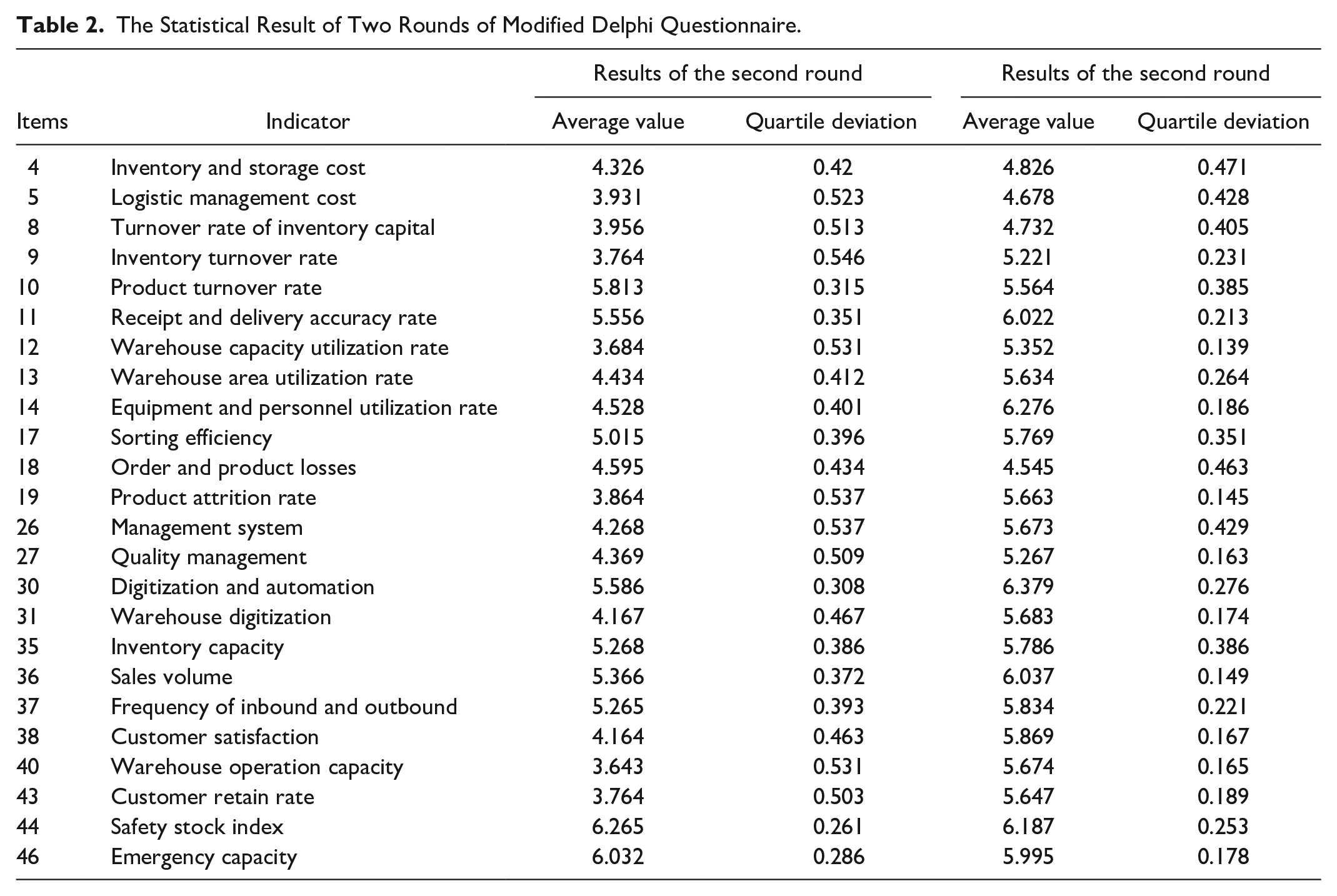
The study involved observing the quartile deviation in the distribution of experts’ opinions on each item, which is half of the distribution distance of 50% of the opinions in the group; the smaller the quartile deviation, the more concentrated the expert opinions. The experts’ opinion is considered to have reached a consensus when the quartile deviation is less than or equal to .50, while no consensus has been reached when the quartile deviation is greater than .60. In the first round of this study, 11 criteria of the date with an importance average on the scale of less than 3.5 and a quartile deviation greater than .60 were deleted. In the second round, 11 criteria of the date with an importance average of less than 4.5 and the quartile deviation greater than .60 were deleted. After two revisions of the modified Delphi questionnaire and the implementation of measurement, according to the verification results of the above quartile deviation, the agreement of experts was initially formed, and 24 criteria were finally retained as listed in Table 2.
The Statistical Result of Two Rounds of Modified Delphi Questionnaire.
Determine the validity of the scale and construct the network structure
First, the validity of the scale was verified by factor analysis, and the preliminary hierarchical structure was determined according to the indicators identified in the first stage. This study establishes the second expert questionnaire of warehouse management classification standard through the preliminary screening index by the Delphi method, with the purpose of determining whether there is commonality and validity among the criteria of preliminary screening. The criteria were classified and summarized through factor analysis, and the criteria that did not meet the validity were deleted to construct the validity and hierarchical structure of the scale. Afterward, this study determined the hierarchical structure through the above classified and concluded warehouse classification index. And then we decided the correlation between each index through the focus group interview to the hierarchical structure of classification standard, and the network structure diagram of the optimization model was the result.
Method
1. Construct the hierarchy structure and validity of scale based on factor analysis.
The basic idea of factor analysis is to group variables according to the degree of correlation, so that variables in the same group have a higher correlation, while variables in different groups have a lower correlation (Child, 1990). Each set of variables represents a basic structure. Factor analysis is a multivariate design analysis method that studies how to condense a large number of original variables into a few factor variables with minimum information loss, and how to make factor variables more explanatory (Child, 1990). The process is as follows:
Step 1: Calculate the correlation matrix or covariance matrix between variables.
If the correlation between a variable and other variables is very low, the variable can be considered excluded in the analysis of the next step. However, whether to exclude it or not, the “communality” and “factor loadings” should also be taken into account.
Step 2: Estimate factor loadings—principal component analysis.
Principal component analysis (PCA) is mainly used as the basis for developing indicators, which create a weighted average of several variables by determining their weights so as to work out the overall indicator. PCA can simplify the data, reduce multiple related variables to a few main components, and the principal component obtained by linear combination can hold the most information of the original variables, that is, the principal component has the maximum number of variations (Warmbrod, 2000).
To simplify multiple related variations to a few uncorrelated principal components, linear combinations of the original variations are sought to maximize the number of variations. It can be concluded that the eigenvalues of the matrix are

where
The largest variation replaced the original variation in the principal component to achieve the goal of simplification, which explains the ratio of the original variation:

The number selected should adopt
Step 3: Determine the rotation axis method—varimax, direct oblimin.
Factors need to be explained and named by the observed variables. For the convenience of naming, the varimax is used to rotate the coordinates to maximize the variation in the factor load table, so that each factor has a high load on a few variables after the coordinate rotation. To make the factor load of each variable significant only under one factor, the absolute value of factor load after rotation is required to be greater than .5 in the selection (Warmbrod, 2000).
Step 4: Determine and name the factors.
After rotating the axis, to determine the number of factors, select a small number of factors to obtain a large amount of interpretation. In terms of factor naming and result interpretation, the score after factor calculation is stored as input variable for other program analysis.
2. Construct the network structure based on the focus group method.
The main purpose of using the focus group in this study is to invite experts to decide the correlation between the correlations of various indicators and to determine the final evaluation system (network structure). Based on the warehouse classification criteria (hierarchy structure) determined above, this study is carried out according to the theoretical basis of the focus group, whose theoretical basis and implementation steps are described as follows: Focus group is an interview method with a group of homogeneous groups on a specific set of issues, problems, or research questions. The goal of focus groups is to explore broad views on controversial issues and to obtain detailed qualitative information about specific groups (Margan, 1996). It is an in-depth discussion limited to a few topics. If people with similar experience or background are selected to participate in the group discussion with an open and cozy place arranged for discussion, it can accurately collect experts’ aspect, attitude, and behavior on some specific research topics (Margan, 1996).
The advantages of using the focus group include the following (Merton et al., 1990): (a) it provides multiple and versatile methods for the qualitative and quantitative research; (b) it sets a structured interview, encourages the flexible interaction as well as extends views of group members on the target topic; (c) it encourages members to express themselves bravely and triggers abundant responses; and (d) it collects meaningful information in a short time. Stewart and Shamdasani (1990) proposed that the main steps of the focus group method are (a) forming research problems, (b) identifying research objects and intermediaries, (c) selecting samples for group discussion, (d) analyzing and interpreting data, and (e) generating reports.
In short, after defining the hierarchical structure of the optimization model through factor analysis, this study determines the correlation among the criteria through the main steps of the focus group of Stewart and Shamdasani (1990). Finally, confirming the network structure diagram of the optimization model.
Analysis
1. Construct the hierarchy structure and validity of scale based on factor analysis.
The basic idea of factor analysis is to group variables according to the degree of correlation, so that variables within the same group are highly correlated with each other, while variables in different groups are less correlated. Each group of variables represents a basic structure. Factor analysis is a multivariate statistical analysis method that studies how to condense many original variables into a few factor variables with minimum information loss, and how to make factor variables more explanatory.
In this study, after the second revision of the modified Delphi method, the 24 criteria were retained, and the hierarchical structure and validity of the scale were constructed by the factor analysis method. At this stage, the questionnaire of the structural opinion survey was also prepared on a 7-point Likert-type scale. From December 2018 to February 2019, a total of 100 copies of the questionnaire were distributed, and the respondents were directors of warehousing, logistics and management departments, along with junior supervisors and staffs in the working area. A total of 87 effective samples were collected and response rate of 100%. After the questionnaire was collected, factor analysis was carried out to construct the scale validity and hierarchical structure. The specific construction process is described below.
Step 1: Calculate the variable correlation matrix.
This study carried out factor analysis three times. The first and second factor analysis extracted seven and five layers, respectively, and eight factors (criteria) were deleted. These criteria did not reach the consistency of expert identification, therefore, the 16 factors (criteria) retained in the previous factor analysis were used for the third factor analysis. First, Kaiser–Meyer–Olkin (KMO) and Bartlett verification was performed, and the value of KMO was .823, indicating that the model was suitable for factor analysis. And the Sig value in the sphericity test is .000, less than .05, that is, there are common factors in the matrix correlation, which makes it suitable for factor analysis.
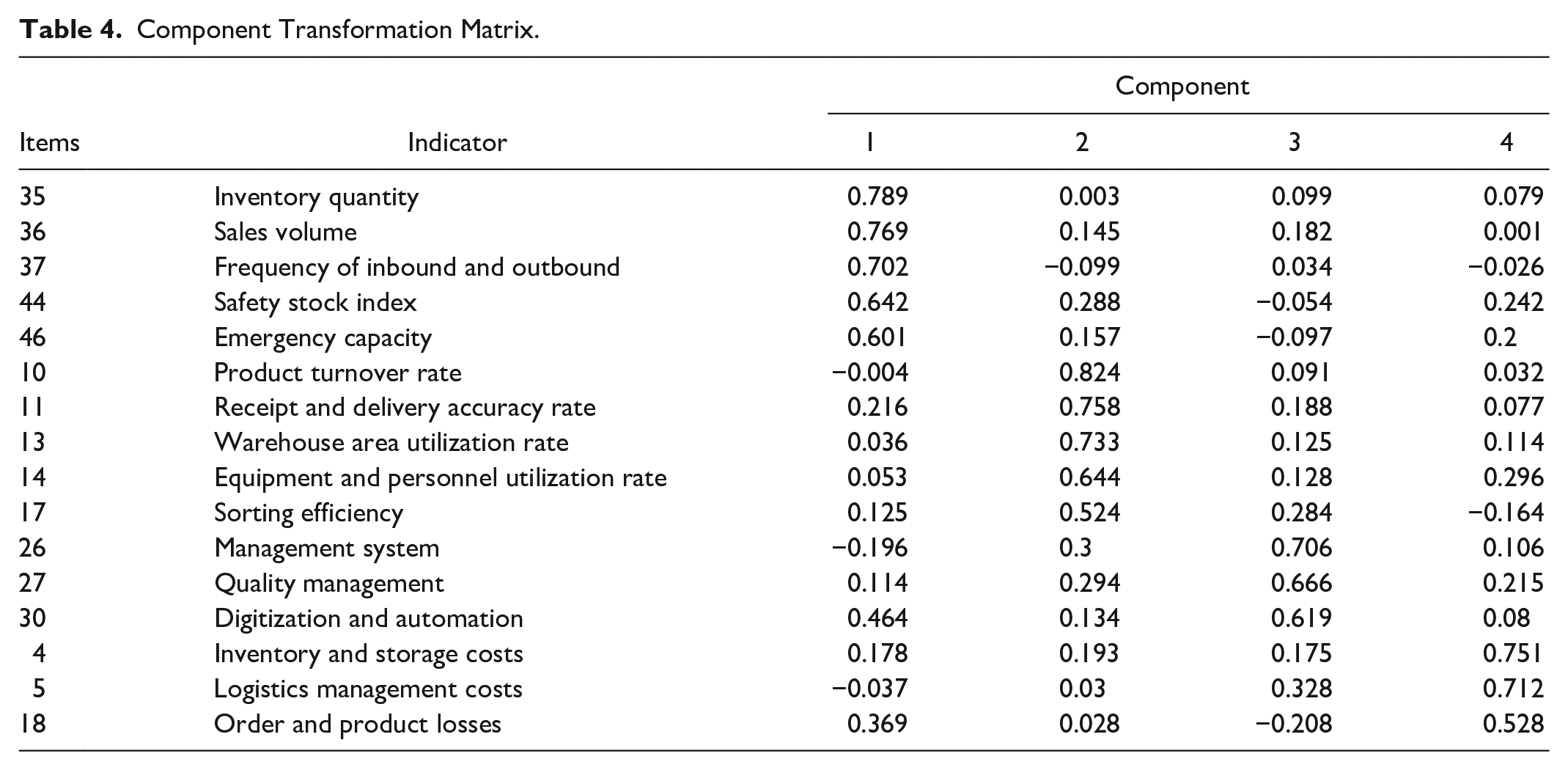
Therefore, formulas 1 and 2 were used for factor analysis. According to the principle of the factor analysis model, statistical software SPSS was applied to analyze the results, shown in Table 4 and 5. As can be seen from Tables 3 and 4, factors were extracted during the process of factor analysis. After rotation, the eigenvalue of the first factor is 4.486, the eigenvalue of the second factor is 2.398, the eigenvalue of the third factor is 1.289, and the eigenvalue of the fourth factor is 1.033. According to the research of Zaltman and Buger (1975), as long as the factor’s eigenvalue is greater than 1, the factor loading of each item is greater than 0.3, and the Total Variance Explained reaches more than 40%, the composition of each factor can be effectively considered as meaningful. It indicates that the first four factors provide sufficient information of the original data.
Total Variance Explained.

Component Transformation Matrix.
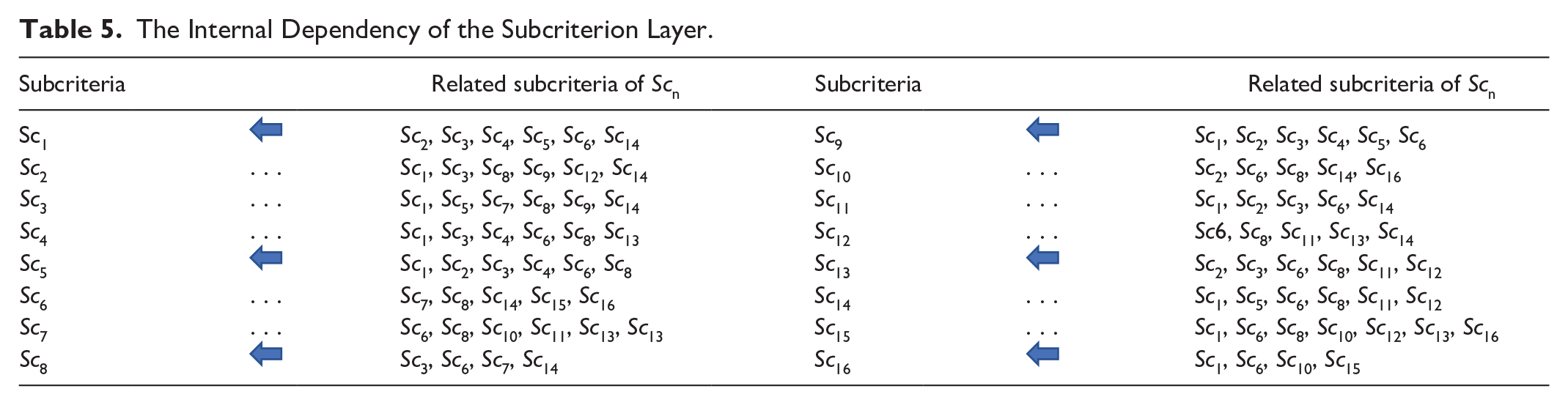
The Internal Dependency of the Subcriterion Layer.
Step 2: Estimate factor loadings.
Table 4 shows the factor loadings matrix after rotation. The first factor has a load factor with an absolute value greater than .5 for inventory capacity, inbound and outbound frequency, sales volume, emergent response, and safety stock index. It can be defined as the storage and security factor for it includes the storage capacity of the warehouse. The second factor, whose factor loading is greater than .5, includes products turnover, correctness rate of receipt and delivery, utilization rate of warehouse area, utilization rate of equipment and personnel, and efficiency of sorting operation, all of which relate to the key factor of efficiency. Therefore, it can be defined as the warehousing efficiency factor. The third factor has a factor loading with an absolute value greater than .5 for management system, quality management, information, and degree of automation. It mainly summarizes warehouse management capability and can be defined as operation management factor.
Step 3: Determine the hierarchy.
The final criteria and subcriteria are as follows:
(a) Storage and safety (C1) including inventory quantity (Sc1), inbound and outbound frequency (Sc2), sales volume (Sc3), emergency capacity (Sc4), and inventory safety index (Sc5).
(b) Operation management (C2) including management system (Sc6), quality management (Sc7), and information and automation (Sc8).
(c) Storage efficiency (C3) including product turnover rate (Sc9), receipt and delivery accuracy rate (Sc10), warehouse area utilization rate (Sc11), equipment and personnel utilization rate (Sc12), and sorting efficiency (Sc13).
(d) Costs, profit, and loss (C4) including inventory and storage costs (Sc14), logistics management costs (Sc15), and order and product losses (Sc16).
Step 4: Construct the network structure based on focus group.
Based on the steps proposed by Stewart and Shamdasani (1990), this study conducted two meetings to summarize the consensus of expert opinions. The specific implementation steps are described below.
1. Forming research questions:
Based on the hierarchical structure obtained from factor analysis, this study was divided into six criteria of the first level and 21 subcriteria of the second level, and internal dependencies were carried out for the criteria and subcriteria of the two levels, respectively. The main issue discussed is, for example, whether the first evaluation criterion—C1 of the first level—will be affected by the other five evaluation criteria.
2. Select samples for group discussion:
After the experts were selected, discussions were held on October 24, 2018, and November 2, 2018.
3. Data analysis and interpretation and 5. report writing.
After two more meetings, the consistency of expert opinions was concluded twice. Finally, the network structure of this study is constructed. Figure 3 shows the internal dependence of the criterion layer, and Table 5 shows the internal dependence of the secondary criterion layer.

The inner dependence of the criterion layer.
Determine the multi-criteria decision model of ABC classification
Method
In this stage, the case company will be analyzed through ANP on the basis of the network structure constructed in stage 2, to propose the specific optimization schemes and suggestions in accordance with analysis results. Implementation based on ANP is described below.
In the process of looking for resolution, AHP assumes that the elements of each level must be independent of each other, and systematize complex problems for evaluation. Nevertheless, there is a dependence or feedback relationship in the real-life problems, meaning that the bigger the problem is, the more complicated the relationship can be. If the assumption of independence is used again at this point, the problem may be oversimplified and lead to bias in the evaluation results. ANP consists of four main steps (Atta Mills et al., 2020):
Step 1: The determination of the problem and network structure.
The problems’ objectives are determined according to the problems, and then the decision criteria and subcriteria are defined according to the relevant characteristics of the objectives. After the criteria are determined, the interaction level between the criteria and subcriteria should be evaluated. The interaction level between criteria and assessment criteria can be determined through expert interviews or questionnaires.
Step 2: The determination of the pairwise comparison matrices and the eigenvectors of each matrix.
If AHP is the same in ANP, it is necessary to make a pairwise comparison on the decision criteria for each component of the structure diagram as well as obtain the weight of the criteria in the corresponding criteria group. In addition, if interdependencies exist between the criteria, the degree of dependency and corresponding weight will be required. The relative importance values between the two decision criteria are determined on a scale of 1 to 9. A score of 1 indicates that the two elements are equally important, and a score of 9 indicates that this criterion is extremely important to the other criterion. As in AHP, in the formula of ANP’s pairwise comparison matrices, aij = 1/ aij, where a denotes the importance of the ith element compared with the jth element. The weight can be calculated by the following formula:

where A is the pairwise comparison matrices; w is the eigenvector, and

Saaty (1980) proposed the use of consistency index (CI) and consistency ratio (CR) to measure the consistency of pairwise comparison matrices to facilitate the correction of unreasonable evaluation values. The following is the definition of CI and CR:


Random Index (RI) is the random index of n- order in positive reciprocal matrix, which is shown in Table 6. The estimate is accepted when CR ≤ .1; if not, a new comparison matrix needs to be reconstructed until CR ≤ .1.
Random Index of n- Order in Positive Reciprocal Matrix.

Note. RI = Random Index.
Step 3: Determine supermatrix.
The supermatrix is composed of several submatrices, each containing the interactions of each group. The supermatrix is formed when the values are compared in pairs, and the eigenvectors (weights) are calculated. If the matrix elements are dependent on each other, the matrix will be multiplied many times to obtain the fixed convergence extreme value.
The supermatrix is a matrix composed of corresponding matrix modules, in which each matrix module represents the relationship between two system nodes clusters. Make the components of a decision system represent t Ck.k = 1, . . ., n, and make each component k contain mk elements representing

For example, the supermatrix representation of a four-layer hierarchy is as follows:

where W21 represents the weight of the influence of the target on the criterion; W32 represents the weight of the influence of the target on the subcriteria; W43 represents the weight of the influence of the criterion on each alternative.
In the example above, if inner dependencies exist between criteria, W22 and W33 represent the vector matrix of interdependence, and the supermatrix is shown as follows:

The calculation of ANP consists of three matrices: unweighted supermatrix, weighted supermatrix, and limit supermatrix. Unweighted supermatrix is the weight of the original pair comparison. Weighted supermatrix refers to the weight of the same element in the unweighted matrix multiplied by the weight of the relevant community (Saaty, 1996). If the columns of the unweighted matrix add to 1, then the weighted matrix is the unweighted matrix. Limit supermatrix multiplies the weighted matrix multiple times to equal the number of fields in each column (Saaty, 1996). According to the ANP calculation method proposed by Saaty, if the supermatrix (W) is irreducible, all the columns in the matrix have the same vector to achieve convergence.
Step 4: Final decision.
Determine the best alternative. Through the above steps, the priority weight value and interdependence between the evaluation criteria and the program are obtained. The scheme with the highest weight value is the best alternative.
Analysis
In this stage, the network structure and commodity classification constructed in the previous stage will be analyzed, and the multi-criteria warehouse optimization scheme of ABC classification will be determined through ANP. The detailed steps are as follows:
Step 1: Determine the problem and network structure.
On the basis of the overall network structure and the network structure constructed by the focus group interview method mentioned above (Figure 3 and Table 6), a total of 15 questionnaires were issued to ANP experts. In total, five university teachers of a logistics major and 10 staff of logistics and warehouse management staff in the case company made up the group. Each expert answered the ANP questionnaire one by one during February and March, 2019. The ANP multi-criteria decision model based on ABC classification is shown in Figure 4.
Step 2: Determine the pairwise comparisons matrices and the eigenvectors of each matrix.

The ANP multi-criteria decision model based on ABC classification.
First, this study establishes the pairwise comparison matrices based on the above questionnaire and calculates the eigenvectors of each matrix by using formulas 3 and 4. Then, formulas 5 and 6 were used to calculate the consistency of each matrix. If the CI and CR of the matrix were not less than .1, experts need to fill out the questionnaire again. Therefore, both CI and CR were less than .1. Then, the geometric average of the answers given by each expert is used to obtain the eigenvectors of W21, W22, W32, W33, and W43. The sample of pairwise comparison matrices and eigenvectors of W21 and W32 are shown in Tables 7 and 8.
Pairwise Comparison Matrices and Eigenvectors of W21.

Note.
Pairwise Comparison Matrices and Eigenvectors of W32.
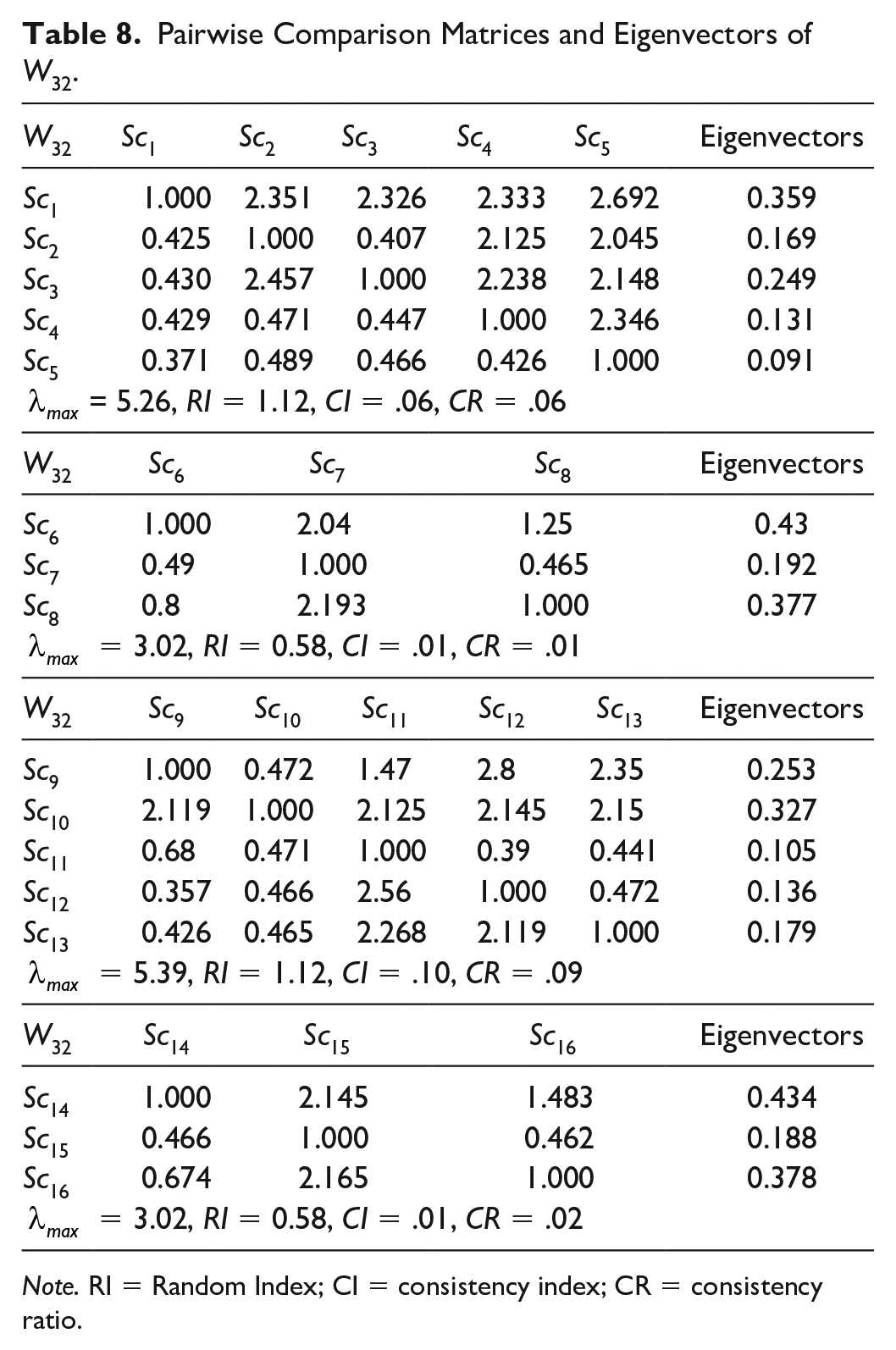
Note. RI = Random Index; CI = consistency index; CR = consistency ratio.
Step 3: Decide on the supermatrix
The unweighted supermatrix is constructed by using formula 9 according to the eigenvectors of W21, W22, W32, W33, and W43. Next, each column of the unweighted supermatrix is weighted, and the result is shown in Table 9.
The Weighted Supermatrix.
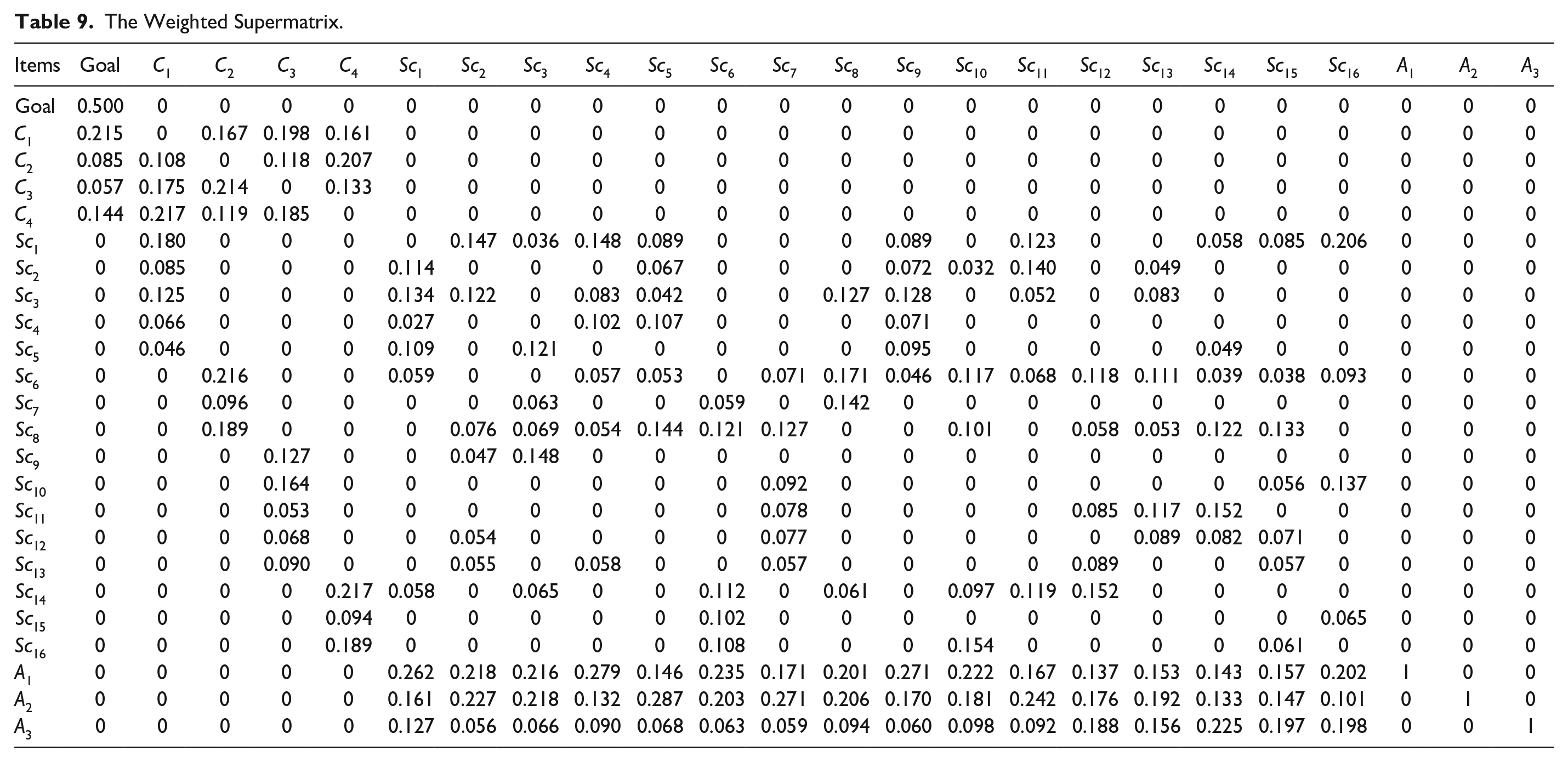
Step 4: Determine multi-criteria warehouse scheme
In this study, super decisions software was used to conduct the extremization operation of the weighted supermatrix. The importance of the optimization scheme was ranked as A1: daily food (.402), A2: household cleaning and daily necessities (.369), and A3: high-priced goods (.229).
The result of ANP ultimate supermatrix
In this study, the importance of the criteria is sorted in order. They are Sc8: digitization and automation (.132), Sc6: management system (.124), Sc3: sales volume (.100), Sc14: inventory and storage costs (.097), Sc1: inventory quantity (.093), Sc7: quality management (.064), Sc5: safety stock index (.060), Sc2: frequency of inbound and outbound (.053), Sc11: warehouse area utilization rate (.053), Sc12: equipment and personnel utilization rate (.040), Sc16: order and product losses (.038), Sc9: product turnover rate (.034), Sc15: logistics management costs (.030), Sc4: emergency capacity (.038), Sc9: sorting efficiency (.027), and Sc10: receipt and delivery accuracy rate (.026).
Optimized Plan for Warehouse Management of the Case
This study puts forward a multi-criteria warehouse scheme based on ABC classification, which is expected to optimize the warehouse classification of the logistics distribution center of chain supermarkets, and specifically point out the ideas and methods improvement applicable to the logistics distribution centers, so as to improve the competitiveness of chain supermarkets. The analysis takes the commodity storage area as an example, and other storage areas can be carried out according to the optimization model. Suggestions are described as follows.
Suggestions for the classification of stored goods
Based on the above comprehensive sorting commodities of category A and the optimized multi-criteria of ABC classification, this project puts forward the following suggestions to improve the inventory management of the distribution center of the case company:
1. Determine the commodities with high price and lower frequency of stock in and out to category A.
The commodities of category A, such as alcoholic beverages and health food, are high priced but low frequency of incoming stock and will need extra caution and protection while moving. Moreover, an inventory must be made every day.
2. Determine the commodities with low price but high frequency of stock in and out to category A.
As for grain and oil products, cake, cookies, and desserts, as well as seasonings in category A, these are the commodities that need the second amount of major attention and are classified as daily food. These commodities need to be kept ventilated at low temperature, regularly recorded and observed with the purpose of maintaining a certain stock level and ensuring freshness of food. Commodities such as daily supplies, personal care, and housecleaning products of category A have a longer shelf life and are in great demand, so we can place large-scale orders and register them regularly to ensure certain inventory.
3. Determine commodities of B and C category.
Commodities of B and C category are in large quantity but generate a small amount of inventory cost, so they can be managed in accordance with the previous inventory strategy of the distribution center, and the cost can be saved by ordering in large quantities and fewer batches.
Suggestions on warehouse layout
As shown in Figure 5, this study suggests that the shelves near the management station be classified as the high-priced goods area. Cameras should be set at the management station for real-time monitoring due to the value of the goods. In addition, the staff at the management station can also conduct observation at all times to minimize the theft of goods. The rest of the shelves near the corridor are classified as category A areas. Because the number of goods in category B are fewer than those in category C, the back side of the corridor is classified as category B, while all the rest are classified as category C. As class A commodities are outbound, it is easier for the staff to pick up the goods and send them to the corridor, thus reducing the distance involved and improving efficiency. The damage rate can also be reduced if category A commodities, such as wine, be placed in the logistics box or directly moved in the whole box. Rice, flour, and other goods such as grain and oil in category A that need to be transported by whole board or skid, can be transported by whole skid to the delivery department directly for delivery audit by the forklift. In this case, they will not cause corridor blockage and affect transportation efficiency.
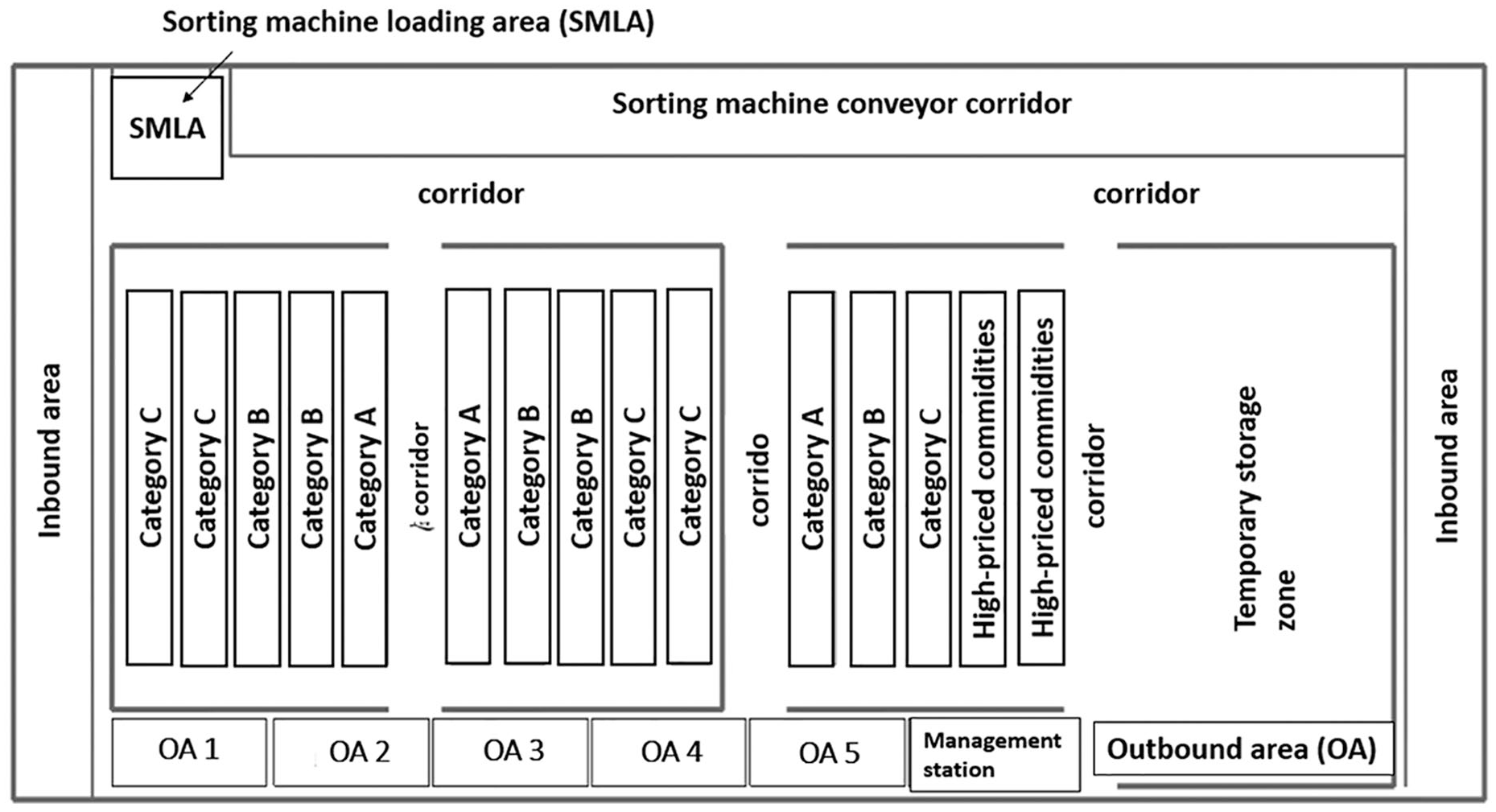
Optimized layout of the case company.
Conclusion
This study applied ABC classification after evaluating the case company’s actual situation. Then, the ANP multi-criteria decision model of ABC classification is constructed by comprehensively considering the criteria of warehouse classification. Finally, the study puts forward the suggestions for commodity classification and the optimal plan of the warehouse layout for warehouse management of the supermarket distribution center. In this study, the theory is applied to the actual case, and combined with the actual situation to help the case enterprise to solve the problem of storage. It is expected that the optimization model provides a set of systematic and scientific reference standards for supermarket managers and decision-makers when they make warehouse management plans. Based on the results of the analysis, this study brings forward a comprehensive discussion and suggestions, which follow.
Research Discussions
The profit of the chain supermarket is mainly due to the chain system, which supports the extensive store network. Meanwhile, with the low cost and efficient operation, the chain supermarket is able to develop a centralized procurement and modern logistics system, and, most important, the “distribution center.” The distribution center will release information to the manufacturing industry, engage in product development, or even form a supply chain to gain production profit. The fundamental function of the distribution center is to allow the chain supermarket to achieve ideal economic benefit through highly centralized procurement and distribution. Multi-frequency and low-price commodities are the main selling products in Chinese chain supermarkets. If the warehouse management of the distribution center is carried out by the traditional ABC classification method, it often causes the five problems as mentioned for the case company. In this study, a new improved method is proposed to build a multi-criteria evaluation model of ANP based on ABC classification, which includes,
1. The construction of evaluation index system.
Based on the analysis of the case company, this study considers multiple evaluation indexes on the basis of ABC classification, and classifies and manages products according to the analysis results of the importance of three types of products: daily food, household cleaning and daily necessities, and high-priced goods.
2. Layout and planning of warehouse facilities.
This study carried out the layout and planning of warehouse facilities for the case company through the results of the analysis (see Figure 5).
To sum up, this study provides a new method for the logistics system of chain supermarkets in China. Through the practice of the case company and integration of the construction and layout, the case company completed the construction of commodity classification and layout of the warehouse in Zone A in June 2019. However, due to the problems of classified storage methods and layout, the low efficiency of the storage operation, and high storage cost, the case company’s efficiency gradually had been deteriorating while costs of operation had been rising. The historical data provided by the case company were compared and analyzed from January to June 2019 and from July to October 2019. In terms of actual warehouse operation efficiency, the average value of the 4 months (July–October 2019) was improved compared with the average value of the first half year (January–June 2019). In terms of cost, the average value of the four months (July–October 2019) post improvement is lower than the average value of the first half year (January–June 2019; see Table 10). After the redesign and layout planning of the case company, the overall efficiency of the warehouse operation improved. It is a strong proof of the applicability of the method proposed in this study.
Benefit Analysis.

Research Suggestions
The main purpose of this study was to propose a new method based on ABC classification especially for a special industry such as chain supermarkets to improve the shortcomings of traditional classification methods. Based on the analysis results, this study puts forward a comprehensive optimization scheme for the distribution center’s warehouse commodity classification and facility layout. The following are some suggestions:
1. The construction of evaluation index system.
For the related chain supermarket industry or chain enterprises, the evaluation index system constructed in this study can be used as the reference standard for warehouse management decision-making to classify and manage commodities based on ABC classification.
2. Layout and planning of warehouse facilities.
For the related chain supermarket industry or chain enterprises, the layout and planning of warehouse facilities can be carried out according to the layout of storage facilities, which can be used as the reference standard for warehouse management.
3. Planning for the construction of modern storage.
Scientific warehouse construction management is a critical part of modern warehouse construction. According to the aforementioned commodity classification and storage layout, a comprehensive information management system inside the enterprise is recommended. Its functions should include the basic units of a modern information system, and utilize the integration technology of a network control system and distributed real-time database (CLPS) to coordinate enterprise resources. The real-time data of Enterprise Resource Planning (ERP), Warehouse Management System (WMS), and Original Design Manufacture (OEM) are collected from the warehouse department of the distribution center. By achieving the goal of centralized management and unified scheduling, the speed of information transmission accelerated, the delivery speed of the inventory replenishment department improved, the waiting rate of the shipping department reduced, the efficiency of storage operations improved, the total cost reduced, and a perfect value chain system formed.
Footnotes
Declaration of Conflicting Interests
The author(s) declared no potential conflicts of interest with respect to the research, authorship, and/or publication of this article.
Funding
The author(s) disclosed receipt of the following financial support for the research, authorship, and/or publication of this article: The authors gratefully acknowledge the financial supports by the Sanming University [grant number 19YG06S].
